Data structures and abstractions with Java 2nd ed Edition Carrano
Data structures and abstractions with Java 2nd ed Edition Carrano
Data structures and abstractions with Java 2nd ed Edition Carrano
Data structures and abstractions with Java 2nd ed Edition Carrano
Data structures and abstractions with Java 2nd ed Edition Carrano
1.
Data structures andabstractions with Java 2nd
ed Edition Carrano download
https://ebookgate.com/product/data-structures-and-abstractions-
with-java-2nd-ed-edition-carrano/
Get Instant Ebook Downloads – Browse at https://ebookgate.com
2.
Get Your DigitalFiles Instantly: PDF, ePub, MOBI and More
Quick Digital Downloads: PDF, ePub, MOBI and Other Formats
Java Structures Data Structures in Java for the
Principled Programmer 2nd edition Duane Bailey
https://ebookgate.com/product/java-structures-data-structures-in-
java-for-the-principled-programmer-2nd-edition-duane-bailey/
Data Structures Outside In with Java 1st Edition Sesh
Venugopal
https://ebookgate.com/product/data-structures-outside-in-with-
java-1st-edition-sesh-venugopal/
Schaum s Outline sof Data Structures with Java Second
Edition John Hubbard
https://ebookgate.com/product/schaum-s-outline-sof-data-
structures-with-java-second-edition-john-hubbard/
Java Software Structures Designing and Using Data
Structures 3rd Edition John Lewis
https://ebookgate.com/product/java-software-structures-designing-
and-using-data-structures-3rd-edition-john-lewis/
3.
Java Foundations Introductionto Program Design and
Data Structures 2nd Edition John Lewis
https://ebookgate.com/product/java-foundations-introduction-to-
program-design-and-data-structures-2nd-edition-john-lewis/
Data structures and algorithms made easy in Java data
structure and algorithmic puzzles 2nd Edition Narasimha
Karumanchi
https://ebookgate.com/product/data-structures-and-algorithms-
made-easy-in-java-data-structure-and-algorithmic-puzzles-2nd-
edition-narasimha-karumanchi/
Data Abstraction Problem Solving with Java Walls and
Mirrors 3rd ed Edition Prichard
https://ebookgate.com/product/data-abstraction-problem-solving-
with-java-walls-and-mirrors-3rd-ed-edition-prichard/
Data Structures Other Objects using Java 4th Edition
Michael Mann
https://ebookgate.com/product/data-structures-other-objects-
using-java-4th-edition-michael-mann/
Data Abstraction and Problem Solving with C Walls and
Mirrors 3rd Edition Frank M. Carrano
https://ebookgate.com/product/data-abstraction-and-problem-
solving-with-c-walls-and-mirrors-3rd-edition-frank-m-carrano/
The main arcadeis carried round the east end of the choir (Fig. 589).
8.
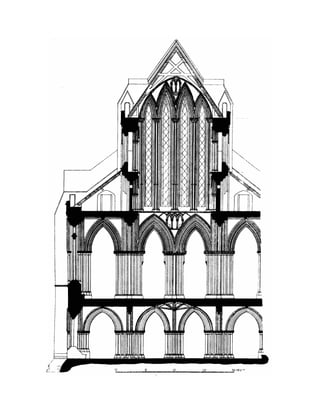
Fig. 591.—St. Mungo’sCathedral. Transverse Section through Choir and Lower Church, looking East.
To accomplish this, with arches of about the same width as those of the
side aisles, the wall had to be divided into two bays having a central pillar,
which is not a pleasing feature. Above the main arcade rises the east wall of
the cathedral, pierced with four graceful lancets (see Fig. 591).[65] This
arrangement of a central mullion in the large upper window was almost
rendered necessary in order to carry up the design of the single pillar in the
centre of the main arcade, otherwise a central light, as at Salisbury, would
doubtless have been preferable.
Churches with an eastern ambulatory are occasionally to be met with in
England, a fine example being the church of the Abbey of Dore, in
Hertfordshire. This ambulatory aisle is the British equivalent for the aisle
which is generally carried round foreign apses, and from which the apsidal
chapels open.
A similar plan to that of the eastern end of Glasgow Cathedral was
reproduced at Rosslyn Collegiate Church two hundred years later, although
with very different details and on a greatly reduced scale.
Each bay of the choir (see Fig. 589) rises from clustered pillars having
numerous attached shafts and mouldings (see Fig. 587), and caps elaborately
carved with first pointed foliage. The triforium gallery contains two pointed
openings, each embracing two smaller arches, and having trefoil and
quatrefoil apertures in the spandrils. The clerestory consists of a double wall,
with passage between. It has three pointed lights of equal height in the outer
wall, and three corresponding openings in the interior, with boldly moulded
shafts and arches. A small sharply pointed arch is introduced at each side of
the main vaulting shafts. The caps on each floor are all of rounded form.
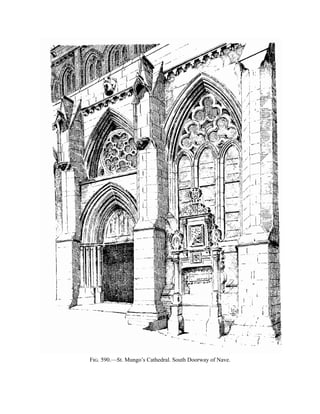
The south doorway of the nave (Fig. 591) (now forming the principal
entrance to the church) is, like that of the lower church, inserted between
two buttresses; but it has no projecting porch, and finishes with a flat roof,
above which the top of an ordinary traceried window is seen in the plane of
the wall. To give importance to this entrance the flanking buttresses are
finished at the top with niches for statues, and in connection with the corbels
under these occur the only pieces of foliaged carving to be seen in the whole
nave.
The western doorway (see Fig. 569) contains two openings with a solid
mullion between. This part of the structure has evidently been greatly
9.
repaired and alteredwhen the western adjuncts above referred to were
removed.
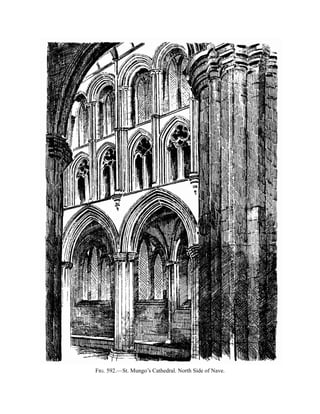
The whole of the cathedral is vaulted except the central alleys of the nave
and choir. Vaulting shafts are carried up in the nave (Fig. 592) from the
string course above the main arcade, and in the choir (see Fig. 589) from the
caps of the main piers to the wall head, as if the idea of vaulting the central
area had been contemplated; but it is quite
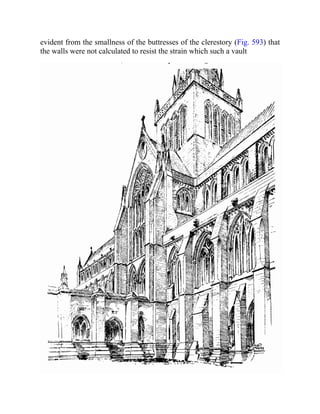
evident from thesmallness of the buttresses of the clerestory (Fig. 593) that
the walls were not calculated to resist the strain which such a vault
12.
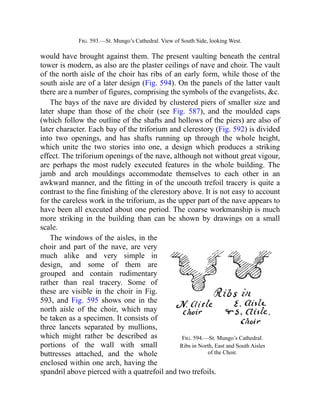
Fig. 594.—St. Mungo’sCathedral.
Ribs in North, East and South Aisles
of the Choir.
Fig. 593.—St. Mungo’s Cathedral. View of South Side, looking West.
would have brought against them. The present vaulting beneath the central
tower is modern, as also are the plaster ceilings of nave and choir. The vault
of the north aisle of the choir has ribs of an early form, while those of the
south aisle are of a later design (Fig. 594). On the panels of the latter vault
there are a number of figures, comprising the symbols of the evangelists, &c.
The bays of the nave are divided by clustered piers of smaller size and
later shape than those of the choir (see Fig. 587), and the moulded caps
(which follow the outline of the shafts and hollows of the piers) are also of
later character. Each bay of the triforium and clerestory (Fig. 592) is divided
into two openings, and has shafts running up through the whole height,
which unite the two stories into one, a design which produces a striking
effect. The triforium openings of the nave, although not without great vigour,
are perhaps the most rudely executed features in the whole building. The
jamb and arch mouldings accommodate themselves to each other in an
awkward manner, and the fitting in of the uncouth trefoil tracery is quite a
contrast to the fine finishing of the clerestory above. It is not easy to account
for the careless work in the triforium, as the upper part of the nave appears to
have been all executed about one period. The coarse workmanship is much
more striking in the building than can be shown by drawings on a small
scale.
The windows of the aisles, in the
choir and part of the nave, are very
much alike and very simple in
design, and some of them are
grouped and contain rudimentary
rather than real tracery. Some of
these are visible in the choir in Fig.
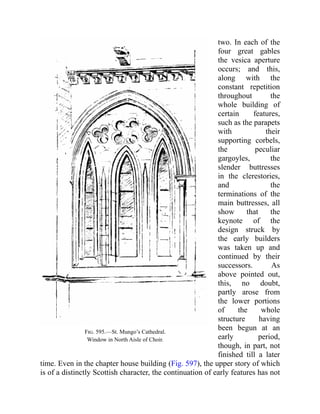
593, and Fig. 595 shows one in the
north aisle of the choir, which may
be taken as a specimen. It consists of
three lancets separated by mullions,
which might rather be described as
portions of the wall with small
buttresses attached, and the whole
enclosed within one arch, having the
spandril above pierced with a quatrefoil and two trefoils.
13.
The tracery ofthe windows on the south side of the nave is simple, but
completely formed (see Fig. 590), each window having two mullions and
three trefoils in the arch head. Those of the clerestory have each a central
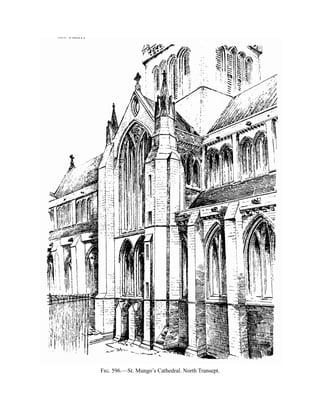
mullion divided in the arch into two branches (Fig. 596).
The tracery in the great windows in the west end (see Fig. 569) and in
those of the north transept (see Fig. 593) and south transept is modern, and it
is not easy to determine how far the designs follow the originals. The north
transept window (see Fig. 596), which was “taken down and rebuilt,”[66]
looks, from the simplicity of its design, to be probably like what the original
may have been. Regarding the other two great windows, one cannot be so
sure. The great buttress enclos-
*ing the
staircase at the
north-west angle of
the north transept
(see Fig. 596) is a
noteworthy feature,
differing as it does
from the other
buttresses flanking
the end walls. It
occupies part of the
space which
naturally falls to
the eastmost
window of the nave
aisle, and this
opening, instead of
being designed as a
smaller window to
fit the space, is
treated with the
same design as the
others, and thus
presents the
appearance of
having been cut in
14.
Fig. 595.—St. Mungo’sCathedral.
Window in North Aisle of Choir.
two. In each of the
four great gables
the vesica aperture
occurs; and this,
along with the
constant repetition
throughout the
whole building of
certain features,
such as the parapets
with their
supporting corbels,
the peculiar
gargoyles, the
slender buttresses
in the clerestories,
and the
terminations of the
main buttresses, all
show that the
keynote of the
design struck by
the early builders
was taken up and
continued by their
successors. As
above pointed out,
this, no doubt,
partly arose from
the lower portions
of the whole
structure having
been begun at an
early period,
though, in part, not
finished till a later
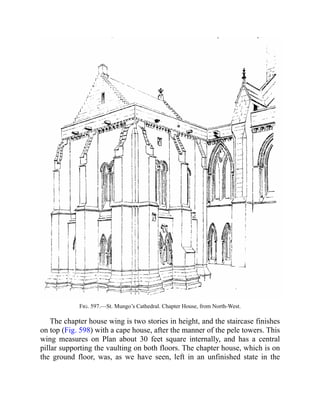
time. Even in the chapter house building (Fig. 597), the upper story of which
is of a distinctly Scottish character, the continuation of early features has not
15.
been lost sightof. Here the details of the church built by Bishop Bondington
in the thirteenth century furnished models for the work even of the fifteenth
century. The lower windows are similar in form, the parapets of the chapter
house wing are continued round at the same level as those of the aisles of the
choir, and the buttresses are also similar. Attention may be drawn to the
curious treatment of the upper water tables of the buttresses of this wing.
The slope is divided into two halves, one half rising a little higher than the
other.
Fig. 597.—St. Mungo’sCathedral. Chapter House, from North-West.
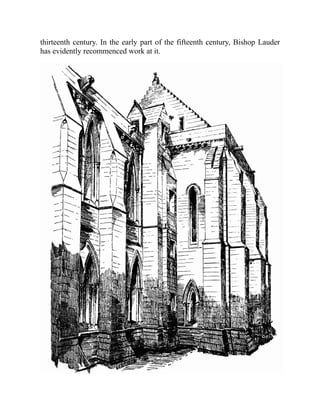
The chapter house wing is two stories in height, and the staircase finishes
on top (Fig. 598) with a cape house, after the manner of the pele towers. This
wing measures on Plan about 30 feet square internally, and has a central
pillar supporting the vaulting on both floors. The chapter house, which is on
the ground floor, was, as we have seen, left in an unfinished state in the
18.
thirteenth century. Inthe early part of the fifteenth century, Bishop Lauder
has evidently recommenced work at it.
19.
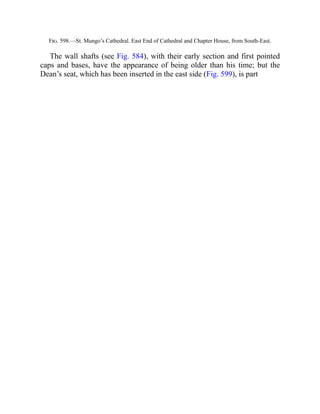
Fig. 598.—St. Mungo’sCathedral. East End of Cathedral and Chapter House, from South-East.
The wall shafts (see Fig. 584), with their early section and first pointed
caps and bases, have the appearance of being older than his time; but the
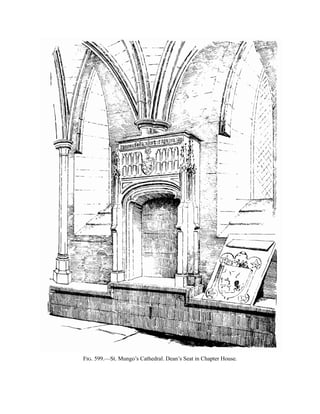
Dean’s seat, which has been inserted in the east side (Fig. 599), is part
of his work.It is in the design of that period, and contains the following
inscription along the top—viz., Wilms: fuda: instut: Caplm: Dei, which
Archbishop Eyre thus renders,[67] “William laid the foundation of this
chapter house in God’s honour.” The William referred to was Bishop
William Lauder, whose arms (a Griffin Segreant) occur on a shield on the
lintel below the inscription. The shield is surmounted by the bishop’s crosier.
Fig. 600.—St. Mungo’s Cathedral. Sacristy, looking North-East.
22.
The shield ofBishop Lauder is also inserted on the exterior of the west
side of the chapter house. It is shown on a slab in Fig. 600, and is a
characteristic piece of heraldic decoration. Fig. 600 shows the upper
apartment or sacristy.
The completion of this wing was carried out by Bishop Cameron, who
built the upper story, or sacristy, and vaulted the building. It is not quite clear
whether the vaulting of the lower story was executed by Bishop Cameron or
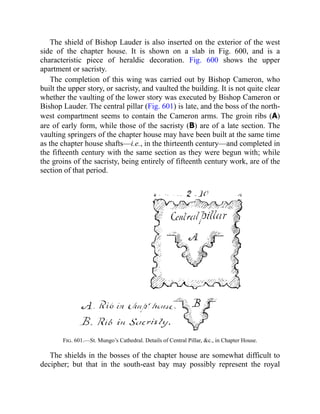
Bishop Lauder. The central pillar (Fig. 601) is late, and the boss of the north-
west compartment seems to contain the Cameron arms. The groin ribs (A)
are of early form, while those of the sacristy (B) are of a late section. The
vaulting springers of the chapter house may have been built at the same time
as the chapter house shafts—i.e., in the thirteenth century—and completed in
the fifteenth century with the same section as they were begun with; while
the groins of the sacristy, being entirely of fifteenth century work, are of the
section of that period.
Fig. 601.—St. Mungo’s Cathedral. Details of Central Pillar, &c., in Chapter House.
The shields in the bosses of the chapter house are somewhat difficult to
decipher; but that in the south-east bay may possibly represent the royal
23.
arms of Scotlandand England impaled, and stand for James I. and his wife,
Margaret Tudor.[68] King James returned to Scotland in 1424, about which
time the chapter house vault may have been built.
The upper chamber is undoubtedly the work of Bishop Cameron. The
central pillar has two shields in the capital. That fronting a person entering
contains the royal arms, surmounted by a crown (see Fig. 600); and the
shield on the opposite side contains Bishop Cameron’s arms. There is here
an analogy with the central pillar of the chapter house of Elgin Cathedral,
where the royal arms and those of the bishop by whom it was completed are
carved on the capital. The Cameron arms also occur in the cap of the wall
shaft opposite the coat above referred to, and likewise over the fireplace (see
Fig. 600).
25.
Fig. 603.—St. Mungo’sCathedral.
Archbishop Blackadder’s Arms on Altar.
Fig. 602.—St. Mungo’s Cathedral. Rood Screen and Entrance to Choir and Lower Church.
The sacristy contains, as shown in the sketch (see Fig. 600), stone built
projecting cupboards and a large fireplace. The arms of Bishop Cameron on
the mantel above the latter contain an example of how heraldry and
architecture may be made to work together; one of the members of the
cornice over the fireplace being continued across the shield, so as to form
one of the fesses of the Cameron coat. A wide wheel stair close to the
entrance connects the chapter house and the vestry above. A shield
containing a bull’s head, the arms of Bishop Turnbull, is inserted in the
outside of the west wall, near the top. The wing may have been completed
by that prelate.
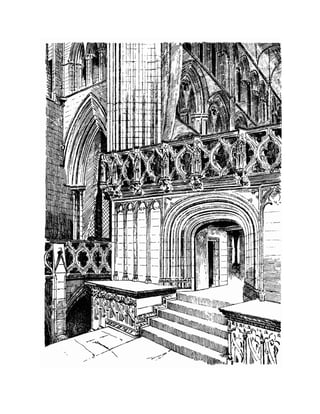
Mr. Honeyman[69]
conjectures that the Rood screen
(Fig. 602) which is erected
between the eastern piers of the
central tower was built by
Bishop Cameron. It contains a
staircase in the space in the
north side, and in the opposite
side are cupboards for
containing church vestments. In
front of the screen there are two
fine stone altars, that on the
south side being known as the
altar of St. Mary of Pity, and
that on the north side as the altar
of the Holy Cross. The arms and
initials of Archbishop
Blackadder (Fig. 603) are
carved on the ends of both of
these altars.
The rood screen with its two
altars, although evidently a late
work, adds considerably to the
picturesque effect of the interior
of the cathedral. It has a large,
26.
Fig. 604.—St. Mungo’sCathedral.
Details of Rood Screen.
deeply-recessed and moulded doorway in the centre, the arch of which is of
elliptical form, and has the jamb mouldings (Fig. 604) continued, without
caps or break, round the arch head. On each side of the doorway the surface
of the wall is covered with shallow panels having trefoiled arch heads. A
corbel in each of these panels (now cut off) once supported a statue, and
these would add much to the effect of the structure. The cornice is large, and
is surmounted by an open parapet containing quatrefoils, and having
standards running up in the centre of each alternate quatrefoil. The standards
are ornamented with small pinnacles, and are supported on corbels, each of
which contains two human figures, which recall similar carvings at Rosslyn
Chapel, but are of finer execution.[70]
The structure begun to be erected in continuation of the south transept has
already been referred to. The building (see Fig. 571) is 57 feet in length by
25 feet in width internally, and comprises four bays in the length and two in
the width, supported on three central pillars. The entrance is from the wide
landing of the staircase in the south transept leading down to the lower
church, from which point a series of wide steps leads down to the floor.
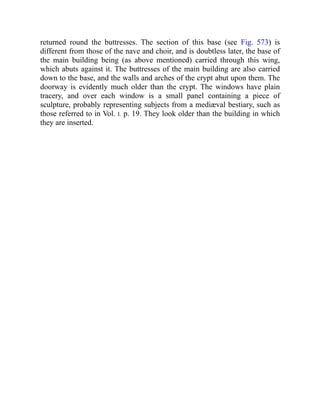
From these steps a good view is obtained of the interior (Fig. 605).
The pillars are all
moulded and provided
with caps and bases, and
the arches springing from
them have numerous
moulded groins with large
foliaged bosses at the
intersections. A
substantial stone bench
surrounds the outer walls;
on this rest the bases of
the responds and the
sloping sills of the
windows. Externally the
building is plain (see Fig.
593), and has evidently
been prepared for an
upper story. It has a heavy
moulded base, which is
27.
returned round thebuttresses. The section of this base (see Fig. 573) is
different from those of the nave and choir, and is doubtless later, the base of
the main building being (as above mentioned) carried through this wing,
which abuts against it. The buttresses of the main building are also carried
down to the base, and the walls and arches of the crypt abut upon them. The
doorway is evidently much older than the crypt. The windows have plain
tracery, and over each window is a small panel containing a piece of
sculpture, probably representing subjects from a mediæval bestiary, such as
those referred to in Vol. I. p. 19. They look older than the building in which
they are inserted.
28.
Fig. 605.—St. Mungo’sCathedral. Interior of Blackadder’s Crypt.
It is conjectured from the following inscription on the vaulting, “This is
ye ile of Car Fergus,” that this structure was begun at an early period, and
that it was completed by Archbishop Blackadder, whose arms, surmounted
by his mitre, are carved on the central buttress at the south end, and also on
29.
Welcome to OurBookstore - The Ultimate Destination for Book Lovers
Are you passionate about books and eager to explore new worlds of
knowledge? At our website, we offer a vast collection of books that
cater to every interest and age group. From classic literature to
specialized publications, self-help books, and children’s stories, we
have it all! Each book is a gateway to new adventures, helping you
expand your knowledge and nourish your soul
Experience Convenient and Enjoyable Book Shopping Our website is more
than just an online bookstore—it’s a bridge connecting readers to the
timeless values of culture and wisdom. With a sleek and user-friendly
interface and a smart search system, you can find your favorite books
quickly and easily. Enjoy special promotions, fast home delivery, and
a seamless shopping experience that saves you time and enhances your
love for reading.
Let us accompany you on the journey of exploring knowledge and
personal growth!
ebookgate.com





![Fig. 591.—St. Mungo’s Cathedral. Transverse Section through Choir and Lower Church, looking East.
To accomplish this, with arches of about the same width as those of the
side aisles, the wall had to be divided into two bays having a central pillar,
which is not a pleasing feature. Above the main arcade rises the east wall of
the cathedral, pierced with four graceful lancets (see Fig. 591).[65] This
arrangement of a central mullion in the large upper window was almost
rendered necessary in order to carry up the design of the single pillar in the
centre of the main arcade, otherwise a central light, as at Salisbury, would
doubtless have been preferable.
Churches with an eastern ambulatory are occasionally to be met with in
England, a fine example being the church of the Abbey of Dore, in
Hertfordshire. This ambulatory aisle is the British equivalent for the aisle
which is generally carried round foreign apses, and from which the apsidal
chapels open.
A similar plan to that of the eastern end of Glasgow Cathedral was
reproduced at Rosslyn Collegiate Church two hundred years later, although
with very different details and on a greatly reduced scale.
Each bay of the choir (see Fig. 589) rises from clustered pillars having
numerous attached shafts and mouldings (see Fig. 587), and caps elaborately
carved with first pointed foliage. The triforium gallery contains two pointed
openings, each embracing two smaller arches, and having trefoil and
quatrefoil apertures in the spandrils. The clerestory consists of a double wall,
with passage between. It has three pointed lights of equal height in the outer
wall, and three corresponding openings in the interior, with boldly moulded
shafts and arches. A small sharply pointed arch is introduced at each side of
the main vaulting shafts. The caps on each floor are all of rounded form.
The south doorway of the nave (Fig. 591) (now forming the principal
entrance to the church) is, like that of the lower church, inserted between
two buttresses; but it has no projecting porch, and finishes with a flat roof,
above which the top of an ordinary traceried window is seen in the plane of
the wall. To give importance to this entrance the flanking buttresses are
finished at the top with niches for statues, and in connection with the corbels
under these occur the only pieces of foliaged carving to be seen in the whole
nave.
The western doorway (see Fig. 569) contains two openings with a solid
mullion between. This part of the structure has evidently been greatly](https://image.slidesharecdn.com/47722-250509081756-26b1a867/85/Data-structures-and-abstractions-with-Java-2nd-ed-Edition-Carrano-8-320.jpg)
![The tracery of the windows on the south side of the nave is simple, but
completely formed (see Fig. 590), each window having two mullions and
three trefoils in the arch head. Those of the clerestory have each a central
mullion divided in the arch into two branches (Fig. 596).
The tracery in the great windows in the west end (see Fig. 569) and in
those of the north transept (see Fig. 593) and south transept is modern, and it
is not easy to determine how far the designs follow the originals. The north
transept window (see Fig. 596), which was “taken down and rebuilt,”[66]
looks, from the simplicity of its design, to be probably like what the original
may have been. Regarding the other two great windows, one cannot be so
sure. The great buttress enclos-
*ing the
staircase at the
north-west angle of
the north transept
(see Fig. 596) is a
noteworthy feature,
differing as it does
from the other
buttresses flanking
the end walls. It
occupies part of the
space which
naturally falls to
the eastmost
window of the nave
aisle, and this
opening, instead of
being designed as a
smaller window to
fit the space, is
treated with the
same design as the
others, and thus
presents the
appearance of
having been cut in](https://image.slidesharecdn.com/47722-250509081756-26b1a867/85/Data-structures-and-abstractions-with-Java-2nd-ed-Edition-Carrano-13-320.jpg)
![of his work. It is in the design of that period, and contains the following
inscription along the top—viz., Wilms: fuda: instut: Caplm: Dei, which
Archbishop Eyre thus renders,[67] “William laid the foundation of this
chapter house in God’s honour.” The William referred to was Bishop
William Lauder, whose arms (a Griffin Segreant) occur on a shield on the
lintel below the inscription. The shield is surmounted by the bishop’s crosier.
Fig. 600.—St. Mungo’s Cathedral. Sacristy, looking North-East.](https://image.slidesharecdn.com/47722-250509081756-26b1a867/85/Data-structures-and-abstractions-with-Java-2nd-ed-Edition-Carrano-21-320.jpg)
![arms of Scotland and England impaled, and stand for James I. and his wife,
Margaret Tudor.[68] King James returned to Scotland in 1424, about which
time the chapter house vault may have been built.
The upper chamber is undoubtedly the work of Bishop Cameron. The
central pillar has two shields in the capital. That fronting a person entering
contains the royal arms, surmounted by a crown (see Fig. 600); and the
shield on the opposite side contains Bishop Cameron’s arms. There is here
an analogy with the central pillar of the chapter house of Elgin Cathedral,
where the royal arms and those of the bishop by whom it was completed are
carved on the capital. The Cameron arms also occur in the cap of the wall
shaft opposite the coat above referred to, and likewise over the fireplace (see
Fig. 600).](https://image.slidesharecdn.com/47722-250509081756-26b1a867/85/Data-structures-and-abstractions-with-Java-2nd-ed-Edition-Carrano-23-320.jpg)
![Fig. 603.—St. Mungo’s Cathedral.
Archbishop Blackadder’s Arms on Altar.
Fig. 602.—St. Mungo’s Cathedral. Rood Screen and Entrance to Choir and Lower Church.
The sacristy contains, as shown in the sketch (see Fig. 600), stone built
projecting cupboards and a large fireplace. The arms of Bishop Cameron on
the mantel above the latter contain an example of how heraldry and
architecture may be made to work together; one of the members of the
cornice over the fireplace being continued across the shield, so as to form
one of the fesses of the Cameron coat. A wide wheel stair close to the
entrance connects the chapter house and the vestry above. A shield
containing a bull’s head, the arms of Bishop Turnbull, is inserted in the
outside of the west wall, near the top. The wing may have been completed
by that prelate.
Mr. Honeyman[69]
conjectures that the Rood screen
(Fig. 602) which is erected
between the eastern piers of the
central tower was built by
Bishop Cameron. It contains a
staircase in the space in the
north side, and in the opposite
side are cupboards for
containing church vestments. In
front of the screen there are two
fine stone altars, that on the
south side being known as the
altar of St. Mary of Pity, and
that on the north side as the altar
of the Holy Cross. The arms and
initials of Archbishop
Blackadder (Fig. 603) are
carved on the ends of both of
these altars.
The rood screen with its two
altars, although evidently a late
work, adds considerably to the
picturesque effect of the interior
of the cathedral. It has a large,](https://image.slidesharecdn.com/47722-250509081756-26b1a867/85/Data-structures-and-abstractions-with-Java-2nd-ed-Edition-Carrano-25-320.jpg)
![Fig. 604.—St. Mungo’s Cathedral.
Details of Rood Screen.
deeply-recessed and moulded doorway in the centre, the arch of which is of
elliptical form, and has the jamb mouldings (Fig. 604) continued, without
caps or break, round the arch head. On each side of the doorway the surface
of the wall is covered with shallow panels having trefoiled arch heads. A
corbel in each of these panels (now cut off) once supported a statue, and
these would add much to the effect of the structure. The cornice is large, and
is surmounted by an open parapet containing quatrefoils, and having
standards running up in the centre of each alternate quatrefoil. The standards
are ornamented with small pinnacles, and are supported on corbels, each of
which contains two human figures, which recall similar carvings at Rosslyn
Chapel, but are of finer execution.[70]
The structure begun to be erected in continuation of the south transept has
already been referred to. The building (see Fig. 571) is 57 feet in length by
25 feet in width internally, and comprises four bays in the length and two in
the width, supported on three central pillars. The entrance is from the wide
landing of the staircase in the south transept leading down to the lower
church, from which point a series of wide steps leads down to the floor.
From these steps a good view is obtained of the interior (Fig. 605).
The pillars are all
moulded and provided
with caps and bases, and
the arches springing from
them have numerous
moulded groins with large
foliaged bosses at the
intersections. A
substantial stone bench
surrounds the outer walls;
on this rest the bases of
the responds and the
sloping sills of the
windows. Externally the
building is plain (see Fig.
593), and has evidently
been prepared for an
upper story. It has a heavy
moulded base, which is](https://image.slidesharecdn.com/47722-250509081756-26b1a867/85/Data-structures-and-abstractions-with-Java-2nd-ed-Edition-Carrano-26-320.jpg)