Ccsp Selfstudy CcspCsi Exam Certification Guide
2nd Edition Dubrawsky I download
https://ebookbell.com/product/ccsp-selfstudy-ccsp-csi-exam-
certification-guide-2nd-edition-dubrawsky-i-920856
Explore and download more ebooks at ebookbell.com
2.
Here are somerecommended products that we believe you will be
interested in. You can click the link to download.
Ccsp Secur Exam Certification Guide Ccsp Selfstudy With Cdrom Bastien
https://ebookbell.com/product/ccsp-secur-exam-certification-guide-
ccsp-selfstudy-with-cdrom-bastien-21984422
Ccsp Cisco Secure Vpn Exam Certification Guide Ccsp Selfstudy With
Cdrom Roland
https://ebookbell.com/product/ccsp-cisco-secure-vpn-exam-
certification-guide-ccsp-selfstudy-with-cdrom-roland-22056896
Ccsp Secur Exam Certification Guide Ccsp Selfstudy Greg Bastien
Christian Degu
https://ebookbell.com/product/ccsp-secur-exam-certification-guide-
ccsp-selfstudy-greg-bastien-christian-degu-4098646
Ccsp Cisco Secure Pix Firewall Advanced Exam Certification Guide Ccsp
Selfstudy Greg Bastien Christian Degu
https://ebookbell.com/product/ccsp-cisco-secure-pix-firewall-advanced-
exam-certification-guide-ccsp-selfstudy-greg-bastien-christian-
degu-4098644
3.
Cisco Secure VirtualPrivate Networks Csvpn Ccsp Selfstudy 2nd Ed
Andrew G Mason
https://ebookbell.com/product/cisco-secure-virtual-private-networks-
csvpn-ccsp-selfstudy-2nd-ed-andrew-g-mason-4116752
Ccnp Selfstudy Ccnp Practical Studies Switching Justin Menga
https://ebookbell.com/product/ccnp-selfstudy-ccnp-practical-studies-
switching-justin-menga-979740
Ccnp Selfstudy Ccnp Bcmsn Exam Certification Guide 3rd Edition David
Hucaby
https://ebookbell.com/product/ccnp-selfstudy-ccnp-bcmsn-exam-
certification-guide-3rd-edition-david-hucaby-923794
Ccdp Selfstudy Designing Cisco Network Architectures Arch Hutton
https://ebookbell.com/product/ccdp-selfstudy-designing-cisco-network-
architectures-arch-hutton-22056874
Ccnp Selfstudy Building Scalable Cisco Internetworks 1st Catherine
Paquet
https://ebookbell.com/product/ccnp-selfstudy-building-scalable-cisco-
internetworks-1st-catherine-paquet-1094332
among which wemay observe the ornament called the mask, the only
example of that form to be found in the cathedral.” This porch is the work
of Gower, and the peculiar mouldings are readily traceable to the same artist
who designed the rood-screen. Scraps of the previous Norman doorway,
which was done away with by Gower, are still to be seen in the plinth. At
one time there were five steps in the porch, but these were removed in
1885. The entrance to the upper chamber (added by Vaughan, c. 1515) is
obtained from the nave by a turret-stair, and the room is now used as a
clerk-of-work’s drawing office.
In 1849 Butterfield renewed the tracery of the aisle windows as it
originally was in Decorated times, but it is not very attractive.
The Clerestory is Norman, of ashlar work, and the windows are rather
wide, stumpy, and round-headed, with flat pilaster-like buttresses between
each pair. But the restoration has deprived the exterior of much of its
interest, although one can easily imagine that those of the next century will
enjoy a very pleasing contrast between the purples of the Caerfai buttresses
and the yellows of the window dressings, which are of Somersetshire oolite.
The South Transept still retains the outline of the arch of the great
south window which was blocked up when the four existing Perpendicular
windows of four lights each were inserted. A double buttress supports the
south-east corner of the transept, and behind this is the present Chapter
House.
The East End.—The south Presbytery aisle was put into proper repair at
the time of the general restoration, and new windows were inserted. The
upper tier of windows at the east end of the Presbytery have been well
restored also by Scott, and his own description[5] may well be given:
“In restoring the eastern arm of the church, a question arose which, though but slightly
suggested in my first Report, grew upon my mind as we proceeded to such a degree, that it
was more than a twelvemonth before I could make up my mind as to which course to take.
The case was this:
“This wall of the church had originally side walls, much lower than at present, with a
high-pitched roof, and was constructed with some view to stone groining, though it is clear
that this was never carried out, and was, in fact, deliberately relinquished.
“The east end had two ranges of windows, three most magnificent lights below and
four above.
7.
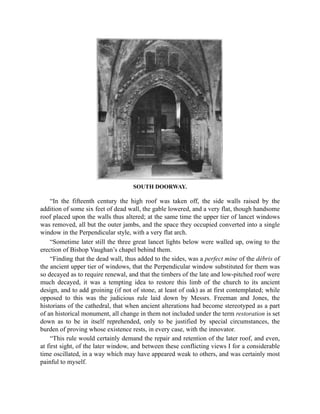
SOUTH DOORWAY.
“In thefifteenth century the high roof was taken off, the side walls raised by the
addition of some six feet of dead wall, the gable lowered, and a very flat, though handsome
roof placed upon the walls thus altered; at the same time the upper tier of lancet windows
was removed, all but the outer jambs, and the space they occupied converted into a single
window in the Perpendicular style, with a very flat arch.
“Sometime later still the three great lancet lights below were walled up, owing to the
erection of Bishop Vaughan’s chapel behind them.
“Finding that the dead wall, thus added to the sides, was a perfect mine of the débris of
the ancient upper tier of windows, that the Perpendicular window substituted for them was
so decayed as to require renewal, and that the timbers of the late and low-pitched roof were
much decayed, it was a tempting idea to restore this limb of the church to its ancient
design, and to add groining (if not of stone, at least of oak) as at first contemplated; while
opposed to this was the judicious rule laid down by Messrs. Freeman and Jones, the
historians of the cathedral, that when ancient alterations had become stereotyped as a part
of an historical monument, all change in them not included under the term restoration is set
down as to be in itself reprehended, only to be justified by special circumstances, the
burden of proving whose existence rests, in every case, with the innovator.
“This rule would certainly demand the repair and retention of the later roof, and even,
at first sight, of the later window, and between these conflicting views I for a considerable
time oscillated, in a way which may have appeared weak to others, and was certainly most
painful to myself.
8.
“I eventually tookan intermediate course, which I think will be admitted to be justified
by the result.
“As regards the roof, though it was so bad as to necessitate its being taken down, and
though all its main beams (I think) but one had to be renewed, the remainder, including
much good carving and many armorial bearings, was capable of reparation. As regards the
original intention of groining, I found unquestionable proofs that it had been relinquished,
if not by the original builders, yet certainly by the reconstructors after the fall of the tower
in 1220, for these builders had inserted niches just where the vaulting would come. They
had also erected the upper range of lancet lights at the east end in a form incompatible with
vaulting.
“These considerations led me at length to determine to relinquish the idea of groining,
and to return to my first intention of restoring the later and existing roof.
“The case, however, was different with the upper east windows, for not only was the
later insertion so decayed as to demand renewal, but on searching below its cill we found
those of the original lights still in situ, while on working the mine of débris which existed
in the dead walls added to the original sides, we found not only evidence sufficient to show
the precise design of the ancient eastern lancets, but sufficient to go a considerable way in
reconstructing them with their own ancient materials, though we found no details to enable
us to complete either the high gable or its flanking turrets.
“While, then, I arrived at the conclusion that the fifteenth-century roof should be
restored, I also felt convinced that, as regards the lancet lights, I had discovered just such
special circumstances as would justify and almost demand the restitution of their original
forms.
“The design of the windows, thus reproduced from their original materials after being
for four centuries immured, is very excellent and interesting. Internally they form a
continuous arcade, supported on little clusters of light shafts, while externally—the lights
being narrow, and the piers between them wide—the latter are occupied each by a double
niche, a fellow to which flanks either jamb, so that while the arcade within consists of four
arches, that without is formed of four groups of arches, making twelve in all—four being
windows and eight niches. The details of all are excellent; unfortunately, however, the roof
of Bishop Vaughan’s Chapel prevents the external group from being seen with any effect,
though within we have now, so far as the forms of the windows go, the ancient
arrangement complete, and a most effective and beautiful one it is.”
On the east wall of the tower the various weather-courses of previous
roofs are visible, which make a not unnatural appeal to the imagination of
the spectator. For the great defect of the exterior generally is that the roofs
are of such a very flat pitch.
The Ruined Chapels—on the south King Edward’s, on the east that of
Our Lady, on the north of St. Nicholas, and the Ante-Chapel—will be
described later, as it is only by an unfortunate chance that they are now
9.
roofless (except thelast), and will, we hope, shortly be correctly regarded as
part of the interior if the proposed restoration takes place.
Not far from the east end of the Lady Chapel is the spring which St.
David is credited with creating. Giraldus[6] has a very pretty legend
concerning this spring, which was known as St. Mary’s Well. It seems to
have been of somewhat variable quality, as its waters were sometimes
changed into milk and at others into wine. Sir G. Scott, however, with scant
respect for its saintly origin, caused it to be drained!
The North Side is much the more interesting of the two. After passing
the chapels we come to a very curious three-storied building, the roof of
which is higher than that of the cathedral. On the ground-floor was the
Chantry of St. Thomas, now a vestry, entered from the east side of the north
transept, and above this the turret stair from the north aisle of the presbytery
leads to the old Chapter House, now the Library, and above this again is a
disused room, once the Treasury.
No parallel has yet been found for this remarkable building, which
Freeman (1856) very accurately describes thus:[7]
“It is continued from the face of the north transept, which it slightly exceeds in point of
elevation. The external work is Decorated; the east is flanked by two flat buttresses of very
singular character, which are terminated by rich pinnacles, now mutilated. Equally singular
is the buttress dividing its two bays on the north side; flat at the bottom, after its first stage
its projection becomes angular, and so runs up the whole height of the wall, becoming
much smaller in its upper portion; its pinnacle is quite destroyed (but is now restored). At
the junction with the transept a staircase is attached, in a singular and almost indescribable
way, to the upper portion of the broad pilaster at the north-east corner of the transept....The
east end has a very strange appearance, having three windows over each other, and a niche,
not unlike a window, above all; that in the third stage is a blocked spherical triangle (now
restored). The lower part of the wall is of ashlar, the occurrence of which is so rare in the
exterior of this church; the upper is of rubble, excepting the buttresses.”
Butterfield is responsible for the large Decorated window in the North
Transept, and Scott raised the roof to its original pitch and rebuilt the
north-west angle turret. In the west wall are two Transitional windows (but
the northern one has long been filled in), and above is a corbelled parapet.
Below, but at a lower level than the transept floor, is a doorway to the
cloisters, with a semicircular outer arch having a solid tympanum and
segmental head within. At a contemporary period half, and much later the
10.
whole, of thisentrance was built up, and in the recess thus formed was
placed a lavatory and drain.
The east wall of the cloisters connects St. Mary’s College with the north
transept. An imposing view is obtained on going through the door at the
north-east corner of the cloisters. We now see the north side of the nave,
with flying buttresses supported on huge masses of masonry, the ruins and
graceful tower of St. Mary’s and, in the distance across the Alan, the
magnificent ruins of the episcopal palace.
The North Doorway (see p. 80) corresponds in position to the south
porch, and is a good example of a Transitional (Norman to Early English)
doorway, but it is much decayed. The principal ornament is, like those in
the arcade, a kind of hybrid composed of the Norman chevron and the
Early-English dog-tooth ornaments. There is a depressed arch to this
doorway, which, with other evidence, leads us to suppose that it has been
higher. Another feature which calls for comment—it is the same in the
arcade but in less marked degree—is that no matter what the size of the
stone, a complete part of the ornament has been carved upon it, thus
obtaining an irregular but not unpleasing effect.
The present West Front is from a design by Sir G. G. Scott, who based
it upon a drawing which he found in the library of the Society of
Antiquaries showing the church as it was before Nash’s alterations.
The illustrations on pages 2 and 7 show Nash’s design of 1793, which
seems to have received the sanction of the Society of Antiquaries. The
figures that appear in the first are Bishop Jones, Professor Freeman, the
authors of the best history of St. David’s, Dean Allen, and Sir G. G. Scott.
This execrable composition was a hopeless conglomeration of Norman,
Decorated, and Perpendicular, with a couple of heavy-arched buttresses,
which were apparently standing as recently as 1887.[8] The rebuilding of
the West Front was undertaken at a cost of about £4,000 as a memorial to
Bishop Thirlwall, who first seriously began to restore the church in 1864,
and his statue stands over the west door. The material is Caerfai stone from
the neighbouring quarries of Caerbwdy, and suffers from its newness in
appearance. In fact the design and the purple stone combine to give the
whole front a very heavy appearance, which only years of exposure to the
sea air will partially remedy.
CHAPTER III
THE INTERIOR—THENAVE
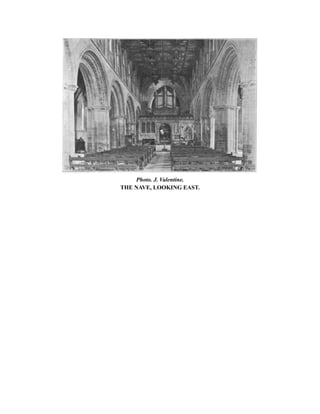
At the South Porch, by which the visitor usually enters, the ogee-headed
holy-water stoup should be noticed, and a general view be made of the
church, as it is most unusual and has a character all its own. The majority of
the work is that of Bishop Peter de Leiâ (1176-1198), and is therefore
Transitional in character; that is to say, it is at the point of fusion between
Norman and Early English. The pointed arch of the latter is not yet adopted,
but the round (more or less) arch is still employed, probably in some degree
to avoid the greater height otherwise entailed, but the details verge on the
purity of the most refined Early English. De Leiâ evidently intended
sexpartite groining to form an internal ceiling, but an earthquake and the
fall of the tower doubtless instilled caution—even if funds were
forthcoming—and the project was never carried out. The exceedingly rich
ceiling, however, of Irish oak does not make one regret this circumstance,
for its very bizarrerie and semi-arabesque character, coming so closely in
contact with the great Norman arches, combine to make the interior of St.
David’s one of unusual beauty. The more so, by contrast, on entering from
the almost bald exterior.
“Possibly the circumstances which conduced to the lack of external
ornament may have led its designers to counterbalance this deficiency by a
superabundance of internal decoration. Certain it is that very few structures
of the same size equal this cathedral in richness and elaborateness of
execution lavished upon this portion of the interior. In fact, much of the
solemnity of a Romanesque nave is lost, an effect which is
13.
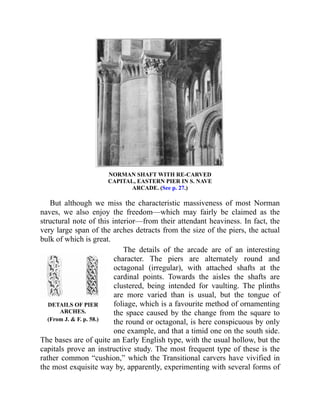
ELEVATION OF ABAY OF THE NAVE, N. SIDE.
From a Drawing by J. Taylor Scott.
certainly far better produced by more massive proportions and a greater
extent of unadorned surface.”[9]
14.
DETAILS OF PIER
ARCHES.
(FromJ. & F. p. 58.)
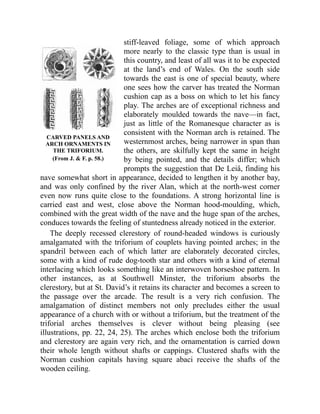
NORMAN SHAFT WITH RE-CARVED
CAPITAL, EASTERN PIER IN S. NAVE
ARCADE. (See p. 27.)
But although we miss the characteristic massiveness of most Norman
naves, we also enjoy the freedom—which may fairly be claimed as the
structural note of this interior—from their attendant heaviness. In fact, the
very large span of the arches detracts from the size of the piers, the actual
bulk of which is great.
The details of the arcade are of an interesting
character. The piers are alternately round and
octagonal (irregular), with attached shafts at the
cardinal points. Towards the aisles the shafts are
clustered, being intended for vaulting. The plinths
are more varied than is usual, but the tongue of
foliage, which is a favourite method of ornamenting
the space caused by the change from the square to
the round or octagonal, is here conspicuous by only
one example, and that a timid one on the south side.
The bases are of quite an Early English type, with the usual hollow, but the
capitals prove an instructive study. The most frequent type of these is the
rather common “cushion,” which the Transitional carvers have vivified in
the most exquisite way by, apparently, experimenting with several forms of
15.
CARVED PANELS AND
ARCHORNAMENTS IN
THE TRIFORIUM.
(From J. & F. p. 58.)
stiff-leaved foliage, some of which approach
more nearly to the classic type than is usual in
this country, and least of all was it to be expected
at the land’s end of Wales. On the south side
towards the east is one of special beauty, where
one sees how the carver has treated the Norman
cushion cap as a boss on which to let his fancy
play. The arches are of exceptional richness and
elaborately moulded towards the nave—in fact,
just as little of the Romanesque character as is
consistent with the Norman arch is retained. The
westernmost arches, being narrower in span than
the others, are skilfully kept the same in height
by being pointed, and the details differ; which
prompts the suggestion that De Leiâ, finding his
nave somewhat short in appearance, decided to lengthen it by another bay,
and was only confined by the river Alan, which at the north-west corner
even now runs quite close to the foundations. A strong horizontal line is
carried east and west, close above the Norman hood-moulding, which,
combined with the great width of the nave and the huge span of the arches,
conduces towards the feeling of stuntedness already noticed in the exterior.
The deeply recessed clerestory of round-headed windows is curiously
amalgamated with the triforium of couplets having pointed arches; in the
spandril between each of which latter are elaborately decorated circles,
some with a kind of rude dog-tooth star and others with a kind of eternal
interlacing which looks something like an interwoven horseshoe pattern. In
other instances, as at Southwell Minster, the triforium absorbs the
clerestory, but at St. David’s it retains its character and becomes a screen to
the passage over the arcade. The result is a very rich confusion. The
amalgamation of distinct members not only precludes either the usual
appearance of a church with or without a triforium, but the treatment of the
triforial arches themselves is clever without being pleasing (see
illustrations, pp. 22, 24, 25). The arches which enclose both the triforium
and clerestory are again very rich, and the ornamentation is carried down
their whole length without shafts or cappings. Clustered shafts with the
Norman cushion capitals having square abaci receive the shafts of the
wooden ceiling.
16.
Of the previousnave-roof we have no date, but very possibly it may
have resembled that at Peterborough or St. Alban’s, as something similar
seems to have existed at Llandaff. The present roof is generally accredited
to the Treasurer, Owen Pole (1472-1509), and in all likelihood that of the
choir may be also.
“This very singular, if not unique, structure is, in its construction, simply a flat ceiling
of timber laid upon the walls; but, by some, certainly unjustifiable, violations of the laws of
architectural reality, such as are not uncommon even in the stone roofs of that period, it is
made to assume a character wholly its own, and which it is very difficult to describe in an
intelligible manner. By the employment of vast pendants, which at the sides take the form
of overlapping capitals to the small shafts already mentioned, the ceiling appears to be
supported by a system of segmental arches effecting a threefold longitudinal division of the
roof, and crossed by a similar range springing from the walls. Of course these arches in
reality support nothing, but are in fact borne up by what appears to rest on them.
Notwithstanding this unreality and the marked inconsistency of the roof with the
architecture below, notwithstanding that its general character would have been much more
adapted to some magnificent state apartment in a royal palace, still the richness and
singularity of such an interminable series of fretted lines renders this on the whole one of
the most attractive features of the cathedral. Both the arches themselves, and the straight
lines which divide the principal panels, drip with minute foliations like lace-work in a style
of almost Arabian gorgeousness. It is much to be regretted that this ceiling cuts off the top
of the western arch of the lantern, which at once spoils the effect of the latter, and gives an
unpleasant appearance to the unfinished pendants of the ceiling, when seen from behind,
out of the choir. Still this very view of the roof, in which hardly any other part of the nave
is visible, is wonderful in the extreme” (J. & F., p. 59).
Having noticed the details and their curious effects in the nave, the
observant visitor still feels that he has not fully explained to his satisfaction
the complete secret of its bizarre effect. It only unfolds itself on measuring
and levelling. The whole nave floor slopes considerably—more than two
feet—from east to west, following the natural fall of the ground, and the
arcades slope outwards respectively north and south, and, in consequence,
their piers lengthen as one nears the west end. A settlement, owing to the
very wet site and bad foundations, probably aided by an earthquake (1248)
and the unusual width of the nave (for a Norman church) are enough to
account for these peculiarities; and the slope of the nave floor seems to have
been purposely so devised for the sake of drainage in flood-time.
At the west end of the south aisle, on three octagonal steps, stands the
Font. Its original shaft is missing. The marble base is octagonal, and rudely
17.
arcaded with sixteenpointed arches, but no part is specially beautiful.
The nave aisles do not call for any very special remarks. At the east end
of both will be seen traces of the original vaulting, and on the north side the
vaulting-shafts are taller than on the south. Also on that side the
Perpendicular flying-buttresses are seen which make such a strange show
outside, where once was the cloister garth, with their huge props. Speaking
of the aisles generally, Freeman says: “It must be remembered that none of
these preparations for vaulting were ever carried into effect. This is, indeed,
no unusual phenomenon, yet there is certainly something striking in so
many designs for a stone roof being traced out upon the same walls, and
none of them being ever brought to perfection. In the nave aisles it may
perhaps be accounted for by the strange and untoward shapes which the
great width of the pier arches compelled the lateral arches of the vaulting to
assume; it may have been found actually impossible to vault the aisles
either at this (1328-1347) or the earlier Romanesque period. But this
argument does not apply to any of the other unfinished vaults in the church
of whatever date.”[10]
The interior of the west front has been as nearly as possible restored to
its former state, but has now no triforium passage. There are a couple of
tiers of windows over the original west entrance. All the lights are round-
headed and are set in a Norman rear-arch.
Some of the nave piers still show traces of polychromatic decoration. On
the north and south sides, on the easternmost pier but one, are the remains
of some frescoes, as also on the middle pier of the south arcade. But Bishop
Field’s white-wash of 1630, which was removed about 1830 under the
careful superintendence of the Ven. Archdeacon Davies, doubtless spoilt
whatever beauty these mural decorations ever had.
It requires considerable discernment to distinguish very clearly what the
designs are, but Freeman[11] made out that on the third southern pier (from
the east) is a representation of the Blessed Virgin seated beneath a canopy.
The figure is within a vesica, vested in a cope and has a nimbus; beneath
which is an inscription, “Virgo Maria.” Above is our Lord and the emblems
of the four Evangelists, and on the small attached shafts are figures of seven
candlesticks, evidently referring to the vision of St. John.[12]
On the south-east face there is a full-length crowned figure of a king in
plate-armour with the basanet and camaille, holding a sword and standing
18.
under a canopy.On the left arm is the initial H, which—the date of the
plate-armour with knee-caps and elbow-pieces corresponding—has been
taken to denote Henry IV.
On the two other piers are achievements of arms which Freeman[13]
states to be “a banner bearing a bend, a shield party per chevron, and a
casque with crest and mantlings, the crest being a head crowned.”
The Rood Screen.—The elaborate rood-screen, which separates the
nave and choir, projects into the nave nearly half a bay. A daïs[14] of three
steps in height occupies the remainder of the bay. The entrance to the choir
is vaulted in two bays, and there are some very unusual flying groin-ribs,
which are shown in the illustration. The work is unmistakably that of
Bishop Gower (1328-1347), and was perhaps the completion of the
Decorated scheme which he inaugurated throughout the fabric. On the
sunny south side the tomb of the Bishop gains by contrast with the heavy
arch-shadow.
On the north side, facing the nave is a peculiarly flat and shallow arcade
in three bays, which formed a kind of reredos to the altar of the Holy Cross
—the piscina being on the north. On the oblique side, facing north-west is a
doorway with a semi-octagonal arch leading to the roof and organ loft.
On the south side of the western bay are two tombs, and on the north
one, all of which will be described with the monuments in the nave (see p.
71).
The backing to the screen was, when Freeman wrote, solid, and he
surmised, with some accuracy, what Sir G. G. Scott found on his restoration
of the screen. In Scott’s words:[15]
“I mentioned in my first Report the massive stonework, some seven or eight feet in
thickness, which blocked the rood-screen, and which I suppose to have been added to
strengthen the tower piers. On examination this was found originally to have been hollow,
but to have been filled up solid for the purpose suggested. The entrance to the choir was
through a roof and uncouth archway in this vast wall, but on searching the contents of the
19.
GROINING OF ROODSCREEN, SHOWING
THE FLYING RIBS.
wall the débris was discovered of the original archway, and of the side doorways into the
hollow spaces. These details were found to be parts of a beautifully groined space, closely
resembling the existing archway through the rood-screen, and forming a second, though
varied, bay of that beautiful entrance. We have been enabled to reconstruct this feature,
using the old remains so far as they would go. This beautiful addition to the choir was
wholly beyond anything I had anticipated.”
In the Computus under 1492 is an entry recording that the sum of 100
shillings[16] for materials for a work which would seem to be for the
blocking up of the screen, and no doubt the constant trouble arising from
the weakness of the western tower arch rendered some such course
imperative.
In De Leiâ’s time, or rather later, the screen probably stood between the
tower piers, as the bases of their eastern responds are raised above those of
the nave and suggest an earlier screen and its platform. And it is not
unlikely that the pleasing incongruity of the western side of the screen is
due to the retention of some portions of earlier work. There are two steps to
20.
the first bayof the screen, and on the second stand the wrought-iron gates
(1847), and to the second bay there are three more steps before we reach the
level of the choir. Gower’s characteristic ornaments and mouldings are
somewhat lavishly bestowed about the screen, and doubtless his statue was
intended to stand in the niche on the south side towards the nave above the
curious aperture fitted with intersecting tracery. For a description of the
tombs, see p. 71.
Along the length of the screen runs an oak cove cornice—possibly
Butterfield’s work—copied from an existing piece which is original. The
arches are fitted with late Perpendicular tracery, very white in appearance,
and the springers of the vaulting seem not to have been completed. The
groining has now been finished and an oak cornice added, and on the rood-
screen is the organ. In 1571 30s. seems to have been paid for taking down
the rood-loft, but it is now almost impossible to be sure what precisely this
meant.[17]
The views north, south, east, and west are well worth the little walk on to
the organ-loft level. Various details are well seen from this height, notably
the interior of the tower, the nave-roof, and the general arrangements and
fittings of the choir.
The Organ.—The present organ and case can hardly be
described as things of beauty, though in point of tone the instrument is
undoubtedly strong, yet sweet. It was built by Messrs. Willis in 1883, and is
almost entirely new. Like the organ at Winchester, it used to occupy the
north lantern arch, and was re-erected there in 1843 by Lincoln of London,
but the present instrument stands on the rood-screen, care being, however,
taken that it should obstruct as little of the view as possible. The tubular
pneumatic system has been here adopted, and there are three manuals. A
few points concerning the previous organs may be of interest, as it is not
unusual to neglect this branch of archæology. According to tradition the
present position of the organ is the original one. Browne Willis[18] says:
“The Organ, before the Rebellion Stood in the Rood-Loft, under the West
Arch, and fac’d the Altar; it is now removed to the North Arch: It is a new
one, and those that are Judges, say, a pretty good one.” This amusing
criticism gives further evidence to the notion that Browne Willis did not
visit the church before—or at any rate very recently before—he wrote his
interesting but somewhat unreliable little survey, which has now become
21.
THE ROOD-SCREEN AND
ORGAN.
veryrare in any form. The items—“Et Sol Willō
Warryn organizanti 40s” and “to ye mr of ye
children for keeping of ye organs and teaching
of ye quoristers, £10,” and others from the Liber
Communis, imply the existence of an organ in
1490, 1492, 1557 and 1565. In the last year the
magnificent sum of 6d. was spent on two stops
“for ye great organs,” from which we may infer
that our organs of to-day are far larger than in
1565. At any rate some small organ might easily
have stood under the western arch of the tower,
although this arch was then built up as it “fac’d
the altar.”[19]
“Probably the tradition of the organ having stood
there, led Browne Willis to suppose that the arch had been
recently built up. However this may be, there are strong
signs of its having occupied that position subsequently to
the erection of the wall. The balustrade which surmounts
the canopies of the stalls projects at this point, as if to
give greater room for a small organ; and the door which
pierces the wall, and is apparently coeval with it, is not set
in the centre, where it would have interfered with the
organ, but near the northern pier of the arch. This seems
to have been the usual place of the organ in our churches,
and to have been retained from the mere force of habit to
the present time, when, from the greater size of our instruments, it is far less
convenient.”[20]
A new organ was built in 1581—“ad usum divini servitii”—but was
ruined in the great rebellion.[21] The ever-interesting Manby, however,
gives another account, by which the organist, hearing some rebel discussing
the demolition of the organ, and fearing that he might lose his position,
dropped a stone from the loft and killed a Roundhead, an “aids-du-camp.”
The organist fled and thus diverted attention from his instrument, having
found a hiding place in the great bell by holding on to the clapper! This
same bell the rebels stole, but their vessel was wrecked off Ramsey Sound,
and the superstitious still say that the tolling of this bell presages a great
storm!
22.
It is clearthere was an organ in 1691, as Precentor Ellis, in his answer to
Bishop Watson’s Visitation Articles, says: “I answeare that we have an
Organ, but out of order, for how long I doe not remember.”
Early in the eighteenth century Bernard Schmidt, the celebrated builder
of that in St. Paul’s Cathedral, constructed an organ as the result of an order
of the Chapter (1695), by which £10 was, for five years, to be set apart “out
of the allowance to the Master of the Fabric”; and in 1698 each canon was
ordered to advance £10 towards the new organ, for which the canons had
expressed a great desire.
A very interesting communication from Archdeacon Davies to
Archdeacon Yardley, of August 3, 1740, gives further particulars:
“What Particular time ye new Organ was set up here, I cannot be positive, but do
believe, from ye accounts, it must be in the year 1704 or 1705. What Exact Sum̃ it stood ye
Chapter In, I cannot for certain say, but am apt to think, from Various Items in various
Years picked up about it, in their Accounts it could not be less, including all Charges, than
£300, whatever More; and in a very little time after it was set up, they were at a
Considerable Expense in repairing it again, after it had been damaged by a Storm, which
uncovered ye very part of ye Roof of ye Church under which it lay, and exposed it to ye
Rain and ye open Sky; and they were obliged to have an Organ Builder (down from
London I think) at a great Expense to put things to rights again.
“Upon looking over some loose Papers in ye Chest at St. David’s, I have found these
Receipts from Mr. Bernard Smith of London, Organ Builder (who made this Organ at St.
David’s) for ye Summe of £290 paid to Him only upon that Account. So that when ye
Charge of bringing it down, ye Necessary workmanship here, and other articles relating to
it are put together, I dare say, before it could be compleatly set up, ye Expense was much
nearer to £400 than £300.”[22]
This organ seems to have been used till that consisting of a choir organ
and swell was put up by Lincoln in 1843 (as already noted), and the old
case “of Norway oak”[23] was re-used. Six of the present stops are Father
Smith’s originals.[24]
In the present restoration this organ was removed, and, to the very great
discredit of all concerned, the splendid case with carvings if not actually by,
certainly worthy of, Grinling Gibbons, was allowed to be broken up. A few
of the best pieces were recently put together and a neat organ-screen
constructed for the Church of St. Martin, Haverfordwest. A brief list of
organists will be found on p. 95.
23.
THE PRESBYTERY IN1856.
Drawn by J. H. Le Keux (from Jones &
Freeman).
THE CHOIR AND TRANSEPTS.
On passing through the rood-screen up five steps from the daïs the choir
is reached, which affords one of the most
24.
Photo: F. Frith& Co.
THE CHOIR AND PRESBYTERY IN 1895.
pleasing prospects in the cathedral. This view gains by comparison with the
nave because of the latter’s over-intricacy, which complication is avoided in
the choir by the absence of a triforium. There are four Transitional bays of
very good proportions, if we except perhaps a tendency to heaviness in the
alternately round and octagonal piers. Here we have—what the nave-bay
design so much wants—strong vertical lines in the clustered shafts. The
Transitional vaulting-shafts stop a little above the string over the arcade,
and continuing them are slender Decorated ones with elaborate capitals.
The clerestory lights (also Transitional) are beautifully detailed with a bold
kind of chevron.
The east end is one of the finest pieces of Norman blending with Early
English in the cathedral, or, for the matter of that, in the kingdom. It is
composed of three lancets below and four above, Sir G. G. Scott having
restored it to the state in which it was after the rebuilding of 1220,
consequent upon the fall of the tower, except that Bishop Vaughan’s Chapel
has made it desirable that the three lower lights should not be open as they
originally were. They are now filled with mosaics.
In the fifteenth century, when the Perpendicular window was inserted,
the stonework of the previous wall and upper tier of lights was used for
25.
heightening the sidewalls. Finding these walls to be a mine of the débris of
the earlier windows, and the Perpendicular window in a bad state of decay,
Scott determined to replace the old work.
After the fall of the tower the rebuilders were astonishingly conservative
in their avoidance of novelty. It cannot have been from any want of ability,
and we incline to the belief that it was the result of a genuine desire to make
the new work harmonise with that in the nave and, by re-using a certain
amount of old material, to relieve a possibly not overflowing exchequer of a
larger disbursement. In the fifteenth century the steep-pitched roof of
cradle-pattern, marks of which remain on the tower, was removed, the gable
lowered, and the walls at each side raised about six feet. A roof of very flat
pitch (as now) and the Perpendicular east window were added.
Finally, when Bishop Vaughan added his chapel behind the east end the
lower lancets were walled up. During the Civil War the lead was stripped
from the aisle roofs and the main arcades of the presbytery were filled up
by walling, and the huge props to the roof were inserted which appear in
Freeman’s view. The eastern windows are deeply recessed, and the banded
shafts have caps of stiff-leaved foliage, and angels form the termination to
the hood-moulding. Just below the cills is an early example of an embattled
band, almost Greek in its severity, and beneath this again are numbers of
intersecting semicircular arches with a ball ornament.
After four centuries of immurement the upper range of lights are restored
to their former arcaded glory, behind the graceful shafts of which runs a
passage. The restored portions are readily recognisable by their being made
of oolite, whilst the original stones are all of purple Caerfai. These windows
are now filled with stained glass by Hardman, the gift of the Rev. J. Lucy.
The subjects are the Last Supper, Gethsemane, the Transfiguration, and the
Nativity. The large lower lancets are filled with mosaics by Salviati, which
are good of their kind. They form a fixed reredos, and were also part of a
memorial by the Reverend John Lucy, Rector of Hampton Lucy,
Warwickshire, to his ancestor, William Lucy, Bishop of St. David’s, 1660-
1677. The designer of the mosaics as well as the glass above was Powell, of
Hardman’s glass works in Birmingham.
“The subjects are—in the central window, the Crucifixion, with the attendant figures of
the Virgin and St. John; the Magdalene kneels at the foot of the cross. In the side windows
are full-lengths of ‘Ecclesia’ and ‘Synagoga,’ the Christian Church and the Jewish. In a
predella below the central mosaic is a representation of the brazen serpent, with figures of
26.
Moses and Aaron.Below the others are—St. David distributing alms to the poor, and St.
David addressing the Synod of Llandewi Brefi. Each of the larger subjects has a rich
architectural canopy, and a broad border of very beautiful design surrounds the whole....
“Immediately under the Crucifixion are the words, ‘Ecce Agnus Dei, ecce qui tollit
peccata mundi’; and below again, within an arcade of three arches are the brazen serpent,
Moses, and Aaron—one bearing his rod, the other his ‘rod that budded.’ Under the figure
of Ecclesia is St. David, in a grey monastic robe, bestowing alms. Under Synagoga, he is
addressing the Bishops at Brefi.... He stands in the centre, while the Bishops are seated
round, with a white robed Abbot in the foreground.”[25]
The golden ground which backs the mosaics sets off advantageously the
delicate garb and pale flesh-tinting of the principal figures. The borders and
other ornaments are rich and varied in colour; and considering that the east
end of the presbytery is somewhat dimly lit, it was unquestionably desirable
that the designs of the mosaics should be firm in drawing. The heads are
perhaps the best part, which is no small achievement, being as a rule the
worst executed. The effect of the mosaics, with their shimmer of gold, and
solemn figures lighting up the dark wall of the sanctuary, is by no means
bad, and, moreover, they harmonise with the deep hues of the surrounding
stonework. There is a pleasing fitness, too, in the “Old coat” of the Lucys
being placed in the pavement of the presbytery, and stained glass above—a
memorial no less of the former Bishop than of the giver of these handsome
decorations.
Under the central recess on a brass is:
“In honorem Dei, et in memoriam Gulielmi Lucy, S.T.P., hujus Ecclesiæ Cathedralis
regnante Carolo Secundo, præclari episcopi; has picturas murales et fenestras superne
pietate adductus, dat dedicat Johannes Lucy per multos annos Hamptoni Luci Rector, A.D.
1871.”
The panelled roof of the presbytery is of flat pitch, and dates from the
period of Owen Pole’s treasurership (1472-1509), to whom also that same
feature of the nave is attributed. Scott restored the ancient decorations,
ignoring that of the seventeenth century, when he was forced to repair and
largely renovate the much-decayed beams, &c. The beams are so large that
considerable difficulty was experienced before suitable oaks could be
found; these were eventually procured from Salop, Radnor, Hereford, and
the Forest of Dean. The main bosses are richly blazoned with shields and
gilt, and the armorial bearings include those of Bishop Robert Tully (1461-
1481), Bishop Richard Martyn (1482-1483), and those of Edmund, Earl of
27.
Richmond, impaling LadyMargaret. Freeman says[26] “the arms of Tully
and Martyn occurred also in the clearly contemporary upper east window.”
If this was contemporary glass we trust it has been carefully preserved. The
entry in 1490, which is repeated in 1492, “Et sol 9£ 4d. Dri Oweno Pole Mro
operis ad usũ fabriciæ per venerabilẽ patrem Robertū nuper Menev. Epūm
per suas litteras patentes assignat,”[27] seems to imply an annual payment,
and that probably this roof was completed soon after this date. The
colouring is rather bright in black, white, and red, and the ornaments are on
a ground of yellowish white. The shields adorn their original positions, and
those not mentioned above are France and England quartered, Edward V.,
Richard III., Henry VII., Rhys ap Tudor, Bishop Gomeg, and that assigned
to Rhodri Mawr, King of Gwynedd, killed 877. The corbels receiving the
walling shafts had lost their decorations, and Scott re-blazoned them with
the arms of the Bishop, Dean, Canons, and Archdeacons of 1864.[28]
The rise from the choir to the eastern bay containing the altar is of four
steps.[29] The tiles in the presbytery are excellent examples of fifteenth-
century encaustics in the usual red-brown and yellow, set diagonally. Some
are, of course, modern, and these are good copies of the old ones, which are
decorated with the arms of Edward III., the Berkeley and Beauchamp
families, and the Tudor rose. Near the sedilia are some ancient bordering
tiles. From the continual repetition of the Berkeley arms Freeman traces
these encaustics to the celebrated Malvern factory.[30]
On the second step of the presbytery, and at about its centre, is a squared
mortice. This may have received the stem of the reader’s lectern, which was
distinct from those often found in the nave. It may possibly have received
even the processional cross or the cross which Alcuin tells us was placed in
this position on Good Friday to be kissed by both the clerics and the laity.
The altar slab of grey sandstone and its supports of oak are new. These
are kept clear of the east wall, as there is a peculiar opening into Bishop
Vaughan’s Chapel just behind. A description of this will be found on p. 62.
On the floor near the altar and behind it are placed sundry altar slabs
brought from disused altars. One of these (to the south), being only 14¾
inches by 9 inches, is let into a larger stone. It is marked with the usual
quintette of crosses and seems to be a picked piece of Caerfai stone in fine
state, from which we may infer that it probably was used as an “altare
portabile.” In the history of St. David we read of one of these altar stones
28.
which was presentedto him by the Patriarch of Jerusalem. King
suggests[31] that this stone may have been a “seal” for a reliquary or
receptacle for altar relics, and if so, this one and
THE PARCLOSE SCREEN, E. SIDE.
that recently unearthed in the Jesus Chapel of Norwich Cathedral are the
only known ones extant.
The woodwork in the choir has many points of interest, notably the
Parclose Screen, which is unique. It divides the presbytery and choir, and
serves to emphasise the ancient three-fold ritual arrangement of nave, choir,
and presbytery. Freeman considers the position of this screen very
remarkable “in this country at least,” and the only churches with analogous
indications that he can instance are Malmesbury and Dorchester. These
divisions were usually well marked in large churches, but not with an actual
screen. In the middle of the fourteenth century the parclose seems to have
been moved to make room for Bishop Morgan’s throne, but as it always
occupied a corresponding position, it is not unlikely that we here find a very
ancient tradition in the church of St. David’s.
Apart from its position, however, the screen itself is not particularly
noteworthy. The style is Decorated, verging towards Perpendicular. The
29.
upper part isopen and filled with sexfoiled tracery, and the lower is, as
usual, panelled. The centre is devoted to a wide entrance, and at different
dates three others have been pierced.
The Stalls are inscribed as follows:[32]
South Return. North Return.
1.Decanus. 15.Præcentor.
2.Archd Meneue. 16.Archd Brecon.
3.P. Llan Dewi. 17.P. Sti Nicholi.
South Side. North Side.
4.P. Cursalis. 18.P. Langan.
5.P. Treflodn. 19.P. Cursalis.
6. ..... 20. ....
7.Vicr Episcop. 21.Succentor.
8.P. Cursalis. 22.P. Cursalis.
9.P. Cursalis. 23.P. Cursalis.
10.P. Cludeu. 24.P. Caer-Fai.
11. .... 25. ....
12.P. Caer-Farchell. 26.Archd Cardign.
13.Archd Carmarn. 27.P. Aurea.
14.Cancellarius. 28.Thesaurarius.
The constructional arches in the transepts are pointed throughout, with
an occasional decorative circular arch, but are
30.
ARCH BETWEEN THES. TRANSEPT AND
THE CHOIR AISLE.
much plainer than those in the nave and choir. “The peculiar character of
the more slender shafts has freer scope than in the nave and choir, where a
more massive pier is employed; we may observe the general omission of
the neck-moulding and the use of the ogee keel as at Llandaff. The latter is
here applied very curiously, being, in several members, doubled and set
laterally, the effect of which is by no means pleasing, though it may have
had some influence on the architecture of the period.”[33]
31.
DOUBLE PISCINA, ST.
THOMAS’SCHAPEL.
The transepts are approached from the nave—not, as is usual, through an
open arch, but through original Transitional doorways. The wall which
contains these doors effectually cuts off the view from the transept to the
nave, and also serves somewhat to make the contrast between the elaborate
nave and the rather bare transepts less marked.
The Chapel of St. Thomas the Martyr, north of the north transept, and
the buildings above form one of the many unique points of St. David’s. On
reference to the ground-plan it will be seen that this remarkable building is
placed at an unexpected angle, the reason for which is not apparent and
remains unexplained.
The year of the fall of the tower—1220—was also that in which the
body of St. Thomas, the martyred primate of Canterbury, was translated
from the crypt of Canterbury Cathedral to the choir. St. David’s, in common
with many other great churches, determined to dedicate a chapel to his
memory. In 1329 this chapel was probably remodelled, when Sir R.
Symonds gave his manor of St. Dogmell to secure two chaplains to
celebrate daily mass for his soul and his wife’s at the altar of St. Thomas. It
has the only original completed Decorated vaulting in the building (except
the south porch), and two stages were added above, making the building
taller than the transept and giving the remarkable external effect seen from
the north-east. The chapel has served as a chapter-house, library, and vestry,
and on its south side has a very beautiful double piscina, in character purely
Early English. The trefoiled heads are characteristically moulded and the
spandrils richly carved, one with stiff-leaved foliage, another with a bird
and foliage, and the third represents a fight between a man and a devil
which is trying to devour another man. This piscina is interesting, apart
from its beauty, as showing that the Early English architects could work
purely in that style when they desired, and that in all probability their use of
Transitional detail was prompted by their artistic sense and desire to make
their work harmonise with their predecessors’. The vaulting rises from
octagonal shafts with round flowered caps, and the bosses at the crossing of
the ribs are elaborate. One contains the head of our Lord, and another a
similar subject, but the Head censed by angels.
32.
The storey abovewas the original Chapter House, later the Grammar
School, now the Library. This position is, we think, unique for a chapter-
house. It is very plain and has a mediæval recessed closet; also a fine
Decorated fireplace (and in it a most unworthy stove), which is obviously
the work of Gower, as it is almost precisely similar to one in the residential
part of his palace over the river. There are also some Early English bracket
capitals, one foliated and the other with the nail-head, probably to carry
lights. On the cill of the north window is a fragment from the old organ-
case, showing how well it was worthy of being, at any rate, attributed to
Grinling Gibbons.
The room above this (third stage) was used as the Treasury, but is not of
any great interest.
Scott did away with an unsightly temporary wooden stair leading to the
chapter-house from the transept, and re-used the original entrance from the
north choir aisle; but we do not consider the present arrangement very
satisfactory, as it still has a temporary appearance.
The Throne (Bishop Morgan, 1496-1505) stands on the south side of the
choir, and is a peculiar structure, rendered the more puzzling by being a
blend of Decorated and Perpendicular, judging by the detail. If the
Decorated parts, however, are not of that period, they are copied from
similar work on the parclose screen. There are three seats, the centre being
the Bishop’s, and the others probably for the Canonici Collaterales. Above
are innumerable crocketed canopies, pinnacles, pediments, &c., terminating
in a kind of open spire. The total height is little short of thirty feet.
At the time of the restoration of the tower all the woodwork in the
immediate vicinity had necessarily to be removed, and under Scott’s
direction was extensively repaired, “the greatest care being taken to
preserve the ancient work as nearly untouched as possible.”
The Sedilia are of a pleasing Perpendicular design, with a cornice in oak
of a peculiar white colour, which leads one to suppose that they were once
coloured. The canopy work and coved cornice are better in detail and
general design than those of the stalls. The buttresses which divide the seats
are pierced with tracery, and are surmounted with crocketed pinnacles.
The oaken stalls—like almost all the woodwork in the choir—belong to
the Perpendicular period, and were erected during the episcopate of Bishop
Tully (1460-1480). They have plain arms, but the return stalls and those of
33.
the Chancellor andTreasurer are decorated with grotesque heads. The
misereres are also conceived in a serio-humorous vein, some, indeed, being
very unusual, the monks being represented as suffering from mal de mer
and crapula. One carving exhibits a cowled fox offering the wafer to a
goose with a human head, which Freeman thinks may have some bearing on
the religious controversy of the time.[34] He also regards the cowled fox as
“the carver’s version of the proverb ‘Cucullus non facit monachum.’ ”
THE SEDILIA.
The decanal stall was formerly assigned to the Bishop as Dean, and
accordingly inscribed Dom. Epī., but when the Precentor in 1840 assumed
the title of Dean[35] this was changed. It will be observed that the seats of
most dignity are the extremes, and the western end and southern side take
precedence. As in the arrangement of stalls which existed in the colleges of
Abergwili and Llanddewi Brefi, founded by Bishop Beck in this diocese,
34.
the Bishop’s Vicar(Subdean) sits on the decanal side, and the Subchanter in
a similar position on the Precentor’s side.
The delicate silver altar-cross was designed by Mr. T. G. Jackson, and is
a choice addition to the cathedral plate. The east end hangings are at once
recognisable as one of the happiest of Mr. Bodley’s exquisite designs.
THE SHRINE OF ST. DAVID.
This shrine, which is, and always has been, one of the most important in
the country, occupies a very modest position in the presbytery, viz., the third
bay from the east on the north side. It is, however, rather a base and a frame
for a movable feretrum, for we know it was carried to battle. Although the
shrine of Edward the Confessor at Westminster and St. Thomas à Beckett at
Canterbury—to mention two great instances—were placed behind the high
altar with much dignity and with plenty of room for pilgrims to circulate,
yet it seems most likely that the somewhat extraordinary position of the
shrine of the patron Saint of Wales is due to a retention of an ancient British
custom.[36] The tombs of St. Trilo and St. Dubricius rest in similar places in
Llandaff Cathedral, and that of St. Ninian at Whitherne, in Galloway,
occupies an identical position. On the other hand, Dr. Rock[37] writes: “I
cannot bring myself to think that the shrine stood anywhere but behind the
high altar, in its full dignity and splendour;” which, however, has not been
the case, certainly since the fifteenth century, as the stone altar stood against
the east wall of the presbytery.
We are inclined to think that the monks divided these relics, which were
so infinitely precious that kings came to venerate, and that some were kept
in a movable shrine or feretory, and that the remainder were shown in a
recently
35.
Photo, J. Valentine.
THESHRINE OF ST. DAVID.
discovered recess behind the high altar.[38] Probably these are the same
relics which were found in the lower part of the recess run with mortar and
formed into a solid mass, evidently to prevent desecration. The relics have
been extracted and are carefully preserved in the cathedral.
St. David, whom Walcott[39] gives as Bishop from 519-542 (when he
presumably died), was canonised by Pope Calixtus II. (Guido of Vienne)[40]
1119-1124, and judging by the numerous Edwardian coins found in the
neighbourhood the shrine attained the height of its celebrity during the
thirteenth and fourteenth centuries. Bishop Gower was thus able to build his
magnificent palace as a hostelry for the many distinguished pilgrims.
Amongst the kings who paid homage to St. David were William I. in 1081,
[41] when he subdued Wales, and this shrine doubtless formed in some sense
36.
Welcome to ourwebsite – the perfect destination for book lovers and
knowledge seekers. We believe that every book holds a new world,
offering opportunities for learning, discovery, and personal growth.
That’s why we are dedicated to bringing you a diverse collection of
books, ranging from classic literature and specialized publications to
self-development guides and children's books.
More than just a book-buying platform, we strive to be a bridge
connecting you with timeless cultural and intellectual values. With an
elegant, user-friendly interface and a smart search system, you can
quickly find the books that best suit your interests. Additionally,
our special promotions and home delivery services help you save time
and fully enjoy the joy of reading.
Join us on a journey of knowledge exploration, passion nurturing, and
personal growth every day!
ebookbell.com




![among which we may observe the ornament called the mask, the only
example of that form to be found in the cathedral.” This porch is the work
of Gower, and the peculiar mouldings are readily traceable to the same artist
who designed the rood-screen. Scraps of the previous Norman doorway,
which was done away with by Gower, are still to be seen in the plinth. At
one time there were five steps in the porch, but these were removed in
1885. The entrance to the upper chamber (added by Vaughan, c. 1515) is
obtained from the nave by a turret-stair, and the room is now used as a
clerk-of-work’s drawing office.
In 1849 Butterfield renewed the tracery of the aisle windows as it
originally was in Decorated times, but it is not very attractive.
The Clerestory is Norman, of ashlar work, and the windows are rather
wide, stumpy, and round-headed, with flat pilaster-like buttresses between
each pair. But the restoration has deprived the exterior of much of its
interest, although one can easily imagine that those of the next century will
enjoy a very pleasing contrast between the purples of the Caerfai buttresses
and the yellows of the window dressings, which are of Somersetshire oolite.
The South Transept still retains the outline of the arch of the great
south window which was blocked up when the four existing Perpendicular
windows of four lights each were inserted. A double buttress supports the
south-east corner of the transept, and behind this is the present Chapter
House.
The East End.—The south Presbytery aisle was put into proper repair at
the time of the general restoration, and new windows were inserted. The
upper tier of windows at the east end of the Presbytery have been well
restored also by Scott, and his own description[5] may well be given:
“In restoring the eastern arm of the church, a question arose which, though but slightly
suggested in my first Report, grew upon my mind as we proceeded to such a degree, that it
was more than a twelvemonth before I could make up my mind as to which course to take.
The case was this:
“This wall of the church had originally side walls, much lower than at present, with a
high-pitched roof, and was constructed with some view to stone groining, though it is clear
that this was never carried out, and was, in fact, deliberately relinquished.
“The east end had two ranges of windows, three most magnificent lights below and
four above.](https://image.slidesharecdn.com/460428-250516024739-f5ee0e50/85/Ccsp-Selfstudy-Ccsp-Csi-Exam-Certification-Guide-2nd-Edition-Dubrawsky-I-6-320.jpg)
![roofless (except the last), and will, we hope, shortly be correctly regarded as
part of the interior if the proposed restoration takes place.
Not far from the east end of the Lady Chapel is the spring which St.
David is credited with creating. Giraldus[6] has a very pretty legend
concerning this spring, which was known as St. Mary’s Well. It seems to
have been of somewhat variable quality, as its waters were sometimes
changed into milk and at others into wine. Sir G. Scott, however, with scant
respect for its saintly origin, caused it to be drained!
The North Side is much the more interesting of the two. After passing
the chapels we come to a very curious three-storied building, the roof of
which is higher than that of the cathedral. On the ground-floor was the
Chantry of St. Thomas, now a vestry, entered from the east side of the north
transept, and above this the turret stair from the north aisle of the presbytery
leads to the old Chapter House, now the Library, and above this again is a
disused room, once the Treasury.
No parallel has yet been found for this remarkable building, which
Freeman (1856) very accurately describes thus:[7]
“It is continued from the face of the north transept, which it slightly exceeds in point of
elevation. The external work is Decorated; the east is flanked by two flat buttresses of very
singular character, which are terminated by rich pinnacles, now mutilated. Equally singular
is the buttress dividing its two bays on the north side; flat at the bottom, after its first stage
its projection becomes angular, and so runs up the whole height of the wall, becoming
much smaller in its upper portion; its pinnacle is quite destroyed (but is now restored). At
the junction with the transept a staircase is attached, in a singular and almost indescribable
way, to the upper portion of the broad pilaster at the north-east corner of the transept....The
east end has a very strange appearance, having three windows over each other, and a niche,
not unlike a window, above all; that in the third stage is a blocked spherical triangle (now
restored). The lower part of the wall is of ashlar, the occurrence of which is so rare in the
exterior of this church; the upper is of rubble, excepting the buttresses.”
Butterfield is responsible for the large Decorated window in the North
Transept, and Scott raised the roof to its original pitch and rebuilt the
north-west angle turret. In the west wall are two Transitional windows (but
the northern one has long been filled in), and above is a corbelled parapet.
Below, but at a lower level than the transept floor, is a doorway to the
cloisters, with a semicircular outer arch having a solid tympanum and
segmental head within. At a contemporary period half, and much later the](https://image.slidesharecdn.com/460428-250516024739-f5ee0e50/85/Ccsp-Selfstudy-Ccsp-Csi-Exam-Certification-Guide-2nd-Edition-Dubrawsky-I-9-320.jpg)
![whole, of this entrance was built up, and in the recess thus formed was
placed a lavatory and drain.
The east wall of the cloisters connects St. Mary’s College with the north
transept. An imposing view is obtained on going through the door at the
north-east corner of the cloisters. We now see the north side of the nave,
with flying buttresses supported on huge masses of masonry, the ruins and
graceful tower of St. Mary’s and, in the distance across the Alan, the
magnificent ruins of the episcopal palace.
The North Doorway (see p. 80) corresponds in position to the south
porch, and is a good example of a Transitional (Norman to Early English)
doorway, but it is much decayed. The principal ornament is, like those in
the arcade, a kind of hybrid composed of the Norman chevron and the
Early-English dog-tooth ornaments. There is a depressed arch to this
doorway, which, with other evidence, leads us to suppose that it has been
higher. Another feature which calls for comment—it is the same in the
arcade but in less marked degree—is that no matter what the size of the
stone, a complete part of the ornament has been carved upon it, thus
obtaining an irregular but not unpleasing effect.
The present West Front is from a design by Sir G. G. Scott, who based
it upon a drawing which he found in the library of the Society of
Antiquaries showing the church as it was before Nash’s alterations.
The illustrations on pages 2 and 7 show Nash’s design of 1793, which
seems to have received the sanction of the Society of Antiquaries. The
figures that appear in the first are Bishop Jones, Professor Freeman, the
authors of the best history of St. David’s, Dean Allen, and Sir G. G. Scott.
This execrable composition was a hopeless conglomeration of Norman,
Decorated, and Perpendicular, with a couple of heavy-arched buttresses,
which were apparently standing as recently as 1887.[8] The rebuilding of
the West Front was undertaken at a cost of about £4,000 as a memorial to
Bishop Thirlwall, who first seriously began to restore the church in 1864,
and his statue stands over the west door. The material is Caerfai stone from
the neighbouring quarries of Caerbwdy, and suffers from its newness in
appearance. In fact the design and the purple stone combine to give the
whole front a very heavy appearance, which only years of exposure to the
sea air will partially remedy.](https://image.slidesharecdn.com/460428-250516024739-f5ee0e50/85/Ccsp-Selfstudy-Ccsp-Csi-Exam-Certification-Guide-2nd-Edition-Dubrawsky-I-10-320.jpg)
![ELEVATION OF A BAY OF THE NAVE, N. SIDE.
From a Drawing by J. Taylor Scott.
certainly far better produced by more massive proportions and a greater
extent of unadorned surface.”[9]](https://image.slidesharecdn.com/460428-250516024739-f5ee0e50/85/Ccsp-Selfstudy-Ccsp-Csi-Exam-Certification-Guide-2nd-Edition-Dubrawsky-I-13-320.jpg)
![arcaded with sixteen pointed arches, but no part is specially beautiful.
The nave aisles do not call for any very special remarks. At the east end
of both will be seen traces of the original vaulting, and on the north side the
vaulting-shafts are taller than on the south. Also on that side the
Perpendicular flying-buttresses are seen which make such a strange show
outside, where once was the cloister garth, with their huge props. Speaking
of the aisles generally, Freeman says: “It must be remembered that none of
these preparations for vaulting were ever carried into effect. This is, indeed,
no unusual phenomenon, yet there is certainly something striking in so
many designs for a stone roof being traced out upon the same walls, and
none of them being ever brought to perfection. In the nave aisles it may
perhaps be accounted for by the strange and untoward shapes which the
great width of the pier arches compelled the lateral arches of the vaulting to
assume; it may have been found actually impossible to vault the aisles
either at this (1328-1347) or the earlier Romanesque period. But this
argument does not apply to any of the other unfinished vaults in the church
of whatever date.”[10]
The interior of the west front has been as nearly as possible restored to
its former state, but has now no triforium passage. There are a couple of
tiers of windows over the original west entrance. All the lights are round-
headed and are set in a Norman rear-arch.
Some of the nave piers still show traces of polychromatic decoration. On
the north and south sides, on the easternmost pier but one, are the remains
of some frescoes, as also on the middle pier of the south arcade. But Bishop
Field’s white-wash of 1630, which was removed about 1830 under the
careful superintendence of the Ven. Archdeacon Davies, doubtless spoilt
whatever beauty these mural decorations ever had.
It requires considerable discernment to distinguish very clearly what the
designs are, but Freeman[11] made out that on the third southern pier (from
the east) is a representation of the Blessed Virgin seated beneath a canopy.
The figure is within a vesica, vested in a cope and has a nimbus; beneath
which is an inscription, “Virgo Maria.” Above is our Lord and the emblems
of the four Evangelists, and on the small attached shafts are figures of seven
candlesticks, evidently referring to the vision of St. John.[12]
On the south-east face there is a full-length crowned figure of a king in
plate-armour with the basanet and camaille, holding a sword and standing](https://image.slidesharecdn.com/460428-250516024739-f5ee0e50/85/Ccsp-Selfstudy-Ccsp-Csi-Exam-Certification-Guide-2nd-Edition-Dubrawsky-I-17-320.jpg)
![under a canopy. On the left arm is the initial H, which—the date of the
plate-armour with knee-caps and elbow-pieces corresponding—has been
taken to denote Henry IV.
On the two other piers are achievements of arms which Freeman[13]
states to be “a banner bearing a bend, a shield party per chevron, and a
casque with crest and mantlings, the crest being a head crowned.”
The Rood Screen.—The elaborate rood-screen, which separates the
nave and choir, projects into the nave nearly half a bay. A daïs[14] of three
steps in height occupies the remainder of the bay. The entrance to the choir
is vaulted in two bays, and there are some very unusual flying groin-ribs,
which are shown in the illustration. The work is unmistakably that of
Bishop Gower (1328-1347), and was perhaps the completion of the
Decorated scheme which he inaugurated throughout the fabric. On the
sunny south side the tomb of the Bishop gains by contrast with the heavy
arch-shadow.
On the north side, facing the nave is a peculiarly flat and shallow arcade
in three bays, which formed a kind of reredos to the altar of the Holy Cross
—the piscina being on the north. On the oblique side, facing north-west is a
doorway with a semi-octagonal arch leading to the roof and organ loft.
On the south side of the western bay are two tombs, and on the north
one, all of which will be described with the monuments in the nave (see p.
71).
The backing to the screen was, when Freeman wrote, solid, and he
surmised, with some accuracy, what Sir G. G. Scott found on his restoration
of the screen. In Scott’s words:[15]
“I mentioned in my first Report the massive stonework, some seven or eight feet in
thickness, which blocked the rood-screen, and which I suppose to have been added to
strengthen the tower piers. On examination this was found originally to have been hollow,
but to have been filled up solid for the purpose suggested. The entrance to the choir was
through a roof and uncouth archway in this vast wall, but on searching the contents of the](https://image.slidesharecdn.com/460428-250516024739-f5ee0e50/85/Ccsp-Selfstudy-Ccsp-Csi-Exam-Certification-Guide-2nd-Edition-Dubrawsky-I-18-320.jpg)
![GROINING OF ROOD SCREEN, SHOWING
THE FLYING RIBS.
wall the débris was discovered of the original archway, and of the side doorways into the
hollow spaces. These details were found to be parts of a beautifully groined space, closely
resembling the existing archway through the rood-screen, and forming a second, though
varied, bay of that beautiful entrance. We have been enabled to reconstruct this feature,
using the old remains so far as they would go. This beautiful addition to the choir was
wholly beyond anything I had anticipated.”
In the Computus under 1492 is an entry recording that the sum of 100
shillings[16] for materials for a work which would seem to be for the
blocking up of the screen, and no doubt the constant trouble arising from
the weakness of the western tower arch rendered some such course
imperative.
In De Leiâ’s time, or rather later, the screen probably stood between the
tower piers, as the bases of their eastern responds are raised above those of
the nave and suggest an earlier screen and its platform. And it is not
unlikely that the pleasing incongruity of the western side of the screen is
due to the retention of some portions of earlier work. There are two steps to](https://image.slidesharecdn.com/460428-250516024739-f5ee0e50/85/Ccsp-Selfstudy-Ccsp-Csi-Exam-Certification-Guide-2nd-Edition-Dubrawsky-I-19-320.jpg)
![the first bay of the screen, and on the second stand the wrought-iron gates
(1847), and to the second bay there are three more steps before we reach the
level of the choir. Gower’s characteristic ornaments and mouldings are
somewhat lavishly bestowed about the screen, and doubtless his statue was
intended to stand in the niche on the south side towards the nave above the
curious aperture fitted with intersecting tracery. For a description of the
tombs, see p. 71.
Along the length of the screen runs an oak cove cornice—possibly
Butterfield’s work—copied from an existing piece which is original. The
arches are fitted with late Perpendicular tracery, very white in appearance,
and the springers of the vaulting seem not to have been completed. The
groining has now been finished and an oak cornice added, and on the rood-
screen is the organ. In 1571 30s. seems to have been paid for taking down
the rood-loft, but it is now almost impossible to be sure what precisely this
meant.[17]
The views north, south, east, and west are well worth the little walk on to
the organ-loft level. Various details are well seen from this height, notably
the interior of the tower, the nave-roof, and the general arrangements and
fittings of the choir.
The Organ.—The present organ and case can hardly be
described as things of beauty, though in point of tone the instrument is
undoubtedly strong, yet sweet. It was built by Messrs. Willis in 1883, and is
almost entirely new. Like the organ at Winchester, it used to occupy the
north lantern arch, and was re-erected there in 1843 by Lincoln of London,
but the present instrument stands on the rood-screen, care being, however,
taken that it should obstruct as little of the view as possible. The tubular
pneumatic system has been here adopted, and there are three manuals. A
few points concerning the previous organs may be of interest, as it is not
unusual to neglect this branch of archæology. According to tradition the
present position of the organ is the original one. Browne Willis[18] says:
“The Organ, before the Rebellion Stood in the Rood-Loft, under the West
Arch, and fac’d the Altar; it is now removed to the North Arch: It is a new
one, and those that are Judges, say, a pretty good one.” This amusing
criticism gives further evidence to the notion that Browne Willis did not
visit the church before—or at any rate very recently before—he wrote his
interesting but somewhat unreliable little survey, which has now become](https://image.slidesharecdn.com/460428-250516024739-f5ee0e50/85/Ccsp-Selfstudy-Ccsp-Csi-Exam-Certification-Guide-2nd-Edition-Dubrawsky-I-20-320.jpg)
![THE ROOD-SCREEN AND
ORGAN.
very rare in any form. The items—“Et Sol Willō
Warryn organizanti 40s” and “to ye mr of ye
children for keeping of ye organs and teaching
of ye quoristers, £10,” and others from the Liber
Communis, imply the existence of an organ in
1490, 1492, 1557 and 1565. In the last year the
magnificent sum of 6d. was spent on two stops
“for ye great organs,” from which we may infer
that our organs of to-day are far larger than in
1565. At any rate some small organ might easily
have stood under the western arch of the tower,
although this arch was then built up as it “fac’d
the altar.”[19]
“Probably the tradition of the organ having stood
there, led Browne Willis to suppose that the arch had been
recently built up. However this may be, there are strong
signs of its having occupied that position subsequently to
the erection of the wall. The balustrade which surmounts
the canopies of the stalls projects at this point, as if to
give greater room for a small organ; and the door which
pierces the wall, and is apparently coeval with it, is not set
in the centre, where it would have interfered with the
organ, but near the northern pier of the arch. This seems
to have been the usual place of the organ in our churches,
and to have been retained from the mere force of habit to
the present time, when, from the greater size of our instruments, it is far less
convenient.”[20]
A new organ was built in 1581—“ad usum divini servitii”—but was
ruined in the great rebellion.[21] The ever-interesting Manby, however,
gives another account, by which the organist, hearing some rebel discussing
the demolition of the organ, and fearing that he might lose his position,
dropped a stone from the loft and killed a Roundhead, an “aids-du-camp.”
The organist fled and thus diverted attention from his instrument, having
found a hiding place in the great bell by holding on to the clapper! This
same bell the rebels stole, but their vessel was wrecked off Ramsey Sound,
and the superstitious still say that the tolling of this bell presages a great
storm!](https://image.slidesharecdn.com/460428-250516024739-f5ee0e50/85/Ccsp-Selfstudy-Ccsp-Csi-Exam-Certification-Guide-2nd-Edition-Dubrawsky-I-21-320.jpg)
![It is clear there was an organ in 1691, as Precentor Ellis, in his answer to
Bishop Watson’s Visitation Articles, says: “I answeare that we have an
Organ, but out of order, for how long I doe not remember.”
Early in the eighteenth century Bernard Schmidt, the celebrated builder
of that in St. Paul’s Cathedral, constructed an organ as the result of an order
of the Chapter (1695), by which £10 was, for five years, to be set apart “out
of the allowance to the Master of the Fabric”; and in 1698 each canon was
ordered to advance £10 towards the new organ, for which the canons had
expressed a great desire.
A very interesting communication from Archdeacon Davies to
Archdeacon Yardley, of August 3, 1740, gives further particulars:
“What Particular time ye new Organ was set up here, I cannot be positive, but do
believe, from ye accounts, it must be in the year 1704 or 1705. What Exact Sum̃ it stood ye
Chapter In, I cannot for certain say, but am apt to think, from Various Items in various
Years picked up about it, in their Accounts it could not be less, including all Charges, than
£300, whatever More; and in a very little time after it was set up, they were at a
Considerable Expense in repairing it again, after it had been damaged by a Storm, which
uncovered ye very part of ye Roof of ye Church under which it lay, and exposed it to ye
Rain and ye open Sky; and they were obliged to have an Organ Builder (down from
London I think) at a great Expense to put things to rights again.
“Upon looking over some loose Papers in ye Chest at St. David’s, I have found these
Receipts from Mr. Bernard Smith of London, Organ Builder (who made this Organ at St.
David’s) for ye Summe of £290 paid to Him only upon that Account. So that when ye
Charge of bringing it down, ye Necessary workmanship here, and other articles relating to
it are put together, I dare say, before it could be compleatly set up, ye Expense was much
nearer to £400 than £300.”[22]
This organ seems to have been used till that consisting of a choir organ
and swell was put up by Lincoln in 1843 (as already noted), and the old
case “of Norway oak”[23] was re-used. Six of the present stops are Father
Smith’s originals.[24]
In the present restoration this organ was removed, and, to the very great
discredit of all concerned, the splendid case with carvings if not actually by,
certainly worthy of, Grinling Gibbons, was allowed to be broken up. A few
of the best pieces were recently put together and a neat organ-screen
constructed for the Church of St. Martin, Haverfordwest. A brief list of
organists will be found on p. 95.](https://image.slidesharecdn.com/460428-250516024739-f5ee0e50/85/Ccsp-Selfstudy-Ccsp-Csi-Exam-Certification-Guide-2nd-Edition-Dubrawsky-I-22-320.jpg)
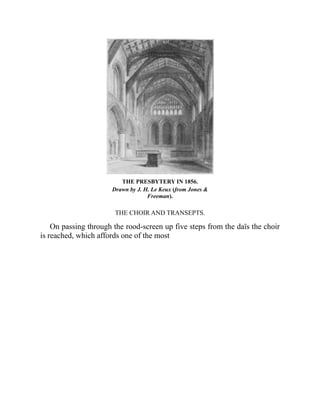
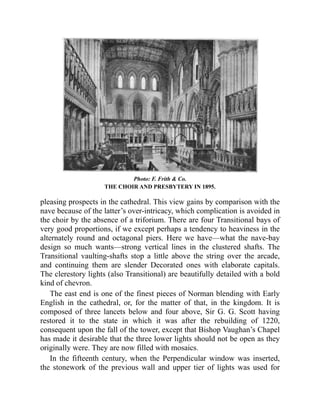
![Moses and Aaron. Below the others are—St. David distributing alms to the poor, and St.
David addressing the Synod of Llandewi Brefi. Each of the larger subjects has a rich
architectural canopy, and a broad border of very beautiful design surrounds the whole....
“Immediately under the Crucifixion are the words, ‘Ecce Agnus Dei, ecce qui tollit
peccata mundi’; and below again, within an arcade of three arches are the brazen serpent,
Moses, and Aaron—one bearing his rod, the other his ‘rod that budded.’ Under the figure
of Ecclesia is St. David, in a grey monastic robe, bestowing alms. Under Synagoga, he is
addressing the Bishops at Brefi.... He stands in the centre, while the Bishops are seated
round, with a white robed Abbot in the foreground.”[25]
The golden ground which backs the mosaics sets off advantageously the
delicate garb and pale flesh-tinting of the principal figures. The borders and
other ornaments are rich and varied in colour; and considering that the east
end of the presbytery is somewhat dimly lit, it was unquestionably desirable
that the designs of the mosaics should be firm in drawing. The heads are
perhaps the best part, which is no small achievement, being as a rule the
worst executed. The effect of the mosaics, with their shimmer of gold, and
solemn figures lighting up the dark wall of the sanctuary, is by no means
bad, and, moreover, they harmonise with the deep hues of the surrounding
stonework. There is a pleasing fitness, too, in the “Old coat” of the Lucys
being placed in the pavement of the presbytery, and stained glass above—a
memorial no less of the former Bishop than of the giver of these handsome
decorations.
Under the central recess on a brass is:
“In honorem Dei, et in memoriam Gulielmi Lucy, S.T.P., hujus Ecclesiæ Cathedralis
regnante Carolo Secundo, præclari episcopi; has picturas murales et fenestras superne
pietate adductus, dat dedicat Johannes Lucy per multos annos Hamptoni Luci Rector, A.D.
1871.”
The panelled roof of the presbytery is of flat pitch, and dates from the
period of Owen Pole’s treasurership (1472-1509), to whom also that same
feature of the nave is attributed. Scott restored the ancient decorations,
ignoring that of the seventeenth century, when he was forced to repair and
largely renovate the much-decayed beams, &c. The beams are so large that
considerable difficulty was experienced before suitable oaks could be
found; these were eventually procured from Salop, Radnor, Hereford, and
the Forest of Dean. The main bosses are richly blazoned with shields and
gilt, and the armorial bearings include those of Bishop Robert Tully (1461-
1481), Bishop Richard Martyn (1482-1483), and those of Edmund, Earl of](https://image.slidesharecdn.com/460428-250516024739-f5ee0e50/85/Ccsp-Selfstudy-Ccsp-Csi-Exam-Certification-Guide-2nd-Edition-Dubrawsky-I-26-320.jpg)
![Richmond, impaling Lady Margaret. Freeman says[26] “the arms of Tully
and Martyn occurred also in the clearly contemporary upper east window.”
If this was contemporary glass we trust it has been carefully preserved. The
entry in 1490, which is repeated in 1492, “Et sol 9£ 4d. Dri Oweno Pole Mro
operis ad usũ fabriciæ per venerabilẽ patrem Robertū nuper Menev. Epūm
per suas litteras patentes assignat,”[27] seems to imply an annual payment,
and that probably this roof was completed soon after this date. The
colouring is rather bright in black, white, and red, and the ornaments are on
a ground of yellowish white. The shields adorn their original positions, and
those not mentioned above are France and England quartered, Edward V.,
Richard III., Henry VII., Rhys ap Tudor, Bishop Gomeg, and that assigned
to Rhodri Mawr, King of Gwynedd, killed 877. The corbels receiving the
walling shafts had lost their decorations, and Scott re-blazoned them with
the arms of the Bishop, Dean, Canons, and Archdeacons of 1864.[28]
The rise from the choir to the eastern bay containing the altar is of four
steps.[29] The tiles in the presbytery are excellent examples of fifteenth-
century encaustics in the usual red-brown and yellow, set diagonally. Some
are, of course, modern, and these are good copies of the old ones, which are
decorated with the arms of Edward III., the Berkeley and Beauchamp
families, and the Tudor rose. Near the sedilia are some ancient bordering
tiles. From the continual repetition of the Berkeley arms Freeman traces
these encaustics to the celebrated Malvern factory.[30]
On the second step of the presbytery, and at about its centre, is a squared
mortice. This may have received the stem of the reader’s lectern, which was
distinct from those often found in the nave. It may possibly have received
even the processional cross or the cross which Alcuin tells us was placed in
this position on Good Friday to be kissed by both the clerics and the laity.
The altar slab of grey sandstone and its supports of oak are new. These
are kept clear of the east wall, as there is a peculiar opening into Bishop
Vaughan’s Chapel just behind. A description of this will be found on p. 62.
On the floor near the altar and behind it are placed sundry altar slabs
brought from disused altars. One of these (to the south), being only 14¾
inches by 9 inches, is let into a larger stone. It is marked with the usual
quintette of crosses and seems to be a picked piece of Caerfai stone in fine
state, from which we may infer that it probably was used as an “altare
portabile.” In the history of St. David we read of one of these altar stones](https://image.slidesharecdn.com/460428-250516024739-f5ee0e50/85/Ccsp-Selfstudy-Ccsp-Csi-Exam-Certification-Guide-2nd-Edition-Dubrawsky-I-27-320.jpg)
![which was presented to him by the Patriarch of Jerusalem. King
suggests[31] that this stone may have been a “seal” for a reliquary or
receptacle for altar relics, and if so, this one and
THE PARCLOSE SCREEN, E. SIDE.
that recently unearthed in the Jesus Chapel of Norwich Cathedral are the
only known ones extant.
The woodwork in the choir has many points of interest, notably the
Parclose Screen, which is unique. It divides the presbytery and choir, and
serves to emphasise the ancient three-fold ritual arrangement of nave, choir,
and presbytery. Freeman considers the position of this screen very
remarkable “in this country at least,” and the only churches with analogous
indications that he can instance are Malmesbury and Dorchester. These
divisions were usually well marked in large churches, but not with an actual
screen. In the middle of the fourteenth century the parclose seems to have
been moved to make room for Bishop Morgan’s throne, but as it always
occupied a corresponding position, it is not unlikely that we here find a very
ancient tradition in the church of St. David’s.
Apart from its position, however, the screen itself is not particularly
noteworthy. The style is Decorated, verging towards Perpendicular. The](https://image.slidesharecdn.com/460428-250516024739-f5ee0e50/85/Ccsp-Selfstudy-Ccsp-Csi-Exam-Certification-Guide-2nd-Edition-Dubrawsky-I-28-320.jpg)
![upper part is open and filled with sexfoiled tracery, and the lower is, as
usual, panelled. The centre is devoted to a wide entrance, and at different
dates three others have been pierced.
The Stalls are inscribed as follows:[32]
South Return. North Return.
1.Decanus. 15.Præcentor.
2.Archd Meneue. 16.Archd Brecon.
3.P. Llan Dewi. 17.P. Sti Nicholi.
South Side. North Side.
4.P. Cursalis. 18.P. Langan.
5.P. Treflodn. 19.P. Cursalis.
6. ..... 20. ....
7.Vicr Episcop. 21.Succentor.
8.P. Cursalis. 22.P. Cursalis.
9.P. Cursalis. 23.P. Cursalis.
10.P. Cludeu. 24.P. Caer-Fai.
11. .... 25. ....
12.P. Caer-Farchell. 26.Archd Cardign.
13.Archd Carmarn. 27.P. Aurea.
14.Cancellarius. 28.Thesaurarius.
The constructional arches in the transepts are pointed throughout, with
an occasional decorative circular arch, but are](https://image.slidesharecdn.com/460428-250516024739-f5ee0e50/85/Ccsp-Selfstudy-Ccsp-Csi-Exam-Certification-Guide-2nd-Edition-Dubrawsky-I-29-320.jpg)
![ARCH BETWEEN THE S. TRANSEPT AND
THE CHOIR AISLE.
much plainer than those in the nave and choir. “The peculiar character of
the more slender shafts has freer scope than in the nave and choir, where a
more massive pier is employed; we may observe the general omission of
the neck-moulding and the use of the ogee keel as at Llandaff. The latter is
here applied very curiously, being, in several members, doubled and set
laterally, the effect of which is by no means pleasing, though it may have
had some influence on the architecture of the period.”[33]](https://image.slidesharecdn.com/460428-250516024739-f5ee0e50/85/Ccsp-Selfstudy-Ccsp-Csi-Exam-Certification-Guide-2nd-Edition-Dubrawsky-I-30-320.jpg)
![the Chancellor and Treasurer are decorated with grotesque heads. The
misereres are also conceived in a serio-humorous vein, some, indeed, being
very unusual, the monks being represented as suffering from mal de mer
and crapula. One carving exhibits a cowled fox offering the wafer to a
goose with a human head, which Freeman thinks may have some bearing on
the religious controversy of the time.[34] He also regards the cowled fox as
“the carver’s version of the proverb ‘Cucullus non facit monachum.’ ”
THE SEDILIA.
The decanal stall was formerly assigned to the Bishop as Dean, and
accordingly inscribed Dom. Epī., but when the Precentor in 1840 assumed
the title of Dean[35] this was changed. It will be observed that the seats of
most dignity are the extremes, and the western end and southern side take
precedence. As in the arrangement of stalls which existed in the colleges of
Abergwili and Llanddewi Brefi, founded by Bishop Beck in this diocese,](https://image.slidesharecdn.com/460428-250516024739-f5ee0e50/85/Ccsp-Selfstudy-Ccsp-Csi-Exam-Certification-Guide-2nd-Edition-Dubrawsky-I-33-320.jpg)
![the Bishop’s Vicar (Subdean) sits on the decanal side, and the Subchanter in
a similar position on the Precentor’s side.
The delicate silver altar-cross was designed by Mr. T. G. Jackson, and is
a choice addition to the cathedral plate. The east end hangings are at once
recognisable as one of the happiest of Mr. Bodley’s exquisite designs.
THE SHRINE OF ST. DAVID.
This shrine, which is, and always has been, one of the most important in
the country, occupies a very modest position in the presbytery, viz., the third
bay from the east on the north side. It is, however, rather a base and a frame
for a movable feretrum, for we know it was carried to battle. Although the
shrine of Edward the Confessor at Westminster and St. Thomas à Beckett at
Canterbury—to mention two great instances—were placed behind the high
altar with much dignity and with plenty of room for pilgrims to circulate,
yet it seems most likely that the somewhat extraordinary position of the
shrine of the patron Saint of Wales is due to a retention of an ancient British
custom.[36] The tombs of St. Trilo and St. Dubricius rest in similar places in
Llandaff Cathedral, and that of St. Ninian at Whitherne, in Galloway,
occupies an identical position. On the other hand, Dr. Rock[37] writes: “I
cannot bring myself to think that the shrine stood anywhere but behind the
high altar, in its full dignity and splendour;” which, however, has not been
the case, certainly since the fifteenth century, as the stone altar stood against
the east wall of the presbytery.
We are inclined to think that the monks divided these relics, which were
so infinitely precious that kings came to venerate, and that some were kept
in a movable shrine or feretory, and that the remainder were shown in a
recently](https://image.slidesharecdn.com/460428-250516024739-f5ee0e50/85/Ccsp-Selfstudy-Ccsp-Csi-Exam-Certification-Guide-2nd-Edition-Dubrawsky-I-34-320.jpg)
![Photo, J. Valentine.
THE SHRINE OF ST. DAVID.
discovered recess behind the high altar.[38] Probably these are the same
relics which were found in the lower part of the recess run with mortar and
formed into a solid mass, evidently to prevent desecration. The relics have
been extracted and are carefully preserved in the cathedral.
St. David, whom Walcott[39] gives as Bishop from 519-542 (when he
presumably died), was canonised by Pope Calixtus II. (Guido of Vienne)[40]
1119-1124, and judging by the numerous Edwardian coins found in the
neighbourhood the shrine attained the height of its celebrity during the
thirteenth and fourteenth centuries. Bishop Gower was thus able to build his
magnificent palace as a hostelry for the many distinguished pilgrims.
Amongst the kings who paid homage to St. David were William I. in 1081,
[41] when he subdued Wales, and this shrine doubtless formed in some sense](https://image.slidesharecdn.com/460428-250516024739-f5ee0e50/85/Ccsp-Selfstudy-Ccsp-Csi-Exam-Certification-Guide-2nd-Edition-Dubrawsky-I-35-320.jpg)