Dictionary
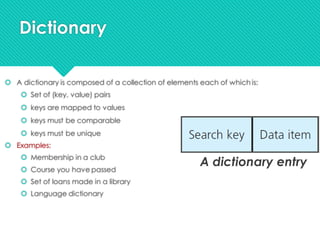
A dictionaryis composed of a collection of elements each of which is:
Set of (key, value) pairs
keys are mapped to values
keys must be comparable
keys must be unique
Examples:
Membership in a club
Course you have passed
Set of loans made in a library
Language dictionary
A dictionary entry
Dictionary Example
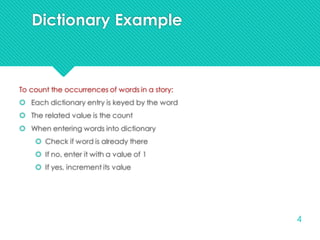
To countthe occurrences of words in a story:
Each dictionary entry is keyed by the word
The related value is the count
When entering words into dictionary
Check if word is already there
If no, enter it with a value of 1
If yes, increment its value
4
5.
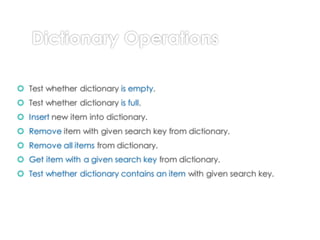
Dictionary Operations
Testwhether dictionary is empty.
Test whether dictionary is full.
Insert new item into dictionary.
Remove item with given search key from dictionary.
Remove all items from dictionary.
Get item with a given search key from dictionary.
Test whether dictionary contains an item with given search key.
Hash table
AHash table is defined as a data structure used to insert, look up, and
remove key-value pairs quickly. It operates on the hashing concept, where
each key is translated by a hash function into a distinct index in an array.
The index functions as a storage location for the matching value. In simple
words, it maps the keys with the value.
9.
What is aHash Table ?
• Effective way of implementing dictionaries.
The simplest kind of hash table is an array of records.
Element whose key is k is obtained by indexing into the kth position of the array.
Applicable when we can afford to allocate an array with one position for every
possible key.
[ 0 ] [ 1 ] [ 2 ] [ 3 ] [ 4 ] [ 5 ]
. . .
[ 700]
10.
Hashing
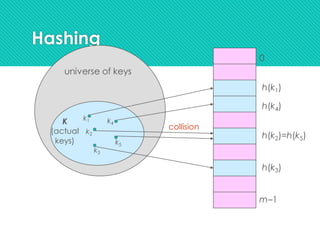
Use hashfunction to map keys into positions in a hash table
Ideally:
If element e has key k and h is hash function, then e is stored in
position h(k) of table
To search for e, compute h(k) to locate position. If no element,
dictionary does not contain e.
Hash Table
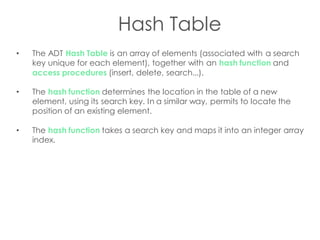
• TheADT Hash Table is an array of elements (associated with a search
key unique for each element), together with an hash function and
access procedures (insert, delete, search...).
• The hash function determines the location in the table of a new
element, using its search key. In a similar way, permits to locate the
position of an existing element.
• The hash function takes a search key and maps it into an integer array
index.
13.
13
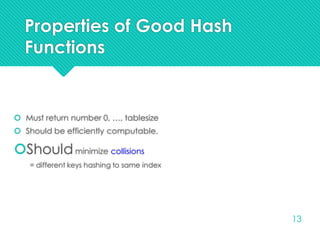
Properties of GoodHash
Functions
Must return number 0, …, tablesize
Should be efficiently computable.
Shouldminimize collisions
= different keys hashing to same index
14.
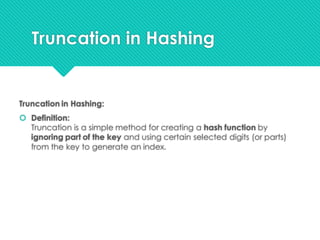
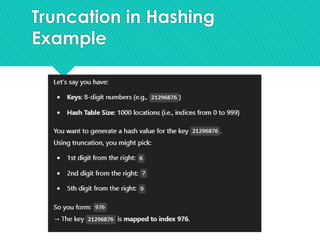
Truncation in Hashing
Truncationin Hashing:
Definition:
Truncation is a simple method for creating a hash function by
ignoring part of the key and using certain selected digits (or parts)
from the key to generate an index.
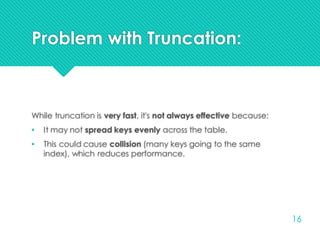
Problem with Truncation:
Whiletruncation is very fast, it's not always effective because:
• It may not spread keys evenly across the table.
• This could cause collision (many keys going to the same
index), which reduces performance.
16
17.
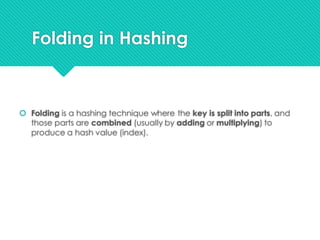
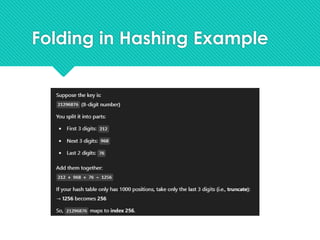
Folding isa hashing technique where the key is split into parts, and
those parts are combined (usually by adding or multiplying) to
produce a hash value (index).
Folding in Hashing
This hashing methoduses modulus division to calculate the index.
The hash function is:
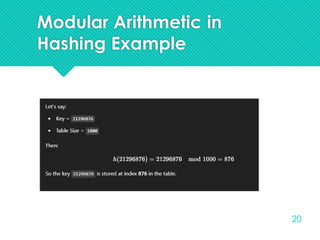
h(key)=key mod TableSize
That means:
• Divide the key by the size of the table.
• Take the remainder as the index.
Modular Arithmetic in
Hashing
Inserting a NewRecord
In order to insert a new record, the
key must somehow be converted to
an array index.
The index is called the hash value of
the key.
[ 0 ] [ 1 ] [ 2 ] [ 3 ] [ 4 ] [ 5 ] [ 700]
Number 506643548
Number 233667136
Number 281942902
Number 155778322
. . .
Number 580625685
23.
Inserting a NewRecord
Typical way create a hash value:
(Key mod TableSize)
[ 0 ] [ 1 ] [ 2 ] [ 3 ] [ 4 ] [ 5 ] [ 700]
Number 506643548
Number 233667136
Number 281942902
Number 155778322
. . .
Number 580625685
What is (580625685 mod 701) ?
24.
Inserting a NewRecord
Typical way to create a hash value:
[ 0 ] [ 1 ] [ 2 ] [ 3 ] [ 4 ] [ 5 ] [ 700]
Number 506643548
Number 233667136
Number 281942902
Number 155778322
. . .
Number 580625685
(Number mod 701)
What is (580625685 mod 701) ? 3
25.
Inserting a NewRecord
The hash value is used for the
location of the new record.
Number 580625685
[ 0 ] [ 1 ] [ 2 ] [ 3 ] [ 4 ] [ 5 ] [ 700]
Number 506643548
Number 233667136
Number 281942902
Number 155778322
. . .
[3]
26.
Inserting a NewRecord
The hash value is used for the
location of the new record.
[ 0 ] [ 1 ] [ 2 ] [ 3 ] [ 4 ] [ 5 ] [ 700]
Number 506643548
Number 233667136
Number 281942902
Number 155778322
. . .
Number 580625685
27.
Collisions
Here isanother new record to insert,
with a hash value of 2.
[ 0 ] [ 1 ] [ 2 ] [ 3 ] [ 4 ] [ 5 ] [ 700]
Number 506643548
Number 233667136
Number 281942902
Number 155778322
. . .
Number 580625685
Number 701466868
My hash
value is
[2].
28.
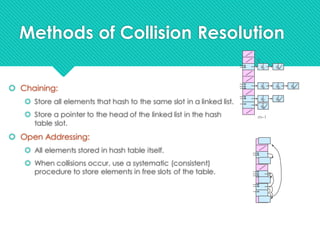
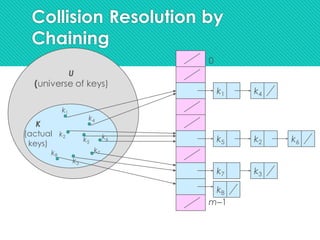
Methods of CollisionResolution
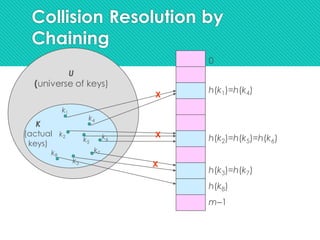
Chaining:
Store all elements that hash to the same slot in a linked list.
Store a pointer to the head of the linked list in the hash
table slot.
Open Addressing:
All elements stored in hash table itself.
When collisions occur, use a systematic (consistent)
procedure to store elements in free slots of the table.
k2
0
m–1
k1 k4
k5 k6
k7 k3
k8
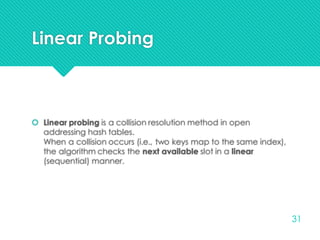
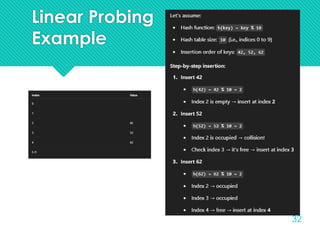
Linear Probing
Linearprobing is a collision resolution method in open
addressing hash tables.
When a collision occurs (i.e., two keys map to the same index),
the algorithm checks the next available slot in a linear
(sequential) manner.
31

![What is a Hash Table ?
• Effective way of implementing dictionaries.
The simplest kind of hash table is an array of records.
Element whose key is k is obtained by indexing into the kth position of the array.
Applicable when we can afford to allocate an array with one position for every
possible key.
[ 0 ] [ 1 ] [ 2 ] [ 3 ] [ 4 ] [ 5 ]
. . .
[ 700]](https://image.slidesharecdn.com/chapter7hashing-250524130543-7ca7b7e9/85/data-structure-chapter-hashing-slides-for-data-structures-learning-9-320.jpg)

![Inserting a New Record
In order to insert a new record, the
key must somehow be converted to
an array index.
The index is called the hash value of
the key.
[ 0 ] [ 1 ] [ 2 ] [ 3 ] [ 4 ] [ 5 ] [ 700]
Number 506643548
Number 233667136
Number 281942902
Number 155778322
. . .
Number 580625685](https://image.slidesharecdn.com/chapter7hashing-250524130543-7ca7b7e9/85/data-structure-chapter-hashing-slides-for-data-structures-learning-22-320.jpg)
![Inserting a New Record
Typical way create a hash value:
(Key mod TableSize)
[ 0 ] [ 1 ] [ 2 ] [ 3 ] [ 4 ] [ 5 ] [ 700]
Number 506643548
Number 233667136
Number 281942902
Number 155778322
. . .
Number 580625685
What is (580625685 mod 701) ?](https://image.slidesharecdn.com/chapter7hashing-250524130543-7ca7b7e9/85/data-structure-chapter-hashing-slides-for-data-structures-learning-23-320.jpg)
![Inserting a New Record
Typical way to create a hash value:
[ 0 ] [ 1 ] [ 2 ] [ 3 ] [ 4 ] [ 5 ] [ 700]
Number 506643548
Number 233667136
Number 281942902
Number 155778322
. . .
Number 580625685
(Number mod 701)
What is (580625685 mod 701) ? 3](https://image.slidesharecdn.com/chapter7hashing-250524130543-7ca7b7e9/85/data-structure-chapter-hashing-slides-for-data-structures-learning-24-320.jpg)
![Inserting a New Record
The hash value is used for the
location of the new record.
Number 580625685
[ 0 ] [ 1 ] [ 2 ] [ 3 ] [ 4 ] [ 5 ] [ 700]
Number 506643548
Number 233667136
Number 281942902
Number 155778322
. . .
[3]](https://image.slidesharecdn.com/chapter7hashing-250524130543-7ca7b7e9/85/data-structure-chapter-hashing-slides-for-data-structures-learning-25-320.jpg)
![Inserting a New Record
The hash value is used for the
location of the new record.
[ 0 ] [ 1 ] [ 2 ] [ 3 ] [ 4 ] [ 5 ] [ 700]
Number 506643548
Number 233667136
Number 281942902
Number 155778322
. . .
Number 580625685](https://image.slidesharecdn.com/chapter7hashing-250524130543-7ca7b7e9/85/data-structure-chapter-hashing-slides-for-data-structures-learning-26-320.jpg)
![Collisions
Here is another new record to insert,
with a hash value of 2.
[ 0 ] [ 1 ] [ 2 ] [ 3 ] [ 4 ] [ 5 ] [ 700]
Number 506643548
Number 233667136
Number 281942902
Number 155778322
. . .
Number 580625685
Number 701466868
My hash
value is
[2].](https://image.slidesharecdn.com/chapter7hashing-250524130543-7ca7b7e9/85/data-structure-chapter-hashing-slides-for-data-structures-learning-27-320.jpg)



![Lect 1 Number systems and base conversions. [Autosaved].pptx](https://cdn.slidesharecdn.com/ss_thumbnails/lect1numbersystemsandbaseconversions-260111134109-67c2d865-thumbnail.jpg?width=640&height=640&fit=bounds)


