DATA SCIENCE USING PYTHON
Under the guidance of
Dr. M. Krishna
Assistant Professor
Department of Electrical and Electronics Engineering
GAYATRI VIDYA PARISHAD COLLEGE OF ENGINEERING FOR WOMEN (A)
[Approved by AICTE NEW DELHI, Affiliated to Andhra University]
[Accredited by National Board of Accreditation (NBA) for B.Tech. CSE, ECE & IT – Valid from 2019-22 and 2022-
25]
[Accredited by National Board of Accreditation (NBA) for B.Tech. EEE – Valid from 2023-24 and 2025-26]
Kommadi , Madhurawada, Visakhapatnam–530048
2024–2025
INTRODUCTION TO AI
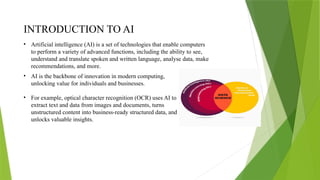
• Artificial intelligence (AI) is a set of technologies that enable computers
to perform a variety of advanced functions, including the ability to see,
understand and translate spoken and written language, analyse data, make
recommendations, and more.
• AI is the backbone of innovation in modern computing,
unlocking value for individuals and businesses.
• For example, optical character recognition (OCR) uses AI to
extract text and data from images and documents, turns
unstructured content into business-ready structured data, and
unlocks valuable insights.
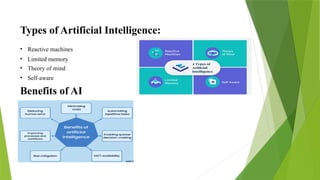
Types of Artificial Intelligence:
• Reactive machines
• Limited memory
• Theory of mind
• Self-aware
Benefits of AI
Data science
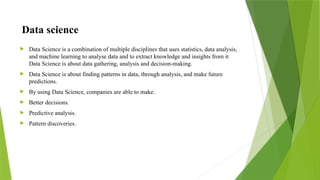
 Data Science is a combination of multiple disciplines that uses statistics, data analysis,
and machine learning to analyse data and to extract knowledge and insights from it
Data Science is about data gathering, analysis and decision-making.
 Data Science is about finding patterns in data, through analysis, and make future
predictions.
 By using Data Science, companies are able to make.
 Better decisions.
 Predictive analysis.
 Pattern discoveries.
Data Scientist Work
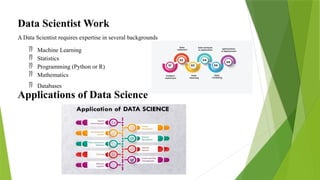
A Data Scientist requires expertise in several backgrounds
 Machine Learning
 Statistics
 Programming (Python or R)
 Mathematics
 Databases
Applications of Data Science
Machine learning
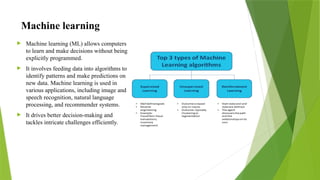
 Machine learning (ML) allows computers
to learn and make decisions without being
explicitly programmed.
 It involves feeding data into algorithms to
identify patterns and make predictions on
new data. Machine learning is used in
various applications, including image and
speech recognition, natural language
processing, and recommender systems.
 It drives better decision-making and
tackles intricate challenges efficiently.
Python
Python is a programming language widely used by Data
Scientists.
 Python has in-built mathematical libraries and functions,
making it easier to calculate mathematical problems and
to perform data analysis.
Why Python for Data Science?
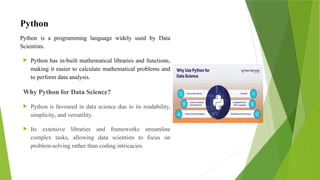
 Python is favoured in data science due to its readability,
simplicity, and versatility.
 Its extensive libraries and frameworks streamline
complex tasks, allowing data scientists to focus on
problem-solving rather than coding intricacies.
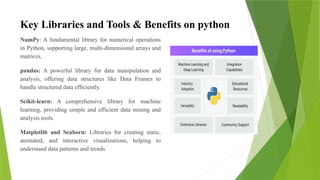
Key Libraries and Tools & Benefits on python
NumPy: A fundamental library for numerical operations
in Python, supporting large, multi-dimensional arrays and
matrices.
pandas: A powerful library for data manipulation and
analysis, offering data structures like Data Frames to
handle structured data efficiently.
Scikit-learn: A comprehensive library for machine
learning, providing simple and efficient data mining and
analysis tools.
Matplotlib and Seaborn: Libraries for creating static,
animated, and interactive visualizations, helping to
understand data patterns and trends.
Python syntax, Data types & Operators
Python Syntax
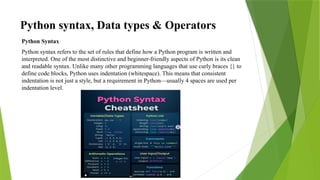
Python syntax refers to the set of rules that define how a Python program is written and
interpreted. One of the most distinctive and beginner-friendly aspects of Python is its clean
and readable syntax. Unlike many other programming languages that use curly braces {} to
define code blocks, Python uses indentation (whitespace). This means that consistent
indentation is not just a style, but a requirement in Python—usually 4 spaces are used per
indentation level.
Python Data Types
In Python, data types define the kind of value a variable can hold, and they are essential for
writing correct and efficient programs. Python is a dynamically typed language, which
means you don't need to declare the data type of a variable explicitly—Python detects it
automatically at runtime. The built-in data types in Python can be broadly categorized into
several types.
 Numeric Types
 Sequence Types
 Set Types
 Mapping Type
 Boolean Type
 None Type
Operators
In Python, operators are special symbols or keywords used to perform operations on
variables and values. Python supports several types of operators that enable arithmetic
operations, comparisons, logical decisions, bitwise manipulations, and more. These
operators make it easier to write expressions that carry out calculations and control flow in
programs.
• Arthamatic Operators
• Comparison (Relational) Operators
• Logical Operators
• Assignment Operators
• Bitwise Operators
• Membership Operators
• Identity Operators
THANK YOU

data science with python internship ppt.

  • 1.
    DATA SCIENCE USINGPYTHON Under the guidance of Dr. M. Krishna Assistant Professor Department of Electrical and Electronics Engineering GAYATRI VIDYA PARISHAD COLLEGE OF ENGINEERING FOR WOMEN (A) [Approved by AICTE NEW DELHI, Affiliated to Andhra University] [Accredited by National Board of Accreditation (NBA) for B.Tech. CSE, ECE & IT – Valid from 2019-22 and 2022- 25] [Accredited by National Board of Accreditation (NBA) for B.Tech. EEE – Valid from 2023-24 and 2025-26] Kommadi , Madhurawada, Visakhapatnam–530048 2024–2025
  • 2.
    INTRODUCTION TO AI •Artificial intelligence (AI) is a set of technologies that enable computers to perform a variety of advanced functions, including the ability to see, understand and translate spoken and written language, analyse data, make recommendations, and more. • AI is the backbone of innovation in modern computing, unlocking value for individuals and businesses. • For example, optical character recognition (OCR) uses AI to extract text and data from images and documents, turns unstructured content into business-ready structured data, and unlocks valuable insights.
  • 3.
    Types of ArtificialIntelligence: • Reactive machines • Limited memory • Theory of mind • Self-aware Benefits of AI
  • 4.
    Data science  DataScience is a combination of multiple disciplines that uses statistics, data analysis, and machine learning to analyse data and to extract knowledge and insights from it Data Science is about data gathering, analysis and decision-making.  Data Science is about finding patterns in data, through analysis, and make future predictions.  By using Data Science, companies are able to make.  Better decisions.  Predictive analysis.  Pattern discoveries.
  • 5.
    Data Scientist Work AData Scientist requires expertise in several backgrounds  Machine Learning  Statistics  Programming (Python or R)  Mathematics  Databases Applications of Data Science
  • 6.
    Machine learning  Machinelearning (ML) allows computers to learn and make decisions without being explicitly programmed.  It involves feeding data into algorithms to identify patterns and make predictions on new data. Machine learning is used in various applications, including image and speech recognition, natural language processing, and recommender systems.  It drives better decision-making and tackles intricate challenges efficiently.
  • 7.
    Python Python is aprogramming language widely used by Data Scientists.  Python has in-built mathematical libraries and functions, making it easier to calculate mathematical problems and to perform data analysis. Why Python for Data Science?  Python is favoured in data science due to its readability, simplicity, and versatility.  Its extensive libraries and frameworks streamline complex tasks, allowing data scientists to focus on problem-solving rather than coding intricacies.
  • 8.
    Key Libraries andTools & Benefits on python NumPy: A fundamental library for numerical operations in Python, supporting large, multi-dimensional arrays and matrices. pandas: A powerful library for data manipulation and analysis, offering data structures like Data Frames to handle structured data efficiently. Scikit-learn: A comprehensive library for machine learning, providing simple and efficient data mining and analysis tools. Matplotlib and Seaborn: Libraries for creating static, animated, and interactive visualizations, helping to understand data patterns and trends.
  • 9.
    Python syntax, Datatypes & Operators Python Syntax Python syntax refers to the set of rules that define how a Python program is written and interpreted. One of the most distinctive and beginner-friendly aspects of Python is its clean and readable syntax. Unlike many other programming languages that use curly braces {} to define code blocks, Python uses indentation (whitespace). This means that consistent indentation is not just a style, but a requirement in Python—usually 4 spaces are used per indentation level.
  • 10.
    Python Data Types InPython, data types define the kind of value a variable can hold, and they are essential for writing correct and efficient programs. Python is a dynamically typed language, which means you don't need to declare the data type of a variable explicitly—Python detects it automatically at runtime. The built-in data types in Python can be broadly categorized into several types.  Numeric Types  Sequence Types  Set Types  Mapping Type  Boolean Type  None Type
  • 11.
    Operators In Python, operatorsare special symbols or keywords used to perform operations on variables and values. Python supports several types of operators that enable arithmetic operations, comparisons, logical decisions, bitwise manipulations, and more. These operators make it easier to write expressions that carry out calculations and control flow in programs. • Arthamatic Operators • Comparison (Relational) Operators • Logical Operators • Assignment Operators • Bitwise Operators • Membership Operators • Identity Operators
  • 12.