Data collection
COLLECTION METHODS
Introduction
 Data is a very valuable asset for businesses
 Data enables businesses to extract valuable insights
 There are different types of data that can be collected
 Data collection approaches need to be carefully selected
 Insights allow businesses to estimate the value of actions
 Data collection is used in marketing, operations research and financial decision
making
What is Data?
 Data consists of facts and statistics for reference and analysis
 Facts such as people like ice cream
 Facts such as people are developing healthier lifestyles
 A statement such as “this was fun, I enjoyed the comedy show”
 90% of kids like playing with colourful toys
 The average Pakistani will choose biryani for dinner 70 % of the time
Types of data: Qualitative
 This defines the quality of a variable and measurement of an information in attributes or
stated facts and not in numerical terms
 Open qualitative data can be collected from asking questions such as “What did you
think about this lecture?”
 Attribute can be either nominal or ordinal
 Nominal is a range of responses without any order of preference
 Ordinal is a range of responses with order of preference
 Both nominal and ordinal responses are finite
Types of data: Quantitative
 This type of data can be expressed in numerical terms
 The data collected relates to a specific measurable quantity
 Quantitate data carries a numerical value
 Quantitative data can be discrete or continuous
 Discrete data can only carry certain values
 Continuous data can carry any value with in a range
Why is data collection important?
 To understand the dynamics of a market
 To identify changes happening in the market
 To align marketing strategy to the market
 To decide pricing, placement and promotion of products
 To decide which market to enter or which markets to exit
 To ensure fact based decision making
 To maintain a good customer relationship management process
The data collection process
 Identification of a problem or a question
 Developing a research question
 Selecting data points
 Targeting the type of data to be collected
 Choosing a data collection method
 Selecting the right measurement scale
 Executing the data collection process
Primary vs Secondary Research
 Primary sources and Secondary sources
 Primary sources are original collections of data, documents or a study
 Secondary sources are is collection of data from a pre-existing primary
source of data
 If one conducts research and gathers data then this is primary research
as this original in nature
 If one uses a research document to gather data then this is secondary
research as data is collected from an existing original work
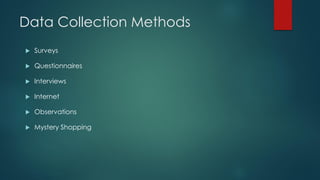
Data Collection Methods
 Surveys
 Questionnaires
 Interviews
 Internet
 Observations
 Mystery Shopping
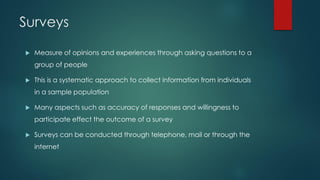
Surveys
 Measure of opinions and experiences through asking questions to a
group of people
 This is a systematic approach to collect information from individuals
in a sample population
 Many aspects such as accuracy of responses and willingness to
participate effect the outcome of a survey
 Surveys can be conducted through telephone, mail or through the
internet
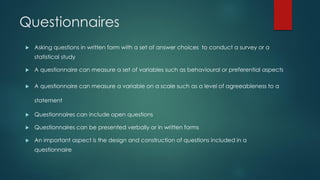
Questionnaires
 Asking questions in written form with a set of answer choices to conduct a survey or a
statistical study
 A questionnaire can measure a set of variables such as behavioural or preferential aspects
 A questionnaire can measure a variable on a scale such as a level of agreeableness to a
statement
 Questionnaires can include open questions
 Questionnaires can be presented verbally or in written forms
 An important aspect is the design and construction of questions included in a
questionnaire
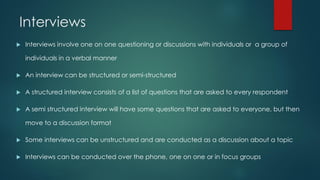
Interviews
 Interviews involve one on one questioning or discussions with individuals or a group of
individuals in a verbal manner
 An interview can be structured or semi-structured
 A structured interview consists of a list of questions that are asked to every respondent
 A semi structured interview will have some questions that are asked to everyone, but then
move to a discussion format
 Some interviews can be unstructured and are conducted as a discussion about a topic
 Interviews can be conducted over the phone, one on one or in focus groups
Observations
 A method of data collection where a situation of interest Is observed and related
factors are recorded
 A simple way of describing observations can be WATCHING
 The situation of interest relates to the research question i.e. a fast food
manufacturer would be interested in observing what behavioural factor leads to
customers choosing a fast food restaurant
 Observation is a tool that can collect data on factors like non verbal expressions,
habits, tastes and preferences without intervening with dynamics of a market
The Internet
 The internet is generating large of amounts of data and much of it is useful for
marketing
 Social media, forums and search engines provide useful information on customer
behaviour and preferences
 The internet can be used to collect both qualitative and quantitative data
 Interviews, surveys and questionaries' can be conducted over the internet
 Secondary research can also be done over the internet
Mystery shopping
 Mystery shopping lets a company gain insight to the customer experience it
is providing to its customers
 Some individuals may be asked to shop or engage with the business with
the aim to provide feedback to the company of the overall experience
 The experience of the individuals will show the company of how the
customer experience is being in qualities and quantitative terms
 After mystery shopping the participants can be interviewed or a
questionnaire can be distributed to them
Case Study
A spa management consulting company and training academy wanted
to align its strategy to high end spas. The company wanted to know
what are the aspects or areas that the company can target to for
training and consulting engagements. Secondly, the company wanted
to decide whether selling equipment to its customers as part of a
complete spa solution will be a good option.
How can the business collect data to reach a decision to both
questions?
Increasing value of data
 Shift to fact based decision making to reduce risk and increase
performance
 Availability of and access to large amount of data sets
 Development of advanced analytical processes
 Advanced data collection techniques such as data warehousing
 Integration of data analysis from operational to strategic levels of
businesses to increase proficiency
 Increased use of data for predictive and prescriptive analysis
 Using the right data collection and analysis techniques gives business a
competitive advantage in the market
Review
 Data is valuable for making appropriate decisions in relation to business strategy
 Choosing the right data collection method for a research questions is important to extract an
actionable insight
 There are different types of data and these can be collected from primary or secondary
sources
 There are many methods of data collection, the list of general methods listed is not exhaustive
 The research aim guides the data collection process
 A proficient data collection method forms the basis for extraction of insights from the market
to act upon
 Data is becoming more readily available in enormous amounts and data collection and
analytical techniques are advancing to produce quicker more valuable insights for businesses
Thank you for listening
Any questions?

Data collection

  • 1.
  • 2.
    Introduction  Data isa very valuable asset for businesses  Data enables businesses to extract valuable insights  There are different types of data that can be collected  Data collection approaches need to be carefully selected  Insights allow businesses to estimate the value of actions  Data collection is used in marketing, operations research and financial decision making
  • 3.
    What is Data? Data consists of facts and statistics for reference and analysis  Facts such as people like ice cream  Facts such as people are developing healthier lifestyles  A statement such as “this was fun, I enjoyed the comedy show”  90% of kids like playing with colourful toys  The average Pakistani will choose biryani for dinner 70 % of the time
  • 4.
    Types of data:Qualitative  This defines the quality of a variable and measurement of an information in attributes or stated facts and not in numerical terms  Open qualitative data can be collected from asking questions such as “What did you think about this lecture?”  Attribute can be either nominal or ordinal  Nominal is a range of responses without any order of preference  Ordinal is a range of responses with order of preference  Both nominal and ordinal responses are finite
  • 5.
    Types of data:Quantitative  This type of data can be expressed in numerical terms  The data collected relates to a specific measurable quantity  Quantitate data carries a numerical value  Quantitative data can be discrete or continuous  Discrete data can only carry certain values  Continuous data can carry any value with in a range
  • 6.
    Why is datacollection important?  To understand the dynamics of a market  To identify changes happening in the market  To align marketing strategy to the market  To decide pricing, placement and promotion of products  To decide which market to enter or which markets to exit  To ensure fact based decision making  To maintain a good customer relationship management process
  • 7.
    The data collectionprocess  Identification of a problem or a question  Developing a research question  Selecting data points  Targeting the type of data to be collected  Choosing a data collection method  Selecting the right measurement scale  Executing the data collection process
  • 8.
    Primary vs SecondaryResearch  Primary sources and Secondary sources  Primary sources are original collections of data, documents or a study  Secondary sources are is collection of data from a pre-existing primary source of data  If one conducts research and gathers data then this is primary research as this original in nature  If one uses a research document to gather data then this is secondary research as data is collected from an existing original work
  • 9.
    Data Collection Methods Surveys  Questionnaires  Interviews  Internet  Observations  Mystery Shopping
  • 10.
    Surveys  Measure ofopinions and experiences through asking questions to a group of people  This is a systematic approach to collect information from individuals in a sample population  Many aspects such as accuracy of responses and willingness to participate effect the outcome of a survey  Surveys can be conducted through telephone, mail or through the internet
  • 11.
    Questionnaires  Asking questionsin written form with a set of answer choices to conduct a survey or a statistical study  A questionnaire can measure a set of variables such as behavioural or preferential aspects  A questionnaire can measure a variable on a scale such as a level of agreeableness to a statement  Questionnaires can include open questions  Questionnaires can be presented verbally or in written forms  An important aspect is the design and construction of questions included in a questionnaire
  • 12.
    Interviews  Interviews involveone on one questioning or discussions with individuals or a group of individuals in a verbal manner  An interview can be structured or semi-structured  A structured interview consists of a list of questions that are asked to every respondent  A semi structured interview will have some questions that are asked to everyone, but then move to a discussion format  Some interviews can be unstructured and are conducted as a discussion about a topic  Interviews can be conducted over the phone, one on one or in focus groups
  • 13.
    Observations  A methodof data collection where a situation of interest Is observed and related factors are recorded  A simple way of describing observations can be WATCHING  The situation of interest relates to the research question i.e. a fast food manufacturer would be interested in observing what behavioural factor leads to customers choosing a fast food restaurant  Observation is a tool that can collect data on factors like non verbal expressions, habits, tastes and preferences without intervening with dynamics of a market
  • 14.
    The Internet  Theinternet is generating large of amounts of data and much of it is useful for marketing  Social media, forums and search engines provide useful information on customer behaviour and preferences  The internet can be used to collect both qualitative and quantitative data  Interviews, surveys and questionaries' can be conducted over the internet  Secondary research can also be done over the internet
  • 15.
    Mystery shopping  Mysteryshopping lets a company gain insight to the customer experience it is providing to its customers  Some individuals may be asked to shop or engage with the business with the aim to provide feedback to the company of the overall experience  The experience of the individuals will show the company of how the customer experience is being in qualities and quantitative terms  After mystery shopping the participants can be interviewed or a questionnaire can be distributed to them
  • 16.
    Case Study A spamanagement consulting company and training academy wanted to align its strategy to high end spas. The company wanted to know what are the aspects or areas that the company can target to for training and consulting engagements. Secondly, the company wanted to decide whether selling equipment to its customers as part of a complete spa solution will be a good option. How can the business collect data to reach a decision to both questions?
  • 17.
    Increasing value ofdata  Shift to fact based decision making to reduce risk and increase performance  Availability of and access to large amount of data sets  Development of advanced analytical processes  Advanced data collection techniques such as data warehousing  Integration of data analysis from operational to strategic levels of businesses to increase proficiency  Increased use of data for predictive and prescriptive analysis  Using the right data collection and analysis techniques gives business a competitive advantage in the market
  • 18.
    Review  Data isvaluable for making appropriate decisions in relation to business strategy  Choosing the right data collection method for a research questions is important to extract an actionable insight  There are different types of data and these can be collected from primary or secondary sources  There are many methods of data collection, the list of general methods listed is not exhaustive  The research aim guides the data collection process  A proficient data collection method forms the basis for extraction of insights from the market to act upon  Data is becoming more readily available in enormous amounts and data collection and analytical techniques are advancing to produce quicker more valuable insights for businesses
  • 19.
    Thank you forlistening Any questions?