Documenting Architectural
Styles using CIDOC- CRM
by
Michail Agathos, Eleftherios Kalogeros,
Manolis Gergatsoulis & Georgios Papaioannou
Laboratory on Digital Libraries and Electronic Publishing,
Department of Archives, Library Science and Museology
Ionian University
ICADL 2022 (online)
November 30 - December 2, 2022
Aims and
Objectives
• Documenting Cultural Heritage: Mayor importance in
the emerging world of digital libraries…
• CIDOC CRM ontology and its extensions: A modern
documentation tool to model (among others)
perceptions and notions associated to architecture
• Can CIDOC CRM and CIDOC CRM based models
sufficiently represent architectural styles / Periods;
• There is less on holistic ontological approaches for
architectural styles / little analysis on their entities and
properties
• Our work offers for the first time a model for
documenting architectural styles via CIDOC CRM and its
extensions.
• Providing a framework to support the documentation of
architectural styles and therefore their interpretation.
2
Presentation Structure
1. Architectural Styles / Periods: Definitions
and Challenges in their documentation
2. The historical context of architectural
styles/periods
3. Representing specific elements that
characterize architectural style
4. The relation between architectural styles
and periods
5. Relating specific buildings (or parts of
buildings) to the architectural styles
affecting their construction
6. Conclusions & Related Work
3
Architectural Styles – Modelling Challenges
• Numerous architectural styles define architecture all over the world, e.g. the Greek and
Roman architectural style, the Gothic, the Baroque, the neoclassical, et.c.
• Architectural Style is the cultural and artistic production of a given historical period
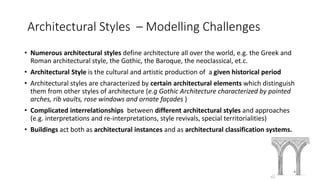
• Architectural styles are characterized by certain architectural elements which distinguish
them from other styles of architecture (e.g Gothic Architecture characterized by pointed
arches, rib vaults, rose windows and ornate façades )
• Complicated interrelationships between different architectural styles and approaches
(e.g. interpretations and re-interpretations, style revivals, special territorialities)
• Buildings act both as architectural instances and as architectural classification systems.
4
Architectural Periods – Modelling Challenges
• Periods and styles flow together: Architectural movement grow from ideas and
construction techniques influenced by historical periods
• There are complex and complicated relationships between different
chronological periods and the architectural styles within them:
[subdivisions of styles with the prefixes early, middle, late, neo, proto…]
• Very common for architectural periods to appear consecutively, influencing one
another or an architectural style may be influenced by other styles from different
chronological periods
5
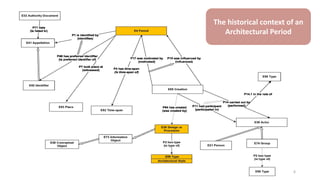
E4 Period class: The historical period in which a specific style was developed, flourished and formed
6
The historical context of an
Architectural Period
Historical Context of Gothic Period - An Example
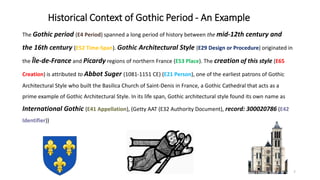
The Gothic period (E4 Period) spanned a long period of history between the mid-12th century and
the 16th century (E52 Time-Span). Gothic Architectural Style (E29 Design or Procedure) originated in
the Île-de-France and Picardy regions of northern France (E53 Place). The creation of this style (E65
Creation) is attributed to Abbot Suger (1081-1151 CE) (E21 Person), one of the earliest patrons of Gothic
Architectural Style who built the Basilica Church of Saint-Denis in France, a Gothic Cathedral that acts as a
prime example of Gothic Architectural Style. In its life span, Gothic architectural style found its own name as
International Gothic (E41 Appellation), (Getty AAT (E32 Authority Document), record: 300020786 (E42
Identifier))
7
8
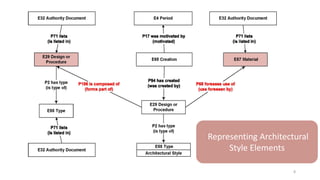
Representing Architectural
Style Elements
Gothic Architectural Style Elements – An Example:
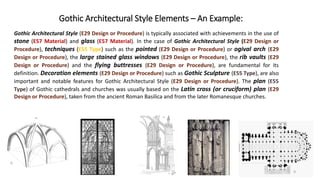
Gothic Architectural Style (E29 Design or Procedure) is typically associated with achievements in the use of
stone (E57 Material) and glass (E57 Material). In the case of Gothic Architectural Style (E29 Design or
Procedure), techniques (E55 Type) such as the pointed (E29 Design or Procedure) or ogival arch (E29
Design or Procedure), the large stained glass windows (E29 Design or Procedure), the rib vaults (E29
Design or Procedure) and the flying buttresses (E29 Design or Procedure), are fundamental for its
definition. Decoration elements (E29 Design or Procedure) such as Gothic Sculpture (E55 Type), are also
important and notable features for Gothic Architectural Style (E29 Design or Procedure). The plan (E55
Type) of Gothic cathedrals and churches was usually based on the Latin cross (or cruciform) plan (E29
Design or Procedure), taken from the ancient Roman Basilica and from the later Romanesque churches.
9
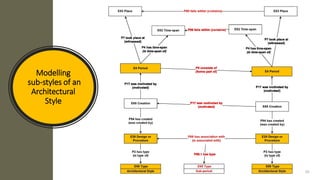
Modelling
sub-styles of an
Architectural
Style
10
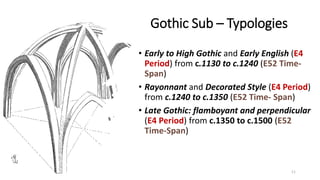
Gothic Sub – Typologies
• Early to High Gothic and Early English (E4
Period) from c.1130 to c.1240 (E52 Time-
Span)
• Rayonnant and Decorated Style (E4 Period)
from c.1240 to c.1350 (E52 Time- Span)
• Late Gothic: flamboyant and perpendicular
(E4 Period) from c.1350 to c.1500 (E52
Time-Span)
11
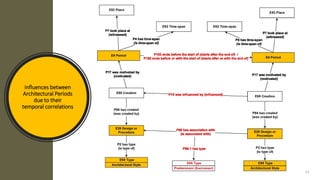
influences between
Architectural Periods
due to their
temporal correlations
12
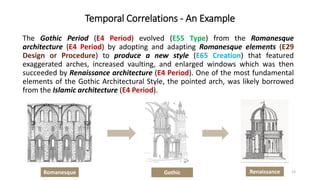
Temporal Correlations - An Example
The Gothic Period (E4 Period) evolved (E55 Type) from the Romanesque
architecture (E4 Period) by adopting and adapting Romanesque elements (E29
Design or Procedure) to produce a new style (E65 Creation) that featured
exaggerated arches, increased vaulting, and enlarged windows which was then
succeeded by Renaissance architecture (E4 Period). One of the most fundamental
elements of the Gothic Architectural Style, the pointed arch, was likely borrowed
from the Islamic architecture (E4 Period).
13
Romanesque Renaissance
Gothic
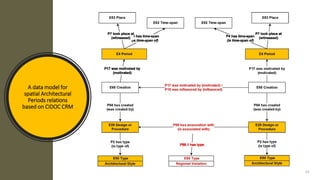
A data model for
spatial Architectural
Periods relations
based on CIDOC CRM
14
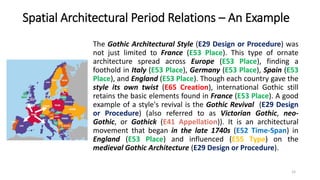
Spatial Architectural Period Relations – An Example
The Gothic Architectural Style (E29 Design or Procedure) was
not just limited to France (E53 Place). This type of ornate
architecture spread across Europe (E53 Place), finding a
foothold in Italy (E53 Place), Germany (E53 Place), Spain (E53
Place), and England (E53 Place). Though each country gave the
style its own twist (E65 Creation), international Gothic still
retains the basic elements found in France (E53 Place). A good
example of a style's revival is the Gothic Revival (E29 Design
or Procedure) (also referred to as Victorian Gothic, neo-
Gothic, or Gothick (E41 Appellation)). It is an architectural
movement that began in the late 1740s (E52 Time-Span) in
England (E53 Place) and influenced (E55 Type) on the
medieval Gothic Architecture (E29 Design or Procedure).
15
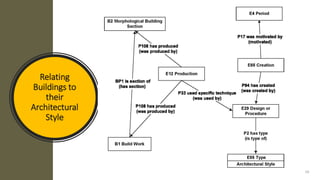
Relating
Buildings to
their
Architectural
Style
16
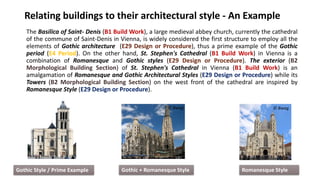
Relating buildings to their architectural style - An Example
The Basilica of Saint- Denis (B1 Build Work), a large medieval abbey church, currently the cathedral
of the commune of Saint-Denis in Vienna, is widely considered the first structure to employ all the
elements of Gothic architecture (E29 Design or Procedure), thus a prime example of the Gothic
period (E4 Period). On the other hand, St. Stephen's Cathedral (B1 Build Work) in Vienna is a
combination of Romanesque and Gothic styles (E29 Design or Procedure). The exterior (B2
Morphological Building Section) of St. Stephen's Cathedral in Vienna (B1 Build Work) is an
amalgamation of Romanesque and Gothic Architectural Styles (E29 Design or Procedure) while its
Towers (B2 Morphological Building Section) on the west front of the cathedral are inspired by
Romanesque Style (E29 Design or Procedure).
17
© Bwag
Romanesque Style
Gothic Style / Prime Example Gothic + Romanesque Style
© Bwag
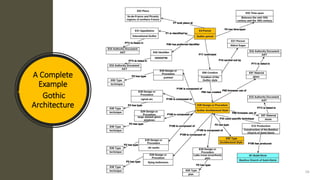
A Complete
Example
Gothic
Architecture
18
Conclusions &
Future Work
19
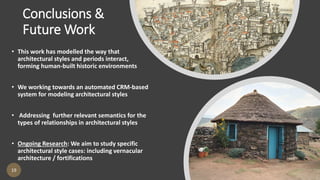
• This work has modelled the way that
architectural styles and periods interact,
forming human-built historic environments
• We working towards an automated CRM-based
system for modeling architectural styles
• Addressing further relevant semantics for the
types of relationships in architectural styles
• Ongoing Research: We aim to study specific
architectural style cases: including vernacular
architecture / fortifications
Thank you!!
20
and do not hesitate to
contact us!
Michail Agathos, Eleftherios
Kalogeros, Manolis Gergatsoulis &
Georgios Papaioannou
[gpapaioa@ionio.gr]

Documenting Architectural Styles using CIDOC- CRM

  • 1.
    Documenting Architectural Styles usingCIDOC- CRM by Michail Agathos, Eleftherios Kalogeros, Manolis Gergatsoulis & Georgios Papaioannou Laboratory on Digital Libraries and Electronic Publishing, Department of Archives, Library Science and Museology Ionian University ICADL 2022 (online) November 30 - December 2, 2022
  • 2.
    Aims and Objectives • DocumentingCultural Heritage: Mayor importance in the emerging world of digital libraries… • CIDOC CRM ontology and its extensions: A modern documentation tool to model (among others) perceptions and notions associated to architecture • Can CIDOC CRM and CIDOC CRM based models sufficiently represent architectural styles / Periods; • There is less on holistic ontological approaches for architectural styles / little analysis on their entities and properties • Our work offers for the first time a model for documenting architectural styles via CIDOC CRM and its extensions. • Providing a framework to support the documentation of architectural styles and therefore their interpretation. 2
  • 3.
    Presentation Structure 1. ArchitecturalStyles / Periods: Definitions and Challenges in their documentation 2. The historical context of architectural styles/periods 3. Representing specific elements that characterize architectural style 4. The relation between architectural styles and periods 5. Relating specific buildings (or parts of buildings) to the architectural styles affecting their construction 6. Conclusions & Related Work 3
  • 4.
    Architectural Styles –Modelling Challenges • Numerous architectural styles define architecture all over the world, e.g. the Greek and Roman architectural style, the Gothic, the Baroque, the neoclassical, et.c. • Architectural Style is the cultural and artistic production of a given historical period • Architectural styles are characterized by certain architectural elements which distinguish them from other styles of architecture (e.g Gothic Architecture characterized by pointed arches, rib vaults, rose windows and ornate façades ) • Complicated interrelationships between different architectural styles and approaches (e.g. interpretations and re-interpretations, style revivals, special territorialities) • Buildings act both as architectural instances and as architectural classification systems. 4
  • 5.
    Architectural Periods –Modelling Challenges • Periods and styles flow together: Architectural movement grow from ideas and construction techniques influenced by historical periods • There are complex and complicated relationships between different chronological periods and the architectural styles within them: [subdivisions of styles with the prefixes early, middle, late, neo, proto…] • Very common for architectural periods to appear consecutively, influencing one another or an architectural style may be influenced by other styles from different chronological periods 5 E4 Period class: The historical period in which a specific style was developed, flourished and formed
  • 6.
    6 The historical contextof an Architectural Period
  • 7.
    Historical Context ofGothic Period - An Example The Gothic period (E4 Period) spanned a long period of history between the mid-12th century and the 16th century (E52 Time-Span). Gothic Architectural Style (E29 Design or Procedure) originated in the Île-de-France and Picardy regions of northern France (E53 Place). The creation of this style (E65 Creation) is attributed to Abbot Suger (1081-1151 CE) (E21 Person), one of the earliest patrons of Gothic Architectural Style who built the Basilica Church of Saint-Denis in France, a Gothic Cathedral that acts as a prime example of Gothic Architectural Style. In its life span, Gothic architectural style found its own name as International Gothic (E41 Appellation), (Getty AAT (E32 Authority Document), record: 300020786 (E42 Identifier)) 7
  • 8.
  • 9.
    Gothic Architectural StyleElements – An Example: Gothic Architectural Style (E29 Design or Procedure) is typically associated with achievements in the use of stone (E57 Material) and glass (E57 Material). In the case of Gothic Architectural Style (E29 Design or Procedure), techniques (E55 Type) such as the pointed (E29 Design or Procedure) or ogival arch (E29 Design or Procedure), the large stained glass windows (E29 Design or Procedure), the rib vaults (E29 Design or Procedure) and the flying buttresses (E29 Design or Procedure), are fundamental for its definition. Decoration elements (E29 Design or Procedure) such as Gothic Sculpture (E55 Type), are also important and notable features for Gothic Architectural Style (E29 Design or Procedure). The plan (E55 Type) of Gothic cathedrals and churches was usually based on the Latin cross (or cruciform) plan (E29 Design or Procedure), taken from the ancient Roman Basilica and from the later Romanesque churches. 9
  • 10.
  • 11.
    Gothic Sub –Typologies • Early to High Gothic and Early English (E4 Period) from c.1130 to c.1240 (E52 Time- Span) • Rayonnant and Decorated Style (E4 Period) from c.1240 to c.1350 (E52 Time- Span) • Late Gothic: flamboyant and perpendicular (E4 Period) from c.1350 to c.1500 (E52 Time-Span) 11
  • 12.
    influences between Architectural Periods dueto their temporal correlations 12
  • 13.
    Temporal Correlations -An Example The Gothic Period (E4 Period) evolved (E55 Type) from the Romanesque architecture (E4 Period) by adopting and adapting Romanesque elements (E29 Design or Procedure) to produce a new style (E65 Creation) that featured exaggerated arches, increased vaulting, and enlarged windows which was then succeeded by Renaissance architecture (E4 Period). One of the most fundamental elements of the Gothic Architectural Style, the pointed arch, was likely borrowed from the Islamic architecture (E4 Period). 13 Romanesque Renaissance Gothic
  • 14.
    A data modelfor spatial Architectural Periods relations based on CIDOC CRM 14
  • 15.
    Spatial Architectural PeriodRelations – An Example The Gothic Architectural Style (E29 Design or Procedure) was not just limited to France (E53 Place). This type of ornate architecture spread across Europe (E53 Place), finding a foothold in Italy (E53 Place), Germany (E53 Place), Spain (E53 Place), and England (E53 Place). Though each country gave the style its own twist (E65 Creation), international Gothic still retains the basic elements found in France (E53 Place). A good example of a style's revival is the Gothic Revival (E29 Design or Procedure) (also referred to as Victorian Gothic, neo- Gothic, or Gothick (E41 Appellation)). It is an architectural movement that began in the late 1740s (E52 Time-Span) in England (E53 Place) and influenced (E55 Type) on the medieval Gothic Architecture (E29 Design or Procedure). 15
  • 16.
  • 17.
    Relating buildings totheir architectural style - An Example The Basilica of Saint- Denis (B1 Build Work), a large medieval abbey church, currently the cathedral of the commune of Saint-Denis in Vienna, is widely considered the first structure to employ all the elements of Gothic architecture (E29 Design or Procedure), thus a prime example of the Gothic period (E4 Period). On the other hand, St. Stephen's Cathedral (B1 Build Work) in Vienna is a combination of Romanesque and Gothic styles (E29 Design or Procedure). The exterior (B2 Morphological Building Section) of St. Stephen's Cathedral in Vienna (B1 Build Work) is an amalgamation of Romanesque and Gothic Architectural Styles (E29 Design or Procedure) while its Towers (B2 Morphological Building Section) on the west front of the cathedral are inspired by Romanesque Style (E29 Design or Procedure). 17 © Bwag Romanesque Style Gothic Style / Prime Example Gothic + Romanesque Style © Bwag
  • 18.
  • 19.
    Conclusions & Future Work 19 •This work has modelled the way that architectural styles and periods interact, forming human-built historic environments • We working towards an automated CRM-based system for modeling architectural styles • Addressing further relevant semantics for the types of relationships in architectural styles • Ongoing Research: We aim to study specific architectural style cases: including vernacular architecture / fortifications
  • 20.
    Thank you!! 20 and donot hesitate to contact us! Michail Agathos, Eleftherios Kalogeros, Manolis Gergatsoulis & Georgios Papaioannou [gpapaioa@ionio.gr]