Data Analysis with SPSS One-way ANOVA
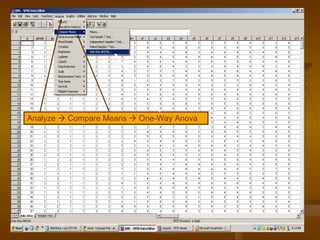
Analyze    Compare Means    One-Way Anova
Example: We want to examine whether there are significant differences in the monthly salary of employees from different age groups. Dependent variable : Monthly Salary Independent variable : Age Group
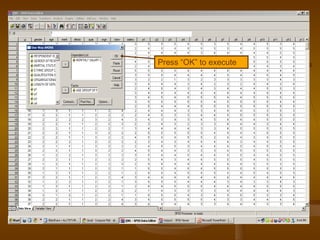
MONTHLY SALARY OF RESPONDENT AGE GROUP OF RESPONDENT Dependent List Factor
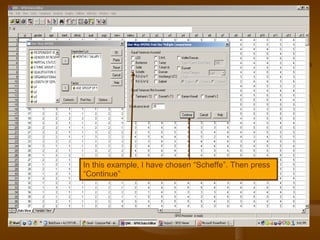
Press “Post Hoc” Multiple Comparisons Dialog Box
In this example, I have chosen “Scheffe”. Then press “Continue”
Press “OK” to execute
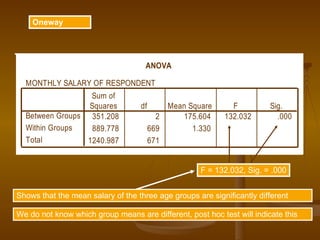
Oneway F = 132.032, Sig. = .000 Shows that the mean salary of the three age groups are significantly different We do not know which group means are different, post hoc test will indicate this
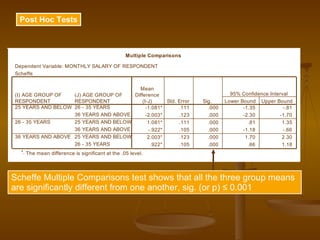
Post Hoc Tests Scheffe Multiple Comparisons test shows that all the three group means are significantly different from one another, sig. (or p)  ≤  0.001
Lets look at two other examples
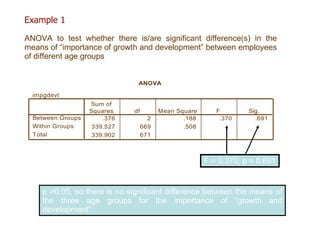
ANOVA to test whether there is/are significant difference(s) in the means of “importance of growth and development” between employees of different age groups  F = 0.370, p = 0.691 p  >0.05, so t here is no significant difference between the means of the three age groups for the importance of “growth and development” Example 1
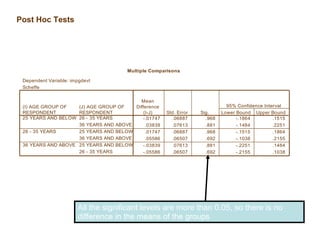
Post Hoc Tests All the significant levels are more than 0.05, so there is no difference in the means of the groups
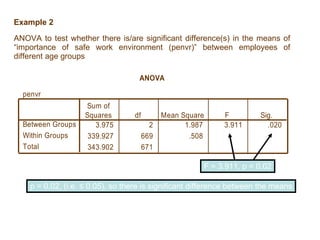
Example 2 ANOVA to test whether there is/are significant difference(s) in the means of “importance of safe work environment (penvr)” between employees of different age groups   F = 3.911, p = 0.02 p = 0.02, (i.e.  ≤ 0.05), so there is significant difference between the means
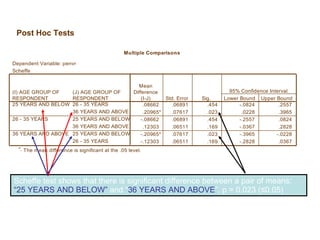
Post Hoc Tests Scheffe test shows that there is significant difference between a pair of means:  “25 YEARS AND BELOW”  and “ 36 YEARS AND ABOVE ”, p = 0.023 ( ≤0.05)
Thank You

Data Analysis with SPSS : One-way ANOVA

  • 1.
    Data Analysis withSPSS One-way ANOVA
  • 2.
    Analyze  Compare Means  One-Way Anova
  • 3.
    Example: We wantto examine whether there are significant differences in the monthly salary of employees from different age groups. Dependent variable : Monthly Salary Independent variable : Age Group
  • 4.
    MONTHLY SALARY OFRESPONDENT AGE GROUP OF RESPONDENT Dependent List Factor
  • 5.
    Press “Post Hoc”Multiple Comparisons Dialog Box
  • 6.
    In this example,I have chosen “Scheffe”. Then press “Continue”
  • 7.
  • 8.
    Oneway F =132.032, Sig. = .000 Shows that the mean salary of the three age groups are significantly different We do not know which group means are different, post hoc test will indicate this
  • 9.
    Post Hoc TestsScheffe Multiple Comparisons test shows that all the three group means are significantly different from one another, sig. (or p) ≤ 0.001
  • 10.
    Lets look attwo other examples
  • 11.
    ANOVA to testwhether there is/are significant difference(s) in the means of “importance of growth and development” between employees of different age groups F = 0.370, p = 0.691 p >0.05, so t here is no significant difference between the means of the three age groups for the importance of “growth and development” Example 1
  • 12.
    Post Hoc TestsAll the significant levels are more than 0.05, so there is no difference in the means of the groups
  • 13.
    Example 2 ANOVAto test whether there is/are significant difference(s) in the means of “importance of safe work environment (penvr)” between employees of different age groups F = 3.911, p = 0.02 p = 0.02, (i.e. ≤ 0.05), so there is significant difference between the means
  • 14.
    Post Hoc TestsScheffe test shows that there is significant difference between a pair of means: “25 YEARS AND BELOW” and “ 36 YEARS AND ABOVE ”, p = 0.023 ( ≤0.05)
  • 15.