
1
Basic Concepts of One-way
Analysis of Variance
(ANOVA)
Sporiš Goran, PhD.
http://kif.hr/predmet/mki
http://www.science4performance.com/
2
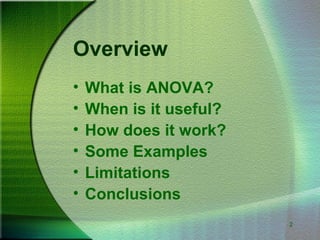
Overview
• What is ANOVA?
• When is it useful?
• How does it work?
• Some Examples
• Limitations
• Conclusions
3
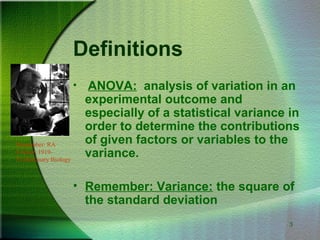
Definitions
• ANOVA: analysis of variation in an
experimental outcome and
especially of a statistical variance in
order to determine the contributions
of given factors or variables to the
variance.
• Remember: Variance: the square of
the standard deviation
Remember: RA
Fischer, 1919-
Evolutionary Biology
4
Introduction
• Any data set has variability
• Variability exists within groups…
• and between groups
• Question that ANOVA allows us to
answer : Is this variability significant, or
merely by chance?
5
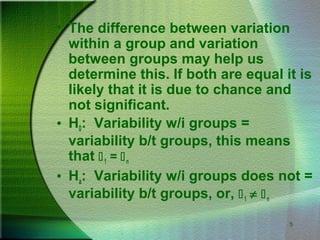
• The difference between variation
within a group and variation
between groups may help us
determine this. If both are equal it is
likely that it is due to chance and
not significant.
• H0: Variability w/i groups =
variability b/t groups, this means
that 1 = n
• Ha: Variability w/i groups does not =
variability b/t groups, or, 1 ≠ n
6
Assumptions
• Normal distribution
• Variances of dependent
variable are equal in all
populations
• Random samples; independent
scores
7
One-Way ANOVA
• One factor (manipulated
variable)
• One response variable
• Two or more groups to
compare
8
Usefulness
• Similar to t-test
• More versatile than t-test
• Compare one parameter
(response variable) between
two or more groups
9
For instance, ANOVA
Could be Used to:
• Compare heights of plants with and
without galls
• Compare birth weights of deer in
different geographical regions
• Compare responses of patients to
real medication vs. placebo
• Compare attention spans of
undergraduate students in different
programs at PC.
10
Why Not Just Use t-
tests?
• Tedious when many groups are
present
• Using all data increases
stability
• Large number of
comparisons some may
appear significant by chance
11
Remember that…
• Standard deviation (s)
n
s = √[(Σ (xi
– X)2
)/(n-1)]
i = 1
• In this case: Degrees of freedom (df)
df = Number of observations or groups - 1
12
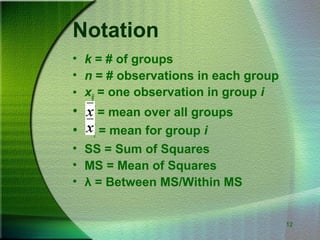
Notation
• k = # of groups
• n = # observations in each group
• xij = one observation in group i
• Y = mean over all groups
• Yi = mean for group i
• SS = Sum of Squares
• MS = Mean of Squares
• λ = Between MS/Within MS
13
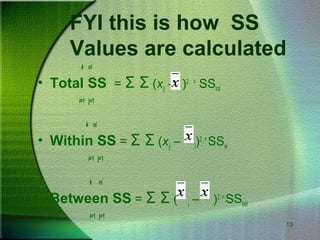
FYI this is how SS
Values are calculated
k ni
• Total SS = Σ Σ (xij
– )2 =
SStot
i=1 j=1
k ni
• Within SS = Σ Σ (xij
– i
)2 =
SSw
i=1 j=1
k ni
• Between SS = Σ Σ ( i
– )2 =
SSbet
i=1 j=1
14
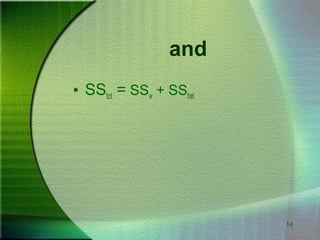
and
• SStot = SSw + SSbet
15
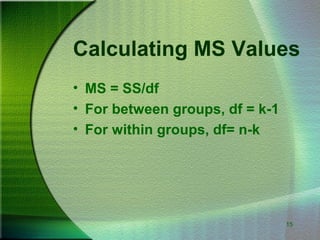
Calculating MS Values
• MS = SS/df
• For between groups, df = k-1
• For within groups, df= n-k
16
Hypothesis Testing &
Significance Levels
17
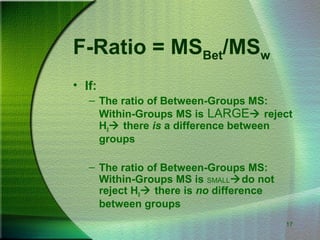
F-Ratio = MSBet/MSw
• If:
– The ratio of Between-Groups MS:
Within-Groups MS is LARGE reject
H0 there is a difference between
groups
– The ratio of Between-Groups MS:
Within-Groups MS is SMALLdo not
reject H0 there is no difference
between groups
18
p-values
• Use table in stats book to determine
p
• Use df for numerator and
denominator
• Choose level of significance
• If F > critical value, reject the null
hypothesis (for one-tail test)
19
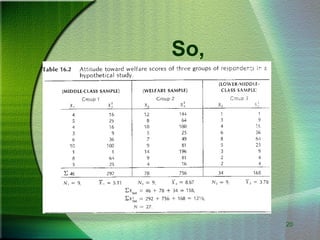
Example 1, pp. 400 of
your handout
• Three groups:
– Middle class sample
– Persons on welfare
– Lower-middle class sample
• Question: Are attitudes toward
welfare payments the same?
20
So,
21
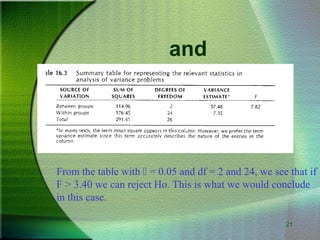
and
From the table with  = 0.05 and df = 2 and 24, we see that if
F > 3.40 we can reject Ho. This is what we would conclude
in this case.
22
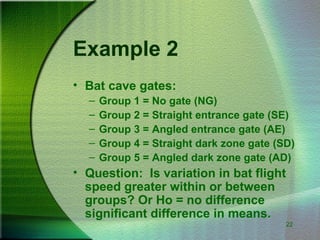
Example 2
• Bat cave gates:
– Group 1 = No gate (NG)
– Group 2 = Straight entrance gate (SE)
– Group 3 = Angled entrance gate (AE)
– Group 4 = Straight dark zone gate (SD)
– Group 5 = Angled dark zone gate (AD)
• Question: Is variation in bat flight
speed greater within or between
groups? Or Ho = no difference
significant difference in means.
23
Just leave me alone
Max! Go back to
your hockey!
24
Example 2 (cont’d)
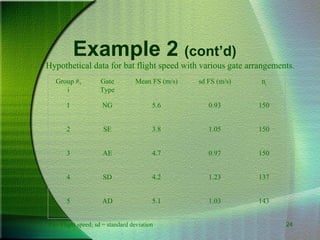
Group #,
i
Gate
Type
Mean FS (m/s) sd FS (m/s) ni
1 NG 5.6 0.93 150
2 SE 3.8 1.05 150
3 AE 4.7 0.97 150
4 SD 4.2 1.23 137
5 AD 5.1 1.03 143
Hypothetical data for bat flight speed with various gate arrangements.
FS= Flight speed; sd = standard deviation
25
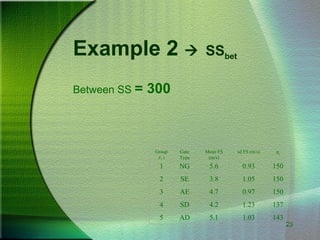
Example 2  SSbet
Between SS = 300
Group
#, i
Gate
Type
Mean FS
(m/s)
sd FS (m/s) ni
1 NG 5.6 0.93 150
2 SE 3.8 1.05 150
3 AE 4.7 0.97 150
4 SD 4.2 1.23 137
5 AD 5.1 1.03 143
26
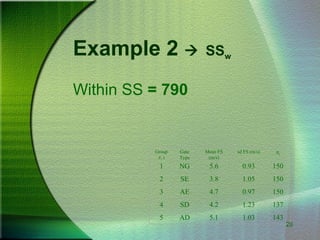
Example 2  SSw
Within SS = 790
Group
#, i
Gate
Type
Mean FS
(m/s)
sd FS (m/s) ni
1 NG 5.6 0.93 150
2 SE 3.8 1.05 150
3 AE 4.7 0.97 150
4 SD 4.2 1.23 137
5 AD 5.1 1.03 143
27
Example 2 (cont’d)
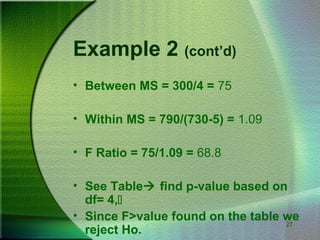
• Between MS = 300/4 = 75
• Within MS = 790/(730-5) = 1.09
• F Ratio = 75/1.09 = 68.8
• See Table find p-value based on
df= 4,
• Since F>value found on the table we
reject Ho.
28
What ANOVA Cannot
Do
• Tell which groups are different
– Post-hoc test of mean differences
required
• Compare multiple parameters
for multiple groups (so it
cannot be used for multiple
response variables)
29
Some Variations
• Two-Way, Three-Way, etc.
ANOVA (will talk about this next
class)
– 2+ factors
• MANOVA (Multiple analysis of
variance)
– multiple response variables
30
Summary
• ANOVA:
– allows us to know if variability in a data
set is between groups or merely within
groups
– is more versatile than t-test
– can compare multiple groups at once
– cannot process multiple response
variables
– does not indicate which groups are
different
31
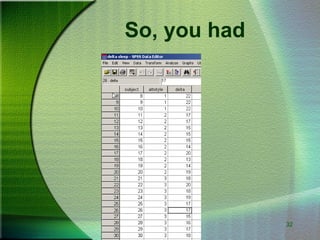
Now, let’s go to our
SPSS manual
• Perform the sample problem on the effects
of attachment styles on the psychology of
sleep with the data set from the NAAGE
site called Delta Sleep.
• Pay attention to the procedure and the
post-hoc tests to determine which groups
are significantly different. Perform the
Tukey Test at a 5% significance level.
• Look at your output and interpret your
results.
• Tell me when you are done.
32
So, you had
33
Then, following the steps
34
35
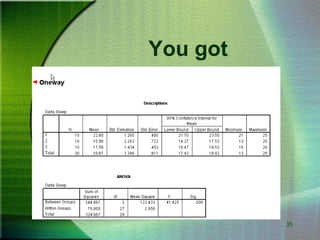
You got
36
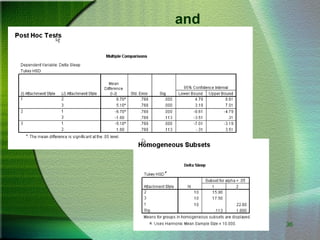
and
37
What do all these
mean?
38
When you are done
with this,
• Do practice exercises 1, 4, 6, 7
and 12 from the handout in
SPSS.
– Create the data sets.
– Run the one-way ANOVAS and
interpret your results.

9. basic concepts_of_one_way_analysis_of_variance_(anova)

  • 1.
    1 Basic Concepts ofOne-way Analysis of Variance (ANOVA) Sporiš Goran, PhD. http://kif.hr/predmet/mki http://www.science4performance.com/
  • 2.
    2 Overview • What isANOVA? • When is it useful? • How does it work? • Some Examples • Limitations • Conclusions
  • 3.
    3 Definitions • ANOVA: analysisof variation in an experimental outcome and especially of a statistical variance in order to determine the contributions of given factors or variables to the variance. • Remember: Variance: the square of the standard deviation Remember: RA Fischer, 1919- Evolutionary Biology
  • 4.
    4 Introduction • Any dataset has variability • Variability exists within groups… • and between groups • Question that ANOVA allows us to answer : Is this variability significant, or merely by chance?
  • 5.
    5 • The differencebetween variation within a group and variation between groups may help us determine this. If both are equal it is likely that it is due to chance and not significant. • H0: Variability w/i groups = variability b/t groups, this means that 1 = n • Ha: Variability w/i groups does not = variability b/t groups, or, 1 ≠ n
  • 6.
    6 Assumptions • Normal distribution •Variances of dependent variable are equal in all populations • Random samples; independent scores
  • 7.
    7 One-Way ANOVA • Onefactor (manipulated variable) • One response variable • Two or more groups to compare
  • 8.
    8 Usefulness • Similar tot-test • More versatile than t-test • Compare one parameter (response variable) between two or more groups
  • 9.
    9 For instance, ANOVA Couldbe Used to: • Compare heights of plants with and without galls • Compare birth weights of deer in different geographical regions • Compare responses of patients to real medication vs. placebo • Compare attention spans of undergraduate students in different programs at PC.
  • 10.
    10 Why Not JustUse t- tests? • Tedious when many groups are present • Using all data increases stability • Large number of comparisons some may appear significant by chance
  • 11.
    11 Remember that… • Standarddeviation (s) n s = √[(Σ (xi – X)2 )/(n-1)] i = 1 • In this case: Degrees of freedom (df) df = Number of observations or groups - 1
  • 12.
    12 Notation • k =# of groups • n = # observations in each group • xij = one observation in group i • Y = mean over all groups • Yi = mean for group i • SS = Sum of Squares • MS = Mean of Squares • λ = Between MS/Within MS
  • 13.
    13 FYI this ishow SS Values are calculated k ni • Total SS = Σ Σ (xij – )2 = SStot i=1 j=1 k ni • Within SS = Σ Σ (xij – i )2 = SSw i=1 j=1 k ni • Between SS = Σ Σ ( i – )2 = SSbet i=1 j=1
  • 14.
    14 and • SStot =SSw + SSbet
  • 15.
    15 Calculating MS Values •MS = SS/df • For between groups, df = k-1 • For within groups, df= n-k
  • 16.
  • 17.
    17 F-Ratio = MSBet/MSw •If: – The ratio of Between-Groups MS: Within-Groups MS is LARGE reject H0 there is a difference between groups – The ratio of Between-Groups MS: Within-Groups MS is SMALLdo not reject H0 there is no difference between groups
  • 18.
    18 p-values • Use tablein stats book to determine p • Use df for numerator and denominator • Choose level of significance • If F > critical value, reject the null hypothesis (for one-tail test)
  • 19.
    19 Example 1, pp.400 of your handout • Three groups: – Middle class sample – Persons on welfare – Lower-middle class sample • Question: Are attitudes toward welfare payments the same?
  • 20.
  • 21.
    21 and From the tablewith  = 0.05 and df = 2 and 24, we see that if F > 3.40 we can reject Ho. This is what we would conclude in this case.
  • 22.
    22 Example 2 • Batcave gates: – Group 1 = No gate (NG) – Group 2 = Straight entrance gate (SE) – Group 3 = Angled entrance gate (AE) – Group 4 = Straight dark zone gate (SD) – Group 5 = Angled dark zone gate (AD) • Question: Is variation in bat flight speed greater within or between groups? Or Ho = no difference significant difference in means.
  • 23.
    23 Just leave mealone Max! Go back to your hockey!
  • 24.
    24 Example 2 (cont’d) Group#, i Gate Type Mean FS (m/s) sd FS (m/s) ni 1 NG 5.6 0.93 150 2 SE 3.8 1.05 150 3 AE 4.7 0.97 150 4 SD 4.2 1.23 137 5 AD 5.1 1.03 143 Hypothetical data for bat flight speed with various gate arrangements. FS= Flight speed; sd = standard deviation
  • 25.
    25 Example 2 SSbet Between SS = 300 Group #, i Gate Type Mean FS (m/s) sd FS (m/s) ni 1 NG 5.6 0.93 150 2 SE 3.8 1.05 150 3 AE 4.7 0.97 150 4 SD 4.2 1.23 137 5 AD 5.1 1.03 143
  • 26.
    26 Example 2 SSw Within SS = 790 Group #, i Gate Type Mean FS (m/s) sd FS (m/s) ni 1 NG 5.6 0.93 150 2 SE 3.8 1.05 150 3 AE 4.7 0.97 150 4 SD 4.2 1.23 137 5 AD 5.1 1.03 143
  • 27.
    27 Example 2 (cont’d) •Between MS = 300/4 = 75 • Within MS = 790/(730-5) = 1.09 • F Ratio = 75/1.09 = 68.8 • See Table find p-value based on df= 4, • Since F>value found on the table we reject Ho.
  • 28.
    28 What ANOVA Cannot Do •Tell which groups are different – Post-hoc test of mean differences required • Compare multiple parameters for multiple groups (so it cannot be used for multiple response variables)
  • 29.
    29 Some Variations • Two-Way,Three-Way, etc. ANOVA (will talk about this next class) – 2+ factors • MANOVA (Multiple analysis of variance) – multiple response variables
  • 30.
    30 Summary • ANOVA: – allowsus to know if variability in a data set is between groups or merely within groups – is more versatile than t-test – can compare multiple groups at once – cannot process multiple response variables – does not indicate which groups are different
  • 31.
    31 Now, let’s goto our SPSS manual • Perform the sample problem on the effects of attachment styles on the psychology of sleep with the data set from the NAAGE site called Delta Sleep. • Pay attention to the procedure and the post-hoc tests to determine which groups are significantly different. Perform the Tukey Test at a 5% significance level. • Look at your output and interpret your results. • Tell me when you are done.
  • 32.
  • 33.
  • 34.
  • 35.
  • 36.
  • 37.
    37 What do allthese mean?
  • 38.
    38 When you aredone with this, • Do practice exercises 1, 4, 6, 7 and 12 from the handout in SPSS. – Create the data sets. – Run the one-way ANOVAS and interpret your results.

Editor's Notes

  • #7 There are exceptions, and some of these assumptions can be violated: Assump. 1 can be violated if large sample size present If assump. 3 is violated, the ANOVA’s F value gives an inaccurate p-value.
  • #9 Similar: use both to compare groups
  • #11 e.g., six (6) groups or treatments = 15 different t-tests if done that way.
  • #12 sd = difference between each value and the mean, squared, then all added together and divided by (n-1) THEN take the square root of this value
  • #14 For grouped data (use diff. equation for raw data) Total SS = Between SS + Within SS
  • #26 730 = total number of observations (150 + 150… etc.)
  • #30 Two-way ANOVA: 2 independent variables (2 factors); ex: seed type and fertilizer type MANOVA: can analyze multiple dependent variables (response) simultaneously ANCOVA: combines of simple linear regression & one-way ANOVA