Vizzini Simone
Description of the problem

The task of the exercise is to study the:
• temperature distribution
• the structural deformation of the dashboard
surface when part of it is subjected to direct sun
light.

Simone Vizzini
Description of the problem
Material
used:
Polypropylene
E [Gpa]

ν

1.8

0.45

ρ

[kg/m3]
946

Thermal
Expansion
coefficient [1/C°]

Thermal
Conductivity
[W/mC°]

Heat
Transfer
coefficient [W/m2C°]

150 e-6

0.16

25.4

73

40

Steel
210

0.3

7800

1 e-5

Dashboard property:
– thickness t= 2.5 mm
Simone Vizzini
Description of the problem

Loading condition.
It is suggested to reach the target following some
intermediate steps:
• to obtain the temperature on the dashboard due to
convection with the inner temperature of the cockpit,
• to apply a heat flux of 400 W/m2 to part of the
dashboard in order to simulate the sun light (heat flows
in the dashboard material by conduction),
• to define a coupled thermo-structural analysis and to
analyse the stress/strain distribution on the dashboard.

Simone Vizzini
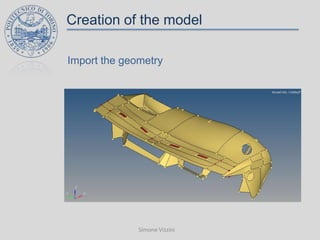
Creation of the model
Import the geometry

Simone Vizzini
Creation of the model
Move some surface from dashboard to air tunnel
– [tool-organize]

Simone Vizzini
Creation of the model
Create the Material and insert the specific
properties
– [card image:MAT1 and MAT4 for thermal properties]

Simone Vizzini
Creation of the model
Create the “Properties” and assign to the
components
• [card image:PSHELL, choose the material and define
the thickness]

Simone Vizzini
Creation of the model
Create the mesh and merging the common
nodes
– [2D-automesh, tool-edges]

Simone Vizzini
Creation of the model
Create the constraint point
– create the master nodes [geom-nodes]
– connect to the dashboard [1D-rigids]

Simone Vizzini
Creation of the model
Create the convection heat exchange surface
– [analysis-interfaces]

Simone Vizzini
Creation of the model
Create the internal heat source, creating a
constraint node with the specific initial T and
assign to to the dashboard
– [geom-node, analysis-constraint, card edit-insert the
inner T ]

Simone Vizzini
Creation of the model
Constraint all the air-tunnel nodes and assign
the initial T
– [analysis-constraints, card edit-insert the T ]

Simone Vizzini
Creation of the model
Create the load-step and Simulate

Simone Vizzini
Creation of the model
Create the conduction heat exchange surface,
create the flux, update the loadstep adding the
flux to the laod and Simulate
– [analysis-interfaces]
– [analysis-flux]

Simone Vizzini
Creation of the model
Create the constraints for the master nodes.
– [analysis-constraints]

Create a generic load-step for the thermal stress

Simulate

Simone Vizzini
Results
Temperature due to convection with
dashboard made of polypropylene

Simone Vizzini
Results
Temperature due to convection with
dashboard made of steel

Simone Vizzini
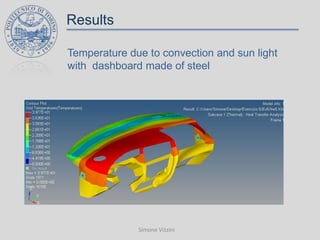
Results
Temperature due to convection and sun light
with dashboard made of polypropylene

Simone Vizzini
Results
Temperature due to convection and sun light
with dashboard made of steel

Simone Vizzini
Results
Strain distribution due to convection and
sunlight with dashboard made of polypropylene

Simone Vizzini
Results
Strain distribution due to convection and
sunlight with dashboard made of steel

Simone Vizzini
Results
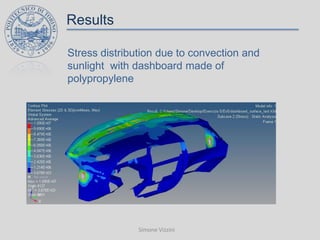
Stress distribution due to convection and
sunlight with dashboard made of
polypropylene

Simone Vizzini
Results
Stress distribution due to convection and
sunlight with dashboard made of steel

Simone Vizzini
Results discussion
Temperature due to convection:
– in both cases, polypropylene and steel, we can see
that the temperature of the dashboard achieved
without the sunlight is 30 C , i.e. the internal
temperature, except for some points in the
polypropylene simulation that achieve a slightly
higher temperature due to maybe a simulation
errors. The difference in the two cases is the
temperature field near the air-tunnel. Because of
the steel has an higher thermal conductivity we can
see an bigger aerea with a temperature ranging
from 10 C (air-tunnel T ) and 30 C (internal T ),
while with poly this boundary area is very limited.

Simone Vizzini
Results discussion
Temperature due to convection and sun-light:
– again, like in the previous simulation, we ca see
that the steel is better in distribute the heat in the
all surface. the temperature distribution is more
uniform and we have a maximum value of 39 C
– in the poly dashboard the sun light tends to
increase, up to 49 C , the temperature of the upper
part.

Simone Vizzini
Results discussion
Stress/Strain due to convection and sun-light:
– from the simulation we can see that with steel we
have lower displacement and higher stress near
the constraint points because of the E modulus is
much higher than the poly one.

But just think to a 2.5mm steel dashboard
without the flexibility in shape of the
polypropylene?? It’s a crazy thing.

Simone Vizzini

Dashboard Thermal Analysis with HyperWorks

  • 1.
  • 2.
    Description of theproblem The task of the exercise is to study the: • temperature distribution • the structural deformation of the dashboard surface when part of it is subjected to direct sun light. Simone Vizzini
  • 3.
    Description of theproblem Material used: Polypropylene E [Gpa] ν 1.8 0.45 ρ [kg/m3] 946 Thermal Expansion coefficient [1/C°] Thermal Conductivity [W/mC°] Heat Transfer coefficient [W/m2C°] 150 e-6 0.16 25.4 73 40 Steel 210 0.3 7800 1 e-5 Dashboard property: – thickness t= 2.5 mm Simone Vizzini
  • 4.
    Description of theproblem Loading condition. It is suggested to reach the target following some intermediate steps: • to obtain the temperature on the dashboard due to convection with the inner temperature of the cockpit, • to apply a heat flux of 400 W/m2 to part of the dashboard in order to simulate the sun light (heat flows in the dashboard material by conduction), • to define a coupled thermo-structural analysis and to analyse the stress/strain distribution on the dashboard. Simone Vizzini
  • 5.
    Creation of themodel Import the geometry Simone Vizzini
  • 6.
    Creation of themodel Move some surface from dashboard to air tunnel – [tool-organize] Simone Vizzini
  • 7.
    Creation of themodel Create the Material and insert the specific properties – [card image:MAT1 and MAT4 for thermal properties] Simone Vizzini
  • 8.
    Creation of themodel Create the “Properties” and assign to the components • [card image:PSHELL, choose the material and define the thickness] Simone Vizzini
  • 9.
    Creation of themodel Create the mesh and merging the common nodes – [2D-automesh, tool-edges] Simone Vizzini
  • 10.
    Creation of themodel Create the constraint point – create the master nodes [geom-nodes] – connect to the dashboard [1D-rigids] Simone Vizzini
  • 11.
    Creation of themodel Create the convection heat exchange surface – [analysis-interfaces] Simone Vizzini
  • 12.
    Creation of themodel Create the internal heat source, creating a constraint node with the specific initial T and assign to to the dashboard – [geom-node, analysis-constraint, card edit-insert the inner T ] Simone Vizzini
  • 13.
    Creation of themodel Constraint all the air-tunnel nodes and assign the initial T – [analysis-constraints, card edit-insert the T ] Simone Vizzini
  • 14.
    Creation of themodel Create the load-step and Simulate Simone Vizzini
  • 15.
    Creation of themodel Create the conduction heat exchange surface, create the flux, update the loadstep adding the flux to the laod and Simulate – [analysis-interfaces] – [analysis-flux] Simone Vizzini
  • 16.
    Creation of themodel Create the constraints for the master nodes. – [analysis-constraints] Create a generic load-step for the thermal stress Simulate Simone Vizzini
  • 17.
    Results Temperature due toconvection with dashboard made of polypropylene Simone Vizzini
  • 18.
    Results Temperature due toconvection with dashboard made of steel Simone Vizzini
  • 19.
    Results Temperature due toconvection and sun light with dashboard made of polypropylene Simone Vizzini
  • 20.
    Results Temperature due toconvection and sun light with dashboard made of steel Simone Vizzini
  • 21.
    Results Strain distribution dueto convection and sunlight with dashboard made of polypropylene Simone Vizzini
  • 22.
    Results Strain distribution dueto convection and sunlight with dashboard made of steel Simone Vizzini
  • 23.
    Results Stress distribution dueto convection and sunlight with dashboard made of polypropylene Simone Vizzini
  • 24.
    Results Stress distribution dueto convection and sunlight with dashboard made of steel Simone Vizzini
  • 25.
    Results discussion Temperature dueto convection: – in both cases, polypropylene and steel, we can see that the temperature of the dashboard achieved without the sunlight is 30 C , i.e. the internal temperature, except for some points in the polypropylene simulation that achieve a slightly higher temperature due to maybe a simulation errors. The difference in the two cases is the temperature field near the air-tunnel. Because of the steel has an higher thermal conductivity we can see an bigger aerea with a temperature ranging from 10 C (air-tunnel T ) and 30 C (internal T ), while with poly this boundary area is very limited. Simone Vizzini
  • 26.
    Results discussion Temperature dueto convection and sun-light: – again, like in the previous simulation, we ca see that the steel is better in distribute the heat in the all surface. the temperature distribution is more uniform and we have a maximum value of 39 C – in the poly dashboard the sun light tends to increase, up to 49 C , the temperature of the upper part. Simone Vizzini
  • 27.
    Results discussion Stress/Strain dueto convection and sun-light: – from the simulation we can see that with steel we have lower displacement and higher stress near the constraint points because of the E modulus is much higher than the poly one. But just think to a 2.5mm steel dashboard without the flexibility in shape of the polypropylene?? It’s a crazy thing. Simone Vizzini