CONTENTS
 INTRODUCTON
 HISTORY
 CLASSIFICATION
 EXTINCTION OF MAJOR GROUPS
 RESEARCH
Dinosaurs are a diverse group of reptiles of the Clade
Dinosauria. They first appeared during the Triassic period,
between 245 and 233.33 million years ago.
INTRODUCTION
Dinosaurs can be divided into
Avian dinosaurs-Birds and Non-Avian dinosaurs-get extinct dinosaurs
Avian dinosaurs-Birds Non -Avian dinosaurs
MAJOR GROUPS
ORNITHISCHIA –It is an extinct order of mainly
herbivorous dinosaurs, characterized by pelvic
structure
SAUROPODOMORPHA –It had very long necks,
long tails ,small heads and four thick pillar like legs.
THEROPODA-They were ancestrally Carnivorous.
Dinosaurs are varied from taxonomic, morphological and ecological
standpoints.
Some were herbivorous and others are carnivorous. Suggest that all
dinosaurs were egg laying and that nests building was a trait shared
by many dinosaurs both avian and non-avian.
While dinosaurs were ancestrally bipedal, many extinct groups.
PRE SCIENTIFIC HISTORY
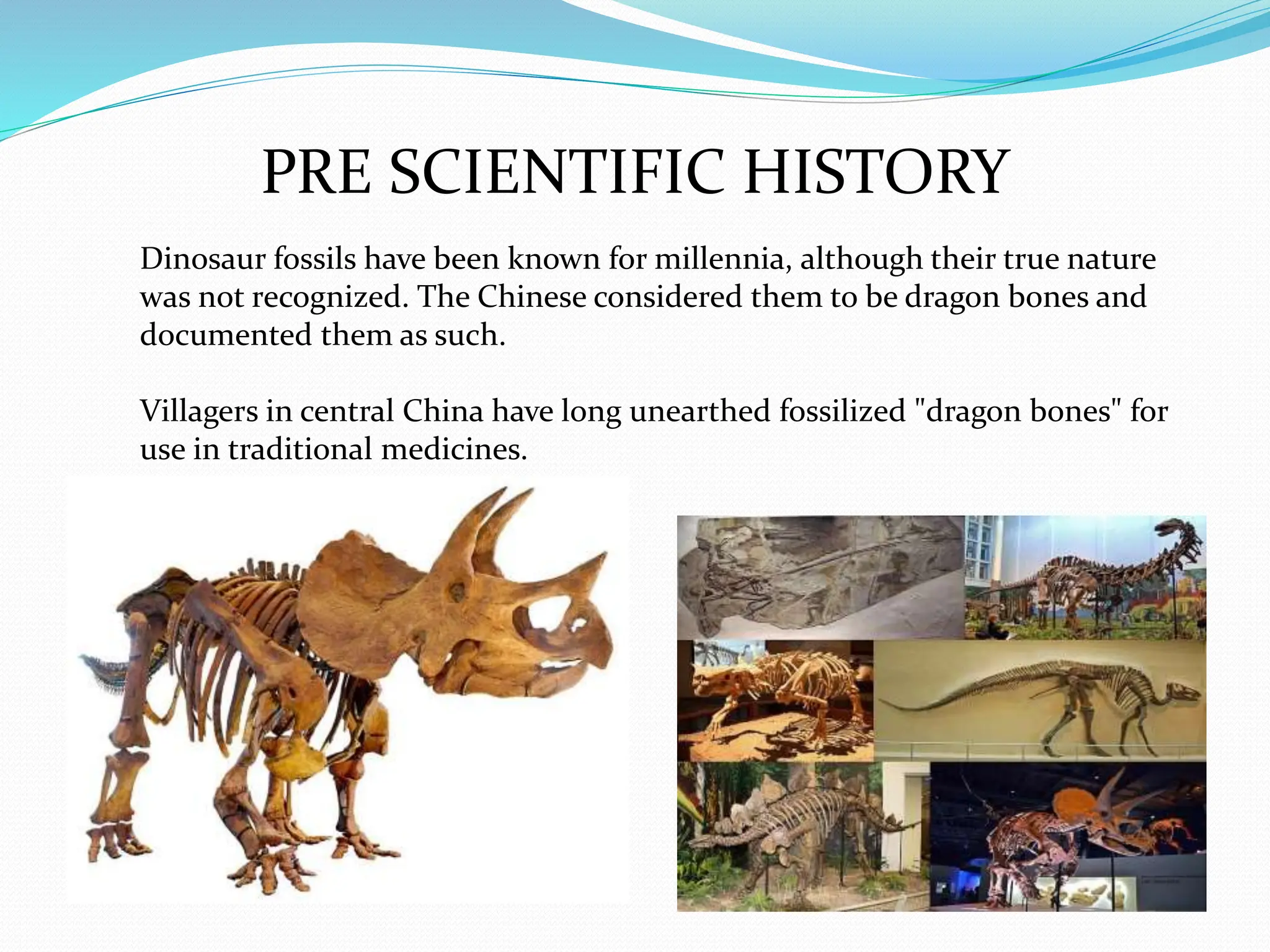
Dinosaur fossils have been known for millennia, although their true nature
was not recognized. The Chinese considered them to be dragon bones and
documented them as such.
Villagers in central China have long unearthed fossilized "dragon bones" for
use in traditional medicines.
Scholarly descriptions of what would now be recognized as dinosaur bones first
appeared in the late 17th century in England
In 1842, the English naturalist Sir Richard Owen coined the term Dinosauria,
derived from the Greek deinos, meaning “fearfully great,” and sauros, meaning
“lizard.”
SCIENTIFIC HISTORY
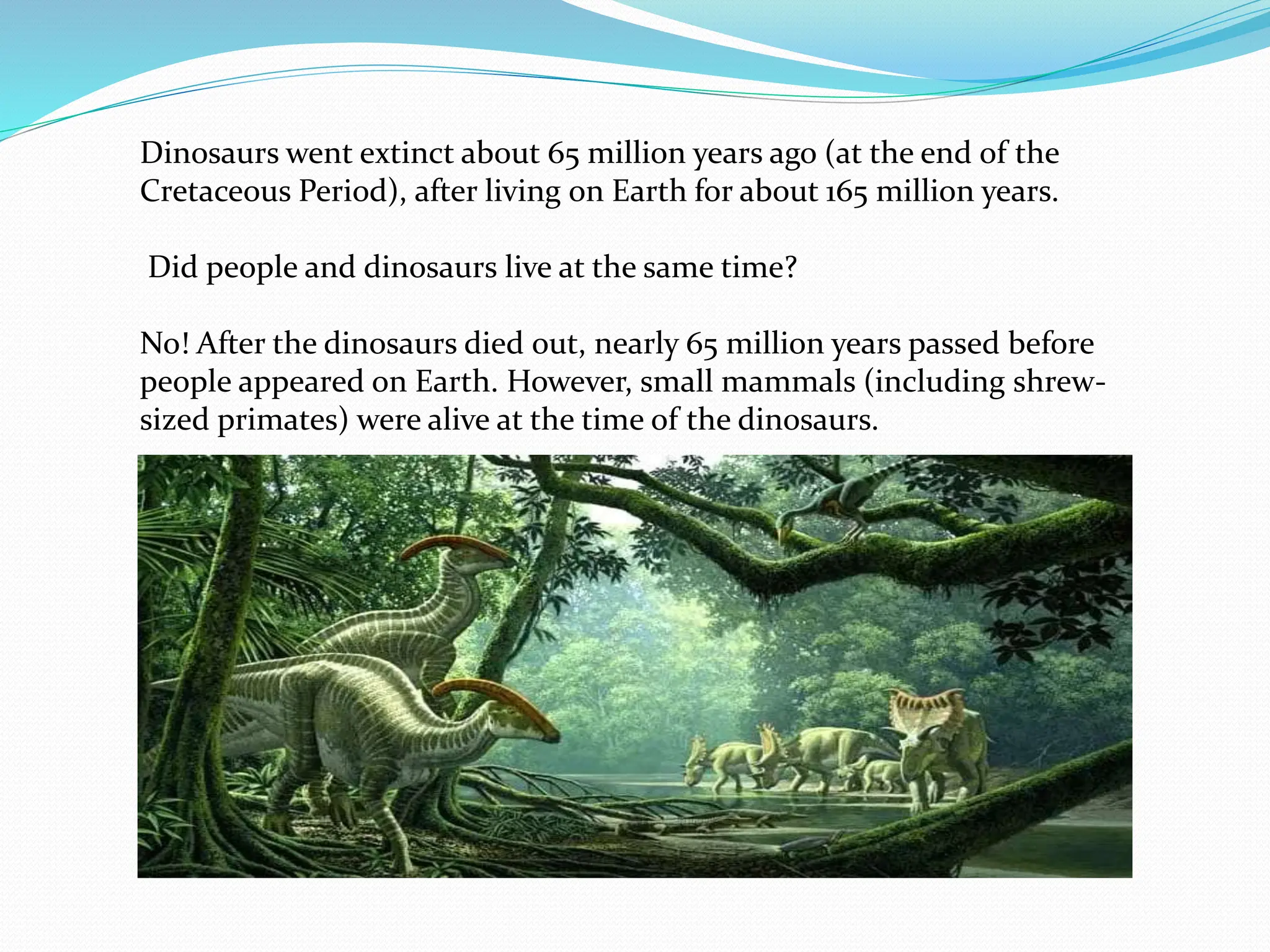
Dinosaurs went extinct about 65 million years ago (at the end of the
Cretaceous Period), after living on Earth for about 165 million years.
Did people and dinosaurs live at the same time?
No! After the dinosaurs died out, nearly 65 million years passed before
people appeared on Earth. However, small mammals (including shrew-
sized primates) were alive at the time of the dinosaurs.
CLASSIFICATIONS OF DINOSAURS
Ankylosaurus
is a creature so overdesigned that it
seems too good to be true. With
spikes on its head and side, a back
covered with armored plates, and a
tail that ended in a massive club of
bone, it was more spectacularly
protected from predators
than Stegosaurus with its
ostentatious plates
Ornithopoda
is a clade of ornithischian dinosaurs,
called ornithopods, that started out
as small, bipedal running grazers and
grew in size and numbers until they
became one of the most successful
groups of herbivores in
the Cretaceous world, dominating
the North American land.
Titanosaurs
were a diverse group of
sauropod dinosaurs,
which included
Saltasaurus and
Isisaurus.
Herrerasaurus
was one of the earliest
carnivorous dinosaurs. It
lived in what is now
Argentina, during the Late
Triassic Period ( Carnian
stage).
Ceratosaurs
The dinosaur was given this
name because it had a row
of sharp horns on its head
and a row of small, bony
pieces of armour running
along its back.
Birds (Aves),
also known as Avian Dinosaurs,
comprise the last surviving
group of theropod dinosaurs
with approximately 18,000
species. This means that there
are more species of dinosaur
alive today than there were in
the Mesozoic.
EXTINCTION
Dinosaurs went extinct about 65 million years ago . Fossils have been found on all seven
continents. All non-avian dinosaurs went extinct about 66 million years ago. There are
roughly 700 known species of extinct dinosaurs. Modern birds are a kind of dinosaur
because they share a common ancestor with non-avian dinosaurs.
RESEARCH
 The first dinosaur fossils were recognized in the early 19th century, with the name
"dinosaur" (meaning "terrible lizard") being coined by Sir Richard Owen in 1841 to
refer to these "great fossil lizards".
Between 1815 and 1824, the Rev William Buckland collected more fossilized bones
of Megalosaurus and became the first person to describe a non-avian dinosaur in a scientific
journal.
Sir Richard Owen's coining of
the word dinosaur, at a
meeting of the British
Association for the
Advancement of Science in
1841
William Buckland
(The first Reader
of Geology at the
University of
Oxford)
Discovery of Fossils
Sleeping Nodosaur Fossil with Skin and
Scales
Iziko Museum (Cape Town, South Africa)
Field Museum (Chicago)
Dinosaur
fossil in
Kutch,
Gujarat
Diplodocus
(1878) – United
States of America
Can we bring back dinosaurs?
It’s a good idea or not.
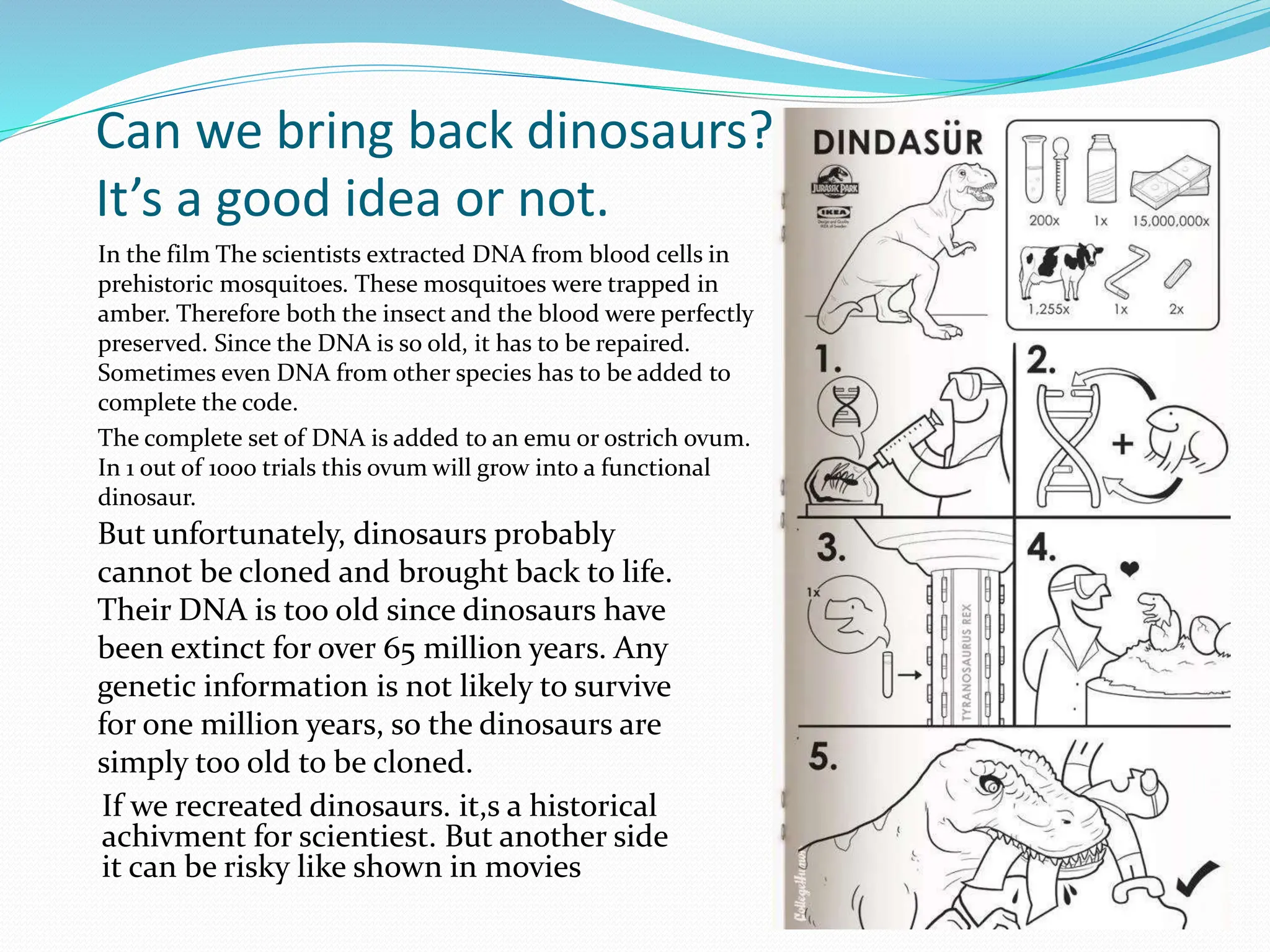
In the film The scientists extracted DNA from blood cells in
prehistoric mosquitoes. These mosquitoes were trapped in
amber. Therefore both the insect and the blood were perfectly
preserved. Since the DNA is so old, it has to be repaired.
Sometimes even DNA from other species has to be added to
complete the code.
The complete set of DNA is added to an emu or ostrich ovum.
In 1 out of 1000 trials this ovum will grow into a functional
dinosaur.
If we recreated dinosaurs. it,s a historical
achivment for scientiest. But another side
it can be risky like shown in movies
But unfortunately, dinosaurs probably
cannot be cloned and brought back to life.
Their DNA is too old since dinosaurs have
been extinct for over 65 million years. Any
genetic information is not likely to survive
for one million years, so the dinosaurs are
simply too old to be cloned.
REFERENCES
Matthew G. Baron; Megan E. Williams (2018). "A re-
evaluation of the enigmatic dinosauriform Caseosaurus
crosbyensis from the Late Triassic of Texas, USA and its
implications for early dinosaur evolution". Acta
Palaeontologica Polonica.
Andrea Cau (2018). "The assembly of the avian body plan: a
160-million-year long process" (PDF). Bollettino della Società
Paleontologica Italiana. 57 (1): 1–25.
Ferigolo, Jorge; Langer, Max C. (January 1, 2007). "A Late
Triassic dinosauriform from south Brazil and the origin of the
ornithischian predentary bone". Historical Biology. 19 (1): 23–
33. doi:10.1080/08912960600845767. ISSN 0891-2963. S2CID
85819339
Purusottam Tushar sahu
Mukesh sahu Mukesh kumar
Dainasor life end the earth  🌎     .pptx

Dainasor life end the earth 🌎 .pptx

  • 2.
    CONTENTS  INTRODUCTON  HISTORY CLASSIFICATION  EXTINCTION OF MAJOR GROUPS  RESEARCH
  • 3.
    Dinosaurs are adiverse group of reptiles of the Clade Dinosauria. They first appeared during the Triassic period, between 245 and 233.33 million years ago. INTRODUCTION
  • 4.
    Dinosaurs can bedivided into Avian dinosaurs-Birds and Non-Avian dinosaurs-get extinct dinosaurs Avian dinosaurs-Birds Non -Avian dinosaurs
  • 5.
    MAJOR GROUPS ORNITHISCHIA –Itis an extinct order of mainly herbivorous dinosaurs, characterized by pelvic structure SAUROPODOMORPHA –It had very long necks, long tails ,small heads and four thick pillar like legs. THEROPODA-They were ancestrally Carnivorous.
  • 6.
    Dinosaurs are variedfrom taxonomic, morphological and ecological standpoints. Some were herbivorous and others are carnivorous. Suggest that all dinosaurs were egg laying and that nests building was a trait shared by many dinosaurs both avian and non-avian. While dinosaurs were ancestrally bipedal, many extinct groups.
  • 7.
    PRE SCIENTIFIC HISTORY Dinosaurfossils have been known for millennia, although their true nature was not recognized. The Chinese considered them to be dragon bones and documented them as such. Villagers in central China have long unearthed fossilized "dragon bones" for use in traditional medicines.
  • 8.
    Scholarly descriptions ofwhat would now be recognized as dinosaur bones first appeared in the late 17th century in England In 1842, the English naturalist Sir Richard Owen coined the term Dinosauria, derived from the Greek deinos, meaning “fearfully great,” and sauros, meaning “lizard.” SCIENTIFIC HISTORY
  • 9.
    Dinosaurs went extinctabout 65 million years ago (at the end of the Cretaceous Period), after living on Earth for about 165 million years. Did people and dinosaurs live at the same time? No! After the dinosaurs died out, nearly 65 million years passed before people appeared on Earth. However, small mammals (including shrew- sized primates) were alive at the time of the dinosaurs.
  • 10.
  • 11.
    Ankylosaurus is a creatureso overdesigned that it seems too good to be true. With spikes on its head and side, a back covered with armored plates, and a tail that ended in a massive club of bone, it was more spectacularly protected from predators than Stegosaurus with its ostentatious plates Ornithopoda is a clade of ornithischian dinosaurs, called ornithopods, that started out as small, bipedal running grazers and grew in size and numbers until they became one of the most successful groups of herbivores in the Cretaceous world, dominating the North American land. Titanosaurs were a diverse group of sauropod dinosaurs, which included Saltasaurus and Isisaurus.
  • 12.
    Herrerasaurus was one ofthe earliest carnivorous dinosaurs. It lived in what is now Argentina, during the Late Triassic Period ( Carnian stage). Ceratosaurs The dinosaur was given this name because it had a row of sharp horns on its head and a row of small, bony pieces of armour running along its back. Birds (Aves), also known as Avian Dinosaurs, comprise the last surviving group of theropod dinosaurs with approximately 18,000 species. This means that there are more species of dinosaur alive today than there were in the Mesozoic.
  • 13.
    EXTINCTION Dinosaurs went extinctabout 65 million years ago . Fossils have been found on all seven continents. All non-avian dinosaurs went extinct about 66 million years ago. There are roughly 700 known species of extinct dinosaurs. Modern birds are a kind of dinosaur because they share a common ancestor with non-avian dinosaurs.
  • 16.
    RESEARCH  The firstdinosaur fossils were recognized in the early 19th century, with the name "dinosaur" (meaning "terrible lizard") being coined by Sir Richard Owen in 1841 to refer to these "great fossil lizards". Between 1815 and 1824, the Rev William Buckland collected more fossilized bones of Megalosaurus and became the first person to describe a non-avian dinosaur in a scientific journal. Sir Richard Owen's coining of the word dinosaur, at a meeting of the British Association for the Advancement of Science in 1841 William Buckland (The first Reader of Geology at the University of Oxford)
  • 17.
    Discovery of Fossils SleepingNodosaur Fossil with Skin and Scales Iziko Museum (Cape Town, South Africa) Field Museum (Chicago) Dinosaur fossil in Kutch, Gujarat Diplodocus (1878) – United States of America
  • 18.
    Can we bringback dinosaurs? It’s a good idea or not. In the film The scientists extracted DNA from blood cells in prehistoric mosquitoes. These mosquitoes were trapped in amber. Therefore both the insect and the blood were perfectly preserved. Since the DNA is so old, it has to be repaired. Sometimes even DNA from other species has to be added to complete the code. The complete set of DNA is added to an emu or ostrich ovum. In 1 out of 1000 trials this ovum will grow into a functional dinosaur. If we recreated dinosaurs. it,s a historical achivment for scientiest. But another side it can be risky like shown in movies But unfortunately, dinosaurs probably cannot be cloned and brought back to life. Their DNA is too old since dinosaurs have been extinct for over 65 million years. Any genetic information is not likely to survive for one million years, so the dinosaurs are simply too old to be cloned.
  • 19.
    REFERENCES Matthew G. Baron;Megan E. Williams (2018). "A re- evaluation of the enigmatic dinosauriform Caseosaurus crosbyensis from the Late Triassic of Texas, USA and its implications for early dinosaur evolution". Acta Palaeontologica Polonica. Andrea Cau (2018). "The assembly of the avian body plan: a 160-million-year long process" (PDF). Bollettino della Società Paleontologica Italiana. 57 (1): 1–25. Ferigolo, Jorge; Langer, Max C. (January 1, 2007). "A Late Triassic dinosauriform from south Brazil and the origin of the ornithischian predentary bone". Historical Biology. 19 (1): 23– 33. doi:10.1080/08912960600845767. ISSN 0891-2963. S2CID 85819339
  • 20.