IOSR Journal Of Pharmacy
(e)-ISSN: 2250-3013, (p)-ISSN: 2319-4219
www.iosrphr.org Volume 5, Issue 1 (January 2015), PP. 21-23
21
Preventing Interruptions in IV Carrier Delivery of Vasoactive
Drips in Cardiac Anesthesia and Intensive Care
John T. Denny MD, FCCP 1,
Darrick Chyu MD 1,
Julia E. Denny MSN 2,
Mohammad Chaudhry MD1,
Marco Del Castillo MD 1,
Alann Solina MD 1,
Sharon L. Morgan MSN 1
1
Rutgers Robert Wood Johnson Medical School 3100 CAB, 125 Paterson Street New Brunswick, NJ USA 08901
2
Rutgers Graduate School of Nursing 65 Bergen Street Newark, NJ USA 07107
I. INTRODUCTION:
Stopcocks in intravenous (IV) tubing are an integral part of delivering safe patient care in anesthesia,
critical care, and other areas of medicine.
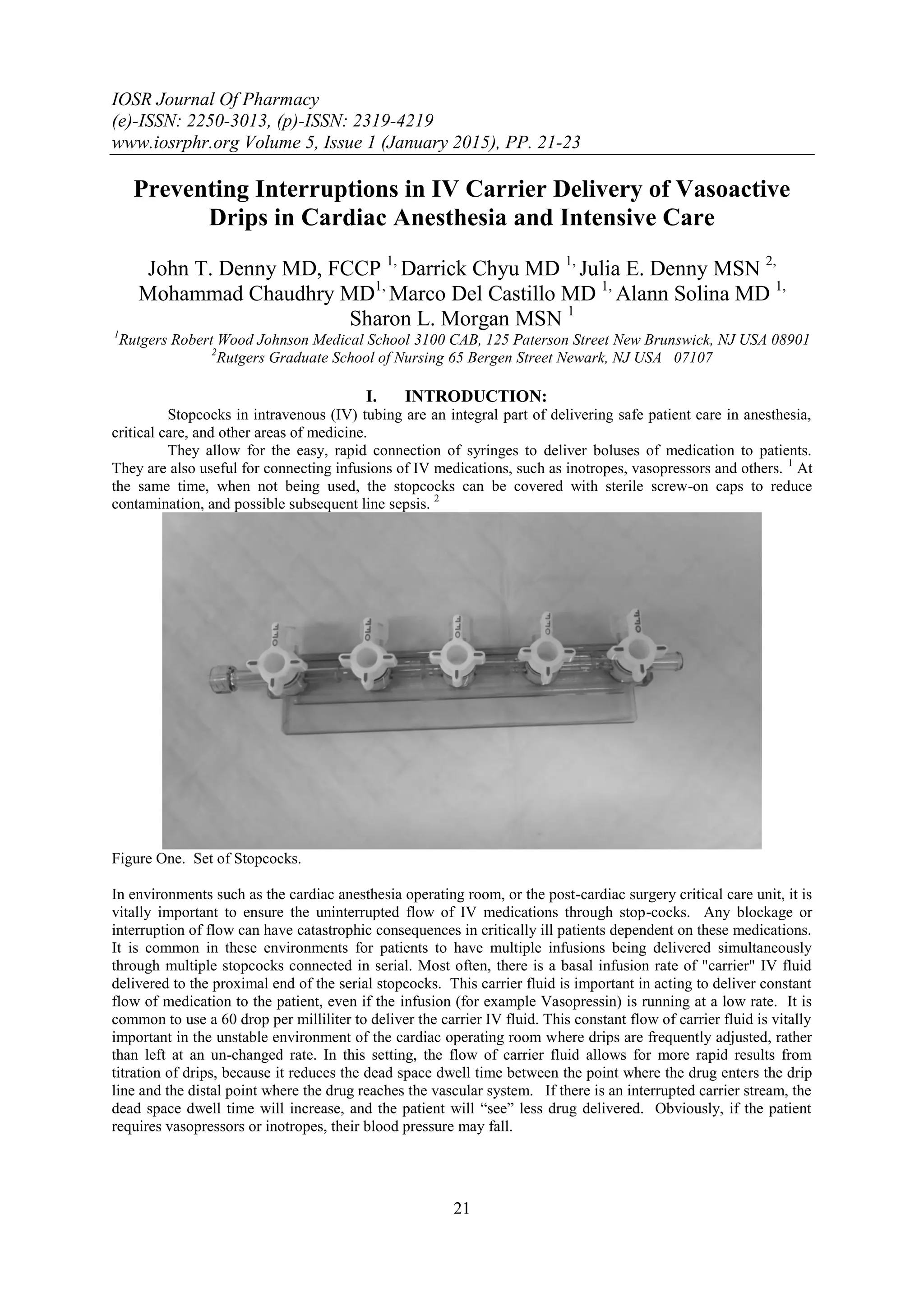
They allow for the easy, rapid connection of syringes to deliver boluses of medication to patients.
They are also useful for connecting infusions of IV medications, such as inotropes, vasopressors and others. 1
At
the same time, when not being used, the stopcocks can be covered with sterile screw-on caps to reduce
contamination, and possible subsequent line sepsis. 2
Figure One. Set of Stopcocks.
In environments such as the cardiac anesthesia operating room, or the post-cardiac surgery critical care unit, it is
vitally important to ensure the uninterrupted flow of IV medications through stop-cocks. Any blockage or
interruption of flow can have catastrophic consequences in critically ill patients dependent on these medications.
It is common in these environments for patients to have multiple infusions being delivered simultaneously
through multiple stopcocks connected in serial. Most often, there is a basal infusion rate of "carrier" IV fluid
delivered to the proximal end of the serial stopcocks. This carrier fluid is important in acting to deliver constant
flow of medication to the patient, even if the infusion (for example Vasopressin) is running at a low rate. It is
common to use a 60 drop per milliliter to deliver the carrier IV fluid. This constant flow of carrier fluid is vitally
important in the unstable environment of the cardiac operating room where drips are frequently adjusted, rather
than left at an un-changed rate. In this setting, the flow of carrier fluid allows for more rapid results from
titration of drips, because it reduces the dead space dwell time between the point where the drug enters the drip
line and the distal point where the drug reaches the vascular system. If there is an interrupted carrier stream, the
dead space dwell time will increase, and the patient will “see” less drug delivered. Obviously, if the patient
requires vasopressors or inotropes, their blood pressure may fall.
Preventing Interruptions in IV Carrier Delivery of Vasoactive Drips in Cardiac Anesthesia and
22
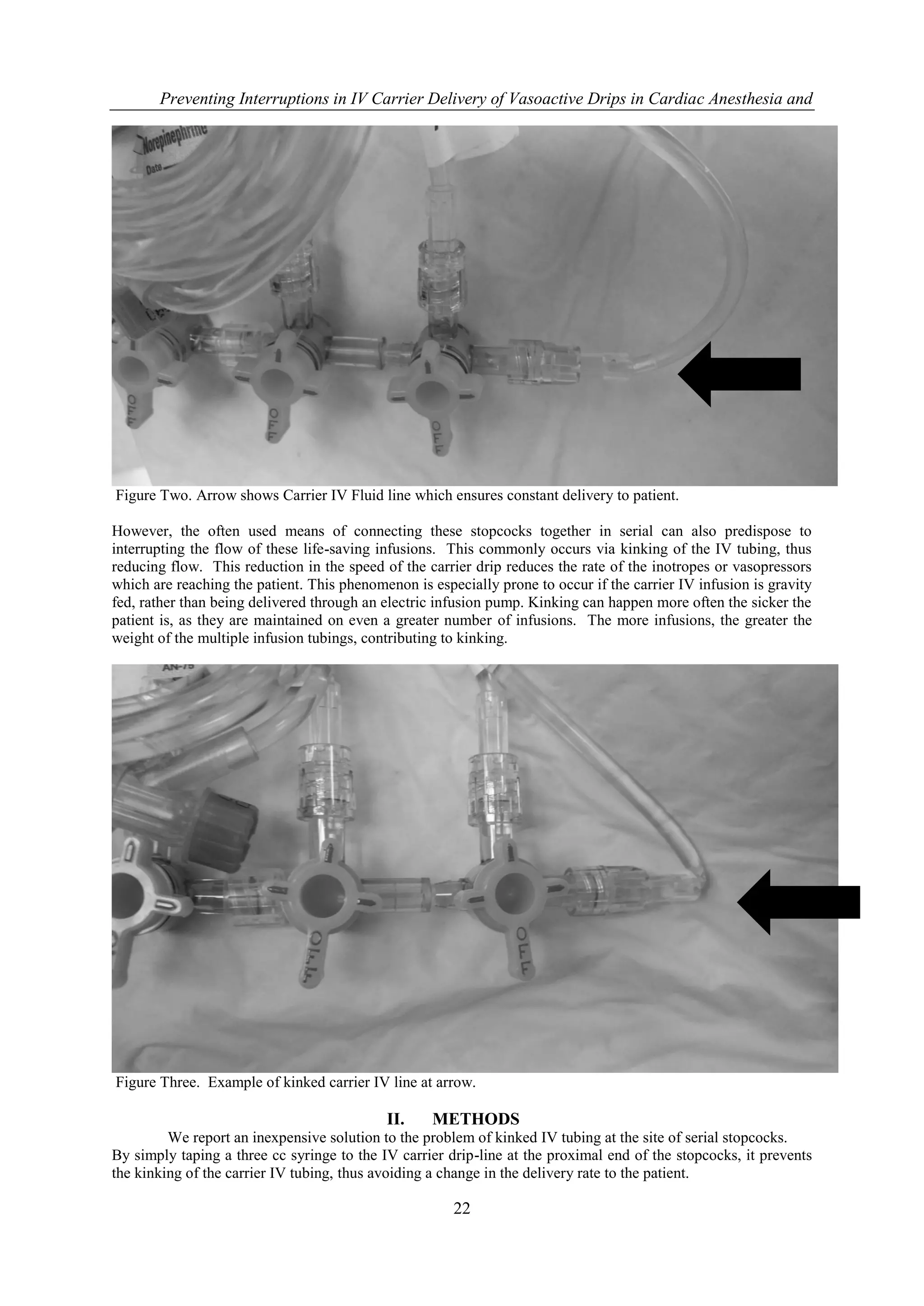
Figure Two. Arrow shows Carrier IV Fluid line which ensures constant delivery to patient.
However, the often used means of connecting these stopcocks together in serial can also predispose to
interrupting the flow of these life-saving infusions. This commonly occurs via kinking of the IV tubing, thus
reducing flow. This reduction in the speed of the carrier drip reduces the rate of the inotropes or vasopressors
which are reaching the patient. This phenomenon is especially prone to occur if the carrier IV infusion is gravity
fed, rather than being delivered through an electric infusion pump. Kinking can happen more often the sicker the
patient is, as they are maintained on even a greater number of infusions. The more infusions, the greater the
weight of the multiple infusion tubings, contributing to kinking.
Figure Three. Example of kinked carrier IV line at arrow.
II. METHODS
We report an inexpensive solution to the problem of kinked IV tubing at the site of serial stopcocks.
By simply taping a three cc syringe to the IV carrier drip-line at the proximal end of the stopcocks, it prevents
the kinking of the carrier IV tubing, thus avoiding a change in the delivery rate to the patient.
Preventing Interruptions in IV Carrier Delivery of Vasoactive Drips in Cardiac Anesthesia and
23
Figure Four. Inexpensive adaptation to prevent IV tubing kinking
III. DISCUSSION
This method ensures the un-interrupted delivery of both carrier IV fluid and the vasoactive medications
to the critically ill patient.
To be sure, there are commercially available 'stopcock holders' which aid in holding stop-cocks,
however, these are costly. They may not be available in environments with limited resources and supplies.
Further, they are best suited for use in stationary settings. The transport of such critically ill patients from the
cardiac surgical suite to the post-op ICU is prone to interruption of such IV infusions due to the constant
movement of the equipment during transport. Our simple and in-expensive method using readily available
equipment helps to prevent kinking.
[1]. White MJ, Holder T. A three-way stopcock as a universal anesthetic adapter for metered dose inhalers. Anesth Analg. 1990;70(6):670-
671.
[2]. Crow S, Conrad SA, Chaney-Rowell C, King JW. Microbial contamination of arterial infusions used for hemodynamic monitoring: a
randomized trial of contamination with sampling through conventional stopcocks versus a novel closed system. Infection control and
hospital epidemiology : the official journal of the Society of Hospital Epidemiologists of America. 1989;10(12):557-561.

Preventing Interruptions in IV Carrier Delivery of Vasoactive Drips in Cardiac Anesthesia and Intensive Care

  • 1.
    IOSR Journal OfPharmacy (e)-ISSN: 2250-3013, (p)-ISSN: 2319-4219 www.iosrphr.org Volume 5, Issue 1 (January 2015), PP. 21-23 21 Preventing Interruptions in IV Carrier Delivery of Vasoactive Drips in Cardiac Anesthesia and Intensive Care John T. Denny MD, FCCP 1, Darrick Chyu MD 1, Julia E. Denny MSN 2, Mohammad Chaudhry MD1, Marco Del Castillo MD 1, Alann Solina MD 1, Sharon L. Morgan MSN 1 1 Rutgers Robert Wood Johnson Medical School 3100 CAB, 125 Paterson Street New Brunswick, NJ USA 08901 2 Rutgers Graduate School of Nursing 65 Bergen Street Newark, NJ USA 07107 I. INTRODUCTION: Stopcocks in intravenous (IV) tubing are an integral part of delivering safe patient care in anesthesia, critical care, and other areas of medicine. They allow for the easy, rapid connection of syringes to deliver boluses of medication to patients. They are also useful for connecting infusions of IV medications, such as inotropes, vasopressors and others. 1 At the same time, when not being used, the stopcocks can be covered with sterile screw-on caps to reduce contamination, and possible subsequent line sepsis. 2 Figure One. Set of Stopcocks. In environments such as the cardiac anesthesia operating room, or the post-cardiac surgery critical care unit, it is vitally important to ensure the uninterrupted flow of IV medications through stop-cocks. Any blockage or interruption of flow can have catastrophic consequences in critically ill patients dependent on these medications. It is common in these environments for patients to have multiple infusions being delivered simultaneously through multiple stopcocks connected in serial. Most often, there is a basal infusion rate of "carrier" IV fluid delivered to the proximal end of the serial stopcocks. This carrier fluid is important in acting to deliver constant flow of medication to the patient, even if the infusion (for example Vasopressin) is running at a low rate. It is common to use a 60 drop per milliliter to deliver the carrier IV fluid. This constant flow of carrier fluid is vitally important in the unstable environment of the cardiac operating room where drips are frequently adjusted, rather than left at an un-changed rate. In this setting, the flow of carrier fluid allows for more rapid results from titration of drips, because it reduces the dead space dwell time between the point where the drug enters the drip line and the distal point where the drug reaches the vascular system. If there is an interrupted carrier stream, the dead space dwell time will increase, and the patient will “see” less drug delivered. Obviously, if the patient requires vasopressors or inotropes, their blood pressure may fall.
  • 2.
    Preventing Interruptions inIV Carrier Delivery of Vasoactive Drips in Cardiac Anesthesia and 22 Figure Two. Arrow shows Carrier IV Fluid line which ensures constant delivery to patient. However, the often used means of connecting these stopcocks together in serial can also predispose to interrupting the flow of these life-saving infusions. This commonly occurs via kinking of the IV tubing, thus reducing flow. This reduction in the speed of the carrier drip reduces the rate of the inotropes or vasopressors which are reaching the patient. This phenomenon is especially prone to occur if the carrier IV infusion is gravity fed, rather than being delivered through an electric infusion pump. Kinking can happen more often the sicker the patient is, as they are maintained on even a greater number of infusions. The more infusions, the greater the weight of the multiple infusion tubings, contributing to kinking. Figure Three. Example of kinked carrier IV line at arrow. II. METHODS We report an inexpensive solution to the problem of kinked IV tubing at the site of serial stopcocks. By simply taping a three cc syringe to the IV carrier drip-line at the proximal end of the stopcocks, it prevents the kinking of the carrier IV tubing, thus avoiding a change in the delivery rate to the patient.
  • 3.
    Preventing Interruptions inIV Carrier Delivery of Vasoactive Drips in Cardiac Anesthesia and 23 Figure Four. Inexpensive adaptation to prevent IV tubing kinking III. DISCUSSION This method ensures the un-interrupted delivery of both carrier IV fluid and the vasoactive medications to the critically ill patient. To be sure, there are commercially available 'stopcock holders' which aid in holding stop-cocks, however, these are costly. They may not be available in environments with limited resources and supplies. Further, they are best suited for use in stationary settings. The transport of such critically ill patients from the cardiac surgical suite to the post-op ICU is prone to interruption of such IV infusions due to the constant movement of the equipment during transport. Our simple and in-expensive method using readily available equipment helps to prevent kinking. [1]. White MJ, Holder T. A three-way stopcock as a universal anesthetic adapter for metered dose inhalers. Anesth Analg. 1990;70(6):670- 671. [2]. Crow S, Conrad SA, Chaney-Rowell C, King JW. Microbial contamination of arterial infusions used for hemodynamic monitoring: a randomized trial of contamination with sampling through conventional stopcocks versus a novel closed system. Infection control and hospital epidemiology : the official journal of the Society of Hospital Epidemiologists of America. 1989;10(12):557-561.