Martin Luther King Community Health
Foundation Event
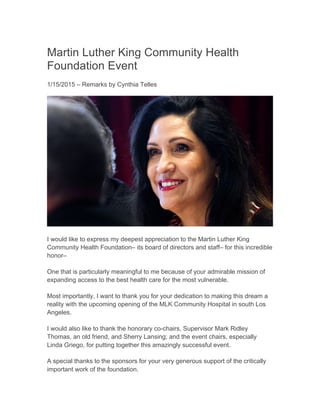
1/15/2015 – Remarks by Cynthia Telles
I would like to express my deepest appreciation to the Martin Luther King
Community Health Foundation– its board of directors and staff– for this incredible
honor–
One that is particularly meaningful to me because of your admirable mission of
expanding access to the best health care for the most vulnerable.
Most importantly, I want to thank you for your dedication to making this dream a
reality with the upcoming opening of the MLK Community Hospital in south Los
Angeles.
I would also like to thank the honorary co-chairs, Supervisor Mark Ridley
Thomas, an old friend, and Sherry Lansing; and the event chairs, especially
Linda Griego, for putting together this amazingly successful event.
A special thanks to the sponsors for your very generous support of the critically
important work of the foundation.
I would like to recognize my family that is present here today, in particular, my
wonderful husband, Joe and my amazing son, Raymond. You are a blessing in
my life. Your love and support mean the world to me.
As well, my late parents, who are here in spirit– who taught me through example
that public and community service is a noble calling–
I am very grateful to each of you for joining us today—your presence here is
evidence of your commitment to making a difference to a cause beyond yourself.
As I look around the room, I see an extraordinary cross-section of people from all
walks of life, from diverse races, cultures, neighborhoods–
Who have come together to show your support for this dream that all people
should have the right to good health—a dream of a more just society.
It is hard to imagine a time of greater need for this type of partnership and true
collaboration between all sectors— including community leaders, philanthropy,
labor, government, business and the entertainment industry— to effectively
tackle the daunting issues of our day.
We are at a pivotal and defining moment in our history. We face great
challenges, as well as great opportunities.
As coined by Dickens–it is “the best of times… The worst of times.”
On the one hand, we live in an era of unprecedented prosperity in the history of
humankind; on the other hand, we see a widening gap in income —and
disparities in job and educational opportunities –at global level.
We live in a nation of unparalleled affluence, while we witness an explosion of
homelessness and failure of our public schools.
We live in a time of extraordinary achievements in biomedical technology. At the
same time, we see growing disparities in health status— related to poverty, race
and ethnicity that, in turn, result in lower educational achievement and future
unemployment.
We live in a period of accelerated global interdependence and exponential
growth of technological, scientific and entrepreneurial collaboration across
national borders— at the same time as increasing ethnic strife, religious conflict
and violence around the world.
Here in Los Angeles–we live in a microcosm of this world—with its best and its
worst.
Thus, we have a unique opportunity. Our city can become the model for weaving
together our various colorful, contrasting, at times clashing, threads into a strong,
healthy social fabric. We can lead the state and even the nation.
We will only thrive as a civil society if we figure out a way of coming together—of
finding solutions that will lift us all—and, thereby, fulfilling the dream envisioned
by Dr. King.
We are at the threshold of real opportunity for positive change.
With the historic passage of the Accountable Care Act, millions of low-income
Americans previously uninsured now have health care coverage.
But, this is only the first step toward ensuring true health equity–providing access
to high quality health services for all and promoting the wellbeing of our diverse
communities.
Unfortunately, we still hear disappointing stories of some newly insured persons
finally seeking care–only to be denied service by listed private providers and
facilities that are now limiting access and even dropping these patients.
We still hear accounts of mothers and children in poverty waiting too long to be
treated when they’re sick— because we haven’t created enough capacity.
We still hear too many stories about hard working, immigrant men and women
not having access to linguistically competent health and mental health services–
and who are exposed to the risks of poor quality care, misdiagnosis and errors in
treatment.
We still know too many undocumented families living in the shadows–ineligible
for insurance and afraid to seek service until its too late.
We still see the lack of parity of mental health care for the poor, especially in the
faces of our homeless and incarcerated mentally ill.
There is much more work to be done.
Thus, to quote Dr. King’s inspiring words, “we cannot rest…we cannot be
satisfied”-
We cannot rest…until we have ensured health equity for all Americans.
We cannot rest… until we eliminate unequal treatment and disparities among the
most vulnerable.
We cannot rest… until our vision for a healthy community ensures the well-being
of all and addresses the social determinants of health where people live and
work.
We cannot rest… until diversity is a source of strength for communities; health is
a shared agenda; and partnership is a norm.
Today, there is reason for much hope.
Your presence here to support a great cause—and, for many of you, your life’s
work– moves us closer and closer to fulfilling the dream.
The MLK Community Hospital was founded on a noble mission to provide the
highest quality of care to the most vulnerable and to improve the health of our
community.
This shared mission, this hospital is an embodiment of Dr. King’s dream.
Clearly, together, we can make a difference in the lives of others, in creating a
healthier community and, ultimately, in strengthening the fabric of our society for
our own good and that of others.
In the end, our destinies are inextricably interwoven. It won’t really matter that we
made it individually, unless we make a difference for those around us who have
been left behind.
In the words of Cesar Chavez: “we cannot seek achievement for ourselves and
forget about the progress and prosperity of our community. Our ambitions must
be broad enough to include the aspirations and needs of others, for their sakes
and for our own.”
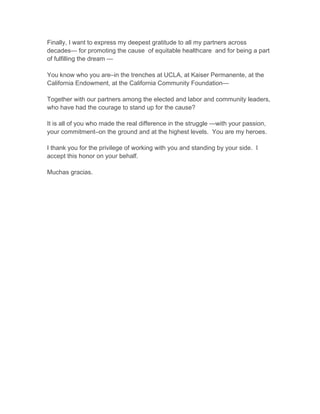
Finally, I want to express my deepest gratitude to all my partners across
decades— for promoting the cause of equitable healthcare and for being a part
of fulfilling the dream —
You know who you are–in the trenches at UCLA, at Kaiser Permanente, at the
California Endowment, at the California Community Foundation—
Together with our partners among the elected and labor and community leaders,
who have had the courage to stand up for the cause?
It is all of you who made the real difference in the struggle —with your passion,
your commitment–on the ground and at the highest levels. You are my heroes.
I thank you for the privilege of working with you and standing by your side. I
accept this honor on your behalf.
Muchas gracias.
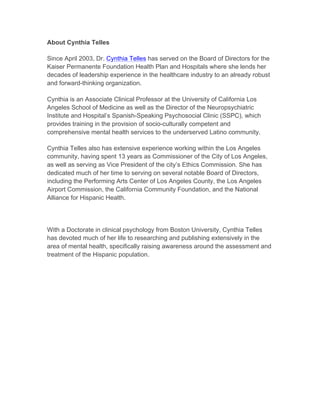
About Cynthia Telles
Since April 2003, Dr. Cynthia Telles has served on the Board of Directors for the
Kaiser Permanente Foundation Health Plan and Hospitals where she lends her
decades of leadership experience in the healthcare industry to an already robust
and forward-thinking organization.
Cynthia is an Associate Clinical Professor at the University of California Los
Angeles School of Medicine as well as the Director of the Neuropsychiatric
Institute and Hospital’s Spanish-Speaking Psychosocial Clinic (SSPC), which
provides training in the provision of socio-culturally competent and
comprehensive mental health services to the underserved Latino community.
Cynthia Telles also has extensive experience working within the Los Angeles
community, having spent 13 years as Commissioner of the City of Los Angeles,
as well as serving as Vice President of the city’s Ethics Commission. She has
dedicated much of her time to serving on several notable Board of Directors,
including the Performing Arts Center of Los Angeles County, the Los Angeles
Airport Commission, the California Community Foundation, and the National
Alliance for Hispanic Health.
With a Doctorate in clinical psychology from Boston University, Cynthia Telles
has devoted much of her life to researching and publishing extensively in the
area of mental health, specifically raising awareness around the assessment and
treatment of the Hispanic population.

Cynthia Telles: Martin Luther King Community Health Foundation Event

  • 1.
    Martin Luther KingCommunity Health Foundation Event 1/15/2015 – Remarks by Cynthia Telles I would like to express my deepest appreciation to the Martin Luther King Community Health Foundation– its board of directors and staff– for this incredible honor– One that is particularly meaningful to me because of your admirable mission of expanding access to the best health care for the most vulnerable. Most importantly, I want to thank you for your dedication to making this dream a reality with the upcoming opening of the MLK Community Hospital in south Los Angeles. I would also like to thank the honorary co-chairs, Supervisor Mark Ridley Thomas, an old friend, and Sherry Lansing; and the event chairs, especially Linda Griego, for putting together this amazingly successful event. A special thanks to the sponsors for your very generous support of the critically important work of the foundation.
  • 2.
    I would liketo recognize my family that is present here today, in particular, my wonderful husband, Joe and my amazing son, Raymond. You are a blessing in my life. Your love and support mean the world to me. As well, my late parents, who are here in spirit– who taught me through example that public and community service is a noble calling– I am very grateful to each of you for joining us today—your presence here is evidence of your commitment to making a difference to a cause beyond yourself. As I look around the room, I see an extraordinary cross-section of people from all walks of life, from diverse races, cultures, neighborhoods– Who have come together to show your support for this dream that all people should have the right to good health—a dream of a more just society. It is hard to imagine a time of greater need for this type of partnership and true collaboration between all sectors— including community leaders, philanthropy, labor, government, business and the entertainment industry— to effectively tackle the daunting issues of our day. We are at a pivotal and defining moment in our history. We face great challenges, as well as great opportunities. As coined by Dickens–it is “the best of times… The worst of times.” On the one hand, we live in an era of unprecedented prosperity in the history of humankind; on the other hand, we see a widening gap in income —and disparities in job and educational opportunities –at global level. We live in a nation of unparalleled affluence, while we witness an explosion of homelessness and failure of our public schools. We live in a time of extraordinary achievements in biomedical technology. At the same time, we see growing disparities in health status— related to poverty, race and ethnicity that, in turn, result in lower educational achievement and future unemployment. We live in a period of accelerated global interdependence and exponential growth of technological, scientific and entrepreneurial collaboration across
  • 3.
    national borders— atthe same time as increasing ethnic strife, religious conflict and violence around the world. Here in Los Angeles–we live in a microcosm of this world—with its best and its worst. Thus, we have a unique opportunity. Our city can become the model for weaving together our various colorful, contrasting, at times clashing, threads into a strong, healthy social fabric. We can lead the state and even the nation. We will only thrive as a civil society if we figure out a way of coming together—of finding solutions that will lift us all—and, thereby, fulfilling the dream envisioned by Dr. King. We are at the threshold of real opportunity for positive change. With the historic passage of the Accountable Care Act, millions of low-income Americans previously uninsured now have health care coverage. But, this is only the first step toward ensuring true health equity–providing access to high quality health services for all and promoting the wellbeing of our diverse communities. Unfortunately, we still hear disappointing stories of some newly insured persons finally seeking care–only to be denied service by listed private providers and facilities that are now limiting access and even dropping these patients. We still hear accounts of mothers and children in poverty waiting too long to be treated when they’re sick— because we haven’t created enough capacity. We still hear too many stories about hard working, immigrant men and women not having access to linguistically competent health and mental health services– and who are exposed to the risks of poor quality care, misdiagnosis and errors in treatment. We still know too many undocumented families living in the shadows–ineligible for insurance and afraid to seek service until its too late. We still see the lack of parity of mental health care for the poor, especially in the faces of our homeless and incarcerated mentally ill.
  • 4.
    There is muchmore work to be done. Thus, to quote Dr. King’s inspiring words, “we cannot rest…we cannot be satisfied”- We cannot rest…until we have ensured health equity for all Americans. We cannot rest… until we eliminate unequal treatment and disparities among the most vulnerable. We cannot rest… until our vision for a healthy community ensures the well-being of all and addresses the social determinants of health where people live and work. We cannot rest… until diversity is a source of strength for communities; health is a shared agenda; and partnership is a norm. Today, there is reason for much hope. Your presence here to support a great cause—and, for many of you, your life’s work– moves us closer and closer to fulfilling the dream. The MLK Community Hospital was founded on a noble mission to provide the highest quality of care to the most vulnerable and to improve the health of our community. This shared mission, this hospital is an embodiment of Dr. King’s dream. Clearly, together, we can make a difference in the lives of others, in creating a healthier community and, ultimately, in strengthening the fabric of our society for our own good and that of others. In the end, our destinies are inextricably interwoven. It won’t really matter that we made it individually, unless we make a difference for those around us who have been left behind. In the words of Cesar Chavez: “we cannot seek achievement for ourselves and forget about the progress and prosperity of our community. Our ambitions must be broad enough to include the aspirations and needs of others, for their sakes and for our own.”
  • 5.
    Finally, I wantto express my deepest gratitude to all my partners across decades— for promoting the cause of equitable healthcare and for being a part of fulfilling the dream — You know who you are–in the trenches at UCLA, at Kaiser Permanente, at the California Endowment, at the California Community Foundation— Together with our partners among the elected and labor and community leaders, who have had the courage to stand up for the cause? It is all of you who made the real difference in the struggle —with your passion, your commitment–on the ground and at the highest levels. You are my heroes. I thank you for the privilege of working with you and standing by your side. I accept this honor on your behalf. Muchas gracias.
  • 6.
    About Cynthia Telles SinceApril 2003, Dr. Cynthia Telles has served on the Board of Directors for the Kaiser Permanente Foundation Health Plan and Hospitals where she lends her decades of leadership experience in the healthcare industry to an already robust and forward-thinking organization. Cynthia is an Associate Clinical Professor at the University of California Los Angeles School of Medicine as well as the Director of the Neuropsychiatric Institute and Hospital’s Spanish-Speaking Psychosocial Clinic (SSPC), which provides training in the provision of socio-culturally competent and comprehensive mental health services to the underserved Latino community. Cynthia Telles also has extensive experience working within the Los Angeles community, having spent 13 years as Commissioner of the City of Los Angeles, as well as serving as Vice President of the city’s Ethics Commission. She has dedicated much of her time to serving on several notable Board of Directors, including the Performing Arts Center of Los Angeles County, the Los Angeles Airport Commission, the California Community Foundation, and the National Alliance for Hispanic Health. With a Doctorate in clinical psychology from Boston University, Cynthia Telles has devoted much of her life to researching and publishing extensively in the area of mental health, specifically raising awareness around the assessment and treatment of the Hispanic population.