Current Issues on Family Business
Lourdes Casanova & Anne Miroux
Emerging Markets Institute
May 13, 2019
2 Johnson | Cornell SC Johnson College of Business
Emerging Markets Report (EMR) 2018 Yearly Report since 2016
• Monitoring Emerging Multinationals  Chinese
– Revenues, profits, Price & branding comparison, OFDI: M&A & greenfield
• With EMRN (USP, UniAndes, Tec de Monterrey, San Andres, China)
• Data Resources covering Chinese companies
– Revenues: Fortune Global 500, 40 years of longitudinal data
– Standard & Poor’s Capital IQ (M&A)
– Financial Times FdI Markets (Greenfield Investments)
– OFDI data from UNCTAD
– China’s MOFCOM
– World Bank
– Interviews with Company executives
• Downloaded for free in the EMI webpage
3 Johnson | Cornell SC Johnson College of Business
Chinese Companies Power: Speed and Size
China, Reshaping Globalization
3
4 Johnson | Cornell SC Johnson College of Business
Speed: China leading the growth after Global Financial crisis (2005-2018)
Growth in Chinese representation in the Global Fortune 500 (2005-2018)
E20 firms now account for 30% of the global Fortune 500 compared to only 7% in 2005
16
China, 111
South Korea, 16
Brazil, India, 7
México, 4
175
U.S., 126
0
20
40
60
80
100
120
140
160
180
200
2005 2006 2007 2008 2009 2010 2011 2012 2013 2014 2015 2016 2017 2018
China: 69% state owned
U.S. 79% publicly traded
5 Johnson | Cornell SC Johnson College of Business
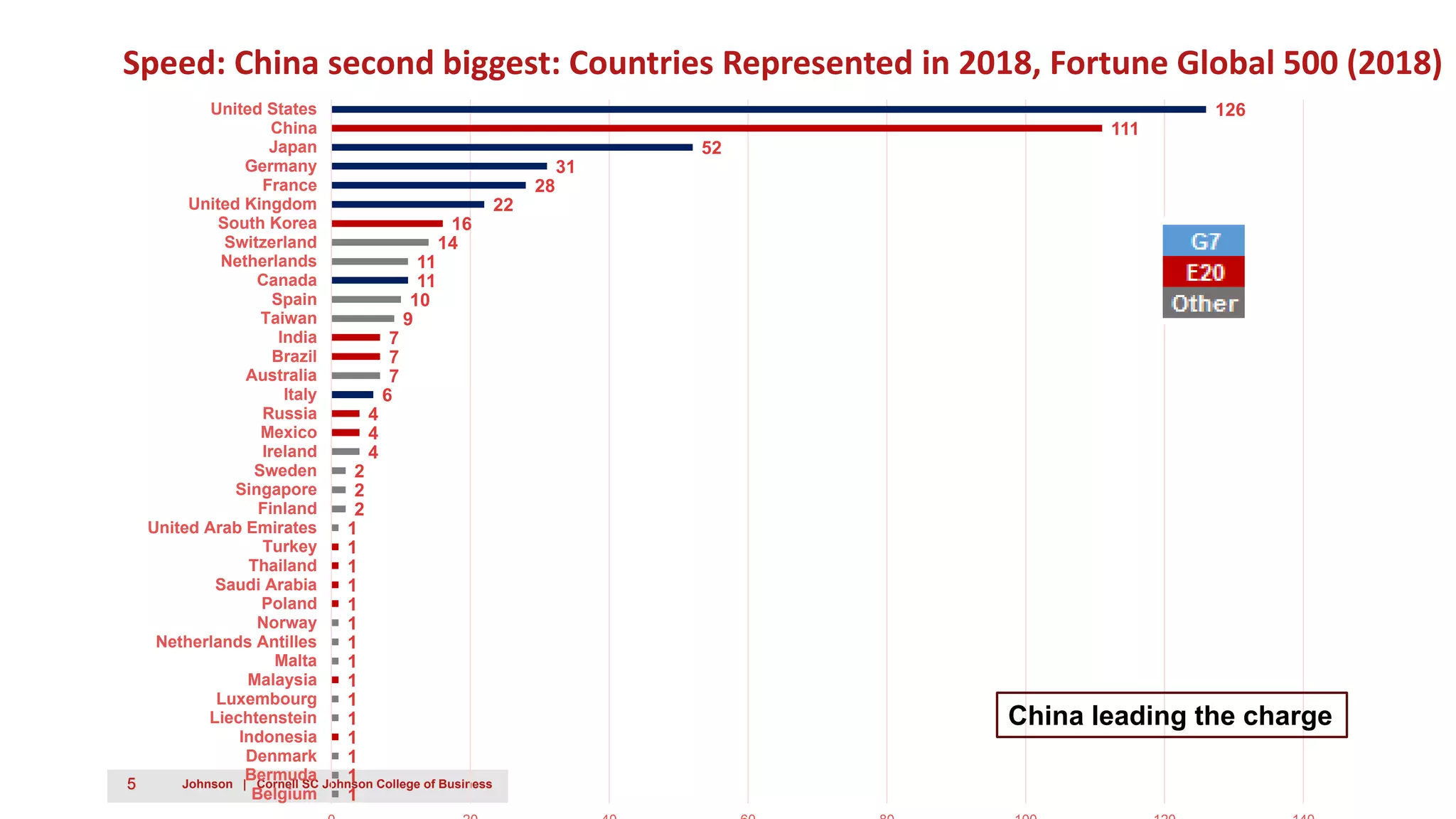
Speed: China second biggest: Countries Represented in 2018, Fortune Global 500 (2018)
1
1
1
1
1
1
1
1
1
1
1
1
1
1
1
2
2
2
4
4
4
6
7
7
7
9
10
11
11
14
16
22
28
31
52
111
126
Belgium
Bermuda
Denmark
Indonesia
Liechtenstein
Luxembourg
Malaysia
Malta
Netherlands Antilles
Norway
Poland
Saudi Arabia
Thailand
Turkey
United Arab Emirates
Finland
Singapore
Sweden
Ireland
Mexico
Russia
Italy
Australia
Brazil
India
Taiwan
Spain
Canada
Netherlands
Switzerland
South Korea
United Kingdom
France
Germany
Japan
China
United States
China leading the charge
6 Johnson | Cornell SC Johnson College of Business
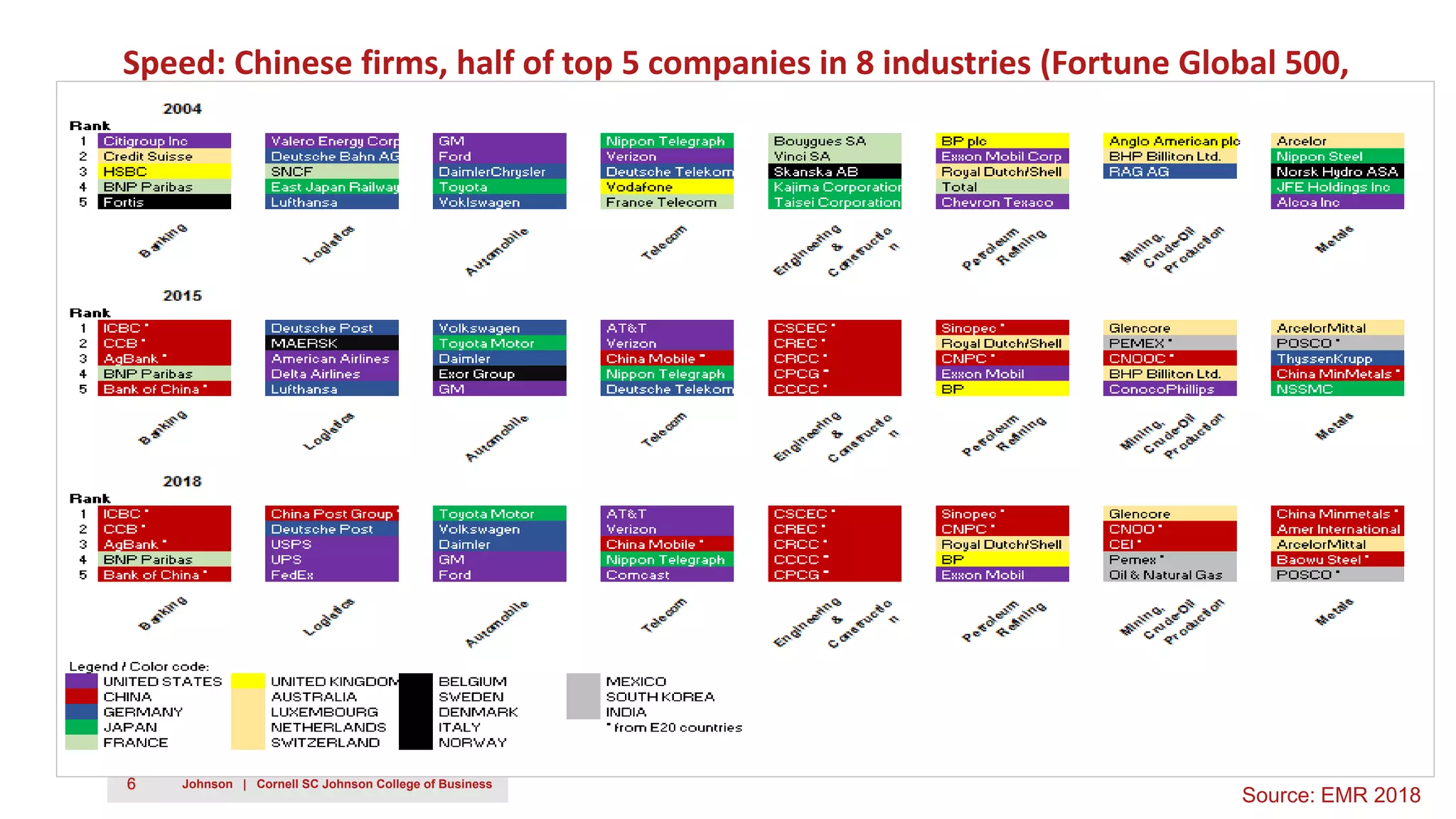
Speed: Chinese firms, half of top 5 companies in 8 industries (Fortune Global 500,
2018)
Source: EMR 2018
7 Johnson | Cornell SC Johnson College of Business
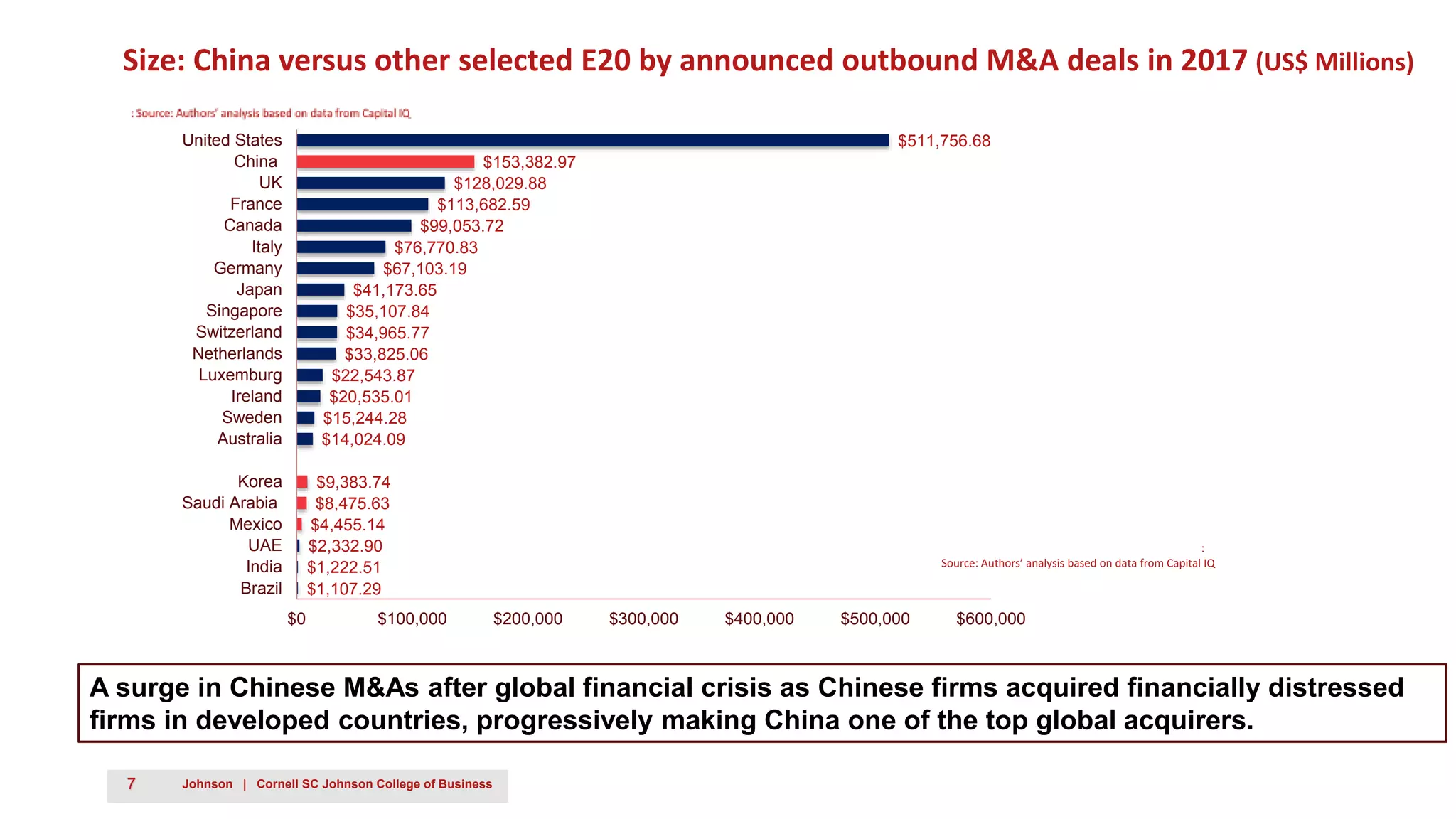
Size: China versus other selected E20 by announced outbound M&A deals in 2017 (US$ Millions)
A surge in Chinese M&As after global financial crisis as Chinese firms acquired financially distressed
firms in developed countries, progressively making China one of the top global acquirers.
$1,107.29
$1,222.51
$2,332.90
$4,455.14
$8,475.63
$9,383.74
$14,024.09
$15,244.28
$20,535.01
$22,543.87
$33,825.06
$34,965.77
$35,107.84
$41,173.65
$67,103.19
$76,770.83
$99,053.72
$113,682.59
$128,029.88
$153,382.97
$511,756.68
$0 $100,000 $200,000 $300,000 $400,000 $500,000 $600,000
Brazil
India
UAE
Mexico
Saudi Arabia
Korea
Australia
Sweden
Ireland
Luxemburg
Netherlands
Switzerland
Singapore
Japan
Germany
Italy
Canada
France
UK
China
United States
:
Source: Authors’ analysis based on data from Capital IQ
8 Johnson | Cornell SC Johnson College of Business
$204 760.78
$511 756.68
$2 893.23
$153 382.97
0%
10%
20%
30%
40%
50%
60%
70%
80%
90%
100%
2000 2001 2002 2003 2004 2005 2006 2007 2008 2009 2010 2011 2012 2013 2014 2015 2016 2017
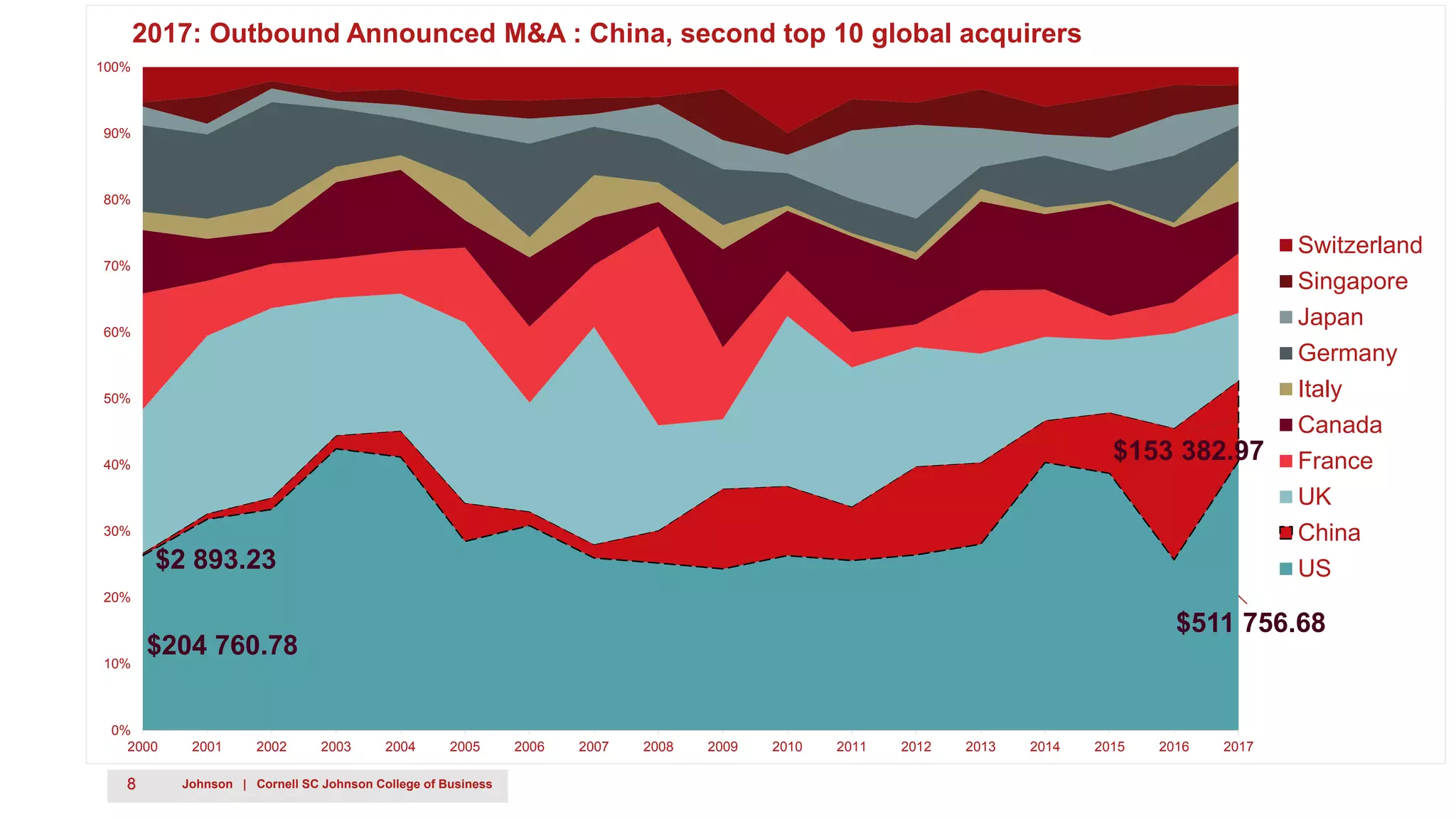
2017: Outbound Announced M&A : China, second top 10 global acquirers
Switzerland
Singapore
Japan
Germany
Italy
Canada
France
UK
China
US
9 Johnson | Cornell SC Johnson College of Business
Investor Greenfield OFDI
(total amount in millions)
Outbound M&A
(total amount in millions)
KOREA
Pre-crisis period: $126,601
Post crisis: $276,368
Growth: +118%
Pre-crisis period: $26,324
Post-crisis period: $138,059
Growth: 424%
INDIA Pre-crisis period: $86,476
Post-crisis period: $158,925
Growth: +84%
Pre-crisis period: $63,250
Post-crisis period: $61,792
Growth: -2%
BRAZIL Pre-crisis period: $29,408
Post-crisis period: $45,773
Growth: +55%
Pre-crisis period: $60,767
Post-crisis period: $47,463
Growth: -22%
CHINA Pre-crisis: $141,448
Post-crisis: $642,950
Growth: +354%
Pre-crisis: $166,325
Post-crisis: $817,533
Growth: +391%
USA Pre-crisis period: $977,553
Post-crisis period: $1,288,383
Growth: +32%
Pre-crisis period: $1,518,855
Post-crisis period: $1,814,891
Growth: +19%
TABLE 2.1 Changes in China compared to most active emerging markets Brazil, India, Korea
and the U.S. of announced outbound M&A deals and greenfield investments: comparing pre-
GFC (2000-2008 for M&A and 2003-2008 for Greenfield) and post-GFC (2009-2018).
(Source: Authors’ analysis based on data on announced M&A transactions originating from China and Hong Kong,
excluding Canceled transactions ($ value in millions) from Standard & Poor’s Capital IQ. Consortium investments
where Korean companies were minority stakeholders were removed manually for Korean M&A figures.)
Source: Authors’ analysis based on data from Capital IQ for M&A data and Fdi markets for greenfield investments
10 Johnson | Cornell SC Johnson College of Business
Chinese Acquisitions have been faced with a double blow …...
• Chinese outbound M&As have faced increased restrictions
– At home: tighter control on acquisitions abroad (new guidelines on overseas
investment)
– Abroad: Increased control and scrutiny of Chinese acquisitions (national
security grounds, other considerations)
…but powerful drivers are still at play
• All of the factors that led to the fast expansion of Chinese outbound M&As still
remain at play (motivations of Chinese firms, Government strategy).
• 2018 China’s investments high & increased 50% in OBOR countries in 5 years
• Chinese acquisitions to continue at a possibly lower but more sustainable level and
smaller deals
11 Johnson | Cornell SC Johnson College of Business
Family Companies in China: Challenges and Opportunities
11
12 Johnson | Cornell SC Johnson College of Business
Opportunities: Size and Growth of the Economy
• Wealth Creation
– Innovation, Digitalization
– Infrastructures Projects
• Challenges: Competition from SOEs
– big Chinese companies, 69% of the them are partially or totally SOEs,
– U.S. 79% are publicly traded
13 Johnson | Cornell SC Johnson College of Business
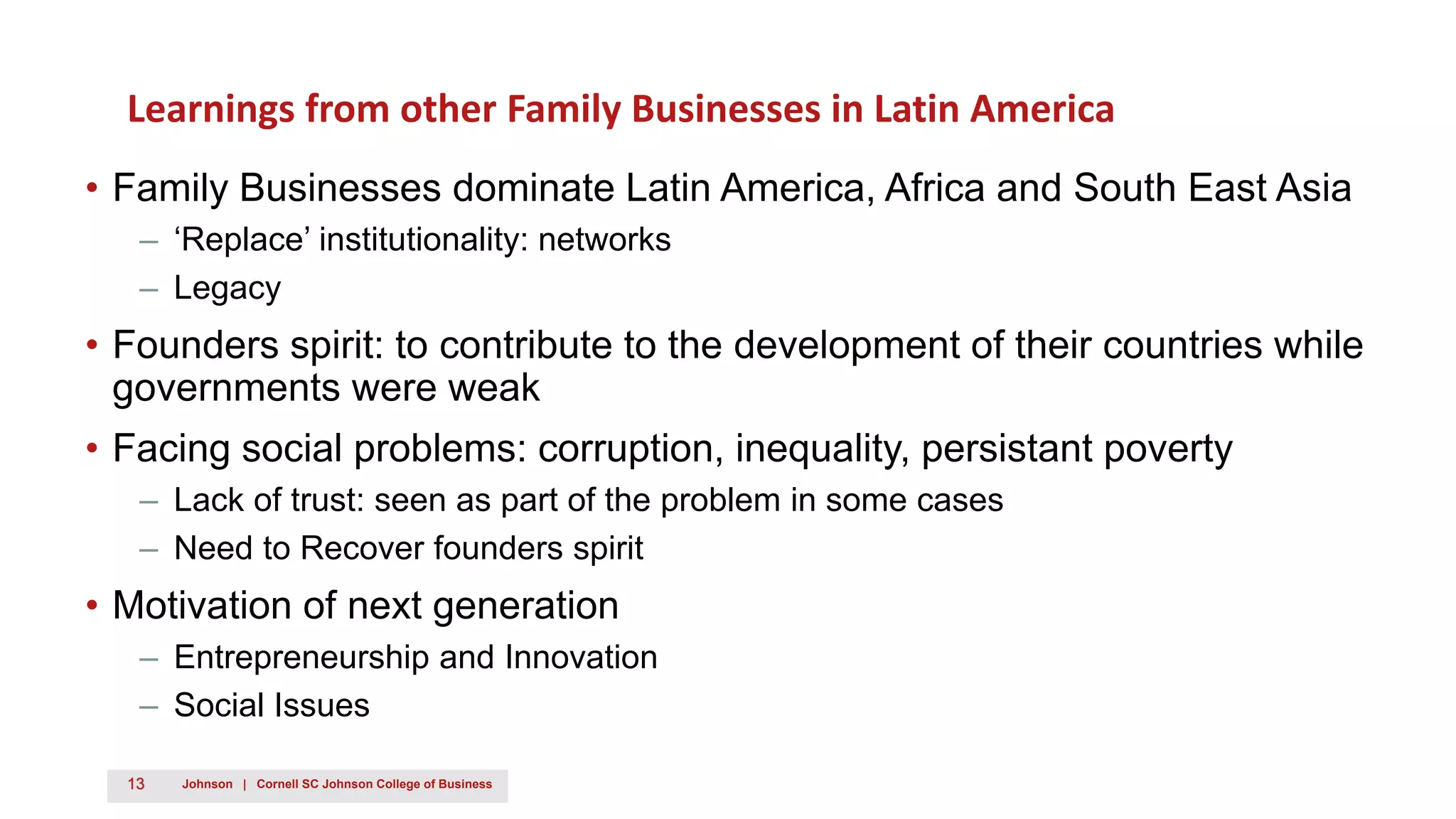
Learnings from other Family Businesses in Latin America
• Family Businesses dominate Latin America, Africa and South East Asia
– ‘Replace’ institutionality: networks
– Legacy
• Founders spirit: to contribute to the development of their countries while
governments were weak
• Facing social problems: corruption, inequality, persistant poverty
– Lack of trust: seen as part of the problem in some cases
– Need to Recover founders spirit
• Motivation of next generation
– Entrepreneurship and Innovation
– Social Issues
Lourdes Casanova
Director of the Emerging Markets Institute
lourdes.casanova@cornell.edu
@lourdescasanova
Anne Miroux
Former Director, Division on Technology and
Logistics, UNCTAD
Faculty Fellow, Emerging Markets Institute
am2449@cornell.edu
Emerging Markets Institute
THANK YOU
Cornell-college-of-business-emerging-markets-institute/
Facebook.com/CornellEMI/
@lourdescasanova

Current Issues on Family Business

  • 1.
    Current Issues onFamily Business Lourdes Casanova & Anne Miroux Emerging Markets Institute May 13, 2019
  • 2.
    2 Johnson |Cornell SC Johnson College of Business Emerging Markets Report (EMR) 2018 Yearly Report since 2016 • Monitoring Emerging Multinationals  Chinese – Revenues, profits, Price & branding comparison, OFDI: M&A & greenfield • With EMRN (USP, UniAndes, Tec de Monterrey, San Andres, China) • Data Resources covering Chinese companies – Revenues: Fortune Global 500, 40 years of longitudinal data – Standard & Poor’s Capital IQ (M&A) – Financial Times FdI Markets (Greenfield Investments) – OFDI data from UNCTAD – China’s MOFCOM – World Bank – Interviews with Company executives • Downloaded for free in the EMI webpage
  • 3.
    3 Johnson |Cornell SC Johnson College of Business Chinese Companies Power: Speed and Size China, Reshaping Globalization 3
  • 4.
    4 Johnson |Cornell SC Johnson College of Business Speed: China leading the growth after Global Financial crisis (2005-2018) Growth in Chinese representation in the Global Fortune 500 (2005-2018) E20 firms now account for 30% of the global Fortune 500 compared to only 7% in 2005 16 China, 111 South Korea, 16 Brazil, India, 7 México, 4 175 U.S., 126 0 20 40 60 80 100 120 140 160 180 200 2005 2006 2007 2008 2009 2010 2011 2012 2013 2014 2015 2016 2017 2018 China: 69% state owned U.S. 79% publicly traded
  • 5.
    5 Johnson |Cornell SC Johnson College of Business Speed: China second biggest: Countries Represented in 2018, Fortune Global 500 (2018) 1 1 1 1 1 1 1 1 1 1 1 1 1 1 1 2 2 2 4 4 4 6 7 7 7 9 10 11 11 14 16 22 28 31 52 111 126 Belgium Bermuda Denmark Indonesia Liechtenstein Luxembourg Malaysia Malta Netherlands Antilles Norway Poland Saudi Arabia Thailand Turkey United Arab Emirates Finland Singapore Sweden Ireland Mexico Russia Italy Australia Brazil India Taiwan Spain Canada Netherlands Switzerland South Korea United Kingdom France Germany Japan China United States China leading the charge
  • 6.
    6 Johnson |Cornell SC Johnson College of Business Speed: Chinese firms, half of top 5 companies in 8 industries (Fortune Global 500, 2018) Source: EMR 2018
  • 7.
    7 Johnson |Cornell SC Johnson College of Business Size: China versus other selected E20 by announced outbound M&A deals in 2017 (US$ Millions) A surge in Chinese M&As after global financial crisis as Chinese firms acquired financially distressed firms in developed countries, progressively making China one of the top global acquirers. $1,107.29 $1,222.51 $2,332.90 $4,455.14 $8,475.63 $9,383.74 $14,024.09 $15,244.28 $20,535.01 $22,543.87 $33,825.06 $34,965.77 $35,107.84 $41,173.65 $67,103.19 $76,770.83 $99,053.72 $113,682.59 $128,029.88 $153,382.97 $511,756.68 $0 $100,000 $200,000 $300,000 $400,000 $500,000 $600,000 Brazil India UAE Mexico Saudi Arabia Korea Australia Sweden Ireland Luxemburg Netherlands Switzerland Singapore Japan Germany Italy Canada France UK China United States : Source: Authors’ analysis based on data from Capital IQ
  • 8.
    8 Johnson |Cornell SC Johnson College of Business $204 760.78 $511 756.68 $2 893.23 $153 382.97 0% 10% 20% 30% 40% 50% 60% 70% 80% 90% 100% 2000 2001 2002 2003 2004 2005 2006 2007 2008 2009 2010 2011 2012 2013 2014 2015 2016 2017 2017: Outbound Announced M&A : China, second top 10 global acquirers Switzerland Singapore Japan Germany Italy Canada France UK China US
  • 9.
    9 Johnson |Cornell SC Johnson College of Business Investor Greenfield OFDI (total amount in millions) Outbound M&A (total amount in millions) KOREA Pre-crisis period: $126,601 Post crisis: $276,368 Growth: +118% Pre-crisis period: $26,324 Post-crisis period: $138,059 Growth: 424% INDIA Pre-crisis period: $86,476 Post-crisis period: $158,925 Growth: +84% Pre-crisis period: $63,250 Post-crisis period: $61,792 Growth: -2% BRAZIL Pre-crisis period: $29,408 Post-crisis period: $45,773 Growth: +55% Pre-crisis period: $60,767 Post-crisis period: $47,463 Growth: -22% CHINA Pre-crisis: $141,448 Post-crisis: $642,950 Growth: +354% Pre-crisis: $166,325 Post-crisis: $817,533 Growth: +391% USA Pre-crisis period: $977,553 Post-crisis period: $1,288,383 Growth: +32% Pre-crisis period: $1,518,855 Post-crisis period: $1,814,891 Growth: +19% TABLE 2.1 Changes in China compared to most active emerging markets Brazil, India, Korea and the U.S. of announced outbound M&A deals and greenfield investments: comparing pre- GFC (2000-2008 for M&A and 2003-2008 for Greenfield) and post-GFC (2009-2018). (Source: Authors’ analysis based on data on announced M&A transactions originating from China and Hong Kong, excluding Canceled transactions ($ value in millions) from Standard & Poor’s Capital IQ. Consortium investments where Korean companies were minority stakeholders were removed manually for Korean M&A figures.) Source: Authors’ analysis based on data from Capital IQ for M&A data and Fdi markets for greenfield investments
  • 10.
    10 Johnson |Cornell SC Johnson College of Business Chinese Acquisitions have been faced with a double blow …... • Chinese outbound M&As have faced increased restrictions – At home: tighter control on acquisitions abroad (new guidelines on overseas investment) – Abroad: Increased control and scrutiny of Chinese acquisitions (national security grounds, other considerations) …but powerful drivers are still at play • All of the factors that led to the fast expansion of Chinese outbound M&As still remain at play (motivations of Chinese firms, Government strategy). • 2018 China’s investments high & increased 50% in OBOR countries in 5 years • Chinese acquisitions to continue at a possibly lower but more sustainable level and smaller deals
  • 11.
    11 Johnson |Cornell SC Johnson College of Business Family Companies in China: Challenges and Opportunities 11
  • 12.
    12 Johnson |Cornell SC Johnson College of Business Opportunities: Size and Growth of the Economy • Wealth Creation – Innovation, Digitalization – Infrastructures Projects • Challenges: Competition from SOEs – big Chinese companies, 69% of the them are partially or totally SOEs, – U.S. 79% are publicly traded
  • 13.
    13 Johnson |Cornell SC Johnson College of Business Learnings from other Family Businesses in Latin America • Family Businesses dominate Latin America, Africa and South East Asia – ‘Replace’ institutionality: networks – Legacy • Founders spirit: to contribute to the development of their countries while governments were weak • Facing social problems: corruption, inequality, persistant poverty – Lack of trust: seen as part of the problem in some cases – Need to Recover founders spirit • Motivation of next generation – Entrepreneurship and Innovation – Social Issues
  • 14.
    Lourdes Casanova Director ofthe Emerging Markets Institute lourdes.casanova@cornell.edu @lourdescasanova Anne Miroux Former Director, Division on Technology and Logistics, UNCTAD Faculty Fellow, Emerging Markets Institute am2449@cornell.edu Emerging Markets Institute THANK YOU Cornell-college-of-business-emerging-markets-institute/ Facebook.com/CornellEMI/ @lourdescasanova

Editor's Notes

  • #5 Total 155 companies, 31% del total. 12 countries are represented: 111 from China, 16 South Korea, 7 India, 7 Brazil, 4 Russia, 4 Mexico, 1 Turkey, Thailand, Saudi Arabia, Malaysia, Indonesia, Poland 8 countries No Argentina, Chile, Colombia, Egypt, Iran, Nigeria, Philippines, Venezuela 27 developed countries + 10 E20 = 37 countries If 9 Taiwan part of china then China 120 and total E20 is 164
  • #6 Total 155 companies, 31% del total. 12 countries are represented: 111 from China, 16 South Korea, 7 India, 7 Brazil, 4 Russia, 4 Mexico, 1 Turkey, Thailand, Saudi Arabia, Malaysia, Indonesia, Poland 8 countries No Argentina, Chile, Colombia, Egypt, Iran, Nigeria, Philippines, Venezuela 27 developed countries + 10 E20 = 37 countries If 9 Taiwan part of china then China 120 and total E20 is 164