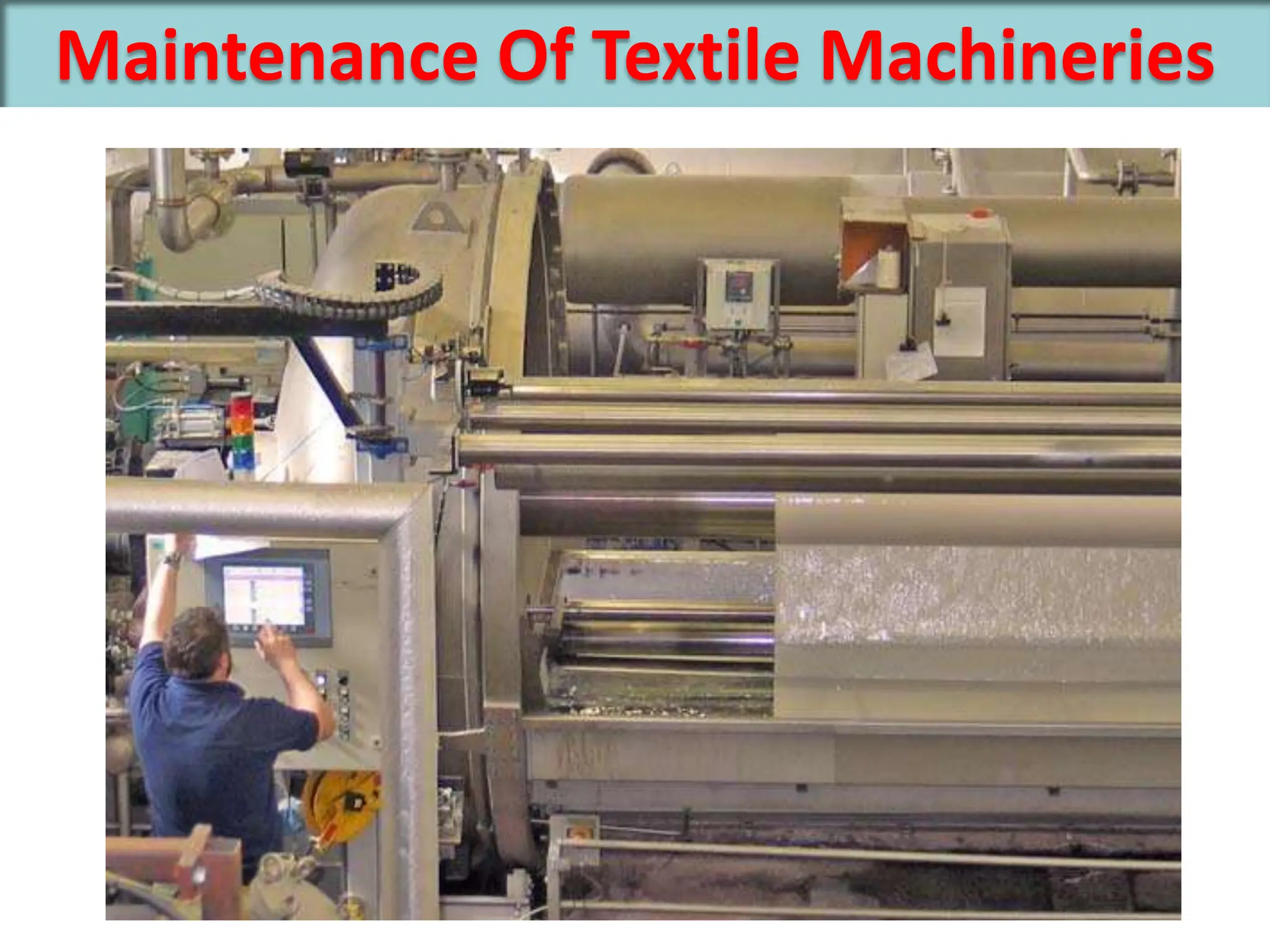
Maintenance Of Textile Machineries
Prepared By : Mazadul Hasan sheshir
ID: 2010000400008
13th Batch (session 2009-2013)
Department : Wet Processing Technology
Email: mazadulhasan@yahoo.com
Blog : www. Textilelab.blogspot.com (visit)
Southeast University
Department Of Textile Engineering
I/A 251,252 Tejgaon Dhaka Bangladesh
Prepared By :
Actions necessary for retaining or restoring a piece of equipment, machine, or system
to the specified operable condition to achieve its maximum useful life. Maintenance is
a set of organized activities that are carried out in order to keep an its in its best
operational condition with minimum cost required.
Maintenance:
Machine, buildings and other facilities are subjected to deterioration due to their use
and exposure to environmental condition. Process of deterioration, if unchecked,
culminates in rendering these service facilities unserviceable and brings them to a
standstill. In Industry, therefore has no choice but to attend them from time to time to
repair and recondition them so as to elongate their life to the extent it is economically
and physically possible to do so.
Maintenance of machineries is very important for any type of industries and it is
a must for a knit composite mill. All machines and machines parts of knitting,
dyeing and garments are maintained with extreme care. Because production
quality and quantity, both depends on the maintenance with regularity. Beximco
Knitting Ltd. lead maintenance with a troop of skilled mechanical fitters. There
are two types of maintenance department found in Beximco Knitting Ltd. such
as:
1. Mechanical Department.
2. Electrical Department.
Maintenance:
Activities of maintenance function could be either repair or replacement activities,
which are necessary for an item to reach its acceptable productivity condition and
these activities should be carried out with a minimum possible cost.
1. To keep the factory plants, equipments, machine tools in an optimum
working condition.
2. To ensure specified accuracy to product and time schedule of delivery to
customer.
3. To keep the downtime of machines to the minimum thus to have control
over the production program.
4. To keep the production cycle within the stipulated range.
5. To modify the machine tools to meet the need for production
Objectives of Maintenance:
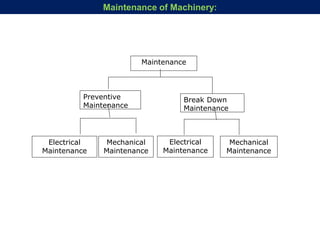
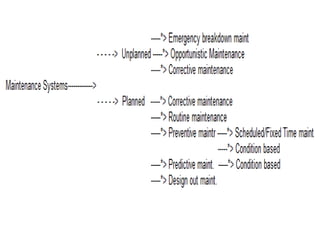
Maintenance
Preventive
Maintenance
Break Down
Maintenance
Electrical
Maintenance
Mechanical
Maintenance
Electrical
Maintenance
Mechanical
Maintenance
Maintenance of Machinery:
Preventive Maintenance:
Preventive maintenance is a predetermined routine actively to ensure on
time inspection / checking of facilities to uncover conditions that may lead to
production break downs or harmful description.
Break Down Maintenance:
In this case, repairs are made after the equipment is out of order and it can not
perform its normal functions.
Routine Maintenance:
Maintenance of different machines are prepared by expert engineer of
maintenance department. Normally in case of dyeing machine maintenance
after 30 days complete checking of different important parts are done.
•To keep the m/c running continuously up to the maximum production level
•To make sure the best use of utilities
•To prevent the undesirable failure of the m/c.
•Reducing break down and emergency shut down
•optimizing resources utilization
•Minimizing energy usage
•Improving equipment efficiency.
• To Keep the machine running continuously up to the
Maximum Production Level.
• To make sure the best use of Utilities.
• To prevent the undesireable failure of the machine.
Objects:
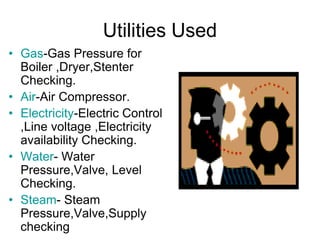
Utilities Used
• Gas-Gas Pressure for
Boiler ,Dryer,Stenter
Checking.
• Air-Air Compressor.
• Electricity-Electric Control
,Line voltage ,Electricity
availability Checking.
• Water- Water
Pressure,Valve, Level
Checking.
• Steam- Steam
Pressure,Valve,Supply
checking
Mechanical Parts
• Free Roller,
• Guide Roller,
• Immersion Roller,
• Winch,
• Belt &Rope Drive,
• Steam Pipe(White Colored),
• Water pipe(Blue colored),
• Burner,
• Suction Hood,
• Adjustable Roller,
• Pump,
• Pressure controller,
• Tray,
• Squeeze Roller,
• Delivery Roller.
• And so on……………….
Electrical Parts
• Motor,
• Cables of electrical wireing
• And so on…
Routine of Maintenance:
•Daily Maintenance: Every machine is taken maintenance daily by the operators during
production. When the operator starts a production after handing over from previous shift
operator, he takes a routine maintenance on the machine. He cleans the machine,
assures yarn is fed to all needles, cleans the eye pot of feeder, memminger, signal lamp
sensor etc. Before a while of a roll cut from batch or cloth roller, operator cleans needles,
cylinder base plate etc. All around of the machine are kept neat and clean as if there is
no dirt with yarn in the fabric.
•Schedule/Routine Maintenance: Every machine has a schedule of maintenance of 10
or 15 days. According to date, schedule maintenance is taken on the machines.
Operators are informed about the time of maintenance. After pre-estimated production,
they hand over the machine to the fitters. Thus, fitters assure all machines are OK. For
any time.
•Break Down Maintenance: When product quality hampered and to complete
production in due time break down maintenance is taken. There are many faults seen in
the fabric during production due to needle, sinker, take down roller etc. Then operators
inform the mechanical fitters and they fix it.
•Restorative Maintenance: Restorative maintenance is taken for design change or
new design development. According to advice or order of production officer, a machine
is fixed for new design and mechanical fitters rearrange cam and needle system.
Planned and preventive maintenance are not taken on the machineries in this mill.
1. For there is any mechanical fault of machine, which is responsible for production
hamper, operator informs mechanical fitters in duty. Mechanical fitters come and
observe the problem firstly, and then they begin to fix it.
2. If mechanical fitters were unable to fix it, then they inform technical in-charge, he
then comes in spot and fixes it.
3. For there is any electrical problem of machine or serious founding mechanical
problem, mechanical and electrical department are informed, they come and fix the
problem. They commence at work after informing of knitting manager. There are two
mechanical engineers in the department.
4. For restorative maintenance, senior production officer orders mechanical fitters to fit
required machine for cam and needle arrangement and other necessary
requirements in case of new design development.
Maintenance Procedure:
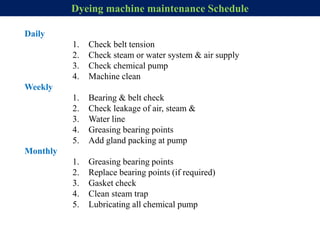
Daily
1. Check belt tension
2. Check steam or water system & air supply
3. Check chemical pump
4. Machine clean
Weekly
1. Bearing & belt check
2. Check leakage of air, steam &
3. Water line
4. Greasing bearing points
5. Add gland packing at pump
Monthly
1. Greasing bearing points
2. Replace bearing points (if required)
3. Gasket check
4. Clean steam trap
5. Lubricating all chemical pump
Dyeing machine maintenance Schedule
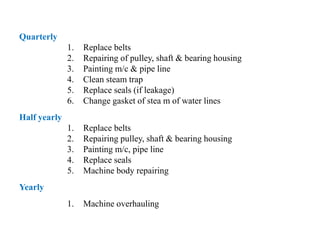
Quarterly
1. Replace belts
2. Repairing of pulley, shaft & bearing housing
3. Painting m/c & pipe line
4. Clean steam trap
5. Replace seals (if leakage)
6. Change gasket of stea m of water lines
Half yearly
1. Replace belts
2. Repairing pulley, shaft & bearing housing
3. Painting m/c, pipe line
4. Replace seals
5. Machine body repairing
Yearly
1. Machine overhauling
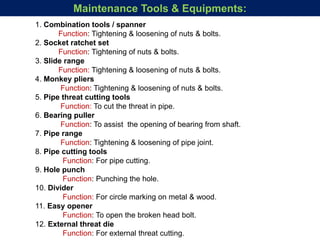
1. Combination tools / spanner
Function: Tightening & loosening of nuts & bolts.
2. Socket ratchet set
Function: Tightening of nuts & bolts.
3. Slide range
Function: Tightening & loosening of nuts & bolts.
4. Monkey pliers
Function: Tightening & loosening of nuts & bolts.
5. Pipe threat cutting tools
Function: To cut the threat in pipe.
6. Bearing puller
Function: To assist the opening of bearing from shaft.
7. Pipe range
Function: Tightening & loosening of pipe joint.
8. Pipe cutting tools
Function: For pipe cutting.
9. Hole punch
Function: Punching the hole.
10. Divider
Function: For circle marking on metal & wood.
11. Easy opener
Function: To open the broken head bolt.
12. External threat die
Function: For external threat cutting.
Maintenance Tools & Equipments:
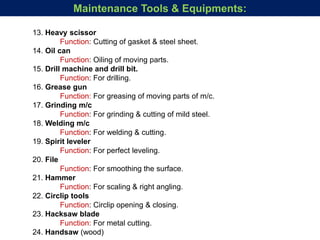
13. Heavy scissor
Function: Cutting of gasket & steel sheet.
14. Oil can
Function: Oiling of moving parts.
15. Drill machine and drill bit.
Function: For drilling.
16. Grease gun
Function: For greasing of moving parts of m/c.
17. Grinding m/c
Function: For grinding & cutting of mild steel.
18. Welding m/c
Function: For welding & cutting.
19. Spirit leveler
Function: For perfect leveling.
20. File
Function: For smoothing the surface.
21. Hammer
Function: For scaling & right angling.
22. Circlip tools
Function: Circlip opening & closing.
23. Hacksaw blade
Function: For metal cutting.
24. Handsaw (wood)
Maintenance Tools & Equipments:
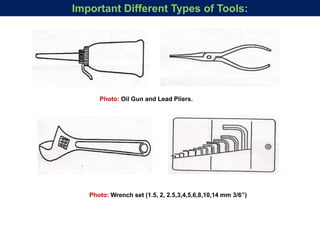
Important Different Types of Tools:
Photo: Oil Gun and Lead Pliers.
Photo: Wrench set (1.5, 2, 2.5,3,4,5,6,8,10,14 mm 3/6’’)
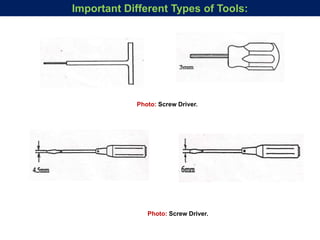
Photo: Screw Driver.
Important Different Types of Tools:
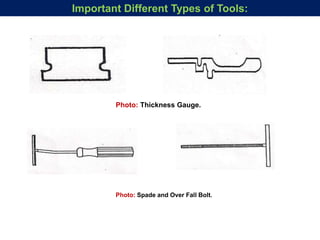
Photo: Thickness Gauge.
Photo: Spade and Over Fall Bolt.
Important Different Types of Tools:
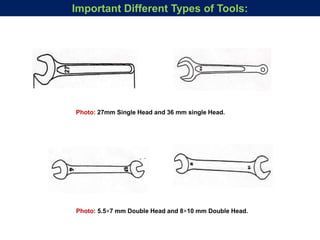
Photo: 27mm Single Head and 36 mm single Head.
Photo: 5.5×7 mm Double Head and 8×10 mm Double Head.
Important Different Types of Tools:
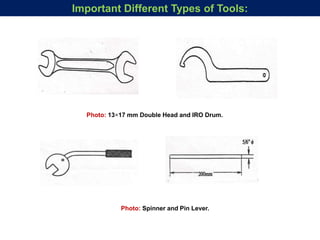
Photo: 13×17 mm Double Head and IRO Drum.
Photo: Spinner and Pin Lever.
Important Different Types of Tools:
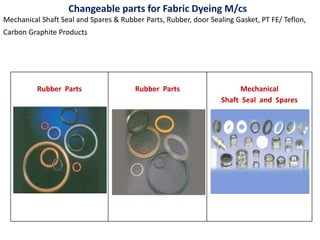
Rubber Parts Rubber Parts Mechanical
Shaft Seal and Spares
Changeable parts for Fabric Dyeing M/cs
Mechanical Shaft Seal and Spares & Rubber Parts, Rubber, door Sealing Gasket, PT FE/ Teflon,
Carbon Graphite Products
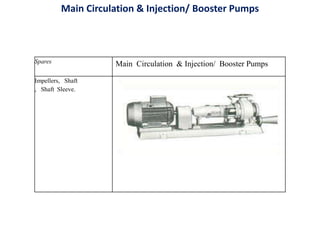
Spares Main Circulation & Injection/ Booster Pumps
Impellers, Shaft
, Shaft Sleeve.
Main Circulation & Injection/ Booster Pumps
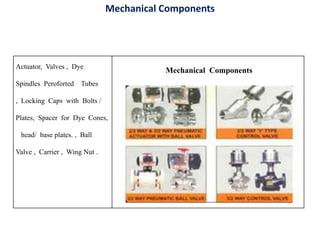
Mechanical Components
Actuator, Valves , Dye
Spindles Peroforted Tubes
, Locking Caps with Bolts /
Plates, Spacer for Dye Cones,
head/ base plates. , Ball
Valve , Carrier , Wing Nut .
Mechanical Components
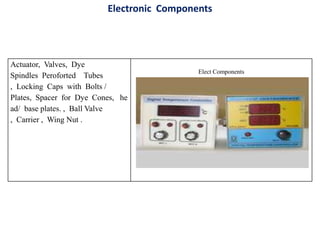
Electronic Components
Actuator, Valves, Dye
Spindles Peroforted Tubes
, Locking Caps with Bolts /
Plates, Spacer for Dye Cones, he
ad/ base plates. , Ball Valve
, Carrier , Wing Nut .
Elect Components
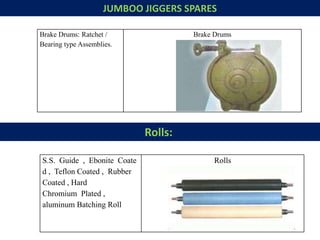
JUMBOO JIGGERS SPARES
Brake Drums: Ratchet /
Bearing type Assemblies.
Brake Drums
Rolls:
S.S. Guide , Ebonite Coate
d , Teflon Coated , Rubber
Coated , Hard
Chromium Plated ,
aluminum Batching Roll
Rolls
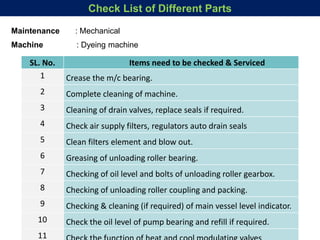
Maintenance : Mechanical
Machine : Dyeing machine
SL. No. Items need to be checked & Serviced
1 Crease the m/c bearing.
2 Complete cleaning of machine.
3 Cleaning of drain valves, replace seals if required.
4 Check air supply filters, regulators auto drain seals
5 Clean filters element and blow out.
6 Greasing of unloading roller bearing.
7 Checking of oil level and bolts of unloading roller gearbox.
8 Checking of unloading roller coupling and packing.
9 Checking & cleaning (if required) of main vessel level indicator.
10 Check the oil level of pump bearing and refill if required.
11
Check List of Different Parts
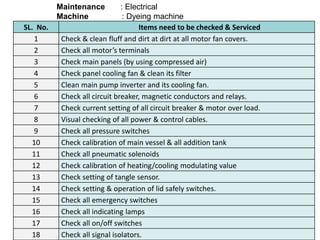
SL. No. Items need to be checked & Serviced
1 Check & clean fluff and dirt at dirt at all motor fan covers.
2 Check all motor’s terminals
3 Check main panels (by using compressed air)
4 Check panel cooling fan & clean its filter
5 Clean main pump inverter and its cooling fan.
6 Check all circuit breaker, magnetic conductors and relays.
7 Check current setting of all circuit breaker & motor over load.
8 Visual checking of all power & control cables.
9 Check all pressure switches
10 Check calibration of main vessel & all addition tank
11 Check all pneumatic solenoids
12 Check calibration of heating/cooling modulating value
13 Check setting of tangle sensor.
14 Check setting & operation of lid safely switches.
15 Check all emergency switches
16 Check all indicating lamps
17 Check all on/off switches
18 Check all signal isolators.
Maintenance : Electrical
Machine : Dyeing machine
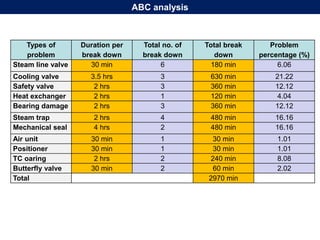
Types of
problem
Duration per
break down
Total no. of
break down
Total break
down
Problem
percentage (%)
Steam line valve 30 min 6 180 min 6.06
Cooling valve 3.5 hrs 3 630 min 21.22
Safety valve 2 hrs 3 360 min 12.12
Heat exchanger 2 hrs 1 120 min 4.04
Bearing damage 2 hrs 3 360 min 12.12
Steam trap 2 hrs 4 480 min 16.16
Mechanical seal 4 hrs 2 480 min 16.16
Air unit 30 min 1 30 min 1.01
Positioner 30 min 1 30 min 1.01
TC oaring 2 hrs 2 240 min 8.08
Butterfly valve 30 min 2 60 min 2.02
Total 2970 min
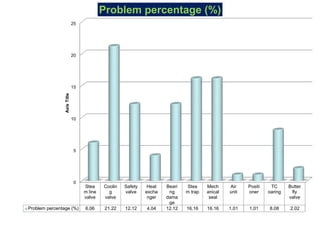
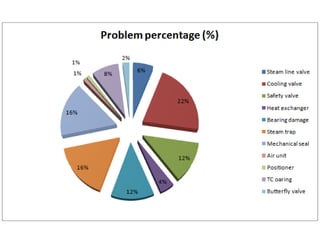
ABC analysis
0
5
10
15
20
25
Stea
m line
valve
Coolin
g
valve
Safety
valve
Heat
excha
nger
Beari
ng
dama
ge
Stea
m trap
Mech
anical
seal
Air
unit
Positi
oner
TC
oaring
Butter
fly
valve
Problem percentage (%) 6.06 21.22 12.12 4.04 12.12 16.16 16.16 1.01 1.01 8.08 2.02
Axis
Title
Problem percentage (%)
Mechanism and working Procedure
of Individual Machines Used in Wet
Processing Industries
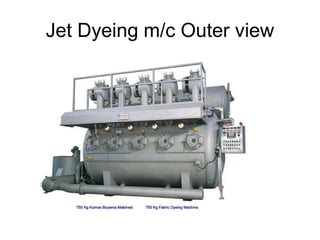
Jet Dyeing m/c Outer view
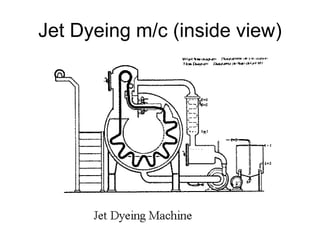
Jet Dyeing m/c (inside view)
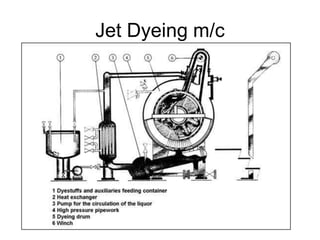
Jet Dyeing m/c
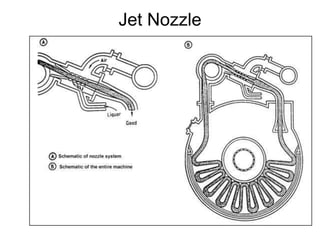
Jet Nozzle
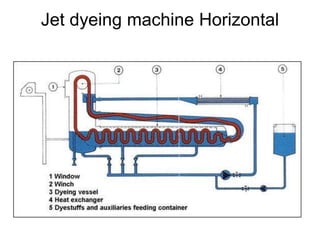
Jet dyeing machine Horizontal
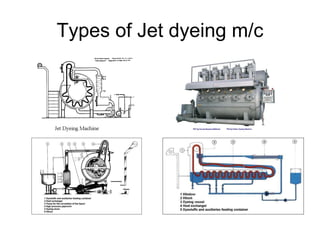
Types of Jet dyeing m/c
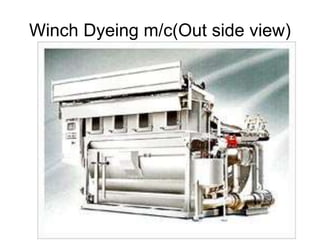
Winch Dyeing m/c(Out side view)
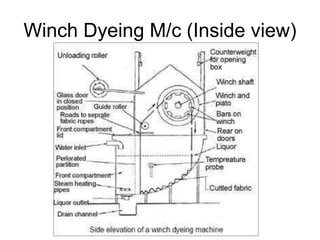
Winch Dyeing M/c (Inside view)
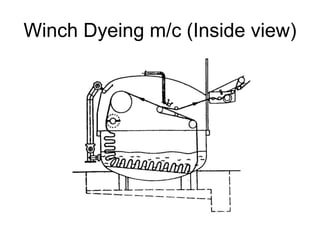
Winch Dyeing m/c (Inside view)
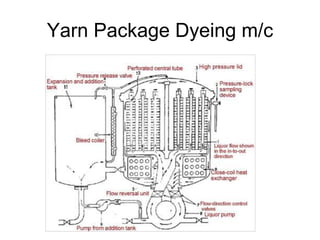
Yarn Package Dyeing m/c
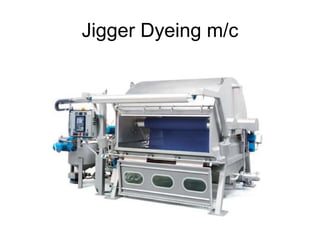
Jigger Dyeing m/c
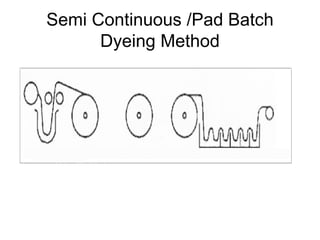
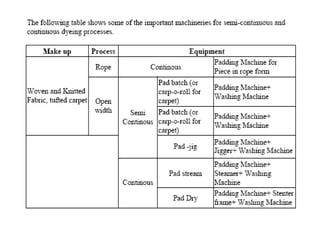
Semi Continuous /Pad Batch
Dyeing Method
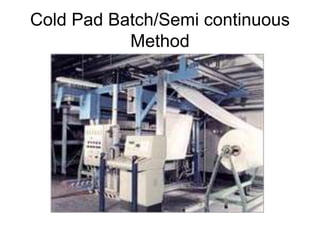
Cold Pad Batch/Semi continuous
Method
Difference between Semi
continuous and Continuous Method
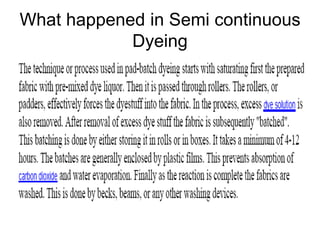
In semi-continuous dyeing, the dye is
applied continuously by a padding. The
fixation and washing remaining
discontinuous. Liquor Ratio in semi-
continuous dyeing is not Important.
What happened in Semi continuous
Dyeing
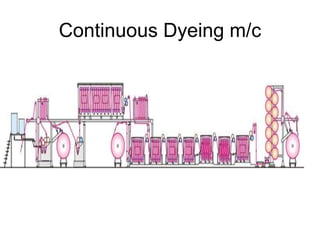
Continuous Dyeing m/c
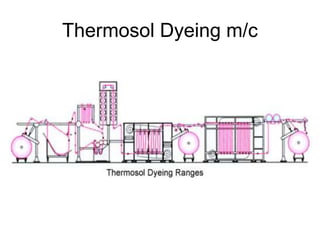
Thermosol Dyeing m/c
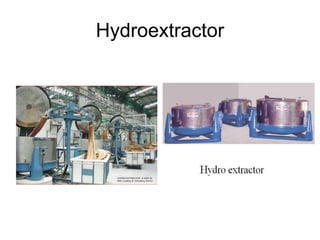
Hydroextractor
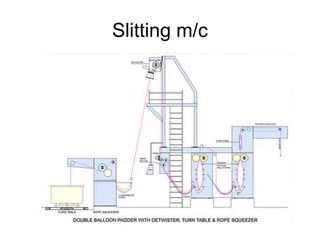
Slitting m/c
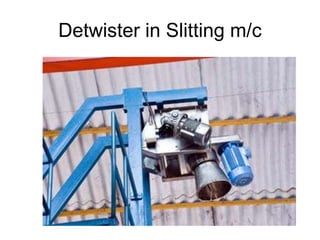
Detwister in Slitting m/c
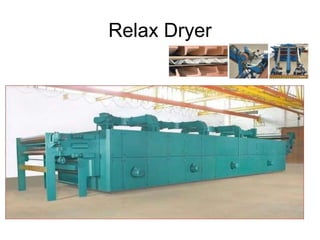
Relax Dryer
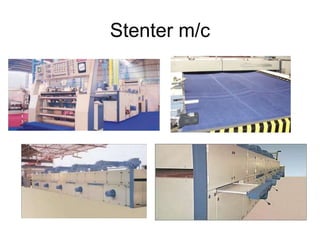
Stenter m/c
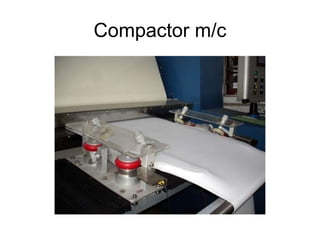
Compactor m/c
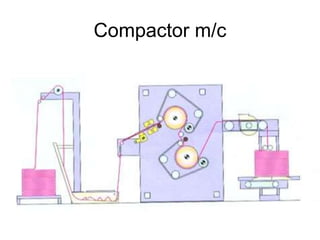
Compactor m/c
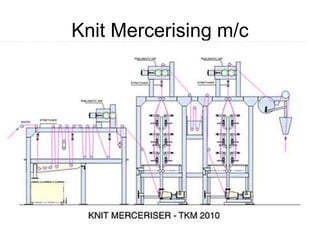
Knit Mercerising m/c
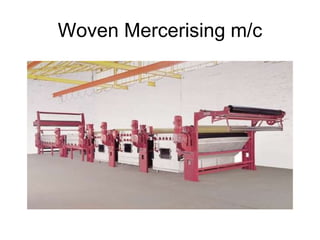
Woven Mercerising m/c
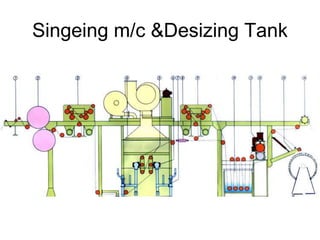
Singeing m/c &Desizing Tank
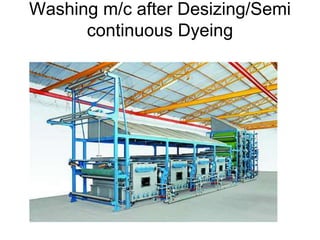
Washing m/c after Desizing/Semi
continuous Dyeing
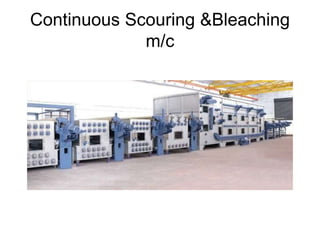
Continuous Scouring &Bleaching
m/c
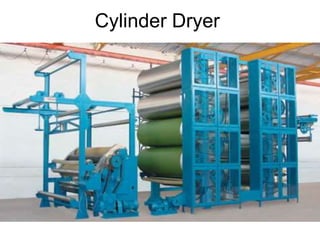
Cylinder Dryer
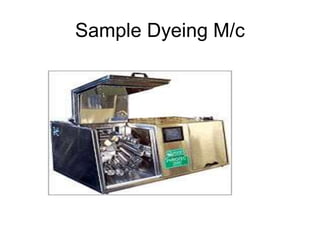
Sample Dyeing M/c
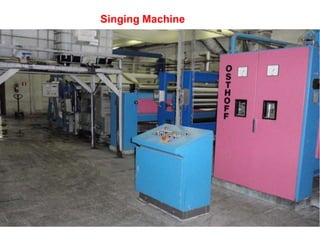
Singing Machine
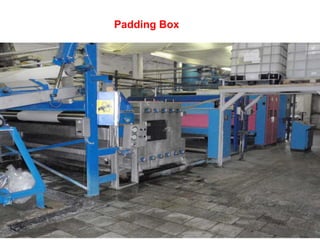
Padding Box
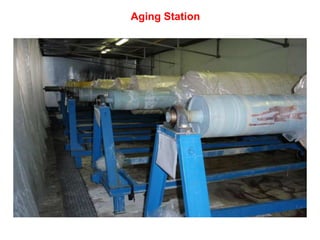
Aging Station
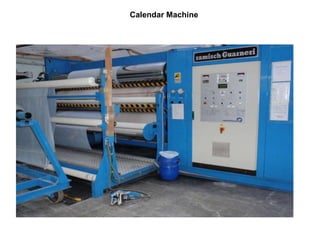
Calendar Machine
Continuous Knit Fabric Processing
• Grey knit fabric Inspection
• Jet / Winch Dyeing m/c
• Scouring, Bleaching, Enzyme wash, Optical
Brightening, Dyeing,Softening.(In Rope form
fabric)
• Squeezing/Padding or Hydroextractor (to
remove excess water from the fabric)
• Open width fabric Slitting m/c is used(to slit the
knit fabric along the needle drop line of the
fabric.
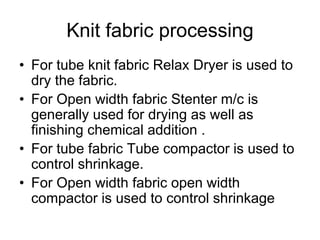
Knit fabric processing
• For tube knit fabric Relax Dryer is used to
dry the fabric.
• For Open width fabric Stenter m/c is
generally used for drying as well as
finishing chemical addition .
• For tube fabric Tube compactor is used to
control shrinkage.
• For Open width fabric open width
compactor is used to control shrinkage
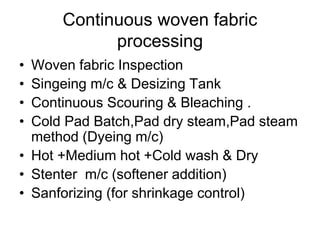
Continuous woven fabric
processing
• Woven fabric Inspection
• Singeing m/c & Desizing Tank
• Continuous Scouring & Bleaching .
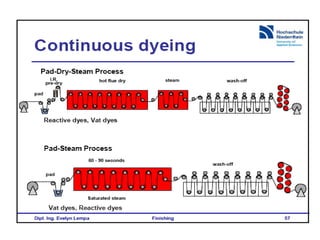
• Cold Pad Batch,Pad dry steam,Pad steam
method (Dyeing m/c)
• Hot +Medium hot +Cold wash & Dry
• Stenter m/c (softener addition)
• Sanforizing (for shrinkage control)
1. Yarn Manufacturing Technology
Link : http://www.facebook.com/pages/Yarn-Manufacturing-
Technology/485014954866808
2. Fabric Manufacturing Technology
Link : http://www.facebook.com/pages/Fabric-Manufacturing-
Technology/459520217425605
3. Garments Manufacturing Technology
Link : http://www.facebook.com/pages/Garments-Manufacturing-
Technology/472364799463126
3. Wet processing Technology
Link : http://www.facebook.com/pages/Wet-Processing-Technology-Dyeing-
/468645219825404
4. Fashion-Design-and-Technology
Link : http://www.facebook.com/pages/Fashion-Design-and-
Technology/587655294583875?ref=ts&fref=ts
My Facebook Textile related Pages
http://www.textilelab.blogspot.com (Visit My Blog for more Info )

cupdf.com_maintenance-in-wet-processing-machine.ppt

  • 1.
  • 2.
    Prepared By :Mazadul Hasan sheshir ID: 2010000400008 13th Batch (session 2009-2013) Department : Wet Processing Technology Email: mazadulhasan@yahoo.com Blog : www. Textilelab.blogspot.com (visit) Southeast University Department Of Textile Engineering I/A 251,252 Tejgaon Dhaka Bangladesh Prepared By :
  • 3.
    Actions necessary forretaining or restoring a piece of equipment, machine, or system to the specified operable condition to achieve its maximum useful life. Maintenance is a set of organized activities that are carried out in order to keep an its in its best operational condition with minimum cost required. Maintenance: Machine, buildings and other facilities are subjected to deterioration due to their use and exposure to environmental condition. Process of deterioration, if unchecked, culminates in rendering these service facilities unserviceable and brings them to a standstill. In Industry, therefore has no choice but to attend them from time to time to repair and recondition them so as to elongate their life to the extent it is economically and physically possible to do so.
  • 4.
    Maintenance of machineriesis very important for any type of industries and it is a must for a knit composite mill. All machines and machines parts of knitting, dyeing and garments are maintained with extreme care. Because production quality and quantity, both depends on the maintenance with regularity. Beximco Knitting Ltd. lead maintenance with a troop of skilled mechanical fitters. There are two types of maintenance department found in Beximco Knitting Ltd. such as: 1. Mechanical Department. 2. Electrical Department. Maintenance:
  • 5.
    Activities of maintenancefunction could be either repair or replacement activities, which are necessary for an item to reach its acceptable productivity condition and these activities should be carried out with a minimum possible cost.
  • 6.
    1. To keepthe factory plants, equipments, machine tools in an optimum working condition. 2. To ensure specified accuracy to product and time schedule of delivery to customer. 3. To keep the downtime of machines to the minimum thus to have control over the production program. 4. To keep the production cycle within the stipulated range. 5. To modify the machine tools to meet the need for production Objectives of Maintenance:
  • 7.
  • 8.
    Preventive Maintenance: Preventive maintenanceis a predetermined routine actively to ensure on time inspection / checking of facilities to uncover conditions that may lead to production break downs or harmful description. Break Down Maintenance: In this case, repairs are made after the equipment is out of order and it can not perform its normal functions. Routine Maintenance: Maintenance of different machines are prepared by expert engineer of maintenance department. Normally in case of dyeing machine maintenance after 30 days complete checking of different important parts are done.
  • 9.
    •To keep them/c running continuously up to the maximum production level •To make sure the best use of utilities •To prevent the undesirable failure of the m/c. •Reducing break down and emergency shut down •optimizing resources utilization •Minimizing energy usage •Improving equipment efficiency.
  • 10.
    • To Keepthe machine running continuously up to the Maximum Production Level. • To make sure the best use of Utilities. • To prevent the undesireable failure of the machine. Objects:
  • 12.
    Utilities Used • Gas-GasPressure for Boiler ,Dryer,Stenter Checking. • Air-Air Compressor. • Electricity-Electric Control ,Line voltage ,Electricity availability Checking. • Water- Water Pressure,Valve, Level Checking. • Steam- Steam Pressure,Valve,Supply checking
  • 13.
    Mechanical Parts • FreeRoller, • Guide Roller, • Immersion Roller, • Winch, • Belt &Rope Drive, • Steam Pipe(White Colored), • Water pipe(Blue colored), • Burner, • Suction Hood, • Adjustable Roller, • Pump, • Pressure controller, • Tray, • Squeeze Roller, • Delivery Roller. • And so on……………….
  • 14.
    Electrical Parts • Motor, •Cables of electrical wireing • And so on…
  • 15.
    Routine of Maintenance: •DailyMaintenance: Every machine is taken maintenance daily by the operators during production. When the operator starts a production after handing over from previous shift operator, he takes a routine maintenance on the machine. He cleans the machine, assures yarn is fed to all needles, cleans the eye pot of feeder, memminger, signal lamp sensor etc. Before a while of a roll cut from batch or cloth roller, operator cleans needles, cylinder base plate etc. All around of the machine are kept neat and clean as if there is no dirt with yarn in the fabric. •Schedule/Routine Maintenance: Every machine has a schedule of maintenance of 10 or 15 days. According to date, schedule maintenance is taken on the machines. Operators are informed about the time of maintenance. After pre-estimated production, they hand over the machine to the fitters. Thus, fitters assure all machines are OK. For any time. •Break Down Maintenance: When product quality hampered and to complete production in due time break down maintenance is taken. There are many faults seen in the fabric during production due to needle, sinker, take down roller etc. Then operators inform the mechanical fitters and they fix it. •Restorative Maintenance: Restorative maintenance is taken for design change or new design development. According to advice or order of production officer, a machine is fixed for new design and mechanical fitters rearrange cam and needle system. Planned and preventive maintenance are not taken on the machineries in this mill.
  • 16.
    1. For thereis any mechanical fault of machine, which is responsible for production hamper, operator informs mechanical fitters in duty. Mechanical fitters come and observe the problem firstly, and then they begin to fix it. 2. If mechanical fitters were unable to fix it, then they inform technical in-charge, he then comes in spot and fixes it. 3. For there is any electrical problem of machine or serious founding mechanical problem, mechanical and electrical department are informed, they come and fix the problem. They commence at work after informing of knitting manager. There are two mechanical engineers in the department. 4. For restorative maintenance, senior production officer orders mechanical fitters to fit required machine for cam and needle arrangement and other necessary requirements in case of new design development. Maintenance Procedure:
  • 17.
    Daily 1. Check belttension 2. Check steam or water system & air supply 3. Check chemical pump 4. Machine clean Weekly 1. Bearing & belt check 2. Check leakage of air, steam & 3. Water line 4. Greasing bearing points 5. Add gland packing at pump Monthly 1. Greasing bearing points 2. Replace bearing points (if required) 3. Gasket check 4. Clean steam trap 5. Lubricating all chemical pump Dyeing machine maintenance Schedule
  • 18.
    Quarterly 1. Replace belts 2.Repairing of pulley, shaft & bearing housing 3. Painting m/c & pipe line 4. Clean steam trap 5. Replace seals (if leakage) 6. Change gasket of stea m of water lines Half yearly 1. Replace belts 2. Repairing pulley, shaft & bearing housing 3. Painting m/c, pipe line 4. Replace seals 5. Machine body repairing Yearly 1. Machine overhauling
  • 19.
    1. Combination tools/ spanner Function: Tightening & loosening of nuts & bolts. 2. Socket ratchet set Function: Tightening of nuts & bolts. 3. Slide range Function: Tightening & loosening of nuts & bolts. 4. Monkey pliers Function: Tightening & loosening of nuts & bolts. 5. Pipe threat cutting tools Function: To cut the threat in pipe. 6. Bearing puller Function: To assist the opening of bearing from shaft. 7. Pipe range Function: Tightening & loosening of pipe joint. 8. Pipe cutting tools Function: For pipe cutting. 9. Hole punch Function: Punching the hole. 10. Divider Function: For circle marking on metal & wood. 11. Easy opener Function: To open the broken head bolt. 12. External threat die Function: For external threat cutting. Maintenance Tools & Equipments:
  • 20.
    13. Heavy scissor Function:Cutting of gasket & steel sheet. 14. Oil can Function: Oiling of moving parts. 15. Drill machine and drill bit. Function: For drilling. 16. Grease gun Function: For greasing of moving parts of m/c. 17. Grinding m/c Function: For grinding & cutting of mild steel. 18. Welding m/c Function: For welding & cutting. 19. Spirit leveler Function: For perfect leveling. 20. File Function: For smoothing the surface. 21. Hammer Function: For scaling & right angling. 22. Circlip tools Function: Circlip opening & closing. 23. Hacksaw blade Function: For metal cutting. 24. Handsaw (wood) Maintenance Tools & Equipments:
  • 21.
    Important Different Typesof Tools: Photo: Oil Gun and Lead Pliers. Photo: Wrench set (1.5, 2, 2.5,3,4,5,6,8,10,14 mm 3/6’’)
  • 22.
    Photo: Screw Driver. Photo:Screw Driver. Important Different Types of Tools:
  • 23.
    Photo: Thickness Gauge. Photo:Spade and Over Fall Bolt. Important Different Types of Tools:
  • 24.
    Photo: 27mm SingleHead and 36 mm single Head. Photo: 5.5×7 mm Double Head and 8×10 mm Double Head. Important Different Types of Tools:
  • 25.
    Photo: 13×17 mmDouble Head and IRO Drum. Photo: Spinner and Pin Lever. Important Different Types of Tools:
  • 26.
    Rubber Parts RubberParts Mechanical Shaft Seal and Spares Changeable parts for Fabric Dyeing M/cs Mechanical Shaft Seal and Spares & Rubber Parts, Rubber, door Sealing Gasket, PT FE/ Teflon, Carbon Graphite Products
  • 27.
    Spares Main Circulation& Injection/ Booster Pumps Impellers, Shaft , Shaft Sleeve. Main Circulation & Injection/ Booster Pumps
  • 28.
    Mechanical Components Actuator, Valves, Dye Spindles Peroforted Tubes , Locking Caps with Bolts / Plates, Spacer for Dye Cones, head/ base plates. , Ball Valve , Carrier , Wing Nut . Mechanical Components
  • 29.
    Electronic Components Actuator, Valves,Dye Spindles Peroforted Tubes , Locking Caps with Bolts / Plates, Spacer for Dye Cones, he ad/ base plates. , Ball Valve , Carrier , Wing Nut . Elect Components
  • 30.
    JUMBOO JIGGERS SPARES BrakeDrums: Ratchet / Bearing type Assemblies. Brake Drums Rolls: S.S. Guide , Ebonite Coate d , Teflon Coated , Rubber Coated , Hard Chromium Plated , aluminum Batching Roll Rolls
  • 31.
    Maintenance : Mechanical Machine: Dyeing machine SL. No. Items need to be checked & Serviced 1 Crease the m/c bearing. 2 Complete cleaning of machine. 3 Cleaning of drain valves, replace seals if required. 4 Check air supply filters, regulators auto drain seals 5 Clean filters element and blow out. 6 Greasing of unloading roller bearing. 7 Checking of oil level and bolts of unloading roller gearbox. 8 Checking of unloading roller coupling and packing. 9 Checking & cleaning (if required) of main vessel level indicator. 10 Check the oil level of pump bearing and refill if required. 11 Check List of Different Parts
  • 32.
    SL. No. Itemsneed to be checked & Serviced 1 Check & clean fluff and dirt at dirt at all motor fan covers. 2 Check all motor’s terminals 3 Check main panels (by using compressed air) 4 Check panel cooling fan & clean its filter 5 Clean main pump inverter and its cooling fan. 6 Check all circuit breaker, magnetic conductors and relays. 7 Check current setting of all circuit breaker & motor over load. 8 Visual checking of all power & control cables. 9 Check all pressure switches 10 Check calibration of main vessel & all addition tank 11 Check all pneumatic solenoids 12 Check calibration of heating/cooling modulating value 13 Check setting of tangle sensor. 14 Check setting & operation of lid safely switches. 15 Check all emergency switches 16 Check all indicating lamps 17 Check all on/off switches 18 Check all signal isolators. Maintenance : Electrical Machine : Dyeing machine
  • 33.
    Types of problem Duration per breakdown Total no. of break down Total break down Problem percentage (%) Steam line valve 30 min 6 180 min 6.06 Cooling valve 3.5 hrs 3 630 min 21.22 Safety valve 2 hrs 3 360 min 12.12 Heat exchanger 2 hrs 1 120 min 4.04 Bearing damage 2 hrs 3 360 min 12.12 Steam trap 2 hrs 4 480 min 16.16 Mechanical seal 4 hrs 2 480 min 16.16 Air unit 30 min 1 30 min 1.01 Positioner 30 min 1 30 min 1.01 TC oaring 2 hrs 2 240 min 8.08 Butterfly valve 30 min 2 60 min 2.02 Total 2970 min ABC analysis
  • 34.
  • 36.
    Mechanism and workingProcedure of Individual Machines Used in Wet Processing Industries
  • 37.
    Jet Dyeing m/cOuter view
  • 38.
    Jet Dyeing m/c(inside view)
  • 39.
  • 40.
  • 41.
  • 42.
    Types of Jetdyeing m/c
  • 43.
  • 44.
    Winch Dyeing M/c(Inside view)
  • 45.
    Winch Dyeing m/c(Inside view)
  • 46.
  • 47.
  • 48.
    Semi Continuous /PadBatch Dyeing Method
  • 49.
    Cold Pad Batch/Semicontinuous Method
  • 50.
    Difference between Semi continuousand Continuous Method In semi-continuous dyeing, the dye is applied continuously by a padding. The fixation and washing remaining discontinuous. Liquor Ratio in semi- continuous dyeing is not Important.
  • 51.
    What happened inSemi continuous Dyeing
  • 54.
  • 55.
  • 56.
  • 57.
  • 58.
  • 59.
  • 60.
  • 61.
  • 62.
  • 63.
  • 64.
  • 65.
  • 66.
    Washing m/c afterDesizing/Semi continuous Dyeing
  • 67.
  • 68.
  • 69.
  • 70.
  • 71.
  • 72.
  • 73.
  • 74.
    Continuous Knit FabricProcessing • Grey knit fabric Inspection • Jet / Winch Dyeing m/c • Scouring, Bleaching, Enzyme wash, Optical Brightening, Dyeing,Softening.(In Rope form fabric) • Squeezing/Padding or Hydroextractor (to remove excess water from the fabric) • Open width fabric Slitting m/c is used(to slit the knit fabric along the needle drop line of the fabric.
  • 75.
    Knit fabric processing •For tube knit fabric Relax Dryer is used to dry the fabric. • For Open width fabric Stenter m/c is generally used for drying as well as finishing chemical addition . • For tube fabric Tube compactor is used to control shrinkage. • For Open width fabric open width compactor is used to control shrinkage
  • 76.
    Continuous woven fabric processing •Woven fabric Inspection • Singeing m/c & Desizing Tank • Continuous Scouring & Bleaching . • Cold Pad Batch,Pad dry steam,Pad steam method (Dyeing m/c) • Hot +Medium hot +Cold wash & Dry • Stenter m/c (softener addition) • Sanforizing (for shrinkage control)
  • 78.
    1. Yarn ManufacturingTechnology Link : http://www.facebook.com/pages/Yarn-Manufacturing- Technology/485014954866808 2. Fabric Manufacturing Technology Link : http://www.facebook.com/pages/Fabric-Manufacturing- Technology/459520217425605 3. Garments Manufacturing Technology Link : http://www.facebook.com/pages/Garments-Manufacturing- Technology/472364799463126 3. Wet processing Technology Link : http://www.facebook.com/pages/Wet-Processing-Technology-Dyeing- /468645219825404 4. Fashion-Design-and-Technology Link : http://www.facebook.com/pages/Fashion-Design-and- Technology/587655294583875?ref=ts&fref=ts My Facebook Textile related Pages http://www.textilelab.blogspot.com (Visit My Blog for more Info )