CSS Overview
                               Cascading Style Sheets


Svetlin Nakov
Manager Technical Training
http://nakov.com
Telerik Web Design Course
html5course.telerik.com
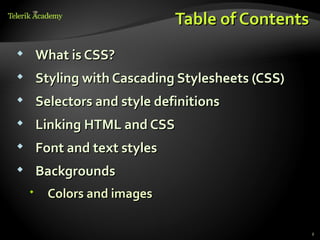
Table of Contents
    What is CSS?
    Styling with Cascading Stylesheets (CSS)
    Selectors and style definitions
    Linking HTML and CSS
    Font and text styles
    Backgrounds
     Colors and images

                                                2
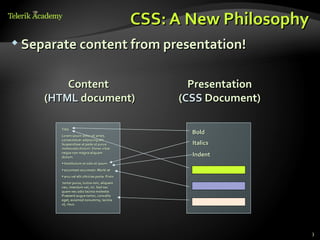
CSS: A New Philosophy
 Separate content from presentation!


         Content                                       Presentation
     (HTML document)                                 (CSS Document)

       Title
       Lorem ipsum dolor sit amet,
                                                       Bold
       consectetuer adipiscing elit.
       Suspendisse at pede ut purus                    Italics
       malesuada dictum. Donec vitae
       neque non magna aliquam
       dictum.                                         Indent
       • Vestibulum et odio et ipsum
       • accumsan accumsan. Morbi at
       • arcu vel elit ultricies porta. Proin
       tortor purus, luctus non, aliquam
       nec, interdum vel, mi. Sed nec
       quam nec odio lacinia molestie.
       Praesent augue tortor, convallis
       eget, euismod nonummy, lacinia
       ut, risus.


                                                                        3
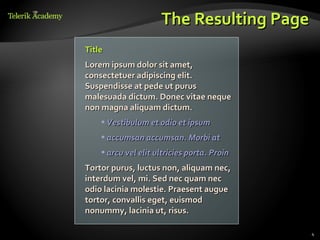
The Resulting Page
Title
Lorem ipsum dolor sit amet,
consectetuer adipiscing elit.
Suspendisse at pede ut purus
malesuada dictum. Donec vitae neque
non magna aliquam dictum.
    • Vestibulum et odio et ipsum
    • accumsan accumsan. Morbi at
    • arcu vel elit ultricies porta. Proin
Tortor purus, luctus non, aliquam nec,
interdum vel, mi. Sed nec quam nec
odio lacinia molestie. Praesent augue
tortor, convallis eget, euismod
nonummy, lacinia ut, risus.

                                             4
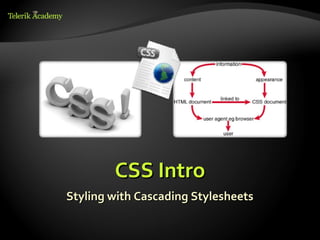
CSS Intro
Styling with Cascading Stylesheets
CSS Introduction
   Cascading Style Sheets (CSS)
     Used to describe the presentation of documents
     Define sizes, spacing, fonts, colors, layout, etc.
     Improve content accessibility
     Improve flexibility
   Designed to separate presentation from content
   Due to CSS, all HTML presentation tags and
    attributes are deprecated, e.g. font, center, etc.


                                                           6
CSS Introduction (2)
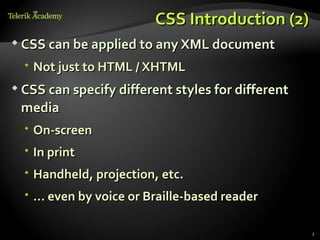
 CSS can be applied to any XML document

   Not just to HTML / XHTML
 CSS can specify different styles for different

 media
   On-screen
   In print
   Handheld, projection, etc.
   … even by voice or Braille-based reader

                                                   7
Why “Cascading”?
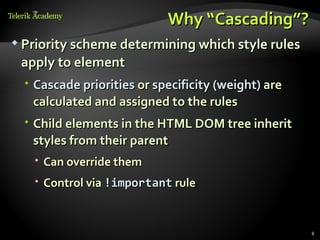
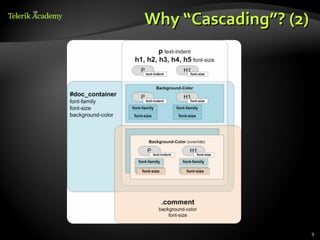
 Priority scheme determining which style rules

 apply to element
   Cascade priorities or specificity (weight) are
    calculated and assigned to the rules
   Child elements in the HTML DOM tree inherit
    styles from their parent
    Can override them
    Control via !important rule


                                                     8
Why “Cascading”? (2)


                       9
Stile Inheritance
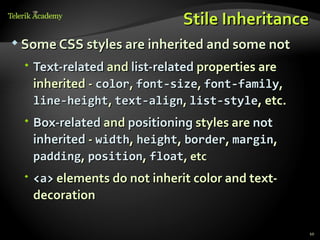
 Some CSS styles are inherited and some not

  Text-related and list-related properties are
   inherited - color, font-size, font-family,
   line-height, text-align, list-style, etc.
  Box-related and positioning styles are not
   inherited - width, height, border, margin,
   padding, position, float, etc
  <a> elements do not inherit color and text-
   decoration

                                                  10
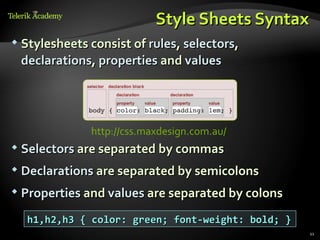
Style Sheets Syntax
   Stylesheets consist of rules, selectors,
    declarations, properties and values


                http://css.maxdesign.com.au/
   Selectors are separated by commas
   Declarations are separated by semicolons
   Properties and values are separated by colons
     h1,h2,h3 { color: green; font-weight: bold; }
                                                     11
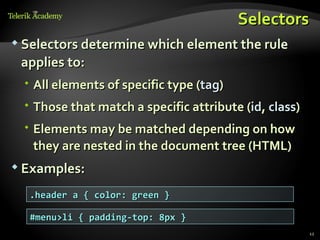
Selectors
 Selectors determine which element the rule

 applies to:
  All elements of specific type (tag)
  Those that match a specific attribute (id, class)
  Elements may be matched depending on how
   they are nested in the document tree (HTML)
 Examples:

  .header a { color: green }

  #menu>li { padding-top: 8px }
                                                       12
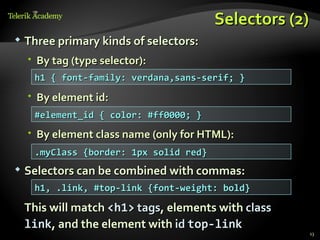
Selectors (2)
   Three primary kinds of selectors:
     By tag (type selector):
     h1 { font-family: verdana,sans-serif; }
     By element id:
     #element_id { color: #ff0000; }
     By element class name (only for HTML):
     .myClass {border: 1px solid red}
   Selectors can be combined with commas:
     h1, .link, #top-link {font-weight: bold}

    This will match <h1> tags, elements with class
    link, and the element with id top-link
                                                     13
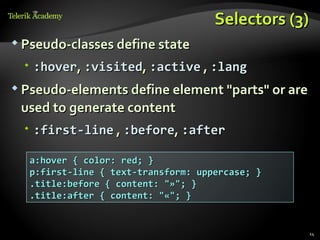
Selectors (3)
 Pseudo-classes define state

   :hover, :visited, :active , :lang
 Pseudo-elements define element "parts" or are

 used to generate content
   :first-line , :before, :after

  a:hover { color: red; }
  p:first-line { text-transform: uppercase; }
  .title:before { content: "»"; }
  .title:after { content: "«"; }


                                                  14
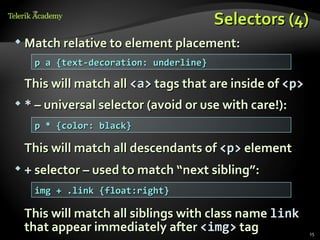
Selectors (4)
   Match relative to element placement:
     p a {text-decoration: underline}

    This will match all <a> tags that are inside of <p>
   * – universal selector (avoid or use with care!):
     p * {color: black}

    This will match all descendants of <p> element
   + selector – used to match “next sibling”:
     img + .link {float:right}

    This will match all siblings with class name link
    that appear immediately after <img> tag               15
Selectors (5)
   > selector – matches direct child nodes:
      p > .error {font-size: 8px}
  This will match all elements with class error, direct
  children of <p> tag
 [ ] – matches tag attributes by regular expression:


      img[alt~=logo] {border: none}
    This will match all <img> tags with alt attribute
    containing the word logo
   .class1.class2 (no space) - matches elements
    with both (all) classes applied at the same time

                                                          16
Values in the CSS Rules
   Colors are set in RGB format (decimal or hex):
     Example: #a0a6aa = rgb(160, 166, 170)
     Predefined color aliases exist: black, blue, etc.
   Numeric values are specified in:
     Pixels, ems, e.g. 12px , 1.4em
     Points, inches, centimeters, millimeters
       E.g. 10pt , 1in, 1cm, 1mm
     Percentages, e.g. 50%
       Percentage of what?...
     Zero can be used with no unit: border: 0;
                                                          17
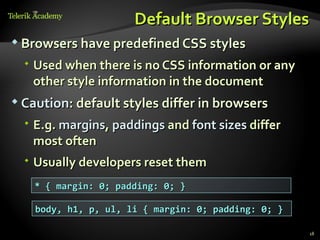
Default Browser Styles
 Browsers have predefined CSS styles

   Used when there is no CSS information or any
    other style information in the document
 Caution: default styles differ in browsers

   E.g. margins, paddings and font sizes differ
    most often
   Usually developers reset them
    * { margin: 0; padding: 0; }

    body, h1, p, ul, li { margin: 0; padding: 0; }

                                                     18
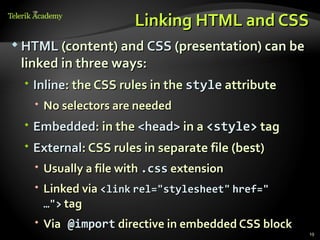
Linking HTML and CSS
 HTML (content) and CSS (presentation) can be
 linked in three ways:
  Inline: the CSS rules in the style attribute
    No selectors are needed
  Embedded: in the <head> in a <style> tag
  External: CSS rules in separate file (best)
    Usually a file with .css extension
    Linked via <link rel="stylesheet" href="
     …"> tag
    Via @import directive in embedded CSS block
                                                   19
Linking HTML and CSS (2)

 Using external files is highly recommended

   Simplifies the HTML document
   Improves page load speed as the CSS file is
    cached


                                                  20
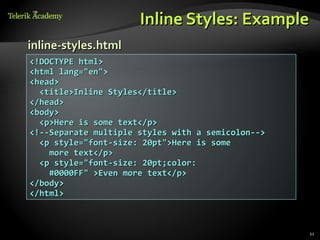
Inline Styles: Example
inline-styles.html
<!DOCTYPE html>
<html lang="en">
<head>
  <title>Inline Styles</title>
</head>
<body>
  <p>Here is some text</p>
<!--Separate multiple styles with a semicolon-->
  <p style="font-size: 20pt">Here is some
    more text</p>
  <p style="font-size: 20pt;color:
    #0000FF" >Even more text</p>
</body>
</html>


                                                   21
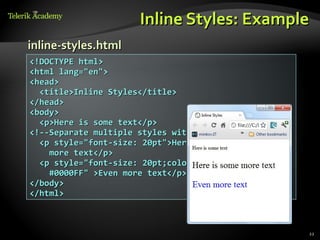
Inline Styles: Example
inline-styles.html
<!DOCTYPE html>
<html lang="en">
<head>
  <title>Inline Styles</title>
</head>
<body>
  <p>Here is some text</p>
<!--Separate multiple styles with a semicolon-->
  <p style="font-size: 20pt">Here is some
    more text</p>
  <p style="font-size: 20pt;color:
    #0000FF" >Even more text</p>
</body>
</html>


                                                   22
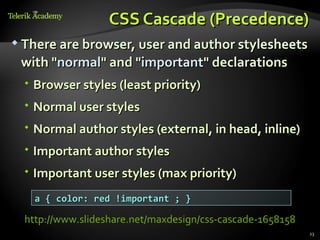
CSS Cascade (Precedence)
 There are browser, user and author stylesheets

 with "normal" and "important" declarations
   Browser styles (least priority)
   Normal user styles
   Normal author styles (external, in head, inline)
   Important author styles
   Important user styles (max priority)
    a { color: red !important ; }

  http://www.slideshare.net/maxdesign/css-cascade-1658158
                                                            23
CSS Specificity
 CSS specificity is used to determine the

 precedence of CSS style declarations with the
 same origin. Selectors are what matters
   Simple calculation: #id = 100, .class = 10,
    :pseudo = 10, [attr] = 10, tag = 1, * = 0
   Same number of points? Order matters!
   See also:
   http://www.smashingmagazine.com/2007/07/27/css-specificity-things-you-


   http://css.maxdesign.com.au/selectutorial/advanced_conflict.htm

                                                                       24
CSS Rules Precedence
        Live Demo
     precedence.html
Embedded Styles
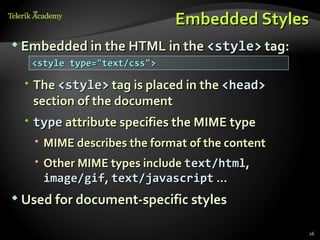
 Embedded in the HTML in the <style> tag:
   <style type="text/css">

   The <style> tag is placed in the <head>
    section of the document
   type attribute specifies the MIME type
    MIME describes the format of the content
    Other MIME types include text/html,
     image/gif, text/javascript …
 Used for document-specific styles


                                                26
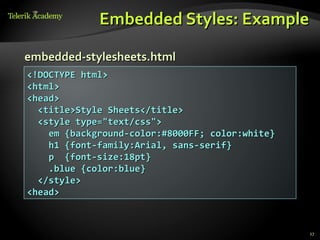
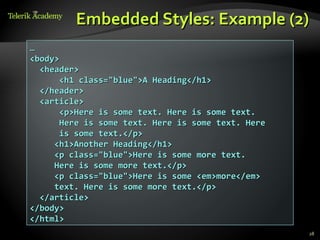
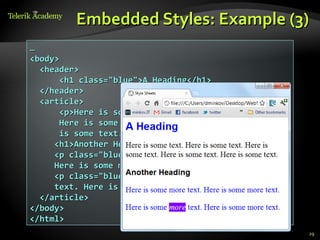
Embedded Styles: Example

embedded-stylesheets.html
<!DOCTYPE html>
<html>
<head>
  <title>Style Sheets</title>
  <style type="text/css">
    em {background-color:#8000FF; color:white}
    h1 {font-family:Arial, sans-serif}
    p {font-size:18pt}
    .blue {color:blue}
  </style>
<head>


                                                 27
Embedded Styles: Example (2)
…
<body>
  <header>
       <h1 class="blue">A Heading</h1>
  </header>
  <article>
       <p>Here is some text. Here is some text.
       Here is some text. Here is some text. Here
       is some text.</p>
     <h1>Another Heading</h1>
     <p class="blue">Here is some more text.
     Here is some more text.</p>
     <p class="blue">Here is some <em>more</em>
     text. Here is some more text.</p>
  </article>
</body>
</html>
                                                    28
Embedded Styles: Example (3)
…
<body>
  <header>
       <h1 class="blue">A Heading</h1>
  </header>
  <article>
       <p>Here is some text. Here is some text.
       Here is some text. Here is some text. Here
       is some text.</p>
     <h1>Another Heading</h1>
     <p class="blue">Here is some more text.
     Here is some more text.</p>
     <p class="blue">Here is some <em>more</em>
     text. Here is some more text.</p>
  </article>
</body>
</html>
                                                    29
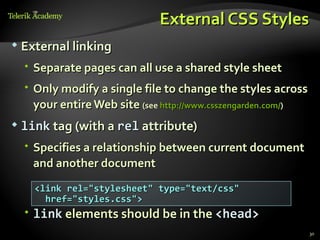
External CSS Styles
   External linking
     Separate pages can all use a shared style sheet
     Only modify a single file to change the styles across
      your entire Web site (see http://www.csszengarden.com/)
   link tag (with a rel attribute)
     Specifies a relationship between current document
      and another document
      <link rel="stylesheet" type="text/css"
        href="styles.css">
     link elements should be in the <head>
                                                                30
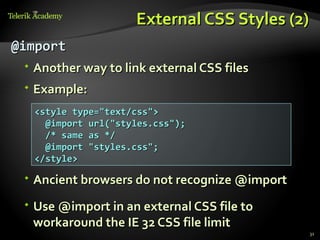
External CSS Styles (2)
@import
  Another way to link external CSS files
  Example:
  <style type="text/css">
    @import url("styles.css");
    /* same as */
    @import "styles.css";
  </style>

  Ancient browsers do not recognize @import

  Use @import in an external CSS file to
   workaround the IE 32 CSS file limit
                                               31
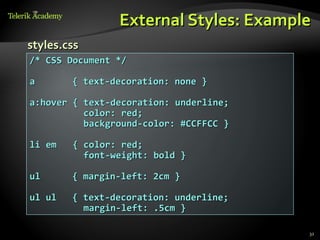
External Styles: Example
styles.css
/* CSS Document */

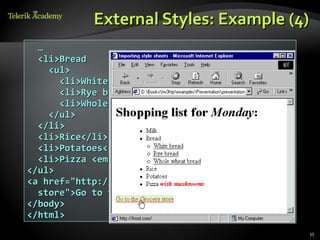
a       { text-decoration: none }

a:hover { text-decoration: underline;
          color: red;
          background-color: #CCFFCC }

li em   { color: red;
          font-weight: bold }

ul      { margin-left: 2cm }

ul ul   { text-decoration: underline;
          margin-left: .5cm }

                                        32
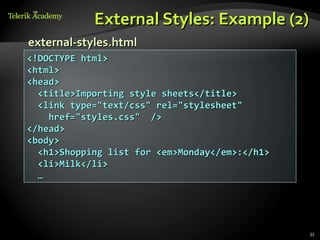
External Styles: Example (2)
external-styles.html
<!DOCTYPE html>
<html>
<head>
  <title>Importing style sheets</title>
  <link type="text/css" rel="stylesheet"
    href="styles.css" />
</head>
<body>
  <h1>Shopping list for <em>Monday</em>:</h1>
  <li>Milk</li>
  …


                                                33
External Styles: Example (3)
  …
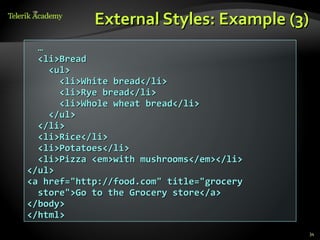
  <li>Bread
    <ul>
      <li>White bread</li>
      <li>Rye bread</li>
      <li>Whole wheat bread</li>
    </ul>
  </li>
  <li>Rice</li>
  <li>Potatoes</li>
  <li>Pizza <em>with mushrooms</em></li>
</ul>
<a href="http://food.com" title="grocery
  store">Go to the Grocery store</a>
</body>
</html>
                                           34
External Styles: Example (4)
  …
  <li>Bread
    <ul>
      <li>White bread</li>
      <li>Rye bread</li>
      <li>Whole wheat bread</li>
    </ul>
  </li>
  <li>Rice</li>
  <li>Potatoes</li>
  <li>Pizza <em>with mushrooms</em></li>
</ul>
<a href="http://food.com" title="grocery
  store">Go to the Grocery store</a>
</body>
</html>
                                           35
Text Related Properties
Text-related CSS Properties
   color – specifies the color of the text
   font-size – size of font: xx-small, x-small,
    small, medium, large, x-large, xx-large,
    smaller, larger or numeric value
   font-family – comma separated font names
     Example: verdana, sans-serif, etc.
     The browser loads the first one that is available
     There should always be at least one generic font
   font-weight can be normal, bold, bolder,
    lighter or a number in range [100 … 900]
                                                          37
CSS Rules for Fonts (2)
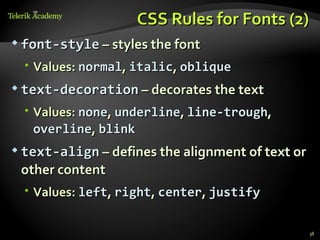
 font-style – styles the font

  Values: normal, italic, oblique
 text-decoration – decorates the text

  Values: none, underline, line-trough,
   overline, blink
 text-align – defines the alignment of text or

 other content
  Values: left, right, center, justify


                                                  38
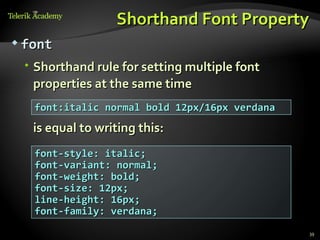
Shorthand Font Property
 font

  Shorthand rule for setting multiple font
   properties at the same time
   font:italic normal bold 12px/16px verdana
   is equal to writing this:
   font-style: italic;
   font-variant: normal;
   font-weight: bold;
   font-size: 12px;
   line-height: 16px;
   font-family: verdana;
                                               39
Fonts
  Live Demo
font-rules.html
Background Properties
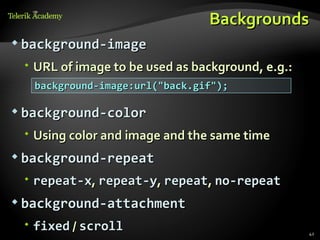
Backgrounds
 background-image

  URL of image to be used as background, e.g.:
   background-image:url("back.gif");

 background-color

  Using color and image and the same time
 background-repeat

  repeat-x, repeat-y, repeat, no-repeat
 background-attachment

  fixed / scroll                                 42
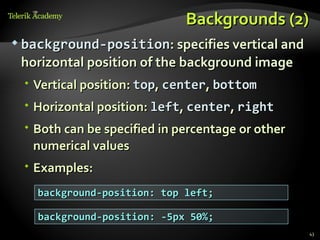
Backgrounds (2)
 background-position: specifies vertical and

 horizontal position of the background image
  Vertical position: top, center, bottom
  Horizontal position: left, center, right
  Both can be specified in percentage or other
   numerical values
  Examples:
    background-position: top left;

    background-position: -5px 50%;
                                                  43
Background Shorthand Property
   background: shorthand rule for setting
    background properties at the same time:
    background: #FFF0C0 url("back.gif") no-repeat
    fixed top;


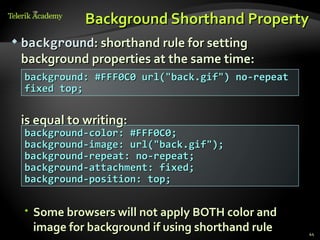
    is equal to writing:
    background-color: #FFF0C0;
    background-image: url("back.gif");
    background-repeat: no-repeat;
    background-attachment: fixed;
    background-position: top;


     Some browsers will not apply BOTH color and
      image for background if using shorthand rule   44
Background-image or <img>?
 Background images allow you to save many

 image tags from the HTML
   Leads to less code
   More content-oriented approach
 All images that are not part of the page

 content (and are used only for "beautification")
 should be moved to the CSS


                                                    45
Background Styles
      Live Demo
 background-rules.html
CSS Reference
 A list of all CSS 2.1 properties is available at

 http://www.w3.org/TR/CSS2/propidx.html


                                                     47
CSS Overview


http://html5course.telerik.com
Homework
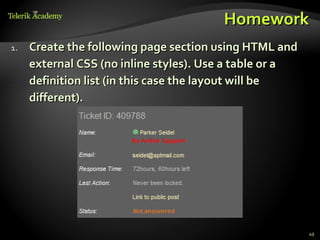
1.   Create the following page section using HTML and
     external CSS (no inline styles). Use a table or a
     definition list (in this case the layout will be
     different).


                                                         49
Homework (2)
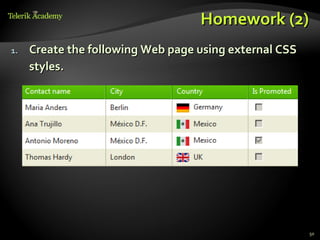
1.   Create the following Web page using external CSS
     styles.


                                                        50
Homework (3)
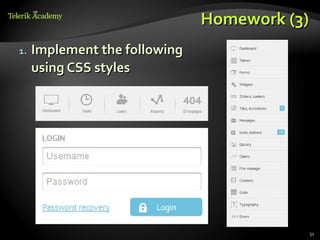
1.   Implement the following
     using CSS styles


                                          51
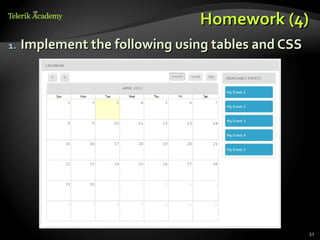
Homework (4)
1.   Implement the following using tables and CSS


                                                    52

CSS Overview

  • 1.
    CSS Overview Cascading Style Sheets Svetlin Nakov Manager Technical Training http://nakov.com Telerik Web Design Course html5course.telerik.com
  • 2.
    Table of Contents  What is CSS?  Styling with Cascading Stylesheets (CSS)  Selectors and style definitions  Linking HTML and CSS  Font and text styles  Backgrounds  Colors and images 2
  • 3.
    CSS: A NewPhilosophy  Separate content from presentation! Content Presentation (HTML document) (CSS Document) Title Lorem ipsum dolor sit amet, Bold consectetuer adipiscing elit. Suspendisse at pede ut purus Italics malesuada dictum. Donec vitae neque non magna aliquam dictum. Indent • Vestibulum et odio et ipsum • accumsan accumsan. Morbi at • arcu vel elit ultricies porta. Proin tortor purus, luctus non, aliquam nec, interdum vel, mi. Sed nec quam nec odio lacinia molestie. Praesent augue tortor, convallis eget, euismod nonummy, lacinia ut, risus. 3
  • 4.
    The Resulting Page Title Loremipsum dolor sit amet, consectetuer adipiscing elit. Suspendisse at pede ut purus malesuada dictum. Donec vitae neque non magna aliquam dictum. • Vestibulum et odio et ipsum • accumsan accumsan. Morbi at • arcu vel elit ultricies porta. Proin Tortor purus, luctus non, aliquam nec, interdum vel, mi. Sed nec quam nec odio lacinia molestie. Praesent augue tortor, convallis eget, euismod nonummy, lacinia ut, risus. 4
  • 5.
    CSS Intro Styling withCascading Stylesheets
  • 6.
    CSS Introduction  Cascading Style Sheets (CSS)  Used to describe the presentation of documents  Define sizes, spacing, fonts, colors, layout, etc.  Improve content accessibility  Improve flexibility  Designed to separate presentation from content  Due to CSS, all HTML presentation tags and attributes are deprecated, e.g. font, center, etc. 6
  • 7.
    CSS Introduction (2) CSS can be applied to any XML document  Not just to HTML / XHTML  CSS can specify different styles for different media  On-screen  In print  Handheld, projection, etc.  … even by voice or Braille-based reader 7
  • 8.
    Why “Cascading”?  Priorityscheme determining which style rules apply to element  Cascade priorities or specificity (weight) are calculated and assigned to the rules  Child elements in the HTML DOM tree inherit styles from their parent  Can override them  Control via !important rule 8
  • 9.
  • 10.
    Stile Inheritance  SomeCSS styles are inherited and some not  Text-related and list-related properties are inherited - color, font-size, font-family, line-height, text-align, list-style, etc.  Box-related and positioning styles are not inherited - width, height, border, margin, padding, position, float, etc  <a> elements do not inherit color and text- decoration 10
  • 11.
    Style Sheets Syntax  Stylesheets consist of rules, selectors, declarations, properties and values http://css.maxdesign.com.au/  Selectors are separated by commas  Declarations are separated by semicolons  Properties and values are separated by colons h1,h2,h3 { color: green; font-weight: bold; } 11
  • 12.
    Selectors  Selectors determinewhich element the rule applies to:  All elements of specific type (tag)  Those that match a specific attribute (id, class)  Elements may be matched depending on how they are nested in the document tree (HTML)  Examples: .header a { color: green } #menu>li { padding-top: 8px } 12
  • 13.
    Selectors (2)  Three primary kinds of selectors:  By tag (type selector): h1 { font-family: verdana,sans-serif; }  By element id: #element_id { color: #ff0000; }  By element class name (only for HTML): .myClass {border: 1px solid red}  Selectors can be combined with commas: h1, .link, #top-link {font-weight: bold} This will match <h1> tags, elements with class link, and the element with id top-link 13
  • 14.
    Selectors (3)  Pseudo-classesdefine state  :hover, :visited, :active , :lang  Pseudo-elements define element "parts" or are used to generate content  :first-line , :before, :after a:hover { color: red; } p:first-line { text-transform: uppercase; } .title:before { content: "»"; } .title:after { content: "«"; } 14
  • 15.
    Selectors (4)  Match relative to element placement: p a {text-decoration: underline} This will match all <a> tags that are inside of <p>  * – universal selector (avoid or use with care!): p * {color: black} This will match all descendants of <p> element  + selector – used to match “next sibling”: img + .link {float:right} This will match all siblings with class name link that appear immediately after <img> tag 15
  • 16.
    Selectors (5)  > selector – matches direct child nodes: p > .error {font-size: 8px} This will match all elements with class error, direct children of <p> tag  [ ] – matches tag attributes by regular expression: img[alt~=logo] {border: none} This will match all <img> tags with alt attribute containing the word logo  .class1.class2 (no space) - matches elements with both (all) classes applied at the same time 16
  • 17.
    Values in theCSS Rules  Colors are set in RGB format (decimal or hex):  Example: #a0a6aa = rgb(160, 166, 170)  Predefined color aliases exist: black, blue, etc.  Numeric values are specified in:  Pixels, ems, e.g. 12px , 1.4em  Points, inches, centimeters, millimeters  E.g. 10pt , 1in, 1cm, 1mm  Percentages, e.g. 50%  Percentage of what?...  Zero can be used with no unit: border: 0; 17
  • 18.
    Default Browser Styles Browsers have predefined CSS styles  Used when there is no CSS information or any other style information in the document  Caution: default styles differ in browsers  E.g. margins, paddings and font sizes differ most often  Usually developers reset them * { margin: 0; padding: 0; } body, h1, p, ul, li { margin: 0; padding: 0; } 18
  • 19.
    Linking HTML andCSS  HTML (content) and CSS (presentation) can be linked in three ways:  Inline: the CSS rules in the style attribute  No selectors are needed  Embedded: in the <head> in a <style> tag  External: CSS rules in separate file (best)  Usually a file with .css extension  Linked via <link rel="stylesheet" href=" …"> tag  Via @import directive in embedded CSS block 19
  • 20.
    Linking HTML andCSS (2)  Using external files is highly recommended  Simplifies the HTML document  Improves page load speed as the CSS file is cached 20
  • 21.
    Inline Styles: Example inline-styles.html <!DOCTYPEhtml> <html lang="en"> <head> <title>Inline Styles</title> </head> <body> <p>Here is some text</p> <!--Separate multiple styles with a semicolon--> <p style="font-size: 20pt">Here is some more text</p> <p style="font-size: 20pt;color: #0000FF" >Even more text</p> </body> </html> 21
  • 22.
    Inline Styles: Example inline-styles.html <!DOCTYPEhtml> <html lang="en"> <head> <title>Inline Styles</title> </head> <body> <p>Here is some text</p> <!--Separate multiple styles with a semicolon--> <p style="font-size: 20pt">Here is some more text</p> <p style="font-size: 20pt;color: #0000FF" >Even more text</p> </body> </html> 22
  • 23.
    CSS Cascade (Precedence) There are browser, user and author stylesheets with "normal" and "important" declarations  Browser styles (least priority)  Normal user styles  Normal author styles (external, in head, inline)  Important author styles  Important user styles (max priority) a { color: red !important ; } http://www.slideshare.net/maxdesign/css-cascade-1658158 23
  • 24.
    CSS Specificity  CSSspecificity is used to determine the precedence of CSS style declarations with the same origin. Selectors are what matters  Simple calculation: #id = 100, .class = 10, :pseudo = 10, [attr] = 10, tag = 1, * = 0  Same number of points? Order matters!  See also:  http://www.smashingmagazine.com/2007/07/27/css-specificity-things-you-  http://css.maxdesign.com.au/selectutorial/advanced_conflict.htm 24
  • 25.
    CSS Rules Precedence Live Demo precedence.html
  • 26.
    Embedded Styles  Embeddedin the HTML in the <style> tag: <style type="text/css">  The <style> tag is placed in the <head> section of the document  type attribute specifies the MIME type  MIME describes the format of the content  Other MIME types include text/html, image/gif, text/javascript …  Used for document-specific styles 26
  • 27.
    Embedded Styles: Example embedded-stylesheets.html <!DOCTYPEhtml> <html> <head> <title>Style Sheets</title> <style type="text/css"> em {background-color:#8000FF; color:white} h1 {font-family:Arial, sans-serif} p {font-size:18pt} .blue {color:blue} </style> <head> 27
  • 28.
    Embedded Styles: Example(2) … <body> <header> <h1 class="blue">A Heading</h1> </header> <article> <p>Here is some text. Here is some text. Here is some text. Here is some text. Here is some text.</p> <h1>Another Heading</h1> <p class="blue">Here is some more text. Here is some more text.</p> <p class="blue">Here is some <em>more</em> text. Here is some more text.</p> </article> </body> </html> 28
  • 29.
    Embedded Styles: Example(3) … <body> <header> <h1 class="blue">A Heading</h1> </header> <article> <p>Here is some text. Here is some text. Here is some text. Here is some text. Here is some text.</p> <h1>Another Heading</h1> <p class="blue">Here is some more text. Here is some more text.</p> <p class="blue">Here is some <em>more</em> text. Here is some more text.</p> </article> </body> </html> 29
  • 30.
    External CSS Styles  External linking  Separate pages can all use a shared style sheet  Only modify a single file to change the styles across your entire Web site (see http://www.csszengarden.com/)  link tag (with a rel attribute)  Specifies a relationship between current document and another document <link rel="stylesheet" type="text/css" href="styles.css">  link elements should be in the <head> 30
  • 31.
    External CSS Styles(2) @import  Another way to link external CSS files  Example: <style type="text/css"> @import url("styles.css"); /* same as */ @import "styles.css"; </style>  Ancient browsers do not recognize @import  Use @import in an external CSS file to workaround the IE 32 CSS file limit 31
  • 32.
    External Styles: Example styles.css /*CSS Document */ a { text-decoration: none } a:hover { text-decoration: underline; color: red; background-color: #CCFFCC } li em { color: red; font-weight: bold } ul { margin-left: 2cm } ul ul { text-decoration: underline; margin-left: .5cm } 32
  • 33.
    External Styles: Example(2) external-styles.html <!DOCTYPE html> <html> <head> <title>Importing style sheets</title> <link type="text/css" rel="stylesheet" href="styles.css" /> </head> <body> <h1>Shopping list for <em>Monday</em>:</h1> <li>Milk</li> … 33
  • 34.
    External Styles: Example(3) … <li>Bread <ul> <li>White bread</li> <li>Rye bread</li> <li>Whole wheat bread</li> </ul> </li> <li>Rice</li> <li>Potatoes</li> <li>Pizza <em>with mushrooms</em></li> </ul> <a href="http://food.com" title="grocery store">Go to the Grocery store</a> </body> </html> 34
  • 35.
    External Styles: Example(4) … <li>Bread <ul> <li>White bread</li> <li>Rye bread</li> <li>Whole wheat bread</li> </ul> </li> <li>Rice</li> <li>Potatoes</li> <li>Pizza <em>with mushrooms</em></li> </ul> <a href="http://food.com" title="grocery store">Go to the Grocery store</a> </body> </html> 35
  • 36.
  • 37.
    Text-related CSS Properties  color – specifies the color of the text  font-size – size of font: xx-small, x-small, small, medium, large, x-large, xx-large, smaller, larger or numeric value  font-family – comma separated font names  Example: verdana, sans-serif, etc.  The browser loads the first one that is available  There should always be at least one generic font  font-weight can be normal, bold, bolder, lighter or a number in range [100 … 900] 37
  • 38.
    CSS Rules forFonts (2)  font-style – styles the font  Values: normal, italic, oblique  text-decoration – decorates the text  Values: none, underline, line-trough, overline, blink  text-align – defines the alignment of text or other content  Values: left, right, center, justify 38
  • 39.
    Shorthand Font Property font  Shorthand rule for setting multiple font properties at the same time font:italic normal bold 12px/16px verdana is equal to writing this: font-style: italic; font-variant: normal; font-weight: bold; font-size: 12px; line-height: 16px; font-family: verdana; 39
  • 40.
    Fonts LiveDemo font-rules.html
  • 41.
  • 42.
    Backgrounds  background-image URL of image to be used as background, e.g.: background-image:url("back.gif");  background-color  Using color and image and the same time  background-repeat  repeat-x, repeat-y, repeat, no-repeat  background-attachment  fixed / scroll 42
  • 43.
    Backgrounds (2)  background-position:specifies vertical and horizontal position of the background image  Vertical position: top, center, bottom  Horizontal position: left, center, right  Both can be specified in percentage or other numerical values  Examples: background-position: top left; background-position: -5px 50%; 43
  • 44.
    Background Shorthand Property  background: shorthand rule for setting background properties at the same time: background: #FFF0C0 url("back.gif") no-repeat fixed top; is equal to writing: background-color: #FFF0C0; background-image: url("back.gif"); background-repeat: no-repeat; background-attachment: fixed; background-position: top;  Some browsers will not apply BOTH color and image for background if using shorthand rule 44
  • 45.
    Background-image or <img>? Background images allow you to save many image tags from the HTML  Leads to less code  More content-oriented approach  All images that are not part of the page content (and are used only for "beautification") should be moved to the CSS 45
  • 46.
    Background Styles Live Demo background-rules.html
  • 47.
    CSS Reference  Alist of all CSS 2.1 properties is available at http://www.w3.org/TR/CSS2/propidx.html 47
  • 48.
  • 49.
    Homework 1. Create the following page section using HTML and external CSS (no inline styles). Use a table or a definition list (in this case the layout will be different). 49
  • 50.
    Homework (2) 1. Create the following Web page using external CSS styles. 50
  • 51.
    Homework (3) 1. Implement the following using CSS styles 51
  • 52.
    Homework (4) 1. Implement the following using tables and CSS 52

Editor's Notes

  • #6 * 07/16/96 (c) 2007 National Academy for Software Development - http://academy.devbg.org. All rights reserved. Unauthorized copying or re-distribution is strictly prohibited.* ##