CSS 220 Module 4 Homework
Think about how many messages are sent electronically today.
What are most common? Email, text messages, in-app
messaging? And what kind of data gets sent? Is it secure? For it
to be secure during transmission, it needs to be encrypted. Do
you know if your messages are encrypted? It is not hard to do.
Let’s work through some classic encryption techniques.
Then when it arrives and the receiver wants to look at your
message, they can perform a decryption. All forms of
encryption rely on two basic forms of ciphers: substitution-
based and transposition-based. Good encryption algorithms
actually use multiple layers of both cipher forms. Let’s look at
each form in more detail.
Substitution-based Ciphers
Have you ever seen the cryptoquote puzzles in the newspaper?
You can try to solve one here:
https://api.razzlepuzzles.com/cryptogram.
Despite its daunting name, the substitution-based cipher is
actually a fairly simple encryption technique. A substitution-
based cipher replaces a character or group of characters with a
different character or group of characters. Consider the
following simple example. Each letter in the plaintext row maps
onto the letter below it in the ciphertext row.
Plaintext: abcdefghijklmnopqrstuvwxyz
Ciphertext: POIUYTREWQLKJHGFDSAMNZVCXB
This ciphertext simply corresponds to the letters on a keyboard,
scanning right to left, top to bottom. To send a message using
this encoding scheme, each plaintext letter of the message is
replaced with the ciphertext character directly below it. Thus,
the message
what are you doing after class?
would encode to
VEPMP STXGN UGWHR PTMYS IKPAA
A space has been placed after every five ciphertext characters to
help disguise obvious patterns.
1. Using the above plaintext and corresponding ciphertext,
encode the message “i will encrypt everything”.
A famous substitution cipher is the Caesar Cipher, created and
used by Julius Caesar. This cipher uses what is called a shift
technique. Similar to above, you will make substitutions, but is
a bit easier to code and decode. The transformation can be
represented by aligning two alphabets; the cipher alphabet is the
plain alphabet shifted left or right by some number of positions
(the key).
For instance: Key = left shift 7 spaces
Plaintext: abcdefghijklmnopqrstuvwxyz
Ciphertext: TUVWXYZABCDEFGHIJKLMNOP
2. Create your own message and encode it using the Caesar
Cipher method. Provide your key to decode the message.
Transposition-based Ciphers
A transposition-based cipher is different from a substitution-
based cipher in that the order of the plaintext is not preserved.
Rearranging the order of the plaintext characters makes common
patterns unclear and the code much more difficult to break. Let
us consider a simple example of a transposition cipher. Choose
a keyword that contains no duplicate letters, such as
COMPUTER. Over each letter in the keyword, write the number
that corresponds to the order in which that letter appears in the
alphabet when compared to the other letters in the keyword. For
the keyword COMPUTER, C appears first in the alphabet, E is
second, M is third, O is fourth, and so on.
14358726
COMPUTER
Take a plaintext message such as “this is the best class i have
ever taken” and write it under the keyword in consecutive rows
going from left to right.
14358726
COMPUTER
thisisth
ebestcla
ssihavee
vertaken
To encode the message, read down each column starting with
the column numbered 1 and proceeding through to the column
numbered 8. Reading column 1 gives us TESV, and column 2
gives us TLEE. Encoding all eight columns gives us the
following message:
TESVTLEEIEIRHBSESSHTHAENSCVKITAA
Two interesting observations can be made about this example.
First, the choice of the keyword is once again very important,
and care must be taken to make sure the keyword does not fall
into the wrong hands. Second, you could make the encryption
even more difficult by performing an additional substitution-
based cipher on the result of the transposition cipher. In fact,
why stop there? You could create a very difficult code if you
repeated various patterns of substitution- and transposition-
based ciphers, one after another.
3. Using the keyword JUNIOR, encode the message “I need
some caffeine to stay awake in class”.
4. One of the most common forms of communication today is
email. It is used for everyday conversations as well as important
business decisions. If email is so important, do you or anyone
you know send encrypted email? Using the email program of
your choice, tell how you can encrypt your emails. Is there an
option in your email program to create an encrypted message? If
not, is there a third-party vendor on the Internet that will
encrypt your messages? Describe it. Sending a message over an
https connection is not good enough.
Homework Sheet #5: Logic
1. Construct the truth table for (p q) (¬p q)
p
q
¬p
p q
¬p q
(p q) (¬p q)
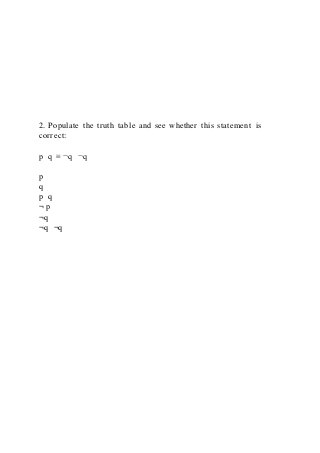
2. Populate the truth table and see whether this statement is
correct:
p q ≡ ¬q ¬q
p
q
p q
¬ p
¬q
¬q ¬q
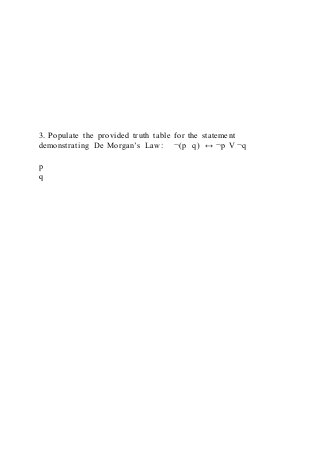
3. Populate the provided truth table for the statement
demonstrating De Morgan’s Law: ¬(p q) ↔ ¬p V ¬q
p
q
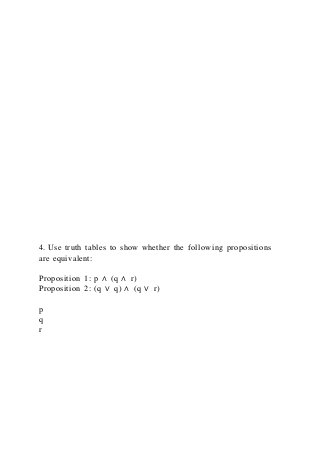
4. Use truth tables to show whether the following propositions
are equivalent:
Proposition 1: p ∧ (q ∧ r)
Proposition 2: (q ∨ q) ∧ (q ∨ r)
p
q
r
5. For this logic circuit provide:
a. the propositional logic formula
b. the truth table.
¬ (A ∨ B)
AND
OR
A
B
C
CSS 220 Module 4 HomeworkThink about how many messages are sent

CSS 220 Module 4 HomeworkThink about how many messages are sent

  • 1.
    CSS 220 Module4 Homework Think about how many messages are sent electronically today. What are most common? Email, text messages, in-app messaging? And what kind of data gets sent? Is it secure? For it to be secure during transmission, it needs to be encrypted. Do you know if your messages are encrypted? It is not hard to do. Let’s work through some classic encryption techniques. Then when it arrives and the receiver wants to look at your message, they can perform a decryption. All forms of encryption rely on two basic forms of ciphers: substitution- based and transposition-based. Good encryption algorithms actually use multiple layers of both cipher forms. Let’s look at each form in more detail. Substitution-based Ciphers Have you ever seen the cryptoquote puzzles in the newspaper? You can try to solve one here: https://api.razzlepuzzles.com/cryptogram. Despite its daunting name, the substitution-based cipher is actually a fairly simple encryption technique. A substitution- based cipher replaces a character or group of characters with a different character or group of characters. Consider the following simple example. Each letter in the plaintext row maps onto the letter below it in the ciphertext row. Plaintext: abcdefghijklmnopqrstuvwxyz Ciphertext: POIUYTREWQLKJHGFDSAMNZVCXB This ciphertext simply corresponds to the letters on a keyboard, scanning right to left, top to bottom. To send a message using this encoding scheme, each plaintext letter of the message is replaced with the ciphertext character directly below it. Thus, the message what are you doing after class? would encode to
  • 2.
    VEPMP STXGN UGWHRPTMYS IKPAA A space has been placed after every five ciphertext characters to help disguise obvious patterns. 1. Using the above plaintext and corresponding ciphertext, encode the message “i will encrypt everything”. A famous substitution cipher is the Caesar Cipher, created and used by Julius Caesar. This cipher uses what is called a shift technique. Similar to above, you will make substitutions, but is a bit easier to code and decode. The transformation can be represented by aligning two alphabets; the cipher alphabet is the plain alphabet shifted left or right by some number of positions (the key). For instance: Key = left shift 7 spaces Plaintext: abcdefghijklmnopqrstuvwxyz Ciphertext: TUVWXYZABCDEFGHIJKLMNOP 2. Create your own message and encode it using the Caesar Cipher method. Provide your key to decode the message. Transposition-based Ciphers A transposition-based cipher is different from a substitution- based cipher in that the order of the plaintext is not preserved. Rearranging the order of the plaintext characters makes common patterns unclear and the code much more difficult to break. Let us consider a simple example of a transposition cipher. Choose a keyword that contains no duplicate letters, such as COMPUTER. Over each letter in the keyword, write the number that corresponds to the order in which that letter appears in the alphabet when compared to the other letters in the keyword. For the keyword COMPUTER, C appears first in the alphabet, E is second, M is third, O is fourth, and so on. 14358726
  • 3.
    COMPUTER Take a plaintextmessage such as “this is the best class i have ever taken” and write it under the keyword in consecutive rows going from left to right. 14358726 COMPUTER thisisth ebestcla ssihavee vertaken To encode the message, read down each column starting with the column numbered 1 and proceeding through to the column numbered 8. Reading column 1 gives us TESV, and column 2 gives us TLEE. Encoding all eight columns gives us the following message: TESVTLEEIEIRHBSESSHTHAENSCVKITAA Two interesting observations can be made about this example. First, the choice of the keyword is once again very important, and care must be taken to make sure the keyword does not fall into the wrong hands. Second, you could make the encryption even more difficult by performing an additional substitution- based cipher on the result of the transposition cipher. In fact, why stop there? You could create a very difficult code if you repeated various patterns of substitution- and transposition- based ciphers, one after another. 3. Using the keyword JUNIOR, encode the message “I need some caffeine to stay awake in class”. 4. One of the most common forms of communication today is email. It is used for everyday conversations as well as important business decisions. If email is so important, do you or anyone you know send encrypted email? Using the email program of your choice, tell how you can encrypt your emails. Is there an option in your email program to create an encrypted message? If not, is there a third-party vendor on the Internet that will
  • 4.
    encrypt your messages?Describe it. Sending a message over an https connection is not good enough. Homework Sheet #5: Logic 1. Construct the truth table for (p q) (¬p q) p q ¬p p q ¬p q (p q) (¬p q)
  • 5.
    2. Populate thetruth table and see whether this statement is correct: p q ≡ ¬q ¬q p q p q ¬ p ¬q ¬q ¬q
  • 6.
    3. Populate theprovided truth table for the statement demonstrating De Morgan’s Law: ¬(p q) ↔ ¬p V ¬q p q
  • 7.
    4. Use truthtables to show whether the following propositions are equivalent: Proposition 1: p ∧ (q ∧ r) Proposition 2: (q ∨ q) ∧ (q ∨ r) p q r
  • 9.
    5. For thislogic circuit provide: a. the propositional logic formula b. the truth table.
  • 10.
    ¬ (A ∨B) AND OR A B C