S
Legalized
Marijuana:
Water Supply and Compliance Issues
in the State of Colorado
COLORADO SUSTAINABILITY CONSULTANTS
www.coloradosc.com
November 19, 2015
Conor P. Filter, Esq.
Legal and Environmental Consultant
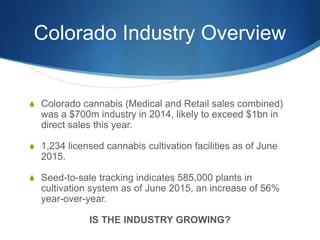
Colorado Industry Overview
S Colorado cannabis (Medical and Retail sales combined)
was a $700m industry in 2014, likely to exceed $1bn in
direct sales this year.
S 1,234 licensed cannabis cultivation facilities as of June
2015.
S Seed-to-sale tracking indicates 585,000 plants in
cultivation system as of June 2015, an increase of 56%
year-over-year.
IS THE INDUSTRY GROWING?
Colorado Industry Overview
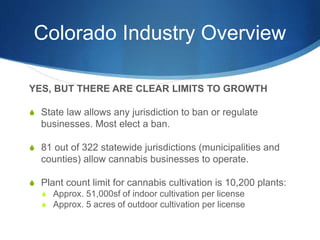
YES, BUT THERE ARE CLEAR LIMITS TO GROWTH
S State law allows any jurisdiction to ban or regulate
businesses. Most elect a ban.
S 81 out of 322 statewide jurisdictions (municipalities and
counties) allow cannabis businesses to operate.
S Plant count limit for cannabis cultivation is 10,200 plants:
S Approx. 51,000sf of indoor cultivation per license
S Approx. 5 acres of outdoor cultivation per license
Weld
Moffat
Mesa
Baca
Park
Routt
Yuma
Las Animas
Garfield
Lincoln
Larimer
Pueblo
Gunnison
Bent
Elbert
Saguache
Grand
Logan
Rio Blanco
Eagle
Kiowa
El Paso
Montrose
Otero
Delta
Washington
Kit Carson
Jackson
La Plata
Prowers
Fremont
Pitkin
Cheyenne
Morgan
Adams
Montezuma
Huerfano
Costilla
ConejosArchuleta
Dolores
Chaffee
Hinsdale
Mineral
San Miguel
Custer
Teller
Douglas
Phillips
Crowley
Boulder
Ouray
Arapahoe
Summit
Alamosa
Lake
Rio Grande
Sedgwick
Jefferson
San Juan
Clear Creek
Gilpin
Denver
Broomfield
Map Revision: January 7, 2015Created by Trent Pingenot for CCI For information purposes ONLY. Please contact individual counties for specifics on their regulatory status.
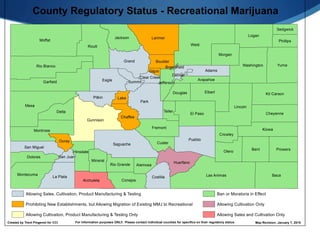
County Regulatory Status - Recreational Marijuana
Prohibiting New Establishments, but Allowing Migration of Existing MMJ to Recreational
Allowing Cultivation, Product Manufacturing & Testing Only
Allowing Cultivation Only
Allowing Sales, Cultivation, Product Manufacturing & Testing Ban or Moratoria in Effect
Allowing Sales and Cultivation Only
S
Cultivation: Industrial or
Agricultural Use?
Water Use is Tied Directly to
Cultivation Sites and Systems
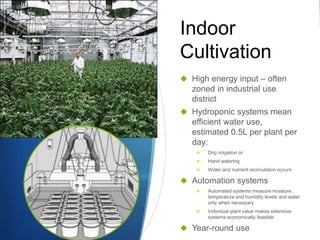
Indoor
Cultivation
 High energy input – often
zoned in industrial use
district
 Hydroponic systems mean
efficient water use,
estimated 0.5L per plant per
day:
 Drip irrigation or
 Hand watering
 Water and nutrient recirculation occurs
 Automation systems
 Automated systems measure moisture,
temperature and humidity levels and water
only when necessary
 Individual plant value makes extensive
systems economically feasible
 Year-round use
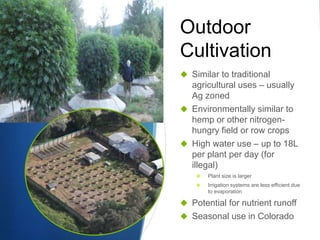
Outdoor
Cultivation
 Similar to traditional
agricultural uses – usually
Ag zoned
 Environmentally similar to
hemp or other nitrogen-
hungry field or row crops
 High water use – up to 18L
per plant per day (for
illegal)
 Plant size is larger
 Irrigation systems are less efficient due
to evaporation
 Potential for nutrient runoff
 Seasonal use in Colorado
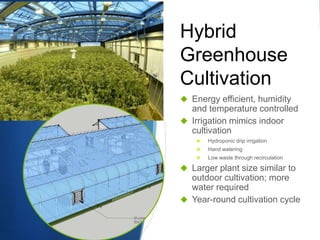
Hybrid
Greenhouse
Cultivation
 Energy efficient, humidity
and temperature controlled
 Irrigation mimics indoor
cultivation
 Hydroponic drip irrigation
 Hand watering
 Low waste through recirculation
 Larger plant size similar to
outdoor cultivation; more
water required
 Year-round cultivation cycle
S
Water Supply and
Compliance Issues
Water Administration Challenges,
Federal Restrictions,
State and Local Solutions
Water Administration
Challenges
S Indoor cultivation is not classified as an irrigation use
S Irrigation water rights and wells cannot be used for indoor
cultivation
S Requires different types of water rights or water rights
policy changes
S Water from Federal facilities not useable for industry
Federal Restrictions:
Bureau of Water Reclamation
Temporary Reclamation Manual Policy no. PEC TRMR-63
S Bans approval of any marijuana cultivation use from BWR-
managed water source under the Controlled Substances Act
S Mandatory reporting requirements for BWR employees if
marijuana cultivation is discovered as a use for any BWR water
S Temporary policy enacted May 14, 2014; set to expire or be
adopted in 2016.
Division of Water Resources
State Regulation:
S State allows all legal uses of water for cannabis cultivation,
including:
S Residential well permits for individual use
S Water hauling from legal sources
S Commercial Well or Ditch rights for irrigation allowable under state law
S Restricts cannabis cultivation as it does other agricultural uses:
S Exempt commercial wells available only for drinking and sanitation in
commercial facilities
S Seasonal use of irrigation rights could restrict greenhouse cultivation
on agricultural land
Local Solutions: Pueblo
County
S Business-friendly regulatory environment
S Pueblo Board of Water Works Resolution 2014-05 was
passed in response to BWR;
S Allows city to lease excess water up to 800 acre feet
annually to marijuana enterprises in unincorporated Pueblo
County
S Provides only for greenhouse operations, no outdoor
facilities allowed
Local Solutions: Eagle County
S Complex regulatory environment requires significant
compliance efforts
S County favors agricultural character on proposed sites,
including greenhouse and outdoor cultivation
S Applicant must submit plans, including expected source
and level of water use, plus evidence of permits showing
availability or ownership of water rights sufficient for use.
Conclusions
S Six gallons of water per plant per day? No! Legal,
regulated cannabis cultivation can be (and is) highly
efficient. Studies show similar impact to almonds, less
impact than corn, potatoes, or tree fruit.
S Site type and cultivation systems result in huge variances
in water use between marijuana enterprises.
S Solutions depend on the jurisdiction, zoning, current or
estimated use and future demand.
COLORADO SUSTAINABILITY CONSULTANTS
www.coloradosc.com
Conor P. Filter, Esq.
Legal and Environmental Consultant
to the Cannabis Industry
Email: conor.filter@cosustainconsult.com
Bibliography
Slide 2 Bullet 1: Washington Post Wonkblog, 2/12/15 -
https://www.washingtonpost.com/news/wonk/wp/2015/02/12/colorados-legal-weed-market-700-million-in-sales-
last-year-1-billion-by-2016/; MED 2015 Mid-Year Update -
https://www.colorado.gov/pacific/sites/default/files/2015%20Mid%20Year%20Update%20FINAL%20%2008272
015.pdf; Bullets 2-3: MED 2015 Mid-Year Update., p. 5.
Slide 3 Bullet 1: Colo. Const. Art. XVIII, Section 16(5)(f); Bullet 2: MED 2015 Mid-Year Update; Bullet 3:
Marijuana Enforcement Medical and Retail Marijuana Business applications, available at:
https://www.colorado.gov/pacific/enforcement/forms-publications-marijuana-enforcement-division; Bullet 3:
Slide 4 Colorado Counties, Inc. Recreational Cannabi County Map, revised 1/7/15, available at:
http://ccionline.org/download/Rec_Marijuana_20150107.pdf
Slide 6Photo Credits: http://currentgreen.com/; www.hydroponicist.com
Slide 7 Photo Credits: Tim Blake; Clay Duda, available at: http://www.redding.com/news/family-values-at-
heart-of-countys-420-marijuana
Slide 8 Photo Credits: Hemperical evidence blog:
http://hempiricalevidence.blogspot.com/2015_07_01_archive.html; Rendering for CSC – High-altitude
Greenhouse design.
Slide 11 Bureau of Water Reclamation Temporary Reclamation Manual Policy no. PEC TRMR-63, passed
May 14, 2014, available at: http://www.usbr.gov/recman/temporary_releases/pectrmr-63.pdf
Bibliography
Slide 12 Colorado Division of Water Resources FAQ Factsheet, available at:
http://water.state.co.us/DWRIPub/Documents/Amendment%2064-Flyer2014-Final.pdf
Slide 13 Pueblo County - http://www.koaa.com/story/30049561/marijuana-sparks-changes-to-water-
business; http://www.denverpost.com/ci_26937941/big-changes-coming-colorados-marijuana-market Pueblo
Board of Water Works Resolution 2014-05 available at:
http://www.pueblowater.org/images/Resolution%202014%20-05.pdf
Slide 14 Eagle County – Eagle County Board of Commissioners, Resolution no. 2013-124, Art. 7(n),
available at:
http://www.eaglecounty.us/Planning/Documents/Adopting_Medical_and_Retail_Marijuna_Business_Licensing_
Regulations/
Slide 15 Bullet 1: Washington Post Wonkblog, available at:
https://www.washingtonpost.com/news/wonk/wp/2015/06/26/forget-almonds-look-at-how-much-water-
californias-pot-growers-use/; Environmantal Risks and Opportunities in Cannabis Cultivaiton, UC Berkeley and
BOTEC Analysis Corporation Study, available at:
http://lcb.wa.gov/publications/Marijuana/SEPA/BOTEC_Whitepaper_Final.pdf

CSC AWRA Presentation

  • 1.
    S Legalized Marijuana: Water Supply andCompliance Issues in the State of Colorado COLORADO SUSTAINABILITY CONSULTANTS www.coloradosc.com November 19, 2015 Conor P. Filter, Esq. Legal and Environmental Consultant
  • 2.
    Colorado Industry Overview SColorado cannabis (Medical and Retail sales combined) was a $700m industry in 2014, likely to exceed $1bn in direct sales this year. S 1,234 licensed cannabis cultivation facilities as of June 2015. S Seed-to-sale tracking indicates 585,000 plants in cultivation system as of June 2015, an increase of 56% year-over-year. IS THE INDUSTRY GROWING?
  • 3.
    Colorado Industry Overview YES,BUT THERE ARE CLEAR LIMITS TO GROWTH S State law allows any jurisdiction to ban or regulate businesses. Most elect a ban. S 81 out of 322 statewide jurisdictions (municipalities and counties) allow cannabis businesses to operate. S Plant count limit for cannabis cultivation is 10,200 plants: S Approx. 51,000sf of indoor cultivation per license S Approx. 5 acres of outdoor cultivation per license
  • 4.
    Weld Moffat Mesa Baca Park Routt Yuma Las Animas Garfield Lincoln Larimer Pueblo Gunnison Bent Elbert Saguache Grand Logan Rio Blanco Eagle Kiowa ElPaso Montrose Otero Delta Washington Kit Carson Jackson La Plata Prowers Fremont Pitkin Cheyenne Morgan Adams Montezuma Huerfano Costilla ConejosArchuleta Dolores Chaffee Hinsdale Mineral San Miguel Custer Teller Douglas Phillips Crowley Boulder Ouray Arapahoe Summit Alamosa Lake Rio Grande Sedgwick Jefferson San Juan Clear Creek Gilpin Denver Broomfield Map Revision: January 7, 2015Created by Trent Pingenot for CCI For information purposes ONLY. Please contact individual counties for specifics on their regulatory status. County Regulatory Status - Recreational Marijuana Prohibiting New Establishments, but Allowing Migration of Existing MMJ to Recreational Allowing Cultivation, Product Manufacturing & Testing Only Allowing Cultivation Only Allowing Sales, Cultivation, Product Manufacturing & Testing Ban or Moratoria in Effect Allowing Sales and Cultivation Only
  • 5.
    S Cultivation: Industrial or AgriculturalUse? Water Use is Tied Directly to Cultivation Sites and Systems
  • 6.
    Indoor Cultivation  High energyinput – often zoned in industrial use district  Hydroponic systems mean efficient water use, estimated 0.5L per plant per day:  Drip irrigation or  Hand watering  Water and nutrient recirculation occurs  Automation systems  Automated systems measure moisture, temperature and humidity levels and water only when necessary  Individual plant value makes extensive systems economically feasible  Year-round use
  • 7.
    Outdoor Cultivation  Similar totraditional agricultural uses – usually Ag zoned  Environmentally similar to hemp or other nitrogen- hungry field or row crops  High water use – up to 18L per plant per day (for illegal)  Plant size is larger  Irrigation systems are less efficient due to evaporation  Potential for nutrient runoff  Seasonal use in Colorado
  • 8.
    Hybrid Greenhouse Cultivation  Energy efficient,humidity and temperature controlled  Irrigation mimics indoor cultivation  Hydroponic drip irrigation  Hand watering  Low waste through recirculation  Larger plant size similar to outdoor cultivation; more water required  Year-round cultivation cycle
  • 9.
    S Water Supply and ComplianceIssues Water Administration Challenges, Federal Restrictions, State and Local Solutions
  • 10.
    Water Administration Challenges S Indoorcultivation is not classified as an irrigation use S Irrigation water rights and wells cannot be used for indoor cultivation S Requires different types of water rights or water rights policy changes S Water from Federal facilities not useable for industry
  • 11.
    Federal Restrictions: Bureau ofWater Reclamation Temporary Reclamation Manual Policy no. PEC TRMR-63 S Bans approval of any marijuana cultivation use from BWR- managed water source under the Controlled Substances Act S Mandatory reporting requirements for BWR employees if marijuana cultivation is discovered as a use for any BWR water S Temporary policy enacted May 14, 2014; set to expire or be adopted in 2016.
  • 12.
    Division of WaterResources State Regulation: S State allows all legal uses of water for cannabis cultivation, including: S Residential well permits for individual use S Water hauling from legal sources S Commercial Well or Ditch rights for irrigation allowable under state law S Restricts cannabis cultivation as it does other agricultural uses: S Exempt commercial wells available only for drinking and sanitation in commercial facilities S Seasonal use of irrigation rights could restrict greenhouse cultivation on agricultural land
  • 13.
    Local Solutions: Pueblo County SBusiness-friendly regulatory environment S Pueblo Board of Water Works Resolution 2014-05 was passed in response to BWR; S Allows city to lease excess water up to 800 acre feet annually to marijuana enterprises in unincorporated Pueblo County S Provides only for greenhouse operations, no outdoor facilities allowed
  • 14.
    Local Solutions: EagleCounty S Complex regulatory environment requires significant compliance efforts S County favors agricultural character on proposed sites, including greenhouse and outdoor cultivation S Applicant must submit plans, including expected source and level of water use, plus evidence of permits showing availability or ownership of water rights sufficient for use.
  • 15.
    Conclusions S Six gallonsof water per plant per day? No! Legal, regulated cannabis cultivation can be (and is) highly efficient. Studies show similar impact to almonds, less impact than corn, potatoes, or tree fruit. S Site type and cultivation systems result in huge variances in water use between marijuana enterprises. S Solutions depend on the jurisdiction, zoning, current or estimated use and future demand.
  • 16.
    COLORADO SUSTAINABILITY CONSULTANTS www.coloradosc.com ConorP. Filter, Esq. Legal and Environmental Consultant to the Cannabis Industry Email: conor.filter@cosustainconsult.com
  • 17.
    Bibliography Slide 2 Bullet1: Washington Post Wonkblog, 2/12/15 - https://www.washingtonpost.com/news/wonk/wp/2015/02/12/colorados-legal-weed-market-700-million-in-sales- last-year-1-billion-by-2016/; MED 2015 Mid-Year Update - https://www.colorado.gov/pacific/sites/default/files/2015%20Mid%20Year%20Update%20FINAL%20%2008272 015.pdf; Bullets 2-3: MED 2015 Mid-Year Update., p. 5. Slide 3 Bullet 1: Colo. Const. Art. XVIII, Section 16(5)(f); Bullet 2: MED 2015 Mid-Year Update; Bullet 3: Marijuana Enforcement Medical and Retail Marijuana Business applications, available at: https://www.colorado.gov/pacific/enforcement/forms-publications-marijuana-enforcement-division; Bullet 3: Slide 4 Colorado Counties, Inc. Recreational Cannabi County Map, revised 1/7/15, available at: http://ccionline.org/download/Rec_Marijuana_20150107.pdf Slide 6Photo Credits: http://currentgreen.com/; www.hydroponicist.com Slide 7 Photo Credits: Tim Blake; Clay Duda, available at: http://www.redding.com/news/family-values-at- heart-of-countys-420-marijuana Slide 8 Photo Credits: Hemperical evidence blog: http://hempiricalevidence.blogspot.com/2015_07_01_archive.html; Rendering for CSC – High-altitude Greenhouse design. Slide 11 Bureau of Water Reclamation Temporary Reclamation Manual Policy no. PEC TRMR-63, passed May 14, 2014, available at: http://www.usbr.gov/recman/temporary_releases/pectrmr-63.pdf
  • 18.
    Bibliography Slide 12 ColoradoDivision of Water Resources FAQ Factsheet, available at: http://water.state.co.us/DWRIPub/Documents/Amendment%2064-Flyer2014-Final.pdf Slide 13 Pueblo County - http://www.koaa.com/story/30049561/marijuana-sparks-changes-to-water- business; http://www.denverpost.com/ci_26937941/big-changes-coming-colorados-marijuana-market Pueblo Board of Water Works Resolution 2014-05 available at: http://www.pueblowater.org/images/Resolution%202014%20-05.pdf Slide 14 Eagle County – Eagle County Board of Commissioners, Resolution no. 2013-124, Art. 7(n), available at: http://www.eaglecounty.us/Planning/Documents/Adopting_Medical_and_Retail_Marijuna_Business_Licensing_ Regulations/ Slide 15 Bullet 1: Washington Post Wonkblog, available at: https://www.washingtonpost.com/news/wonk/wp/2015/06/26/forget-almonds-look-at-how-much-water- californias-pot-growers-use/; Environmantal Risks and Opportunities in Cannabis Cultivaiton, UC Berkeley and BOTEC Analysis Corporation Study, available at: http://lcb.wa.gov/publications/Marijuana/SEPA/BOTEC_Whitepaper_Final.pdf

Editor's Notes

  • #4 Show that there are limits to growth that impact how the industry will evolve.
  • #12 Policy creates difficulties for water augmentation plans (i.e. when does a plan affect a BWR reservoir?) and creates unique burdens not only for state license applicants but for existing businesses
  • #15 Method puts affirmative duty of producing a water resource plan upon submission of an application. Preemptively requires Only 4 cultivation facilities have been approved in Eagle county thus far.