Cryptography & Information Security
A presentation in ‘knowledge session’
for 10+2 students
25 Oct 16
25 October 2016
Dr. Naim R Kidwai, Professor & Dean,
JIT Jahangirabad
1
Cryptography
In this information era
• Information is related to money & need to be
protected. Ex bank password, transaction
• Information is encoded into bit stream (data) and
transmitted on wireless networks/ Intranet /Internet
• During transmission information is vulnerable to attack
Solution : Cryptography
25 October 2016
Dr. Naim R Kidwai, Professor & Dean,
JIT Jahangirabad
2
Cryptography
Solution : Encryption/ Decryption
Cryptography = Crypto + Graphy
Greek word Crypto Hidden secret
Greek word Graphy writing
Cryptography  art of hidden secret writing
25 October 2016
Dr. Naim R Kidwai, Professor & Dean,
JIT Jahangirabad
3
Basic Terms in Cryptography
• Encryption/Decryption: scrambling a message or data using a
cryptographic algorithm or vice versa.
• Plaintext: the message or data
• Cipher text: the encrypted (scrambled) version of the message.
• Key: info used in cipher known only to sender/ receiver
• Cipher: the algorithm that does the encryption.
25 October 2016
Dr. Naim R Kidwai, Professor & Dean,
JIT Jahangirabad
4
Goals of Cryptography (Cipher)
• Authentication
• Data Confidentiality
• Data Integrity
• Non-Repudiation
25 October 2016
Dr. Naim R Kidwai, Professor & Dean,
JIT Jahangirabad
5
Confidentiality
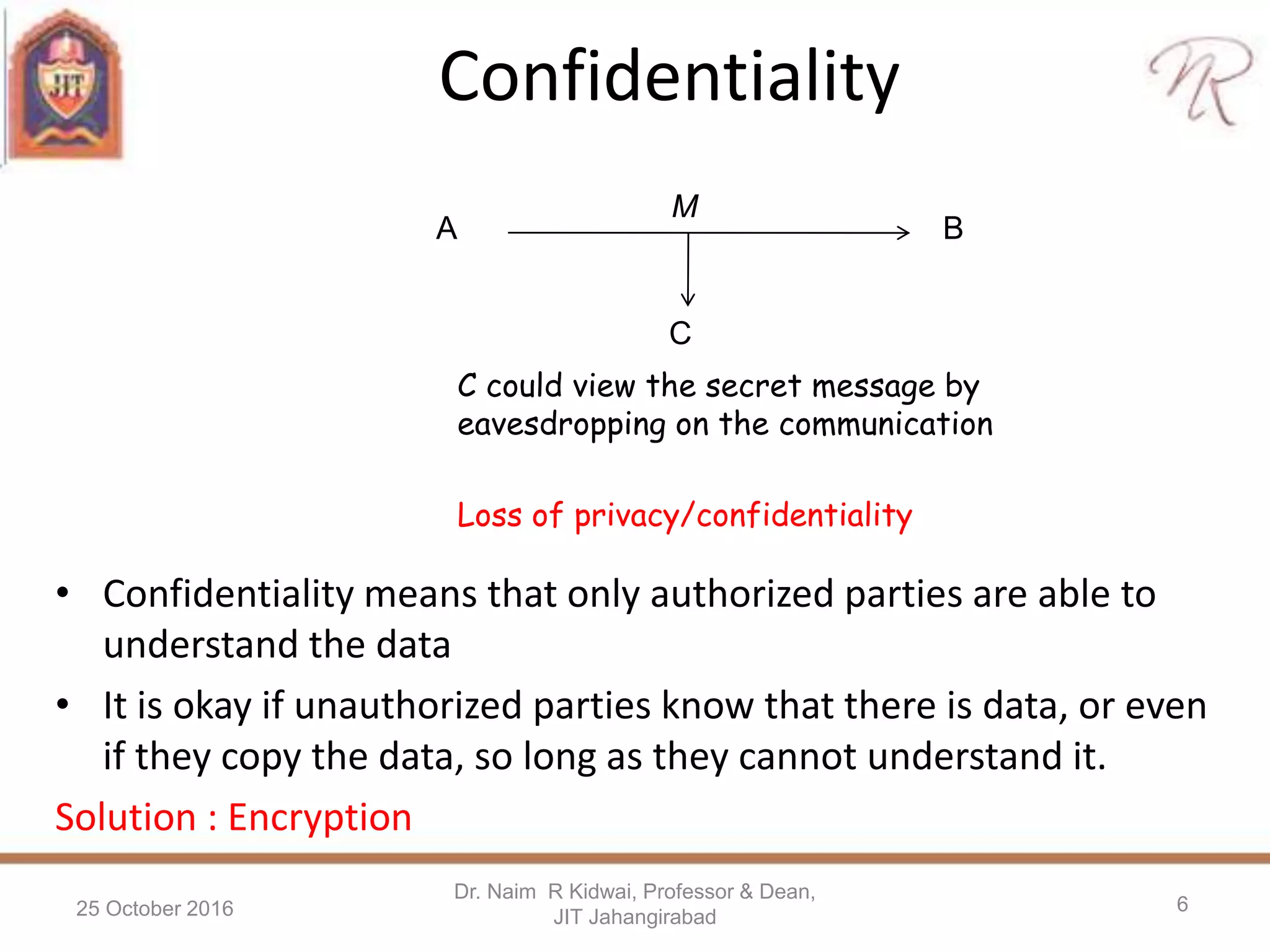
• Confidentiality means that only authorized parties are able to
understand the data
• It is okay if unauthorized parties know that there is data, or even
if they copy the data, so long as they cannot understand it.
Solution : Encryption
25 October 2016
Dr. Naim R Kidwai, Professor & Dean,
JIT Jahangirabad
6
A B
C could view the secret message by
eavesdropping on the communication
Loss of privacy/confidentiality
C
M
Authentication
25 October 2016
Dr. Naim R Kidwai, Professor & Dean,
JIT Jahangirabad
7
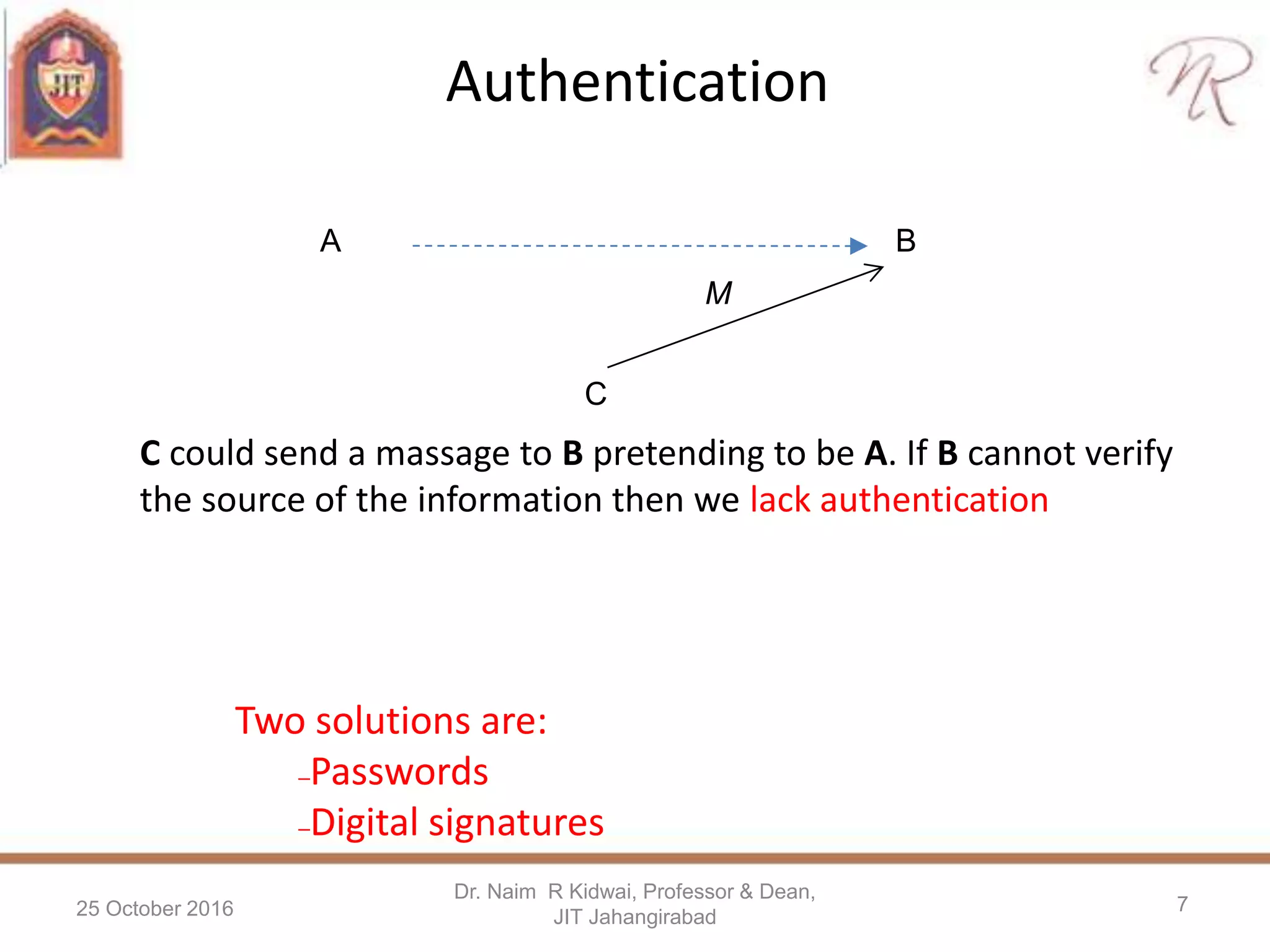
Two solutions are:
–Passwords
–Digital signatures
A B
C
M
C could send a massage to B pretending to be A. If B cannot verify
the source of the information then we lack authentication
Data Integrity
25 October 2016
Dr. Naim R Kidwai, Professor & Dean,
JIT Jahangirabad
8
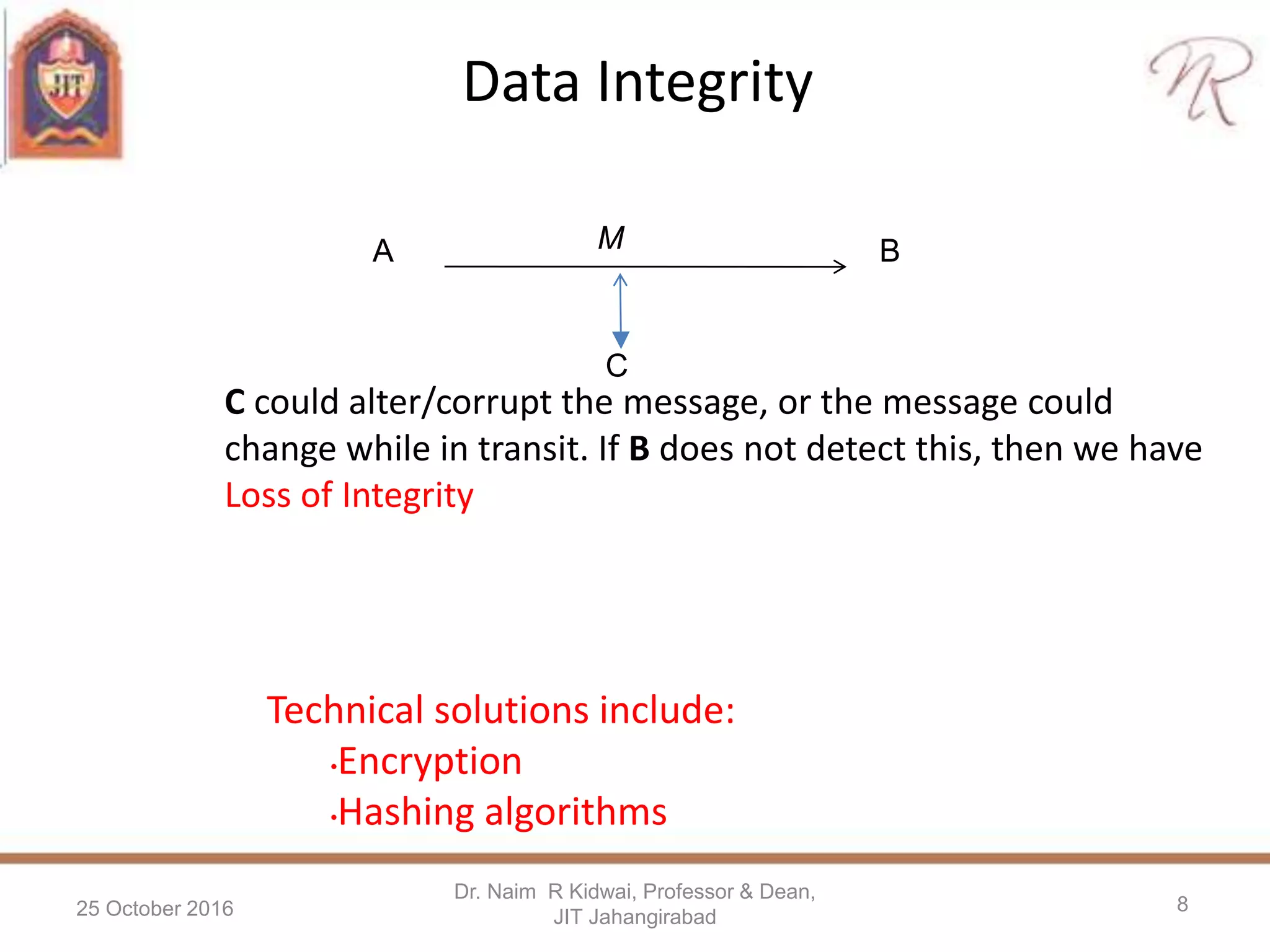
A B
C could alter/corrupt the message, or the message could
change while in transit. If B does not detect this, then we have
Loss of Integrity
C
M
Technical solutions include:
•Encryption
•Hashing algorithms
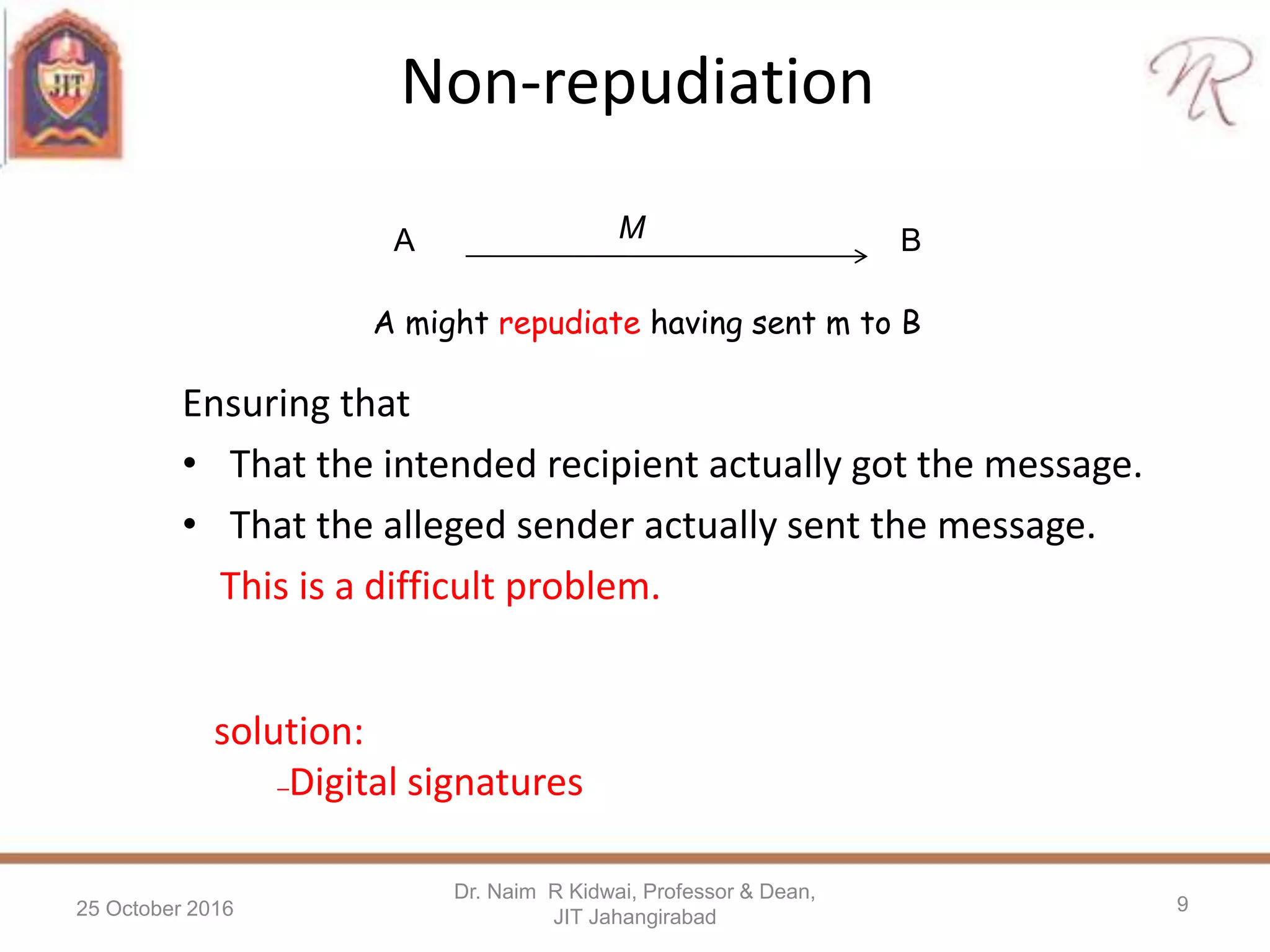
Non-repudiation
Ensuring that
• That the intended recipient actually got the message.
• That the alleged sender actually sent the message.
This is a difficult problem.
25 October 2016
Dr. Naim R Kidwai, Professor & Dean,
JIT Jahangirabad
9
A BM
A might repudiate having sent m to B
solution:
–Digital signatures
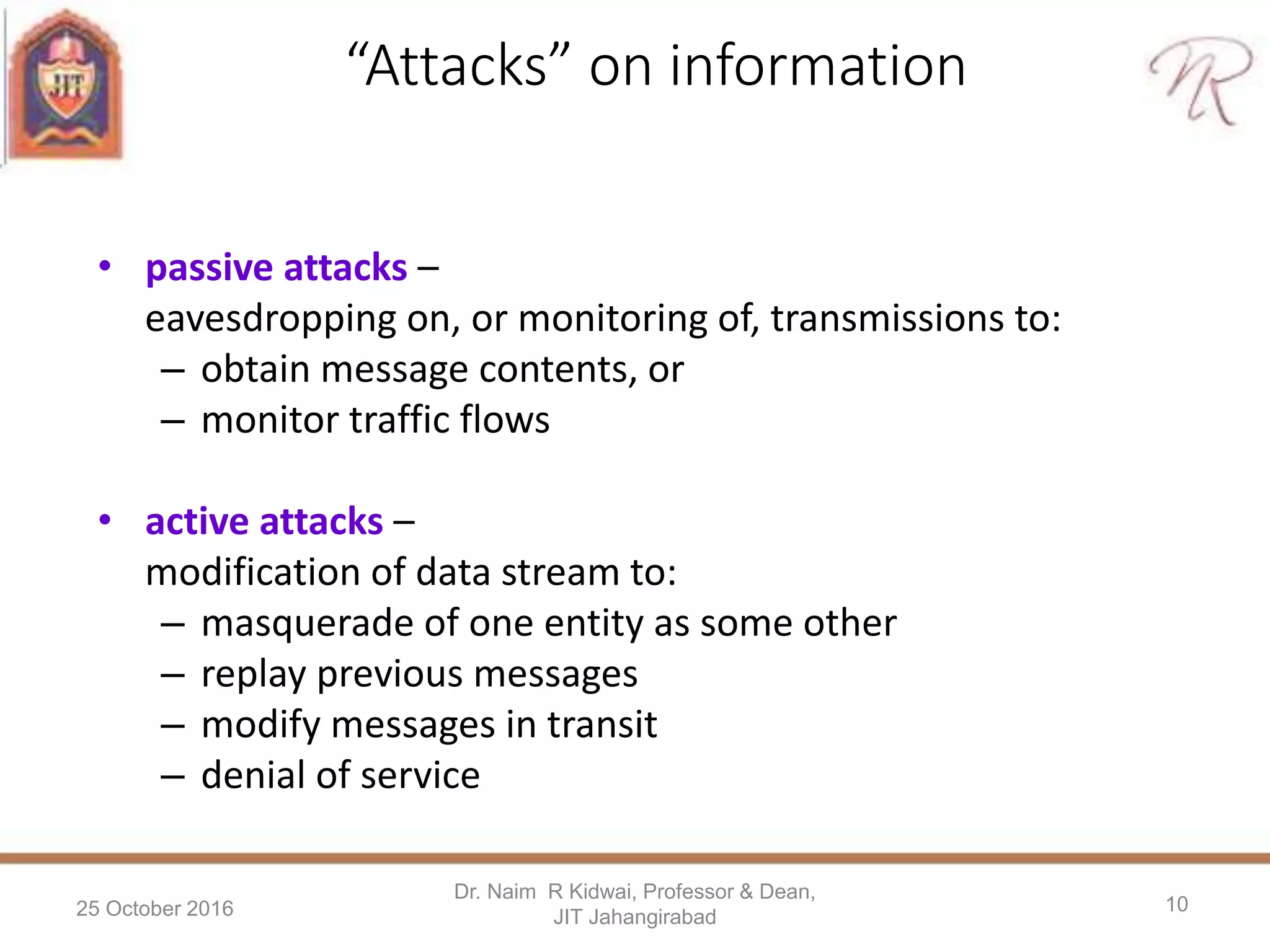
“Attacks” on information
• passive attacks –
eavesdropping on, or monitoring of, transmissions to:
– obtain message contents, or
– monitor traffic flows
• active attacks –
modification of data stream to:
– masquerade of one entity as some other
– replay previous messages
– modify messages in transit
– denial of service
25 October 2016
Dr. Naim R Kidwai, Professor & Dean,
JIT Jahangirabad
10
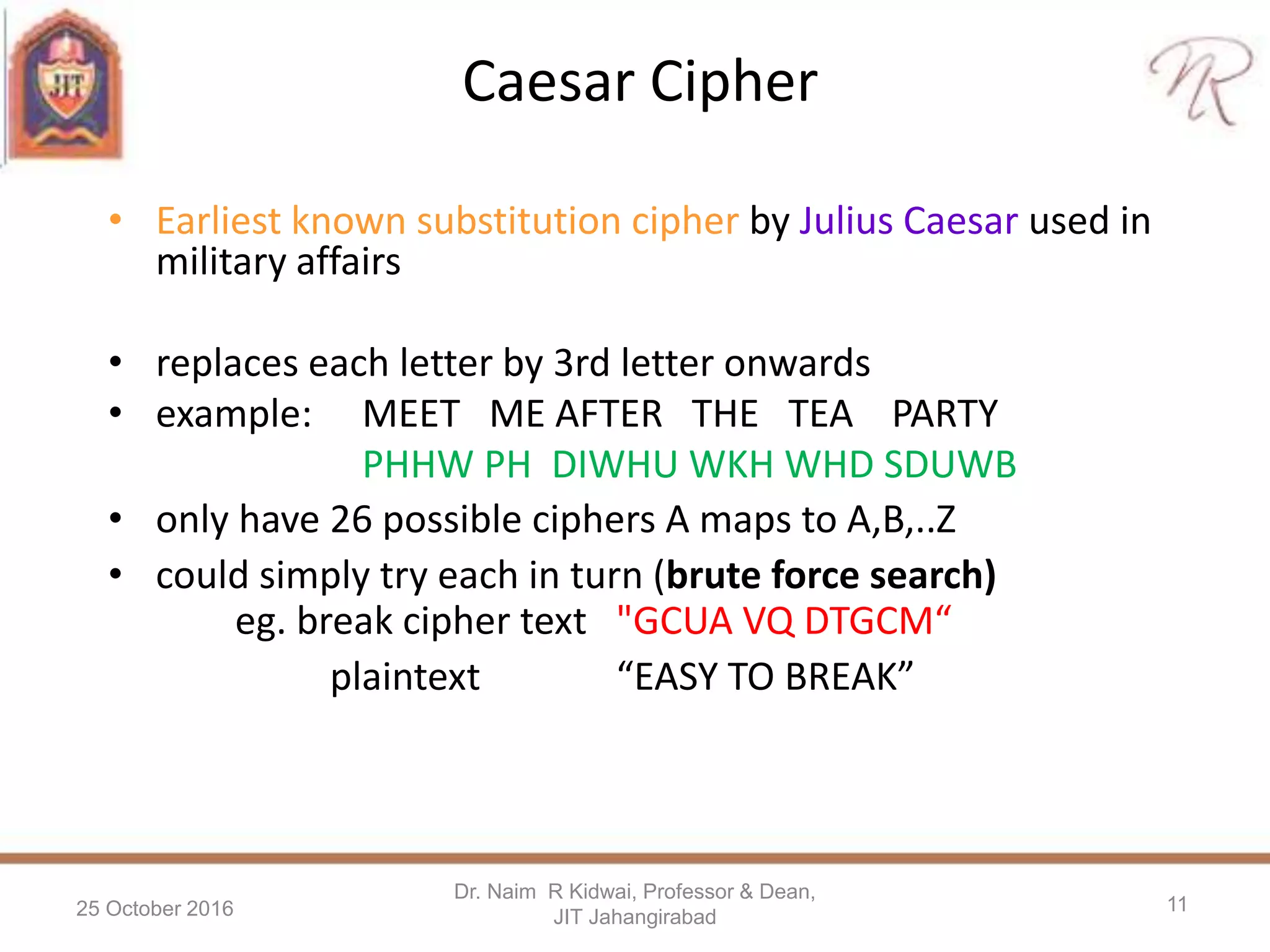
Caesar Cipher
• Earliest known substitution cipher by Julius Caesar used in
military affairs
• replaces each letter by 3rd letter onwards
• example: MEET ME AFTER THE TEA PARTY
PHHW PH DIWHU WKH WHD SDUWB
• only have 26 possible ciphers A maps to A,B,..Z
• could simply try each in turn (brute force search)
eg. break cipher text "GCUA VQ DTGCM“
plaintext “EASY TO BREAK”
25 October 2016
Dr. Naim R Kidwai, Professor & Dean,
JIT Jahangirabad
11
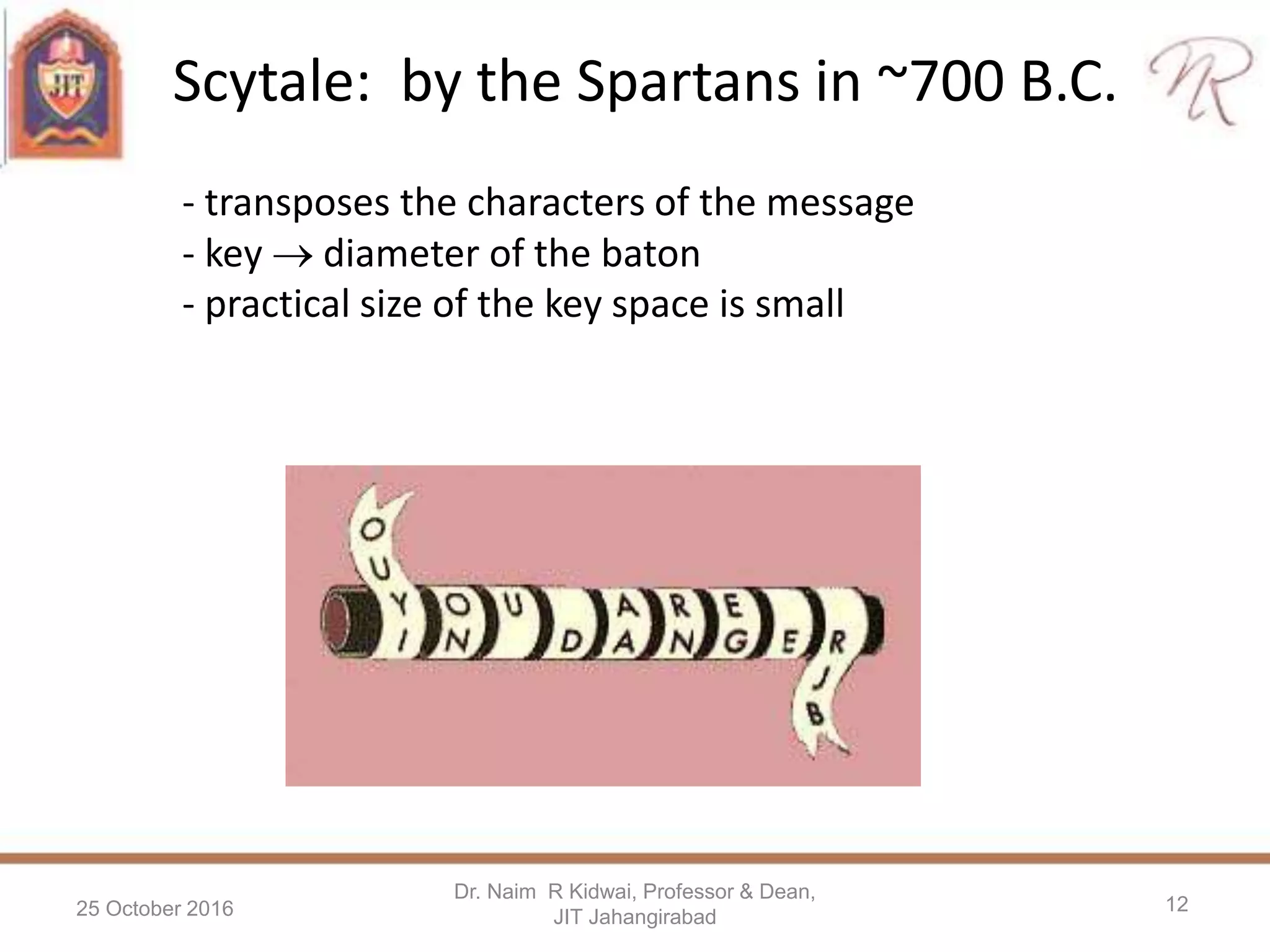
Scytale: by the Spartans in ~700 B.C.
25 October 2016
Dr. Naim R Kidwai, Professor & Dean,
JIT Jahangirabad
12
- transposes the characters of the message
- key  diameter of the baton
- practical size of the key space is small
One-Time Pad
• Invented by Major Joseph Mauborgne & Benam in 1917
• if a truly random key as long as the message is used, the cipher
will be secure
• called a One-Time pad
• is unbreakable since ciphertext bears no statistical relationship to
the plaintext
• since for any plaintext & any ciphertext there exists a key
mapping one to other
• can only use the key once though
• have problem of safe distribution of key
25 October 2016
Dr. Naim R Kidwai, Professor & Dean,
JIT Jahangirabad
13
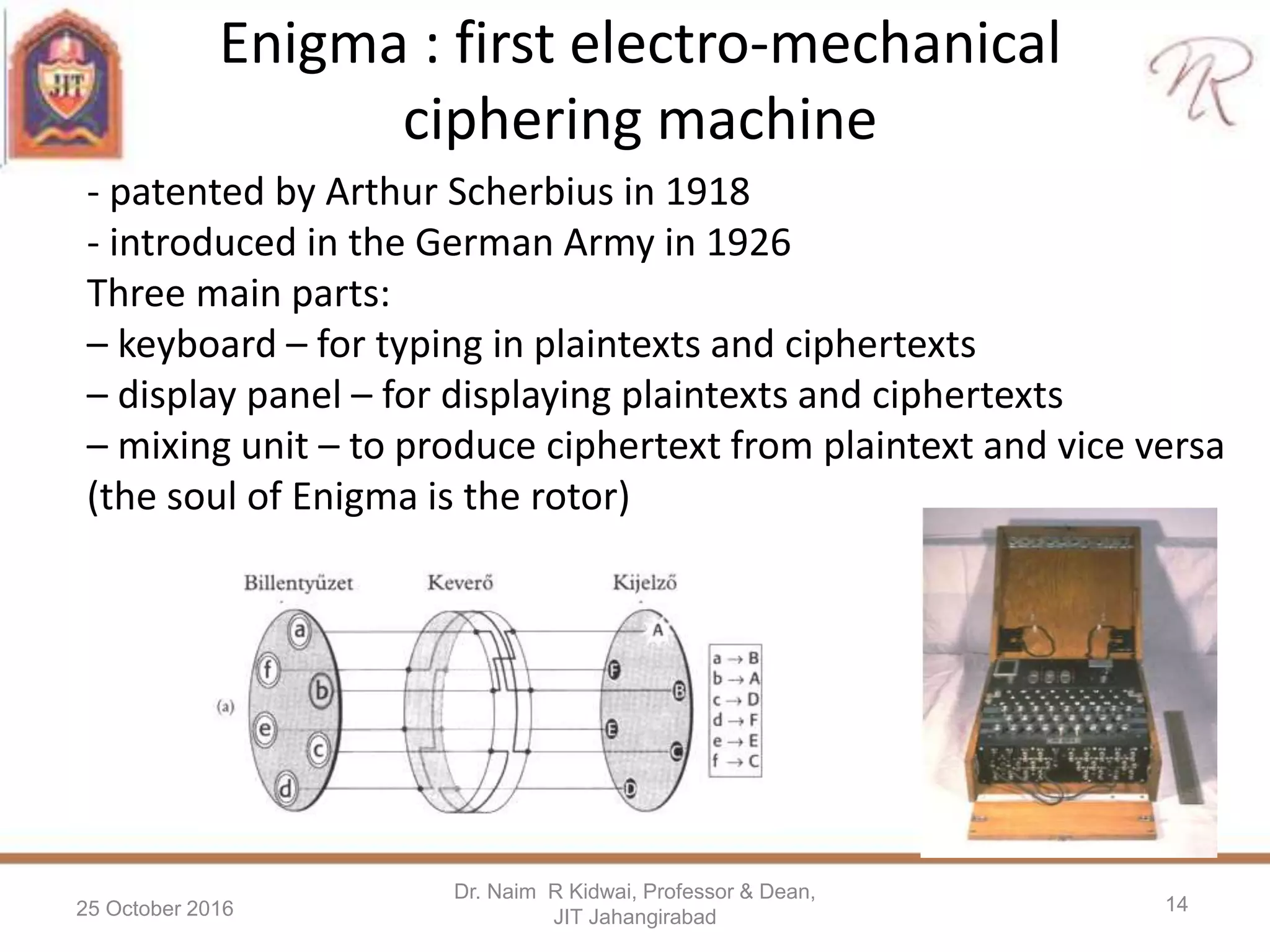
Enigma : first electro-mechanical
ciphering machine
25 October 2016
Dr. Naim R Kidwai, Professor & Dean,
JIT Jahangirabad
14
- patented by Arthur Scherbius in 1918
- introduced in the German Army in 1926
Three main parts:
– keyboard – for typing in plaintexts and ciphertexts
– display panel – for displaying plaintexts and ciphertexts
– mixing unit – to produce ciphertext from plaintext and vice versa
(the soul of Enigma is the rotor)
Confusion and Diffusion
According to Shannon (1949), confusion and diffusion are two
properties of the operation of a secure cipher
• diffusion – dissipates statistical structure of plaintext over bulk of
ciphertext
• confusion – makes relationship between ciphertext and key as
complex as possible
• In other words cipher needs to completely change statistical
properties of original message
a one-time pad does this perfectly
25 October 2016
Dr. Naim R Kidwai, Professor & Dean,
JIT Jahangirabad
15
Symmetric Cipher Model
25 October 2016
Dr. Naim R Kidwai, Professor & Dean,
JIT Jahangirabad
16
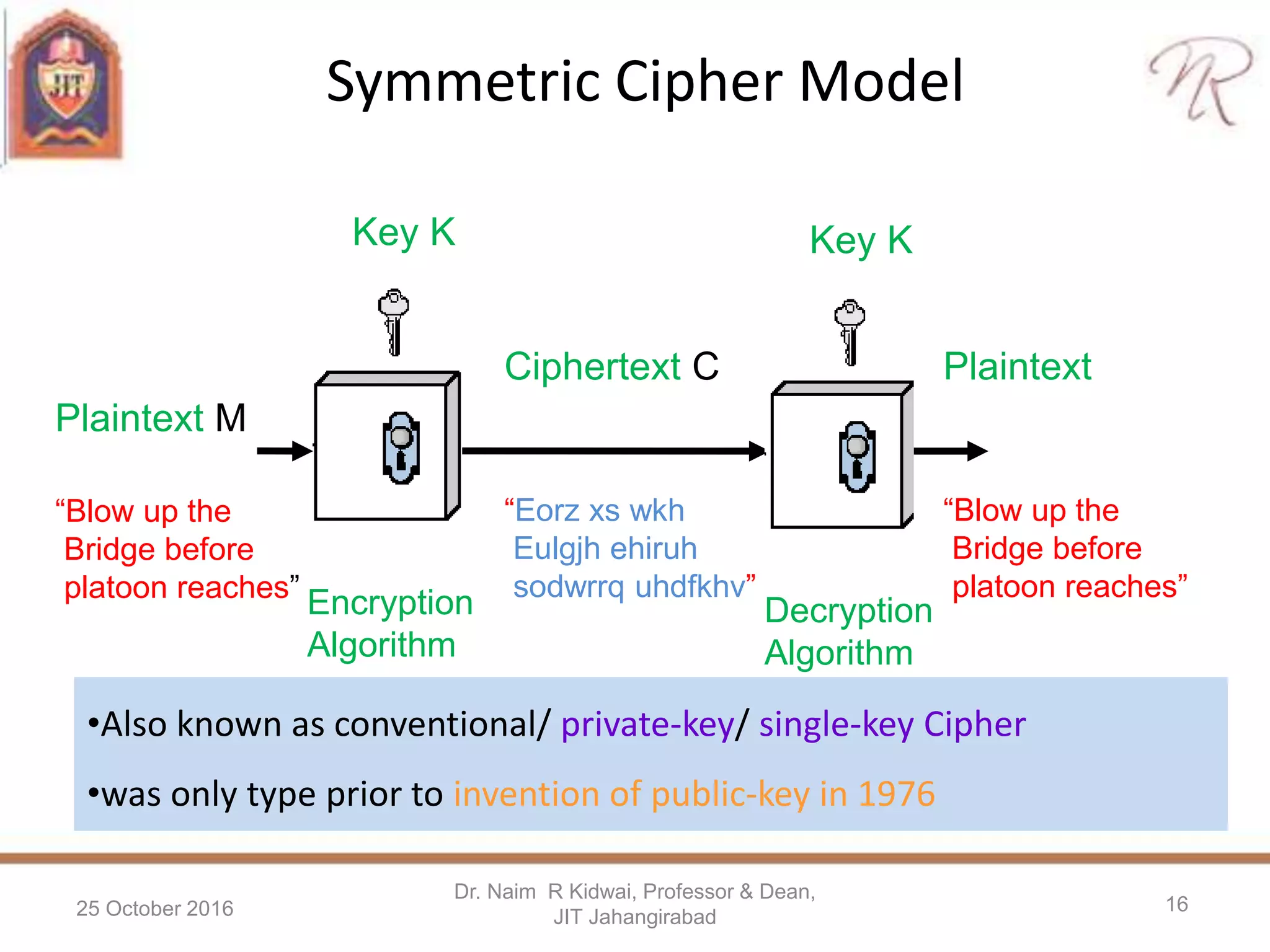
Ciphertext C
“Eorz xs wkh
Eulgjh ehiruh
sodwrrq uhdfkhv”
Plaintext M
“Blow up the
Bridge before
platoon reaches”
Key K
Encryption
Algorithm
Key K
Decryption
Algorithm
Plaintext
“Blow up the
Bridge before
platoon reaches”
•Also known as conventional/ private-key/ single-key Cipher
•was only type prior to invention of public-key in 1976
Symmetric Cipher Model
25 October 2016
Dr. Naim R Kidwai, Professor & Dean,
JIT Jahangirabad
17
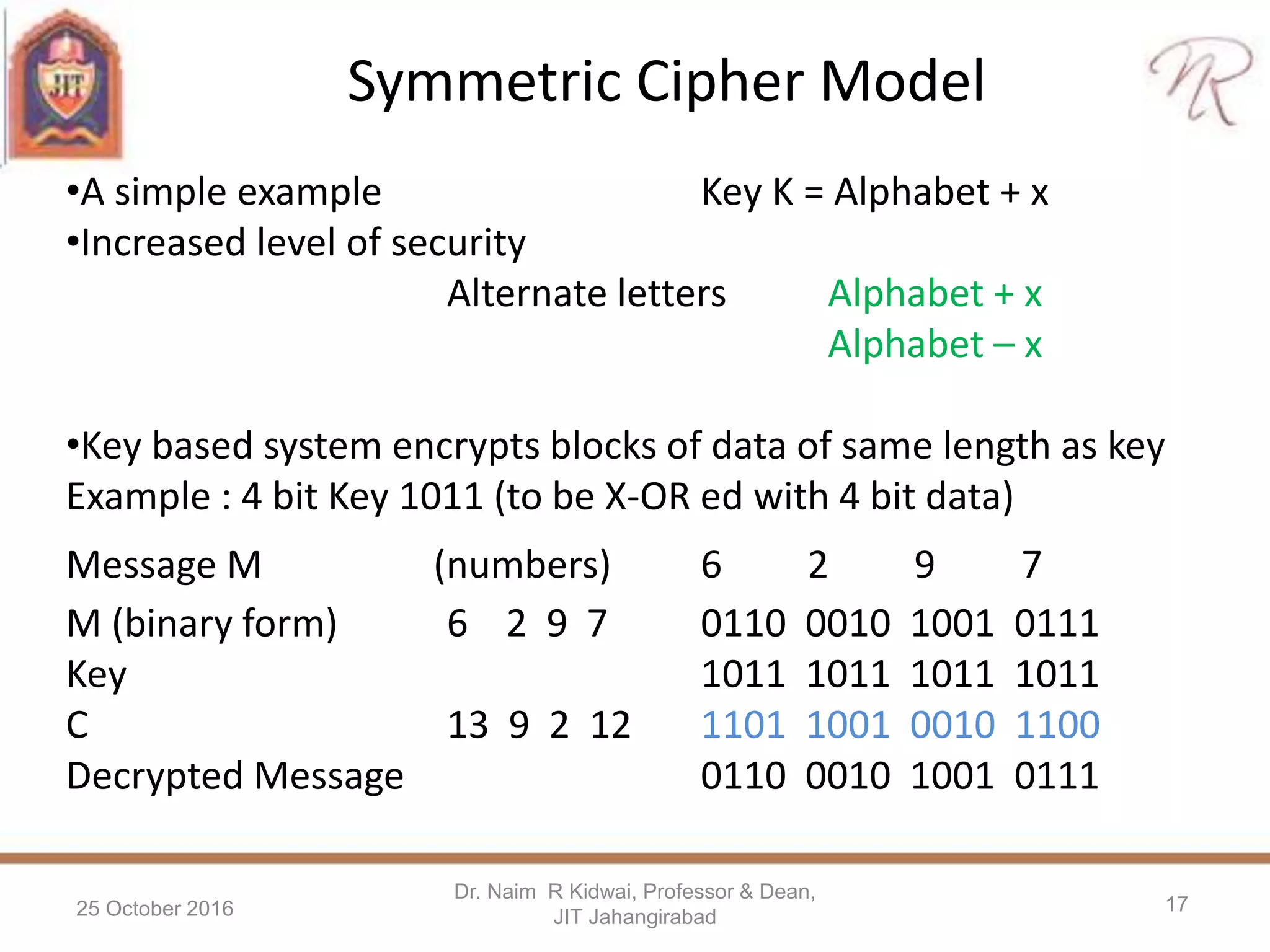
•A simple example Key K = Alphabet + x
•Increased level of security
Alternate letters Alphabet + x
Alphabet – x
•Key based system encrypts blocks of data of same length as key
Example : 4 bit Key 1011 (to be X-OR ed with 4 bit data)
Message M (numbers) 6 2 9 7
M (binary form) 6 2 9 7 0110 0010 1001 0111
Key 1011 1011 1011 1011
C 13 9 2 12 1101 1001 0010 1100
Decrypted Message 0110 0010 1001 0111
Symmetric Cipher Model
25 October 2016
Dr. Naim R Kidwai, Professor & Dean,
JIT Jahangirabad
18
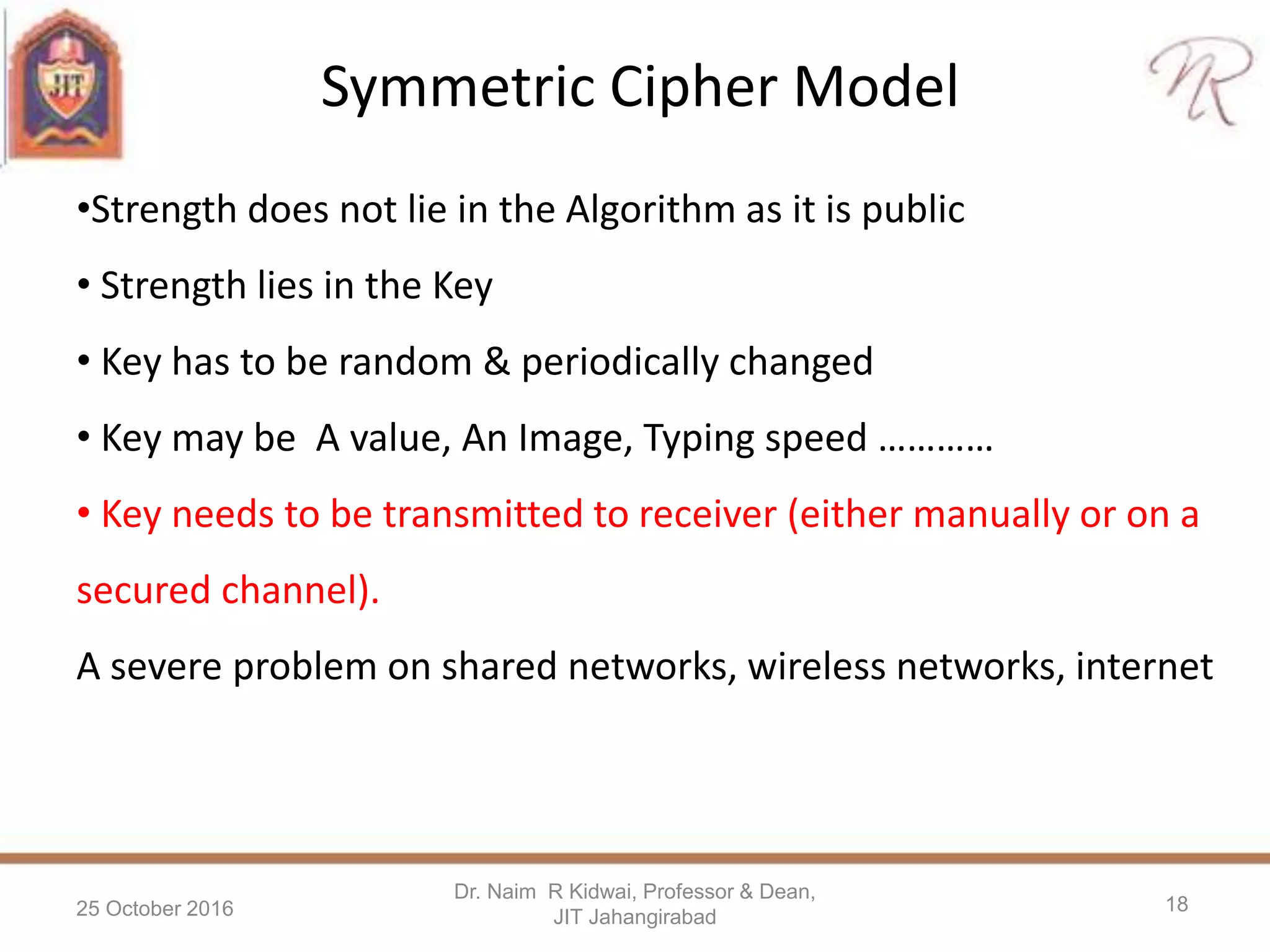
•Strength does not lie in the Algorithm as it is public
• Strength lies in the Key
• Key has to be random & periodically changed
• Key may be A value, An Image, Typing speed …………
• Key needs to be transmitted to receiver (either manually or on a
secured channel).
A severe problem on shared networks, wireless networks, internet
Asymmetric (Public) key Cipher Model
25 October 2016
Dr. Naim R Kidwai, Professor & Dean,
JIT Jahangirabad
19
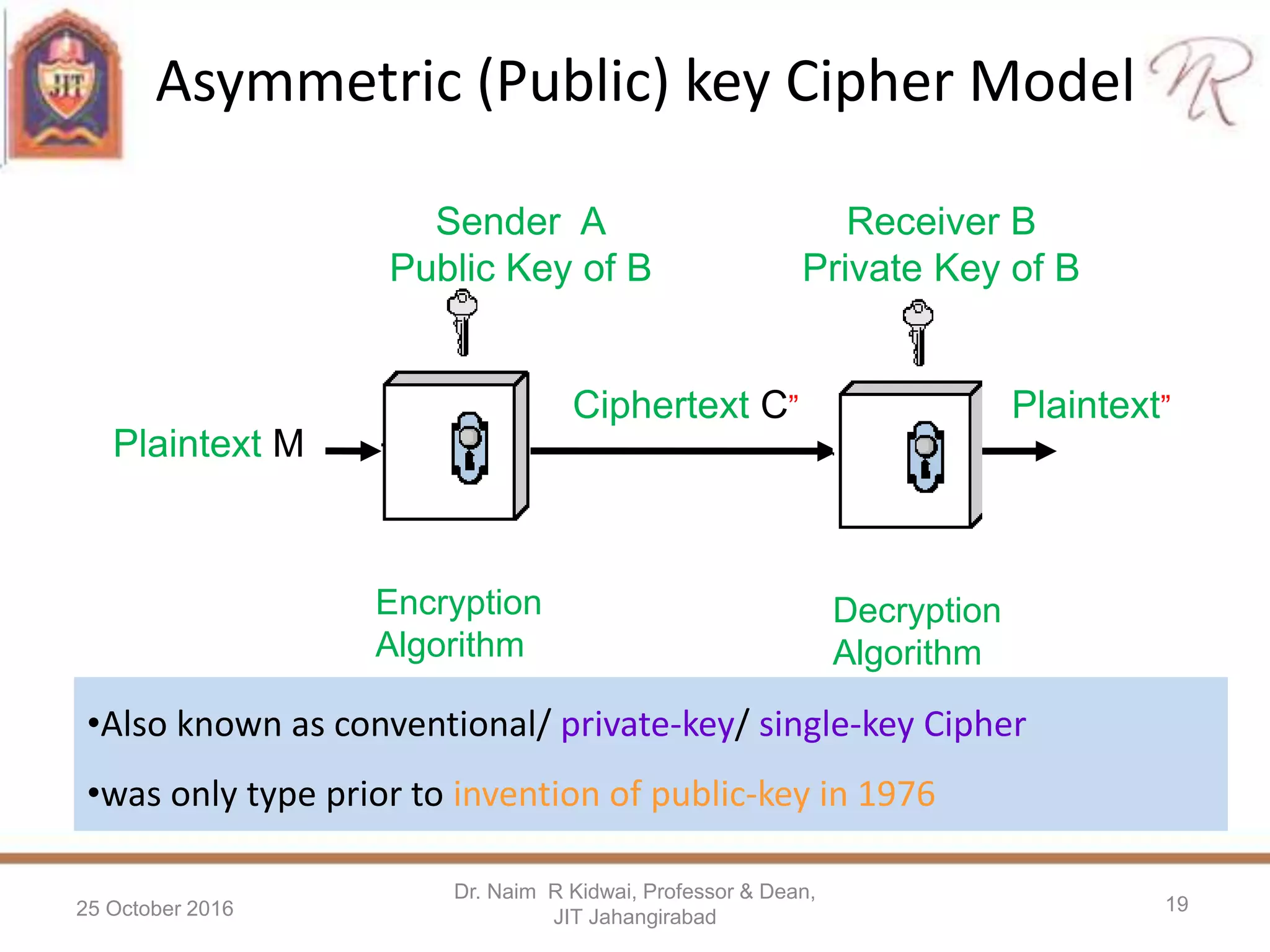
Ciphertext C”
Plaintext M
Sender A
Public Key of B
Encryption
Algorithm
Receiver B
Private Key of B
Decryption
Algorithm
Plaintext”
•Also known as conventional/ private-key/ single-key Cipher
•was only type prior to invention of public-key in 1976
Asymmetric (Public Key) Cryptography Ex.
25 October 2016
Dr. Naim R Kidwai, Professor & Dean,
JIT Jahangirabad
20
Private Key d
e*d=1 mod[(p-1)*(q-1)]
7d=1mod(12*18)
7d=1mod(216)
d=31
Public Key
N=247
e=7
Encryption
Plaintext : 4
Encryption C=Me mod[N]
C=47mod(247)
C = 16384 mod(247)
Ciphertext =82
Let N=p x q, N=247, p=13, q=19 a prime number
Pick another prime number e=7
Decryption
Ciphertext: 82
M=Cd mod[N]
M=8231mod(247)
M=4
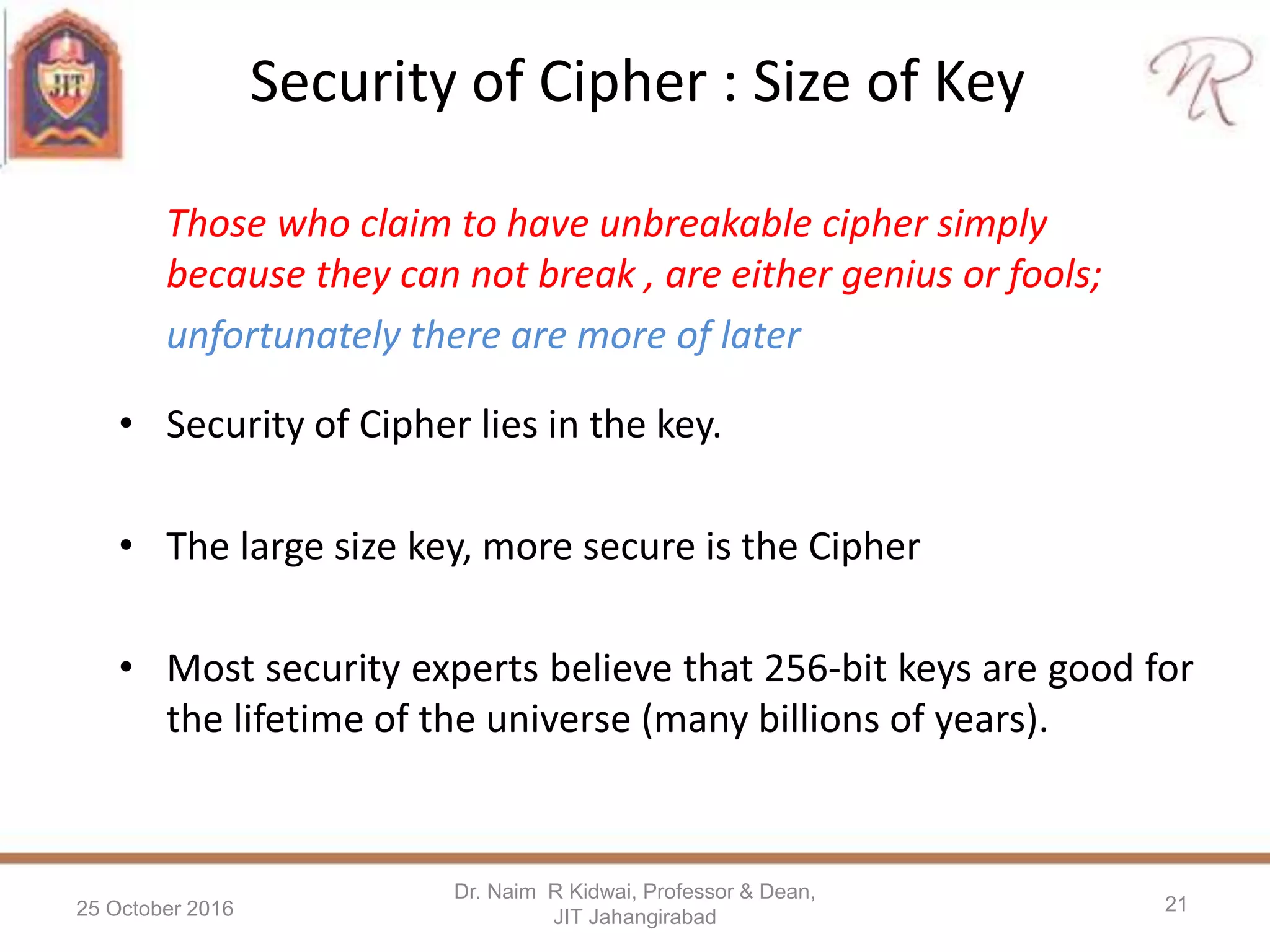
Security of Cipher : Size of Key
• Security of Cipher lies in the key.
• The large size key, more secure is the Cipher
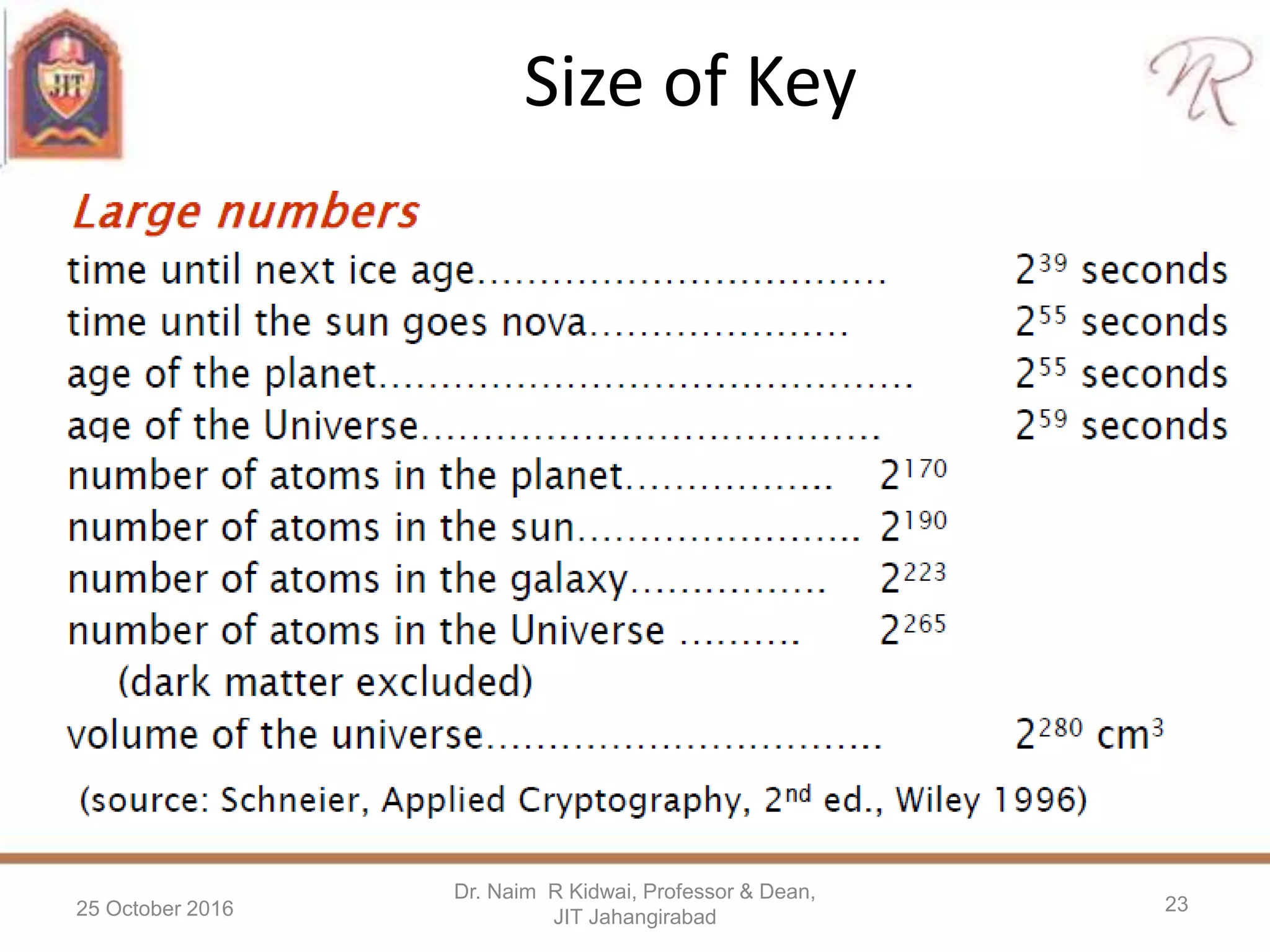
• Most security experts believe that 256-bit keys are good for
the lifetime of the universe (many billions of years).
25 October 2016
Dr. Naim R Kidwai, Professor & Dean,
JIT Jahangirabad
21
Those who claim to have unbreakable cipher simply
because they can not break , are either genius or fools;
unfortunately there are more of later
Size of Key
25 October 2016
Dr. Naim R Kidwai, Professor & Dean,
JIT Jahangirabad
22
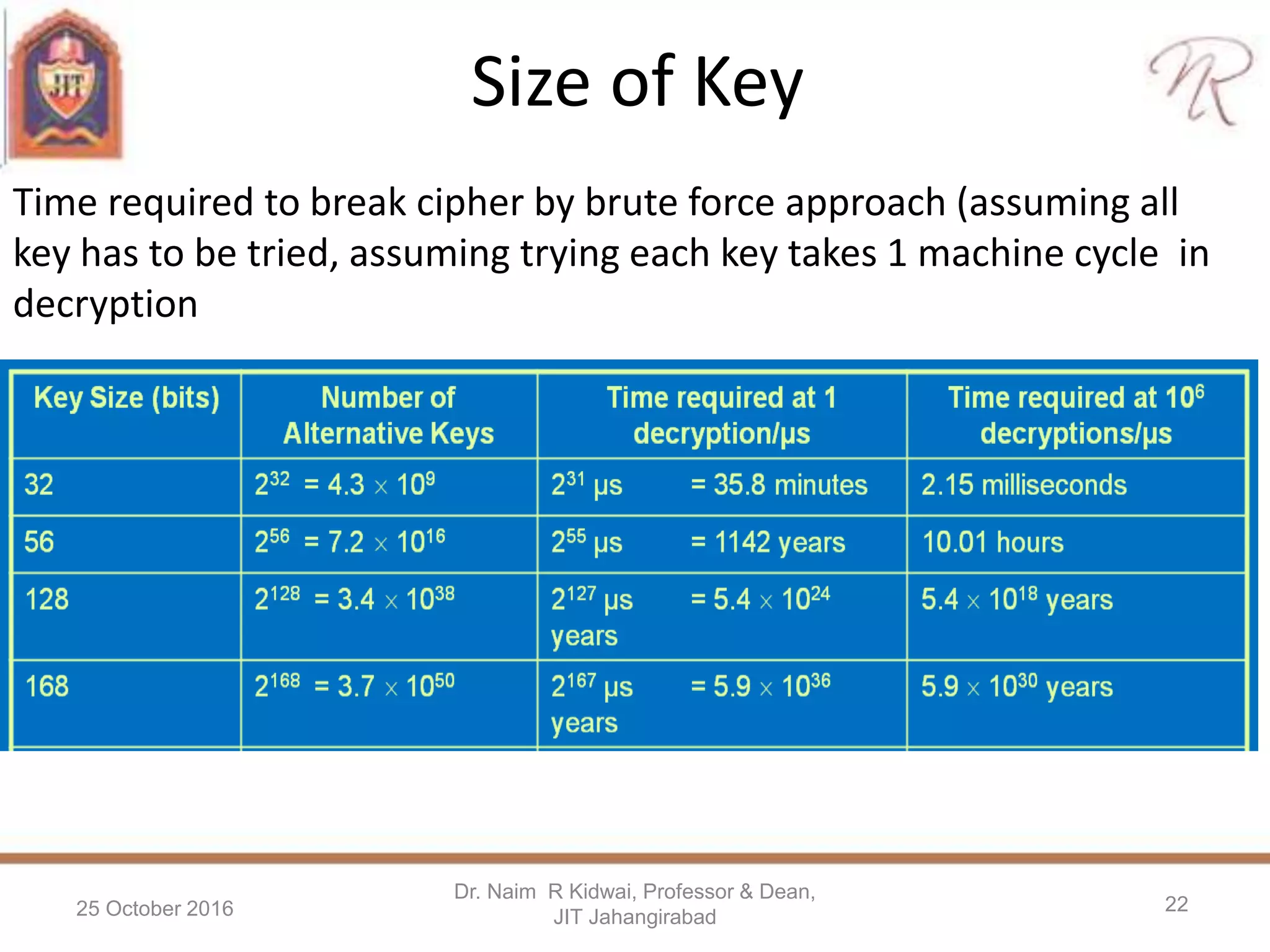
Time required to break cipher by brute force approach (assuming all
key has to be tried, assuming trying each key takes 1 machine cycle in
decryption
Size of Key
25 October 2016
Dr. Naim R Kidwai, Professor & Dean,
JIT Jahangirabad
23
Thank You
25 October 2016
Dr. Naim R Kidwai, Professor & Dean,
JIT Jahangirabad
24

Cryptography and Information Security

  • 1.
    Cryptography & InformationSecurity A presentation in ‘knowledge session’ for 10+2 students 25 Oct 16 25 October 2016 Dr. Naim R Kidwai, Professor & Dean, JIT Jahangirabad 1
  • 2.
    Cryptography In this informationera • Information is related to money & need to be protected. Ex bank password, transaction • Information is encoded into bit stream (data) and transmitted on wireless networks/ Intranet /Internet • During transmission information is vulnerable to attack Solution : Cryptography 25 October 2016 Dr. Naim R Kidwai, Professor & Dean, JIT Jahangirabad 2
  • 3.
    Cryptography Solution : Encryption/Decryption Cryptography = Crypto + Graphy Greek word Crypto Hidden secret Greek word Graphy writing Cryptography  art of hidden secret writing 25 October 2016 Dr. Naim R Kidwai, Professor & Dean, JIT Jahangirabad 3
  • 4.
    Basic Terms inCryptography • Encryption/Decryption: scrambling a message or data using a cryptographic algorithm or vice versa. • Plaintext: the message or data • Cipher text: the encrypted (scrambled) version of the message. • Key: info used in cipher known only to sender/ receiver • Cipher: the algorithm that does the encryption. 25 October 2016 Dr. Naim R Kidwai, Professor & Dean, JIT Jahangirabad 4
  • 5.
    Goals of Cryptography(Cipher) • Authentication • Data Confidentiality • Data Integrity • Non-Repudiation 25 October 2016 Dr. Naim R Kidwai, Professor & Dean, JIT Jahangirabad 5
  • 6.
    Confidentiality • Confidentiality meansthat only authorized parties are able to understand the data • It is okay if unauthorized parties know that there is data, or even if they copy the data, so long as they cannot understand it. Solution : Encryption 25 October 2016 Dr. Naim R Kidwai, Professor & Dean, JIT Jahangirabad 6 A B C could view the secret message by eavesdropping on the communication Loss of privacy/confidentiality C M
  • 7.
    Authentication 25 October 2016 Dr.Naim R Kidwai, Professor & Dean, JIT Jahangirabad 7 Two solutions are: –Passwords –Digital signatures A B C M C could send a massage to B pretending to be A. If B cannot verify the source of the information then we lack authentication
  • 8.
    Data Integrity 25 October2016 Dr. Naim R Kidwai, Professor & Dean, JIT Jahangirabad 8 A B C could alter/corrupt the message, or the message could change while in transit. If B does not detect this, then we have Loss of Integrity C M Technical solutions include: •Encryption •Hashing algorithms
  • 9.
    Non-repudiation Ensuring that • Thatthe intended recipient actually got the message. • That the alleged sender actually sent the message. This is a difficult problem. 25 October 2016 Dr. Naim R Kidwai, Professor & Dean, JIT Jahangirabad 9 A BM A might repudiate having sent m to B solution: –Digital signatures
  • 10.
    “Attacks” on information •passive attacks – eavesdropping on, or monitoring of, transmissions to: – obtain message contents, or – monitor traffic flows • active attacks – modification of data stream to: – masquerade of one entity as some other – replay previous messages – modify messages in transit – denial of service 25 October 2016 Dr. Naim R Kidwai, Professor & Dean, JIT Jahangirabad 10
  • 11.
    Caesar Cipher • Earliestknown substitution cipher by Julius Caesar used in military affairs • replaces each letter by 3rd letter onwards • example: MEET ME AFTER THE TEA PARTY PHHW PH DIWHU WKH WHD SDUWB • only have 26 possible ciphers A maps to A,B,..Z • could simply try each in turn (brute force search) eg. break cipher text "GCUA VQ DTGCM“ plaintext “EASY TO BREAK” 25 October 2016 Dr. Naim R Kidwai, Professor & Dean, JIT Jahangirabad 11
  • 12.
    Scytale: by theSpartans in ~700 B.C. 25 October 2016 Dr. Naim R Kidwai, Professor & Dean, JIT Jahangirabad 12 - transposes the characters of the message - key  diameter of the baton - practical size of the key space is small
  • 13.
    One-Time Pad • Inventedby Major Joseph Mauborgne & Benam in 1917 • if a truly random key as long as the message is used, the cipher will be secure • called a One-Time pad • is unbreakable since ciphertext bears no statistical relationship to the plaintext • since for any plaintext & any ciphertext there exists a key mapping one to other • can only use the key once though • have problem of safe distribution of key 25 October 2016 Dr. Naim R Kidwai, Professor & Dean, JIT Jahangirabad 13
  • 14.
    Enigma : firstelectro-mechanical ciphering machine 25 October 2016 Dr. Naim R Kidwai, Professor & Dean, JIT Jahangirabad 14 - patented by Arthur Scherbius in 1918 - introduced in the German Army in 1926 Three main parts: – keyboard – for typing in plaintexts and ciphertexts – display panel – for displaying plaintexts and ciphertexts – mixing unit – to produce ciphertext from plaintext and vice versa (the soul of Enigma is the rotor)
  • 15.
    Confusion and Diffusion Accordingto Shannon (1949), confusion and diffusion are two properties of the operation of a secure cipher • diffusion – dissipates statistical structure of plaintext over bulk of ciphertext • confusion – makes relationship between ciphertext and key as complex as possible • In other words cipher needs to completely change statistical properties of original message a one-time pad does this perfectly 25 October 2016 Dr. Naim R Kidwai, Professor & Dean, JIT Jahangirabad 15
  • 16.
    Symmetric Cipher Model 25October 2016 Dr. Naim R Kidwai, Professor & Dean, JIT Jahangirabad 16 Ciphertext C “Eorz xs wkh Eulgjh ehiruh sodwrrq uhdfkhv” Plaintext M “Blow up the Bridge before platoon reaches” Key K Encryption Algorithm Key K Decryption Algorithm Plaintext “Blow up the Bridge before platoon reaches” •Also known as conventional/ private-key/ single-key Cipher •was only type prior to invention of public-key in 1976
  • 17.
    Symmetric Cipher Model 25October 2016 Dr. Naim R Kidwai, Professor & Dean, JIT Jahangirabad 17 •A simple example Key K = Alphabet + x •Increased level of security Alternate letters Alphabet + x Alphabet – x •Key based system encrypts blocks of data of same length as key Example : 4 bit Key 1011 (to be X-OR ed with 4 bit data) Message M (numbers) 6 2 9 7 M (binary form) 6 2 9 7 0110 0010 1001 0111 Key 1011 1011 1011 1011 C 13 9 2 12 1101 1001 0010 1100 Decrypted Message 0110 0010 1001 0111
  • 18.
    Symmetric Cipher Model 25October 2016 Dr. Naim R Kidwai, Professor & Dean, JIT Jahangirabad 18 •Strength does not lie in the Algorithm as it is public • Strength lies in the Key • Key has to be random & periodically changed • Key may be A value, An Image, Typing speed ………… • Key needs to be transmitted to receiver (either manually or on a secured channel). A severe problem on shared networks, wireless networks, internet
  • 19.
    Asymmetric (Public) keyCipher Model 25 October 2016 Dr. Naim R Kidwai, Professor & Dean, JIT Jahangirabad 19 Ciphertext C” Plaintext M Sender A Public Key of B Encryption Algorithm Receiver B Private Key of B Decryption Algorithm Plaintext” •Also known as conventional/ private-key/ single-key Cipher •was only type prior to invention of public-key in 1976
  • 20.
    Asymmetric (Public Key)Cryptography Ex. 25 October 2016 Dr. Naim R Kidwai, Professor & Dean, JIT Jahangirabad 20 Private Key d e*d=1 mod[(p-1)*(q-1)] 7d=1mod(12*18) 7d=1mod(216) d=31 Public Key N=247 e=7 Encryption Plaintext : 4 Encryption C=Me mod[N] C=47mod(247) C = 16384 mod(247) Ciphertext =82 Let N=p x q, N=247, p=13, q=19 a prime number Pick another prime number e=7 Decryption Ciphertext: 82 M=Cd mod[N] M=8231mod(247) M=4
  • 21.
    Security of Cipher: Size of Key • Security of Cipher lies in the key. • The large size key, more secure is the Cipher • Most security experts believe that 256-bit keys are good for the lifetime of the universe (many billions of years). 25 October 2016 Dr. Naim R Kidwai, Professor & Dean, JIT Jahangirabad 21 Those who claim to have unbreakable cipher simply because they can not break , are either genius or fools; unfortunately there are more of later
  • 22.
    Size of Key 25October 2016 Dr. Naim R Kidwai, Professor & Dean, JIT Jahangirabad 22 Time required to break cipher by brute force approach (assuming all key has to be tried, assuming trying each key takes 1 machine cycle in decryption
  • 23.
    Size of Key 25October 2016 Dr. Naim R Kidwai, Professor & Dean, JIT Jahangirabad 23
  • 24.
    Thank You 25 October2016 Dr. Naim R Kidwai, Professor & Dean, JIT Jahangirabad 24