PTOCURRENCY BY: RAJ BABU JIREL
Bitcoin Mining
Process
Explain the complex
process of bitcoin mining
with a clear and concise
diagram.
Cryptocurrency
Market
Visualize the growth and
trends of the
cryptocurrency market with
a dynamic graph.
Blockchain
Technology
Demonstrate the inner
workings of blockchain
technology with a
flowchart.
Introduction To
Cryptocurrency
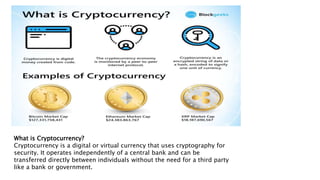
What is Cryptocurrency?
Cryptocurrency is a digital or virtual currency that uses cryptography for
security. It operates independently of a central bank and can be
transferred directly between individuals without the need for a third party
like a bank or government.
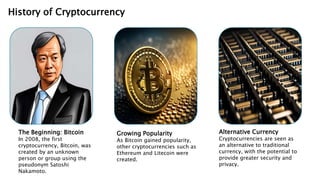
History of Cryptocurrency
The Beginning: Bitcoin
In 2008, the first
cryptocurrency, Bitcoin, was
created by an unknown
person or group using the
pseudonym Satoshi
Nakamoto.
Growing Popularity
As Bitcoin gained popularity,
other cryptocurrencies such as
Ethereum and Litecoin were
created.
Alternative Currency
Cryptocurrencies are seen as
an alternative to traditional
currency, with the potential to
provide greater security and
privacy.
Cryptocurrency is a digital or virtual currency that uses
cryptography for security. It operates independently of a central
bank and can be transferred directly between individuals without
the need for intermediaries like banks or payment processors.
Transactions are recorded on a decentralized public ledger called
a blockchain. This ledger is maintained by a network of computers
around the world, making it difficult to alter or tamper with the
records.
Cryptocurrency is created through a process called mining, which
involves solving complex mathematical problems using computer
processing power. Miners are rewarded with new coins for their
efforts, which helps to maintain the integrity of the blockchain.
How Cryptocurrency works?
Benefits of Cryptocurrency
• Decentralization: Cryptocurrencies are not controlled by governments or financial
institutions, providing users with more control over their assets.
• Security: Cryptocurrency transactions are secured using advanced encryption techniques,
making them less susceptible to fraud and hacking compared to traditional payment
methods.
• Lower transaction fees: Cryptocurrency transactions typically have lower fees compared
to traditional banking transactions, making them more accessible to people in developing
countries and those without access to traditional banking services.
Downsides of Cryptocurrency
• Volatility: Cryptocurrencies are highly volatile, with their value fluctuating rapidly and
unpredictably. This makes them a risky investment for many people.
• Lack of regulation: Cryptocurrencies are not regulated by governments or financial
institutions, which can make them vulnerable to fraud and scams.
• Limited acceptance: Cryptocurrencies are not widely accepted as a form of payment,
which can limit their usefulness for everyday transactions.
Pros and Cons of Cryptocurrency
Bitcoin
The first and
most well-
known
cryptocurrency,
Bitcoin uses a
decentralized
system to
enable peer-
to-peer
transactions
without the
need for
intermediaries
like banks.
Litecoin
Litecoin is a
peer-to-peer
cryptocurrency
that is similar
to Bitcoin but
with faster
transaction
times and
lower fees. It
was designed
to be more
efficient for
everyday
transactions.
Ripple
Ripple is a
payment
protocol and
cryptocurrency
that enables
fast and secure
global
transactions. It
is designed to
be used by
banks and
financial
institutions to
facilitate
cross-border
payments and
remittances.
Ethereum
Ethereum is a
blockchain
platform that
enables
developers to
build
decentralized
applications
(dapps) on top
of its
blockchain. Its
cryptocurrency,
Ether, is used
to pay for
transactions
and
computational
services on the
network.
Types of Cryptocurrency
Cryptocurrency is the
Future
With the rise of digital
currencies, traditional
forms of money are
becoming less
relevant.
Ethereum is Pushing
Boundaries
With its smart
contract technology,
Ethereum is enabling
new applications for
blockchain
technology.
Bitcoin is Leading
the Way
As the first and
most well-known
cryptocurrency,
Bitcoin has set the
standard for the
industry.
Ripple is
Revolutionizing
Payments
By facilitating fast
and cheap cross-
border payments,
Ripple is disrupting
the traditional
banking system.
Future of Cryptocurrency
•Cryptocurrency is a rapidly evolving and complex technology with
significant potential for disruption.
•While there are risks associated with investing in cryptocurrency,
there are also opportunities for significant financial gain.
•Regulation and adoption will be key factors in determining the future
of cryptocurrency.
Conclusion
cryptocurrency.raj.pptx about cryptocurrency

cryptocurrency.raj.pptx about cryptocurrency

  • 1.
  • 2.
    Bitcoin Mining Process Explain thecomplex process of bitcoin mining with a clear and concise diagram. Cryptocurrency Market Visualize the growth and trends of the cryptocurrency market with a dynamic graph. Blockchain Technology Demonstrate the inner workings of blockchain technology with a flowchart. Introduction To Cryptocurrency
  • 3.
    What is Cryptocurrency? Cryptocurrencyis a digital or virtual currency that uses cryptography for security. It operates independently of a central bank and can be transferred directly between individuals without the need for a third party like a bank or government.
  • 4.
    History of Cryptocurrency TheBeginning: Bitcoin In 2008, the first cryptocurrency, Bitcoin, was created by an unknown person or group using the pseudonym Satoshi Nakamoto. Growing Popularity As Bitcoin gained popularity, other cryptocurrencies such as Ethereum and Litecoin were created. Alternative Currency Cryptocurrencies are seen as an alternative to traditional currency, with the potential to provide greater security and privacy.
  • 5.
    Cryptocurrency is adigital or virtual currency that uses cryptography for security. It operates independently of a central bank and can be transferred directly between individuals without the need for intermediaries like banks or payment processors. Transactions are recorded on a decentralized public ledger called a blockchain. This ledger is maintained by a network of computers around the world, making it difficult to alter or tamper with the records. Cryptocurrency is created through a process called mining, which involves solving complex mathematical problems using computer processing power. Miners are rewarded with new coins for their efforts, which helps to maintain the integrity of the blockchain. How Cryptocurrency works?
  • 6.
    Benefits of Cryptocurrency •Decentralization: Cryptocurrencies are not controlled by governments or financial institutions, providing users with more control over their assets. • Security: Cryptocurrency transactions are secured using advanced encryption techniques, making them less susceptible to fraud and hacking compared to traditional payment methods. • Lower transaction fees: Cryptocurrency transactions typically have lower fees compared to traditional banking transactions, making them more accessible to people in developing countries and those without access to traditional banking services. Downsides of Cryptocurrency • Volatility: Cryptocurrencies are highly volatile, with their value fluctuating rapidly and unpredictably. This makes them a risky investment for many people. • Lack of regulation: Cryptocurrencies are not regulated by governments or financial institutions, which can make them vulnerable to fraud and scams. • Limited acceptance: Cryptocurrencies are not widely accepted as a form of payment, which can limit their usefulness for everyday transactions. Pros and Cons of Cryptocurrency
  • 7.
    Bitcoin The first and mostwell- known cryptocurrency, Bitcoin uses a decentralized system to enable peer- to-peer transactions without the need for intermediaries like banks. Litecoin Litecoin is a peer-to-peer cryptocurrency that is similar to Bitcoin but with faster transaction times and lower fees. It was designed to be more efficient for everyday transactions. Ripple Ripple is a payment protocol and cryptocurrency that enables fast and secure global transactions. It is designed to be used by banks and financial institutions to facilitate cross-border payments and remittances. Ethereum Ethereum is a blockchain platform that enables developers to build decentralized applications (dapps) on top of its blockchain. Its cryptocurrency, Ether, is used to pay for transactions and computational services on the network. Types of Cryptocurrency
  • 8.
    Cryptocurrency is the Future Withthe rise of digital currencies, traditional forms of money are becoming less relevant. Ethereum is Pushing Boundaries With its smart contract technology, Ethereum is enabling new applications for blockchain technology. Bitcoin is Leading the Way As the first and most well-known cryptocurrency, Bitcoin has set the standard for the industry. Ripple is Revolutionizing Payments By facilitating fast and cheap cross- border payments, Ripple is disrupting the traditional banking system. Future of Cryptocurrency
  • 9.
    •Cryptocurrency is arapidly evolving and complex technology with significant potential for disruption. •While there are risks associated with investing in cryptocurrency, there are also opportunities for significant financial gain. •Regulation and adoption will be key factors in determining the future of cryptocurrency. Conclusion