Frame the Crowd:
Global Visual Features
Labeling boosted with
Crowdsourcing Information
Presentation: Michael Riegler, AAU
Mathias Lux, AAU
Christoph Kofler, TU Delft
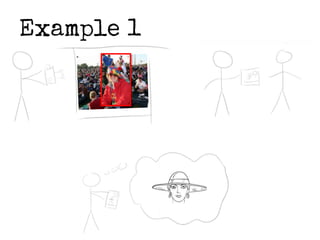
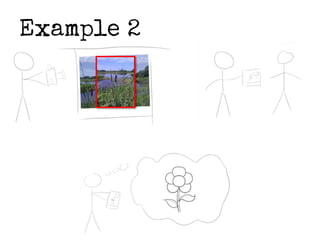
Framing
• Similar intentions for taking the pictures
will lead to similar framings of the images
Example 1
Example 2
Idea
• Solve the problem with a Global Visual Features
approach based on the framing theory
– Always available and for free (beside computation time)
• Workers Reliability for Crowdsourcing Information
• Transfer learning
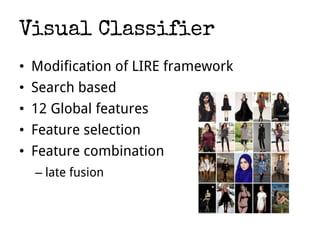
Visual Classifier
• Modification of LIRE framework
• Search based
• 12 Global features
• Feature selection
• Feature combination
– late fusion
Workers’ Reliability
• Calculate the reliability of a Worker:
#(agrees with majority vote) /
#(total votes by worker)
• Used as weight for the votes
• Together with self report familiarity as
feature vector
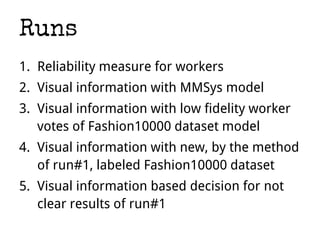
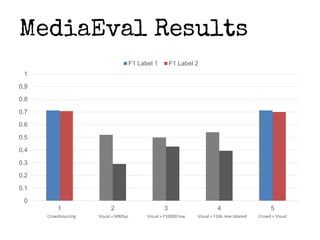
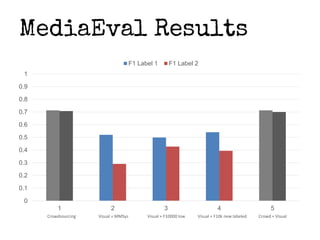
Runs
1. Reliability measure for workers
2. Visual information with MMSys model
3. Visual information with low fidelity worker
votes of Fashion10000 dataset model
4. Visual information with new, by the method
of run#1, labeled Fashion10000 dataset
5. Visual information based decision for not
clear results of run#1
MediaEval Results
0
0.1
0.2
0.3
0.4
0.5
0.6
0.7
0.8
0.9
1
1 2 3 4 5
F1 Label 1 F1 Label 2
Crowdsourcing Visual + MMSys Visual + F10000 low Visual + F10k new labeled Crowd + Visual
MediaEval Results
0
0.1
0.2
0.3
0.4
0.5
0.6
0.7
0.8
0.9
1
1 2 3 4 5
F1 Label 1 F1 Label 2
Crowdsourcing Visual + MMSys Visual + F10000 low Visual + F10k new labeled Crowd + Visual
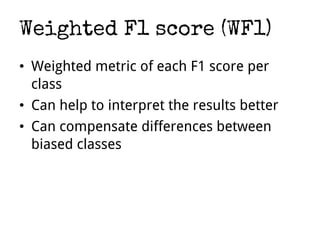
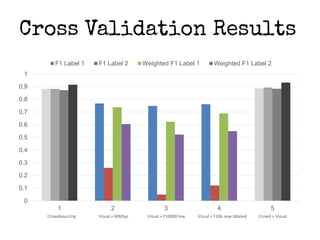
Weighted F1 score (WF1)
• Weighted metric of each F1 score per
class
• Can help to interpret the results better
• Can compensate differences between
biased classes
Cross Validation Results
0
0.1
0.2
0.3
0.4
0.5
0.6
0.7
0.8
0.9
1
1 2 3 4 5
F1 Label 1 F1 Label 2 Weighted F1 Label 1 Weighted F1 Label 2
Crowdsourcing Visual + MMSys Visual + F10000 low Visual + F10k new labeled Crowd + Visual
Conclusion
• Calculating the workers’ reliability performs well
– Well known that metadata leads to better results
• Transfer learning works well
– Crowdsourcing can boost visual classification
• With visual features, even small amount of labeled data leads
to good results
• Usefulness of Framing is reflected by the results
• Label 1 very good detectable with global visual features,
but label 2 not (concept detection)
• Weighted F1 score can help to understand the results better
Michael Riegler
michael.riegler@edu.uni-klu.ac.at
Mathias Lux
mlux@itec.aau.at
Christoph Kofler
c.Kofler@tudelft.nl

Frame the Crowd: Global Visual Features Labeling boosted with Crowdsourcing Information

  • 1.
    Frame the Crowd: GlobalVisual Features Labeling boosted with Crowdsourcing Information Presentation: Michael Riegler, AAU Mathias Lux, AAU Christoph Kofler, TU Delft
  • 2.
    Framing • Similar intentionsfor taking the pictures will lead to similar framings of the images
  • 3.
  • 4.
  • 5.
    Idea • Solve theproblem with a Global Visual Features approach based on the framing theory – Always available and for free (beside computation time) • Workers Reliability for Crowdsourcing Information • Transfer learning
  • 6.
    Visual Classifier • Modificationof LIRE framework • Search based • 12 Global features • Feature selection • Feature combination – late fusion
  • 7.
    Workers’ Reliability • Calculatethe reliability of a Worker: #(agrees with majority vote) / #(total votes by worker) • Used as weight for the votes • Together with self report familiarity as feature vector
  • 8.
    Runs 1. Reliability measurefor workers 2. Visual information with MMSys model 3. Visual information with low fidelity worker votes of Fashion10000 dataset model 4. Visual information with new, by the method of run#1, labeled Fashion10000 dataset 5. Visual information based decision for not clear results of run#1
  • 9.
    MediaEval Results 0 0.1 0.2 0.3 0.4 0.5 0.6 0.7 0.8 0.9 1 1 23 4 5 F1 Label 1 F1 Label 2 Crowdsourcing Visual + MMSys Visual + F10000 low Visual + F10k new labeled Crowd + Visual
  • 10.
    MediaEval Results 0 0.1 0.2 0.3 0.4 0.5 0.6 0.7 0.8 0.9 1 1 23 4 5 F1 Label 1 F1 Label 2 Crowdsourcing Visual + MMSys Visual + F10000 low Visual + F10k new labeled Crowd + Visual
  • 11.
    Weighted F1 score(WF1) • Weighted metric of each F1 score per class • Can help to interpret the results better • Can compensate differences between biased classes
  • 12.
    Cross Validation Results 0 0.1 0.2 0.3 0.4 0.5 0.6 0.7 0.8 0.9 1 12 3 4 5 F1 Label 1 F1 Label 2 Weighted F1 Label 1 Weighted F1 Label 2 Crowdsourcing Visual + MMSys Visual + F10000 low Visual + F10k new labeled Crowd + Visual
  • 13.
    Conclusion • Calculating theworkers’ reliability performs well – Well known that metadata leads to better results • Transfer learning works well – Crowdsourcing can boost visual classification • With visual features, even small amount of labeled data leads to good results • Usefulness of Framing is reflected by the results • Label 1 very good detectable with global visual features, but label 2 not (concept detection) • Weighted F1 score can help to understand the results better
  • 14.