MODULE 7 – Policies, Procedures & Standards Module Goal Participants will recall all applicable policies and procedures and demonstrate standards of conduct governing them as a school crossing guard.  Objective One Participants will recall policies and procedures within their hiring agency, school and county. Objective Two Participants will recall school crossing guard standards of behavior and conduct.  
QUALIFICATIONS Adult crossing guards should possess the following (minimum) qualifications:Average intelligence Good physical condition, including sight, hearing, and mobility Mental alertness Neat appearance Good character Dependability Responsibility for the safety of students Passing the basic physical and the criminal background checks should be conditions for employment.
POLICIES, PROCEDURES AND STANDARDS Orientation to the organization structure: Organization Chart/Chain of Command Supervisor Contact Information Traffic Enforcement Contact Information Authority Differences Sworn Officer Service Technician/Crossing Guard Hiring Agency
POLICIES, PROCEDURES AND STANDARDS Policies and Procedures Uniform or Dress Code Standards of Conduct Pay and Benefits 2-Way Radio (if used) Standards Reporting Times Re-trainings Reports Physical Standards Grooming Contact with School Distraction Devices Vacation / Temporary Guards Who to Call if... Sick Damaged/Malfunctioning traffic control device Dangerous situation precluding safe crossing Uncooperative student or parent You need to report a crash Hiring Agency
POLICIES, PROCEDURES AND STANDARDS District  / school policies Safety Patrol School Zone Inspections – who does them? Walking and Biking to school School contact information Principal's name Safety Patrol Supervisor School Resource Officer School year, hours and holidays When school is let out early during an emergency (snow, ice, heat, etc.) School Walk Route Plan Locations of adult guards / school safety patrol School Districts and Schools
RE-TRAINING Re-train in trainer course at least every other year – shorter  Re-train guards yearly to every other year
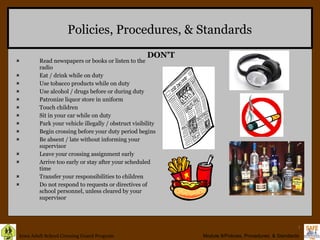
Policies, Procedures, & Standards Read newspapers or books or listen to the radio Eat / drink while on duty Use tobacco products while on duty Use alcohol / drugs before or during duty Patronize liquor store in uniform Touch children Sit in your car while on duty Park your vehicle illegally / obstruct visibility Begin crossing before your duty period begins Be absent / late without informing your supervisor Leave your crossing assignment early Arrive too early or stay after your scheduled time Transfer your responsibilities to children Do not respond to requests or directives of school personnel, unless cleared by your supervisor DON'T
POLICIES, PROCEDURES AND STANDARDS Legal Risk and Management Rendering First Aid  Should be Trained “ Immunity for Emergency Aid - Exceptions” Follow Agency Policy Failure to notify Put agency “on notice” that a potential problem exists. Document Notification Guards are responsible ONLY during their posted time Worker’s Compensation

Crossing Guard Training Module 7 Policies

  • 1.
    MODULE 7 –Policies, Procedures & Standards Module Goal Participants will recall all applicable policies and procedures and demonstrate standards of conduct governing them as a school crossing guard. Objective One Participants will recall policies and procedures within their hiring agency, school and county. Objective Two Participants will recall school crossing guard standards of behavior and conduct.  
  • 2.
    QUALIFICATIONS Adult crossingguards should possess the following (minimum) qualifications:Average intelligence Good physical condition, including sight, hearing, and mobility Mental alertness Neat appearance Good character Dependability Responsibility for the safety of students Passing the basic physical and the criminal background checks should be conditions for employment.
  • 3.
    POLICIES, PROCEDURES ANDSTANDARDS Orientation to the organization structure: Organization Chart/Chain of Command Supervisor Contact Information Traffic Enforcement Contact Information Authority Differences Sworn Officer Service Technician/Crossing Guard Hiring Agency
  • 4.
    POLICIES, PROCEDURES ANDSTANDARDS Policies and Procedures Uniform or Dress Code Standards of Conduct Pay and Benefits 2-Way Radio (if used) Standards Reporting Times Re-trainings Reports Physical Standards Grooming Contact with School Distraction Devices Vacation / Temporary Guards Who to Call if... Sick Damaged/Malfunctioning traffic control device Dangerous situation precluding safe crossing Uncooperative student or parent You need to report a crash Hiring Agency
  • 5.
    POLICIES, PROCEDURES ANDSTANDARDS District / school policies Safety Patrol School Zone Inspections – who does them? Walking and Biking to school School contact information Principal's name Safety Patrol Supervisor School Resource Officer School year, hours and holidays When school is let out early during an emergency (snow, ice, heat, etc.) School Walk Route Plan Locations of adult guards / school safety patrol School Districts and Schools
  • 6.
    RE-TRAINING Re-train intrainer course at least every other year – shorter Re-train guards yearly to every other year
  • 7.
    Policies, Procedures, &Standards Read newspapers or books or listen to the radio Eat / drink while on duty Use tobacco products while on duty Use alcohol / drugs before or during duty Patronize liquor store in uniform Touch children Sit in your car while on duty Park your vehicle illegally / obstruct visibility Begin crossing before your duty period begins Be absent / late without informing your supervisor Leave your crossing assignment early Arrive too early or stay after your scheduled time Transfer your responsibilities to children Do not respond to requests or directives of school personnel, unless cleared by your supervisor DON'T
  • 8.
    POLICIES, PROCEDURES ANDSTANDARDS Legal Risk and Management Rendering First Aid Should be Trained “ Immunity for Emergency Aid - Exceptions” Follow Agency Policy Failure to notify Put agency “on notice” that a potential problem exists. Document Notification Guards are responsible ONLY during their posted time Worker’s Compensation

Editor's Notes

  • #2 Message The goal of this module is that participants will recall all applicable policies and procedures and demonstrate standards of conduct governing them as a school crossing guard. Participants will recall policies and procedures within their hiring agency, school and county. Participants will recall school crossing guard standards of behavior and conduct.
  • #3 Message The prequalifications of guards is discussed in 1C. Adult crossing guards should possess the following (minimum qualifications: Average intellegence - Good physical condition, including sight, hearing, and mobility - Mental alertness - Neat appearance - Good character - Dependability - Responsibility for the safety of students Passing the basic physical and the criminal background checks should be conditions for employment.
  • #4 Message Now we will discuss your relationship to our organization. This slide shows our organization and where you fit in. Your supervisor is _______________. His/her contact information is shown on screen. This person will be your point of contact for most issues. He/she will be responsible for your assignment and keeping you informed of your schedule. If you are sick and must miss an assignment, contact him/her immediately so that a replacement can be scheduled to take your place. This is very important as we need to ensure that an adult guard is in place at the scheduled time. Your supervisor is also your first point of contact for any problems that you may note at your crosswalk. This includes observed hazardous conditions, dangerous motorist or pedestrian behaviors, or an accident. Remember to make the call as soon as practicable unless there is an urgent dangerous situation – then call immediately. Key Point: In an emergency, call 911 or if you do not have a cell phone, have a motorist call. Key Point: School crossing guards provide an important service to our agency and the community. You are a valuable member of our team.
  • #5 Message Let's go over some important agency policies and procedures. 1. Uniform or dress code 2. Standards of Conduct 3. Pay and Benefits 4. 2-Way Radio (if issued) Standards 5. Reporting Times 6. Retraining 7. Reports 8. Physical Standards 9. Grooming 10. Contact with School 11. Distraction Devices (cell phones, listening to music, reading, etc.) Who to call 1. Sick 2. Damaged / Malfunctioning traffic control device 3. Dangerous situation precluding safe crossing 4. Uncooperative student or parent 5. Report a crash
  • #6 Message Now that we have covered information about our agency, we need to discuss the policies of the school district and schools that we support. 1. Safety Patrol 2. School zone inspections – who does them 3. Walking to school 4. School contact information 5. Principal's name 6. Safety patrol supervisor 7. School Resource Officer 8. School year, hours and holidays 9. When school is let out early during an emergency (snow, ice, or heat). 10. School walk route plan 11. Locations of adult guards/ school safety patrol
  • #8 Message 1. Don't read newspapers or books or listen to the radio 2. Don't eat/drink while on duty 3. Don't use tobacco products while on duty 4. Don't patronize liquor store in uniform 5. Don't touch children 6. Don't sit in your car while on duty 7. Don't park your vehicle illegally/ obstruct visibility 8. Don't begin crossing before your duty period begins 9. Dont' be absent / late without informing your supervisor 10. Don't leave your crossing assignment early 11. Don't arrive too early or stay after your scheduled time 12. Don't transfer your responsiblities to children 13. Don't respond to requests or directives of school personnel, unless cleared by your supervisor.
  • #9 Message While school crossing guard activity is not generally hazardous, there are some physical and legal risks involved. Legal limitations and liabilities may arise during the performance of duty. It's important for school crossing guards to be familiar with department policies and procedures.