FACULTY OF TECHNOLOGY ENGINEERING
UNIVERSITI TEKNIKAL MALAYSIA MELAKA
BETE 3393- TELECOMMUNICATION SWITCHING
SYSTEM
TOPIC: 4 CROSSBAR SWITCHING (32X32)
1. SARAVANA A/L SUKUMARAN B071210044
2. ASMIDA BT ASRI B071210063
3. NOR SARIZA BT ISMAIL B071210035
4. MOHD RAFIQ BIN NORDIN @ RUBU B071210120
5. AMIRUL ALIFF BIN AMINUDDIN B071210143
Prepared for: EN. CHAIRULSYAH WASLI
OBJECTIVE
• To design the crossbar switch technologies
• To analyze the implementation of the technologies
• To investigate the compatible of the design with the requirement
• To determine the aspect included in the crossbar.
BACKGROUND
• Upgraded of the existing network of the client network
• The report present the results of the analysis which based on HSPICE
simulation.
• Using through a 32 x 32 crossbar switch.
• Delays for optimized input and output interconnect lines are also presented
for 64x (128x128), 32x (128x128), and 64x (32x32) crossbar switch designs.
THEORY
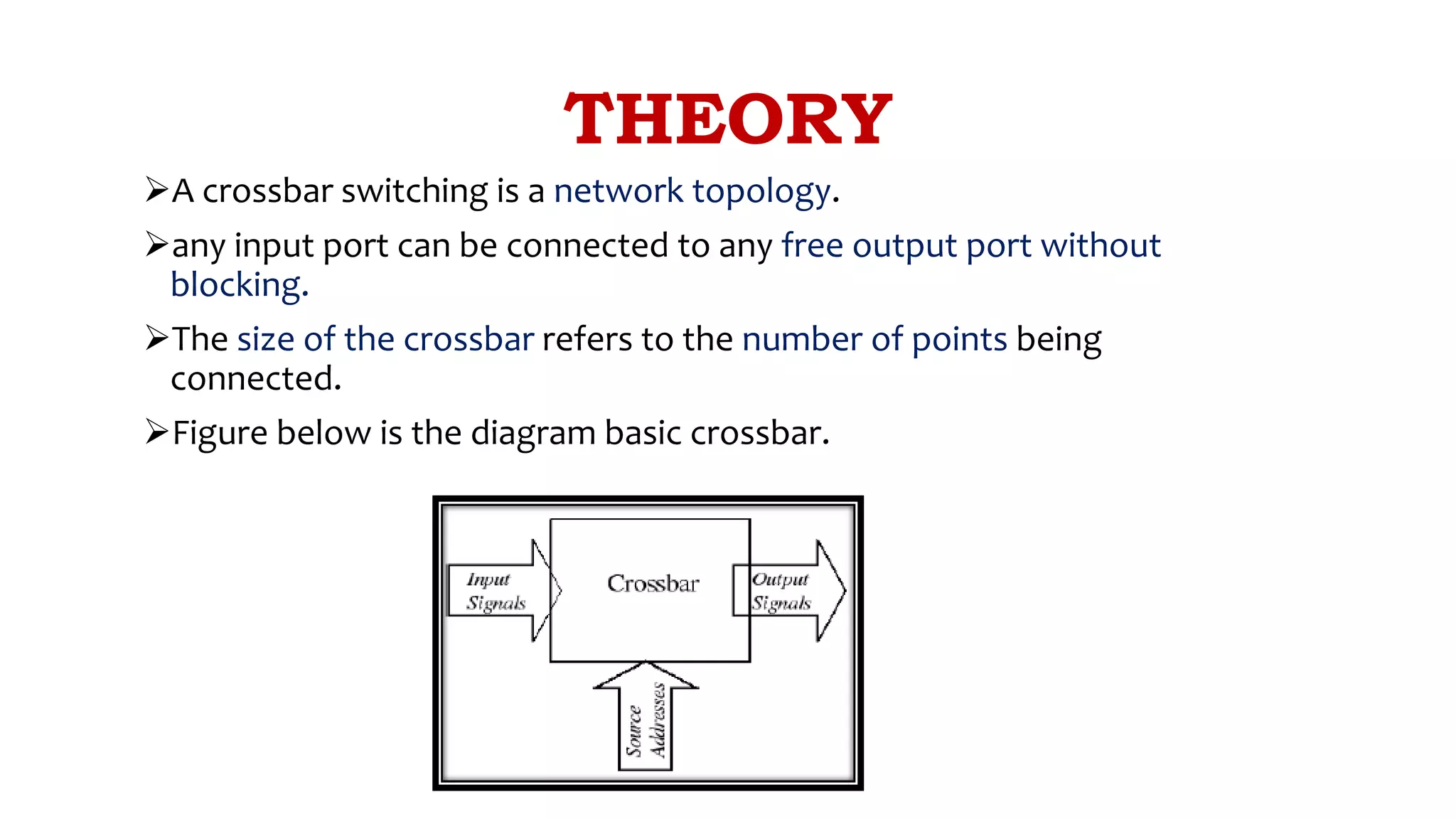
A crossbar switching is a network topology.
any input port can be connected to any free output port without
blocking.
The size of the crossbar refers to the number of points being
connected.
Figure below is the diagram basic crossbar.
 Crossbar switching networks can be categorized into three major topological
classes. Below is the categorized of crossbar switching networks.
1.full-crossbar networks
2.multistage interconnection networks
3.networks consisting of multiple levels of full crossbar connections
 A full-crossbar network is comprised of a single switching element.
 Multistage interconnection networks consist of multiple interconnected
layers of simpler switches.
 networks consisting of multiple levels of full crossbar connections also called
hierarchical crossbar interconnection networks (HCINs).
EXISTING TECHNOLOGY
Historically, a crossbar switch consisted of metal bars associated
with each input and output, together with some means of
controlling movable contacts at each cross-point (in 20th Century)
Firstly, crossbar switches use switching matrices made from a two-
dimensional array of contacts arranged in an x-y format.
Latest model Western Electric crossbar switch, the majority of Bell
System switches were made to connect three wires including the
tip and ring of a balanced pair circuit and a sleeve lead for control
PLANNING TECHNOLOGY TO
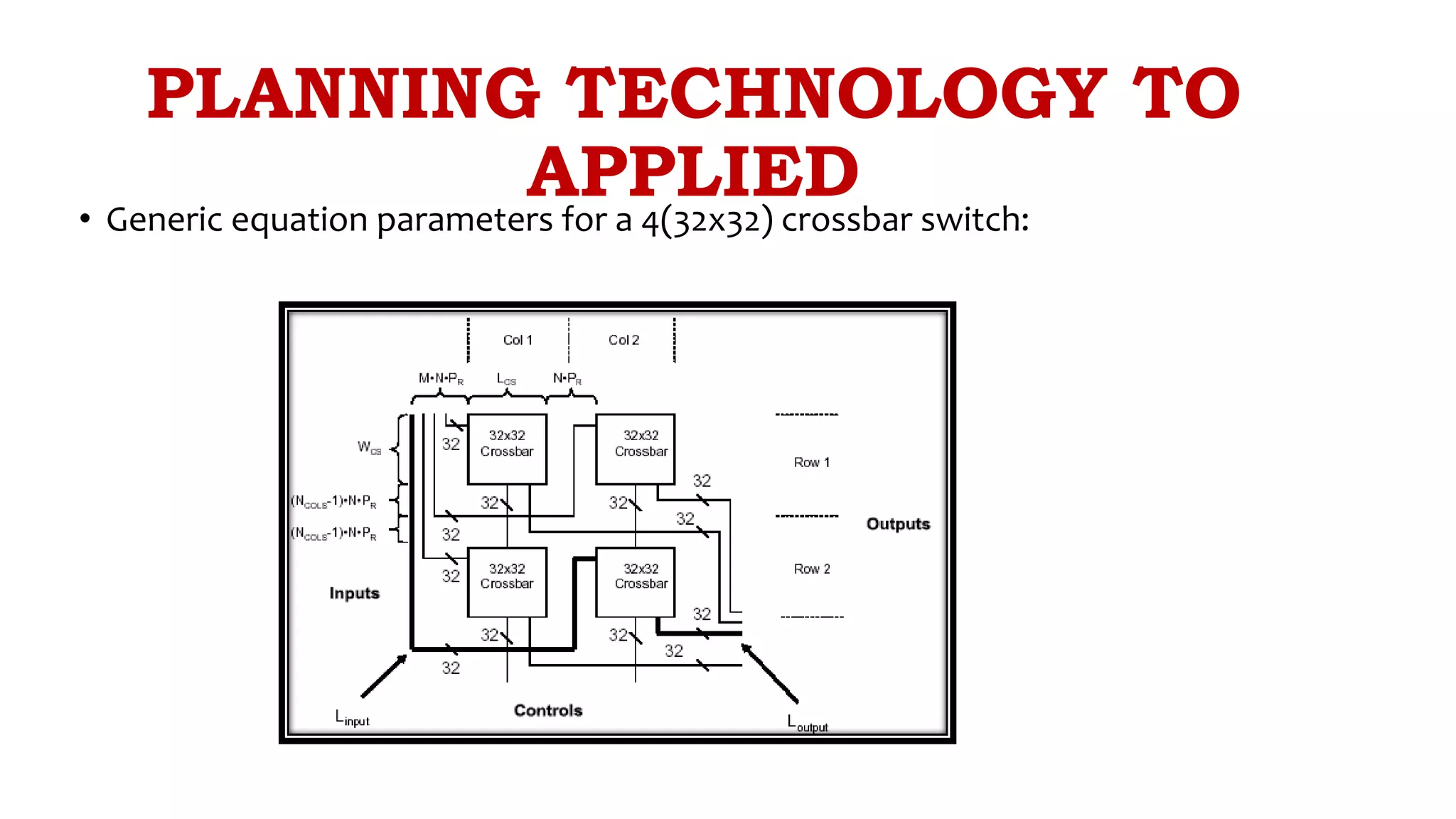
APPLIED• Generic equation parameters for a 4(32x32) crossbar switch:
1. Crossbar input interconnect length Linput= (M . N). PR (Equation 1)
2. Horizontal spacing between crossbars = N . PR (Equation 2)
3. Vertical spacing between crossbars = 2*(NCOLS -1). N . PR (Equation 3)
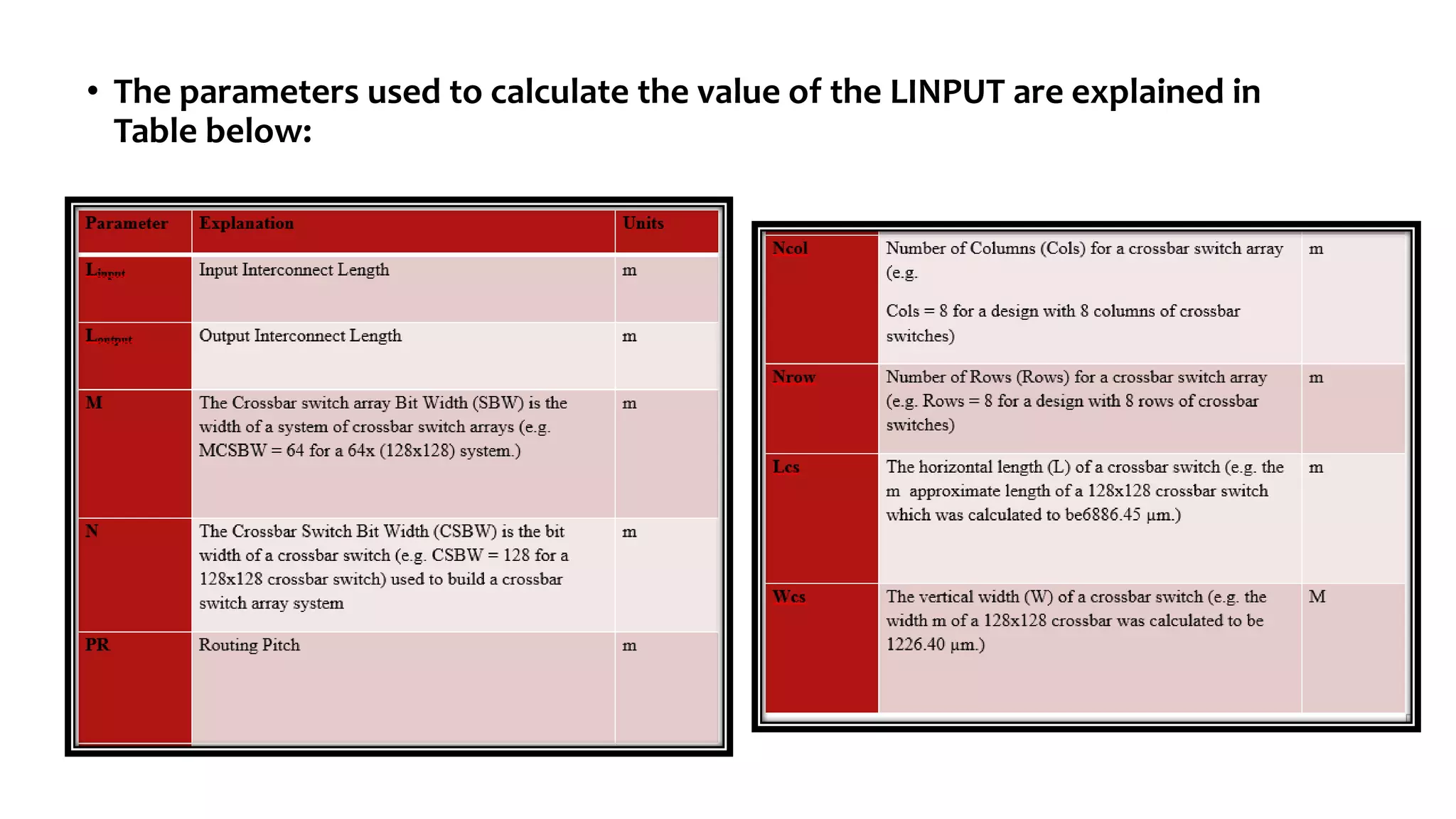
4. LINPUT = [(M . N ) . PR ] + [(NCOLS -1) . LCS ] +[(2 . (NCOLS - 1) . N . PR ). (N ROWS - 1)+ [
((N ROWS -1) . WCS ] + [(NCOLS -1) . N . PR ] (Equation 4)
5. LOUTPUT = M . N . PR (Equation 5)
6. A = (2 . M . N . PR . NCOLS . LCOLS + (NCOLS - 1) . N . PR ).{[2 . (NCOLS - 1) . N . PR ] . (N R - 1)
+ PR .WCS } (Equation 6)
• The parameters used to calculate the value of the LINPUT are explained in
Table below:
ASPECT AND CONSTRAIN TO
BE CONSIDER
• Design
• Switching matrix and array of control cells
• The high-frequency sequence
• Multiplexed input signal
RESULT ANALYSIS
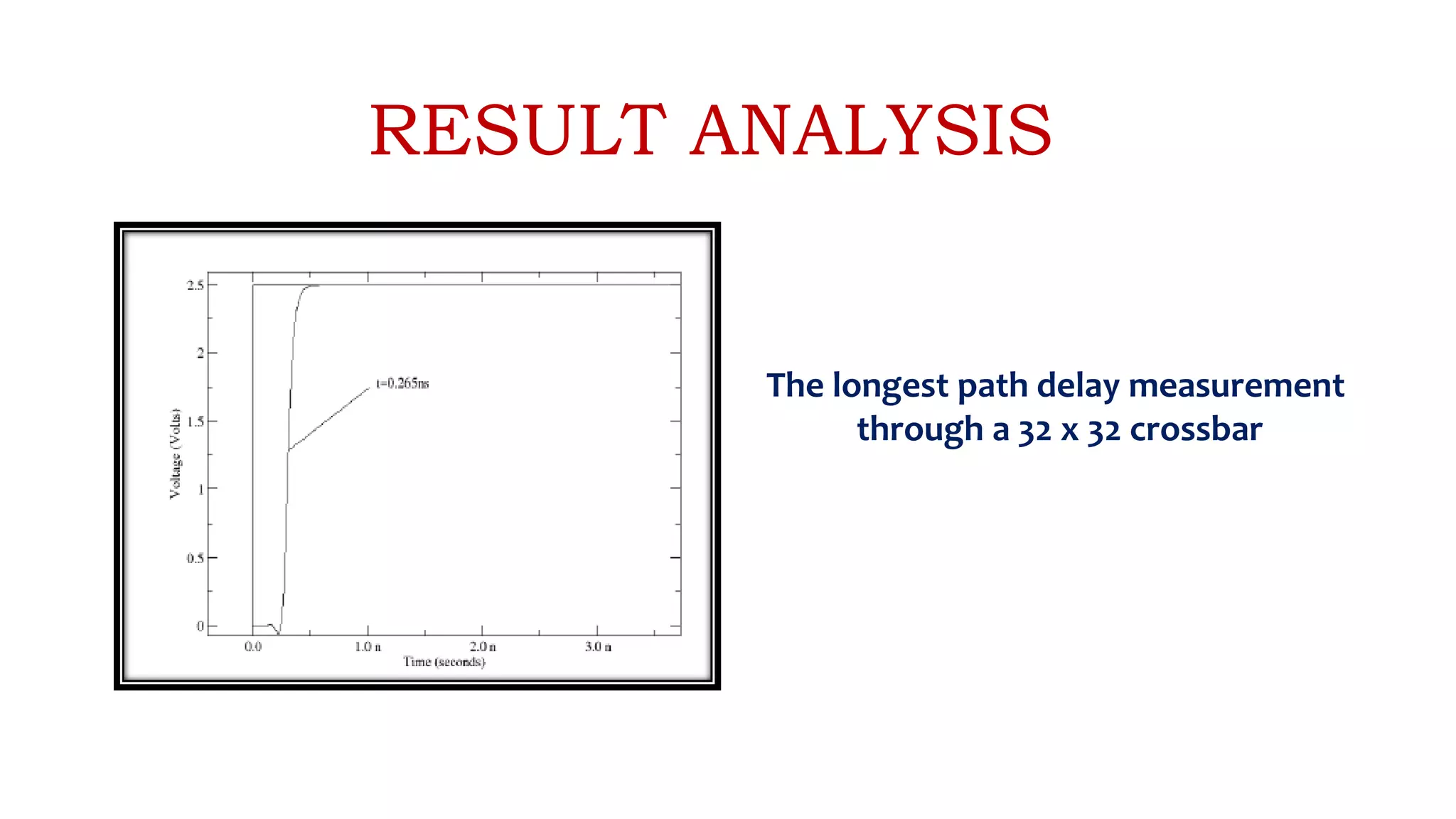
The longest path delay measurement
through a 32 x 32 crossbar
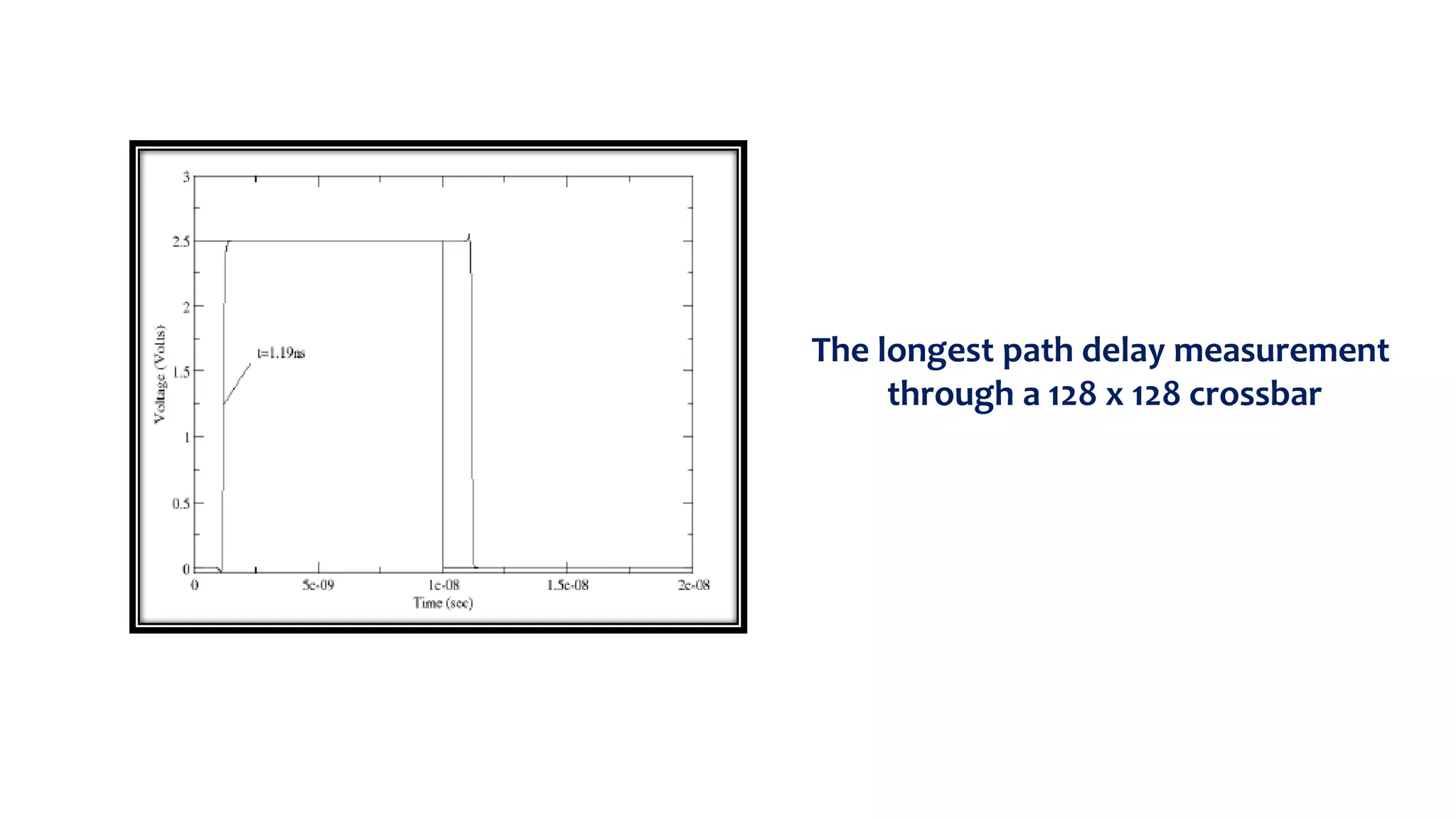
The longest path delay measurement
through a 128 x 128 crossbar
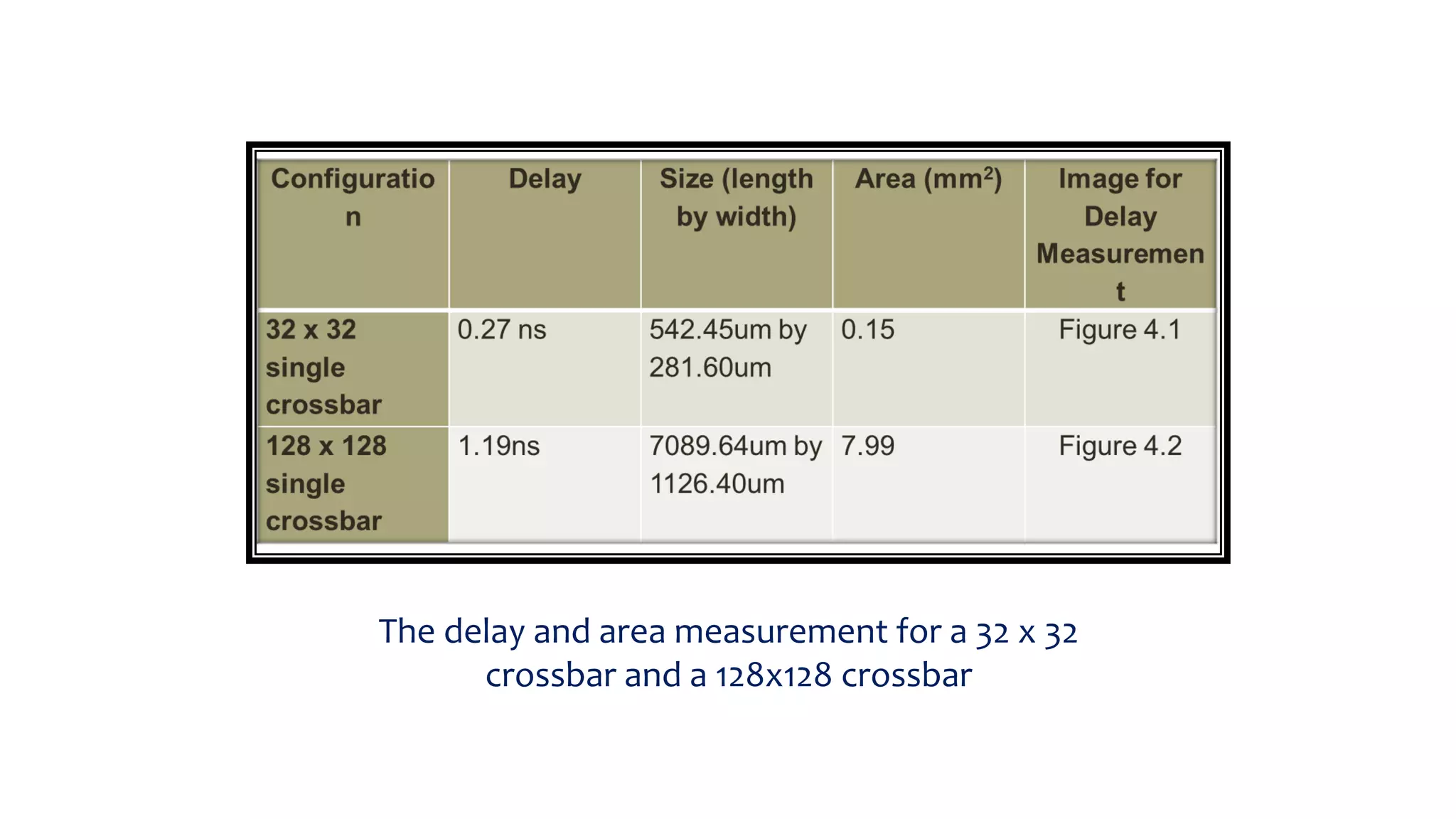
The delay and area measurement for a 32 x 32
crossbar and a 128x128 crossbar
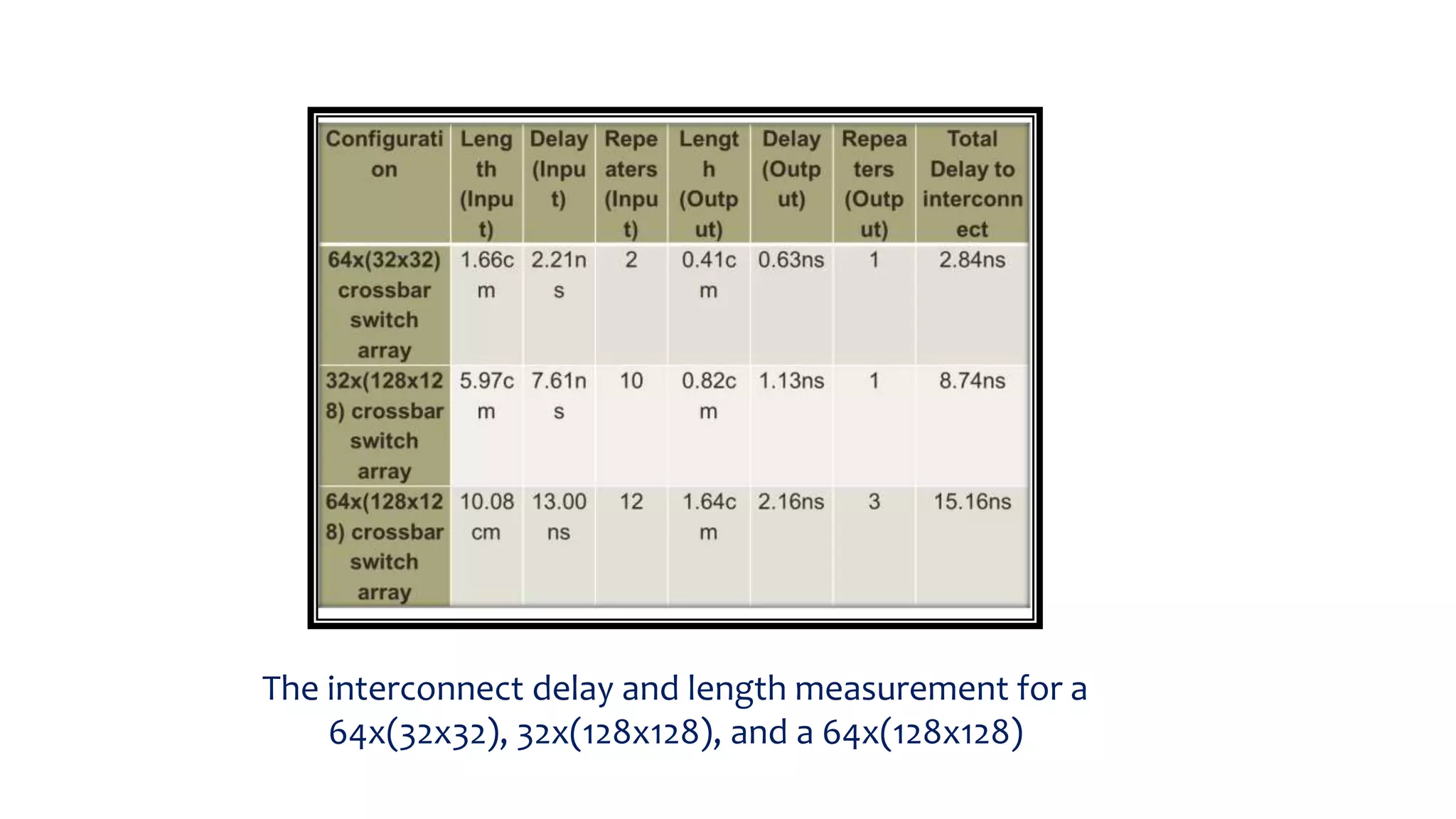
The interconnect delay and length measurement for a
64x(32x32), 32x(128x128), and a 64x(128x128)
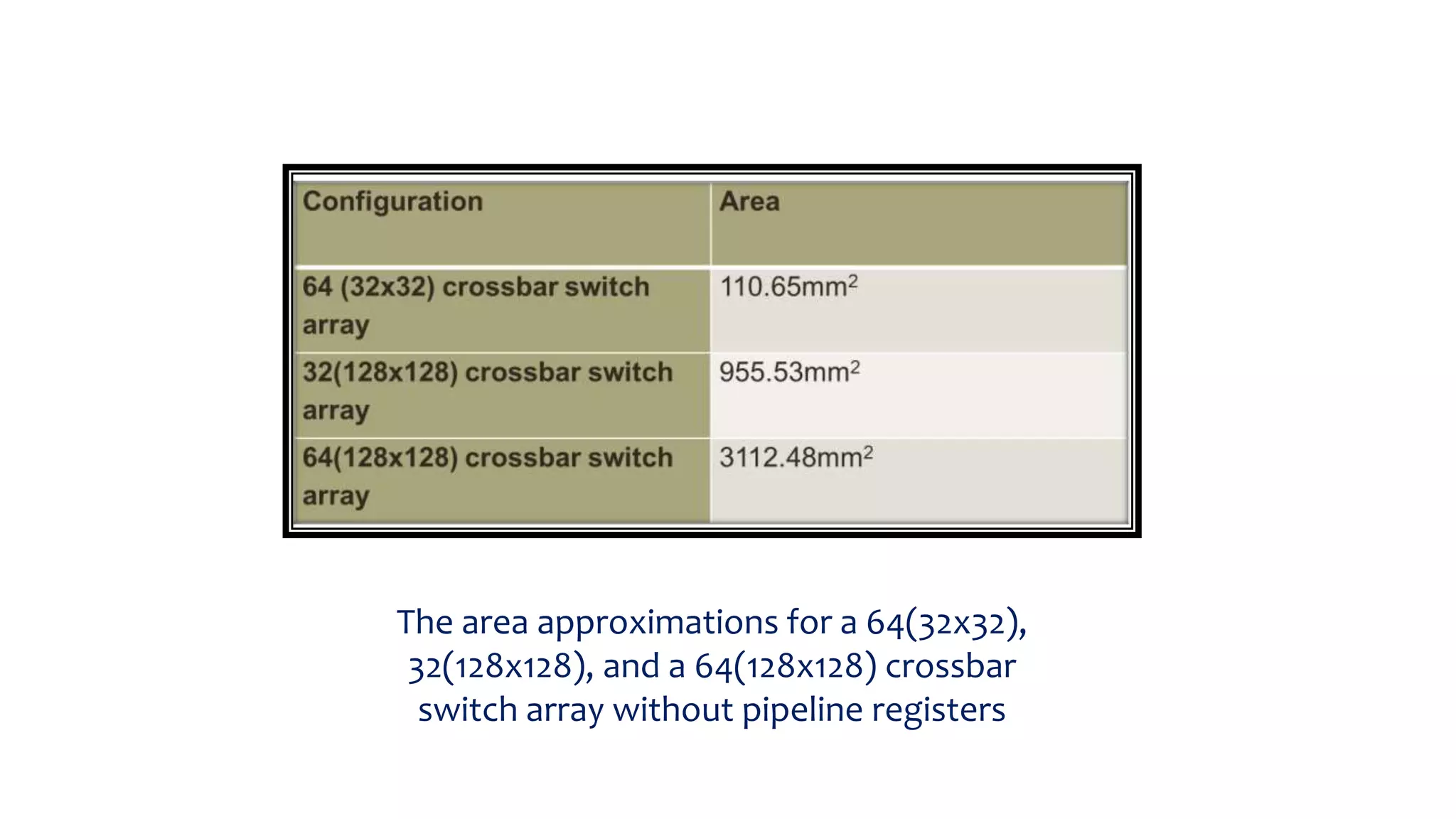
The area approximations for a 64(32x32),
32(128x128), and a 64(128x128) crossbar
switch array without pipeline registers
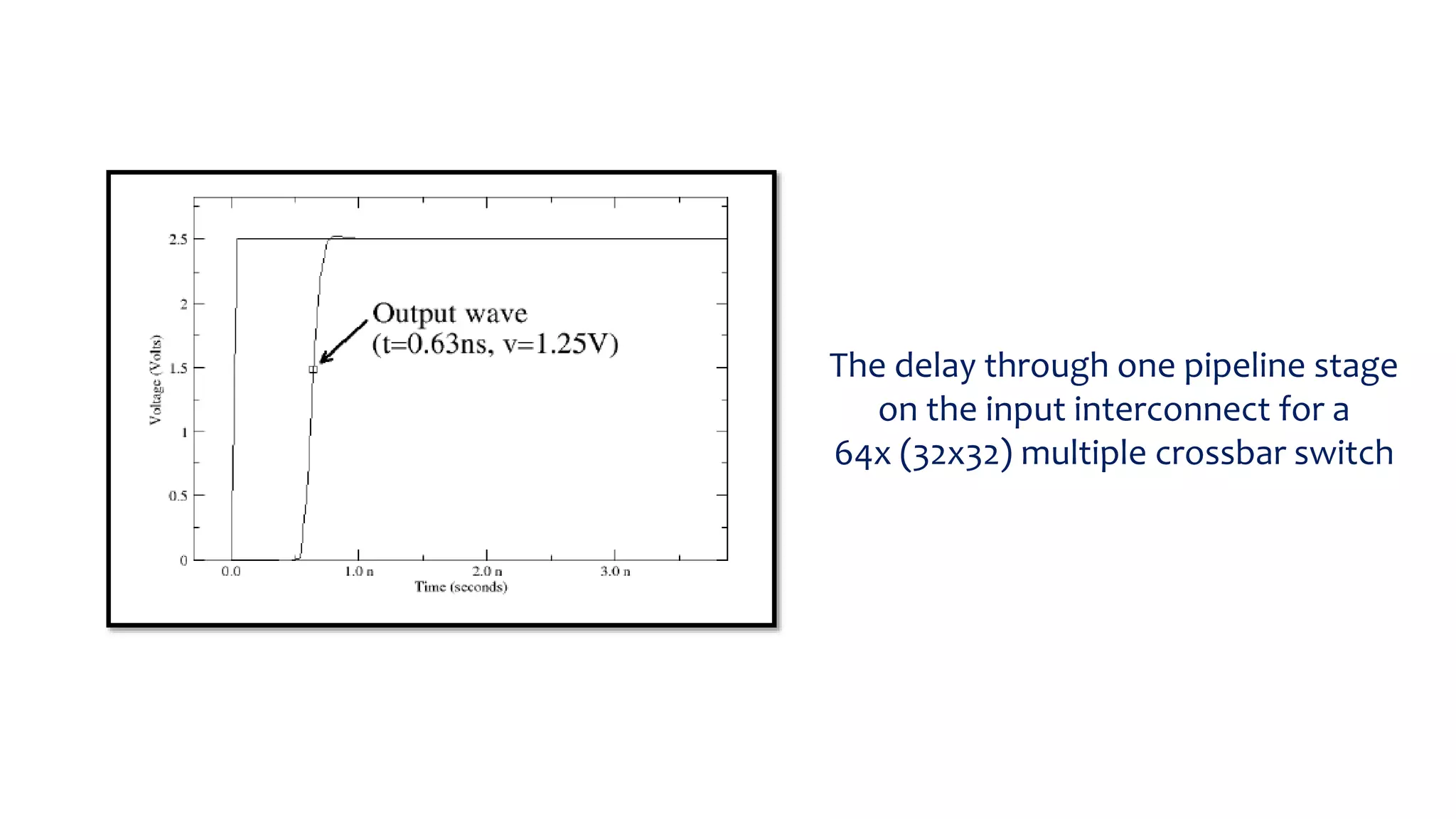
The delay through one pipeline stage
on the input interconnect for a
64x (32x32) multiple crossbar switch
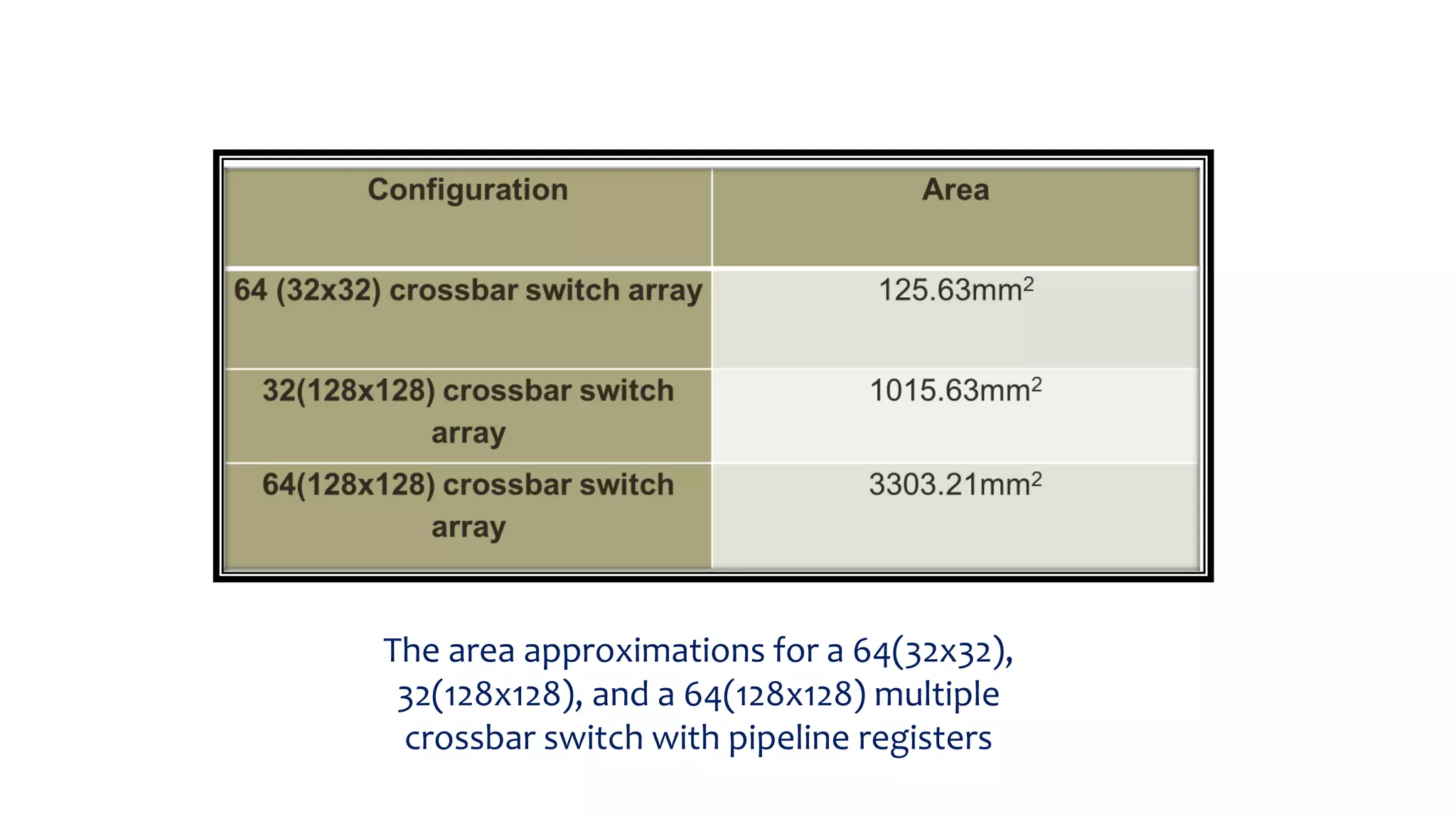
The area approximations for a 64(32x32),
32(128x128), and a 64(128x128) multiple
crossbar switch with pipeline registers
Advantage crossbar:
1. It is a Non Blocking Network that allows multiple i/o connections to be
achieved simultaneously.
2. It provides full connectivity.
*Example: any permutation can be implemented using a crossbar.
3. It is highly useful in a multiprocessor system, as all processors can
send memory requests independently and asynchronously.
4. It gives maximum utilization of bandwidth as compared to other
networks like bus system, multistage networks.
Disadvantage crossbar:
1. The crossbar switch is singled-layered switch.
2. At each point, there is a switch when closed, connects one of
the inputs to one of the outputs.
CONCLUSION
• Understand more about the crossbar switch technologies.
• Determine the best technologies between 32 x 32 and 64 x (32 x
32).
• Know the compatible of the design with the requirement.
• Understand the aspect of the crossbar switch technologies.
• Understand the HSPICE simulation for this network.

Cross Bar Switching

  • 1.
    FACULTY OF TECHNOLOGYENGINEERING UNIVERSITI TEKNIKAL MALAYSIA MELAKA BETE 3393- TELECOMMUNICATION SWITCHING SYSTEM TOPIC: 4 CROSSBAR SWITCHING (32X32) 1. SARAVANA A/L SUKUMARAN B071210044 2. ASMIDA BT ASRI B071210063 3. NOR SARIZA BT ISMAIL B071210035 4. MOHD RAFIQ BIN NORDIN @ RUBU B071210120 5. AMIRUL ALIFF BIN AMINUDDIN B071210143 Prepared for: EN. CHAIRULSYAH WASLI
  • 2.
    OBJECTIVE • To designthe crossbar switch technologies • To analyze the implementation of the technologies • To investigate the compatible of the design with the requirement • To determine the aspect included in the crossbar.
  • 3.
    BACKGROUND • Upgraded ofthe existing network of the client network • The report present the results of the analysis which based on HSPICE simulation. • Using through a 32 x 32 crossbar switch. • Delays for optimized input and output interconnect lines are also presented for 64x (128x128), 32x (128x128), and 64x (32x32) crossbar switch designs.
  • 4.
    THEORY A crossbar switchingis a network topology. any input port can be connected to any free output port without blocking. The size of the crossbar refers to the number of points being connected. Figure below is the diagram basic crossbar.
  • 5.
     Crossbar switchingnetworks can be categorized into three major topological classes. Below is the categorized of crossbar switching networks. 1.full-crossbar networks 2.multistage interconnection networks 3.networks consisting of multiple levels of full crossbar connections  A full-crossbar network is comprised of a single switching element.  Multistage interconnection networks consist of multiple interconnected layers of simpler switches.  networks consisting of multiple levels of full crossbar connections also called hierarchical crossbar interconnection networks (HCINs).
  • 6.
    EXISTING TECHNOLOGY Historically, acrossbar switch consisted of metal bars associated with each input and output, together with some means of controlling movable contacts at each cross-point (in 20th Century) Firstly, crossbar switches use switching matrices made from a two- dimensional array of contacts arranged in an x-y format. Latest model Western Electric crossbar switch, the majority of Bell System switches were made to connect three wires including the tip and ring of a balanced pair circuit and a sleeve lead for control
  • 7.
    PLANNING TECHNOLOGY TO APPLIED•Generic equation parameters for a 4(32x32) crossbar switch:
  • 8.
    1. Crossbar inputinterconnect length Linput= (M . N). PR (Equation 1) 2. Horizontal spacing between crossbars = N . PR (Equation 2) 3. Vertical spacing between crossbars = 2*(NCOLS -1). N . PR (Equation 3) 4. LINPUT = [(M . N ) . PR ] + [(NCOLS -1) . LCS ] +[(2 . (NCOLS - 1) . N . PR ). (N ROWS - 1)+ [ ((N ROWS -1) . WCS ] + [(NCOLS -1) . N . PR ] (Equation 4) 5. LOUTPUT = M . N . PR (Equation 5) 6. A = (2 . M . N . PR . NCOLS . LCOLS + (NCOLS - 1) . N . PR ).{[2 . (NCOLS - 1) . N . PR ] . (N R - 1) + PR .WCS } (Equation 6)
  • 9.
    • The parametersused to calculate the value of the LINPUT are explained in Table below:
  • 10.
    ASPECT AND CONSTRAINTO BE CONSIDER • Design • Switching matrix and array of control cells • The high-frequency sequence • Multiplexed input signal
  • 11.
    RESULT ANALYSIS The longestpath delay measurement through a 32 x 32 crossbar
  • 12.
    The longest pathdelay measurement through a 128 x 128 crossbar
  • 13.
    The delay andarea measurement for a 32 x 32 crossbar and a 128x128 crossbar
  • 14.
    The interconnect delayand length measurement for a 64x(32x32), 32x(128x128), and a 64x(128x128)
  • 15.
    The area approximationsfor a 64(32x32), 32(128x128), and a 64(128x128) crossbar switch array without pipeline registers
  • 16.
    The delay throughone pipeline stage on the input interconnect for a 64x (32x32) multiple crossbar switch
  • 17.
    The area approximationsfor a 64(32x32), 32(128x128), and a 64(128x128) multiple crossbar switch with pipeline registers
  • 18.
    Advantage crossbar: 1. Itis a Non Blocking Network that allows multiple i/o connections to be achieved simultaneously. 2. It provides full connectivity. *Example: any permutation can be implemented using a crossbar. 3. It is highly useful in a multiprocessor system, as all processors can send memory requests independently and asynchronously. 4. It gives maximum utilization of bandwidth as compared to other networks like bus system, multistage networks.
  • 19.
    Disadvantage crossbar: 1. Thecrossbar switch is singled-layered switch. 2. At each point, there is a switch when closed, connects one of the inputs to one of the outputs.
  • 20.
    CONCLUSION • Understand moreabout the crossbar switch technologies. • Determine the best technologies between 32 x 32 and 64 x (32 x 32). • Know the compatible of the design with the requirement. • Understand the aspect of the crossbar switch technologies. • Understand the HSPICE simulation for this network.