PROPAGATION MECHANISMS 3 TYPES
PROPAGATION MECHANISMS We next discuss propagation mechanisms (Reflection,  Diffraction, and Scattering) because: They have an impact on the wave propagation in a mobile communication system The most important parameter,  Received power  is predicted by large scale propagation models based on the physics of reflection, diffraction and scattering
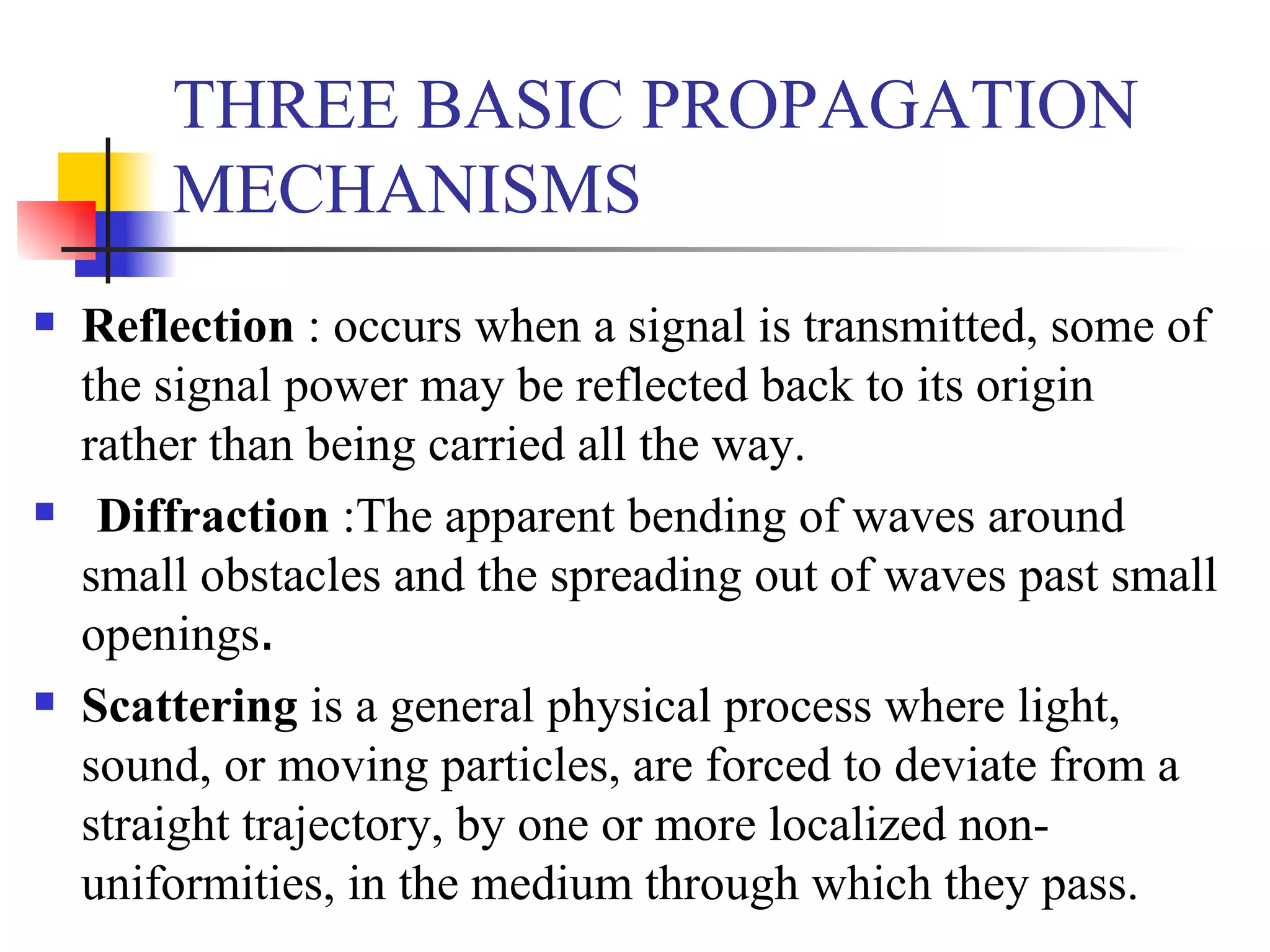
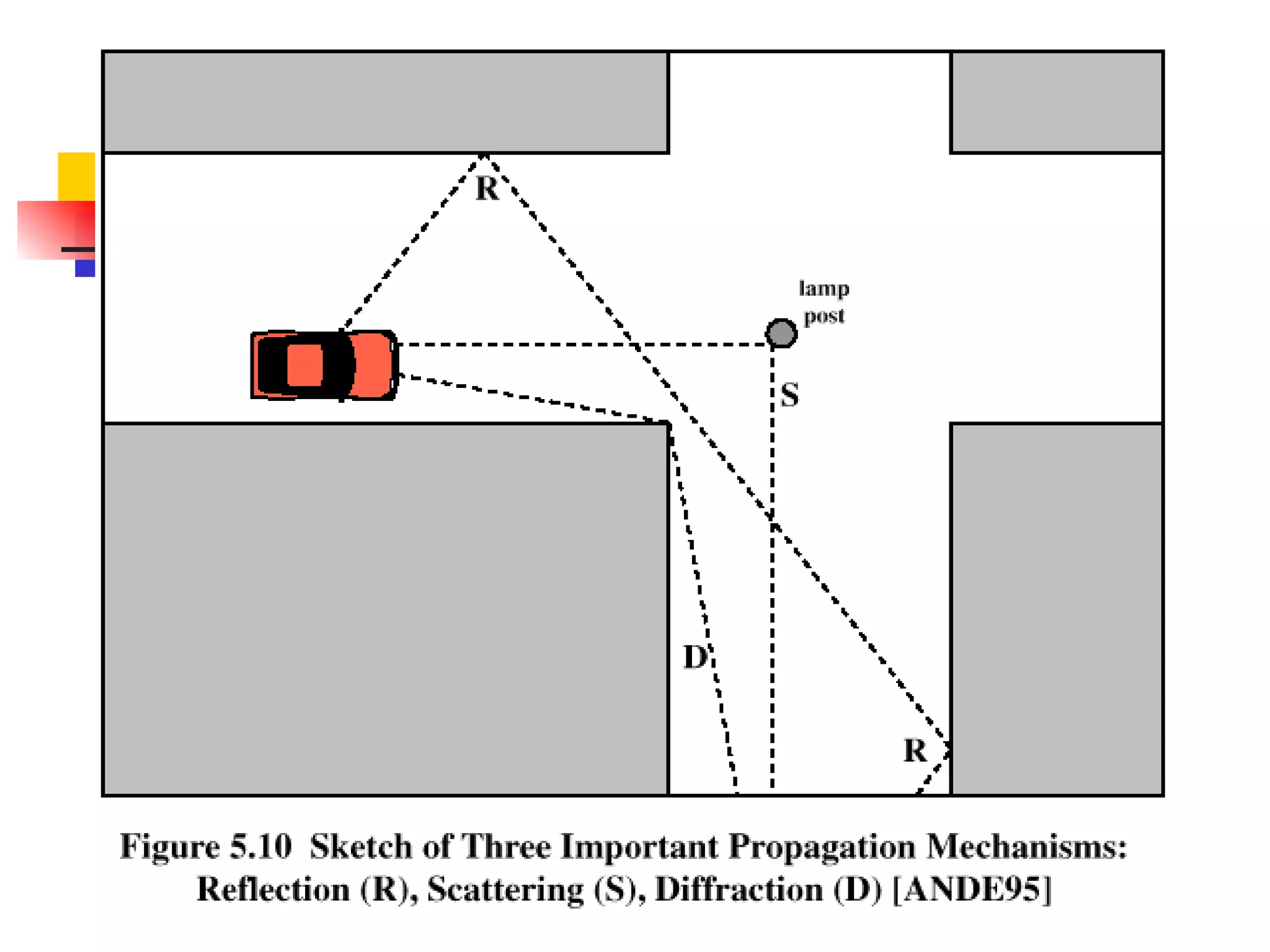
THREE BASIC PROPAGATION MECHANISMS Reflection  : occurs when a signal is transmitted, some of the signal power may be reflected back to its origin rather than being carried all the way.  Diffraction  :The apparent bending of waves around small obstacles and the spreading out of waves past small openings . Scattering  is a general physical process where light, sound, or moving particles, are forced to deviate from a straight trajectory, by one or more localized non-uniformities, in the medium through which they pass.
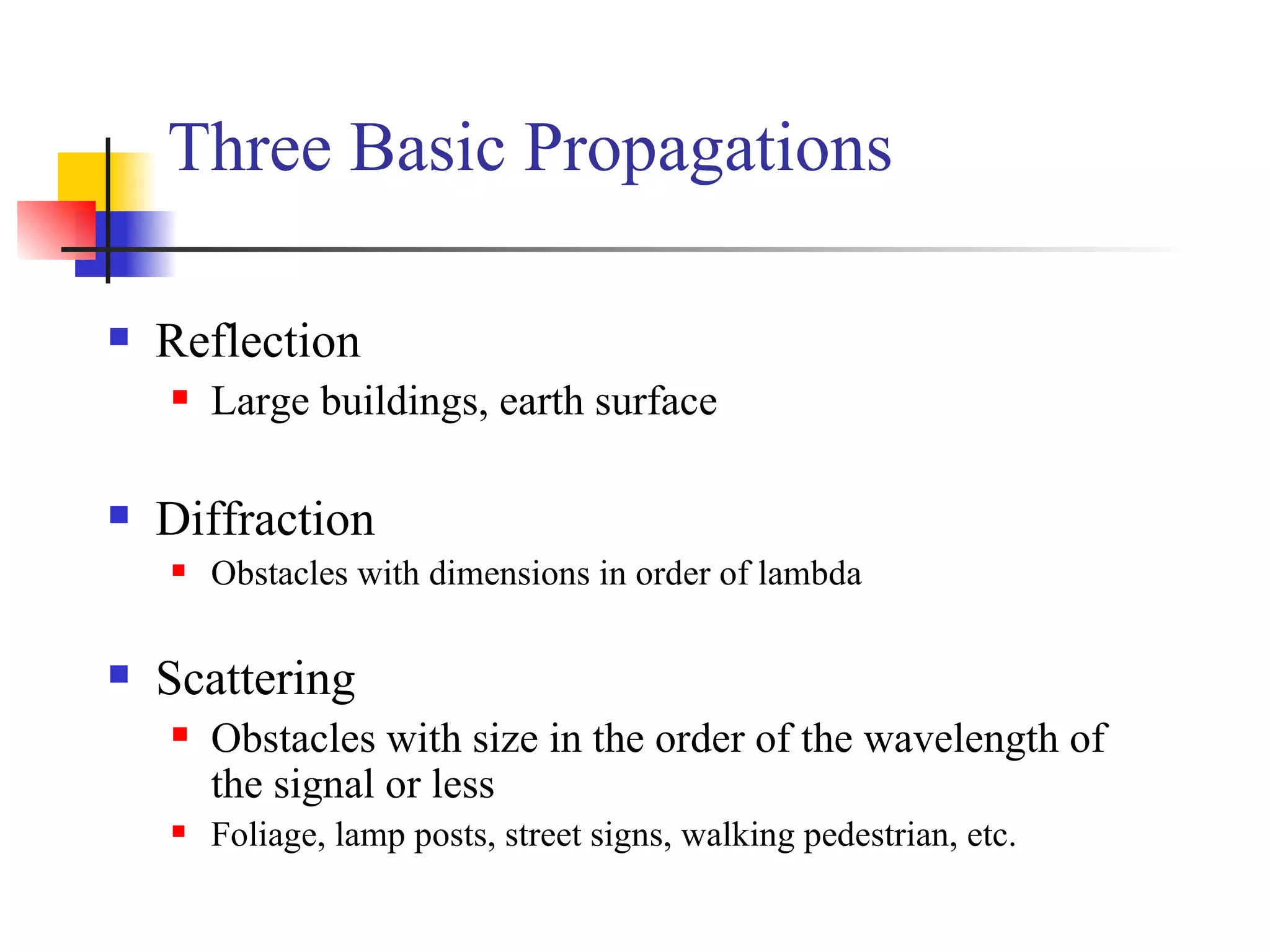
Reflection Large buildings, earth surface Diffraction Obstacles with dimensions in order of lambda Scattering  Obstacles with size in the order of the wavelength of the signal or less  Foliage, lamp posts, street signs, walking pedestrian, etc. Three Basic Propagations
Multipath Propagation
Reflection When a radio wave propagating in one medium impinges upon another medium having different electrical properties, the wave is partially reflected and partially transmitted Fresnel Reflection Coefficient (Γ)  gives the relationship between the electric field intensity of the reflected and transmitted waves to the incident wave in the medium of origin The Reflection Coefficient  is a function of the material properties, depending on  Wave Polarization (direction of vibration-propagation: orientation) Angle of Incidence Frequency of the propagating wave
Ground Reflection (2- ray) Model In a mobile radio channel, a single direct path between the base station and mobile is rarely the only physical path for propagation Hence the free space propagation model in most cases is inaccurate when used alone The  2- ray GRM  is based on geometric optics It considers both- direct path and ground reflected propagation path between transmitter and receiver This was found reasonably accurate for predicting large scale signal strength over distances of several kilometers for mobile radio systems using tall towers ( heights above 50 m ), and also for  L-O-S  micro cell channels in urban environments
Diffraction Phenomena: Radio signal can propagate around the curved surface of the earth, beyond the horizon and behind obstructions. Although the received field strength decreases rapidly as a receiver moves deeper into the obstructed ( shadowed ) region, the diffraction field still exists and often has sufficient strength to produce a useful signal. The field strength of a diffracted wave in the shadowed region is the vector sum of the electric field components of all the secondary wavelets in the space around the obstacles.
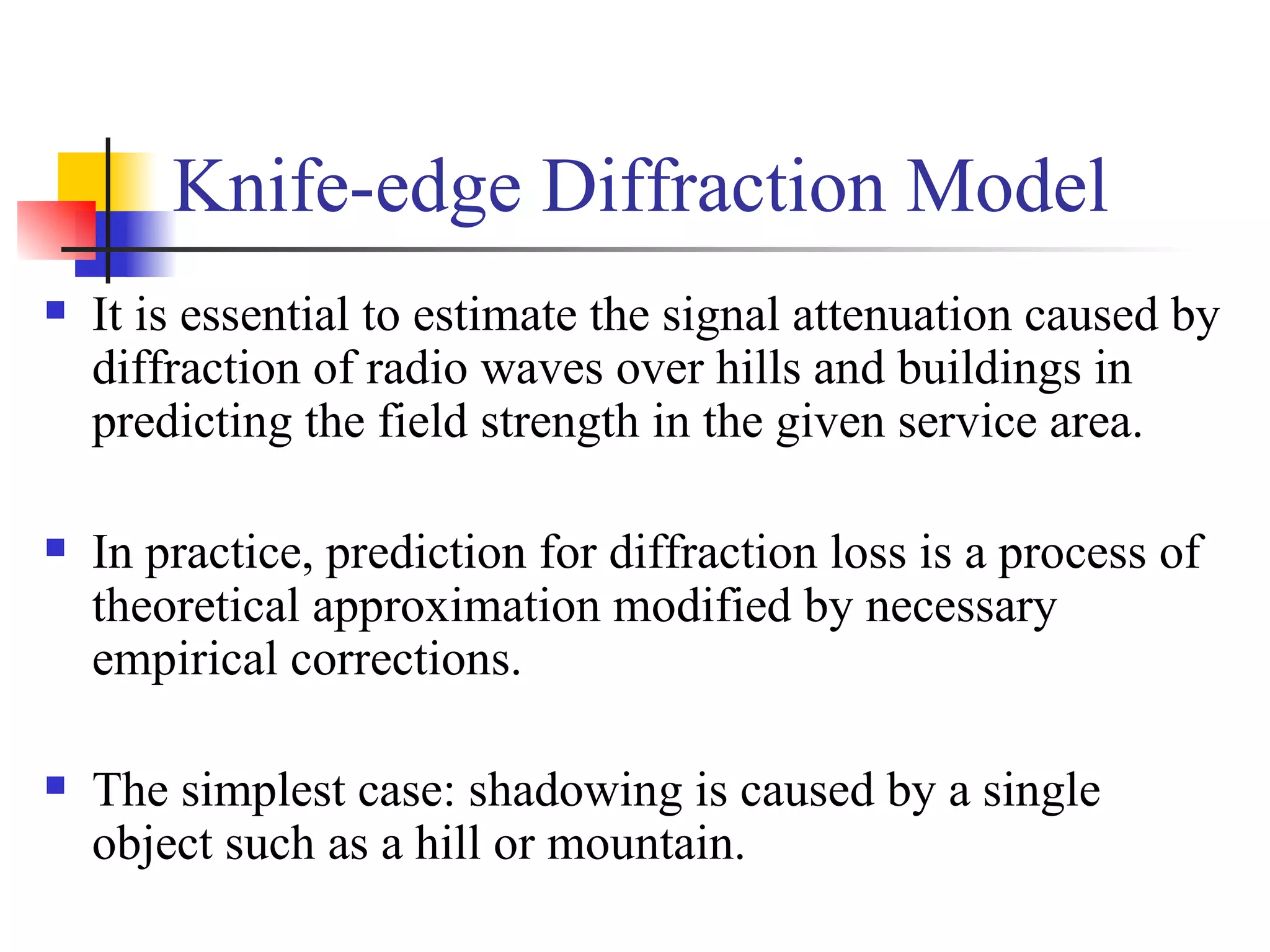
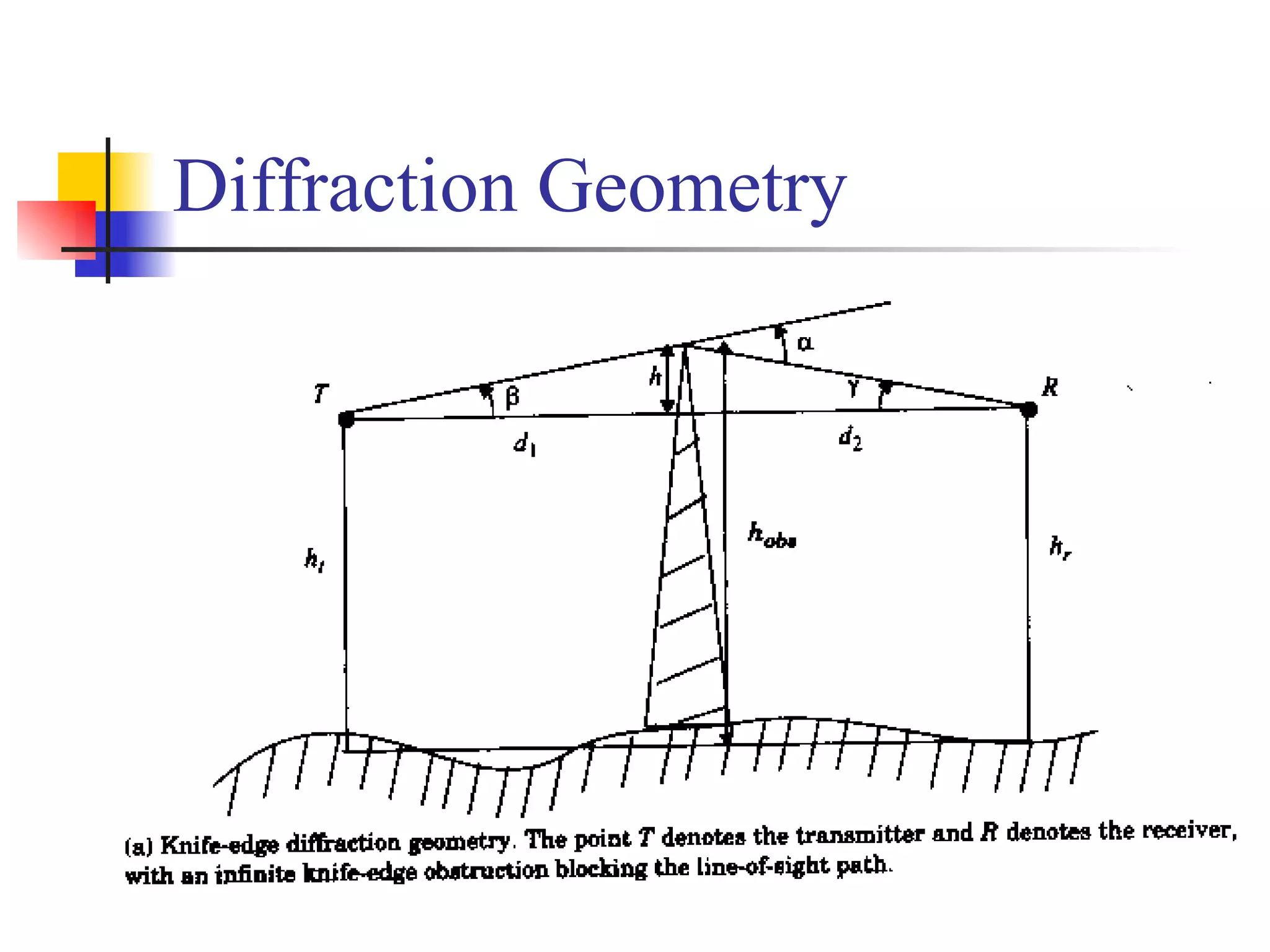
It is essential to estimate the signal attenuation caused by diffraction of radio waves over hills and buildings in predicting the field strength in the given service area. In practice, prediction for diffraction loss is a process of theoretical approximation modified by necessary empirical corrections. The simplest case: shadowing is caused by a single object such as a hill or mountain. Knife-edge Diffraction Model
Diffraction Geometry
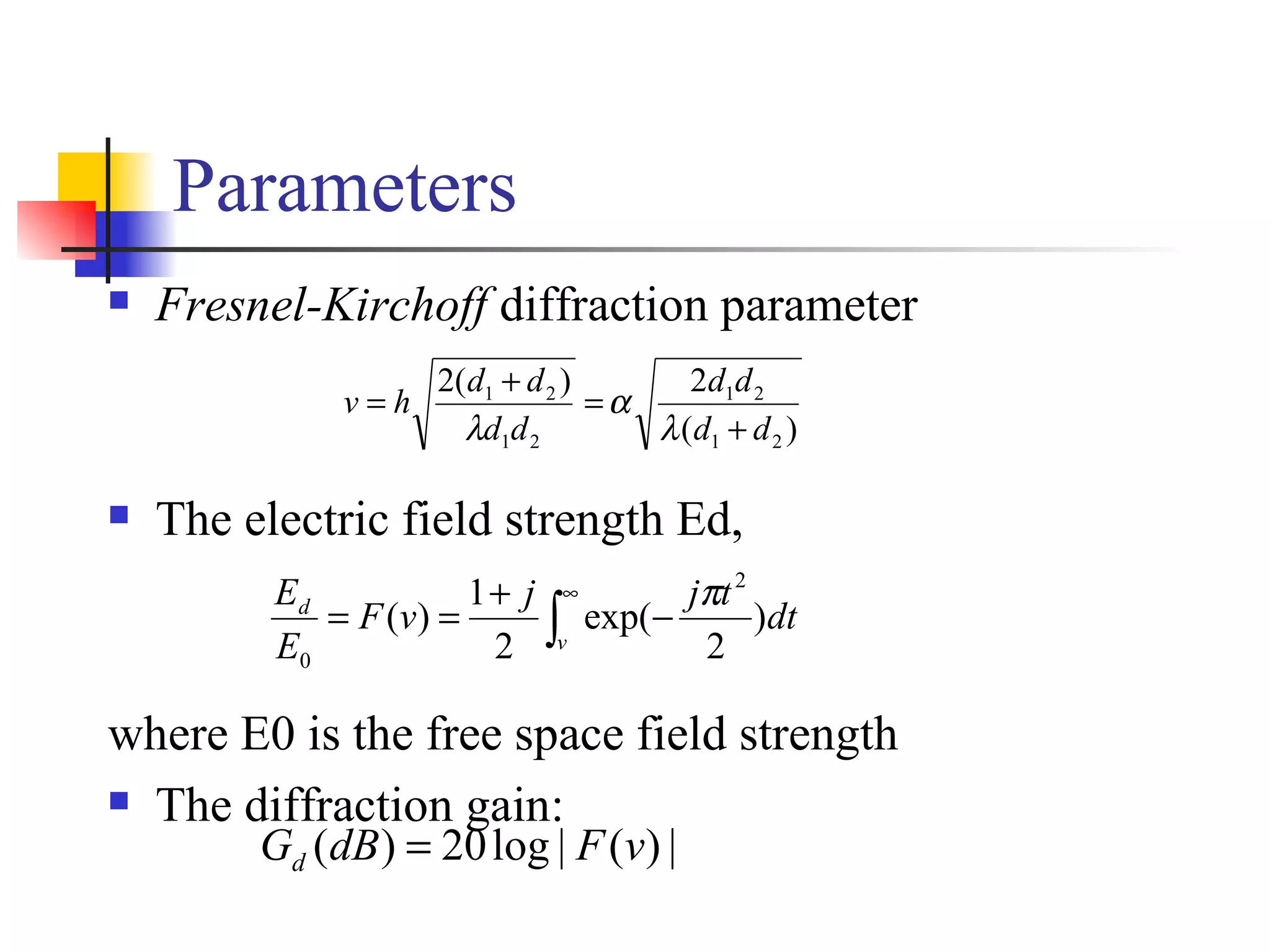
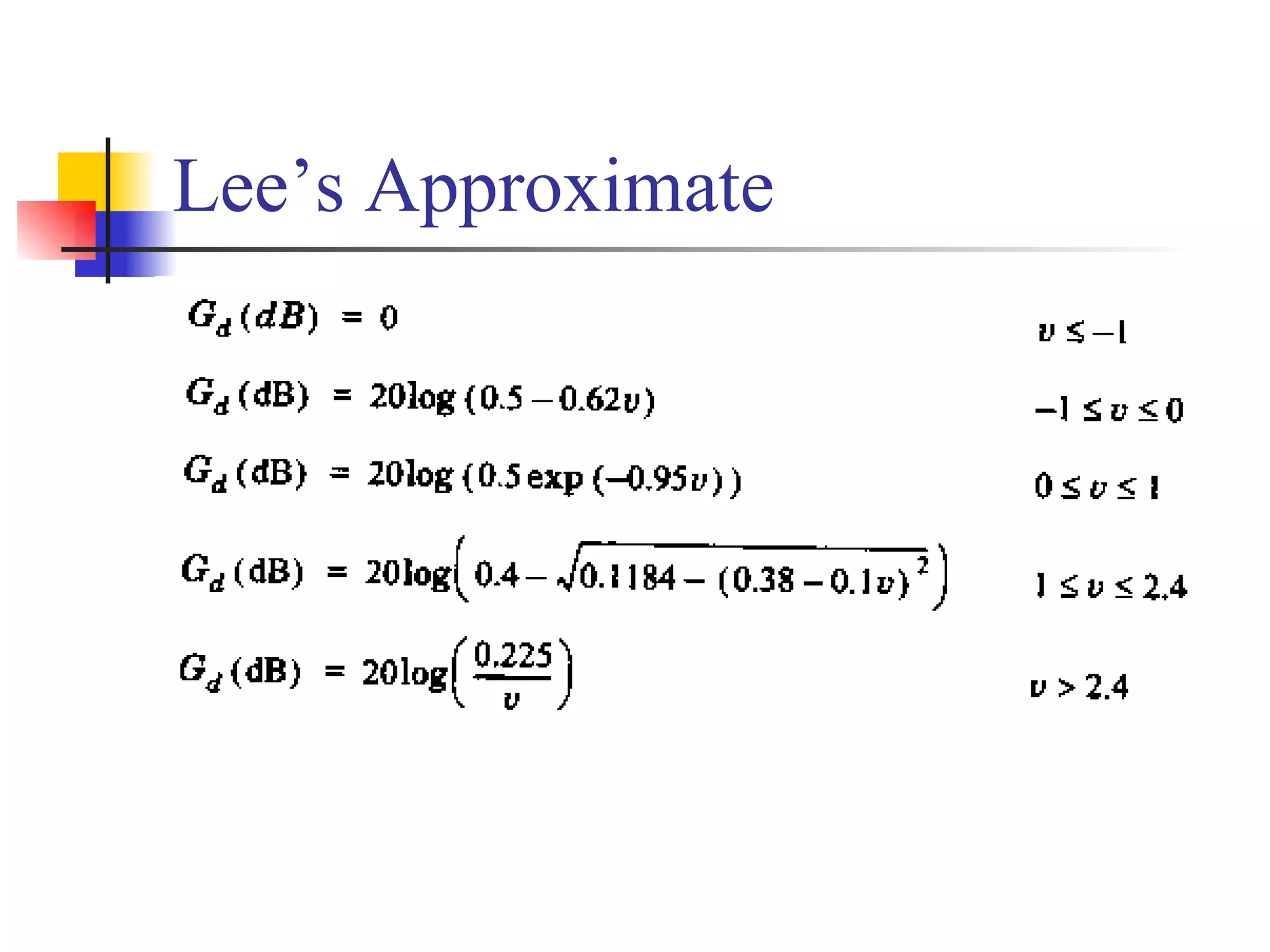
Parameters Fresnel-Kirchoff  diffraction parameter The electric field strength Ed, where E0 is the free space field strength The diffraction gain:
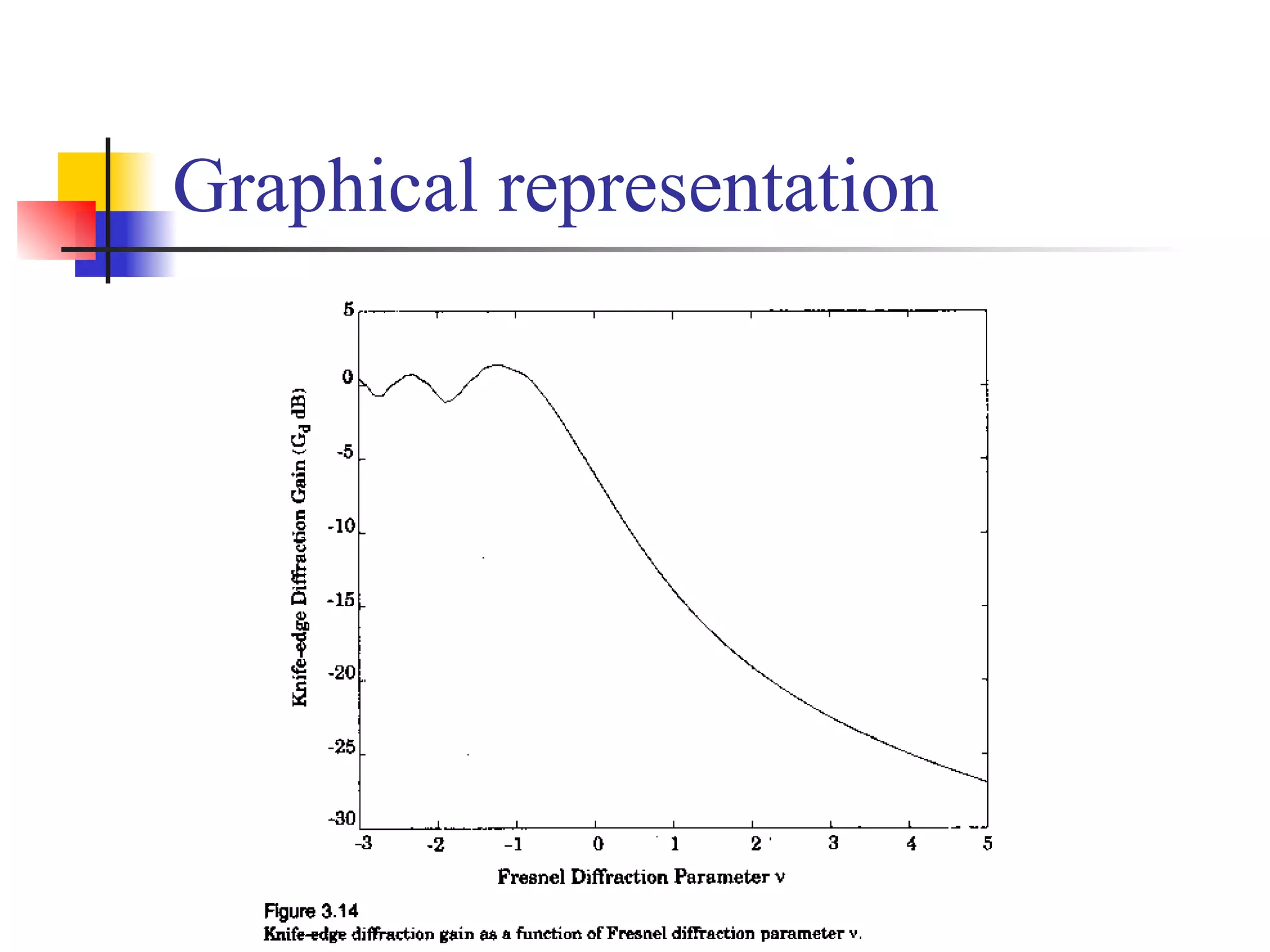
Graphical representation
Lee’s Approximate
Multiple Knife-edge Diffraction In the practical situations, especially in hilly terrain, the propagation path may consist of more than on obstruction. Optimistic solution (by Bullington): The series of obstacles are replaced by a single equivalent obstacle so that the path loss can be obtained using single knife-edge diffraction models.
Note The actual received signal in a mobile radio environment is often stronger than what is predicted by reflection and diffraction Reason: When a radio wave impinges on a rough surface,the reflected energy is spread in all directions due to scattering
Scattering Loss Factor ρ s  = exp[-8(Πσ h sinθ i ) 2 ]I 0 [8(Πσ h cosθ i ) 2 ] where , I 0  is the Bessel function of the first kind and zero order σ h  is the standard deviation of the surface height, h about the mean surface height θ i  is the angle of incidence
Radar cross section model The radar cross section of a  scattering object is defined as the ratio of the power density of the signal scattered  in the direction of the receiver to the power density of the  radio wave incident upon the scattering object, and has units of square meters.   Why do we require this? In radio channels where large, distant objects induce scattering, the physical location of such objects can be used to accurately predict scattered signal strengths.
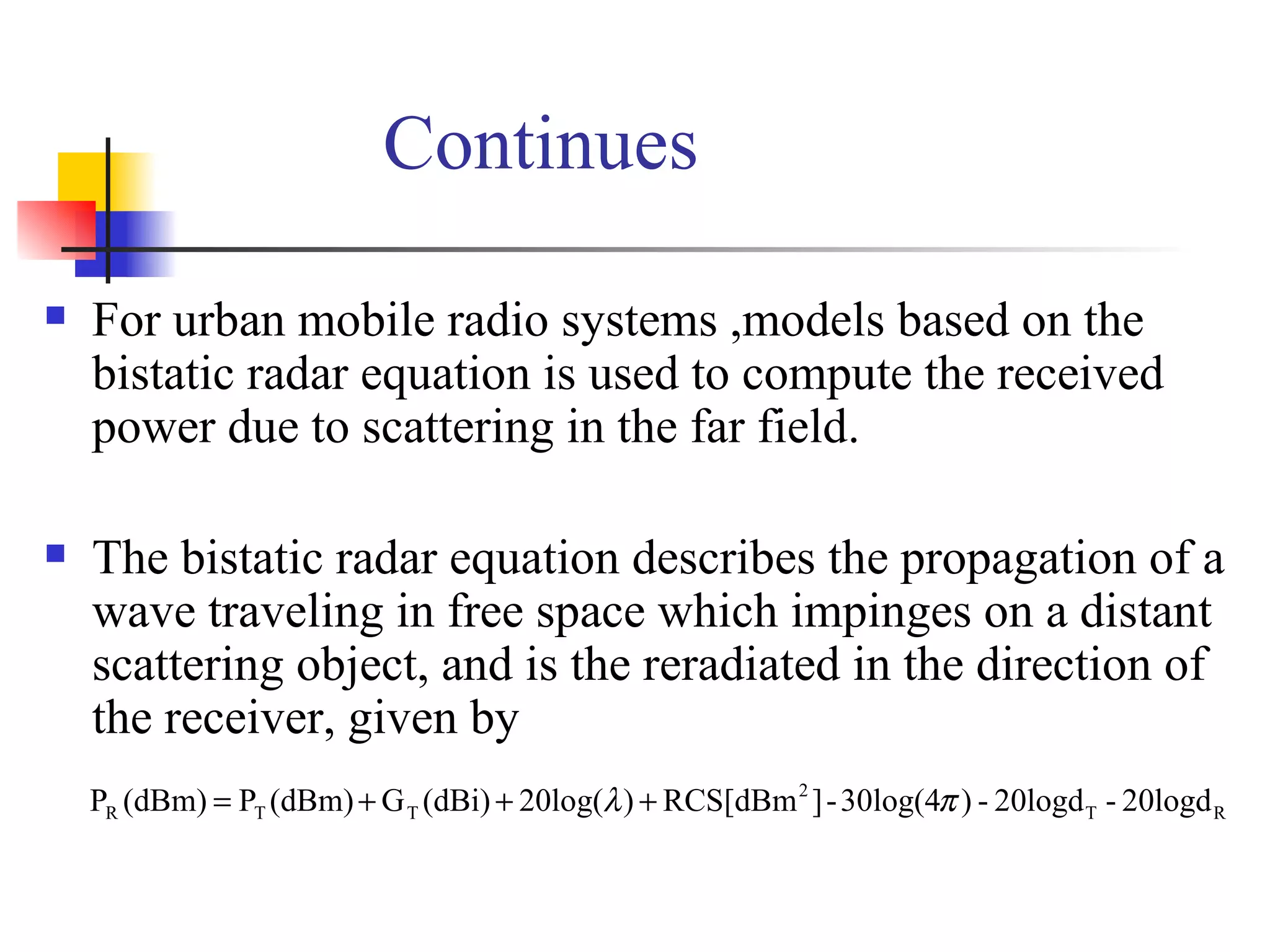
Continues For urban mobile radio systems ,models based on the bistatic radar equation is used to compute the received power due to scattering in the far field. The bistatic radar equation describes the propagation of a wave traveling in free space which impinges on a distant scattering object, and is the reradiated in the direction of the receiver, given by
Continues Where d T  and d R  are the distance from the scattering object to the transmitter and receiver respectively. In the above equation the scattering object is assumed to be in the(far field) Fraunhofer region of both the transmitter and receiver and is useful for predicting receiver power which scatters off large objects such as buildings, which are for both the transmitter and receiver.
3 PROPAGATION MECHANISMS THE END

Propagation mechanisms

  • 1.
  • 2.
    PROPAGATION MECHANISMS Wenext discuss propagation mechanisms (Reflection, Diffraction, and Scattering) because: They have an impact on the wave propagation in a mobile communication system The most important parameter, Received power is predicted by large scale propagation models based on the physics of reflection, diffraction and scattering
  • 3.
    THREE BASIC PROPAGATIONMECHANISMS Reflection : occurs when a signal is transmitted, some of the signal power may be reflected back to its origin rather than being carried all the way. Diffraction :The apparent bending of waves around small obstacles and the spreading out of waves past small openings . Scattering is a general physical process where light, sound, or moving particles, are forced to deviate from a straight trajectory, by one or more localized non-uniformities, in the medium through which they pass.
  • 4.
    Reflection Large buildings,earth surface Diffraction Obstacles with dimensions in order of lambda Scattering Obstacles with size in the order of the wavelength of the signal or less Foliage, lamp posts, street signs, walking pedestrian, etc. Three Basic Propagations
  • 5.
  • 6.
    Reflection When aradio wave propagating in one medium impinges upon another medium having different electrical properties, the wave is partially reflected and partially transmitted Fresnel Reflection Coefficient (Γ) gives the relationship between the electric field intensity of the reflected and transmitted waves to the incident wave in the medium of origin The Reflection Coefficient is a function of the material properties, depending on Wave Polarization (direction of vibration-propagation: orientation) Angle of Incidence Frequency of the propagating wave
  • 7.
    Ground Reflection (2-ray) Model In a mobile radio channel, a single direct path between the base station and mobile is rarely the only physical path for propagation Hence the free space propagation model in most cases is inaccurate when used alone The 2- ray GRM is based on geometric optics It considers both- direct path and ground reflected propagation path between transmitter and receiver This was found reasonably accurate for predicting large scale signal strength over distances of several kilometers for mobile radio systems using tall towers ( heights above 50 m ), and also for L-O-S micro cell channels in urban environments
  • 8.
    Diffraction Phenomena: Radiosignal can propagate around the curved surface of the earth, beyond the horizon and behind obstructions. Although the received field strength decreases rapidly as a receiver moves deeper into the obstructed ( shadowed ) region, the diffraction field still exists and often has sufficient strength to produce a useful signal. The field strength of a diffracted wave in the shadowed region is the vector sum of the electric field components of all the secondary wavelets in the space around the obstacles.
  • 9.
    It is essentialto estimate the signal attenuation caused by diffraction of radio waves over hills and buildings in predicting the field strength in the given service area. In practice, prediction for diffraction loss is a process of theoretical approximation modified by necessary empirical corrections. The simplest case: shadowing is caused by a single object such as a hill or mountain. Knife-edge Diffraction Model
  • 10.
  • 11.
    Parameters Fresnel-Kirchoff diffraction parameter The electric field strength Ed, where E0 is the free space field strength The diffraction gain:
  • 12.
  • 13.
  • 14.
    Multiple Knife-edge DiffractionIn the practical situations, especially in hilly terrain, the propagation path may consist of more than on obstruction. Optimistic solution (by Bullington): The series of obstacles are replaced by a single equivalent obstacle so that the path loss can be obtained using single knife-edge diffraction models.
  • 15.
    Note The actualreceived signal in a mobile radio environment is often stronger than what is predicted by reflection and diffraction Reason: When a radio wave impinges on a rough surface,the reflected energy is spread in all directions due to scattering
  • 16.
    Scattering Loss Factorρ s = exp[-8(Πσ h sinθ i ) 2 ]I 0 [8(Πσ h cosθ i ) 2 ] where , I 0 is the Bessel function of the first kind and zero order σ h is the standard deviation of the surface height, h about the mean surface height θ i is the angle of incidence
  • 17.
    Radar cross sectionmodel The radar cross section of a scattering object is defined as the ratio of the power density of the signal scattered in the direction of the receiver to the power density of the radio wave incident upon the scattering object, and has units of square meters.   Why do we require this? In radio channels where large, distant objects induce scattering, the physical location of such objects can be used to accurately predict scattered signal strengths.
  • 18.
    Continues For urbanmobile radio systems ,models based on the bistatic radar equation is used to compute the received power due to scattering in the far field. The bistatic radar equation describes the propagation of a wave traveling in free space which impinges on a distant scattering object, and is the reradiated in the direction of the receiver, given by
  • 19.
    Continues Where dT and d R are the distance from the scattering object to the transmitter and receiver respectively. In the above equation the scattering object is assumed to be in the(far field) Fraunhofer region of both the transmitter and receiver and is useful for predicting receiver power which scatters off large objects such as buildings, which are for both the transmitter and receiver.
  • 20.