Content
• Introduction
• Needof Project
• Idea of Project
• Aim & Objectives of Project
• Literature Survey
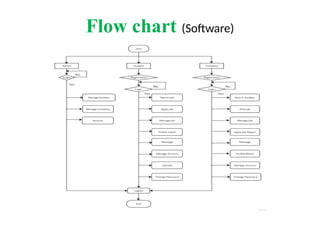
• Flow chart
• Results and Discussions
• Individual & Group Contribution Table
• Advantages
• Disadvantages
• Applications
• Project Plan
• Conclusions
• Future Scope
• References
2.
Introduction
This project helpsstudents and employers connect
for job opportunities using an online system. It makes
hiring easier by allowing job postings, applications,
and tracking in one place.
3.
Need of Project
Itsaves time by automating job postings,
applications, and recruitment events. It also
improves communication between students and
employers and increases job placement chances.
4.
Idea of Project
It’sa website where students can create profiles, apply
for jobs, and track applications. Employers can post
jobs, review student profiles, shortlist candidates, and
communicate with them.
5.
Aim
To make thehiring process in colleges smooth
and simple by providing an easy-to-use platform
for students, employers, and career services.
6.
Objectives of Project
•Make hiring faster and more efficient.
• Provide an easy-to-use website for students and
recruiters.
• Offer tools for managing profiles, job
applications, and recruitment events.
• Help students search for jobs and internships
easily.
7.
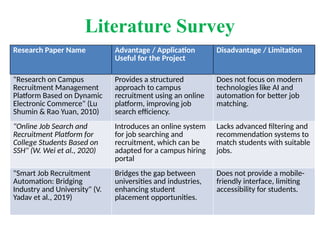
Literature Survey
Research PaperName Advantage / Application
Useful for the Project
Disadvantage / Limitation
"Research on Campus
Recruitment Management
Platform Based on Dynamic
Electronic Commerce" (Lu
Shumin & Rao Yuan, 2010)
Provides a structured
approach to campus
recruitment using an online
platform, improving job
search efficiency.
Does not focus on modern
technologies like AI and
automation for better job
matching.
"Online Job Search and
Recruitment Platform for
College Students Based on
SSH" (W. Wei et al., 2020)
Introduces an online system
for job searching and
recruitment, which can be
adapted for a campus hiring
portal
Lacks advanced filtering and
recommendation systems to
match students with suitable
jobs.
"Smart Job Recruitment
Automation: Bridging
Industry and University" (V.
Yadav et al., 2019)
Bridges the gap between
universities and industries,
enhancing student
placement opportunities.
Does not provide a mobile-
friendly interface, limiting
accessibility for students.
Results and Discussions
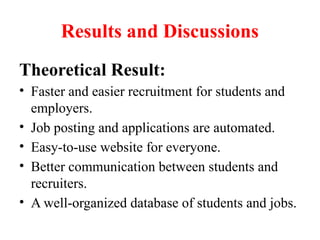
TheoreticalResult:
• Faster and easier recruitment for students and
employers.
• Job posting and applications are automated.
• Easy-to-use website for everyone.
• Better communication between students and
recruiters.
• A well-organized database of students and jobs.
10.
Results and discussions
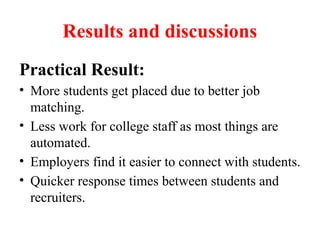
PracticalResult:
• More students get placed due to better job
matching.
• Less work for college staff as most things are
automated.
• Employers find it easier to connect with students.
• Quicker response times between students and
recruiters.
11.
Advantages
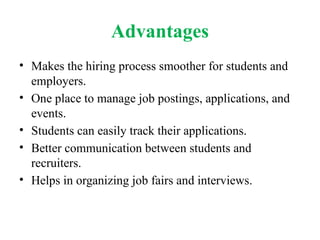
• Makes thehiring process smoother for students and
employers.
• One place to manage job postings, applications, and
events.
• Students can easily track their applications.
• Better communication between students and
recruiters.
• Helps in organizing job fairs and interviews.
12.
Disadvantages
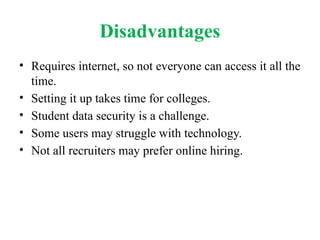
• Requires internet,so not everyone can access it all the
time.
• Setting it up takes time for colleges.
• Student data security is a challenge.
• Some users may struggle with technology.
• Not all recruiters may prefer online hiring.
13.
Applications
• Colleges tohelp students get jobs.
• Organizing recruitment events like job fairs.
• Helping students find internships.
• Career services to monitor student job applications.
14.
Conclusions
The portal makeshiring easier for students,
employers, and colleges by automating job
postings, applications, and event management.
15.
Future Scope
• MobileApp: Creating a mobile version of the portal
for easier access on smartphones.
• AI Job Matching: Using AI to better match students
with suitable job opportunities.
• Resume Builder: Adding a feature that helps students
create professional resumes.
16.
References
• Lu Shuminand Rao Yuan, "Research on Campus Recruitment management platform
based on dynamic electronic commerce," The 2nd International Conference on
Information Science and Engineering, Hangzhou, China, 2010.
• W. Wei, B. Wang, B. Zhang, R. Scherer and R. Damaševičius, "Online Job Search and
Recruitment Platform for College Students Based on SSH," 2020 International
Conference on Intelligent Computing and Human-Computer Interaction (ICHCI), Sanya,
China, 2020.
• V. Yadav, U. Gewali, S. Khatri, S. R. Rauniyar and A. Shakya, "Smart Job Recruitment
Automation: Bridging Industry and University," 2019 Artificial Intelligence for
Transforming Business and Society (AITB), Kathmandu, Nepal, 2019.
• S. Amberkar, S. Chandorkar, M. Dalvi, A. Gawand and M. Cherian, "Survey on Virtual
Recruitment System," 2023 5th Biennial International Conference on Nascent
Technologies in Engineering (ICNTE), Navi Mumbai, India, 2023.
• N. Srivastava, M. Tripathi and V. Rai, "The Development of a Job Portal to Facilitate
Incampus Placement," 2023 5th International Conference on Advances in Computing,
Communication Control and Networking (ICAC3N), Greater Noida, India, 2023.




![Revolutionizing-Job-Search-A-Comprehensive-Job-Portal-Solution[1].pptx](https://cdn.slidesharecdn.com/ss_thumbnails/revolutionizing-job-search-a-comprehensive-job-portal-solution1-241107081449-dda4311a-thumbnail.jpg?width=640&height=640&fit=bounds)


