Introduction-
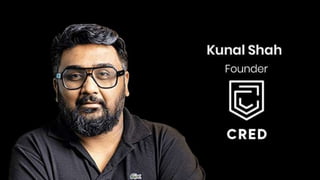
Founder and CEO of Bengaluru based fintech unicorn-CRED.
Born on 20 May 1983 in Mumbai, Maharashtra into a Gujarati family.
Graduated in the year 2000 from Wilson College, Mumbai.
Dropping out-
Then, in 2003, he joined Narsee Monjee Institute of
Management Studies (NMIMS), Mumbai to study part-time
MBA but dropped out after a couple of semesters.
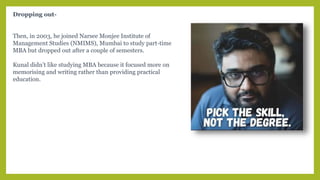
Kunal didn’t like studying MBA because it focused more on
memorising and writing rather than providing practical
education.
Hardships-
His father’s pharmaceutical distribution business wasn’t doing well and as a consequence, they suffered a financial
crisis.
Kunal was 15 at that time and decided to take up a job to pay for his school fees and also lessen the financial
burden on his parents.
He started working as a Data Entry Operator and since then, he became financially independent.
Jugaad-
While in his 12th grade, Kunal got introduced to the internet.
But during that time, the internet was very expensive and so, he decided to teach about the internet in a few
internet institutes so that he can get free access to the internet.
So, Kunal started working part-time in the institutes and in addition to the salary, he was also enjoying the free
internet access.
Later, Kunal quit his Data Entry job and moved full-time to teaching at several internet institutes and there, he
used to surf the internet all night.
Dream to become rich-
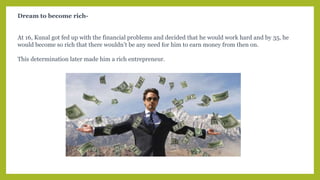
At 16, Kunal got fed up with the financial problems and decided that he would work hard and by 35, he
would become so rich that there wouldn’t be any need for him to earn money from then on.
This determination later made him a rich entrepreneur.
Choosing Philosophy-
After completing his schooling, Kunal wanted to select either engineering or medical but as he was doing a part-
time job, he couldn’t properly focus on his studies and wasn’t able to enter either engineering or medical.
So, he chose to study B.A. in Philosophy.
While studying in his college, Kunal used to sell pirated music CDs and mehandi cones to pay his college fees.
Later, he also operated a small cybercafé from his home and did many other businesses.
Joining startups-
In 2000, Kunal joined a .com startup as a programmer.
Unfortunately, this startup failed so, later he joined another startup, Net4Pharma.
Later, for many years, Kunal worked in many startups.
While working in one of the startups, he met Sandeep Tandon.
Sandeep Tandon was his boss who later partnered with him to start Freecharge.
In 2009, Kunal started the PaisaBack website. This site used to provide cashbacks, coupons, etc. while online
shopping.
PaisaBack later helped him to start Freecharge.
Founding Freecharge-
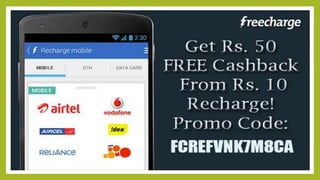
On 15 August 2010, Kunal along with Sandeep Tandon founded Freecharge.
Kunal was inspired by the IRCTC website which attracted people to book tickets online and he thought that
Freecharge would do the same thing to prepaid mobile top ups.
Freecharge started off by offering coupons on recharges and over time, this company became hugely
successful.
Kunal served as the CEO and Chairman of Freecharge and in 2015, it was acquired by Snapdeal for around
$450 million.
Partner, Chairman, Investor & Advisor-
In January 2016, Kunal joined YCombinator as a part-time partner and continued in it until December 2016.
From January 2016 to May 2017, he also served as the Chairman of Internet and Mobile Association of India
(IAMAI).
Since January 2016, Kunal has invested in more than 20 companies like Unacademy, Mobile Premier League
(MPL), Razorpay, TVF, Zilingo, etc.
In January 2017, he joined as an Advisor for Sequoia Capital.
Here, Kunal was offered to become a partner but he rejected and he worked as an Advisor until December
2017.
Since October 2017, he is serving as an Advisor To The Board at The Times Group and since January 2018, he
is serving as an Advisor for AngelList.
Founding CRED-
Even though Kunal worked with many companies, he wasn’t satisfied and wanted to create (start) a new
company of his own.
So, after rejecting the Sequoia Capital offer of becoming a partner, in April 2018, he founded CRED, a fintech
company.
This company is headquartered in Bengaluru, Karnataka.
Awards and recognitions-
• In 2015 and 2016, Kunal was featured in the Fortune India 40 under 40 list.
• In 2016, he was featured in the Economic Times 40 under Forty list and also received the Comeback award
from Economic Times.
Delta 4 theory-
Kunal coined Delta 4 theory and this theory helps in predicting the success of startups.
Whenever the delta of efficiency will be greater than 4, then the business would have high chances of success
and profitability and the business would last for a very long period.
The components of this theory are-
•Irreversibility.
•Unique Bragworthy Proposition (UBP).
•Tolerance.
Irreversibility-
The product or service which offers Delta 4 would be so efficient that people will never think of going to the
other inefficient products or services.
Unique Bragworthy Proposition (UBP)-
A Delta 4 product can become successful even without advertising because the product will be so good that its
customers would brag (do free word-of-mouth marketing) and introduce the product to others.
Tolerance-
As a Delta 4 product will be many times more efficient than the competition, the consumers of a Delta 4 product
will exhibit high tolerance and wouldn’t consider leaving a Delta 4 product for minor impediments.
THANKYOU
Prepared by:
Dimple joshi
Riya patel
Sagar mangnani

cred kunal shah.pptx

  • 2.
    Introduction- Founder and CEOof Bengaluru based fintech unicorn-CRED. Born on 20 May 1983 in Mumbai, Maharashtra into a Gujarati family. Graduated in the year 2000 from Wilson College, Mumbai.
  • 3.
    Dropping out- Then, in2003, he joined Narsee Monjee Institute of Management Studies (NMIMS), Mumbai to study part-time MBA but dropped out after a couple of semesters. Kunal didn’t like studying MBA because it focused more on memorising and writing rather than providing practical education.
  • 4.
    Hardships- His father’s pharmaceuticaldistribution business wasn’t doing well and as a consequence, they suffered a financial crisis. Kunal was 15 at that time and decided to take up a job to pay for his school fees and also lessen the financial burden on his parents. He started working as a Data Entry Operator and since then, he became financially independent.
  • 5.
    Jugaad- While in his12th grade, Kunal got introduced to the internet. But during that time, the internet was very expensive and so, he decided to teach about the internet in a few internet institutes so that he can get free access to the internet. So, Kunal started working part-time in the institutes and in addition to the salary, he was also enjoying the free internet access. Later, Kunal quit his Data Entry job and moved full-time to teaching at several internet institutes and there, he used to surf the internet all night.
  • 6.
    Dream to becomerich- At 16, Kunal got fed up with the financial problems and decided that he would work hard and by 35, he would become so rich that there wouldn’t be any need for him to earn money from then on. This determination later made him a rich entrepreneur.
  • 7.
    Choosing Philosophy- After completinghis schooling, Kunal wanted to select either engineering or medical but as he was doing a part- time job, he couldn’t properly focus on his studies and wasn’t able to enter either engineering or medical. So, he chose to study B.A. in Philosophy. While studying in his college, Kunal used to sell pirated music CDs and mehandi cones to pay his college fees. Later, he also operated a small cybercafé from his home and did many other businesses.
  • 8.
    Joining startups- In 2000,Kunal joined a .com startup as a programmer. Unfortunately, this startup failed so, later he joined another startup, Net4Pharma. Later, for many years, Kunal worked in many startups. While working in one of the startups, he met Sandeep Tandon. Sandeep Tandon was his boss who later partnered with him to start Freecharge. In 2009, Kunal started the PaisaBack website. This site used to provide cashbacks, coupons, etc. while online shopping. PaisaBack later helped him to start Freecharge.
  • 10.
    Founding Freecharge- On 15August 2010, Kunal along with Sandeep Tandon founded Freecharge. Kunal was inspired by the IRCTC website which attracted people to book tickets online and he thought that Freecharge would do the same thing to prepaid mobile top ups. Freecharge started off by offering coupons on recharges and over time, this company became hugely successful. Kunal served as the CEO and Chairman of Freecharge and in 2015, it was acquired by Snapdeal for around $450 million.
  • 11.
    Partner, Chairman, Investor& Advisor- In January 2016, Kunal joined YCombinator as a part-time partner and continued in it until December 2016. From January 2016 to May 2017, he also served as the Chairman of Internet and Mobile Association of India (IAMAI). Since January 2016, Kunal has invested in more than 20 companies like Unacademy, Mobile Premier League (MPL), Razorpay, TVF, Zilingo, etc. In January 2017, he joined as an Advisor for Sequoia Capital. Here, Kunal was offered to become a partner but he rejected and he worked as an Advisor until December 2017. Since October 2017, he is serving as an Advisor To The Board at The Times Group and since January 2018, he is serving as an Advisor for AngelList.
  • 13.
    Founding CRED- Even thoughKunal worked with many companies, he wasn’t satisfied and wanted to create (start) a new company of his own. So, after rejecting the Sequoia Capital offer of becoming a partner, in April 2018, he founded CRED, a fintech company. This company is headquartered in Bengaluru, Karnataka. Awards and recognitions- • In 2015 and 2016, Kunal was featured in the Fortune India 40 under 40 list. • In 2016, he was featured in the Economic Times 40 under Forty list and also received the Comeback award from Economic Times.
  • 14.
    Delta 4 theory- Kunalcoined Delta 4 theory and this theory helps in predicting the success of startups. Whenever the delta of efficiency will be greater than 4, then the business would have high chances of success and profitability and the business would last for a very long period. The components of this theory are- •Irreversibility. •Unique Bragworthy Proposition (UBP). •Tolerance.
  • 15.
    Irreversibility- The product orservice which offers Delta 4 would be so efficient that people will never think of going to the other inefficient products or services. Unique Bragworthy Proposition (UBP)- A Delta 4 product can become successful even without advertising because the product will be so good that its customers would brag (do free word-of-mouth marketing) and introduce the product to others. Tolerance- As a Delta 4 product will be many times more efficient than the competition, the consumers of a Delta 4 product will exhibit high tolerance and wouldn’t consider leaving a Delta 4 product for minor impediments.
  • 16.