CRAs:  Community Working 
                Together
Agenda
What is redevelopment and what are  
Community Redevelopment Agencies 
(CRAs)
How can you be an effective leader?
What are the “Rules of Engagement”?
What are the Best Practices?
What is legal?
Why do they work or not work?
Top Ten Reasons to Rebuild
Economic Development
Business retention
Crime Prevention 
Streetscapes
Housing
Historic Preservation
Clean and Safe Places To Be
Storm water Management 
Parks and Recreation  
Sustainable Reuse and Urban Infill
Relative to your CRA, any activity authorized 
under Ch 163, Part III, Florida Statutes

Revolves around a publicly customized plan, 
funded by the increase in assessed values over 
time, called increment.
What Redevelopment is Not
Anything spent outside the plan or the area
Eminent domain for redevelopment purposes
General government line items
Grants or donations to non‐profits or events that have 
nothing to do with the redevelopment plan
Salaries for city or county staff that do not work on 
CRA activities
Operations
Maintenance normally done by city or county
Comprehensive planning, zoning or land use
Redevelopment as a Contact Sport
Chapter 163, Part III encourages government to invest 
public funds with private enterprise to ultimately bring an 
area back to life

Diverse groups have differing ideas on how to use the 
money

The money is locally generated, by cities and counties, can 
be political football

People do not understand the how and when of the 
process

Lack of leadership, vision and buy in
“What is the sound bite?”
As with most municipal issues, our message is  
complex and could lead to misunderstandings by 
citizens who don’t hear the rest of the story.  Try 
saying this:  “for a limited period of time, CRAs 
eradicate slum and blight, to sustain an improved 
quality of life…all ships rise w the tide; the plan is 
developed by the community and is tailored to their 
needs and desires;  for our community’s future”….and 
the word TAX is in the glossary of terms!
Redevelopment is Good
A wise investment, especially in tough economic 
times, in the future of an area
Breathes new life into areas in need revitalization 
Consistency and predictability for private sector
Designed, created and funded locally
Every $ of public leverages for $$$$$$$$$$$$$$ private
Fully transparent public process to develop a 
common vision for sustainable viability
Powers of a CRA
        (highly recommended reading)
163.358  Exercise of powers in carrying out community 
redevelopment and related activities.
163.370  Powers; counties and municipalities; 
community redevelopment agencies.
163.410  Exercise of powers in counties with home rule 
charters.
163.415  Exercise of powers in counties without home 
rule charters.
163.400  Cooperation by public bodies.
How to be a CRA Leader and Teacher
Do your homework (call the FRA)
Adopt a shared vision and work for it
Explain WHAT, WHY, WHEN, WHERE, HOW as 
many times as necessary
Talk with other leaders 
Seek out comment from citizens, businesses
Work for consensus, not credit
Do cost benefit analysis at each phase
Get out of the way  – steer don’t row
To Do Visioning, or Not?
No one right way to build consensus 
You can over think it
Key indicators of when to stop don’t go
Key indicators of when to go don’t stop
Measuring success
Measuring progress
Measuring support
Things to Know
What is the history of your CRA? 
What has been accomplished?
What are the current projects?
How much money is in the trust fund?
How much does the county v. city contribute?
How much longer has the CRA to operate?
Review the plan, yes the whole thing, keep a copy 
When was the last time the plan was amended?
What programs does the CRA offer?
Review:  How is a CRA Created? All Local 
Notices and Public Meetings
Finding of Necessity and “blight by statute,
not Mr. Webster”
Establish Board 
Create Trust Fund
Adopt Redevelopment Plan
No state approval required, but plenty of reporting
What is a CRA?  
         Agency or Area…Yes 

BD Members appointed by local government 
Dependent Special District
Elected and or appointed people 
May have multiple CRA districts
Law generally says only one CRA Board 
The Plan as a Blueprint
Board implements, (not sets), policy per City/Co
Addresses unique customized needs
A publically drafted master plan
Sets goals, specifies priorities 
Roadmap for private sector
Ensures focused investment 
Living document can be amended w/o limit 
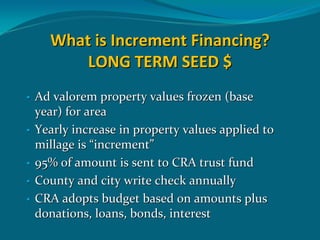
What is Increment Financing?  
      LONG TERM SEED $
Ad valorem property values frozen (base 
year) for area
Yearly increase in property values applied to 
millage is “increment”
95% of amount is sent to CRA trust fund
County and city write check annually
CRA adopts budget based on amounts plus 
donations, loans, bonds, interest  
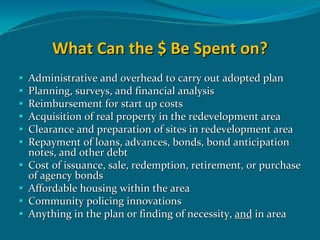
What Can the $ Be Spent on?
Administrative and overhead to carry out adopted plan 
Planning, surveys, and financial analysis
Reimbursement for start up costs
Acquisition of real property in the redevelopment area
Clearance and preparation of sites in redevelopment area   
Repayment of loans, advances, bonds, bond anticipation 
notes, and other debt
Cost of issuance, sale, redemption, retirement, or purchase 
of agency bonds
Affordable housing within the area
Community policing innovations
Anything in the plan or finding of necessity, and in area
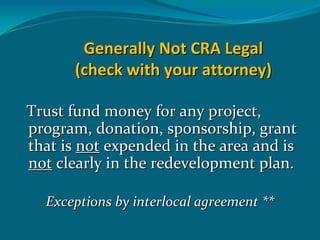
Generally Not CRA Legal 
       (check with your attorney)

Trust fund money for any project, 
program, donation, sponsorship, grant 
that is not expended in the area and is 
not clearly in the redevelopment plan.

  Exceptions by interlocal agreement **
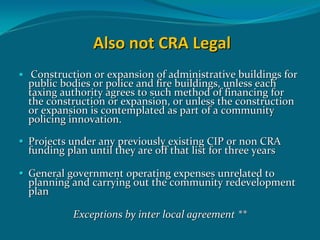
Also not CRA Legal 
 Construction or expansion of administrative buildings for 
public bodies or police and fire buildings, unless each 
taxing authority agrees to such method of financing for 
the construction or expansion, or unless the construction 
or expansion is contemplated as part of a community 
policing innovation.

Projects under any previously existing CIP or non CRA 
funding plan until they are off that list for three years 

General government operating expenses unrelated to 
planning and carrying out the community redevelopment 
plan

          Exceptions by inter local agreement **
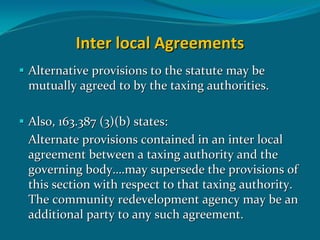
Inter local Agreements
Alternative provisions to the statute may be 
mutually agreed to by the taxing authorities. 

Also, 163.387 (3)(b) states:
Alternate provisions contained in an inter local 
agreement between a taxing authority and the 
governing body….may supersede the provisions of 
this section with respect to that taxing authority. 
The community redevelopment agency may be an 
additional party to any such agreement.
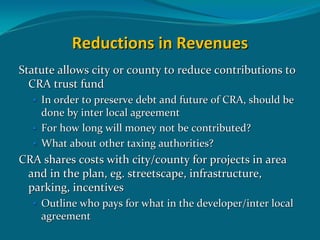
Reductions in Revenues
Statute allows city or county to reduce contributions to 
  CRA trust fund
    In order to preserve debt and future of CRA, should be 
    done by inter local agreement
    For how long will money not be contributed?
    What about other taxing authorities?
CRA shares costs with city/county for projects in area 
 and in the plan, eg. streetscape, infrastructure, 
 parking, incentives
    Outline who pays for what in the developer/inter local 
    agreement
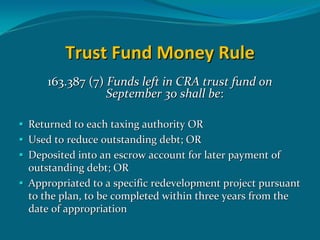
Trust Fund Money Rule
    163.387 (7) Funds left in CRA trust fund on 
                September 30 shall be:

Returned to each taxing authority OR
Used to reduce outstanding debt; OR
Deposited into an escrow account for later payment of 
outstanding debt; OR 
Appropriated to a specific redevelopment project pursuant 
to the plan, to be completed within three years from the 
date of appropriation
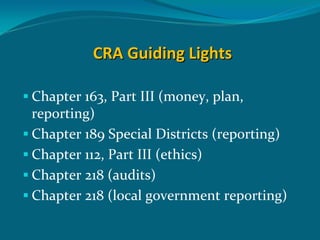
CRA Guiding Lights

Chapter 163, Part III (money, plan, 
reporting)
Chapter 189 Special Districts (reporting)  
Chapter 112, Part III (ethics)  
Chapter 218 (audits)
Chapter 218 (local government reporting)
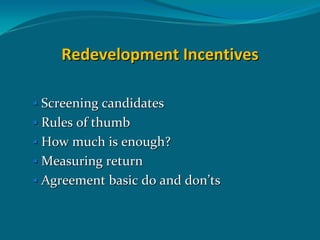
Redevelopment Incentives

Screening candidates
Rules of thumb
How much is enough?
Measuring return
Agreement basic do and don’ts
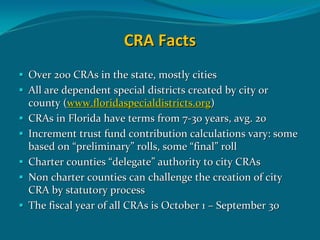
CRA Facts
Over 200 CRAs in the state, mostly cities
All are dependent special districts created by city or 
county (www.floridaspecialdistricts.org)
CRAs in Florida have terms from 7‐30 years, avg. 20
Increment trust fund contribution calculations vary: some 
based on “preliminary” rolls, some “final” roll
Charter counties “delegate” authority to city CRAs
Non charter counties can challenge the creation of city 
CRA by statutory process
The fiscal year of all CRAs is October 1 – September 30
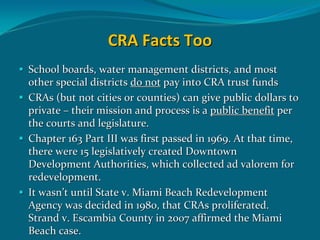
CRA Facts Too
School boards, water management districts, and most 
other special districts do not pay into CRA trust funds 
CRAs (but not cities or counties) can give public dollars to 
private – their mission and process is a public benefit per 
the courts and legislature. 
Chapter 163 Part III was first passed in 1969. At that time, 
there were 15 legislatively created Downtown 
Development Authorities, which collected ad valorem for 
redevelopment.   
It wasn’t until State v. Miami Beach Redevelopment 
Agency was decided in 1980, that CRAs proliferated.  
Strand v. Escambia County in 2007 affirmed the Miami 
Beach case.
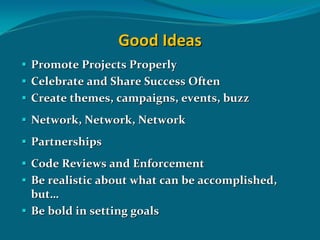
Good Ideas
Promote Projects Properly
Celebrate and Share Success Often
Create themes, campaigns, events, buzz 
Network, Network, Network
Partnerships
Code Reviews and Enforcement
Be realistic about what can be accomplished, 
but…
Be bold in setting goals 
Step Back & Agree  

Redevelopment benefits everyone’s taxpayers
Long process, patience is a virtue worth having
Planning, formal agreements, communication 
and consensus are critical
Each area is unique so make it yours, establish an 
identity
Be a champion for a shared vision 
Amending a Plan
Update plan every 5 yrs / re‐set  goals
Must be consistent with the comprehensive plan (but 
not a required element)
Process similar to creation of CRA
Proposed by the CRA Board, sent to local planning 
agency, to governing body, notices, public hearing, 
governing body, then charter county approves
Options
  Expand or contract boundaries
  Extend term of CRA
  General updates, additions, edits
Best Practices
Establish goals, tasks, track progress
Analyze  and study the market 
Apply for grants
Do your research
Understand the profit motive
Monitor contracts with public eye
Over communicate on expectations
Use your legal counsel ‐ pay now or pay more 
later
Best Practices Too
Always separate CRA v. Commission meetings 
Public notice requirements same as local govt.
Complete all appropriate reports
Joint procedures for CRA and city, eg. personnel
Separate insurance (errors/ommissions, liability)
Adopt by‐laws   
Mission, goals, objectives – keep copy handy
Annual strategic planning workshop (two hours)
Information and samples from FRA 
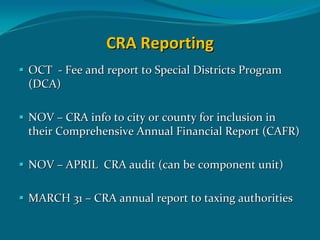
CRA Reporting  
OCT  ‐ Fee and report to Special Districts Program 
(DCA)

NOV – CRA info to city or county for inclusion in 
their Comprehensive Annual Financial Report (CAFR)

NOV – APRIL  CRA audit (can be component unit)

MARCH 31 – CRA annual report to taxing authorities
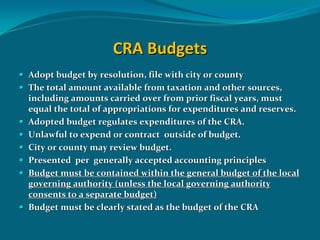
CRA Budgets
Adopt budget by resolution, file with city or county
The total amount available from taxation and other sources, 
including amounts carried over from prior fiscal years, must 
equal the total of appropriations for expenditures and reserves.
Adopted budget regulates expenditures of the CRA.
Unlawful to expend or contract  outside of budget.
City or county may review budget.
Presented  per  generally accepted accounting principles
Budget must be contained within the general budget of the local 
governing authority (unless the local governing authority 
consents to a separate budget)
Budget must be clearly stated as the budget of the CRA
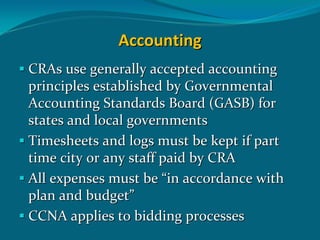
Accounting
CRAs use generally accepted accounting 
principles established by Governmental 
Accounting Standards Board (GASB) for 
states and local governments
Timesheets and logs must be kept if part 
time city or any staff paid by CRA
All expenses must be “in accordance with 
plan and budget”
CCNA applies to bidding processes 
Why Do CRAs Succeed? 

Leadership 
Power used for working the partnerships
Vision  
Guts, passion, sticking with it, wisdom, patience
Community support and trust
PARTNERSHIPS 
Empowering citizens with sweat equity 
FRA Can Help
Legislative  
Technical Assistance 
Legal Opinions  
Web, Face book, Twitter, YouTube
Professional Development and Training
Brownfields and Grant Funding
Certification Program
News Clips
The Future 
Inter local agreements will be used more to 
outline who pays for what, when, how and why 
Cooperative instead of competitive approach to 
governing
Dialogue, not monologue
Strong legislative defense ‐ any changes to the 
redevelopment act should empower, not limit.
Florida Chapter  of the American Planning Association
www.floridaplanning.org

Florida Brownfields Association  www.fba.org

Florida League of Cities  www.flcities.com

Florida Association of Counties  www.flcounties.com

Urban Land Institute  www.uli.org

International Council of Shopping Centers
www.icsc.org
Florida Redevelopment 
        Association
850.701.3608
www.redevelopment.net

Carol Westmoreland, Executive Director
cwestmoreland@flcities.com
Jan Piland, Executive Assistant
jpiland@flcities.com

CRA's Communities Working Together