1
C++ Testing: Techniques, Tips and Tricks
Clare Macrae (She/her)
clare@claremacrae.co.uk
25 February 2020
Cpp Europe
2
About Me
• C++ and Qt developer since 1999
• My mission: Sustainable and efficient testing and refactoring of legacy code
– Co-author of “Approval Tests for C++”
• Consulting & training
– https://claremacrae.co.uk
• All links from this talk via:
– github.com/claremacrae/talks
3
Why?
• Share things I wish I knew earlier
– Some well known
– Some less so…
• High-level overview, with links
– Avoiding detail
• Anything unclear?
– Please ask!
4
Assumptions
• Value of testing – safety net!
• No worries about types of tests
– (unit, integration, regression)
5
Foundations
6
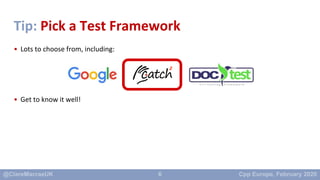
Tip: Pick a Test Framework
• Lots to choose from, including:
• Get to know it well!
7
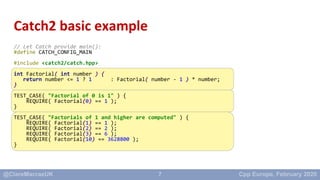
Catch2 basic example
// Let Catch provide main():
#define CATCH_CONFIG_MAIN
#include <catch2/catch.hpp>
int Factorial( int number ) {
return number <= 1 ? 1 : Factorial( number - 1 ) * number;
}
TEST_CASE( "Factorial of 0 is 1" ) {
REQUIRE( Factorial(0) == 1 );
}
TEST_CASE( "Factorials of 1 and higher are computed" ) {
REQUIRE( Factorial(1) == 1 );
REQUIRE( Factorial(2) == 2 );
REQUIRE( Factorial(3) == 6 );
REQUIRE( Factorial(10) == 3628800 );
}
8
But what about
Real World Code?
9
Rarely that simple!
• Long methods
• Interdependent code
• Tests hard to set up
• Not designed to be testable
10
Tip: Take any reasonable measure!
• … to get code tested!
• Don’t get hung up on perfect code…
• What does that mean?
11
Tip: Take any reasonable measure!
• When you are stuck, write the test you want
• Then safely do whatever you need to your implementation – temporarily!
– Make method static to call from outside?
– Add getters – and maybe even setters?
– Public data?
• Hold your nose!
• Then refactor
12
Prioritise Testable code
Over Perfect code
13
How do I test private code?
Don’t!
14
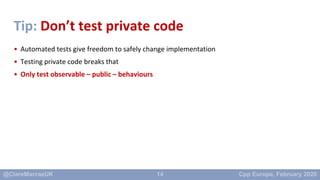
Tip: Don’t test private code
• Automated tests give freedom to safely change implementation
• Testing private code breaks that
• Only test observable – public – behaviours
15
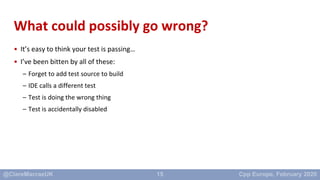
What could possibly go wrong?
• It’s easy to think your test is passing…
• I’ve been bitten by all of these:
– Forget to add test source to build
– IDE calls a different test
– Test is doing the wrong thing
– Test is accidentally disabled
16
Never trust a test until
you have seen it fail!
17
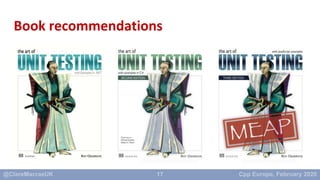
Book recommendations
18
Summary: Foundations
• Use a test framework – get to know it well
• Take any reasonable measure to add tests
– Then improve it
• Test public behaviour – not private implementation
• Testable code over perfect code
• Never trust a test until you have seen it fail
19
Private code revisited
20
How do I test private code?
Don’t!
21
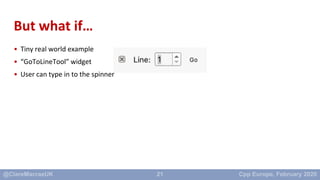
But what if…
• Tiny real world example
• “GoToLineTool” widget
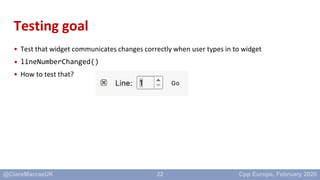
• User can type in to the spinner
22
Testing goal
• Test that widget communicates changes correctly when user types in to widget
• lineNumberChanged()
• How to test that?
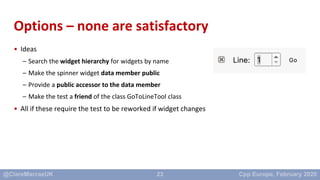
23
Options – none are satisfactory
• Ideas
– Search the widget hierarchy for widgets by name
– Make the spinner widget data member public
– Provide a public accessor to the data member
– Make the test a friend of the class GoToLineTool class
• All if these require the test to be reworked if widget changes
24
Goal: Make tests super easy to write
• And super easy to maintain…
• Test code accessing widgets directly makes that hard
25
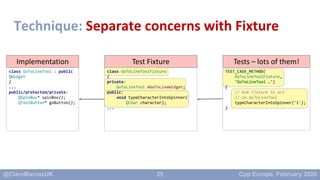
Technique: Separate concerns with Fixture
class GoToLineTool : public
QWidget
{
...
public/protected/private:
QSpinBox* spinBox();
QToolButton* goButton();
Implementation Tests – lots of them!Test Fixture
class GoToLineToolFixture
{
private:
GoToLineTool mGoToLineWidget;
public:
void typeCharacterIntoSpinner(
QChar character);
...
TEST_CASE_METHOD(
GoToLineToolFixture,
"GoToLineTool …")
{
// Ask Fixture to act
// on GoToLineTool
typeCharacterIntoSpinner('1');
}
26
Summary: Fixtures
• Test Fixtures can make tests of complex code expressive
• And Maintainable
27
Inheriting Legacy/Existing Code
28
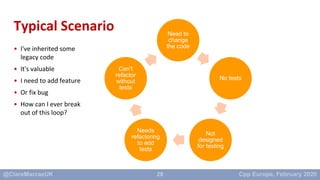
Typical Scenario
• I've inherited some
legacy code
• It's valuable
• I need to add feature
• Or fix bug
• How can I ever break
out of this loop?
Need to
change
the code
No tests
Not
designed
for testing
Needs
refactoring
to add
tests
Can’t
refactor
without
tests
29
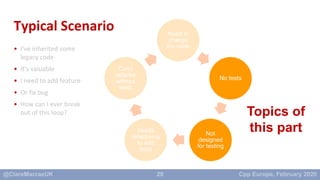
Typical Scenario
•
•
•
•
•
Need to
change
the code
No tests
Not
designed
for testing
Needs
refactoring
to add
tests
Can’t
refactor
without
tests
Topics of
this part
30
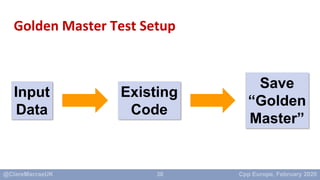
Golden Master Test Setup
Input
Data
Existing
Code
Save
“Golden
Master”
31
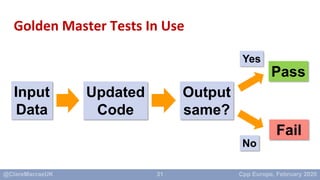
Golden Master Tests In Use
Input
Data
Updated
Code
Pass
Fail
Output
same?
Yes
No
32
Approval Tests
TEST_CASE( "Factorials up to 10" )
{
// Create a container with values 0 ... 10 inclusive
std::vector<int> inputs(11);
std::iota(inputs.begin(), inputs.end(), 0);
// Act on all values in inputs container:
Approvals::verifyAll("Factorial", inputs,
[](auto i, auto& os)
{
os << i << "! => " << Factorial(i);
});
}
33
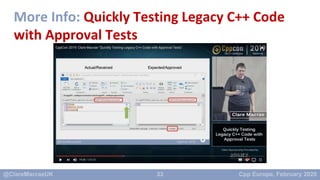
More Info: Quickly Testing Legacy C++ Code
with Approval Tests
34
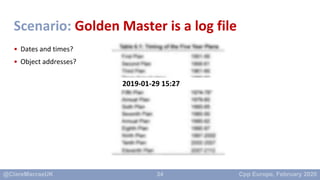
Scenario: Golden Master is a log file
• Dates and times?
• Object addresses?
2019-01-29 15:27
35
Options for unstable output
• Introduce date-time abstraction?
• Customised comparison function?
• Or: strip dates from the log file
– Credit: Llewellyn Falco
36
Tip: Rewrite output file, before testing it
2019-01-29 15:27 [date-time-stamp]
37
Summary: Legacy Code
• Approval Tests
• Be creative to make your tests work for you!
• After adding tests, start refactoring for maintainability
38
Testing Qt User Interfaces
39
40
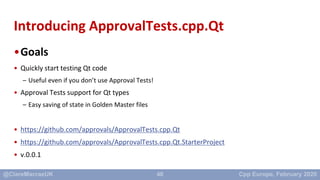
Introducing ApprovalTests.cpp.Qt
•Goals
• Quickly start testing Qt code
– Useful even if you don’t use Approval Tests!
• Approval Tests support for Qt types
– Easy saving of state in Golden Master files
• https://github.com/approvals/ApprovalTests.cpp.Qt
• https://github.com/approvals/ApprovalTests.cpp.Qt.StarterProject
• v.0.0.1
41
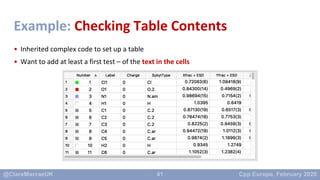
Example: Checking Table Contents
• Inherited complex code to set up a table
• Want to add at least a first test – of the text in the cells
42
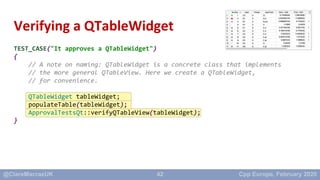
Verifying a QTableWidget
TEST_CASE("It approves a QTableWidget")
{
// A note on naming: QTableWidget is a concrete class that implements
// the more general QTableView. Here we create a QTableWidget,
// for convenience.
QTableWidget tableWidget;
populateTable(tableWidget);
ApprovalTestsQt::verifyQTableView(tableWidget);
}
43
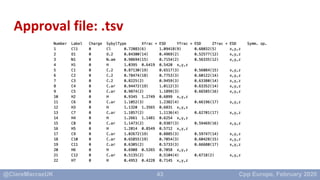
Approval file: .tsv
44
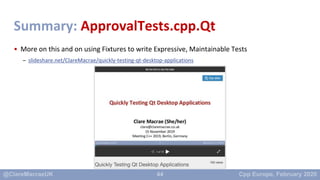
Summary: ApprovalTests.cpp.Qt
• More on this and on using Fixtures to write Expressive, Maintainable Tests
– slideshare.net/ClareMacrae/quickly-testing-qt-desktop-applications
45
Maintaining Tests
46
Scenario: Tests too slow for CI
• “Builds take 2 to 3 days!” => No hope of Continuous Integration
• Most of that was running tests
• No prospect of speeding up some very slow tests
47
Solution: Don’t run slow tests during day
• Mark some tests as Slow
– Filtering built in to Google Test Framework
• Teach CI system to run sub-set of tests
– Only run the Slow tests at night
– Everything else run on every commit
• Thanks to Michael Platings for making this happen!
48
Tip: Never tolerate Flickering tests
• Tests that fail randomly
• Rapidly devalue other tests
• Fix them, or delete them!
• Especially don’t mix performance tests with unit tests
49
Summary: Maintaining Tests
• Fast feedback from Continuous Integration
• Stomp on flickering tests
50
Summary
• It’s never too late to start testing!
– Pick a framework and practice it
– Explore different types of testing
• You can test legacy code too!
• Keep maintaining your tests
• Even GUIs can be tested
51
C++ Testing: Techniques, Tips and Tricks
• All links from this talk, and more, via:
– bit.ly/CppTestingTips
– github.com/claremacrae/talks
• Sustainable and efficient testing and refactoring of legacy code
• Consulting & Training
– https://claremacrae.co.uk
– clare@claremacrae.co.uk
• Any Questions?
• Any More Tips?

Cpp Testing Techniques Tips and Tricks - Cpp Europe

  • 1.
    1 C++ Testing: Techniques,Tips and Tricks Clare Macrae (She/her) clare@claremacrae.co.uk 25 February 2020 Cpp Europe
  • 2.
    2 About Me • C++and Qt developer since 1999 • My mission: Sustainable and efficient testing and refactoring of legacy code – Co-author of “Approval Tests for C++” • Consulting & training – https://claremacrae.co.uk • All links from this talk via: – github.com/claremacrae/talks
  • 3.
    3 Why? • Share thingsI wish I knew earlier – Some well known – Some less so… • High-level overview, with links – Avoiding detail • Anything unclear? – Please ask!
  • 4.
    4 Assumptions • Value oftesting – safety net! • No worries about types of tests – (unit, integration, regression)
  • 5.
  • 6.
    6 Tip: Pick aTest Framework • Lots to choose from, including: • Get to know it well!
  • 7.
    7 Catch2 basic example //Let Catch provide main(): #define CATCH_CONFIG_MAIN #include <catch2/catch.hpp> int Factorial( int number ) { return number <= 1 ? 1 : Factorial( number - 1 ) * number; } TEST_CASE( "Factorial of 0 is 1" ) { REQUIRE( Factorial(0) == 1 ); } TEST_CASE( "Factorials of 1 and higher are computed" ) { REQUIRE( Factorial(1) == 1 ); REQUIRE( Factorial(2) == 2 ); REQUIRE( Factorial(3) == 6 ); REQUIRE( Factorial(10) == 3628800 ); }
  • 8.
  • 9.
    9 Rarely that simple! •Long methods • Interdependent code • Tests hard to set up • Not designed to be testable
  • 10.
    10 Tip: Take anyreasonable measure! • … to get code tested! • Don’t get hung up on perfect code… • What does that mean?
  • 11.
    11 Tip: Take anyreasonable measure! • When you are stuck, write the test you want • Then safely do whatever you need to your implementation – temporarily! – Make method static to call from outside? – Add getters – and maybe even setters? – Public data? • Hold your nose! • Then refactor
  • 12.
  • 13.
    13 How do Itest private code? Don’t!
  • 14.
    14 Tip: Don’t testprivate code • Automated tests give freedom to safely change implementation • Testing private code breaks that • Only test observable – public – behaviours
  • 15.
    15 What could possiblygo wrong? • It’s easy to think your test is passing… • I’ve been bitten by all of these: – Forget to add test source to build – IDE calls a different test – Test is doing the wrong thing – Test is accidentally disabled
  • 16.
    16 Never trust atest until you have seen it fail!
  • 17.
  • 18.
    18 Summary: Foundations • Usea test framework – get to know it well • Take any reasonable measure to add tests – Then improve it • Test public behaviour – not private implementation • Testable code over perfect code • Never trust a test until you have seen it fail
  • 19.
  • 20.
    20 How do Itest private code? Don’t!
  • 21.
    21 But what if… •Tiny real world example • “GoToLineTool” widget • User can type in to the spinner
  • 22.
    22 Testing goal • Testthat widget communicates changes correctly when user types in to widget • lineNumberChanged() • How to test that?
  • 23.
    23 Options – noneare satisfactory • Ideas – Search the widget hierarchy for widgets by name – Make the spinner widget data member public – Provide a public accessor to the data member – Make the test a friend of the class GoToLineTool class • All if these require the test to be reworked if widget changes
  • 24.
    24 Goal: Make testssuper easy to write • And super easy to maintain… • Test code accessing widgets directly makes that hard
  • 25.
    25 Technique: Separate concernswith Fixture class GoToLineTool : public QWidget { ... public/protected/private: QSpinBox* spinBox(); QToolButton* goButton(); Implementation Tests – lots of them!Test Fixture class GoToLineToolFixture { private: GoToLineTool mGoToLineWidget; public: void typeCharacterIntoSpinner( QChar character); ... TEST_CASE_METHOD( GoToLineToolFixture, "GoToLineTool …") { // Ask Fixture to act // on GoToLineTool typeCharacterIntoSpinner('1'); }
  • 26.
    26 Summary: Fixtures • TestFixtures can make tests of complex code expressive • And Maintainable
  • 27.
  • 28.
    28 Typical Scenario • I'veinherited some legacy code • It's valuable • I need to add feature • Or fix bug • How can I ever break out of this loop? Need to change the code No tests Not designed for testing Needs refactoring to add tests Can’t refactor without tests
  • 29.
    29 Typical Scenario • • • • • Need to change thecode No tests Not designed for testing Needs refactoring to add tests Can’t refactor without tests Topics of this part
  • 30.
    30 Golden Master TestSetup Input Data Existing Code Save “Golden Master”
  • 31.
    31 Golden Master TestsIn Use Input Data Updated Code Pass Fail Output same? Yes No
  • 32.
    32 Approval Tests TEST_CASE( "Factorialsup to 10" ) { // Create a container with values 0 ... 10 inclusive std::vector<int> inputs(11); std::iota(inputs.begin(), inputs.end(), 0); // Act on all values in inputs container: Approvals::verifyAll("Factorial", inputs, [](auto i, auto& os) { os << i << "! => " << Factorial(i); }); }
  • 33.
    33 More Info: QuicklyTesting Legacy C++ Code with Approval Tests
  • 34.
    34 Scenario: Golden Masteris a log file • Dates and times? • Object addresses? 2019-01-29 15:27
  • 35.
    35 Options for unstableoutput • Introduce date-time abstraction? • Customised comparison function? • Or: strip dates from the log file – Credit: Llewellyn Falco
  • 36.
    36 Tip: Rewrite outputfile, before testing it 2019-01-29 15:27 [date-time-stamp]
  • 37.
    37 Summary: Legacy Code •Approval Tests • Be creative to make your tests work for you! • After adding tests, start refactoring for maintainability
  • 38.
  • 39.
  • 40.
    40 Introducing ApprovalTests.cpp.Qt •Goals • Quicklystart testing Qt code – Useful even if you don’t use Approval Tests! • Approval Tests support for Qt types – Easy saving of state in Golden Master files • https://github.com/approvals/ApprovalTests.cpp.Qt • https://github.com/approvals/ApprovalTests.cpp.Qt.StarterProject • v.0.0.1
  • 41.
    41 Example: Checking TableContents • Inherited complex code to set up a table • Want to add at least a first test – of the text in the cells
  • 42.
    42 Verifying a QTableWidget TEST_CASE("Itapproves a QTableWidget") { // A note on naming: QTableWidget is a concrete class that implements // the more general QTableView. Here we create a QTableWidget, // for convenience. QTableWidget tableWidget; populateTable(tableWidget); ApprovalTestsQt::verifyQTableView(tableWidget); }
  • 43.
  • 44.
    44 Summary: ApprovalTests.cpp.Qt • Moreon this and on using Fixtures to write Expressive, Maintainable Tests – slideshare.net/ClareMacrae/quickly-testing-qt-desktop-applications
  • 45.
  • 46.
    46 Scenario: Tests tooslow for CI • “Builds take 2 to 3 days!” => No hope of Continuous Integration • Most of that was running tests • No prospect of speeding up some very slow tests
  • 47.
    47 Solution: Don’t runslow tests during day • Mark some tests as Slow – Filtering built in to Google Test Framework • Teach CI system to run sub-set of tests – Only run the Slow tests at night – Everything else run on every commit • Thanks to Michael Platings for making this happen!
  • 48.
    48 Tip: Never tolerateFlickering tests • Tests that fail randomly • Rapidly devalue other tests • Fix them, or delete them! • Especially don’t mix performance tests with unit tests
  • 49.
    49 Summary: Maintaining Tests •Fast feedback from Continuous Integration • Stomp on flickering tests
  • 50.
    50 Summary • It’s nevertoo late to start testing! – Pick a framework and practice it – Explore different types of testing • You can test legacy code too! • Keep maintaining your tests • Even GUIs can be tested
  • 51.
    51 C++ Testing: Techniques,Tips and Tricks • All links from this talk, and more, via: – bit.ly/CppTestingTips – github.com/claremacrae/talks • Sustainable and efficient testing and refactoring of legacy code • Consulting & Training – https://claremacrae.co.uk – clare@claremacrae.co.uk • Any Questions? • Any More Tips?

Editor's Notes

  • #9 Harder than testing non-Graphical User Interface code But it’s still a learnable skill
  • #13 Harder than testing non-Graphical User Interface code But it’s still a learnable skill
  • #14 Harder than testing non-Graphical User Interface code But it’s still a learnable skill
  • #17 Harder than testing non-Graphical User Interface code But it’s still a learnable skill
  • #21 Harder than testing non-Graphical User Interface code But it’s still a learnable skill
  • #26 Note the dependency order
  • #31 Another phrase for the Golden Master output is “Known Good” output.
  • #52 A lot of this stuff you can get going on your own. If you get stuck, I can help you!