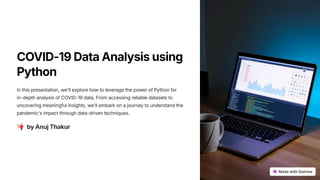
COVID-19 DataAnalysisusing
Python
In this presentation, we'll explore how to leverage the power of Python for
in-depth analysis of COVID-19 data. From accessing reliable datasets to
uncovering meaningful insights, we'll embark on a journey to understand the
pandemic's impact through data-driven techniques.
byAnujThakur
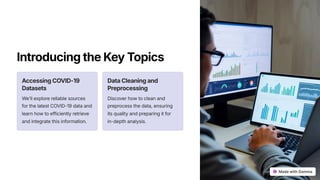
Introducing the Key Topics
AccessingCOVID-19
Datasets
We'll explore reliable sources
for the latest COVID-19 data and
learn how to efficiently retrieve
and integrate this information.
DataCleaningand
Preprocessing
Discover how to clean and
preprocess the data, ensuring
its quality and preparing it for
in-depth analysis.
TheImportanceofCOVID-19 DataAnalysis
Understand the Pandemic's Impact
Data analysis provides a comprehensive view of the COVID-19
situation, enabling informed decision-making and effective
response strategies.
Identify Trends and Patterns
Explore the evolution of cases, hospitalizations, and other key
metrics over time, uncovering valuable insights.
AccessingCOVID-19
Datasets
PublicRepositories
Utilize reputable sources like the
Centers for Disease Control and
Prevention (CDC) and the World
Health Organization (WHO) for up-
to-date COVID-19 data.
APIIntegration
Leverage API endpoints to
seamlessly integrate real-time
COVID-19 data into your Python-
based analysis and visualization
workflows.
DataCleaningand
Preprocessing
1 HandleMissingData
Identify and address any
gaps or inconsistencies in the
COVID-19 dataset using
robust techniques.
2 NormalizeData
Formats
Ensure consistency across
data sources by
standardizing date formats,
unit conversions, and other
relevant attributes.
ExploratoryDataAnalysis
1 DescriptiveStatistics
Analyze key metrics such as case counts, hospitalization
rates, and mortality figures to gain a comprehensive
understanding of the pandemic's progression.
2 TrendIdentification
Uncover patterns and trends in the data, including seasonal
fluctuations, geographical variations, and demographic-
specific insights.
3 AnomalyDetection
Identify any outliers or unexpected data points that may
require further investigation or adjustments to modeling
approaches.
VisualizingCOVID-19 Trends
InteractiveDashboards
Create visually appealing and interactive dashboards to
present key COVID-19 metrics, enabling stakeholders to
explore the data and gain deeper insights.
GeospatialMapping
Leverage geospatial data to visualize the spread of COVID-19
cases across different regions, highlighting hotspots and
identifying patterns.
PredictiveModelingforCOVID-19 Cases
1
Forecasting
Develop predictive models to forecast the trajectory of COVID-19 cases,
hospitalizations, and deaths, aiding in resource planning and decision-making.
2
ScenarioAnalysis
Explore different scenarios, such as the impact of vaccination rates or
the emergence of new variants, to understand the potential future
implications of the pandemic.
3
EarlyWarningSystems
Establish early warning systems to detect potential surges or
outbreaks, enabling proactive measures to be taken by public
health authorities.
Insights and
Recommendations
InformedDecision-
Making
The insights gained from
COVID-19 data analysis can
guide policymakers, healthcare
providers, and the public in
making informed decisions to
mitigate the pandemic's impact.
Preparednessand
Resilience
By understanding the trends
and patterns revealed through
data analysis, we can enhance
preparedness and build
resilience for future public
health crises.
ThankYou
10
Takeaways
1
NextSteps
Explore the provided resources and
continue your journey in leveraging
Python for COVID-19 data analysis.

COVID-19-Data-Analysis-using-Python.pdf.

  • 1.
    COVID-19 DataAnalysisusing Python In thispresentation, we'll explore how to leverage the power of Python for in-depth analysis of COVID-19 data. From accessing reliable datasets to uncovering meaningful insights, we'll embark on a journey to understand the pandemic's impact through data-driven techniques. byAnujThakur
  • 2.
    Introducing the KeyTopics AccessingCOVID-19 Datasets We'll explore reliable sources for the latest COVID-19 data and learn how to efficiently retrieve and integrate this information. DataCleaningand Preprocessing Discover how to clean and preprocess the data, ensuring its quality and preparing it for in-depth analysis.
  • 3.
    TheImportanceofCOVID-19 DataAnalysis Understand thePandemic's Impact Data analysis provides a comprehensive view of the COVID-19 situation, enabling informed decision-making and effective response strategies. Identify Trends and Patterns Explore the evolution of cases, hospitalizations, and other key metrics over time, uncovering valuable insights.
  • 4.
    AccessingCOVID-19 Datasets PublicRepositories Utilize reputable sourceslike the Centers for Disease Control and Prevention (CDC) and the World Health Organization (WHO) for up- to-date COVID-19 data. APIIntegration Leverage API endpoints to seamlessly integrate real-time COVID-19 data into your Python- based analysis and visualization workflows.
  • 5.
    DataCleaningand Preprocessing 1 HandleMissingData Identify andaddress any gaps or inconsistencies in the COVID-19 dataset using robust techniques. 2 NormalizeData Formats Ensure consistency across data sources by standardizing date formats, unit conversions, and other relevant attributes.
  • 6.
    ExploratoryDataAnalysis 1 DescriptiveStatistics Analyze keymetrics such as case counts, hospitalization rates, and mortality figures to gain a comprehensive understanding of the pandemic's progression. 2 TrendIdentification Uncover patterns and trends in the data, including seasonal fluctuations, geographical variations, and demographic- specific insights. 3 AnomalyDetection Identify any outliers or unexpected data points that may require further investigation or adjustments to modeling approaches.
  • 7.
    VisualizingCOVID-19 Trends InteractiveDashboards Create visuallyappealing and interactive dashboards to present key COVID-19 metrics, enabling stakeholders to explore the data and gain deeper insights. GeospatialMapping Leverage geospatial data to visualize the spread of COVID-19 cases across different regions, highlighting hotspots and identifying patterns.
  • 8.
    PredictiveModelingforCOVID-19 Cases 1 Forecasting Develop predictivemodels to forecast the trajectory of COVID-19 cases, hospitalizations, and deaths, aiding in resource planning and decision-making. 2 ScenarioAnalysis Explore different scenarios, such as the impact of vaccination rates or the emergence of new variants, to understand the potential future implications of the pandemic. 3 EarlyWarningSystems Establish early warning systems to detect potential surges or outbreaks, enabling proactive measures to be taken by public health authorities.
  • 9.
    Insights and Recommendations InformedDecision- Making The insightsgained from COVID-19 data analysis can guide policymakers, healthcare providers, and the public in making informed decisions to mitigate the pandemic's impact. Preparednessand Resilience By understanding the trends and patterns revealed through data analysis, we can enhance preparedness and build resilience for future public health crises.
  • 10.
    ThankYou 10 Takeaways 1 NextSteps Explore the providedresources and continue your journey in leveraging Python for COVID-19 data analysis.