Brazil and CubaBrazil and Cuba
SS6G3
Compare how the location, climate, and
natural resources of Brazil and Cuba
affect where people live and how they
trade.
Brazil’s LocationBrazil’s Location
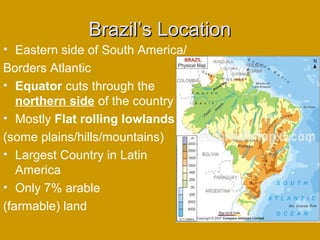
• Eastern side of South America/
Borders Atlantic
• Equator cuts through the
northern side of the country
• Mostly Flat rolling lowlands
(some plains/hills/mountains)
• Largest Country in Latin
America
• Only 7% arable
(farmable) land
Brazil’s ClimateBrazil’s Climate
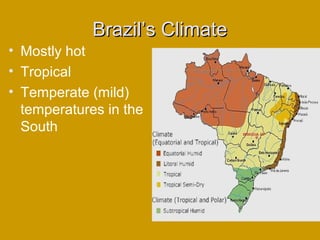
• Mostly hot
• Tropical
• Temperate (mild)
temperatures in the
South
Brazil’s Natural ResourcesBrazil’s Natural Resources
• Bauxite
• Gold
• Iron ore/nickel/tin/phosphates
• Uranium
• Petroleum
• Hydro-Electric power
• Timber
• Coffee/sugar/soybeans
Brazil’s PopulationBrazil’s Population
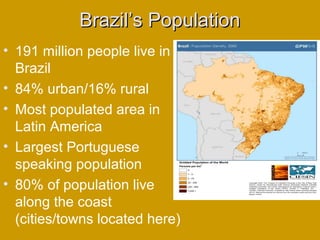
• 191 million people live in
Brazil
• 84% urban/16% rural
• Most populated area in
Latin America
• Largest Portuguese
speaking population
• 80% of population live
along the coast
(cities/towns located here)
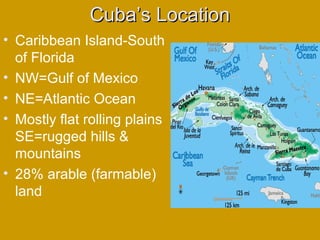
Cuba’s LocationCuba’s Location
• Caribbean Island-South
of Florida
• NW=Gulf of Mexico
• NE=Atlantic Ocean
• Mostly flat rolling plains
SE=rugged hills &
mountains
• 28% arable (farmable)
land
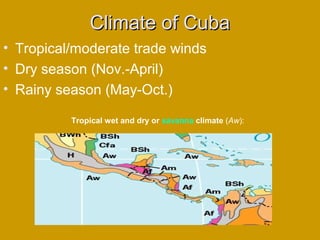
Climate of CubaClimate of Cuba
• Tropical/moderate trade winds
• Dry season (Nov.-April)
• Rainy season (May-Oct.)
Tropical wet and dry or savanna climate (Aw):
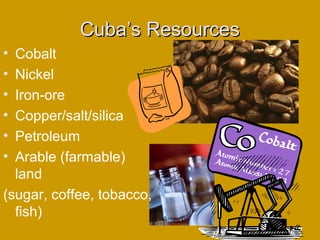
Cuba’s ResourcesCuba’s Resources
• Cobalt
• Nickel
• Iron-ore
• Copper/salt/silica
• Petroleum
• Arable (farmable)
land
(sugar, coffee, tobacco,
fish)
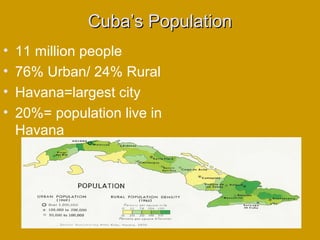
Cuba’s PopulationCuba’s Population
• 11 million people
• 76% Urban/ 24% Rural
• Havana=largest city
• 20%= population live in
Havana
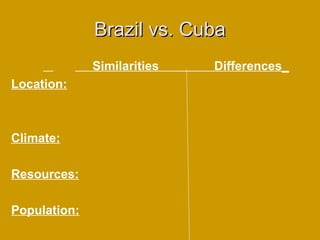
Brazil vs. CubaBrazil vs. Cuba
Similarities Differences_
Location:
Climate:
Resources:
Population:

Country comparison-brazil-cuba

  • 1.
    Brazil and CubaBraziland Cuba SS6G3 Compare how the location, climate, and natural resources of Brazil and Cuba affect where people live and how they trade.
  • 2.
    Brazil’s LocationBrazil’s Location •Eastern side of South America/ Borders Atlantic • Equator cuts through the northern side of the country • Mostly Flat rolling lowlands (some plains/hills/mountains) • Largest Country in Latin America • Only 7% arable (farmable) land
  • 3.
    Brazil’s ClimateBrazil’s Climate •Mostly hot • Tropical • Temperate (mild) temperatures in the South
  • 4.
    Brazil’s Natural ResourcesBrazil’sNatural Resources • Bauxite • Gold • Iron ore/nickel/tin/phosphates • Uranium • Petroleum • Hydro-Electric power • Timber • Coffee/sugar/soybeans
  • 5.
    Brazil’s PopulationBrazil’s Population •191 million people live in Brazil • 84% urban/16% rural • Most populated area in Latin America • Largest Portuguese speaking population • 80% of population live along the coast (cities/towns located here)
  • 6.
    Cuba’s LocationCuba’s Location •Caribbean Island-South of Florida • NW=Gulf of Mexico • NE=Atlantic Ocean • Mostly flat rolling plains SE=rugged hills & mountains • 28% arable (farmable) land
  • 7.
    Climate of CubaClimateof Cuba • Tropical/moderate trade winds • Dry season (Nov.-April) • Rainy season (May-Oct.) Tropical wet and dry or savanna climate (Aw):
  • 8.
    Cuba’s ResourcesCuba’s Resources •Cobalt • Nickel • Iron-ore • Copper/salt/silica • Petroleum • Arable (farmable) land (sugar, coffee, tobacco, fish)
  • 9.
    Cuba’s PopulationCuba’s Population •11 million people • 76% Urban/ 24% Rural • Havana=largest city • 20%= population live in Havana
  • 10.
    Brazil vs. CubaBrazilvs. Cuba Similarities Differences_ Location: Climate: Resources: Population: