How corruption threatens the forests of
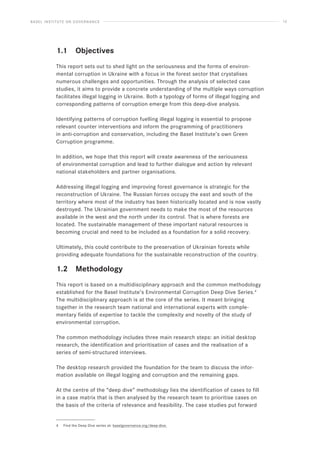
Ukraine: Typology and case studies on
corruption and illegal logging
Yehor Hrynyk, Andrii Biletskyi, Amanda Cabrejo le Roux | 2023
Basel Institute on Governance
Steinenring 60 | 4051 Basel, Switzerland | +41 61 205 55 11
www.baselgovernance.org | info@baselgovernance.org
Associated Institute of
the University of Basel
Working Paper 43
Environmental Corruption
Deep Dive Series
BASEL INSTITUTE ON GOVERNANCE 2
Table of contents
About the authors....................................................................................................... 4
About this report and acknowledgements............................................................... 5
Foreword by Juhani Grossmann................................................................................ 7
Executive summary.................................................................................................... 8
1 Introduction..........................................................................................................11
1.1 Objectives 12
1.2 Methodology 12
1.3 Structure 13
2 Forest management and logging in Ukraine....................................................14
2.1 Forest management actors 15
2.2 The logging/timber industry 17
2.3 State taxation and funding related to forest use 18
3 Illegal logging in Ukraine����������������������������������������������������������������������������������� 20
3.1 Challenges in defining illegal logging 20
3.2 Distinguishing illegal logging and illegal timber trade 20
3.3 Types of illegal logging 21
4 Corruption in Ukraine: an overview������������������������������������������������������������������ 26
4.1 Corruption: a deep-rooted concern 26
4.2 Legal definition and types 27
4.3 Anti-corruption institutions 27
4.4 Relevant transparency tools 29
4.5 Remaining challenges 29
5 Corruption and illegal logging��������������������������������������������������������������������������� 31
5.1 Corruption and illegal logging by private actors 31
5.2 Corruption and illegal logging by forest management officials 32
5.3 Corruption in controls and sanctions 34
5.4 Corruption and illegal forest conversion 37
5.5 Changes and prospects in the context of the Russian
invasion of 2022 37
BASEL INSTITUTE ON GOVERNANCE 3
6 Case studies.........................................................................................................39
6.1 The Dubky forest case 39
6.2 The case of the head of the Huta SFE 42
6.3 The case of illegal sanitary logging in the Carpathian region 45
6.4 The cases of the environmental inspectors 48
6.5 Cases of corruption related to unlawful appropriation of
forestry lands 51
7 Conclusions and recommendations..................................................................53
7.1 Conclusions 53
7.2 Recommendations 55
BASEL INSTITUTE ON GOVERNANCE 4
About the authors
Yehor Hrynyk
Environmental Campaigner
Yehor Hrynyk is an environmental campaigner with the Ukrainian Nature
Conservation Group (UNCG). He focuses on the identification and prevention of
illegal and unsustainable logging and the conservation of forests in Ukraine.
Yehor holds a Master’s Degree in Zoology from Kyiv National University.
Email: vereuxvereux@gmail.com
Andrii Biletskyi
Anti-Corruption Expert
Dr. Andrii Biletskyi is an anti-corruption expert with experience in conducting
anti-corruption research, providing anti-corruption trainings and developing
anti-corruption legislation. He is currently working at the Anti-Corruption Research
and Education Centre of the National University of Kyiv-Mohyla Academy.
Andrii holds a PhD in Criminal Law, Criminology and Penitentiary Law from the
Yaroslav Mudryi National Law University.
Email: a.beletskiy17@gmail.com
Amanda Cabrejo le Roux
Environmental Crime Specialist
Dr. Amanda Cabrejo le Roux is the Environmental Crime Specialist of the Green
Corruption Programme. She is the Lead Researcher of the Environmental Corruption
Deep Dive Series.
Amanda holds a PhD in International and Comparative Criminal Law from the
Sorbonne Law School (University Paris I Pantheon-Sorbonne). She also holds
a LL.M. in International Criminal Law (University of Amsterdam/Columbia Law
School), Master’s Degrees in French Law and Comparative Criminal Law (Sorbonne
Law School) and Spanish Law (Universidad Complutense), and Bachelor’s Degrees
in History (University Paris 1) and Anthropology (University Paris 8).
Email: amanda.cabrejo@baselgovernance.org
BASEL INSTITUTE ON GOVERNANCE 5
About this report
This report is part of the Environmental Corruption Deep Dive Series, a
multidisciplinary research project of the Green Corruption programme at the Basel
Institute on Governance. The Environmental Corruption Deep Dive Series analyses,
through selected case studies, how corruption facilitates environmental crimes.
The main objectives of the research project are to raise awareness of the
seriousness of environmental corruption and create a better understanding of its
concrete mechanisms. By building up a collection of case studies from various
countries and sectors, the series seeks to identify patterns of environmental
corruption and ultimately a general typology. In doing so it aims to expand the
global conversation on environmental corruption and bolster dialogue between
stakeholders at the national level.
The Environmental Corruption Deep Dive Series, including this report, is made
possible by the generous support of the Principality of Liechtenstein.
It is part of the Basel Institute on Governance Working Paper Series, ISSN:
2624-9650. You may share or republish the Working Paper under a Creative
Commons Attribution-NonCommercial-NoDerivatives 4.0 International License
(CC BY-NC-ND 4.0).
Suggested citation: Hrynyk, Yehor, Andrii Biletskyi, and Amanda Cabrejo le Roux.
2023. ‘How corruption threatens the forests of Ukraine: Typology and case studies
on corruption and illegal logging.’ Working Paper 43 / Environmental Corruption
Deep Dive Series, Basel Institute on Governance. Available at: baselgovernance.
org/publications/deepdive1-ukraine.
BASEL INSTITUTE ON GOVERNANCE 6
Acknowledgments
This report benefited from contributions of numerous individuals who shared their
expertise and views at various stages of the research process.
The research team is particularly grateful to the individuals who agreed to share
their perspectives during extensive interviews. Most of them preferred to remain
anonymous and we thank them collectively.
The research team is also deeply grateful for the colleagues of the Basel Institute
on Governance who participated in the internal review process: Juhani Grossmann
(Team Leader, Green Corruption programme), Monica Guy (Communications
Specialist) and Manuel Medina (IWT Intelligence Analyst, Green Corruption
programme). Finally, we thank for their invaluable contributions the following
experts who participated in the external review process, in alphabetical order:
Anatolii Borsuk (Chief Specialist of the Forest Resources Protection and
Restoration Division, Ministry of Environmental Protection and Natural Resources
of Ukraine), Dmytro Karabchuk (CEO, ForestCom), Halyna Kokhan (Anti-Corruption
Policy Expert, Support to Anti-Corruption Champion Institutions in Ukraine (SACCI)
) Sophie Lemaître (Senior Adviser, U4 Anti-Corruption Resource Centre), Micol
Martini (Governance Technical Lead, WWF International), Bohdan Prots (CEO,
Danube-Carpathian Programme).
BASEL INSTITUTE ON GOVERNANCE 7
Foreword
Ukrainian forests cover over 10 million hectares – about the size of Iceland, or 2.5
times the size of Switzerland – mainly in the western and northern parts of Ukraine.
Their preservation is key for the rich ecosystems and climate benefits that Ukrainian
forests represent and the communities that depend on them.
Economically, the full-scale Russian attack on Ukraine in 2022 has drastically
heightened the relative value of the previously under-utilised role that forests play
in the national economy. This is because Ukraine’s main industrial areas are located
in occupied and fought-over territories and a large share have thus become dysfunc-
tional. Forests, thankfully, are largely located in the “safe” areas of Ukraine and thus
remain a largely intact resource.
Continued attacks on civilian infrastructure are creating high demand for forest
products to generate heat and be used in reconstruction efforts. The Ukrainian
Government has recognised the sector’s increased importance by creating a new
state-owned enterprise, Forests of Ukraine.
For Ukraine’s forests to play its role in its reconstruction, significant reforms are needed:
both its sustainability and governance are currently insufficient to meet this challenge.
Without sustainability, any short-term benefits will pale into insignificance compared to
the long-term harm to Ukraine’s environment and economy. Without solid governance
systems, corruption will undermine even short-term reconstruction benefits.
This report seeks to take systematic stock of the pre-war governance and corruption
issues in Ukraine’s forestry sector. It reveals deep-seated challenges as governance
reforms have not yet had a significant effect. Considering that the EU is significantly
tightening its transparency and sustainability requirements for forestry products, and
that the EU makes up the majority of Ukraine’s wood products exports, these reforms
are increasingly urgent to ensure this vital market remains accessible.
This report is the first in a series of Deep Dives into critical issues of environmental
corruption around the world. It identifies a typology of the main corruption patterns that
enable illegal logging, involving both private actors and culprits within government. It
illuminates the challenge of corruptly obtained permits allowing illegally sourced wood
to be sold and exported “legally” and contributing to the governance issues. And it
proposes targeted recommendations for European authorities, Ukraine’s Verkhovna Rada
and Cabinet of Ministers, and relevant Ukrainian government agencies.
I urge all actors to come to the table at this critical time, take stock of corruption challenges
and anti-corruption efforts in Ukraine’s forestry sector so far, and play their parts to ensure
that Ukraine’s forestry sector does not become the reconstruction effort’s Achilles’ heel.
Juhani Grossmann
Team Leader, Green Corruption programme and Senior Advisor,
Central and Eastern Europe
Basel Institute on Governance
BASEL INSTITUTE ON GOVERNANCE 8
Executive summary
The Russian invasion is putting Ukraine’s forests under unprecedented threat.
The demand for wood in Ukraine has dramatically escalated since other energy
sources have been destroyed. The Ministry of Environment estimates that 3 million
hectares of forest (about a third of the total) have already been affected by the war,
including by illegal logging in national parks and reserves occupied by the Russian
forces. With a moratorium on inspections and limited oversight by civil society,
illegal logging – already a major challenge before the war – is going unchecked.
Addressing illegal logging and improving forest governance are a strategic
necessity for the reconstruction of Ukraine. Russian forces occupy the east and
south of the territory, where most of the industry has been historically located.
Industry in these areas and those at the near-front have been rendered ineffective.
The Ukrainian Government needs to make the most of the resources available in
the west and the north under its control. That is where forests are located. The
sustainable management of these important natural resources is crucial for a solid
recovery.
Corruption remains a serious problem in forest management. Ukraine has a
history of widespread corruption. Progress has been made since the Revolution
of Dignity in 2014: Government and civil society organisations have created
anti-corruption institutions, anti-corruption legislation has have been updated and
tools have been created to detect corruption and improve transparency. However,
corruption in Ukraine remains prevalent and affects multiple sectors, including
forest management. Understanding how corruption fuels illegal logging both before
and during the war is an essential starting point to strengthen governance mecha-
nisms and ensure the sustainable management of forests.
Illegal logging by forest management officials could be stripping Ukraine of
millions of cubic metres of timber every year. Thanks to corruptly obtained
permits, much of the wood can be “legally” exported to foreign markets, primarily
in other European countries. Importing countries have a role to play in supporting
integrity in this sector.
Specific patterns of corruption are entwined with the three main types of
illegal logging:
• For illegal logging carried out by private actors (local communities
or criminal groups), these are able to evade justice by corrupting law
enforcement officials.
• For illegal logging by forest management officials, these can obtain
false paperwork to fell trees by, for instance, having them declared as
infected by pests or disease, or illegally fell trees without any permits.
Corruption schemes here can involve both the bodies in charge of
authorising fellings and those responsible for inspections.
• Illegal conversion of forests is linked to the illegal manipulation of land
documents by corrupted officials, leading to the irreversible loss of forests
for construction, infrastructure projects or agriculture.
BASEL INSTITUTE ON GOVERNANCE 9
There is an urgent need to strengthen control measures and authorities in the
forestry sector. The existing control bodies either have low efficiency – which may
be due to conflicts of interest, lack of political will, legislative restrictions or low
wages – or are themselves subject to the influence of corruption. Both internal
and external anti-corruption control measures could help, such as introducing
compliance officers in state forestry enterprises and involving anti-corruption
authorities in the investigation of corruption cases in this sector.
Forest management needs to be a high priority in the anti-corruption activities
of Ukraine and its international partners. Despite having catastrophic consequences
for the environment and the well-being of citizens, corruption related to the
forestry sector still fails to appear high on the agenda. The problem deserves
more attention from the Government of Ukraine, as well as international partners
that are supporting the process of reconstruction and/or consuming wood and
wood-based products from Ukraine.
Mitigating corruption related to illegal logging in Ukraine requires a systemic and
inclusive approach from the national government, as well as Ukraine’s interna-
tional partners. Recommendations at the end of this report include:
• Reforming the forest management system to eliminate existing conflicts
of interest, in particular, ensuring the independence of forest protection
authorities from authorities engaged in wood harvesting and trade.
• Increasing the transparency of the forest industry.
• Ensuring adequate budgetary financing of forest management authorities.
• Reforming the system of environmental control by increasing the
capacity of the State Environmental Inspection, as well as other law
enforcement and control bodies.
• European Union authorities have a role to play in encouraging the
Ukrainian government to implement the needed changes, for instance through
specific conditions attached to the recovery programmes and platforms, as
well as within the framework of Ukraine’s EU accession procedure. Recent
changes in EU legislation designed to stop illegal timber entering EU markets
and enhance corporate sustainability reporting could also be powerful tools in
this regard.
BASEL INSTITUTE ON GOVERNANCE 10
Acronyms and abbreviations
ETA		 Electronic Timber Accounting
		(електронний облік деревини)
HACC		 High Anti-Corruption Court
		(Вищий антикорупційний суд)
MENR		 Ministry of Ecology and Natural Resources of Ukraine
		(Міністерство захисту довкілля та природних ресурсів України)
NABU		 National Anti-Corruption Bureau of Ukraine
		(Національне антикорупційне бюро України)
NACP		 National Agency on Corruption Prevention
		(Національне агентство з питань запобігання корупції)
SAFR		 State Agency of Forest Resources of Ukraine
		(Державне агентство лісових ресурсів України)
SAPO		 Specialized Anti-Corruption Prosecutors Office
		(Спеціалізована антикорупційна прокуратура)
SBI		 State Bureau of Investigations
		(Державне бюро розслідувань)
SEI		 State Environmental Inspectorate of Ukraine
		(Державна екологічна інспекція України)
SFE		 State Forest Enterprise
		(Державне лісогосподарське підприємство)
SSS		 State Security Service
		(Служба безпеки України)
BASEL INSTITUTE ON GOVERNANCE 11
1			 Introduction
The forests of Ukraine, which cover at least 16% of the country’s territory, are one of
its greatest natural treasures. Many old-growth forests are still preserved. They are
crucial for the conservation of endangered and vulnerable species, as well as climate
change mitigation and adaptation. Moreover, Ukrainian forests play an important
economic role, serving as the main source of income for many rural communities.
Wood from Ukrainian forests is needed not only inside the country – the European
Union is its largest importer.
Nevertheless, Ukraine’s forests are under constant threat due to unsustainable and
illegal logging. Illegal logging has a negative impact on the provision of various
ecosystem services by forests, including those related to climate and biodiversity.
It has an obviously negative impact on the well-being of the country’s citizens.
Among other things, it leads to a decrease in revenues to state and local budgets,
and creates a negative image of Ukraine on the world stage.
Some estimations indicated that each year millions of cubic meters of wood are
harvested illegally to be consumed both in Ukraine and abroad.1
In the conditions of the
Russian invasion, such threats only increased. The demand for Ukrainian wood increased
both within the country (due to Russia’s destruction of the energy sector of Ukraine) and
in the EU (due to the introduction of sanctions on wood from Belarus and Russia2
).
At the same time, the ability of the state and civil society to identify or prevent
illegal and unsustainable logging has decreased significantly since the beginning of
the war. The ministry of environment already estimates that 3 million hectares of
forest (about a third of the total) have been affected by the war with at least 23,300
hectares burned down by shelling and illegal logging documented at many of the
national parks and reserves occupied by the Russians.3
Studies of public opinion in Ukraine indicate that the problem of corruption is
widespread. Since 2014, Ukraine has been trying to build a powerful system of
preventing and countering corruption. A new legal framework in this area has been
adopted and reformed a few times. New anti-corruption institutions have been
established. In addition, Ukraine has created innovative tools to achieve trans-
parency and accountability in certain areas of the economy, which are recognised
by the international community.
But is this enough to eliminate illegal logging and face the new challenges
emerging in the war context?
1 This assessment provided by UK-based NGO Earthsight in their report “Complicit in Corruption: How billion-dollar firms
and EU governments are failing Ukraine’s forests” (https://www.earthsight.org.uk/news/investigations/complic-
it-in-corruption-report) is a rough approximation. However, it gives an understanding of the magnitude of the problem of
illegal logging in Ukraine, and it aligns with the estimations obtained during the development of this study.
2 On illegal timber trends emerging in relation to these sanctions see OCCRP’s investigation: “Traders Are Sneaking
Banned Russian and Belarusian Wood Into the EU By Pretending It’s From Central Asia”, 20 December 2022, available
at: https://www.occrp.org/en/investigations/traders-are-sneaking-banned-russian-and-belarusian-wood-into-the-eu-
by-pretending-its-from-central-asia.
3 The Economist, “The war has devastated Ukraine’s environment, too”, 12 January 2023, available at: https://www.
economist.com/europe/2023/01/12/the-war-has-devastated-ukraines-environment-too.
BASEL INSTITUTE ON GOVERNANCE 12
1.1 Objectives
This report sets out to shed light on the seriousness and the forms of environ-
mental corruption in Ukraine with a focus in the forest sector that crystalises
numerous challenges and opportunities. Through the analysis of selected case
studies, it aims to provide a concrete understanding of the multiple ways corruption
facilitates illegal logging in Ukraine. Both a typology of forms of illegal logging and
corresponding patterns of corruption emerge from this deep-dive analysis.
Identifying patterns of corruption fuelling illegal logging is essential to propose
relevant counter interventions and inform the programming of practitioners
in anti-corruption and conservation, including the Basel Institute’s own Green
Corruption programme.
In addition, we hope that this report will create awareness of the seriousness
of environmental corruption and lead to further dialogue and action by relevant
national stakeholders and partner organisations.
Addressing illegal logging and improving forest governance is strategic for the
reconstruction of Ukraine. The Russian forces occupy the east and south of the
territory where most of the industry has been historically located and is now vastly
destroyed. The Ukrainian government needs to make the most of the resources
available in the west and the north under its control. That is where forests are
located. The sustainable management of these important natural resources is
becoming crucial and need to be included as a foundation for a solid recovery.
Ultimately, this could contribute to the preservation of Ukrainian forests while
providing adequate foundations for the sustainable reconstruction of the country.
1.2 Methodology
This report is based on a multidisciplinary approach and the common methodology
established for the Basel Institute’s Environmental Corruption Deep Dive Series.4
The multidisciplinary approach is at the core of the series. It meant bringing
together in the research team national and international experts with comple-
mentary fields of expertise to tackle the complexity and novelty of the study of
environmental corruption.
The common methodology includes three main research steps: an initial desktop
research, the identification and prioritisation of cases and the realisation of a
series of semi-structured interviews.
The desktop research provided the foundation for the team to discuss the infor-
mation available on illegal logging and corruption and the remaining gaps.
At the centre of the “deep dive” methodology lies the identification of cases to fill
in a case matrix that is then analysed by the research team to prioritise cases on
the basis of the criteria of relevance and feasibility. The case studies put forward
4 Find the Deep Dive series at: baselgovernance.org/deep-dive.
BASEL INSTITUTE ON GOVERNANCE 13
in this report were selected as a result of the case prioritisation matrix. The analysis
of the case studies was conducted using publicly available sources (court decisions,
media reports, civil society reports and academic literature). For one case one of the
co-authors was also able to carry out a field visit (“Dubky” forest case).
The third key element of the methodology is a series of semi-structured interviews
in order to provide additional perspectives on the case studies. Because of
the sensitivity of the topics all interviewees were offered the option to remain
anonymous. For this report, 10 extensive interviews were conducted with
individuals that have direct knowledge of the forest sector and the anti-corruption
sector in Ukraine. Stakeholders from a wide range of backgrounds and expertise
– representatives of environmental NGOs, current or former employees of
governmental bodies, former forest sector employees, investigative journalists etc.
– were contacted.
In addition, the report went through an extensive review process to collect views of
in-house experts of the Basel Institute on Governance (internal review process) in
addition to views of key stakeholders (external review process).
1.3 Structure
Section 2 gives an overview of forest management and logging in Ukraine. Section
3 defines illegal logging and proposes a framework to understand different
typologies of illegal logging. Section 4 gives an overview of corruption and
anti-corruption in Ukraine.
Section 5 brings these together, using the framework to explore how corruption
facilitates illegal logging. Section 6 offers extensive case studies showcasing
different aspects of corruption related to illegal logging.
Finally, section 7 proposes recommendations for European and Ukrainian
authorities.
BASEL INSTITUTE ON GOVERNANCE 14
2		Forest management and logging
in Ukraine
Ukraine’s forests are rich sources of biodiversity and of economic activity in
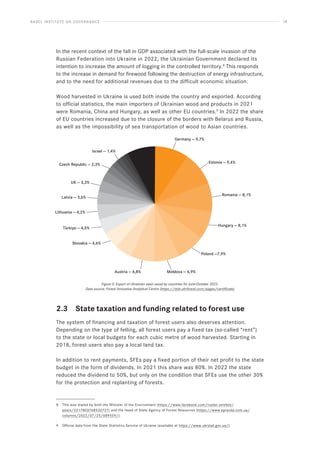
some regions. They are mostly state-owned, with just 13% communally owned
and 7% located on reserve lands without clear ownership. There are numerous
administrative deficiencies and overlaps in state forest policymaking and imple-
mentation. Day-to-day management is delegated to so-called permanent forest
users, often state-owned forest enterprises. These are largely reliant on logging
for their financing. The share of exports to EU countries has recently increased.
Forests in Ukraine
According to official statistics, forests cover about 16% of the territory of
Ukraine (9.6 million hectares) (SAFR, 2022), mostly in the west and north. This
figure may be inaccurate and does not include “self-seeded forests” (naturally
afforested agricultural lands) and other forested lands which do not have the
legal status of “forest”.
Figure 1: Percentage of forest cover in the regions of Ukraine. Data for 2011, taken from
https://forest.gov.ua/napryamki-diyalnosti/lisi-ukrayini/zagalna-harakteristika-lisiv-ukrayini
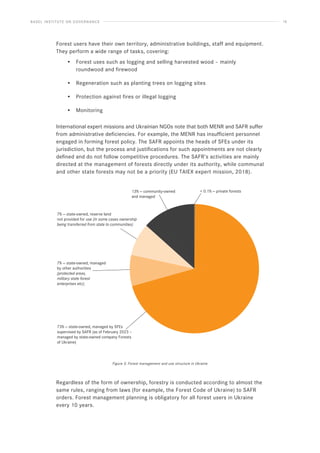
Some 87% are state-owned, while another 13% are communally owned. The share
of private forests is less than 0.1% (SAFR, 2022).
51.4
41.0
29.2
28.5
31.0
36.4
33.6
12.8
13.3
13.1
15.1
22.2
20.9
17.8
8.6
6.7 5.6
4.0
6.1
4.1
3.7
6.9
10.7
12.0
11.0
BASEL INSTITUTE ON GOVERNANCE 15
2.1 Forest management actors
The Ministry of Ecology and Natural Resources of Ukraine (MENR) is primarily
responsible for setting policies on forest management, while the State Agency
of Forest Resources of Ukraine (SAFR) is the central body responsible for
implementation. However, in practice, MENR also performs a number of policy
implementation functions (for example, approves felling within protected areas).
Meanwhile, SAFR is often involved in setting state policy, for instance by preparing
draft bylaws.
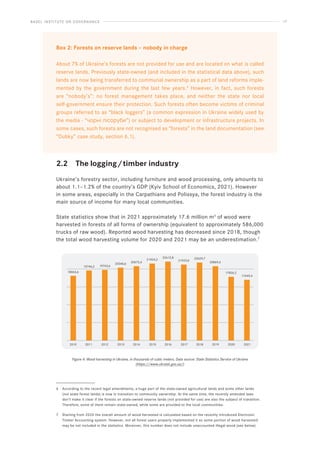
Figure 2: Authorities in charge of forest management
Direct management of state or communal forests is carried out by forest
management authorities often referred to as “permanent forest users” (SAFR,
2022). These separate legal entities fall under the supervision of various
authorities:
• SAFR supervises more than 170 forest users. These are called state forest
enterprises (SFEs) and manage around 73% of Ukrainian forests. As of
February 2023, all forest users under the supervision of SAFR were united
into one single state company, Forests of Ukraine. As of February 2023,
the former SFEs are now operating as branches of the State enterprise
“Forests of Ukraine” and are no longer separate legal entities.
• Most other permanent forest users are supervised by the Ministry of
Defence (“military SFEs”), the National Academy of Sciences and MENR
(national parks and reserves).
• Communal forest users, which often include former collective farm forests,
are unevenly distributed across Ukraine and subject to various local
authorities.5
5 During the Soviet times some community-run collective farms had forests under their management. Later, after the
collapse of the Soviet Union, many of those forests were provided to newly established communal forest enterprises
under the jurisdiction of local authorities.
Body hierarchy Responsibilities
Formation of state forest
policy + policy
implementation (partially)
Implementation of state forest
policy + policy formation
(partially) + control over SFEs
under its jurisdiction
Forest managemet
(harvest, wood trade, protection
of forest etc.)
MENR
State forest enterprises
(united into a single SE “Forests
of Ukraine” in 2023)
SAFR
Other forest management
authorities: military SFEs,
communal forests,
specific reserves.
BASEL INSTITUTE ON GOVERNANCE 16
Forest users have their own territory, administrative buildings, staff and equipment.
They perform a wide range of tasks, covering:
• Forest uses such as logging and selling harvested wood – mainly
roundwood and firewood
• Regeneration such as planting trees on logging sites
• Protection against fires or illegal logging
• Monitoring
International expert missions and Ukrainian NGOs note that both MENR and SAFR suffer
from administrative deficiencies. For example, the MENR has insufficient personnel
engaged in forming forest policy. The SAFR appoints the heads of SFEs under its
jurisdiction, but the process and justifications for such appointments are not clearly
defined and do not follow competitive procedures. The SAFR’s activities are mainly
directed at the management of forests directly under its authority, while communal
and other state forests may not be a priority (EU TAIEX expert mission, 2018).
Figure 3: Forest management and use structure in Ukraine
Regardless of the form of ownership, forestry is conducted according to almost the
same rules, ranging from laws (for example, the Forest Code of Ukraine) to SAFR
orders. Forest management planning is obligatory for all forest users in Ukraine
every 10 years.
73% — state-owned, managed by SFEs
supervised by SAFR (as of February 2023 –
managed by state-owned company Forests
of Ukraine)
13% — community-owned
and managed
7% — state-owned, reserve land
not provided for use (in some cases ownership
being transferred from state to communities)
7% — state-owned, managed
by other authorities
(protected areas,
military state forest
enterprises etc);
 0.1% — private forests
BASEL INSTITUTE ON GOVERNANCE 17
Box 2: Forests on reserve lands – nobody in charge
About 7% of Ukraine’s forests are not provided for use and are located on what is called
reserve lands. Previously state-owned (and included in the statistical data above), such
lands are now being transferred to communal ownership as a part of land reforms imple-
mented by the government during the last few years.6
However, in fact, such forests
are “nobody’s”: no forest management takes place, and neither the state nor local
self-government ensure their protection. Such forests often become victims of criminal
groups referred to as “black loggers” (a common expression in Ukraine widely used by
the media - “чорні лісоруби”) or subject to development or infrastructure projects. In
some cases, such forests are not recognised as “forests” in the land documentation (see
“Dubky” case study, section 6.1).
2.2 The logging/timber industry
Ukraine’s forestry sector, including furniture and wood processing, only amounts to
about 1.1–1.2% of the country’s GDP (Kyiv School of Economics, 2021). However
in some areas, especially in the Carpathians and Polissya, the forest industry is the
main source of income for many local communities.
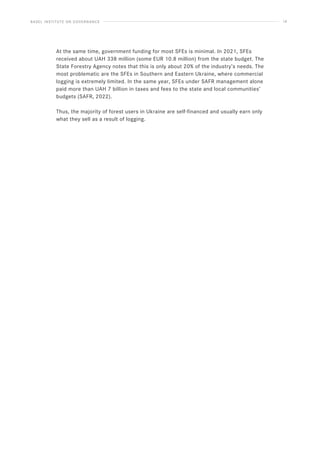
State statistics show that in 2021 approximately 17.6 million m3
of wood were
harvested in forests of all forms of ownership (equivalent to approximately 586,000
trucks of raw wood). Reported wood harvesting has decreased since 2018, though
the total wood harvesting volume for 2020 and 2021 may be an underestimation.7
Figure 4: Wood harvesting in Ukraine, in thousands of cubic meters. Data source: State Statistics Service of Ukraine
(https://www.ukrstat.gov.ua/)
6 According to the recent legal amendments, a huge part of the state-owned agricultural lands and some other lands
(not state forest lands) is now in transition to community ownership. At the same time, the recently amended laws
don’t make it clear if the forests on state-owned reserve lands (not provided for use) are also the subject of transition.
Therefore, some of them remain state-owned, while some are provided to the local communities.
7 Starting from 2020 the overall amount of wood harvested is calculated based on the recently introduced Electronic
Timber Accounting system. However, not all forest users properly implemented it so some portion of wood harvested
may be not included in the statistics. Moreover, this number does not include unaccounted illegal wood (see below).
2010 2011 2012 2013 2014 2015 2016 2017 2018 2019 2020 2021
18064,6
19746,2 19763,6
20340,6 20672,4
22612,8
21924,2 21923,0
22629,7
17826,2
17649,4
20869,6
BASEL INSTITUTE ON GOVERNANCE 18
In the recent context of the fall in GDP associated with the full-scale invasion of the
Russian Federation into Ukraine in 2022, the Ukrainian Government declared its
intention to increase the amount of logging in the controlled territory.8
This responds
to the increase in demand for firewood following the destruction of energy infrastructure,
and to the need for additional revenues due to the difficult economic situation.
Wood harvested in Ukraine is used both inside the country and exported. According
to official statistics, the main importers of Ukrainian wood and products in 2021
were Romania, China and Hungary, as well as other EU countries.9
In 2022 the share
of EU countries increased due to the closure of the borders with Belarus and Russia,
as well as the impossibility of sea transportation of wood to Asian countries.
Figure 5: Export of Ukrainian sawn wood by countries for June-October 2022.
Data source: Forest Innovative Analytical Centre (https://stat.ukrforest.com/pages/certificate)
2.3 State taxation and funding related to forest use
The system of financing and taxation of forest users also deserves attention.
Depending on the type of felling, all forest users pay a fixed tax (so-called “rent”)
to the state or local budgets for each cubic metre of wood harvested. Starting in
2018, forest users also pay a local land tax.
In addition to rent payments, SFEs pay a fixed portion of their net profit to the state
budget in the form of dividends. In 2021 this share was 80%. In 2022 the state
reduced the dividend to 50%, but only on the condition that SFEs use the other 30%
for the protection and replanting of forests.
8 This was stated by both the Minister of the Environment (https://www.facebook.com/ruslan.strelets/
posts/3317803768532727) and the Head of State Agency of Forest Resources (https://www.epravda.com.ua/
columns/2022/07/25/689559/).
9 Official data from the State Statistics Service of Ukraine (available at https://www.ukrstat.gov.ua/).
Germany — 9,7%
Romania — 8,1%
Estonia — 9,4%
Hungary — 8,1%
Moldova — 6,9%
Poland —7,9%
Israel — 1,4%
Latvia — 3,6%
Czech Republic — 2,3%
Lithuania — 4,2%
Austria — 6,8%
Slovakia — 4,6%
UK — 3,3%
Türkiye — 4,5%
BASEL INSTITUTE ON GOVERNANCE 19
At the same time, government funding for most SFEs is minimal. In 2021, SFEs
received about UAH 338 million (some EUR 10.8 million) from the state budget. The
State Forestry Agency notes that this is only about 20% of the industry’s needs. The
most problematic are the SFEs in Southern and Eastern Ukraine, where commercial
logging is extremely limited. In the same year, SFEs under SAFR management alone
paid more than UAH 7 billion in taxes and fees to the state and local communities’
budgets (SAFR, 2022).
Thus, the majority of forest users in Ukraine are self-financed and usually earn only
what they sell as a result of logging.
BASEL INSTITUTE ON GOVERNANCE 20
3			 Illegal logging in Ukraine
Illegal logging is defined as any wood harvesting carried out without permits or
in violation of legal requirements. It is not clearly defined in Ukrainian legislation,
leading to misunderstandings. Three types can be identified: illegal logging by
private actors (locals and criminal groups); illegal logging by forest management
officials (with and without permits); and illegal forest conversion.
3.1 Challenges in defining illegal logging
For this report, we understand illegal logging as any wood harvesting carried out
without permits or in violation of legal requirements for wood harvesting. For
example, a tree cut by a local resident for firewood without any permits, or a tree
felled by the forest user with all the necessary documents but during the prohibited
period for felling.
In Ukraine, it is necessary to distinguish between illegal and unsustainable logging
because often these are different things. In terms of protecting biodiversity and
preventing climate change, Ukrainian legislation is outdated and often based on
Soviet approaches to forest management. As a result, perfectly legal logging can
have catastrophic environmental consequences, and vice versa (Free Svydovets
Group, 2021).
Ukrainian legislation does not provide a comprehensive definition of illegal logging,
leading to misunderstandings (REC, 2010, EU TAIEX mission, 2018). For example,
official statistics on illegal logging only include logging carried out without permits
– commonly called “self-willed logging” (самовільні рубки). When the head of the
SAFR reported a 54% decrease in the volume of illegal logging in 2021 compared to
2020 (SAFR, 2021), he meant exclusively logging without permits.
In 2004, the Plenum of the Supreme Court of Ukraine decided that the concept of
“illegal logging” referred to in article 246 of the Criminal Code of Ukraine includes
not only logging without permits but also any logging in violation of the law.10
However, in practice, this decision is rarely taken into account. Analysis of the
Unified Register of Court Decisions shows that the vast majority of cases concern
only logging without permits. As interviewees mention, other types of illegal logging
(if identified) are classified as “abuse of power” or “official negligence”.
3.2 Distinguishing illegal logging and illegal timber trade
Illegal logging is not the only illegal activity that impacts the wood supply chain in
Ukraine. According to the available data, numerous manipulations and schemes
also occur at the stage of timber transportation and sales by forest users. For
10 See article 9 of the Decision of the Plenum of the Supreme Court of Ukraine #17 of 10 December 2004 (https://zakon.
rada.gov.ua/laws/show/v0017700-04#Text).
BASEL INSTITUTE ON GOVERNANCE 21
example, there are common cases of selling commercial wood under the guise of
firewood, or deliberately underestimating the value of wood (EU TAIEX mission,
2018). For this report we focus on illegal logging in the strict sense and map the
challenges at the harvesting stage and not the other steps of the wood supply
chain. Timber trade involves different actors and is regulated under different norms
and law enforcement mechanisms.
3.3 Types of illegal logging
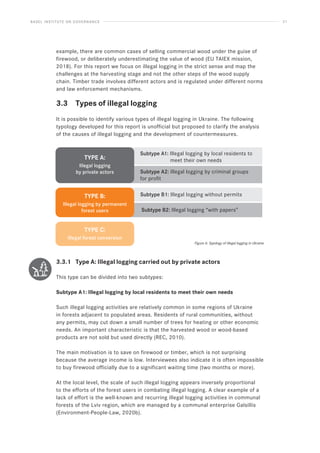
It is possible to identify various types of illegal logging in Ukraine. The following
typology developed for this report is unofficial but proposed to clarify the analysis
of the causes of illegal logging and the development of countermeasures.
Figure 6: Typology of illegal logging in Ukraine
3.3.1 Type A: Illegal logging carried out by private actors
This type can be divided into two subtypes:
Subtype A1: Illegal logging by local residents to meet their own needs
Such illegal logging activities are relatively common in some regions of Ukraine
in forests adjacent to populated areas. Residents of rural communities, without
any permits, may cut down a small number of trees for heating or other economic
needs. An important characteristic is that the harvested wood or wood-based
products are not sold but used directly (REC, 2010).
The main motivation is to save on firewood or timber, which is not surprising
because the average income is low. Interviewees also indicate it is often impossible
to buy firewood officially due to a significant waiting time (two months or more).
At the local level, the scale of such illegal logging appears inversely proportional
to the efforts of the forest users in combating illegal logging. A clear example of a
lack of effort is the well-known and recurring illegal logging activities in communal
forests of the Lviv region, which are managed by a communal enterprise Galsillis
(Environment-People-Law, 2020b).
TYPE A:
Illegal logging
by private actors
TYPE B:
Illegal logging by permanent
forest users
TYPE C:
Illegal forest conversion
Subtype A1: Illegal logging by local residents to
meet their own needs
Subtype A2: Illegal logging by criminal groups
for profit
Subtype B1: Illegal logging without permits
Subtype B2: Illegal logging “with papers”
BASEL INSTITUTE ON GOVERNANCE 22
There is no detailed assessment of the scale of this type of illegal logging.
However, considering the low capacity of local communities to illegally cut wood,
this type of illegal logging does not seem to constitute a major threat either from
the economic or environmental point of view.
Subtype A2: illegal logging by criminal groups for profit
This subtype of illegal logging activities is or was common in many regions of
Ukraine. A group of people (locals or not), often in collusion with representatives of
law enforcement agencies, carries out illegal logging for financial benefit.
For example, in 2019-21 there were widespread cases of illegal logging of the
largest oak trees in Polissya. The intruders took only the lower, thickest and most
valuable part of the tree, which was then used to make barrels and other wood
products.11
Another example is the illegal production of charcoal from illegally
harvested wood, especially in the northern regions.12
Illegal logging of this subtype is commonly carried out by logging crews contracted
by the forest users. Taking advantage of their position, such crews go beyond what
is authorised and secretly cut down more trees for their own gain. Some experts
attribute this not only to the desire to obtain undue profit but also to the low price
that the forest user pays for felling: in some cases, this amount does not cover the
costs of the felling itself.13
Illegal logging of both sub-types is often carried out in forests on reserve lands that
are not given to anyone for use and are poorly managed and protected.
There are no exact figures for the volume of illegal logging of type A. Official
statistics indicate 25,800 cubic metres – approximately equivalent to 122 football
fields – in 2021 (SAFR, 2022). This number includes both type A logging and
individual isolated cases of subtype B1 logging, which will be discussed below.
The volume of illegal logging of type A most likely exceeds official statistics, since
forest users often deliberately do not report illegal logging on their territory, even
if it is discovered. The reason is that if the perpetrators of illegal logging are not
identified, the forest user itself must pay for the damage.
Exact data on the further fate of cut wood is also not available. Most likely wood from
the felling of subtype A1 is used locally and does not go abroad. Wood of subtype A2
(for example, in the form of charcoal or other wood products) can be used throughout
the country, as well as exported abroad with the use of forged documents.
11 For example, see https://www.forester.org.ua/chorni-lisoruby-z-volyni-u-lisovij-glushyni-vid-band-tikaye-navit-politsiya/
and https://m.facebook.com/NewsPolissia/photos/a.108377744260125/253155086449056/?type=3_rdr.
12 For example, see https://suspilne.media/116906-skodili-ekologii-na-rivnensini-zupinili-vipaluvanna-vugilla-u-desat-
kah-bocok-prokuratura/ and https://rivne.rayon.in.ua/news/520489-na-kostopilshchini-nezakonno-vipalyuvali-vugillya.
13 For more details see https://www.youtube.com/watch?v=PNWVCJc03BYfeature=emb_logo.
BASEL INSTITUTE ON GOVERNANCE 23
3.3.2 Type B: Illegal logging by forest management officials
The key characteristic of this type of illegal logging is that it takes place with the
direct participation of people who are officials of a permanent forest user (SFE,
national park, communal forest user etc.).
Subtype B1: Illegal logging without permits
Examples of illegal logging by forest management officials without permits include:
• Exceeding the permissible volume of felled wood. For example, a forest
user receives a permit for felling 250 m3
of wood but in fact 300 m3
is
felled. There is no documentation for the extra 50 m3
.
• Felling of trees outside the permitted area. For example, a forest user
receives a permit for clearcut of 1 hectare of forest but the actual felling
area is 1.1 hectares. That extra 0.1 hectare is not covered by the permit.
• Illegal logging not associated with any permit documents. For
example, officials of forest users knowingly and illegally cut down trees on
a plot for which no permits were issued (WWF, 2020).
The motivation is to obtain illegal profit. The wood is sold on the black market,
so the entire profit is received directly by the officials of the forest users, without
any taxes or other fees. Some interviewees mention that such wood may also be
“legalised” through various schemes with documents, allowing it to be sold both
inside the country and possibly be exported.
It is impossible to reliably estimate the volume of illegal logging of subtype B1.
Nevertheless, some interviewees estimate that it is significantly larger than illegal
logging of type A.
Subtype B2: Illegal logging “with papers”
In this subtype, logging is carried out on the basis of a permit, but obtaining such a
permit or carrying out the logging itself was accompanied by a violation of certain
legal requirements. In the available literature, such logging is often called illegal
logging “with papers” (for example, Earthsight, 2020). In practice it refers mostly
to illegal sanitary logging. But other forms of illegal felling with documents exist:
ignoring the need to carry out an environmental impact assessment, carrying
out clear-cuts under the guise of shelterwood logging, carrying out felling in the
absence of properly approved forest management plans or estimated annual
allowable cuts, etc.
BASEL INSTITUTE ON GOVERNANCE 24
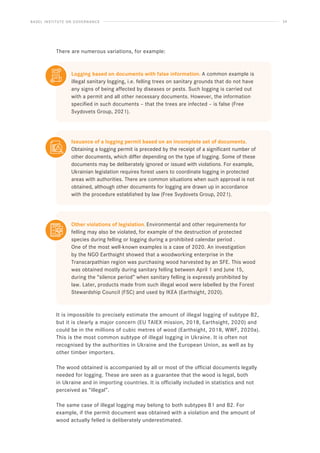
There are numerous variations, for example:
It is impossible to precisely estimate the amount of illegal logging of subtype B2,
but it is clearly a major concern (EU TAIEX mission, 2018, Earthsight, 2020) and
could be in the millions of cubic metres of wood (Earthsight, 2018, WWF, 2020a).
This is the most common subtype of illegal logging in Ukraine. It is often not
recognised by the authorities in Ukraine and the European Union, as well as by
other timber importers.
The wood obtained is accompanied by all or most of the official documents legally
needed for logging. These are seen as a guarantee that the wood is legal, both
in Ukraine and in importing countries. It is officially included in statistics and not
perceived as “illegal”.
The same case of illegal logging may belong to both subtypes B1 and B2. For
example, if the permit document was obtained with a violation and the amount of
wood actually felled is deliberately underestimated.
Logging based on documents with false information. A common example is
illegal sanitary logging, i.e. felling trees on sanitary grounds that do not have
any signs of being affected by diseases or pests. Such logging is carried out
with a permit and all other necessary documents. However, the information
specified in such documents – that the trees are infected – is false (Free
Svydovets Group, 2021).
Issuance of a logging permit based on an incomplete set of documents.
Obtaining a logging permit is preceded by the receipt of a significant number of
other documents, which differ depending on the type of logging. Some of these
documents may be deliberately ignored or issued with violations. For example,
Ukrainian legislation requires forest users to coordinate logging in protected
areas with authorities. There are common situations when such approval is not
obtained, although other documents for logging are drawn up in accordance
with the procedure established by law (Free Svydovets Group, 2021).
Other violations of legislation. Environmental and other requirements for
felling may also be violated, for example of the destruction of protected
species during felling or logging during a prohibited calendar period .
One of the most well-known examples is a case of 2020. An investigation
by the NGO Earthsight showed that a woodworking enterprise in the
Transcarpathian region was purchasing wood harvested by an SFE. This wood
was obtained mostly during sanitary felling between April 1 and June 15,
during the “silence period” when sanitary felling is expressly prohibited by
law. Later, products made from such illegal wood were labelled by the Forest
Stewardship Council (FSC) and used by IKEA (Earthsight, 2020).
BASEL INSTITUTE ON GOVERNANCE 25
Motivations range from personal gain to filling gaps in the forest user’s budget.
Laws and rules may be regarded as unimportant, in part due to the low probability of
punishment.
3.3.3 Type C: Illegal forest conversion
Illegal logging in this type includes forests being cut down for agriculture,
construction or other infrastructure projects, leading to their conversion into
non-forest lands (REC, 2010).
An example is the illegal alienation of forest lands from forest users with subse-
quent transfer to private or communal ownership. This mostly happens due to
problematic land documentation of forest users. The required approval of the
Cabinet of Ministers of Ukraine is not obtained.
Another variant is the deliberate ignoring of the presence of forest on the land plot
during its transfer for use. For example, a local self-government body can transfer a
plot of forest on reserve lands to private ownership, but the presence of a forest on
the plot does not appear in any way in the land documentation. As a result, felling
and subsequent development or conversion of the site into agricultural land may
take place easily. The same is true for naturally afforested agricultural areas which
are provided for agricultural use after years of non-intervention (Environment-Peo-
ple-Law, 2020a).
It is currently impossible to estimate the scale of such violations. However, some
experts emphasise that cases of illegal deforestation with subsequent construction
are more common near big cities because the price of land is higher there. For
example, in 2022, an environmental NGO discovered at least 1,459 hectares of
forests that were illegally alienated from forest users within the Kyiv region during
the past eight years.14
14 See more: https://uncg.org.ua/deryban-1459-hektariv-lisu/.
BASEL INSTITUTE ON GOVERNANCE 26
4			 Corruption in Ukraine:
an overview
Corruption remains an ever-present concern in Ukraine, despite the ongoing efforts
of civil society actors to trigger reforms to Ukraine’s anti-corruption landscape
following the 2014 Revolution of Dignity. Relevant transparency tools include the
award-winning Prozorro platform for public procurement and open databases on
real estate, land and vehicles, as well as the beneficial owners of legal entities.
The Covid-19 pandemic and Russia’s invasion have added to the challenges. The
RISE Ukraine coalition is already acting to address corruption risks in Ukraine’s
reconstruction.
4.1 Corruption: a deep-rooted concern
Since its independence in 1991, Ukraine has been trying to build an effective system
for preventing and combating corruption. But despite having developed anti-corruption
legislation and institutions, a number of problems are slowing down the process.
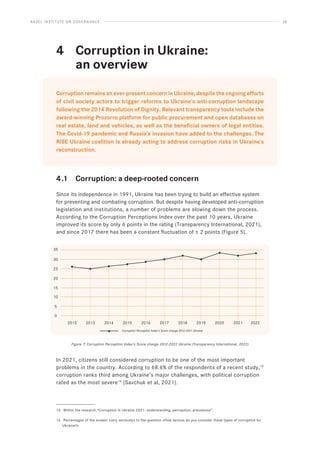
According to the Corruption Perceptions Index over the past 10 years, Ukraine
improved its score by only 6 points in the rating (Transparency International, 2021),
and since 2017 there has been a constant fluctuation of ± 2 points (Figure 5).
Figure 7: Corruption Perception Index’s Score change 2012-2022 Ukraine (Transparency International, 2022)
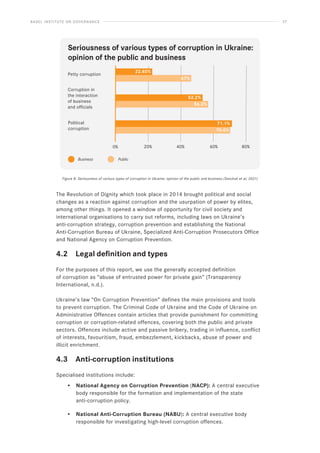
In 2021, citizens still considered corruption to be one of the most important
problems in the country. According to 68.6% of the respondents of a recent study,15
corruption ranks third among Ukraine’s major challenges, with political corruption
rated as the most severe16
(Savchuk et al, 2021).
15 Within the research “Corruption in Ukraine 2021: understanding, perception, prevalence”.
16 Percentages of the answer «very seriously» to the question «How serious do you consider these types of corruption for
Ukraine?»
0
5
10
15
20
25
30
35
2012 2013 2014 2015 2016 2017 2018 2019 2020 2021
Corruption Perception Index’s Score change 2012-2021 Ukraine
2022
BASEL INSTITUTE ON GOVERNANCE 27
Figure 8: Seriousness of various types of corruption in Ukraine: opinion of the public and business (Savchuk et al, 2021)
The Revolution of Dignity which took place in 2014 brought political and social
changes as a reaction against corruption and the usurpation of power by elites,
among other things. It opened a window of opportunity for civil society and
international organisations to carry out reforms, including laws on Ukraine’s
anti-corruption strategy, corruption prevention and establishing the National
Anti-Corruption Bureau of Ukraine, Specialized Anti-Corruption Prosecutors Office
and National Agency on Corruption Prevention.
4.2 Legal definition and types
For the purposes of this report, we use the generally accepted definition
of corruption as “abuse of entrusted power for private gain” (Transparency
International, n.d.).
Ukraine’s law “On Corruption Prevention” defines the main provisions and tools
to prevent corruption. The Criminal Code of Ukraine and the Code of Ukraine on
Administrative Offences contain articles that provide punishment for committing
corruption or corruption-related offences, covering both the public and private
sectors. Offences include active and passive bribery, trading in influence, conflict
of interests, favouritism, fraud, embezzlement, kickbacks, abuse of power and
illicit enrichment.
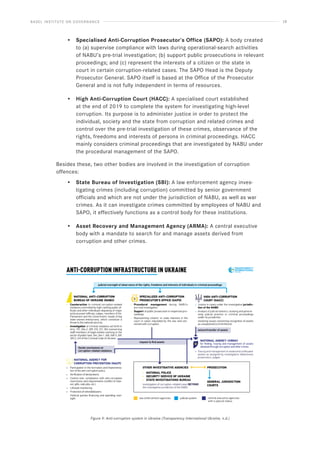
4.3 Anti-corruption institutions
Specialised institutions include:
• National Agency on Corruption Prevention (NACP): A central executive
body responsible for the formation and implementation of the state
anti-corruption policy.
• National Anti-Corruption Bureau (NABU): A central executive body
responsible for investigating high-level corruption offences.
Seriousness of various types of corruption in Ukraine:
opinion of the public and business
Petty corruption
Corruption in
the interaction
of business
and officials
Political
corruption
0% 20% 40% 60% 80%
70.4%
71.1%
56.2%
52.2%
47%
22.40%
Business Public
BASEL INSTITUTE ON GOVERNANCE 28
• Specialised Anti-Corruption Prosecutor’s Office (SAPO): A body created
to (a) supervise compliance with laws during operational-search activities
of NABU’s pre-trial investigation; (b) support public prosecutions in relevant
proceedings; and (c) represent the interests of a citizen or the state in
court in certain corruption-related cases. The SAPO Head is the Deputy
Prosecutor General. SAPO itself is based at the Office of the Prosecutor
General and is not fully independent in terms of resources.
• High Anti-Corruption Court (HACC): A specialised court established
at the end of 2019 to complete the system for investigating high-level
corruption. Its purpose is to administer justice in order to protect the
individual, society and the state from corruption and related crimes and
control over the pre-trial investigation of these crimes, observance of the
rights, freedoms and interests of persons in criminal proceedings. HACC
mainly considers criminal proceedings that are investigated by NABU under
the procedural management of the SAPO.
Besides these, two other bodies are involved in the investigation of corruption
offences:
• State Bureau of Investigation (SBI): A law enforcement agency inves-
tigating crimes (including corruption) committed by senior government
officials and which are not under the jurisdiction of NABU, as well as war
crimes. As it can investigate crimes committed by employees of NABU and
SAPO, it effectively functions as a control body for these institutions.
• Asset Recovery and Management Agency (ARMA): A central executive
body with a mandate to search for and manage assets derived from
corruption and other crimes.
Figure 9: Anti-corruption system in Ukraine (Transparency International Ukraine, n.d.)
BASEL INSTITUTE ON GOVERNANCE 29
4.4 Relevant transparency tools
After the Revolution of Dignity, Ukraine created different tools aimed at ensuring
transparency of information. One of these is the award-winning Prozorro electronic
public procurement system (Prozorro, n.d.). This is an online platform where state
and municipal customers announce tenders for the purchase of goods and services,
and business representatives compete for the opportunity to supply them to the
state (Prozorro, n.d.).
After 2014, the government opened up state databases on the owners of real
estate, land plots and vehicles, as well as information on the ultimate beneficial
owner of legal entities. Information from these databases and registers has
repeatedly served as the basis for high-profile journalistic investigations, business
and civil society.
In order to reduce the level of petty corruption, the government implemented
various measures to digitise public services. These include electronic queues
for obtaining, for example, driving licences or ID cards, plus the “Diia” mobile
application/web portal of public services. The portal simplifies the procedure for
obtaining a number of documents, transferring them to an electronic format and
thereby reducing corruption risks in the provision of public services.
4.5 Remaining challenges
Corruption remains a challenge, with particular concerns over political influence in
the judicial system and anti-corruption institutions, including encroachments on their
independence. Political influence is also cited in relation to anti-corruption policies,
including numerous delays in adopting the Anti-Corruption Strategy. The Anti-Corruption
Strategy was eventually adopted in June 2022 and, if properly implemented, should bring
qualitative changes to the anti-corruption process in Ukraine (Chumak et al, 2021).
Figure 10: Opinion of the public and business of the sectors, most affected by corruption (Savchuk et al, 2021)
The Covid-19 pandemic contributed to the deterioration of the corruption landscape
in Ukraine. Concerns were raised over the use of nearly half of the so-called “Covid
Fund” – primarily intended to help the healthcare system face the pandemic –
for road construction, mostly by companies connected with current politicians
and oligarchs (Bukatiuk, 2021). Another 9% was used to pay the salaries of law
enforcement officers, while medical workers received only 3% (Zanuda, 2020).
4.6
4.5
4.4
4.3
4.2
4.1
4.0
3.9
4.6
4.5
4.4
4.3
4.2
4.1
4.0
Opinion of the public Opinion of business
Judicial
system
Healthcare
Customs Land
management
Border
control
(except
customs...)
Permits for
mining
Customs Privatization
of the
enterprises
Forestry Public
procurements
in a road...
BASEL INSTITUTE ON GOVERNANCE 30
In addition, amendments to the Law On Political Parties mean that political parties
now independently decide whether to submit financial reports to the NACP or not.
According to experts, it is currently unknown how the political parties used UAH
1.5 billion of budget funds (Chesno Movement, 2021).
In addition to the horrific effects of Russia’s full-scale invasion of Ukraine on 24
February 2022, the war also revealed several problems related to corruption. One
is corruption in the process of providing humanitarian aid. During the war, cases of
the sale of humanitarian aid (Office of the Prosecutors General, 2022) and military
ammunition, which came as humanitarian aid (Ukrainska Pravda, 2022), have
become a concern. With the increase of these cases, Ukraine’s Parliament made
changes to the Criminal Code regarding responsibility for the illegal use of human-
itarian aid. In addition, NACP analysed typical corruption risks during the provision
of humanitarian assistance17
(National Agency on Corruption Prevention, 2022).
Despite the fact that the war is still ongoing, the Ukrainian Government, civil
society organisations and international partners are already making plans for
the reconstruction and restoration of the country. Civil society took the initiative
to raise awareness of corruption risks during this process, resulting in the RISE
Ukraine coalition18
of international and national organisations. Its work will focus
on integrity, sustainability and efficiency of Ukraine’s reconstruction.
17 Risks at the stage of determining the need for humanitarian assistance; risks at the stage of determining the sources
of meeting humanitarian aid needs; risks at the stage of customs clearance of humanitarian goods; risks at the stage
of transportation of humanitarian goods; risks in the warehouse logistics system; risks at the stage of distribution of
humanitarian aid.
18 Members of Rise coalition are Ukrainian NGOs and international NGOs such as the Basel Institute of Governance, Open
Contracting Partnership, Open Ownership.
BASEL INSTITUTE ON GOVERNANCE 31
5			 Corruption and illegal logging
Corruption may facilitate illegal logging through bribery of law enforcement
officers, forest management planners, forest pathologists, environmental
inspectors and land registration officials. Illegal logging by forest officials
themselves constitutes an abuse of power for private gain. Serious conflicts of
interest, indications of a vertical distribution of illegally obtained benefits, and
weaknesses in the criminal justice system make ongoing efforts to stamp out
corruption difficult. The Russian full-scale invasion added to the challenges, but
Ukraine’s new status as a candidate for EU membership is an opportunity to
address illegal logging and corruption in the forestry sector.
Corruption within the forest sector, despite having catastrophic consequences
for the environment and the wellbeing of the citizens, often fails to appear on the
anti-corruption agenda of both the government and international partners. Given its
relevance to Ukraine’s reconstruction and the risks of illegally logged wood from
Ukraine entering markets in the EU and elsewhere, greater understanding of the
relationship between corruption and illegal logging is critical.
Below is an overview of the relationship between corruption and different types of
illegal logging according to the typology in section 3.3. These are further explored
via the analysis of real cases in section 6.
5.1 Corruption and illegal logging by private actors
5.1.1 Illegal logging by local residents to meet their own needs
Corruption plays a minor role here. Local residents act on their own to meet their
needs. They generate losses for forest users, who try to oppose this form of illegal
logging. However, interviewees indicate that in some cases forestry officials allow
local residents to illegally cut deadwood for heating for a small bribe.
In many regions the official purchase of firewood from forest users is difficult
or sometimes simply impossible. This is due to the fact that forest users are
interested in selling firewood to businesses, and not to the public. It is currently
impossible to estimate the contribution of this factor to the prevalence of illegal
logging of subtype A1.
5.1.2 Illegal logging by criminal groups for profit
Corruption seems to play a much larger role here. Several interviewees consider
that illegal logging of subtype A2 may involve corrupt forestry officials. However, it
is not possible to estimate if this scenario is marginal or not.
BASEL INSTITUTE ON GOVERNANCE 32
By contrast, interviews with forest user employees, as well as an analysis of media
publications, suggest a broader issue of corruption related to law enforcement
officers. It seems that in many judicial cases so-called “black loggers” (criminals
involved in illegal logging) avoid punishment and get back confiscated equipment
through informal connections with local law enforcement agencies.19
Thus,
corruption in law enforcement agencies could be a key enabler of the activities of
“black loggers”. See the Dubky case study, section 6.1.
Nonetheless caution is needed. The research team has not identified cases of
corruption charges against law enforcement officers for covering for the activities
of “black loggers”. The assumption about the presence of corruption is based on
instances of apparent inactivity of law enforcement officers, as well as on the
opinions of the interviewed experts. The relationship between “black loggers” and
law enforcement agencies would require further investigations and analysis.
5.2 Corruption and illegal logging by forest
		 management officials
Illegal logging by forest management officials themselves (type B) appears deeply
interlinked with corruption and would mostly not exist without it. Corruption exists
in two stages:
5.2.1 Corruption at the stage of the preparation and felling
The most obvious manifestation of abuse of power for private gain is the very fact
of illegal logging being committed by forest officials themselves. According to
Ukrainian legislation, wood harvesting is in the vast majority of cases exclusively
the prerogative of forest management officials. A forest official is responsible for
obtaining permits for felling, the actual felling of trees, their transportation to the
warehouse and further sale. In practice this, together with weak controls discussed
below, leads to multiple risks of abuse.
Other individuals and organisations may also be involved in many of the illegal
logging activities of this type.
5.2.2 Corruption risks related to forest management plans
A significant share of logging activities is determined by the forest management
plans. For each Ukrainian forest user, such plans are developed every 10 years by
a separate structure - “Ukrderzhlisproekt”, which is part of SAFR management but
separate from forest users. Specialist planners are contracted by forest users.
According to interviewees working in the forest industry, as well as observations
of the authors of the report, “Ukrderzhlisproekt” specialists may manipulate the
management plans to benefit unscrupulous forest users. For example, Ukrainian
legislation envisages that final cutting is carried out only when the trees reach a
19 For example https://procherk.info/news/7-cherkassy/43122-hto-pokrivae-chornih-lisorubiv-na-cherkaschini or http://
poleznaya.dp.ua/%D0%BD%D0%B0-%D0%BD%D0%BE%D0%B2%D0%BE%D0%BC%D0%BE%D1%81%D0%BA%D0%BE%D0%B2%
D1%89%D0%B8%D0%BD%D1%96-%D1%87%D0%BE%D1%80%D0%BD%D1%96-%D0%BB%D1%96%D1%81%D0%BE%D1%80%D1
%83%D0%B1%D0%B8-%D0%BC%D0%B0%D1%81/.
BASEL INSTITUTE ON GOVERNANCE 33
certain age (“maturity age”), which differs for different tree species. If there are
several species of trees on the forest site at the same time, the age of maturity is
set for the most common species on the site. In practice, this can lead to manipu-
lations, when the age of maturity is set not according to the actual most common
tree species on the site, but according to the one that has a shorter age of
maturity. Thus, it allows the final cutting to be carried out earlier than it should be.
The research team was unable to find any documentary evidence that “Ukrderzh-
lisproekt” specialists receive bribes from forest management officials for manipu-
lating management plans. But some interviewees claim that such a practice takes
place. This issue would require further research.
5.2.3 Forest pathologists and sanitary felling
Carrying out sanitary logging is impossible without the appropriate decision of forest
pathologists – specialists in the fight against diseases and pests in forests. Formally
independent from forest users, forest pathologists in practice receive funds from
forest users for forest surveys. This gives rise to an obvious conflict of interests
because budgetary funding for forest pathology stations is absent or insufficient.
The interviewees claim that it is common for forest pathologists to receive bribes
from forest users to allow the sanitary felling of trees that are actually not affected
by any pests or diseases. However, the research team was not able to find
documentary evidence of bribery among forest pathologists or their prosecution for
providing false information in documents for sanitary felling.
5.2.4 Issues at the core of forest management
Various interviewees considered that most cases of corruption in forest users are
related to the management of the forest industry. According to them, forest users
unofficially receive an instruction “from above” to transfer a certain amount of
funds “upward” within a specified period of time.
Forest users might collect such funds by carrying out illegal logging or via manipula-
tions during the sale of wood. Thus, the profit from illegal logging may be distributed
not only “within” the SFE or other forest user, but also partially transferred “upwards”.
Corruption issues among former top managers of the forest sector of Ukraine
were described in details by the British NGO Earthsight (Earthsight, 2018). But
this investigation mostly refers to cases 8-10 years ago. We are not aware of
any recent criminal cases regarding corruption in the management of the forest
industry of Ukraine. At the same time, due to the shortcomings of anti-corruption
law enforcement, the absence of such cases is not a reason to believe that
corruption is not happening among forest management top authorities. Some inter-
viewees also pointed out that the State Security Service (SSS) as well as other law
enforcement agencies might also be involved.
The scale and the roots of corruption in forest management hierarchy clearly need
further investigation. Effective elimination of corruption in the forest sector of Ukraine
may be impossible without its elimination in the top management of the sector.
BASEL INSTITUTE ON GOVERNANCE 34
5.3 Corruption in controls and sanctions
The systematic identification and punishment of officials guilty of illegal logging of
type B would significantly reduce their prevalence. However, in practice identifi-
cation of such behaviours is limited and subsequent prosecution is rare. A number
of factors lead to inadequate controls.
5.3.1 Conflicts of interest and vertical distribution of benefits
First, the function of protecting forests from illegal logging is partially entrusted
to a structure called the State Forest Guard. This includes forest management
officials, regional bodies and the central apparatus of the SAFR. Representatives
of the State Forest Guard (= forest management officials) are not interested in
detecting illegal logging which they themselves carry out. In practice, the forest
guard deals only with the detection and prevention of illegal logging not related to
forest management officials themselves (type A).
In theory, the identification of illegal logging could be carried out by officials of
regional bodies and the central apparatus of the SAFR, who also have the status
of State Forest Guards and are not involved in logging themselves. In practice,
it is hard to ascertain whether this happens or not. The results of internal audits
conducted annually by SAFR are usually not provided to law enforcement agencies
and are not public (UNCG, 2022). Various interviewees considered that the reason
is a vertical system of distribution of illegally obtained revenue – from the lowest-
ranked officials of forest users to the representatives of the central office of the
SAFR and even higher, although this information is not supported by any official
investigations.
After the 2022–23 reform that unified all SFEs under SAFR supervision into the
single state company Forests of Ukraine, responsibility for forest protection will
be separated between SAFR authorities and authorities of the state company. It
is unlikely that this division will bring positive changes: the capacity of SAFR to
identify illegal logging is low, while the authorities of Forests of Ukraine still face
conflicts of interest and remain linked to the SAFR regional bodies.
5.3.2 Bribes in environmental inspections
In Ukraine there is another body responsible for identification of illegal logging
– the State Environmental Inspectorate of Ukraine (SEI). This body is not in the
sphere of SAFR management, which means that it does not work in conditions of
a serious conflict of interest, as happens with the State Forest Guard. However, in
practice, the efficiency of the SEI appears low.
All interviewees considered that the SEI is affected by corruption. The salary of an
ordinary SEI inspector in 2020 was up to UAH 11,000 per month (some EUR 300),
which is obviously insufficient for the honest performance of official duties, as well
as for new and qualified people to become SEI inspectors. The experts interviewed
claim that corruption is widespread during SEI inspections, for example that forest
management officials pay a “tax” to SEI to avoid identification of violations.
BASEL INSTITUTE ON GOVERNANCE 35
In addition, the existing legal framework does not contribute much to effective
environmental control. For example, the SEI can conduct unscheduled inspections
of forest users exclusively at the request of individuals, as well as after warning
forest users about the inspection in advance. Forest users can also officially
prevent the SEI from starting the inspection, which entails the imposition of a
meagre fine of UAH 760 (some EUR 20).
As a result, the analysis of the Unified Register of Court Decisions and media
publications shows cases of bribery among SEI officials. See the case studies in the
following section.
In theory, other law enforcement agencies are involved in the detection of illegal
logging – the National Police, the State Bureau of Investigation (SBI), the State Security
Service of Ukraine (SSS). In practice, cases of identification of illegal logging by
these bodies are rare and unsystematic. Moreover, these bodies have no monitoring
function. Interviewees also claim that these bodies lack competences in forest
management, which also decreases their effectiveness in preventing illegal logging.
5.3.3 Issues with criminal proceedings
The identification of illegal logging and the initiation of criminal proceedings do not
always guarantee that the perpetrators will be brought to justice. Consideration by the
prosecutor’s office and courts of many cases of illegal logging drags on for years.
In many cases suspicion of illegal logging, if it comes to an investigation or a court,
is received by “masters of forests” – the lowest position in the forest enterprise.
According to the interviewed experts, in such cases foresters act as “scapegoats”
because illegal logging mostly takes place with the knowledge of high-ranking
forest officials.
Experts also point to the ineffectiveness of the mechanisms countering illegal
logging. Among the main gaps they see:
a. lack of a proper and/or reliable method of calculating the financial damage;
b. insufficient counteraction to corruption schemes in the field of felling, trans-
portation and import of wood by the existing control bodies;
c. lack of witnesses to help expose corrupt officials;
d. lack of significant success stories in cases of corruption and money
laundering related to criminal activities in the forestry sector;
e. fictitious companies created to accumulate funds from criminal activities.
5.3.4 Efforts to improve controls and sanctions
Over the last decade, initiatives designed to reduce illegal logging have included:
1. The requirement that trees are to be selected for felling by persons
other than those who will carry out the felling. However, this gave little
result because the illegal profit obtained during felling may be vertically
BASEL INSTITUTE ON GOVERNANCE 36
distributed among the officials of forest users, as well as regional SAFR
bodies. In other words, all forest officials, not only those directly involved in
logging, may be interested in illegal logging.
2. An initiative to increase transparency by publishing documents related
to logging (permits, forest maps) on an online portal.20
Sanitary felling
plans and related documents were published on the websites of SAFR
regional bodies. Access to such information was an important prerequisite
for the work of civic activists engaged in combating illegal logging. However,
in many cases the published information was outdated, inaccurate or incom-
plete. After the Russian invasion of 2022, most of the previously public data
was closed or limited. In addition, there was a change of concepts - forest
officials noted that any felling indicated on the online portal is legal.21
.In
practice, illegal logging of subtype B2 also appeared on the portal.
3. The “digitalisation” of the forest industry, via a system of electronic
accounting of wood (ETA). Information about harvested wood is entered
into an electronic database directly during the felling together with a unique
identification tag. The aim was to prevent the circulation of illegally logged
wood or manipulations with underestimation of the quality of wood. In
practice, the ETA system gave modest results. Field research conducted by
activists shows that in many cases forest users ignore the requirements to
tag wood and enter data into the system.22
In addition, only forestry officials
have full access to information from the ETA system, and forest management
officials themselves can change previously entered data. Despite the fact
that information on timber harvesting exists, the public has no way to track
the movement of harvested timber from the point of felling to the places of
further processing.
4. A recent reform of the forest management structure. As of January
2023, the Ukrainian Government has united all forest users under SAFR
management into one state company, Forests of Ukraine. The stated aim
is to improve forest management efficiency, remove conflicts of interests
and increase financing possibilities within the forest industry. The reform
has faced serious opposition from many stakeholders.23
Some question the
financial and economic justification and point to the many risks, especially
in wartime conditions. Others fear the reform may be a first step towards
privatisation of the forests in Ukraine. At the time of writing, the reform is
far from complete, although the state company Forests of Ukraine uniting
former SFEs under SAFR supervision has already been established. At
the same time, the reform provides a window of opportunity to improve
measures aimed at eliminating illegal logging and corruption in the forest
sector of Ukraine.
20 See https://www.ukrforest.com/.
21 See https://tsn.ua/ukrayina/lis-u-smartfoni-chomu-ta-yak-onlayn-kontrolyuvati-lisove-gospodarstvo-1486326.html.
22 For example, see https://uncg.org.ua/berehivskyj-lishosp-manipuliatsii-pid-chas-povnomasshtabnoi-vijny/.
23 For example, the reform was opposed by some current forest sector employees, local authorities, as well as members
of the Parliament of Ukraine. For more details see https://www.epravda.com.ua/columns/2022/08/19/690606/ and
https://www.epravda.com.ua/columns/2022/09/28/691967/.
BASEL INSTITUTE ON GOVERNANCE 37
5.4 Corruption and illegal forest conversion
Numerous cases of illegal alienation of state-owned forests to private or communal
ownership is also a subject of corruption. To be legal, such alienation requires
approval by the Cabinet of Ministers of Ukraine. However, officials responsible for
land registration illegally develop documents for alienation of forests and include
the information in the land registers, even though no approval was made.24
As a
result, lands previously considered as “forests” are converted into other categories
of land use with subsequent deforestation. The beneficiaries of the scheme are the
new “owners”, which use them for construction or other business-related activities.
Technically speaking, cutting of trees on previously “forest” lands is not logging
because it is not a part of a normal forest management process. At the same time,
illegal alienation of forests leads to deforestation so it is worth considering the
issue of bribery among land registration officials.
Similarly, officials or registrars may deliberately ignore the presence of forests
on reserve lands or other lands, transferring them to private ownership for infra-
structure projects, development or agriculture. It is currently impossible to assess
the influence of corruption on such decisions.
5.5 Changes and prospects in the context of the
		 Russian invasion of 2022
The full-scale Russian invasion in 2022 has certainly not improved the situation
with illegal logging:
• With the beginning of the full-scale invasion, the authorities decided on a
moratorium on inspections by the SEI.25
• A decision was made to restrict public access to previously public
documents and data on logging (forest maps, logging plans, permits,
results of SEI inspections etc.).
• The capacity of NGOs that deal with illegal logging issues has decreased to
due to a lack of financing, staff loss and a diversion of public interest.
• Russia’s attacks on Ukraine’s energy infrastructure significantly increased
the country’s need for firewood. Moreover, the government directly
declared its intention to increase the volume of felling, not only to provide
people with firewood but also to support the economy.26
In the absence of
controls, this can lead to a proportional increase in both unsustainable and
illegal logging.
24 The examples of such cases can be found at https://uncg.org.ua/deryban-1459-hektariv-lisu/ and https://ecopolitic.
com.ua/ua/news/dijshlo-do-sudu-pid-kiievom-nezakonno-zahopili-zemli-lisovogo-zakaznika/. The latter case is
described in details in the next section.
25 See a Decree of the Cabinet of Ministers of Ukraine #303 of 13, March 2022 (https://zakon.rada.gov.ua/laws/
show/303-2022-%D0%BF?lang=en#Text).
26 See footnote #8 above.
BASEL INSTITUTE ON GOVERNANCE 38
At the same time, in 2022, Ukraine received the status of a candidate for EU
membership, and the EU itself remained the main large consumer of wood and
wood products from Ukraine. Already in the near future, Ukraine can start the
accession procedure, which will be accompanied by the implementation of
European legislation, in particular, regarding the prevention of corruption and
illegal logging.
Similarly, recent changes to EU legislation will force European countries to make
additional efforts to verify the legality of Ukrainian timber exported to the EU. All
this creates opportunities and even an urgent need for synergistic work of Ukraine
and the EU to eliminate illegal logging and corruption in the forestry sector.
BASEL INSTITUTE ON GOVERNANCE 39
6			 Case studies
6.1 The Dubky forest case
So-called black loggers completely destroyed a 10-hectare forest located on
reserve lands. Despite copious evidence of their identity and crimes, the perpe-
trators were never arrested and criminal proceedings were dropped. Corruption
is seen as the most likely reason for the inaction of law enforcement.
In 2018, the media of the Transcarpathian region published a number of materials
on the “Dubky” forest – a massif of oak forest of ​​
about 10 hectares near the town
of Tyachiv. The journalists focused on large-scale illegal logging without permits
carried out by “black loggers”. Trees disappeared almost every week, threatening
to completely destroy the forest massif. Calls to law enforcement agencies and
publicity in the media did not do much to solve the problem.27
The field research carried out during the preparation of this report, as well as the
analysis of satellite images below, make it possible to assert that the Dubky forest
was completely destroyed by black loggers. As of October 2022, not a single tree
older than 20–30 years remains.
27 For more details please refer to https://goloskarpat.info/analytics/5c1d568e42ba7/ and https://goloskarpat.info/
society/5cefb0999249d/?utm_content=03134.
CASE 1 (Dubky Forest)
CASE 3 (Brustury SFE)
CASE 4 (Unava Nature Reserve)
CASE 2 (Huta SFE)
BASEL INSTITUTE ON GOVERNANCE 40
Figure 11: Dubky forest in 2017 (left) and 2022 (right)
The Dubky forest was located on state-owned reserve lands, i.e. not used by any
private or legal entity. In fact, no one was responsible for its preservation, although
oversight was nominally supposed to be done by the regional state administration.
Law enforcement agencies knew about the illegal logging in the Dubky forest: back
in 2018, SEI representatives surveying the forest massif recorded 239 illegally
felled oaks.28
Both the local SFE and local authorities disclaimed responsibility. The
local authorities stated that the territory is state-owned reserve land so it is not
their responsibility to protect it.
Figure 12: One of the last large oak trees of the forest, felled in late summer/autumn 2022.
The entire area in the photo was completely covered with forest back in 2017.
28 See https://www.facebook.com/ZakarpattiaNews/videos/2245751652319301/.
BASEL INSTITUTE ON GOVERNANCE 41
Local activists and journalists have stated, including in filmed news reports, that
the black loggers working in the Dubky forest are three local residents who were
repeatedly seen during the commission of the crime. Sawing of felled trees at
local private sawmills was also recorded. However, the police never arrested the
suspected loggers, even after one rammed a police car while trying to escape with
the illegally cut oaks.29
Most of the proceedings have been closed by the police.
Those that have not yet been closed are delayed.
Local journalists and activists estimate that the most likely reason for the closure
of criminal proceedings against black loggers is their corrupt connections with the
local police. Otherwise, in their opinion, it is impossible to explain the inaction of
the police.
Analysis
This case is an interesting illustration of some aspects related to illegal logging of
subtype A2 (illegal logging by criminal groups).
Firstly, the targeted forest massif was located on reserve lands, that is, it was
actually nobody’s property. As a result, no state or local authority was allowed to
use it and therefore not directly invested in its protection, and this situation was
most likely known to the black loggers. As the representatives of the regional
administration of the Transcarpathian region noted back in 2016, there are at least
21,000 hectares of such forests in the region. There are hundreds of thousands
of hectares of such forests in Ukraine, and they are the primary target of black
loggers (Environment-People-Law, 2020a).
Secondly, the available information (including even video footage) makes it possible
to accurately identify the local residents who carried out the illegal logging. Their
names are well known to journalists and activists. Nevertheless, law enforcement
agencies (primarily, the police) from 2018 to 2022 were unable to prosecute even
one of them.
This situation appears widespread throughout Ukraine. Most likely it is the result
of the corruption of local police representatives. There are various other cases in
which black loggers, identified right at the scene of the crime, were never brought
to justice and were even able to get back confiscated equipment and vehicles.30
It is also worth noting that this case is an extreme example of the activity of black
loggers. Most often, although not always, their illegal activities do not lead to
the disappearance of entire forest massifs, but rather is limited to the felling of
individual trees.
29 Information from the investigative journalist interviewed, as well as from an official request to the National Police of
Ukraine.
30 The examples of such cases are provided in footnote #19. The statement was also supported by the majority of the
experts interviewed.
BASEL INSTITUTE ON GOVERNANCE 42
6.2 The case of the head of the Huta SFE
The head of a state forest enterprise faces charges for illegal logging without
permits and was convicted in 2022 of attempting to bribe an anti-corruption
official. Suspicion of involvement of forestry officials in such large-scale illegal
logging is widespread, but most cases are neither reported not prosecuted. The
case highlights issues with conflicts of interest, a lack of capacity and the devas-
tating profitability of illegal logging.
In July 2019, media reported how the newly elected President of Ukraine,
Volodymyr Zelenskyi, inspected logging in the forests of the Kharkiv region from
a helicopter. On the same day, the President called a meeting in Kharkiv with the
Prime Minister and other officials to discuss illegal logging. As President Zelensky
stated, he wanted to find out what was happening in the Kharkiv region with the
forest – “more precisely, with this place where it [a forest] used to be.”31
At the meeting Ruslan Chaharovskyi, head of one of the SFEs of the Kharkiv region,
reported that when he returned to work after parental leave he discovered evidence
of large-scale of illegal logging without permits. In particular, a survey of only 10%
of the territory of the SFE found illegally cut trees with a total volume of about
8,000 cubic meters (some 38 football fields). Chaharovskyi also reported large-
scale illegal logging in other SFEs of the Kharkiv region. He accused a wide range
of people of carrying out illegal logging – from the leadership of law enforcement
and state forestry authorities to specific officials on the ground. One was the then
head of the “Huta” SFE. President Zelensky called him and asked him to appear at
the President’s Office the next day.
After such a high-profile event, law enforcement agencies paid attention to the
Huta SFE and its head. While they were collecting information, another high-profile
event took place.
In November 2019, the head was detained for trying to bribe a NABU detective. The
amount he offered was USD 110,000. The man had transferred USD 10,000 “by
mistake” and asked the NABU detective to return them. According to the materials
in the criminal proceedings, the bribe was intended to close NABU’s investigation
into illegal logging and other violations in the Huta SFE.32
The court proceedings regarding the man’s attempt to bribe a NABU detective lasted
until 2022 and also deserve attention. Almost immediately after the arrest, the court
released him on a bail of UAH 5 million (about USD 185,000) but refused to remove
31 For more details please refer to https://www.mediaport.ua/zelenskiy-u-harkovi-obgovoriv-pitannya-nezakonnoyi-rub-
ki-lisu and https://www.ukrinform.ua/rubric-regions/2742422-zelenskij-zatelefonuvav-cinovniku-z-naradi-pan-si-
sa-mi-tut-vas-cekaemo.html.
32 More details are provided in the court decision (case #991/4996/20) available at https://reyestr.court.gov.ua/
Review/103409303.
BASEL INSTITUTE ON GOVERNANCE 43
him from the post of director of the Huta SFE.33
His dismissal only took place in
January 2020. On 17 February 2022, he was found guilty of bribery. He was sentenced
to five and a half years of imprisonment with partial confiscation of property.34
At the same time, the case regarding illegal logging and other violations committed
during his time as as the head of the Huta SFE is still not resolved. In 2019, the SEI
found that at least 750 trees were cut down without official permits on the territory of
the Huta SFE.35
It is likely that these are not all related to illegal logging without permits.
As it seems difficult to cut so many trees without the SFE knowing about it, it is likely
that at least part of these illegal activities were conducted with Sysa’s participation.
Illegal logging and bribery cases are not the only cases in which this same man
appears to be involved. According to preliminary data, as the head of an SFE,
he allegedly sold “black” wood to companies, including those related to himself
or his wife. The available information indicates the sale of “legal” wood to such
companies at reduced prices. The estimated amount of losses to the state is more
than UAH 50 million (about USD 1.8 million). The verdict in this case has not yet
been pronounced.36
Analysis
This case of Victor Sysa is a vivid illustration of illegal logging of subtype B1 –
illegal logging without permits carried out by forest management officials. In this
case the director of an SFE, systematically harvested wood without any permits,
subsequently selling it to private companies connected to himself. This is a clear
case of abuse of entrusted power for private gain.
Currently, there is no official information available on the total volume of illegal
logging related to his activities.37
The question of the actual volume of illegal logging by forest management officials
is raised by Chaharovskyi’s statement that in just 10% of the territory of one
sub-division of his SFE, at least 8,000 cubic meters of illegal felling without permits
had taken place while he was on parental leave. Chaharovskyi connects most of
this with SFE officials. Thus, the official statistics of the State Agency of Forest
Resources of Ukraine – just 25,800 cubic meters of illegally harvested wood in
2021 throughout Ukraine – seems widely underestimated. Especially given the
fact that this figure is supposed to include not only illegal logging of subtype B1
described in this section, but also all illegal logging of type A.
33 See https://kh.vgorode.ua/news/sobytyia/415082-skandal-s-vyrubkoi-lesov-y-vziatkamy-hlava-leskhoza-na-khark-
ovschyne-sysa-ostaetsia-v-dolzhnosty.
34 See footnote 25.
35 See https://kh.depo.ua/ukr/kh/virubka-lisiv-na-kharkivshchini-sud-styagnuv-na-korist-derzhavi-7-mln-
grn-202109081365804.
36 See court cases #991/1071/22 (https://reyestr.court.gov.ua/Review/103504107#) and 991/1109/19 (https://
reyestr.court.gov.ua/Review/87452227).
37 The research team did not manage to obtain primary documentation from the SEI, because, since the beginning of
the full-scale Russian invasion of Ukraine, its unit in the Kharkiv region works only remotely and cannot share the
documents.
BASEL INSTITUTE ON GOVERNANCE 44
This case is not typical for Ukraine. Generally the detection of large-scale illegal
logging is not accompanied by prosecution of the management of SFEs. For example,
in 2020, about 700 illegally felled trees were found within the territory of the Yasinya
SFE in the Transcarpathian region.38
It is most likely that such large-scale illegal
logging would have been impossible without the knowledge and participation of SFE
officials. Nevertheless, suspicion was announced only to the low-ranked forest officials
under the article “official negligence”. That is, officials “did not ensure the protection
of forests from unknown black loggers”. It is noteworthy that unlike lowest-ranked
forestry officials, the head of a SFE has no legal personal responsibility for illegal
logging without permits within the SFE’s territory.
A similar case was recorded in 2021 in the Transcarpathian region during the
transfer of a territory’s control from the Irshava SFE to the Dovha SFE. The volume
of recorded illegal logging amounted to 3,380 cubic meters of wood (about 10
hectares of forest on average), but there is no information on the prosecution of
the then management of the SFE in public sources.39
What are the challenges in combating illegal logging committed by forest
management officials? One of the most problematic aspects is their identification.
It is obvious that representatives of forestry enterprises, who are in the forest
every day, have the best opportunities to detect illegal logging. However, if such
logging is connected with forest user officials, a conflict of interests arises. As
already mentioned above, the State Forest Guard consists entirely of employees
of the SFEs themselves, who are unlikely to report illegal logging activities of
themselves or other SFEs employees.
There are no conflicts of interest in the case of an inspection of the forest user by
third-party bodies, for example the SEI or other law enforcement agencies. But in
practice, scheduled inspections of the SEI take place no more than once a year.
SFEs or other forest users know about the inspections in advance. The format of
scheduled inspections allows one to inspect only specific areas in the forest; there
is no broader monitoring of the territory. The effectiveness of the SEI’s work would
be greatly increased if they could conduct raids or large-scale inspections on their
own initiative. But current legislation does not allow SEI officials to take these or
other measures that are more suitable for detecting large-scale illegal logging. In
addition, since the beginning of Russia’s full-scale invasion , the Ukrainian author-
ities have generally established a moratorium on any inspections of businesses,
including forest users.
Neither the SBI nor other law enforcement agencies have the authority to monitor
forests. They can work on illegal logging only when they receive reports of illegal
logging from third parties. In addition, according to some experts interviewed, law
enforcement agencies (SSS, SBI, National Police etc.) lack understanding of the
specifics of forestry, which also reduces the effectiveness of their work.
In addition, it is problematic to establish the relationship between forest
management officials and specific cases of illegal logging. In most cases, the
38 See https://goloskarpat.info/criminal/5f05c8cc6f55d/.
39 See https://zak.gp.gov.ua/ua/news.html?_m=publications_c=view_t=recid=308856.
BASEL INSTITUTE ON GOVERNANCE 45
detected illegal logging is attributed to “unidentified third parties”, that is,
classified as illegal logging of type A. Even in the case of the high-profile case of
described above, the final verdict on the connection between the head of the SFE
and illegal logging on his territory is still missing. In other words, in practice it
is almost impossible to establish whether representatives of the forest user are
involved in any particular tree cut down without permits. Analysis of the register of
court decisions shows that most often such illegal logging is attributed to “uniden-
tified third parties”.
The case is also indicative of the monetary value of illegal logging. The USD 110,000
bribe to the NABU detective is a particularly large bribe according to Ukrainian
legislation. Possible losses from the illegal activities are at least UAH 50 million
(about USD 2 million at the exchange rate of 2019). These estimates refer to only
one SFE with an area of ​​
about 30,000 hectares or approximately 0.3% of Ukraine’s
forests. Extrapolating, one can only wonder at the potential high monetary value and
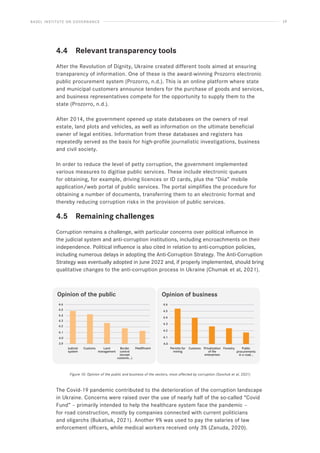
devastating impact of illegal logging across the country.
6.3 The case of illegal sanitary logging in the
		 Carpathian region
Healthy trees were designated for sanitary felling with the suspected collusion
of forest pathologists. Despite activists reporting the issue, no violations were
reported and the trees were cut down. Illegal sanitary logging could be happening
on a massive scale, along with other forms of illegal logging carried out with the
collusion of forest officials. Thanks to their paperwork, such wood can easily enter
legal markets.
In June 2020, a group of activists from Free Svydovets Group and Ukrainian
Nature Conservation Group conducted a field survey of the Yasinya and Brustury
SFEs, where sanitary felling was planned. The purpose of the survey was to find
out whether sanitary logging of healthy trees was planned, which is expressly
prohibited by Ukrainian legislation.
Both SFEs are located in the Ukrainian Carpathians, a mountainous region rich in
old forests and wildlife including lynxes and bears. The issue of illegal logging is
perhaps the most acute here, because of its impact on biodiversity, erosion and the
hydrological regime of rivers.
The inspections were done after the trees were marked for logging but before
the logging started. In the Brustury SFE, numerous live and healthy trees illegally
selected for sanitary cutting were found in each of the eight inspected plots. A
similar situation was observed in the nearby Yasinya SFE, where violations were
detected in four of the seven examined plots (Free Svydovets Group, 2021).
BASEL INSTITUTE ON GOVERNANCE 46
Figure 13: The forest plot where illegal sanitary clearcut was planned and subsequently carried out in the Brustury SFE.
Although the documents state that most of the trees on the site were windthrown or declining, this photo (taken before the
logging in question started) shows this is not the case.
Regarding the sanitary cuts planned in 2020 at the Brustury SFE, the activists sent a
request to the SEI to initiate an unscheduled inspection and record violations. However,
at the time of conducting such an unscheduled inspection (2–3 weeks after receiving
the appeal), SEI found that all but one of the sanitary cuts had already been completed,
that is, all the trees had already been cut down. It was impossible to register a violation
on the stumps. Only in one case did the SEI confirm the intention to cut down healthy
trees and turned to the SFE with the aim of cancelling the logging permit.
In 2020, representatives of WWF Ukraine also discovered a number of areas in the
Brustury SFE where healthy trees were planned to be felled with sanitary cutting
under the guise of diseased and windthrown trees. Likewise, the SEI’s inspection
yielded no results. In one of the sites where illegal sanitary cutting was planned, at
the time of the inspection the necessary permit documents were missing, so SEI
representatives did not record the violation. After the inspection, the SFE quickly
completed the documents and felled the above-mentioned plot (WWF, 2020b).
In 2022, representatives of the Ukrainian Nature Conservation Group carried out
a survey of six more future sanitary logging sites planned by the Brustury SFE.
Similarly, numerous live and healthy trees were planned for felling, some of which
were obviously downgraded in their classification: according to the documents, all
the trees taken for sanitary felling were classified as firewood, although in fact they
were of superior commercial value (UNCG, 2022b).40
Adding to the evidence of abuse of sanitary felling legislation, a study published by
WWF Germany states that only about 20% of randomly selected areas of sanitary
cuts were designated properly (WWF, 2019).
40 This common scheme allows SFEs to sell commercial wood as “firewood”. The difference in monetary value of the wood
is unofficially provided back to SFEs by wood consumers.
BASEL INSTITUTE ON GOVERNANCE 47
Analysis
This case is an excellent illustration of a widespread problem in Ukraine – illegal
logging “with papers” (subtype B2), of which illegal sanitary logging is the most
common variant. It is concerning because the scale of sanitary logging in Ukraine is
massive: in 2021, it accounted for 44.6% of wood officially harvested in Ukraine.41
The Brustury SFE, which appears in the case described above, harvested more than
52% of wood with sanitary logging in 2021.
According to the current legislation, sanitary felling can be carried out in almost
all types of forests, except for those that are in protected areas under strict
protection. Thus, forest officials use sanitary logging where other types of logging
are limited, including in the most environmentally sensitive forests and in protected
areas (Free Svydovets Group, 2021).
Sanitary logging is supposed to combat “forest pests and diseases” or to remove
weakened and diseased trees before the wood begins to lose its quality and value.
It is a highly regulated process that requires numerous approvals from various
authorities. The main one is the approval of forest pathologists, i.e. specialists in
the protection of forests from diseases and pests. In Ukraine, forest pathologists
work in the forest protection stations, which are independent from forest users
but subordinated to SAFR. According to the procedure, forest users invite
forest pathologists to inspect planned sanitary cuts, officially paying for such
inspections.
Forest pathology stations do not have enough budget funding, therefore, receiving
funds from forest users for inspection of planned sanitary cuts is one of their main
sources of income. It is obvious that in this case, a conflict of interests arises,
which is most likely accompanied by corruption. Interviewed experts explained
that forest pathologists have a pre-set “tax” (i.e., the amount of a bribe from
forest users) for each cubic metre of wood that will be harvested during sanitary
logging, which requires the consent of forest pathologists.
However, we did not manage to find information about any criminal case against
forest pathologists for entering false information about the condition of trees in the
documents for sanitary felling.
After obtaining the approval of forest pathologists, the forest user can issue a
logging permit for the fellings to itself. Other necessary documents are also issued
by forest users or developed with the involvement of regional forestry and hunting
departments, which are not actually independent bodies.42
One may ask: “If the benefit of forest pathologists from illegal sanitary logging is
obvious, what is the benefit of forest users?”
Firstly, illegal logging “with papers” is important for filling the budgets of forest
officials. Most are self-financed and depend on the money they earn from logging.
41 Data by State Statistical Service of Ukraine (https://www.ukrstat.gov.ua/).
42 Although declared independent, both SFEs and regional forestry and hunting departments are in SAFR subordination.
BASEL INSTITUTE ON GOVERNANCE 48
Thus, officials of a forest management authority may be interested in increasing the
volume of felling, including by felling that cannot be carried out legally.
Secondly, illegal logging “with papers” can be financially beneficial not only to the
forest authority as a whole but also for the personal gain of foresters. Any official
logging opens up opportunities for abuse and direct enrichment of individual
forestry officials. For example, illegal sanitary logging serves as an opportunity
for manipulations during the sale of wood (for example, underestimating the
quality of wood) or the opportunity to additionally cut down trees beyond the
limit established in a permit during an “official” felling. Regardless of the details,
experts interviewed note that in many cases it is the combination of the desire to
fill the budget of a forest user with a desire to obtain undue profit that is the key
motivation for conducting such illegal logging.
6.4 The cases of the environmental inspectors
Several cases attest to bribery of state environmental inspectors to turn a blind
eye to illegal logging and/or protect perpetrators from law enforcement. Bribes
are also paid to reduce the estimated amount of damage and thus reduce the fine.
Low salaries, a lack of financing and weak powers contribute to corruption risks
in monitoring and control bodies.
The case of the head of Ukraine’s SEI department in the Ivano-Frankivsk region
in 2018 (Yedynyi derzhavnyi reiestr sudovykh rishen, 2018) illustrates how
corruption in environmental control and supervision authorities contributes to
illegal logging. He was instructed to check whether the Bolekhiv SFE complies with
the requirements of environmental legislation in its activities. For this purpose,
a team of three inspectors was formed and all necessary documents for the
inspection were drawn up.43
However, he didn’t actually exercise his powers but, as was established by the
court, from the very beginning aimed to obtain an unlawful benefit from the repre-
sentatives of the Bolekhiv SFE. He entered into negotiations to reach an agreement
on obtaining an illegal benefit for not conducting an inspection and, as a result, not
detecting violations regarding possible illegal logging. He promised to influence his
own co-workers to achieve this goal. The amount of the bribe to “solve this issue”
was USD 7,000. After the illegal benefit was transferred, he was caught red-handed.
He was found guilty of corruption under Part 2 of Art. 369-2 of the Criminal Code of
Ukraine44
and sanctioned to a fine of UAH 25,500 (almost USD 909).
43 Direction No. 84 “On the implementation of a planned measure of state supervision (control) regarding compliance with
the requirements of legislation in the field of environmental protection, rational use, reproduction and protection of
natural resources in Bolekhiv SFE.
44 Acceptance of an offer, promise or receipt of an illegal benefit for oneself or a third person for influencing the
decision-making by a person authorized to perform the functions of the state or local self-government, or an offer or
promise to exert influence for the provision of such a benefit.
BASEL INSTITUTE ON GOVERNANCE 49
A similar case happened in September 2016, when the state inspector of the SEI
in the Kirovohrad region requested a bribe of UAH 8,000 from a private enterprise
(as of September 2016 – USD 307) (Grechka, 2016). A bribe was requested
for non-prosecution and non-accumulation of damages for about UAH 100,000
(approximately USD 3,834) for cutting down the forest. Previously, the SEI had
received a report about illegal felling committed in one of the districts of the
region. The investigation and clarification of the circumstances of this situation was
entrusted to the concerned state inspector. An interesting fact is that this person
was appointed to the position with a probationary period from 1st
August 2016 till
1st
September 2016. . And right after this, the newly appointed state inspector of
SEI demanded a bribe. We can conclude that after the appointment this inspector
realised the powers he was given with and that he can use them in an illegal way.
After arriving at the place of illegal logging, the state inspector found employees
of a private enterprise, including the head of this enterprise. The head of the
enterprise said that the enterprise had a logging permit dated April 2016, but he
did not have it with him. The state inspector decided to take advantage of this
situation and began to demand a bribe from the head for helping the enterprise
evade liability for committing illegal logging, which caused damage in the amount
of UAH 100,000. The head of the enterprise was forced to agree to these demands.
As a result, the state inspector was put into custody until the court hearings for
demanding and accepting the bribe (Part 3 of Article 368 of the Criminal Code of
Ukraine). As of today, according to the information available in the Unified Register
of Court Decisions, the state inspector has not been convicted (Yedynyi derzhavnyi
reiestr sudovykh rishen, 2016).
In 2021, similar cases were also discovered in the Zhytomyr and Donetsk regions.
In the Zhytomyr region in January 2021, the acting head of the SEI department
received an illegal benefit from the ‘black lumberjack’ in the amount of USD 600
for not bringing the concerned person to justice. The SEI official additionally
promised the violator to cover him from the law enforcement officers (Zhytomyr
region Prosecutor’s Office, 2021).
In January 2021, two employees of the SEI of the Donetsk region were detained for
obtaining illegal benefits (Part 3 of Article 368 of the Criminal Code of Ukraine).
The head and chief specialist of the control department demanded from the private
entrepreneur an unlawful benefit in the amount of UAH 25,000 (as of January 2021,
around USD 884) for reducing the amount of damages in the act of environmental
inspection. Such a reduction would make it possible to reclassify the case from
a criminal to an administrative one and reduce the amount of the fine for illegal
logging (Donetsk region Prosecutor’s Office, 2021).
Analysis
The following conclusions can be drawn from all these cases: active/passive
bribery cases are recurrent in monitoring bodies.
As indicated earlier, the average salary of SEI employees is about EUR/USD 300
per month . This circumstance contributes to push officials who have powers of
control and supervision in the field of protection, use and reproduction of forests to
BASEL INSTITUTE ON GOVERNANCE 50
use these powers for personal illegal enrichment. The amount of the bribes varies
from USD 200 to USD 7,000, depending on the level of the issue and the status of
the official. From one of the cases, we can see that people working in rural areas
are aware of the “prestige” of working in the SEI and the possibility of organising
illegal profits from positions in this institution. It is possible that such persons
purposefully go to work for the SEI in order to enrich themselves.
It is also interesting to analyse the ratio of the imposed fine in the first case of the SEI
inspector. Despite the fact, that p.2 of the art. 369-2 of the Criminal Code gives us
the strict list of penalties (fine with the amount of 2,000 to 5,000 tax-free minimum
incomes45
and imprisonment from 2 to 5 years), the court decided to impose 1,500
tax-free minimum incomes (UAH 25, 500) fine which is below the threshold provided for
by the art. 369-2. The court proceeded from the positive characterisation of the accused
person, his sincere confession and repentance. But at the same time, the court did not
consider the amount of the extorted bribe (USD 7,000), as well as the fact that Article
69 of the Criminal Code of Ukraine prohibits the imposition of a punishment milder
than prescribed by the law for a corruption criminal offense (Article 369-2 is one of
them). This fact raises the issue of judges’ awareness of the application of criminal
penalties for corruption offenses, as well as the proportionality between the size of the
object of a corruption offense and the criminal penalty for such an offense.
Forest users and private individuals, knowing about this situation, also use it to
avoid responsibility or reclassify actions from criminal to administrative. Do illegal
loggers prefer to pay a USD 300 bribe and continue their illegal activities or want
to pay almost USD 4,000 for damages to the state and possibly stop the business
altogether and get a criminal record? The solution is completely rational and logical.
Most interviewees believed that there is a corrupt component in the activities of
the SEI. Contributing factors are the low salary, the lack of financing of the body
(supplies, equipment, etc.) and the absence of proper powers to carry out full
supervision and control in the field of forest protection.
Weakening of controls by monitoring authorities, in turn, serves as a factor contributing
to the increase in illegal logging. The fact the violators are aware that there is a possi-
bility to avoid responsibility by bribing SEI inspectors generates a feeling of impunity.
It is worth noting that SEI conducts unscheduled inspections exclusively based on
reports of possible illegal logging. Verification of such statements is carried out
in coordination with the central office of the SEI. At the same time, SEI cannot
independently initiate the inspection. These circumstances became more complicated
because of a moratorium on inspections by state supervision (control) bodies during
wartime. Therefore, opportunities for personal enrichment are significantly reduced.
With this in mind, we can suspect that each report of possible illegal logging repre-
sents a kind of “window of opportunity” for corrupt officials to make a profit.
Corruption in control bodies thus directly fuels logging by citizens and organised
criminal groups, as well as illegal logging by forest users.
45 The tax-free minimum income is the amount of money which is used to determine the amount of criminal punishment in
the form of fine or confiscation. The amount of tax-free minimum income is UAH 17 (as of February 2023 – USD 0.46).
BASEL INSTITUTE ON GOVERNANCE 51
6.5 Cases of corruption related to unlawful
		 appropriation of forestry lands
Several cases illustrate how private individuals or enterprises, unscrupulous
land registrars and government officials collude to transfer state forested land
to private ownership for the purpose of development. Even when the corrupt
scheme is detected and the perpetrators sanctioned, the land is often not
returned to state ownership.
This type of case reveals how plots belonging to forestry enterprises suffer from
unlawful appropriation, alienation and transfer to private ownership. In the vast
majority of cases, alienated forests lose their “forest” status. Therefore, logging of
trees (for example, for building) is technically not considered as logging at all. As a
result, the relevant articles of the Criminal Code on illegal logging do not apply to
these cases. Illegal logging in this case is an action committed for the purpose of
obtaining collateral profit.
One of the recent examples of such cases is the expropriation of forests which occurred
in village Slavske (Lviv region, a village deep in the Carpathians). The most important
feature of this case is that the director of the Slavske SFE and the head of the Slavske
regional administration were involved in the organisation of the unlawful appropriation.
The concerned officials developed a corruption scheme to transfer the lands of the
forest fund, which were owned by the Slavske SFE, into private ownership. To achieve
this goal, a private enterprise was engaged, which provides engineering, geology and
geodesy services, as well as technical consulting in these areas.
The roles were distributed as follows: the head of the Slavske local council addressed
several local residents and offered them a reward in return for writing statements to
the Council about providing them with land plots for ownership, which were accepted
for consideration by the session. Later, the head encouraged the council members to
make a decision to grant permission to the above-mentioned citizens to develop land
management projects regarding the acquisition of land plots.
At this stage, another player of this scheme joined – a private enterprise that
produced land management projects for the specified land plots. This enterprise
intentionally didn’t include the information about the ownership of the specified
lands to the forest fund. This happened by entering false information about their
real location, establishing their false borders. Later on, the director of the Slavske
SFE approved the land management projects developed by the private enterprise
regarding the allocation of land parcels that are under the control of the concerned
forestry enterprise. Further, the developed projects of land management were
brought to the session of the Slavske local council, where they were approved by
the relevant decision. Thanks to this, it was possible to register the property rights
to the above-mentioned land parcels to fictitious persons for the purpose of their
subsequent re-registration to third parties.
BASEL INSTITUTE ON GOVERNANCE 52
Thanks to this scheme, it was possible to appropriate 22 land plots of the forest
fund, the total area of ​​
which is 26,5 hectares. As a reminder, in accordance
with the legislation, the allocation of land plots of the forest fund into private
ownership is carried out only in agreement with the Cabinet of Ministers of
Ukraine. However, the investigation, with the help of the SEI of the Lviv region,
established that the plots of land were illegally removed from the lands of the
forest fund, in violation of the rules for changing the purpose of land use (without
the approval of the Cabinet of Ministers of Ukraine). This case is still at the stage
of pre-trial investigation.
Analysis
The specified cases are vivid examples of the organisation of corruption schemes with
documents. There are potentially criminal offences provided for in Art. 191 (misap-
propriation, embezzlement, conversion, or property by abuse of power) and Art. 364
(abuse of power and official position) of the Criminal Code of Ukraine. Both offences
are considered as corruption crime within the meaning of national legislation.
Here we see two types of such violations:
a. committed by persons outside the system (private individuals/enterprises +
“black registrars”);
b. committed by persons who are in the system and who have the right to
dispose of land plots of the forest fund (representatives of local government,
representatives of forestry enterprises).
The first group includes the commission of illegal actions by persons who have access to
the State Register of Property Rights, the cadastral map, and other registers that record
the ownership of land. Registration takes place with the help of forged documents.
The second group includes abuse of power by local officials and forestry enter-
prises in order to allocate land plots to their own property or to the property of
third parties in exchange for an unlawful benefit. At the same time, in the second
group, we can observe the interaction of the private and public sectors in order to
achieve the illegal goal of taking over land plots of the forest fund. In the future,
in both groups, land plots can be used for commercial activities (construction
of cottage towns, recreation centres, hotel and restaurant complexes) or for
themselves (construction of private complexes, houses).
The existence of the corruption schemes was confirmed by the representatives of
NABU during the interviews conducted with them. The respondents noted that in
such cases it is important to file a civil lawsuit within the framework of criminal
proceedings for the return of land to state ownership.
The main problem in such cases is the lack of documents from forest users
confirming the right to use specific areas of forests. For example, the Fastiv SFE is
one of two SFEs in the Kyiv region that have state land deeds. Other forestry enter-
prises’ land may not have an established location, boundaries, dimensions, legal
status, etc. In accordance with the legislation, without land deeds, the right of the
SFEs to use the land is confirmed only by management plans, which are not tied to
the land cadastre and are regularly changed.
BASEL INSTITUTE ON GOVERNANCE 53
7			 Conclusions and
recommendations
7.1 Conclusions
It is currently impossible to reliably estimate the scale of illegal logging. However,
there are clear indications that millions of cubic meters of wood are illegally obtained
annually. The war context is leading to even more demand for wood and more threats
to forests. It is also impossible to accurately estimate the amount of illegally obtained
wood that is exported from Ukraine to other countries (including member states of the
European Union). However, it is clear that such exports still occur.
As concretely shown in the case studies of this report, illegal logging in Ukraine is
largely facilitated by corruption in the forestry industry but also in law enforcement
and monitoring agencies. The concept of illegal logging includes various types of
activities and beneficiaries and various patterns of corruption are at play. That is
why the development of strategies to combat illegal logging and related corruption
should take into account the specifics of each type of illegal logging.
Already before the war the significant volumes of illegal logging (especially illegal
logging “with papers”), represented a severe threat to the ecological security of
Ukraine. One single category of illegal logging – illegal sanitary felling of living and
healthy trees – has been a common problem across most regions of Ukraine and
even threatens protected forests. With the ongoing war, forests are under even more
pressure. As the needs grow (for firewood and timber for reconstruction), these
precious resources need to be managed sustainably to support a solid recovery.
If the issue of illegal logging and sustainable forest management in Ukraine is not
yet seen as a priority of the reconstruction agenda it could be seen increasingly as
a strategic national asset. Because the Ukrainian government needs to make the
most of the resources available in the west and the north under its control, forests
have a central role to play. The sustainable management of these important natural
resources is becoming more crucial than ever.
The lessons learnt from the past weaknesses of forest governance can help pave a
better path for forest management in the context of the reconstruction. The report
identified that Ukrainian authorities used to focus on combating illegal logging
carried out by non-forest users, often ignoring the much larger illegal logging
“with papers” carried out by the forest management officials themselves. This
happened partly because of a lack of awareness and competence. According to the
experts interviewed by the research team, the problem may be fuelled by the top
management of the forest sector of Ukraine, which may be directly interested in
receiving undue benefits as a result of illegal logging or other manipulations related
to wood, although this definitely needs further research.
Conflicts of interest in the forestry sector remain even if the public and experts
have been insisting on this issue for many years. Unfortunately, the current reform
of the structure of the forest sector (i.e. the unification of all state-owned forest
enterprises under the management of SAFR into one state-owned company), which
BASEL INSTITUTE ON GOVERNANCE 54
the Ukrainian authorities are working on, does not seem to be enough to eliminate
conflicts of interest and significantly reduce illegal logging.
That is why it is necessary to develop and implement a strategy and action plan to
radically reduce illegal logging in Ukraine and reduce the level of corruption in forestry
and related spheres. Such actions cannot take place without the political will of the
leadership of Ukraine (first of all the Office of the President of Ukraine), and without
the full and comprehensive support of the highest state authorities. The involvement
of civil society, often the main driver of reforms in Ukraine, is also required.
With the beginning of the full-scale invasion of the Russian Federation, local and
regional demand for Ukrainian wood is growing. The European Union became the
main gateway for the export of Ukrainian wood and wood products. In addition,
Ukraine received the status of candidate for EU membership, and with it the
obligation to bring its legislation and practices into line with those of the EU. There
are currently numerous shortcomings of the Ukrainian forest and nature conser-
vation legislation. Thus, even logging that is completely legal under Ukrainian
legislation can be extremely unsustainable and have dire negative consequences
for the environment.
Implementation of best standards of anti-corruption management is urgently needed
in the forestry sector. Authorised units (authorised persons) on the prevention and
detection of corruption and commissioners on the implementation of anti-corruption
programmes could become the first link in the prevention of corruption (falsification
of documents, active and passive bribery, abuse of power and official position, etc.).
For this, it would be necessary to review their legal status, improve the effectiveness
of their interaction with the NACP, which is the responsible body for working with
such persons, and other law enforcement agencies.
In addition, authorised units in forestry should establish an effective anti-corruption
system within the state enterprises in which they work: implement proper proce-
dures and reporting channels for whistleblowers, carry out regular educational work,
and conduct information work among enterprise employees.
Finally, they should promote the implementation of a culture of transparency and
integrity, including zero tolerance for corruption in the forest industry, and build
relationships based on mutual trust with their colleagues and employees. This will
contribute to the effective work of the commissioner. All this is included in the
concept of effective compliance at state-owned enterprises.
Key remaining gaps/needs
• It is not possible to reliably assess the scale of illegal logging in Ukraine,
although there is an understanding that such a scale is significant. It is
unclear whether such an assessment is even possible.
• There is no precise understanding of the further movement of illegal
timber, although there is an understanding that it is used both
domestically and exported.
BASEL INSTITUTE ON GOVERNANCE 55
• There is no detailed understanding of the situation of corruption at the
stage of sale and export of wood and its products.
• There is no detailed understanding of the presence of corruption in the top
management of the forest industry.
• There are no forestry specialists in law enforcement agencies (primarily
NABU and SBI), which limits the effectiveness of such agencies.
• The powers of the main supervisory body – SEI – are significantly limited
and the capacity is low.
7.2 Recommendations
7.2.1 Verkhovna Rada of Ukraine (Parliament):
• Amend the Criminal Code of Ukraine and the Code of Ukraine on Admin-
istrative Offences to detail the concept of “illegal logging” and include
all types of illegal logging, illegal logging “with papers”, as well as illegal
felling of trees in forests, which are not recognised as such in accordance
with land documentation.
• Amend the Criminal Code of Ukraine and the Code of Ukraine on Admin-
istrative Offences with the aim of introducing responsibility for knowingly
including false information in documents (land documentation, forest
pathology surveys, forest management materials etc.), which lead to illegal
felling of trees.
• Ensure the implementation of the strategy for reforming the management of the
forest sector developed by the Cabinet of Ministers of Ukraine (see below).
• Ensure the adoption of draft law No.3091 “On State Environmental
Control” which provides for the expansion of powers and increases the
capacity of the State Environmental Inspectorate of Ukraine.
• Provide amendment to the Art. 246 of the Criminal Code of Ukraine in
order to establish the criminal liability for committing illegal logging for the
purpose of obtaining any unlawful benefit for oneself or another individual
or legal entity through the abuse of authority or office. Additionally, amend
the Art. 216 of the Criminal Procedure Code of Ukraine to establish that
the newly created part of the Art. 246 of the Criminal Code of Ukraine falls
under the jurisdiction of the NABU.
• In general, contribute to the general reform of the judicial and law
enforcement system of Ukraine (detailed recommendations on this matter
are beyond the scope of this publication).
• Implement the best EU practices on corporate sustainability reporting,
which could help to increase transparency and integrity of the SOEs.
BASEL INSTITUTE ON GOVERNANCE 56
Most of these recommendations are based on existing draft documents and
concepts, so their implementation would not require significant technical work.
At the same time, there might currently be little political will to prioritise the
above-mentioned recommendations.
The lack of political will can be explained by both other priorities caused by the
Russian invasion, and by the opposition of the current beneficiaries of the corrupt
system (the forest industry, individual woodworkers and other business structures,
individual representatives of the governmental bodies). At the same time, there
is a strong support for reforms from ordinary employees of the forest sector,
woodworkers, as well as environmental NGOs.
7.2.2 Cabinet of Ministers of Ukraine (and relevant stakeholders)
• Develop a high-quality strategy and action plan for reforming the forest
industry, which would provide for the minimisation of corruption risks and a
significant increase in the transparency of the industry’s work. Such a strategy
should be developed in the most transparent and inclusive manner, with the
involvement of all stakeholders and international experts, and envisage:
— Elimination of conflict of interests in the forestry sector (ensuring
the independence of forest pathology stations, forest inventory
expeditions, State Forest Guard etc.).
— Ensuring adequate state funding of SFEs and other state forest
users and related organisations, as well as the State Environ-
mental Inspectorate.
— Significant increase in the transparency of the forest industry
(providing online access to key forestry documents (permits, forest
maps, felling plans, management plans, information on purchases,
certificates of origin of wood, etc.), the possibility of public tracking
of the movement of felled wood from the harvesting site to places
of processing and border crossing, development of transparent
rules for appointment to management positions in the industry etc).
— Ensuring independent and high-quality control over illegal logging
and other illegal actions in the forest sector (specific mechanisms
need to be developed).
— Implementing transparent and fair mechanisms of appointment of
the managers of permanent forest users.
• Establish an inventory of unregistered forests of Ukraine (forests on reserve
lands, forests on agricultural lands, forests illegally provided to private or
communal ownership for development) and subsequent transfer of such forests
to state forestry enterprises (if necessary, with alienation through court).
• Eliminate cases of unjustified closure of data and limitation of powers of
supervisory authorities that appeared after the start of a full-scale invasion
of Ukraine by Russia in 2022.
BASEL INSTITUTE ON GOVERNANCE 57
• Improve the capacity of law enforcement agencies that work to detect
illegal logging and further bring the culprits to justice.
• Ensure sufficient capacity of the MENR to implement reforms in the forest
sector (additional forest-related staff, additional funding, political support etc.).
• Ensure close collaboration with the civil society in Ukraine.
7.2.3 National Agency on corruption prevention and other control
		 and law enforcement agencies
• Conduct a corruption risk assessment in the forestry sector, independently or
cooperatively with independent research organisations/consultancy groups.
• Establish close cooperation with authorised units (authorised persons)
on the prevention and detection of corruption / commissioners on the
implementation of anti-corruption programmes in the forestry sector in
order to help them to establish an effective anti-corruption system within
the authorities and/or state enterprises in which they work.
• Identify and prosecute high-ranking officials of the forestry sector (SAFR,
MENR etc.) involved in corruption (including those related to the powers of
NABU, SBI etc.).
• Increase efforts to investigate the activities of officials of the forest-related
organisations (forest pathologists, forest inventory officers, SEI, land
registration authorities etc.) related to corruption and illegal logging.
7.2.4 European authorities (European Commission, European
		 Parliament etc.)
• Put additional pressure to the Government of Ukraine to develop and
implement reforms in the forest and anti-corruption sectors. This can be
achieved through direct communication with the Government of Ukraine,
and also through specific conditions attached to the Ukraine recovery
platform, as well as within the framework of the Ukraine’s EU accession
procedure.
• Ensure adequate law enforcement in order to prevent Ukrainian illegal
wood and wood products from entering the markets of EU member states.
• Provide technical and financial support for the forest and anti-corruption
reforms in Ukraine.
• Ensure close cooperation with Ukrainian and international NGOs and
initiatives active in environmental and anti-corruption spheres.
Taking into account recent changes to EU legislation designed to stop illegal timber
entering European markets, as well as the acceleration of the accession of Ukraine
to the EU, the implementation of these recommendations seems realistic and more
than necessary.
BASEL INSTITUTE ON GOVERNANCE 58
Bibliography
ARMA. (2021). Віталій Сигидин назвав найбільші активи в управлінні АРМА
(Vitalii Syhydyn named the largest assets in the management of ARMA).
Accessed November, 6, 2022. https://arma.gov.ua/news/typical/vitaliy-sigi-
din-nazvav-naybilshi-aktivi-v-upravlinni-arma
Banchuk, Oleksandr, Dudorov, Oleksandr, Khavroniuk, Mykola, Kutsyk, Vasyl,
Popovych, Vitaliia, Soroka, Olena, (2018). Науково-практичний коментар
до Закону України «Про запобігання корупції» (Scientific and practical
commentary to the Law of Ukraine “On Prevention of Corruption”). Kyiv, Vaite.
BTI. (2018). BTI 2018 Country Report: Ukraine. Accessed November, 6, 2022.
https://bti-project.org/fileadmin/api/content/en/downloads/reports/country_
report_2018_UKR.pdf
Bukatiuk, Uliana. (2021). Коломойський, Труханов, турки. Хто заробляє на
“Великому будівництві” Зеленського – УП (Kolomoisky, Trukhanov, Turks. Who
earns from Zelenskyi’s “Big Construction” - UP). Liga.Biznes. October 28. 2022.
https://biz.liga.net/ua/all/all/novosti/kolomoyskiy-truhanov-turki-kto-zarabaty-
vaet-na-bolshom-stroitelstve-zelenskogo-up
Chesno Movement. (2021). Фінансові звіти подає лише 7,4% політичних партій
(Only 7.4% of political parties submit financial reports). Accessed August, 17,
2022. https://www.chesno.org/post/4944/?fbclid=IwAR19IuxBiPwOYOAD-
EINPSe4JNXzgnWf8CAmRuNE05pYc0L76vWMFQzxUg2s
Chumak, Viktor, Kalitenko, Oleksandr, Khavroniuk, Mykola, Lemenov,
Oleksandr, Malyshev, Borys, Marchuk, Anton, Serdiuk, Kateryna, Sivers,
Robert. (2021). Альтернативний звіт з оцінки ефективності впровадження
державної антикорупційної політики (Alternative report on the evaluation of
the effectiveness of the implementation of the state anti-corruption policy). Kyiv,
Myshalov D.V.
Constitutional Court of Ukraine. (2020). Рішення у справі №13-p/2020 (Court
decision in the case №13-r/2020). Accessed August, 17, 2022. https://ccu.
gov.ua/sites/default/files/docs/13_p_2020.pdf
De Jure Foundation. (2021). The Verkhovna Rada appointed Olha Sovhyria as a
judge of the Constitutional Court in disregard of the Constitution. Accessed
August, 17, 2022. http://en.dejure.foundation/tpost/zoe6h53s81-the-verkhov-
na-rada-appointed-olha-sovhyr
Donetsk region Prosecutor’s Office. (2021). Двох держслужбовців екологічної
інспекції викрито на одержанні 25 000 грн хабаря (Two civil servants of the
environmental inspection were exposed for receiving a bribe of UAH 25,000).
Accessed September, 29, 2022. https://don.gp.gov.ua/ua/news.html?_m=publi-
cations_c=view_t=recid=287930
BASEL INSTITUTE ON GOVERNANCE 59
Earthsight (2018) Complicit in Corruption: How billion-dollar firms and EU govern-
ments are failing Ukraine’s forests. Accessed September, 29, 2022. https://
www.earthsight.org.uk/news/investigations/complicit-in-corruption-report
Earthsight (2020) Flatpacked Forests: Ikea’s illegal timber problem and the flawed
green label behind it. Accessed September, 29, 2022. https://www.earthsight.
org.uk/investigations/flatpacked-forests
Environment-People-Law (2020a) Необліковані ліси України. Аналітична
записка (Unaccounted forests of Ukraine. Analytical paper) Accessed
September, 15, 2022. http://epl.org.ua/eco-analytics/neoblikovani-lisy-ukray-
iny-analitychna-zapyska/#
Environment-People-Law (2020b) Необліковані ліси України. Аналітична
записка (Community-owned forests of Ukraine. Analytical paper) Accessed
September, 19, 2022. http://epl.org.ua/wp-content/uploads/2020/11/
Komunalni_lisy3011.pdf
EU TAIEX expert mission (2018) Reform of forest governance in Ukraine. Accessed
September, 19, 2022 https://neighbourhood-enlargement.ec.europa.eu/
forest-governance-ukraine-taiex-expert-report_en
Free Svydovets Group. (2021) Trees cannot scream. How unsustainability and
illegality are destroying the forests of the Ukrainian Carpathians. Accessed
September, 15, 2022 https://freesvydovets.org/en/#flipbook-df_2047/1/
Grechka. (2016) На Кіровоградщині на хабарі затримали інспектора
екологічної інспекції (In Kirovohrad Oblast, an environmental inspection
inspector was arrested for bribery). Accessed November, 6, 2022. https://
gre4ka.info/suspilstvo/29911-na-kirovohradshchyni-na-khabari-zatrymaly-inspekto-
ra-ekolohichnoi-inspektsii
Gryshchenko, Kateryna, Chyzhyk, Tetyana, Valko, Vadym. (2020). Реформи у
сфері верховенства права в Україні: звіт за 2020 рік (Reforms in the sphere
of the rule of law in Ukraine: report for 2020). Kyiv
Horiunov Dmytro, Nozdriv Viacheslav, Prokhorov Bohdan, Samoiliuk Maksym.
(2022). Олігархічний український капітал (Oligarchic Ukrainian capital), Center
for Economic Strategy, Accessed January 12, 2023. https://cutt.ly/H2G9s1b
Kyiv School of Economics (2021) Ринок деревини та лісоматеріалів України:
як працює та що стримує розвиток? (Wood and wood-products market in
Ukraine: how it works and what obstacles faces?). Accessed November, 3, 2022
https://kse.ua/wp-content/uploads/2021/12/KSE_Rinok_derevini_ta_
lisomaterialiv.pdf
Lough John, Dubrovskiy Vladimir. (2018). Are Ukraine’s Anti-corruption Reforms
Working? Chatham House. 2018. Accessed November, 6, 2022. https://www.
chathamhouse.org/sites/default/files/publications/research/2018-11-19-ukraine-
anti-corruption-reforms-lough-dubrovskiy.pdf
BASEL INSTITUTE ON GOVERNANCE 60
National Agency on Corruption Prevention. (2022). Корупційні та інші ризики у
процедурах забезпечення державною гуманітарною допомогою в умовах
воєнного стану (Corruption and other risks in procedures for providing state
humanitarian aid in a wartime period). Accessed August, 17, 2022. https://
drive.google.com/file/d/187TRkwQhxSsjjjGENc3NaYlmhzHV-zOB/view
Office of the Prosecutor’s General. (2022). Продаж гуманітарної допомоги –
повідомлено про підозру директору благодійного фонду на Одещині (Sale
of humanitarian aid - the director of a charitable foundation in Odesa region was
given the note of the suspicion). Accessed August, 17, 2022. https://www.
gp.gov.ua/ua/posts/prodaz-gumanitarnoyi-dopomogi-povidomleno-pro-pidozru-direk-
toru-blagodiinogo-fondu-na-odeshhini
Prozorro. (n.d.) About Prozorro. Accessed August, 17, 2022. https://prozorro.
gov.ua/about
Regional Environmental Center (REC) (2010) Illegal Logging in Ukraine.
Fact-finding study. Accessed October, 10, 2022 https://www.google.
com/url?sa=trct=jq=esrc=ssource=webcd=ved=2ahUKEwios7i_
l5T7AhUChf0HHT6gB9UQFnoECAgQAQurl=https%3A%2F%2Feuropa.
eu%2Fcapacity4dev%2Ffile%2F16794%2Fdownload%3Ftoken%3DmdyD-
gAkmusg=AOvVaw259PH96vuMOETPafdedNzB
Savchuk, Dmytro, Shurenkova, Anastasiia, Yablonovska, Tetyana. 2021.
Corruption in Ukraine 2021: Understanding, Perception, Prevalence. Report
Based on the Results of the Survey with the Public and Entrepreneurs. Kyiv. Info
Sapiens
State Agency of Forest Resources of Ukraine (SAFR) (2021)
Публічний звіт Голови Державного агентства лісових ресурсів
України за 2020 рік (Public report of the Head of the State Agency
of Forest Resources of Ukraine for 2020). Accessed September,
19, 2022 https://forest.gov.ua/storage/app/sites/8/%D0%B-
F%D1%83%D0%B1%D0%BB%D1%96%D1%87%D0%BD%D1%96%20
%D0%B7%D0%B2%D1%96%D1%82%D0%B8/publichniy-zvit-derzhlisagentst-
va-za-2020.pdf
State Agency of Forest Resources of Ukraine (SAFR) (2022) Публічний
звіт Голови Державного агентства лісових ресурсів України за 2021 рік
(Public report of the Head of the State Agency of Forest Resources of Ukraine
for 2021). Accessed October, 4, 2022 https://forest.gov.ua/storage/app/
sites/8/%D0%BF%D1%83%D0%B1%D0%BB%D1%96%D1%87%D0%BD%D1%96%20
%D0%B7%D0%B2%D1%96%D1%82%D0%B8/publichniy-zvit-za-2021.pdf
The Cabinet of Ministers of Ukraine. (2022). Government has approved compo-
sition of the Commission for the competition to hold the position of NABU
Director. Accessed August, 17, 2022. https://www.kmu.gov.ua/en/news/
uryad-zatverdiv-sklad-komisiyi-z-provedennya-konkursu-na-zajnyattya-posadi-direkto-
ra-nabu
BASEL INSTITUTE ON GOVERNANCE 61
Transparency International Ukraine. (n.d.) Anti-Corruption Infrastructure.
Accessed November, 6, 2022. https://ti-ukraine.org/en/project/anti-corrup-
tion-infrastructure/
Transparency International. (2021). Corruption Perception Index 2021: Ukraine.
Accessed August, 17, 2022. https://www.transparency.org/en/cpi/2021/
index/ukr
Transparency International. (n.d.) What is corruption. Accessed November, 6,
2022. https://www.transparency.org/en/what-is-corruption
Ukrainian Nature Conservation Group (UNCG) (2022a) Які порушення
виявляють аудитори Держлісагентства в українських лісгоспах? (What
violations do the auditors of the SAFR detect in Ukrainian forest enterprises?)
Accessed September, 19, 2022 https://uncg.org.ua/iaki-porushennia-vyiavliai-
ut-audytory-derzhlisahentstva-v-ukrainskykh-lishospakh/.
Ukrainian Nature Conservation Group (UNCG) (2022b) Карпатський
біосферний заповідник погодив незаконні санітарні рубки! (The Carpathian
Biosphere Reserve approved illegal sanitary logging!) Accessed November, 17,
2022 https://uncg.org.ua/karpatskyj-biosfernyj-zapovidnyk-pohodyv-nezakon-
ni-sanitarni-rubky/
Ukrainska Pravda. (2022). Відому мережу військових магазинів підозрюють
у махінаціях із гуманітаркою: обшуки в Києві (A well-known chain of
military stores is suspected of fraud with a humanitarian: searches in
Kyiv). Ukrainska Pravda, July 22. 2022. https://www.pravda.com.ua/
news/2022/07/22/7359549/
World Wide Fund For Nature (WWF) (2019) Selective Field Assessment of
sanitary Logging Sites in Ukrainian Carpathians. Accessed November, 4, 2022
https://www.wwf.de/fileadmin/fm-wwf/Publikationen-PDF/WWF-Report-
Sanitary-logging-Ukraine.pdf
World Wide Fund For Nature (WWF) (2020b) Перепони на шляху до
припинення незаконних санітарних рубок, і чому екоінспекція нічим не
може зарадити. (Obstacles on the way to stopping illegal sanitary logging,
and why ecoinspection can’t help) Accessed November, 4, 2022 https://wwf.
ua/?1180366/illegal-sanitary-logging
World Wide Fund For Nature (WWF) (2020а) EU Forest Crime Initiative.
Gap Analysis: Ukraine. Accessed November, 21, 2022 https://www.
wwf.de/fileadmin/fm-wwf/Publikationen-PDF/EU-Forest-Crime-Initia-
tive-Ukraine-GAP-Analysis.pdf
Yedynyi derzhavnyi reiestr sudovykh rishen. (2016). Ухвала у справі
№ 405/6440/16-к.( Decision in the case № 405/6440/16-к) Accessed
November, 6, 2022. https://reyestr.court.gov.ua/Review/76632857
BASEL INSTITUTE ON GOVERNANCE 62
Yedynyi derzhavnyi reiestr sudovykh rishen. (2018). Вирок у справі №:
343/1365/18 (Verdict in the case №: 343/1365/18). Accessed November, 6,
2022. https://reyestr.court.gov.ua/Review/76632857
Yemelianova Anna. (2010). A Diagnosis of Corruption in Ukraine. ERCAS Working
Papers, Working paper No. 14. Accessed January, 12, 2023 https://www.
againstcorruption.eu/wp-content/uploads/2012/09/WP-14-Diagnosis-of-Corrup-
tion-in-Ukraine-new.pdf
Zadyraka Nataliia. (2012). Шляхи становлення антикорупційного
законодавства в Україні (Ways of forming anti-corruption legislation in
Ukraine). Forum prava no 2: 274-277
Zanuda Anastasiia. (2020). Кисень закатали в асфальт. Куди пішли гроші з
коронавірусного фонду. (Oxygen was rolled into the asphalt. Where did the
money from the coronavirus fund go?), BBC, October, 9. 2020 https://www.bbc.
com/ukrainian/features-54476824
Zhytomyr region Prosecutor’s Office. (2021). На Житомирщині викрито в. о.
начальника відділу Держекоінспекції регіону, який за долари прикривав
«чорного лісоруба» (In Zhytomyr Oblast, the acting head of the department
of the SEI of the region was exposed in covering the “black lumberjack” for
dollars). Accessed September, 29, 2022. https://zhit.gp.gov.ua/ua/news.
html?_m=publications_c=view_t=recid=287636

Corruption illegal logging Ukraine EMBARGOED 4 APR.pdf

  • 1.
    How corruption threatensthe forests of Ukraine: Typology and case studies on corruption and illegal logging Yehor Hrynyk, Andrii Biletskyi, Amanda Cabrejo le Roux | 2023 Basel Institute on Governance Steinenring 60 | 4051 Basel, Switzerland | +41 61 205 55 11 www.baselgovernance.org | info@baselgovernance.org Associated Institute of the University of Basel Working Paper 43 Environmental Corruption Deep Dive Series
  • 2.
    BASEL INSTITUTE ONGOVERNANCE 2 Table of contents About the authors....................................................................................................... 4 About this report and acknowledgements............................................................... 5 Foreword by Juhani Grossmann................................................................................ 7 Executive summary.................................................................................................... 8 1 Introduction..........................................................................................................11 1.1 Objectives 12 1.2 Methodology 12 1.3 Structure 13 2 Forest management and logging in Ukraine....................................................14 2.1 Forest management actors 15 2.2 The logging/timber industry 17 2.3 State taxation and funding related to forest use 18 3 Illegal logging in Ukraine����������������������������������������������������������������������������������� 20 3.1 Challenges in defining illegal logging 20 3.2 Distinguishing illegal logging and illegal timber trade 20 3.3 Types of illegal logging 21 4 Corruption in Ukraine: an overview������������������������������������������������������������������ 26 4.1 Corruption: a deep-rooted concern 26 4.2 Legal definition and types 27 4.3 Anti-corruption institutions 27 4.4 Relevant transparency tools 29 4.5 Remaining challenges 29 5 Corruption and illegal logging��������������������������������������������������������������������������� 31 5.1 Corruption and illegal logging by private actors 31 5.2 Corruption and illegal logging by forest management officials 32 5.3 Corruption in controls and sanctions 34 5.4 Corruption and illegal forest conversion 37 5.5 Changes and prospects in the context of the Russian invasion of 2022 37
  • 3.
    BASEL INSTITUTE ONGOVERNANCE 3 6 Case studies.........................................................................................................39 6.1 The Dubky forest case 39 6.2 The case of the head of the Huta SFE 42 6.3 The case of illegal sanitary logging in the Carpathian region 45 6.4 The cases of the environmental inspectors 48 6.5 Cases of corruption related to unlawful appropriation of forestry lands 51 7 Conclusions and recommendations..................................................................53 7.1 Conclusions 53 7.2 Recommendations 55
  • 4.
    BASEL INSTITUTE ONGOVERNANCE 4 About the authors Yehor Hrynyk Environmental Campaigner Yehor Hrynyk is an environmental campaigner with the Ukrainian Nature Conservation Group (UNCG). He focuses on the identification and prevention of illegal and unsustainable logging and the conservation of forests in Ukraine. Yehor holds a Master’s Degree in Zoology from Kyiv National University. Email: vereuxvereux@gmail.com Andrii Biletskyi Anti-Corruption Expert Dr. Andrii Biletskyi is an anti-corruption expert with experience in conducting anti-corruption research, providing anti-corruption trainings and developing anti-corruption legislation. He is currently working at the Anti-Corruption Research and Education Centre of the National University of Kyiv-Mohyla Academy. Andrii holds a PhD in Criminal Law, Criminology and Penitentiary Law from the Yaroslav Mudryi National Law University. Email: a.beletskiy17@gmail.com Amanda Cabrejo le Roux Environmental Crime Specialist Dr. Amanda Cabrejo le Roux is the Environmental Crime Specialist of the Green Corruption Programme. She is the Lead Researcher of the Environmental Corruption Deep Dive Series. Amanda holds a PhD in International and Comparative Criminal Law from the Sorbonne Law School (University Paris I Pantheon-Sorbonne). She also holds a LL.M. in International Criminal Law (University of Amsterdam/Columbia Law School), Master’s Degrees in French Law and Comparative Criminal Law (Sorbonne Law School) and Spanish Law (Universidad Complutense), and Bachelor’s Degrees in History (University Paris 1) and Anthropology (University Paris 8). Email: amanda.cabrejo@baselgovernance.org
  • 5.
    BASEL INSTITUTE ONGOVERNANCE 5 About this report This report is part of the Environmental Corruption Deep Dive Series, a multidisciplinary research project of the Green Corruption programme at the Basel Institute on Governance. The Environmental Corruption Deep Dive Series analyses, through selected case studies, how corruption facilitates environmental crimes. The main objectives of the research project are to raise awareness of the seriousness of environmental corruption and create a better understanding of its concrete mechanisms. By building up a collection of case studies from various countries and sectors, the series seeks to identify patterns of environmental corruption and ultimately a general typology. In doing so it aims to expand the global conversation on environmental corruption and bolster dialogue between stakeholders at the national level. The Environmental Corruption Deep Dive Series, including this report, is made possible by the generous support of the Principality of Liechtenstein. It is part of the Basel Institute on Governance Working Paper Series, ISSN: 2624-9650. You may share or republish the Working Paper under a Creative Commons Attribution-NonCommercial-NoDerivatives 4.0 International License (CC BY-NC-ND 4.0). Suggested citation: Hrynyk, Yehor, Andrii Biletskyi, and Amanda Cabrejo le Roux. 2023. ‘How corruption threatens the forests of Ukraine: Typology and case studies on corruption and illegal logging.’ Working Paper 43 / Environmental Corruption Deep Dive Series, Basel Institute on Governance. Available at: baselgovernance. org/publications/deepdive1-ukraine.
  • 6.
    BASEL INSTITUTE ONGOVERNANCE 6 Acknowledgments This report benefited from contributions of numerous individuals who shared their expertise and views at various stages of the research process. The research team is particularly grateful to the individuals who agreed to share their perspectives during extensive interviews. Most of them preferred to remain anonymous and we thank them collectively. The research team is also deeply grateful for the colleagues of the Basel Institute on Governance who participated in the internal review process: Juhani Grossmann (Team Leader, Green Corruption programme), Monica Guy (Communications Specialist) and Manuel Medina (IWT Intelligence Analyst, Green Corruption programme). Finally, we thank for their invaluable contributions the following experts who participated in the external review process, in alphabetical order: Anatolii Borsuk (Chief Specialist of the Forest Resources Protection and Restoration Division, Ministry of Environmental Protection and Natural Resources of Ukraine), Dmytro Karabchuk (CEO, ForestCom), Halyna Kokhan (Anti-Corruption Policy Expert, Support to Anti-Corruption Champion Institutions in Ukraine (SACCI) ) Sophie Lemaître (Senior Adviser, U4 Anti-Corruption Resource Centre), Micol Martini (Governance Technical Lead, WWF International), Bohdan Prots (CEO, Danube-Carpathian Programme).
  • 7.
    BASEL INSTITUTE ONGOVERNANCE 7 Foreword Ukrainian forests cover over 10 million hectares – about the size of Iceland, or 2.5 times the size of Switzerland – mainly in the western and northern parts of Ukraine. Their preservation is key for the rich ecosystems and climate benefits that Ukrainian forests represent and the communities that depend on them. Economically, the full-scale Russian attack on Ukraine in 2022 has drastically heightened the relative value of the previously under-utilised role that forests play in the national economy. This is because Ukraine’s main industrial areas are located in occupied and fought-over territories and a large share have thus become dysfunc- tional. Forests, thankfully, are largely located in the “safe” areas of Ukraine and thus remain a largely intact resource. Continued attacks on civilian infrastructure are creating high demand for forest products to generate heat and be used in reconstruction efforts. The Ukrainian Government has recognised the sector’s increased importance by creating a new state-owned enterprise, Forests of Ukraine. For Ukraine’s forests to play its role in its reconstruction, significant reforms are needed: both its sustainability and governance are currently insufficient to meet this challenge. Without sustainability, any short-term benefits will pale into insignificance compared to the long-term harm to Ukraine’s environment and economy. Without solid governance systems, corruption will undermine even short-term reconstruction benefits. This report seeks to take systematic stock of the pre-war governance and corruption issues in Ukraine’s forestry sector. It reveals deep-seated challenges as governance reforms have not yet had a significant effect. Considering that the EU is significantly tightening its transparency and sustainability requirements for forestry products, and that the EU makes up the majority of Ukraine’s wood products exports, these reforms are increasingly urgent to ensure this vital market remains accessible. This report is the first in a series of Deep Dives into critical issues of environmental corruption around the world. It identifies a typology of the main corruption patterns that enable illegal logging, involving both private actors and culprits within government. It illuminates the challenge of corruptly obtained permits allowing illegally sourced wood to be sold and exported “legally” and contributing to the governance issues. And it proposes targeted recommendations for European authorities, Ukraine’s Verkhovna Rada and Cabinet of Ministers, and relevant Ukrainian government agencies. I urge all actors to come to the table at this critical time, take stock of corruption challenges and anti-corruption efforts in Ukraine’s forestry sector so far, and play their parts to ensure that Ukraine’s forestry sector does not become the reconstruction effort’s Achilles’ heel. Juhani Grossmann Team Leader, Green Corruption programme and Senior Advisor, Central and Eastern Europe Basel Institute on Governance
  • 8.
    BASEL INSTITUTE ONGOVERNANCE 8 Executive summary The Russian invasion is putting Ukraine’s forests under unprecedented threat. The demand for wood in Ukraine has dramatically escalated since other energy sources have been destroyed. The Ministry of Environment estimates that 3 million hectares of forest (about a third of the total) have already been affected by the war, including by illegal logging in national parks and reserves occupied by the Russian forces. With a moratorium on inspections and limited oversight by civil society, illegal logging – already a major challenge before the war – is going unchecked. Addressing illegal logging and improving forest governance are a strategic necessity for the reconstruction of Ukraine. Russian forces occupy the east and south of the territory, where most of the industry has been historically located. Industry in these areas and those at the near-front have been rendered ineffective. The Ukrainian Government needs to make the most of the resources available in the west and the north under its control. That is where forests are located. The sustainable management of these important natural resources is crucial for a solid recovery. Corruption remains a serious problem in forest management. Ukraine has a history of widespread corruption. Progress has been made since the Revolution of Dignity in 2014: Government and civil society organisations have created anti-corruption institutions, anti-corruption legislation has have been updated and tools have been created to detect corruption and improve transparency. However, corruption in Ukraine remains prevalent and affects multiple sectors, including forest management. Understanding how corruption fuels illegal logging both before and during the war is an essential starting point to strengthen governance mecha- nisms and ensure the sustainable management of forests. Illegal logging by forest management officials could be stripping Ukraine of millions of cubic metres of timber every year. Thanks to corruptly obtained permits, much of the wood can be “legally” exported to foreign markets, primarily in other European countries. Importing countries have a role to play in supporting integrity in this sector. Specific patterns of corruption are entwined with the three main types of illegal logging: • For illegal logging carried out by private actors (local communities or criminal groups), these are able to evade justice by corrupting law enforcement officials. • For illegal logging by forest management officials, these can obtain false paperwork to fell trees by, for instance, having them declared as infected by pests or disease, or illegally fell trees without any permits. Corruption schemes here can involve both the bodies in charge of authorising fellings and those responsible for inspections. • Illegal conversion of forests is linked to the illegal manipulation of land documents by corrupted officials, leading to the irreversible loss of forests for construction, infrastructure projects or agriculture.
  • 9.
    BASEL INSTITUTE ONGOVERNANCE 9 There is an urgent need to strengthen control measures and authorities in the forestry sector. The existing control bodies either have low efficiency – which may be due to conflicts of interest, lack of political will, legislative restrictions or low wages – or are themselves subject to the influence of corruption. Both internal and external anti-corruption control measures could help, such as introducing compliance officers in state forestry enterprises and involving anti-corruption authorities in the investigation of corruption cases in this sector. Forest management needs to be a high priority in the anti-corruption activities of Ukraine and its international partners. Despite having catastrophic consequences for the environment and the well-being of citizens, corruption related to the forestry sector still fails to appear high on the agenda. The problem deserves more attention from the Government of Ukraine, as well as international partners that are supporting the process of reconstruction and/or consuming wood and wood-based products from Ukraine. Mitigating corruption related to illegal logging in Ukraine requires a systemic and inclusive approach from the national government, as well as Ukraine’s interna- tional partners. Recommendations at the end of this report include: • Reforming the forest management system to eliminate existing conflicts of interest, in particular, ensuring the independence of forest protection authorities from authorities engaged in wood harvesting and trade. • Increasing the transparency of the forest industry. • Ensuring adequate budgetary financing of forest management authorities. • Reforming the system of environmental control by increasing the capacity of the State Environmental Inspection, as well as other law enforcement and control bodies. • European Union authorities have a role to play in encouraging the Ukrainian government to implement the needed changes, for instance through specific conditions attached to the recovery programmes and platforms, as well as within the framework of Ukraine’s EU accession procedure. Recent changes in EU legislation designed to stop illegal timber entering EU markets and enhance corporate sustainability reporting could also be powerful tools in this regard.
  • 10.
    BASEL INSTITUTE ONGOVERNANCE 10 Acronyms and abbreviations ETA Electronic Timber Accounting (електронний облік деревини) HACC High Anti-Corruption Court (Вищий антикорупційний суд) MENR Ministry of Ecology and Natural Resources of Ukraine (Міністерство захисту довкілля та природних ресурсів України) NABU National Anti-Corruption Bureau of Ukraine (Національне антикорупційне бюро України) NACP National Agency on Corruption Prevention (Національне агентство з питань запобігання корупції) SAFR State Agency of Forest Resources of Ukraine (Державне агентство лісових ресурсів України) SAPO Specialized Anti-Corruption Prosecutors Office (Спеціалізована антикорупційна прокуратура) SBI State Bureau of Investigations (Державне бюро розслідувань) SEI State Environmental Inspectorate of Ukraine (Державна екологічна інспекція України) SFE State Forest Enterprise (Державне лісогосподарське підприємство) SSS State Security Service (Служба безпеки України)
  • 11.
    BASEL INSTITUTE ONGOVERNANCE 11 1 Introduction The forests of Ukraine, which cover at least 16% of the country’s territory, are one of its greatest natural treasures. Many old-growth forests are still preserved. They are crucial for the conservation of endangered and vulnerable species, as well as climate change mitigation and adaptation. Moreover, Ukrainian forests play an important economic role, serving as the main source of income for many rural communities. Wood from Ukrainian forests is needed not only inside the country – the European Union is its largest importer. Nevertheless, Ukraine’s forests are under constant threat due to unsustainable and illegal logging. Illegal logging has a negative impact on the provision of various ecosystem services by forests, including those related to climate and biodiversity. It has an obviously negative impact on the well-being of the country’s citizens. Among other things, it leads to a decrease in revenues to state and local budgets, and creates a negative image of Ukraine on the world stage. Some estimations indicated that each year millions of cubic meters of wood are harvested illegally to be consumed both in Ukraine and abroad.1 In the conditions of the Russian invasion, such threats only increased. The demand for Ukrainian wood increased both within the country (due to Russia’s destruction of the energy sector of Ukraine) and in the EU (due to the introduction of sanctions on wood from Belarus and Russia2 ). At the same time, the ability of the state and civil society to identify or prevent illegal and unsustainable logging has decreased significantly since the beginning of the war. The ministry of environment already estimates that 3 million hectares of forest (about a third of the total) have been affected by the war with at least 23,300 hectares burned down by shelling and illegal logging documented at many of the national parks and reserves occupied by the Russians.3 Studies of public opinion in Ukraine indicate that the problem of corruption is widespread. Since 2014, Ukraine has been trying to build a powerful system of preventing and countering corruption. A new legal framework in this area has been adopted and reformed a few times. New anti-corruption institutions have been established. In addition, Ukraine has created innovative tools to achieve trans- parency and accountability in certain areas of the economy, which are recognised by the international community. But is this enough to eliminate illegal logging and face the new challenges emerging in the war context? 1 This assessment provided by UK-based NGO Earthsight in their report “Complicit in Corruption: How billion-dollar firms and EU governments are failing Ukraine’s forests” (https://www.earthsight.org.uk/news/investigations/complic- it-in-corruption-report) is a rough approximation. However, it gives an understanding of the magnitude of the problem of illegal logging in Ukraine, and it aligns with the estimations obtained during the development of this study. 2 On illegal timber trends emerging in relation to these sanctions see OCCRP’s investigation: “Traders Are Sneaking Banned Russian and Belarusian Wood Into the EU By Pretending It’s From Central Asia”, 20 December 2022, available at: https://www.occrp.org/en/investigations/traders-are-sneaking-banned-russian-and-belarusian-wood-into-the-eu- by-pretending-its-from-central-asia. 3 The Economist, “The war has devastated Ukraine’s environment, too”, 12 January 2023, available at: https://www. economist.com/europe/2023/01/12/the-war-has-devastated-ukraines-environment-too.
  • 12.
    BASEL INSTITUTE ONGOVERNANCE 12 1.1 Objectives This report sets out to shed light on the seriousness and the forms of environ- mental corruption in Ukraine with a focus in the forest sector that crystalises numerous challenges and opportunities. Through the analysis of selected case studies, it aims to provide a concrete understanding of the multiple ways corruption facilitates illegal logging in Ukraine. Both a typology of forms of illegal logging and corresponding patterns of corruption emerge from this deep-dive analysis. Identifying patterns of corruption fuelling illegal logging is essential to propose relevant counter interventions and inform the programming of practitioners in anti-corruption and conservation, including the Basel Institute’s own Green Corruption programme. In addition, we hope that this report will create awareness of the seriousness of environmental corruption and lead to further dialogue and action by relevant national stakeholders and partner organisations. Addressing illegal logging and improving forest governance is strategic for the reconstruction of Ukraine. The Russian forces occupy the east and south of the territory where most of the industry has been historically located and is now vastly destroyed. The Ukrainian government needs to make the most of the resources available in the west and the north under its control. That is where forests are located. The sustainable management of these important natural resources is becoming crucial and need to be included as a foundation for a solid recovery. Ultimately, this could contribute to the preservation of Ukrainian forests while providing adequate foundations for the sustainable reconstruction of the country. 1.2 Methodology This report is based on a multidisciplinary approach and the common methodology established for the Basel Institute’s Environmental Corruption Deep Dive Series.4 The multidisciplinary approach is at the core of the series. It meant bringing together in the research team national and international experts with comple- mentary fields of expertise to tackle the complexity and novelty of the study of environmental corruption. The common methodology includes three main research steps: an initial desktop research, the identification and prioritisation of cases and the realisation of a series of semi-structured interviews. The desktop research provided the foundation for the team to discuss the infor- mation available on illegal logging and corruption and the remaining gaps. At the centre of the “deep dive” methodology lies the identification of cases to fill in a case matrix that is then analysed by the research team to prioritise cases on the basis of the criteria of relevance and feasibility. The case studies put forward 4 Find the Deep Dive series at: baselgovernance.org/deep-dive.
  • 13.
    BASEL INSTITUTE ONGOVERNANCE 13 in this report were selected as a result of the case prioritisation matrix. The analysis of the case studies was conducted using publicly available sources (court decisions, media reports, civil society reports and academic literature). For one case one of the co-authors was also able to carry out a field visit (“Dubky” forest case). The third key element of the methodology is a series of semi-structured interviews in order to provide additional perspectives on the case studies. Because of the sensitivity of the topics all interviewees were offered the option to remain anonymous. For this report, 10 extensive interviews were conducted with individuals that have direct knowledge of the forest sector and the anti-corruption sector in Ukraine. Stakeholders from a wide range of backgrounds and expertise – representatives of environmental NGOs, current or former employees of governmental bodies, former forest sector employees, investigative journalists etc. – were contacted. In addition, the report went through an extensive review process to collect views of in-house experts of the Basel Institute on Governance (internal review process) in addition to views of key stakeholders (external review process). 1.3 Structure Section 2 gives an overview of forest management and logging in Ukraine. Section 3 defines illegal logging and proposes a framework to understand different typologies of illegal logging. Section 4 gives an overview of corruption and anti-corruption in Ukraine. Section 5 brings these together, using the framework to explore how corruption facilitates illegal logging. Section 6 offers extensive case studies showcasing different aspects of corruption related to illegal logging. Finally, section 7 proposes recommendations for European and Ukrainian authorities.
  • 14.
    BASEL INSTITUTE ONGOVERNANCE 14 2 Forest management and logging in Ukraine Ukraine’s forests are rich sources of biodiversity and of economic activity in some regions. They are mostly state-owned, with just 13% communally owned and 7% located on reserve lands without clear ownership. There are numerous administrative deficiencies and overlaps in state forest policymaking and imple- mentation. Day-to-day management is delegated to so-called permanent forest users, often state-owned forest enterprises. These are largely reliant on logging for their financing. The share of exports to EU countries has recently increased. Forests in Ukraine According to official statistics, forests cover about 16% of the territory of Ukraine (9.6 million hectares) (SAFR, 2022), mostly in the west and north. This figure may be inaccurate and does not include “self-seeded forests” (naturally afforested agricultural lands) and other forested lands which do not have the legal status of “forest”. Figure 1: Percentage of forest cover in the regions of Ukraine. Data for 2011, taken from https://forest.gov.ua/napryamki-diyalnosti/lisi-ukrayini/zagalna-harakteristika-lisiv-ukrayini Some 87% are state-owned, while another 13% are communally owned. The share of private forests is less than 0.1% (SAFR, 2022). 51.4 41.0 29.2 28.5 31.0 36.4 33.6 12.8 13.3 13.1 15.1 22.2 20.9 17.8 8.6 6.7 5.6 4.0 6.1 4.1 3.7 6.9 10.7 12.0 11.0
  • 15.
    BASEL INSTITUTE ONGOVERNANCE 15 2.1 Forest management actors The Ministry of Ecology and Natural Resources of Ukraine (MENR) is primarily responsible for setting policies on forest management, while the State Agency of Forest Resources of Ukraine (SAFR) is the central body responsible for implementation. However, in practice, MENR also performs a number of policy implementation functions (for example, approves felling within protected areas). Meanwhile, SAFR is often involved in setting state policy, for instance by preparing draft bylaws. Figure 2: Authorities in charge of forest management Direct management of state or communal forests is carried out by forest management authorities often referred to as “permanent forest users” (SAFR, 2022). These separate legal entities fall under the supervision of various authorities: • SAFR supervises more than 170 forest users. These are called state forest enterprises (SFEs) and manage around 73% of Ukrainian forests. As of February 2023, all forest users under the supervision of SAFR were united into one single state company, Forests of Ukraine. As of February 2023, the former SFEs are now operating as branches of the State enterprise “Forests of Ukraine” and are no longer separate legal entities. • Most other permanent forest users are supervised by the Ministry of Defence (“military SFEs”), the National Academy of Sciences and MENR (national parks and reserves). • Communal forest users, which often include former collective farm forests, are unevenly distributed across Ukraine and subject to various local authorities.5 5 During the Soviet times some community-run collective farms had forests under their management. Later, after the collapse of the Soviet Union, many of those forests were provided to newly established communal forest enterprises under the jurisdiction of local authorities. Body hierarchy Responsibilities Formation of state forest policy + policy implementation (partially) Implementation of state forest policy + policy formation (partially) + control over SFEs under its jurisdiction Forest managemet (harvest, wood trade, protection of forest etc.) MENR State forest enterprises (united into a single SE “Forests of Ukraine” in 2023) SAFR Other forest management authorities: military SFEs, communal forests, specific reserves.
  • 16.
    BASEL INSTITUTE ONGOVERNANCE 16 Forest users have their own territory, administrative buildings, staff and equipment. They perform a wide range of tasks, covering: • Forest uses such as logging and selling harvested wood – mainly roundwood and firewood • Regeneration such as planting trees on logging sites • Protection against fires or illegal logging • Monitoring International expert missions and Ukrainian NGOs note that both MENR and SAFR suffer from administrative deficiencies. For example, the MENR has insufficient personnel engaged in forming forest policy. The SAFR appoints the heads of SFEs under its jurisdiction, but the process and justifications for such appointments are not clearly defined and do not follow competitive procedures. The SAFR’s activities are mainly directed at the management of forests directly under its authority, while communal and other state forests may not be a priority (EU TAIEX expert mission, 2018). Figure 3: Forest management and use structure in Ukraine Regardless of the form of ownership, forestry is conducted according to almost the same rules, ranging from laws (for example, the Forest Code of Ukraine) to SAFR orders. Forest management planning is obligatory for all forest users in Ukraine every 10 years. 73% — state-owned, managed by SFEs supervised by SAFR (as of February 2023 – managed by state-owned company Forests of Ukraine) 13% — community-owned and managed 7% — state-owned, reserve land not provided for use (in some cases ownership being transferred from state to communities) 7% — state-owned, managed by other authorities (protected areas, military state forest enterprises etc); 0.1% — private forests
  • 17.
    BASEL INSTITUTE ONGOVERNANCE 17 Box 2: Forests on reserve lands – nobody in charge About 7% of Ukraine’s forests are not provided for use and are located on what is called reserve lands. Previously state-owned (and included in the statistical data above), such lands are now being transferred to communal ownership as a part of land reforms imple- mented by the government during the last few years.6 However, in fact, such forests are “nobody’s”: no forest management takes place, and neither the state nor local self-government ensure their protection. Such forests often become victims of criminal groups referred to as “black loggers” (a common expression in Ukraine widely used by the media - “чорні лісоруби”) or subject to development or infrastructure projects. In some cases, such forests are not recognised as “forests” in the land documentation (see “Dubky” case study, section 6.1). 2.2 The logging/timber industry Ukraine’s forestry sector, including furniture and wood processing, only amounts to about 1.1–1.2% of the country’s GDP (Kyiv School of Economics, 2021). However in some areas, especially in the Carpathians and Polissya, the forest industry is the main source of income for many local communities. State statistics show that in 2021 approximately 17.6 million m3 of wood were harvested in forests of all forms of ownership (equivalent to approximately 586,000 trucks of raw wood). Reported wood harvesting has decreased since 2018, though the total wood harvesting volume for 2020 and 2021 may be an underestimation.7 Figure 4: Wood harvesting in Ukraine, in thousands of cubic meters. Data source: State Statistics Service of Ukraine (https://www.ukrstat.gov.ua/) 6 According to the recent legal amendments, a huge part of the state-owned agricultural lands and some other lands (not state forest lands) is now in transition to community ownership. At the same time, the recently amended laws don’t make it clear if the forests on state-owned reserve lands (not provided for use) are also the subject of transition. Therefore, some of them remain state-owned, while some are provided to the local communities. 7 Starting from 2020 the overall amount of wood harvested is calculated based on the recently introduced Electronic Timber Accounting system. However, not all forest users properly implemented it so some portion of wood harvested may be not included in the statistics. Moreover, this number does not include unaccounted illegal wood (see below). 2010 2011 2012 2013 2014 2015 2016 2017 2018 2019 2020 2021 18064,6 19746,2 19763,6 20340,6 20672,4 22612,8 21924,2 21923,0 22629,7 17826,2 17649,4 20869,6
  • 18.
    BASEL INSTITUTE ONGOVERNANCE 18 In the recent context of the fall in GDP associated with the full-scale invasion of the Russian Federation into Ukraine in 2022, the Ukrainian Government declared its intention to increase the amount of logging in the controlled territory.8 This responds to the increase in demand for firewood following the destruction of energy infrastructure, and to the need for additional revenues due to the difficult economic situation. Wood harvested in Ukraine is used both inside the country and exported. According to official statistics, the main importers of Ukrainian wood and products in 2021 were Romania, China and Hungary, as well as other EU countries.9 In 2022 the share of EU countries increased due to the closure of the borders with Belarus and Russia, as well as the impossibility of sea transportation of wood to Asian countries. Figure 5: Export of Ukrainian sawn wood by countries for June-October 2022. Data source: Forest Innovative Analytical Centre (https://stat.ukrforest.com/pages/certificate) 2.3 State taxation and funding related to forest use The system of financing and taxation of forest users also deserves attention. Depending on the type of felling, all forest users pay a fixed tax (so-called “rent”) to the state or local budgets for each cubic metre of wood harvested. Starting in 2018, forest users also pay a local land tax. In addition to rent payments, SFEs pay a fixed portion of their net profit to the state budget in the form of dividends. In 2021 this share was 80%. In 2022 the state reduced the dividend to 50%, but only on the condition that SFEs use the other 30% for the protection and replanting of forests. 8 This was stated by both the Minister of the Environment (https://www.facebook.com/ruslan.strelets/ posts/3317803768532727) and the Head of State Agency of Forest Resources (https://www.epravda.com.ua/ columns/2022/07/25/689559/). 9 Official data from the State Statistics Service of Ukraine (available at https://www.ukrstat.gov.ua/). Germany — 9,7% Romania — 8,1% Estonia — 9,4% Hungary — 8,1% Moldova — 6,9% Poland —7,9% Israel — 1,4% Latvia — 3,6% Czech Republic — 2,3% Lithuania — 4,2% Austria — 6,8% Slovakia — 4,6% UK — 3,3% Türkiye — 4,5%
  • 19.
    BASEL INSTITUTE ONGOVERNANCE 19 At the same time, government funding for most SFEs is minimal. In 2021, SFEs received about UAH 338 million (some EUR 10.8 million) from the state budget. The State Forestry Agency notes that this is only about 20% of the industry’s needs. The most problematic are the SFEs in Southern and Eastern Ukraine, where commercial logging is extremely limited. In the same year, SFEs under SAFR management alone paid more than UAH 7 billion in taxes and fees to the state and local communities’ budgets (SAFR, 2022). Thus, the majority of forest users in Ukraine are self-financed and usually earn only what they sell as a result of logging.
  • 20.
    BASEL INSTITUTE ONGOVERNANCE 20 3 Illegal logging in Ukraine Illegal logging is defined as any wood harvesting carried out without permits or in violation of legal requirements. It is not clearly defined in Ukrainian legislation, leading to misunderstandings. Three types can be identified: illegal logging by private actors (locals and criminal groups); illegal logging by forest management officials (with and without permits); and illegal forest conversion. 3.1 Challenges in defining illegal logging For this report, we understand illegal logging as any wood harvesting carried out without permits or in violation of legal requirements for wood harvesting. For example, a tree cut by a local resident for firewood without any permits, or a tree felled by the forest user with all the necessary documents but during the prohibited period for felling. In Ukraine, it is necessary to distinguish between illegal and unsustainable logging because often these are different things. In terms of protecting biodiversity and preventing climate change, Ukrainian legislation is outdated and often based on Soviet approaches to forest management. As a result, perfectly legal logging can have catastrophic environmental consequences, and vice versa (Free Svydovets Group, 2021). Ukrainian legislation does not provide a comprehensive definition of illegal logging, leading to misunderstandings (REC, 2010, EU TAIEX mission, 2018). For example, official statistics on illegal logging only include logging carried out without permits – commonly called “self-willed logging” (самовільні рубки). When the head of the SAFR reported a 54% decrease in the volume of illegal logging in 2021 compared to 2020 (SAFR, 2021), he meant exclusively logging without permits. In 2004, the Plenum of the Supreme Court of Ukraine decided that the concept of “illegal logging” referred to in article 246 of the Criminal Code of Ukraine includes not only logging without permits but also any logging in violation of the law.10 However, in practice, this decision is rarely taken into account. Analysis of the Unified Register of Court Decisions shows that the vast majority of cases concern only logging without permits. As interviewees mention, other types of illegal logging (if identified) are classified as “abuse of power” or “official negligence”. 3.2 Distinguishing illegal logging and illegal timber trade Illegal logging is not the only illegal activity that impacts the wood supply chain in Ukraine. According to the available data, numerous manipulations and schemes also occur at the stage of timber transportation and sales by forest users. For 10 See article 9 of the Decision of the Plenum of the Supreme Court of Ukraine #17 of 10 December 2004 (https://zakon. rada.gov.ua/laws/show/v0017700-04#Text).
  • 21.
    BASEL INSTITUTE ONGOVERNANCE 21 example, there are common cases of selling commercial wood under the guise of firewood, or deliberately underestimating the value of wood (EU TAIEX mission, 2018). For this report we focus on illegal logging in the strict sense and map the challenges at the harvesting stage and not the other steps of the wood supply chain. Timber trade involves different actors and is regulated under different norms and law enforcement mechanisms. 3.3 Types of illegal logging It is possible to identify various types of illegal logging in Ukraine. The following typology developed for this report is unofficial but proposed to clarify the analysis of the causes of illegal logging and the development of countermeasures. Figure 6: Typology of illegal logging in Ukraine 3.3.1 Type A: Illegal logging carried out by private actors This type can be divided into two subtypes: Subtype A1: Illegal logging by local residents to meet their own needs Such illegal logging activities are relatively common in some regions of Ukraine in forests adjacent to populated areas. Residents of rural communities, without any permits, may cut down a small number of trees for heating or other economic needs. An important characteristic is that the harvested wood or wood-based products are not sold but used directly (REC, 2010). The main motivation is to save on firewood or timber, which is not surprising because the average income is low. Interviewees also indicate it is often impossible to buy firewood officially due to a significant waiting time (two months or more). At the local level, the scale of such illegal logging appears inversely proportional to the efforts of the forest users in combating illegal logging. A clear example of a lack of effort is the well-known and recurring illegal logging activities in communal forests of the Lviv region, which are managed by a communal enterprise Galsillis (Environment-People-Law, 2020b). TYPE A: Illegal logging by private actors TYPE B: Illegal logging by permanent forest users TYPE C: Illegal forest conversion Subtype A1: Illegal logging by local residents to meet their own needs Subtype A2: Illegal logging by criminal groups for profit Subtype B1: Illegal logging without permits Subtype B2: Illegal logging “with papers”
  • 22.
    BASEL INSTITUTE ONGOVERNANCE 22 There is no detailed assessment of the scale of this type of illegal logging. However, considering the low capacity of local communities to illegally cut wood, this type of illegal logging does not seem to constitute a major threat either from the economic or environmental point of view. Subtype A2: illegal logging by criminal groups for profit This subtype of illegal logging activities is or was common in many regions of Ukraine. A group of people (locals or not), often in collusion with representatives of law enforcement agencies, carries out illegal logging for financial benefit. For example, in 2019-21 there were widespread cases of illegal logging of the largest oak trees in Polissya. The intruders took only the lower, thickest and most valuable part of the tree, which was then used to make barrels and other wood products.11 Another example is the illegal production of charcoal from illegally harvested wood, especially in the northern regions.12 Illegal logging of this subtype is commonly carried out by logging crews contracted by the forest users. Taking advantage of their position, such crews go beyond what is authorised and secretly cut down more trees for their own gain. Some experts attribute this not only to the desire to obtain undue profit but also to the low price that the forest user pays for felling: in some cases, this amount does not cover the costs of the felling itself.13 Illegal logging of both sub-types is often carried out in forests on reserve lands that are not given to anyone for use and are poorly managed and protected. There are no exact figures for the volume of illegal logging of type A. Official statistics indicate 25,800 cubic metres – approximately equivalent to 122 football fields – in 2021 (SAFR, 2022). This number includes both type A logging and individual isolated cases of subtype B1 logging, which will be discussed below. The volume of illegal logging of type A most likely exceeds official statistics, since forest users often deliberately do not report illegal logging on their territory, even if it is discovered. The reason is that if the perpetrators of illegal logging are not identified, the forest user itself must pay for the damage. Exact data on the further fate of cut wood is also not available. Most likely wood from the felling of subtype A1 is used locally and does not go abroad. Wood of subtype A2 (for example, in the form of charcoal or other wood products) can be used throughout the country, as well as exported abroad with the use of forged documents. 11 For example, see https://www.forester.org.ua/chorni-lisoruby-z-volyni-u-lisovij-glushyni-vid-band-tikaye-navit-politsiya/ and https://m.facebook.com/NewsPolissia/photos/a.108377744260125/253155086449056/?type=3_rdr. 12 For example, see https://suspilne.media/116906-skodili-ekologii-na-rivnensini-zupinili-vipaluvanna-vugilla-u-desat- kah-bocok-prokuratura/ and https://rivne.rayon.in.ua/news/520489-na-kostopilshchini-nezakonno-vipalyuvali-vugillya. 13 For more details see https://www.youtube.com/watch?v=PNWVCJc03BYfeature=emb_logo.
  • 23.
    BASEL INSTITUTE ONGOVERNANCE 23 3.3.2 Type B: Illegal logging by forest management officials The key characteristic of this type of illegal logging is that it takes place with the direct participation of people who are officials of a permanent forest user (SFE, national park, communal forest user etc.). Subtype B1: Illegal logging without permits Examples of illegal logging by forest management officials without permits include: • Exceeding the permissible volume of felled wood. For example, a forest user receives a permit for felling 250 m3 of wood but in fact 300 m3 is felled. There is no documentation for the extra 50 m3 . • Felling of trees outside the permitted area. For example, a forest user receives a permit for clearcut of 1 hectare of forest but the actual felling area is 1.1 hectares. That extra 0.1 hectare is not covered by the permit. • Illegal logging not associated with any permit documents. For example, officials of forest users knowingly and illegally cut down trees on a plot for which no permits were issued (WWF, 2020). The motivation is to obtain illegal profit. The wood is sold on the black market, so the entire profit is received directly by the officials of the forest users, without any taxes or other fees. Some interviewees mention that such wood may also be “legalised” through various schemes with documents, allowing it to be sold both inside the country and possibly be exported. It is impossible to reliably estimate the volume of illegal logging of subtype B1. Nevertheless, some interviewees estimate that it is significantly larger than illegal logging of type A. Subtype B2: Illegal logging “with papers” In this subtype, logging is carried out on the basis of a permit, but obtaining such a permit or carrying out the logging itself was accompanied by a violation of certain legal requirements. In the available literature, such logging is often called illegal logging “with papers” (for example, Earthsight, 2020). In practice it refers mostly to illegal sanitary logging. But other forms of illegal felling with documents exist: ignoring the need to carry out an environmental impact assessment, carrying out clear-cuts under the guise of shelterwood logging, carrying out felling in the absence of properly approved forest management plans or estimated annual allowable cuts, etc.
  • 24.
    BASEL INSTITUTE ONGOVERNANCE 24 There are numerous variations, for example: It is impossible to precisely estimate the amount of illegal logging of subtype B2, but it is clearly a major concern (EU TAIEX mission, 2018, Earthsight, 2020) and could be in the millions of cubic metres of wood (Earthsight, 2018, WWF, 2020a). This is the most common subtype of illegal logging in Ukraine. It is often not recognised by the authorities in Ukraine and the European Union, as well as by other timber importers. The wood obtained is accompanied by all or most of the official documents legally needed for logging. These are seen as a guarantee that the wood is legal, both in Ukraine and in importing countries. It is officially included in statistics and not perceived as “illegal”. The same case of illegal logging may belong to both subtypes B1 and B2. For example, if the permit document was obtained with a violation and the amount of wood actually felled is deliberately underestimated. Logging based on documents with false information. A common example is illegal sanitary logging, i.e. felling trees on sanitary grounds that do not have any signs of being affected by diseases or pests. Such logging is carried out with a permit and all other necessary documents. However, the information specified in such documents – that the trees are infected – is false (Free Svydovets Group, 2021). Issuance of a logging permit based on an incomplete set of documents. Obtaining a logging permit is preceded by the receipt of a significant number of other documents, which differ depending on the type of logging. Some of these documents may be deliberately ignored or issued with violations. For example, Ukrainian legislation requires forest users to coordinate logging in protected areas with authorities. There are common situations when such approval is not obtained, although other documents for logging are drawn up in accordance with the procedure established by law (Free Svydovets Group, 2021). Other violations of legislation. Environmental and other requirements for felling may also be violated, for example of the destruction of protected species during felling or logging during a prohibited calendar period . One of the most well-known examples is a case of 2020. An investigation by the NGO Earthsight showed that a woodworking enterprise in the Transcarpathian region was purchasing wood harvested by an SFE. This wood was obtained mostly during sanitary felling between April 1 and June 15, during the “silence period” when sanitary felling is expressly prohibited by law. Later, products made from such illegal wood were labelled by the Forest Stewardship Council (FSC) and used by IKEA (Earthsight, 2020).
  • 25.
    BASEL INSTITUTE ONGOVERNANCE 25 Motivations range from personal gain to filling gaps in the forest user’s budget. Laws and rules may be regarded as unimportant, in part due to the low probability of punishment. 3.3.3 Type C: Illegal forest conversion Illegal logging in this type includes forests being cut down for agriculture, construction or other infrastructure projects, leading to their conversion into non-forest lands (REC, 2010). An example is the illegal alienation of forest lands from forest users with subse- quent transfer to private or communal ownership. This mostly happens due to problematic land documentation of forest users. The required approval of the Cabinet of Ministers of Ukraine is not obtained. Another variant is the deliberate ignoring of the presence of forest on the land plot during its transfer for use. For example, a local self-government body can transfer a plot of forest on reserve lands to private ownership, but the presence of a forest on the plot does not appear in any way in the land documentation. As a result, felling and subsequent development or conversion of the site into agricultural land may take place easily. The same is true for naturally afforested agricultural areas which are provided for agricultural use after years of non-intervention (Environment-Peo- ple-Law, 2020a). It is currently impossible to estimate the scale of such violations. However, some experts emphasise that cases of illegal deforestation with subsequent construction are more common near big cities because the price of land is higher there. For example, in 2022, an environmental NGO discovered at least 1,459 hectares of forests that were illegally alienated from forest users within the Kyiv region during the past eight years.14 14 See more: https://uncg.org.ua/deryban-1459-hektariv-lisu/.
  • 26.
    BASEL INSTITUTE ONGOVERNANCE 26 4 Corruption in Ukraine: an overview Corruption remains an ever-present concern in Ukraine, despite the ongoing efforts of civil society actors to trigger reforms to Ukraine’s anti-corruption landscape following the 2014 Revolution of Dignity. Relevant transparency tools include the award-winning Prozorro platform for public procurement and open databases on real estate, land and vehicles, as well as the beneficial owners of legal entities. The Covid-19 pandemic and Russia’s invasion have added to the challenges. The RISE Ukraine coalition is already acting to address corruption risks in Ukraine’s reconstruction. 4.1 Corruption: a deep-rooted concern Since its independence in 1991, Ukraine has been trying to build an effective system for preventing and combating corruption. But despite having developed anti-corruption legislation and institutions, a number of problems are slowing down the process. According to the Corruption Perceptions Index over the past 10 years, Ukraine improved its score by only 6 points in the rating (Transparency International, 2021), and since 2017 there has been a constant fluctuation of ± 2 points (Figure 5). Figure 7: Corruption Perception Index’s Score change 2012-2022 Ukraine (Transparency International, 2022) In 2021, citizens still considered corruption to be one of the most important problems in the country. According to 68.6% of the respondents of a recent study,15 corruption ranks third among Ukraine’s major challenges, with political corruption rated as the most severe16 (Savchuk et al, 2021). 15 Within the research “Corruption in Ukraine 2021: understanding, perception, prevalence”. 16 Percentages of the answer «very seriously» to the question «How serious do you consider these types of corruption for Ukraine?» 0 5 10 15 20 25 30 35 2012 2013 2014 2015 2016 2017 2018 2019 2020 2021 Corruption Perception Index’s Score change 2012-2021 Ukraine 2022
  • 27.
    BASEL INSTITUTE ONGOVERNANCE 27 Figure 8: Seriousness of various types of corruption in Ukraine: opinion of the public and business (Savchuk et al, 2021) The Revolution of Dignity which took place in 2014 brought political and social changes as a reaction against corruption and the usurpation of power by elites, among other things. It opened a window of opportunity for civil society and international organisations to carry out reforms, including laws on Ukraine’s anti-corruption strategy, corruption prevention and establishing the National Anti-Corruption Bureau of Ukraine, Specialized Anti-Corruption Prosecutors Office and National Agency on Corruption Prevention. 4.2 Legal definition and types For the purposes of this report, we use the generally accepted definition of corruption as “abuse of entrusted power for private gain” (Transparency International, n.d.). Ukraine’s law “On Corruption Prevention” defines the main provisions and tools to prevent corruption. The Criminal Code of Ukraine and the Code of Ukraine on Administrative Offences contain articles that provide punishment for committing corruption or corruption-related offences, covering both the public and private sectors. Offences include active and passive bribery, trading in influence, conflict of interests, favouritism, fraud, embezzlement, kickbacks, abuse of power and illicit enrichment. 4.3 Anti-corruption institutions Specialised institutions include: • National Agency on Corruption Prevention (NACP): A central executive body responsible for the formation and implementation of the state anti-corruption policy. • National Anti-Corruption Bureau (NABU): A central executive body responsible for investigating high-level corruption offences. Seriousness of various types of corruption in Ukraine: opinion of the public and business Petty corruption Corruption in the interaction of business and officials Political corruption 0% 20% 40% 60% 80% 70.4% 71.1% 56.2% 52.2% 47% 22.40% Business Public
  • 28.
    BASEL INSTITUTE ONGOVERNANCE 28 • Specialised Anti-Corruption Prosecutor’s Office (SAPO): A body created to (a) supervise compliance with laws during operational-search activities of NABU’s pre-trial investigation; (b) support public prosecutions in relevant proceedings; and (c) represent the interests of a citizen or the state in court in certain corruption-related cases. The SAPO Head is the Deputy Prosecutor General. SAPO itself is based at the Office of the Prosecutor General and is not fully independent in terms of resources. • High Anti-Corruption Court (HACC): A specialised court established at the end of 2019 to complete the system for investigating high-level corruption. Its purpose is to administer justice in order to protect the individual, society and the state from corruption and related crimes and control over the pre-trial investigation of these crimes, observance of the rights, freedoms and interests of persons in criminal proceedings. HACC mainly considers criminal proceedings that are investigated by NABU under the procedural management of the SAPO. Besides these, two other bodies are involved in the investigation of corruption offences: • State Bureau of Investigation (SBI): A law enforcement agency inves- tigating crimes (including corruption) committed by senior government officials and which are not under the jurisdiction of NABU, as well as war crimes. As it can investigate crimes committed by employees of NABU and SAPO, it effectively functions as a control body for these institutions. • Asset Recovery and Management Agency (ARMA): A central executive body with a mandate to search for and manage assets derived from corruption and other crimes. Figure 9: Anti-corruption system in Ukraine (Transparency International Ukraine, n.d.)
  • 29.
    BASEL INSTITUTE ONGOVERNANCE 29 4.4 Relevant transparency tools After the Revolution of Dignity, Ukraine created different tools aimed at ensuring transparency of information. One of these is the award-winning Prozorro electronic public procurement system (Prozorro, n.d.). This is an online platform where state and municipal customers announce tenders for the purchase of goods and services, and business representatives compete for the opportunity to supply them to the state (Prozorro, n.d.). After 2014, the government opened up state databases on the owners of real estate, land plots and vehicles, as well as information on the ultimate beneficial owner of legal entities. Information from these databases and registers has repeatedly served as the basis for high-profile journalistic investigations, business and civil society. In order to reduce the level of petty corruption, the government implemented various measures to digitise public services. These include electronic queues for obtaining, for example, driving licences or ID cards, plus the “Diia” mobile application/web portal of public services. The portal simplifies the procedure for obtaining a number of documents, transferring them to an electronic format and thereby reducing corruption risks in the provision of public services. 4.5 Remaining challenges Corruption remains a challenge, with particular concerns over political influence in the judicial system and anti-corruption institutions, including encroachments on their independence. Political influence is also cited in relation to anti-corruption policies, including numerous delays in adopting the Anti-Corruption Strategy. The Anti-Corruption Strategy was eventually adopted in June 2022 and, if properly implemented, should bring qualitative changes to the anti-corruption process in Ukraine (Chumak et al, 2021). Figure 10: Opinion of the public and business of the sectors, most affected by corruption (Savchuk et al, 2021) The Covid-19 pandemic contributed to the deterioration of the corruption landscape in Ukraine. Concerns were raised over the use of nearly half of the so-called “Covid Fund” – primarily intended to help the healthcare system face the pandemic – for road construction, mostly by companies connected with current politicians and oligarchs (Bukatiuk, 2021). Another 9% was used to pay the salaries of law enforcement officers, while medical workers received only 3% (Zanuda, 2020). 4.6 4.5 4.4 4.3 4.2 4.1 4.0 3.9 4.6 4.5 4.4 4.3 4.2 4.1 4.0 Opinion of the public Opinion of business Judicial system Healthcare Customs Land management Border control (except customs...) Permits for mining Customs Privatization of the enterprises Forestry Public procurements in a road...
  • 30.
    BASEL INSTITUTE ONGOVERNANCE 30 In addition, amendments to the Law On Political Parties mean that political parties now independently decide whether to submit financial reports to the NACP or not. According to experts, it is currently unknown how the political parties used UAH 1.5 billion of budget funds (Chesno Movement, 2021). In addition to the horrific effects of Russia’s full-scale invasion of Ukraine on 24 February 2022, the war also revealed several problems related to corruption. One is corruption in the process of providing humanitarian aid. During the war, cases of the sale of humanitarian aid (Office of the Prosecutors General, 2022) and military ammunition, which came as humanitarian aid (Ukrainska Pravda, 2022), have become a concern. With the increase of these cases, Ukraine’s Parliament made changes to the Criminal Code regarding responsibility for the illegal use of human- itarian aid. In addition, NACP analysed typical corruption risks during the provision of humanitarian assistance17 (National Agency on Corruption Prevention, 2022). Despite the fact that the war is still ongoing, the Ukrainian Government, civil society organisations and international partners are already making plans for the reconstruction and restoration of the country. Civil society took the initiative to raise awareness of corruption risks during this process, resulting in the RISE Ukraine coalition18 of international and national organisations. Its work will focus on integrity, sustainability and efficiency of Ukraine’s reconstruction. 17 Risks at the stage of determining the need for humanitarian assistance; risks at the stage of determining the sources of meeting humanitarian aid needs; risks at the stage of customs clearance of humanitarian goods; risks at the stage of transportation of humanitarian goods; risks in the warehouse logistics system; risks at the stage of distribution of humanitarian aid. 18 Members of Rise coalition are Ukrainian NGOs and international NGOs such as the Basel Institute of Governance, Open Contracting Partnership, Open Ownership.
  • 31.
    BASEL INSTITUTE ONGOVERNANCE 31 5 Corruption and illegal logging Corruption may facilitate illegal logging through bribery of law enforcement officers, forest management planners, forest pathologists, environmental inspectors and land registration officials. Illegal logging by forest officials themselves constitutes an abuse of power for private gain. Serious conflicts of interest, indications of a vertical distribution of illegally obtained benefits, and weaknesses in the criminal justice system make ongoing efforts to stamp out corruption difficult. The Russian full-scale invasion added to the challenges, but Ukraine’s new status as a candidate for EU membership is an opportunity to address illegal logging and corruption in the forestry sector. Corruption within the forest sector, despite having catastrophic consequences for the environment and the wellbeing of the citizens, often fails to appear on the anti-corruption agenda of both the government and international partners. Given its relevance to Ukraine’s reconstruction and the risks of illegally logged wood from Ukraine entering markets in the EU and elsewhere, greater understanding of the relationship between corruption and illegal logging is critical. Below is an overview of the relationship between corruption and different types of illegal logging according to the typology in section 3.3. These are further explored via the analysis of real cases in section 6. 5.1 Corruption and illegal logging by private actors 5.1.1 Illegal logging by local residents to meet their own needs Corruption plays a minor role here. Local residents act on their own to meet their needs. They generate losses for forest users, who try to oppose this form of illegal logging. However, interviewees indicate that in some cases forestry officials allow local residents to illegally cut deadwood for heating for a small bribe. In many regions the official purchase of firewood from forest users is difficult or sometimes simply impossible. This is due to the fact that forest users are interested in selling firewood to businesses, and not to the public. It is currently impossible to estimate the contribution of this factor to the prevalence of illegal logging of subtype A1. 5.1.2 Illegal logging by criminal groups for profit Corruption seems to play a much larger role here. Several interviewees consider that illegal logging of subtype A2 may involve corrupt forestry officials. However, it is not possible to estimate if this scenario is marginal or not.
  • 32.
    BASEL INSTITUTE ONGOVERNANCE 32 By contrast, interviews with forest user employees, as well as an analysis of media publications, suggest a broader issue of corruption related to law enforcement officers. It seems that in many judicial cases so-called “black loggers” (criminals involved in illegal logging) avoid punishment and get back confiscated equipment through informal connections with local law enforcement agencies.19 Thus, corruption in law enforcement agencies could be a key enabler of the activities of “black loggers”. See the Dubky case study, section 6.1. Nonetheless caution is needed. The research team has not identified cases of corruption charges against law enforcement officers for covering for the activities of “black loggers”. The assumption about the presence of corruption is based on instances of apparent inactivity of law enforcement officers, as well as on the opinions of the interviewed experts. The relationship between “black loggers” and law enforcement agencies would require further investigations and analysis. 5.2 Corruption and illegal logging by forest management officials Illegal logging by forest management officials themselves (type B) appears deeply interlinked with corruption and would mostly not exist without it. Corruption exists in two stages: 5.2.1 Corruption at the stage of the preparation and felling The most obvious manifestation of abuse of power for private gain is the very fact of illegal logging being committed by forest officials themselves. According to Ukrainian legislation, wood harvesting is in the vast majority of cases exclusively the prerogative of forest management officials. A forest official is responsible for obtaining permits for felling, the actual felling of trees, their transportation to the warehouse and further sale. In practice this, together with weak controls discussed below, leads to multiple risks of abuse. Other individuals and organisations may also be involved in many of the illegal logging activities of this type. 5.2.2 Corruption risks related to forest management plans A significant share of logging activities is determined by the forest management plans. For each Ukrainian forest user, such plans are developed every 10 years by a separate structure - “Ukrderzhlisproekt”, which is part of SAFR management but separate from forest users. Specialist planners are contracted by forest users. According to interviewees working in the forest industry, as well as observations of the authors of the report, “Ukrderzhlisproekt” specialists may manipulate the management plans to benefit unscrupulous forest users. For example, Ukrainian legislation envisages that final cutting is carried out only when the trees reach a 19 For example https://procherk.info/news/7-cherkassy/43122-hto-pokrivae-chornih-lisorubiv-na-cherkaschini or http:// poleznaya.dp.ua/%D0%BD%D0%B0-%D0%BD%D0%BE%D0%B2%D0%BE%D0%BC%D0%BE%D1%81%D0%BA%D0%BE%D0%B2% D1%89%D0%B8%D0%BD%D1%96-%D1%87%D0%BE%D1%80%D0%BD%D1%96-%D0%BB%D1%96%D1%81%D0%BE%D1%80%D1 %83%D0%B1%D0%B8-%D0%BC%D0%B0%D1%81/.
  • 33.
    BASEL INSTITUTE ONGOVERNANCE 33 certain age (“maturity age”), which differs for different tree species. If there are several species of trees on the forest site at the same time, the age of maturity is set for the most common species on the site. In practice, this can lead to manipu- lations, when the age of maturity is set not according to the actual most common tree species on the site, but according to the one that has a shorter age of maturity. Thus, it allows the final cutting to be carried out earlier than it should be. The research team was unable to find any documentary evidence that “Ukrderzh- lisproekt” specialists receive bribes from forest management officials for manipu- lating management plans. But some interviewees claim that such a practice takes place. This issue would require further research. 5.2.3 Forest pathologists and sanitary felling Carrying out sanitary logging is impossible without the appropriate decision of forest pathologists – specialists in the fight against diseases and pests in forests. Formally independent from forest users, forest pathologists in practice receive funds from forest users for forest surveys. This gives rise to an obvious conflict of interests because budgetary funding for forest pathology stations is absent or insufficient. The interviewees claim that it is common for forest pathologists to receive bribes from forest users to allow the sanitary felling of trees that are actually not affected by any pests or diseases. However, the research team was not able to find documentary evidence of bribery among forest pathologists or their prosecution for providing false information in documents for sanitary felling. 5.2.4 Issues at the core of forest management Various interviewees considered that most cases of corruption in forest users are related to the management of the forest industry. According to them, forest users unofficially receive an instruction “from above” to transfer a certain amount of funds “upward” within a specified period of time. Forest users might collect such funds by carrying out illegal logging or via manipula- tions during the sale of wood. Thus, the profit from illegal logging may be distributed not only “within” the SFE or other forest user, but also partially transferred “upwards”. Corruption issues among former top managers of the forest sector of Ukraine were described in details by the British NGO Earthsight (Earthsight, 2018). But this investigation mostly refers to cases 8-10 years ago. We are not aware of any recent criminal cases regarding corruption in the management of the forest industry of Ukraine. At the same time, due to the shortcomings of anti-corruption law enforcement, the absence of such cases is not a reason to believe that corruption is not happening among forest management top authorities. Some inter- viewees also pointed out that the State Security Service (SSS) as well as other law enforcement agencies might also be involved. The scale and the roots of corruption in forest management hierarchy clearly need further investigation. Effective elimination of corruption in the forest sector of Ukraine may be impossible without its elimination in the top management of the sector.
  • 34.
    BASEL INSTITUTE ONGOVERNANCE 34 5.3 Corruption in controls and sanctions The systematic identification and punishment of officials guilty of illegal logging of type B would significantly reduce their prevalence. However, in practice identifi- cation of such behaviours is limited and subsequent prosecution is rare. A number of factors lead to inadequate controls. 5.3.1 Conflicts of interest and vertical distribution of benefits First, the function of protecting forests from illegal logging is partially entrusted to a structure called the State Forest Guard. This includes forest management officials, regional bodies and the central apparatus of the SAFR. Representatives of the State Forest Guard (= forest management officials) are not interested in detecting illegal logging which they themselves carry out. In practice, the forest guard deals only with the detection and prevention of illegal logging not related to forest management officials themselves (type A). In theory, the identification of illegal logging could be carried out by officials of regional bodies and the central apparatus of the SAFR, who also have the status of State Forest Guards and are not involved in logging themselves. In practice, it is hard to ascertain whether this happens or not. The results of internal audits conducted annually by SAFR are usually not provided to law enforcement agencies and are not public (UNCG, 2022). Various interviewees considered that the reason is a vertical system of distribution of illegally obtained revenue – from the lowest- ranked officials of forest users to the representatives of the central office of the SAFR and even higher, although this information is not supported by any official investigations. After the 2022–23 reform that unified all SFEs under SAFR supervision into the single state company Forests of Ukraine, responsibility for forest protection will be separated between SAFR authorities and authorities of the state company. It is unlikely that this division will bring positive changes: the capacity of SAFR to identify illegal logging is low, while the authorities of Forests of Ukraine still face conflicts of interest and remain linked to the SAFR regional bodies. 5.3.2 Bribes in environmental inspections In Ukraine there is another body responsible for identification of illegal logging – the State Environmental Inspectorate of Ukraine (SEI). This body is not in the sphere of SAFR management, which means that it does not work in conditions of a serious conflict of interest, as happens with the State Forest Guard. However, in practice, the efficiency of the SEI appears low. All interviewees considered that the SEI is affected by corruption. The salary of an ordinary SEI inspector in 2020 was up to UAH 11,000 per month (some EUR 300), which is obviously insufficient for the honest performance of official duties, as well as for new and qualified people to become SEI inspectors. The experts interviewed claim that corruption is widespread during SEI inspections, for example that forest management officials pay a “tax” to SEI to avoid identification of violations.
  • 35.
    BASEL INSTITUTE ONGOVERNANCE 35 In addition, the existing legal framework does not contribute much to effective environmental control. For example, the SEI can conduct unscheduled inspections of forest users exclusively at the request of individuals, as well as after warning forest users about the inspection in advance. Forest users can also officially prevent the SEI from starting the inspection, which entails the imposition of a meagre fine of UAH 760 (some EUR 20). As a result, the analysis of the Unified Register of Court Decisions and media publications shows cases of bribery among SEI officials. See the case studies in the following section. In theory, other law enforcement agencies are involved in the detection of illegal logging – the National Police, the State Bureau of Investigation (SBI), the State Security Service of Ukraine (SSS). In practice, cases of identification of illegal logging by these bodies are rare and unsystematic. Moreover, these bodies have no monitoring function. Interviewees also claim that these bodies lack competences in forest management, which also decreases their effectiveness in preventing illegal logging. 5.3.3 Issues with criminal proceedings The identification of illegal logging and the initiation of criminal proceedings do not always guarantee that the perpetrators will be brought to justice. Consideration by the prosecutor’s office and courts of many cases of illegal logging drags on for years. In many cases suspicion of illegal logging, if it comes to an investigation or a court, is received by “masters of forests” – the lowest position in the forest enterprise. According to the interviewed experts, in such cases foresters act as “scapegoats” because illegal logging mostly takes place with the knowledge of high-ranking forest officials. Experts also point to the ineffectiveness of the mechanisms countering illegal logging. Among the main gaps they see: a. lack of a proper and/or reliable method of calculating the financial damage; b. insufficient counteraction to corruption schemes in the field of felling, trans- portation and import of wood by the existing control bodies; c. lack of witnesses to help expose corrupt officials; d. lack of significant success stories in cases of corruption and money laundering related to criminal activities in the forestry sector; e. fictitious companies created to accumulate funds from criminal activities. 5.3.4 Efforts to improve controls and sanctions Over the last decade, initiatives designed to reduce illegal logging have included: 1. The requirement that trees are to be selected for felling by persons other than those who will carry out the felling. However, this gave little result because the illegal profit obtained during felling may be vertically
  • 36.
    BASEL INSTITUTE ONGOVERNANCE 36 distributed among the officials of forest users, as well as regional SAFR bodies. In other words, all forest officials, not only those directly involved in logging, may be interested in illegal logging. 2. An initiative to increase transparency by publishing documents related to logging (permits, forest maps) on an online portal.20 Sanitary felling plans and related documents were published on the websites of SAFR regional bodies. Access to such information was an important prerequisite for the work of civic activists engaged in combating illegal logging. However, in many cases the published information was outdated, inaccurate or incom- plete. After the Russian invasion of 2022, most of the previously public data was closed or limited. In addition, there was a change of concepts - forest officials noted that any felling indicated on the online portal is legal.21 .In practice, illegal logging of subtype B2 also appeared on the portal. 3. The “digitalisation” of the forest industry, via a system of electronic accounting of wood (ETA). Information about harvested wood is entered into an electronic database directly during the felling together with a unique identification tag. The aim was to prevent the circulation of illegally logged wood or manipulations with underestimation of the quality of wood. In practice, the ETA system gave modest results. Field research conducted by activists shows that in many cases forest users ignore the requirements to tag wood and enter data into the system.22 In addition, only forestry officials have full access to information from the ETA system, and forest management officials themselves can change previously entered data. Despite the fact that information on timber harvesting exists, the public has no way to track the movement of harvested timber from the point of felling to the places of further processing. 4. A recent reform of the forest management structure. As of January 2023, the Ukrainian Government has united all forest users under SAFR management into one state company, Forests of Ukraine. The stated aim is to improve forest management efficiency, remove conflicts of interests and increase financing possibilities within the forest industry. The reform has faced serious opposition from many stakeholders.23 Some question the financial and economic justification and point to the many risks, especially in wartime conditions. Others fear the reform may be a first step towards privatisation of the forests in Ukraine. At the time of writing, the reform is far from complete, although the state company Forests of Ukraine uniting former SFEs under SAFR supervision has already been established. At the same time, the reform provides a window of opportunity to improve measures aimed at eliminating illegal logging and corruption in the forest sector of Ukraine. 20 See https://www.ukrforest.com/. 21 See https://tsn.ua/ukrayina/lis-u-smartfoni-chomu-ta-yak-onlayn-kontrolyuvati-lisove-gospodarstvo-1486326.html. 22 For example, see https://uncg.org.ua/berehivskyj-lishosp-manipuliatsii-pid-chas-povnomasshtabnoi-vijny/. 23 For example, the reform was opposed by some current forest sector employees, local authorities, as well as members of the Parliament of Ukraine. For more details see https://www.epravda.com.ua/columns/2022/08/19/690606/ and https://www.epravda.com.ua/columns/2022/09/28/691967/.
  • 37.
    BASEL INSTITUTE ONGOVERNANCE 37 5.4 Corruption and illegal forest conversion Numerous cases of illegal alienation of state-owned forests to private or communal ownership is also a subject of corruption. To be legal, such alienation requires approval by the Cabinet of Ministers of Ukraine. However, officials responsible for land registration illegally develop documents for alienation of forests and include the information in the land registers, even though no approval was made.24 As a result, lands previously considered as “forests” are converted into other categories of land use with subsequent deforestation. The beneficiaries of the scheme are the new “owners”, which use them for construction or other business-related activities. Technically speaking, cutting of trees on previously “forest” lands is not logging because it is not a part of a normal forest management process. At the same time, illegal alienation of forests leads to deforestation so it is worth considering the issue of bribery among land registration officials. Similarly, officials or registrars may deliberately ignore the presence of forests on reserve lands or other lands, transferring them to private ownership for infra- structure projects, development or agriculture. It is currently impossible to assess the influence of corruption on such decisions. 5.5 Changes and prospects in the context of the Russian invasion of 2022 The full-scale Russian invasion in 2022 has certainly not improved the situation with illegal logging: • With the beginning of the full-scale invasion, the authorities decided on a moratorium on inspections by the SEI.25 • A decision was made to restrict public access to previously public documents and data on logging (forest maps, logging plans, permits, results of SEI inspections etc.). • The capacity of NGOs that deal with illegal logging issues has decreased to due to a lack of financing, staff loss and a diversion of public interest. • Russia’s attacks on Ukraine’s energy infrastructure significantly increased the country’s need for firewood. Moreover, the government directly declared its intention to increase the volume of felling, not only to provide people with firewood but also to support the economy.26 In the absence of controls, this can lead to a proportional increase in both unsustainable and illegal logging. 24 The examples of such cases can be found at https://uncg.org.ua/deryban-1459-hektariv-lisu/ and https://ecopolitic. com.ua/ua/news/dijshlo-do-sudu-pid-kiievom-nezakonno-zahopili-zemli-lisovogo-zakaznika/. The latter case is described in details in the next section. 25 See a Decree of the Cabinet of Ministers of Ukraine #303 of 13, March 2022 (https://zakon.rada.gov.ua/laws/ show/303-2022-%D0%BF?lang=en#Text). 26 See footnote #8 above.
  • 38.
    BASEL INSTITUTE ONGOVERNANCE 38 At the same time, in 2022, Ukraine received the status of a candidate for EU membership, and the EU itself remained the main large consumer of wood and wood products from Ukraine. Already in the near future, Ukraine can start the accession procedure, which will be accompanied by the implementation of European legislation, in particular, regarding the prevention of corruption and illegal logging. Similarly, recent changes to EU legislation will force European countries to make additional efforts to verify the legality of Ukrainian timber exported to the EU. All this creates opportunities and even an urgent need for synergistic work of Ukraine and the EU to eliminate illegal logging and corruption in the forestry sector.
  • 39.
    BASEL INSTITUTE ONGOVERNANCE 39 6 Case studies 6.1 The Dubky forest case So-called black loggers completely destroyed a 10-hectare forest located on reserve lands. Despite copious evidence of their identity and crimes, the perpe- trators were never arrested and criminal proceedings were dropped. Corruption is seen as the most likely reason for the inaction of law enforcement. In 2018, the media of the Transcarpathian region published a number of materials on the “Dubky” forest – a massif of oak forest of ​​ about 10 hectares near the town of Tyachiv. The journalists focused on large-scale illegal logging without permits carried out by “black loggers”. Trees disappeared almost every week, threatening to completely destroy the forest massif. Calls to law enforcement agencies and publicity in the media did not do much to solve the problem.27 The field research carried out during the preparation of this report, as well as the analysis of satellite images below, make it possible to assert that the Dubky forest was completely destroyed by black loggers. As of October 2022, not a single tree older than 20–30 years remains. 27 For more details please refer to https://goloskarpat.info/analytics/5c1d568e42ba7/ and https://goloskarpat.info/ society/5cefb0999249d/?utm_content=03134. CASE 1 (Dubky Forest) CASE 3 (Brustury SFE) CASE 4 (Unava Nature Reserve) CASE 2 (Huta SFE)
  • 40.
    BASEL INSTITUTE ONGOVERNANCE 40 Figure 11: Dubky forest in 2017 (left) and 2022 (right) The Dubky forest was located on state-owned reserve lands, i.e. not used by any private or legal entity. In fact, no one was responsible for its preservation, although oversight was nominally supposed to be done by the regional state administration. Law enforcement agencies knew about the illegal logging in the Dubky forest: back in 2018, SEI representatives surveying the forest massif recorded 239 illegally felled oaks.28 Both the local SFE and local authorities disclaimed responsibility. The local authorities stated that the territory is state-owned reserve land so it is not their responsibility to protect it. Figure 12: One of the last large oak trees of the forest, felled in late summer/autumn 2022. The entire area in the photo was completely covered with forest back in 2017. 28 See https://www.facebook.com/ZakarpattiaNews/videos/2245751652319301/.
  • 41.
    BASEL INSTITUTE ONGOVERNANCE 41 Local activists and journalists have stated, including in filmed news reports, that the black loggers working in the Dubky forest are three local residents who were repeatedly seen during the commission of the crime. Sawing of felled trees at local private sawmills was also recorded. However, the police never arrested the suspected loggers, even after one rammed a police car while trying to escape with the illegally cut oaks.29 Most of the proceedings have been closed by the police. Those that have not yet been closed are delayed. Local journalists and activists estimate that the most likely reason for the closure of criminal proceedings against black loggers is their corrupt connections with the local police. Otherwise, in their opinion, it is impossible to explain the inaction of the police. Analysis This case is an interesting illustration of some aspects related to illegal logging of subtype A2 (illegal logging by criminal groups). Firstly, the targeted forest massif was located on reserve lands, that is, it was actually nobody’s property. As a result, no state or local authority was allowed to use it and therefore not directly invested in its protection, and this situation was most likely known to the black loggers. As the representatives of the regional administration of the Transcarpathian region noted back in 2016, there are at least 21,000 hectares of such forests in the region. There are hundreds of thousands of hectares of such forests in Ukraine, and they are the primary target of black loggers (Environment-People-Law, 2020a). Secondly, the available information (including even video footage) makes it possible to accurately identify the local residents who carried out the illegal logging. Their names are well known to journalists and activists. Nevertheless, law enforcement agencies (primarily, the police) from 2018 to 2022 were unable to prosecute even one of them. This situation appears widespread throughout Ukraine. Most likely it is the result of the corruption of local police representatives. There are various other cases in which black loggers, identified right at the scene of the crime, were never brought to justice and were even able to get back confiscated equipment and vehicles.30 It is also worth noting that this case is an extreme example of the activity of black loggers. Most often, although not always, their illegal activities do not lead to the disappearance of entire forest massifs, but rather is limited to the felling of individual trees. 29 Information from the investigative journalist interviewed, as well as from an official request to the National Police of Ukraine. 30 The examples of such cases are provided in footnote #19. The statement was also supported by the majority of the experts interviewed.
  • 42.
    BASEL INSTITUTE ONGOVERNANCE 42 6.2 The case of the head of the Huta SFE The head of a state forest enterprise faces charges for illegal logging without permits and was convicted in 2022 of attempting to bribe an anti-corruption official. Suspicion of involvement of forestry officials in such large-scale illegal logging is widespread, but most cases are neither reported not prosecuted. The case highlights issues with conflicts of interest, a lack of capacity and the devas- tating profitability of illegal logging. In July 2019, media reported how the newly elected President of Ukraine, Volodymyr Zelenskyi, inspected logging in the forests of the Kharkiv region from a helicopter. On the same day, the President called a meeting in Kharkiv with the Prime Minister and other officials to discuss illegal logging. As President Zelensky stated, he wanted to find out what was happening in the Kharkiv region with the forest – “more precisely, with this place where it [a forest] used to be.”31 At the meeting Ruslan Chaharovskyi, head of one of the SFEs of the Kharkiv region, reported that when he returned to work after parental leave he discovered evidence of large-scale of illegal logging without permits. In particular, a survey of only 10% of the territory of the SFE found illegally cut trees with a total volume of about 8,000 cubic meters (some 38 football fields). Chaharovskyi also reported large- scale illegal logging in other SFEs of the Kharkiv region. He accused a wide range of people of carrying out illegal logging – from the leadership of law enforcement and state forestry authorities to specific officials on the ground. One was the then head of the “Huta” SFE. President Zelensky called him and asked him to appear at the President’s Office the next day. After such a high-profile event, law enforcement agencies paid attention to the Huta SFE and its head. While they were collecting information, another high-profile event took place. In November 2019, the head was detained for trying to bribe a NABU detective. The amount he offered was USD 110,000. The man had transferred USD 10,000 “by mistake” and asked the NABU detective to return them. According to the materials in the criminal proceedings, the bribe was intended to close NABU’s investigation into illegal logging and other violations in the Huta SFE.32 The court proceedings regarding the man’s attempt to bribe a NABU detective lasted until 2022 and also deserve attention. Almost immediately after the arrest, the court released him on a bail of UAH 5 million (about USD 185,000) but refused to remove 31 For more details please refer to https://www.mediaport.ua/zelenskiy-u-harkovi-obgovoriv-pitannya-nezakonnoyi-rub- ki-lisu and https://www.ukrinform.ua/rubric-regions/2742422-zelenskij-zatelefonuvav-cinovniku-z-naradi-pan-si- sa-mi-tut-vas-cekaemo.html. 32 More details are provided in the court decision (case #991/4996/20) available at https://reyestr.court.gov.ua/ Review/103409303.
  • 43.
    BASEL INSTITUTE ONGOVERNANCE 43 him from the post of director of the Huta SFE.33 His dismissal only took place in January 2020. On 17 February 2022, he was found guilty of bribery. He was sentenced to five and a half years of imprisonment with partial confiscation of property.34 At the same time, the case regarding illegal logging and other violations committed during his time as as the head of the Huta SFE is still not resolved. In 2019, the SEI found that at least 750 trees were cut down without official permits on the territory of the Huta SFE.35 It is likely that these are not all related to illegal logging without permits. As it seems difficult to cut so many trees without the SFE knowing about it, it is likely that at least part of these illegal activities were conducted with Sysa’s participation. Illegal logging and bribery cases are not the only cases in which this same man appears to be involved. According to preliminary data, as the head of an SFE, he allegedly sold “black” wood to companies, including those related to himself or his wife. The available information indicates the sale of “legal” wood to such companies at reduced prices. The estimated amount of losses to the state is more than UAH 50 million (about USD 1.8 million). The verdict in this case has not yet been pronounced.36 Analysis This case of Victor Sysa is a vivid illustration of illegal logging of subtype B1 – illegal logging without permits carried out by forest management officials. In this case the director of an SFE, systematically harvested wood without any permits, subsequently selling it to private companies connected to himself. This is a clear case of abuse of entrusted power for private gain. Currently, there is no official information available on the total volume of illegal logging related to his activities.37 The question of the actual volume of illegal logging by forest management officials is raised by Chaharovskyi’s statement that in just 10% of the territory of one sub-division of his SFE, at least 8,000 cubic meters of illegal felling without permits had taken place while he was on parental leave. Chaharovskyi connects most of this with SFE officials. Thus, the official statistics of the State Agency of Forest Resources of Ukraine – just 25,800 cubic meters of illegally harvested wood in 2021 throughout Ukraine – seems widely underestimated. Especially given the fact that this figure is supposed to include not only illegal logging of subtype B1 described in this section, but also all illegal logging of type A. 33 See https://kh.vgorode.ua/news/sobytyia/415082-skandal-s-vyrubkoi-lesov-y-vziatkamy-hlava-leskhoza-na-khark- ovschyne-sysa-ostaetsia-v-dolzhnosty. 34 See footnote 25. 35 See https://kh.depo.ua/ukr/kh/virubka-lisiv-na-kharkivshchini-sud-styagnuv-na-korist-derzhavi-7-mln- grn-202109081365804. 36 See court cases #991/1071/22 (https://reyestr.court.gov.ua/Review/103504107#) and 991/1109/19 (https:// reyestr.court.gov.ua/Review/87452227). 37 The research team did not manage to obtain primary documentation from the SEI, because, since the beginning of the full-scale Russian invasion of Ukraine, its unit in the Kharkiv region works only remotely and cannot share the documents.
  • 44.
    BASEL INSTITUTE ONGOVERNANCE 44 This case is not typical for Ukraine. Generally the detection of large-scale illegal logging is not accompanied by prosecution of the management of SFEs. For example, in 2020, about 700 illegally felled trees were found within the territory of the Yasinya SFE in the Transcarpathian region.38 It is most likely that such large-scale illegal logging would have been impossible without the knowledge and participation of SFE officials. Nevertheless, suspicion was announced only to the low-ranked forest officials under the article “official negligence”. That is, officials “did not ensure the protection of forests from unknown black loggers”. It is noteworthy that unlike lowest-ranked forestry officials, the head of a SFE has no legal personal responsibility for illegal logging without permits within the SFE’s territory. A similar case was recorded in 2021 in the Transcarpathian region during the transfer of a territory’s control from the Irshava SFE to the Dovha SFE. The volume of recorded illegal logging amounted to 3,380 cubic meters of wood (about 10 hectares of forest on average), but there is no information on the prosecution of the then management of the SFE in public sources.39 What are the challenges in combating illegal logging committed by forest management officials? One of the most problematic aspects is their identification. It is obvious that representatives of forestry enterprises, who are in the forest every day, have the best opportunities to detect illegal logging. However, if such logging is connected with forest user officials, a conflict of interests arises. As already mentioned above, the State Forest Guard consists entirely of employees of the SFEs themselves, who are unlikely to report illegal logging activities of themselves or other SFEs employees. There are no conflicts of interest in the case of an inspection of the forest user by third-party bodies, for example the SEI or other law enforcement agencies. But in practice, scheduled inspections of the SEI take place no more than once a year. SFEs or other forest users know about the inspections in advance. The format of scheduled inspections allows one to inspect only specific areas in the forest; there is no broader monitoring of the territory. The effectiveness of the SEI’s work would be greatly increased if they could conduct raids or large-scale inspections on their own initiative. But current legislation does not allow SEI officials to take these or other measures that are more suitable for detecting large-scale illegal logging. In addition, since the beginning of Russia’s full-scale invasion , the Ukrainian author- ities have generally established a moratorium on any inspections of businesses, including forest users. Neither the SBI nor other law enforcement agencies have the authority to monitor forests. They can work on illegal logging only when they receive reports of illegal logging from third parties. In addition, according to some experts interviewed, law enforcement agencies (SSS, SBI, National Police etc.) lack understanding of the specifics of forestry, which also reduces the effectiveness of their work. In addition, it is problematic to establish the relationship between forest management officials and specific cases of illegal logging. In most cases, the 38 See https://goloskarpat.info/criminal/5f05c8cc6f55d/. 39 See https://zak.gp.gov.ua/ua/news.html?_m=publications_c=view_t=recid=308856.
  • 45.
    BASEL INSTITUTE ONGOVERNANCE 45 detected illegal logging is attributed to “unidentified third parties”, that is, classified as illegal logging of type A. Even in the case of the high-profile case of described above, the final verdict on the connection between the head of the SFE and illegal logging on his territory is still missing. In other words, in practice it is almost impossible to establish whether representatives of the forest user are involved in any particular tree cut down without permits. Analysis of the register of court decisions shows that most often such illegal logging is attributed to “uniden- tified third parties”. The case is also indicative of the monetary value of illegal logging. The USD 110,000 bribe to the NABU detective is a particularly large bribe according to Ukrainian legislation. Possible losses from the illegal activities are at least UAH 50 million (about USD 2 million at the exchange rate of 2019). These estimates refer to only one SFE with an area of ​​ about 30,000 hectares or approximately 0.3% of Ukraine’s forests. Extrapolating, one can only wonder at the potential high monetary value and devastating impact of illegal logging across the country. 6.3 The case of illegal sanitary logging in the Carpathian region Healthy trees were designated for sanitary felling with the suspected collusion of forest pathologists. Despite activists reporting the issue, no violations were reported and the trees were cut down. Illegal sanitary logging could be happening on a massive scale, along with other forms of illegal logging carried out with the collusion of forest officials. Thanks to their paperwork, such wood can easily enter legal markets. In June 2020, a group of activists from Free Svydovets Group and Ukrainian Nature Conservation Group conducted a field survey of the Yasinya and Brustury SFEs, where sanitary felling was planned. The purpose of the survey was to find out whether sanitary logging of healthy trees was planned, which is expressly prohibited by Ukrainian legislation. Both SFEs are located in the Ukrainian Carpathians, a mountainous region rich in old forests and wildlife including lynxes and bears. The issue of illegal logging is perhaps the most acute here, because of its impact on biodiversity, erosion and the hydrological regime of rivers. The inspections were done after the trees were marked for logging but before the logging started. In the Brustury SFE, numerous live and healthy trees illegally selected for sanitary cutting were found in each of the eight inspected plots. A similar situation was observed in the nearby Yasinya SFE, where violations were detected in four of the seven examined plots (Free Svydovets Group, 2021).
  • 46.
    BASEL INSTITUTE ONGOVERNANCE 46 Figure 13: The forest plot where illegal sanitary clearcut was planned and subsequently carried out in the Brustury SFE. Although the documents state that most of the trees on the site were windthrown or declining, this photo (taken before the logging in question started) shows this is not the case. Regarding the sanitary cuts planned in 2020 at the Brustury SFE, the activists sent a request to the SEI to initiate an unscheduled inspection and record violations. However, at the time of conducting such an unscheduled inspection (2–3 weeks after receiving the appeal), SEI found that all but one of the sanitary cuts had already been completed, that is, all the trees had already been cut down. It was impossible to register a violation on the stumps. Only in one case did the SEI confirm the intention to cut down healthy trees and turned to the SFE with the aim of cancelling the logging permit. In 2020, representatives of WWF Ukraine also discovered a number of areas in the Brustury SFE where healthy trees were planned to be felled with sanitary cutting under the guise of diseased and windthrown trees. Likewise, the SEI’s inspection yielded no results. In one of the sites where illegal sanitary cutting was planned, at the time of the inspection the necessary permit documents were missing, so SEI representatives did not record the violation. After the inspection, the SFE quickly completed the documents and felled the above-mentioned plot (WWF, 2020b). In 2022, representatives of the Ukrainian Nature Conservation Group carried out a survey of six more future sanitary logging sites planned by the Brustury SFE. Similarly, numerous live and healthy trees were planned for felling, some of which were obviously downgraded in their classification: according to the documents, all the trees taken for sanitary felling were classified as firewood, although in fact they were of superior commercial value (UNCG, 2022b).40 Adding to the evidence of abuse of sanitary felling legislation, a study published by WWF Germany states that only about 20% of randomly selected areas of sanitary cuts were designated properly (WWF, 2019). 40 This common scheme allows SFEs to sell commercial wood as “firewood”. The difference in monetary value of the wood is unofficially provided back to SFEs by wood consumers.
  • 47.
    BASEL INSTITUTE ONGOVERNANCE 47 Analysis This case is an excellent illustration of a widespread problem in Ukraine – illegal logging “with papers” (subtype B2), of which illegal sanitary logging is the most common variant. It is concerning because the scale of sanitary logging in Ukraine is massive: in 2021, it accounted for 44.6% of wood officially harvested in Ukraine.41 The Brustury SFE, which appears in the case described above, harvested more than 52% of wood with sanitary logging in 2021. According to the current legislation, sanitary felling can be carried out in almost all types of forests, except for those that are in protected areas under strict protection. Thus, forest officials use sanitary logging where other types of logging are limited, including in the most environmentally sensitive forests and in protected areas (Free Svydovets Group, 2021). Sanitary logging is supposed to combat “forest pests and diseases” or to remove weakened and diseased trees before the wood begins to lose its quality and value. It is a highly regulated process that requires numerous approvals from various authorities. The main one is the approval of forest pathologists, i.e. specialists in the protection of forests from diseases and pests. In Ukraine, forest pathologists work in the forest protection stations, which are independent from forest users but subordinated to SAFR. According to the procedure, forest users invite forest pathologists to inspect planned sanitary cuts, officially paying for such inspections. Forest pathology stations do not have enough budget funding, therefore, receiving funds from forest users for inspection of planned sanitary cuts is one of their main sources of income. It is obvious that in this case, a conflict of interests arises, which is most likely accompanied by corruption. Interviewed experts explained that forest pathologists have a pre-set “tax” (i.e., the amount of a bribe from forest users) for each cubic metre of wood that will be harvested during sanitary logging, which requires the consent of forest pathologists. However, we did not manage to find information about any criminal case against forest pathologists for entering false information about the condition of trees in the documents for sanitary felling. After obtaining the approval of forest pathologists, the forest user can issue a logging permit for the fellings to itself. Other necessary documents are also issued by forest users or developed with the involvement of regional forestry and hunting departments, which are not actually independent bodies.42 One may ask: “If the benefit of forest pathologists from illegal sanitary logging is obvious, what is the benefit of forest users?” Firstly, illegal logging “with papers” is important for filling the budgets of forest officials. Most are self-financed and depend on the money they earn from logging. 41 Data by State Statistical Service of Ukraine (https://www.ukrstat.gov.ua/). 42 Although declared independent, both SFEs and regional forestry and hunting departments are in SAFR subordination.
  • 48.
    BASEL INSTITUTE ONGOVERNANCE 48 Thus, officials of a forest management authority may be interested in increasing the volume of felling, including by felling that cannot be carried out legally. Secondly, illegal logging “with papers” can be financially beneficial not only to the forest authority as a whole but also for the personal gain of foresters. Any official logging opens up opportunities for abuse and direct enrichment of individual forestry officials. For example, illegal sanitary logging serves as an opportunity for manipulations during the sale of wood (for example, underestimating the quality of wood) or the opportunity to additionally cut down trees beyond the limit established in a permit during an “official” felling. Regardless of the details, experts interviewed note that in many cases it is the combination of the desire to fill the budget of a forest user with a desire to obtain undue profit that is the key motivation for conducting such illegal logging. 6.4 The cases of the environmental inspectors Several cases attest to bribery of state environmental inspectors to turn a blind eye to illegal logging and/or protect perpetrators from law enforcement. Bribes are also paid to reduce the estimated amount of damage and thus reduce the fine. Low salaries, a lack of financing and weak powers contribute to corruption risks in monitoring and control bodies. The case of the head of Ukraine’s SEI department in the Ivano-Frankivsk region in 2018 (Yedynyi derzhavnyi reiestr sudovykh rishen, 2018) illustrates how corruption in environmental control and supervision authorities contributes to illegal logging. He was instructed to check whether the Bolekhiv SFE complies with the requirements of environmental legislation in its activities. For this purpose, a team of three inspectors was formed and all necessary documents for the inspection were drawn up.43 However, he didn’t actually exercise his powers but, as was established by the court, from the very beginning aimed to obtain an unlawful benefit from the repre- sentatives of the Bolekhiv SFE. He entered into negotiations to reach an agreement on obtaining an illegal benefit for not conducting an inspection and, as a result, not detecting violations regarding possible illegal logging. He promised to influence his own co-workers to achieve this goal. The amount of the bribe to “solve this issue” was USD 7,000. After the illegal benefit was transferred, he was caught red-handed. He was found guilty of corruption under Part 2 of Art. 369-2 of the Criminal Code of Ukraine44 and sanctioned to a fine of UAH 25,500 (almost USD 909). 43 Direction No. 84 “On the implementation of a planned measure of state supervision (control) regarding compliance with the requirements of legislation in the field of environmental protection, rational use, reproduction and protection of natural resources in Bolekhiv SFE. 44 Acceptance of an offer, promise or receipt of an illegal benefit for oneself or a third person for influencing the decision-making by a person authorized to perform the functions of the state or local self-government, or an offer or promise to exert influence for the provision of such a benefit.
  • 49.
    BASEL INSTITUTE ONGOVERNANCE 49 A similar case happened in September 2016, when the state inspector of the SEI in the Kirovohrad region requested a bribe of UAH 8,000 from a private enterprise (as of September 2016 – USD 307) (Grechka, 2016). A bribe was requested for non-prosecution and non-accumulation of damages for about UAH 100,000 (approximately USD 3,834) for cutting down the forest. Previously, the SEI had received a report about illegal felling committed in one of the districts of the region. The investigation and clarification of the circumstances of this situation was entrusted to the concerned state inspector. An interesting fact is that this person was appointed to the position with a probationary period from 1st August 2016 till 1st September 2016. . And right after this, the newly appointed state inspector of SEI demanded a bribe. We can conclude that after the appointment this inspector realised the powers he was given with and that he can use them in an illegal way. After arriving at the place of illegal logging, the state inspector found employees of a private enterprise, including the head of this enterprise. The head of the enterprise said that the enterprise had a logging permit dated April 2016, but he did not have it with him. The state inspector decided to take advantage of this situation and began to demand a bribe from the head for helping the enterprise evade liability for committing illegal logging, which caused damage in the amount of UAH 100,000. The head of the enterprise was forced to agree to these demands. As a result, the state inspector was put into custody until the court hearings for demanding and accepting the bribe (Part 3 of Article 368 of the Criminal Code of Ukraine). As of today, according to the information available in the Unified Register of Court Decisions, the state inspector has not been convicted (Yedynyi derzhavnyi reiestr sudovykh rishen, 2016). In 2021, similar cases were also discovered in the Zhytomyr and Donetsk regions. In the Zhytomyr region in January 2021, the acting head of the SEI department received an illegal benefit from the ‘black lumberjack’ in the amount of USD 600 for not bringing the concerned person to justice. The SEI official additionally promised the violator to cover him from the law enforcement officers (Zhytomyr region Prosecutor’s Office, 2021). In January 2021, two employees of the SEI of the Donetsk region were detained for obtaining illegal benefits (Part 3 of Article 368 of the Criminal Code of Ukraine). The head and chief specialist of the control department demanded from the private entrepreneur an unlawful benefit in the amount of UAH 25,000 (as of January 2021, around USD 884) for reducing the amount of damages in the act of environmental inspection. Such a reduction would make it possible to reclassify the case from a criminal to an administrative one and reduce the amount of the fine for illegal logging (Donetsk region Prosecutor’s Office, 2021). Analysis The following conclusions can be drawn from all these cases: active/passive bribery cases are recurrent in monitoring bodies. As indicated earlier, the average salary of SEI employees is about EUR/USD 300 per month . This circumstance contributes to push officials who have powers of control and supervision in the field of protection, use and reproduction of forests to
  • 50.
    BASEL INSTITUTE ONGOVERNANCE 50 use these powers for personal illegal enrichment. The amount of the bribes varies from USD 200 to USD 7,000, depending on the level of the issue and the status of the official. From one of the cases, we can see that people working in rural areas are aware of the “prestige” of working in the SEI and the possibility of organising illegal profits from positions in this institution. It is possible that such persons purposefully go to work for the SEI in order to enrich themselves. It is also interesting to analyse the ratio of the imposed fine in the first case of the SEI inspector. Despite the fact, that p.2 of the art. 369-2 of the Criminal Code gives us the strict list of penalties (fine with the amount of 2,000 to 5,000 tax-free minimum incomes45 and imprisonment from 2 to 5 years), the court decided to impose 1,500 tax-free minimum incomes (UAH 25, 500) fine which is below the threshold provided for by the art. 369-2. The court proceeded from the positive characterisation of the accused person, his sincere confession and repentance. But at the same time, the court did not consider the amount of the extorted bribe (USD 7,000), as well as the fact that Article 69 of the Criminal Code of Ukraine prohibits the imposition of a punishment milder than prescribed by the law for a corruption criminal offense (Article 369-2 is one of them). This fact raises the issue of judges’ awareness of the application of criminal penalties for corruption offenses, as well as the proportionality between the size of the object of a corruption offense and the criminal penalty for such an offense. Forest users and private individuals, knowing about this situation, also use it to avoid responsibility or reclassify actions from criminal to administrative. Do illegal loggers prefer to pay a USD 300 bribe and continue their illegal activities or want to pay almost USD 4,000 for damages to the state and possibly stop the business altogether and get a criminal record? The solution is completely rational and logical. Most interviewees believed that there is a corrupt component in the activities of the SEI. Contributing factors are the low salary, the lack of financing of the body (supplies, equipment, etc.) and the absence of proper powers to carry out full supervision and control in the field of forest protection. Weakening of controls by monitoring authorities, in turn, serves as a factor contributing to the increase in illegal logging. The fact the violators are aware that there is a possi- bility to avoid responsibility by bribing SEI inspectors generates a feeling of impunity. It is worth noting that SEI conducts unscheduled inspections exclusively based on reports of possible illegal logging. Verification of such statements is carried out in coordination with the central office of the SEI. At the same time, SEI cannot independently initiate the inspection. These circumstances became more complicated because of a moratorium on inspections by state supervision (control) bodies during wartime. Therefore, opportunities for personal enrichment are significantly reduced. With this in mind, we can suspect that each report of possible illegal logging repre- sents a kind of “window of opportunity” for corrupt officials to make a profit. Corruption in control bodies thus directly fuels logging by citizens and organised criminal groups, as well as illegal logging by forest users. 45 The tax-free minimum income is the amount of money which is used to determine the amount of criminal punishment in the form of fine or confiscation. The amount of tax-free minimum income is UAH 17 (as of February 2023 – USD 0.46).
  • 51.
    BASEL INSTITUTE ONGOVERNANCE 51 6.5 Cases of corruption related to unlawful appropriation of forestry lands Several cases illustrate how private individuals or enterprises, unscrupulous land registrars and government officials collude to transfer state forested land to private ownership for the purpose of development. Even when the corrupt scheme is detected and the perpetrators sanctioned, the land is often not returned to state ownership. This type of case reveals how plots belonging to forestry enterprises suffer from unlawful appropriation, alienation and transfer to private ownership. In the vast majority of cases, alienated forests lose their “forest” status. Therefore, logging of trees (for example, for building) is technically not considered as logging at all. As a result, the relevant articles of the Criminal Code on illegal logging do not apply to these cases. Illegal logging in this case is an action committed for the purpose of obtaining collateral profit. One of the recent examples of such cases is the expropriation of forests which occurred in village Slavske (Lviv region, a village deep in the Carpathians). The most important feature of this case is that the director of the Slavske SFE and the head of the Slavske regional administration were involved in the organisation of the unlawful appropriation. The concerned officials developed a corruption scheme to transfer the lands of the forest fund, which were owned by the Slavske SFE, into private ownership. To achieve this goal, a private enterprise was engaged, which provides engineering, geology and geodesy services, as well as technical consulting in these areas. The roles were distributed as follows: the head of the Slavske local council addressed several local residents and offered them a reward in return for writing statements to the Council about providing them with land plots for ownership, which were accepted for consideration by the session. Later, the head encouraged the council members to make a decision to grant permission to the above-mentioned citizens to develop land management projects regarding the acquisition of land plots. At this stage, another player of this scheme joined – a private enterprise that produced land management projects for the specified land plots. This enterprise intentionally didn’t include the information about the ownership of the specified lands to the forest fund. This happened by entering false information about their real location, establishing their false borders. Later on, the director of the Slavske SFE approved the land management projects developed by the private enterprise regarding the allocation of land parcels that are under the control of the concerned forestry enterprise. Further, the developed projects of land management were brought to the session of the Slavske local council, where they were approved by the relevant decision. Thanks to this, it was possible to register the property rights to the above-mentioned land parcels to fictitious persons for the purpose of their subsequent re-registration to third parties.
  • 52.
    BASEL INSTITUTE ONGOVERNANCE 52 Thanks to this scheme, it was possible to appropriate 22 land plots of the forest fund, the total area of ​​ which is 26,5 hectares. As a reminder, in accordance with the legislation, the allocation of land plots of the forest fund into private ownership is carried out only in agreement with the Cabinet of Ministers of Ukraine. However, the investigation, with the help of the SEI of the Lviv region, established that the plots of land were illegally removed from the lands of the forest fund, in violation of the rules for changing the purpose of land use (without the approval of the Cabinet of Ministers of Ukraine). This case is still at the stage of pre-trial investigation. Analysis The specified cases are vivid examples of the organisation of corruption schemes with documents. There are potentially criminal offences provided for in Art. 191 (misap- propriation, embezzlement, conversion, or property by abuse of power) and Art. 364 (abuse of power and official position) of the Criminal Code of Ukraine. Both offences are considered as corruption crime within the meaning of national legislation. Here we see two types of such violations: a. committed by persons outside the system (private individuals/enterprises + “black registrars”); b. committed by persons who are in the system and who have the right to dispose of land plots of the forest fund (representatives of local government, representatives of forestry enterprises). The first group includes the commission of illegal actions by persons who have access to the State Register of Property Rights, the cadastral map, and other registers that record the ownership of land. Registration takes place with the help of forged documents. The second group includes abuse of power by local officials and forestry enter- prises in order to allocate land plots to their own property or to the property of third parties in exchange for an unlawful benefit. At the same time, in the second group, we can observe the interaction of the private and public sectors in order to achieve the illegal goal of taking over land plots of the forest fund. In the future, in both groups, land plots can be used for commercial activities (construction of cottage towns, recreation centres, hotel and restaurant complexes) or for themselves (construction of private complexes, houses). The existence of the corruption schemes was confirmed by the representatives of NABU during the interviews conducted with them. The respondents noted that in such cases it is important to file a civil lawsuit within the framework of criminal proceedings for the return of land to state ownership. The main problem in such cases is the lack of documents from forest users confirming the right to use specific areas of forests. For example, the Fastiv SFE is one of two SFEs in the Kyiv region that have state land deeds. Other forestry enter- prises’ land may not have an established location, boundaries, dimensions, legal status, etc. In accordance with the legislation, without land deeds, the right of the SFEs to use the land is confirmed only by management plans, which are not tied to the land cadastre and are regularly changed.
  • 53.
    BASEL INSTITUTE ONGOVERNANCE 53 7 Conclusions and recommendations 7.1 Conclusions It is currently impossible to reliably estimate the scale of illegal logging. However, there are clear indications that millions of cubic meters of wood are illegally obtained annually. The war context is leading to even more demand for wood and more threats to forests. It is also impossible to accurately estimate the amount of illegally obtained wood that is exported from Ukraine to other countries (including member states of the European Union). However, it is clear that such exports still occur. As concretely shown in the case studies of this report, illegal logging in Ukraine is largely facilitated by corruption in the forestry industry but also in law enforcement and monitoring agencies. The concept of illegal logging includes various types of activities and beneficiaries and various patterns of corruption are at play. That is why the development of strategies to combat illegal logging and related corruption should take into account the specifics of each type of illegal logging. Already before the war the significant volumes of illegal logging (especially illegal logging “with papers”), represented a severe threat to the ecological security of Ukraine. One single category of illegal logging – illegal sanitary felling of living and healthy trees – has been a common problem across most regions of Ukraine and even threatens protected forests. With the ongoing war, forests are under even more pressure. As the needs grow (for firewood and timber for reconstruction), these precious resources need to be managed sustainably to support a solid recovery. If the issue of illegal logging and sustainable forest management in Ukraine is not yet seen as a priority of the reconstruction agenda it could be seen increasingly as a strategic national asset. Because the Ukrainian government needs to make the most of the resources available in the west and the north under its control, forests have a central role to play. The sustainable management of these important natural resources is becoming more crucial than ever. The lessons learnt from the past weaknesses of forest governance can help pave a better path for forest management in the context of the reconstruction. The report identified that Ukrainian authorities used to focus on combating illegal logging carried out by non-forest users, often ignoring the much larger illegal logging “with papers” carried out by the forest management officials themselves. This happened partly because of a lack of awareness and competence. According to the experts interviewed by the research team, the problem may be fuelled by the top management of the forest sector of Ukraine, which may be directly interested in receiving undue benefits as a result of illegal logging or other manipulations related to wood, although this definitely needs further research. Conflicts of interest in the forestry sector remain even if the public and experts have been insisting on this issue for many years. Unfortunately, the current reform of the structure of the forest sector (i.e. the unification of all state-owned forest enterprises under the management of SAFR into one state-owned company), which
  • 54.
    BASEL INSTITUTE ONGOVERNANCE 54 the Ukrainian authorities are working on, does not seem to be enough to eliminate conflicts of interest and significantly reduce illegal logging. That is why it is necessary to develop and implement a strategy and action plan to radically reduce illegal logging in Ukraine and reduce the level of corruption in forestry and related spheres. Such actions cannot take place without the political will of the leadership of Ukraine (first of all the Office of the President of Ukraine), and without the full and comprehensive support of the highest state authorities. The involvement of civil society, often the main driver of reforms in Ukraine, is also required. With the beginning of the full-scale invasion of the Russian Federation, local and regional demand for Ukrainian wood is growing. The European Union became the main gateway for the export of Ukrainian wood and wood products. In addition, Ukraine received the status of candidate for EU membership, and with it the obligation to bring its legislation and practices into line with those of the EU. There are currently numerous shortcomings of the Ukrainian forest and nature conser- vation legislation. Thus, even logging that is completely legal under Ukrainian legislation can be extremely unsustainable and have dire negative consequences for the environment. Implementation of best standards of anti-corruption management is urgently needed in the forestry sector. Authorised units (authorised persons) on the prevention and detection of corruption and commissioners on the implementation of anti-corruption programmes could become the first link in the prevention of corruption (falsification of documents, active and passive bribery, abuse of power and official position, etc.). For this, it would be necessary to review their legal status, improve the effectiveness of their interaction with the NACP, which is the responsible body for working with such persons, and other law enforcement agencies. In addition, authorised units in forestry should establish an effective anti-corruption system within the state enterprises in which they work: implement proper proce- dures and reporting channels for whistleblowers, carry out regular educational work, and conduct information work among enterprise employees. Finally, they should promote the implementation of a culture of transparency and integrity, including zero tolerance for corruption in the forest industry, and build relationships based on mutual trust with their colleagues and employees. This will contribute to the effective work of the commissioner. All this is included in the concept of effective compliance at state-owned enterprises. Key remaining gaps/needs • It is not possible to reliably assess the scale of illegal logging in Ukraine, although there is an understanding that such a scale is significant. It is unclear whether such an assessment is even possible. • There is no precise understanding of the further movement of illegal timber, although there is an understanding that it is used both domestically and exported.
  • 55.
    BASEL INSTITUTE ONGOVERNANCE 55 • There is no detailed understanding of the situation of corruption at the stage of sale and export of wood and its products. • There is no detailed understanding of the presence of corruption in the top management of the forest industry. • There are no forestry specialists in law enforcement agencies (primarily NABU and SBI), which limits the effectiveness of such agencies. • The powers of the main supervisory body – SEI – are significantly limited and the capacity is low. 7.2 Recommendations 7.2.1 Verkhovna Rada of Ukraine (Parliament): • Amend the Criminal Code of Ukraine and the Code of Ukraine on Admin- istrative Offences to detail the concept of “illegal logging” and include all types of illegal logging, illegal logging “with papers”, as well as illegal felling of trees in forests, which are not recognised as such in accordance with land documentation. • Amend the Criminal Code of Ukraine and the Code of Ukraine on Admin- istrative Offences with the aim of introducing responsibility for knowingly including false information in documents (land documentation, forest pathology surveys, forest management materials etc.), which lead to illegal felling of trees. • Ensure the implementation of the strategy for reforming the management of the forest sector developed by the Cabinet of Ministers of Ukraine (see below). • Ensure the adoption of draft law No.3091 “On State Environmental Control” which provides for the expansion of powers and increases the capacity of the State Environmental Inspectorate of Ukraine. • Provide amendment to the Art. 246 of the Criminal Code of Ukraine in order to establish the criminal liability for committing illegal logging for the purpose of obtaining any unlawful benefit for oneself or another individual or legal entity through the abuse of authority or office. Additionally, amend the Art. 216 of the Criminal Procedure Code of Ukraine to establish that the newly created part of the Art. 246 of the Criminal Code of Ukraine falls under the jurisdiction of the NABU. • In general, contribute to the general reform of the judicial and law enforcement system of Ukraine (detailed recommendations on this matter are beyond the scope of this publication). • Implement the best EU practices on corporate sustainability reporting, which could help to increase transparency and integrity of the SOEs.
  • 56.
    BASEL INSTITUTE ONGOVERNANCE 56 Most of these recommendations are based on existing draft documents and concepts, so their implementation would not require significant technical work. At the same time, there might currently be little political will to prioritise the above-mentioned recommendations. The lack of political will can be explained by both other priorities caused by the Russian invasion, and by the opposition of the current beneficiaries of the corrupt system (the forest industry, individual woodworkers and other business structures, individual representatives of the governmental bodies). At the same time, there is a strong support for reforms from ordinary employees of the forest sector, woodworkers, as well as environmental NGOs. 7.2.2 Cabinet of Ministers of Ukraine (and relevant stakeholders) • Develop a high-quality strategy and action plan for reforming the forest industry, which would provide for the minimisation of corruption risks and a significant increase in the transparency of the industry’s work. Such a strategy should be developed in the most transparent and inclusive manner, with the involvement of all stakeholders and international experts, and envisage: — Elimination of conflict of interests in the forestry sector (ensuring the independence of forest pathology stations, forest inventory expeditions, State Forest Guard etc.). — Ensuring adequate state funding of SFEs and other state forest users and related organisations, as well as the State Environ- mental Inspectorate. — Significant increase in the transparency of the forest industry (providing online access to key forestry documents (permits, forest maps, felling plans, management plans, information on purchases, certificates of origin of wood, etc.), the possibility of public tracking of the movement of felled wood from the harvesting site to places of processing and border crossing, development of transparent rules for appointment to management positions in the industry etc). — Ensuring independent and high-quality control over illegal logging and other illegal actions in the forest sector (specific mechanisms need to be developed). — Implementing transparent and fair mechanisms of appointment of the managers of permanent forest users. • Establish an inventory of unregistered forests of Ukraine (forests on reserve lands, forests on agricultural lands, forests illegally provided to private or communal ownership for development) and subsequent transfer of such forests to state forestry enterprises (if necessary, with alienation through court). • Eliminate cases of unjustified closure of data and limitation of powers of supervisory authorities that appeared after the start of a full-scale invasion of Ukraine by Russia in 2022.
  • 57.
    BASEL INSTITUTE ONGOVERNANCE 57 • Improve the capacity of law enforcement agencies that work to detect illegal logging and further bring the culprits to justice. • Ensure sufficient capacity of the MENR to implement reforms in the forest sector (additional forest-related staff, additional funding, political support etc.). • Ensure close collaboration with the civil society in Ukraine. 7.2.3 National Agency on corruption prevention and other control and law enforcement agencies • Conduct a corruption risk assessment in the forestry sector, independently or cooperatively with independent research organisations/consultancy groups. • Establish close cooperation with authorised units (authorised persons) on the prevention and detection of corruption / commissioners on the implementation of anti-corruption programmes in the forestry sector in order to help them to establish an effective anti-corruption system within the authorities and/or state enterprises in which they work. • Identify and prosecute high-ranking officials of the forestry sector (SAFR, MENR etc.) involved in corruption (including those related to the powers of NABU, SBI etc.). • Increase efforts to investigate the activities of officials of the forest-related organisations (forest pathologists, forest inventory officers, SEI, land registration authorities etc.) related to corruption and illegal logging. 7.2.4 European authorities (European Commission, European Parliament etc.) • Put additional pressure to the Government of Ukraine to develop and implement reforms in the forest and anti-corruption sectors. This can be achieved through direct communication with the Government of Ukraine, and also through specific conditions attached to the Ukraine recovery platform, as well as within the framework of the Ukraine’s EU accession procedure. • Ensure adequate law enforcement in order to prevent Ukrainian illegal wood and wood products from entering the markets of EU member states. • Provide technical and financial support for the forest and anti-corruption reforms in Ukraine. • Ensure close cooperation with Ukrainian and international NGOs and initiatives active in environmental and anti-corruption spheres. Taking into account recent changes to EU legislation designed to stop illegal timber entering European markets, as well as the acceleration of the accession of Ukraine to the EU, the implementation of these recommendations seems realistic and more than necessary.
  • 58.
    BASEL INSTITUTE ONGOVERNANCE 58 Bibliography ARMA. (2021). Віталій Сигидин назвав найбільші активи в управлінні АРМА (Vitalii Syhydyn named the largest assets in the management of ARMA). Accessed November, 6, 2022. https://arma.gov.ua/news/typical/vitaliy-sigi- din-nazvav-naybilshi-aktivi-v-upravlinni-arma Banchuk, Oleksandr, Dudorov, Oleksandr, Khavroniuk, Mykola, Kutsyk, Vasyl, Popovych, Vitaliia, Soroka, Olena, (2018). Науково-практичний коментар до Закону України «Про запобігання корупції» (Scientific and practical commentary to the Law of Ukraine “On Prevention of Corruption”). Kyiv, Vaite. BTI. (2018). BTI 2018 Country Report: Ukraine. Accessed November, 6, 2022. https://bti-project.org/fileadmin/api/content/en/downloads/reports/country_ report_2018_UKR.pdf Bukatiuk, Uliana. (2021). Коломойський, Труханов, турки. Хто заробляє на “Великому будівництві” Зеленського – УП (Kolomoisky, Trukhanov, Turks. Who earns from Zelenskyi’s “Big Construction” - UP). Liga.Biznes. October 28. 2022. https://biz.liga.net/ua/all/all/novosti/kolomoyskiy-truhanov-turki-kto-zarabaty- vaet-na-bolshom-stroitelstve-zelenskogo-up Chesno Movement. (2021). Фінансові звіти подає лише 7,4% політичних партій (Only 7.4% of political parties submit financial reports). Accessed August, 17, 2022. https://www.chesno.org/post/4944/?fbclid=IwAR19IuxBiPwOYOAD- EINPSe4JNXzgnWf8CAmRuNE05pYc0L76vWMFQzxUg2s Chumak, Viktor, Kalitenko, Oleksandr, Khavroniuk, Mykola, Lemenov, Oleksandr, Malyshev, Borys, Marchuk, Anton, Serdiuk, Kateryna, Sivers, Robert. (2021). Альтернативний звіт з оцінки ефективності впровадження державної антикорупційної політики (Alternative report on the evaluation of the effectiveness of the implementation of the state anti-corruption policy). Kyiv, Myshalov D.V. Constitutional Court of Ukraine. (2020). Рішення у справі №13-p/2020 (Court decision in the case №13-r/2020). Accessed August, 17, 2022. https://ccu. gov.ua/sites/default/files/docs/13_p_2020.pdf De Jure Foundation. (2021). The Verkhovna Rada appointed Olha Sovhyria as a judge of the Constitutional Court in disregard of the Constitution. Accessed August, 17, 2022. http://en.dejure.foundation/tpost/zoe6h53s81-the-verkhov- na-rada-appointed-olha-sovhyr Donetsk region Prosecutor’s Office. (2021). Двох держслужбовців екологічної інспекції викрито на одержанні 25 000 грн хабаря (Two civil servants of the environmental inspection were exposed for receiving a bribe of UAH 25,000). Accessed September, 29, 2022. https://don.gp.gov.ua/ua/news.html?_m=publi- cations_c=view_t=recid=287930
  • 59.
    BASEL INSTITUTE ONGOVERNANCE 59 Earthsight (2018) Complicit in Corruption: How billion-dollar firms and EU govern- ments are failing Ukraine’s forests. Accessed September, 29, 2022. https:// www.earthsight.org.uk/news/investigations/complicit-in-corruption-report Earthsight (2020) Flatpacked Forests: Ikea’s illegal timber problem and the flawed green label behind it. Accessed September, 29, 2022. https://www.earthsight. org.uk/investigations/flatpacked-forests Environment-People-Law (2020a) Необліковані ліси України. Аналітична записка (Unaccounted forests of Ukraine. Analytical paper) Accessed September, 15, 2022. http://epl.org.ua/eco-analytics/neoblikovani-lisy-ukray- iny-analitychna-zapyska/# Environment-People-Law (2020b) Необліковані ліси України. Аналітична записка (Community-owned forests of Ukraine. Analytical paper) Accessed September, 19, 2022. http://epl.org.ua/wp-content/uploads/2020/11/ Komunalni_lisy3011.pdf EU TAIEX expert mission (2018) Reform of forest governance in Ukraine. Accessed September, 19, 2022 https://neighbourhood-enlargement.ec.europa.eu/ forest-governance-ukraine-taiex-expert-report_en Free Svydovets Group. (2021) Trees cannot scream. How unsustainability and illegality are destroying the forests of the Ukrainian Carpathians. Accessed September, 15, 2022 https://freesvydovets.org/en/#flipbook-df_2047/1/ Grechka. (2016) На Кіровоградщині на хабарі затримали інспектора екологічної інспекції (In Kirovohrad Oblast, an environmental inspection inspector was arrested for bribery). Accessed November, 6, 2022. https:// gre4ka.info/suspilstvo/29911-na-kirovohradshchyni-na-khabari-zatrymaly-inspekto- ra-ekolohichnoi-inspektsii Gryshchenko, Kateryna, Chyzhyk, Tetyana, Valko, Vadym. (2020). Реформи у сфері верховенства права в Україні: звіт за 2020 рік (Reforms in the sphere of the rule of law in Ukraine: report for 2020). Kyiv Horiunov Dmytro, Nozdriv Viacheslav, Prokhorov Bohdan, Samoiliuk Maksym. (2022). Олігархічний український капітал (Oligarchic Ukrainian capital), Center for Economic Strategy, Accessed January 12, 2023. https://cutt.ly/H2G9s1b Kyiv School of Economics (2021) Ринок деревини та лісоматеріалів України: як працює та що стримує розвиток? (Wood and wood-products market in Ukraine: how it works and what obstacles faces?). Accessed November, 3, 2022 https://kse.ua/wp-content/uploads/2021/12/KSE_Rinok_derevini_ta_ lisomaterialiv.pdf Lough John, Dubrovskiy Vladimir. (2018). Are Ukraine’s Anti-corruption Reforms Working? Chatham House. 2018. Accessed November, 6, 2022. https://www. chathamhouse.org/sites/default/files/publications/research/2018-11-19-ukraine- anti-corruption-reforms-lough-dubrovskiy.pdf
  • 60.
    BASEL INSTITUTE ONGOVERNANCE 60 National Agency on Corruption Prevention. (2022). Корупційні та інші ризики у процедурах забезпечення державною гуманітарною допомогою в умовах воєнного стану (Corruption and other risks in procedures for providing state humanitarian aid in a wartime period). Accessed August, 17, 2022. https:// drive.google.com/file/d/187TRkwQhxSsjjjGENc3NaYlmhzHV-zOB/view Office of the Prosecutor’s General. (2022). Продаж гуманітарної допомоги – повідомлено про підозру директору благодійного фонду на Одещині (Sale of humanitarian aid - the director of a charitable foundation in Odesa region was given the note of the suspicion). Accessed August, 17, 2022. https://www. gp.gov.ua/ua/posts/prodaz-gumanitarnoyi-dopomogi-povidomleno-pro-pidozru-direk- toru-blagodiinogo-fondu-na-odeshhini Prozorro. (n.d.) About Prozorro. Accessed August, 17, 2022. https://prozorro. gov.ua/about Regional Environmental Center (REC) (2010) Illegal Logging in Ukraine. Fact-finding study. Accessed October, 10, 2022 https://www.google. com/url?sa=trct=jq=esrc=ssource=webcd=ved=2ahUKEwios7i_ l5T7AhUChf0HHT6gB9UQFnoECAgQAQurl=https%3A%2F%2Feuropa. eu%2Fcapacity4dev%2Ffile%2F16794%2Fdownload%3Ftoken%3DmdyD- gAkmusg=AOvVaw259PH96vuMOETPafdedNzB Savchuk, Dmytro, Shurenkova, Anastasiia, Yablonovska, Tetyana. 2021. Corruption in Ukraine 2021: Understanding, Perception, Prevalence. Report Based on the Results of the Survey with the Public and Entrepreneurs. Kyiv. Info Sapiens State Agency of Forest Resources of Ukraine (SAFR) (2021) Публічний звіт Голови Державного агентства лісових ресурсів України за 2020 рік (Public report of the Head of the State Agency of Forest Resources of Ukraine for 2020). Accessed September, 19, 2022 https://forest.gov.ua/storage/app/sites/8/%D0%B- F%D1%83%D0%B1%D0%BB%D1%96%D1%87%D0%BD%D1%96%20 %D0%B7%D0%B2%D1%96%D1%82%D0%B8/publichniy-zvit-derzhlisagentst- va-za-2020.pdf State Agency of Forest Resources of Ukraine (SAFR) (2022) Публічний звіт Голови Державного агентства лісових ресурсів України за 2021 рік (Public report of the Head of the State Agency of Forest Resources of Ukraine for 2021). Accessed October, 4, 2022 https://forest.gov.ua/storage/app/ sites/8/%D0%BF%D1%83%D0%B1%D0%BB%D1%96%D1%87%D0%BD%D1%96%20 %D0%B7%D0%B2%D1%96%D1%82%D0%B8/publichniy-zvit-za-2021.pdf The Cabinet of Ministers of Ukraine. (2022). Government has approved compo- sition of the Commission for the competition to hold the position of NABU Director. Accessed August, 17, 2022. https://www.kmu.gov.ua/en/news/ uryad-zatverdiv-sklad-komisiyi-z-provedennya-konkursu-na-zajnyattya-posadi-direkto- ra-nabu
  • 61.
    BASEL INSTITUTE ONGOVERNANCE 61 Transparency International Ukraine. (n.d.) Anti-Corruption Infrastructure. Accessed November, 6, 2022. https://ti-ukraine.org/en/project/anti-corrup- tion-infrastructure/ Transparency International. (2021). Corruption Perception Index 2021: Ukraine. Accessed August, 17, 2022. https://www.transparency.org/en/cpi/2021/ index/ukr Transparency International. (n.d.) What is corruption. Accessed November, 6, 2022. https://www.transparency.org/en/what-is-corruption Ukrainian Nature Conservation Group (UNCG) (2022a) Які порушення виявляють аудитори Держлісагентства в українських лісгоспах? (What violations do the auditors of the SAFR detect in Ukrainian forest enterprises?) Accessed September, 19, 2022 https://uncg.org.ua/iaki-porushennia-vyiavliai- ut-audytory-derzhlisahentstva-v-ukrainskykh-lishospakh/. Ukrainian Nature Conservation Group (UNCG) (2022b) Карпатський біосферний заповідник погодив незаконні санітарні рубки! (The Carpathian Biosphere Reserve approved illegal sanitary logging!) Accessed November, 17, 2022 https://uncg.org.ua/karpatskyj-biosfernyj-zapovidnyk-pohodyv-nezakon- ni-sanitarni-rubky/ Ukrainska Pravda. (2022). Відому мережу військових магазинів підозрюють у махінаціях із гуманітаркою: обшуки в Києві (A well-known chain of military stores is suspected of fraud with a humanitarian: searches in Kyiv). Ukrainska Pravda, July 22. 2022. https://www.pravda.com.ua/ news/2022/07/22/7359549/ World Wide Fund For Nature (WWF) (2019) Selective Field Assessment of sanitary Logging Sites in Ukrainian Carpathians. Accessed November, 4, 2022 https://www.wwf.de/fileadmin/fm-wwf/Publikationen-PDF/WWF-Report- Sanitary-logging-Ukraine.pdf World Wide Fund For Nature (WWF) (2020b) Перепони на шляху до припинення незаконних санітарних рубок, і чому екоінспекція нічим не може зарадити. (Obstacles on the way to stopping illegal sanitary logging, and why ecoinspection can’t help) Accessed November, 4, 2022 https://wwf. ua/?1180366/illegal-sanitary-logging World Wide Fund For Nature (WWF) (2020а) EU Forest Crime Initiative. Gap Analysis: Ukraine. Accessed November, 21, 2022 https://www. wwf.de/fileadmin/fm-wwf/Publikationen-PDF/EU-Forest-Crime-Initia- tive-Ukraine-GAP-Analysis.pdf Yedynyi derzhavnyi reiestr sudovykh rishen. (2016). Ухвала у справі № 405/6440/16-к.( Decision in the case № 405/6440/16-к) Accessed November, 6, 2022. https://reyestr.court.gov.ua/Review/76632857
  • 62.
    BASEL INSTITUTE ONGOVERNANCE 62 Yedynyi derzhavnyi reiestr sudovykh rishen. (2018). Вирок у справі №: 343/1365/18 (Verdict in the case №: 343/1365/18). Accessed November, 6, 2022. https://reyestr.court.gov.ua/Review/76632857 Yemelianova Anna. (2010). A Diagnosis of Corruption in Ukraine. ERCAS Working Papers, Working paper No. 14. Accessed January, 12, 2023 https://www. againstcorruption.eu/wp-content/uploads/2012/09/WP-14-Diagnosis-of-Corrup- tion-in-Ukraine-new.pdf Zadyraka Nataliia. (2012). Шляхи становлення антикорупційного законодавства в Україні (Ways of forming anti-corruption legislation in Ukraine). Forum prava no 2: 274-277 Zanuda Anastasiia. (2020). Кисень закатали в асфальт. Куди пішли гроші з коронавірусного фонду. (Oxygen was rolled into the asphalt. Where did the money from the coronavirus fund go?), BBC, October, 9. 2020 https://www.bbc. com/ukrainian/features-54476824 Zhytomyr region Prosecutor’s Office. (2021). На Житомирщині викрито в. о. начальника відділу Держекоінспекції регіону, який за долари прикривав «чорного лісоруба» (In Zhytomyr Oblast, the acting head of the department of the SEI of the region was exposed in covering the “black lumberjack” for dollars). Accessed September, 29, 2022. https://zhit.gp.gov.ua/ua/news. html?_m=publications_c=view_t=recid=287636