Corporate Tax
Planning in India
Unit 2
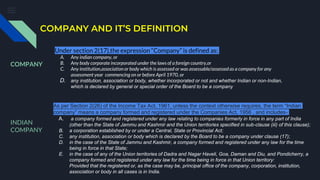
COMPANY AND IT’S DEFINITION
Under section 2(17),the expression “Company” is defined as:
A. Any indian company, or
B. Any body corporate incorporated under the laws of a foreign country,or
C. Any institution,associationor body which is assessed or was assessable/assessed as a company for any
assessment year commencing on or before April 1970, or
D. any institution, association or body, whether incorporated or not and whether Indian or non-Indian,
which is declared by general or special order of the Board to be a company
COMPANY
INDIAN
COMPANY
As per Section 2(26) of the Income Tax Act, 1961, unless the context otherwise requires, the term “Indian
company” means a company formed and registered under the Companies Act, 1956 , and includes-
A. a company formed and registered under any law relating to companies formerly in force in any part of India
(other than the State of Jammu and Kashmir and the Union territories specified in sub-clause (iii) of this clause);
B. a corporation established by or under a Central, State or Provincial Act;
C. any institution, association or body which is declared by the Board to be a company under clause (17);
D. in the case of the State of Jammu and Kashmir, a company formed and registered under any law for the time
being in force in that State;
E. in the case of any of the Union territories of Dadra and Nagar Haveli, Goa, Daman and Diu, and Pondicherry, a
company formed and registered under any law for the time being in force in that Union territory:
Provided that the registered or, as the case may be, principal office of the company, corporation, institution,
association or body in all cases is in India.
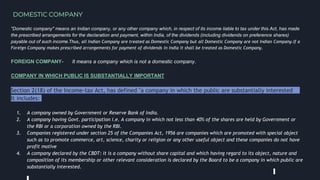
DOMESTIC COMPANY
"Domestic company" means an Indian company, or any other company which, in respect of its income liable to tax under this Act, has made
the prescribed arrangements for the declaration and payment, within India, of the dividends (including dividends on preference shares)
payable out of such income.Thus, all Indian Company are treated as Domestic Company but all Domestic Company are not Indian Company.If a
Foreign Company makes prescribed arrangements for payment of dividends in India it shall be treated as Domestic Company.
FOREIGN COMPANY- It means a company which is not a domestic company.
COMPANY IN WHICH PUBLIC IS SUBSTANTIALLY IMPORTANT
Section 2(18) of the Income-tax Act, has defined "a company in which the public are substantially interested
It includes:
1. A company owned by Government or Reserve Bank of India.
2. A company having Govt. participation i.e. A company in which not less than 40% of the shares are held by Government or
the RBI or a corporation owned by the RBI.
3. Companies registered under section 25 of the Companies Act, 1956 are companies which are promoted with special object
such as to promote commerce, art, science, charity or religion or any other useful object and these companies do not have
profit motive
4. A company declared by the CBDT: It is a company without share capital and which having regard to its object, nature and
composition of its membership or other relevant consideration is declared by the Board to be a company in which public are
substantially interested.
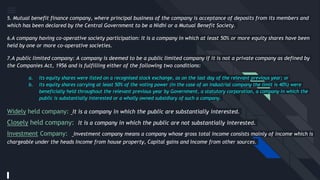
5. Mutual benefit finance company, where principal business of the company is acceptance of deposits from its members and
which has been declared by the Central Government to be a Nidhi or a Mutual Benefit Society.
6.A company having co-operative society participation: It is a company in which at least 50% or more equity shares have been
held by one or more co-operative societies.
7.A public limited company: A company is deemed to be a public limited company if it is not a private company as defined by
the Companies Act, 1956 and is fulfilling either of the following two conditions:
a. Its equity shares were listed on a recognised stock exchange, as on the last day of the relevant previous year; or
b. Its equity shares carrying at least 50% of the voting power (in the case of an industrial company the limit is 40%) were
beneficially held throughout the relevant previous year by Government, a statutory corporation, a company in which the
public is substantially interested or a wholly owned subsidiary of such a company.
Widely held company: It is a company in which the public are substantially interested.
Closely held company: It is a company in which the public are not substantially interested.
Investment Company: Investment company means a company whose gross total income consists mainly of income which is
chargeable under the heads Income from house property, Capital gains and Income from other sources.
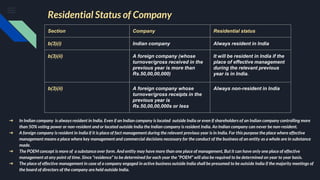
Residential Status of Company
➔ In Indian company is always resident in India. Even if an Indian company is located outside India or even if shareholders of an Indian company controlling more
than 50% voting power or non-resident and or located outside India the Indian company is resident India. An Indian company can never be non-resident.
➔ A foreign company is resident in India if it is place of fact management during the relevant previous year is in India. For this purpose the place where effective
management means a place where key management and commercial decisions necessary for the conduct of the business of an entity as a whole are in substance
made.
➔ The POEM concept is more of a substance over form. And entity may have more than one place of management, But it can have only one place of effective
management at any point of time. Since “residence” to be determined for each year the “POEM” will also be required to be determined on year to year basis.
➔ The place of effective management in case of a company engaged in active business outside India shall be presumed to be outside India if the majority meetings of
the board of directors of the company are held outside India.
Section Company Residential status
b(3)(i) Indian company Always resident in India
b(3)(ii) A foreign company (whose
turnover/gross received in the
previous year is more than
Rs.50,00,00,000)
It will be resident in India if the
place of effective management
during the relevant previous
year is in India.
b(3)(ii) A foreign company whose
turnover/gross receipts in the
previous year is
Rs.50,00,00,000s or less
Always non-resident in India
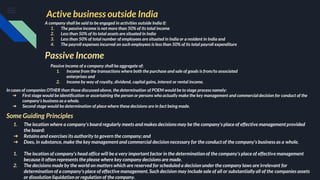
Active business outside India
A company shall be said to be engaged in activities outside India if:
1. The passive income is not more than 50% of its total income
2. Less than 50% of its total assets are situated in India
3. Less than 50% of total number of employees are situated in India or a resident in India and
4. The payroll expenses incurred on such employees is less than 50% of its total payroll expenditure
Passive Income
Passive income of a company shall be aggregate of:
1. Income from the transactions where both the purchase and sale of goods is from/to associated
enterprises and
2. Income by way of royalty, dividend, capital gains, interest or rental income.
In cases of companies OTHER than those discussed above, the determination of POEM would be to stage process namely:
➔ First stage would be identification or ascertaining the person or persons who actually make the key management and commercial decision for conduct of the
company’s business as a whole.
➔ Second stage would be determination of place where these decisions are in fact being made.
Some Guiding Principles
1. The location where a company's board regularly meets and makes decisions may be the company's place of effective management provided
the board:
➔ Retains and exercises its authority to govern the company; and
➔ Does, in substance, make the key management and commercial decision necessary for the conduct of the company's business as a whole.
1. The location of company's head office will be a very important factor in the determination of the company's place of effective management
because it often represents the please where key company decisions are made.
2. The decisions made by the world on matters which are reserved for scheduled a decision under the company laws are irrelevant for
determination of a company's place of effective management. Such decision may include sale of all or substantially all of the companies assets
or dissolution liquidation or regulation of the company.
➔ In case the assessing officer proposes to hold a foreign company, on the basis of its POEM, as being resident India
Then any such finding shall be given by the assessing officer after seeking prior approval of the collegium of three
members consisting of the principal CIT or CITs as the case maybe, to be constituted by the Principal Chief
Commissioner of the region concerned, in this regard. The collegium so constituted shall provide an opportunity of
being heard to the foreign company before issuing any directions in the matter.
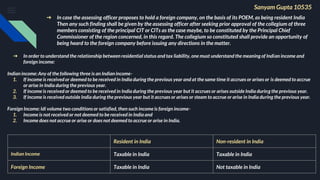
➔ In order to understand the relationship between residential status and tax liability, one must understand the meaning of Indian income and
foreign income:
Indian income: Any of the following three is an Indian income-
1. If income is received or deemed to be received in India during the previous year and at the same time it accrues or arises or is deemed to accrue
or arise in India during the previous year.
2. If income is received or deemed to be received in India during the previous year but it accrues or arises outside India during the previous year.
3. If income is received outside India during the previous year but it accrues or arises or steam to accrue or arise in India during the previous year.
Foreign Income: Idi volume two conditions or satisfied, then such income is foreign income-
1. Income is not received or not deemed to be received in India and
2. Income does not accrue or arise or does not deemed to accrue or arise in India.
Resident in India Non-resident in India
Indian Income Taxable in India Taxable in India
Foreign Income Taxable in India Not taxable in India
Sanyam Gupta 10535
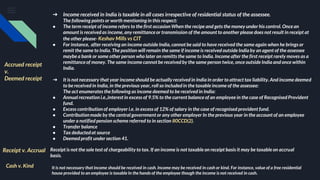
➔ Income received in India is taxable in all cases irrespective of residential status of the assessee.
The following points or worth mentioning in this respect:
● The term receipt of income refers to the first occasion When the recipe and gets the money under his control. Once an
amount is received as income, any remittance or transmission of the amount to another please does not result in receipt at
the other please- Keshav Mills vs CIT
● For instance, after receiving an income outside India, cannot be said to have received the same again when he brings or
remit the same to India. The position will remain the same if income is received outside India by an agent of the assessee
maybe a bank or some other person who later on remitts the same to India. Income after the first receipt rarely moves as a
remittance of money. The same income cannot be received by the same person twice, once outside India and once within
India.
➔ It is not necessary that year income should be actually received in India in order to attract tax liability. And income deemed
to be received in India, in the previous year, roll so included in the taxable income of the assessee:
The act enumerates the following as income deemed to be received in India:
● Annual recreation i.e.,interest in excess of 9.5% to the current balance of an employee in the case of Recognised Provident
fund.
● Excess contributionof employer i.e. in excess of 12% of salary in the case of recognised provident fund.
● Contributionmade by the central government or any other employer In the previous year in the account of an employee
under a notified pension scheme referred to in section 80CCD(2).
● Transfer balance
● Tax deductedat source
● Deemed profit under section 41.
Accrued receipt
v.
Deemed receipt
Receipt v. Accrual Receipt is not the sole test of chargeability to tax. If an income is not taxable on receipt basis it may be taxable on accrual
basis.
Cash v. Kind It is not necessary that income should be received in cash. Income may be received in cash or kind. For instance, value of a free residential
house provided to an employee is taxable In the hands of the employee though the income is not received in cash.
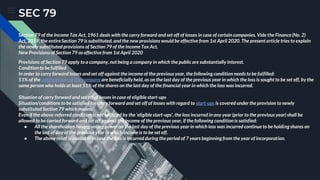
SEC 79
Section 79 of the Income Tax Act, 1961 deals with the carry forward and set off of losses in case of certain companies. Vide the Finance (No. 2)
Act, 2019, the entire Section 79 is substituted, and the new provisions would be effective from 1st April 2020. The present article tries to explain
the newly substituted provisions of Section 79 of the Income Tax Act.
New Provisions of Section 79 as effective from 1st April 2020
Provisions of Section 79 apply to a company, not being a company in which the public are substantially interest.
Condition to be fulfilled
In order to carry forward losses and set off against the income of the previous year, the following condition needs to be fulfilled:
51% of the voting power of the company are beneficially held, as on the last day of the previous year in which the loss is sought to be set off, by the
same person who holds at least 51% of the shares on the last day of the financial year in which the loss was incurred.
Situation of carry forward and set off of losses in case of eligible start-ups
Situation/conditions to be satisfied for carry forward and set off of losses with regard to start-ups is covered under the provision to newly
substituted Section 79 which means:
Even if the above-referred condition is not satisfied by the ‘eligible start-ups’, the loss incurred in any year (prior to the previous year) shall be
allowed to be carried forward and set off against the income of the previous year, if the following condition is satisfied:
● All the shareholders having voting power on the last day of the previous year in which loss was incurred continue to be holding shares on
the last of day of the previous year in which income is to be set off.
● The above relief is available in case the loss is incurred during the period of 7 years beginning from the year of incorporation.
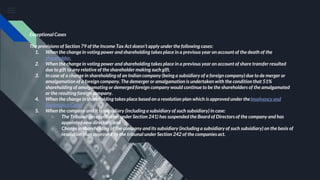
Exceptional Cases
The provisions of Section 79 of the Income Tax Act doesn’t apply under the following cases:
1. When the change in voting power and shareholding takes place in a previous year on account of the death of the
shareholder.
2. When the change in voting power and shareholding takes place in a previous year on account of share transfer resulted
due to gift to any relative of the shareholder making such gift.
3. In case of a change in shareholding of an Indian company (being a subsidiary of a foreign company) due to de merger or
amalgamation of a foreign company. The demerger or amalgamation is undertaken with the conditionthat 51%
shareholding of amalgamating or demerged foreign company would continue to be the shareholders of the amalgamated
or the resulting foreign company.
4. When the change in shareholding takes place based on a resolution plan which is approved under theInsolvency and
Bankruptcy Code.
5. When the company and it is subsidiary (including a subsidiary of such subsidiary) in case:
○ The Tribunal (on application under Section 241) has suspended the Board of Directors of the company and has
appointed new directors; and
○ Change in shareholding of the company and its subsidiary (including a subsidiary of such subsidiary) on the basis of
resolution plan approved by the tribunal under Section 242 of the companies act.
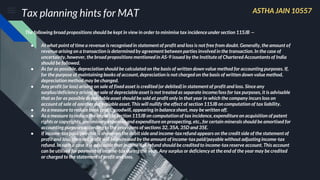
Tax planning hints for MAT
The following broad propositions should be kept in view in order to minimise tax incidence under section 115JB —
● At what point of time a revenue is recognised in statement of profit and loss is not free from doubt. Generally, the amount of
revenue arising on a transaction is determined by agreement between parties involved in the transaction. In the case of
uncertainty, however, the broad propositions mentionedin AS-9 issued by the Institute of Chartered Accountants of India
should be followed.
● As far as possible, depreciation should be calculated on the basis of written down value method for accounting purposes. If,
for the purpose of maintaining books of account, depreciation is not charged on the basis of written down value method,
depreciation method may be changed.
● Any profit (or loss) arising on sale of fixed asset is credited (or debited)in statement of profit and loss. Since any
surplus/deficiency arising on sale of depreciable asset is not treated as separate income/loss for tax purposes, it is advisable
that as far as possible depreciable asset should be sold at profit only in that year in which the company incurs loss on
account of sale of another depreciable asset. This will nullify the effect of section 115JB on computation of tax liability.
● As a measure to reduce book profit, goodwill, appearing in balance sheet, may be written off.
● As a measure to reduce the impact of section 115JB on computation of tax incidence, expenditure on acquisition of patent
rights or copyrights, preliminary expenses and expenditure on prospecting, etc., for certain minerals should be amortised for
accounting purposes according to the provisions of sections 32, 35A, 35D and 35E.
● If income-tax paid/payable is shown on the debit side and income-tax refund appears on the credit side of the statement of
profit and loss, then net profit will be increased by the amount of income-taxpaid/payable without adjusting income-tax
refund. In such a case it is advisable that income-tax refund should be credited to income-taxreserve account. This account
can be utilised for payment of income-tax during the year. Any surplus or deficiency at the end of the year may be credited
or charged to the statement of profit and loss.
ASTHA JAIN 10557
● It may be noted that in respect of the following amounts debited to the statement of profit and loss, no adjustment is required under
section 115JB : a. any penalty or fine paid or payable under the Income-taxAct ; b. any tax, penalty or interest paid or payable under
the Wealth-taxAct ; c. any tax, penalty or interest paid or payable under the Gift-tax Act ; or d. any tax, penalty, or interest paid or
payable under the Companies (Profits) Surtax Act ; and e. any tax or duty which is not allowed as deduction while calculating taxable
income by virtue of section 43B f. securities transaction tax; g. banking cash transaction tax; and h. fringe benefit tax. The aforesaid
sums are not added to net profit in order to compute book profit for the purpose of section 115JB, though some of these expenses are
not allowed as deduction while calculating/ determining taxable income.
● Arrears of depreciation not provided in books in earlier years may be provided in the current year.
● Where the assessee has changed method of providing depreciation from straight line to written down value method which resulted in
shortfall in depreciation provided and resultant shortfall in depreciation is charged to statement of profit and loss for the current year,
the Assessing Officer is not justified in disallowing assessee’s claim of such additional depreciation while computing book profit on the
ground that such depreciation was not provided for in books of account of the assessee for the earlier years – CIT v. Farmson
Pharmaceuticals Gujarat Ltd. [ 2011] 241 CTR (Guj.) 568.
● Depreciation can be provided in books of account at rates higher than those specified in the Companies Act. Extra depreciation
(pertaining to earlier years) arising because of a bona fide change in depreciation method can be debitedto statement of profit and loss
for computing book profit.
● Guidance Note of ICAI indicates that depreciation also includes depletion of natural resources through process of extraction or use.
Book profit under section 115JB would be computed after allowing claim of depletion of natural resources.
● Refund of tax not credited to statement of profit and loss cannot be added to book profit.
● The Delhi High Court in CIT v. G E Power Services India Ltd. [2008] 171 Taxman 10 held that software expenditure debited to
statement of profit and loss is an allowable deduction in computing book profits. The Court refuted the argument of the revenue that
such expenditure would be capital in nature after amendment to section 32. The Court found such argument as unworthy, perhaps for
the reason that section 32 has no relevance as far as determination of book profits goes.
● This judgment thus provides a good tax planning method and, thus, an assessee can charge off software costs in accounts even while it
resorts to depreciation claim in tax computation after taking disallowance first. Before the statutory auditor, the assessee can take the
contention that the software in use has a short span of life and further it needs updating from time to time.
ASTHA JAIN 10557
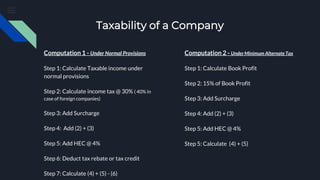
Taxability of a Company
Computation 1 - Under Normal Provisions
Step 1: Calculate Taxable income under
normal provisions
Step 2: Calculate income tax @ 30% ( 40% in
case of foreign companies)
Step 3: Add Surcharge
Step 4: Add (2) + (3)
Step 5: Add HEC @ 4%
Step 6: Deduct tax rebate or tax credit
Step 7: Calculate (4) + (5) - (6)
Computation 2 - Under Minimum Alternate Tax
Step 1: Calculate Book Profit
Step 2: 15% of Book Profit
Step 3: Add Surcharge
Step 4: Add (2) + (3)
Step 5: Add HEC @ 4%
Step 5: Calculate (4) + (5)
Minimum Alternate Tax [Sec. 115JB]
➢ MAT is applicable when tax computed under normal provisions is less than tax computed under
Sec 115JB provisions.
➢ In the case of a company (may be domestic or foreign company), the income tax payable on its total
income (computed after applying all provisions of income tax except section 115JB) is less than
15% of book profits + surcharge (if applicable) + cess, then such book profits shall be deemed to be
total income.
➢ Book profit shall be calculated on the basis of profit and loss account prepared in accordance with
the provisions of schedule VI of the Companies Act.
➢ Exceptions - Life Insurance business, Shipping income liable to tonnage taxation
➢ In the following two cases, the Assessing Officer can rewrite the profit and loss account:
○ If profit and loss account is not prepared according to the Companies Act
○ If accounting policies, accounting standards or rates or method of depreciation are different
Determining Book Profit [Sec 115JB]
Negative Adjustments (Less)
● Income tax or any provision for Income tax
● Transfer to Reserve
● Provision for unascertained liability
● Dividends (whether proposed or paid)
● Loss/Provision for loss of Subsidiary company
● Provision for diminution in the value of assets
● Deferred tax or any provision for deferred tax
● Depreciation as per books of account
● Expenditure on income which are exempt u/s
10,11,12
● Expenditure relatable to income from share in
AOP or BOI.
● Amount standing in Revaluation reserve in
respect of an asset which has been sold or
disposed off but not credited to P&L A/c.
● Any Amount withdrawn from Reserves
● Depreciation as per books of account. (ignoring
revaluation)
● Amount withdrawn from provision for deferred
tax.
● Any amount of income which is exempt.
● Share of Profit from AOP/ BOI.
● Amount withdrawn from revaluation reserve
and credited to Profit and loss account to the
extent it doesn’t exceed the amount of
depreciation on account of revaluation.
● Amount of unabsorbed loss or unabsorbed
depreciation whichever is lower as per
Companies Act. (Aggregate Amount will be
considered not year wise amount.)
Positive Adjustments (Add)
Adjustments to Net Profit -
Tax Credit [Sec. 115JAA]
➢ The extra tax which the company has to pay because of MAT will be available for “tax credit” under
section 115JAA.
➢ Tax credit can be set off against future tax liability of the company but only in that year in which
the tax computed under normal provisions is more than MAT.
➢ The maximum amount which can be set off in respect of the brought forward tax credit shall be
allowed for any assessment year to the extent of the difference between the tax on the total
income and the tax which would have been payable under section 115JB for that assessment year.
➢ Tax credit can be carry forward up to a maximum of 15 years. For example, if MAT is paid in the
assessment year 2018-19, then 2033-34 is the last assessment year for adjustment of MAT credit.
➢ Carry forward and set off of MAT credit shall not apply to a limited liability partnership which has
been converted from a private company or unlisted public company
Non-Applicability of MAT
➢ Income from any business/ services in the hands of entrepreneur/ developer in a special economic
zone for income arising after March 31, 2005 but before April 1, 2011.
➢ Income of a shipping company which is subject to the provisions of “tonnage income” of chapter
XII-G (i.e., sections 115V to 115VZC) for income arising after March 31, 2004.
➢ Income which accrues or arises to a company from life insurance business referred to in section
115JB for income arising after March 31, 2000.
➢ Foreign companies in the following two cases:
○ The assessee is a resident of a country/ specified territory with which India has an agreement under
section 90/ 90A and the assessee does not have a permanent establishment in India in accordance
with the provisions of such agreement.
○ The assessee is a resident of a country with which India does not have an agreement referred to
above and the assessee is not required to seek registration under any law for the time being in force
relating to companies.
Alternate Tax Regime [Sec 115 BAA]
● Must be a domestic company.
● Disallowed deductions : Additional depreciated u/s 32(1)(iia), 10AA, 32AD, 33AB, 33ABA, 35(1)(ii),
35 (iia), 35(iii), 35(2AA), 35(2AB), 35AD, 35CCC, 35CCD, from 80C to 80U (excpt 80JJAA, 80LA,
80M)
● Adjustment of loss : Brought forward losses and unabsorbed depreciation are disallowed.
However, unadjusted additional depreciation in respect of block of asset which has not been given
full effect prior to A.Y. 2020-21, corresponding adjustment to be made to such block on 1st April,
2019(if 115BAA is opted)
● Depreciation allowed for taxation purposes, but restriction on availing additional depreciation.
● This option to avail 115 BAA can be exercised by domestic company by submitting Form No. 10-IC
on or before the due date of return filing u/s 139(1).
Conditions for availing benefit of lower tax :
Taxability u/s 115BAA : 22% + Surcharge + HEC @4%
If domestic company is taxable u/s 115BAB, then surcharge is increased by 10% irrespective of
total income. Moreover if company has income taxable under provisions of chapter XII, then tax
on such income will be calculated at specified rates, and balance income as per tax rate of sec
115BAA.
Notable points
● If a domestic company fails to satisfy the above prescribed conditions for any of the
subsequent P.Y.s , when it had opted for 115BAA for any of the earlier P.Y.s , then this
option of lower tax u/s 115BAA would become invalid.
● Even if a domestic company becomes ineligible to opt Sec 115BAB , it still has an
option to avail 115BAA.
● If this option to avail lower tax u/s 115BAA availed , then minimum alternate tax u/s
115JB would not be applicable and also the benefit of MAT Credit u/s 115JAA(2A)
would be unavailable.
Vedant Choudhary 10560
Alternate Tax Regime for Manufacturing cos.
[115BAB]
Conditions for availing benefit of lower tax :
● Must be a domestic company.
● Such company is set up on or after 1st October,2019( not formed by split or reconstruction
of already existing business) and commenced manufacturing / production on or before 31st
March, 2024.
● It includes manufacturing / production of any article(including generation of electricity), but
excludes the following business:
Development of computer software in any form
Conversion of marble blocks into slabs
Bottling of gas into cylinders
Printing of books / production of cinematographic films
Mining business
Any other business notified by Central govt.
● Company does not any plant / machinery , previously used for any other purpose
Exception : i) 20% of old plant / machinery permitted
ii) Second hand imported plant / machinery to be treated as new
● Company does not use building previously used as hotel/ convention centre in respect of
which deduction u/s 80-ID has been claimed and allowed.
● Company is not engaged in any business other than the business of manufacture or
production of any article or thing and research in relation to or distribution of such article or
thing produced by it.
● Disallowed deductions : Additional depreciated u/s 32(1)(iia), 10AA, 32AD, 33AB, 33ABA,
35(1)(ii), 35 (iia), 35(iii), 35(2AA), 35(2AB), 35AD, 35CCC, 35CCD, from 80C to 80U (excpt
80JJAA, 80LA, 80M)
● Depreciation allowed for taxation purposes, but restriction on availing additional
depreciation.
● This option to avail 115 BAB can be exercised by domestic company by submitting Form No.
10-ID on or before the due date of return filing u/s 139(1) for furnishing “the 1st of returns
of income for any P.Y. commencing on or after 1st April,2020”.
Vedant Choudhary 10560
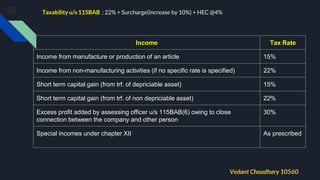
Taxability u/s 115BAB : 22% + Surcharge(increase by 10%) + HEC @4%
Income Tax Rate
Income from manufacture or production of an article 15%
Income from non-manufacturing activities (if no specific rate is specified) 22%
Short term capital gain (from trf. of depriciable asset) 15%
Short term capital gain (from trf. of non depriciable asset) 22%
Excess profit added by assessing officer u/s 115BAB(6) owing to close
connection between the company and other person
30%
Special incomes under chapter XII As prescribed
Vedant Choudhary 10560
Thank you!

corporate tax planning .pptx

  • 1.
  • 2.
    COMPANY AND IT’SDEFINITION Under section 2(17),the expression “Company” is defined as: A. Any indian company, or B. Any body corporate incorporated under the laws of a foreign country,or C. Any institution,associationor body which is assessed or was assessable/assessed as a company for any assessment year commencing on or before April 1970, or D. any institution, association or body, whether incorporated or not and whether Indian or non-Indian, which is declared by general or special order of the Board to be a company COMPANY INDIAN COMPANY As per Section 2(26) of the Income Tax Act, 1961, unless the context otherwise requires, the term “Indian company” means a company formed and registered under the Companies Act, 1956 , and includes- A. a company formed and registered under any law relating to companies formerly in force in any part of India (other than the State of Jammu and Kashmir and the Union territories specified in sub-clause (iii) of this clause); B. a corporation established by or under a Central, State or Provincial Act; C. any institution, association or body which is declared by the Board to be a company under clause (17); D. in the case of the State of Jammu and Kashmir, a company formed and registered under any law for the time being in force in that State; E. in the case of any of the Union territories of Dadra and Nagar Haveli, Goa, Daman and Diu, and Pondicherry, a company formed and registered under any law for the time being in force in that Union territory: Provided that the registered or, as the case may be, principal office of the company, corporation, institution, association or body in all cases is in India.
  • 3.
    DOMESTIC COMPANY "Domestic company"means an Indian company, or any other company which, in respect of its income liable to tax under this Act, has made the prescribed arrangements for the declaration and payment, within India, of the dividends (including dividends on preference shares) payable out of such income.Thus, all Indian Company are treated as Domestic Company but all Domestic Company are not Indian Company.If a Foreign Company makes prescribed arrangements for payment of dividends in India it shall be treated as Domestic Company. FOREIGN COMPANY- It means a company which is not a domestic company. COMPANY IN WHICH PUBLIC IS SUBSTANTIALLY IMPORTANT Section 2(18) of the Income-tax Act, has defined "a company in which the public are substantially interested It includes: 1. A company owned by Government or Reserve Bank of India. 2. A company having Govt. participation i.e. A company in which not less than 40% of the shares are held by Government or the RBI or a corporation owned by the RBI. 3. Companies registered under section 25 of the Companies Act, 1956 are companies which are promoted with special object such as to promote commerce, art, science, charity or religion or any other useful object and these companies do not have profit motive 4. A company declared by the CBDT: It is a company without share capital and which having regard to its object, nature and composition of its membership or other relevant consideration is declared by the Board to be a company in which public are substantially interested.
  • 4.
    5. Mutual benefitfinance company, where principal business of the company is acceptance of deposits from its members and which has been declared by the Central Government to be a Nidhi or a Mutual Benefit Society. 6.A company having co-operative society participation: It is a company in which at least 50% or more equity shares have been held by one or more co-operative societies. 7.A public limited company: A company is deemed to be a public limited company if it is not a private company as defined by the Companies Act, 1956 and is fulfilling either of the following two conditions: a. Its equity shares were listed on a recognised stock exchange, as on the last day of the relevant previous year; or b. Its equity shares carrying at least 50% of the voting power (in the case of an industrial company the limit is 40%) were beneficially held throughout the relevant previous year by Government, a statutory corporation, a company in which the public is substantially interested or a wholly owned subsidiary of such a company. Widely held company: It is a company in which the public are substantially interested. Closely held company: It is a company in which the public are not substantially interested. Investment Company: Investment company means a company whose gross total income consists mainly of income which is chargeable under the heads Income from house property, Capital gains and Income from other sources.
  • 5.
    Residential Status ofCompany ➔ In Indian company is always resident in India. Even if an Indian company is located outside India or even if shareholders of an Indian company controlling more than 50% voting power or non-resident and or located outside India the Indian company is resident India. An Indian company can never be non-resident. ➔ A foreign company is resident in India if it is place of fact management during the relevant previous year is in India. For this purpose the place where effective management means a place where key management and commercial decisions necessary for the conduct of the business of an entity as a whole are in substance made. ➔ The POEM concept is more of a substance over form. And entity may have more than one place of management, But it can have only one place of effective management at any point of time. Since “residence” to be determined for each year the “POEM” will also be required to be determined on year to year basis. ➔ The place of effective management in case of a company engaged in active business outside India shall be presumed to be outside India if the majority meetings of the board of directors of the company are held outside India. Section Company Residential status b(3)(i) Indian company Always resident in India b(3)(ii) A foreign company (whose turnover/gross received in the previous year is more than Rs.50,00,00,000) It will be resident in India if the place of effective management during the relevant previous year is in India. b(3)(ii) A foreign company whose turnover/gross receipts in the previous year is Rs.50,00,00,000s or less Always non-resident in India
  • 6.
    Active business outsideIndia A company shall be said to be engaged in activities outside India if: 1. The passive income is not more than 50% of its total income 2. Less than 50% of its total assets are situated in India 3. Less than 50% of total number of employees are situated in India or a resident in India and 4. The payroll expenses incurred on such employees is less than 50% of its total payroll expenditure Passive Income Passive income of a company shall be aggregate of: 1. Income from the transactions where both the purchase and sale of goods is from/to associated enterprises and 2. Income by way of royalty, dividend, capital gains, interest or rental income. In cases of companies OTHER than those discussed above, the determination of POEM would be to stage process namely: ➔ First stage would be identification or ascertaining the person or persons who actually make the key management and commercial decision for conduct of the company’s business as a whole. ➔ Second stage would be determination of place where these decisions are in fact being made. Some Guiding Principles 1. The location where a company's board regularly meets and makes decisions may be the company's place of effective management provided the board: ➔ Retains and exercises its authority to govern the company; and ➔ Does, in substance, make the key management and commercial decision necessary for the conduct of the company's business as a whole. 1. The location of company's head office will be a very important factor in the determination of the company's place of effective management because it often represents the please where key company decisions are made. 2. The decisions made by the world on matters which are reserved for scheduled a decision under the company laws are irrelevant for determination of a company's place of effective management. Such decision may include sale of all or substantially all of the companies assets or dissolution liquidation or regulation of the company.
  • 7.
    ➔ In casethe assessing officer proposes to hold a foreign company, on the basis of its POEM, as being resident India Then any such finding shall be given by the assessing officer after seeking prior approval of the collegium of three members consisting of the principal CIT or CITs as the case maybe, to be constituted by the Principal Chief Commissioner of the region concerned, in this regard. The collegium so constituted shall provide an opportunity of being heard to the foreign company before issuing any directions in the matter. ➔ In order to understand the relationship between residential status and tax liability, one must understand the meaning of Indian income and foreign income: Indian income: Any of the following three is an Indian income- 1. If income is received or deemed to be received in India during the previous year and at the same time it accrues or arises or is deemed to accrue or arise in India during the previous year. 2. If income is received or deemed to be received in India during the previous year but it accrues or arises outside India during the previous year. 3. If income is received outside India during the previous year but it accrues or arises or steam to accrue or arise in India during the previous year. Foreign Income: Idi volume two conditions or satisfied, then such income is foreign income- 1. Income is not received or not deemed to be received in India and 2. Income does not accrue or arise or does not deemed to accrue or arise in India. Resident in India Non-resident in India Indian Income Taxable in India Taxable in India Foreign Income Taxable in India Not taxable in India Sanyam Gupta 10535
  • 8.
    ➔ Income receivedin India is taxable in all cases irrespective of residential status of the assessee. The following points or worth mentioning in this respect: ● The term receipt of income refers to the first occasion When the recipe and gets the money under his control. Once an amount is received as income, any remittance or transmission of the amount to another please does not result in receipt at the other please- Keshav Mills vs CIT ● For instance, after receiving an income outside India, cannot be said to have received the same again when he brings or remit the same to India. The position will remain the same if income is received outside India by an agent of the assessee maybe a bank or some other person who later on remitts the same to India. Income after the first receipt rarely moves as a remittance of money. The same income cannot be received by the same person twice, once outside India and once within India. ➔ It is not necessary that year income should be actually received in India in order to attract tax liability. And income deemed to be received in India, in the previous year, roll so included in the taxable income of the assessee: The act enumerates the following as income deemed to be received in India: ● Annual recreation i.e.,interest in excess of 9.5% to the current balance of an employee in the case of Recognised Provident fund. ● Excess contributionof employer i.e. in excess of 12% of salary in the case of recognised provident fund. ● Contributionmade by the central government or any other employer In the previous year in the account of an employee under a notified pension scheme referred to in section 80CCD(2). ● Transfer balance ● Tax deductedat source ● Deemed profit under section 41. Accrued receipt v. Deemed receipt Receipt v. Accrual Receipt is not the sole test of chargeability to tax. If an income is not taxable on receipt basis it may be taxable on accrual basis. Cash v. Kind It is not necessary that income should be received in cash. Income may be received in cash or kind. For instance, value of a free residential house provided to an employee is taxable In the hands of the employee though the income is not received in cash.
  • 9.
    SEC 79 Section 79of the Income Tax Act, 1961 deals with the carry forward and set off of losses in case of certain companies. Vide the Finance (No. 2) Act, 2019, the entire Section 79 is substituted, and the new provisions would be effective from 1st April 2020. The present article tries to explain the newly substituted provisions of Section 79 of the Income Tax Act. New Provisions of Section 79 as effective from 1st April 2020 Provisions of Section 79 apply to a company, not being a company in which the public are substantially interest. Condition to be fulfilled In order to carry forward losses and set off against the income of the previous year, the following condition needs to be fulfilled: 51% of the voting power of the company are beneficially held, as on the last day of the previous year in which the loss is sought to be set off, by the same person who holds at least 51% of the shares on the last day of the financial year in which the loss was incurred. Situation of carry forward and set off of losses in case of eligible start-ups Situation/conditions to be satisfied for carry forward and set off of losses with regard to start-ups is covered under the provision to newly substituted Section 79 which means: Even if the above-referred condition is not satisfied by the ‘eligible start-ups’, the loss incurred in any year (prior to the previous year) shall be allowed to be carried forward and set off against the income of the previous year, if the following condition is satisfied: ● All the shareholders having voting power on the last day of the previous year in which loss was incurred continue to be holding shares on the last of day of the previous year in which income is to be set off. ● The above relief is available in case the loss is incurred during the period of 7 years beginning from the year of incorporation.
  • 10.
    Exceptional Cases The provisionsof Section 79 of the Income Tax Act doesn’t apply under the following cases: 1. When the change in voting power and shareholding takes place in a previous year on account of the death of the shareholder. 2. When the change in voting power and shareholding takes place in a previous year on account of share transfer resulted due to gift to any relative of the shareholder making such gift. 3. In case of a change in shareholding of an Indian company (being a subsidiary of a foreign company) due to de merger or amalgamation of a foreign company. The demerger or amalgamation is undertaken with the conditionthat 51% shareholding of amalgamating or demerged foreign company would continue to be the shareholders of the amalgamated or the resulting foreign company. 4. When the change in shareholding takes place based on a resolution plan which is approved under theInsolvency and Bankruptcy Code. 5. When the company and it is subsidiary (including a subsidiary of such subsidiary) in case: ○ The Tribunal (on application under Section 241) has suspended the Board of Directors of the company and has appointed new directors; and ○ Change in shareholding of the company and its subsidiary (including a subsidiary of such subsidiary) on the basis of resolution plan approved by the tribunal under Section 242 of the companies act.
  • 11.
    Tax planning hintsfor MAT The following broad propositions should be kept in view in order to minimise tax incidence under section 115JB — ● At what point of time a revenue is recognised in statement of profit and loss is not free from doubt. Generally, the amount of revenue arising on a transaction is determined by agreement between parties involved in the transaction. In the case of uncertainty, however, the broad propositions mentionedin AS-9 issued by the Institute of Chartered Accountants of India should be followed. ● As far as possible, depreciation should be calculated on the basis of written down value method for accounting purposes. If, for the purpose of maintaining books of account, depreciation is not charged on the basis of written down value method, depreciation method may be changed. ● Any profit (or loss) arising on sale of fixed asset is credited (or debited)in statement of profit and loss. Since any surplus/deficiency arising on sale of depreciable asset is not treated as separate income/loss for tax purposes, it is advisable that as far as possible depreciable asset should be sold at profit only in that year in which the company incurs loss on account of sale of another depreciable asset. This will nullify the effect of section 115JB on computation of tax liability. ● As a measure to reduce book profit, goodwill, appearing in balance sheet, may be written off. ● As a measure to reduce the impact of section 115JB on computation of tax incidence, expenditure on acquisition of patent rights or copyrights, preliminary expenses and expenditure on prospecting, etc., for certain minerals should be amortised for accounting purposes according to the provisions of sections 32, 35A, 35D and 35E. ● If income-tax paid/payable is shown on the debit side and income-tax refund appears on the credit side of the statement of profit and loss, then net profit will be increased by the amount of income-taxpaid/payable without adjusting income-tax refund. In such a case it is advisable that income-tax refund should be credited to income-taxreserve account. This account can be utilised for payment of income-tax during the year. Any surplus or deficiency at the end of the year may be credited or charged to the statement of profit and loss. ASTHA JAIN 10557
  • 12.
    ● It maybe noted that in respect of the following amounts debited to the statement of profit and loss, no adjustment is required under section 115JB : a. any penalty or fine paid or payable under the Income-taxAct ; b. any tax, penalty or interest paid or payable under the Wealth-taxAct ; c. any tax, penalty or interest paid or payable under the Gift-tax Act ; or d. any tax, penalty, or interest paid or payable under the Companies (Profits) Surtax Act ; and e. any tax or duty which is not allowed as deduction while calculating taxable income by virtue of section 43B f. securities transaction tax; g. banking cash transaction tax; and h. fringe benefit tax. The aforesaid sums are not added to net profit in order to compute book profit for the purpose of section 115JB, though some of these expenses are not allowed as deduction while calculating/ determining taxable income. ● Arrears of depreciation not provided in books in earlier years may be provided in the current year. ● Where the assessee has changed method of providing depreciation from straight line to written down value method which resulted in shortfall in depreciation provided and resultant shortfall in depreciation is charged to statement of profit and loss for the current year, the Assessing Officer is not justified in disallowing assessee’s claim of such additional depreciation while computing book profit on the ground that such depreciation was not provided for in books of account of the assessee for the earlier years – CIT v. Farmson Pharmaceuticals Gujarat Ltd. [ 2011] 241 CTR (Guj.) 568. ● Depreciation can be provided in books of account at rates higher than those specified in the Companies Act. Extra depreciation (pertaining to earlier years) arising because of a bona fide change in depreciation method can be debitedto statement of profit and loss for computing book profit. ● Guidance Note of ICAI indicates that depreciation also includes depletion of natural resources through process of extraction or use. Book profit under section 115JB would be computed after allowing claim of depletion of natural resources. ● Refund of tax not credited to statement of profit and loss cannot be added to book profit. ● The Delhi High Court in CIT v. G E Power Services India Ltd. [2008] 171 Taxman 10 held that software expenditure debited to statement of profit and loss is an allowable deduction in computing book profits. The Court refuted the argument of the revenue that such expenditure would be capital in nature after amendment to section 32. The Court found such argument as unworthy, perhaps for the reason that section 32 has no relevance as far as determination of book profits goes. ● This judgment thus provides a good tax planning method and, thus, an assessee can charge off software costs in accounts even while it resorts to depreciation claim in tax computation after taking disallowance first. Before the statutory auditor, the assessee can take the contention that the software in use has a short span of life and further it needs updating from time to time. ASTHA JAIN 10557
  • 13.
    Taxability of aCompany Computation 1 - Under Normal Provisions Step 1: Calculate Taxable income under normal provisions Step 2: Calculate income tax @ 30% ( 40% in case of foreign companies) Step 3: Add Surcharge Step 4: Add (2) + (3) Step 5: Add HEC @ 4% Step 6: Deduct tax rebate or tax credit Step 7: Calculate (4) + (5) - (6) Computation 2 - Under Minimum Alternate Tax Step 1: Calculate Book Profit Step 2: 15% of Book Profit Step 3: Add Surcharge Step 4: Add (2) + (3) Step 5: Add HEC @ 4% Step 5: Calculate (4) + (5)
  • 14.
    Minimum Alternate Tax[Sec. 115JB] ➢ MAT is applicable when tax computed under normal provisions is less than tax computed under Sec 115JB provisions. ➢ In the case of a company (may be domestic or foreign company), the income tax payable on its total income (computed after applying all provisions of income tax except section 115JB) is less than 15% of book profits + surcharge (if applicable) + cess, then such book profits shall be deemed to be total income. ➢ Book profit shall be calculated on the basis of profit and loss account prepared in accordance with the provisions of schedule VI of the Companies Act. ➢ Exceptions - Life Insurance business, Shipping income liable to tonnage taxation ➢ In the following two cases, the Assessing Officer can rewrite the profit and loss account: ○ If profit and loss account is not prepared according to the Companies Act ○ If accounting policies, accounting standards or rates or method of depreciation are different
  • 15.
    Determining Book Profit[Sec 115JB] Negative Adjustments (Less) ● Income tax or any provision for Income tax ● Transfer to Reserve ● Provision for unascertained liability ● Dividends (whether proposed or paid) ● Loss/Provision for loss of Subsidiary company ● Provision for diminution in the value of assets ● Deferred tax or any provision for deferred tax ● Depreciation as per books of account ● Expenditure on income which are exempt u/s 10,11,12 ● Expenditure relatable to income from share in AOP or BOI. ● Amount standing in Revaluation reserve in respect of an asset which has been sold or disposed off but not credited to P&L A/c. ● Any Amount withdrawn from Reserves ● Depreciation as per books of account. (ignoring revaluation) ● Amount withdrawn from provision for deferred tax. ● Any amount of income which is exempt. ● Share of Profit from AOP/ BOI. ● Amount withdrawn from revaluation reserve and credited to Profit and loss account to the extent it doesn’t exceed the amount of depreciation on account of revaluation. ● Amount of unabsorbed loss or unabsorbed depreciation whichever is lower as per Companies Act. (Aggregate Amount will be considered not year wise amount.) Positive Adjustments (Add) Adjustments to Net Profit -
  • 16.
    Tax Credit [Sec.115JAA] ➢ The extra tax which the company has to pay because of MAT will be available for “tax credit” under section 115JAA. ➢ Tax credit can be set off against future tax liability of the company but only in that year in which the tax computed under normal provisions is more than MAT. ➢ The maximum amount which can be set off in respect of the brought forward tax credit shall be allowed for any assessment year to the extent of the difference between the tax on the total income and the tax which would have been payable under section 115JB for that assessment year. ➢ Tax credit can be carry forward up to a maximum of 15 years. For example, if MAT is paid in the assessment year 2018-19, then 2033-34 is the last assessment year for adjustment of MAT credit. ➢ Carry forward and set off of MAT credit shall not apply to a limited liability partnership which has been converted from a private company or unlisted public company
  • 17.
    Non-Applicability of MAT ➢Income from any business/ services in the hands of entrepreneur/ developer in a special economic zone for income arising after March 31, 2005 but before April 1, 2011. ➢ Income of a shipping company which is subject to the provisions of “tonnage income” of chapter XII-G (i.e., sections 115V to 115VZC) for income arising after March 31, 2004. ➢ Income which accrues or arises to a company from life insurance business referred to in section 115JB for income arising after March 31, 2000. ➢ Foreign companies in the following two cases: ○ The assessee is a resident of a country/ specified territory with which India has an agreement under section 90/ 90A and the assessee does not have a permanent establishment in India in accordance with the provisions of such agreement. ○ The assessee is a resident of a country with which India does not have an agreement referred to above and the assessee is not required to seek registration under any law for the time being in force relating to companies.
  • 18.
    Alternate Tax Regime[Sec 115 BAA] ● Must be a domestic company. ● Disallowed deductions : Additional depreciated u/s 32(1)(iia), 10AA, 32AD, 33AB, 33ABA, 35(1)(ii), 35 (iia), 35(iii), 35(2AA), 35(2AB), 35AD, 35CCC, 35CCD, from 80C to 80U (excpt 80JJAA, 80LA, 80M) ● Adjustment of loss : Brought forward losses and unabsorbed depreciation are disallowed. However, unadjusted additional depreciation in respect of block of asset which has not been given full effect prior to A.Y. 2020-21, corresponding adjustment to be made to such block on 1st April, 2019(if 115BAA is opted) ● Depreciation allowed for taxation purposes, but restriction on availing additional depreciation. ● This option to avail 115 BAA can be exercised by domestic company by submitting Form No. 10-IC on or before the due date of return filing u/s 139(1). Conditions for availing benefit of lower tax :
  • 19.
    Taxability u/s 115BAA: 22% + Surcharge + HEC @4% If domestic company is taxable u/s 115BAB, then surcharge is increased by 10% irrespective of total income. Moreover if company has income taxable under provisions of chapter XII, then tax on such income will be calculated at specified rates, and balance income as per tax rate of sec 115BAA. Notable points ● If a domestic company fails to satisfy the above prescribed conditions for any of the subsequent P.Y.s , when it had opted for 115BAA for any of the earlier P.Y.s , then this option of lower tax u/s 115BAA would become invalid. ● Even if a domestic company becomes ineligible to opt Sec 115BAB , it still has an option to avail 115BAA. ● If this option to avail lower tax u/s 115BAA availed , then minimum alternate tax u/s 115JB would not be applicable and also the benefit of MAT Credit u/s 115JAA(2A) would be unavailable. Vedant Choudhary 10560
  • 20.
    Alternate Tax Regimefor Manufacturing cos. [115BAB] Conditions for availing benefit of lower tax : ● Must be a domestic company. ● Such company is set up on or after 1st October,2019( not formed by split or reconstruction of already existing business) and commenced manufacturing / production on or before 31st March, 2024. ● It includes manufacturing / production of any article(including generation of electricity), but excludes the following business: Development of computer software in any form Conversion of marble blocks into slabs Bottling of gas into cylinders Printing of books / production of cinematographic films Mining business Any other business notified by Central govt. ● Company does not any plant / machinery , previously used for any other purpose Exception : i) 20% of old plant / machinery permitted ii) Second hand imported plant / machinery to be treated as new
  • 21.
    ● Company doesnot use building previously used as hotel/ convention centre in respect of which deduction u/s 80-ID has been claimed and allowed. ● Company is not engaged in any business other than the business of manufacture or production of any article or thing and research in relation to or distribution of such article or thing produced by it. ● Disallowed deductions : Additional depreciated u/s 32(1)(iia), 10AA, 32AD, 33AB, 33ABA, 35(1)(ii), 35 (iia), 35(iii), 35(2AA), 35(2AB), 35AD, 35CCC, 35CCD, from 80C to 80U (excpt 80JJAA, 80LA, 80M) ● Depreciation allowed for taxation purposes, but restriction on availing additional depreciation. ● This option to avail 115 BAB can be exercised by domestic company by submitting Form No. 10-ID on or before the due date of return filing u/s 139(1) for furnishing “the 1st of returns of income for any P.Y. commencing on or after 1st April,2020”. Vedant Choudhary 10560
  • 22.
    Taxability u/s 115BAB: 22% + Surcharge(increase by 10%) + HEC @4% Income Tax Rate Income from manufacture or production of an article 15% Income from non-manufacturing activities (if no specific rate is specified) 22% Short term capital gain (from trf. of depriciable asset) 15% Short term capital gain (from trf. of non depriciable asset) 22% Excess profit added by assessing officer u/s 115BAB(6) owing to close connection between the company and other person 30% Special incomes under chapter XII As prescribed Vedant Choudhary 10560
  • 23.