B.COM (H) – Core 12 - Semester V
FUNDAMENTALS OF
FINANCIAL MANAGEMENT
Author:
Dr.Biswo Ranjan Mishra
Edited By:
Dr.Sujit Kumar Acharya
Dr.Rashmi Ranjeeta Das
UTKAL UNIVERSITY
Directorate of Distance & Continuing Education
Bhubaneswar
SYLLABUS
(Core-12)
FUNDAMENTALS OF FINANCIAL MANAGEMENT
Objective: To familiarize the students with the principles and practices of financial
management.
Contents:
Unit – I: Introduction& Basic Concepts
Important functions of Financial Management, Objectives of the firm: Profit maximization
vs. Value maximization, Role of Chief Financial Officer. Financial environment in which
a firm has to operate, Time Value of Money: concept and reasons, Compounding and
Discounting techniques, Concepts of Annuity and Perpetuity. Risk-return relationship
(Concepts only)
Unit – II: Sources of Finance and Cost of Capital/ Financing Decisions
Different sources of finance; long term and short term sources, Cost of capital: concept,
relevance of cost of capital, Implicit and Explicit cost, specific costs (its computation)
and weighted average cost (its computation) , rationale of after tax weighted average
cost of capital, marginal cost of capital (its computation).
Unit – III: Capital Expenditure Decisions / Long term Financial Decisions &
Dividend Decisions
Capital Expenditure Decisions / Long term Financial Decisions
Objectives of Capital Budgeting Process, Concept of Cash flow, Methods of long term
Investment decisions - Discounted Payback Period, Net Present Value, Profitability
Index, Average Rate of Return / Accounting Rate of Return, Internal Rate of Return
(Including relative merits and demerits of each of the methods)
Dividend Decisions
Meaning, Nature and Types of Dividend, concept of pay-out ratio, retention ratio
Decisions and growth, Dividend policies and formulating a dividend policy, Dividend
Theories: Walter’s Model, Gordon’s Model
Unit – IV: Working Capital Management/ Liquidity Management
Meaning and various concepts of Working Capital, Management of Working Capital and
Issues in Working Capital, Estimating Working Capital Needs; Operating or Working
Capital Cycle, Policies relating to Current Assets – Conservative, Aggressive and
Balance, Various sources of finance to meet working capital requirements
Learning Outcome:
After the completion of this paper, students will be able to understand finance in a better
way along with giving them insight to practical management of long and short finance
for real business houses.
Text Books Recommended
1. Rostogi, Fundamentals of Financial Management, Taxmann Publications
2. Fundamental of Financial Management, Sharma, Gupta, Kalyani Publishers, New
Delhi.
Suggested Readings
1. Fundamentals of Financial Management, Vandana Dangi, V.K. Global Pvt. Ltd., New
Delhi
2. Parasuraman – Financial Management: A Step by Step Approach, Cengage Learning
3. Pandey, I.M. Financial Management. Vikas Publications.
4. Financial Management, Himalaya Publishing House
5. BhallaV.K – Financial Management – S.Chand
6. Horne, J.C. Van and Wackowich. Fundamentals of Financial Management. 9tged.
New Delhi Prentice Hall of India.
UNIT-1
INTRODUCTION OF FINANCIAL MANAGEMENT
STRUCTURE:
1.0 Introduction
1.1 Learning Objectives
1.2 Meaning, Nature and Scope of Finance
1.2.1.Nature of Financial Management
1.2.2 Real and Financial Assets
1.2.3 Equity and Borrowed Funds
1.2.4 Finance and Management Functions
1.2.5 Scope of Financial Management/Finance Function
1.3 Financial Goal: Profit Maximization vs Wealth Maximization
1.3.1 Profit Maximization
1.3.2 Objections to Profit Maximization
1.3.3 Maximizing Profit after Taxes
1.3.4 Maximizing EPS
13.5 Shareholders' Wealth Maximization
1.3.6 Profit Maximization vs Wealth Maximization
1.3.7 Need for a Valuation Approach
1.3.8 Risk-Return Trade-Off
1.4 Finance Functions
1.4.1 Investment Decision
1.4.2 Financing Decision
1.4.3 Dividend Decision
1.4.4 Liquidity Decision
1.5 Innovative Finance Functions
1.5.1 Fund Raising
1.5.2 Fund Allocation
1.5.3 Profit Planning
1.5.4 Understanding Capital Markets
1.5.5 Status and Duties of Finance Executives
1.5.6 Controller's and Treasurer's Functions in the Indian Context
1.6 Summary
1.7 Key Terms
1.8 Answers to 'Check Your Progress'
1.9 Questions and Exercises
1.10 Further Reading
1.0 INTRODUCTION
Financial management is concerned with the planning and controlling of a firm's
financial resources. It was a branch of economics till 1890 and recently it has become a
separate discipline. The subject of financial management is of immense interest to both
academicians and practicing managers. It is of interest to academicians because the
subject is still developing, and there are areas where controversies still exist for which
no unanimous solutions have been found. Practicing managers are interested in this
subject because the most crucial decisions of the firm are related to finance, and an
understanding of the theory of financial management enables them to make those
decisions skillfully and correctly. This unit will discuss the nature and scope of finance,
the financial goals of organizations and finance functions.
1.1 LEARNING OBJECTIVES
After going through this unit, you will be able to:
 Explain the nature of finance and its interaction with other management
functions.
 Review the changing role of a finance manager and his/her position in the
management hierarchy.
 Discuss agency problems arising from the relationship between shareholders
and managers.
 Illustrate the organization of the finance function.
 Focus on shareholder’s wealth maximization principle.
1.2 MEANING, NATURE AND SCOPE OF FINANCE
What is finance? What are the firm's financial activities? How are they related to the
firm's other activities? Financial management is a long term decision making process
which involves lot of planning, allocation of funds, discipline and much more. Nobody
can ever think to start a business or a company without financial knowledge and
management strategies. Finance links itself directly to several functional departments
like marketing, production and personnel. .Let us understand the nature of
financial management with reference of this discipline.
1.2.1Nature of Financial Management: Finance management is a long term
decision making process which involves lot of planning, allocation of funds, discipline
and much more. Let us understand the nature of financial management with reference
of this discipline.
1. Financial management is one of the important educations which have been realized
word wide. Now a day’s people are undergoing through various specialization courses
of financial management. Many people have chosen financial management as their
profession.
2. The nature of financial management is never a separate entity. Even as an
operational manager or functional manager one has to take responsibility of financial
management.
3. Finance is a foundation of economic activities. The person who manages finance is
called as financial manager. Important role of financial manager is to control finance and
implement the plans. For any company financial manager plays a crucial role in it. Many
times it happens that lack of skills or wrong decisions can lead to heavy losses to an
organization.
4. Nature of financial management is multi-disciplinary. Financial management depends
upon various other factors like: accounting, banking, inflation, economy, etc. for the
better utilization of finances.
5. Approach of financial management is not limited to business functions but it is a
backbone of commerce, economic and industry.
Some of the major scope of financial management is as follows: 1. Investment Decision
2. Financing Decision 3. Dividend Decision 4. Working Capital Decision.
1.2.2 Real and Financial Assets
Real asset can be defined as “assets that are tangible or physical in nature such as
property, plants and equipments. As an example in our bank many real assets can be
identified such as the buildings, computers, lands that we own, ATM machines,
vehicles, machineries such as note counters etc.
Financial assets can be defined as “assets in the form of stocks, bonds, rights,
certificates, bank balances, etc., as distinguished from tangible, physical assets”
(Pension Boards-UCC, 2009). For our bank financial assets can be identified as our
investments in bonds, issued by government and companies, bills issued by
government and companies, shares of other companies and debentures of other
companies, loans we have lent, reserves we hold at Central bank and etc.
Real assets are tangible and financial assets are intangible in nature. Real assets are
used in day to business operations to produce/generate an output where as financial
assets are used to generate a return by investing activities. In general by investing in
real assets company generates an income by way of profits earned from production
utilizing the asset, rent (from lands) and gain/loss on disposals. By investing in financial
assets company earns dividends, interest income and capital gains/loss upon disposal
of assets.
Firms issue securities to investors in the primary capital markets to raise necessary
funds. The securities issued by firms are traded - bought and sold - by investors in the
secondary capital markets, referred to as stock exchanges. Financial assets also
include lease obligations and borrowing from banks, financial institutions and other
sources. In a lease, the lessee obtains a right to use the lessor's asset for an agreed
amount of rental over the period of lease. Funds applied to assets by the firm are called
capital expenditures or investment. The firm expects to receive return on investment
and might distribute return (or profit) as dividends to investors.
1.2.3 Equity and Borrowed Funds
To raise capital, an enterprise either used owned sources or borrowed ones. Owned
capital can be in the form of equity, whereas borrowed capital refers to the company's
owed funds or say debt. Borrowed funds refer to the borrowings of a business firm. In a
company, borrowed funds consist of the finance raised from debenture holders, public
deposits, financial institutions and commercial banks. Equity refers to the stock,
indicating the ownership interest in the company.
Shareholders can be of two types: ordinary and preference. Preference
shareholders receive dividend at a fixed rate, and they have a priority over ordinary
shareholders. The dividend rate for ordinary shareholders is not fixed, and it can vary
from year to year depending on the decision of the board of directors. The payment of
dividends to shareholders is not a legal obligation; it depends on the discretion of the
board of directors. Since ordinary shareholders receive dividend (or repayment of
invested capital, only when the company is wound up) after meeting the obligations of
others, they are generally called owners of residue. Dividends paid by a company are
not deductible expenses for calculating corporate income taxes, and they are paid out of
profits after corporate taxes. As per the current laws in India, a company is required to
pay 12.5 per cent tax on dividends.
Equity shares, preference shares, ploughing back of profits and debentures are
generally used for long-term finance. Public deposits, commercial banks and financial
institutions are the main sources of medium-term and short-term finance. A company
can also obtain equity funds by retaining earnings available for shareholders.
Retained earnings, which could be referred to as internal equity, are undistributed
profits of equity capital. The retention of earnings can be considered as a form of raising
new capital. If a company distributes all earnings to shareholders, then, it can reacquire
new'' capital from the same sources (existing shareholders) by issuing new shares
called rights shares. Also, a public issue of shares may be made to attract new (as well
as the existing) shareholders to contribute equity capital.
Another important source of securing capital is creditors or lenders. Lenders are
not the owners of the company. They make money available to the firm as loan or debt
and retain title to the funds lent. Loans are generally furnished for a specified period at a
fixed rate of interest. For lenders, the return on loans or debt comes in the form of
interest paid by the firm. Interest is a cost of debt to the firm. Payment of interest is a
legal obligation. The amount of interest paid by a firm is a deductible expense for
computing corporate income taxes. Thus, interest provides tax shield to a firm. The
interest tax shield is valuable to a firm. The firm may borrow funds from a large number
of sources, such as banks, financial institutions, public or by issuing bonds or
debentures. A bond or a debenture is a certificate acknowledging the amount of money
lent by a bondholder to the company. It states the amount, the rate of interest and the
maturity of the bond or debenture. Since bond or debenture is a financial instrument, it
can be traded in the secondary capital markets.
1.2.4 Finance and Management Functions
There is a valuable and undivided relationship between finance on the one hand and
production, marketing and other functions on the other. Almost all business activities,
directly or indirectly, involve the acquisition and use of funds. For example, recruitment
and promotion of employees in production is clearly a responsibility of the production
department; but it requires payment of wages and salaries and other benefits, and thus,
involves finance.
1.2.5 Scope of Financial Management/ Finance Function:-
The main objective of financial management is to arrange sufficient finances for
meeting short term and long term needs. A financial manager will have to concentrate
on the following areas of finance function:
1. Estimating Financial Requirements: -
The first task of financial manager is to estimate short term and long-term
financial requirements of his business. For this purpose, he will prepare a financial plan
for present as well as for future. The amount required for purchasing fixed assets as
well as for working capital will have to be ascertained.
2. Deciding Capital Structure: -
The capital structure refers to the kind and proportion of different securities
for raising funds. After deciding about the quantum of funds required, it should be
decided which type of securities should be raised. It may be wise to finance fixed assets
through long-term debts and current assets through short-term debts.
3. Selecting a Source of Finance: -
After preparing capital structure, an appropriate source of finance is
selected. Various sources from which finance may be raised include: share capital,
debentures, financial institutions, commercial banks, public deposits etc. If finance is
needed for short period then banks, public deposits and financial institutions may be
appropriate. On the other hand, if long-term finance is required then, share capital, and
debentures may be useful.
4. Selecting a pattern of Investment: -
When funds have been procured then a decision about investment pattern
is to be taken. The selection of an investment pattern is related to the use of funds. A
decision will have to be taken as to which asset is to be purchased. The funds will have
to be spent first on fixed assets and then an appropriate portion will be retained for
working capital. The decision-making techniques such as capital budgeting, opportunity
cost analysis etc. may be applied in making decisions about capital expenditures.
5. Proper cash Management: -
Cash management is an important task of finance manager. He has to
assess various cash needs at different times and then make arrangements for arranging
cash. The cash management should be such that neither there is a shortage of it and
nor it is idle. Any shortage of cash will damage the credit worthiness of the enterprise.
The idle cash with the business will mean that it is not properly used. Cash flow
statements are used to find out various sources and application of cash.
6. Implementing Financial Controls:-
An efficient system of financial management necessitates the use of
various control devises. Financial control devises generally used are budgetary control,
break even analysis; cost control, ratio analysis etc. The use of various techniques by
the finance manager will help him in evaluating the performance in various areas and
take corrective measures whenever needed.
7. Proper use of Surplus: -
The utilization of profit or surplus is also an important factor in financial
management. A judicious use of surpluses is essential for expansion and diversification
plan and also in protecting the interest of shareholders. The finance manager should
consider the following factors before declaring the dividend;
a. Trend of earnings of the enterprise
b. Expected earnings in future.
c. Market value of shares.
d. Shareholders interest.
e. Needs of fund for expansion etc.
1.3 FINANCIAL GOAL: PROFIT MAXIMIZATION VS WEALTH MAXIMIZATION
The objective of a Financial Management is to design a method of operating the Internal
Investment and financing of a firm. The two widely used approaches are Profit
Maximization and Wealth maximization.
Investment and financing decisions of the firm's are continuous and unavoidable.
Generally the financial goal of the firm should be shareholders' wealth maximization
(SWM), as reflected in the market value of the firm's shares. In this section, we show
that the shareholders' wealth maximization is theoretically logical and operationally
feasible for guiding the financial decision-making.
1.3.1 Profit Maximization
Profit maximization is considered as the goal of financial management. In this
approach actions that increase the profits should be undertaken and the actions that
decrease the profits are avoided. The term 'profit' is used in two senses. In one sense it
is used as an owner oriented. In this concept it refers to the amount and share of
national Income that is paid to the owners of business. The second way is an
operational concept i.e. profitability. It is the traditional and narrow approach, which
aims at, maximizes the profit of the concern. The Ultimate aim of the business concern
is earning profit, hence, it considers all the possible ways to increase the profitability of
the concern. Profit is the parameter of measuring the efficiency of the business concern.
So it shows the entire position of the business concern. And hence Profit maximization
objectives help to reduce the risk of the business. Its main aim is to earn profit. In this
criteria Profit is the main parameter of business operation. It reduces the risk of
business concern. In this criteria profit is the main source of finance and profitability
meets the social needs.
Some of the unfavorable arguments of profit maximizations are that it leads
to exploiting workers and consumers. It also creates immoral practices such as corrupt
practice, unfair trade practice, etc. It also creates inequalities among the stake holders
such as customers, suppliers, public shareholders, etc.
1.3.2 Objections to Profit Maximization
1. In Profit Maximization, profit is not defined precisely or correctly. It creates some
unnecessary opinion regarding earning habits of the business concern. For
example, profit may be long term or short term. It may be total profit or rate of
profit. It may be net profit before tax or net profit after tax. It may be return on
total capital employed or total assets or shareholders equity and so on.
2. It ignores the time value of money: Profit maximization does not consider the
time value of money or the net present value of the cash inflow. It leads certain
differences between the actual cash inflow and net present cash flow during a
particular period. When the profitability is worked out the bigger the better
principle is adopted as the decision is based on the total benefits received over
the working life of the asset, Irrespective of when they were received.
3. It ignores the quality aspects of benefits which are associated with the financial
course of action. The term 'quality' means the degree of certainty associated with
which benefits can be expected. Therefore, the more certain the expected return,
the higher the quality of benefits. As against this, the more uncertain or
fluctuating the expected benefits, the lower the quality of benefits.
4. It ignores risk: Profit maximization does not consider risk of the business
concern. Risks may be internal or external which will affect the overall operation
of the business concern.
It suffers from the following limitations:
• It is vague
• It ignores the timing of returns
• It ignores risk.
Definition of profit: “Profit” is a vague term. It is because different mindset will have a
different perception of profit. For e.g. profits can be the net profit, gross profit, before tax
profit, or the rate of profit, short- or long-term profit, total profits or profit per share. Does
it mean total operating profit or profit accruing to shareholders ,etc.?
Time value of Money
The profit maximization formula simply suggests “higher the profit better is the
proposal”. In essence, it is considering the naked profits without considering the timing
of them. Another important dictum of finance says “a dollar today is not equal to a dollar
a year later”. So, the time value of money is completely ignored.
Uncertainty of returns: A decision solely based on profit maximization model would
take a decision in favor of profits. In the pursuit of profits, the risk involved is ignored
which may prove unaffordable at times simply because higher risks directly questions
the survival of a business. The streams of benefits may possess different degree of
certainty. Two firms may have same total expected earnings, but if the earnings of one
firm fluctuate considerably as compared to the other, it will be more risky. Possibly,
owners of the firm would prefer smaller but surer profits to potentially larger but less
certain profits.
Ignores Quality
The most problematic aspect of profit maximization as an objective is that it ignores the
intangible benefits such as quality, image, technological advancements etc. The
contribution of intangible assets in generating value for a business is not worth ignoring.
They indirectly create assets for the organization.
1.3.3 Maximizing Profit after Taxes
Profit after tax is the net profit attributable to shareholders of a company
after all costs and taxes have been deducted. This is the amount left to be paid out as
dividends to shareholders as a return on their investment or to be ploughedback into the
business as undistributed profits to add to the company's reserve.Maximising profit
means maximising profits after taxes, in the sense of net profit as reported in the profit
and loss account (income statement) of the firm. It can easily be realised that
maximising this figure will not maximize the economic welfare of the owners. It is
possible for a firm to increase profit after taxes by selling additional equity shares and
investing the proceeds in low-yielding assets, such as the government bonds. Profit
after taxes would increase but earnings per share (EPS) would decrease. To illustrate,
let us assume that a company has 20,000 shares outstanding, profit after taxes of
Rs.1,00,000 and earnings per share of Rs.5. If the company sells 20,000 additional
shares at Rs.50 per share and invests the proceeds (10,00,000) at 5 per cent after
taxes, then the total profits after taxes will increase to Rs.150,000. However, the
earnings per share will fall to Rs.3.75 (i.e.,Rs.150,000/40,000). This example clearly
indicates that maximising profits after taxes does not necessarily serve the best
interests of owners.
1.3.4 Maximizing EPS
Earnings per share (EPS) is the portion of the company’s distributable profit which is
allocated to each outstanding equity share (common share). Earnings per share are a
very good indicator of the profitability of any organization, and it is one of the most
widely used measures of profitability.
The earnings per share are a useful measure of profitability, and when compared with
EPS of other similar companies, it gives a view of the comparative earning power of the
companies. EPS when calculated over a number of years indicates whether the earning
power of the company has improved or deteriorated. Investors usually look for
companies with steadily increasing earnings per share.
Growth in EPS is an important measure of management performance because it shows
how much money the company is making for its shareholders, not only due to changes
in profit, but also after all the effects of issuance of new shares (this is especially
important when the growth comes as a result of acquisition).
If we adopt maximising EPS as the financial objective of the firm, this will also not
ensure the maximization of owners' economic welfare. It also suffers from the flaws
already mentioned, i.e. it ignores timing and risk of the expected benefits.
It is, thus, clear that maximising profits after taxes or EPS as the financial
objective fails to maximize the economic welfare of owners. Both methods do not take
account of the timing and uncertainty of the benefits. An alternative to profit
maximization, which solves these problems, is the objective of wealth maximization.
1.3.5 Wealth Maximization: Wealth maximization is one of the modern approaches,
which involves latest innovations and improvements in the field of the business concern.
The term wealth means shareholder wealth or the wealth of the persons those who are
involved in the business concern. Wealth maximization is also known as value
maximization or net present worth maximization. This objective is a universally accepted
concept in the field of business. It removes technical disadvantages of the profit
maximization. Wealth maximization is superior to the profit maximization because the
main aim of the business concern under this concept is to improve the value or wealth
of the shareholders. Wealth maximization considers the comparison of the value to cost
associated with the business concern. Total value detected from the total cost incurred
for the business operation. It provides extract value of the business concern. This
concept considers both time and risk of business concern. This criterion provides
efficient allocation of resources and it also ensures the economic interest of the society.
The wealth maximization criterion is based on cash flows generated and not on
accounting profit. The computation of cash inflows and cash outflows is precise. Wealth
maximization can be activated only with the help of the profitable position of the
business concern. So the goal of maximizing the value of the stock avoids the problems
associated with the different goals we discussed above. In a simple language a good
financial decisions increase the market value of the owners’ equity and poor financial
decisions decrease it. So the financial manager best serves the owners of the business
by identifying goods and services that add value to the firm because they are desired
and valued in the free marketplace. So it is a long term concept based on the cash flows
rather than profits and hence there can be a situation where a business makes losses
every year but there are cash profits because of heavy depreciation which indirectly
suggests heavy investment in fixed assets and that is the real wealth and it takes into
account the time value of money and so is universally accepted.
ShareShare Profit Maximisation and Wealth Maximisation
1.3.6 Profit maximization vs. wealth maximization
The essential difference between the maximization of profits and the maximization
of wealth is that the profits focus is on short-term earnings, while the wealth focus is
on increasing the overall value of the business entity over time. These differences
are substantial, as noted below:
 Planning duration. Under profit maximization, the immediate increase of profits is
paramount, so management may elect not to pay for discretionary expenses, such
as advertising, research, and maintenance. Under wealth maximization,
management always pays for the discretionary expenditures.
 Risk management. Under profit maximization, management minimizes expenditures,
so it is less likely to pay for hedges that could reduce the organization's risk profile.
A wealth-focused company would work on risk mitigation, so its risk of loss is
reduced.
 Pricing strategy. When management wants to maximize profits, it prices products as
high as possible in order to increase margins. A wealth-oriented company could do
the reverse, electing to reduce prices in order to build market share over the long
term.
 Capacity planning. A profit-oriented business will spend just enough on its
productive capacity to handle the existing sales level and perhaps the short-term
sales forecast. A wealth-oriented business will spend more heavily on capacity in
order to meet its long-term sales projections.
It should be apparent from the preceding discussion that profit maximization is a
strictly short-term approach to managing a business, which could be damaging over
the long term. Wealth maximization focuses attention on the long term, requiring a
larger investment and lower short-term profits, but with a long-term payoff that
increases the value of the business.
1.3.7 Need for a Valuation Approach
The necessity for valuation of shares arises in the following circumstances:
 Assessments under the wealth tax or gift tax acts.
 Purchase of a block of shares which may or may not give the holder thereof a
controlling interest in the company.
 Purchase of share by the employees of the company where the retention of such
shares is limited to the period of their employment.
 Formulation of schemes of amalgamation, absorption, etc.
 Acquisition of interest of dissenting shareholders under a scheme of
rationalization.
 Compensating shareholders on the acquisition of their shares by the government
under a scheme of rationalization.
 Conversation of shares i.e. preference into equity.
 Advancing of loan on the security of shares.
 Resolving a deadlock in the management of a private limited company on the
basis of the controlling block of shares being given to either of the parties.
Normally, the price prevailing on the stock exchange is accepted.
Valuation by a valuer becomes a necessary when:
 Shares are unquoted.
 Shares relate to private limited companies.
 Courts are direct.
 Articles of association or relevant agreement so provide.
 Large block of shares is under transfer.
 Statutes so require.
. The financial manager must know or at least assume the factors that influence the
market price of shares, otherwise he or she would find himself or herself unable to
maximize the market value of the company's shares. What is the appropriate share
valuation model? In practice, innumerable factors influence the price of a share, and
also, these factors change very frequently. Moreover, these factors vary across shares
of different companies. For the purpose of the financial management problem, we can
phrase the crucial questions normally: How much should a particular share be worth?
Upon what factor or factors should its value depend? Although there is no simple
answer to these questions, it is generally agreed that the value of an asset depends on
its risk and return
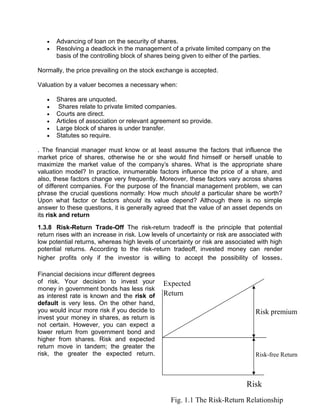
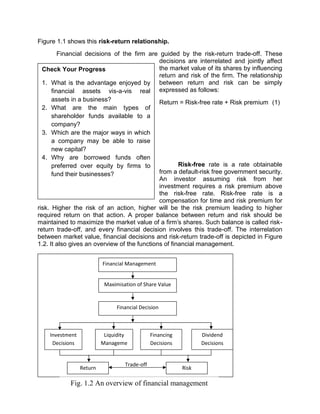
1.3.8 Risk-Return Trade-Off The risk-return tradeoff is the principle that potential
return rises with an increase in risk. Low levels of uncertainty or risk are associated with
low potential returns, whereas high levels of uncertainty or risk are associated with high
potential returns. According to the risk-return tradeoff, invested money can render
higher profits only if the investor is willing to accept the possibility of losses.
Financial decisions incur different degrees
of risk. Your decision to invest your
money in government bonds has less risk
as interest rate is known and the risk of
default is very less. On the other hand,
you would incur more risk if you decide to
invest your money in shares, as return is
not certain. However, you can expect a
lower return from government bond and
higher from shares. Risk and expected
return move in tandem; the greater the
risk, the greater the expected return.
Risk premium
Risk-free Return
Risk
Expected
Return
Fig. 1.1 The Risk-Return Relationship
Check Your Progress
1. What is the advantage enjoyed by
financial assets vis-a-vis real
assets in a business?
2. What are the main types of
shareholder funds available to a
company?
3. Which are the major ways in which
a company may be able to raise
new capital?
4. Why are borrowed funds often
preferred over equity by firms to
fund their businesses?
Figure 1.1 shows this risk-return relationship.
Financial decisions of the firm are guided by the risk-return trade-off. These
decisions are interrelated and jointly affect
the market value of its shares by influencing
return and risk of the firm. The relationship
between return and risk can be simply
expressed as follows:
Return = Risk-free rate + Risk premium (1)
Risk-free rate is a rate obtainable
from a default-risk free government security.
An investor assuming risk from her
investment requires a risk premium above
the risk-free rate. Risk-free rate is a
compensation for time and risk premium for
risk. Higher the risk of an action, higher will be the risk premium leading to higher
required return on that action. A proper balance between return and risk should be
maintained to maximize the market value of a firm's shares. Such balance is called risk-
return trade-off, and every financial decision involves this trade-off. The interrelation
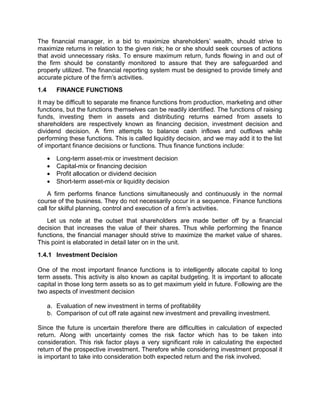
between market value, financial decisions and risk-return trade-off is depicted in Figure
1.2. It also gives an overview of the functions of financial management.
Financial Management
Maximisation of Share Value
Financial Decision
Investment
Decisions
Liquidity
Manageme
nt
Financing
Decisions
Dividend
Decisions
Risk
Return
Trade-off
Fig. 1.2 An overview of financial management
The financial manager, in a bid to maximize shareholders' wealth, should strive to
maximize returns in relation to the given risk; he or she should seek courses of actions
that avoid unnecessary risks. To ensure maximum return, funds flowing in and out of
the firm should be constantly monitored to assure that they are safeguarded and
properly utilized. The financial reporting system must be designed to provide timely and
accurate picture of the firm's activities.
1.4 FINANCE FUNCTIONS
It may be difficult to separate me finance functions from production, marketing and other
functions, but the functions themselves can be readily identified. The functions of raising
funds, investing them in assets and distributing returns earned from assets to
shareholders are respectively known as financing decision, investment decision and
dividend decision. A firm attempts to balance cash inflows and outflows while
performing these functions. This is called liquidity decision, and we may add it to the list
of important finance decisions or functions. Thus finance functions include:
 Long-term asset-mix or investment decision
 Capital-mix or financing decision
 Profit allocation or dividend decision
 Short-term asset-mix or liquidity decision
A firm performs finance functions simultaneously and continuously in the normal
course of the business. They do not necessarily occur in a sequence. Finance functions
call for skilful planning, control and execution of a firm's activities.
Let us note at the outset that shareholders are made better off by a financial
decision that increases the value of their shares. Thus while performing the finance
functions, the financial manager should strive to maximize the market value of shares.
This point is elaborated in detail later on in the unit.
1.4.1 Investment Decision
One of the most important finance functions is to intelligently allocate capital to long
term assets. This activity is also known as capital budgeting. It is important to allocate
capital in those long term assets so as to get maximum yield in future. Following are the
two aspects of investment decision
a. Evaluation of new investment in terms of profitability
b. Comparison of cut off rate against new investment and prevailing investment.
Since the future is uncertain therefore there are difficulties in calculation of expected
return. Along with uncertainty comes the risk factor which has to be taken into
consideration. This risk factor plays a very significant role in calculating the expected
return of the prospective investment. Therefore while considering investment proposal it
is important to take into consideration both expected return and the risk involved.
Check Your Progress
5. List the main areas of financial
decision making.
6. What should be the main financial
goal of a firm?
7. Why are indicators like profits
after taxes and earnings per
share not the best ways to decide
the financial goals of a firm?
Investment decision not only involves allocating capital to long term assets but also
involves decisions of using funds which are obtained by selling those assets which
become less profitable and less productive. It wise decisions to decompose depreciated
assets which are not adding value and utilize those funds in securing other beneficial
assets. An opportunity cost of capital needs to be calculating while dissolving such
assets. The correct cut off rate is calculated by using this opportunity cost of the
required rate of return (RRR)
1.4.2 Financing Decision
Financial decision is yet another important
function which a financial manger must
perform. It is important to make wise
decisions about when, where and how should
a business acquire funds. Funds can be
acquired through many ways and channels.
Broadly speaking a correct ratio of an equity
and debt has to be maintained. This mix of
equity capital and debt is known as a firm’s
capital structure.
A firm tends to benefit most when the market
value of a company’s share maximizes this
not only is a sign of growth for the firm but
also maximizes shareholders wealth. On the
other hand the use of debt affects the risk and
return of a shareholder. It is more risky though it may increase the return on equity
funds.
A sound financial structure is said to be one which aims at maximizing shareholders
return with minimum risk. In such a scenario the market value of the firm will maximize
and hence an optimum capital structure would be achieved. Other than equity and debt
there are several other tools which are used in deciding a firm capital structure.
1.4.3 Dividend Decision
Earning profit or a positive return is a common goal of all the businesses. But the key
function a financial manger performs in case of profitability is to decide whether to
distribute all the profits to the shareholders or retain all the profits or distribute part of
the profits to the shareholder and retain the other half in the business.
It’s the financial manager’s responsibility to decide an optimum dividend policy which
maximizes the market value of the firm. Hence an optimum dividend payout ratio is
calculated. It is a common practice to pay regular dividends in case of profitability
another way is to issue bonus shares to existing shareholders.
Bonus shares are shares issued to the existing shareholders without any charge. The
financial manager should consider the questions of dividend stability, bonus shares and
cash dividends in practice.
1.4.4 Liquidity Decision
It is very important to maintain a liquidity position of a firm to avoid insolvency. Firm’s
profitability, liquidity and risk all are associated with the investment in current assets. In
order to maintain a tradeoff between profitability and liquidity it is important to invest
sufficient funds in current assets. But since current assets do not earn anything for
business therefore a proper calculation must be done before investing in current assets.
Current assets should properly be valued and disposed of from time to time once they
become non profitable. Currents assets must be used in times of liquidity problems and
times of insolvency.
In sum, financial decisions directly concern the firm's decision to acquire or
dispose off assets and require commitment or recommitment of funds on a continuous
basis. It is in this context that finance functions are said to influence production,
marketing and other functions of the firm. Hence finance functions may affect the size,
growth, profitability and risk of the firm, and ultimately, the value of the firm.
1.5 INNOVATIVE FINANCE FUNCTIONS
Who is a financial manager? What is his or her role? A financial manager is a person
who is responsible, in a significant way, to carry out the finance functions. It should be
noted that, in a modern enterprise, the financial manager occupies a key position. He or
she is one of the members of the top management team, and his or her role, day-by-
day, is becoming more pervasive, intensive and significant in solving the complex funds
management problems. Now his or her function is not confined to mat of a scorekeeper
maintaining records, preparing reports and raising funds when needed, nor is he or she
a staff officer-in a passive role of an adviser. The finance manager is now responsible
for shaping the fortunes of the enterprise, and is involved in the most vital decision of
the allocation of capital. In his or her new role, he or she needs to have a broader and
far-sighted outlook, and must ensure that the funds of the enterprise are utilized in the
most efficient manner. He or she must realize that his or her actions have far-reaching
consequences for the firm because they influence the size, profitability, growth, risk and
survival of the firm, and as a consequence, affect the overall value of the firm The
financial manager, therefore, must have a clear understanding and a strong grasp of the
nature and scope of the finance functions.
The financial manager has not always been in the dynamic role of decision
making. About three decades ago, he or she was not considered an important person,
as far as the top management decision-making was concerned. He or she became an
important management person only which the advent of the modern or contemporary
approach to the financial management. What are the main functions of a financial
manager?
1.5.1 Fund Raising
The traditional approach dominated the scope of financial management and limited the
role of the financial manager simply to funds raising. It was during the major events,
such as promotion, reorganization, expansion or diversification in the firm dial the
financial manager was called upon to raise funds. In his or her day-to-day activities, his
or her only significant duty was to see that the firm had enough cash to meet its
obligations. Because of its central emphasis on the procurement of funds, the finance
textbooks, for example, in the USA, till the mid 1950s covered discussion of the
instruments, institutions and practices through which funds were obtained. Further, as
the problem of raising funds was more intensely felt in the special events, these books
also contained detailed descriptions of the major events like mergers, consolidations,
reorganizations and recapitalizations involving episodic financing. The finance books
in India and other countries simply followed the American pattern. The notable feature
of the traditional view of financial management was the assumption that the financial
manager had no concern with the decision of allocating the firm's funds. These
decisions were assumed as given, and he or she was required to raise the needed
funds from a combination of various sources.
The traditional approach did not go unchallenged even during the period of its
dominance. But the criticism related more to the treatment of various topics rather than
the basic definition of the finance function. The traditional approach has been criticized
because it failed to consider the day-to-day managerial problems relating to finance of
the firm. It concentrated itself to looking into the problems from management's point of
view. Thus the traditional approach of looking at the role of the financial manager lacked
a conceptual framework for making financial decisions, misplaced emphasis on raising
of funds, and neglected the real issues relating to the allocation and management of
funds.
1.5.2 Fund Allocation
The traditional approach outlived its utility in the changed business situation particularly
after the mid 1950s. A number of economic and environmental factors, such as the
increasing pace of industrialization, technological innovations and inventions, intense
competition, increasing intervention of government on account of management
inefficiency and failure, population growth and widened markets, during and after mid
1950s, necessitated efficient and effective utilization of the firm's resources, including
financial resources. The development of a number of management skills and decision
making techniques facilitated the implementation of a system of optimum allocation of
the firm's resources. As a result, the approach to, and the scope of financial
management, also changed. The emphasis shifted from the episodic financing to the
financial management, from raising of funds to efficient and effective use of funds. The
new approach is embedded in sound conceptual and analytical theories.
The new or modern approach to finance is an analytical way of looking into the
financial problems of the firm. Financial management is considered a vital and an
integral part of overall management. To quote Ezra Solomon:
In this broader view the central issue of financial policy is the wise use of funds,
and the central process involved is a rational matching of advantages of potential uses
against the cost of alternative potential sources so as to achieve the broad financial
goals which an enterprise sets for itself.
Thus, in a modern enterprise, the basic finance function is to decide about the
expenditure decisions and to determine the demand for capital for these expenditures.
In other words, the financial manager, in his or her new role, is concerned with the
efficient allocation of funds. The allocation of funds is not a new problem, however. It
did exist in the past, but it was not considered important enough in achieving the firm's
long run objectives.
In his or her new role of using funds wisely, the financial manager must find a
rationale for answering the following three questions:
 How large should an enterprise be, and how fast should it grow?
 In what form should it hold its assets?
 How should the funds required be raised?
As discussed earlier, the questions stated above relate to three broad decision areas
of financial management: investment (including both long and short-term assets),
financing and dividend. The "modern" financial manager has to help making these
decisions in the most rational way. They have to be made in such a way that the funds
of the firm are used optimally. We have referred to these decisions as managerial
finance functions since they require special care and extraordinary managerial ability.
As discussed earlier, the financial decisions have a great impact on all other
business activities. The concern of the financial manager, besides his traditional
function of raising money, will be on determining the size and technology of the firm, in
setting the pace and direction of growth and in shaping the profitability and risk
complexion of the firm by selecting the best asset mix and financing mix,
1.5.3 Profit Planning
The functions of the financial manager may be broadened to include profit-planning
function. Profit planning refers to the operating decisions in the areas of pricing, costs,
volume of output and the firm's selection of product lines. Profit planning is, therefore, a
prerequisite for optimizing investment and financing decisions. The cost structure of the
firm, i.e. the mix of fixed and variable costs has a significant influence on a firm's
profitability. Fixed costs remain constant while variable costs change in direct proportion
to volume changes. Because of the fixed costs, profits fluctuate at a higher degree than
the fluctuations in sales. The change in profits due to the change in sales is referred to
as operating leverage. Profit planning helps to anticipate the relationships between
volume, costs and profits and develop action plans to face unexpected surprises.
1.5.4 Understanding Capital Markets
Capital markets bring investors (lenders) and firms (borrowers) together. Hence the
financial manager has to deal with capital markets. He or she should fully understand
the operations of capital markets and the way in which the capital markets value
securities. He or she should also know-how risk is measured and how to cope with it in
investment and financing decisions. For example, if a firm uses excessive debt to
finance its growth, investors may perceive it as risky. The value of the firm's share may,
therefore, decline. Similarly, investors may not like the decision of a highly profitable,
growing firm to distribute dividend. They may like the firm to reinvest profits in attractive
opportunities that would enhance their prospects for making high capital gains in the
future. Investments also involve risk and return. It is through their operations in capital
markets that investors continuously evaluate the actions of the financial manager.
The vital importance of the financial decisions to a firm makes it imperative to set
up a sound and efficient organization for the finance functions. The ultimate
responsibility of carrying out the finance functions lies with the top management. Thus,
a department to organize financial activities may be created under the direct control of
the board of directors. The board may constitute a finance committee. The executive
heading the finance department is the firm's chief finance officer (CFO), and he or she
may be known by different designations. The finance committee or CFO will decide the
major financial policy matters, while the routine activities would be delegated to lower
levels. For example, at BHEL a director of finance at the corporate office heads the
finance function. He is a member of the board of directors and reports to the chairman
and managing director (CMD). An executive director of finance (EDF) and a general
manager of finance (GMF) assist the director of finance. EDF looks after funding,
budgets and cost, books of accounts, financial services and cash management. GMF is
responsible for internal audit and taxation.
The reason for placing the finance functions in the hands of top management
may be attributed to the following factors: First, financial decisions are crucial for the
survival of the firm. The growth and development of the firm is directly influenced by the
financial policies. Second, the financial actions determine solvency of the firm. At no
cost can a firm afford to threaten its solvency. Because solvency is affected by the flow
of funds, which is a result of the various financial activities, top management being in a
position to coordinate these activities retains finance functions in its control. Third,
centralization of the finance functions can result in a number of economies to the firm.
For example, the firm can save in terms of interest on borrowed funds, can purchase
fixed assets economically or issue shares or debentures efficiently.
1.5.5 Status and Duties of Finance Executives
The exact organization structure for financial management will differ across firms. It will
depend on factors such as the size of the firm, nature of the business, financing
operations, capabilities, of the firm's financial officers and most importantly, on the
financial philosophy of the firm. The designation of the chief financial officer (CFO)
would also differ within firms. In some firms, the financial officer may be known as me
financial manager, while in others as the vice-president of finance or the director of
finance or the financial controller. Two more officers—treasurer and controller— may be
appointed under the direct supervision of CFO to assist him or her. In larger companies,
with modern management, there may be vice-president or director of finance, usually
with both controller and treasurer reporting to him.15
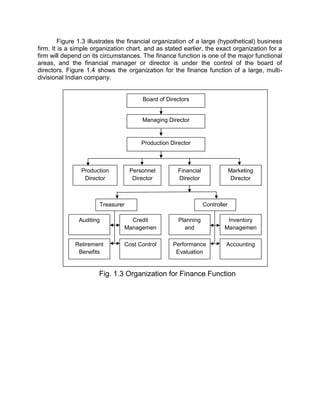
Figure 1.3 illustrates the financial organization of a large (hypothetical) business
firm. It is a simple organization chart, and as stated earlier, the exact organization for a
firm will depend on its circumstances. The finance function is one of the major functional
areas, and the financial manager or director is under the control of the board of
directors. Figure 1.4 shows the organization for the finance function of a large, multi-
divisional Indian company.
Board of Directors
Managing Director
Production Director
Production
Director
Personnel
Director
Financial
Director
Marketing
Director
Controller
Treasurer
Fig. 1.3 Organization for Finance Function
Planning and
Budgeting
Inventory
Management
Performance
Evaluation
Accounting
Auditing Credit
Management
Retirement
Benefits
Cost Control
Board of Directors
Managing Director
Production Director
Production
Director
Personnel
Director
Financial
Director
Marketing
Director
Controller
Treasurer
Fig. 1.3 Organization for Finance Function
Planning
and
Budgeting
Inventory
Managemen
t
Performance
Evaluation
Accounting
Auditing Credit
Managemen
t
Retirement
Benefits
Cost Control
CFO has both line and staff responsibilities. He or she is directly concerned with
the financial planning and control. He or she is a member of the top management, and
he or she is closely associated with the formulation of policies and making decisions for
the firm. The treasurer and controller, if a company has these executives, would operate
under CFO's supervision. He or she must guide them and others in the effective working
of the finance department.
The main function of the treasurer is to manage the firm's funds. His or her major
duties include forecasting the financial needs, administering the flow of cash, managing
credit, floating securities, maintaining relations with financial institution and protecting
funds and securities. On the other hand, the functions of the controller relate to the
management and control of assets. His or her duties include providing information to
formulate accounting and costing policies, preparation of financial reports, direction of
internal auditing, budgeting, inventory control, taxes etc. It may be stated that the
controller's functions concentrate the asset side of the balance sheet, while treasurer's
functions relate to the liability side.
1.5.6 Controller's and Treasurer's Functions in the Indian Context
The controller and the treasurer are essentially American terms. Generally speaking,
the American pattern of dividing the financial executive's functions into controllership
and treasurer ship functions is not being widely followed in India. We do have a number
of companies in India having officers with the designation of the controller, or the
financial controller. The controller or the financial controller in India, by and large,
performs the functions of a chief accountant or management accountant. The officer
with the title of treasurer can also be found in a few companies in India.
It should be realised that the financial controller does not control finances; he or
she develops, uses and interprets information—some of which will be financial in
nature—for management control and planning. For this reason, the financial controller
may simply be called as the controller. Management of finance or money is a separate
and important activity. Traditionally, the accountants have been involved in managing
money in India. But the difference in managing money resources and information
resources should be appreciated.
In the American business, the management of finance is treated as a separate
activity and is being performed by the treasurer. The title of the treasurer has not found
favour in India to the extent the controller has. The company secretary in India
discharges some of the functions performed by the treasurer in the American context.
Insurance coverage is an example in this regard. The function of maintaining relations
with investors (particularly shareholders) may now assume significance in India
because of the development in the Indian capital markets and the increasing awareness
among investors.
The general title, financial manager or finance director, seems to be more
popular in India. This title is also better than me title of treasurer since it conveys the
functions involved. The main function of the financial manager in India should be the
management of the company's funds. The financial duties may often be combined with
Check Your Progress
8. What are the major roles that
the Chief Finance Officer (CFO)
of a firm is expected to play in
today's business environment?
others. But the significance of not combining the financial manager's duties with others
should be realised. The managing of funds—a very valuable resource—is a business
activity requiring extraordinary skill on the part of the financial manager. He or she
should ensure the optimum use of money under various constraints. He or she should,
therefore, be allowed to devote his or her full energy and time in managing the money
resources only.
1.6 SUMMARY
 The finance functions can be divided into three broad categories: (1) investment
decision, (2) financing decision, and (3) dividend decision. In other words, the
firm decides how much to invest in short-term and long-term assets and how to
raise the required funds.
 In making financial decisions, the financial manager should aim at increasing the
value of the shareholders' stake in the firm. This is referred to as the principle of
shareholders' wealth maximization (SWM).
 Wealth maximization is superior to profit maximization since wealth is precisely
defined as net present value and it accounts for time value of money and risk.
 Shareholders and managers have the principal-agent relationship. In practice,
there may arise a conflict between the interests of shareholders and managers.
This is referred to the agency problem and the associated costs are called
agency costs. Offering ownership rights (in the form of stock options) to
managers can mitigate agency costs.
 The financial manager raises capital
from the capital markets. He or she
should therefore know how the capital
markets function to allocate capital to
the competing firms and how security
prices are determined in the capital
markets.
 Most companies have only one chief
financial officer (CFO). But a large
company may have both a treasurer and
a controller, who may or may not operate under a CFO.
 The treasurer's function is to raise and manage company funds while the
controller oversees whether the funds are correctly applied. A number of
companies in India either have a finance director or a vice-president of finance as
the chief financial officer.
1.7 KEY TERMS
 Profit Planning: The operating decisions in the areas of pricing, costs, volume of
output and the firm's selection of product lines.
 Operating Leverage: The change in profits due to the change in sales.
 Opportunity Cost of Capital: The expected rate of return that an investor could
earn by investing his or her money in financial assets of equivalent risk.
 Net Present Value (NPV): The NPV of a course of action is the difference
between the present value of its benefits and the present value of its costs.
1.8 ANSWERS TO 'CHECK YOUR PROGRESS'
1. Financial assets like shares and bonds can be bought or sold more easily. Real
assets like plant and machinery, building etc. are not as liquid as financial assets
are.
2. Mostly equity funds consisting of ordinary shares and undistributed profits
(retained earnings).
3. By issuing new shares to the general public as well as to existing shareholders
which are known as rights shares.
4. A firm borrows money from lenders; they are not owners of the business. There
are three reasons for preferring borrowed funds: (1) Unlike dividends on
shareholder funds, the amount of interest paid on borrowed funds by a firm saves
taxes as it is treated as a deductible expense while computing income tax
payable by a firm. (2) The shareholders' return will be higher if the interest rate
on borrowed funds is less than return from assets or business. (3) It is relatively
easy to raise borrowed funds from a financial institution or bank than issuing
equity funds.
5. The main areas of financial decision making are (1) the investment decision (or
capital budgeting decision), (2) the financing decision (or capital structure
decision), (3) the dividend decision (or profit allocation decision) and (4) the
liquidity decision (or working capital management decision).
6. The main financial goal of a firm is to create value for shareholders by
maximizing the wealth of shareholders.
7. The CFO, heading the finance function of a company, is often a member of the
Board of Directors and reports to the Chairman & Managing Director of the
Company. Typically, the CFO supervises the work of the Treasurer and the
Controller, who in turn look after various functional areas.
1.9 QUESTIONS AND EXERCISES
Short- Answer Questions
1. Define the scope of financial management. What role should the financial
manager play in a modern enterprise?
2. What are the basic financial decisions? How do they involve risk-return trade-off?
3. How should the finance function of an enterprise be organized? What functions
does the financial officer perform?
4. When can there arise a conflict between shareholders' and managers' goals?
How does the wealth maximization goal take care of this conflict?
Long-Answer Questions
1. How does the "modern" financial manager differ from the "traditional" financial
manager? Does the "modern" financial manager's role differ for the large
diversified firm and the small to medium size firm?
2. "Profit maximization is not an operationally feasible criterion". Do you agree?
Illustrate your views.
3. In what ways is the wealth maximization objective superior to the profit
maximization objective? Explain.
4. Should the titles of controller and treasurer be adopted under Indian context?
Would you like to modify their functions in view of the company practices in
India? Justify your opinion.
UNIT-2
COST OF CAPITAL
2.1 COST OF CAPITAL
In this unit, we focus on the concept of the cost of capital as a discount rate and the
procedure of its measurement.
The opportunity cost of capital (or simply, the cost of capital) for a project is the
discount rate for discounting its cash flows. The project's cost of capital is the minimum
required rate of return on funds committed to the project, which depends on the
riskiness of its cash flows. Since the investment projects undertaken by a firm may differ
in risk, each one of them will have its own unique cost of capital. It should be clear at
the outset that the cost of capital for a project is defined by its risk, rather than the
characteristics of the firm undertaking the project.
The firm represents the aggregate of investment projects undertaken by it.
Therefore, the firm's cost of capital will be the overall, or average, required rate of return
on the aggregate of investment projects. Thus the firm's cost of capital is not the same
thing as the project's cost of capital. Can we use the firm's cost of capital for discounting
the cash flows of an investment projects. The firm's cost of capital can be used for
discounting the cash flows of those investment projects, which have risk equivalent to
the average risk of the firm. As a first step, however, the firm's cost of capital can be
used as a standard for establishing the required rates of return of the individual
investment projects. In the absence of a reliable formal procedure of calculating the cost
of capital for projects, the firm's cost of capital can be adjusted upward or downward to
account for risk differentials of investment projects. That is, an investment project's
required rate of return may be equal to the firm's cost of capital plus or minus a risk
adjustment factor depending on whether the project's risk is higher or lower than the
firm's risk. There does exit a methodology to calculate its cost of capital for projects. The
objective method of calculating the risk-adjusted cost of capital for projects is to use the
capital asset pricing model (CAPM), as we show later in this unit.
2.1.1 Meaning and Significance of Cost of Capital
We should recognize that the cost of capital is one of the most difficult and disputed
topics in the finance theory. Financial experts express conflicting opinions as to the
correct way in which the cost of capital can be measured. Irrespective of the
measurement problems, it is a concept of vital importance in the financial decision
making. It is useful as a standard for:
 evaluating investment decisions,
 designing a firm's debt policy, and
 appraising the financial performance of top management.
Investment evaluation
The primary purpose of measuring the cost of capital is its use as a financial
standard for evaluating the investment projects. In the NPV method, an investment
project is accepted if it has a positive NPV. The project's NPV is calculated by
discounting its cash flows by the cost of capital. In this sense, the cost of capital is the
discount rate used for evaluating the desirability of an investment project. In the IRR
method, the investment project is accepted if it has an internal rate of return greater
than the cost of capital. In this context, the cost of capital is the minimum required rate
of return on an investment project. It is also known as the cutoff rate, or the hurdle rate.
An investment project that provides a positive NPV when its cash flows are
discounted by the cost of capital makes a net contribution to the wealth of shareholders.
If the project has zero NPV, it means that its cash flows, have yielded a return just equal
to the cost of capital, and the acceptance or rejection of the project will not affect the
wealth of shareholders. The cost of capital is the minimum required rate of return on the
investment project that keeps the present wealth of shareholders unchanged. It may be,
thus, noted that the cost of capital represents a financial standard for allocating the
firm's funds, supplied by owners and creditors, to the various investment projects in the
most efficient manner.
Designing debt policy
The debt policy of a firm is significantly influenced by the cost consideration. As
we shall learn later on, debt helps to save taxes, as interest on debt is a tax-deductible
expense. The interest tax shield reduces the overall cost of capital, though it also
increases the financial risk of the firm. In designing the financing policy, that is, the
proportion of debt and equity in the capital structure, the firm aims at maximising the
firm value by minimizing the overall cost of capital.
The cost of capital can also be useful in deciding about the methods of financing
at a point of time. For example, cost may be compared in choosing between leasing and
borrowing. Of course, equally important considerations are control and risk.28
Performance appraisal
The cost of capital framework can be used to evaluate the financial performance of top
management.29
Such an evaluation will involve a comparison of actual profitability of the
investment projects undertaken by the firm with the projected overall cost of capital, and
the appraisal of the actual costs incurred by management in raising the required funds.
The cost of capital also plays a useful role in dividend decision and investment in
current assets.
2.1.2 Calculation of Cost of Debt
A company may raise debt in a variety of ways. It may borrow funds from financial
institutions or public either in the form of public deposits or debentures (bonds) for a
specified period of time at a certain rate of interest. A debenture or bond may be Issued
at par or at a discount or premium as compared to its face value. The contractual rule of
interest or the coupon rate forms the basis for calculating the cost of debt.
Debt issued at par
The method of computation for ascertaining cost of debt which is issued at par is
comparatively an easy task. It is nothing but the explicit interest rate adjusted again for
the tax liability.
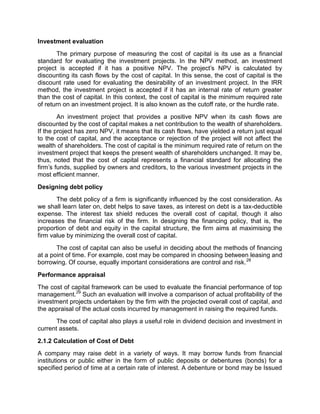
Symbolically,
Example:
A company has issued 8% debentures and the tax rate is 50%, the after tax cost of debt
will be 4%. — It may be’ calculated as under:
kd=(1-50%)8=(1-0.5)8=4
Since interest is treated as an expense while calculating firm’s income for income- tax
purpose, the tax is deducted out of the interest payable. This tax adjusted interest rate
is used only where the EBIT (Earnings/Profits before Interest and Tax) is equal to or
exceed the interest.
The before-tax cost of debt is the rate of return required by lenders. It is easy to
compute before-tax cost of debt issued and to be redeemed at par; it is simply equal to
the contractual (or coupon) rate of interest. For example, a company decides to sell
new issue of 7 year 15 per cent bonds of Rs. 100 each at par. If the company realizes
the full face value of Rs. 100 bond and will pay Rs. 100 principal to bondholders at
maturity, the before-tax cost of debt will simply be equal to the rate of interest of 15 per
cent.
Thus: kd= i = (13)
where kd is the before-tax cost of debt, i is the coupon rate of interest, B0 is the issue
price of the bond (debt) and in Equation (13) it is assumed to be equal to the face value
(F), and INT is the amount of interest. The amount of interest payable to the lender is
always equal to:
Interest = Face value of debt x Interest rate
The before-tax cost of bond in the example is:
kd =
.
.
= 0.15 or 15%
We could arrive at same results as above by using Equation (13): cash outflow are Rs.
15 interest per year for 7 years and Rs. 100 at the end of seventh year in exchange for
Rs 100 now. Thus:
By trial and error, we find that the discount rate (kd), which solves the equation, is 15 per
cent:
100 = 15(4.160) + 100(0.376) = 62.40 + 37.60 = 100
Clearly, the before-tax cost of bond is the rate, which the investment should yield to
meet the outflows to bondholders.
Debt issued at discount or premium
In many cases, bonds or debentures may be issued at a premium (when, it is more than
the face value) or at a discount (when it is less than the face value). In that case, the
cost of debt must not be equal to the coupon rate of interest. Moreover, if discounts or
premiums are amortized for income-tax purposes, it should also be considered.
(14)
Illustration 2.1: A company issues 10% Debentures tor Rs. 2,00,000 Rate of tax is
55%. Calculate the cost of debt (after tax) if the debentures are issued (i) at par (ii) at a
discount of 10% and (iii) at a premium of 10%.
Solution:
Cost of debt is calculated as under:
Solution:
(i) Issued at Par
= Rs. 20,000/Rs. 2,00,000 (1 – .55)
=1/10 x .45
= 4.5%
(ii) Issued at a Discount of 10%
Rs. 20,000/Rs. 1,80,000 (1 – .55)
= 1/9 x .45
= 5 %
(iii) Issued at Premium of 10%
Rs. 20,000/Rs. 2,20,000 (1 – .55)
= 1/11 x .45
= 4.1 %
Illustration:2.2
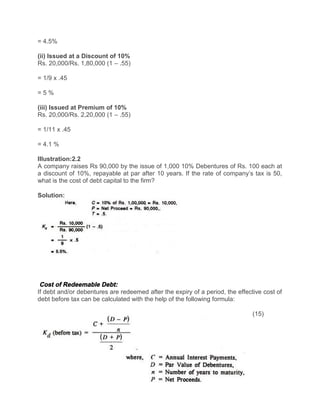
A company raises Rs 90,000 by the issue of 1,000 10% Debentures of Rs. 100 each at
a discount of 10%, repayable at par after 10 years. If the rate of company’s tax is 50,
what is the cost of debt capital to the firm?
Solution:
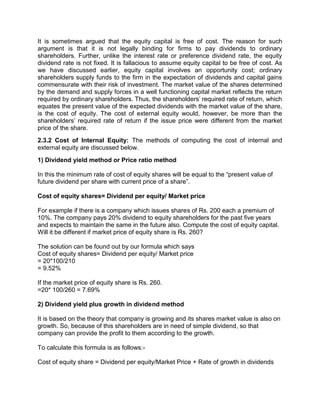
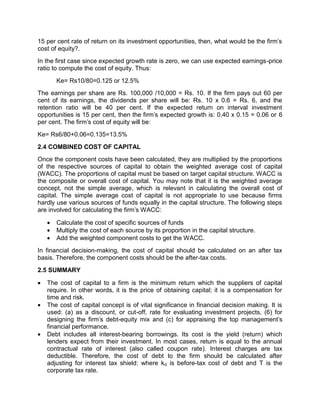
Cost of Redeemable Debt:
If debt and/or debentures are redeemed after the expiry of a period, the effective cost of
debt before tax can be calculated with the help of the following formula:
(15)
Illustration:2.3
A company issues 10,000, 10% Debentures of Rs.10 each and realizes Rs.95,000 after
allowing 5% commission to brokers. The debentures are redeemed after 10 years.
Calculate the effective cost of debt before tax.
Solution:
Tax adjustment
The interest paid on debt is tax deductible. The higher the interest charges, the lower
will be the amount of tax payable by the firm. This implies that the government indirectly
pays a part of the lender's required rate of return. As a result of the interest tax lenders,
the after-tax cost of debt to the firm will be substantially less than the investors' required
rate of return. The before-tax cost of debt, kd, should, therefore, be adjusted for the tax
effect as follows:
After- tax cost of debt = kd (l -T) (16)
where T is the corporate tax rate. If the before-tax cost of bond in our example is 16.5
per cent, and the corporate tax rate is 35 per cent, the after-tax cost of bond will be:
kd (l -T)= 0.1650(1-0.35) = 0.l073 or 10.73%
It should be noted that the tax benefit of interest deductibility would be available
only when the firm is profitable and is paying taxes. An unprofitable firm is not required
to pay any taxes. It would not gain any tax benefit associated with the payment of
interest, and its true cost of debt is the before-tax cost.
It is important to remember that in the calculation of the average cost of capital,
the after-tax cost of debt must be used, not the before-tax cost of debt.
2.2 COST OF PREFERENCE CAPITAL
The cost of preference share capital is apparently the dividend which is committed and
paid by the company. This cost is not relevant for project evaluation because this is not
the cost at which further capital can be obtained. To find out the cost of acquiring
the marginal cost, we will be finding the yield on the preference share based on the
current market value of the preference share. The measurement of the cost of
preference capital poses some conceptual difficulty. In the case of debt, there is a
binding legal obligation on the firm to pay interest, and tax interest constitutes the basis
to calculate the cost of debt. However, in the case o preference capital, payment of
dividends is not legally binding on the firm and even if the dividends are paid, it is not a
charge on earnings; rather it is a distribution or appropriate of earnings to preference
shareholders. One may, therefore, be tempted to conclude that the dividends on
preference capital do not constitute cost. This is not true.
The cost of preference capital is a function of the dividend expected by investors for
Preference capital is never issued with an intention not to pay dividends. Although it not
legally binding upon the firm to pay dividends on preference capital, yet it is general
paid when the firm makes sufficient profits. The failure to pay dividends, although does
not cause bankruptcy, yet it can be a serious matter from the ordinary shareholders
point of view. The non-payment of dividends on preference capital may result in voting
rights and control to the preference shareholders. More than this, the firm's credit
standing may be damaged. The accumulation of preference dividend arrears may
adversely affect the prospects of ordinary shareholders for receiving any dividends
because dividends on preference capital represent a prior claim on profits. As
consequence, the firm may find difficulty in raising funds by issuing preference to equity
shares. Also, the market value of the equity shares can be adversely affected if
dividends are not paid to the preference shareholders and, therefore, to the equity
shareholders. For these reasons, dividends on preference capital should be paid
regularly except when the firm does not make profits, or it is in a very tight cash
position.
2.2.1 Irredeemable Preference Share
The preference share may be treated as a perpetual security if it is irredeemable. Thus,
its cost is given by the following equation:
Kp = (17)
Where kp is the cost of preference share, PDIV is the expected preference dividend]
and Po is the issue price of preference share.
Illustration 2.10: Cost of Irredeemable Preference Share
A company issues 10 per cent irredeemable preference shares. The face value per
share is Rs. 100, but the issue price is Rs. 95. What is the cost of a preference share?
What is the cost if the issue price is Rs. 105?
We can compute cost of a preference share as follows:
Issue price Rs. 95: Kp = = = 0.1053 or 10.53%
Issue price Rs. 105: : Kp = = = 0.0952 or 9.52%
2.2.2 Redeemable Preference Share
Redeemable preference shares (that is, preference shares with finite maturity) are also
issued in practice..These shares are issued for a particular period and at the expiry of
that period, they are redeemed and principal is paid back to the preference
shareholders. The characteristics are very similar to debt and therefore the calculations
will be similar too. For finding cost of redeemable preference shares, following formula
can be used. These shares are issued for a particular period and at the expiry of that
period, they are redeemed and principal is paid back to the preference shareholders.
The characteristics are very similar to debt and therefore the calculations will be similar
too. A formula similar to previous equation can be used to compute the cost of
redeemable preference share
P0 = ∑t=1 to n [ PDIV / (1 +Kp)t
] + [ Pn / (1 + Kp)n
] (18)
Here, preference share is traded at say P0 with dividend payments ‘D’ and principal
repayment ‘P’. The cost of debt is designated by Kp. Kp can be determined by solving
above equation. In Equation (18), k, is the cost of preference capital. Given the current
price, expected preference dividend (PDIV,), and maturity price Kf can be found by trial
and error.
The cost of preference share is not adjusted for taxes because preference dividend is
paid after the corporate taxes have been paid. Preference dividends do not save any
taxes. Thus, the cost of preference capital is automatically computed on an after-tax
basis. Since interest is tax deductible and preference dividend is not, the after-tax cost
of preference capital is substantially higher than the after-tax cost of debt.
2.3 COST OF EQUITY CAPITAL AND RETAINED EARNINGS
Cost of equity share is the part of cost of capital which allows the payment to only the
equity shareholders. In this every shareholders get the shares for getting the return on
the shares on which they are investing so much. From company's perspective the
company must earn more than cost of equity capital in order to be unaffected by the
market value of the shares of its. Firms may raise equity capital internally by retaining
earnings. Alternatively, they could distribute the entire earnings to equity shareholders
and raise equity capital externally by issuing new shares. In both cases, shareholders
are providing funds to the firms to finance their capital expenditures. Therefore, the
equity shareholders' required rate of return would be the same whether they supply
funds by purchasing new shares or by foregoing dividends, which could have been
distributed to them.
2.3.1 Is Equity Capital Free of Cost?
It is sometimes argued that the equity capital is free of cost. The reason for such
argument is that it is not legally binding for firms to pay dividends to ordinary
shareholders. Further, unlike the interest rate or preference dividend rate, the equity
dividend rate is not fixed. It is fallacious to assume equity capital to be free of cost. As
we have discussed earlier, equity capital involves an opportunity cost; ordinary
shareholders supply funds to the firm in the expectation of dividends and capital gains
commensurate with their risk of investment. The market value of the shares determined
by the demand and supply forces in a well functioning capital market reflects the return
required by ordinary shareholders. Thus, the shareholders' required rate of return, which
equates the present value of the expected dividends with the market value of the share,
is the cost of equity. The cost of external equity would, however, be more than the
shareholders' required rate of return if the issue price were different from the market
price of the share.
2.3.2 Cost of Internal Equity: The methods of computing the cost of internal and
external equity are discussed below.
1) Dividend yield method or Price ratio method
In this the minimum rate of cost of equity shares will be equal to the “present value of
future dividend per share with current price of a share”.
Cost of equity shares= Dividend per equity/ Market price
For example if there is a company which issues shares of Rs. 200 each a premium of
10%. The company pays 20% dividend to equity shareholders for the past five years
and expects to maintain the same in the future also. Compute the cost of equity capital.
Will it be different if market price of equity share is Rs. 260?
The solution can be found out by our formula which says
Cost of equity shares= Dividend per equity/ Market price
= 20*100/210
= 9.52%
If the market price of equity share is Rs. 260.
=20* 100/260 = 7.69%
2) Dividend yield plus growth in dividend method
It is based on the theory that company is growing and its shares market value is also on
growth. So, because of this shareholders are in need of simple dividend, so that
company can provide the profit to them according to the growth.
To calculate this formula is as follows:-
Cost of equity share = Dividend per equity/Market Price + Rate of growth in dividends
3) Earning yield method
In this cost of equity capital is minimum and the earning of the company should be
considered on market price of share. The formula for this is as follows:-
Cost of equity share = Earnings per share / Market Price per share
4) Realised yield method
This method removes the drawback which in the dividend yield method or earning yield
method as both are based on future estimation of dividend or earning. In the economics
there are many factors which can't be controlled and are very uncertain and if the risk is
involved then the future planning can't be used and the decision related estimation
return on investment can't be considered. It is based on actual earning which is earned
on the amount of investment. The equity share capital is calculated as:-
Cost of equity share = Actual earnings per share * 100
2.3.3 Earning-Price Ratio and the Cost of Equity
Earnings per share (EPS) are the amount of earning per each share of a company's
stock. Companies require the EPS for their each income statement which shows about
the continuing operations, discontinued operations, net income and outstanding items.
EPS doesn't depend on the increase or decrease of the earning power of the company
and gets calculated over number of years.
How is it calculated?
Earnings per share ratio (EPS Ratio) are calculated by dividing the net profit after taxes
and preference dividend by the total number of equity shares. It is a small variance of
return on equity capital ratio. The formula of Earning per share ratio is given as:-
“[Earnings per share (EPS) Ratio = (Net profit after tax - Preference dividend) / No. of
equity shares (common shares)]”
. For example, if the current market price of a share is Rs. 500 (face value being Rs
100) and the earning per share is Rs. 10, the E/P ratio will be: Rs 10 / Rs. 500 = 0.02 or
2 per cent. Does this mean that the expectation of shareholders is 2 per cent? They
would, in fact, expect to receive a stream of dividends and a final price of the share that
would result in a return significantly greater than the E/P ratio. Thus, the dividend
valuation model gives the most of valid measure of the cost of equity.
Illustration 2.13: Earnings-Price Ratio and the Cost of Equity
A firm is currently earning Rs. 100,000 and its share is selling at a market price of Rs.
80. The firm has 10,000 shares outstanding and has no debt. The earnings of the firm
are expected to remain stable, and it has a payout ratio of 100 per cent. What is the
cost of equity? If the firm's payout ratio is assumed to be 60 per cent and that it earns
15 per cent rate of return on its investment opportunities, then, what would be the firm's
cost of equity?.
In the first case since expected growth rate is zero, we can use expected earnings-price
ratio to compute the cost of equity. Thus:
Ke= Rs10/80=0.125 or 12.5%
The earnings per share are Rs. 100,000 /10,000 = Rs. 10. If the firm pays out 60 per
cent of its earnings, the dividends per share will be: Rs. 10 x 0.6 = Rs. 6, and the
retention ratio will be 40 per cent. If the expected return on interval investment
opportunities is 15 per cent, then the firm's expected growth is: 0.40 x 0.15 = 0.06 or 6
per cent. The firm's cost of equity will be:
Ke= Rs6/80+0.06=0.135=13.5%
2.4 COMBINED COST OF CAPITAL
Once the component costs have been calculated, they are multiplied by the proportions
of the respective sources of capital to obtain the weighted average cost of capital
(WACC). The proportions of capital must be based on target capital structure. WACC is
the composite or overall cost of capital. You may note that it is the weighted average
concept, not the simple average, which is relevant in calculating the overall cost of
capital. The simple average cost of capital is not appropriate to use because firms
hardly use various sources of funds equally in the capital structure. The following steps
are involved for calculating the firm's WACC:
 Calculate the cost of specific sources of funds
 Multiply the cost of each source by its proportion in the capital structure.
 Add the weighted component costs to get the WACC.
In financial decision-making, the cost of capital should be calculated on an after tax
basis. Therefore, the component costs should be the after-tax costs.
2.5 SUMMARY
 The cost of capital to a firm is the minimum return which the suppliers of capital
require. In other words, it is the price of obtaining capital; it is a compensation for
time and risk.
 The cost of capital concept is of vital significance in financial decision making. It is
used: (a) as a discount, or cut-off, rate for evaluating investment projects, (6) for
designing the firm's debt-equity mix and (c) for appraising the top management's
financial performance.
 Debt includes all interest-bearing borrowings. Its cost is the yield (return) which
lenders expect from their investment. In most cases, return is equal to the annual
contractual rate of interest (also called coupon rate). Interest charges are tax
deductible. Therefore, the cost of debt to the firm should be calculated after
adjusting for interest tax shield: where kd is before-tax cost of debt and T is the
corporate tax rate.
 Equity includes paid-up capital and reserve and surplus (retained earnings). Equity
has no explicit cost, as payment of dividends is not obligatory. However, it involves
an opportunity cost.
 Three steps are involved in calculating the firm's weighted average cost of capital
(WACC). First, the component costs of debt and equity are calculated. Second,
weights to each component of capital are assigned according to the target capital
structure. Third, the product of component costs and weights is summed up to
determine WACC. The weighted average cost of new capital is the weighted
marginal cost of capital (WMCC). WACC for a firm which debt and equity in the
capital structure, is given by the following formula:
Where ke is the cost of equity, kd is the cost of debt, T is the tax rate, D is d and £ is
equity. The market value weights should be used in calculating WAC
2. 6 QUESTIONS AND EXERCISES
Short-Answer Questions
1. Define cost of capital. Explain its significance in financial decision-making,
2. How is the cost of debt computed? How does it differ from the cost of preference
capital?
Long-Answer Questions
1. A company has 5,000,000 ordinary shares outstanding. The market price of the
share is Rs. 96 while the book value is Rs. 65. The firm's earnings and dividends
per share are X 10 and Rs. 7, respectively. The company wants to issue
1,000,000 shares with net proceeds of Rs. 80 per share. What is the cost of
capital of the new issue?
UNIT-3
CAPITAL BUDGETING
Structure
3.0 INTRODUCTION
3.1 Learning Objectives
3.2 Nature and Types of Investment Decisions
3.2.1 Importance of Investment Decisions
3.2.2 Expansion and Diversification
3.2.3 Replacement and Modernization
32.4 Mutually Exclusive Investments
3.2.5 Independent Investments
3.2.6 Contingent Investments
3.3 Investment Evaluation Criteria
3.3.1 Investment Decision Rule
3.3.2 Evaluation Criteria
3.4 Net Present Value Method
3.4.1 Why is NPV Important?
3.4.2 Acceptance Rule
3.4.3 Evaluation of NPV Method
3.5 Internal Rate of Return Method
3.5.1 Calculating IRR by Trial and Error
3.5.2 NPV Profile and ERR
3.5.3 Acceptance Rule
3.5.4 Evaluation of IRR Method
3.5.5 NPV versus IRR
3.6 Payback
3.6.1 Acceptance Rule
3.6.2 Evaluation of Payback
3.6.3 Payback Reciprocal and the Rate of Return
3.6.4 Discounted Payback Period
3.7 Accounting Rate of Return Method
2.7.1 Acceptance Rule
2.7.2 Evaluation of ARR Method
3.8 Summary
3.9 Key Terms
3.10 Answers to 'Check Your Progress'
3.11Questions and Exercises
3.0 INTRODUCTION
Capital budgeting, and investment appraisal, is the planning process used to
determine whether an organization's long term investments such as purchase new
machinery, replacement of machinery, new plants, new products, and research
development projects are worth the funding of cash through the firm's capitalization
structure (debt, equity or retained earnings). It is the process of allocating resources for
major capital, or investment, expenditures. One of the primary goals of capital budgeting
investments is to increase the value of the firm to the shareholders.
An efficient allocation of capital is the most important finance function in modern times.
It involves decisions to commit the firm's funds to long-term assets. Capital budgeting or
investment decisions are of considerable importance to a firm since they tend to
determine its value by influencing its growth, profitability and risk. In this unit, we will
focus on the nature and evaluation of capital budgeting decisions. You will learn about
the net present value and internal rate of return methods. The unit will also discuss the
cost of capital, emphasizing on the calculation of cost of debt and equity capital and
retained earnings.
3.1 Learning Objectives
After going through this unit, you will be able to:
 Understand the nature and importance of investment decisions.
 Understand the capital budgeting and investment proccess, including planning
and control.
 Explain the methods of calculating net present value (NPV) and internal rate of
return (IRR).
 .Describe the non-DCF evaluation criteria: payback and accounting rate of
return.
 Illustrate the computation of discounted payback. ,
 Compare NPV and IRR and emphasize the superiority of NPV rule.
 Understand how to take investment decisions under capital rationing.
3.2 NATURE AND TYPES OF INVESTMENT DECISIONS
The investment decisions of a firm are generally known as the capital budgeting, or
capital expenditure decisions. A capital budgeting decision may be defined as the firm's
decision to invest its current funds most efficiently in the long-term assets in anticipation
of an expected flow of benefits over a series of years. The long-term assets are those
that affect the firm's operations beyond the one-year period. The firm's investment
decisions would generally include expansion, acquisition, modernization and
replacement of the long-term assets. Sale of a division or business (divestment) is also
as an investment decision. Decisions like the change in the methods of sales
distribution, or an advertisement campaign or a research and development programme
have long-term implications for the firm's expenditures and benefits, and therefore, they
should also be evaluated as investment decisions. It is important to note that investment
in the long-term assets invariably requires large funds to be tied up in the current assets
such as inventories and receivables. As such, investment in fixed and current assets is
one single activity.
The following are the features of investment decisions:
 The exchange of current funds for future benefits.
 The funds are invested in long-term assets.
 The future benefits will occur to the firm over a series of years.
It is significant to emphasize those expenditures and benefits of an investment
should be measured in cash. In the investment analysis, it is cash flow, which is
important, not the accounting profit. It may also be pointed out that investment decisions
affect the firm's value. The firm's value will increase if investments are profitable and
add to the shareholders' wealth. Thus, investments should be evaluated on the basis of
a criterion, which is compatible with the objective of the shareholders' wealth
maximization. An investment will add to the shareholders' wealth if it yields benefits in
excess of the minimum benefits as per the opportunity cost of capital. In this unit, we
assume that the investment project's opportunity cost of capital is known. We also
assume that the expenditures and benefits of the investment are known with certainty.
Both these assumptions are relaxed in later units.
3.2.1 Importance of Investment Decisions
Investment decisions require special attention because of the following reasons:1
 They influence the firm's growth in the long run
 They affect the risk of the firm
 They involve commitment of large amount of funds
 They are irreversible, or reversible at substantial loss
 They are among the most difficult decisions to make.
Growth: The effects of investment decisions extend into the future and have to be
endured for a longer period than the consequences of the current operating
expenditure. A firm's decision to invest in long-term assets has a decisive influence on
the rate and direction of its growth. A wrong decision can prove disastrous for the
continued survival of the firm; unwanted or unprofitable expansion of assets will result in
heavy operating costs to the firm. On the other hand, inadequate investment in assets
would make it difficult for the firm to compete successfully and maintain its market
share.
Risk: A long-term commitment of funds may also change the risk complexity of the firm.
If the adoption of an investment increases average gain but causes frequent fluctuations
in its earnings, the firm will become more risky. Thus, investment decisions shape the
basic character of a firm.
Funding: Investment decisions generally involve large amount of funds, which make it
imperative for the firm to plan its investment programmes very carefully and make an
advance arrangement for procuring finances internally or externally.
Irreversibility: Most investment decisions are irreversible. It is difficult to find a market
for such capital items once they have been acquired. The firm will incur heavy losses if
such assets are scrapped.
Complexity: Investment decisions are among the firm's most difficult decisions. They
are an assessment of future events, which are difficult to predict. It is really a complex
problem to correctly estimate the future cash flows of an investment. Economic,
political, social and technological forces cause the uncertainty in cash flow estimation.
There are many ways to classify investments. One classification is as follows:
 Expansion of existing business
 Expansion of new business
 Replacement and modernization.
3.2.2 Expansion and Diversification
A company may add capacity to its existing product
lines to expand existing operations. For example,
the Gujarat State Fertilizer Company (GSFC) may
increase its plant capacity to manufacture more
urea. It is an example of related diversification. A
firm may expand its activities in a new business.
Expansion of a new business requires investment
in new products and a new kind of production
activity within the firm. If a packaging manufacturing
company invests in a new plant and machinery to
produce ball bearings, which the firm has not
manufactured before, this represents expansion of
new business or unrelated diversification.
Sometimes a company acquires existing firms to
expand its business. In either case, the firm makes
investment in the expectation of additional revenue. Investments in existing or new
products may also be called as revenue-expansion investments.
3.2.3 Replacement and Modernization
The main objective of modernization and replacement is to improve operating efficiency
and reduce costs. Cost savings will reflect in the increased profits, but the firm's
revenue may remain unchanged. Assets become outdated and obsolete with
technological changes. The firm must decide to replace those assets with new assets
that operate more economically. If a cement company changes from semi-automatic
drying equipment to fully automatic drying equipment, it is an example of modernization
and replacement. Replacement decisions help to introduce more efficient and
economical assets and therefore, are also called cost-reduction investments. However,
Check Your Progress
1. How do we define capital
budgeting decisions?
2. How do we usually define
long-term assets?
3. What type of decisions
may be termed as a firm's
long-term investment
decisions?
4. Why do investment
decisions require special
attention from a firm's
management?
replacement decisions that involve substantial modernization and technological
improvements expand revenues as well as reduce costs.
Yet another useful way to classify investments is as follows:
 Mutually exclusive investments
 Independent investments
 Contingent investments
3.2.4 Mutually Exclusive Investments
Mutually exclusive investments serve the same purpose and compete with each other. If
one investment is undertaken, others will have to be excluded. A company may, for
example, either use a more labour-intensive, semi-automatic machine, or employ a
more capital-intensive, highly automatic machine for production. Choosing the
semiautomatic machine precludes the acceptance of the highly automatic machine.
3.2.5 Independent Investments
Independent investments serve different purposes and do not compete with each other.
For example, a heavy engineering company may be considering expansion of its plant
capacity to manufacture additional excavators and addition of new production facilities
to manufacture a new product—light commercial vehicles. Depending on their
profitability and availability of funds, the company can undertake both investments.
3.2.6 Contingent Investments
Contingent investments are dependent projects; the choice of one investment
necessitates undertaking one or more other investments. For example, if a company
decides to build a factory in a remote, backward area, it may have to invest in houses,
roads, hospitals, schools etc. for employees to attract the work force. Thus, building of
factory also requires investment in facilities for employees. The total expenditure will be
treated as one single investment.
3.3 INVESTMENT EVALUATION CRITERIA
Three steps are involved in the evaluation of an investment:
 Estimation of cash flows
 Estimation of the required rate of return (the opportunity cost of capital)
 Application of a decision rule for making the choice
The first two steps, discussed in the subsequent units, are assumed as given. Thus, our
discussion in this unit is confined to the third step. Specifically, we focus on the merits
and demerits of various decision rules.
3.3.1 Investment Decision Rule
The investment decision rules may be referred to as capital budgeting techniques, or
investment criteria. A sound appraisal technique should be used to measure the
economic worth of an investment project. The essential property of a sound technique is
that it should maximize the shareholders' wealth. The following other characteristics
should also be possessed by a sound investment evaluation criterion:2
 It should consider all cash flows to determine the true profitability of the project.
 It should provide for an objective and unambiguous way of separating good
projects from bad projects.
 It should help ranking of projects according to their true profitability.
 It should recognize the fact that bigger cash flows are preferable to smaller ones
and early cash flows are preferable to later ones.
 It should help to choose among mutually exclusive projects that project which
maximizes the shareholders' wealth.
 It should be a criterion which is applicable to any conceivable investment project
independent of others.
These conditions will be clarified as we discuss the features of various investment
criteria in the following pages.
3.3.2 Evaluation Criteria
A number of investment criteria (or capital budgeting techniques) are in practice. They
may be grouped in the following two categories:
1. Discounted Cash Flow (DCF) Criteria
 Net present value (NPV)
 Internal rate of return (IRR)
 Profitability index (PI)
2. Non-discounted Cash Flow Criteria
 Payback period (PB)
 Discounted payback period
 Accounting rate of return (ARR)
Discounted payback is a variation of the
payback method. It involves discounted cash flows,
but, as we shall see later, it is not a true measure of investment profitability. We will
show in the following pages that the net present value criterion is the most valid
technique of evaluating an investment project. It is consistent with the objective of
maximising the shareholders' wealth.
3.4 NET PRESENT VALUE METHOD
The net present value (NPV) method is the classic economic method of evaluating the
investment proposals. It is a DCF technique that explicitly recognizes the time value of
money. It correctly postulates that cash flows arising at different time periods differ in
value and are comparable only when their equivalents—present values—are found out.
The following steps are involved in the calculation of NPV:
Check Your Progress
5. Which are the two main
categories in which we divide the
evaluation criteria of capital
budgeting decisions?
 Cash flows of the investment project should be forecasted based on realistic
assumptions.
 Appropriate discount rate should be identified to discount the forecasted cash
flows. The appropriate discount rate is the project's opportunity cost of capital,
which is equal to the required rate of return expected by investors on investments
of equivalent risk.
 Present value of cash flows should be calculated using the opportunity cost of
capital as the discount rate.
 Net present value should be found out by subtracting present value of cash
outflows from present value of cash inflows. The project should be accepted if
NPV is positive (i.e., NPV > 0).
Let us consider an example.
Illustration 3.1: Calculating Net Present Value
Assume that Project A costs Rs3000 now and is expected to generate year-end cash
inflows of Rs 1000, Rs 900, Rs 800, Rs 700, and Rs 600 in 5 years. The opportunity
cost of the capital may be assumed to be 10 per cent.
The net present value for Project A can be calculated by referring to the present value
table. The calculations are shown below:
NPV = ( . )
+ ( . )
+ ( . )
+ ( . )
+ ( . )
− 3500
NPV = [Rs 1000(PVF1,0.10)+ Rs 900(PVF2,0.10)+ Rs 800(PVF3,0.10)+ Rs 700(PVF4,0.10)+
Rs 600(PVF5,0.10)]- Rs 3000
NPV = [Rs 1000x 0.909+Rs 900x0.826+Rs 800x 0.751+Rs 700x 0.683+Rs 600 x
0.6201 - Rs 3000
NPV = Rs 3,104 - Rs 3,000=+ Rs 104
Thus, it generates a positive net present value (NPV = Rs 104). Project A adds to the
wealth of owners; therefore, it should be accepted.
The formula for the net present value can be written as follows:
NPV=V= ( )
+ ( )
+ ⋯ ( )
− (1)
where A1, A2... represent net cash inflows (after but before depreciation) in year 1, 2...,
A0 is the initial cost of the investment and n is the expected life of the investment. I=rate
of interest
3.4.1 Why is NPV Important?
A question may be raised: why should a financial manager invest Rs 3,000in Project A?
Project A should be undertaken if it is best for the company's shareholders; they would
like their shares to be as valuable as possible. Let us assume that the total market value
of a hypothetical company is Rs 10,000, which includes Rs 3,000 cash that can be
invested in Project A. Thus the value of the company's other assets must be Rs 7,000.
The company has to decide whether it should spend cash and accept Project A or to
keep the cash and reject Project A. Clearly Project A is desirable since its PV (Rs
3,104) is greater than the Rs 3,000 cash. If Project A is accepted, the total market
value of the firm will be: Rs 7,000 +• PV of Project A = Rs 7,000 + Rs 3104 = Rs
10,104; that is, an increase by Rs 104. The company's total market value would remain
only Rs 10,000 if Project A was rejected.
3.4.2 Acceptance Rule
It should be clear that the acceptance rule using the NPV method is to accept the
investment project if its net present value is positive (NPV > 0) and to reject it if the net
present value is negative (NPV < 0). Positive NPV contributes to the net wealth of the
shareholders, which should result in the increased price of a firm's share. The positive
net present value will result only if the project generates cash inflows at a rate higher
than the opportunity cost of capital. A project with zero NPV (NPV = 0) may be
accepted. A zero NPV implies that project generates cash flows at a rate just equal to
the opportunity cost of capital. The NPV acceptance rules are:
 Accept the project when NPV is positive NPV > 0
 Reject the project when NPV is negative NPV < 0
 May accept the project when NPV is zero NPV = 0
The NPV method can be used to select between mutually exclusive projects; the one
with the higher NPV should be selected. Using the NPV method, projects would be
ranked in order of net present values; that is, first rank will be given to the project with
highest positive net present value and so on.
3.4.3 Evaluation of NPV Method
NPV is the true measure of an investment's profitability. It provides the most acceptable
investment rule for the following reasons:
• Time value: It recognizes the time value of money—a rupee received today is
worth more than a rupee received tomorrow.
• Measure of true profitability: It uses all cash flows occurring over the entire life
of the project in calculating its worth. Hence, it is a measure of the project's true
profitability. The NPV method relies on estimated cash flows and the discount
rate rather than any arbitrary assumptions, or subjective considerations.
• Value-additivity : The discounting process facilitates measuring cash flows in
terms of present values; that is, in terms of equivalent, current rupees. Therefore,
the NPVs of projects can be added. For example, NPV (A + B) = NPV (A) + NPV
(B). This is called the value-additivity principle. It implies that if we know the
NPVs of individual projects, the value of the firm will increase by the sum of their
NPVs. We can also say that if we know values of individual assets, the firm's
value can simply be found by adding their values. The value-additivity is an
important property of an investment criterion because it means that each project
can be evaluated, independent of others, on its own merit.
• Shareholder value: The NPV method is always consistent with the objective of
maximization of the shareholder value. This is the greatest virtue of me method.
Are there any limitations in using the NPV rule? The NPV method is a theoretically
sound method. In practice, it may pose some computational problems.
• Cash flow estimation: The NPV method is easy to use if forecasted cash flows
are known. In practice, it is quite difficult to obtain the estimates of cash flows
due to uncertainty.
• Discount rate: It is also difficult in practice to precisely measure the discount rate.
• Mutually exclusive projects: Further, caution needs to be applied in using the
NPV method when alternative (mutually exclusive) projects with unequal lives, or
under funds constraint are evaluated. The NPV rule may not give unambiguous
results in these situations.
• Ranking of projects: It should be noted that the ranking of investment projects as
per the NPV rule is not independent of the discount rates.4 Let us consider an
example.
Suppose two projects—X and Y—both costing Rs. 50 each. Project X returns Rs.100
after one year and Rs. 25 after two years. On the other hand, Project Y returns Rs. 30
after one year and Rs. 100 after two years. At discount rates of 5 per cent and 10 per
cent, the NPV of projects and their ranking are as follows:
NPV at 5% Rank NPV at 10% Rank
Project X 67.92 II 61.57 I
Project Y 69.27 I 59.91 II
It can be seen that the project ranking is reversed
when the discount rate is changed from 5 per cent to
10 per cent. The reason lies in the cash flow
patterns. The impact of the discounting becomes
more severe for the cash flow occurring later in the
life of the project; the higher is the discount rate, the
higher would be the discounting impact. In the case
of Project Y, the larger cash flows come later in the
life. Their present value will decline as the discount
rate increases.
3.5 INTERNAL RATE OF RETURN METHOD
The internal rate of return (IRR) method is another
discounted cash flow technique, which takes account
of the magnitude and timing of cash flows. It is the
rate which equates the present value of the expected future cash flows with the cost of
the investment. Other terms used to describe the IRR method are yield on an
investment, marginal efficiency of capital, rate of return over cost, time-adjusted rate of
internal return and so on. The concept of internal rate of return is quite simple to
understand in the case of a one-period project. Assume that you deposit Rs 10,000 with
Check Your Progress
6. Describe the basic
approach of calculating the
net present value of an
investment proposal.
7. Why is NPV method
considered perhaps the best
method for evaluating the
profitability of a project? Are
there any difficulties
associated with this method?
a bank and would get back Rs 10,800 after one year. The true rate of return on your
investment would be:
Rate of return = = − 10000 = 1.08 − 1 = 0.08 or, 8%
The amount that you would obtain in the future (Rs. 10,800) would consist of your
investment (Rs. 10,000) plus return on your investment (0.08 x Rs. 10,000):
10,000(1.08)= 10,800
10,000 = ( . )
You may observe that the rate of return of your investment (8 per cent) makes the
discounted (present) value of your cash inflow Rs ( 10,800) equal to your investment
(Rs. 10,000).
We can now develop a formula for the rate of return (r) on an investment (C0) that
generates a single cash flow after one period (C1) as follows:
r = = − 1 (2)
Equation (2) can be rewritten as follows:
= 1+r
C0 = ( )
(3)
From Equation (3), you may notice that the rate of return, r, depends on the project's
cash flows, rather than any outside factor. Therefore, it is referred to as the internal rate
of return. The internal rate of return (IRR) is the rate that equates the investment outlay
with the present value of cash inflow received after one period. This also implies that the
rate of return is the discount rate which makes NPV = 0. There is no satisfactory way of
defining the true rate of return of a long-term asset. IRR is the best available concept.
We shall see that although it is a very frequently used concept in finance, yet at times it
can be a misleading measure of investment worth. IRR can be determined by solving
the following equation for r.
C0 = ( )
+ ( )
+ ( )
+ ⋯ + ( )
C0=∑ ( )
∑
( )
-C0 =0 (4)
It can be noticed that the ERR equation is the same as the one used for the NPV
method. In the NPV method, the required rate of return, k, is known and the net present
value is found, while in the IRR method the value of r has to be determined at which the
net present value becomes zero.
3.5.1 Calculating IRR by Trial and Error
The value of r in Equation (2) can be found out by trial and error. The approach is to
select any discount rate to compute me present value of cash inflows. If the calculated
present value of the expected cash inflow is lower than the present value of cash
outflows, a lower rate should be tried. On me other hand, a higher value should be tried
if the present value of inflows is higher than the present value of outflows. This process
will be repeated unless the net present value becomes zero. The following illustration
explains the procedure of calculating IRR.
Illustration 3.2: Trial and Error Method for Calculating IRR
A project costs Rs. 16,000 and is expected to generate cash inflows of Rs. 8,000, Rs.
7,000 and Rs. 6,000 at the end of each year for next 3 years. We know that IRR is the
rate at which project will have a zero NPV. As a first step, we try (arbitrarily) a 20 per
cent discount rate. The project's NPV at 20 per cent is:
NPV = - Rs.16,000+Rs.8,000(PVF1.020)+Rs. 7,000(PVF2,0.20)+Rs.6,000(PVF3, 0.20)
= - Rs.16,000+Rs.8,000x0.833+Rs.7,000x0.694+Rs.6,000x0.579
= -Rs. 16,000+Rs. 14,996=-Rs. 1,004
A negative NPV of Rs. 1,004 at 20 per cent indicates that the project's true rate of return
is lower than 20 per cent. Let us try 16 per cent as the discount rate. At 16 per cent, the
project's NPV is:
NPV = -Rs.16,000+Rs.8,000(PVF1,0.16)+Rs.7,000(PVF2,0.16)+Rs.6,000(PVF3, 0.16)
= -Rs.16,000+Rs.8,000x0.862+Rs.7,000x0.743+Rs.6,000x0.641
= -Rs. 16,000+Rs. 15,943=-Rs. 57
Since the project's NPV is still negative at 16 per cent, a rate lower than 16 per cent
should be tried. When we select 15 per cent as the trial rate, we find that the project's
NPV is Rs. 200:
NPV = -Rs.16,000+Rs.8,000(PVF1,0.15)+ Rs. 7,000(PVF2,0.15)+Rs.6,000(PVF3,0.15)
= -Rs.16,000 + Rs.8,000x0.870 + Rs.7,000x0.756 + Rs. 6,000x0.658
= -Rs. 16,000 + Rs. 16,200 = Rs. 200
The true rate of return should lie between 15-16 per cent. We can find out a close
approximation of the rate of return by the method of linear interpolation as follows:
3.5.2 NPV Profile and IRR
We repeat to emphasize that NPV of a project declines as the discount rate increases,
and for discount rates higher than the project's IRR, NPV will be negative. NPV profile of
the project at various discount rates is shown in Table 2.2. At 16 per cent, the NPV is
zero; therefore, it is the IRR of the project. As you may notice, we have used the Excel
spreadsheet to make the computations and create the chart using the Excel chart
wizard.
Table 2.2 NPV Profile
3.5.3 Acceptance Rule
The accept-or-reject rule, using the IRR method, is to accept the project if its internal
rate of return is higher than the opportunity cost of capital (r > k). Note that k is also
known as the required rate of return, or the cut-off. The project shall be rejected if its
internal rate of return is lower than the opportunity cost of capital (r < k). The decision
maker may remain indifferent if the internal rate of return is equal to the opportunity cost
of capital. Thus the IRR acceptance rules are:
 Accept the project when r > k
 Reject the project when r < k
 May accept the project when r = k
3.5.4 Evaluation of IRR Method
Difference
PV required Rs. 16,000
200
PV at lower rate, 15% 16,200
257
PV at higher rate, 16% 15,943
r = 15% + (16% - 15%)200/257
= 15%+ 0.80%= 15.8%
1 NPV Profile
2 Cash Flow
Discount
Rate
NPV
3 -20000 0% 12580
4 5430 5% 7561
5 5430 10% 3649
6 5430 15% 550
7 5430 16% 0
8 5430 20% (1942)
9 5430 25% (3,974)
NPV
15000
10000
5000
-
(5000)
0% 10% 16% 20% 30%
Discount Rate
The IRR method is like the NPV method. It is a popular investment criterion since it
measures profitability as a percentage and can be easily compared with the opportunity
cost of capital. IRR method has following merits:
 Time value: The IRR method recognizes the time value of money.
 Profitability measure: It considers all cash flows occurring over the entire life of the
project to calculate its rate of return.
 Acceptance rule: It generally gives the same acceptance rule as the NPV method.
 Shareholder value: It is consistent with the shareholders' wealth maximization
objective. Whenever a project's IRR is greater than the opportunity cost of capital,
the shareholders' wealth will be enhanced.
Like the NPV method, the IRR method is also theoretically a sound investment
evaluation criterion. However, IRR rule can give misleading and inconsistent results
under certain circumstances. Here we briefly mention the problems that IRR method
may suffer from.
 Multiple rates: A project may have multiple rates, or it may not have a unique rate
of return. As we explain later on, these problems arise because of the mathematics
of IRR computation.
 Mutually exclusive projects: It may also fail to indicate a correct choice between
mutually exclusive projects under certain situations. This pitfall of the IRR method is
elaborated later on in this unit.
 Value additivity: Unlike in the case of the NPV method, the value additivity principle
does not hold when the IRR method is used—IRRs of projects do not add.7 Thus,
for Projects A and B, IRR(A) + IRR(B) need not be equal to IRR (A + B). Consider an
example given below.
The NPV and IRR of Projects A and B are given below:
Project
C0
(`)
C1
(`)
NPV @ 10%
(`)
IRR
(%)
A -100 + 120 + 9.1 r 20.0
B -150 + 168 + 2.7 12.0
A + B -250 + 288 + 11.8 15.2
It can be seen from the example that NPVs of projects add:
NPV(A) + NPV(B) = NPV(A + B) = 9.1 + 2.7 = 11.8, while
IRR(A) + IRR(B) IRR(A + B) = 20%+12% # 15.2%
3.5.5 NPV versus IRR
The net present value and the internal rate of return methods are two closely related
investment criteria. Both are time-adjusted methods of measuring investment worth. In
case of independent projects, two methods lead to same decisions. However, under
certain situations (to be discussed later in this section), a conflict arises between them.
It is under these cases that a choice between the two criteria has to be made.
Equivalence of NPV and IRR: Case of Conventional Independent Projects
It is important to distinguish between conventional and non-conventional investments in
discussing the comparison between NPV and IRR methods. A conventional investment
can be defined as one whose cash flows take the pattern of an initial cash outlay
followed by cash inflows. Conventional projects have only one change in the sign of
cash flows; for example, the initial outflow followed by inflows, i.e., - + + +. A non-
conventional investment, on the other hand, is one, which has cash outflows mingled
with cash inflows throughout the life of the project.8 Non-conventional investments have
more than one change in the signs of cash flows; for example, - +
In case of conventional investments, which are economically independent of mil other,
NPV and IRR methods result in same accept-or-reject decision if the firm be is not
constrained for funds in accepting all profitable projects. Same projects would be
indicated profitable by both methods. The logic is simple to understand. As has been
explained earlier, all projects with positive net present values would be accepted. If the
NPV method is used, or projects with internal rates of return higher than the internal
rates of return would be accepted if the IRR method were followed. The last marginal
project acceptable under the NPV method is the one, which has zero net present value;
while using the IRR method, this project will have an internal rate of return equal to the
required rate of return. Projects with positive net present values would also have
internal rates of return higher than the required rate of return and the marginal project
will have zero present value only when its internal rate of return is equal to the required
rate of return.
We know that NPV is:
NPV=∑ ( )
-C0 (5)
and IRR is that rate r which satisfies the following equation:
NPV=∑ ( )
-C0 = 0 (6)
Subtracting Equation (6 from Equation (5), we get
NPV=∑ ( )
− ( )
(7)
As we know that C(, A:, r and t are positive, NPV can be positive (NPV > 0) only
if r > k. NPV would be zero if and only if r = k and it would be negative (NPV < 0) If r < k.
Thus, we find that NPV and IRR methods are equivalent as regards the acceptance or
rejection of independent conventional investments.
Figure 2.2 also substantiates this argument where oa2 represents the highest net
present value for the project at zero discount rate; at this point NPV is simply the
difference between cash inflows and cash outflows. At r2, discount rate, the net present
value is zero and therefore, by definition, r, is the internal rate of return of the project.
For discount rate (say r3) greater than IRR, the net present value would be negative.
Conversely, for discount rate (say r1) lower than IRR, the net present value of the
project will be positive. Thus, if the required rate of return is r., the project will be
accepted under both methods since the net present value, oa1 is greater than zero and
internal rate, r2, exceeds the required rate, r1. Project could also be accepted if the
required rate is r2 as net present value is zero and the required rate and internal rate are
equal. But the project would be rejected under either method if the required rate is r3, as
the net present value is negative and the internal rate of return is lower than the
required rate of return (i.e., r2 < r3).
Assuming
= x, we obtain – 3,750x2
+ 4,000x-1,000 = 0
This is a quadratic equation of the form: ax2
+ bx
+ c = Q, and we can solve it by using the
following formula:
x=
± √
Substituting values, we obtain
x =
± ( ) ( )
( )
x =
±
= ,
Since x = , therefore
= , =
r = or 150%, r = = 50%
It is obvious from the above calculation that Project I yields dual rates of return:
50 per cent and 150 per cent. At these two rates of return the net, present value of the
project is zero. It needs to be emphasized here that this dilemma does not arise when
the NPV method is used—we have simply to specify the required rate of return and find
NPV. The relationship between discount rates and NPVs are shown in Figure 2.4,
where the discount rate is plotted along the horizontal axis and net present value along
the vertical axis.
At zero rate of discount, the net present value of the project is simply the
difference of undiscounted cash flows. It is - Rs. 750 for Project I (- 1,000 + 4,000 -3,750
= - 750). As the discount rate increases, the negative net present value diminishes and
becomes zero at 50 per cent. The positive net present value increases as the discount
Check Your Progress
8. Define the basic method of
calculating the internal rate of
return (IRR) while appraising an
investment project.
9. In the IRR system, how do we
decide which projects to accept
or reject ?
10. What is the main difference
between the concepts of NPV
and IRRRs.
rate exceeds 50 per cent, but reaching a maximum it starts decreasing and at 150 per
cent it again becomes zero.
It should be clear from Figure 2.4 that Project I combines the features of both lending
and borrowing.'' The first part of the figure has an upward slope typical of a loan; the
second part has a downward slope typical of an ordinary investment (lending). Since the
NPV curve cuts the horizontal-axis twice, the project has two rates of return, 50 and 150
per cent.
Which of the two rates is correct? None. The project would be worthwhile only
when the opportunity cost of the capital falls between these two rates; NPV is positive at
the discount rates ranging between 50 and 150 per cent.
The number of rates of return depends on the number of times the sip of the
cash flow stream changes. In the case of Project I above, there are two reversals of
sign (- + -), and there are two rates of return. Reversal of sign is a necessary but not n
sufficient condition for multiple rates of return.
A number of adaptations of the IRR criterion have been suggested to take care of
the problem of multiple rates. In our opinion, none of them will work satisfactorily. The
simple, straightforward alternative is to use the NPV rule.
Difference: Case of ranking mutually exclusive projects
We have shown that the NPV and IRR methods yield the same accept-or-reject rule in
case of independent conventional investments. However, in real business situations
there are alternative ways of achieving an objective and, thus, accepting one alternative
will mean excluding the other. As defined earlier, investment projects are said to be
mutually exclusive when only one investment could be accepted and others would
have to be excluded.12 For example, in order to distribute its products a company may
decide either to establish its own sales organization or engage outside distributors. The
more profitable out of the two alternatives shall be selected. This type of exclusiveness
may be referred to as technical exclusiveness. On the other hand, two independent
250
NPV Rs 63
0
-250
-500
-750
0 50 100 150 200 250
Discount Rate (%)
Fig. 2.4 Dual Rales of Return
projects may also be mutually exclusive if a financial constraint is imposed. If limited
funds are available to accept either Project A or Project B, this would be an example of
financial exclusiveness or capital rationing. The NPV and IRR methods can give
conflicting ranking to mutually exclusive projects. In the case of independent projects
ranking is not important since all profitable projects will be accepted. Ranking of
projects, however, becomes crucial in the case of mutually exclusive projects. Since the
NPV and IRR rules can give conflicting ranking to projects, one cannot remain
indifferent as to the choice of the rule.
The NPV and ERR rules will give conflicting ranking to the projects under the following
conditions:
 The cash flow pattern of the projects may differ. That is, the cash flows of one
project may increase over time, while those of others may decrease or vice
versa.
 The cash outlays (initial investments) of the projects may differ.
 The projects may have different expected lives.
Timing of cash flows: The most commonly found condition for the conflict between the
NPV and IRR methods is the difference in the timing of cash flows. Let us consider the
following two Projects, M and N.
Cash Flow (`) NPV
Project C0 C1 C2 C3 at 9% IRR
M -1680 1400 700 140 301 23%
N -1680 140 840 1510 321 17%
At 9 per cent discount rate, project N has higher NPV of Rs. 321 than Project
ATs NPV of Rs. 301. However, Project N has a lower IRR of 17 per cent than Project
M's IRR of 23 per cent. Why this conflict?. Which project should we accept?. Let us see
how NPVs of Projects M and N behave with discount rates. The NPV profiles of two
projects would be as shown in Table 2.5.
The net present values of Projects M and N, as a function of discount rates, are
plotted in Figure 2.5. It is noticeable from the NPV calculations as well as from Figure
2.5 that the present value of Project N falls rapidly as the discount rate increases. The
reason is that its largest cash flows come late in life, when the compounding effect of
time is most significant. Reverse is true with Project M as its largest cash flows come
early in the life when compounding effect is not so severe. The internal rates of Projects
M and N respectively are 23 per cent and 17 per cent. The NPV profiles of two projects
intersect at 10 per cent discount rate. This is called Fisher's intersection.14
Table 2.3 NPV Profiles of Projects M and N
Discount Rate (%) Project M Project N
0 560 810
5 409 520
10 276 276
15 159 70
20 54 -106
25 -40 -251
30 - 125 -388
Fisher's intersection occurs at the discount rate where the NPVs of two projects are
equal. We can determine the discount rate at which Fisher's intersection occurs as
follows:
-1680+
( ∗)
+
( ∗)
+
( ∗)
= -1680+
( ∗)
+
( ∗)
+
( ∗)
This equation can be simplified by bringing all terms over the left-hand side.
-
( ∗)
+
( ∗)
+
( ∗)
= 0
Solving for r*—Fisher's intersection rate—by trial and error, we obtain: r* = 10%. We
can write the following formula for determining the rate at which Fisher's intersection
occurs for two Projects M and N:
NPVM = NPVN
∑ ∗
− = ∑ ∗
− (8)
It is notable from Table 2.5 and Figure 2.5 that at the discount rates less than the
intersection rate (10 per cent). Project N has the higher NPV but lower IRR (17 percent).
On the other hand, at the discount rates greater than the intersection rate (10 per cent).
Project M has both higher NPV as well as higher IRR (23 per cent). Thus, if the required
rate of return is greater than the intersection rate, both NPV and IRR methods will yield
consistent results. That is, the project with higher internal rate of Mini n will also have
higher net present value. However, if the required rate of return is than the intersection
rate, the two methods will give contradictory results. That is, the project with higher
internal rate of return will have lower net present value and Vice versa.
Which project should we choose between Projects M and NRs. Both projects
generate positive net present value at 9 per cent opportunity cost of capital. Therefore,
both are profitable. But Project N is better since it has a higher NPV. The IRR rule,
however, indicates that we should choose Project M as it has a higher IRR. If we
choose Project N, following the NPV rule, we shall be richer by an additional value of
120. Should we have the satisfaction of earning a higher rate of return, or should we like
to be richer ? The NPV rule is consistent with the objective of maximizing wealth. When
we have to choose between mutually exclusive projects, the easiest procedure is to
compare the NPVs of the projects and choose the one with the larger NPV.
Incremental approach: It is argued that the IRR method can still be used to
choose between mutually exclusive projects if we adapt it to calculate rate of return on
the incremental cash flows. If we prefer Project N to Project M, there should be
incremental benefits in doing so. To see this, let us calculate the incremental flows of
Project N over Project M. We obtain the following cash flows:
Cash Flow (`) NPV
Project C0 C1 C2 C3 at 9% IRR
(N-M) 0 -1260 140 1370 20 10%
The IRR on the incremental flows is 10 per cent. It is more than the opportunity
cost of 9 per cent. Therefore, Project N should be accepted. Project N is better than
Project M despite its lower IRR because it offers all benefits that Project M offers plus
the opportunity of an incremental investment at 10 per cent—a rate higher than 11io
required rate of return of 9 per cent. It may be noticed that the NPV of the Incremental
flows is the difference of the NPV of Project N over that of Project M; this is so because
of the value-additivity principle.
The incremental approach is a satisfactory way of salvaging the IRR rule. But the
series of incremental cash flows may result in negative and positive cash flows (i.e.,
lending and borrowing type pattern). This would result in multiple rates of return and
ultimately the NPV method will have to be used.
Some people find it difficult to appreciate that the IRR rule can mislead. Let us,
for instance, assume that we are considering two mutually exclusive Projects M and N,
and we are also contemplating an investment opportunity, say Project O, to occur after
one year. Project O has the following cash follows:
Cash Flow (`) NPV
Project C0 C1 C2 C3 at 9% IRR
O 0 -1400 700 948 37 11%
We have established so far that Project N is better than Project M, since it adds
more wealth. Still some may argue in favour of Project M. Their reasoning could I that if
we accept Project M today, we would also be able to undertake Project O ne; year that
can be financed out of the cash flows generated by Project M in the fir year. This
reasoning implies a capital shortage next year to undertake Project O if Project M is
rejected in the absence of capital constraint. Project N is definitely better (NPV is
higher) than Project M, and Project O can also be accepted next year by raising Rs.
1,260 at a rate equal to the cost of capital. It is very unlikely that the large companies
would face capital constraint. However, some companies do impose capital rationing on
their divisions for control purposes. Such impositions are thought to b real constraints by
management people at the lower levels. Even if there is a capital constraint, real or self-
imposed, the IRR rule cannot be used for ranking projects. The problem under capital
rationing is to determine the portfolio of projects, which have the largest net present
value satisfying such portfolio. We shall show later on that this problem can be handled
through the programming techniques.
Settlement of investment: Another condition, under which the NPV and IRR methods
will give contradictory ranking to the projects, is when the cash outlays are of different
sizes. Let us consider Projects A and B, involving following cash flows:
Cash Flow (`) NPV
Project C0 C1 at 10% IRR
A -1000 1500 364 50%
B -100000 120000 9091 20%
Project A's NPV at 10 per cent required rate of return of `. 364 and IRR is 50
percent. Project B’s NPV at 10 per cent required rate of return is `. 9,091 and internal
rate of return is 20 per cent. Thus, the two projects are ranked differently by the NPV
and IRR rules.
As we have explained earlier, the NPV method gives unambiguous results. Since
the NPV of Project B is high, it should be accepted. The same result will be obtained if
we calculate the internal rate of return on the incremental investment:
The incremental investment of `. 99,000 (i.e., `. 100,000 - `. 1,000) will generate
cash inflow of `. 118,500 after a year. Thus, the return on the incremental investment is
19.7 per cent, which is in excess of the 10 per cent required rate of return. We should,
therefore, prefer Project B to Project-4.
Project life span: Difference in the life spans of two mutually exclusive projects can
also give rise to the conflict between the NPV and IRR rules. To illustrate, let us
consider two mutually exclusive Projects, X and Y, of significantly different expected
lives:
Cash Flow (`) NPV
Project C0 C1 C2 C3 C4 C5 at 10% IRR
X -10000 -12000 - - - - 909 20%
Y -10000 0 0 0 0 20120 2493 15%
Both the projects require initial cash outlays of `. 10,000 each. Project X generates a
cash flow of `. 12,000 at the end of one year, while Project Y generated cash flow of `.
20,120 at the end of fifth year. At 10 per cent required rate of return, Project X's net
present value is `. 908 and internal rate of return is 20 per cent, while Project Ts net
present value is `. 2,495 and internal rate of return is 15 per cent. Thus, the two
methods rank the projects differently. The NPV rule can be used to choose between the
projects since it is always consistent with the wealth maximization principle. Thus,
Project Y should be preferred since it has higher NPV. The problem of choosing
between the short and long-lived assets, which have to be replaced in future, is
discussed later on.
3.6 PAYBACK
The payback (PB) is one of the most popular and widely recognized traditional methods
of evaluating investment proposals. It is based on the assumption that the degree of risk
associated with the fixed asset is the length of time required to recover the investment
from the firm’s cash flow. Payback is the number of years required to recover the
original cash outlay invested in a project. If the project generates constant annual cash
inflows, the payback period can be computed by dividing cash outlay by the annual
cash inflow. That is:
Payback = =
Illustration 34: Payback (Constant Cash Flows)
Assume that a project requires an outlay of Rs 2,00,000 and yields annual cash inflow
of Rs 40000 for 9 years. The payback period for the project is:
PB=
.
= 5years
Unequal cash flows: In case of unequal cash inflows, the payback period can be found
out by adding up the cash inflows until the total is equal to the initial cash outlay.
Consider the following example.
Illustration 35: Payback (Uneven Cash Flows)
Suppose that a project requires a cash outlay of Rs 20,000, and generates cash inflows
of Rs 8,000; Rs 7,000; Rs 4,000; and Rs 3,000 during the next 4 years. What is the
project's payback?. When we add up the cash inflows, we find that in the first three
years Rs 19,000 of the original outlay is recovered. In the fourth year cash inflow
generated is Rs 3,000 and only Rs 1,000 of the original outlay remains to be recovered.
Assuming that the cash inflows occur evenly during the year, the time required to
recover Rs 1,000 will be (Rs 1,000/ Rs 3,000) x 12 months = 4 months. Thus, the
payback period is 3 years and 4 months.
3.6.1 Acceptance Rule
Many firms use the payback period as an investment evaluation criterion and a method
of ranking projects. They compare the project's payback with a predetermined, standard
payback. The project would be accepted if it’s payback period is less than the maximum
or standard payback period set by management. As a ranking method, it gives highest
ranking to the project, which has the shortest payback period and lowest ranking to the
project with highest payback period. Thus, if the firm has to choose between two
mutually exclusive projects, the project with shorter payback period will be selected.
3.6.2 Evaluation of Payback
Payback is a popular investment criterion in practice, lt is considered to have certain
virtues.
Simplicity: The most significant merit of payback is that it is simple to understand and
easy to calculate. The business executives consider the simplicity of method as a virtue.
This is evident from their heavy reliance on it for appraising investment proposals in
practice.
 Cost effective: Payback method costs less than most of the sophisticated
techniques that require a lot of the analysts" time and the use of computers.
 Short-term effects: A company can have more favorable short-run effects on
earnings per share by setting up a shorter standard payback period.16 It should,
however, be remembered that this may not be a wise long-term policy as the
company may have to sacrifice its future growth for current earnings.
 Risk shield: The risk of the project can be tackled by having a shorter standard
payback period as it may ensure guarantee against loss. A company has to invest in
many projects where the cash inflows and life expectancies are highly uncertain.
Under such circumstances, payback may become important, not so much as a
measure of profitability but as a means of establishing an upper bound on the
acceptable degree of risk.17
 Liquidity: The emphasis in payback is on the early recovery of the investment.
Thus, it gives an insight into the liquidity of the project. The funds so released can be
put to other uses.
 In spite of its simplicity and the so-called virtues, the payback may not be a desirable
investment criterion since it suffers from a number of serious limitations:
 Cash flows after payback: Payback fails to take account of the cash inflows earned
after the payback period. For example, consider the following projects X and Y:
Cash Flow (`) NPV
Project C0 C1 C2 C3 Payback NPV
X -4000 0 4000 2000 2 years +806
Y -4000 2000 2000 0 3 years -530
As per the payback rule, both the projects are equally desirable since both return the
investment outlay in two years. If we assume an opportunity cost of 10 per cent, Project
X yields a positive net present value of X 806 and Project Y yields a negative net
present value of Rs. 530. As per the NPV rule. Project X should be accepted and
Project Y rejected. Payback rule gave wrong results because it failed to consider Rs.
2,000 cash flow in third year for Project X.
 Cash flows ignored: Payback is not an appropriate method of measuring the
profitability of an investment project as it does not consider all cash inflows yielded
by the project. Considering Project X again, payback rule did not take into account
its entire series of cash flows.
 Cash flow patterns: Payback fails to consider the pattern of cash inflows, i.e.,
magnitude and timing of cash inflows. In other words, it gives equal weights to
returns of equal amounts even though they occur in different time periods. For
example, compare the following projects C and D where they involve equal cash
outlay and yield equal total cash inflows over equal time periods:
Cash Flow (`) NPV
Project C0 C1 C2 C3 Payback NPV
C -5000 3000 2000 2000 2 years +881
D -5000 2000 3000 2000 2 years + 798
Using payback period, both projects are equally desirable. But Project C should be
preferable as larger cash inflows' come earlier in its life. This is indicated by the NPV
rule; project C has higher NPV (Rs 881) than Project D (Rs 798) at 10 per cent
opportunity cost. It should be thus clear that payback is not a measure of profitability. As
such, it is dangerous to use it as a decision criterion.
 Administrative difficulties: A firm may face difficulties in determining the
maximum acceptable payback period. There is no rational basis for setting a
maximum payback period. It is generally a subjective decision.
 Inconsistent with shareholder value: Payback is not consistent with the objective
of maximising the market value of the firm's shares. Share values do not depend on
payback periods of investment projects.
Let us re-emphasize that the payback is not a valid method for evaluating the
acceptability of the investment projects. It can, however, be used along with the NPV
rule as a first step in roughly screening the projects. In practice, the use of DCF
techniques has been increasing but payback continues to remain a popular and primary
method of investment evaluation (Exhibit 2.1).
3.6.3 Payback Reciprocal and the Rate of Return
Payback is considered theoretically useful in a few situations. One significant argument
in favour of payback is that its reciprocal is a good approximation of the rate of return
under certain conditions.
Exhibit 2.1: Capital Budgeting Methods in Practice
 In a study of the capital budgeting practices of fourteen medium to large size
companies in India, it was found that all companies, except one, used
payback. With payback and/or other techniques, about two-thirds of
companies used IRR and about two-fifths NPV. IRR was found to be the
second most popular method.
 The reasons for the popularity of payback in order of significance were stated
to be its simplicity to use and understand its emphasis on the early recovery
of investment and focus on risk.
 It was also found that one-third of companies always insisted on the
computation of payback for all projects, one-third of its majority of projects
and remaining for some of the projects. For about two-thirds of company’s
standard payback ranged between 3 and 5 years.
 Reasons for the secondary role of DCF techniques in India included difficulty
in understanding and using these techniques, lack of qualified professionals
and unwillingness of top management to use DCF techniques. One large
manufacturing and marketing organisation mentioned that conditions of its
business were such mat DCF techniques were not needed. Yet another
company stated that replacement projects were very frequent in the company,
and it was not considered necessary to use DCF techniques for evaluating
such projects.
Source: Pandey, I.M., Capital Budgeting Practices of Indian Companies,
MDI Management Journal,Vol.2,No. I (Jan. 1989).
The payback period is defined as follows:
Payback = ( )
= (9)
The formula for the present value of an annuity is given by the following equation as
discussed in Unit 2. (i) in the original equation is being replaced by r, the internal rate of
return).
C0= C
( )
= −
( )
(10)
Multiplying both sides by r, we get
rC0 = C-C ( )
Solving for r, we find
r= −
( )
where C0 is the initial investment, C is annual cash inflow, r is rate of return and n is the
life of investment.
In Equation (10), the first right-hand term is the reciprocal of the payback period. The
second right-hand term is payback reciprocal multiplied by 1/(1 + r)n
. If n is very large or
extends to infinity, the second term becomes insignificant (almost equal to zero), and
we are left with the term C/C0. Thus, IRR is equal to the reciprocal of payback.
The reciprocal of payback will be a close approximation of the internal rate of return if
the following two conditions are satisfied:
 The life of the project is large or at least twice the payback period.
 The project generates equal annual cash inflows,
The payback reciprocal is a useful technique to quickly estimate the true rate of return.
But its major limitation is that every investment project does not satisfy the conditions on
which this method is based. When the useful life of the project is not at least twice the
payback period, the payback reciprocal will always exceed the rate of return. Similarly, it
cannot be used as an approximation of the rate of return if the project yields uneven
cash inflows.
3.6.4 Discounted Payback Period
One of the serious objections to the payback method is that it does not discount the
cash flows for calculating the payback period. We can discount cash flows and then
calculate the payback. The discounted payback period is the number of periods taken in
recovering the investment outlay on the present value basis. The discounted payback
period still fails to consider the cash flows occurring after the payback period.
Let us consider an example. Projects P and Q involve the same outlay of Rs 4,000
each. The opportunity cost of capital may be assumed as 10 per cent. The cash flows ill
the projects and their discounted payback periods are shown in Table 2.3.
Table 2.3 Discounted Payback Illustrated
Cash Flow (`)
Project C0 C1 C2 C3 C4 Simple
PB
Discounted
PB
NPV at
10%
P -4000 3000 1000 1000 1000 2 years - -
PV of cash flows -4000 2727 826 751 683 - 2.6 years 987
Q -4000 0 4000 1000 2000 2 years - -
PV of cash flows -4000 0 3304 751 1366 2.9 years 1421
The projects are indicated of same desirability by the simple payback period. When
cash flows are discounted to calculate the discounted payback period, Project P
recovers the investment outlay faster than Project Q, and therefore, it would be
preferred over Project Q. Discounted payback period for a project will be always higher
than simple payback period because its calculation is based on the discounted cash
flows. Discounted payback rule is better as it discounts the cash flows until the outlay is
recovered. But it does not help much. It does not take into consideration the entire
aeries of cash flows. It can be seen in our example that if we use the NPV rule, Project
Q (with higher discounted payback period) is better.
3.7 ACCOUNTING RATE OF RETURN METHOD
The accounting rate of return (ARR), also known as the return on investment (ROI),
uses accounting information, as revealed by financial statements, to measure the
profitability of an investment. The accounting rate of return is the ratio of the average
after tax profit divided by the average investment. The average investment would be
equal to half of the original investment if it were depreciated constantly. Alternatively, it
can be found out by dividing the total of the investment's book values after depreciation
by the life of the project. The accounting rate of return, thus, is an average rate and can
be determined by the following equation:
ARR = (11)
In Equation (11) average income should be defined in terms of earnings after
taxes without an adjustment for interest viz. EBIT (1 - T) or net operating profit after tax.
Thus
ARR =
∑ ( )
(12)
where EBIT is earnings before interest and taxes, T tax rate, /0 book value of
investment in the beginning, /( book value of investment at the end of n number of
years.
Illustration 3.6: Accounting Rate of Return
A project will cost Rs 40,000. Its stream of earnings before depreciation, interest and
taxes (EBDIT) during first year through five years is expected to be Rs 10,000. Rs
12,000, Rs 14,000, Rs. 16,000 and Rs 20,000. Assume a 50 per cent tax rate and
depreciation on straight-line basis. Project's ARR is computed in Table 2.4.
Accounting Rate of Return = x 100 = 16 per cent
A variation of the ARR method is to divide average earnings after taxes by the original
cost of the project instead of the average cost. Thus, using this version, the ARR in
Illustration 2.6 would be: Rs 3,200  Rs 40.000 x 100 = 8 per cent. This version of the
ARR method is less consistent as earnings are averaged but investment is not.
Table 2.4 Calculation of Accounting Rate of Return
(`)
Period 1 2 3 4 5 Average
Earnings before depreciation.
interest and taxes (EBDIT)
Depreciation
10,000
8,000
12,000
8,000
14,000
8,000
16,000
8,000
20,000
8,000
14,400
8,000
Earnings before interest and
taxes (EB1T)
Taxes at 50%
2,000
1,000
4,000
2,000
6,000
3,000
8,000
4,000
12,000
6,000
6,400
3,200
Earnings before interest and
after taxes [EBIT (1-T)]
1,000 2,000 3,000 4,000 6,000 3,200
Book value of investment:
Beginning
Ending
Average
40,000
32,000
36,000
32,000
24,000
28,000
24,000
16,000
20,000
16,000
8,000
12,000
8,000
-
4,000 20,000
3.7.1 Acceptance Rule
As an accept-or-reject criterion, this method will accept all those projects whose ARR is
higher than the minimum rate established by the management and reject those projects
which have ARR less than the minimum rate. This method would rank a project as
number one if it has highest ARR and lowest rank would be assigned to the project with
lowest ARR.
3.7.2 Evaluation of ARR Method
The ARR method may claim some merits:
 Simplicity: The ARR method is simple to understand and use. It does not involve
complicated computations.
 Accounting data: The ARR can be readily calculated from the accounting data;
unlike in the NPV and IRR methods, no adjustments are required to arrive at cash
flows of the project.
 Accounting profitability: The ARR rule incorporates the entire stream of income in
calculating the project's profitability.
The ARR is a method commonly understood by accountants, and frequently used as a
performance measure. As a decision criterion, however, it has serious shortcomings.
 Cash flows ignored: The ARR method uses accounting profits, not cash flows, in
appraising the projects. Accounting profits arc based on arbitrary assumptions and
choices and also include non-cash items. It is, therefore, inappropriate to rely on
them for measuring the acceptability of the investment projects.
 Time value ignored: The averaging of income ignores the time value of money. In
fact, this procedure gives more weightage to the distant receipts.
 Arbitrary cut-off: The firm employing the ARR rule uses an arbitrary cut-off
yardstick. Generally, the yardstick is the firm's current return on its assets (book-
value). Because of this, the growth companies earning very high rates on their
existing assets may reject profitable projects (i.e., with positive NPVs) and the less
profitable companies may accept bad projects (i.e.. with negative NPVs).
The ARR method continues to be used as a performance evaluation and control
measure in practice. But its use as an investment criterion is certainly undesirable. It
may lead to unprofitable allocation of capital.
3.8 SUMMARY
 Investments involve cash flows. The profitability of an investment project is
determined by evaluating its cash flows.
 The capital budgeting process involves a process of facilitating decisions which
cover expenditures on long-term assets. They encompass both tangible and
intangible assets.
 The phases of expenditure planning and control include identification of investment
opportunities, forecasting benefits and costs, authorization of capital expenditure
and control of capital projects.
 NPV, IRR and PI are the discounted cash flow (DCF) criteria for appraising the worth
of an investment project.
 The net present value (NPV) method is a process of calculating the present value of
a project's cash flows using the opportunity cost of capital as the discount rate, and
finding out the net present value by subtracting the initial Investment from the
present value of cash flows.
 Under the NPV method, the investment project is accepted if its net present value is
positive (NPV > 0). The market value of the firm's share is expected 10 increase by
the project's positive NPV Between the mutually exclusive projects, the one with the
highest NPV will be chosen.
 The internal rate of return (ERR) is that discount rate at which the project's net
present value is zero. Under the IRR rule, the project will be accepted when its
internal rate of return is higher than the opportunity cost of capital (IRR > jfc).
 I'B is the number of years required to recoup the initial cash outlay of an investment
project. The project would be accepted if it’s payback is less than the standard
payback. The greatest limitations of this method are that it does not consider the
time' value of money, and does not consider cash flows after the payback period.
 Discounted payback considers the time value of money, but like simple payback, it
also ignores cash flows after the payback period. Under the conditions of constant
cash flows and the long life of a project, the reciprocal of payback can be a good
approximation of the project's rate of return.
 Capital rationing is a situation where in a firm may be constrained by external or
internal reasons to obtain necessary funds to invest in all projects with positive NPV.
 The cost of capital to a firm is the minimum return which the suppliers of capital
require. In other words, it is the price of obtaining capital; it is a compensation for
time and risk.
 The cost of capital concept is of vital significance in financial decision making. It is
used: (a) as a discount, or cut-off, rate for evaluating investment projects, (6) for
designing the firm's debt-equity mix and (c) for appraising the top management's
financial performance.
 Debt includes all interest-bearing borrowings. Its cost is the yield (return) which
lenders expect from their investment. In most cases, return is equal to the annual
contractual rate of interest (also called coupon rate). Interest charges are tax
deductible. Therefore, the cost of debt to the firm should be calculated after
adjusting for interest tax shield: where kd is before-tax cost of debt and T is the
corporate tax rate.
 Equity includes paid-up capital and reserve and surplus (retained earnings). Equity
has no explicit cost, as payment of dividends is not obligatory. However, it involves
an opportunity cost.
 Three steps are involved in calculating the firm's weighted average cost of capital
(WACC). First, the component costs of debt and equity are calculated. Second,
weights to each component of capital are assigned according to the target capital
structure. Third, the product of component costs and weights is summed up to
determine WACC. The weighted average cost of new capital is the weighted
marginal cost of capital (WMCC). WACC for a firm which debt and equity in the
capital structure, is given by the following formula:
where ke is the cost of equity, kd is the cost of debt, T is the tax rate, D is d and £ is
equity. The market value weights should be used in calculating WAC
3.9 KEY TERMS
 Capital Budget: The formal plan for the appropriation of funds is called capital
budget.
 Payback: The number of years required to recover the original cash outlay
invested in a project.
 Accounting Rate of Return: ARR, also known as the return on investment
(ROI) uses accounting information as revealed by financial statements, measure
the profitability of an investment.
 Internal Rate of Return Method: A discounted cash flow technique which takes
account of the magnitude and timing of cash flows.
 Internal Rate of Return: The rate that equates the investment outlay with
present value of cash inflow received after one period.
 Discounted Payback Period: The number of periods taken in recovering
investment outlay on the present value basis.
3.10 ANSWERS TO 'CHECK YOUR PROGRES”
1 A capital budgeting decision is a decision to invest the firm's funds most efficient
in anticipation of a projected flow of benefits (measured in cash flows) of number
of years in the future.
2 Long-term assets are those assets which affect a firm's operations beyond o
year.
3 A firm's long-term investment decisions would generally include expansion
acquisition, modernization and replacement of long-term assets. Sale of lot term
assets is also considered an investment decision. Further, business decision
which have long-term implications like research and development programme
advertising campaigns, etc., should also be treated as investment decisions.
4 The reasons are as follows: (1) Growth: Investment decisions affect the firm's
growth in the long run. (2) Commitment of funds: Usually, in capital budgeting
decisions, large amounts of funds have to be committed. Once this large quantity
of funds is invested in long-term assets, the decision is irreversible, or reversible
at a substantial cost. (3) Risk: Given the nature of capital budgeting decision the
overall riskiness of the firm may also be considerably affected. (Complexities:
Finally, investment decisions are complex decisions, as so decisions have to
take into account a large number of factors which are uncertain and difficult to
predict. Economic, political, social and technological fact causes uncertainty in
future incomes.
5 The two main categories for assessment of capital budgeting decisions non-
discounted cash flow criteria and discounted cash flow criteria. T discounted
cash flow techniques use cash flows and take into account the value of money.
The non-discounted cash flow criteria may measure benefit cither in cash flows
or non-cash flows terms but they not consider the time value of money.
6 The first step is to forecast on a realistic basis the cash flows of the proposed
project. The forecasted cash flows then should be discounted with the
appropriate discount rate, otherwise known as the cost of capital. The net
present value is then arrived at by subtracting the present value of cash outflows
from the present value of cash inflows. The project is acceptable if the net
present value is positive and rejected if the net present value is negative.
7 It is well-accepted that the best way to measure returns from a proposed project
is to estimate future cash flows. This avoids the ambiguities of different
accounting systems. The NPV method measures all cash flows occurring over
the entire life of the project. After the future cash flows are projected, the NPV
method discounts the cash flows with the cost of capital (or opportunity cost of
capital) which reflects the risks and missed opportunities in the financial market.
Hence the NPV method takes into account the time value of money and risk.
8 Finally, a project is found acceptable only if the net present value is positive, that
is the discounted cash inflows exceed the discounted cash outflows. This
approach is consistent with the objective of shareholder value maximization.
9 However, in spite of its obvious strengths, there are difficulties in using the NPV
method. First, it is not easy to forecast cash flows accurately. There are also
difficulties in arriving at the cost of capital or the discount rate that we use to
discount cash flows. In the case of alternative or mutually exclusive projects, a
project which yields a higher amount of NPV may also be more expensive to
implement. This means that a company with a funds constraint may prefer a
lower cost project. Finally, the ranking of investment projects are not independent
of the discount rates. This means that as the discount rate or cost of capital
changes, me ranking of projects may vary.
10 In this case, as in the NPV method, the projected cash flows of the project are
estimated on a realistic basis. IRR is the rate that equates the investment outlay
with me present value of the cash inflows. As the cash inflows from the proposed
project are uneven, the IRR has to be calculated by a trial and error method.
11 Under the IRR method, if we find that the calculated internal rate of return
exceeds the assumed opportunity cost of capital we accept the proposal;
otherwise we reject it. This minimum rate of return is sometimes known as the
cut-off or hurdle rate.
12 In the NPV method, the required rate of return is given, and this required rate of
return or cost of capital is used to calculate the present value of the projected
cash inflows, and hence the NPV of the project.
13 ARR is the ratio of average profit and average investment. It is calculated from
the accounting data which is available from me projected financial statements of
the proposed project.
14 Payback is defined as the number of years required to recover the original cash
outlay invested in a project. It is very simple to calculate as we obtain i.e Payback
period of a project by the cash flows obtained on an annual basis.
15 The Payback system has serious limitations as it does not take into account the
time value of money. Further, it does not take into account the cash flows earned
after the payback period.
3.11 QUESTIONS AND EXERCISES
Short-Answer Questions
1What is capital budgeting?. Describe its significant for a firm.
2 Despite its weaknesses, the payback period method is popular in practice. What
are the reasons for its popularity?.
3. How do you calculate the accounting rate of return? What are its limitations?
4. What is profitability index? Which is a superior ranking criterion, profitability index
or the net present value?
5. What are the limitations of Profitability Index in the capital budgeting process?
Long-Answer Questions
1Under what circumstances do the net present value and internal rate of return
methods differ? Which method would you prefer and why ?
2. Comment on the following statements:
a. '"We use payback primarily as a method of coping with risk."
b. "The virtue of the IRR rule is that it does not require the computation of the
required rate of return."
c. "The average accounting rate of return fails to give weight to the later cash
flows."
UNIT-3
DIVIDEND DECISIONS
STRUCTURE
4.0 Introduction
4.1 Learning Objectives
4.2 Issues in Dividend Decisions
4.2.1 Dividend Decision and Valuation of the Firms
4.3 Walter's Model
4.3.1 Assumptions
4.3.2 Relation of Dividend Decision and Valuation of a Firm
4.3.3 Criticisms of Walter's Model
4.3.4 Implications of Walter's Model
4.4 Gordon's Model
4.5 Miller-Modigliani (MM) Hypothesis
4.6 Dividends and Uncertainty
4.7 Relevance of Dividend
4.7.1 Relevance under Market Imperfections
4.7.2 Uncertainty and Shareholders' Preference for Dividends
4.7.3 Transaction Costs and the Case against Dividend Payments
4.7.4 Information Asymmetry and Agency Costs and the Case for Dividend Payments
4.7.5 Tax Differential: Low-Payout and High-Payout Clientele
4.7.6 Neutrality of Dividend Policy: Black-Scholes Hypothesis
4.8 Dividend Policy in Practice
4.8.1 Firm's Investment Opportunities and Financial Needs
4.8.2 Shareholders' Expectations
4.8.3 Constraints on Paying Dividends
4.9 Stability of Dividends
4.10 Corporate Dividend Behaviour
4.11 Forms of Dividends
4.11.1 Cash Dividend
4.11.2 Bonus Shares
4.11.3 Advantages of Bonus Shares
4.11.4 Limitations of Bonus Shares
4.11.5 Conditions for the Issue of Bonus Shares
4.12 Questions and Exercises
4.0 INTRODUCTION
Dividend policy is the set of guidelines a company uses to decide how much of its
earnings it will pay out to shareholders. Some evidence suggests that investors are not
concerned with a company’s dividend policy since they can sell a portion of their
portfolio of equities if they want cash. The dividend decision of a firm is a crucial area of
financial management. The important aspect of dividend policy is to determine the
amount of earnings to be distributed to shareholders and the amount to be retained in
the firm. Retained earnings are the most important internal sources of financing the firm.
On the other hand, dividends may be considered desirable from shareholders' point of
view as they tend to increase their current return.
There are three main approaches to dividends: residual, stability or a hybrid of the two.
Residual Dividend Policy
Companies using the residual dividend policy choose to rely on internally
generated equity to finance any new projects. As a result, dividend payments can come
out of the residual or leftover equity only after all project capital requirements are met.
These companies usually attempt to maintain balance in their debt/equity ratios before
making any dividend distributions, deciding on dividends only if there is enough money
left over after all operating and expansion expenses are met.
Typically, this method of dividend payment creates volatility in the dividend payments
that some investors find undesirable.
The residual-dividend model is based on three key pieces: an investment opportunity
schedule (IOS), a target capital structure and a cost of external capital.
1. The first step in the residual dividend model to set a target dividend payout ratio to
determine the optimal capital budget.
2. Then, management must determine the equity amount needed to finance the optimal
capital budget. This should be done primarily through retained earnings.
3. The dividends are then paid out with the leftover, or residual, earnings. Given the use
of residual earnings, the model is known as the "residual-dividend model."
A primary advantage of the dividend-residual model is that with capital-projects
budgeting, the residual-dividend model is useful in setting longer-term dividend policy. A
significant disadvantage is that dividends may be unstable. Earnings from year to year
can vary depending on business situations. As such, it is difficult to maintain stable
earnings and thus a stable dividend. While the residual-dividend model is useful for
longer-term planning, many firms do not use the model in calculating dividends each
quarter.
Dividend Stability Policy
The fluctuation of dividends created by the residual policy significantly contrasts with the
certainty of the dividend stability policy. With the stability policy, quarterly dividends are
set at a fraction of yearly earnings. This policy reduces uncertainty for investors and
provides them with income.
Hybrid Dividend Policy
The final approach is a combination between the residual and stable dividend policy.
Using this approach, companies tend to view the debt/equity ratio as a long-term rather
than a short-term goal. In today's markets, this approach is commonly used by
companies that pay dividends. As these companies will generally experience business
cycle fluctuations, they will generally have one set dividend, which is set as a relatively
small portion of yearly income and can be easily maintained. On top of this set dividend,
these companies will offer another extra dividend paid only when income exceeds
general levels.
4.1 LEARNING OBJECTIVES
After going through this unit, you will be able to:
• Identify the issues in dividend decisions.
• Explain the Walter's and Gordon's models of dividend policies.
• Discuss the MM hypothesis.
• Understand the relevance of dividends.
• Explain the various forms of dividends.
• Understand corporate dividend behavior.
• Understand the meaning, significance and types of working capital.
• Get an idea of the financing of current assets.
• Understand the sources of working capital.
4.2 ISSUES IN DIVIDEND DECISIONS
In dividend decision, a financial manager is concerned to decide one or more of the
following:
- Should the profits be ploughed back to finance the investment decisions?
- Whether any dividend be paid? If yes, how much dividend be paid?
- When these dividend be paid? Interim or final.
- In what form the dividend be paid? Cash dividend or Bonus shares.
All these decisions are inter-related and have bearing on the future growth plans
of firm. If a firm pays dividend it affects the cash flow position of the firm but earns the
goodwill among investors who therefore may be willing to provide additional funds for
financing of investment plans of firm. On the other hand, the profits which are not
distributed as dividends become an easily available source of funds at no explicit costs.
However, in case of ploughing back of profits ,the firm may loose the goodwill
and confidence of the investors and may also defy the standards set by other firms.
Therefore, in taking dividend decision, the financial manager has to consider and
analyse various factors. Every aspects of dividend decision are to be critically
evaluated. The most important of these considerations is to decide as to what portion of
profit should be distributed which is also known as dividend payout ratio.
A low payout policy might produce a higher share price because it accelerates
earnings growth. Investors of growth companies will realise their return mostly in the
form of capital gains. Dividend yield—dividend per share divided by the market price per
share—will be low for such companies. The impact of dividend policy on future capital
gains is, however, complex. Capital gains occur in distant future, and therefore, many
people consider them uncertain. It is not sure that low-payout policy will necessarily lead
to higher prices in reality. It is quite difficult to clearly identify the effect of payout on
share price. Share price is a reflection of so many factors that the long-run effect of
payout is quite difficult to isolate. A high payout policy means more current dividends
and less retained earnings, which may consequently result in slower growth and
perhaps lower market price per share. As stated earlier, low payout policy means less
current dividends, more retained earnings and higher capital gains and perhaps higher
market price per share. Capital gains are future earnings while dividends are current
earnings. Dividends in most countries are taxed more than capital gains.1 Therefore, it
is quite possible that some investors would prefer high-payout companies while others
may prefer low-payout companies
Table 4.1 Consequences of High and Low Payout Policies
Year Equity Earnings at
20%
Dividends Retained
Earnings
High Payout
Company 1
100.00 20.00 16.00 4.00
2 104.00 20.80 16.64 4.16
3 108.16 21.63 7.31 4.32
4 112.48 22.50 18.00 4.50
5 116.98 23.40 18.72 4.68
10 142.33 28.47 22.77 5.69
15 173.17 34.63 27.71 6.92
20 210.68 42.14 33.71 8.43
Low Payout
Company
1 100.00 20.00' 4.00 16.00
2 116.00 23.20 4.64 18.56
3 134.56 26.91 5.38 21.53
4 156.09 31.22 6.24 24.98
5 181.07 36.21 7.24 28.97
10 380.30 76.06 15.21 60.85
15 798.75 159.75 31.95 127.80
20 1,677.65 335.53 67.11 268.42
It may be seen from Table 4.1 that High Payout's dividend is initially four times that of
Low Payout's. However, over a long period of time, Low Payout overtake! High Payout's
dividend payments. As shown in Figure 4.1, in our example, fourteenth; year onwards
Low Payout's dividend exceeds that of High Payout. Note that Low| Payout retains
much more than High Payout, and as a consequence, High Payouts’ earnings,
dividends and equity investment are growing at 16 per cent while that the Low Payout's
at 4 per cent only.
4.2.1 Dividend Decision and Valuation of Firms
The value of the firm can be maximized if the shareholders wealth is maximized.
There are conflicting views regarding the impact of dividend decision on valuation of the
firm. According to one school of thought, dividend decision does not affect shareholders
wealth and hence the valuation of firm. On other hand, according to other school of
thought dividend decision materially affects the shareholders wealth and also valuation
of the firm. We have discussed below the views of two schools of thought under two
groups:
1. The Relevance Concept of Dividend a Theory of Relevance.
2. The Irrelevance Concept of Dividend or Theory of Irrelevance.
The Relevance Concept of Dividend
The advocates of this school of thought include Myron Gordon, James Walter
and Richardson. According to them dividends communicate information to the investors
about the firm’s profitability and hence dividend decision becomes relevant. Those firms
which pay higher dividends will have greater value as compared to those which do not
pay dividends or have a lower dividend pay out ratio. It holds that dividend decisions
affect value of the firm.
We have examined below two theories representing this notion: (i) Walter’s
Approach and (ii) Gordon’s Approach.
4.3 WALTER'S MODEL:
Professor James E. Walter argues that the choice of dividend policies almost always
affect the value of the firm. His model, one of the earlier theoretical works, shows the
importance of the relationship between the firm's rate of return, r, and its cost of capital,
k, in determining the dividend policy that will maximise the wealth of shareholders.
Walter's model is based on the following assumptions:
4.3.1 Assumptions of Walter’s model
• Internal financing: All the investments are financed by the firm through retained
earnings. No new equity or debt is issued for the same.
• Constant return and cost of capital: The internal rate of return (r) and the cost
of capital (k) of the firm are constant. The business risks remain same for all
the investment decisions
•100 per cent payout or retention: All the earnings of the company are either
reinvested internally or distributed as dividends.
• Constant EPS and DIV: Beginning earnings and dividends of the firm never
change. Though different values of EPS and DPS may be used in the model, but they
are assumed to remain constant while determining a value.
• Infinite time: The firm has a very long or infinite life.
Walter’s formula for determining the value of share
P = D/K +{r(E-D)/K}/K
Where P = Market price per share
D = Dividend per share
r = internal rate of return
E = earnings per share
K = Cost of equity capital.
The above equation clearly reveals that the market price per share is the sum of
the present value of two sources of income:
i) The present value of an infinite stream of constant dividends, (D/K) and
ii) The present value of the infinite stream of stream gains.
4.3.2 .RELATION OF DIVIDEND DECISION AND VALUE OF A FIRM
According to Walter’s theory, the dividend payout in relation to (Internal Rate of Return)
‘r’ and (Cost of Capital) ‘k’ will impact the value of the firm in the following ways:
Relationship between
r and k
Increase in Dividend
Payout
Decrease in Dividend
Payout
r>k
Value of the firm decreases Value of the firm increases
r<k
Value of the firm increases Value of the firm decreases
r=k No change in the value of
the firm
No change in the value of
the firm
Illustration 4.1 A company has an EPS of Rs. 15. The market rate of discount
applicable to the company is 12.5%. Retained earnings can be reinvested at IRR of
10%. The company is paying out Rs.5 as a dividend.
Calculate the market price of the share using Walter’s model.
Here,
D = 5, E = 15, k = 12.5%, r = 10%
Market price of the share = P = 5/.125 + {.10 * (15-5)/.125} /.125 =Rs. 104
4.3.3 Criticism of Walter’s Model
Walter’s model has been criticized on account of various assumptions made by Prof
Walter in formulating his hypothesis.
(i) The basic assumption that investments are financed through retained
earnings only is seldom true in real world. Firms do raise fund by external
financing.
(ii) The internal rate of return i.e. r also does not remain constant. As a matter of
fact, with increased investment the rate of return also changes.
(iii) The assumption that cost of capital (k) will remain constant also does not
hold good. As a firm’s risk pattern does not remain constant, it is not proper to
assume that (k) will always remain constant.
(IV) No external financing: Walter's model of share valuation mixes dividend policy
with investment policy of the firm. The model assumes that retained earnings finance
the investment opportunities of the firm and no external financing—debt or equity—is
used for the purpose. When such a situation exists, either the firm's investment or its
dividend policy or both will be sub-optimum. This is shown graphically in Figure 4.2. The
horizontal axis represents the amount of earnings, investment and new financing in
rupees. The vertical axis shows the rates of return and the cost of capital. It is assumed
that the cost of capital, k, remains constant regardless of the amount of new capital
raised.
4.3.4 IMPLICATIONS OF WALTER’S MODEL
Walter’s model has important implications for firms in various levels of growth as
described below:
GROWTH FIRM
Growth firms are characterized by an internal rate of return > cost of the capital i.e. r >
k. These firms will have surplus profitable opportunities to invest. Because of this, the
firms in growth phase can earn more return for their shareholders in comparison to what
the shareholders can earn if they reinvested the dividends. Hence, for growth firms, the
optimum payout ratio is 0%.
NORMAL FIRM
Normal firms have an internal rate of return = cost of the capital i.e. r = k. The firms in
normal phase will make returns equal to that of a shareholder. Hence, the dividend
policy is of no relevance in such a scenario. It will have no influence on the market price
of the share. So, there is no optimum payout ratio for firms in the normal phase. Any
payout is optimum.
DECLINING FIRM
Declining firms have an internal rate of return < cost of the capital i.e. r < k. Declining
firms make returns that are less than what shareholders can make on their investments.
So, it is illogical to retain the company’s earnings. In fact, the best scenario to maximize
the price of the share is to distribute entire earnings to their shareholders. The optimum
dividend payout ratio, in such situations, is 100%.
4.4 Gordon’s Approach : Another theory which contends that dividends are
relevant is Gordon’s model. This model which opinions that dividend policy of a firm
affects its value are based on following assumptions:-
1. The firm is an all equity firm. No external financing is used and
investment programmes are financed exclusively by retained earnings.
2. r and k are constant.
3. The firm has perpetual life.
4. The retention ratio, once decided upon, is constant. Thus, the growth
rate, (g=br) is also constant.
5. k >br
Gordon argues that the investors do have a preference for current dividends and
there is a direct relationship between the dividend policy and the market value of share.
He has built the model on basic premise that investors are basically risk averse and
they evaluate the future dividend/capital gains as a risky and uncertain proposition.
Investors are certain of receiving incomes from dividend than from future capital gains.
The incremental risk associated with capital gains implies a higher required rate of
return for discounting the capital gains than for discounting the current dividends. In
other words, an investor values current dividends more highly than an expected future
capital gain.
Hence, the “bird-in-hand” argument of this model suggests that dividend policy is
relevant, as investors prefer current dividends as against the future uncertain capital
gains. When investors are certain about their returns they discount the firm’s earnings at
lower rate and therefore placing a higher value for share and that of firm. So, the
investors require a higher rate of return as retention rate increases and this would
adversely affect share price.
Symbolically: -
Where Po = Market price of equity share
E = Earnings per share of firm.
b = Retention Ratio (1 – payout ratio)
r = Rate of Return on Investment of the firm.
K = Cost of equity share capital.
br = g i.e. growth rate of firm.
The Irrelevance Concept of Dividend
The other school of thought on dividend policy and valuation of the firm argues
that what a firm pays as dividends to share holders is irrelevant and the shareholders
are indifferent about receiving current dividend in future. The advocates of this school of
thought argue that dividend policy has no effect on market price of share. Two theories
have been discussed here to focus on irrelevance of dividend policy for valuation of the
firm which is as follows:
4.4.1 Residual’s Theory of Dividend
According to this theory, dividend decision has no effect on the wealth of
shareholders or the prices of the shares and hence it is irrelevant so far as valuation of
firm is concerned. This theory regards dividend decision merely as a part of financing
decision because earnings available may be retained in the business for re-investment.
But if the funds are not required in the business they may be distributed as dividends.
Thus, the decision to pay dividend or retain the earnings may be taken as residual
decision. This theory assumes that investors do not differentiate between dividends and
retentions by firm. Their basic desire is to earn higher return on their investment. In case
the firm has profitable opportunities giving higher rate of return than cost of retained
earnings, the investors would be content with the firm retaining the earnings to finance
the same. However, if the firm is not in a position to find profitable investment
opportunities, the investors would prefer to receive the earnings in the form of
dividends. Thus, a firm should retain earnings if it has profitable investment
opportunities otherwise it should pay them as dividends.
Under the Residuals theory, the firm would treat the dividend decision in three steps:
o Determining the level of capital expenditures which is determined by the investment
opportunities.
o Using the optimal financing mix, find out the amount of equity financing need to
support the capital expenditure in step (i) above
o As the cost of retained earnings kr is less than the cost of new equity capital, the
retained earnings would be used to meet the equity portions financing in step (ii)
above. If available profits are more than this need, then the surplus may be
distributed as dividends of shareholder. As far as the required equity financing is in
excess of the amount of profits available, no dividends would be paid to the
shareholders.
Hence, in residual theory the dividend policy is influenced by (i) the company’s
investment opportunities and (ii) the availability of internally generated funds, where
dividends are paid only after all acceptable investment proposals have been financed.
The dividend policy is totally passive in nature and has no direct influence on the market
price of the share.
4.5 Modigliani and Miller Approach (MM Model)
Modigliani and Miller have expressed in the most comprehensive manner in
support of theory of irrelevance. They maintain that dividend policy has no effect on
market prices of shares and the value of firm is determined by earning capacity of the
firm or its investment policy. As observed by M.M, “Under conditions of perfect capital
markets, rational investors, absence of tax discrimination between dividend income and
capital appreciation, given the firm’s investment policy, its dividend policy may have no
influence on the market price of shares”. Even, the splitting of earnings between
retentions and dividends does not affect value of firm.
Assumptions of MM Hypothesis
(1) There are perfect capital markets.
(2) Investors behave rationally.
(3) Information about company is available to all without any cost.
(4) There are no floatation and transaction costs.
(5) The firm has a rigid investment policy.
(6) No investor is large enough to effect the market price of shares.
(7) There are either no taxes or there are no differences in tax rates applicable
to dividends and capital gains.
4.5.2 The Argument of MM
The argument given by MM in support of their hypothesis is that whatever increase in
value of the firm results from payment of dividend, will be exactly off set by achieve in
market price of shares because of external financing and there will be no change in total
wealth of the shareholders. For example, if a company, having investment opportunities
distributes all its earnings among the shareholders, it will have to raise additional funds
from external sources. This will result in increase in number of shares or payment of
interest charges, resulting in fall in earnings per share in future. Thus whatever a
shareholder gains on account of dividend payment is neutralized completely by the fall
in the market price of shares due to decline in expected future earnings per share. To
be more specific, the market price of share in beginning of period is equal to present
value of dividends paid at end of period plus the market price of shares at end of period
plus the market price of shares at end of the period. This can be put in form of following
formula:-
P0 = D1 + P1
1 + Ke
Where
PO = Market price per share at beginning of period.
D1 = Dividend to be received at end of period.
P1 = Market price per share at end of period.
Ke = Cost of equity capital.
The MM Hypothesis can be explained in another form also presuming that
investment required by the firm on account of payment of dividends is financed out of
the new issue of equity shares.
In such a case, the number of shares to be issued can be computed with the help
of the following equation:
The rate of return for a share held for one year may be calculated as follows:
Where P^ is the market or purchase price per share at time 0, P, is the market price per
share at time and D is dividend per share at time . As hypothesized by M – M, r should
be equal for all shares. If it is not so, the low-return yielding shares will be sold by
investors who will purchase the high-return yielding shares.
This process will tend to reduce the price of the low-return shares and to increase the
prices of the high-return shares. This switching will continue until the differentials in
rates of return are eliminated. This discount rate will also be equal for all firms under the
M-M assumption since there are no risk differences.
From the above M-M fundamental principle we can derive their valuation model as
follows:
Multiplying both sides of equation by the number of shares outstanding (n), we obtain
the value of the firm if no new financing exists.
If the firm sells m number of new shares at time 1 at a price of P^, the value of the firm
at time 0 will be
The above equation of M – M valuation allows for the issuance of new shares, unlike
Walter’s and Gordon’s models. Consequently, a firm can pay dividends and raise funds
to undertake the optimum investment policy. Thus, dividend and investment policies are
not confounded in M – M model, like waiter’s and Gordon’s models.
m = number of shares to be issued.
I = Investment required.
E = Total earnings of the firm during the period.
P1 = Market price per share at the end of the period.
Ke = Cost of equity capital.
n = number of shares outstanding at the beginning of the period.
D1 = Dividend to be paid at the end of the period.
nPO = Value of the firm.
This equation shows that dividends have no effect on the value of the firm when
external financing is used. Given the firm’s investment decision, the firm has two
alternatives, it can retain its earnings to finance the investments or it can distribute the
earnings to the shareholders as dividends and can arise an equal amount externally. If
the second alternative is preferred, it would involve arbitrage process. Arbitrage refers
to entering simultaneously into two transactions which exactly balance or completely
offset each other. Payment of dividends is associated with raising funds through other
means of financing. The effect of dividend payment on shareholder’s wealth will be
exactly offset by the effect of raising additional share capital. When dividends are paid
to the shareholder, the market price of the shares will increase. But the issue of
additional block of shares will cause a decline in the terminal value of shares. The
market price before and after the payment of the dividend would be identical. This
theory thus signifies that investors are indifferent about dividends and capital gains.
Their principal aim is to earn higher on investment. If a firm has investment
opportunities at hand promising higher rate of return than cost of capital, investor will be
inclined more towards retention. However, if the expected return is likely to be less than
what it would cost, they would be least interested in reinvestment of income. Modigiliani
and Miller are of the opinion that value of a firm is determined by earning potentiality
and investment policy and never by dividend decision.
4.5.3 Criticism of MM Approach
MM Hypothesis has been criticized on account of various unrealistic assumptions
as given below.
1. Perfect capital markets does not exist in reality.
2. Information about company is not available to all persons.
3. The firms have to incur floatation costs which issuing securities.
4. Taxes do exit and there is normally different tax treatment for dividends and
capital gains.
5. The firms do not follow rigid investment policy.
6. The investors have to pay brokerage, fees etc. which doing any transaction.
7. Shareholders may prefer current income as compared to further gains.
Illustration 4.2: Dividend Policy: Application of Walter's Model
To illustrate the effect of different dividend policies on the value of shares respectively
for the growth firm, normal firm and declining firm Table 4.2 is constructed.
Table 4.2 Dividend Policy and the Value of the Firm
Growth Firm, r>k Normal Firm, r = k
Basic Data
Declining Firm, r<k
r=0.15
k = 0.10
EPS, = Rs 10
r=0.10
k = 0.10
EPS, = Rs. 10
r=0.08
k = 0.10
EPS,=Rs.10
Payout Ratio 40%
Div=Rs.4 Div=Rs.4 Div=Rs.4
P={4+(0.15/0.10)(10-
4)}/0.10=Rs.130
P={4+(0.10/0.10)(10-
4)}/0.10=Rs.100
P={4+(0.08/0.10)(10-
4)}/0.10=Rs.188
Payout Ratio 80%
Div=Rs.8 Div=Rs.8 Div=Rs.8
P={8+(0.15/0.10)(10-
8)}/0.10=Rs.110
P={8+(0.10/0.10)(10-
8)}/0.10=Rs.100
P={8+(0..08/0.10)(10-
8)}/0.10=Rs.96
Payout Ratio 100%
Div=Rs.10 Div=Rs.10 Div=Rs.10
P={10+(0.15/0.10)(10-
10)}/0.10=Rs.100
P={10+(0.1/0.10)(10-
10)}/0.10=Rs.100
P={10+(0.08/0.10)(10-
10)}/0.10=Rs.100
Table 4.2 shows that, in Walter's model, the optimum dividend policy depends on the
relationship between the firm's rate of return, r and its cost of capital, k. Walter's view on
the optimum dividend-payout ratio is explained in the next section.
Illustration 4.3: ABC Ltd. belongs to a risk class for which the appropriate capitalization
rate is 10%. It currently has outstanding 5,000 shares selling at Rs.100 each. The firm is
contemplating the declaration of dividend of Rs.6 per share at the end of the current
financial year. The company expects to have net income of Rs.50,000 and has a
proposal for making new investments of Rs.1,00,000. Show that under the MM
hypothesis, the payment of dividend does not affect the value of the firm.
Solution:
A. Value of the firm when dividends are paid:
(i) Price of the share at the end of the current financial year.
P1 = P0 (1 + Ke) – D1
= 100 (1 + 10) – 6
= 100 x 1.10 – 6
= 110 – 6 = Rs.104
B. Value of the firm when dividends are not paid:
(i) Price per share at the end of the current financial year
P1 = P0 (1 + ke) – D1
= 100 (1+.10)-0
= 100´1.10
= Rs. 110
Hence, whether dividends are paid or not, the value of the firm remains the same.
Illustration 4.4: Expandent Ltd. had 50,000 equity shares of Rs. 10 each outstanding
on January 1. The shares are currently being quoted at par the market. In the wake of
the removal of dividend restraint, the company now intends to pay a dividend of Rs. 2
per share for the current calendar year. It belongs to a risk-class whose appropriate
capitalization rate is 15%. Using MM model and assuming no taxes, ascertain the price
of the company's share as it is likely to prevail at the end of the year (i) when dividend is
declared, and (ii) when no dividend is declared. Also find out the number of new equity
shares that the company must issue to meet its investment needs of Rs. 2 lakhs,
assuming a net income of Rs. 1.1 lakhs and also assuming that the dividend is paid
Solution:
(i) Price as per share when dividends are paid
P1 = P0 (1+ke) – D1
= 10 (1+.15)-2
= 11.5-2
= Rs. 9.5.
(ii) Price per share when dividends are not paid:
P1 = P0 (1+ke)-D1
= 10 (1+. 15)-0
= Rs. 11.5
4.6 DIVIDENDS AND UNCERTAINTY
According to Gordon's model, dividend policy is irrelevant where r = k, when all other
assumptions are held valid. But when the simplifying assumptions are modified to
conform more closely to reality, Gordon concludes that dividend policy does affect the
value of a share even when r = k. This view is based on the assumption that under
conditions of uncertainty, investors tend to discount distant dividends (capital gains) at a
higher rate than they discount near dividends. Investors, behaving rationally, are risk-
averse and, therefore, have a preference for near dividends to future dividends. The
logic underlying the dividend effect on the share value can be described as the bird-in-
the-hand argument.
The typical investor would most certainly prefer to have his dividend today and let
tomorrow take care of it. No instances are in record in which the withholding of
dividends for the sake of future profits has been hailed with such enthusiasm as to
advance the price of the stock, the direct opposite has invariably been true. Given two
companies in the same general position and with the same earning power, the one
paying the larger dividend will always sell at a higher price.
Myron Gordon has expressed the bird-in-the-hand argument more convincingly and in
formal terms. According to him, uncertainty increases with futurity; that is the further one
looks into the future the more uncertain dividends become. Accordingly, when dividend
policy is considered in the context of uncertainty, the appropriate discount rate, k cannot
be assumed to be constant, in fact. it increases with uncertainty; investors prefer to
constant. In fact, it increases with uncertainty; investors prefer to avoid uncertainty and
would be willing to pay higher price for the share that pays the greater current dividend,
all other things held constant.
Table 4.3 Dividend Policy and the Value of the Firm
Growth Firm, r>k Normal Firm, r = k
Basic Data
Declining Firm, r<k
r=0.15
k = 0.10
EPS, = Rs 10
r=0.10
k = 0.10
EPS, = Rs. 10
r=0.08
k = 0.10
EPS,=Rs.10
Payout Ratio 40%
g = br= 0.6x0.15 = 0.09
p= 10(1-0.6)/( 0.10-0.09)
=4/0.01 = Rs400
g = br = 0.6x0.10 = 0.06
p= 10(1-0.6) 0/(0.10-0.06)
=4/0.04 = Rs100
g = br= 0.6x0.08 = 0.048
p= 10(1-0.6)/( 0.10 -0.048)
= 4/0.052 =Rs77
Payout Ratio 60%
g = br= 0.4x0.15 = 0.06 * g=br = 0.4x0.10 = 0.04 g = br = 0.4x0.08 = 0.032
p= 10(1-0.4)/( 0.10-0.06)
=6/0.04 = Rs150
p= 10(1-0.4)/( 0.10-0.04)
=6/0.06 = Rs100
p= 10(1-0.4)/( 0.10-0.032)
=6/0.068 = Rs88
Payout Ratio 90%
g = br= 0.10x0.15 = 0.015 S = br=0.10x0.l0 = 0.01 g = br = 0.10x0.08 = 0.008
p= 10(1-0.1)/( 0.10-0.015)
=9/0.085 = Rs106
p= 10(1-0.1)/( 0.10-0.01)
=9/0.09 = Rs100
p= 10(1-0.1)/( 0.10-0.008)
=9/0.092 = Rs98
Illustration 4.3: Dividend Irrelevance: The Miller-Modigliani Hypothesis
The HCL Limited currently has 2 crore outstanding shares selling at a market price of
Rs. 100 per share. The firm has no borrowing. It has internal funds available to make a
capital expenditure (capex) of Rs. 30 crore. The capex is expected to yield a positive
net present value of Rs. 20 crore. The firm also wants to pay a dividend per share of Rs.
15. Given the firm's capex plan and its policy of zero borrowing, the firm will have to
issue new shares to finance payment of dividends to its shareholders. How will the
firm's value be affected (i) if it does not pay any dividend; (ii) if it pays dividend per share
Rs. 15Rs.
The firm's current value is: 2 x 100 = Rs. 200 crore. After the capex, the value will
Increase to: 200 + 20 = Rs. 220 crore. If the firm does not pay dividends, me value per
share will be: 220/2 = Rs. 110.
If the firm pays a dividend of Rs. 15 per share, it will entirely utilise its internal funds
(15x2 = Rs. 30 crore), and it will have to raise Rs. 30 crore by issuing new shares lo
undertake capex. The value of a share after paying dividend will be: 110 - 15 = X 95.
Thus, the existing shareholders get cash of f 15 per share in the form of dividends, but
incur a capital loss of Rs. 15 in the form of reduced share value. They neither gain nor
lose. The firm will have to issue: 30 crore/95 = 31,57,895 (about 31.6 lakh) share to
raise Rs. 30 crore. The firm now has 2.316 crore shares at Rs. 95 each share. Thus, dfl
value of the firm remains as: 2.316 x 95 = Rs. 220 crore.
Illustration 4.4: Dividend Policy with and without Issue of Shares
The Bright Engineering Co. Ltd., currently has one lakh outstanding shares selling at
100 each. The firm has net profits of Rs. 10 lakh and wants to make new investments of
Rs. 20 lakh during the period. The firm is also thinking of declaring a dividend of Rs. 5
per share at the end of the current fiscal year. The firm's opportunity cost of capital is 10
per cent. What will be the price of the share at the end of the year if (i) a dividend is not
declared; (ii) a dividend is declared. (iii) How many new shares must be issued
The price of the share at the end of the current fiscal year is determined as follows:
P0 = D1 + P1
1 + Ke
Or the value of P1 = P0( 1 + Ke )-D1=Rs100(1.10)-0=Rs 110
The value of P1 when dividend is paid is: Rs100(1.10)- Rs 5=Rs 105
It can be observed that whether dividend is paid or not the wealth of shareholders
remains the same. When the dividend is not paid the shareholder will get f 110 by way
of the price per share at the end of the current fiscal year. On the other hand, when
dividend is paid, the shareholder will realise Rs. 105
by way of the price per share at the end of the
current fiscal year plus Rs. 5 as dividend.
4.7 RELEVANCE OF DIVIDEND
4.7.1 Relevance under Market Imperfections
The assumptions underlying MM's hypothesis may
not always be found valid in practice. For example,
we may not find capital markets to be perfect in
reality; there may exist issue costs; dividends may
be taxed differently than capital gains; investors may encounter difficulties in selling
their shares. Because of the unrealistic nature of the assumptions, MM's hypothesis is
alleged to lack practical relevance. This suggests that internal financing and external
financing are not equivalent. Dividend policy of the firm may affect the perception of
shareholders and, therefore, they may not remain indifferent between dividends and
capital gains. The following are the situations where the MM hypothesis may go wrong.
4.7.2 Uncertainty and Shareholders' Preference for Dividends
. It is suggested that dividends resolve uncertainty in the minds of investors and,
therefore, they prefer dividends than capital gains. As explained earlier, Gordon and
others have referred to the argument that dividends are relevant under uncertainty as
the bird-in-the-hand argument. Gordon asserts that uncertainty increases with the
length of time period. Investors are risk-averters and, therefore, prefer near dividends to
future dividends. Thus, future dividends are discounted at a higher rate than near
dividends. This implies that the discount rate increases with uncertainty. As a result, a
Check Your Progress
1. What is the most important aspect of
dividend management?
2 What are the basic assumptions of
Walter's model?
3. What is meant by arbitrage?
4. What does the MM hypothesis
hold?
firm paying dividends earlier will command a higher value than a firm which follows a
policy of retention. This view implies that there exists a high-payout clientele who value
shares of dividend paying more than those which do not pay dividends.
Yet another reason for shareholders preferring current dividends maybe their desire to
diversify their portfolios according to their risk preferences. Hence, they would like firms
to distribute earnings. They will be able to invest dividends received in other assets
keeping in mind their need for diversification. Under these circumstances, investors may
discount the value of the firms that use internal financing.
4.7.3 Transaction Costs and the Case against Dividend Payments
In MM hypothesis it is argued that internal financing (retained earnings) and external
financing (issue of shares) are equivalent. This implies that when firms pay dividends,
they can finance their investment plans by issuing shares. Whether the firm retains
earnings or issues new shares, the wealth of shareholders would remain unaffected.
This cannot be true since the issue of shares involve flotation or issue costs, including
costs of preparing and issuing prospectus, underwriting fee, brokers' commission etc.
No flotation costs are involved if the earnings are retained. The presence of flotation or
transaction costs makes the external financing costlier than the internal financing via
retained earnings. In practice, dividend decisions seem to be sticky for whatever
reasons. Companies continue paying same dividends, rather increasing it, unless
earnings decline, in spite of need for funds. Under the MM hypothesis, the wealth of a
shareholder will be same whether the firm pays dividends or not. If a shareholder is not
paid dividends and he desires to have current income, he can sell the shares held by
him. When the shareholder sells his shares to satisfy his desire for current income, he
will have to pay brokerage fee. This fee is more for small sales. Some emerging
markets are not very liquid. And many shares are not frequently traded. Because of the
transactions costs and inconvenience associated with the sale of shares to realise
capital gains, shareholders may prefer dividends to capital gains.
4.7.4 Information Asymmetry and Agency Costs and the
Case for Dividend Payments
In practice managers may not share complete information with shareholders. This gap
between information available with managers and what is actually shared with
shareholders is called information asymmetry. This leads to several agency problems,
viz., conflicts between managers and shareholders. Managers may not have enough
incentive to disclose full information to shareholders. They may act in their own self-
interest and take away the firm's wealth in the form of non-pecuniary benefits.
Shareholders incur agency costs to obtain full information about a company's
investment plans, future earnings, expected dividend payments etc. The shareholders-
managers conflict can be reduced through monitoring which includes bonding contracts
and limiting the power of managers vis-a-vis allocation of wealth and managerial
compensation. However, monitoring involves costs that are referred to as agency costs.
The high-payout policy of a company helps to reduce the conflict arising out of
information asymmetry." It is argued that companies which pay high dividends regularly
may be raising capital more frequently from the primary markets. Therefore, the actors
in primary markets like the financial institutions and banks would be monitoring the
performance of these companies. If the professionals in the banks and financial
institutions continuously do such monitoring, shareholders need not incur monitoring
(agency) costs.
4.7.5 Tax Differential: Low-Payout and High-Payout Clientele
Investors have to pay taxes on dividends and capital gains. But different tax rates are
applicable to dividends and capital gains. Dividend income is generally treated as the
ordinary income, while capital gains are specially treated for tax purposes. In most
countries, the "capital gains rate is lower than the marginal tax rate for ordinary income.
From the tax point of view, a shareholder in high tax bracket should prefer capital gains
over current dividends i.e. for two reasons: (i) the capital gains tax is less than the tax
on dividends, and (ii) the Capital gains tax is payable only when the shares are actually
sold .
Consider an example. Two identical firms A and B have different dividend policy.
Both have after tax profit, P of Rs. 100, A pays 100 per cent dividend. B does not pay
any dividend and shareholders get capital gains. Assume further that capital gains from
shares held at least for one year are taxed at 20 per cent and marginal income tax rate
is 40 per cent. Suppose B’s shareholders are in highest tax bracket and pay tax on
dividend income at 40 per cent, A’s shareholders will receive dividends of Rs. 100 and
their after tax dividend income will be: 100 x (1 - 0.40) = Rs. 60. B’s shareholders will
realize capital gains of Rs. 100 and their after tax capital gains will be: 100 x (1 - 0.20) =
is Rs. 80. B’s shareholders are better off as they have tax advantage. Since the after tax
equity income of B’s shareholders is higher than A’*s shareholders and since both firms
are identical in all other respects, B’s equity price will be higher.
If a tax system favours capital gains to dividend income, there may still be several
investors who are in lower tax brackets. These investors investing in shares will prefer
dividend income rather capital gains. Thus, there may exit high-payout clientele. India is
an exception where dividends are not taxed but capital gains are. In most countries, tax
systems favour capital gains with no or low tax rates as compared to dividends. Thus,
the preference for low-payout or high-payout shares will depend on the tax status of the
individual investors. (See Exhibit 4.1 for the different tax schedule regarding dividends
and capital gains.)
Exhibit 4.1: Taxes and Dividends
Shareholders' earnings are taxed differently in different countries. We can identify the
following four tax systems regarding the taxation of shareholders' earnings:
• Double taxation: Under this system, shareholders' earnings are taxed twice; first
the corporate tax is levied on profits at the level of the company! and then, the after¬tax
profits distributed as dividends are taxed as ordinary income in the hands of
shareholders. Most countries have a higher marginal tax rate for dividend income tiian
capital gains. The wealthy shareholders with high personal tax rates will prefer capital
gains to dividends. A number of countries such as USA follow the double (or two-tier)
taxation system. India practised this system until the change in the tax laws in 1997.
• Single taxation: Under this system, shareholders' earnings are taxed only once at
the corporate level. Dividends received by shareholders are exempt from tax. India
currently follows this system. Companies in India pay tax on their profits at 35 per cent,
and tiiey will have to pay additional tax at 12.5 per cent on the after-tax profits
distributed as dividends to shareholders. Shareholders, born individuals and corporate,
do not pay taxes on the dividend income. However, they do pay tax on short-term
capital gains. The marginal personal rate is 30 per cent and short-term capital gain tax
rate is 10 per cent. Under this system, all investors will prefer dividends and long-term
capital gains
• Split-rate taxation: Under this system, corporate profits are divided into retained
earnings and dividends for the purpose of taxation. A higher tax rate is applied to
retained earnings and a lower rate to earnings distributed as dividends. Shareholders
pay tax on dividends and capital gains. This system, but for a lower tax rate on dividend,
is similar to double taxation system. Tax-exempt and low-tax paying shareholders would
prefer dividends while shareholders in high tax brackets will prefer capital gains.
• Imputation taxation: Under this system, shareholders' earnings are not subjected
to double taxation. A company pays corporate tax on its earnings. Shareholders pay
personal taxes on dividends but get full or partial tax relief for the tax paid by the
company. In Australia, shareholders get full tax relief while in Canada they get partial
relief. Under full tax relief, a tax-exempt shareholder or a shareholder, who has a
personal tax rate lower than the corporate tax rate, will get a tax refund.
4.7.6 Neutrality of Dividend Policy: Biack-Scholes Hypothesis
Black and Scholes argued that shareholders trade off the benefits of dividends against
the tax loss. Based on the trade offs of the shareholders, they are classified into three
types (i) one that considers dividends are always good;( ii) secondly that considers
dividends are always bad; and (iii) thirdly that is indifferent to dividends. Shareholders in
high tax brackets may belong to high-payout clientele since in their case the tax
disadvantage may outweigh the benefits of dividends. On the other hand, shareholders
in low tax brackets may fit in to low-payout clientele , they may suffer marginal tax
disadvantage of dividends. Tax-exempt investors’ are indifferent to dividends and
capital gains, as they pay no taxes on their incomes
4.8 DIVIDEND POLICY IN PRACTICE
The main consideration in determining the dividend policy is the objective of
maximization of wealth of shareholders. Thus, a firm should retain earnings if it has
profitable opportunities, giving a higher rate of return than cost of retained earnings,
otherwise it should pay them as dividends. It implies that a firm should treat retained
earnings as the active decision variable, and dividends as the passive residual.
In actual practice, however, we find that most firms determine the amount of
dividends first, as an active decision variable, and the residue constitutes the retained
earnings. In fact, there is no choice with the companies between paying dividends and
not paying dividends. Most of the companies believe that by following a stable dividend
policy with a high payout ratio, they can maximize the market value of shares.
Moreover, the image of such companies also improved on the market and the investors
also favour such companies. The firms following this policy, can thus successfully
approach the market for raising additional funds for future expansion and growth, as
and when required. It has therefore, been rightly said that theoretically retained earnings
should be treated as the active decision variable and dividends as passive residual but
practice does not conform to this in most cases.
There are a very few exceptions to the practice of paying high dividends and
continuously increasing dividends. The Chairman and Managing Director of the Great
Eastern Shipping Company Limited, is in favour of not paying any dividends.
Deliberating on the company's dividend policy in his 1992-93 Chairman's Statement, he
stated:
...” We do not intend to maintain dividends as a percentage of the face value of your
share, nor do we intend to maintain dividend at a fixed rupee value.... it is our intention
to retain as much profit as we possibly can, ideally we should like to retain all our
earnings, we certainly believe that to be in the shareholders' interest, ... payment of
dividends is an inefficient way of increasing shareholders' wealth. That, had we been a
new company the most sensible policy may well have been to pay no dividends and
accumulate our profits. This is a policy followed by the most successful companies in
the world. We have been inhibited in doing so by tradition and conventional wisdom. .”..
The following questions relate to the dividend policy of a firm:
• What are the firm's financial needs given its growth plans and investment
opportunities?
• Who are the firm's shareholders and what are their preferences with regard to
dividend payments?
• What are the firm's business risks?
• What are the firm's constraints-financial and legal-in paying dividends?
• Is control a consideration for the firm?
• Should the firm follow a stable dividend policy?
• How should the firm pay dividends—cash dividend or bonus shares or shares
buyback?
It is not easy to answer these questions. A number of factors will have to be evaluated
to analyse each of these questions to evolve a long-term dividend policy for the firm
which are discussed below.
4.8.1 Firm’s requirement for Investments and Other Financial Needs
Firms have to consider the future investment projects while deciding about the dividend
policies. If the future demands saving for long term projects, it is better to retain
earnings rather than distributing the dividends. In case firms distribute its earnings in
form of dividends to the shareholders, it will have to raise funds externally and spend
floatation costs. In practice, the firms follow this policy of retention of profits. Thus,
priority should be to given to retention of earnings over dividends payments. It also
depends on the types of firms – Growth firms have large number of investment projects
which require them to keep the earnings to be utilized for the same whereas for mature
firms the investment projects are few. Hence, these firms can distribute easily to the
shareholders. It requires that a firm should have a target payout ratio which matches
with the availability of future investment projects. Sometimes, companies’ capital
structures are also laden with debts which require financial obligations in the form of
principal and interest payments. Such financial needs also force companies to plan for a
payout which meets the needs of the shareholders and debt holders. Therefore,
dividend policy is very much dependent on the companies’ long term financial needs..
Firms should tailor their dividend policies to their long-term investment opportunities to
have maximum financial flexibility and avoid financial frictions and costs of raising
external funds. Generally, retained earnings should be used as a source of internal
financing only when a company has profitable investment opportunities. If shareholders
themselves have better investment opportunities, the earnings should be distributed to
them so that they may be able to maximise their wealth. Theoretically, when the
company has an internal rate of return greater than the return required by shareholders,
it would be to the advantage of shareholders to allow the reinvestment of earnings by
the company. When the company does not have highly profitable opportunities and
earns a rate on investment, which is lower than the rate required by shareholders, it is
not in the interest of shareholders to retain earnings.
4.8.2 Shareholders' Expectations
The shareholders have diverse views when it comes to holding shares of a company.
There are investors who are interested in capital gains while some want a steady flow of
dividends. The reasons are age factor, risk appetite, financial needs, etc. of the
investors. A retired elderly investor may prefer for a steady source of income whereas a
young investor having a higher risk appetite may be interested in holding a stock for
long term in the expectations of high capital gains. Sometimes, the investors plan their
portfolios to plan their tax expenses as well. Institutional investors and retail investors
too differ when an investing into dividend yielding stocks and stocks yielding capital
gains. Therefore, the companies have to consider the conflicting interests of investors
preferring capital gains as well as dividends. Also once a dividend policy is put into
place; it should be not changed immediately. This can have a negative impact on the
shareholders preferring dividends whereby they can shift their preferences to stocks of
other companies giving better dividends. Legally, the board of directors has discretion to
decide the distribution of the earnings of a company. Shareholders are the legal owners
of the company, and directors, appointed by them are their agents. Therefore, directors
should give due importance to the expectations of shareholders in the matter of
dividend decision. Shareholders' preference for dividends or capital gains may depend
on their economic status and the effect of tax differential' on dividends and capital gains.
In most countries, dividend income is taxed at a rate higher than the capital gains.
4.8.3 Constraints on Paying Dividends
Companies have to undergo various constraints while deciding over their dividend
policy which include liquidity, legal pressures etc. The following are the constraints that
companies face:
Liquidity: There is a difference between liquidity and profitability. If the cash flows of
the companies are restricted, it will not be able to pay dividends even if it is having very
high earnings. This situation is mostly faced by growth companies which enjoy reap in
earnings but their liquidity position is tight as their cash is blocked in investment
projects. Similarly, the mature companies having lesser investment plans in hand have
cash flows available which can be distributed for paying dividends.
Capital Market: Access to capital market is an important consideration when it comes to
deciding dividend policy. Companies with higher cash flows and earnings with a track
record are able to raise easily capital from the capital market and hence can pay
dividends easily whereas it is vice versa for the firms with tightened liquidity and lower
earnings. Also capital market is dependent on overall market conditions like political
conditions, world market, etc.
Inflationary conditions: During the times of inflation, the dividend payout is low. The
reason is that the depreciation sinking fund is not sufficient to fund the new equipments
available at high costs. Inflation can act as a constraint on paying dividends. Our
accounting system is based on historical costs. Depreciation is charged on the basis of
original costs at which assets were acquired. As a result, when prices rise, funds equal
to depreciation set aside would not be adequate to replace assets or to maintain the
capital intact. Consequently, to maintain the capital intact and preserve their earnings
power, firms’ earnings may avoid paying dividends.
Financial Leverage: Leverage refers to the amount of debt in the capital structure. If a
firm is highly levered with lower profitability, then it is obliged to pay interest and
principal amount to the debt holders before preference shareholders and equity
shareholders. On the other hand, highly profitable firms even though highly levered can
pay dividends easily to its shareholders.
Legal Restrictions: Companies have to follow legalities before declaring dividends. For
example, in India dividend should be paid after providing for depreciation. Also theThe
legal rules act as boundaries within which a company can operate in terms of paying
dividends. Acting within these boundaries, a company will have to consider many
financial variables and constraints in deciding the amount of earnings to be distributed
as dividends. Dividends should be paid in cash. Dividends cannot be declared for past
year for which the accounts have been closed.
Dilution of Ownership: Shareholders do have concerns over their control over their
company. If a company pays dividend, then the firm raises funds by issuing new shares
as the cash flow reduces. But it adds to the new shareholder base resulting in dilution of
ownership if the existing shareholders don’t buy the new shares. In such situations, the
company prefers that the dividend payment be avoided and investment plans be
financed through existing cash flows only.
Financial condition and borrowing capacity: The financial condition or capability of a
firm depends on its use of borrowings and interest charges payable. A high degree of
financial leverage makes a company quite vulnerable to changes in earnings, and also,
it becomes quite difficult to raise funds externally for financing its growth. A highly
levered firm is, therefore, expected to retain more to strengthen its equity base.
However, a company with steady growing earnings and cash flows and without much
investment opportunities may follow a high dividend payment policy in spite of high
amount of debt in its capital structure. A growth firm lacking liquidity may borrow to pay
dividends. But this is not a sound policy. This will adversely affect the firm's financial
flexibility. Financial flexibility includes the firm's ability to access external funds at a later
date. The firm may lose the flexibility and capacity of raising external funds to finance
growth opportunities in the future.
Restrictions in loan agreements: Lenders may generally put restrictions on dividend
payments to protect their interests when the firm is experiencing low liquidity or low
profitability. As such, the firm agrees as part of a contract with a lender to restrict
dividend payments. For example, a loan agreement may prohibit payment of dividends
as long as the firm's debt-equity ratio is in excess of, say, 1.5:1 or when the liquidity
ratio is less than, say, 2:1 or may require the firm to pay dividends only when some
amount of current earnings has been transferred to a sinking fund established to retire
debt. These are some of the examples of the restrictions put by lenders on the payment
of dividends. When these restrictions are put, the company is forced to retain earnings
and have a low payout.
Control: The objective of maintaining control over the company by the existing
management group or the body of shareholders can be an important variable in
influencing the company's dividend policy. When a company pays large dividends, its
cash position is affected. As a result, the company will have to issue new shares to
raise funds to finance its investment programmes. The control of the existing
shareholders will be diluted if they do not want or cannot buy additional shares. Under
these circumstances the payment of dividends may be withheld and earnings may be
retained to finance the firm's investment opportunities.
4.9 STABILITY OF DIVIDENDS
Stability of dividends is the most desirable policy favored by companies and investors. It
instills confidence in the shareholders to stay invested in the company and has a
positive impact on the market price. Stability of dividends means regularity in payment
of dividends even though there might be fluctuations in the earnings. There are
following ways by which firms can maintain stability of dividends
• Constant dividend per share or dividend rate
• Constant Dividend Payout
• and Stable Dividend Plus Extra Dividend
Before understanding the above terms, we should first know the justification behind
dividend stability.
# Investors’ needs for current income: There is a class of investors which always
prefer dividends over capital gains. The reason is that stable dividends act as current
income for them like wages and salaries. These investors include retired, elderly
people, widows, etc. For such investors, the expenses remain more or less constant
over a time frame. Thus, they prefer the dividend stream should match their expense
stream also. In case, the dividend policy changes, they may sell their shares and they
have to bear transaction costs. This situation is quite inconvenient to them. Also such
investors are ready to pay higher price for dividend paying stocks to avoid the
inconveniences of selling the shares.
# Resolves Investors’ uncertainty: Dividend decision conveys a good amount of
information in the minds of investors. An increase in dividend payment signifies
optimistic picture of firm’s financial position whereas a decrease in dividends may be
perceived as downfall in the future earnings prospects. An erratic dividend policy does
not give any information about the company rather investors feel that the company’s
future is not bright enough. This kind of policy has a negative impact on the market price
of its share. Firms should ideally vary dividends gradually when they expect changes in
long term prospects.
# Raising Additional Finances: Stability of dividends ensures that a firm will be able
to raise additional finance whenever it needs. The reason is that it has provided
assurance and confidence to the investors community as they believe that investment in
such a company will not result in speculation rather will prove a quality investment. Also
a small investor looks forward to issues of such companies due to the reason that they
want to supplement their income by stable dividend payments. Even issues of
preference shares and debentures of such companies are also favored as the
subscribers may feel that if the company is able to satisfy the current needs of the
ordinary shareholders, undoubtedly, their interest and principal obligation will be done
on time.
# Requirements of Institutional Investors: Institutional investors prefer to invest in
companies which have a track record of paying stable dividends. Such investors include
financial institutions (LIC, IDBI, UTI, etc.), educational and social institutions. The
plausible rationale behind such investment is availability of huge amount of funds with
them. Therefore, a stable dividend policy is followed by firms to get funds and satisfy the
needs of institutional investors.
On the other hand, a stable dividend policy has drawbacks too. Once a stable dividend
policy is set, it cannot be reversed. It tends to have an impact on the investors’ attitudes.
With a stable dividend policy, the firm is able to create a clientele who prefers dividend
and they remain invested in the company. Whereas a dividend cut tends to give a
negative impression about a company’s financial prospects and the investors may pull
out principal amount from the company. Thus, that is the reasoning behind maintaining
a stable dividend policy. The solution can be to keep a dividend rate at a conservative
figure. The other way out could be to provide extra dividends to signal an improvement
in company’s earnings. Even if the extra dividends are not paid regularly the investor
will not mind but an instance of nonpayment of regular dividends brings a pessimistic
reactions.
#Constant dividend per share or dividend rate
As per this policy, the firms pay dividends as a percentage of paid up capital. This can
be referred as Dividend per share. This kind of policy is followed by Indian companies
whereby companies pay a fixed rate on paid up capital as dividend every year. For
instance, the face value of XYZ Ltd. is Rs 10 and the dividend fixed is Rs 2. So, this
amount has to be paid irrespective of fluctuations of earnings. So such policy becomes
a drawback for companies especially if their earnings tend to fluctuate. Such companies
have to keep provisions from profits for payment of dividends in lean times. This
provision is called Dividend Equalization Reserve. This reserve is invested in
marketable securities and assets which can be easily converted into cash in times of
need. Constant dividend per share does not mean that the dividend is fixed all the
times. This can increase with the increase in earnings. Such a dividend policy is favored
by investors who prefer current income.
The earnings per share and the dividend per share relationship under this policy is
shown in Figure 4.3.
#Constant Dividend Payout ratio
Constant Dividend Payout ratio Policy Payout ratio means ratio of dividend to earnings.
In the policy of constant payout, the firms tend to pay a fixed percentage of earnings to
the shareholders. In this sense, the dividend payments are dependent on the earnings
pattern. If earnings of the firm increase, the dividends automatically increase and vice-
versa. Firms are able to internally finance themselves with such a policy. The liquidity of
the firms is not affected by employing such a policy. The ratio of dividend to earnings is
known as payout ratio. Some companies may follow a policy of constant payout ratio,
i.e., paying a fixed percentage of net earnings every year. With this policy the amount of
dividend will fluctuate indirect proportion to ratio, then 40 per cent of every earnings. If
a company adopts a 40 percent payout if the company earns Rs. 2 per rupee of net
earnings will be paid out. For example, share, the dividend per share will be Re 0.80
and if it earns X 1.50 per share the dividend per share will be Re 0.60. The relation
between the earnings per share and the dividend per share under this policy is exhibited
in Figure4.4. .
Merits of Stability of Dividends
The stability of dividends has several advantages as discussed below:
• Resolution of investors' uncertainty.
• Investors' desire for current income.
• Institutional investors' requirements.
• Raising additional finances.
Resolution of investors' uncertainty: We have argued in the previous chapter that
dividends have informational value, and resolve uncertainty in the minds of investors.
When a company follows a policy of stable dividends, it will not change the amount of
dividends if mere are temporary changes in its earnings. Thus, when the earnings of a
company fall and it continues to pay same amount of dividend as in the past, it conveys
to investors that the future of the company is brighter than suggested by the drop in
earnings. Similarly, the amount of dividends is increased with increased earnings level
only when it is possible to maintain it in future. On the other hand, if a company follows
a policy of changing dividends with cyclical changes in the earnings, shareholders
would not be certain about the amount of dividends.
Investors' desire for current income: There are many investors, such as old and retired
persons, women etc., who desire to receive regular periodic income. They •nvest their
savings in the shares with a view to use dividends as a source of income to meet their
living expenses. Dividends are like wages and salaries for them. These investors will
prefer a company with stable dividends to the one with fluctuating dividends.
Institutional investors' requirements: Financial, educational and social institutions and
unit trusts also invest funds in shares of companies. In India, financial institutions such
as IFCI, IDBI, LIC, and UTI are some of the largest investors in corporate securities.
Every company is interested to have these financial institutions in the list of their
investors. These institutions may generally invest in the shares of those companies,
which have a record of paying regular dividends. These institutional investors may not
prefer a company, which has a history of adopting an erratic dividend policy. Thus, to
cater the requirement of institutional investors, a company prefers to follow a stable
dividend policy.
Raising additional finances: A stable dividend policy is also advantageous to the
company in its efforts to raise external finances. Stable and regular dividend policy
tends to make the share of a company as quality investment rather than a speculation.
Investors purchasing these shares intend to hold them for long periods of time. The
loyalty and goodwill of shareholders towards a company increases with stable dividend
policy. They would be more receptive to an offer by the company for further issues of
shares. A history of stable dividends serves to spread ownership of outstanding shares
more widely among small investors, and thereby reduces the chance of loss of control.
The persons with small means, in the hope of supplementing their income, usually
purchase shares of the companies with a history of paying regular dividends. A stable
dividend policy also helps the sale of debentures and preference shares. The fact that
the company has been paying dividend regularly in the past is a sufficient assurance to
the purchasers of these securities that no default will be made by the company in
paying their interest or preference dividend and returning the principal sum. The
financial
4.10 CORPORATE DIVIDEND BEHAVIOUR
We have discussed stability of dividends in terms of stable dividends per share (or
djvidend rate) and stable payout ratio. A stable payout ratio results into fluctuating
dividend per share pattern, which could be a cause of uncertainty for investors. In
practice, firms express their dividend policy either in terms of dividend per share or
dividend rate. Does this mean that payout ratio is not considered important by firms
while determining their dividend policies?. One of the central issues of corporate finance
has been the dividend decision of a firm, which has always been studied in relation to a
firm’s financing and investment decisions. The association amongst these two decisions
has posed various questions. How much should a firm pay as dividend? How does a
dividend payout policy influence the valuation of a firm? Does a firm’s decision to
distribute cash correspond to its financing and investing decisions? What is the outcome
of changes in the dividend policy assuming steady financing and investment decisions
of a firm? Research has attempted to provide answers to these questions and many
more but mystery still shrouds the dividend decision. Lintner (1956) argues that firms of
developed markets target their dividend payout ratio with the help of current earnings
and past dividends. In order to reach such target, various adjustments are made in the
dividend policy of a firm and therefore firms should have stable dividend policies. Miller
and Modigliani (1961) on the other hand feel that dividend policy is irrelevant in
measuring the current worth of shares considering the irrational assumptions of market
perfections, zero transaction costs, perfect certainty and indifferent behaviour of
investors. However, Miller and Scholes (1982) argue that in the real world, dividend
decision is inspired more by high taxes on dividends than capital gains and market
imperfections.
4.11 FORMS OF DIVIDENDS
The usual practice is to pay dividends in cash. Other options are payment of tin-bonus
shares (referred to as stock dividend in USA) and shares buyback. In this section, we
shall also discuss share split. The share (stock) split is not a form of dividend; but its
effects are similar to the effects of the bonus shares.
4.11.1 Cash Dividend
Companies mostly pay dividends in cash. A company should have enough cash in its
bank account when cash dividends are declared. If it does not have enough bank
balance, arrangement should be made to borrow funds. When the company follows I
stable dividend policy, it should prepare a cash budget for the coming period to indicate
the necessary funds, which would be needed to meet the regular dividend payment of
the company. It is relatively difficult to make cash planning in anticipation of dividend
needs when an unstable policy is followed.
The cash account and the reserves account of a company will be reduced when the
cash dividend is paid. Thus, both the total assets and the net worth of the company are
reduced when the cash dividend is distributed. The market price of the share drops in
most cases by the amount of the cash dividend distributed.
4.11.2 Bonus Shares
An issue of bonus shares is the distribution of shares free of cost to the existing share
holders. In India, bonus shares are issued in addition to the cash dividend and not in
lieu of cash dividend. Hence companies in India may supplement cash dividend by
bonus issues. Issuing bonus shares increases the number of outstanding shares of the
Company. The bonus shares are distributed proportionately to the existing shareholder.
Hence there is no dilution of ownership. For example, if a shareholder owns 100 shares
at the time when a 10 per cent (i.e., 1:10) bonus issue is made, she will receive 10
additional shares. The declaration of the bonus shares will increase the paid-up share
capital and reduce the reserves and surplus (retained earnings) of the company. The
total net worth (paid-up capital plus reserves and surplus) is not affected by the bonus
issue. In fact, a bonus issue represents a recapitalisation of reserves and surplus. It is
merely an accounting transfer from reserves and surplus to paid-up capital.
4.11.3 Advantages of Bonus Shares
Prima facie the bonus shares do not affect the wealth of the shareholders. In practice,
however, it carries certain advantages both for shareholders and the company.
Shareholders: The following are advantages of the bonus shares to shareholders:
Tax benefit: One of the advantages to shareholders in the receipt of bonus shares is the
beneficial treatment of such dividends with regard to income taxes. When a shareholder
receives cash dividend from company, this is included in his ordinary income and taxed
at ordinary income tax rate. But the receipt of bonus shares by the shareholder is not
taxable as income. Further, the shareholder can sell the new shares received by way of
the bonus issue to satisfy his desire for income and pay capital gain taxes, which are
usually less than the income taxes on the cash dividends. The shareholder could sell a
few shares of his original holding to derive capital gains. But selling the original shares
are considered as a sale of asset by some shareholders. They do not mind selling the
shares received by way of the bonus shares as they consider it a windfall gain and not a
part of the principal. Note that in India as per the current law investors do not pay any
taxes on dividends but they have to pay tax on capital gains. Hence, the Indian law
makes bonus shares less attractive than dividends.
Indication of higher future profits: The issue of bonus shares is normally interpreted by
shareholders as an indication of higher profitability. When the profits of a company do
not rise, and it declares a bonus issue, the company will experience a dilution of
earnings as a result of the additional shares outstanding. Since a dilution of earnings is
not desirable, directors usually declare bonus shares only when they expect rise in
earnings to offset the additional outstanding shares. Bonus shares, thus, may convey
some information that may have a favourable impact on value of the shares. But it
should be noticed that the impact on value is that of the growth expectation and not the
bonus shares per se.
Future dividends may increase: If a company has been following a policy of paying a
fixed amount of dividend per share and continues it after the declaration of the bonus
issue, the total cash dividends of the shareholders will increase in the future. For
example, a company may be paying a Re 1 dividend per share and pays 1:1 bonus
shares with the announcement that the cash dividend per share will remain unchanged.
If a shareholder originally held 100 shares, he will receive additional 100 shares. His
total cash dividend in future will be Rs. 200 (Rs. 1 x 200) instead of X 100 (X 1 x 100)
received in the past. The increase in the shareholders' cash dividend may have a
favourable effect on the value of the share. It should be, however, realised that the
bonus issue per share has no effect on the value of the share; it is the increase in
earnings from the company's investments that affects the value.
Psychological value: The declaration of the bonus issue may have a favourable
psychological effect on shareholders. The receipt of bonus shares gives them a chance
to sell the shares to make capital gains without impairing their principal investment.
They also associate it with the prosperity of the company. Because of these positive
expects of the bonus issue, the market usually receives it positively. The sale of the
shares, received by way of the bonus shares, by some shareholders widens the
distribution of the company's shares. This tends to increase the market interest in the
company's shares; thus supporting or raising its market price.
Company: The bonus share is also advantageous to the company. The advantages
are:
Conservation of cash: The declaration of a bonus issue allows the company to declare l
dividend without using up cash that may be needed to finance me profitable investment
opportunities within the company. The company is, thus, able to retain earnings and at
the same time satisfy the desires of shareholders to receive dividend. We have stated
earlier that directors of a company must consider the financial needs of the company
and the desires of shareholders while making the dividend decision. These two
objectives are often in conflict. The use of bonus issue represents a compromise which
enables directors to achieve both these objectives of a dividend policy.
Only means to pay dividend under financial difficulty and contractual restrictions:
In some situations, even if the company's intention is not to retain earnings, the bonus
issue (with a small amount of dividend) is the only means to pay dividends and satisfy
the desires of shareholders. When a company is facing a stringent cash situation, the
only way to replace or reduce cash dividend is the issue of bonus shares. The
declaration of the bonus issue under such a situation should not convey a message of
the company's profitability, but financial difficulty. The declaration of the bonus issue is
also necessitated when the restrictions to pay the cash dividend are put under loan
agreements. Thus, under the situations of financial stringency or contractual constrain in
paying cash dividend, the bonus issue is meant to maintain the confidence of
shareholders in the company.
More attractive share price: Sometimes the intention of a company in issuing bonus
shares is to reduce the market price of the share and make it more attractive to
investors. If the market price of a company's share is very high, it may not appeal to
small investors. If the price could be brought down to a desired range, the trading
activity would increase. Therefore, the bonus issue is used as a means to keep the
market price of the share within a desired trading range. As we shall discuss below, this
objective can also be achieved by share split.
4.11.4 Limitations of Bonus Shares
Bonus shares have the following limitations:
Shareholders' wealth remains unaffected
• Costly to administer
• Problem of adjusting EPS and P/E ratio
Bonus shares are considered valuable by most shareholders. But they fail to! realise
that the bonus shares do not affect their wealth and therefore, in itself it has no value for
them. The declaration of bonus shares is a method of capitalising the past earnings of
the shareholders. Thus, it is a formal way of recognising something (earnings), which
the shareholders already own. It merely divides the ownership of the company into a
large number of share certificates. Bonus shares represent simply a division of
corporate pie into a large number of pieces. In fact, the bonus issue does not give any
extra or special benefit to a shareholder. His proportionate ownership in the company
does not change. The chief advantage of the bonus share issue is that it has a
favourable psychological impact on shareholders. The issue of bonus shares | gives an
indication of the company's growth to shareholders. Shareholders welcome the
distribution of bonus shares since it has informational value.
4.12. QUESTIONS AND EXERCISES
Short-Answer Questions
1 Explain the Modigliani-Miller hypothesis of dividend irrelevance. Does this dividend
irrelevance. Does this hypothesis suffer from deficiencies?
2 How far do you agree that dividends are irrelevant?
3 In Walter’s Approach, the dividend policy of firm depends on availability of
investment opportunity and relationship between firm’s internal rate of return and its
cost of capital. Discuss what are shortcomings of this view?
4. What are the essentials of Walter's dividend model? Explain its shortcomings
5. Discuss different sources of working capital.
6. What is a stable dividend policy?. Why should it be followed?. What can be the
consequences of changing a stable dividend policy?.
Long-Answer Questions
1. How is the corporate dividend behaviour determined ? Explain Lintner's model in this
regard.
2. The following information is available in respect of a firm:
Capitalisation rate = 10%
Earnings per share = Rs. 50
Assumed rate of return on investments:
(i) 12%
(ii) 8%
(iii) 10%
Show the effect of dividend policy on market price of shares applying Walter's formula
when dividend pay out ratio is (a) 0% (b) 20%, (c) 40%, (d) 80%, and (e) 100%
3. The earnings per share of company are Rs. 8 and the rate of capitalisation
applicable to the company is 10%. The company has before it an option of adopting a
payout ratio of 25% or 50% or 75%. Using Walter's formula of dividend payout, compute
the market value of the company's share if the productivity of retained earnings is (i)
15% (ii) 10% and (iii) 5%
4. The earnings per share of a share of the face value of Rs.100 to PQR Ltd. is
Rs.20. It has a rate of return of 25%. Capitalisation rate of its risk class is 12.5%. If
Walter's model is used:
a) What should be the optimum payout ratio?
b) What should be the market price per share if the payout ratio is zero?
c) Suppose, the company has a payout of 25% of EPS, what would be the price per
share?
5. Determine the market value of equity shares of the company from the following
information:
Earnings of the company Rs.5,00,000
Dividend paid 3,00,000
Number of shares outstanding 1,00,000
Price-earning ratio 8
Rate of return on investment 15%
6. The earnings per share (EPS) of a company is Rs.10. It has an internal rate of return
of 15% and the capitalization rate of its risk class is 12.5%. If Walter's Model is used –
(i) What should be the optimum payout ratio of the company?
(ii) What would be the price of the share at this payout?
(iii) How shall the price of the share be affected, if a different payout were
employed?
7. From the following information supplied to you, ascertain whether the firm is following
an optimal dividend policy as per Walter's model?
Total Earnings Rs.2,00,000
Number of equity shares (of Rs.100 each) 20,000
Dividend paid 1,50,000
Price/Earning ratio 12.5
The firm is expected to maintain its rate of return on fresh investment. Also find
out what should be the P/E ratio at which the dividend policy will have no effect on the
value of the share?
8. A company has total investment of Rs.5,00,000 assets and 50,000 outstanding
equity shares of Rs.10 each. It earns a rate of 15% on its investments, and has a policy
of retaining 50% of the earnings. If the appropriate discount rate for the firm is 10%,
determine the price of its share using Gordon Model. What shall happen to the price, if
the company has a payout of 80% or 20%.
9. Assuming that rate of return expected by investor is 11%; internal rate of
return is 12%; and earnings per share are Rs.15, calculate price per share by 'Gordon
Approach' method if dividend payout ratio is 10% and 30%.
10. Textrol Ltd. has 80,000 shares outstanding. The current market price of
these shares is Rs.15 each. The company expect a net profit of Rs.2,40,000 during the
year and it belongs to a risk-class for which the appropriate capitalisation rate has been
estimated to be 20%. The Company is considering dividend of Rs.2 per share for the
current year.
a) What will be the price of the share at the end of the year (i) if the dividend is paid
and (ii) if the dividend is not paid?
(b) How many new shares must the Co. issue if the dividend is paid and the Co.
needs Rs.5,60,000 for an approved investment expenditure during the
year? Use MM model for the calculation.
UNIT-4
WORKING CAPITAL MANAGEMENT
STRUCTURE
4.0 Introduction
4.1 Requirement of Working Capital and Financing
4.12.1 Meaning and Types of Working Capital
4.12.2 Importance of Adequate Working Capital
4.12.3 Factors Determining Working Capital Requirement
4.12.4 Focusing on Management of Current Assets
4.12.5 Focusing on Liquidity Management
4.12.6 Permanent and Variable Working Capital
4.2 Calculating Operating Cycle Period and Estimating Working Capital Needs
4.3Financing of Working Capital
4.4 Types of Working Capital Financing/Loans
4.5 Sources of Working Capital
4.6 Summary
4.7Key Terms
4.8 Answers to 'Check Your Progress'
4.9 Questions and Exercises
UNIT-4
4.0 INTRODUCTION:
You may not talk about working capital every day, but this accounting term may hold the
key to your company’s success. Working capital affects many aspects of your business,
from paying your employees and vendors to keeping the lights on and planning for
sustainable long-term growth. In short, working capital is the money available to meet
your current, short-term obligations. To make sure your working capital works for you,
you’ll need to calculate your current levels, project your future needs and consider ways
to make sure you always have enough cash. Working capital (abbreviated WC) is a
financial metric which represents operating liquidity available to a business,
organization, or other entity, including governmental entities. Along with fixed assets
such as plant and equipment, working capital is considered a part of operating capital.
Gross working capital is equal to current assets. Working capital is calculated as current
assets minus current liabilities.[1] If current assets are less than current liabilities, an
entity has a working capital deficiency, also called a working capital deficit and Negative
Working capital. A company can be endowed with assets and profitability but may fall
short of liquidity if its assets cannot be readily converted into cash. Positive working
capital is required to ensure that a firm is able to continue its operations and that it has
sufficient funds to satisfy both maturing short-term debt and upcoming operational
expenses. The management of working capital involves managing inventories, accounts
receivable and payable, and cash.
4.1 REQUIREMENT OF WORKING CAPITAL AND FINANCING
The management of current assets is similar to that of fixed assets in the sense that in
both cases a firm analyses their effects on its return and risk. The management of fixed
and current assets, however, differs in three important ways: First, in managing fixed
assets, time is a very important factor; consequently, discounting and compounding
techniques play a significant role in capital budgeting and a minor one in the
management of current assets. Second, the large holding of current assets, especially
cash, Strengthens the firm's liquidity position (and reduces riskiness), but also reduces
the overall profitability. Thus, a risk-return trade off is involved in holding current assets.
Third, levels of fixed as well as current assets depend upon expected sales, but it is
only current assets which can be adjusted with sales, fluctuations in the short run. Thus,
the firm has a greater degree of flexibility in managing current assets. The two main
sources of working capital are trade credit and bank borrowing. Commercial paper is
another important source of short-term funds.
4.1.1. Meaning and Types of Working Capital
There are two concepts of working capital—gross and net.
• Gross working capital refers to the firm's investment in current assets, Current
assets are the assets which can be converted into cash within an accounting year and
include cash, short-term securities, debtors, (accounts receivable or book debts) bills
receivable and stock (inventory).
• Net working capital refers to the difference between current assets and current
liabilities. Current liabilities are those claims of outsiders which are expected to mature
for payment within an accounting year and include creditors (accounts payable), bills
payable, and outstanding expenses. Net working capital can be positive or negative. A
positive net working capital will arise when current assets exceed current liabilities. A
negative net working capital occurs when current liabilities are in excess of current
assets.
4.1.2 Importance or Advantages of Adequate Working Capital : Working capital is
the life blood and nerve centre of a business. Hence, it is very essential to maintain
smooth running of a business. No business can run successfully without an adequate
amount of working capital. The main advantages of maintaining adequate amount of
working capital are as follows:
1. Solvency of the Business: Adequate working capital helps in maintaining
solvency of business by providing uninterrupted flow of production.
2. Goodwill: Sufficient working capital enables a business concern to make
prompt payments and hence helps in creating and maintaining goodwill.
3. Easy Loans: A concern having adequate working capital, high solvency and
good credit standing can arrange loans from banks and others on easy and
favourable terms.
4. Cash Discounts: Adequate working capital also enables a concern to avail
cash discounts on purchases and hence it reduces cost.
5. Regular Supply of Raw Material: Sufficient working capital ensure regular
supply of raw materials and continuous production.
6. Regular payment of salaries, wages and other day to
day commitments: A company which has ample working capital can make
regular payment of salaries, wages and other day to day commitments which
raises morale of its employees, increases their efficiency, reduces costs and
wastages.
7. Ability to face crisis: Adequate working capital enables a concern to face
business crisis in emergencies such as depression.
8. Quick and regular return on investments: Every investor wants a quick and
regular return on his investments. Sufficiency of working capital enables a concern
to pay quick and regular dividends to is investor as there may not be much
pressure to plough back profits which gains the confidence of investors and
creates a favourable market to raise additional funds in future.
9. Exploitation of Favourable market conditions: Only concerns with
adequate working capital can exploit favourable market conditions such as
purchasing its requirements in bulk when the prices are lower and by holding its
inventories for higher prices.
10. High Morale: Adequacy of working capital creates an environment of security,
confidence, high morale and creates overall efficiency in a business.
4.1.3 Factors Determing the Working Capital Requirements
The following are important factors which influence working capital requirements:
1. Nature or Character of Business: The working capital requirements of
firm depend upon nature of its business. Public utility undertakings like
electricity, water supply need very limited working capital because they offer
cash sales only and supply services, not products, and such no funds are tied
up in inventories and receivables whereas trading and financial firms require
less investment in fixed assets but have to invest large amounts in current
assets and as such they need large amount of working capital. Manufacturing
undertaking require sizeable working capital between these two.
2. Size of Business/Scale of Operations: Greater the size of a business
unit, larger will be requirement of working capital and vice-versa.
3. Production Policy: The requirements of working capital depend upon
production policy. If the policy is to keep production steady by accumulating
inventories it will require higher working capital. The production could be kept
either steady by accumulating inventories during slack periods with view to
meet high demand during peak season or production could be curtailed during
slack season and increased during peak season.
4. Manufacturing process / Length of Production cycle: Longer the
process period of manufacture, larger is the amount of working capital
required. The longer the manufacturing time, the raw materials and other
supplies have to be carried for longer period in the process with progressive
increment of labour and service costs before finished product is finally
obtained. Therefore, if there are alternative processes of production, the
process with the shortest production period should be chosen.
5. Credit Policy: A concern that purchases its requirements on credit and
sell its products/services on cash requires lesser amount of working capital.
On other hand a concern buying its requirements for cash and allowing credit
to its customers, shall need larger amount of working capital as very huge
amount of funds are bound to be tied up in debtors or bills receivables.
6. Business Cycles: In period of boom i.e. when business is prosperous,
there is need for larger amount of working capital due to increase in sales, rise
in prices etc. On contrary in times of depression the business contracts, sales
decline, difficulties are faced in collections from debtors and firms may have
large amount of working capital lying idle.
7. Rate of Growth of Business: The working capital requirements of a
concern increase with growth and expansion of its business activities. In fast
growing concerns large amount of working capital is required whereas in
normal rate of expansion in the volume of business the firm may have retained
profits to provide for more working capital.
8. Earning Capacity and Dividend Policy. The firms with high earning
capacity generate cash profits from operations and contribute to working
capital. The dividend policy of concern also influences the requirements of its
working capital. A firm that maintains a steady high rate of cash dividend
irrespective of its generation of profits need more working capital than firm that
retains larger part of its profits and does not pay so high rate of cash dividend.
9. Price Level Changes: Changes in price level affect the working capital
requirements. Generally, the rising prices will require the firm to maintain large
amount of working capital as more funds will be required to maintain the same
current assets. The effect of rising prices may be different for different firms.
10. Working Capital Cycle: In a manufacturing concern, the working capital
cycle starts with the purchase of raw material and ends with realisation of cash
from the sale of finished products. This cycle involves purchase of raw
materials and stores, its conversion into stocks of finished goods through work
in progress with progressive increment of labour and service costs, conversion
of finished stock into sales, debtors and receivables and ultimately realisation
of cash and this cycle again from cash to purchase of raw material and so
on. The speed with which the working capital completes one cycle determines
the requirements of working capital longer the period of cycle larger is
requirement of working capital.
4.1 .4 Focusing on management of current assets
The gross working capital concept focuses attention on two aspects of current assets!
Management: (1) How to optimize investment in current assets? (2) How should current
assets be financed?
Investment in current assets should be just adequate to the needs of the business firm.
Excessive investment in current assets should be avoided because it impairs the firm's
profitability, as idle investment earns nothing. On the other hand, inadequate amount of
working capital can threaten solvency of the firm because of its inability to meet its
current obligations. It should be realised that the working capital needs of the firm may
be| fluctuating with changing business activity. This may cause excess or shortage in
working capital frequently. The management should be prompt to initiate an action and
correct imbalances.
Another aspect of the gross working capital points to the need of arranging funds to
finance current assets. Whenever a need for working capital funds arises due to the
increasing level of business activity or for any other reason, financing arrangement |
should be made quickly. Similarly, if suddenly, some surplus funds arise they should not
be allowed to remain idle, but should be invested in short-term securities. Thus, that
financial manager should have knowledge of the sources of working capital funds as
well as investment avenues where idle funds may be temporarily invested.
4.1 .5 Focusing on liquidity management
Net working capital is a qualitative concept. It indicates the liquidity position of the firm
and suggests the extent to which working capital needs may be financed by permanent
sources of funds. It is a conventional rule to maintain the level of current assets twice
the level of current liabilities. However, the quality of current assets should be
considered in determining the level of current assets vis-a-vis current liabilities. A weak
liquidity position poses a threat to the solvency of the company and makes it unsafe and
unsound. A negative working capital means a negative liquidity- and may prove to be
harmful for the company's reputation. Excessive liquidity is also bad. It may be due to
mismanagement of current assets. Therefore, prompt and timely action should be taken
by management to improve and correct the imbalances in the liquidity position of the
firm.
Net working capital concept also covers the question of judicious mix of long-term and
short-term funds for financing current assets. For every firm, there is a minimum amount
of net working capital which is permanent. Therefore, a portion of the working capital
should be financed with the permanent sources of funds such as equity share capital,
debentures, long-term debt, preference share capital or retained earnings. Management
must, therefore, decide the extent to which current assets should be financed with
equity capital and/or borrowed capital.
In summary, it may be emphasised that both gross and net concepts of working capital
are equally important for the efficient management of working capital. There is no
precise way to determine the exact amount of gross or net working capital for any firm.
4.1.6 Permanent and Variable Working Capital
We know that the need for current assets arises because of the operating cycle. The
operating cycle is a continuous process and, therefore, the need for current assets is
felt constantly. But the magnitude of current assets needed is not always the same; it
increases and decreases over time. However, there is always a minimum level of
current assets which is continuously required by a firm to carry on its business
operations. Permanent or fixed, working capital is the minimum level of current assets. It
is permanent in the same way as the firm's fixed assets are. Depending upon the
changes in production and sales, the need for working capital, over and above
permanent working capital, will fluctuate. For example, extra inventory of finished goods
will have to be maintained to support the peak periods of sale, and investment in
debtors (receivable) may also increase during such periods. On the other hand,
investment in raw material, work-in-process and finished goods will fall if the market is
slack.
Fluctuating or variable working capital is the extra working capital needed to support the
changing production and sales activities of the firm. Both kinds of working capital—
permanent and fluctuating (temporary)—are necessary to facilitate production and sale
through the operating cycle. But the firm to meet liquidity requirements that will last only
temporarily creates the temporary working capital. Figure 4.5 illustrates differences
between permanent and temporary working capital. It is shown that permanent working
capital is stable over time, while temporary working capital is fluctuating—sometimes
increasing and sometimes decreasing. However, the permanent working capital line
need not be horizontal if the firm's requirement for permanent capital is increasing (or
decreasing) over a period. For a growing firm, the difference between permanent and
temporary working capital can be depicted through Figure 4.6.
4.2 CALCULATING OPERATING CYCLE PERIOD AND ESTIMATING WORKING
CAPITAL NEEDS
The most appropriate method of calculating the working capital needs of a firm is the
concept of operating cycle. However, a number of other methods may be used to
determine working capital needs in practice. We shall illustrate here three approaches
which have been successfully applied in practice:
• Current assets holding period: To estimate working capital requirements on the
basis of average holding period of current assets and relating them to costs based on
the company's experience in the previous years. This method is essentially based on
the operating cycle concept.
• Ratio of sales: To estimate working capital requirements as a ratio of sales on
the assumption that current assets change with sales.
• Ratio affixed investment: To estimate working capital requirements as a
percentage of fixed investment.
.
Example4.1. From the following projects of PQR
Ltd. for the coming year, you are asked to determine the working capital needs of the
company.
Annuals Sales: Rs. 15,60,000
Cost of production (including depreciation of Rs. 1,30,000): Rs.12,50,000
Raw material purchases: Rs.7,00,000
Opening Stock of raw materials: Rs. 1,50,000
Closing stock of raw materials: Rs. 1,30,000
Inventory Norms:
Raw materials: 2 months
Work-in-process: 1/2 month
Finished goods: 1 month
The firm enjoys credit of 1 month on its purchases and also extends credit of 1 month
on its supplier. It may be assumed that production is carried out evenly. Cash balance
of the year and the minimum cash balance to be maintained is Rs. 50,000.
Check Your Progress
7. Differentiate between
permanent and variable working
capital.
8. What are the main methods for
estimating working capital needs?
Solution: Determination of net working capital
(i)Current Assets:
Cash Balance (Rs.) 50,000
Inventories:
Raw materials :
Opening Stock Rs. 1,50,000
Add: Purchase Rs. 7,00,000
Less: Closing Stock Rs. 130,000
-----------------
Annual Consumption Rs 7,20,000
Two months' requirement (7,20,000 x 2/12) 120,000
Work-in-process (l 1,20,000 x 1/24) 46,667
Finished goods (11,20,000 x 1/12) 93,333
Debtors (11,20,000x1/12) 93,333
-----------
Total Current Assets Rs 4,,03,333
(II) Current liabilities:
Trade creditors (7,00,000 x 1/12) 58333
--------------
(iii) Net working capital (I - II) Rs. 3,45,000
Note: Depreciation is excluded from the cost of production.
Example 4.2: Walmart Stores Inc. provides all about inventories. Find its operating
cycle assuming all sales are (a) cash sales and (b) credit sales. You can use cost of
revenue as approximate figure for purchases (i.e. no need to adjust it for changes in
inventories).
Rs.
Revenue 4,69,162
Cost of revenue 3,52,488
Inventories as at 31 January 2013 43,803
Inventories as at 31 January 2012 40,714
Average inventories 42,259
Accounts receivable as at 31 January 2013 6,768
Accounts receivable as at 31 January 2012 5,937
Average accounts receivable 6,353
Solution
Part (a)
Days taken in converting inventories to accounts receivable = 365/352,488*42,259 =
43.75
Since there are no credit sales, time taken in recovering cash from accounts receivable
is zero. Customers pay cash right away.
Operating cycle is 43.75 days and this represents the time taken in selling inventories.
Part (b)
There is no change in days taken in converting inventories to accounts receivable.
Days taken in converting receivables to cash = 365/469,162*6,353 = 4.92
Operating cycle = days taken in selling + days taken in recovering cash = 43.75 + 4.92
= 48.68
Example 4.3. XYZ Ltd. has obtained the following data concerning the average working
capital cycle for other companies in the same industry :
Raw material stock turnover 20 Days
Credit received 40 Days
Work-in-Progress Turnover 15 Days
Finished goods stock turnover 40 Days
Debtors' collection period 60 Days
95 Days
Using the following data, calculate the current working capital cycle for XYZ Ltd. And
briefly comment on it.
(Rs. in '000)
Sales 3,000
Cost of Production 2,100
Purchase 600
Average raw material stock 80
Average work-in-progress 85
Average finished goods stock 180
Average creditors 90
Average debtors 350
Solution: Operating cycle of XYZ Ltd.
1. Raw material = 49 Days
2. Work-in-progress = 15Days
3. Finished Goods = 31 Days
4. Debtors = 43 Days
5. Creditors = 55 Days
Net Operating Cycle = 49 days + 15 days + 31 days + 43 days – 55 days
= 138 Days – 55 Days = 83 Days
Comment : For XYZ Ltd., the working capital cycle is below the industry average,
including a lower investment in net current assets. However, the following points should
be noted about the individual elements of working capital.
a) The stock of raw materials is considerably higher than average. So there is a need
for stock control procedure to be reviewed.
b) The value of creditors is also above average; this indicates that XYZ Ltd. is
delaying the payment of creditors beyond the credit period. Although this is an
additional source of finance, it may result in a higher cost of raw materials or loss of
goodwill among the suppliers.
c) The finished goods stock is below average. This may be due to a high demand for
the firm's goods or to efficient stock control. A low finished goods stock can,
however, reduce sales since it can cause delivery delays.
d) Debts are collected more quickly than average. The company might have
employed good credit control procedure or offer cash discounts for early payments.
Example.4.4 A proforma cost sheet of a company provides the following particulars:
Elements of Cost
Material 40%
Direct Labour 20%
Overheads 20%
The following further particulars are available:
(a) It is proposed to maintain a level of activity of 2,00,000 units.
(b) Selling price is Rs.12/- per unit.
(c) Raw materials are expected to remain in stores for an average period of one
month.
(d) Materials will be in process, on averages half a month.
(e) Finished goods are required to be in stock for an average period of one month.
(f) Credit allowed to debtors is two months.
(g) Creditor allowed by suppliers is one month.
You may assume that sales and production follow a consistent pattern.
You are required to prepare a statement of working capital requirements, a
forecast Profit and Loss Account and Balance Sheet of the company assuming that:
Rs.
Share Capital 15,00,000
8% Debentures 2,00,000
Fixed Assets 13,00,000
Solution:
Statement of Working Capital
Current Assets: Rs. Rs.
Stock of Raw Materials (1 month)
80,000
Work in progress (1/2 month):
Materials
40,000
Labour
20,000
Overheads
20,000 80,000
Stock of Finished Goods (1 month)
Materials
80,000
Labour
40,000
Overheads
40,000
1,60,000
Debtors (2 months)
at cost
Material 1,60,000
Labour 80,000
Overheads 80,000 3,20,000
6,40,000
Less: Current Liabilities:
Creditors (1 month) for raw materials
80,000
Net Working Capital Required: 5,60,000
Note: Sales = (2,00,000 X 12 = Rs.24,00,000)
Forecast Profit and Loss Account
For the year ended….
Rs. Rs.
To Materials 9,60,000 By Cost of good old 19,20,000
To Wages 4,80,000
To Overheads 4,80,000
19,20,000 19,20,000
To Cost of goods sold 19,20,000 By Sales 24,00,000
To Gross profit c/d 4,80,000
24,00,000 24,00,000
To Interest on Debentures 16,000 By Gross Profit b/d 4,80,000
To Net Profit 4,64,000
4,80,000 4,80,000
Forecast Balance Sheet
as at……
Liabilities Rs. Assets Rs.
Share Capital 15,00,000 Fixed Assets 13,00,000
8% Debentures 2,00,000 Stocks:
Net Profit 4,64,000 Raw Materials 80,000
Creditors 80,000 Work-in-Progress 80,000
Finished Goods 1,60,000
Debtors 4,00,000
Cash & Bank Balance
(Balancing figure) 2,24,000
22,44,000 22,44,000
Working Notes:
(a) Profits have been ignored while preparing working capital requirements for the
following reasons:
(i) Profits may or may not be used for working capital.
(ii) Even if profits have to be used for working capital, they have to be reduced
by the amount of income tax, dividends, etc.
(b) Interest on debentures has been assumed to have been paid.
4.3 FINANCING OF WORKING CAPITAL
Working capital financing is done by various modes such as trade credit, cash
credit/bank overdraft, working capital loan, purchase of bills/discount of bills, bank
guarantee, letter of credit, factoring, commercial paper, inter-corporate deposits etc.
The arrangement of working capital financing forms a major part of the day to day
activities of a finance manager. It is a very crucial activity and requires continuous
attention because working capital is the money which keeps the day to day business
operations smooth. Without appropriate and sufficient working capital financing, a firm
may get into troubles. Insufficient working capital may result in nonpayment of certain
dues on time. Inappropriate mode of financing would result in loss of interest which
directly hits the profits of the firm.
4.15 Types of Working Capital Financing / Loans
A firm may adopt three types of financing policies as follows:
=>Long-term financing: The sources of long-term financing include ordinary
share capital, preference share capital, debentures, long-term borrowings from financial
institutions and reserves and surplus (retained earnings).
1. Long-Term Loan from a Bank:
Many companies opt for a full-fledged long term loan from a bank that allows them to
meet all their working capital needs for two, three or more years.
2. Retain Profits:
Rather than making dividend payments to shareholders or investing in new ventures,
many businesses retain a portion of their profits so that they may use it for working
capital. This way they do not have to take loans, pay interest, incur losses on
discounted bills, and they can be self-sufficient in their financing.
3. Issue Equities and Debentures:
In extreme cases when the business is really short of funds, or when the company is
investing in a large-scale venture, they might decide to issue debentures or bonds to the
general public or in some cases even equity stock. Of course, this will be done only by
conglomerates and only in cases when there is a need for a huge quantum of funds.
=>Short-term financing: The short-term financing is obtained for a period less
than one year. It is arranged in advance from banks and other suppliers of short-term
finance in the money market. Short-term finances include working capital funds from
banks, public deposits, commercial paper, factoring of receivable etc.
1. Overdraft Agreement:
By entering into an overdraft agreement with the bank, the bank will allow the business
to borrow up to a certain limit without the need for further discussion. The bank might
ask for security in the form of collateral and they might charge daily interest at a variable
rate on the outstanding debt. However, if the business is confident of making the
repayments quickly, then an overdraft agreement is a valuable source of financing, and
one that many companies resort to.
2. Accounts ReceivableFinancing:
Many banks and non-banking financial institutions provide invoice discounting facilities.
The company takes the commercial bills to the bank which makes the payment minus a
small fee. Then, on the due date the bank collects the money from the customer. This is
another popular method of financing especially among small traders. Businesses that
offer large terms of credit can carry on their operations without having to wait for the
customers to settle their bills.
3. Customer Advances:
There are many companies that insist on the customer making an advance payment
before selling them goods or providing a service. This is especially true while dealing
with large orders that take a long time to fulfill. This method also ensures that the
company has some funds to channelize into its operations for fulfilling those orders.
4. Selling Goods on Installment:
Many companies, especially those that sell television sets, fans, radios, refrigerators,
vehicles and so on, allow customers to make their payments in installments. Since
many of these items have become modern day essentials, their customers might not
come from well-to-do backgrounds or the cost of the product might be too prohibitive for
immediate payment. In such a case, instead of waiting for a large payment at the end,
they allow the customers to make regular monthly payments. This ensures that there is
a constant flow of funds coming into the business that does not choke up the accounts
receivable numbers.
5. Commercial Paper (CP):
CP is a debt instrument for short-term borrowing that enables highly-rated corporate
borrowers to diversify their sources of short-term borrowings, and provides an additional
financial instrument to investors with a freely negotiable interest rate. The maturity
period ranges from three months to less than 1 year.
6. Public Deposits:
Deposits from the public are one of the important sources of finance particularly for well
established big companies with huge capital base. The period of public deposits is
restricted to a maximum 5 years at a time and hence, this source can provide finance
only for short-term to medium-term, which could be more useful for meeting working
capital needs of the company. It is advisable to use the amounts of public deposits for
acquiring assets of long-term nature unless its pay back is very short.
=>Spontaneous financing: Spontaneous financing refers to the automatic
sources of short-term funds arising in the normal course of a business. Trade
(suppliers') credit and outstanding expenses are examples of spontaneous financing.
1. Trade Credit
This credit service offered by suppliers allows businesses to get goods and pay for them
later. This is a source of working capital that may be acquired from all suppliers
depending on the business arrangements, the type of business you conduct and the
worth of the credit to be offered.
2. Asset-Based Financing
A business may use its assets to secure working capital from financial institutions that
offer asset based loans. The asset includes machinery, vehicle or accounts receivable.
Accounts receivable are financial documents of people or companies that owe money to
the business and they may be traded in to finance working capital at discounting
companies.
3. Inventory Financing
These loans are secured with the business` inventory acting as the security. Finance for
working capital may be acquired through its inventory although the business cannot sell
it until the loan is repaid because the lender has the right to the inventory until the loan
has been repaid.
4. Accrued Expenses:
Another source of spontaneous short-term financing is the accrued expenses that arise
from the normal conduct of business. An accrued expense is an expense that has been
incurred, but has not yet been paid.
What should be the mix of short-and long-term sources in financing current assets?.
Depending on the mix of short- and long-term financing, the approach followed by a
company may be referred to as:
• matching approach
• Conservative approach
• Aggressive approach
(1)The Hedging or Matching Approach: The term ‘hedging’ refers to two off-selling
transactions of a simultaneous but opposite nature which counterbalance effect of each
other. With reference to financing mix, the term hedging refers to ‘process of matching
of maturities of debt with maturities of financial needs’. According to this approach the
maturity of sources of funds should match the nature of assets to be financed. This
approach is also known as ‘matching approach’ which classifies the requirements of
total working capital into permanent and temporary working capital.
The hedging approach suggests that permanent working capital requirements
should be financed with funds from long-term sources while temporary working capital
requirements should be financed with short-term funds. When the firm follows matching
approach, long-term financing will be used to finance fixed assets and permanent
current assets and short-term financing to finance temporary or variable current assets.
However, it should be realised that exact matching is not possible because of the
uncertainty about the expected lives of assets. The firm can adopt a financial plan which
matches the expected life of assets with the expected life of the source of funds raised
to finance assets. Thus, a ten-year loan may be raised to finance a plant with an
expected life of ten years; stock of goods to be sold in thirty days may be financed with
a thirty-day commercial paper or a bank loan.
Figure 4.7 is used to illustrate the matching plan over time.
The firm's fixed assets and permanent current assets are financed with long-term funds
and as the level of these assets increases, the long-term financing level also increases.
The temporary or variable current assets are financed with short-term funds and as their
level increases, the level of short-term financing also increases. Under matching plan,
no short-term financing will be used if the firm has fixed current assets sonly.
(2) The Conservative Approach: This approach suggests that the entire estimated
investments in current assets should be financed from long-term sources and short-term
sources should be used only for emergency requirements. The distinct features of this
approach are:
(ii) Liquidity is greater
(iii) Risk is minimized
(iv) The cost of financing is relatively more as interest has to be paid
even on seasonal requirements for entire period.
A firm in practice may adopt a conservative approach in financing its current and fixed
assets. The financing policy of the firm is said to be conservative when it depends more
on long-term funds for financing needs. Under a conservative plan, the firm finances its
permanent assets and also a part of temporary current assets with long-term financing.
In the periods when the firm has no need for temporary current assets, the idle long-
term funds can be invested in the tradable securities to conserve liquidity. The
conservative plan relies heavily on long-term financing and, therefore, the firm has less
risk of facing the problem of shortage of funds. The conservative financing policy is
shown in Figure 4.8
Trade off between the Hedging and Conservative Approaches
The hedging approach implies low cost, high profit and high risk while the conservative
approach leads to high cost, low profits and low risk. Both the approaches are the two
extremes and neither of them serves the purpose of efficient working capital
management. A trade off between the two will then be an acceptable approach. The
level of trade off may differ from case to case depending upon the perception of risk by
the persons involved in financial decision making. However, one way of determining the
trade off is by finding the average of maximum and the minimum requirements of
current assets. The average requirements so calculated may be financed out of long-
term funds and excess over the average from short-term funds.
(3). Aggressive Approach: The aggressive approach suggests that entire estimated
requirements of current asset should be financed from short-term sources even a part of
fixed assets investments be financed from short-term sources. This approach makes
the finance – mix more risky, less costly and more profitable.
A firm may be aggressive in financing its assets. An aggressive policy is said to be
followed by the firm when it uses more short-term financing than warranted by me
matching plan. Under an aggressive policy, the firm finances a part of its permanent
current assets with short-term financing. Some extremely aggressive firms may even
finance a part of their fixed assets with short-term financing. The relatively more use of
short-term financing makes the firm more risky. The aggressive financing is illustrated in
Figure 4.9.
Hedging Vs Conservative Approach
Hedging Approach Conservative Approach
1. The cost of financing is
reduced.
1. The cost of financing is higher
2. The investment in net working
capital is nil.
2. Large Investment is blocked in
temporary working capital.
3. Frequent efforts are required to
arrange funds.
3. The firm does not face frequent
financing problems.
4. The risk is increased as firm is
vulnerable to sudden shocks.
4. It is less risky and firm is able to
absorb shocks.
Short-term vs. Long-term Financing: A Risk-Return Trade-off
A firm should decide whether or not it should use short-term financing. If short-term
financing has to be used, the firm must determine its portion in total financing. This
decision of the firm will be guided by the risk-return trade-off. Short-term financing may
be preferred over long-term financing for two reasons: (i) the cost advantage and (ii)
flexibility. But short-term financing is more risky than long-term financing. Cost: Short-
term financing should generally be less costly than long-term financing. It has been
found in developed countries, like USA, that the rate of interest is related to the maturity
of debt. The relationship between the maturity of debt and its cost is called the term
structure of interest rates. The curve, relating to the maturity of debt and interest rates,
is called the yield curve. The yield curve may assume any shape, but it is generally
upward sloping. Figure 4.10 shows the yield curve. The figure indicates that more the
maturity greater the interest rate.
4.4 SOURCES OF WORKING CAPITAL
1.Trade Credit
This is simply the credit period which is extended by the creditor of the business. Trade
credit is extended based on the creditworthiness of the firm which is reflected by its
earning records, liquidity position, and records of payment. Just like other sources of
working capital financing, trade credit also comes with a cost after the free credit period.
Normally, it is a costly source as a means of financing business working capital.
2.Cash Credit / Bank Overdraft
Cash credit or bank overdraft is the most useful and appropriate type of working capital
financing extensively used by all small and big businesses. It is a facility offered by
commercial banks whereby the borrower is sanctioned a particular amount which can
be utilized for making his business payments. The borrower has to make sure that he
does not cross the sanctioned limit. The best part is that the interest is charged to the
extent the money is used and not on the sanctioned amount which motivates him to
keep depositing the amount as soon as possible to save on interest cost. Without a
doubt, this is a cost-effective working capital financing.
3.Working Capital Loans
Working capital loans are as good as term loan for a short period. These loans may be
repaid in installments or a lump sum at the end. The borrower should take such loans
for financing permanent working capital needs. The cost of interest would not allow
using such loans for temporary working capital.
4.Purchase / Discount of Bills
For a business, it is another good service provided by commercial banks for working
capital financing. Every firm generates bills in the normal course of business while
selling goods to debtors. Ultimately, that bill acts as a document to receive payment
from the debtor. The seller who requires money will approach the bank with that bill and
bank will apply the discount on the total amount of the bill based on the prevailing
interest rates and pay the remaining amount to the seller. On the date of maturity of that
bill, the bank will approach the debtor and collect the money from him.
5.Bank Guarantee
It is primarily known as non-fund based working capital financing. Bank guarantee is
acquired by a buyer or seller to reduce the risk of loss to the opposite party due to non-
performance of the agreed task which may be repaying money or providing of some
services etc. A buyer ‘B1’ is buying some products from seller ‘S1’. In this case, ‘B1’
may acquire bank guarantee from the bank and give it to ‘S1’ to save him from the risk
of nonpayment. Similarly, if ‘S1’ may acquire bank guarantee and hand it over to ‘B1’ to
save him from the risk of getting lower quality goods or late delivery of goods etc. In
essence, a bank guarantee is revoked by the holder only in case of non-performance by
the other party. Bank charges some commission for same and may also ask for
security.
6.Letter of Credit
It is also known as non-fund based working capital financing. Letter of credit and bank
guarantee has a very thin line of difference. Bank guarantee is revoked and the bank
makes payment to the holder in case of non-performance of the opposite party
whereas, in the case of a letter of credit, the bank will pay the opposite party as soon as
the party performs as per agreed terms. So, a buyer would buy a letter of credit and
send it to the seller. Once the seller sends the goods as per the agreement, the bank
would pay the seller and collects that money from the buyer.
7.Intercorporate Loans and Deposits:
In present corporate world, it is a common practice that the company with surplus cash
will lend other companies for short period normally ranging from 60 days to 180 days.
The rate of interest will be higher than the bank rate of interest and depending on the
financial soundness of the borrower company. This source of finance reduces
intermediation of banks in financing.
8. Commercial Paper (CP):
CP is a debt instrument for short-term borrowing, that enables highly-rated corporate
borrowers to diversify their sources of short-term borrowings, and provides an additional
financial instrument to investors with a freely negotiable interest rate. The maturity
period ranges from three months to less than 1 year. Since it is a short-term debt, the
issuing company is required to meet dealers’ fees, rating agency fees and any other
relevant charges. Commercial paper is short-term unsecured promissory note issued by
corporation with high credit ratings.
9. Funds Generated from Operations:
Funds generated from operations, during an accounting period, increase working capital
by an equivalent amount. The two main components of funds generated from
operations are retained profit and depreciation. Working capital will increase by the
extent of funds generated from operations.
10. Retained Profit:
Profit is the accretion of fund which is available for finance internally, to the extent it is
retained in the organization. Retained profits are an important source of working capital
finance.
11. Depreciation Provision:
Since there is no cash outflow to the extent of depreciation provided in the accounting, it
is used for financing the internal operations of a firm. The amount deducted towards
depreciation on fixed assets is not immediately used in acquisition of fixed assets and
such amount is retained in business for same time. This is used as a temporary source
of working capital so long as the capital expenditure is postponed.
12. Amortization Provisions:
Any provisions made for meeting the future payments or expenses such as provision for
dividend, provision for taxation, provision for gratuity etc. provide a source of finance so
long as they are kept in the business.
13.. Deferred Tax Payments:
Another source of short-term funds similar in character to trade credit is the credit
supplied by the tax authorities. This is created by the interval that elapses between the
earning of the profits by the company and the payment of the taxes due on them.
Deferred payment of taxes is also used as a temporary source of working capital so
long as the amount is deposited with the tax authorities. The taxes deducted at sources,
collection of sales tax and excise duty, retirement benefits deducted from salaries of
staff etc. also retained in business for some time and used as a source of working
capital.
14.Accrued Expenses:
Another source of spontaneous short-term financing is the accrued expenses that arise
from the normal conduct of business. An accrued expense is an expense that has been
incurred, but has not yet been paid. For most firms, one of the largest accrued
expenses is likely to be employees’ accrued wages. For large firms, the accrued wages
held by the firm constitute an important source of financing. Usually, accrued expenses
are not subject to much managerial manipulation.
15.Deposits and Advances:
The deposits collected from dealers and advances received from customers will also
constitute a source of finance.
16.. Public Deposits:
Deposits from the public is one of the important
source of finance particularly for well established
big companies with huge capital base. The period
of public deposits is restricted to a maximum 5
years at a time and hence, this source can provide
finance only for short-term to medium-term, which
could be more useful for meeting working capital
needs of the company. It is advisable to use the
amounts of public deposits for acquiring assets of
long-term nature unless its pay back is very short.
4.5 SUMMARY
 The term working capital may be used to denote either the gross working capital
which refers to total current assets or net working capital which refers to excess of
current asset over current liabilities.
 The working capital requirement for a firm depends upon several factors such as
Nature or Character of Business, Credit Policy, Price level changes, business
cycles, manufacturing process, production policy.
 The working capital need of the firm may be bifurcated into permanent and
temporary working capital.
 The Hedging Approach says that permanent requirement should be financed by long
term sources while the temporary requirement should be financed by short-term
sources of finance.
 The Conservative approach on the other hand says that the working capital
requirement be financed from long-term sources.
 The Aggressive approach says that even a part of permanent requirement may be
financed out of short-term funds. Every firm must monitor the working capital
position and for this purpose certain accounting ratios may be calculated. There is
no set formula for deciding the break-up.
 The 'matching approach' suggests that long term financing be used to finance fixed
assets and permanent current assets, while short-term financing should be used to
finance temporary or variable current assets. Overall, a firm in practice adopts a
conservative approach in financing its current and fixed assets when it depends
more on long-term funds for financing needs. On the other hand, an aggressive
Check Your Progress
9. What are the main long- term
and short-term sources for
financing working capital?
10. What should be the mix of
snort-term and long-term sources
in financing current Assets?
11. List the main sources of
working capital.
12 What are the main forms by
means of which firms may avail
working capital finance from
banks?.
policy would be implied when a firm uses more short-term financing than suggested
by the matching plan. Usually, short-tem financing is more risky but less expensive
than long-term financing, and hence there is a risk-return trade-off.
 The main sources of working capital include trade credit, accrued expenses and
deferred income, bank finance and commercial paper.
 The main forms in which bank finance for working capital are availed of by firms
are overdraft facility, cash credit facility, bills purchasing/discounting facility and
working capital loan.
4.6 KEY TERMS
. Gross working capital: It refers to the firm's investment in current assets,
. Current assets: are the assets which can be converted into cash within an
accounting year
• Net working capital refers to the difference between current assets and current
liabilities.
. Current liabilities are those claims of outsiders which are expected to mature for
payment within an accounting year
4.7ANSWERS TO CHECK YOUR PROGRESS
1. There is no set formula for deciding the break-up. The 'matching approach'
suggests that long term financing be used to finance fixed assets and permanent
current assets, while short-term financing should be used to finance temporary or
variable current assets. Overall, a firm in practice adopts a conservative approach in
financing its current and fixed assets when it depends more on long-term funds for
financing needs. On the other hand, an aggressive policy would be implied when a
firm uses more short-term financing than suggested by the matching plan. Usually,
short-terms financing is more risky but less expensive than long-term financing, and
hence there is a risk-return trade-off.
2. The main sources of working capital include trade credit, accrued expenses and
deferred income, bank finance and commercial paper.
3. The main forms in which bank finance for working capital are availed of by firms
are overdraft facility, cash credit facility, bills purchasing/discounting facility and
working capital loan.
4 .MM approach holds that under a perfect market situation the dividend policy of a
firm is irrelevant, as it does not affect the value of the firm.
4.8 .QUESTIONS AND EXERCISES
1. Discuss different sources of working capital.
2. Explain the concept of operating cycle in determining working capital requirement of a
firm?
3. Differentiate between Gross working capital and Net working capital?
4. Differentiate between Permanent and Temporary working capital?
5.Elaborate the factors affecting the working capital requirement of a firm?

Core_12.pdf financial management book pdf

  • 1.
    B.COM (H) –Core 12 - Semester V FUNDAMENTALS OF FINANCIAL MANAGEMENT Author: Dr.Biswo Ranjan Mishra Edited By: Dr.Sujit Kumar Acharya Dr.Rashmi Ranjeeta Das UTKAL UNIVERSITY Directorate of Distance & Continuing Education Bhubaneswar
  • 2.
    SYLLABUS (Core-12) FUNDAMENTALS OF FINANCIALMANAGEMENT Objective: To familiarize the students with the principles and practices of financial management. Contents: Unit – I: Introduction& Basic Concepts Important functions of Financial Management, Objectives of the firm: Profit maximization vs. Value maximization, Role of Chief Financial Officer. Financial environment in which a firm has to operate, Time Value of Money: concept and reasons, Compounding and Discounting techniques, Concepts of Annuity and Perpetuity. Risk-return relationship (Concepts only) Unit – II: Sources of Finance and Cost of Capital/ Financing Decisions Different sources of finance; long term and short term sources, Cost of capital: concept, relevance of cost of capital, Implicit and Explicit cost, specific costs (its computation) and weighted average cost (its computation) , rationale of after tax weighted average cost of capital, marginal cost of capital (its computation). Unit – III: Capital Expenditure Decisions / Long term Financial Decisions & Dividend Decisions Capital Expenditure Decisions / Long term Financial Decisions Objectives of Capital Budgeting Process, Concept of Cash flow, Methods of long term Investment decisions - Discounted Payback Period, Net Present Value, Profitability Index, Average Rate of Return / Accounting Rate of Return, Internal Rate of Return (Including relative merits and demerits of each of the methods) Dividend Decisions Meaning, Nature and Types of Dividend, concept of pay-out ratio, retention ratio Decisions and growth, Dividend policies and formulating a dividend policy, Dividend Theories: Walter’s Model, Gordon’s Model Unit – IV: Working Capital Management/ Liquidity Management Meaning and various concepts of Working Capital, Management of Working Capital and Issues in Working Capital, Estimating Working Capital Needs; Operating or Working Capital Cycle, Policies relating to Current Assets – Conservative, Aggressive and Balance, Various sources of finance to meet working capital requirements Learning Outcome:
  • 3.
    After the completionof this paper, students will be able to understand finance in a better way along with giving them insight to practical management of long and short finance for real business houses. Text Books Recommended 1. Rostogi, Fundamentals of Financial Management, Taxmann Publications 2. Fundamental of Financial Management, Sharma, Gupta, Kalyani Publishers, New Delhi. Suggested Readings 1. Fundamentals of Financial Management, Vandana Dangi, V.K. Global Pvt. Ltd., New Delhi 2. Parasuraman – Financial Management: A Step by Step Approach, Cengage Learning 3. Pandey, I.M. Financial Management. Vikas Publications. 4. Financial Management, Himalaya Publishing House 5. BhallaV.K – Financial Management – S.Chand 6. Horne, J.C. Van and Wackowich. Fundamentals of Financial Management. 9tged. New Delhi Prentice Hall of India.
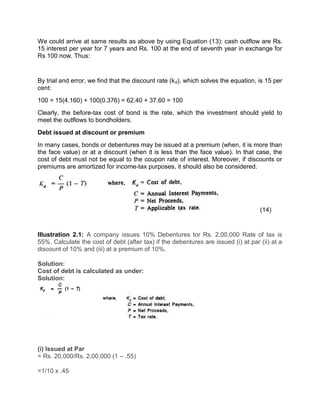
  • 4.
    UNIT-1 INTRODUCTION OF FINANCIALMANAGEMENT STRUCTURE: 1.0 Introduction 1.1 Learning Objectives 1.2 Meaning, Nature and Scope of Finance 1.2.1.Nature of Financial Management 1.2.2 Real and Financial Assets 1.2.3 Equity and Borrowed Funds 1.2.4 Finance and Management Functions 1.2.5 Scope of Financial Management/Finance Function 1.3 Financial Goal: Profit Maximization vs Wealth Maximization 1.3.1 Profit Maximization 1.3.2 Objections to Profit Maximization 1.3.3 Maximizing Profit after Taxes 1.3.4 Maximizing EPS 13.5 Shareholders' Wealth Maximization 1.3.6 Profit Maximization vs Wealth Maximization 1.3.7 Need for a Valuation Approach 1.3.8 Risk-Return Trade-Off 1.4 Finance Functions 1.4.1 Investment Decision 1.4.2 Financing Decision 1.4.3 Dividend Decision 1.4.4 Liquidity Decision 1.5 Innovative Finance Functions 1.5.1 Fund Raising 1.5.2 Fund Allocation 1.5.3 Profit Planning 1.5.4 Understanding Capital Markets 1.5.5 Status and Duties of Finance Executives 1.5.6 Controller's and Treasurer's Functions in the Indian Context 1.6 Summary 1.7 Key Terms 1.8 Answers to 'Check Your Progress' 1.9 Questions and Exercises 1.10 Further Reading
  • 5.
    1.0 INTRODUCTION Financial managementis concerned with the planning and controlling of a firm's financial resources. It was a branch of economics till 1890 and recently it has become a separate discipline. The subject of financial management is of immense interest to both academicians and practicing managers. It is of interest to academicians because the subject is still developing, and there are areas where controversies still exist for which no unanimous solutions have been found. Practicing managers are interested in this subject because the most crucial decisions of the firm are related to finance, and an understanding of the theory of financial management enables them to make those decisions skillfully and correctly. This unit will discuss the nature and scope of finance, the financial goals of organizations and finance functions. 1.1 LEARNING OBJECTIVES After going through this unit, you will be able to:  Explain the nature of finance and its interaction with other management functions.  Review the changing role of a finance manager and his/her position in the management hierarchy.  Discuss agency problems arising from the relationship between shareholders and managers.  Illustrate the organization of the finance function.  Focus on shareholder’s wealth maximization principle. 1.2 MEANING, NATURE AND SCOPE OF FINANCE What is finance? What are the firm's financial activities? How are they related to the firm's other activities? Financial management is a long term decision making process which involves lot of planning, allocation of funds, discipline and much more. Nobody can ever think to start a business or a company without financial knowledge and management strategies. Finance links itself directly to several functional departments like marketing, production and personnel. .Let us understand the nature of financial management with reference of this discipline. 1.2.1Nature of Financial Management: Finance management is a long term decision making process which involves lot of planning, allocation of funds, discipline and much more. Let us understand the nature of financial management with reference of this discipline. 1. Financial management is one of the important educations which have been realized word wide. Now a day’s people are undergoing through various specialization courses of financial management. Many people have chosen financial management as their profession.
  • 6.
    2. The natureof financial management is never a separate entity. Even as an operational manager or functional manager one has to take responsibility of financial management. 3. Finance is a foundation of economic activities. The person who manages finance is called as financial manager. Important role of financial manager is to control finance and implement the plans. For any company financial manager plays a crucial role in it. Many times it happens that lack of skills or wrong decisions can lead to heavy losses to an organization. 4. Nature of financial management is multi-disciplinary. Financial management depends upon various other factors like: accounting, banking, inflation, economy, etc. for the better utilization of finances. 5. Approach of financial management is not limited to business functions but it is a backbone of commerce, economic and industry. Some of the major scope of financial management is as follows: 1. Investment Decision 2. Financing Decision 3. Dividend Decision 4. Working Capital Decision. 1.2.2 Real and Financial Assets Real asset can be defined as “assets that are tangible or physical in nature such as property, plants and equipments. As an example in our bank many real assets can be identified such as the buildings, computers, lands that we own, ATM machines, vehicles, machineries such as note counters etc. Financial assets can be defined as “assets in the form of stocks, bonds, rights, certificates, bank balances, etc., as distinguished from tangible, physical assets” (Pension Boards-UCC, 2009). For our bank financial assets can be identified as our investments in bonds, issued by government and companies, bills issued by government and companies, shares of other companies and debentures of other companies, loans we have lent, reserves we hold at Central bank and etc. Real assets are tangible and financial assets are intangible in nature. Real assets are used in day to business operations to produce/generate an output where as financial assets are used to generate a return by investing activities. In general by investing in real assets company generates an income by way of profits earned from production utilizing the asset, rent (from lands) and gain/loss on disposals. By investing in financial assets company earns dividends, interest income and capital gains/loss upon disposal of assets. Firms issue securities to investors in the primary capital markets to raise necessary funds. The securities issued by firms are traded - bought and sold - by investors in the secondary capital markets, referred to as stock exchanges. Financial assets also include lease obligations and borrowing from banks, financial institutions and other
  • 7.
    sources. In alease, the lessee obtains a right to use the lessor's asset for an agreed amount of rental over the period of lease. Funds applied to assets by the firm are called capital expenditures or investment. The firm expects to receive return on investment and might distribute return (or profit) as dividends to investors. 1.2.3 Equity and Borrowed Funds To raise capital, an enterprise either used owned sources or borrowed ones. Owned capital can be in the form of equity, whereas borrowed capital refers to the company's owed funds or say debt. Borrowed funds refer to the borrowings of a business firm. In a company, borrowed funds consist of the finance raised from debenture holders, public deposits, financial institutions and commercial banks. Equity refers to the stock, indicating the ownership interest in the company. Shareholders can be of two types: ordinary and preference. Preference shareholders receive dividend at a fixed rate, and they have a priority over ordinary shareholders. The dividend rate for ordinary shareholders is not fixed, and it can vary from year to year depending on the decision of the board of directors. The payment of dividends to shareholders is not a legal obligation; it depends on the discretion of the board of directors. Since ordinary shareholders receive dividend (or repayment of invested capital, only when the company is wound up) after meeting the obligations of others, they are generally called owners of residue. Dividends paid by a company are not deductible expenses for calculating corporate income taxes, and they are paid out of profits after corporate taxes. As per the current laws in India, a company is required to pay 12.5 per cent tax on dividends. Equity shares, preference shares, ploughing back of profits and debentures are generally used for long-term finance. Public deposits, commercial banks and financial institutions are the main sources of medium-term and short-term finance. A company can also obtain equity funds by retaining earnings available for shareholders. Retained earnings, which could be referred to as internal equity, are undistributed profits of equity capital. The retention of earnings can be considered as a form of raising new capital. If a company distributes all earnings to shareholders, then, it can reacquire new'' capital from the same sources (existing shareholders) by issuing new shares called rights shares. Also, a public issue of shares may be made to attract new (as well as the existing) shareholders to contribute equity capital. Another important source of securing capital is creditors or lenders. Lenders are not the owners of the company. They make money available to the firm as loan or debt and retain title to the funds lent. Loans are generally furnished for a specified period at a fixed rate of interest. For lenders, the return on loans or debt comes in the form of interest paid by the firm. Interest is a cost of debt to the firm. Payment of interest is a legal obligation. The amount of interest paid by a firm is a deductible expense for computing corporate income taxes. Thus, interest provides tax shield to a firm. The interest tax shield is valuable to a firm. The firm may borrow funds from a large number of sources, such as banks, financial institutions, public or by issuing bonds or debentures. A bond or a debenture is a certificate acknowledging the amount of money
  • 8.
    lent by abondholder to the company. It states the amount, the rate of interest and the maturity of the bond or debenture. Since bond or debenture is a financial instrument, it can be traded in the secondary capital markets. 1.2.4 Finance and Management Functions There is a valuable and undivided relationship between finance on the one hand and production, marketing and other functions on the other. Almost all business activities, directly or indirectly, involve the acquisition and use of funds. For example, recruitment and promotion of employees in production is clearly a responsibility of the production department; but it requires payment of wages and salaries and other benefits, and thus, involves finance. 1.2.5 Scope of Financial Management/ Finance Function:- The main objective of financial management is to arrange sufficient finances for meeting short term and long term needs. A financial manager will have to concentrate on the following areas of finance function: 1. Estimating Financial Requirements: - The first task of financial manager is to estimate short term and long-term financial requirements of his business. For this purpose, he will prepare a financial plan for present as well as for future. The amount required for purchasing fixed assets as well as for working capital will have to be ascertained. 2. Deciding Capital Structure: - The capital structure refers to the kind and proportion of different securities for raising funds. After deciding about the quantum of funds required, it should be decided which type of securities should be raised. It may be wise to finance fixed assets through long-term debts and current assets through short-term debts. 3. Selecting a Source of Finance: - After preparing capital structure, an appropriate source of finance is selected. Various sources from which finance may be raised include: share capital, debentures, financial institutions, commercial banks, public deposits etc. If finance is needed for short period then banks, public deposits and financial institutions may be appropriate. On the other hand, if long-term finance is required then, share capital, and debentures may be useful. 4. Selecting a pattern of Investment: - When funds have been procured then a decision about investment pattern is to be taken. The selection of an investment pattern is related to the use of funds. A decision will have to be taken as to which asset is to be purchased. The funds will have to be spent first on fixed assets and then an appropriate portion will be retained for working capital. The decision-making techniques such as capital budgeting, opportunity cost analysis etc. may be applied in making decisions about capital expenditures. 5. Proper cash Management: - Cash management is an important task of finance manager. He has to assess various cash needs at different times and then make arrangements for arranging cash. The cash management should be such that neither there is a shortage of it and nor it is idle. Any shortage of cash will damage the credit worthiness of the enterprise.
  • 9.
    The idle cashwith the business will mean that it is not properly used. Cash flow statements are used to find out various sources and application of cash. 6. Implementing Financial Controls:- An efficient system of financial management necessitates the use of various control devises. Financial control devises generally used are budgetary control, break even analysis; cost control, ratio analysis etc. The use of various techniques by the finance manager will help him in evaluating the performance in various areas and take corrective measures whenever needed. 7. Proper use of Surplus: - The utilization of profit or surplus is also an important factor in financial management. A judicious use of surpluses is essential for expansion and diversification plan and also in protecting the interest of shareholders. The finance manager should consider the following factors before declaring the dividend; a. Trend of earnings of the enterprise b. Expected earnings in future. c. Market value of shares. d. Shareholders interest. e. Needs of fund for expansion etc. 1.3 FINANCIAL GOAL: PROFIT MAXIMIZATION VS WEALTH MAXIMIZATION The objective of a Financial Management is to design a method of operating the Internal Investment and financing of a firm. The two widely used approaches are Profit Maximization and Wealth maximization. Investment and financing decisions of the firm's are continuous and unavoidable. Generally the financial goal of the firm should be shareholders' wealth maximization (SWM), as reflected in the market value of the firm's shares. In this section, we show that the shareholders' wealth maximization is theoretically logical and operationally feasible for guiding the financial decision-making. 1.3.1 Profit Maximization Profit maximization is considered as the goal of financial management. In this approach actions that increase the profits should be undertaken and the actions that decrease the profits are avoided. The term 'profit' is used in two senses. In one sense it is used as an owner oriented. In this concept it refers to the amount and share of national Income that is paid to the owners of business. The second way is an operational concept i.e. profitability. It is the traditional and narrow approach, which aims at, maximizes the profit of the concern. The Ultimate aim of the business concern is earning profit, hence, it considers all the possible ways to increase the profitability of the concern. Profit is the parameter of measuring the efficiency of the business concern. So it shows the entire position of the business concern. And hence Profit maximization objectives help to reduce the risk of the business. Its main aim is to earn profit. In this criteria Profit is the main parameter of business operation. It reduces the risk of
  • 10.
    business concern. Inthis criteria profit is the main source of finance and profitability meets the social needs. Some of the unfavorable arguments of profit maximizations are that it leads to exploiting workers and consumers. It also creates immoral practices such as corrupt practice, unfair trade practice, etc. It also creates inequalities among the stake holders such as customers, suppliers, public shareholders, etc. 1.3.2 Objections to Profit Maximization 1. In Profit Maximization, profit is not defined precisely or correctly. It creates some unnecessary opinion regarding earning habits of the business concern. For example, profit may be long term or short term. It may be total profit or rate of profit. It may be net profit before tax or net profit after tax. It may be return on total capital employed or total assets or shareholders equity and so on. 2. It ignores the time value of money: Profit maximization does not consider the time value of money or the net present value of the cash inflow. It leads certain differences between the actual cash inflow and net present cash flow during a particular period. When the profitability is worked out the bigger the better principle is adopted as the decision is based on the total benefits received over the working life of the asset, Irrespective of when they were received. 3. It ignores the quality aspects of benefits which are associated with the financial course of action. The term 'quality' means the degree of certainty associated with which benefits can be expected. Therefore, the more certain the expected return, the higher the quality of benefits. As against this, the more uncertain or fluctuating the expected benefits, the lower the quality of benefits. 4. It ignores risk: Profit maximization does not consider risk of the business concern. Risks may be internal or external which will affect the overall operation of the business concern. It suffers from the following limitations: • It is vague • It ignores the timing of returns • It ignores risk. Definition of profit: “Profit” is a vague term. It is because different mindset will have a different perception of profit. For e.g. profits can be the net profit, gross profit, before tax profit, or the rate of profit, short- or long-term profit, total profits or profit per share. Does it mean total operating profit or profit accruing to shareholders ,etc.? Time value of Money The profit maximization formula simply suggests “higher the profit better is the proposal”. In essence, it is considering the naked profits without considering the timing of them. Another important dictum of finance says “a dollar today is not equal to a dollar a year later”. So, the time value of money is completely ignored.
  • 11.
    Uncertainty of returns:A decision solely based on profit maximization model would take a decision in favor of profits. In the pursuit of profits, the risk involved is ignored which may prove unaffordable at times simply because higher risks directly questions the survival of a business. The streams of benefits may possess different degree of certainty. Two firms may have same total expected earnings, but if the earnings of one firm fluctuate considerably as compared to the other, it will be more risky. Possibly, owners of the firm would prefer smaller but surer profits to potentially larger but less certain profits. Ignores Quality The most problematic aspect of profit maximization as an objective is that it ignores the intangible benefits such as quality, image, technological advancements etc. The contribution of intangible assets in generating value for a business is not worth ignoring. They indirectly create assets for the organization. 1.3.3 Maximizing Profit after Taxes Profit after tax is the net profit attributable to shareholders of a company after all costs and taxes have been deducted. This is the amount left to be paid out as dividends to shareholders as a return on their investment or to be ploughedback into the business as undistributed profits to add to the company's reserve.Maximising profit means maximising profits after taxes, in the sense of net profit as reported in the profit and loss account (income statement) of the firm. It can easily be realised that maximising this figure will not maximize the economic welfare of the owners. It is possible for a firm to increase profit after taxes by selling additional equity shares and investing the proceeds in low-yielding assets, such as the government bonds. Profit after taxes would increase but earnings per share (EPS) would decrease. To illustrate, let us assume that a company has 20,000 shares outstanding, profit after taxes of Rs.1,00,000 and earnings per share of Rs.5. If the company sells 20,000 additional shares at Rs.50 per share and invests the proceeds (10,00,000) at 5 per cent after taxes, then the total profits after taxes will increase to Rs.150,000. However, the earnings per share will fall to Rs.3.75 (i.e.,Rs.150,000/40,000). This example clearly indicates that maximising profits after taxes does not necessarily serve the best interests of owners. 1.3.4 Maximizing EPS Earnings per share (EPS) is the portion of the company’s distributable profit which is allocated to each outstanding equity share (common share). Earnings per share are a very good indicator of the profitability of any organization, and it is one of the most widely used measures of profitability. The earnings per share are a useful measure of profitability, and when compared with EPS of other similar companies, it gives a view of the comparative earning power of the companies. EPS when calculated over a number of years indicates whether the earning
  • 12.
    power of thecompany has improved or deteriorated. Investors usually look for companies with steadily increasing earnings per share. Growth in EPS is an important measure of management performance because it shows how much money the company is making for its shareholders, not only due to changes in profit, but also after all the effects of issuance of new shares (this is especially important when the growth comes as a result of acquisition). If we adopt maximising EPS as the financial objective of the firm, this will also not ensure the maximization of owners' economic welfare. It also suffers from the flaws already mentioned, i.e. it ignores timing and risk of the expected benefits. It is, thus, clear that maximising profits after taxes or EPS as the financial objective fails to maximize the economic welfare of owners. Both methods do not take account of the timing and uncertainty of the benefits. An alternative to profit maximization, which solves these problems, is the objective of wealth maximization. 1.3.5 Wealth Maximization: Wealth maximization is one of the modern approaches, which involves latest innovations and improvements in the field of the business concern. The term wealth means shareholder wealth or the wealth of the persons those who are involved in the business concern. Wealth maximization is also known as value maximization or net present worth maximization. This objective is a universally accepted concept in the field of business. It removes technical disadvantages of the profit maximization. Wealth maximization is superior to the profit maximization because the main aim of the business concern under this concept is to improve the value or wealth of the shareholders. Wealth maximization considers the comparison of the value to cost associated with the business concern. Total value detected from the total cost incurred for the business operation. It provides extract value of the business concern. This concept considers both time and risk of business concern. This criterion provides efficient allocation of resources and it also ensures the economic interest of the society. The wealth maximization criterion is based on cash flows generated and not on accounting profit. The computation of cash inflows and cash outflows is precise. Wealth maximization can be activated only with the help of the profitable position of the business concern. So the goal of maximizing the value of the stock avoids the problems associated with the different goals we discussed above. In a simple language a good financial decisions increase the market value of the owners’ equity and poor financial decisions decrease it. So the financial manager best serves the owners of the business by identifying goods and services that add value to the firm because they are desired and valued in the free marketplace. So it is a long term concept based on the cash flows rather than profits and hence there can be a situation where a business makes losses every year but there are cash profits because of heavy depreciation which indirectly suggests heavy investment in fixed assets and that is the real wealth and it takes into account the time value of money and so is universally accepted. ShareShare Profit Maximisation and Wealth Maximisation
  • 13.
    1.3.6 Profit maximizationvs. wealth maximization The essential difference between the maximization of profits and the maximization of wealth is that the profits focus is on short-term earnings, while the wealth focus is on increasing the overall value of the business entity over time. These differences are substantial, as noted below:  Planning duration. Under profit maximization, the immediate increase of profits is paramount, so management may elect not to pay for discretionary expenses, such as advertising, research, and maintenance. Under wealth maximization, management always pays for the discretionary expenditures.  Risk management. Under profit maximization, management minimizes expenditures, so it is less likely to pay for hedges that could reduce the organization's risk profile. A wealth-focused company would work on risk mitigation, so its risk of loss is reduced.  Pricing strategy. When management wants to maximize profits, it prices products as high as possible in order to increase margins. A wealth-oriented company could do the reverse, electing to reduce prices in order to build market share over the long term.  Capacity planning. A profit-oriented business will spend just enough on its productive capacity to handle the existing sales level and perhaps the short-term sales forecast. A wealth-oriented business will spend more heavily on capacity in order to meet its long-term sales projections. It should be apparent from the preceding discussion that profit maximization is a strictly short-term approach to managing a business, which could be damaging over the long term. Wealth maximization focuses attention on the long term, requiring a larger investment and lower short-term profits, but with a long-term payoff that increases the value of the business. 1.3.7 Need for a Valuation Approach The necessity for valuation of shares arises in the following circumstances:  Assessments under the wealth tax or gift tax acts.  Purchase of a block of shares which may or may not give the holder thereof a controlling interest in the company.  Purchase of share by the employees of the company where the retention of such shares is limited to the period of their employment.  Formulation of schemes of amalgamation, absorption, etc.  Acquisition of interest of dissenting shareholders under a scheme of rationalization.  Compensating shareholders on the acquisition of their shares by the government under a scheme of rationalization.  Conversation of shares i.e. preference into equity.
  • 14.
     Advancing ofloan on the security of shares.  Resolving a deadlock in the management of a private limited company on the basis of the controlling block of shares being given to either of the parties. Normally, the price prevailing on the stock exchange is accepted. Valuation by a valuer becomes a necessary when:  Shares are unquoted.  Shares relate to private limited companies.  Courts are direct.  Articles of association or relevant agreement so provide.  Large block of shares is under transfer.  Statutes so require. . The financial manager must know or at least assume the factors that influence the market price of shares, otherwise he or she would find himself or herself unable to maximize the market value of the company's shares. What is the appropriate share valuation model? In practice, innumerable factors influence the price of a share, and also, these factors change very frequently. Moreover, these factors vary across shares of different companies. For the purpose of the financial management problem, we can phrase the crucial questions normally: How much should a particular share be worth? Upon what factor or factors should its value depend? Although there is no simple answer to these questions, it is generally agreed that the value of an asset depends on its risk and return 1.3.8 Risk-Return Trade-Off The risk-return tradeoff is the principle that potential return rises with an increase in risk. Low levels of uncertainty or risk are associated with low potential returns, whereas high levels of uncertainty or risk are associated with high potential returns. According to the risk-return tradeoff, invested money can render higher profits only if the investor is willing to accept the possibility of losses. Financial decisions incur different degrees of risk. Your decision to invest your money in government bonds has less risk as interest rate is known and the risk of default is very less. On the other hand, you would incur more risk if you decide to invest your money in shares, as return is not certain. However, you can expect a lower return from government bond and higher from shares. Risk and expected return move in tandem; the greater the risk, the greater the expected return. Risk premium Risk-free Return Risk Expected Return Fig. 1.1 The Risk-Return Relationship
  • 15.
    Check Your Progress 1.What is the advantage enjoyed by financial assets vis-a-vis real assets in a business? 2. What are the main types of shareholder funds available to a company? 3. Which are the major ways in which a company may be able to raise new capital? 4. Why are borrowed funds often preferred over equity by firms to fund their businesses? Figure 1.1 shows this risk-return relationship. Financial decisions of the firm are guided by the risk-return trade-off. These decisions are interrelated and jointly affect the market value of its shares by influencing return and risk of the firm. The relationship between return and risk can be simply expressed as follows: Return = Risk-free rate + Risk premium (1) Risk-free rate is a rate obtainable from a default-risk free government security. An investor assuming risk from her investment requires a risk premium above the risk-free rate. Risk-free rate is a compensation for time and risk premium for risk. Higher the risk of an action, higher will be the risk premium leading to higher required return on that action. A proper balance between return and risk should be maintained to maximize the market value of a firm's shares. Such balance is called risk- return trade-off, and every financial decision involves this trade-off. The interrelation between market value, financial decisions and risk-return trade-off is depicted in Figure 1.2. It also gives an overview of the functions of financial management. Financial Management Maximisation of Share Value Financial Decision Investment Decisions Liquidity Manageme nt Financing Decisions Dividend Decisions Risk Return Trade-off Fig. 1.2 An overview of financial management
  • 16.
    The financial manager,in a bid to maximize shareholders' wealth, should strive to maximize returns in relation to the given risk; he or she should seek courses of actions that avoid unnecessary risks. To ensure maximum return, funds flowing in and out of the firm should be constantly monitored to assure that they are safeguarded and properly utilized. The financial reporting system must be designed to provide timely and accurate picture of the firm's activities. 1.4 FINANCE FUNCTIONS It may be difficult to separate me finance functions from production, marketing and other functions, but the functions themselves can be readily identified. The functions of raising funds, investing them in assets and distributing returns earned from assets to shareholders are respectively known as financing decision, investment decision and dividend decision. A firm attempts to balance cash inflows and outflows while performing these functions. This is called liquidity decision, and we may add it to the list of important finance decisions or functions. Thus finance functions include:  Long-term asset-mix or investment decision  Capital-mix or financing decision  Profit allocation or dividend decision  Short-term asset-mix or liquidity decision A firm performs finance functions simultaneously and continuously in the normal course of the business. They do not necessarily occur in a sequence. Finance functions call for skilful planning, control and execution of a firm's activities. Let us note at the outset that shareholders are made better off by a financial decision that increases the value of their shares. Thus while performing the finance functions, the financial manager should strive to maximize the market value of shares. This point is elaborated in detail later on in the unit. 1.4.1 Investment Decision One of the most important finance functions is to intelligently allocate capital to long term assets. This activity is also known as capital budgeting. It is important to allocate capital in those long term assets so as to get maximum yield in future. Following are the two aspects of investment decision a. Evaluation of new investment in terms of profitability b. Comparison of cut off rate against new investment and prevailing investment. Since the future is uncertain therefore there are difficulties in calculation of expected return. Along with uncertainty comes the risk factor which has to be taken into consideration. This risk factor plays a very significant role in calculating the expected return of the prospective investment. Therefore while considering investment proposal it is important to take into consideration both expected return and the risk involved.
  • 17.
    Check Your Progress 5.List the main areas of financial decision making. 6. What should be the main financial goal of a firm? 7. Why are indicators like profits after taxes and earnings per share not the best ways to decide the financial goals of a firm? Investment decision not only involves allocating capital to long term assets but also involves decisions of using funds which are obtained by selling those assets which become less profitable and less productive. It wise decisions to decompose depreciated assets which are not adding value and utilize those funds in securing other beneficial assets. An opportunity cost of capital needs to be calculating while dissolving such assets. The correct cut off rate is calculated by using this opportunity cost of the required rate of return (RRR) 1.4.2 Financing Decision Financial decision is yet another important function which a financial manger must perform. It is important to make wise decisions about when, where and how should a business acquire funds. Funds can be acquired through many ways and channels. Broadly speaking a correct ratio of an equity and debt has to be maintained. This mix of equity capital and debt is known as a firm’s capital structure. A firm tends to benefit most when the market value of a company’s share maximizes this not only is a sign of growth for the firm but also maximizes shareholders wealth. On the other hand the use of debt affects the risk and return of a shareholder. It is more risky though it may increase the return on equity funds. A sound financial structure is said to be one which aims at maximizing shareholders return with minimum risk. In such a scenario the market value of the firm will maximize and hence an optimum capital structure would be achieved. Other than equity and debt there are several other tools which are used in deciding a firm capital structure. 1.4.3 Dividend Decision Earning profit or a positive return is a common goal of all the businesses. But the key function a financial manger performs in case of profitability is to decide whether to distribute all the profits to the shareholders or retain all the profits or distribute part of the profits to the shareholder and retain the other half in the business. It’s the financial manager’s responsibility to decide an optimum dividend policy which maximizes the market value of the firm. Hence an optimum dividend payout ratio is calculated. It is a common practice to pay regular dividends in case of profitability another way is to issue bonus shares to existing shareholders.
  • 18.
    Bonus shares areshares issued to the existing shareholders without any charge. The financial manager should consider the questions of dividend stability, bonus shares and cash dividends in practice. 1.4.4 Liquidity Decision It is very important to maintain a liquidity position of a firm to avoid insolvency. Firm’s profitability, liquidity and risk all are associated with the investment in current assets. In order to maintain a tradeoff between profitability and liquidity it is important to invest sufficient funds in current assets. But since current assets do not earn anything for business therefore a proper calculation must be done before investing in current assets. Current assets should properly be valued and disposed of from time to time once they become non profitable. Currents assets must be used in times of liquidity problems and times of insolvency. In sum, financial decisions directly concern the firm's decision to acquire or dispose off assets and require commitment or recommitment of funds on a continuous basis. It is in this context that finance functions are said to influence production, marketing and other functions of the firm. Hence finance functions may affect the size, growth, profitability and risk of the firm, and ultimately, the value of the firm. 1.5 INNOVATIVE FINANCE FUNCTIONS Who is a financial manager? What is his or her role? A financial manager is a person who is responsible, in a significant way, to carry out the finance functions. It should be noted that, in a modern enterprise, the financial manager occupies a key position. He or she is one of the members of the top management team, and his or her role, day-by- day, is becoming more pervasive, intensive and significant in solving the complex funds management problems. Now his or her function is not confined to mat of a scorekeeper maintaining records, preparing reports and raising funds when needed, nor is he or she a staff officer-in a passive role of an adviser. The finance manager is now responsible for shaping the fortunes of the enterprise, and is involved in the most vital decision of the allocation of capital. In his or her new role, he or she needs to have a broader and far-sighted outlook, and must ensure that the funds of the enterprise are utilized in the most efficient manner. He or she must realize that his or her actions have far-reaching consequences for the firm because they influence the size, profitability, growth, risk and survival of the firm, and as a consequence, affect the overall value of the firm The financial manager, therefore, must have a clear understanding and a strong grasp of the nature and scope of the finance functions. The financial manager has not always been in the dynamic role of decision making. About three decades ago, he or she was not considered an important person, as far as the top management decision-making was concerned. He or she became an important management person only which the advent of the modern or contemporary approach to the financial management. What are the main functions of a financial manager?
  • 19.
    1.5.1 Fund Raising Thetraditional approach dominated the scope of financial management and limited the role of the financial manager simply to funds raising. It was during the major events, such as promotion, reorganization, expansion or diversification in the firm dial the financial manager was called upon to raise funds. In his or her day-to-day activities, his or her only significant duty was to see that the firm had enough cash to meet its obligations. Because of its central emphasis on the procurement of funds, the finance textbooks, for example, in the USA, till the mid 1950s covered discussion of the instruments, institutions and practices through which funds were obtained. Further, as the problem of raising funds was more intensely felt in the special events, these books also contained detailed descriptions of the major events like mergers, consolidations, reorganizations and recapitalizations involving episodic financing. The finance books in India and other countries simply followed the American pattern. The notable feature of the traditional view of financial management was the assumption that the financial manager had no concern with the decision of allocating the firm's funds. These decisions were assumed as given, and he or she was required to raise the needed funds from a combination of various sources. The traditional approach did not go unchallenged even during the period of its dominance. But the criticism related more to the treatment of various topics rather than the basic definition of the finance function. The traditional approach has been criticized because it failed to consider the day-to-day managerial problems relating to finance of the firm. It concentrated itself to looking into the problems from management's point of view. Thus the traditional approach of looking at the role of the financial manager lacked a conceptual framework for making financial decisions, misplaced emphasis on raising of funds, and neglected the real issues relating to the allocation and management of funds. 1.5.2 Fund Allocation The traditional approach outlived its utility in the changed business situation particularly after the mid 1950s. A number of economic and environmental factors, such as the increasing pace of industrialization, technological innovations and inventions, intense competition, increasing intervention of government on account of management inefficiency and failure, population growth and widened markets, during and after mid 1950s, necessitated efficient and effective utilization of the firm's resources, including financial resources. The development of a number of management skills and decision making techniques facilitated the implementation of a system of optimum allocation of the firm's resources. As a result, the approach to, and the scope of financial management, also changed. The emphasis shifted from the episodic financing to the financial management, from raising of funds to efficient and effective use of funds. The new approach is embedded in sound conceptual and analytical theories. The new or modern approach to finance is an analytical way of looking into the financial problems of the firm. Financial management is considered a vital and an integral part of overall management. To quote Ezra Solomon:
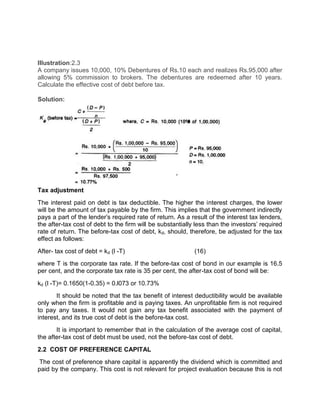
  • 20.
    In this broaderview the central issue of financial policy is the wise use of funds, and the central process involved is a rational matching of advantages of potential uses against the cost of alternative potential sources so as to achieve the broad financial goals which an enterprise sets for itself. Thus, in a modern enterprise, the basic finance function is to decide about the expenditure decisions and to determine the demand for capital for these expenditures. In other words, the financial manager, in his or her new role, is concerned with the efficient allocation of funds. The allocation of funds is not a new problem, however. It did exist in the past, but it was not considered important enough in achieving the firm's long run objectives. In his or her new role of using funds wisely, the financial manager must find a rationale for answering the following three questions:  How large should an enterprise be, and how fast should it grow?  In what form should it hold its assets?  How should the funds required be raised? As discussed earlier, the questions stated above relate to three broad decision areas of financial management: investment (including both long and short-term assets), financing and dividend. The "modern" financial manager has to help making these decisions in the most rational way. They have to be made in such a way that the funds of the firm are used optimally. We have referred to these decisions as managerial finance functions since they require special care and extraordinary managerial ability. As discussed earlier, the financial decisions have a great impact on all other business activities. The concern of the financial manager, besides his traditional function of raising money, will be on determining the size and technology of the firm, in setting the pace and direction of growth and in shaping the profitability and risk complexion of the firm by selecting the best asset mix and financing mix, 1.5.3 Profit Planning The functions of the financial manager may be broadened to include profit-planning function. Profit planning refers to the operating decisions in the areas of pricing, costs, volume of output and the firm's selection of product lines. Profit planning is, therefore, a prerequisite for optimizing investment and financing decisions. The cost structure of the firm, i.e. the mix of fixed and variable costs has a significant influence on a firm's profitability. Fixed costs remain constant while variable costs change in direct proportion to volume changes. Because of the fixed costs, profits fluctuate at a higher degree than the fluctuations in sales. The change in profits due to the change in sales is referred to as operating leverage. Profit planning helps to anticipate the relationships between volume, costs and profits and develop action plans to face unexpected surprises. 1.5.4 Understanding Capital Markets Capital markets bring investors (lenders) and firms (borrowers) together. Hence the financial manager has to deal with capital markets. He or she should fully understand
  • 21.
    the operations ofcapital markets and the way in which the capital markets value securities. He or she should also know-how risk is measured and how to cope with it in investment and financing decisions. For example, if a firm uses excessive debt to finance its growth, investors may perceive it as risky. The value of the firm's share may, therefore, decline. Similarly, investors may not like the decision of a highly profitable, growing firm to distribute dividend. They may like the firm to reinvest profits in attractive opportunities that would enhance their prospects for making high capital gains in the future. Investments also involve risk and return. It is through their operations in capital markets that investors continuously evaluate the actions of the financial manager. The vital importance of the financial decisions to a firm makes it imperative to set up a sound and efficient organization for the finance functions. The ultimate responsibility of carrying out the finance functions lies with the top management. Thus, a department to organize financial activities may be created under the direct control of the board of directors. The board may constitute a finance committee. The executive heading the finance department is the firm's chief finance officer (CFO), and he or she may be known by different designations. The finance committee or CFO will decide the major financial policy matters, while the routine activities would be delegated to lower levels. For example, at BHEL a director of finance at the corporate office heads the finance function. He is a member of the board of directors and reports to the chairman and managing director (CMD). An executive director of finance (EDF) and a general manager of finance (GMF) assist the director of finance. EDF looks after funding, budgets and cost, books of accounts, financial services and cash management. GMF is responsible for internal audit and taxation. The reason for placing the finance functions in the hands of top management may be attributed to the following factors: First, financial decisions are crucial for the survival of the firm. The growth and development of the firm is directly influenced by the financial policies. Second, the financial actions determine solvency of the firm. At no cost can a firm afford to threaten its solvency. Because solvency is affected by the flow of funds, which is a result of the various financial activities, top management being in a position to coordinate these activities retains finance functions in its control. Third, centralization of the finance functions can result in a number of economies to the firm. For example, the firm can save in terms of interest on borrowed funds, can purchase fixed assets economically or issue shares or debentures efficiently. 1.5.5 Status and Duties of Finance Executives The exact organization structure for financial management will differ across firms. It will depend on factors such as the size of the firm, nature of the business, financing operations, capabilities, of the firm's financial officers and most importantly, on the financial philosophy of the firm. The designation of the chief financial officer (CFO) would also differ within firms. In some firms, the financial officer may be known as me financial manager, while in others as the vice-president of finance or the director of finance or the financial controller. Two more officers—treasurer and controller— may be appointed under the direct supervision of CFO to assist him or her. In larger companies, with modern management, there may be vice-president or director of finance, usually with both controller and treasurer reporting to him.15
  • 22.
    Figure 1.3 illustratesthe financial organization of a large (hypothetical) business firm. It is a simple organization chart, and as stated earlier, the exact organization for a firm will depend on its circumstances. The finance function is one of the major functional areas, and the financial manager or director is under the control of the board of directors. Figure 1.4 shows the organization for the finance function of a large, multi- divisional Indian company. Board of Directors Managing Director Production Director Production Director Personnel Director Financial Director Marketing Director Controller Treasurer Fig. 1.3 Organization for Finance Function Planning and Budgeting Inventory Management Performance Evaluation Accounting Auditing Credit Management Retirement Benefits Cost Control Board of Directors Managing Director Production Director Production Director Personnel Director Financial Director Marketing Director Controller Treasurer Fig. 1.3 Organization for Finance Function Planning and Budgeting Inventory Managemen t Performance Evaluation Accounting Auditing Credit Managemen t Retirement Benefits Cost Control
  • 23.
    CFO has bothline and staff responsibilities. He or she is directly concerned with the financial planning and control. He or she is a member of the top management, and he or she is closely associated with the formulation of policies and making decisions for the firm. The treasurer and controller, if a company has these executives, would operate under CFO's supervision. He or she must guide them and others in the effective working of the finance department. The main function of the treasurer is to manage the firm's funds. His or her major duties include forecasting the financial needs, administering the flow of cash, managing credit, floating securities, maintaining relations with financial institution and protecting funds and securities. On the other hand, the functions of the controller relate to the management and control of assets. His or her duties include providing information to formulate accounting and costing policies, preparation of financial reports, direction of internal auditing, budgeting, inventory control, taxes etc. It may be stated that the controller's functions concentrate the asset side of the balance sheet, while treasurer's functions relate to the liability side. 1.5.6 Controller's and Treasurer's Functions in the Indian Context The controller and the treasurer are essentially American terms. Generally speaking, the American pattern of dividing the financial executive's functions into controllership and treasurer ship functions is not being widely followed in India. We do have a number of companies in India having officers with the designation of the controller, or the financial controller. The controller or the financial controller in India, by and large, performs the functions of a chief accountant or management accountant. The officer with the title of treasurer can also be found in a few companies in India. It should be realised that the financial controller does not control finances; he or she develops, uses and interprets information—some of which will be financial in nature—for management control and planning. For this reason, the financial controller may simply be called as the controller. Management of finance or money is a separate and important activity. Traditionally, the accountants have been involved in managing money in India. But the difference in managing money resources and information resources should be appreciated. In the American business, the management of finance is treated as a separate activity and is being performed by the treasurer. The title of the treasurer has not found favour in India to the extent the controller has. The company secretary in India discharges some of the functions performed by the treasurer in the American context. Insurance coverage is an example in this regard. The function of maintaining relations with investors (particularly shareholders) may now assume significance in India because of the development in the Indian capital markets and the increasing awareness among investors. The general title, financial manager or finance director, seems to be more popular in India. This title is also better than me title of treasurer since it conveys the functions involved. The main function of the financial manager in India should be the management of the company's funds. The financial duties may often be combined with
  • 24.
    Check Your Progress 8.What are the major roles that the Chief Finance Officer (CFO) of a firm is expected to play in today's business environment? others. But the significance of not combining the financial manager's duties with others should be realised. The managing of funds—a very valuable resource—is a business activity requiring extraordinary skill on the part of the financial manager. He or she should ensure the optimum use of money under various constraints. He or she should, therefore, be allowed to devote his or her full energy and time in managing the money resources only. 1.6 SUMMARY  The finance functions can be divided into three broad categories: (1) investment decision, (2) financing decision, and (3) dividend decision. In other words, the firm decides how much to invest in short-term and long-term assets and how to raise the required funds.  In making financial decisions, the financial manager should aim at increasing the value of the shareholders' stake in the firm. This is referred to as the principle of shareholders' wealth maximization (SWM).  Wealth maximization is superior to profit maximization since wealth is precisely defined as net present value and it accounts for time value of money and risk.  Shareholders and managers have the principal-agent relationship. In practice, there may arise a conflict between the interests of shareholders and managers. This is referred to the agency problem and the associated costs are called agency costs. Offering ownership rights (in the form of stock options) to managers can mitigate agency costs.  The financial manager raises capital from the capital markets. He or she should therefore know how the capital markets function to allocate capital to the competing firms and how security prices are determined in the capital markets.  Most companies have only one chief financial officer (CFO). But a large company may have both a treasurer and a controller, who may or may not operate under a CFO.  The treasurer's function is to raise and manage company funds while the controller oversees whether the funds are correctly applied. A number of companies in India either have a finance director or a vice-president of finance as the chief financial officer. 1.7 KEY TERMS  Profit Planning: The operating decisions in the areas of pricing, costs, volume of output and the firm's selection of product lines.  Operating Leverage: The change in profits due to the change in sales.  Opportunity Cost of Capital: The expected rate of return that an investor could earn by investing his or her money in financial assets of equivalent risk.
  • 25.
     Net PresentValue (NPV): The NPV of a course of action is the difference between the present value of its benefits and the present value of its costs. 1.8 ANSWERS TO 'CHECK YOUR PROGRESS' 1. Financial assets like shares and bonds can be bought or sold more easily. Real assets like plant and machinery, building etc. are not as liquid as financial assets are. 2. Mostly equity funds consisting of ordinary shares and undistributed profits (retained earnings). 3. By issuing new shares to the general public as well as to existing shareholders which are known as rights shares. 4. A firm borrows money from lenders; they are not owners of the business. There are three reasons for preferring borrowed funds: (1) Unlike dividends on shareholder funds, the amount of interest paid on borrowed funds by a firm saves taxes as it is treated as a deductible expense while computing income tax payable by a firm. (2) The shareholders' return will be higher if the interest rate on borrowed funds is less than return from assets or business. (3) It is relatively easy to raise borrowed funds from a financial institution or bank than issuing equity funds. 5. The main areas of financial decision making are (1) the investment decision (or capital budgeting decision), (2) the financing decision (or capital structure decision), (3) the dividend decision (or profit allocation decision) and (4) the liquidity decision (or working capital management decision). 6. The main financial goal of a firm is to create value for shareholders by maximizing the wealth of shareholders. 7. The CFO, heading the finance function of a company, is often a member of the Board of Directors and reports to the Chairman & Managing Director of the Company. Typically, the CFO supervises the work of the Treasurer and the Controller, who in turn look after various functional areas. 1.9 QUESTIONS AND EXERCISES Short- Answer Questions 1. Define the scope of financial management. What role should the financial manager play in a modern enterprise? 2. What are the basic financial decisions? How do they involve risk-return trade-off? 3. How should the finance function of an enterprise be organized? What functions does the financial officer perform? 4. When can there arise a conflict between shareholders' and managers' goals? How does the wealth maximization goal take care of this conflict? Long-Answer Questions 1. How does the "modern" financial manager differ from the "traditional" financial manager? Does the "modern" financial manager's role differ for the large diversified firm and the small to medium size firm?
  • 26.
    2. "Profit maximizationis not an operationally feasible criterion". Do you agree? Illustrate your views. 3. In what ways is the wealth maximization objective superior to the profit maximization objective? Explain. 4. Should the titles of controller and treasurer be adopted under Indian context? Would you like to modify their functions in view of the company practices in India? Justify your opinion.
  • 27.
    UNIT-2 COST OF CAPITAL 2.1COST OF CAPITAL In this unit, we focus on the concept of the cost of capital as a discount rate and the procedure of its measurement. The opportunity cost of capital (or simply, the cost of capital) for a project is the discount rate for discounting its cash flows. The project's cost of capital is the minimum required rate of return on funds committed to the project, which depends on the riskiness of its cash flows. Since the investment projects undertaken by a firm may differ in risk, each one of them will have its own unique cost of capital. It should be clear at the outset that the cost of capital for a project is defined by its risk, rather than the characteristics of the firm undertaking the project. The firm represents the aggregate of investment projects undertaken by it. Therefore, the firm's cost of capital will be the overall, or average, required rate of return on the aggregate of investment projects. Thus the firm's cost of capital is not the same thing as the project's cost of capital. Can we use the firm's cost of capital for discounting the cash flows of an investment projects. The firm's cost of capital can be used for discounting the cash flows of those investment projects, which have risk equivalent to the average risk of the firm. As a first step, however, the firm's cost of capital can be used as a standard for establishing the required rates of return of the individual investment projects. In the absence of a reliable formal procedure of calculating the cost of capital for projects, the firm's cost of capital can be adjusted upward or downward to account for risk differentials of investment projects. That is, an investment project's required rate of return may be equal to the firm's cost of capital plus or minus a risk adjustment factor depending on whether the project's risk is higher or lower than the firm's risk. There does exit a methodology to calculate its cost of capital for projects. The objective method of calculating the risk-adjusted cost of capital for projects is to use the capital asset pricing model (CAPM), as we show later in this unit. 2.1.1 Meaning and Significance of Cost of Capital We should recognize that the cost of capital is one of the most difficult and disputed topics in the finance theory. Financial experts express conflicting opinions as to the correct way in which the cost of capital can be measured. Irrespective of the measurement problems, it is a concept of vital importance in the financial decision making. It is useful as a standard for:  evaluating investment decisions,  designing a firm's debt policy, and  appraising the financial performance of top management.
  • 28.
    Investment evaluation The primarypurpose of measuring the cost of capital is its use as a financial standard for evaluating the investment projects. In the NPV method, an investment project is accepted if it has a positive NPV. The project's NPV is calculated by discounting its cash flows by the cost of capital. In this sense, the cost of capital is the discount rate used for evaluating the desirability of an investment project. In the IRR method, the investment project is accepted if it has an internal rate of return greater than the cost of capital. In this context, the cost of capital is the minimum required rate of return on an investment project. It is also known as the cutoff rate, or the hurdle rate. An investment project that provides a positive NPV when its cash flows are discounted by the cost of capital makes a net contribution to the wealth of shareholders. If the project has zero NPV, it means that its cash flows, have yielded a return just equal to the cost of capital, and the acceptance or rejection of the project will not affect the wealth of shareholders. The cost of capital is the minimum required rate of return on the investment project that keeps the present wealth of shareholders unchanged. It may be, thus, noted that the cost of capital represents a financial standard for allocating the firm's funds, supplied by owners and creditors, to the various investment projects in the most efficient manner. Designing debt policy The debt policy of a firm is significantly influenced by the cost consideration. As we shall learn later on, debt helps to save taxes, as interest on debt is a tax-deductible expense. The interest tax shield reduces the overall cost of capital, though it also increases the financial risk of the firm. In designing the financing policy, that is, the proportion of debt and equity in the capital structure, the firm aims at maximising the firm value by minimizing the overall cost of capital. The cost of capital can also be useful in deciding about the methods of financing at a point of time. For example, cost may be compared in choosing between leasing and borrowing. Of course, equally important considerations are control and risk.28 Performance appraisal The cost of capital framework can be used to evaluate the financial performance of top management.29 Such an evaluation will involve a comparison of actual profitability of the investment projects undertaken by the firm with the projected overall cost of capital, and the appraisal of the actual costs incurred by management in raising the required funds. The cost of capital also plays a useful role in dividend decision and investment in current assets. 2.1.2 Calculation of Cost of Debt A company may raise debt in a variety of ways. It may borrow funds from financial institutions or public either in the form of public deposits or debentures (bonds) for a specified period of time at a certain rate of interest. A debenture or bond may be Issued
  • 29.
    at par orat a discount or premium as compared to its face value. The contractual rule of interest or the coupon rate forms the basis for calculating the cost of debt. Debt issued at par The method of computation for ascertaining cost of debt which is issued at par is comparatively an easy task. It is nothing but the explicit interest rate adjusted again for the tax liability. Symbolically, Example: A company has issued 8% debentures and the tax rate is 50%, the after tax cost of debt will be 4%. — It may be’ calculated as under: kd=(1-50%)8=(1-0.5)8=4 Since interest is treated as an expense while calculating firm’s income for income- tax purpose, the tax is deducted out of the interest payable. This tax adjusted interest rate is used only where the EBIT (Earnings/Profits before Interest and Tax) is equal to or exceed the interest. The before-tax cost of debt is the rate of return required by lenders. It is easy to compute before-tax cost of debt issued and to be redeemed at par; it is simply equal to the contractual (or coupon) rate of interest. For example, a company decides to sell new issue of 7 year 15 per cent bonds of Rs. 100 each at par. If the company realizes the full face value of Rs. 100 bond and will pay Rs. 100 principal to bondholders at maturity, the before-tax cost of debt will simply be equal to the rate of interest of 15 per cent. Thus: kd= i = (13) where kd is the before-tax cost of debt, i is the coupon rate of interest, B0 is the issue price of the bond (debt) and in Equation (13) it is assumed to be equal to the face value (F), and INT is the amount of interest. The amount of interest payable to the lender is always equal to: Interest = Face value of debt x Interest rate The before-tax cost of bond in the example is: kd = . . = 0.15 or 15%
  • 30.
    We could arriveat same results as above by using Equation (13): cash outflow are Rs. 15 interest per year for 7 years and Rs. 100 at the end of seventh year in exchange for Rs 100 now. Thus: By trial and error, we find that the discount rate (kd), which solves the equation, is 15 per cent: 100 = 15(4.160) + 100(0.376) = 62.40 + 37.60 = 100 Clearly, the before-tax cost of bond is the rate, which the investment should yield to meet the outflows to bondholders. Debt issued at discount or premium In many cases, bonds or debentures may be issued at a premium (when, it is more than the face value) or at a discount (when it is less than the face value). In that case, the cost of debt must not be equal to the coupon rate of interest. Moreover, if discounts or premiums are amortized for income-tax purposes, it should also be considered. (14) Illustration 2.1: A company issues 10% Debentures tor Rs. 2,00,000 Rate of tax is 55%. Calculate the cost of debt (after tax) if the debentures are issued (i) at par (ii) at a discount of 10% and (iii) at a premium of 10%. Solution: Cost of debt is calculated as under: Solution: (i) Issued at Par = Rs. 20,000/Rs. 2,00,000 (1 – .55) =1/10 x .45
  • 31.
    = 4.5% (ii) Issuedat a Discount of 10% Rs. 20,000/Rs. 1,80,000 (1 – .55) = 1/9 x .45 = 5 % (iii) Issued at Premium of 10% Rs. 20,000/Rs. 2,20,000 (1 – .55) = 1/11 x .45 = 4.1 % Illustration:2.2 A company raises Rs 90,000 by the issue of 1,000 10% Debentures of Rs. 100 each at a discount of 10%, repayable at par after 10 years. If the rate of company’s tax is 50, what is the cost of debt capital to the firm? Solution: Cost of Redeemable Debt: If debt and/or debentures are redeemed after the expiry of a period, the effective cost of debt before tax can be calculated with the help of the following formula: (15)
  • 32.
    Illustration:2.3 A company issues10,000, 10% Debentures of Rs.10 each and realizes Rs.95,000 after allowing 5% commission to brokers. The debentures are redeemed after 10 years. Calculate the effective cost of debt before tax. Solution: Tax adjustment The interest paid on debt is tax deductible. The higher the interest charges, the lower will be the amount of tax payable by the firm. This implies that the government indirectly pays a part of the lender's required rate of return. As a result of the interest tax lenders, the after-tax cost of debt to the firm will be substantially less than the investors' required rate of return. The before-tax cost of debt, kd, should, therefore, be adjusted for the tax effect as follows: After- tax cost of debt = kd (l -T) (16) where T is the corporate tax rate. If the before-tax cost of bond in our example is 16.5 per cent, and the corporate tax rate is 35 per cent, the after-tax cost of bond will be: kd (l -T)= 0.1650(1-0.35) = 0.l073 or 10.73% It should be noted that the tax benefit of interest deductibility would be available only when the firm is profitable and is paying taxes. An unprofitable firm is not required to pay any taxes. It would not gain any tax benefit associated with the payment of interest, and its true cost of debt is the before-tax cost. It is important to remember that in the calculation of the average cost of capital, the after-tax cost of debt must be used, not the before-tax cost of debt. 2.2 COST OF PREFERENCE CAPITAL The cost of preference share capital is apparently the dividend which is committed and paid by the company. This cost is not relevant for project evaluation because this is not
  • 33.
    the cost atwhich further capital can be obtained. To find out the cost of acquiring the marginal cost, we will be finding the yield on the preference share based on the current market value of the preference share. The measurement of the cost of preference capital poses some conceptual difficulty. In the case of debt, there is a binding legal obligation on the firm to pay interest, and tax interest constitutes the basis to calculate the cost of debt. However, in the case o preference capital, payment of dividends is not legally binding on the firm and even if the dividends are paid, it is not a charge on earnings; rather it is a distribution or appropriate of earnings to preference shareholders. One may, therefore, be tempted to conclude that the dividends on preference capital do not constitute cost. This is not true. The cost of preference capital is a function of the dividend expected by investors for Preference capital is never issued with an intention not to pay dividends. Although it not legally binding upon the firm to pay dividends on preference capital, yet it is general paid when the firm makes sufficient profits. The failure to pay dividends, although does not cause bankruptcy, yet it can be a serious matter from the ordinary shareholders point of view. The non-payment of dividends on preference capital may result in voting rights and control to the preference shareholders. More than this, the firm's credit standing may be damaged. The accumulation of preference dividend arrears may adversely affect the prospects of ordinary shareholders for receiving any dividends because dividends on preference capital represent a prior claim on profits. As consequence, the firm may find difficulty in raising funds by issuing preference to equity shares. Also, the market value of the equity shares can be adversely affected if dividends are not paid to the preference shareholders and, therefore, to the equity shareholders. For these reasons, dividends on preference capital should be paid regularly except when the firm does not make profits, or it is in a very tight cash position. 2.2.1 Irredeemable Preference Share The preference share may be treated as a perpetual security if it is irredeemable. Thus, its cost is given by the following equation: Kp = (17) Where kp is the cost of preference share, PDIV is the expected preference dividend] and Po is the issue price of preference share. Illustration 2.10: Cost of Irredeemable Preference Share A company issues 10 per cent irredeemable preference shares. The face value per share is Rs. 100, but the issue price is Rs. 95. What is the cost of a preference share? What is the cost if the issue price is Rs. 105? We can compute cost of a preference share as follows: Issue price Rs. 95: Kp = = = 0.1053 or 10.53%
  • 34.
    Issue price Rs.105: : Kp = = = 0.0952 or 9.52% 2.2.2 Redeemable Preference Share Redeemable preference shares (that is, preference shares with finite maturity) are also issued in practice..These shares are issued for a particular period and at the expiry of that period, they are redeemed and principal is paid back to the preference shareholders. The characteristics are very similar to debt and therefore the calculations will be similar too. For finding cost of redeemable preference shares, following formula can be used. These shares are issued for a particular period and at the expiry of that period, they are redeemed and principal is paid back to the preference shareholders. The characteristics are very similar to debt and therefore the calculations will be similar too. A formula similar to previous equation can be used to compute the cost of redeemable preference share P0 = ∑t=1 to n [ PDIV / (1 +Kp)t ] + [ Pn / (1 + Kp)n ] (18) Here, preference share is traded at say P0 with dividend payments ‘D’ and principal repayment ‘P’. The cost of debt is designated by Kp. Kp can be determined by solving above equation. In Equation (18), k, is the cost of preference capital. Given the current price, expected preference dividend (PDIV,), and maturity price Kf can be found by trial and error. The cost of preference share is not adjusted for taxes because preference dividend is paid after the corporate taxes have been paid. Preference dividends do not save any taxes. Thus, the cost of preference capital is automatically computed on an after-tax basis. Since interest is tax deductible and preference dividend is not, the after-tax cost of preference capital is substantially higher than the after-tax cost of debt. 2.3 COST OF EQUITY CAPITAL AND RETAINED EARNINGS Cost of equity share is the part of cost of capital which allows the payment to only the equity shareholders. In this every shareholders get the shares for getting the return on the shares on which they are investing so much. From company's perspective the company must earn more than cost of equity capital in order to be unaffected by the market value of the shares of its. Firms may raise equity capital internally by retaining earnings. Alternatively, they could distribute the entire earnings to equity shareholders and raise equity capital externally by issuing new shares. In both cases, shareholders are providing funds to the firms to finance their capital expenditures. Therefore, the equity shareholders' required rate of return would be the same whether they supply funds by purchasing new shares or by foregoing dividends, which could have been distributed to them. 2.3.1 Is Equity Capital Free of Cost?
  • 35.
    It is sometimesargued that the equity capital is free of cost. The reason for such argument is that it is not legally binding for firms to pay dividends to ordinary shareholders. Further, unlike the interest rate or preference dividend rate, the equity dividend rate is not fixed. It is fallacious to assume equity capital to be free of cost. As we have discussed earlier, equity capital involves an opportunity cost; ordinary shareholders supply funds to the firm in the expectation of dividends and capital gains commensurate with their risk of investment. The market value of the shares determined by the demand and supply forces in a well functioning capital market reflects the return required by ordinary shareholders. Thus, the shareholders' required rate of return, which equates the present value of the expected dividends with the market value of the share, is the cost of equity. The cost of external equity would, however, be more than the shareholders' required rate of return if the issue price were different from the market price of the share. 2.3.2 Cost of Internal Equity: The methods of computing the cost of internal and external equity are discussed below. 1) Dividend yield method or Price ratio method In this the minimum rate of cost of equity shares will be equal to the “present value of future dividend per share with current price of a share”. Cost of equity shares= Dividend per equity/ Market price For example if there is a company which issues shares of Rs. 200 each a premium of 10%. The company pays 20% dividend to equity shareholders for the past five years and expects to maintain the same in the future also. Compute the cost of equity capital. Will it be different if market price of equity share is Rs. 260? The solution can be found out by our formula which says Cost of equity shares= Dividend per equity/ Market price = 20*100/210 = 9.52% If the market price of equity share is Rs. 260. =20* 100/260 = 7.69% 2) Dividend yield plus growth in dividend method It is based on the theory that company is growing and its shares market value is also on growth. So, because of this shareholders are in need of simple dividend, so that company can provide the profit to them according to the growth. To calculate this formula is as follows:- Cost of equity share = Dividend per equity/Market Price + Rate of growth in dividends
  • 36.
    3) Earning yieldmethod In this cost of equity capital is minimum and the earning of the company should be considered on market price of share. The formula for this is as follows:- Cost of equity share = Earnings per share / Market Price per share 4) Realised yield method This method removes the drawback which in the dividend yield method or earning yield method as both are based on future estimation of dividend or earning. In the economics there are many factors which can't be controlled and are very uncertain and if the risk is involved then the future planning can't be used and the decision related estimation return on investment can't be considered. It is based on actual earning which is earned on the amount of investment. The equity share capital is calculated as:- Cost of equity share = Actual earnings per share * 100 2.3.3 Earning-Price Ratio and the Cost of Equity Earnings per share (EPS) are the amount of earning per each share of a company's stock. Companies require the EPS for their each income statement which shows about the continuing operations, discontinued operations, net income and outstanding items. EPS doesn't depend on the increase or decrease of the earning power of the company and gets calculated over number of years. How is it calculated? Earnings per share ratio (EPS Ratio) are calculated by dividing the net profit after taxes and preference dividend by the total number of equity shares. It is a small variance of return on equity capital ratio. The formula of Earning per share ratio is given as:- “[Earnings per share (EPS) Ratio = (Net profit after tax - Preference dividend) / No. of equity shares (common shares)]” . For example, if the current market price of a share is Rs. 500 (face value being Rs 100) and the earning per share is Rs. 10, the E/P ratio will be: Rs 10 / Rs. 500 = 0.02 or 2 per cent. Does this mean that the expectation of shareholders is 2 per cent? They would, in fact, expect to receive a stream of dividends and a final price of the share that would result in a return significantly greater than the E/P ratio. Thus, the dividend valuation model gives the most of valid measure of the cost of equity. Illustration 2.13: Earnings-Price Ratio and the Cost of Equity A firm is currently earning Rs. 100,000 and its share is selling at a market price of Rs. 80. The firm has 10,000 shares outstanding and has no debt. The earnings of the firm are expected to remain stable, and it has a payout ratio of 100 per cent. What is the cost of equity? If the firm's payout ratio is assumed to be 60 per cent and that it earns
  • 37.
    15 per centrate of return on its investment opportunities, then, what would be the firm's cost of equity?. In the first case since expected growth rate is zero, we can use expected earnings-price ratio to compute the cost of equity. Thus: Ke= Rs10/80=0.125 or 12.5% The earnings per share are Rs. 100,000 /10,000 = Rs. 10. If the firm pays out 60 per cent of its earnings, the dividends per share will be: Rs. 10 x 0.6 = Rs. 6, and the retention ratio will be 40 per cent. If the expected return on interval investment opportunities is 15 per cent, then the firm's expected growth is: 0.40 x 0.15 = 0.06 or 6 per cent. The firm's cost of equity will be: Ke= Rs6/80+0.06=0.135=13.5% 2.4 COMBINED COST OF CAPITAL Once the component costs have been calculated, they are multiplied by the proportions of the respective sources of capital to obtain the weighted average cost of capital (WACC). The proportions of capital must be based on target capital structure. WACC is the composite or overall cost of capital. You may note that it is the weighted average concept, not the simple average, which is relevant in calculating the overall cost of capital. The simple average cost of capital is not appropriate to use because firms hardly use various sources of funds equally in the capital structure. The following steps are involved for calculating the firm's WACC:  Calculate the cost of specific sources of funds  Multiply the cost of each source by its proportion in the capital structure.  Add the weighted component costs to get the WACC. In financial decision-making, the cost of capital should be calculated on an after tax basis. Therefore, the component costs should be the after-tax costs. 2.5 SUMMARY  The cost of capital to a firm is the minimum return which the suppliers of capital require. In other words, it is the price of obtaining capital; it is a compensation for time and risk.  The cost of capital concept is of vital significance in financial decision making. It is used: (a) as a discount, or cut-off, rate for evaluating investment projects, (6) for designing the firm's debt-equity mix and (c) for appraising the top management's financial performance.  Debt includes all interest-bearing borrowings. Its cost is the yield (return) which lenders expect from their investment. In most cases, return is equal to the annual contractual rate of interest (also called coupon rate). Interest charges are tax deductible. Therefore, the cost of debt to the firm should be calculated after adjusting for interest tax shield: where kd is before-tax cost of debt and T is the corporate tax rate.
  • 38.
     Equity includespaid-up capital and reserve and surplus (retained earnings). Equity has no explicit cost, as payment of dividends is not obligatory. However, it involves an opportunity cost.  Three steps are involved in calculating the firm's weighted average cost of capital (WACC). First, the component costs of debt and equity are calculated. Second, weights to each component of capital are assigned according to the target capital structure. Third, the product of component costs and weights is summed up to determine WACC. The weighted average cost of new capital is the weighted marginal cost of capital (WMCC). WACC for a firm which debt and equity in the capital structure, is given by the following formula: Where ke is the cost of equity, kd is the cost of debt, T is the tax rate, D is d and £ is equity. The market value weights should be used in calculating WAC 2. 6 QUESTIONS AND EXERCISES Short-Answer Questions 1. Define cost of capital. Explain its significance in financial decision-making, 2. How is the cost of debt computed? How does it differ from the cost of preference capital? Long-Answer Questions 1. A company has 5,000,000 ordinary shares outstanding. The market price of the share is Rs. 96 while the book value is Rs. 65. The firm's earnings and dividends per share are X 10 and Rs. 7, respectively. The company wants to issue 1,000,000 shares with net proceeds of Rs. 80 per share. What is the cost of capital of the new issue?
  • 39.
    UNIT-3 CAPITAL BUDGETING Structure 3.0 INTRODUCTION 3.1Learning Objectives 3.2 Nature and Types of Investment Decisions 3.2.1 Importance of Investment Decisions 3.2.2 Expansion and Diversification 3.2.3 Replacement and Modernization 32.4 Mutually Exclusive Investments 3.2.5 Independent Investments 3.2.6 Contingent Investments 3.3 Investment Evaluation Criteria 3.3.1 Investment Decision Rule 3.3.2 Evaluation Criteria 3.4 Net Present Value Method 3.4.1 Why is NPV Important? 3.4.2 Acceptance Rule 3.4.3 Evaluation of NPV Method 3.5 Internal Rate of Return Method 3.5.1 Calculating IRR by Trial and Error 3.5.2 NPV Profile and ERR 3.5.3 Acceptance Rule 3.5.4 Evaluation of IRR Method 3.5.5 NPV versus IRR 3.6 Payback 3.6.1 Acceptance Rule 3.6.2 Evaluation of Payback 3.6.3 Payback Reciprocal and the Rate of Return 3.6.4 Discounted Payback Period 3.7 Accounting Rate of Return Method 2.7.1 Acceptance Rule 2.7.2 Evaluation of ARR Method 3.8 Summary 3.9 Key Terms 3.10 Answers to 'Check Your Progress' 3.11Questions and Exercises
  • 40.
    3.0 INTRODUCTION Capital budgeting,and investment appraisal, is the planning process used to determine whether an organization's long term investments such as purchase new machinery, replacement of machinery, new plants, new products, and research development projects are worth the funding of cash through the firm's capitalization structure (debt, equity or retained earnings). It is the process of allocating resources for major capital, or investment, expenditures. One of the primary goals of capital budgeting investments is to increase the value of the firm to the shareholders. An efficient allocation of capital is the most important finance function in modern times. It involves decisions to commit the firm's funds to long-term assets. Capital budgeting or investment decisions are of considerable importance to a firm since they tend to determine its value by influencing its growth, profitability and risk. In this unit, we will focus on the nature and evaluation of capital budgeting decisions. You will learn about the net present value and internal rate of return methods. The unit will also discuss the cost of capital, emphasizing on the calculation of cost of debt and equity capital and retained earnings. 3.1 Learning Objectives After going through this unit, you will be able to:  Understand the nature and importance of investment decisions.  Understand the capital budgeting and investment proccess, including planning and control.  Explain the methods of calculating net present value (NPV) and internal rate of return (IRR).  .Describe the non-DCF evaluation criteria: payback and accounting rate of return.  Illustrate the computation of discounted payback. ,  Compare NPV and IRR and emphasize the superiority of NPV rule.  Understand how to take investment decisions under capital rationing. 3.2 NATURE AND TYPES OF INVESTMENT DECISIONS The investment decisions of a firm are generally known as the capital budgeting, or capital expenditure decisions. A capital budgeting decision may be defined as the firm's decision to invest its current funds most efficiently in the long-term assets in anticipation of an expected flow of benefits over a series of years. The long-term assets are those that affect the firm's operations beyond the one-year period. The firm's investment decisions would generally include expansion, acquisition, modernization and replacement of the long-term assets. Sale of a division or business (divestment) is also as an investment decision. Decisions like the change in the methods of sales distribution, or an advertisement campaign or a research and development programme have long-term implications for the firm's expenditures and benefits, and therefore, they should also be evaluated as investment decisions. It is important to note that investment in the long-term assets invariably requires large funds to be tied up in the current assets
  • 41.
    such as inventoriesand receivables. As such, investment in fixed and current assets is one single activity. The following are the features of investment decisions:  The exchange of current funds for future benefits.  The funds are invested in long-term assets.  The future benefits will occur to the firm over a series of years. It is significant to emphasize those expenditures and benefits of an investment should be measured in cash. In the investment analysis, it is cash flow, which is important, not the accounting profit. It may also be pointed out that investment decisions affect the firm's value. The firm's value will increase if investments are profitable and add to the shareholders' wealth. Thus, investments should be evaluated on the basis of a criterion, which is compatible with the objective of the shareholders' wealth maximization. An investment will add to the shareholders' wealth if it yields benefits in excess of the minimum benefits as per the opportunity cost of capital. In this unit, we assume that the investment project's opportunity cost of capital is known. We also assume that the expenditures and benefits of the investment are known with certainty. Both these assumptions are relaxed in later units. 3.2.1 Importance of Investment Decisions Investment decisions require special attention because of the following reasons:1  They influence the firm's growth in the long run  They affect the risk of the firm  They involve commitment of large amount of funds  They are irreversible, or reversible at substantial loss  They are among the most difficult decisions to make. Growth: The effects of investment decisions extend into the future and have to be endured for a longer period than the consequences of the current operating expenditure. A firm's decision to invest in long-term assets has a decisive influence on the rate and direction of its growth. A wrong decision can prove disastrous for the continued survival of the firm; unwanted or unprofitable expansion of assets will result in heavy operating costs to the firm. On the other hand, inadequate investment in assets would make it difficult for the firm to compete successfully and maintain its market share. Risk: A long-term commitment of funds may also change the risk complexity of the firm. If the adoption of an investment increases average gain but causes frequent fluctuations in its earnings, the firm will become more risky. Thus, investment decisions shape the basic character of a firm. Funding: Investment decisions generally involve large amount of funds, which make it imperative for the firm to plan its investment programmes very carefully and make an advance arrangement for procuring finances internally or externally.
  • 42.
    Irreversibility: Most investmentdecisions are irreversible. It is difficult to find a market for such capital items once they have been acquired. The firm will incur heavy losses if such assets are scrapped. Complexity: Investment decisions are among the firm's most difficult decisions. They are an assessment of future events, which are difficult to predict. It is really a complex problem to correctly estimate the future cash flows of an investment. Economic, political, social and technological forces cause the uncertainty in cash flow estimation. There are many ways to classify investments. One classification is as follows:  Expansion of existing business  Expansion of new business  Replacement and modernization. 3.2.2 Expansion and Diversification A company may add capacity to its existing product lines to expand existing operations. For example, the Gujarat State Fertilizer Company (GSFC) may increase its plant capacity to manufacture more urea. It is an example of related diversification. A firm may expand its activities in a new business. Expansion of a new business requires investment in new products and a new kind of production activity within the firm. If a packaging manufacturing company invests in a new plant and machinery to produce ball bearings, which the firm has not manufactured before, this represents expansion of new business or unrelated diversification. Sometimes a company acquires existing firms to expand its business. In either case, the firm makes investment in the expectation of additional revenue. Investments in existing or new products may also be called as revenue-expansion investments. 3.2.3 Replacement and Modernization The main objective of modernization and replacement is to improve operating efficiency and reduce costs. Cost savings will reflect in the increased profits, but the firm's revenue may remain unchanged. Assets become outdated and obsolete with technological changes. The firm must decide to replace those assets with new assets that operate more economically. If a cement company changes from semi-automatic drying equipment to fully automatic drying equipment, it is an example of modernization and replacement. Replacement decisions help to introduce more efficient and economical assets and therefore, are also called cost-reduction investments. However, Check Your Progress 1. How do we define capital budgeting decisions? 2. How do we usually define long-term assets? 3. What type of decisions may be termed as a firm's long-term investment decisions? 4. Why do investment decisions require special attention from a firm's management?
  • 43.
    replacement decisions thatinvolve substantial modernization and technological improvements expand revenues as well as reduce costs. Yet another useful way to classify investments is as follows:  Mutually exclusive investments  Independent investments  Contingent investments 3.2.4 Mutually Exclusive Investments Mutually exclusive investments serve the same purpose and compete with each other. If one investment is undertaken, others will have to be excluded. A company may, for example, either use a more labour-intensive, semi-automatic machine, or employ a more capital-intensive, highly automatic machine for production. Choosing the semiautomatic machine precludes the acceptance of the highly automatic machine. 3.2.5 Independent Investments Independent investments serve different purposes and do not compete with each other. For example, a heavy engineering company may be considering expansion of its plant capacity to manufacture additional excavators and addition of new production facilities to manufacture a new product—light commercial vehicles. Depending on their profitability and availability of funds, the company can undertake both investments. 3.2.6 Contingent Investments Contingent investments are dependent projects; the choice of one investment necessitates undertaking one or more other investments. For example, if a company decides to build a factory in a remote, backward area, it may have to invest in houses, roads, hospitals, schools etc. for employees to attract the work force. Thus, building of factory also requires investment in facilities for employees. The total expenditure will be treated as one single investment. 3.3 INVESTMENT EVALUATION CRITERIA Three steps are involved in the evaluation of an investment:  Estimation of cash flows  Estimation of the required rate of return (the opportunity cost of capital)  Application of a decision rule for making the choice The first two steps, discussed in the subsequent units, are assumed as given. Thus, our discussion in this unit is confined to the third step. Specifically, we focus on the merits and demerits of various decision rules. 3.3.1 Investment Decision Rule The investment decision rules may be referred to as capital budgeting techniques, or investment criteria. A sound appraisal technique should be used to measure the
  • 44.
    economic worth ofan investment project. The essential property of a sound technique is that it should maximize the shareholders' wealth. The following other characteristics should also be possessed by a sound investment evaluation criterion:2  It should consider all cash flows to determine the true profitability of the project.  It should provide for an objective and unambiguous way of separating good projects from bad projects.  It should help ranking of projects according to their true profitability.  It should recognize the fact that bigger cash flows are preferable to smaller ones and early cash flows are preferable to later ones.  It should help to choose among mutually exclusive projects that project which maximizes the shareholders' wealth.  It should be a criterion which is applicable to any conceivable investment project independent of others. These conditions will be clarified as we discuss the features of various investment criteria in the following pages. 3.3.2 Evaluation Criteria A number of investment criteria (or capital budgeting techniques) are in practice. They may be grouped in the following two categories: 1. Discounted Cash Flow (DCF) Criteria  Net present value (NPV)  Internal rate of return (IRR)  Profitability index (PI) 2. Non-discounted Cash Flow Criteria  Payback period (PB)  Discounted payback period  Accounting rate of return (ARR) Discounted payback is a variation of the payback method. It involves discounted cash flows, but, as we shall see later, it is not a true measure of investment profitability. We will show in the following pages that the net present value criterion is the most valid technique of evaluating an investment project. It is consistent with the objective of maximising the shareholders' wealth. 3.4 NET PRESENT VALUE METHOD The net present value (NPV) method is the classic economic method of evaluating the investment proposals. It is a DCF technique that explicitly recognizes the time value of money. It correctly postulates that cash flows arising at different time periods differ in value and are comparable only when their equivalents—present values—are found out. The following steps are involved in the calculation of NPV: Check Your Progress 5. Which are the two main categories in which we divide the evaluation criteria of capital budgeting decisions?
  • 45.
     Cash flowsof the investment project should be forecasted based on realistic assumptions.  Appropriate discount rate should be identified to discount the forecasted cash flows. The appropriate discount rate is the project's opportunity cost of capital, which is equal to the required rate of return expected by investors on investments of equivalent risk.  Present value of cash flows should be calculated using the opportunity cost of capital as the discount rate.  Net present value should be found out by subtracting present value of cash outflows from present value of cash inflows. The project should be accepted if NPV is positive (i.e., NPV > 0). Let us consider an example. Illustration 3.1: Calculating Net Present Value Assume that Project A costs Rs3000 now and is expected to generate year-end cash inflows of Rs 1000, Rs 900, Rs 800, Rs 700, and Rs 600 in 5 years. The opportunity cost of the capital may be assumed to be 10 per cent. The net present value for Project A can be calculated by referring to the present value table. The calculations are shown below: NPV = ( . ) + ( . ) + ( . ) + ( . ) + ( . ) − 3500 NPV = [Rs 1000(PVF1,0.10)+ Rs 900(PVF2,0.10)+ Rs 800(PVF3,0.10)+ Rs 700(PVF4,0.10)+ Rs 600(PVF5,0.10)]- Rs 3000 NPV = [Rs 1000x 0.909+Rs 900x0.826+Rs 800x 0.751+Rs 700x 0.683+Rs 600 x 0.6201 - Rs 3000 NPV = Rs 3,104 - Rs 3,000=+ Rs 104 Thus, it generates a positive net present value (NPV = Rs 104). Project A adds to the wealth of owners; therefore, it should be accepted. The formula for the net present value can be written as follows: NPV=V= ( ) + ( ) + ⋯ ( ) − (1) where A1, A2... represent net cash inflows (after but before depreciation) in year 1, 2..., A0 is the initial cost of the investment and n is the expected life of the investment. I=rate of interest 3.4.1 Why is NPV Important? A question may be raised: why should a financial manager invest Rs 3,000in Project A? Project A should be undertaken if it is best for the company's shareholders; they would like their shares to be as valuable as possible. Let us assume that the total market value of a hypothetical company is Rs 10,000, which includes Rs 3,000 cash that can be
  • 46.
    invested in ProjectA. Thus the value of the company's other assets must be Rs 7,000. The company has to decide whether it should spend cash and accept Project A or to keep the cash and reject Project A. Clearly Project A is desirable since its PV (Rs 3,104) is greater than the Rs 3,000 cash. If Project A is accepted, the total market value of the firm will be: Rs 7,000 +• PV of Project A = Rs 7,000 + Rs 3104 = Rs 10,104; that is, an increase by Rs 104. The company's total market value would remain only Rs 10,000 if Project A was rejected. 3.4.2 Acceptance Rule It should be clear that the acceptance rule using the NPV method is to accept the investment project if its net present value is positive (NPV > 0) and to reject it if the net present value is negative (NPV < 0). Positive NPV contributes to the net wealth of the shareholders, which should result in the increased price of a firm's share. The positive net present value will result only if the project generates cash inflows at a rate higher than the opportunity cost of capital. A project with zero NPV (NPV = 0) may be accepted. A zero NPV implies that project generates cash flows at a rate just equal to the opportunity cost of capital. The NPV acceptance rules are:  Accept the project when NPV is positive NPV > 0  Reject the project when NPV is negative NPV < 0  May accept the project when NPV is zero NPV = 0 The NPV method can be used to select between mutually exclusive projects; the one with the higher NPV should be selected. Using the NPV method, projects would be ranked in order of net present values; that is, first rank will be given to the project with highest positive net present value and so on. 3.4.3 Evaluation of NPV Method NPV is the true measure of an investment's profitability. It provides the most acceptable investment rule for the following reasons: • Time value: It recognizes the time value of money—a rupee received today is worth more than a rupee received tomorrow. • Measure of true profitability: It uses all cash flows occurring over the entire life of the project in calculating its worth. Hence, it is a measure of the project's true profitability. The NPV method relies on estimated cash flows and the discount rate rather than any arbitrary assumptions, or subjective considerations. • Value-additivity : The discounting process facilitates measuring cash flows in terms of present values; that is, in terms of equivalent, current rupees. Therefore, the NPVs of projects can be added. For example, NPV (A + B) = NPV (A) + NPV (B). This is called the value-additivity principle. It implies that if we know the NPVs of individual projects, the value of the firm will increase by the sum of their NPVs. We can also say that if we know values of individual assets, the firm's value can simply be found by adding their values. The value-additivity is an important property of an investment criterion because it means that each project can be evaluated, independent of others, on its own merit.
  • 47.
    • Shareholder value:The NPV method is always consistent with the objective of maximization of the shareholder value. This is the greatest virtue of me method. Are there any limitations in using the NPV rule? The NPV method is a theoretically sound method. In practice, it may pose some computational problems. • Cash flow estimation: The NPV method is easy to use if forecasted cash flows are known. In practice, it is quite difficult to obtain the estimates of cash flows due to uncertainty. • Discount rate: It is also difficult in practice to precisely measure the discount rate. • Mutually exclusive projects: Further, caution needs to be applied in using the NPV method when alternative (mutually exclusive) projects with unequal lives, or under funds constraint are evaluated. The NPV rule may not give unambiguous results in these situations. • Ranking of projects: It should be noted that the ranking of investment projects as per the NPV rule is not independent of the discount rates.4 Let us consider an example. Suppose two projects—X and Y—both costing Rs. 50 each. Project X returns Rs.100 after one year and Rs. 25 after two years. On the other hand, Project Y returns Rs. 30 after one year and Rs. 100 after two years. At discount rates of 5 per cent and 10 per cent, the NPV of projects and their ranking are as follows: NPV at 5% Rank NPV at 10% Rank Project X 67.92 II 61.57 I Project Y 69.27 I 59.91 II It can be seen that the project ranking is reversed when the discount rate is changed from 5 per cent to 10 per cent. The reason lies in the cash flow patterns. The impact of the discounting becomes more severe for the cash flow occurring later in the life of the project; the higher is the discount rate, the higher would be the discounting impact. In the case of Project Y, the larger cash flows come later in the life. Their present value will decline as the discount rate increases. 3.5 INTERNAL RATE OF RETURN METHOD The internal rate of return (IRR) method is another discounted cash flow technique, which takes account of the magnitude and timing of cash flows. It is the rate which equates the present value of the expected future cash flows with the cost of the investment. Other terms used to describe the IRR method are yield on an investment, marginal efficiency of capital, rate of return over cost, time-adjusted rate of internal return and so on. The concept of internal rate of return is quite simple to understand in the case of a one-period project. Assume that you deposit Rs 10,000 with Check Your Progress 6. Describe the basic approach of calculating the net present value of an investment proposal. 7. Why is NPV method considered perhaps the best method for evaluating the profitability of a project? Are there any difficulties associated with this method?
  • 48.
    a bank andwould get back Rs 10,800 after one year. The true rate of return on your investment would be: Rate of return = = − 10000 = 1.08 − 1 = 0.08 or, 8% The amount that you would obtain in the future (Rs. 10,800) would consist of your investment (Rs. 10,000) plus return on your investment (0.08 x Rs. 10,000): 10,000(1.08)= 10,800 10,000 = ( . ) You may observe that the rate of return of your investment (8 per cent) makes the discounted (present) value of your cash inflow Rs ( 10,800) equal to your investment (Rs. 10,000). We can now develop a formula for the rate of return (r) on an investment (C0) that generates a single cash flow after one period (C1) as follows: r = = − 1 (2) Equation (2) can be rewritten as follows: = 1+r C0 = ( ) (3) From Equation (3), you may notice that the rate of return, r, depends on the project's cash flows, rather than any outside factor. Therefore, it is referred to as the internal rate of return. The internal rate of return (IRR) is the rate that equates the investment outlay with the present value of cash inflow received after one period. This also implies that the rate of return is the discount rate which makes NPV = 0. There is no satisfactory way of defining the true rate of return of a long-term asset. IRR is the best available concept. We shall see that although it is a very frequently used concept in finance, yet at times it can be a misleading measure of investment worth. IRR can be determined by solving the following equation for r. C0 = ( ) + ( ) + ( ) + ⋯ + ( ) C0=∑ ( ) ∑ ( ) -C0 =0 (4) It can be noticed that the ERR equation is the same as the one used for the NPV method. In the NPV method, the required rate of return, k, is known and the net present
  • 49.
    value is found,while in the IRR method the value of r has to be determined at which the net present value becomes zero. 3.5.1 Calculating IRR by Trial and Error The value of r in Equation (2) can be found out by trial and error. The approach is to select any discount rate to compute me present value of cash inflows. If the calculated present value of the expected cash inflow is lower than the present value of cash outflows, a lower rate should be tried. On me other hand, a higher value should be tried if the present value of inflows is higher than the present value of outflows. This process will be repeated unless the net present value becomes zero. The following illustration explains the procedure of calculating IRR. Illustration 3.2: Trial and Error Method for Calculating IRR A project costs Rs. 16,000 and is expected to generate cash inflows of Rs. 8,000, Rs. 7,000 and Rs. 6,000 at the end of each year for next 3 years. We know that IRR is the rate at which project will have a zero NPV. As a first step, we try (arbitrarily) a 20 per cent discount rate. The project's NPV at 20 per cent is: NPV = - Rs.16,000+Rs.8,000(PVF1.020)+Rs. 7,000(PVF2,0.20)+Rs.6,000(PVF3, 0.20) = - Rs.16,000+Rs.8,000x0.833+Rs.7,000x0.694+Rs.6,000x0.579 = -Rs. 16,000+Rs. 14,996=-Rs. 1,004 A negative NPV of Rs. 1,004 at 20 per cent indicates that the project's true rate of return is lower than 20 per cent. Let us try 16 per cent as the discount rate. At 16 per cent, the project's NPV is: NPV = -Rs.16,000+Rs.8,000(PVF1,0.16)+Rs.7,000(PVF2,0.16)+Rs.6,000(PVF3, 0.16) = -Rs.16,000+Rs.8,000x0.862+Rs.7,000x0.743+Rs.6,000x0.641 = -Rs. 16,000+Rs. 15,943=-Rs. 57 Since the project's NPV is still negative at 16 per cent, a rate lower than 16 per cent should be tried. When we select 15 per cent as the trial rate, we find that the project's NPV is Rs. 200: NPV = -Rs.16,000+Rs.8,000(PVF1,0.15)+ Rs. 7,000(PVF2,0.15)+Rs.6,000(PVF3,0.15) = -Rs.16,000 + Rs.8,000x0.870 + Rs.7,000x0.756 + Rs. 6,000x0.658 = -Rs. 16,000 + Rs. 16,200 = Rs. 200 The true rate of return should lie between 15-16 per cent. We can find out a close approximation of the rate of return by the method of linear interpolation as follows:
  • 50.
    3.5.2 NPV Profileand IRR We repeat to emphasize that NPV of a project declines as the discount rate increases, and for discount rates higher than the project's IRR, NPV will be negative. NPV profile of the project at various discount rates is shown in Table 2.2. At 16 per cent, the NPV is zero; therefore, it is the IRR of the project. As you may notice, we have used the Excel spreadsheet to make the computations and create the chart using the Excel chart wizard. Table 2.2 NPV Profile Table 2.2 NPV Profile 3.5.3 Acceptance Rule The accept-or-reject rule, using the IRR method, is to accept the project if its internal rate of return is higher than the opportunity cost of capital (r > k). Note that k is also known as the required rate of return, or the cut-off. The project shall be rejected if its internal rate of return is lower than the opportunity cost of capital (r < k). The decision maker may remain indifferent if the internal rate of return is equal to the opportunity cost of capital. Thus the IRR acceptance rules are:  Accept the project when r > k  Reject the project when r < k  May accept the project when r = k 3.5.4 Evaluation of IRR Method Difference PV required Rs. 16,000 200 PV at lower rate, 15% 16,200 257 PV at higher rate, 16% 15,943 r = 15% + (16% - 15%)200/257 = 15%+ 0.80%= 15.8% 1 NPV Profile 2 Cash Flow Discount Rate NPV 3 -20000 0% 12580 4 5430 5% 7561 5 5430 10% 3649 6 5430 15% 550 7 5430 16% 0 8 5430 20% (1942) 9 5430 25% (3,974) NPV 15000 10000 5000 - (5000) 0% 10% 16% 20% 30% Discount Rate
  • 51.
    The IRR methodis like the NPV method. It is a popular investment criterion since it measures profitability as a percentage and can be easily compared with the opportunity cost of capital. IRR method has following merits:  Time value: The IRR method recognizes the time value of money.  Profitability measure: It considers all cash flows occurring over the entire life of the project to calculate its rate of return.  Acceptance rule: It generally gives the same acceptance rule as the NPV method.  Shareholder value: It is consistent with the shareholders' wealth maximization objective. Whenever a project's IRR is greater than the opportunity cost of capital, the shareholders' wealth will be enhanced. Like the NPV method, the IRR method is also theoretically a sound investment evaluation criterion. However, IRR rule can give misleading and inconsistent results under certain circumstances. Here we briefly mention the problems that IRR method may suffer from.  Multiple rates: A project may have multiple rates, or it may not have a unique rate of return. As we explain later on, these problems arise because of the mathematics of IRR computation.  Mutually exclusive projects: It may also fail to indicate a correct choice between mutually exclusive projects under certain situations. This pitfall of the IRR method is elaborated later on in this unit.  Value additivity: Unlike in the case of the NPV method, the value additivity principle does not hold when the IRR method is used—IRRs of projects do not add.7 Thus, for Projects A and B, IRR(A) + IRR(B) need not be equal to IRR (A + B). Consider an example given below. The NPV and IRR of Projects A and B are given below: Project C0 (`) C1 (`) NPV @ 10% (`) IRR (%) A -100 + 120 + 9.1 r 20.0 B -150 + 168 + 2.7 12.0 A + B -250 + 288 + 11.8 15.2 It can be seen from the example that NPVs of projects add: NPV(A) + NPV(B) = NPV(A + B) = 9.1 + 2.7 = 11.8, while IRR(A) + IRR(B) IRR(A + B) = 20%+12% # 15.2% 3.5.5 NPV versus IRR The net present value and the internal rate of return methods are two closely related investment criteria. Both are time-adjusted methods of measuring investment worth. In case of independent projects, two methods lead to same decisions. However, under
  • 52.
    certain situations (tobe discussed later in this section), a conflict arises between them. It is under these cases that a choice between the two criteria has to be made. Equivalence of NPV and IRR: Case of Conventional Independent Projects It is important to distinguish between conventional and non-conventional investments in discussing the comparison between NPV and IRR methods. A conventional investment can be defined as one whose cash flows take the pattern of an initial cash outlay followed by cash inflows. Conventional projects have only one change in the sign of cash flows; for example, the initial outflow followed by inflows, i.e., - + + +. A non- conventional investment, on the other hand, is one, which has cash outflows mingled with cash inflows throughout the life of the project.8 Non-conventional investments have more than one change in the signs of cash flows; for example, - + In case of conventional investments, which are economically independent of mil other, NPV and IRR methods result in same accept-or-reject decision if the firm be is not constrained for funds in accepting all profitable projects. Same projects would be indicated profitable by both methods. The logic is simple to understand. As has been explained earlier, all projects with positive net present values would be accepted. If the NPV method is used, or projects with internal rates of return higher than the internal rates of return would be accepted if the IRR method were followed. The last marginal project acceptable under the NPV method is the one, which has zero net present value; while using the IRR method, this project will have an internal rate of return equal to the required rate of return. Projects with positive net present values would also have internal rates of return higher than the required rate of return and the marginal project will have zero present value only when its internal rate of return is equal to the required rate of return. We know that NPV is: NPV=∑ ( ) -C0 (5) and IRR is that rate r which satisfies the following equation: NPV=∑ ( ) -C0 = 0 (6) Subtracting Equation (6 from Equation (5), we get NPV=∑ ( ) − ( ) (7) As we know that C(, A:, r and t are positive, NPV can be positive (NPV > 0) only if r > k. NPV would be zero if and only if r = k and it would be negative (NPV < 0) If r < k. Thus, we find that NPV and IRR methods are equivalent as regards the acceptance or rejection of independent conventional investments. Figure 2.2 also substantiates this argument where oa2 represents the highest net present value for the project at zero discount rate; at this point NPV is simply the difference between cash inflows and cash outflows. At r2, discount rate, the net present
  • 53.
    value is zeroand therefore, by definition, r, is the internal rate of return of the project. For discount rate (say r3) greater than IRR, the net present value would be negative. Conversely, for discount rate (say r1) lower than IRR, the net present value of the project will be positive. Thus, if the required rate of return is r., the project will be accepted under both methods since the net present value, oa1 is greater than zero and internal rate, r2, exceeds the required rate, r1. Project could also be accepted if the required rate is r2 as net present value is zero and the required rate and internal rate are equal. But the project would be rejected under either method if the required rate is r3, as the net present value is negative and the internal rate of return is lower than the required rate of return (i.e., r2 < r3). Assuming = x, we obtain – 3,750x2 + 4,000x-1,000 = 0 This is a quadratic equation of the form: ax2 + bx + c = Q, and we can solve it by using the following formula: x= ± √ Substituting values, we obtain x = ± ( ) ( ) ( ) x = ± = , Since x = , therefore = , = r = or 150%, r = = 50% It is obvious from the above calculation that Project I yields dual rates of return: 50 per cent and 150 per cent. At these two rates of return the net, present value of the project is zero. It needs to be emphasized here that this dilemma does not arise when the NPV method is used—we have simply to specify the required rate of return and find NPV. The relationship between discount rates and NPVs are shown in Figure 2.4, where the discount rate is plotted along the horizontal axis and net present value along the vertical axis. At zero rate of discount, the net present value of the project is simply the difference of undiscounted cash flows. It is - Rs. 750 for Project I (- 1,000 + 4,000 -3,750 = - 750). As the discount rate increases, the negative net present value diminishes and becomes zero at 50 per cent. The positive net present value increases as the discount Check Your Progress 8. Define the basic method of calculating the internal rate of return (IRR) while appraising an investment project. 9. In the IRR system, how do we decide which projects to accept or reject ? 10. What is the main difference between the concepts of NPV and IRRRs.
  • 54.
    rate exceeds 50per cent, but reaching a maximum it starts decreasing and at 150 per cent it again becomes zero. It should be clear from Figure 2.4 that Project I combines the features of both lending and borrowing.'' The first part of the figure has an upward slope typical of a loan; the second part has a downward slope typical of an ordinary investment (lending). Since the NPV curve cuts the horizontal-axis twice, the project has two rates of return, 50 and 150 per cent. Which of the two rates is correct? None. The project would be worthwhile only when the opportunity cost of the capital falls between these two rates; NPV is positive at the discount rates ranging between 50 and 150 per cent. The number of rates of return depends on the number of times the sip of the cash flow stream changes. In the case of Project I above, there are two reversals of sign (- + -), and there are two rates of return. Reversal of sign is a necessary but not n sufficient condition for multiple rates of return. A number of adaptations of the IRR criterion have been suggested to take care of the problem of multiple rates. In our opinion, none of them will work satisfactorily. The simple, straightforward alternative is to use the NPV rule. Difference: Case of ranking mutually exclusive projects We have shown that the NPV and IRR methods yield the same accept-or-reject rule in case of independent conventional investments. However, in real business situations there are alternative ways of achieving an objective and, thus, accepting one alternative will mean excluding the other. As defined earlier, investment projects are said to be mutually exclusive when only one investment could be accepted and others would have to be excluded.12 For example, in order to distribute its products a company may decide either to establish its own sales organization or engage outside distributors. The more profitable out of the two alternatives shall be selected. This type of exclusiveness may be referred to as technical exclusiveness. On the other hand, two independent 250 NPV Rs 63 0 -250 -500 -750 0 50 100 150 200 250 Discount Rate (%) Fig. 2.4 Dual Rales of Return
  • 55.
    projects may alsobe mutually exclusive if a financial constraint is imposed. If limited funds are available to accept either Project A or Project B, this would be an example of financial exclusiveness or capital rationing. The NPV and IRR methods can give conflicting ranking to mutually exclusive projects. In the case of independent projects ranking is not important since all profitable projects will be accepted. Ranking of projects, however, becomes crucial in the case of mutually exclusive projects. Since the NPV and IRR rules can give conflicting ranking to projects, one cannot remain indifferent as to the choice of the rule. The NPV and ERR rules will give conflicting ranking to the projects under the following conditions:  The cash flow pattern of the projects may differ. That is, the cash flows of one project may increase over time, while those of others may decrease or vice versa.  The cash outlays (initial investments) of the projects may differ.  The projects may have different expected lives. Timing of cash flows: The most commonly found condition for the conflict between the NPV and IRR methods is the difference in the timing of cash flows. Let us consider the following two Projects, M and N. Cash Flow (`) NPV Project C0 C1 C2 C3 at 9% IRR M -1680 1400 700 140 301 23% N -1680 140 840 1510 321 17% At 9 per cent discount rate, project N has higher NPV of Rs. 321 than Project ATs NPV of Rs. 301. However, Project N has a lower IRR of 17 per cent than Project M's IRR of 23 per cent. Why this conflict?. Which project should we accept?. Let us see how NPVs of Projects M and N behave with discount rates. The NPV profiles of two projects would be as shown in Table 2.5. The net present values of Projects M and N, as a function of discount rates, are plotted in Figure 2.5. It is noticeable from the NPV calculations as well as from Figure 2.5 that the present value of Project N falls rapidly as the discount rate increases. The reason is that its largest cash flows come late in life, when the compounding effect of time is most significant. Reverse is true with Project M as its largest cash flows come early in the life when compounding effect is not so severe. The internal rates of Projects M and N respectively are 23 per cent and 17 per cent. The NPV profiles of two projects intersect at 10 per cent discount rate. This is called Fisher's intersection.14 Table 2.3 NPV Profiles of Projects M and N Discount Rate (%) Project M Project N 0 560 810 5 409 520
  • 56.
    10 276 276 15159 70 20 54 -106 25 -40 -251 30 - 125 -388 Fisher's intersection occurs at the discount rate where the NPVs of two projects are equal. We can determine the discount rate at which Fisher's intersection occurs as follows: -1680+ ( ∗) + ( ∗) + ( ∗) = -1680+ ( ∗) + ( ∗) + ( ∗) This equation can be simplified by bringing all terms over the left-hand side. - ( ∗) + ( ∗) + ( ∗) = 0 Solving for r*—Fisher's intersection rate—by trial and error, we obtain: r* = 10%. We can write the following formula for determining the rate at which Fisher's intersection occurs for two Projects M and N: NPVM = NPVN ∑ ∗ − = ∑ ∗ − (8) It is notable from Table 2.5 and Figure 2.5 that at the discount rates less than the intersection rate (10 per cent). Project N has the higher NPV but lower IRR (17 percent). On the other hand, at the discount rates greater than the intersection rate (10 per cent). Project M has both higher NPV as well as higher IRR (23 per cent). Thus, if the required rate of return is greater than the intersection rate, both NPV and IRR methods will yield
  • 57.
    consistent results. Thatis, the project with higher internal rate of Mini n will also have higher net present value. However, if the required rate of return is than the intersection rate, the two methods will give contradictory results. That is, the project with higher internal rate of return will have lower net present value and Vice versa. Which project should we choose between Projects M and NRs. Both projects generate positive net present value at 9 per cent opportunity cost of capital. Therefore, both are profitable. But Project N is better since it has a higher NPV. The IRR rule, however, indicates that we should choose Project M as it has a higher IRR. If we choose Project N, following the NPV rule, we shall be richer by an additional value of 120. Should we have the satisfaction of earning a higher rate of return, or should we like to be richer ? The NPV rule is consistent with the objective of maximizing wealth. When we have to choose between mutually exclusive projects, the easiest procedure is to compare the NPVs of the projects and choose the one with the larger NPV. Incremental approach: It is argued that the IRR method can still be used to choose between mutually exclusive projects if we adapt it to calculate rate of return on the incremental cash flows. If we prefer Project N to Project M, there should be incremental benefits in doing so. To see this, let us calculate the incremental flows of Project N over Project M. We obtain the following cash flows: Cash Flow (`) NPV Project C0 C1 C2 C3 at 9% IRR (N-M) 0 -1260 140 1370 20 10% The IRR on the incremental flows is 10 per cent. It is more than the opportunity cost of 9 per cent. Therefore, Project N should be accepted. Project N is better than Project M despite its lower IRR because it offers all benefits that Project M offers plus the opportunity of an incremental investment at 10 per cent—a rate higher than 11io required rate of return of 9 per cent. It may be noticed that the NPV of the Incremental flows is the difference of the NPV of Project N over that of Project M; this is so because of the value-additivity principle. The incremental approach is a satisfactory way of salvaging the IRR rule. But the series of incremental cash flows may result in negative and positive cash flows (i.e., lending and borrowing type pattern). This would result in multiple rates of return and ultimately the NPV method will have to be used. Some people find it difficult to appreciate that the IRR rule can mislead. Let us, for instance, assume that we are considering two mutually exclusive Projects M and N, and we are also contemplating an investment opportunity, say Project O, to occur after one year. Project O has the following cash follows: Cash Flow (`) NPV Project C0 C1 C2 C3 at 9% IRR O 0 -1400 700 948 37 11% We have established so far that Project N is better than Project M, since it adds more wealth. Still some may argue in favour of Project M. Their reasoning could I that if we accept Project M today, we would also be able to undertake Project O ne; year that
  • 58.
    can be financedout of the cash flows generated by Project M in the fir year. This reasoning implies a capital shortage next year to undertake Project O if Project M is rejected in the absence of capital constraint. Project N is definitely better (NPV is higher) than Project M, and Project O can also be accepted next year by raising Rs. 1,260 at a rate equal to the cost of capital. It is very unlikely that the large companies would face capital constraint. However, some companies do impose capital rationing on their divisions for control purposes. Such impositions are thought to b real constraints by management people at the lower levels. Even if there is a capital constraint, real or self- imposed, the IRR rule cannot be used for ranking projects. The problem under capital rationing is to determine the portfolio of projects, which have the largest net present value satisfying such portfolio. We shall show later on that this problem can be handled through the programming techniques. Settlement of investment: Another condition, under which the NPV and IRR methods will give contradictory ranking to the projects, is when the cash outlays are of different sizes. Let us consider Projects A and B, involving following cash flows: Cash Flow (`) NPV Project C0 C1 at 10% IRR A -1000 1500 364 50% B -100000 120000 9091 20% Project A's NPV at 10 per cent required rate of return of `. 364 and IRR is 50 percent. Project B’s NPV at 10 per cent required rate of return is `. 9,091 and internal rate of return is 20 per cent. Thus, the two projects are ranked differently by the NPV and IRR rules. As we have explained earlier, the NPV method gives unambiguous results. Since the NPV of Project B is high, it should be accepted. The same result will be obtained if we calculate the internal rate of return on the incremental investment: The incremental investment of `. 99,000 (i.e., `. 100,000 - `. 1,000) will generate cash inflow of `. 118,500 after a year. Thus, the return on the incremental investment is 19.7 per cent, which is in excess of the 10 per cent required rate of return. We should, therefore, prefer Project B to Project-4. Project life span: Difference in the life spans of two mutually exclusive projects can also give rise to the conflict between the NPV and IRR rules. To illustrate, let us consider two mutually exclusive Projects, X and Y, of significantly different expected lives: Cash Flow (`) NPV Project C0 C1 C2 C3 C4 C5 at 10% IRR X -10000 -12000 - - - - 909 20% Y -10000 0 0 0 0 20120 2493 15% Both the projects require initial cash outlays of `. 10,000 each. Project X generates a cash flow of `. 12,000 at the end of one year, while Project Y generated cash flow of `.
  • 59.
    20,120 at theend of fifth year. At 10 per cent required rate of return, Project X's net present value is `. 908 and internal rate of return is 20 per cent, while Project Ts net present value is `. 2,495 and internal rate of return is 15 per cent. Thus, the two methods rank the projects differently. The NPV rule can be used to choose between the projects since it is always consistent with the wealth maximization principle. Thus, Project Y should be preferred since it has higher NPV. The problem of choosing between the short and long-lived assets, which have to be replaced in future, is discussed later on. 3.6 PAYBACK The payback (PB) is one of the most popular and widely recognized traditional methods of evaluating investment proposals. It is based on the assumption that the degree of risk associated with the fixed asset is the length of time required to recover the investment from the firm’s cash flow. Payback is the number of years required to recover the original cash outlay invested in a project. If the project generates constant annual cash inflows, the payback period can be computed by dividing cash outlay by the annual cash inflow. That is: Payback = = Illustration 34: Payback (Constant Cash Flows) Assume that a project requires an outlay of Rs 2,00,000 and yields annual cash inflow of Rs 40000 for 9 years. The payback period for the project is: PB= . = 5years Unequal cash flows: In case of unequal cash inflows, the payback period can be found out by adding up the cash inflows until the total is equal to the initial cash outlay. Consider the following example. Illustration 35: Payback (Uneven Cash Flows) Suppose that a project requires a cash outlay of Rs 20,000, and generates cash inflows of Rs 8,000; Rs 7,000; Rs 4,000; and Rs 3,000 during the next 4 years. What is the project's payback?. When we add up the cash inflows, we find that in the first three years Rs 19,000 of the original outlay is recovered. In the fourth year cash inflow generated is Rs 3,000 and only Rs 1,000 of the original outlay remains to be recovered. Assuming that the cash inflows occur evenly during the year, the time required to recover Rs 1,000 will be (Rs 1,000/ Rs 3,000) x 12 months = 4 months. Thus, the payback period is 3 years and 4 months. 3.6.1 Acceptance Rule Many firms use the payback period as an investment evaluation criterion and a method of ranking projects. They compare the project's payback with a predetermined, standard payback. The project would be accepted if it’s payback period is less than the maximum
  • 60.
    or standard paybackperiod set by management. As a ranking method, it gives highest ranking to the project, which has the shortest payback period and lowest ranking to the project with highest payback period. Thus, if the firm has to choose between two mutually exclusive projects, the project with shorter payback period will be selected. 3.6.2 Evaluation of Payback Payback is a popular investment criterion in practice, lt is considered to have certain virtues. Simplicity: The most significant merit of payback is that it is simple to understand and easy to calculate. The business executives consider the simplicity of method as a virtue. This is evident from their heavy reliance on it for appraising investment proposals in practice.  Cost effective: Payback method costs less than most of the sophisticated techniques that require a lot of the analysts" time and the use of computers.  Short-term effects: A company can have more favorable short-run effects on earnings per share by setting up a shorter standard payback period.16 It should, however, be remembered that this may not be a wise long-term policy as the company may have to sacrifice its future growth for current earnings.  Risk shield: The risk of the project can be tackled by having a shorter standard payback period as it may ensure guarantee against loss. A company has to invest in many projects where the cash inflows and life expectancies are highly uncertain. Under such circumstances, payback may become important, not so much as a measure of profitability but as a means of establishing an upper bound on the acceptable degree of risk.17  Liquidity: The emphasis in payback is on the early recovery of the investment. Thus, it gives an insight into the liquidity of the project. The funds so released can be put to other uses.  In spite of its simplicity and the so-called virtues, the payback may not be a desirable investment criterion since it suffers from a number of serious limitations:  Cash flows after payback: Payback fails to take account of the cash inflows earned after the payback period. For example, consider the following projects X and Y: Cash Flow (`) NPV Project C0 C1 C2 C3 Payback NPV X -4000 0 4000 2000 2 years +806 Y -4000 2000 2000 0 3 years -530 As per the payback rule, both the projects are equally desirable since both return the investment outlay in two years. If we assume an opportunity cost of 10 per cent, Project X yields a positive net present value of X 806 and Project Y yields a negative net present value of Rs. 530. As per the NPV rule. Project X should be accepted and Project Y rejected. Payback rule gave wrong results because it failed to consider Rs. 2,000 cash flow in third year for Project X.
  • 61.
     Cash flowsignored: Payback is not an appropriate method of measuring the profitability of an investment project as it does not consider all cash inflows yielded by the project. Considering Project X again, payback rule did not take into account its entire series of cash flows.  Cash flow patterns: Payback fails to consider the pattern of cash inflows, i.e., magnitude and timing of cash inflows. In other words, it gives equal weights to returns of equal amounts even though they occur in different time periods. For example, compare the following projects C and D where they involve equal cash outlay and yield equal total cash inflows over equal time periods: Cash Flow (`) NPV Project C0 C1 C2 C3 Payback NPV C -5000 3000 2000 2000 2 years +881 D -5000 2000 3000 2000 2 years + 798 Using payback period, both projects are equally desirable. But Project C should be preferable as larger cash inflows' come earlier in its life. This is indicated by the NPV rule; project C has higher NPV (Rs 881) than Project D (Rs 798) at 10 per cent opportunity cost. It should be thus clear that payback is not a measure of profitability. As such, it is dangerous to use it as a decision criterion.  Administrative difficulties: A firm may face difficulties in determining the maximum acceptable payback period. There is no rational basis for setting a maximum payback period. It is generally a subjective decision.  Inconsistent with shareholder value: Payback is not consistent with the objective of maximising the market value of the firm's shares. Share values do not depend on payback periods of investment projects. Let us re-emphasize that the payback is not a valid method for evaluating the acceptability of the investment projects. It can, however, be used along with the NPV rule as a first step in roughly screening the projects. In practice, the use of DCF techniques has been increasing but payback continues to remain a popular and primary method of investment evaluation (Exhibit 2.1). 3.6.3 Payback Reciprocal and the Rate of Return
  • 62.
    Payback is consideredtheoretically useful in a few situations. One significant argument in favour of payback is that its reciprocal is a good approximation of the rate of return under certain conditions. Exhibit 2.1: Capital Budgeting Methods in Practice  In a study of the capital budgeting practices of fourteen medium to large size companies in India, it was found that all companies, except one, used payback. With payback and/or other techniques, about two-thirds of companies used IRR and about two-fifths NPV. IRR was found to be the second most popular method.  The reasons for the popularity of payback in order of significance were stated to be its simplicity to use and understand its emphasis on the early recovery of investment and focus on risk.  It was also found that one-third of companies always insisted on the computation of payback for all projects, one-third of its majority of projects and remaining for some of the projects. For about two-thirds of company’s standard payback ranged between 3 and 5 years.  Reasons for the secondary role of DCF techniques in India included difficulty in understanding and using these techniques, lack of qualified professionals and unwillingness of top management to use DCF techniques. One large manufacturing and marketing organisation mentioned that conditions of its business were such mat DCF techniques were not needed. Yet another company stated that replacement projects were very frequent in the company, and it was not considered necessary to use DCF techniques for evaluating such projects. Source: Pandey, I.M., Capital Budgeting Practices of Indian Companies, MDI Management Journal,Vol.2,No. I (Jan. 1989).
  • 63.
    The payback periodis defined as follows: Payback = ( ) = (9) The formula for the present value of an annuity is given by the following equation as discussed in Unit 2. (i) in the original equation is being replaced by r, the internal rate of return). C0= C ( ) = − ( ) (10) Multiplying both sides by r, we get rC0 = C-C ( ) Solving for r, we find r= − ( ) where C0 is the initial investment, C is annual cash inflow, r is rate of return and n is the life of investment. In Equation (10), the first right-hand term is the reciprocal of the payback period. The second right-hand term is payback reciprocal multiplied by 1/(1 + r)n . If n is very large or extends to infinity, the second term becomes insignificant (almost equal to zero), and we are left with the term C/C0. Thus, IRR is equal to the reciprocal of payback. The reciprocal of payback will be a close approximation of the internal rate of return if the following two conditions are satisfied:  The life of the project is large or at least twice the payback period.  The project generates equal annual cash inflows, The payback reciprocal is a useful technique to quickly estimate the true rate of return. But its major limitation is that every investment project does not satisfy the conditions on which this method is based. When the useful life of the project is not at least twice the payback period, the payback reciprocal will always exceed the rate of return. Similarly, it cannot be used as an approximation of the rate of return if the project yields uneven cash inflows. 3.6.4 Discounted Payback Period One of the serious objections to the payback method is that it does not discount the cash flows for calculating the payback period. We can discount cash flows and then calculate the payback. The discounted payback period is the number of periods taken in
  • 64.
    recovering the investmentoutlay on the present value basis. The discounted payback period still fails to consider the cash flows occurring after the payback period. Let us consider an example. Projects P and Q involve the same outlay of Rs 4,000 each. The opportunity cost of capital may be assumed as 10 per cent. The cash flows ill the projects and their discounted payback periods are shown in Table 2.3. Table 2.3 Discounted Payback Illustrated Cash Flow (`) Project C0 C1 C2 C3 C4 Simple PB Discounted PB NPV at 10% P -4000 3000 1000 1000 1000 2 years - - PV of cash flows -4000 2727 826 751 683 - 2.6 years 987 Q -4000 0 4000 1000 2000 2 years - - PV of cash flows -4000 0 3304 751 1366 2.9 years 1421 The projects are indicated of same desirability by the simple payback period. When cash flows are discounted to calculate the discounted payback period, Project P recovers the investment outlay faster than Project Q, and therefore, it would be preferred over Project Q. Discounted payback period for a project will be always higher than simple payback period because its calculation is based on the discounted cash flows. Discounted payback rule is better as it discounts the cash flows until the outlay is recovered. But it does not help much. It does not take into consideration the entire aeries of cash flows. It can be seen in our example that if we use the NPV rule, Project Q (with higher discounted payback period) is better. 3.7 ACCOUNTING RATE OF RETURN METHOD The accounting rate of return (ARR), also known as the return on investment (ROI), uses accounting information, as revealed by financial statements, to measure the profitability of an investment. The accounting rate of return is the ratio of the average after tax profit divided by the average investment. The average investment would be equal to half of the original investment if it were depreciated constantly. Alternatively, it can be found out by dividing the total of the investment's book values after depreciation by the life of the project. The accounting rate of return, thus, is an average rate and can be determined by the following equation: ARR = (11) In Equation (11) average income should be defined in terms of earnings after taxes without an adjustment for interest viz. EBIT (1 - T) or net operating profit after tax. Thus ARR = ∑ ( ) (12)
  • 65.
    where EBIT isearnings before interest and taxes, T tax rate, /0 book value of investment in the beginning, /( book value of investment at the end of n number of years. Illustration 3.6: Accounting Rate of Return A project will cost Rs 40,000. Its stream of earnings before depreciation, interest and taxes (EBDIT) during first year through five years is expected to be Rs 10,000. Rs 12,000, Rs 14,000, Rs. 16,000 and Rs 20,000. Assume a 50 per cent tax rate and depreciation on straight-line basis. Project's ARR is computed in Table 2.4. Accounting Rate of Return = x 100 = 16 per cent A variation of the ARR method is to divide average earnings after taxes by the original cost of the project instead of the average cost. Thus, using this version, the ARR in Illustration 2.6 would be: Rs 3,200  Rs 40.000 x 100 = 8 per cent. This version of the ARR method is less consistent as earnings are averaged but investment is not. Table 2.4 Calculation of Accounting Rate of Return (`) Period 1 2 3 4 5 Average Earnings before depreciation. interest and taxes (EBDIT) Depreciation 10,000 8,000 12,000 8,000 14,000 8,000 16,000 8,000 20,000 8,000 14,400 8,000 Earnings before interest and taxes (EB1T) Taxes at 50% 2,000 1,000 4,000 2,000 6,000 3,000 8,000 4,000 12,000 6,000 6,400 3,200 Earnings before interest and after taxes [EBIT (1-T)] 1,000 2,000 3,000 4,000 6,000 3,200 Book value of investment: Beginning Ending Average 40,000 32,000 36,000 32,000 24,000 28,000 24,000 16,000 20,000 16,000 8,000 12,000 8,000 - 4,000 20,000 3.7.1 Acceptance Rule As an accept-or-reject criterion, this method will accept all those projects whose ARR is higher than the minimum rate established by the management and reject those projects which have ARR less than the minimum rate. This method would rank a project as number one if it has highest ARR and lowest rank would be assigned to the project with lowest ARR. 3.7.2 Evaluation of ARR Method The ARR method may claim some merits:
  • 66.
     Simplicity: TheARR method is simple to understand and use. It does not involve complicated computations.  Accounting data: The ARR can be readily calculated from the accounting data; unlike in the NPV and IRR methods, no adjustments are required to arrive at cash flows of the project.  Accounting profitability: The ARR rule incorporates the entire stream of income in calculating the project's profitability. The ARR is a method commonly understood by accountants, and frequently used as a performance measure. As a decision criterion, however, it has serious shortcomings.  Cash flows ignored: The ARR method uses accounting profits, not cash flows, in appraising the projects. Accounting profits arc based on arbitrary assumptions and choices and also include non-cash items. It is, therefore, inappropriate to rely on them for measuring the acceptability of the investment projects.  Time value ignored: The averaging of income ignores the time value of money. In fact, this procedure gives more weightage to the distant receipts.  Arbitrary cut-off: The firm employing the ARR rule uses an arbitrary cut-off yardstick. Generally, the yardstick is the firm's current return on its assets (book- value). Because of this, the growth companies earning very high rates on their existing assets may reject profitable projects (i.e., with positive NPVs) and the less profitable companies may accept bad projects (i.e.. with negative NPVs). The ARR method continues to be used as a performance evaluation and control measure in practice. But its use as an investment criterion is certainly undesirable. It may lead to unprofitable allocation of capital. 3.8 SUMMARY  Investments involve cash flows. The profitability of an investment project is determined by evaluating its cash flows.  The capital budgeting process involves a process of facilitating decisions which cover expenditures on long-term assets. They encompass both tangible and intangible assets.  The phases of expenditure planning and control include identification of investment opportunities, forecasting benefits and costs, authorization of capital expenditure and control of capital projects.  NPV, IRR and PI are the discounted cash flow (DCF) criteria for appraising the worth of an investment project.  The net present value (NPV) method is a process of calculating the present value of a project's cash flows using the opportunity cost of capital as the discount rate, and finding out the net present value by subtracting the initial Investment from the present value of cash flows.  Under the NPV method, the investment project is accepted if its net present value is positive (NPV > 0). The market value of the firm's share is expected 10 increase by the project's positive NPV Between the mutually exclusive projects, the one with the highest NPV will be chosen.
  • 67.
     The internalrate of return (ERR) is that discount rate at which the project's net present value is zero. Under the IRR rule, the project will be accepted when its internal rate of return is higher than the opportunity cost of capital (IRR > jfc).  I'B is the number of years required to recoup the initial cash outlay of an investment project. The project would be accepted if it’s payback is less than the standard payback. The greatest limitations of this method are that it does not consider the time' value of money, and does not consider cash flows after the payback period.  Discounted payback considers the time value of money, but like simple payback, it also ignores cash flows after the payback period. Under the conditions of constant cash flows and the long life of a project, the reciprocal of payback can be a good approximation of the project's rate of return.  Capital rationing is a situation where in a firm may be constrained by external or internal reasons to obtain necessary funds to invest in all projects with positive NPV.  The cost of capital to a firm is the minimum return which the suppliers of capital require. In other words, it is the price of obtaining capital; it is a compensation for time and risk.  The cost of capital concept is of vital significance in financial decision making. It is used: (a) as a discount, or cut-off, rate for evaluating investment projects, (6) for designing the firm's debt-equity mix and (c) for appraising the top management's financial performance.  Debt includes all interest-bearing borrowings. Its cost is the yield (return) which lenders expect from their investment. In most cases, return is equal to the annual contractual rate of interest (also called coupon rate). Interest charges are tax deductible. Therefore, the cost of debt to the firm should be calculated after adjusting for interest tax shield: where kd is before-tax cost of debt and T is the corporate tax rate.  Equity includes paid-up capital and reserve and surplus (retained earnings). Equity has no explicit cost, as payment of dividends is not obligatory. However, it involves an opportunity cost.  Three steps are involved in calculating the firm's weighted average cost of capital (WACC). First, the component costs of debt and equity are calculated. Second, weights to each component of capital are assigned according to the target capital structure. Third, the product of component costs and weights is summed up to determine WACC. The weighted average cost of new capital is the weighted marginal cost of capital (WMCC). WACC for a firm which debt and equity in the capital structure, is given by the following formula: where ke is the cost of equity, kd is the cost of debt, T is the tax rate, D is d and £ is equity. The market value weights should be used in calculating WAC 3.9 KEY TERMS  Capital Budget: The formal plan for the appropriation of funds is called capital budget.  Payback: The number of years required to recover the original cash outlay invested in a project.
  • 68.
     Accounting Rateof Return: ARR, also known as the return on investment (ROI) uses accounting information as revealed by financial statements, measure the profitability of an investment.  Internal Rate of Return Method: A discounted cash flow technique which takes account of the magnitude and timing of cash flows.  Internal Rate of Return: The rate that equates the investment outlay with present value of cash inflow received after one period.  Discounted Payback Period: The number of periods taken in recovering investment outlay on the present value basis. 3.10 ANSWERS TO 'CHECK YOUR PROGRES” 1 A capital budgeting decision is a decision to invest the firm's funds most efficient in anticipation of a projected flow of benefits (measured in cash flows) of number of years in the future. 2 Long-term assets are those assets which affect a firm's operations beyond o year. 3 A firm's long-term investment decisions would generally include expansion acquisition, modernization and replacement of long-term assets. Sale of lot term assets is also considered an investment decision. Further, business decision which have long-term implications like research and development programme advertising campaigns, etc., should also be treated as investment decisions. 4 The reasons are as follows: (1) Growth: Investment decisions affect the firm's growth in the long run. (2) Commitment of funds: Usually, in capital budgeting decisions, large amounts of funds have to be committed. Once this large quantity of funds is invested in long-term assets, the decision is irreversible, or reversible at a substantial cost. (3) Risk: Given the nature of capital budgeting decision the overall riskiness of the firm may also be considerably affected. (Complexities: Finally, investment decisions are complex decisions, as so decisions have to take into account a large number of factors which are uncertain and difficult to predict. Economic, political, social and technological fact causes uncertainty in future incomes. 5 The two main categories for assessment of capital budgeting decisions non- discounted cash flow criteria and discounted cash flow criteria. T discounted cash flow techniques use cash flows and take into account the value of money. The non-discounted cash flow criteria may measure benefit cither in cash flows or non-cash flows terms but they not consider the time value of money. 6 The first step is to forecast on a realistic basis the cash flows of the proposed project. The forecasted cash flows then should be discounted with the appropriate discount rate, otherwise known as the cost of capital. The net present value is then arrived at by subtracting the present value of cash outflows from the present value of cash inflows. The project is acceptable if the net present value is positive and rejected if the net present value is negative. 7 It is well-accepted that the best way to measure returns from a proposed project is to estimate future cash flows. This avoids the ambiguities of different accounting systems. The NPV method measures all cash flows occurring over the entire life of the project. After the future cash flows are projected, the NPV
  • 69.
    method discounts thecash flows with the cost of capital (or opportunity cost of capital) which reflects the risks and missed opportunities in the financial market. Hence the NPV method takes into account the time value of money and risk. 8 Finally, a project is found acceptable only if the net present value is positive, that is the discounted cash inflows exceed the discounted cash outflows. This approach is consistent with the objective of shareholder value maximization. 9 However, in spite of its obvious strengths, there are difficulties in using the NPV method. First, it is not easy to forecast cash flows accurately. There are also difficulties in arriving at the cost of capital or the discount rate that we use to discount cash flows. In the case of alternative or mutually exclusive projects, a project which yields a higher amount of NPV may also be more expensive to implement. This means that a company with a funds constraint may prefer a lower cost project. Finally, the ranking of investment projects are not independent of the discount rates. This means that as the discount rate or cost of capital changes, me ranking of projects may vary. 10 In this case, as in the NPV method, the projected cash flows of the project are estimated on a realistic basis. IRR is the rate that equates the investment outlay with me present value of the cash inflows. As the cash inflows from the proposed project are uneven, the IRR has to be calculated by a trial and error method. 11 Under the IRR method, if we find that the calculated internal rate of return exceeds the assumed opportunity cost of capital we accept the proposal; otherwise we reject it. This minimum rate of return is sometimes known as the cut-off or hurdle rate. 12 In the NPV method, the required rate of return is given, and this required rate of return or cost of capital is used to calculate the present value of the projected cash inflows, and hence the NPV of the project. 13 ARR is the ratio of average profit and average investment. It is calculated from the accounting data which is available from me projected financial statements of the proposed project. 14 Payback is defined as the number of years required to recover the original cash outlay invested in a project. It is very simple to calculate as we obtain i.e Payback period of a project by the cash flows obtained on an annual basis. 15 The Payback system has serious limitations as it does not take into account the time value of money. Further, it does not take into account the cash flows earned after the payback period. 3.11 QUESTIONS AND EXERCISES Short-Answer Questions 1What is capital budgeting?. Describe its significant for a firm. 2 Despite its weaknesses, the payback period method is popular in practice. What are the reasons for its popularity?. 3. How do you calculate the accounting rate of return? What are its limitations? 4. What is profitability index? Which is a superior ranking criterion, profitability index or the net present value?
  • 70.
    5. What arethe limitations of Profitability Index in the capital budgeting process? Long-Answer Questions 1Under what circumstances do the net present value and internal rate of return methods differ? Which method would you prefer and why ? 2. Comment on the following statements: a. '"We use payback primarily as a method of coping with risk." b. "The virtue of the IRR rule is that it does not require the computation of the required rate of return." c. "The average accounting rate of return fails to give weight to the later cash flows."
  • 71.
    UNIT-3 DIVIDEND DECISIONS STRUCTURE 4.0 Introduction 4.1Learning Objectives 4.2 Issues in Dividend Decisions 4.2.1 Dividend Decision and Valuation of the Firms 4.3 Walter's Model 4.3.1 Assumptions 4.3.2 Relation of Dividend Decision and Valuation of a Firm 4.3.3 Criticisms of Walter's Model 4.3.4 Implications of Walter's Model 4.4 Gordon's Model 4.5 Miller-Modigliani (MM) Hypothesis 4.6 Dividends and Uncertainty 4.7 Relevance of Dividend 4.7.1 Relevance under Market Imperfections 4.7.2 Uncertainty and Shareholders' Preference for Dividends 4.7.3 Transaction Costs and the Case against Dividend Payments 4.7.4 Information Asymmetry and Agency Costs and the Case for Dividend Payments 4.7.5 Tax Differential: Low-Payout and High-Payout Clientele 4.7.6 Neutrality of Dividend Policy: Black-Scholes Hypothesis 4.8 Dividend Policy in Practice 4.8.1 Firm's Investment Opportunities and Financial Needs 4.8.2 Shareholders' Expectations 4.8.3 Constraints on Paying Dividends 4.9 Stability of Dividends 4.10 Corporate Dividend Behaviour 4.11 Forms of Dividends 4.11.1 Cash Dividend 4.11.2 Bonus Shares 4.11.3 Advantages of Bonus Shares 4.11.4 Limitations of Bonus Shares 4.11.5 Conditions for the Issue of Bonus Shares 4.12 Questions and Exercises
  • 72.
    4.0 INTRODUCTION Dividend policyis the set of guidelines a company uses to decide how much of its earnings it will pay out to shareholders. Some evidence suggests that investors are not concerned with a company’s dividend policy since they can sell a portion of their portfolio of equities if they want cash. The dividend decision of a firm is a crucial area of financial management. The important aspect of dividend policy is to determine the amount of earnings to be distributed to shareholders and the amount to be retained in the firm. Retained earnings are the most important internal sources of financing the firm. On the other hand, dividends may be considered desirable from shareholders' point of view as they tend to increase their current return. There are three main approaches to dividends: residual, stability or a hybrid of the two. Residual Dividend Policy Companies using the residual dividend policy choose to rely on internally generated equity to finance any new projects. As a result, dividend payments can come out of the residual or leftover equity only after all project capital requirements are met. These companies usually attempt to maintain balance in their debt/equity ratios before making any dividend distributions, deciding on dividends only if there is enough money left over after all operating and expansion expenses are met. Typically, this method of dividend payment creates volatility in the dividend payments that some investors find undesirable. The residual-dividend model is based on three key pieces: an investment opportunity schedule (IOS), a target capital structure and a cost of external capital. 1. The first step in the residual dividend model to set a target dividend payout ratio to determine the optimal capital budget. 2. Then, management must determine the equity amount needed to finance the optimal capital budget. This should be done primarily through retained earnings. 3. The dividends are then paid out with the leftover, or residual, earnings. Given the use of residual earnings, the model is known as the "residual-dividend model." A primary advantage of the dividend-residual model is that with capital-projects budgeting, the residual-dividend model is useful in setting longer-term dividend policy. A significant disadvantage is that dividends may be unstable. Earnings from year to year can vary depending on business situations. As such, it is difficult to maintain stable earnings and thus a stable dividend. While the residual-dividend model is useful for longer-term planning, many firms do not use the model in calculating dividends each quarter. Dividend Stability Policy The fluctuation of dividends created by the residual policy significantly contrasts with the
  • 73.
    certainty of thedividend stability policy. With the stability policy, quarterly dividends are set at a fraction of yearly earnings. This policy reduces uncertainty for investors and provides them with income. Hybrid Dividend Policy The final approach is a combination between the residual and stable dividend policy. Using this approach, companies tend to view the debt/equity ratio as a long-term rather than a short-term goal. In today's markets, this approach is commonly used by companies that pay dividends. As these companies will generally experience business cycle fluctuations, they will generally have one set dividend, which is set as a relatively small portion of yearly income and can be easily maintained. On top of this set dividend, these companies will offer another extra dividend paid only when income exceeds general levels. 4.1 LEARNING OBJECTIVES After going through this unit, you will be able to: • Identify the issues in dividend decisions. • Explain the Walter's and Gordon's models of dividend policies. • Discuss the MM hypothesis. • Understand the relevance of dividends. • Explain the various forms of dividends. • Understand corporate dividend behavior. • Understand the meaning, significance and types of working capital. • Get an idea of the financing of current assets. • Understand the sources of working capital. 4.2 ISSUES IN DIVIDEND DECISIONS In dividend decision, a financial manager is concerned to decide one or more of the following: - Should the profits be ploughed back to finance the investment decisions? - Whether any dividend be paid? If yes, how much dividend be paid? - When these dividend be paid? Interim or final. - In what form the dividend be paid? Cash dividend or Bonus shares. All these decisions are inter-related and have bearing on the future growth plans of firm. If a firm pays dividend it affects the cash flow position of the firm but earns the
  • 74.
    goodwill among investorswho therefore may be willing to provide additional funds for financing of investment plans of firm. On the other hand, the profits which are not distributed as dividends become an easily available source of funds at no explicit costs. However, in case of ploughing back of profits ,the firm may loose the goodwill and confidence of the investors and may also defy the standards set by other firms. Therefore, in taking dividend decision, the financial manager has to consider and analyse various factors. Every aspects of dividend decision are to be critically evaluated. The most important of these considerations is to decide as to what portion of profit should be distributed which is also known as dividend payout ratio. A low payout policy might produce a higher share price because it accelerates earnings growth. Investors of growth companies will realise their return mostly in the form of capital gains. Dividend yield—dividend per share divided by the market price per share—will be low for such companies. The impact of dividend policy on future capital gains is, however, complex. Capital gains occur in distant future, and therefore, many people consider them uncertain. It is not sure that low-payout policy will necessarily lead to higher prices in reality. It is quite difficult to clearly identify the effect of payout on share price. Share price is a reflection of so many factors that the long-run effect of payout is quite difficult to isolate. A high payout policy means more current dividends and less retained earnings, which may consequently result in slower growth and perhaps lower market price per share. As stated earlier, low payout policy means less current dividends, more retained earnings and higher capital gains and perhaps higher market price per share. Capital gains are future earnings while dividends are current earnings. Dividends in most countries are taxed more than capital gains.1 Therefore, it is quite possible that some investors would prefer high-payout companies while others may prefer low-payout companies Table 4.1 Consequences of High and Low Payout Policies Year Equity Earnings at 20% Dividends Retained Earnings High Payout Company 1 100.00 20.00 16.00 4.00 2 104.00 20.80 16.64 4.16 3 108.16 21.63 7.31 4.32 4 112.48 22.50 18.00 4.50 5 116.98 23.40 18.72 4.68 10 142.33 28.47 22.77 5.69 15 173.17 34.63 27.71 6.92 20 210.68 42.14 33.71 8.43 Low Payout Company 1 100.00 20.00' 4.00 16.00 2 116.00 23.20 4.64 18.56 3 134.56 26.91 5.38 21.53 4 156.09 31.22 6.24 24.98
  • 75.
    5 181.07 36.217.24 28.97 10 380.30 76.06 15.21 60.85 15 798.75 159.75 31.95 127.80 20 1,677.65 335.53 67.11 268.42 It may be seen from Table 4.1 that High Payout's dividend is initially four times that of Low Payout's. However, over a long period of time, Low Payout overtake! High Payout's dividend payments. As shown in Figure 4.1, in our example, fourteenth; year onwards Low Payout's dividend exceeds that of High Payout. Note that Low| Payout retains much more than High Payout, and as a consequence, High Payouts’ earnings, dividends and equity investment are growing at 16 per cent while that the Low Payout's at 4 per cent only. 4.2.1 Dividend Decision and Valuation of Firms The value of the firm can be maximized if the shareholders wealth is maximized. There are conflicting views regarding the impact of dividend decision on valuation of the firm. According to one school of thought, dividend decision does not affect shareholders wealth and hence the valuation of firm. On other hand, according to other school of thought dividend decision materially affects the shareholders wealth and also valuation of the firm. We have discussed below the views of two schools of thought under two groups: 1. The Relevance Concept of Dividend a Theory of Relevance. 2. The Irrelevance Concept of Dividend or Theory of Irrelevance.
  • 76.
    The Relevance Conceptof Dividend The advocates of this school of thought include Myron Gordon, James Walter and Richardson. According to them dividends communicate information to the investors about the firm’s profitability and hence dividend decision becomes relevant. Those firms which pay higher dividends will have greater value as compared to those which do not pay dividends or have a lower dividend pay out ratio. It holds that dividend decisions affect value of the firm. We have examined below two theories representing this notion: (i) Walter’s Approach and (ii) Gordon’s Approach. 4.3 WALTER'S MODEL: Professor James E. Walter argues that the choice of dividend policies almost always affect the value of the firm. His model, one of the earlier theoretical works, shows the importance of the relationship between the firm's rate of return, r, and its cost of capital, k, in determining the dividend policy that will maximise the wealth of shareholders. Walter's model is based on the following assumptions: 4.3.1 Assumptions of Walter’s model • Internal financing: All the investments are financed by the firm through retained earnings. No new equity or debt is issued for the same. • Constant return and cost of capital: The internal rate of return (r) and the cost of capital (k) of the firm are constant. The business risks remain same for all the investment decisions •100 per cent payout or retention: All the earnings of the company are either reinvested internally or distributed as dividends. • Constant EPS and DIV: Beginning earnings and dividends of the firm never change. Though different values of EPS and DPS may be used in the model, but they are assumed to remain constant while determining a value. • Infinite time: The firm has a very long or infinite life. Walter’s formula for determining the value of share P = D/K +{r(E-D)/K}/K Where P = Market price per share D = Dividend per share r = internal rate of return E = earnings per share
  • 77.
    K = Costof equity capital. The above equation clearly reveals that the market price per share is the sum of the present value of two sources of income: i) The present value of an infinite stream of constant dividends, (D/K) and ii) The present value of the infinite stream of stream gains. 4.3.2 .RELATION OF DIVIDEND DECISION AND VALUE OF A FIRM According to Walter’s theory, the dividend payout in relation to (Internal Rate of Return) ‘r’ and (Cost of Capital) ‘k’ will impact the value of the firm in the following ways: Relationship between r and k Increase in Dividend Payout Decrease in Dividend Payout r>k Value of the firm decreases Value of the firm increases r<k Value of the firm increases Value of the firm decreases r=k No change in the value of the firm No change in the value of the firm Illustration 4.1 A company has an EPS of Rs. 15. The market rate of discount applicable to the company is 12.5%. Retained earnings can be reinvested at IRR of 10%. The company is paying out Rs.5 as a dividend. Calculate the market price of the share using Walter’s model. Here, D = 5, E = 15, k = 12.5%, r = 10% Market price of the share = P = 5/.125 + {.10 * (15-5)/.125} /.125 =Rs. 104 4.3.3 Criticism of Walter’s Model Walter’s model has been criticized on account of various assumptions made by Prof Walter in formulating his hypothesis. (i) The basic assumption that investments are financed through retained earnings only is seldom true in real world. Firms do raise fund by external financing.
  • 78.
    (ii) The internalrate of return i.e. r also does not remain constant. As a matter of fact, with increased investment the rate of return also changes. (iii) The assumption that cost of capital (k) will remain constant also does not hold good. As a firm’s risk pattern does not remain constant, it is not proper to assume that (k) will always remain constant. (IV) No external financing: Walter's model of share valuation mixes dividend policy with investment policy of the firm. The model assumes that retained earnings finance the investment opportunities of the firm and no external financing—debt or equity—is used for the purpose. When such a situation exists, either the firm's investment or its dividend policy or both will be sub-optimum. This is shown graphically in Figure 4.2. The horizontal axis represents the amount of earnings, investment and new financing in rupees. The vertical axis shows the rates of return and the cost of capital. It is assumed that the cost of capital, k, remains constant regardless of the amount of new capital raised. 4.3.4 IMPLICATIONS OF WALTER’S MODEL Walter’s model has important implications for firms in various levels of growth as described below: GROWTH FIRM Growth firms are characterized by an internal rate of return > cost of the capital i.e. r > k. These firms will have surplus profitable opportunities to invest. Because of this, the firms in growth phase can earn more return for their shareholders in comparison to what
  • 79.
    the shareholders canearn if they reinvested the dividends. Hence, for growth firms, the optimum payout ratio is 0%. NORMAL FIRM Normal firms have an internal rate of return = cost of the capital i.e. r = k. The firms in normal phase will make returns equal to that of a shareholder. Hence, the dividend policy is of no relevance in such a scenario. It will have no influence on the market price of the share. So, there is no optimum payout ratio for firms in the normal phase. Any payout is optimum. DECLINING FIRM Declining firms have an internal rate of return < cost of the capital i.e. r < k. Declining firms make returns that are less than what shareholders can make on their investments. So, it is illogical to retain the company’s earnings. In fact, the best scenario to maximize the price of the share is to distribute entire earnings to their shareholders. The optimum dividend payout ratio, in such situations, is 100%. 4.4 Gordon’s Approach : Another theory which contends that dividends are relevant is Gordon’s model. This model which opinions that dividend policy of a firm affects its value are based on following assumptions:- 1. The firm is an all equity firm. No external financing is used and investment programmes are financed exclusively by retained earnings. 2. r and k are constant. 3. The firm has perpetual life. 4. The retention ratio, once decided upon, is constant. Thus, the growth rate, (g=br) is also constant. 5. k >br Gordon argues that the investors do have a preference for current dividends and there is a direct relationship between the dividend policy and the market value of share. He has built the model on basic premise that investors are basically risk averse and they evaluate the future dividend/capital gains as a risky and uncertain proposition. Investors are certain of receiving incomes from dividend than from future capital gains. The incremental risk associated with capital gains implies a higher required rate of return for discounting the capital gains than for discounting the current dividends. In other words, an investor values current dividends more highly than an expected future capital gain. Hence, the “bird-in-hand” argument of this model suggests that dividend policy is relevant, as investors prefer current dividends as against the future uncertain capital gains. When investors are certain about their returns they discount the firm’s earnings at lower rate and therefore placing a higher value for share and that of firm. So, the investors require a higher rate of return as retention rate increases and this would adversely affect share price.
  • 80.
    Symbolically: - Where Po= Market price of equity share E = Earnings per share of firm. b = Retention Ratio (1 – payout ratio) r = Rate of Return on Investment of the firm. K = Cost of equity share capital. br = g i.e. growth rate of firm. The Irrelevance Concept of Dividend The other school of thought on dividend policy and valuation of the firm argues that what a firm pays as dividends to share holders is irrelevant and the shareholders are indifferent about receiving current dividend in future. The advocates of this school of thought argue that dividend policy has no effect on market price of share. Two theories have been discussed here to focus on irrelevance of dividend policy for valuation of the firm which is as follows: 4.4.1 Residual’s Theory of Dividend According to this theory, dividend decision has no effect on the wealth of shareholders or the prices of the shares and hence it is irrelevant so far as valuation of firm is concerned. This theory regards dividend decision merely as a part of financing decision because earnings available may be retained in the business for re-investment. But if the funds are not required in the business they may be distributed as dividends. Thus, the decision to pay dividend or retain the earnings may be taken as residual decision. This theory assumes that investors do not differentiate between dividends and retentions by firm. Their basic desire is to earn higher return on their investment. In case the firm has profitable opportunities giving higher rate of return than cost of retained earnings, the investors would be content with the firm retaining the earnings to finance the same. However, if the firm is not in a position to find profitable investment opportunities, the investors would prefer to receive the earnings in the form of dividends. Thus, a firm should retain earnings if it has profitable investment opportunities otherwise it should pay them as dividends. Under the Residuals theory, the firm would treat the dividend decision in three steps: o Determining the level of capital expenditures which is determined by the investment opportunities. o Using the optimal financing mix, find out the amount of equity financing need to support the capital expenditure in step (i) above
  • 81.
    o As thecost of retained earnings kr is less than the cost of new equity capital, the retained earnings would be used to meet the equity portions financing in step (ii) above. If available profits are more than this need, then the surplus may be distributed as dividends of shareholder. As far as the required equity financing is in excess of the amount of profits available, no dividends would be paid to the shareholders. Hence, in residual theory the dividend policy is influenced by (i) the company’s investment opportunities and (ii) the availability of internally generated funds, where dividends are paid only after all acceptable investment proposals have been financed. The dividend policy is totally passive in nature and has no direct influence on the market price of the share. 4.5 Modigliani and Miller Approach (MM Model) Modigliani and Miller have expressed in the most comprehensive manner in support of theory of irrelevance. They maintain that dividend policy has no effect on market prices of shares and the value of firm is determined by earning capacity of the firm or its investment policy. As observed by M.M, “Under conditions of perfect capital markets, rational investors, absence of tax discrimination between dividend income and capital appreciation, given the firm’s investment policy, its dividend policy may have no influence on the market price of shares”. Even, the splitting of earnings between retentions and dividends does not affect value of firm. Assumptions of MM Hypothesis (1) There are perfect capital markets. (2) Investors behave rationally. (3) Information about company is available to all without any cost. (4) There are no floatation and transaction costs. (5) The firm has a rigid investment policy. (6) No investor is large enough to effect the market price of shares. (7) There are either no taxes or there are no differences in tax rates applicable to dividends and capital gains. 4.5.2 The Argument of MM The argument given by MM in support of their hypothesis is that whatever increase in value of the firm results from payment of dividend, will be exactly off set by achieve in market price of shares because of external financing and there will be no change in total wealth of the shareholders. For example, if a company, having investment opportunities distributes all its earnings among the shareholders, it will have to raise additional funds from external sources. This will result in increase in number of shares or payment of interest charges, resulting in fall in earnings per share in future. Thus whatever a shareholder gains on account of dividend payment is neutralized completely by the fall
  • 82.
    in the marketprice of shares due to decline in expected future earnings per share. To be more specific, the market price of share in beginning of period is equal to present value of dividends paid at end of period plus the market price of shares at end of period plus the market price of shares at end of the period. This can be put in form of following formula:- P0 = D1 + P1 1 + Ke Where PO = Market price per share at beginning of period. D1 = Dividend to be received at end of period. P1 = Market price per share at end of period. Ke = Cost of equity capital. The MM Hypothesis can be explained in another form also presuming that investment required by the firm on account of payment of dividends is financed out of the new issue of equity shares. In such a case, the number of shares to be issued can be computed with the help of the following equation: The rate of return for a share held for one year may be calculated as follows: Where P^ is the market or purchase price per share at time 0, P, is the market price per share at time and D is dividend per share at time . As hypothesized by M – M, r should be equal for all shares. If it is not so, the low-return yielding shares will be sold by investors who will purchase the high-return yielding shares. This process will tend to reduce the price of the low-return shares and to increase the prices of the high-return shares. This switching will continue until the differentials in rates of return are eliminated. This discount rate will also be equal for all firms under the M-M assumption since there are no risk differences. From the above M-M fundamental principle we can derive their valuation model as follows:
  • 83.
    Multiplying both sidesof equation by the number of shares outstanding (n), we obtain the value of the firm if no new financing exists. If the firm sells m number of new shares at time 1 at a price of P^, the value of the firm at time 0 will be The above equation of M – M valuation allows for the issuance of new shares, unlike Walter’s and Gordon’s models. Consequently, a firm can pay dividends and raise funds to undertake the optimum investment policy. Thus, dividend and investment policies are not confounded in M – M model, like waiter’s and Gordon’s models. m = number of shares to be issued. I = Investment required. E = Total earnings of the firm during the period. P1 = Market price per share at the end of the period. Ke = Cost of equity capital. n = number of shares outstanding at the beginning of the period. D1 = Dividend to be paid at the end of the period. nPO = Value of the firm. This equation shows that dividends have no effect on the value of the firm when external financing is used. Given the firm’s investment decision, the firm has two alternatives, it can retain its earnings to finance the investments or it can distribute the earnings to the shareholders as dividends and can arise an equal amount externally. If the second alternative is preferred, it would involve arbitrage process. Arbitrage refers to entering simultaneously into two transactions which exactly balance or completely offset each other. Payment of dividends is associated with raising funds through other means of financing. The effect of dividend payment on shareholder’s wealth will be exactly offset by the effect of raising additional share capital. When dividends are paid to the shareholder, the market price of the shares will increase. But the issue of additional block of shares will cause a decline in the terminal value of shares. The market price before and after the payment of the dividend would be identical. This theory thus signifies that investors are indifferent about dividends and capital gains. Their principal aim is to earn higher on investment. If a firm has investment opportunities at hand promising higher rate of return than cost of capital, investor will be inclined more towards retention. However, if the expected return is likely to be less than
  • 84.
    what it wouldcost, they would be least interested in reinvestment of income. Modigiliani and Miller are of the opinion that value of a firm is determined by earning potentiality and investment policy and never by dividend decision. 4.5.3 Criticism of MM Approach MM Hypothesis has been criticized on account of various unrealistic assumptions as given below. 1. Perfect capital markets does not exist in reality. 2. Information about company is not available to all persons. 3. The firms have to incur floatation costs which issuing securities. 4. Taxes do exit and there is normally different tax treatment for dividends and capital gains. 5. The firms do not follow rigid investment policy. 6. The investors have to pay brokerage, fees etc. which doing any transaction. 7. Shareholders may prefer current income as compared to further gains. Illustration 4.2: Dividend Policy: Application of Walter's Model To illustrate the effect of different dividend policies on the value of shares respectively for the growth firm, normal firm and declining firm Table 4.2 is constructed. Table 4.2 Dividend Policy and the Value of the Firm Growth Firm, r>k Normal Firm, r = k Basic Data Declining Firm, r<k r=0.15 k = 0.10 EPS, = Rs 10 r=0.10 k = 0.10 EPS, = Rs. 10 r=0.08 k = 0.10 EPS,=Rs.10 Payout Ratio 40% Div=Rs.4 Div=Rs.4 Div=Rs.4 P={4+(0.15/0.10)(10- 4)}/0.10=Rs.130 P={4+(0.10/0.10)(10- 4)}/0.10=Rs.100 P={4+(0.08/0.10)(10- 4)}/0.10=Rs.188 Payout Ratio 80% Div=Rs.8 Div=Rs.8 Div=Rs.8
  • 85.
    P={8+(0.15/0.10)(10- 8)}/0.10=Rs.110 P={8+(0.10/0.10)(10- 8)}/0.10=Rs.100 P={8+(0..08/0.10)(10- 8)}/0.10=Rs.96 Payout Ratio 100% Div=Rs.10Div=Rs.10 Div=Rs.10 P={10+(0.15/0.10)(10- 10)}/0.10=Rs.100 P={10+(0.1/0.10)(10- 10)}/0.10=Rs.100 P={10+(0.08/0.10)(10- 10)}/0.10=Rs.100 Table 4.2 shows that, in Walter's model, the optimum dividend policy depends on the relationship between the firm's rate of return, r and its cost of capital, k. Walter's view on the optimum dividend-payout ratio is explained in the next section. Illustration 4.3: ABC Ltd. belongs to a risk class for which the appropriate capitalization rate is 10%. It currently has outstanding 5,000 shares selling at Rs.100 each. The firm is contemplating the declaration of dividend of Rs.6 per share at the end of the current financial year. The company expects to have net income of Rs.50,000 and has a proposal for making new investments of Rs.1,00,000. Show that under the MM hypothesis, the payment of dividend does not affect the value of the firm. Solution: A. Value of the firm when dividends are paid: (i) Price of the share at the end of the current financial year. P1 = P0 (1 + Ke) – D1 = 100 (1 + 10) – 6 = 100 x 1.10 – 6 = 110 – 6 = Rs.104 B. Value of the firm when dividends are not paid: (i) Price per share at the end of the current financial year P1 = P0 (1 + ke) – D1 = 100 (1+.10)-0 = 100´1.10 = Rs. 110 Hence, whether dividends are paid or not, the value of the firm remains the same. Illustration 4.4: Expandent Ltd. had 50,000 equity shares of Rs. 10 each outstanding on January 1. The shares are currently being quoted at par the market. In the wake of the removal of dividend restraint, the company now intends to pay a dividend of Rs. 2 per share for the current calendar year. It belongs to a risk-class whose appropriate capitalization rate is 15%. Using MM model and assuming no taxes, ascertain the price
  • 86.
    of the company'sshare as it is likely to prevail at the end of the year (i) when dividend is declared, and (ii) when no dividend is declared. Also find out the number of new equity shares that the company must issue to meet its investment needs of Rs. 2 lakhs, assuming a net income of Rs. 1.1 lakhs and also assuming that the dividend is paid Solution: (i) Price as per share when dividends are paid P1 = P0 (1+ke) – D1 = 10 (1+.15)-2 = 11.5-2 = Rs. 9.5. (ii) Price per share when dividends are not paid: P1 = P0 (1+ke)-D1 = 10 (1+. 15)-0 = Rs. 11.5 4.6 DIVIDENDS AND UNCERTAINTY According to Gordon's model, dividend policy is irrelevant where r = k, when all other assumptions are held valid. But when the simplifying assumptions are modified to conform more closely to reality, Gordon concludes that dividend policy does affect the value of a share even when r = k. This view is based on the assumption that under conditions of uncertainty, investors tend to discount distant dividends (capital gains) at a higher rate than they discount near dividends. Investors, behaving rationally, are risk- averse and, therefore, have a preference for near dividends to future dividends. The logic underlying the dividend effect on the share value can be described as the bird-in- the-hand argument. The typical investor would most certainly prefer to have his dividend today and let tomorrow take care of it. No instances are in record in which the withholding of dividends for the sake of future profits has been hailed with such enthusiasm as to advance the price of the stock, the direct opposite has invariably been true. Given two companies in the same general position and with the same earning power, the one paying the larger dividend will always sell at a higher price. Myron Gordon has expressed the bird-in-the-hand argument more convincingly and in formal terms. According to him, uncertainty increases with futurity; that is the further one looks into the future the more uncertain dividends become. Accordingly, when dividend policy is considered in the context of uncertainty, the appropriate discount rate, k cannot be assumed to be constant, in fact. it increases with uncertainty; investors prefer to constant. In fact, it increases with uncertainty; investors prefer to avoid uncertainty and would be willing to pay higher price for the share that pays the greater current dividend, all other things held constant. Table 4.3 Dividend Policy and the Value of the Firm
  • 87.
    Growth Firm, r>kNormal Firm, r = k Basic Data Declining Firm, r<k r=0.15 k = 0.10 EPS, = Rs 10 r=0.10 k = 0.10 EPS, = Rs. 10 r=0.08 k = 0.10 EPS,=Rs.10 Payout Ratio 40% g = br= 0.6x0.15 = 0.09 p= 10(1-0.6)/( 0.10-0.09) =4/0.01 = Rs400 g = br = 0.6x0.10 = 0.06 p= 10(1-0.6) 0/(0.10-0.06) =4/0.04 = Rs100 g = br= 0.6x0.08 = 0.048 p= 10(1-0.6)/( 0.10 -0.048) = 4/0.052 =Rs77 Payout Ratio 60% g = br= 0.4x0.15 = 0.06 * g=br = 0.4x0.10 = 0.04 g = br = 0.4x0.08 = 0.032 p= 10(1-0.4)/( 0.10-0.06) =6/0.04 = Rs150 p= 10(1-0.4)/( 0.10-0.04) =6/0.06 = Rs100 p= 10(1-0.4)/( 0.10-0.032) =6/0.068 = Rs88 Payout Ratio 90% g = br= 0.10x0.15 = 0.015 S = br=0.10x0.l0 = 0.01 g = br = 0.10x0.08 = 0.008 p= 10(1-0.1)/( 0.10-0.015) =9/0.085 = Rs106 p= 10(1-0.1)/( 0.10-0.01) =9/0.09 = Rs100 p= 10(1-0.1)/( 0.10-0.008) =9/0.092 = Rs98 Illustration 4.3: Dividend Irrelevance: The Miller-Modigliani Hypothesis The HCL Limited currently has 2 crore outstanding shares selling at a market price of Rs. 100 per share. The firm has no borrowing. It has internal funds available to make a capital expenditure (capex) of Rs. 30 crore. The capex is expected to yield a positive net present value of Rs. 20 crore. The firm also wants to pay a dividend per share of Rs. 15. Given the firm's capex plan and its policy of zero borrowing, the firm will have to issue new shares to finance payment of dividends to its shareholders. How will the firm's value be affected (i) if it does not pay any dividend; (ii) if it pays dividend per share Rs. 15Rs. The firm's current value is: 2 x 100 = Rs. 200 crore. After the capex, the value will Increase to: 200 + 20 = Rs. 220 crore. If the firm does not pay dividends, me value per share will be: 220/2 = Rs. 110. If the firm pays a dividend of Rs. 15 per share, it will entirely utilise its internal funds (15x2 = Rs. 30 crore), and it will have to raise Rs. 30 crore by issuing new shares lo undertake capex. The value of a share after paying dividend will be: 110 - 15 = X 95. Thus, the existing shareholders get cash of f 15 per share in the form of dividends, but incur a capital loss of Rs. 15 in the form of reduced share value. They neither gain nor lose. The firm will have to issue: 30 crore/95 = 31,57,895 (about 31.6 lakh) share to raise Rs. 30 crore. The firm now has 2.316 crore shares at Rs. 95 each share. Thus, dfl value of the firm remains as: 2.316 x 95 = Rs. 220 crore.
  • 88.
    Illustration 4.4: DividendPolicy with and without Issue of Shares The Bright Engineering Co. Ltd., currently has one lakh outstanding shares selling at 100 each. The firm has net profits of Rs. 10 lakh and wants to make new investments of Rs. 20 lakh during the period. The firm is also thinking of declaring a dividend of Rs. 5 per share at the end of the current fiscal year. The firm's opportunity cost of capital is 10 per cent. What will be the price of the share at the end of the year if (i) a dividend is not declared; (ii) a dividend is declared. (iii) How many new shares must be issued The price of the share at the end of the current fiscal year is determined as follows: P0 = D1 + P1 1 + Ke Or the value of P1 = P0( 1 + Ke )-D1=Rs100(1.10)-0=Rs 110 The value of P1 when dividend is paid is: Rs100(1.10)- Rs 5=Rs 105 It can be observed that whether dividend is paid or not the wealth of shareholders remains the same. When the dividend is not paid the shareholder will get f 110 by way of the price per share at the end of the current fiscal year. On the other hand, when dividend is paid, the shareholder will realise Rs. 105 by way of the price per share at the end of the current fiscal year plus Rs. 5 as dividend. 4.7 RELEVANCE OF DIVIDEND 4.7.1 Relevance under Market Imperfections The assumptions underlying MM's hypothesis may not always be found valid in practice. For example, we may not find capital markets to be perfect in reality; there may exist issue costs; dividends may be taxed differently than capital gains; investors may encounter difficulties in selling their shares. Because of the unrealistic nature of the assumptions, MM's hypothesis is alleged to lack practical relevance. This suggests that internal financing and external financing are not equivalent. Dividend policy of the firm may affect the perception of shareholders and, therefore, they may not remain indifferent between dividends and capital gains. The following are the situations where the MM hypothesis may go wrong. 4.7.2 Uncertainty and Shareholders' Preference for Dividends . It is suggested that dividends resolve uncertainty in the minds of investors and, therefore, they prefer dividends than capital gains. As explained earlier, Gordon and others have referred to the argument that dividends are relevant under uncertainty as the bird-in-the-hand argument. Gordon asserts that uncertainty increases with the length of time period. Investors are risk-averters and, therefore, prefer near dividends to future dividends. Thus, future dividends are discounted at a higher rate than near dividends. This implies that the discount rate increases with uncertainty. As a result, a Check Your Progress 1. What is the most important aspect of dividend management? 2 What are the basic assumptions of Walter's model? 3. What is meant by arbitrage? 4. What does the MM hypothesis hold?
  • 89.
    firm paying dividendsearlier will command a higher value than a firm which follows a policy of retention. This view implies that there exists a high-payout clientele who value shares of dividend paying more than those which do not pay dividends. Yet another reason for shareholders preferring current dividends maybe their desire to diversify their portfolios according to their risk preferences. Hence, they would like firms to distribute earnings. They will be able to invest dividends received in other assets keeping in mind their need for diversification. Under these circumstances, investors may discount the value of the firms that use internal financing. 4.7.3 Transaction Costs and the Case against Dividend Payments In MM hypothesis it is argued that internal financing (retained earnings) and external financing (issue of shares) are equivalent. This implies that when firms pay dividends, they can finance their investment plans by issuing shares. Whether the firm retains earnings or issues new shares, the wealth of shareholders would remain unaffected. This cannot be true since the issue of shares involve flotation or issue costs, including costs of preparing and issuing prospectus, underwriting fee, brokers' commission etc. No flotation costs are involved if the earnings are retained. The presence of flotation or transaction costs makes the external financing costlier than the internal financing via retained earnings. In practice, dividend decisions seem to be sticky for whatever reasons. Companies continue paying same dividends, rather increasing it, unless earnings decline, in spite of need for funds. Under the MM hypothesis, the wealth of a shareholder will be same whether the firm pays dividends or not. If a shareholder is not paid dividends and he desires to have current income, he can sell the shares held by him. When the shareholder sells his shares to satisfy his desire for current income, he will have to pay brokerage fee. This fee is more for small sales. Some emerging markets are not very liquid. And many shares are not frequently traded. Because of the transactions costs and inconvenience associated with the sale of shares to realise capital gains, shareholders may prefer dividends to capital gains. 4.7.4 Information Asymmetry and Agency Costs and the Case for Dividend Payments In practice managers may not share complete information with shareholders. This gap between information available with managers and what is actually shared with shareholders is called information asymmetry. This leads to several agency problems, viz., conflicts between managers and shareholders. Managers may not have enough incentive to disclose full information to shareholders. They may act in their own self- interest and take away the firm's wealth in the form of non-pecuniary benefits. Shareholders incur agency costs to obtain full information about a company's investment plans, future earnings, expected dividend payments etc. The shareholders- managers conflict can be reduced through monitoring which includes bonding contracts and limiting the power of managers vis-a-vis allocation of wealth and managerial compensation. However, monitoring involves costs that are referred to as agency costs. The high-payout policy of a company helps to reduce the conflict arising out of information asymmetry." It is argued that companies which pay high dividends regularly
  • 90.
    may be raisingcapital more frequently from the primary markets. Therefore, the actors in primary markets like the financial institutions and banks would be monitoring the performance of these companies. If the professionals in the banks and financial institutions continuously do such monitoring, shareholders need not incur monitoring (agency) costs. 4.7.5 Tax Differential: Low-Payout and High-Payout Clientele Investors have to pay taxes on dividends and capital gains. But different tax rates are applicable to dividends and capital gains. Dividend income is generally treated as the ordinary income, while capital gains are specially treated for tax purposes. In most countries, the "capital gains rate is lower than the marginal tax rate for ordinary income. From the tax point of view, a shareholder in high tax bracket should prefer capital gains over current dividends i.e. for two reasons: (i) the capital gains tax is less than the tax on dividends, and (ii) the Capital gains tax is payable only when the shares are actually sold . Consider an example. Two identical firms A and B have different dividend policy. Both have after tax profit, P of Rs. 100, A pays 100 per cent dividend. B does not pay any dividend and shareholders get capital gains. Assume further that capital gains from shares held at least for one year are taxed at 20 per cent and marginal income tax rate is 40 per cent. Suppose B’s shareholders are in highest tax bracket and pay tax on dividend income at 40 per cent, A’s shareholders will receive dividends of Rs. 100 and their after tax dividend income will be: 100 x (1 - 0.40) = Rs. 60. B’s shareholders will realize capital gains of Rs. 100 and their after tax capital gains will be: 100 x (1 - 0.20) = is Rs. 80. B’s shareholders are better off as they have tax advantage. Since the after tax equity income of B’s shareholders is higher than A’*s shareholders and since both firms are identical in all other respects, B’s equity price will be higher. If a tax system favours capital gains to dividend income, there may still be several investors who are in lower tax brackets. These investors investing in shares will prefer dividend income rather capital gains. Thus, there may exit high-payout clientele. India is an exception where dividends are not taxed but capital gains are. In most countries, tax systems favour capital gains with no or low tax rates as compared to dividends. Thus, the preference for low-payout or high-payout shares will depend on the tax status of the individual investors. (See Exhibit 4.1 for the different tax schedule regarding dividends and capital gains.) Exhibit 4.1: Taxes and Dividends Shareholders' earnings are taxed differently in different countries. We can identify the following four tax systems regarding the taxation of shareholders' earnings: • Double taxation: Under this system, shareholders' earnings are taxed twice; first the corporate tax is levied on profits at the level of the company! and then, the after¬tax profits distributed as dividends are taxed as ordinary income in the hands of shareholders. Most countries have a higher marginal tax rate for dividend income tiian capital gains. The wealthy shareholders with high personal tax rates will prefer capital
  • 91.
    gains to dividends.A number of countries such as USA follow the double (or two-tier) taxation system. India practised this system until the change in the tax laws in 1997. • Single taxation: Under this system, shareholders' earnings are taxed only once at the corporate level. Dividends received by shareholders are exempt from tax. India currently follows this system. Companies in India pay tax on their profits at 35 per cent, and tiiey will have to pay additional tax at 12.5 per cent on the after-tax profits distributed as dividends to shareholders. Shareholders, born individuals and corporate, do not pay taxes on the dividend income. However, they do pay tax on short-term capital gains. The marginal personal rate is 30 per cent and short-term capital gain tax rate is 10 per cent. Under this system, all investors will prefer dividends and long-term capital gains • Split-rate taxation: Under this system, corporate profits are divided into retained earnings and dividends for the purpose of taxation. A higher tax rate is applied to retained earnings and a lower rate to earnings distributed as dividends. Shareholders pay tax on dividends and capital gains. This system, but for a lower tax rate on dividend, is similar to double taxation system. Tax-exempt and low-tax paying shareholders would prefer dividends while shareholders in high tax brackets will prefer capital gains. • Imputation taxation: Under this system, shareholders' earnings are not subjected to double taxation. A company pays corporate tax on its earnings. Shareholders pay personal taxes on dividends but get full or partial tax relief for the tax paid by the company. In Australia, shareholders get full tax relief while in Canada they get partial relief. Under full tax relief, a tax-exempt shareholder or a shareholder, who has a personal tax rate lower than the corporate tax rate, will get a tax refund. 4.7.6 Neutrality of Dividend Policy: Biack-Scholes Hypothesis Black and Scholes argued that shareholders trade off the benefits of dividends against the tax loss. Based on the trade offs of the shareholders, they are classified into three types (i) one that considers dividends are always good;( ii) secondly that considers dividends are always bad; and (iii) thirdly that is indifferent to dividends. Shareholders in high tax brackets may belong to high-payout clientele since in their case the tax disadvantage may outweigh the benefits of dividends. On the other hand, shareholders in low tax brackets may fit in to low-payout clientele , they may suffer marginal tax disadvantage of dividends. Tax-exempt investors’ are indifferent to dividends and capital gains, as they pay no taxes on their incomes 4.8 DIVIDEND POLICY IN PRACTICE The main consideration in determining the dividend policy is the objective of maximization of wealth of shareholders. Thus, a firm should retain earnings if it has profitable opportunities, giving a higher rate of return than cost of retained earnings, otherwise it should pay them as dividends. It implies that a firm should treat retained earnings as the active decision variable, and dividends as the passive residual. In actual practice, however, we find that most firms determine the amount of dividends first, as an active decision variable, and the residue constitutes the retained
  • 92.
    earnings. In fact,there is no choice with the companies between paying dividends and not paying dividends. Most of the companies believe that by following a stable dividend policy with a high payout ratio, they can maximize the market value of shares. Moreover, the image of such companies also improved on the market and the investors also favour such companies. The firms following this policy, can thus successfully approach the market for raising additional funds for future expansion and growth, as and when required. It has therefore, been rightly said that theoretically retained earnings should be treated as the active decision variable and dividends as passive residual but practice does not conform to this in most cases. There are a very few exceptions to the practice of paying high dividends and continuously increasing dividends. The Chairman and Managing Director of the Great Eastern Shipping Company Limited, is in favour of not paying any dividends. Deliberating on the company's dividend policy in his 1992-93 Chairman's Statement, he stated: ...” We do not intend to maintain dividends as a percentage of the face value of your share, nor do we intend to maintain dividend at a fixed rupee value.... it is our intention to retain as much profit as we possibly can, ideally we should like to retain all our earnings, we certainly believe that to be in the shareholders' interest, ... payment of dividends is an inefficient way of increasing shareholders' wealth. That, had we been a new company the most sensible policy may well have been to pay no dividends and accumulate our profits. This is a policy followed by the most successful companies in the world. We have been inhibited in doing so by tradition and conventional wisdom. .”.. The following questions relate to the dividend policy of a firm: • What are the firm's financial needs given its growth plans and investment opportunities? • Who are the firm's shareholders and what are their preferences with regard to dividend payments? • What are the firm's business risks? • What are the firm's constraints-financial and legal-in paying dividends? • Is control a consideration for the firm? • Should the firm follow a stable dividend policy? • How should the firm pay dividends—cash dividend or bonus shares or shares buyback? It is not easy to answer these questions. A number of factors will have to be evaluated to analyse each of these questions to evolve a long-term dividend policy for the firm which are discussed below. 4.8.1 Firm’s requirement for Investments and Other Financial Needs
  • 93.
    Firms have toconsider the future investment projects while deciding about the dividend policies. If the future demands saving for long term projects, it is better to retain earnings rather than distributing the dividends. In case firms distribute its earnings in form of dividends to the shareholders, it will have to raise funds externally and spend floatation costs. In practice, the firms follow this policy of retention of profits. Thus, priority should be to given to retention of earnings over dividends payments. It also depends on the types of firms – Growth firms have large number of investment projects which require them to keep the earnings to be utilized for the same whereas for mature firms the investment projects are few. Hence, these firms can distribute easily to the shareholders. It requires that a firm should have a target payout ratio which matches with the availability of future investment projects. Sometimes, companies’ capital structures are also laden with debts which require financial obligations in the form of principal and interest payments. Such financial needs also force companies to plan for a payout which meets the needs of the shareholders and debt holders. Therefore, dividend policy is very much dependent on the companies’ long term financial needs.. Firms should tailor their dividend policies to their long-term investment opportunities to have maximum financial flexibility and avoid financial frictions and costs of raising external funds. Generally, retained earnings should be used as a source of internal financing only when a company has profitable investment opportunities. If shareholders themselves have better investment opportunities, the earnings should be distributed to them so that they may be able to maximise their wealth. Theoretically, when the company has an internal rate of return greater than the return required by shareholders, it would be to the advantage of shareholders to allow the reinvestment of earnings by the company. When the company does not have highly profitable opportunities and earns a rate on investment, which is lower than the rate required by shareholders, it is not in the interest of shareholders to retain earnings. 4.8.2 Shareholders' Expectations The shareholders have diverse views when it comes to holding shares of a company. There are investors who are interested in capital gains while some want a steady flow of dividends. The reasons are age factor, risk appetite, financial needs, etc. of the investors. A retired elderly investor may prefer for a steady source of income whereas a young investor having a higher risk appetite may be interested in holding a stock for long term in the expectations of high capital gains. Sometimes, the investors plan their portfolios to plan their tax expenses as well. Institutional investors and retail investors too differ when an investing into dividend yielding stocks and stocks yielding capital gains. Therefore, the companies have to consider the conflicting interests of investors preferring capital gains as well as dividends. Also once a dividend policy is put into place; it should be not changed immediately. This can have a negative impact on the shareholders preferring dividends whereby they can shift their preferences to stocks of other companies giving better dividends. Legally, the board of directors has discretion to decide the distribution of the earnings of a company. Shareholders are the legal owners of the company, and directors, appointed by them are their agents. Therefore, directors should give due importance to the expectations of shareholders in the matter of dividend decision. Shareholders' preference for dividends or capital gains may depend
  • 94.
    on their economicstatus and the effect of tax differential' on dividends and capital gains. In most countries, dividend income is taxed at a rate higher than the capital gains. 4.8.3 Constraints on Paying Dividends Companies have to undergo various constraints while deciding over their dividend policy which include liquidity, legal pressures etc. The following are the constraints that companies face: Liquidity: There is a difference between liquidity and profitability. If the cash flows of the companies are restricted, it will not be able to pay dividends even if it is having very high earnings. This situation is mostly faced by growth companies which enjoy reap in earnings but their liquidity position is tight as their cash is blocked in investment projects. Similarly, the mature companies having lesser investment plans in hand have cash flows available which can be distributed for paying dividends. Capital Market: Access to capital market is an important consideration when it comes to deciding dividend policy. Companies with higher cash flows and earnings with a track record are able to raise easily capital from the capital market and hence can pay dividends easily whereas it is vice versa for the firms with tightened liquidity and lower earnings. Also capital market is dependent on overall market conditions like political conditions, world market, etc. Inflationary conditions: During the times of inflation, the dividend payout is low. The reason is that the depreciation sinking fund is not sufficient to fund the new equipments available at high costs. Inflation can act as a constraint on paying dividends. Our accounting system is based on historical costs. Depreciation is charged on the basis of original costs at which assets were acquired. As a result, when prices rise, funds equal to depreciation set aside would not be adequate to replace assets or to maintain the capital intact. Consequently, to maintain the capital intact and preserve their earnings power, firms’ earnings may avoid paying dividends. Financial Leverage: Leverage refers to the amount of debt in the capital structure. If a firm is highly levered with lower profitability, then it is obliged to pay interest and principal amount to the debt holders before preference shareholders and equity shareholders. On the other hand, highly profitable firms even though highly levered can pay dividends easily to its shareholders. Legal Restrictions: Companies have to follow legalities before declaring dividends. For example, in India dividend should be paid after providing for depreciation. Also theThe legal rules act as boundaries within which a company can operate in terms of paying dividends. Acting within these boundaries, a company will have to consider many financial variables and constraints in deciding the amount of earnings to be distributed as dividends. Dividends should be paid in cash. Dividends cannot be declared for past year for which the accounts have been closed. Dilution of Ownership: Shareholders do have concerns over their control over their company. If a company pays dividend, then the firm raises funds by issuing new shares as the cash flow reduces. But it adds to the new shareholder base resulting in dilution of
  • 95.
    ownership if theexisting shareholders don’t buy the new shares. In such situations, the company prefers that the dividend payment be avoided and investment plans be financed through existing cash flows only. Financial condition and borrowing capacity: The financial condition or capability of a firm depends on its use of borrowings and interest charges payable. A high degree of financial leverage makes a company quite vulnerable to changes in earnings, and also, it becomes quite difficult to raise funds externally for financing its growth. A highly levered firm is, therefore, expected to retain more to strengthen its equity base. However, a company with steady growing earnings and cash flows and without much investment opportunities may follow a high dividend payment policy in spite of high amount of debt in its capital structure. A growth firm lacking liquidity may borrow to pay dividends. But this is not a sound policy. This will adversely affect the firm's financial flexibility. Financial flexibility includes the firm's ability to access external funds at a later date. The firm may lose the flexibility and capacity of raising external funds to finance growth opportunities in the future. Restrictions in loan agreements: Lenders may generally put restrictions on dividend payments to protect their interests when the firm is experiencing low liquidity or low profitability. As such, the firm agrees as part of a contract with a lender to restrict dividend payments. For example, a loan agreement may prohibit payment of dividends as long as the firm's debt-equity ratio is in excess of, say, 1.5:1 or when the liquidity ratio is less than, say, 2:1 or may require the firm to pay dividends only when some amount of current earnings has been transferred to a sinking fund established to retire debt. These are some of the examples of the restrictions put by lenders on the payment of dividends. When these restrictions are put, the company is forced to retain earnings and have a low payout. Control: The objective of maintaining control over the company by the existing management group or the body of shareholders can be an important variable in influencing the company's dividend policy. When a company pays large dividends, its cash position is affected. As a result, the company will have to issue new shares to raise funds to finance its investment programmes. The control of the existing shareholders will be diluted if they do not want or cannot buy additional shares. Under these circumstances the payment of dividends may be withheld and earnings may be retained to finance the firm's investment opportunities. 4.9 STABILITY OF DIVIDENDS Stability of dividends is the most desirable policy favored by companies and investors. It instills confidence in the shareholders to stay invested in the company and has a positive impact on the market price. Stability of dividends means regularity in payment of dividends even though there might be fluctuations in the earnings. There are following ways by which firms can maintain stability of dividends • Constant dividend per share or dividend rate • Constant Dividend Payout
  • 96.
    • and StableDividend Plus Extra Dividend Before understanding the above terms, we should first know the justification behind dividend stability. # Investors’ needs for current income: There is a class of investors which always prefer dividends over capital gains. The reason is that stable dividends act as current income for them like wages and salaries. These investors include retired, elderly people, widows, etc. For such investors, the expenses remain more or less constant over a time frame. Thus, they prefer the dividend stream should match their expense stream also. In case, the dividend policy changes, they may sell their shares and they have to bear transaction costs. This situation is quite inconvenient to them. Also such investors are ready to pay higher price for dividend paying stocks to avoid the inconveniences of selling the shares. # Resolves Investors’ uncertainty: Dividend decision conveys a good amount of information in the minds of investors. An increase in dividend payment signifies optimistic picture of firm’s financial position whereas a decrease in dividends may be perceived as downfall in the future earnings prospects. An erratic dividend policy does not give any information about the company rather investors feel that the company’s future is not bright enough. This kind of policy has a negative impact on the market price of its share. Firms should ideally vary dividends gradually when they expect changes in long term prospects. # Raising Additional Finances: Stability of dividends ensures that a firm will be able to raise additional finance whenever it needs. The reason is that it has provided assurance and confidence to the investors community as they believe that investment in such a company will not result in speculation rather will prove a quality investment. Also a small investor looks forward to issues of such companies due to the reason that they want to supplement their income by stable dividend payments. Even issues of preference shares and debentures of such companies are also favored as the subscribers may feel that if the company is able to satisfy the current needs of the ordinary shareholders, undoubtedly, their interest and principal obligation will be done on time. # Requirements of Institutional Investors: Institutional investors prefer to invest in companies which have a track record of paying stable dividends. Such investors include financial institutions (LIC, IDBI, UTI, etc.), educational and social institutions. The plausible rationale behind such investment is availability of huge amount of funds with them. Therefore, a stable dividend policy is followed by firms to get funds and satisfy the needs of institutional investors. On the other hand, a stable dividend policy has drawbacks too. Once a stable dividend policy is set, it cannot be reversed. It tends to have an impact on the investors’ attitudes. With a stable dividend policy, the firm is able to create a clientele who prefers dividend and they remain invested in the company. Whereas a dividend cut tends to give a negative impression about a company’s financial prospects and the investors may pull out principal amount from the company. Thus, that is the reasoning behind maintaining
  • 97.
    a stable dividendpolicy. The solution can be to keep a dividend rate at a conservative figure. The other way out could be to provide extra dividends to signal an improvement in company’s earnings. Even if the extra dividends are not paid regularly the investor will not mind but an instance of nonpayment of regular dividends brings a pessimistic reactions. #Constant dividend per share or dividend rate As per this policy, the firms pay dividends as a percentage of paid up capital. This can be referred as Dividend per share. This kind of policy is followed by Indian companies whereby companies pay a fixed rate on paid up capital as dividend every year. For instance, the face value of XYZ Ltd. is Rs 10 and the dividend fixed is Rs 2. So, this amount has to be paid irrespective of fluctuations of earnings. So such policy becomes a drawback for companies especially if their earnings tend to fluctuate. Such companies have to keep provisions from profits for payment of dividends in lean times. This provision is called Dividend Equalization Reserve. This reserve is invested in marketable securities and assets which can be easily converted into cash in times of need. Constant dividend per share does not mean that the dividend is fixed all the times. This can increase with the increase in earnings. Such a dividend policy is favored by investors who prefer current income. The earnings per share and the dividend per share relationship under this policy is shown in Figure 4.3. #Constant Dividend Payout ratio Constant Dividend Payout ratio Policy Payout ratio means ratio of dividend to earnings. In the policy of constant payout, the firms tend to pay a fixed percentage of earnings to the shareholders. In this sense, the dividend payments are dependent on the earnings pattern. If earnings of the firm increase, the dividends automatically increase and vice- versa. Firms are able to internally finance themselves with such a policy. The liquidity of the firms is not affected by employing such a policy. The ratio of dividend to earnings is
  • 98.
    known as payoutratio. Some companies may follow a policy of constant payout ratio, i.e., paying a fixed percentage of net earnings every year. With this policy the amount of dividend will fluctuate indirect proportion to ratio, then 40 per cent of every earnings. If a company adopts a 40 percent payout if the company earns Rs. 2 per rupee of net earnings will be paid out. For example, share, the dividend per share will be Re 0.80 and if it earns X 1.50 per share the dividend per share will be Re 0.60. The relation between the earnings per share and the dividend per share under this policy is exhibited in Figure4.4. . Merits of Stability of Dividends The stability of dividends has several advantages as discussed below: • Resolution of investors' uncertainty. • Investors' desire for current income. • Institutional investors' requirements. • Raising additional finances. Resolution of investors' uncertainty: We have argued in the previous chapter that dividends have informational value, and resolve uncertainty in the minds of investors. When a company follows a policy of stable dividends, it will not change the amount of dividends if mere are temporary changes in its earnings. Thus, when the earnings of a company fall and it continues to pay same amount of dividend as in the past, it conveys to investors that the future of the company is brighter than suggested by the drop in earnings. Similarly, the amount of dividends is increased with increased earnings level only when it is possible to maintain it in future. On the other hand, if a company follows a policy of changing dividends with cyclical changes in the earnings, shareholders would not be certain about the amount of dividends.
  • 99.
    Investors' desire forcurrent income: There are many investors, such as old and retired persons, women etc., who desire to receive regular periodic income. They •nvest their savings in the shares with a view to use dividends as a source of income to meet their living expenses. Dividends are like wages and salaries for them. These investors will prefer a company with stable dividends to the one with fluctuating dividends. Institutional investors' requirements: Financial, educational and social institutions and unit trusts also invest funds in shares of companies. In India, financial institutions such as IFCI, IDBI, LIC, and UTI are some of the largest investors in corporate securities. Every company is interested to have these financial institutions in the list of their investors. These institutions may generally invest in the shares of those companies, which have a record of paying regular dividends. These institutional investors may not prefer a company, which has a history of adopting an erratic dividend policy. Thus, to cater the requirement of institutional investors, a company prefers to follow a stable dividend policy. Raising additional finances: A stable dividend policy is also advantageous to the company in its efforts to raise external finances. Stable and regular dividend policy tends to make the share of a company as quality investment rather than a speculation. Investors purchasing these shares intend to hold them for long periods of time. The loyalty and goodwill of shareholders towards a company increases with stable dividend policy. They would be more receptive to an offer by the company for further issues of shares. A history of stable dividends serves to spread ownership of outstanding shares more widely among small investors, and thereby reduces the chance of loss of control. The persons with small means, in the hope of supplementing their income, usually purchase shares of the companies with a history of paying regular dividends. A stable dividend policy also helps the sale of debentures and preference shares. The fact that the company has been paying dividend regularly in the past is a sufficient assurance to the purchasers of these securities that no default will be made by the company in paying their interest or preference dividend and returning the principal sum. The financial 4.10 CORPORATE DIVIDEND BEHAVIOUR We have discussed stability of dividends in terms of stable dividends per share (or djvidend rate) and stable payout ratio. A stable payout ratio results into fluctuating dividend per share pattern, which could be a cause of uncertainty for investors. In practice, firms express their dividend policy either in terms of dividend per share or dividend rate. Does this mean that payout ratio is not considered important by firms while determining their dividend policies?. One of the central issues of corporate finance has been the dividend decision of a firm, which has always been studied in relation to a firm’s financing and investment decisions. The association amongst these two decisions has posed various questions. How much should a firm pay as dividend? How does a dividend payout policy influence the valuation of a firm? Does a firm’s decision to distribute cash correspond to its financing and investing decisions? What is the outcome of changes in the dividend policy assuming steady financing and investment decisions of a firm? Research has attempted to provide answers to these questions and many more but mystery still shrouds the dividend decision. Lintner (1956) argues that firms of
  • 100.
    developed markets targettheir dividend payout ratio with the help of current earnings and past dividends. In order to reach such target, various adjustments are made in the dividend policy of a firm and therefore firms should have stable dividend policies. Miller and Modigliani (1961) on the other hand feel that dividend policy is irrelevant in measuring the current worth of shares considering the irrational assumptions of market perfections, zero transaction costs, perfect certainty and indifferent behaviour of investors. However, Miller and Scholes (1982) argue that in the real world, dividend decision is inspired more by high taxes on dividends than capital gains and market imperfections. 4.11 FORMS OF DIVIDENDS The usual practice is to pay dividends in cash. Other options are payment of tin-bonus shares (referred to as stock dividend in USA) and shares buyback. In this section, we shall also discuss share split. The share (stock) split is not a form of dividend; but its effects are similar to the effects of the bonus shares. 4.11.1 Cash Dividend Companies mostly pay dividends in cash. A company should have enough cash in its bank account when cash dividends are declared. If it does not have enough bank balance, arrangement should be made to borrow funds. When the company follows I stable dividend policy, it should prepare a cash budget for the coming period to indicate the necessary funds, which would be needed to meet the regular dividend payment of the company. It is relatively difficult to make cash planning in anticipation of dividend needs when an unstable policy is followed. The cash account and the reserves account of a company will be reduced when the cash dividend is paid. Thus, both the total assets and the net worth of the company are reduced when the cash dividend is distributed. The market price of the share drops in most cases by the amount of the cash dividend distributed. 4.11.2 Bonus Shares An issue of bonus shares is the distribution of shares free of cost to the existing share holders. In India, bonus shares are issued in addition to the cash dividend and not in lieu of cash dividend. Hence companies in India may supplement cash dividend by bonus issues. Issuing bonus shares increases the number of outstanding shares of the Company. The bonus shares are distributed proportionately to the existing shareholder. Hence there is no dilution of ownership. For example, if a shareholder owns 100 shares at the time when a 10 per cent (i.e., 1:10) bonus issue is made, she will receive 10 additional shares. The declaration of the bonus shares will increase the paid-up share capital and reduce the reserves and surplus (retained earnings) of the company. The total net worth (paid-up capital plus reserves and surplus) is not affected by the bonus issue. In fact, a bonus issue represents a recapitalisation of reserves and surplus. It is merely an accounting transfer from reserves and surplus to paid-up capital. 4.11.3 Advantages of Bonus Shares
  • 101.
    Prima facie thebonus shares do not affect the wealth of the shareholders. In practice, however, it carries certain advantages both for shareholders and the company. Shareholders: The following are advantages of the bonus shares to shareholders: Tax benefit: One of the advantages to shareholders in the receipt of bonus shares is the beneficial treatment of such dividends with regard to income taxes. When a shareholder receives cash dividend from company, this is included in his ordinary income and taxed at ordinary income tax rate. But the receipt of bonus shares by the shareholder is not taxable as income. Further, the shareholder can sell the new shares received by way of the bonus issue to satisfy his desire for income and pay capital gain taxes, which are usually less than the income taxes on the cash dividends. The shareholder could sell a few shares of his original holding to derive capital gains. But selling the original shares are considered as a sale of asset by some shareholders. They do not mind selling the shares received by way of the bonus shares as they consider it a windfall gain and not a part of the principal. Note that in India as per the current law investors do not pay any taxes on dividends but they have to pay tax on capital gains. Hence, the Indian law makes bonus shares less attractive than dividends. Indication of higher future profits: The issue of bonus shares is normally interpreted by shareholders as an indication of higher profitability. When the profits of a company do not rise, and it declares a bonus issue, the company will experience a dilution of earnings as a result of the additional shares outstanding. Since a dilution of earnings is not desirable, directors usually declare bonus shares only when they expect rise in earnings to offset the additional outstanding shares. Bonus shares, thus, may convey some information that may have a favourable impact on value of the shares. But it should be noticed that the impact on value is that of the growth expectation and not the bonus shares per se. Future dividends may increase: If a company has been following a policy of paying a fixed amount of dividend per share and continues it after the declaration of the bonus issue, the total cash dividends of the shareholders will increase in the future. For example, a company may be paying a Re 1 dividend per share and pays 1:1 bonus shares with the announcement that the cash dividend per share will remain unchanged. If a shareholder originally held 100 shares, he will receive additional 100 shares. His total cash dividend in future will be Rs. 200 (Rs. 1 x 200) instead of X 100 (X 1 x 100) received in the past. The increase in the shareholders' cash dividend may have a favourable effect on the value of the share. It should be, however, realised that the bonus issue per share has no effect on the value of the share; it is the increase in earnings from the company's investments that affects the value. Psychological value: The declaration of the bonus issue may have a favourable psychological effect on shareholders. The receipt of bonus shares gives them a chance to sell the shares to make capital gains without impairing their principal investment. They also associate it with the prosperity of the company. Because of these positive expects of the bonus issue, the market usually receives it positively. The sale of the shares, received by way of the bonus shares, by some shareholders widens the
  • 102.
    distribution of thecompany's shares. This tends to increase the market interest in the company's shares; thus supporting or raising its market price. Company: The bonus share is also advantageous to the company. The advantages are: Conservation of cash: The declaration of a bonus issue allows the company to declare l dividend without using up cash that may be needed to finance me profitable investment opportunities within the company. The company is, thus, able to retain earnings and at the same time satisfy the desires of shareholders to receive dividend. We have stated earlier that directors of a company must consider the financial needs of the company and the desires of shareholders while making the dividend decision. These two objectives are often in conflict. The use of bonus issue represents a compromise which enables directors to achieve both these objectives of a dividend policy. Only means to pay dividend under financial difficulty and contractual restrictions: In some situations, even if the company's intention is not to retain earnings, the bonus issue (with a small amount of dividend) is the only means to pay dividends and satisfy the desires of shareholders. When a company is facing a stringent cash situation, the only way to replace or reduce cash dividend is the issue of bonus shares. The declaration of the bonus issue under such a situation should not convey a message of the company's profitability, but financial difficulty. The declaration of the bonus issue is also necessitated when the restrictions to pay the cash dividend are put under loan agreements. Thus, under the situations of financial stringency or contractual constrain in paying cash dividend, the bonus issue is meant to maintain the confidence of shareholders in the company. More attractive share price: Sometimes the intention of a company in issuing bonus shares is to reduce the market price of the share and make it more attractive to investors. If the market price of a company's share is very high, it may not appeal to small investors. If the price could be brought down to a desired range, the trading activity would increase. Therefore, the bonus issue is used as a means to keep the market price of the share within a desired trading range. As we shall discuss below, this objective can also be achieved by share split. 4.11.4 Limitations of Bonus Shares Bonus shares have the following limitations: Shareholders' wealth remains unaffected • Costly to administer • Problem of adjusting EPS and P/E ratio Bonus shares are considered valuable by most shareholders. But they fail to! realise that the bonus shares do not affect their wealth and therefore, in itself it has no value for them. The declaration of bonus shares is a method of capitalising the past earnings of
  • 103.
    the shareholders. Thus,it is a formal way of recognising something (earnings), which the shareholders already own. It merely divides the ownership of the company into a large number of share certificates. Bonus shares represent simply a division of corporate pie into a large number of pieces. In fact, the bonus issue does not give any extra or special benefit to a shareholder. His proportionate ownership in the company does not change. The chief advantage of the bonus share issue is that it has a favourable psychological impact on shareholders. The issue of bonus shares | gives an indication of the company's growth to shareholders. Shareholders welcome the distribution of bonus shares since it has informational value. 4.12. QUESTIONS AND EXERCISES Short-Answer Questions 1 Explain the Modigliani-Miller hypothesis of dividend irrelevance. Does this dividend irrelevance. Does this hypothesis suffer from deficiencies? 2 How far do you agree that dividends are irrelevant? 3 In Walter’s Approach, the dividend policy of firm depends on availability of investment opportunity and relationship between firm’s internal rate of return and its cost of capital. Discuss what are shortcomings of this view? 4. What are the essentials of Walter's dividend model? Explain its shortcomings 5. Discuss different sources of working capital. 6. What is a stable dividend policy?. Why should it be followed?. What can be the consequences of changing a stable dividend policy?. Long-Answer Questions 1. How is the corporate dividend behaviour determined ? Explain Lintner's model in this regard. 2. The following information is available in respect of a firm: Capitalisation rate = 10% Earnings per share = Rs. 50 Assumed rate of return on investments: (i) 12% (ii) 8% (iii) 10% Show the effect of dividend policy on market price of shares applying Walter's formula when dividend pay out ratio is (a) 0% (b) 20%, (c) 40%, (d) 80%, and (e) 100%
  • 104.
    3. The earningsper share of company are Rs. 8 and the rate of capitalisation applicable to the company is 10%. The company has before it an option of adopting a payout ratio of 25% or 50% or 75%. Using Walter's formula of dividend payout, compute the market value of the company's share if the productivity of retained earnings is (i) 15% (ii) 10% and (iii) 5% 4. The earnings per share of a share of the face value of Rs.100 to PQR Ltd. is Rs.20. It has a rate of return of 25%. Capitalisation rate of its risk class is 12.5%. If Walter's model is used: a) What should be the optimum payout ratio? b) What should be the market price per share if the payout ratio is zero? c) Suppose, the company has a payout of 25% of EPS, what would be the price per share? 5. Determine the market value of equity shares of the company from the following information: Earnings of the company Rs.5,00,000 Dividend paid 3,00,000 Number of shares outstanding 1,00,000 Price-earning ratio 8 Rate of return on investment 15% 6. The earnings per share (EPS) of a company is Rs.10. It has an internal rate of return of 15% and the capitalization rate of its risk class is 12.5%. If Walter's Model is used – (i) What should be the optimum payout ratio of the company? (ii) What would be the price of the share at this payout? (iii) How shall the price of the share be affected, if a different payout were employed? 7. From the following information supplied to you, ascertain whether the firm is following an optimal dividend policy as per Walter's model? Total Earnings Rs.2,00,000 Number of equity shares (of Rs.100 each) 20,000 Dividend paid 1,50,000 Price/Earning ratio 12.5 The firm is expected to maintain its rate of return on fresh investment. Also find out what should be the P/E ratio at which the dividend policy will have no effect on the value of the share? 8. A company has total investment of Rs.5,00,000 assets and 50,000 outstanding equity shares of Rs.10 each. It earns a rate of 15% on its investments, and has a policy
  • 105.
    of retaining 50%of the earnings. If the appropriate discount rate for the firm is 10%, determine the price of its share using Gordon Model. What shall happen to the price, if the company has a payout of 80% or 20%. 9. Assuming that rate of return expected by investor is 11%; internal rate of return is 12%; and earnings per share are Rs.15, calculate price per share by 'Gordon Approach' method if dividend payout ratio is 10% and 30%. 10. Textrol Ltd. has 80,000 shares outstanding. The current market price of these shares is Rs.15 each. The company expect a net profit of Rs.2,40,000 during the year and it belongs to a risk-class for which the appropriate capitalisation rate has been estimated to be 20%. The Company is considering dividend of Rs.2 per share for the current year. a) What will be the price of the share at the end of the year (i) if the dividend is paid and (ii) if the dividend is not paid? (b) How many new shares must the Co. issue if the dividend is paid and the Co. needs Rs.5,60,000 for an approved investment expenditure during the year? Use MM model for the calculation.
  • 106.
    UNIT-4 WORKING CAPITAL MANAGEMENT STRUCTURE 4.0Introduction 4.1 Requirement of Working Capital and Financing 4.12.1 Meaning and Types of Working Capital 4.12.2 Importance of Adequate Working Capital 4.12.3 Factors Determining Working Capital Requirement 4.12.4 Focusing on Management of Current Assets 4.12.5 Focusing on Liquidity Management 4.12.6 Permanent and Variable Working Capital 4.2 Calculating Operating Cycle Period and Estimating Working Capital Needs 4.3Financing of Working Capital 4.4 Types of Working Capital Financing/Loans 4.5 Sources of Working Capital 4.6 Summary 4.7Key Terms 4.8 Answers to 'Check Your Progress' 4.9 Questions and Exercises
  • 107.
    UNIT-4 4.0 INTRODUCTION: You maynot talk about working capital every day, but this accounting term may hold the key to your company’s success. Working capital affects many aspects of your business, from paying your employees and vendors to keeping the lights on and planning for sustainable long-term growth. In short, working capital is the money available to meet your current, short-term obligations. To make sure your working capital works for you, you’ll need to calculate your current levels, project your future needs and consider ways to make sure you always have enough cash. Working capital (abbreviated WC) is a financial metric which represents operating liquidity available to a business, organization, or other entity, including governmental entities. Along with fixed assets such as plant and equipment, working capital is considered a part of operating capital. Gross working capital is equal to current assets. Working capital is calculated as current assets minus current liabilities.[1] If current assets are less than current liabilities, an entity has a working capital deficiency, also called a working capital deficit and Negative Working capital. A company can be endowed with assets and profitability but may fall short of liquidity if its assets cannot be readily converted into cash. Positive working capital is required to ensure that a firm is able to continue its operations and that it has sufficient funds to satisfy both maturing short-term debt and upcoming operational expenses. The management of working capital involves managing inventories, accounts receivable and payable, and cash. 4.1 REQUIREMENT OF WORKING CAPITAL AND FINANCING The management of current assets is similar to that of fixed assets in the sense that in both cases a firm analyses their effects on its return and risk. The management of fixed and current assets, however, differs in three important ways: First, in managing fixed assets, time is a very important factor; consequently, discounting and compounding techniques play a significant role in capital budgeting and a minor one in the management of current assets. Second, the large holding of current assets, especially cash, Strengthens the firm's liquidity position (and reduces riskiness), but also reduces the overall profitability. Thus, a risk-return trade off is involved in holding current assets. Third, levels of fixed as well as current assets depend upon expected sales, but it is only current assets which can be adjusted with sales, fluctuations in the short run. Thus, the firm has a greater degree of flexibility in managing current assets. The two main sources of working capital are trade credit and bank borrowing. Commercial paper is another important source of short-term funds. 4.1.1. Meaning and Types of Working Capital There are two concepts of working capital—gross and net.
  • 108.
    • Gross workingcapital refers to the firm's investment in current assets, Current assets are the assets which can be converted into cash within an accounting year and include cash, short-term securities, debtors, (accounts receivable or book debts) bills receivable and stock (inventory). • Net working capital refers to the difference between current assets and current liabilities. Current liabilities are those claims of outsiders which are expected to mature for payment within an accounting year and include creditors (accounts payable), bills payable, and outstanding expenses. Net working capital can be positive or negative. A positive net working capital will arise when current assets exceed current liabilities. A negative net working capital occurs when current liabilities are in excess of current assets. 4.1.2 Importance or Advantages of Adequate Working Capital : Working capital is the life blood and nerve centre of a business. Hence, it is very essential to maintain smooth running of a business. No business can run successfully without an adequate amount of working capital. The main advantages of maintaining adequate amount of working capital are as follows: 1. Solvency of the Business: Adequate working capital helps in maintaining solvency of business by providing uninterrupted flow of production. 2. Goodwill: Sufficient working capital enables a business concern to make prompt payments and hence helps in creating and maintaining goodwill. 3. Easy Loans: A concern having adequate working capital, high solvency and good credit standing can arrange loans from banks and others on easy and favourable terms. 4. Cash Discounts: Adequate working capital also enables a concern to avail cash discounts on purchases and hence it reduces cost. 5. Regular Supply of Raw Material: Sufficient working capital ensure regular supply of raw materials and continuous production. 6. Regular payment of salaries, wages and other day to day commitments: A company which has ample working capital can make regular payment of salaries, wages and other day to day commitments which raises morale of its employees, increases their efficiency, reduces costs and wastages. 7. Ability to face crisis: Adequate working capital enables a concern to face business crisis in emergencies such as depression. 8. Quick and regular return on investments: Every investor wants a quick and regular return on his investments. Sufficiency of working capital enables a concern to pay quick and regular dividends to is investor as there may not be much pressure to plough back profits which gains the confidence of investors and creates a favourable market to raise additional funds in future. 9. Exploitation of Favourable market conditions: Only concerns with adequate working capital can exploit favourable market conditions such as
  • 109.
    purchasing its requirementsin bulk when the prices are lower and by holding its inventories for higher prices. 10. High Morale: Adequacy of working capital creates an environment of security, confidence, high morale and creates overall efficiency in a business. 4.1.3 Factors Determing the Working Capital Requirements The following are important factors which influence working capital requirements: 1. Nature or Character of Business: The working capital requirements of firm depend upon nature of its business. Public utility undertakings like electricity, water supply need very limited working capital because they offer cash sales only and supply services, not products, and such no funds are tied up in inventories and receivables whereas trading and financial firms require less investment in fixed assets but have to invest large amounts in current assets and as such they need large amount of working capital. Manufacturing undertaking require sizeable working capital between these two. 2. Size of Business/Scale of Operations: Greater the size of a business unit, larger will be requirement of working capital and vice-versa. 3. Production Policy: The requirements of working capital depend upon production policy. If the policy is to keep production steady by accumulating inventories it will require higher working capital. The production could be kept either steady by accumulating inventories during slack periods with view to meet high demand during peak season or production could be curtailed during slack season and increased during peak season. 4. Manufacturing process / Length of Production cycle: Longer the process period of manufacture, larger is the amount of working capital required. The longer the manufacturing time, the raw materials and other supplies have to be carried for longer period in the process with progressive increment of labour and service costs before finished product is finally obtained. Therefore, if there are alternative processes of production, the process with the shortest production period should be chosen. 5. Credit Policy: A concern that purchases its requirements on credit and sell its products/services on cash requires lesser amount of working capital. On other hand a concern buying its requirements for cash and allowing credit to its customers, shall need larger amount of working capital as very huge amount of funds are bound to be tied up in debtors or bills receivables. 6. Business Cycles: In period of boom i.e. when business is prosperous, there is need for larger amount of working capital due to increase in sales, rise in prices etc. On contrary in times of depression the business contracts, sales decline, difficulties are faced in collections from debtors and firms may have large amount of working capital lying idle. 7. Rate of Growth of Business: The working capital requirements of a concern increase with growth and expansion of its business activities. In fast growing concerns large amount of working capital is required whereas in
  • 110.
    normal rate ofexpansion in the volume of business the firm may have retained profits to provide for more working capital. 8. Earning Capacity and Dividend Policy. The firms with high earning capacity generate cash profits from operations and contribute to working capital. The dividend policy of concern also influences the requirements of its working capital. A firm that maintains a steady high rate of cash dividend irrespective of its generation of profits need more working capital than firm that retains larger part of its profits and does not pay so high rate of cash dividend. 9. Price Level Changes: Changes in price level affect the working capital requirements. Generally, the rising prices will require the firm to maintain large amount of working capital as more funds will be required to maintain the same current assets. The effect of rising prices may be different for different firms. 10. Working Capital Cycle: In a manufacturing concern, the working capital cycle starts with the purchase of raw material and ends with realisation of cash from the sale of finished products. This cycle involves purchase of raw materials and stores, its conversion into stocks of finished goods through work in progress with progressive increment of labour and service costs, conversion of finished stock into sales, debtors and receivables and ultimately realisation of cash and this cycle again from cash to purchase of raw material and so on. The speed with which the working capital completes one cycle determines the requirements of working capital longer the period of cycle larger is requirement of working capital. 4.1 .4 Focusing on management of current assets The gross working capital concept focuses attention on two aspects of current assets! Management: (1) How to optimize investment in current assets? (2) How should current assets be financed? Investment in current assets should be just adequate to the needs of the business firm. Excessive investment in current assets should be avoided because it impairs the firm's profitability, as idle investment earns nothing. On the other hand, inadequate amount of working capital can threaten solvency of the firm because of its inability to meet its current obligations. It should be realised that the working capital needs of the firm may be| fluctuating with changing business activity. This may cause excess or shortage in working capital frequently. The management should be prompt to initiate an action and correct imbalances. Another aspect of the gross working capital points to the need of arranging funds to finance current assets. Whenever a need for working capital funds arises due to the increasing level of business activity or for any other reason, financing arrangement | should be made quickly. Similarly, if suddenly, some surplus funds arise they should not be allowed to remain idle, but should be invested in short-term securities. Thus, that financial manager should have knowledge of the sources of working capital funds as well as investment avenues where idle funds may be temporarily invested. 4.1 .5 Focusing on liquidity management
  • 111.
    Net working capitalis a qualitative concept. It indicates the liquidity position of the firm and suggests the extent to which working capital needs may be financed by permanent sources of funds. It is a conventional rule to maintain the level of current assets twice the level of current liabilities. However, the quality of current assets should be considered in determining the level of current assets vis-a-vis current liabilities. A weak liquidity position poses a threat to the solvency of the company and makes it unsafe and unsound. A negative working capital means a negative liquidity- and may prove to be harmful for the company's reputation. Excessive liquidity is also bad. It may be due to mismanagement of current assets. Therefore, prompt and timely action should be taken by management to improve and correct the imbalances in the liquidity position of the firm. Net working capital concept also covers the question of judicious mix of long-term and short-term funds for financing current assets. For every firm, there is a minimum amount of net working capital which is permanent. Therefore, a portion of the working capital should be financed with the permanent sources of funds such as equity share capital, debentures, long-term debt, preference share capital or retained earnings. Management must, therefore, decide the extent to which current assets should be financed with equity capital and/or borrowed capital. In summary, it may be emphasised that both gross and net concepts of working capital are equally important for the efficient management of working capital. There is no precise way to determine the exact amount of gross or net working capital for any firm. 4.1.6 Permanent and Variable Working Capital We know that the need for current assets arises because of the operating cycle. The operating cycle is a continuous process and, therefore, the need for current assets is felt constantly. But the magnitude of current assets needed is not always the same; it increases and decreases over time. However, there is always a minimum level of current assets which is continuously required by a firm to carry on its business operations. Permanent or fixed, working capital is the minimum level of current assets. It is permanent in the same way as the firm's fixed assets are. Depending upon the changes in production and sales, the need for working capital, over and above permanent working capital, will fluctuate. For example, extra inventory of finished goods will have to be maintained to support the peak periods of sale, and investment in debtors (receivable) may also increase during such periods. On the other hand, investment in raw material, work-in-process and finished goods will fall if the market is slack.
  • 112.
    Fluctuating or variableworking capital is the extra working capital needed to support the changing production and sales activities of the firm. Both kinds of working capital— permanent and fluctuating (temporary)—are necessary to facilitate production and sale through the operating cycle. But the firm to meet liquidity requirements that will last only temporarily creates the temporary working capital. Figure 4.5 illustrates differences between permanent and temporary working capital. It is shown that permanent working capital is stable over time, while temporary working capital is fluctuating—sometimes increasing and sometimes decreasing. However, the permanent working capital line need not be horizontal if the firm's requirement for permanent capital is increasing (or decreasing) over a period. For a growing firm, the difference between permanent and temporary working capital can be depicted through Figure 4.6. 4.2 CALCULATING OPERATING CYCLE PERIOD AND ESTIMATING WORKING CAPITAL NEEDS
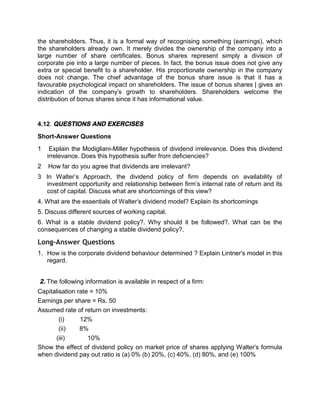
  • 113.
    The most appropriatemethod of calculating the working capital needs of a firm is the concept of operating cycle. However, a number of other methods may be used to determine working capital needs in practice. We shall illustrate here three approaches which have been successfully applied in practice: • Current assets holding period: To estimate working capital requirements on the basis of average holding period of current assets and relating them to costs based on the company's experience in the previous years. This method is essentially based on the operating cycle concept. • Ratio of sales: To estimate working capital requirements as a ratio of sales on the assumption that current assets change with sales. • Ratio affixed investment: To estimate working capital requirements as a percentage of fixed investment. . Example4.1. From the following projects of PQR Ltd. for the coming year, you are asked to determine the working capital needs of the company. Annuals Sales: Rs. 15,60,000 Cost of production (including depreciation of Rs. 1,30,000): Rs.12,50,000 Raw material purchases: Rs.7,00,000 Opening Stock of raw materials: Rs. 1,50,000 Closing stock of raw materials: Rs. 1,30,000 Inventory Norms: Raw materials: 2 months Work-in-process: 1/2 month Finished goods: 1 month The firm enjoys credit of 1 month on its purchases and also extends credit of 1 month on its supplier. It may be assumed that production is carried out evenly. Cash balance of the year and the minimum cash balance to be maintained is Rs. 50,000. Check Your Progress 7. Differentiate between permanent and variable working capital. 8. What are the main methods for estimating working capital needs?
  • 114.
    Solution: Determination ofnet working capital (i)Current Assets: Cash Balance (Rs.) 50,000 Inventories: Raw materials : Opening Stock Rs. 1,50,000 Add: Purchase Rs. 7,00,000 Less: Closing Stock Rs. 130,000 ----------------- Annual Consumption Rs 7,20,000 Two months' requirement (7,20,000 x 2/12) 120,000 Work-in-process (l 1,20,000 x 1/24) 46,667 Finished goods (11,20,000 x 1/12) 93,333 Debtors (11,20,000x1/12) 93,333 ----------- Total Current Assets Rs 4,,03,333 (II) Current liabilities: Trade creditors (7,00,000 x 1/12) 58333 -------------- (iii) Net working capital (I - II) Rs. 3,45,000 Note: Depreciation is excluded from the cost of production. Example 4.2: Walmart Stores Inc. provides all about inventories. Find its operating cycle assuming all sales are (a) cash sales and (b) credit sales. You can use cost of revenue as approximate figure for purchases (i.e. no need to adjust it for changes in inventories). Rs. Revenue 4,69,162 Cost of revenue 3,52,488
  • 115.
    Inventories as at31 January 2013 43,803 Inventories as at 31 January 2012 40,714 Average inventories 42,259 Accounts receivable as at 31 January 2013 6,768 Accounts receivable as at 31 January 2012 5,937 Average accounts receivable 6,353 Solution Part (a) Days taken in converting inventories to accounts receivable = 365/352,488*42,259 = 43.75 Since there are no credit sales, time taken in recovering cash from accounts receivable is zero. Customers pay cash right away. Operating cycle is 43.75 days and this represents the time taken in selling inventories. Part (b) There is no change in days taken in converting inventories to accounts receivable. Days taken in converting receivables to cash = 365/469,162*6,353 = 4.92 Operating cycle = days taken in selling + days taken in recovering cash = 43.75 + 4.92 = 48.68 Example 4.3. XYZ Ltd. has obtained the following data concerning the average working capital cycle for other companies in the same industry : Raw material stock turnover 20 Days Credit received 40 Days Work-in-Progress Turnover 15 Days Finished goods stock turnover 40 Days Debtors' collection period 60 Days 95 Days Using the following data, calculate the current working capital cycle for XYZ Ltd. And briefly comment on it. (Rs. in '000) Sales 3,000 Cost of Production 2,100 Purchase 600 Average raw material stock 80 Average work-in-progress 85 Average finished goods stock 180 Average creditors 90
  • 116.
    Average debtors 350 Solution:Operating cycle of XYZ Ltd. 1. Raw material = 49 Days 2. Work-in-progress = 15Days 3. Finished Goods = 31 Days 4. Debtors = 43 Days 5. Creditors = 55 Days Net Operating Cycle = 49 days + 15 days + 31 days + 43 days – 55 days = 138 Days – 55 Days = 83 Days Comment : For XYZ Ltd., the working capital cycle is below the industry average, including a lower investment in net current assets. However, the following points should be noted about the individual elements of working capital. a) The stock of raw materials is considerably higher than average. So there is a need for stock control procedure to be reviewed. b) The value of creditors is also above average; this indicates that XYZ Ltd. is delaying the payment of creditors beyond the credit period. Although this is an additional source of finance, it may result in a higher cost of raw materials or loss of goodwill among the suppliers. c) The finished goods stock is below average. This may be due to a high demand for the firm's goods or to efficient stock control. A low finished goods stock can, however, reduce sales since it can cause delivery delays. d) Debts are collected more quickly than average. The company might have employed good credit control procedure or offer cash discounts for early payments. Example.4.4 A proforma cost sheet of a company provides the following particulars: Elements of Cost Material 40% Direct Labour 20% Overheads 20% The following further particulars are available: (a) It is proposed to maintain a level of activity of 2,00,000 units. (b) Selling price is Rs.12/- per unit. (c) Raw materials are expected to remain in stores for an average period of one month. (d) Materials will be in process, on averages half a month. (e) Finished goods are required to be in stock for an average period of one month. (f) Credit allowed to debtors is two months. (g) Creditor allowed by suppliers is one month.
  • 117.
    You may assumethat sales and production follow a consistent pattern. You are required to prepare a statement of working capital requirements, a forecast Profit and Loss Account and Balance Sheet of the company assuming that: Rs. Share Capital 15,00,000 8% Debentures 2,00,000 Fixed Assets 13,00,000 Solution: Statement of Working Capital Current Assets: Rs. Rs. Stock of Raw Materials (1 month) 80,000 Work in progress (1/2 month): Materials 40,000 Labour 20,000 Overheads 20,000 80,000 Stock of Finished Goods (1 month) Materials 80,000 Labour 40,000 Overheads 40,000 1,60,000
  • 118.
    Debtors (2 months) atcost Material 1,60,000 Labour 80,000 Overheads 80,000 3,20,000 6,40,000 Less: Current Liabilities: Creditors (1 month) for raw materials 80,000 Net Working Capital Required: 5,60,000 Note: Sales = (2,00,000 X 12 = Rs.24,00,000) Forecast Profit and Loss Account For the year ended…. Rs. Rs. To Materials 9,60,000 By Cost of good old 19,20,000 To Wages 4,80,000 To Overheads 4,80,000 19,20,000 19,20,000 To Cost of goods sold 19,20,000 By Sales 24,00,000 To Gross profit c/d 4,80,000 24,00,000 24,00,000 To Interest on Debentures 16,000 By Gross Profit b/d 4,80,000 To Net Profit 4,64,000 4,80,000 4,80,000 Forecast Balance Sheet as at…… Liabilities Rs. Assets Rs.
  • 119.
    Share Capital 15,00,000Fixed Assets 13,00,000 8% Debentures 2,00,000 Stocks: Net Profit 4,64,000 Raw Materials 80,000 Creditors 80,000 Work-in-Progress 80,000 Finished Goods 1,60,000 Debtors 4,00,000 Cash & Bank Balance (Balancing figure) 2,24,000 22,44,000 22,44,000 Working Notes: (a) Profits have been ignored while preparing working capital requirements for the following reasons: (i) Profits may or may not be used for working capital. (ii) Even if profits have to be used for working capital, they have to be reduced by the amount of income tax, dividends, etc. (b) Interest on debentures has been assumed to have been paid. 4.3 FINANCING OF WORKING CAPITAL Working capital financing is done by various modes such as trade credit, cash credit/bank overdraft, working capital loan, purchase of bills/discount of bills, bank guarantee, letter of credit, factoring, commercial paper, inter-corporate deposits etc. The arrangement of working capital financing forms a major part of the day to day activities of a finance manager. It is a very crucial activity and requires continuous attention because working capital is the money which keeps the day to day business operations smooth. Without appropriate and sufficient working capital financing, a firm may get into troubles. Insufficient working capital may result in nonpayment of certain dues on time. Inappropriate mode of financing would result in loss of interest which directly hits the profits of the firm. 4.15 Types of Working Capital Financing / Loans A firm may adopt three types of financing policies as follows: =>Long-term financing: The sources of long-term financing include ordinary share capital, preference share capital, debentures, long-term borrowings from financial institutions and reserves and surplus (retained earnings).
  • 120.
    1. Long-Term Loanfrom a Bank: Many companies opt for a full-fledged long term loan from a bank that allows them to meet all their working capital needs for two, three or more years. 2. Retain Profits: Rather than making dividend payments to shareholders or investing in new ventures, many businesses retain a portion of their profits so that they may use it for working capital. This way they do not have to take loans, pay interest, incur losses on discounted bills, and they can be self-sufficient in their financing. 3. Issue Equities and Debentures: In extreme cases when the business is really short of funds, or when the company is investing in a large-scale venture, they might decide to issue debentures or bonds to the general public or in some cases even equity stock. Of course, this will be done only by conglomerates and only in cases when there is a need for a huge quantum of funds. =>Short-term financing: The short-term financing is obtained for a period less than one year. It is arranged in advance from banks and other suppliers of short-term finance in the money market. Short-term finances include working capital funds from banks, public deposits, commercial paper, factoring of receivable etc. 1. Overdraft Agreement: By entering into an overdraft agreement with the bank, the bank will allow the business to borrow up to a certain limit without the need for further discussion. The bank might ask for security in the form of collateral and they might charge daily interest at a variable rate on the outstanding debt. However, if the business is confident of making the repayments quickly, then an overdraft agreement is a valuable source of financing, and one that many companies resort to. 2. Accounts ReceivableFinancing: Many banks and non-banking financial institutions provide invoice discounting facilities. The company takes the commercial bills to the bank which makes the payment minus a small fee. Then, on the due date the bank collects the money from the customer. This is another popular method of financing especially among small traders. Businesses that offer large terms of credit can carry on their operations without having to wait for the customers to settle their bills. 3. Customer Advances: There are many companies that insist on the customer making an advance payment before selling them goods or providing a service. This is especially true while dealing with large orders that take a long time to fulfill. This method also ensures that the company has some funds to channelize into its operations for fulfilling those orders.
  • 121.
    4. Selling Goodson Installment: Many companies, especially those that sell television sets, fans, radios, refrigerators, vehicles and so on, allow customers to make their payments in installments. Since many of these items have become modern day essentials, their customers might not come from well-to-do backgrounds or the cost of the product might be too prohibitive for immediate payment. In such a case, instead of waiting for a large payment at the end, they allow the customers to make regular monthly payments. This ensures that there is a constant flow of funds coming into the business that does not choke up the accounts receivable numbers. 5. Commercial Paper (CP): CP is a debt instrument for short-term borrowing that enables highly-rated corporate borrowers to diversify their sources of short-term borrowings, and provides an additional financial instrument to investors with a freely negotiable interest rate. The maturity period ranges from three months to less than 1 year. 6. Public Deposits: Deposits from the public are one of the important sources of finance particularly for well established big companies with huge capital base. The period of public deposits is restricted to a maximum 5 years at a time and hence, this source can provide finance only for short-term to medium-term, which could be more useful for meeting working capital needs of the company. It is advisable to use the amounts of public deposits for acquiring assets of long-term nature unless its pay back is very short. =>Spontaneous financing: Spontaneous financing refers to the automatic sources of short-term funds arising in the normal course of a business. Trade (suppliers') credit and outstanding expenses are examples of spontaneous financing. 1. Trade Credit This credit service offered by suppliers allows businesses to get goods and pay for them later. This is a source of working capital that may be acquired from all suppliers depending on the business arrangements, the type of business you conduct and the worth of the credit to be offered. 2. Asset-Based Financing A business may use its assets to secure working capital from financial institutions that offer asset based loans. The asset includes machinery, vehicle or accounts receivable. Accounts receivable are financial documents of people or companies that owe money to the business and they may be traded in to finance working capital at discounting companies. 3. Inventory Financing These loans are secured with the business` inventory acting as the security. Finance for working capital may be acquired through its inventory although the business cannot sell it until the loan is repaid because the lender has the right to the inventory until the loan has been repaid.
  • 122.
    4. Accrued Expenses: Anothersource of spontaneous short-term financing is the accrued expenses that arise from the normal conduct of business. An accrued expense is an expense that has been incurred, but has not yet been paid. What should be the mix of short-and long-term sources in financing current assets?. Depending on the mix of short- and long-term financing, the approach followed by a company may be referred to as: • matching approach • Conservative approach • Aggressive approach (1)The Hedging or Matching Approach: The term ‘hedging’ refers to two off-selling transactions of a simultaneous but opposite nature which counterbalance effect of each other. With reference to financing mix, the term hedging refers to ‘process of matching of maturities of debt with maturities of financial needs’. According to this approach the maturity of sources of funds should match the nature of assets to be financed. This approach is also known as ‘matching approach’ which classifies the requirements of total working capital into permanent and temporary working capital. The hedging approach suggests that permanent working capital requirements should be financed with funds from long-term sources while temporary working capital requirements should be financed with short-term funds. When the firm follows matching approach, long-term financing will be used to finance fixed assets and permanent current assets and short-term financing to finance temporary or variable current assets. However, it should be realised that exact matching is not possible because of the uncertainty about the expected lives of assets. The firm can adopt a financial plan which matches the expected life of assets with the expected life of the source of funds raised to finance assets. Thus, a ten-year loan may be raised to finance a plant with an expected life of ten years; stock of goods to be sold in thirty days may be financed with a thirty-day commercial paper or a bank loan. Figure 4.7 is used to illustrate the matching plan over time.
  • 123.
    The firm's fixedassets and permanent current assets are financed with long-term funds and as the level of these assets increases, the long-term financing level also increases. The temporary or variable current assets are financed with short-term funds and as their level increases, the level of short-term financing also increases. Under matching plan, no short-term financing will be used if the firm has fixed current assets sonly. (2) The Conservative Approach: This approach suggests that the entire estimated investments in current assets should be financed from long-term sources and short-term sources should be used only for emergency requirements. The distinct features of this approach are: (ii) Liquidity is greater (iii) Risk is minimized (iv) The cost of financing is relatively more as interest has to be paid even on seasonal requirements for entire period. A firm in practice may adopt a conservative approach in financing its current and fixed assets. The financing policy of the firm is said to be conservative when it depends more on long-term funds for financing needs. Under a conservative plan, the firm finances its permanent assets and also a part of temporary current assets with long-term financing. In the periods when the firm has no need for temporary current assets, the idle long- term funds can be invested in the tradable securities to conserve liquidity. The conservative plan relies heavily on long-term financing and, therefore, the firm has less risk of facing the problem of shortage of funds. The conservative financing policy is shown in Figure 4.8
  • 124.
    Trade off betweenthe Hedging and Conservative Approaches The hedging approach implies low cost, high profit and high risk while the conservative approach leads to high cost, low profits and low risk. Both the approaches are the two extremes and neither of them serves the purpose of efficient working capital management. A trade off between the two will then be an acceptable approach. The level of trade off may differ from case to case depending upon the perception of risk by the persons involved in financial decision making. However, one way of determining the trade off is by finding the average of maximum and the minimum requirements of current assets. The average requirements so calculated may be financed out of long- term funds and excess over the average from short-term funds. (3). Aggressive Approach: The aggressive approach suggests that entire estimated requirements of current asset should be financed from short-term sources even a part of fixed assets investments be financed from short-term sources. This approach makes the finance – mix more risky, less costly and more profitable. A firm may be aggressive in financing its assets. An aggressive policy is said to be followed by the firm when it uses more short-term financing than warranted by me matching plan. Under an aggressive policy, the firm finances a part of its permanent current assets with short-term financing. Some extremely aggressive firms may even finance a part of their fixed assets with short-term financing. The relatively more use of short-term financing makes the firm more risky. The aggressive financing is illustrated in Figure 4.9.
  • 125.
    Hedging Vs ConservativeApproach Hedging Approach Conservative Approach 1. The cost of financing is reduced. 1. The cost of financing is higher 2. The investment in net working capital is nil. 2. Large Investment is blocked in temporary working capital. 3. Frequent efforts are required to arrange funds. 3. The firm does not face frequent financing problems. 4. The risk is increased as firm is vulnerable to sudden shocks. 4. It is less risky and firm is able to absorb shocks. Short-term vs. Long-term Financing: A Risk-Return Trade-off A firm should decide whether or not it should use short-term financing. If short-term financing has to be used, the firm must determine its portion in total financing. This decision of the firm will be guided by the risk-return trade-off. Short-term financing may be preferred over long-term financing for two reasons: (i) the cost advantage and (ii) flexibility. But short-term financing is more risky than long-term financing. Cost: Short- term financing should generally be less costly than long-term financing. It has been found in developed countries, like USA, that the rate of interest is related to the maturity of debt. The relationship between the maturity of debt and its cost is called the term structure of interest rates. The curve, relating to the maturity of debt and interest rates,
  • 126.
    is called theyield curve. The yield curve may assume any shape, but it is generally upward sloping. Figure 4.10 shows the yield curve. The figure indicates that more the maturity greater the interest rate. 4.4 SOURCES OF WORKING CAPITAL 1.Trade Credit This is simply the credit period which is extended by the creditor of the business. Trade credit is extended based on the creditworthiness of the firm which is reflected by its earning records, liquidity position, and records of payment. Just like other sources of working capital financing, trade credit also comes with a cost after the free credit period. Normally, it is a costly source as a means of financing business working capital. 2.Cash Credit / Bank Overdraft Cash credit or bank overdraft is the most useful and appropriate type of working capital financing extensively used by all small and big businesses. It is a facility offered by commercial banks whereby the borrower is sanctioned a particular amount which can be utilized for making his business payments. The borrower has to make sure that he does not cross the sanctioned limit. The best part is that the interest is charged to the extent the money is used and not on the sanctioned amount which motivates him to keep depositing the amount as soon as possible to save on interest cost. Without a doubt, this is a cost-effective working capital financing. 3.Working Capital Loans Working capital loans are as good as term loan for a short period. These loans may be repaid in installments or a lump sum at the end. The borrower should take such loans for financing permanent working capital needs. The cost of interest would not allow using such loans for temporary working capital.
  • 127.
    4.Purchase / Discountof Bills For a business, it is another good service provided by commercial banks for working capital financing. Every firm generates bills in the normal course of business while selling goods to debtors. Ultimately, that bill acts as a document to receive payment from the debtor. The seller who requires money will approach the bank with that bill and bank will apply the discount on the total amount of the bill based on the prevailing interest rates and pay the remaining amount to the seller. On the date of maturity of that bill, the bank will approach the debtor and collect the money from him. 5.Bank Guarantee It is primarily known as non-fund based working capital financing. Bank guarantee is acquired by a buyer or seller to reduce the risk of loss to the opposite party due to non- performance of the agreed task which may be repaying money or providing of some services etc. A buyer ‘B1’ is buying some products from seller ‘S1’. In this case, ‘B1’ may acquire bank guarantee from the bank and give it to ‘S1’ to save him from the risk of nonpayment. Similarly, if ‘S1’ may acquire bank guarantee and hand it over to ‘B1’ to save him from the risk of getting lower quality goods or late delivery of goods etc. In essence, a bank guarantee is revoked by the holder only in case of non-performance by the other party. Bank charges some commission for same and may also ask for security. 6.Letter of Credit It is also known as non-fund based working capital financing. Letter of credit and bank guarantee has a very thin line of difference. Bank guarantee is revoked and the bank makes payment to the holder in case of non-performance of the opposite party whereas, in the case of a letter of credit, the bank will pay the opposite party as soon as the party performs as per agreed terms. So, a buyer would buy a letter of credit and send it to the seller. Once the seller sends the goods as per the agreement, the bank would pay the seller and collects that money from the buyer. 7.Intercorporate Loans and Deposits: In present corporate world, it is a common practice that the company with surplus cash will lend other companies for short period normally ranging from 60 days to 180 days. The rate of interest will be higher than the bank rate of interest and depending on the financial soundness of the borrower company. This source of finance reduces intermediation of banks in financing. 8. Commercial Paper (CP): CP is a debt instrument for short-term borrowing, that enables highly-rated corporate borrowers to diversify their sources of short-term borrowings, and provides an additional financial instrument to investors with a freely negotiable interest rate. The maturity period ranges from three months to less than 1 year. Since it is a short-term debt, the issuing company is required to meet dealers’ fees, rating agency fees and any other
  • 128.
    relevant charges. Commercialpaper is short-term unsecured promissory note issued by corporation with high credit ratings. 9. Funds Generated from Operations: Funds generated from operations, during an accounting period, increase working capital by an equivalent amount. The two main components of funds generated from operations are retained profit and depreciation. Working capital will increase by the extent of funds generated from operations. 10. Retained Profit: Profit is the accretion of fund which is available for finance internally, to the extent it is retained in the organization. Retained profits are an important source of working capital finance. 11. Depreciation Provision: Since there is no cash outflow to the extent of depreciation provided in the accounting, it is used for financing the internal operations of a firm. The amount deducted towards depreciation on fixed assets is not immediately used in acquisition of fixed assets and such amount is retained in business for same time. This is used as a temporary source of working capital so long as the capital expenditure is postponed. 12. Amortization Provisions: Any provisions made for meeting the future payments or expenses such as provision for dividend, provision for taxation, provision for gratuity etc. provide a source of finance so long as they are kept in the business. 13.. Deferred Tax Payments: Another source of short-term funds similar in character to trade credit is the credit supplied by the tax authorities. This is created by the interval that elapses between the earning of the profits by the company and the payment of the taxes due on them. Deferred payment of taxes is also used as a temporary source of working capital so long as the amount is deposited with the tax authorities. The taxes deducted at sources, collection of sales tax and excise duty, retirement benefits deducted from salaries of staff etc. also retained in business for some time and used as a source of working capital. 14.Accrued Expenses: Another source of spontaneous short-term financing is the accrued expenses that arise from the normal conduct of business. An accrued expense is an expense that has been incurred, but has not yet been paid. For most firms, one of the largest accrued expenses is likely to be employees’ accrued wages. For large firms, the accrued wages held by the firm constitute an important source of financing. Usually, accrued expenses are not subject to much managerial manipulation.
  • 129.
    15.Deposits and Advances: Thedeposits collected from dealers and advances received from customers will also constitute a source of finance. 16.. Public Deposits: Deposits from the public is one of the important source of finance particularly for well established big companies with huge capital base. The period of public deposits is restricted to a maximum 5 years at a time and hence, this source can provide finance only for short-term to medium-term, which could be more useful for meeting working capital needs of the company. It is advisable to use the amounts of public deposits for acquiring assets of long-term nature unless its pay back is very short. 4.5 SUMMARY  The term working capital may be used to denote either the gross working capital which refers to total current assets or net working capital which refers to excess of current asset over current liabilities.  The working capital requirement for a firm depends upon several factors such as Nature or Character of Business, Credit Policy, Price level changes, business cycles, manufacturing process, production policy.  The working capital need of the firm may be bifurcated into permanent and temporary working capital.  The Hedging Approach says that permanent requirement should be financed by long term sources while the temporary requirement should be financed by short-term sources of finance.  The Conservative approach on the other hand says that the working capital requirement be financed from long-term sources.  The Aggressive approach says that even a part of permanent requirement may be financed out of short-term funds. Every firm must monitor the working capital position and for this purpose certain accounting ratios may be calculated. There is no set formula for deciding the break-up.  The 'matching approach' suggests that long term financing be used to finance fixed assets and permanent current assets, while short-term financing should be used to finance temporary or variable current assets. Overall, a firm in practice adopts a conservative approach in financing its current and fixed assets when it depends more on long-term funds for financing needs. On the other hand, an aggressive Check Your Progress 9. What are the main long- term and short-term sources for financing working capital? 10. What should be the mix of snort-term and long-term sources in financing current Assets? 11. List the main sources of working capital. 12 What are the main forms by means of which firms may avail working capital finance from banks?.
  • 130.
    policy would beimplied when a firm uses more short-term financing than suggested by the matching plan. Usually, short-tem financing is more risky but less expensive than long-term financing, and hence there is a risk-return trade-off.  The main sources of working capital include trade credit, accrued expenses and deferred income, bank finance and commercial paper.  The main forms in which bank finance for working capital are availed of by firms are overdraft facility, cash credit facility, bills purchasing/discounting facility and working capital loan. 4.6 KEY TERMS . Gross working capital: It refers to the firm's investment in current assets, . Current assets: are the assets which can be converted into cash within an accounting year • Net working capital refers to the difference between current assets and current liabilities. . Current liabilities are those claims of outsiders which are expected to mature for payment within an accounting year 4.7ANSWERS TO CHECK YOUR PROGRESS 1. There is no set formula for deciding the break-up. The 'matching approach' suggests that long term financing be used to finance fixed assets and permanent current assets, while short-term financing should be used to finance temporary or variable current assets. Overall, a firm in practice adopts a conservative approach in financing its current and fixed assets when it depends more on long-term funds for financing needs. On the other hand, an aggressive policy would be implied when a firm uses more short-term financing than suggested by the matching plan. Usually, short-terms financing is more risky but less expensive than long-term financing, and hence there is a risk-return trade-off. 2. The main sources of working capital include trade credit, accrued expenses and deferred income, bank finance and commercial paper. 3. The main forms in which bank finance for working capital are availed of by firms are overdraft facility, cash credit facility, bills purchasing/discounting facility and working capital loan. 4 .MM approach holds that under a perfect market situation the dividend policy of a firm is irrelevant, as it does not affect the value of the firm. 4.8 .QUESTIONS AND EXERCISES 1. Discuss different sources of working capital.
  • 131.
    2. Explain theconcept of operating cycle in determining working capital requirement of a firm? 3. Differentiate between Gross working capital and Net working capital? 4. Differentiate between Permanent and Temporary working capital? 5.Elaborate the factors affecting the working capital requirement of a firm?