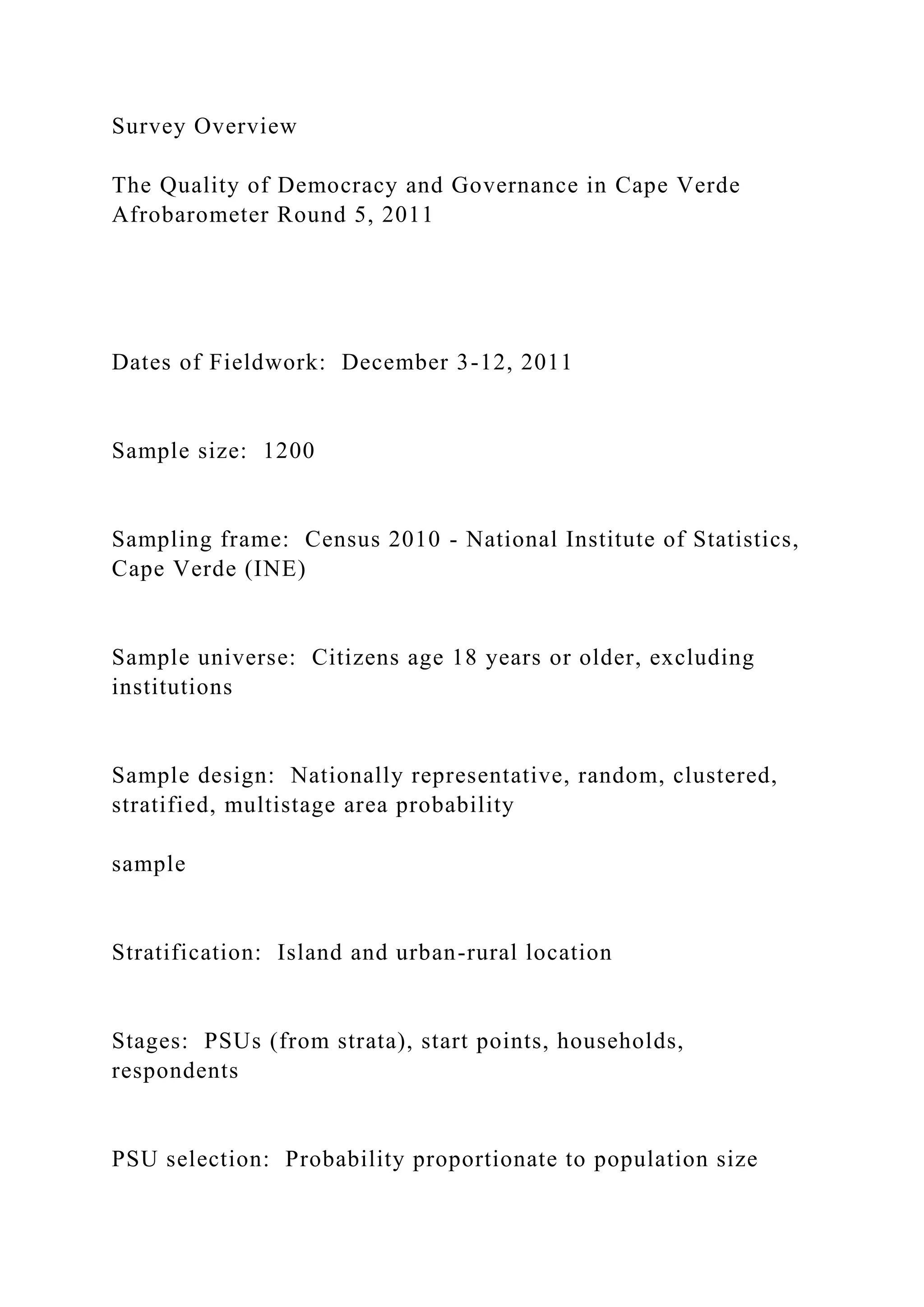
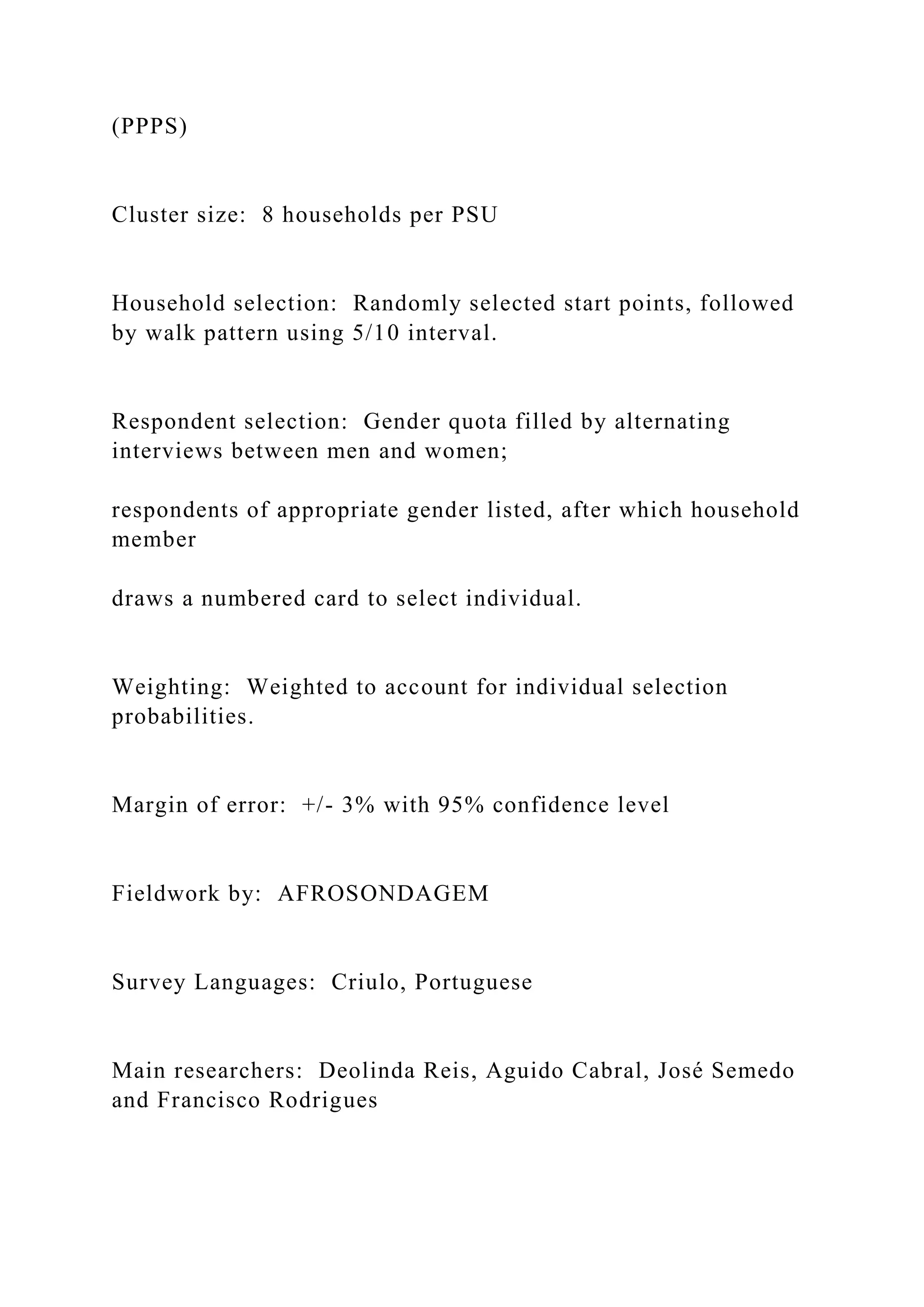
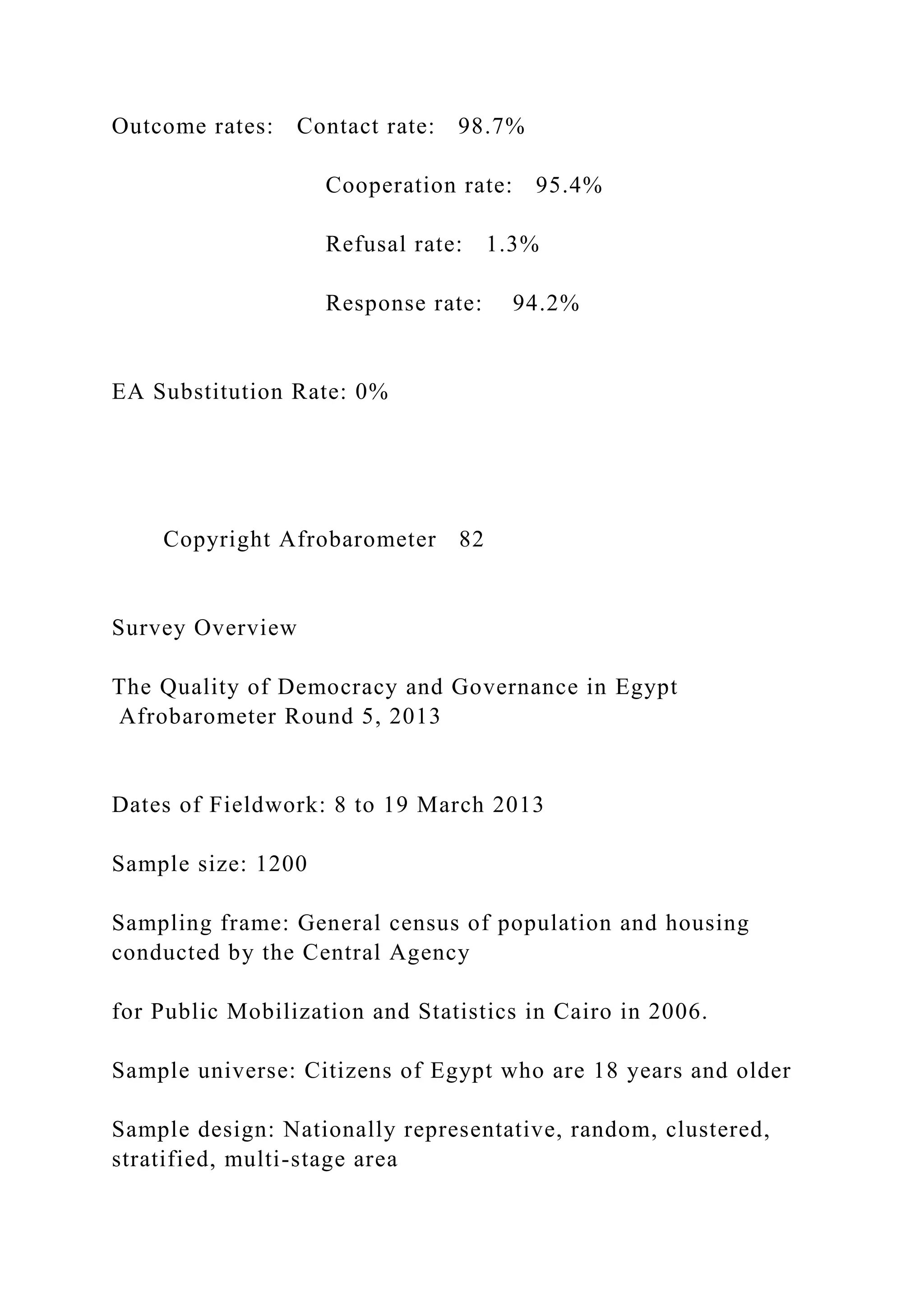
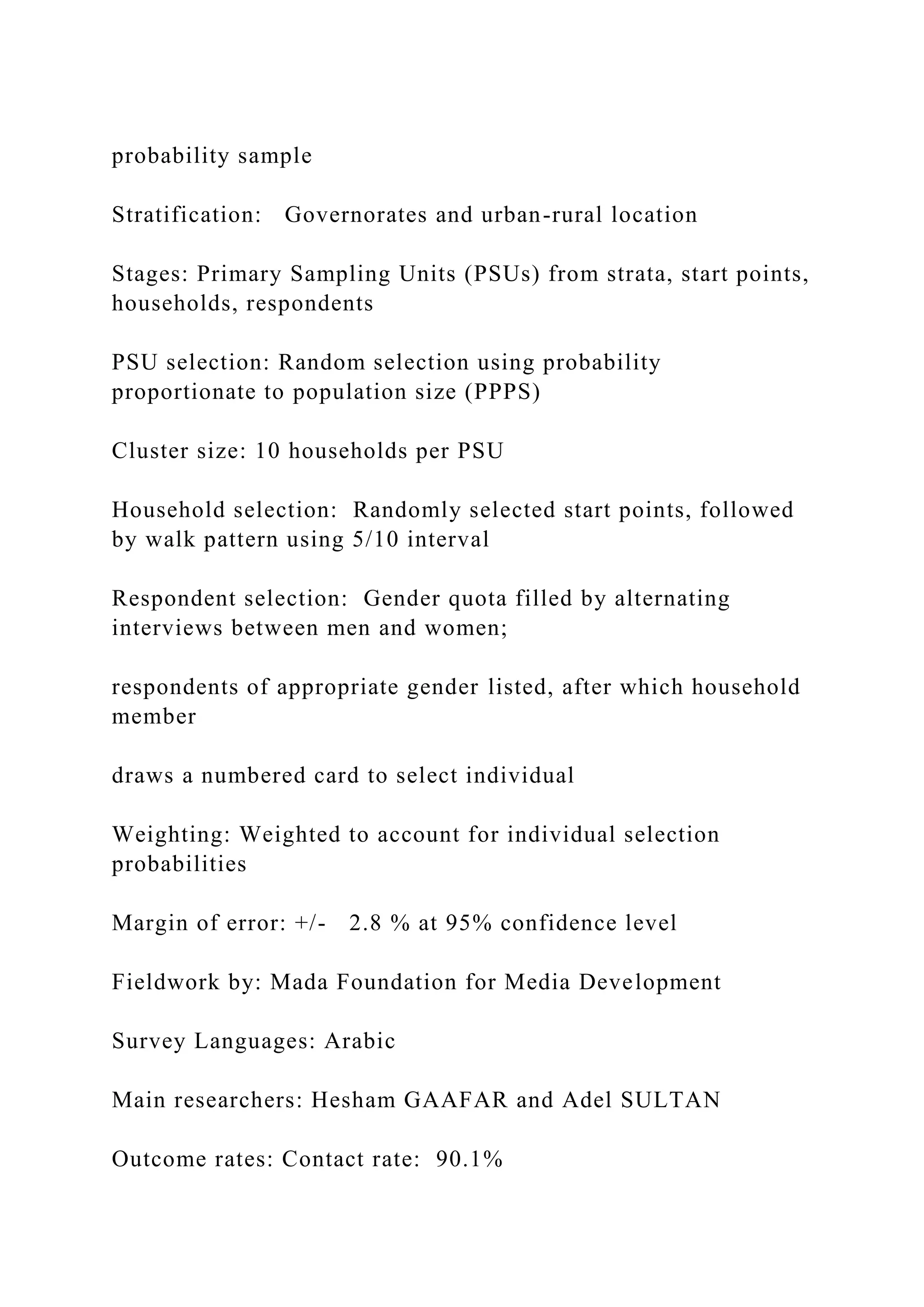
Copyright Afrobarometer
Data codebook
for a
Round 5 Afrobarometer survey
in
34 African countries
Prepared by:
Chunho Park
Michigan State University
July 2015
University of Cape Town (UCT) Center for Democratic
Development (CDD-Ghana) Michigan State University (MSU)
Centre for Social Science Research 14 W. Airport Residential
Area Department of Political Science
Private Bag, Rondebosch, 7701, South Africa P.O. Box 404,
Legon-Accra, Ghana East Lansing, Michigan 48824
27 21 650 3827•fax: 27 21 650 4657 233 21 776 142•fax: 233
21 763 028 517 353 3377•fax: 517 432 1091
Mattes ([email protected]) Gyimah-Boadi ([email protected])
Bratton ([email protected])
Copyright Afrobarometer 2
Table of Contents
Page number
Variable descriptives 3-71
Appendix 1: Sample characteristics 72
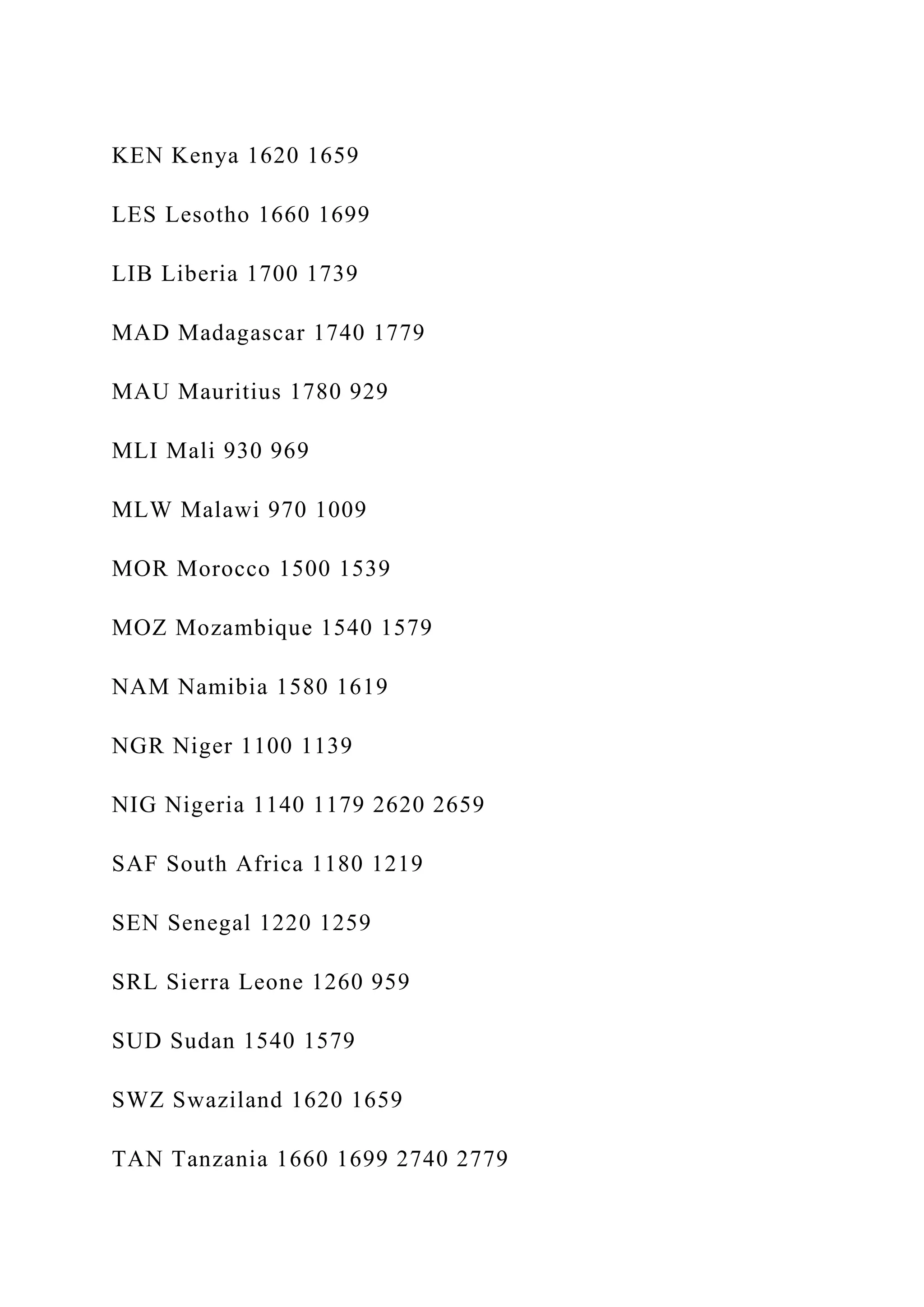
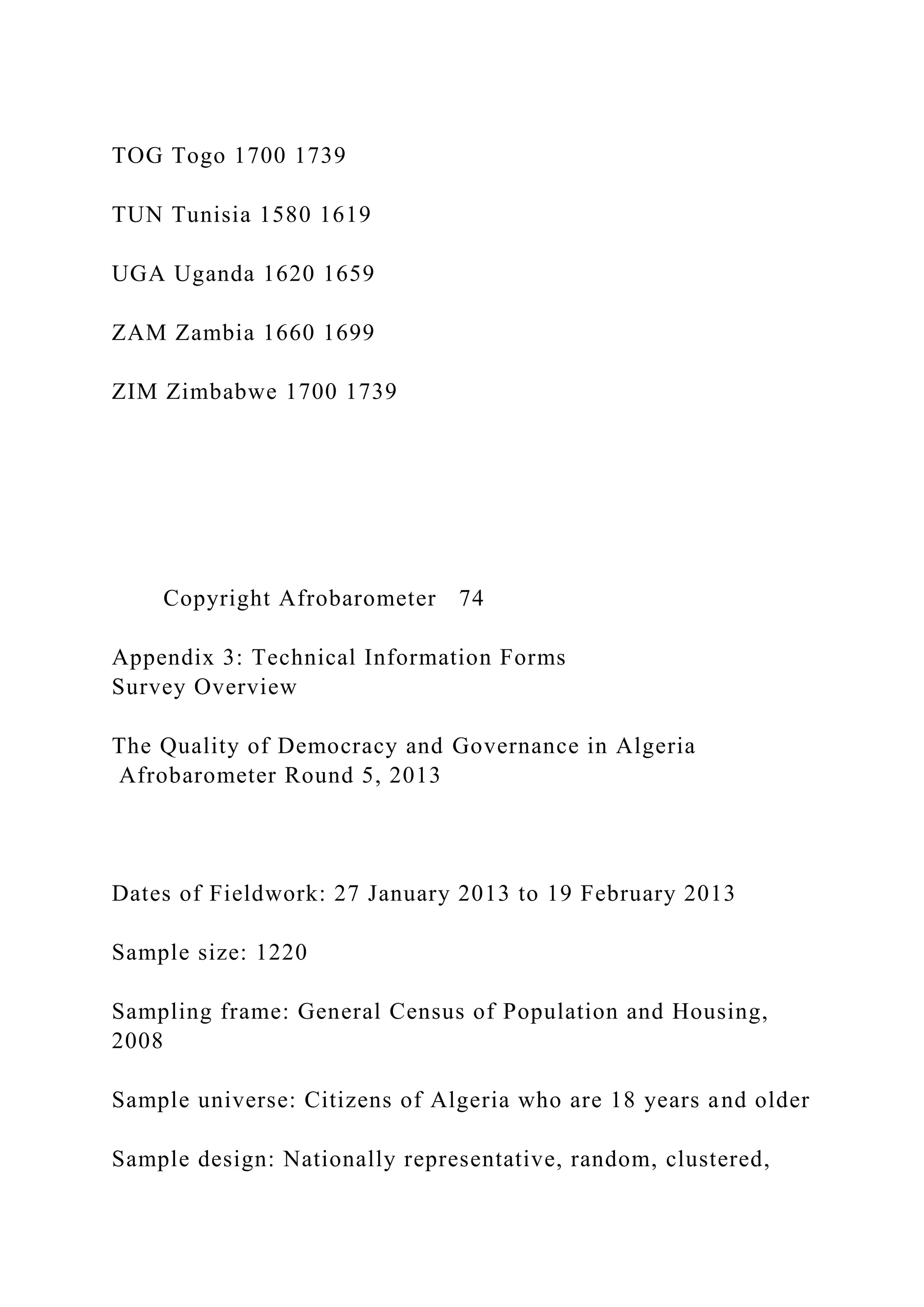
Appendix 2: List of country abbreviations and country-specific
codes 73
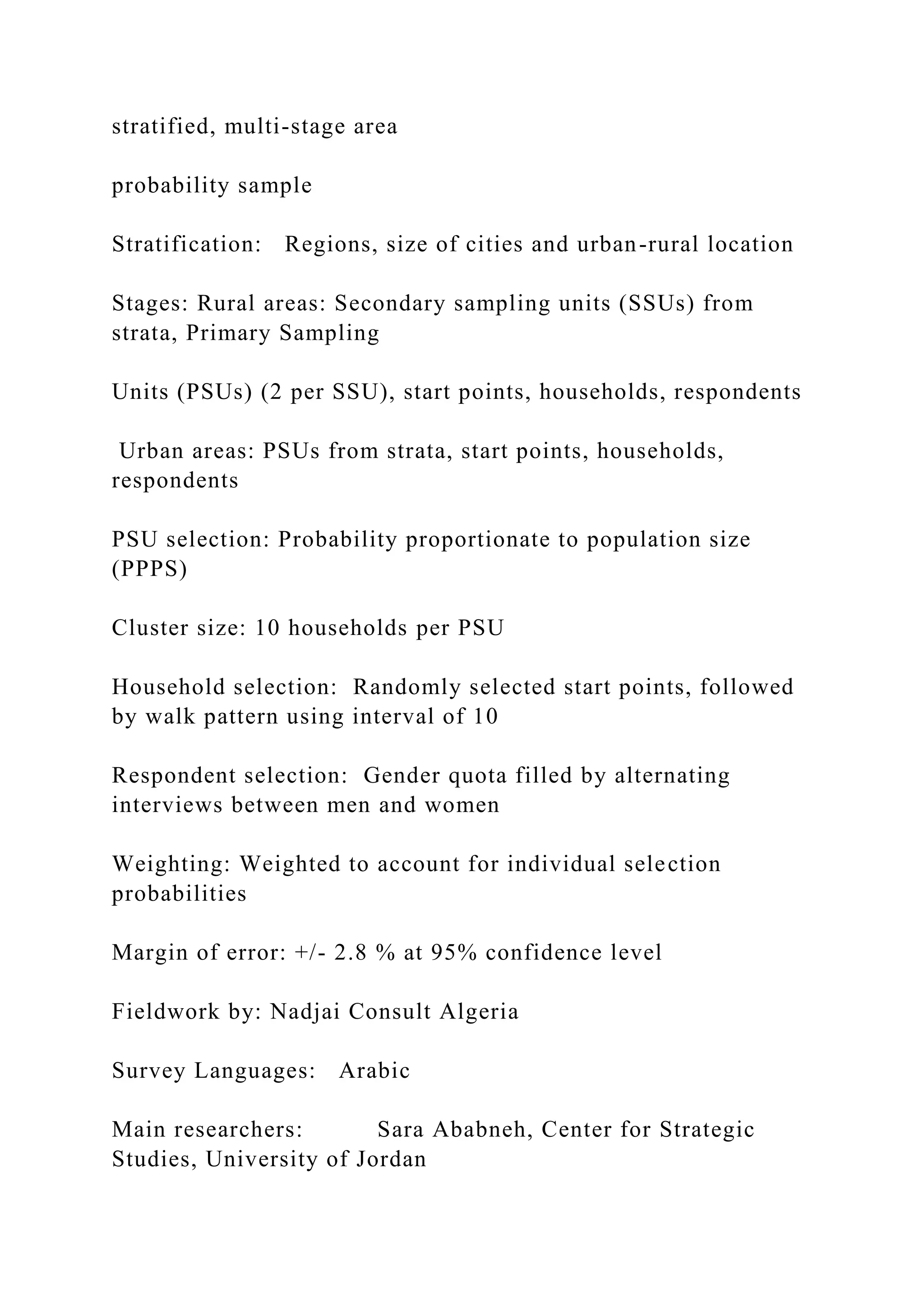
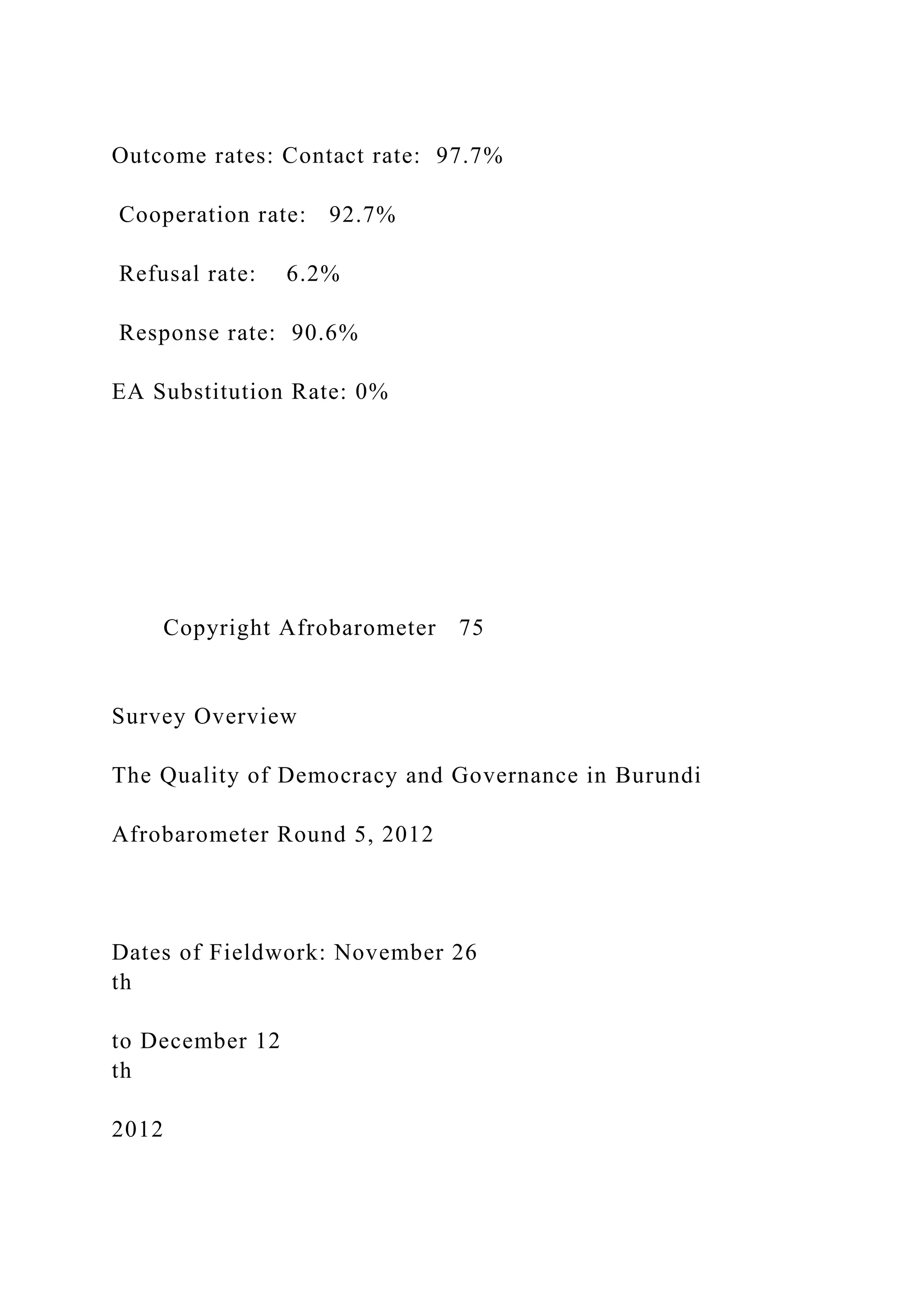
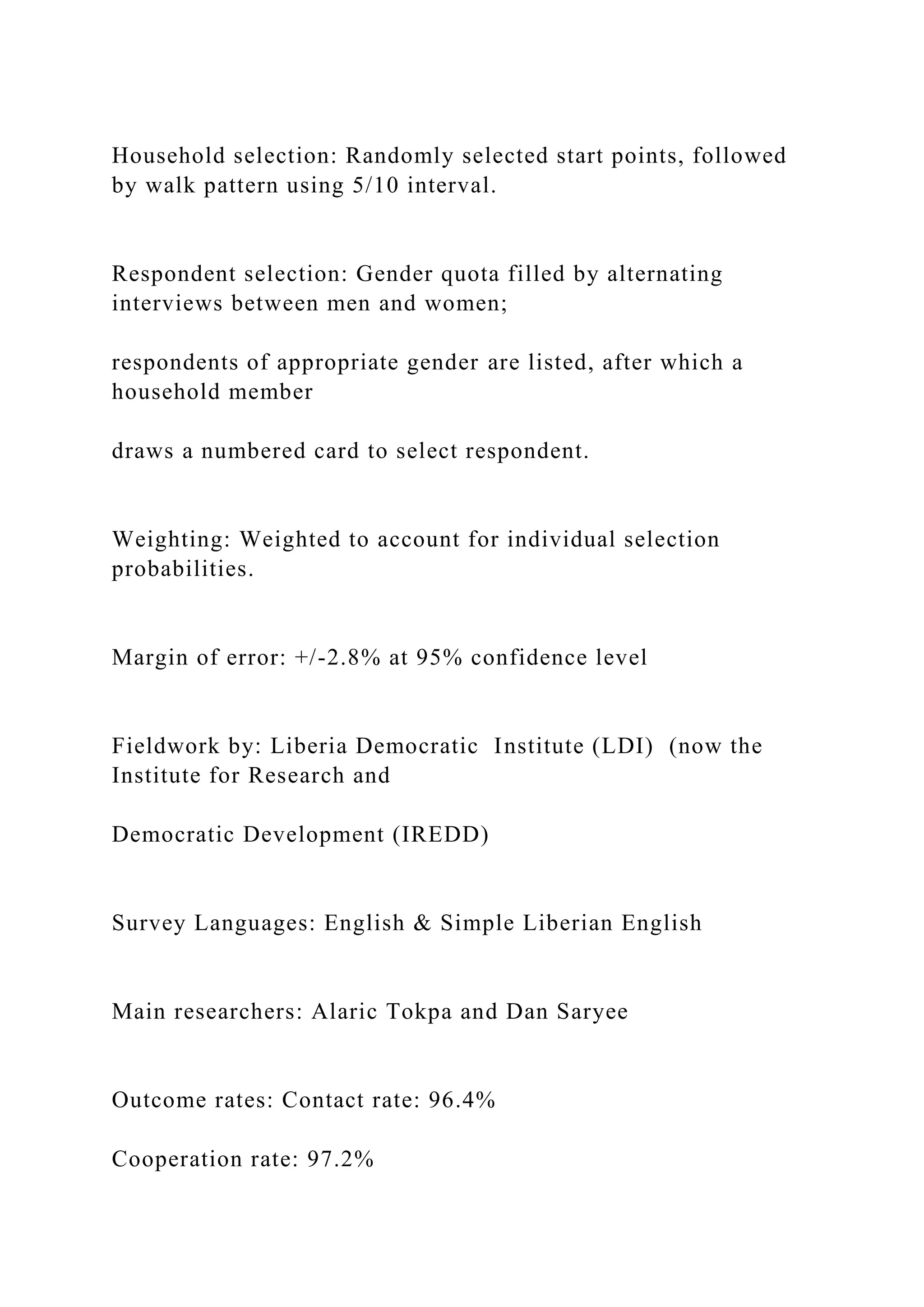
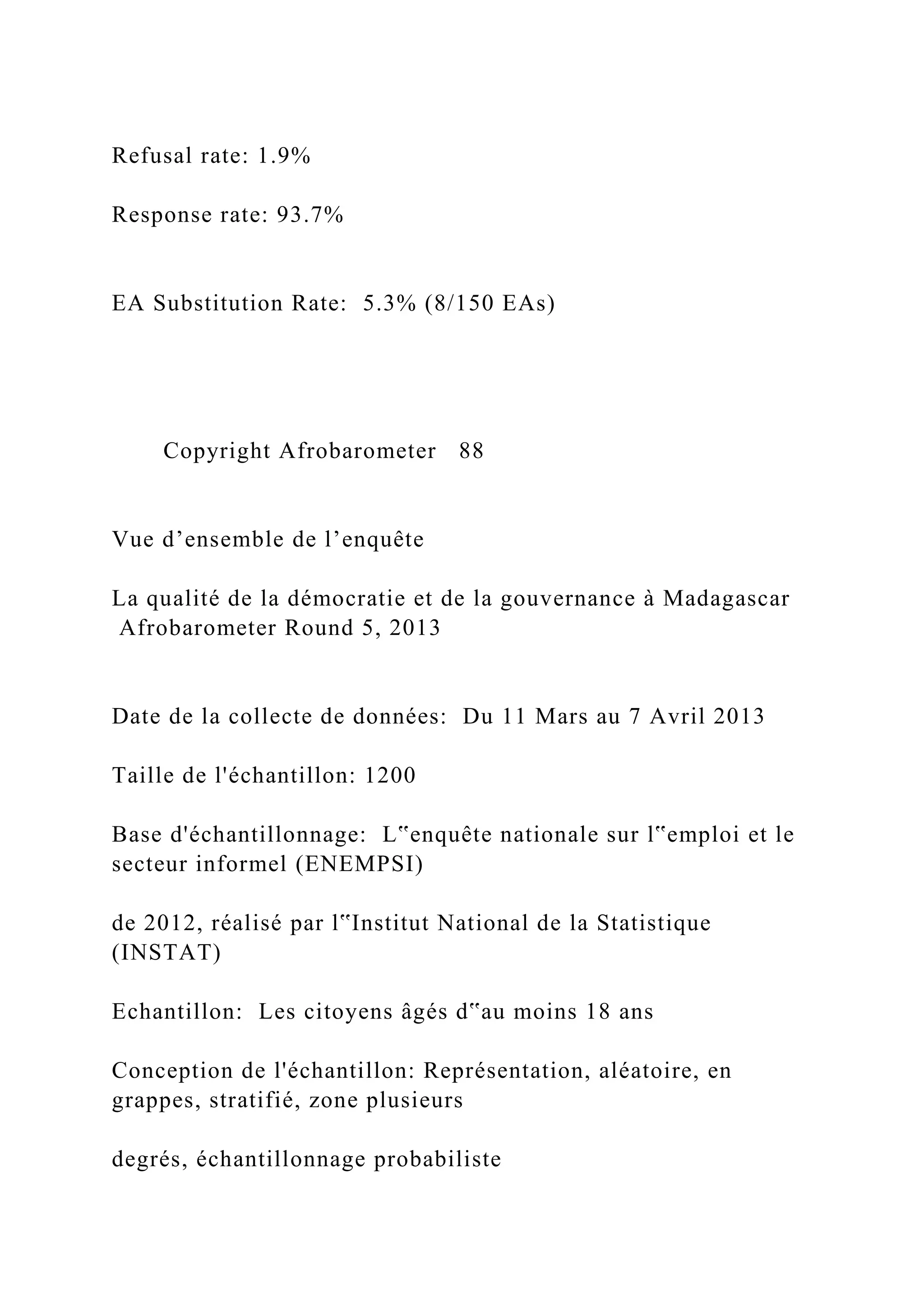
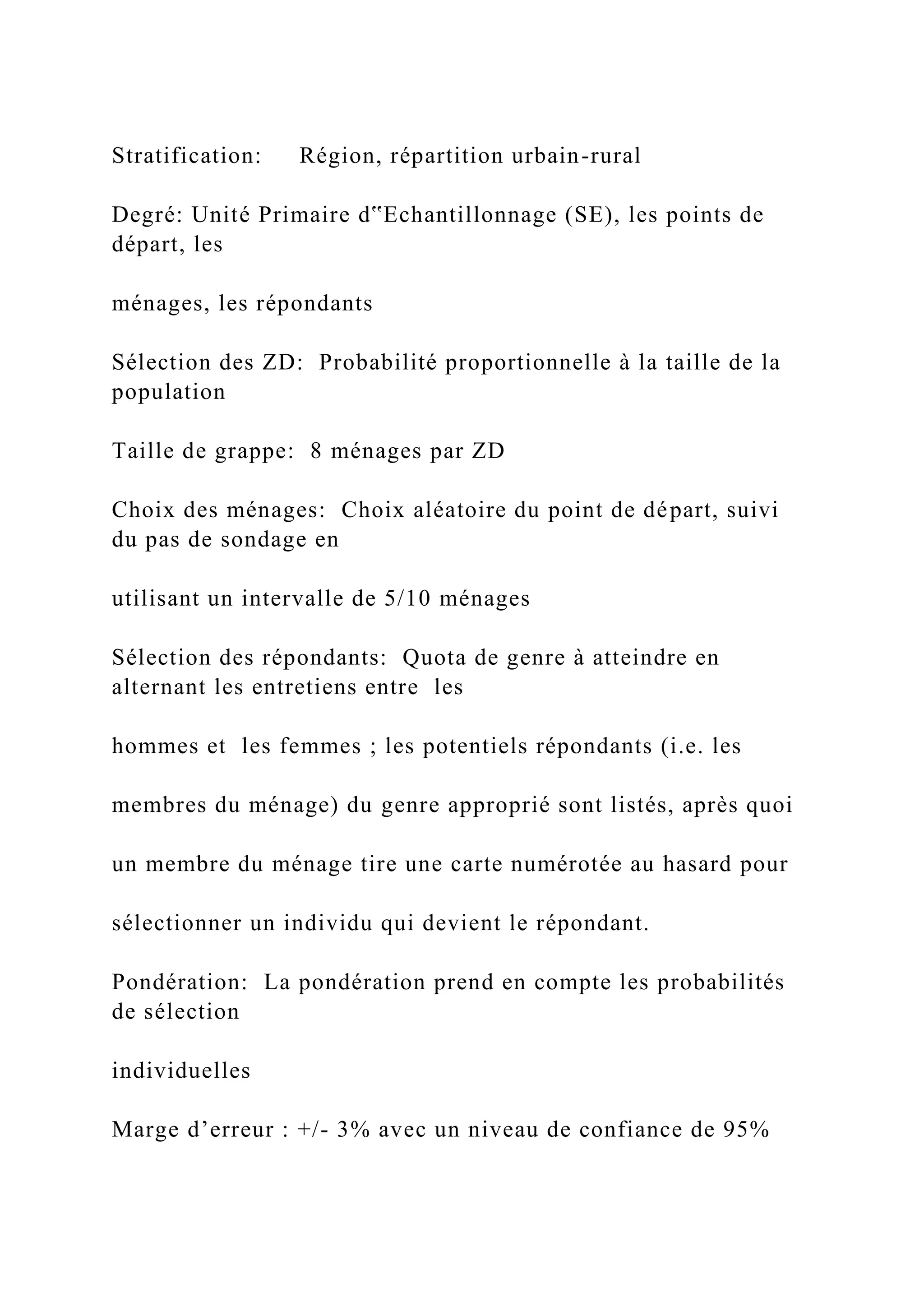
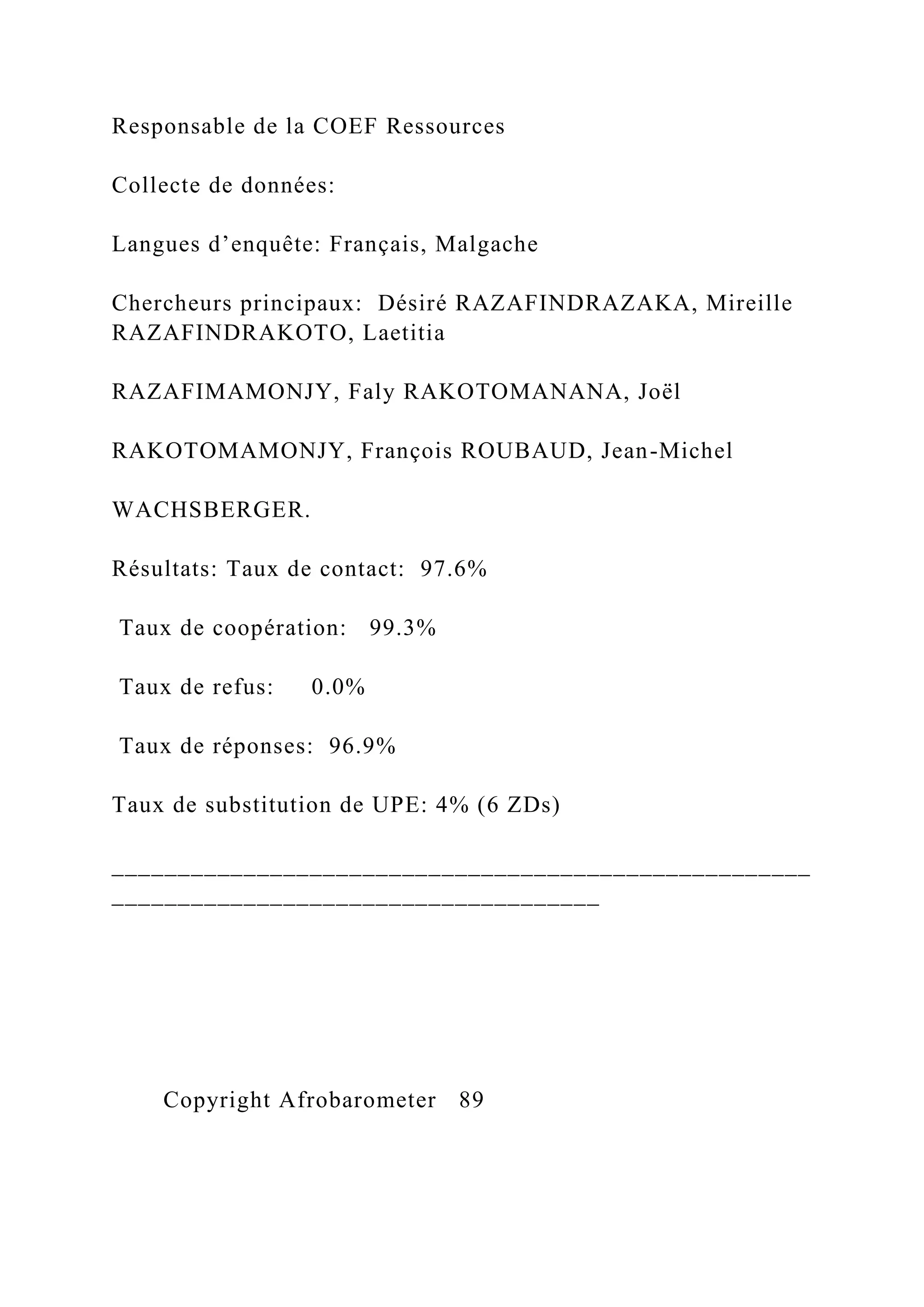
Appendix 3: Technical Information Forms for each country
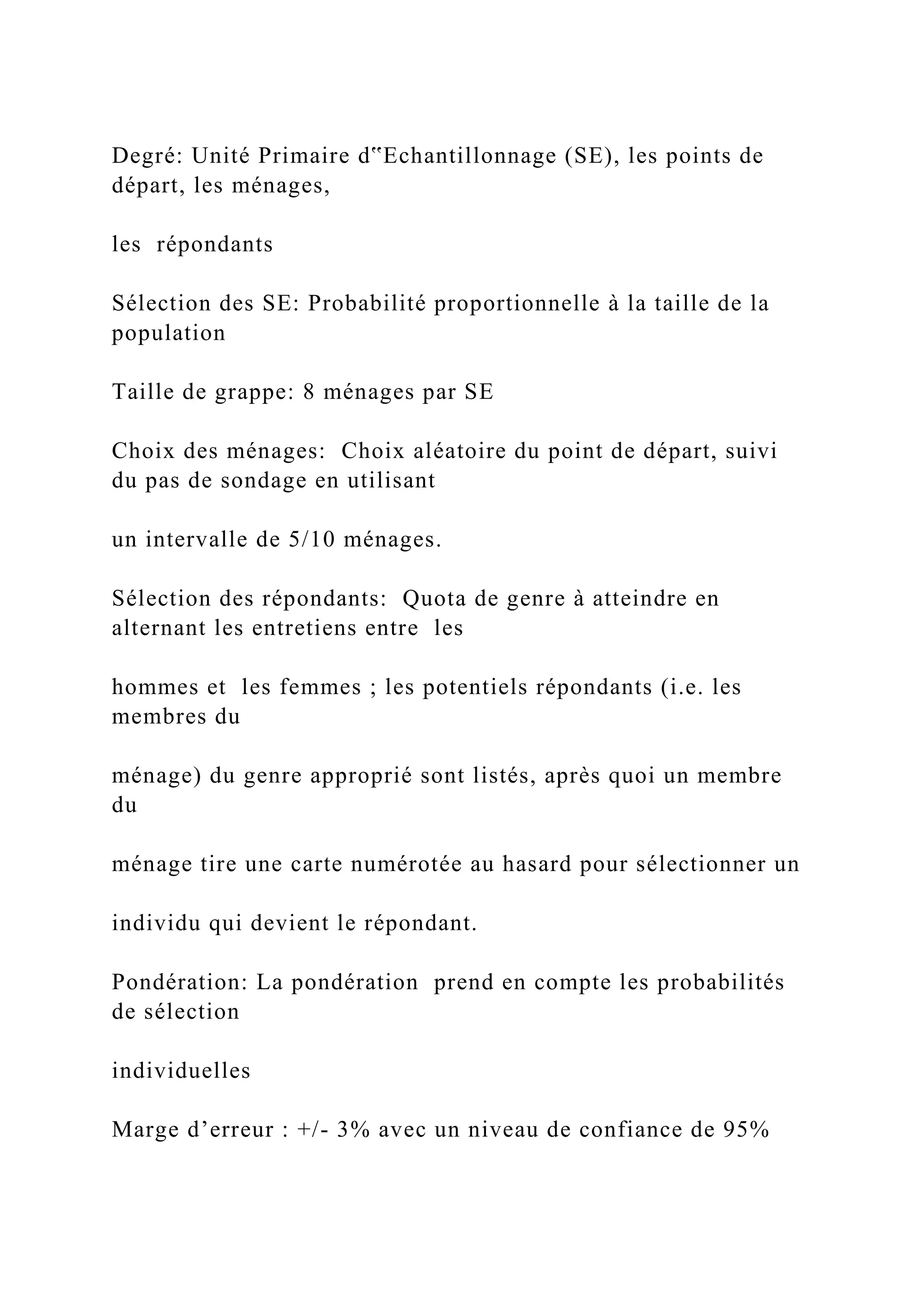
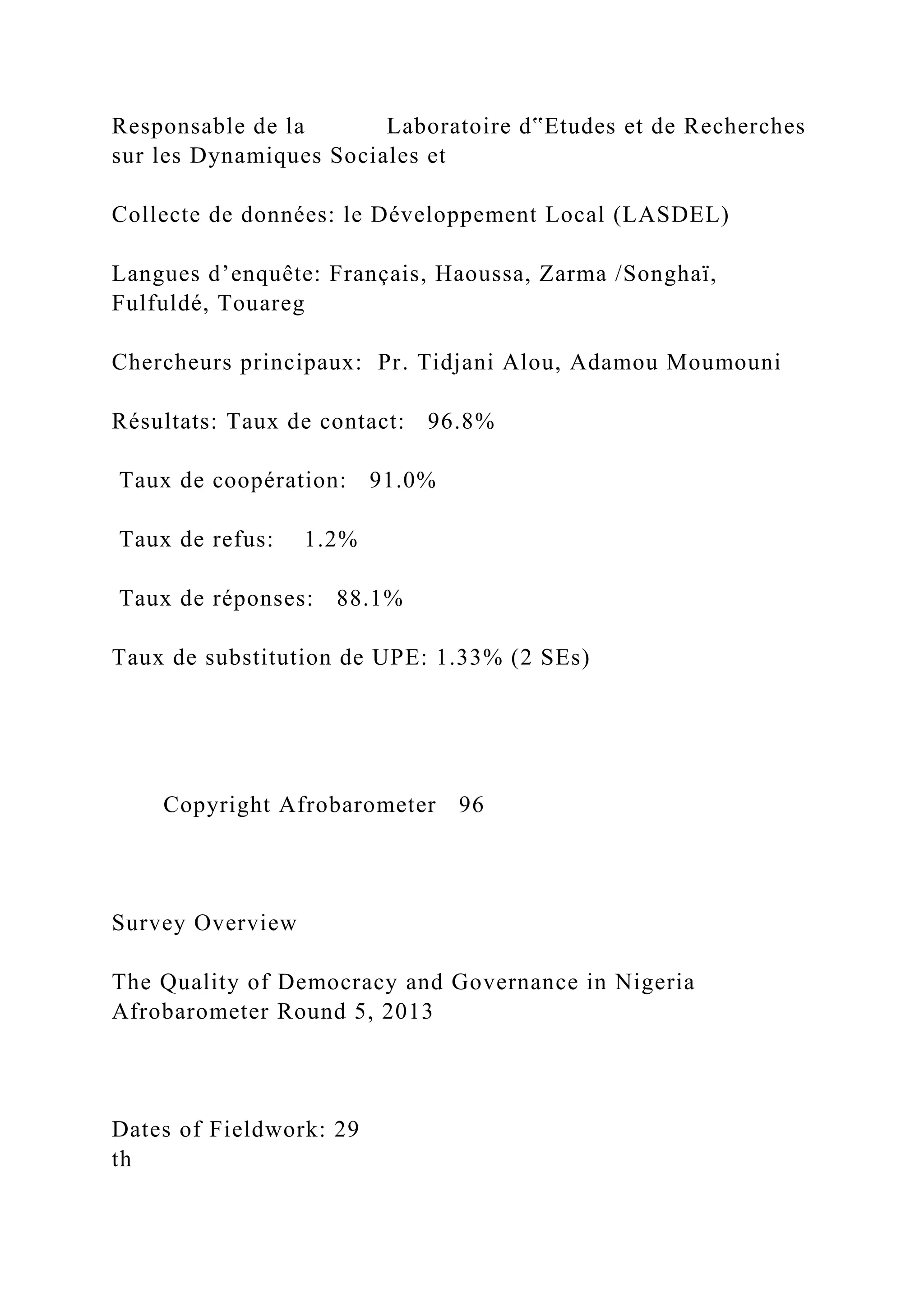
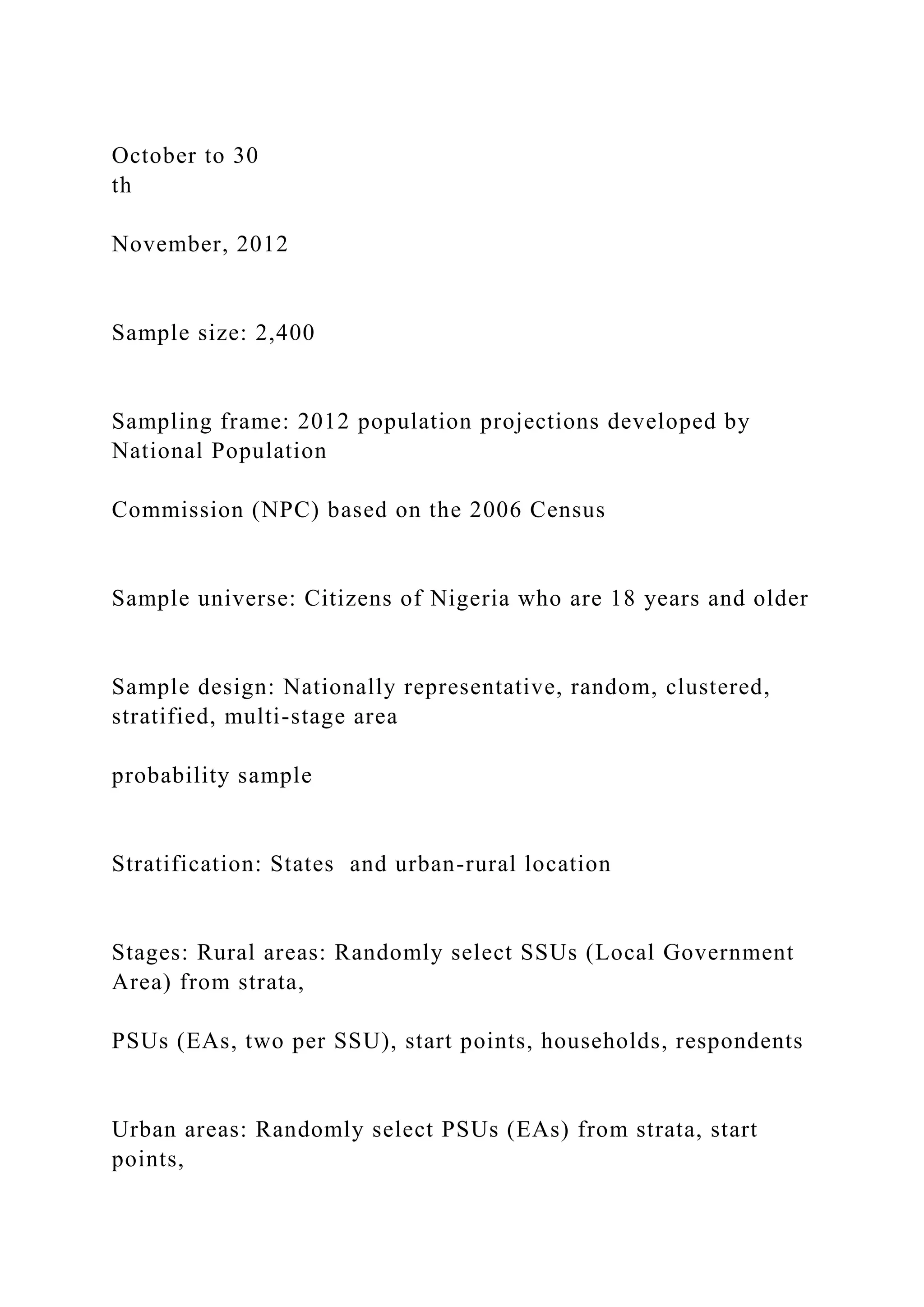
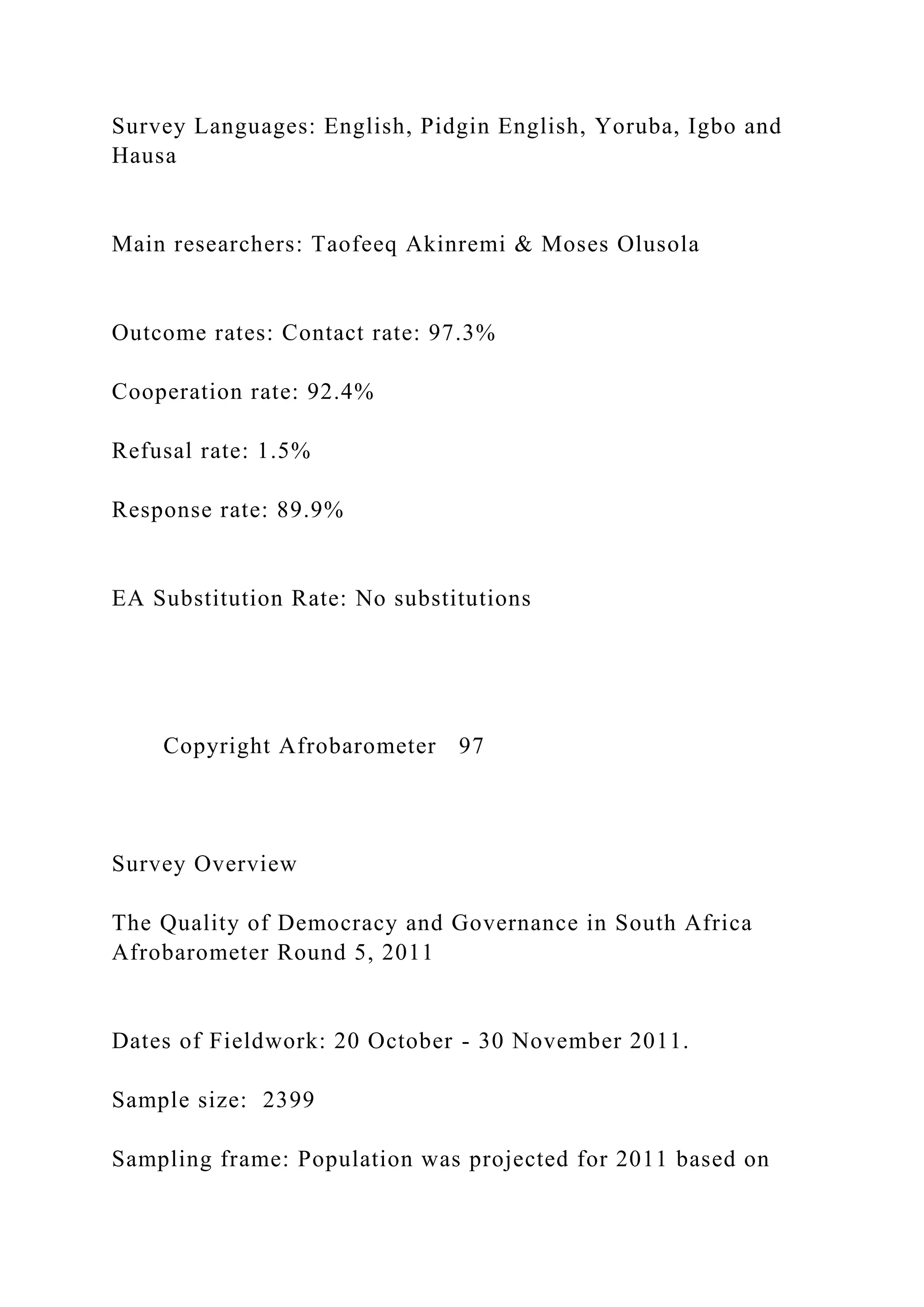
survey 74-107
Copyright Afrobarometer 3
Question Number: COUNTRY_ALPHA
Question: Country
Variable Label: Country in alphabetical order
Values: 1-35
Value Labels: 1=Algeria, 2=Benin, 3=Botswana, 4=Burkina
Faso, 5=Burundi, 6=Cameroon, 7=Cape Verde,
8=Cote d‟Ivoire, 9=Egypt, 11=Ghana, 12=Guinea, 13=Kenya,
14=Lesotho, 15=Liberia, 16=Madagascar,
17=Malawi, 18=Mali, 19=Mauritius, 20=Morocco,
21=Mozambique, 22=Namibia, 23=Niger, 24=Nigeria,
25=Senegal, 26=Sierra Leone, 27=South Africa, 28=Sudan,
29=Swaziland, 30=Tanzania, 31=Togo, 32=Tunisia,
33=Uganda, 34=Zambia, 35=Zimbabwe
Note: Answered by interviewer
Question Number: RESPNO
Question: Respondent number
Variable Label: Respondent number
Values: ALG0001-ALG0134, ALG0136-ALG0427, ALG0429,
ALG0431-ALG1136, ALG1138-ALG1210, BDI0001-
BDI1200, BEN0001-BEN1200, BFO0001-BFO1200, BOT0001-
BOT1200, CAM0001-CAM1200, CDI0001-CDI1200,
CVE0001-CVE0349, CVE0351-CVE1133, CVE1135-1210,
EGY0001-EGY1200, GHA0001-GHA2400, GUI0001-
GUI1200, KEN0001-KEN2122, KEN2124-KEN2400, LES0001-
LES0060, LES0062-LES0098, LES0100-LES0528, LES0530-
0817, LES0819-LES1201, LIB0001-LIB0491, LIB0493-1200,
MAD0001-MAD1200, MAU0001-MAU1200, MLI0001-
MLI1200, MLW0001-MLW0597, MLW0599-MLW2408,
MOZ0001-MOZ2400, MRC0001-MRC1200, NAM0001-
NAM1200, NGR0001-NGR1200, NIG0001-NIG2400, SAF0001-
SAF1334, SAF1336-SAF2400, SEN0001-SEN1200,
SRL0001-SRL0463, SRL0465-SRL0681, SRL0683-1022,
SRL1024-SRL1060, SRL1062-SRL1065, SRL1067-SRL1084,
SRL1086-SRL1096, SRL1098-SRL1130, SRL1132-SRL1167,
SRL1169-SRL1185, SRL1187-SRL1200, SUD0001-SUD1200,
SWZ0001-SWZ1200, TAN0001-TAN2400, TOG0001-TOG1200,
TUN0001-TUN1200, UGA0001-UGA0016, UGA0161-
0168, UGA0241-UGA0256, UGA0313-UGA0320, UGA0329-
UGA0336, UGA0361-UGA0384, UGA0523-UGA0538,
UGA0563-UGA0578, UGA0627-UGA0642, UGA0675-
UGA0682, UGA0699-UGA0706, UGA0787-UGA0802,
UGA0811-UGA0842, UGA0867-UGA0882, UGA0939-
UGA0954, UGA0971-UGA0986, UGA1011-UGA1026,
UGA1099-UGA1130, UGA1155-UGA1162, UGA1171-
UGA1178, UGA1187-UGA1202, UGA1227-UGA1234,
UGA1243-UGA1250, UGA1267-UGA1330, UGA1339-
UGA1346, UGA1387-UGA1418, UGA1443-UGA1458,
UGA1579-UGA1642, UGA1691-UGA1706, UGA1739-
UGA1762, UGA1811-UGA1866, UGA1915-UGA1938,
UGA1955-UGA1962, UGA1971-UGA1978, UGA2027-
UGA2034, UGA2059-UGA2066, UGA2139-UGA2226,
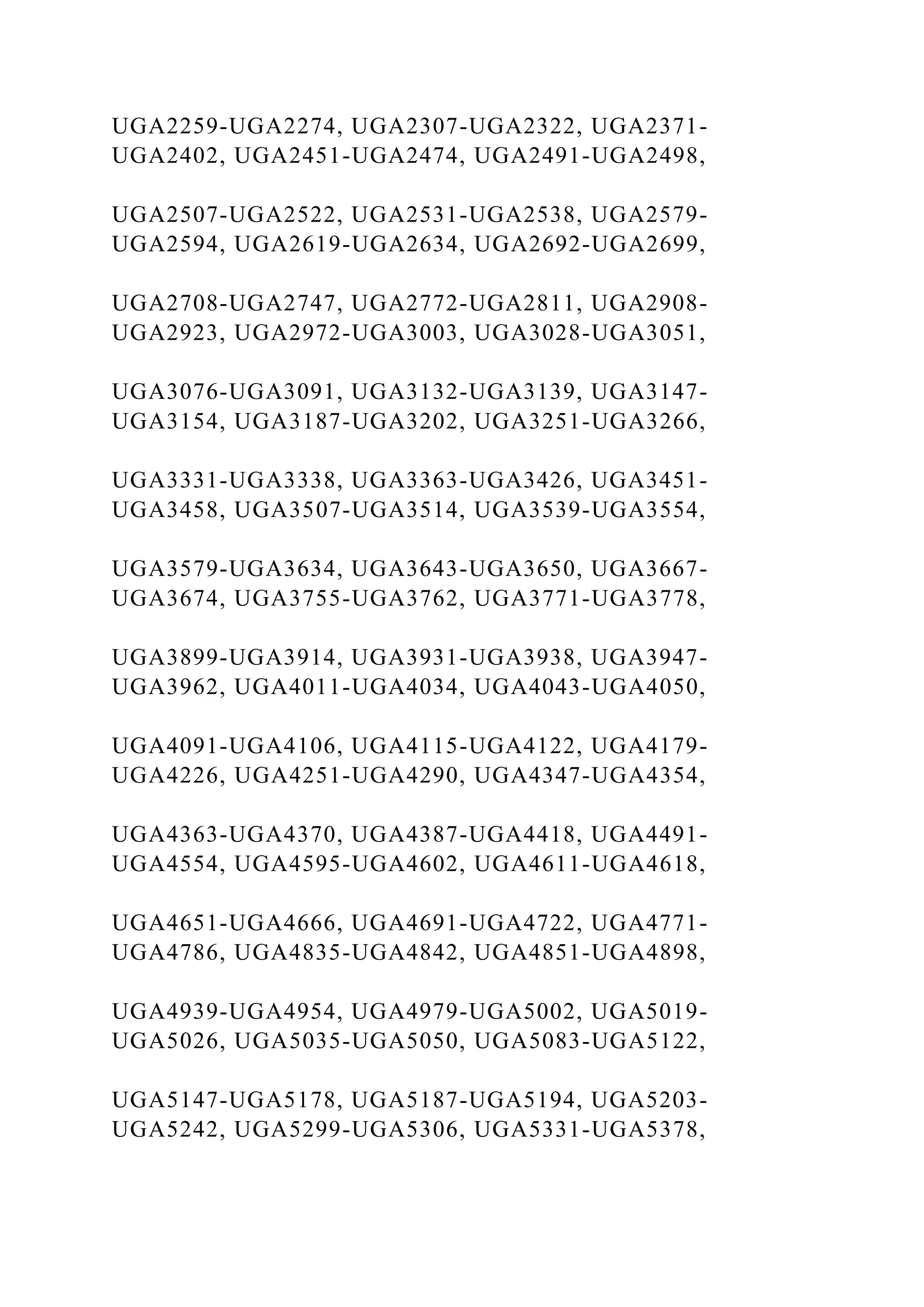
UGA2259-UGA2274, UGA2307-UGA2322, UGA2371-
UGA2402, UGA2451-UGA2474, UGA2491-UGA2498,
UGA2507-UGA2522, UGA2531-UGA2538, UGA2579-
UGA2594, UGA2619-UGA2634, UGA2692-UGA2699,
UGA2708-UGA2747, UGA2772-UGA2811, UGA2908-
UGA2923, UGA2972-UGA3003, UGA3028-UGA3051,
UGA3076-UGA3091, UGA3132-UGA3139, UGA3147-
UGA3154, UGA3187-UGA3202, UGA3251-UGA3266,
UGA3331-UGA3338, UGA3363-UGA3426, UGA3451-
UGA3458, UGA3507-UGA3514, UGA3539-UGA3554,
UGA3579-UGA3634, UGA3643-UGA3650, UGA3667-
UGA3674, UGA3755-UGA3762, UGA3771-UGA3778,
UGA3899-UGA3914, UGA3931-UGA3938, UGA3947-
UGA3962, UGA4011-UGA4034, UGA4043-UGA4050,
UGA4091-UGA4106, UGA4115-UGA4122, UGA4179-
UGA4226, UGA4251-UGA4290, UGA4347-UGA4354,
UGA4363-UGA4370, UGA4387-UGA4418, UGA4491-
UGA4554, UGA4595-UGA4602, UGA4611-UGA4618,
UGA4651-UGA4666, UGA4691-UGA4722, UGA4771-
UGA4786, UGA4835-UGA4842, UGA4851-UGA4898,
UGA4939-UGA4954, UGA4979-UGA5002, UGA5019-
UGA5026, UGA5035-UGA5050, UGA5083-UGA5122,
UGA5147-UGA5178, UGA5187-UGA5194, UGA5203-
UGA5242, UGA5299-UGA5306, UGA5331-UGA5378,
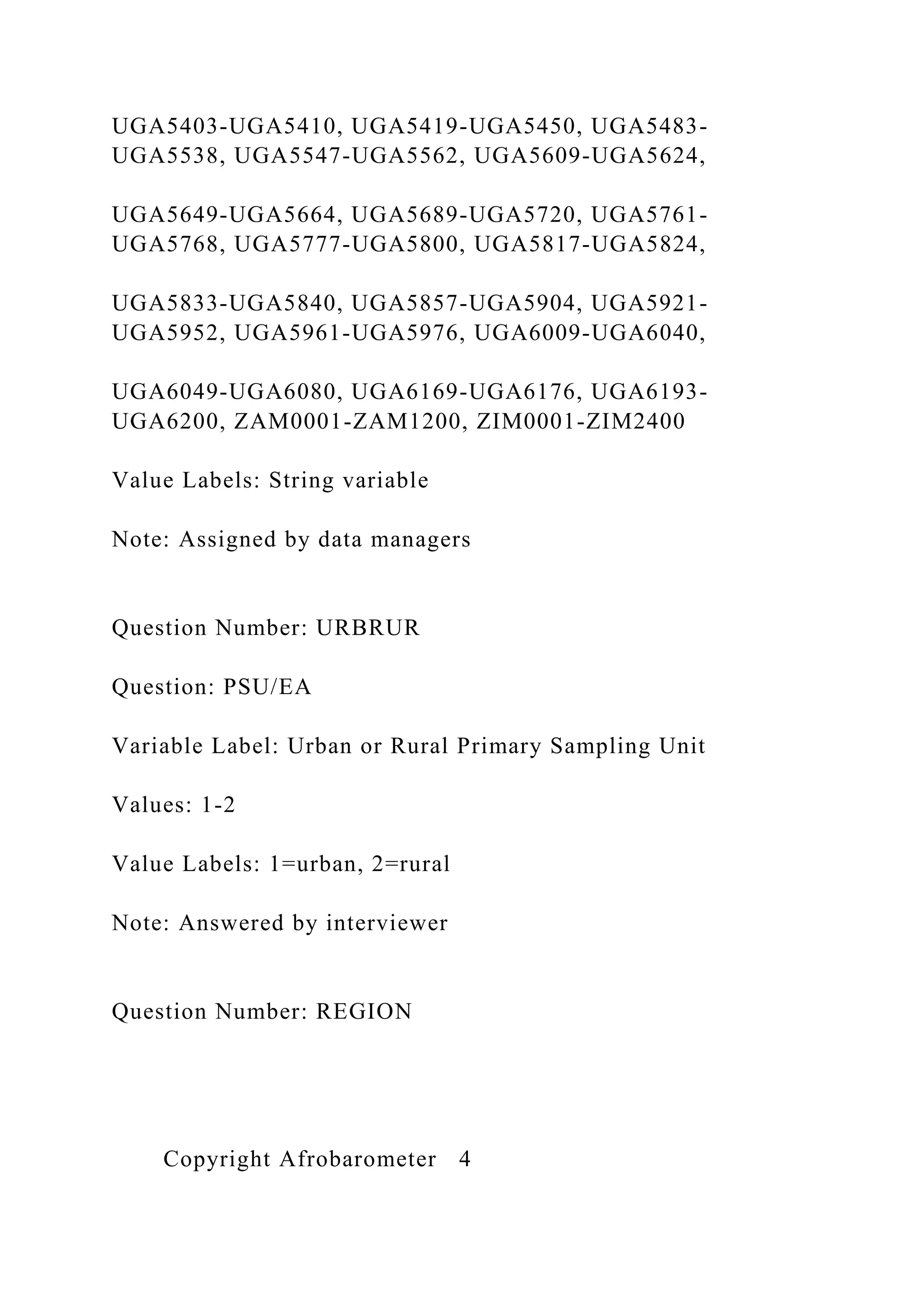
UGA5403-UGA5410, UGA5419-UGA5450, UGA5483-
UGA5538, UGA5547-UGA5562, UGA5609-UGA5624,
UGA5649-UGA5664, UGA5689-UGA5720, UGA5761-
UGA5768, UGA5777-UGA5800, UGA5817-UGA5824,
UGA5833-UGA5840, UGA5857-UGA5904, UGA5921-
UGA5952, UGA5961-UGA5976, UGA6009-UGA6040,
UGA6049-UGA6080, UGA6169-UGA6176, UGA6193-
UGA6200, ZAM0001-ZAM1200, ZIM0001-ZIM2400
Value Labels: String variable
Note: Assigned by data managers
Question Number: URBRUR
Question: PSU/EA
Variable Label: Urban or Rural Primary Sampling Unit
Values: 1-2
Value Labels: 1=urban, 2=rural
Note: Answered by interviewer
Question Number: REGION
Copyright Afrobarometer 4
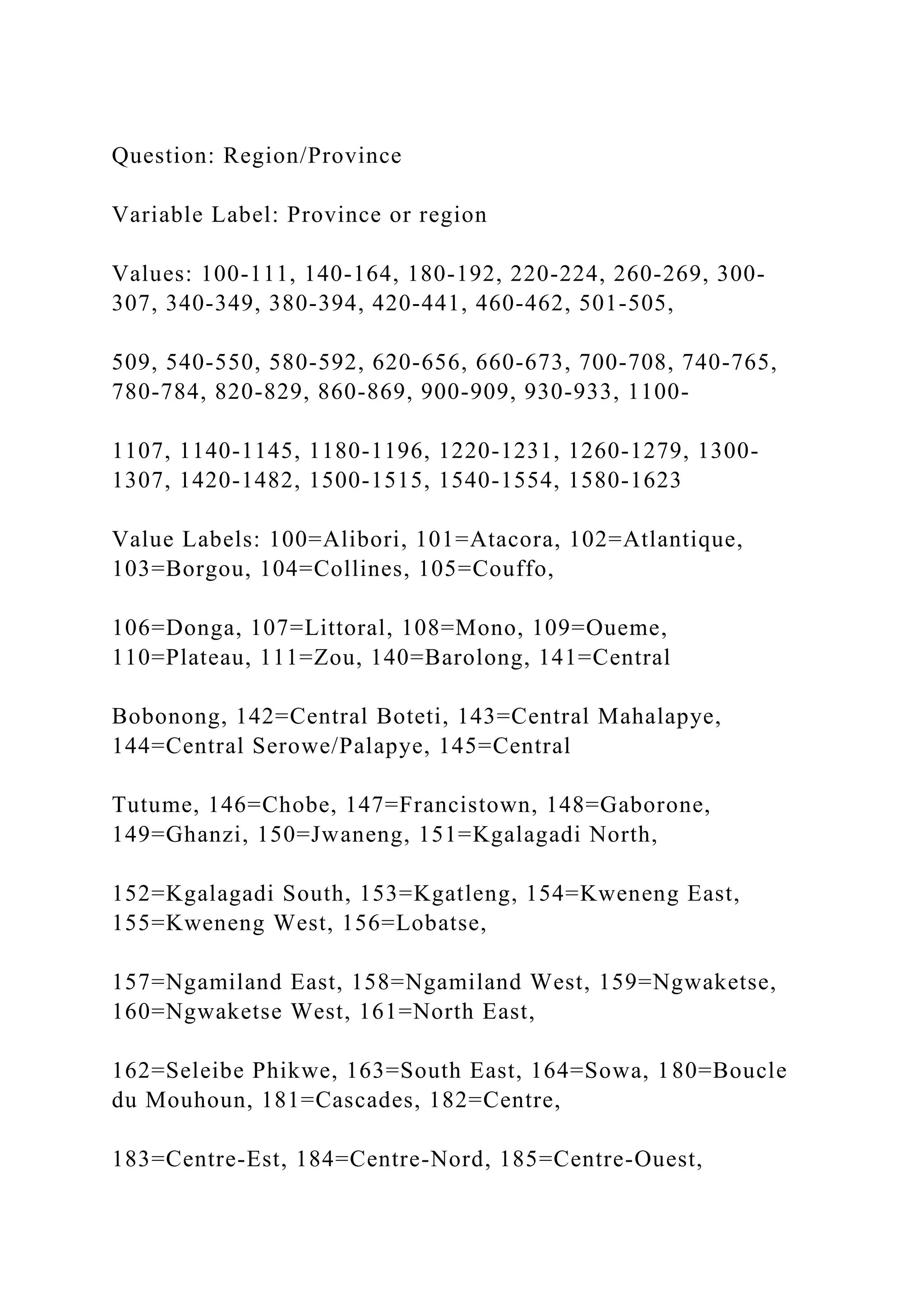
Question: Region/Province
Variable Label: Province or region
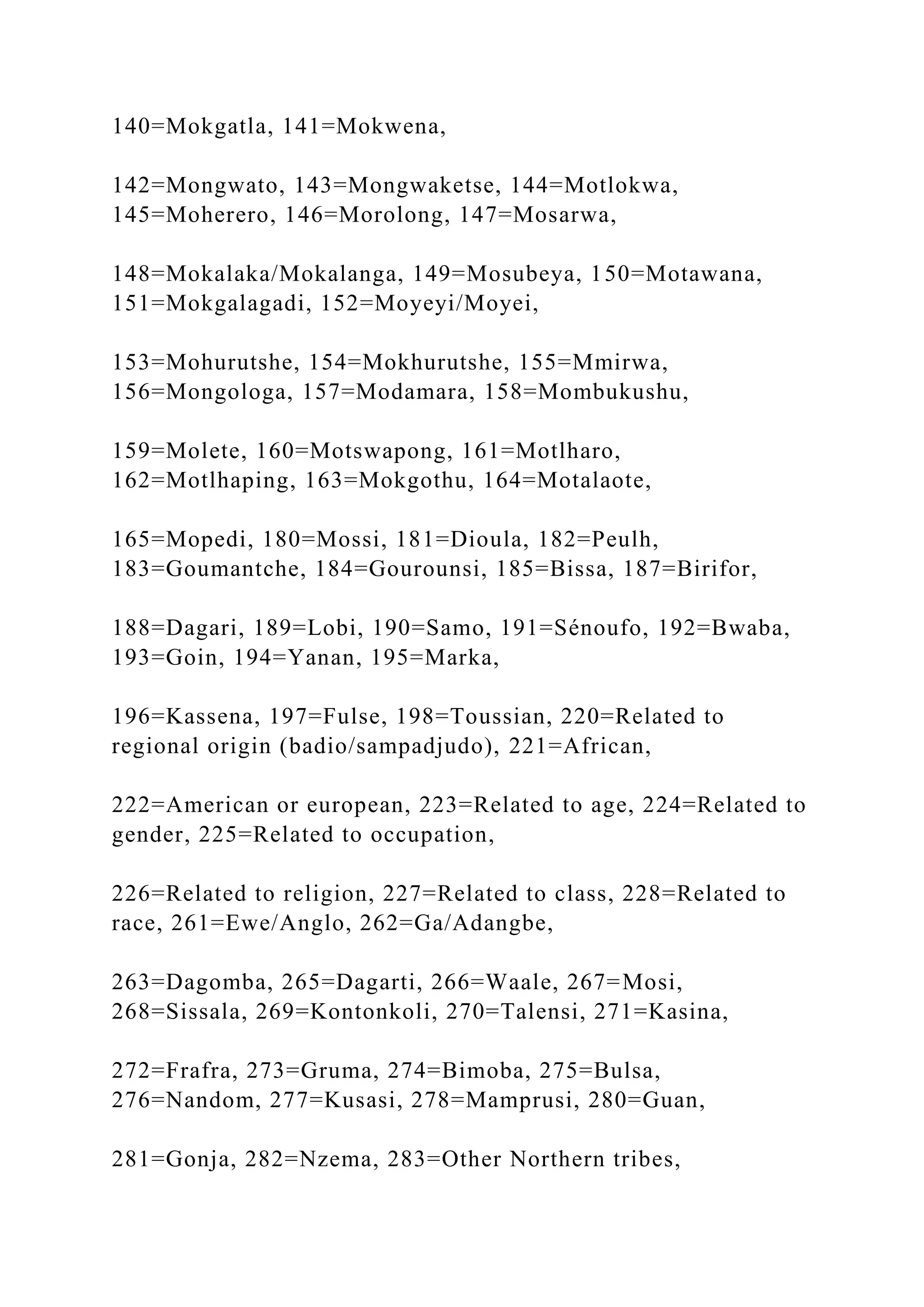
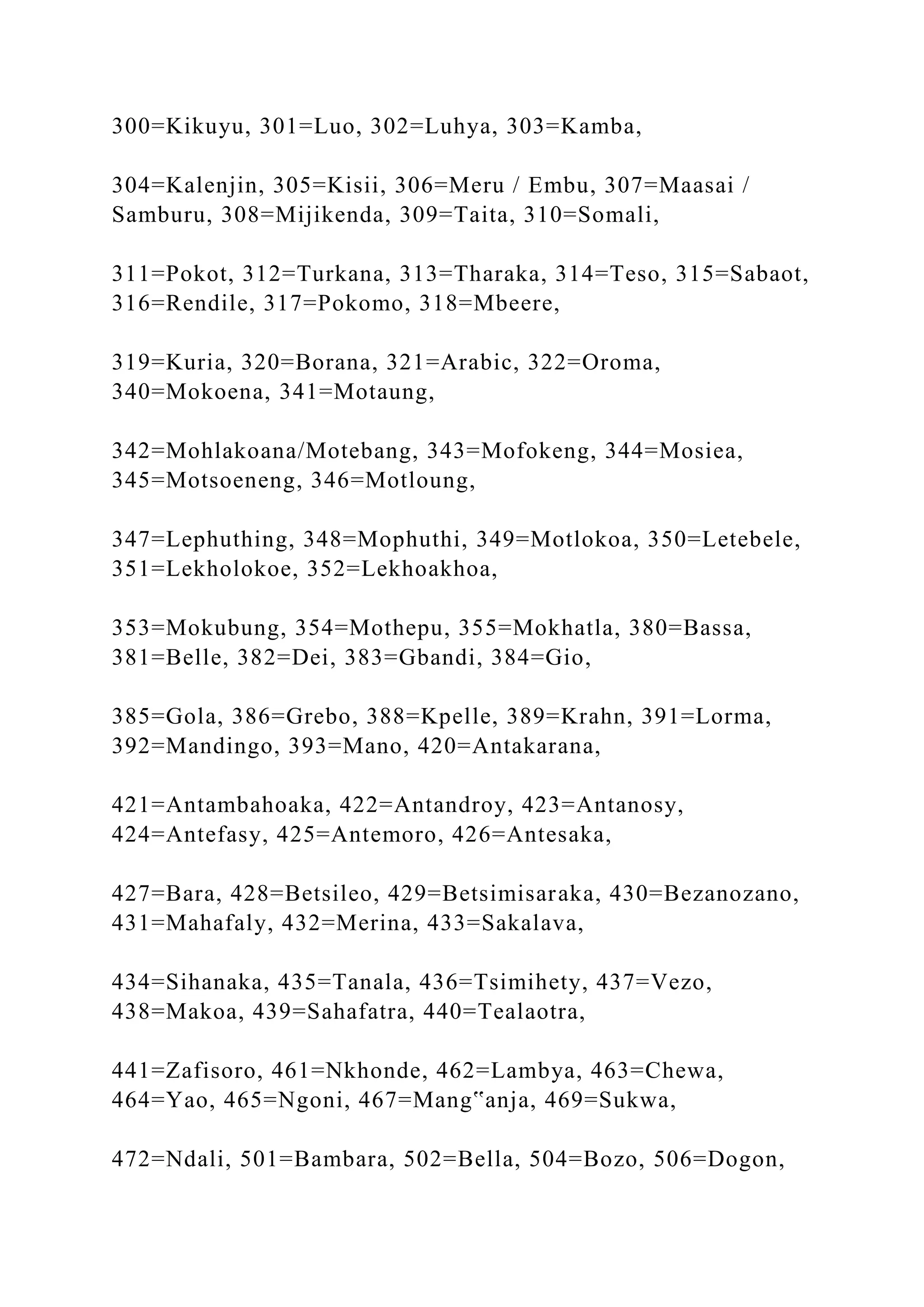
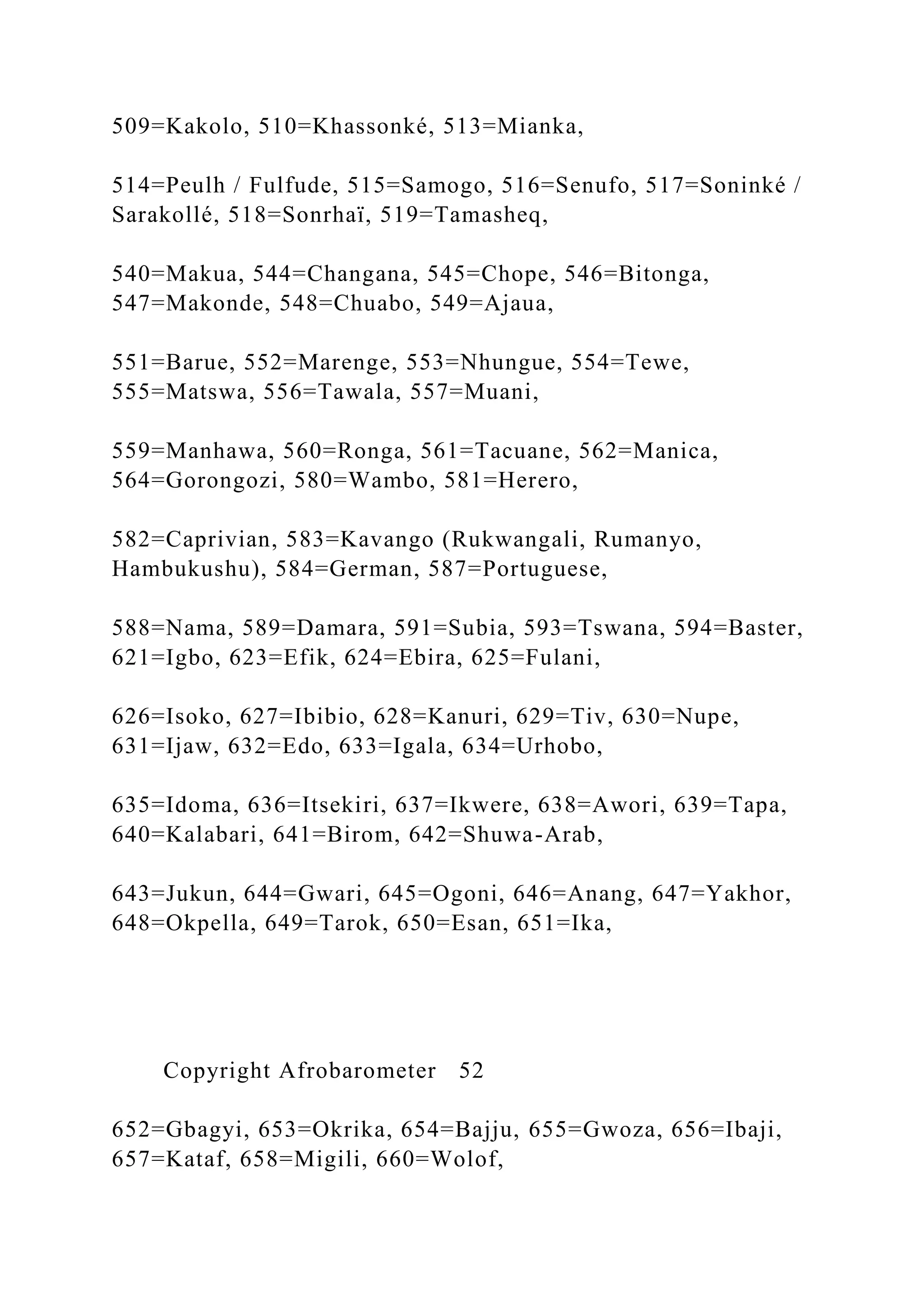
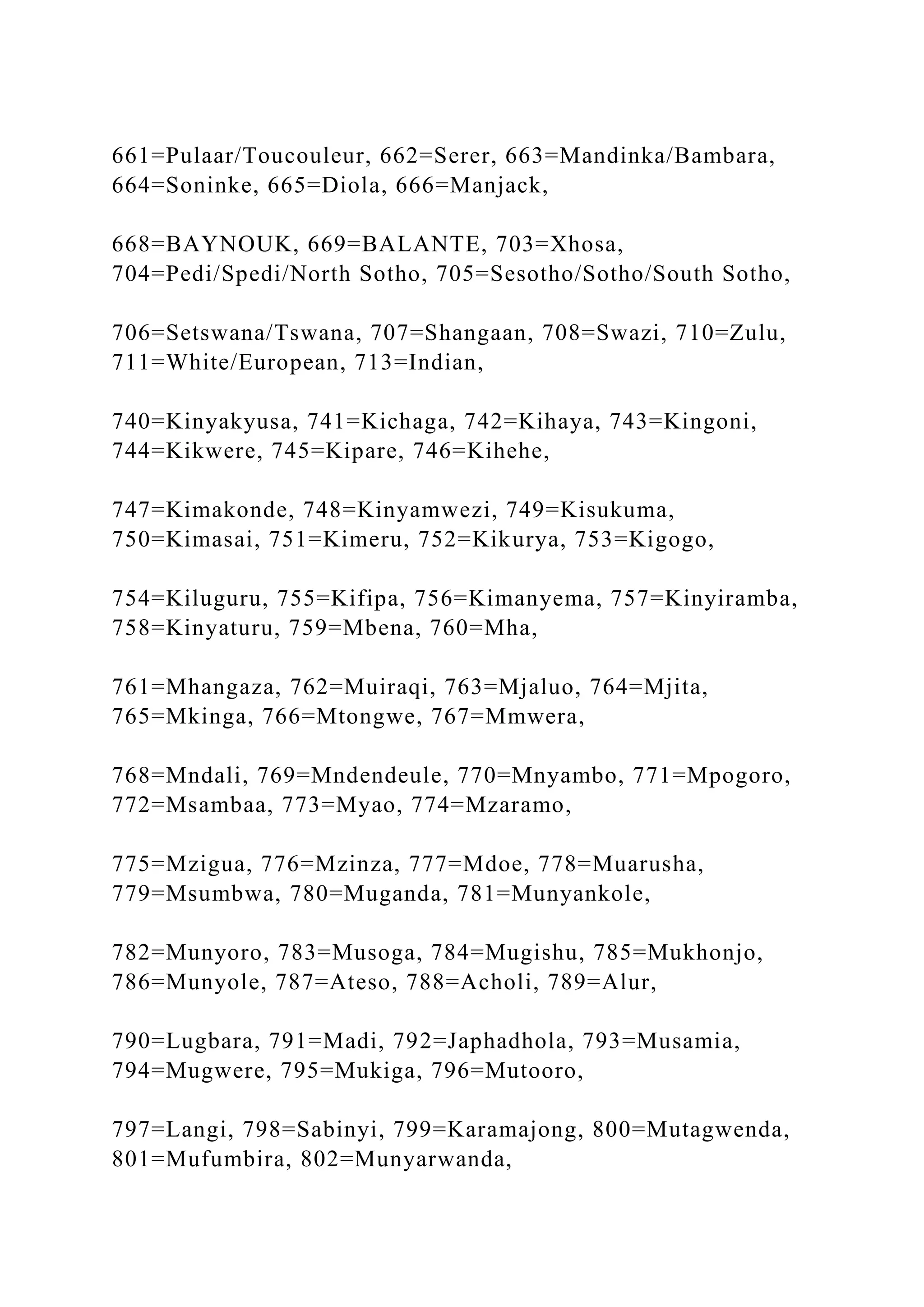
Values: 100-111, 140-164, 180-192, 220-224, 260-269, 300-
307, 340-349, 380-394, 420-441, 460-462, 501-505,
509, 540-550, 580-592, 620-656, 660-673, 700-708, 740-765,
780-784, 820-829, 860-869, 900-909, 930-933, 1100-
1107, 1140-1145, 1180-1196, 1220-1231, 1260-1279, 1300-
1307, 1420-1482, 1500-1515, 1540-1554, 1580-1623
Value Labels: 100=Alibori, 101=Atacora, 102=Atlantique,
103=Borgou, 104=Collines, 105=Couffo,
106=Donga, 107=Littoral, 108=Mono, 109=Oueme,
110=Plateau, 111=Zou, 140=Barolong, 141=Central
Bobonong, 142=Central Boteti, 143=Central Mahalapye,
144=Central Serowe/Palapye, 145=Central
Tutume, 146=Chobe, 147=Francistown, 148=Gaborone,
149=Ghanzi, 150=Jwaneng, 151=Kgalagadi North,
152=Kgalagadi South, 153=Kgatleng, 154=Kweneng East,
155=Kweneng West, 156=Lobatse,
157=Ngamiland East, 158=Ngamiland West, 159=Ngwaketse,
160=Ngwaketse West, 161=North East,
162=Seleibe Phikwe, 163=South East, 164=Sowa, 180=Boucle
du Mouhoun, 181=Cascades, 182=Centre,
183=Centre-Est, 184=Centre-Nord, 185=Centre-Ouest,
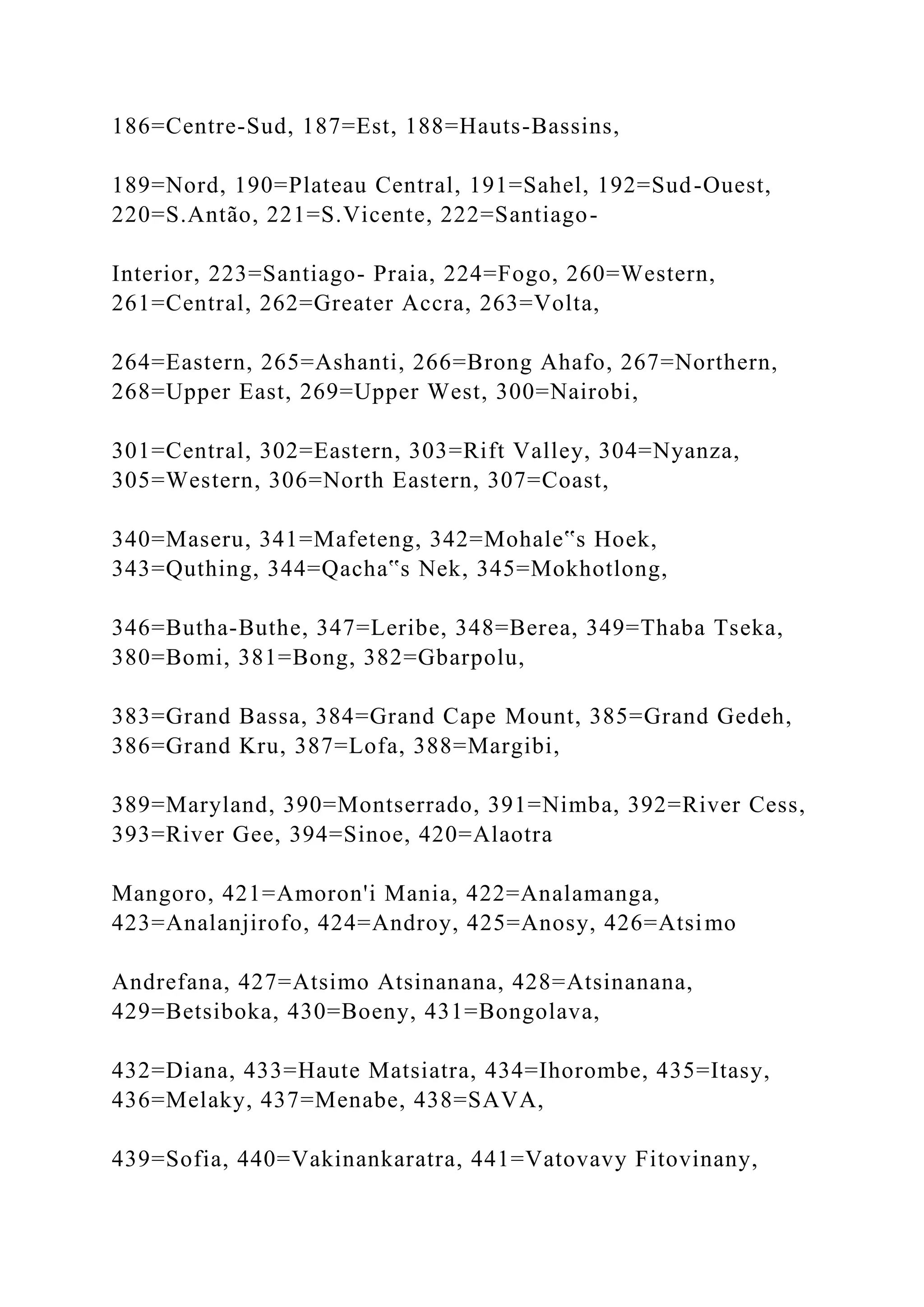
186=Centre-Sud, 187=Est, 188=Hauts-Bassins,
189=Nord, 190=Plateau Central, 191=Sahel, 192=Sud-Ouest,
220=S.Antão, 221=S.Vicente, 222=Santiago-
Interior, 223=Santiago- Praia, 224=Fogo, 260=Western,
261=Central, 262=Greater Accra, 263=Volta,
264=Eastern, 265=Ashanti, 266=Brong Ahafo, 267=Northern,
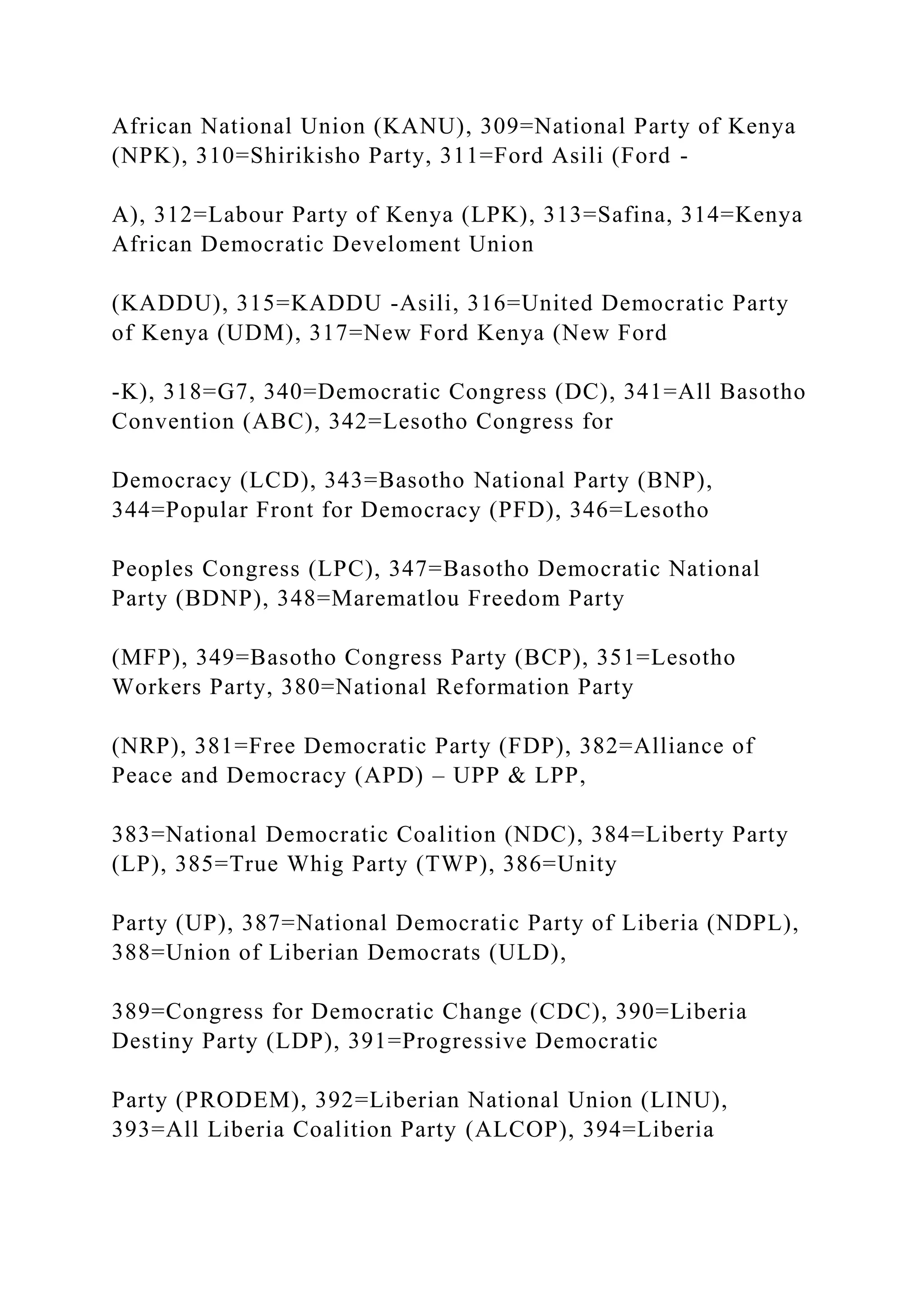
268=Upper East, 269=Upper West, 300=Nairobi,
301=Central, 302=Eastern, 303=Rift Valley, 304=Nyanza,
305=Western, 306=North Eastern, 307=Coast,
340=Maseru, 341=Mafeteng, 342=Mohale‟s Hoek,
343=Quthing, 344=Qacha‟s Nek, 345=Mokhotlong,
346=Butha-Buthe, 347=Leribe, 348=Berea, 349=Thaba Tseka,
380=Bomi, 381=Bong, 382=Gbarpolu,
383=Grand Bassa, 384=Grand Cape Mount, 385=Grand Gedeh,
386=Grand Kru, 387=Lofa, 388=Margibi,
389=Maryland, 390=Montserrado, 391=Nimba, 392=River Cess,
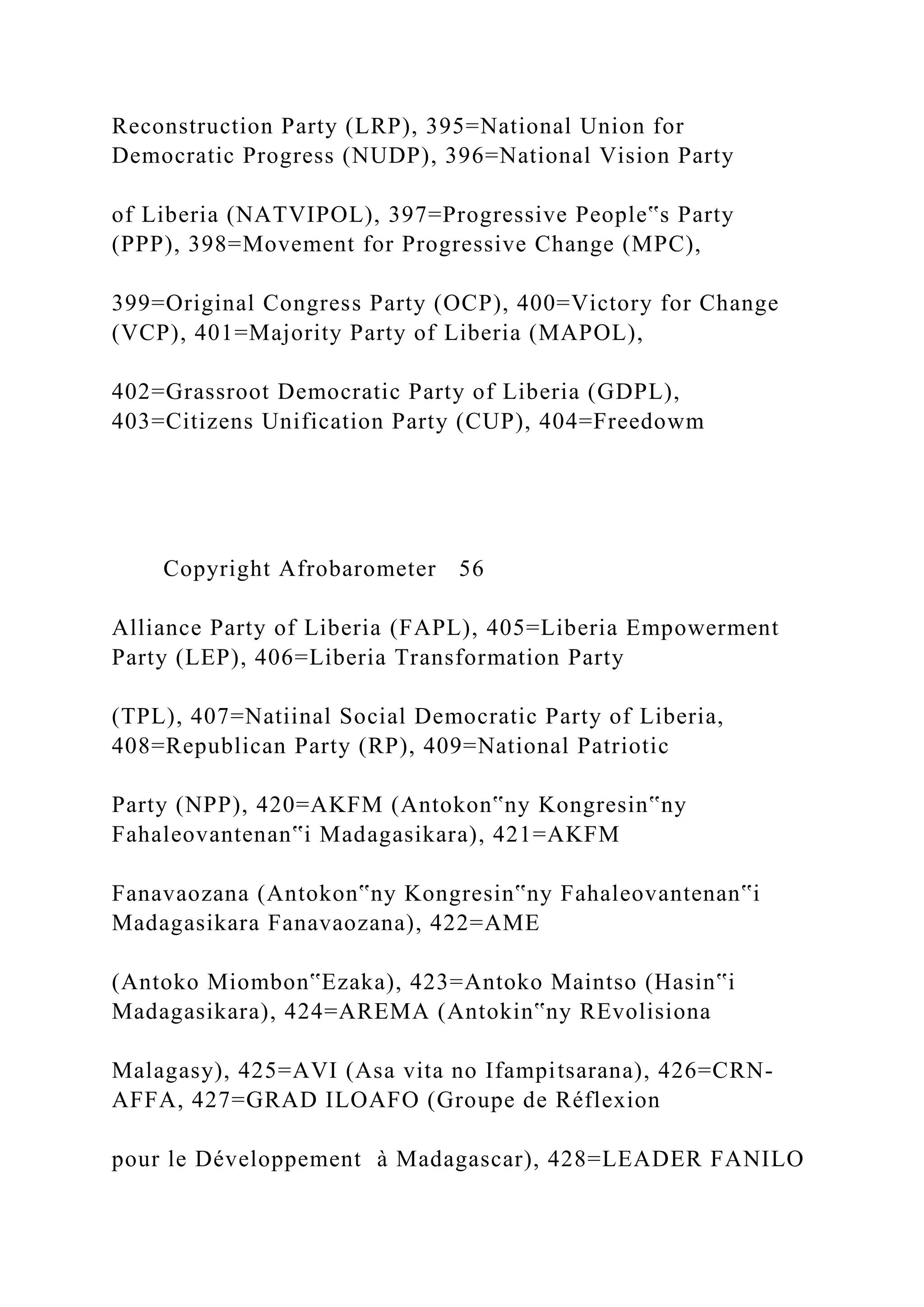
393=River Gee, 394=Sinoe, 420=Alaotra
Mangoro, 421=Amoron'i Mania, 422=Analamanga,
423=Analanjirofo, 424=Androy, 425=Anosy, 426=Atsimo
Andrefana, 427=Atsimo Atsinanana, 428=Atsinanana,
429=Betsiboka, 430=Boeny, 431=Bongolava,
432=Diana, 433=Haute Matsiatra, 434=Ihorombe, 435=Itasy,
436=Melaky, 437=Menabe, 438=SAVA,
439=Sofia, 440=Vakinankaratra, 441=Vatovavy Fitovinany,
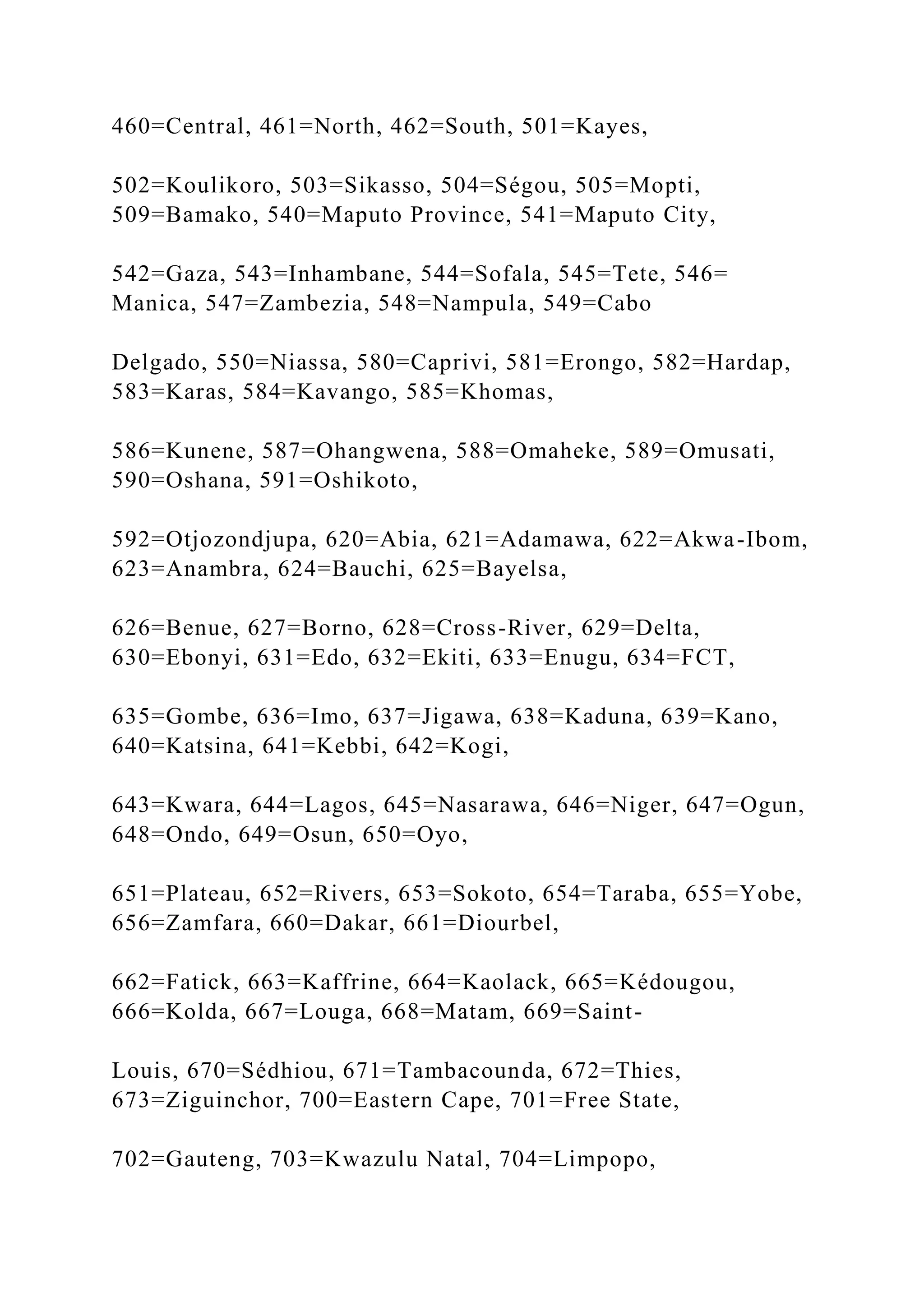
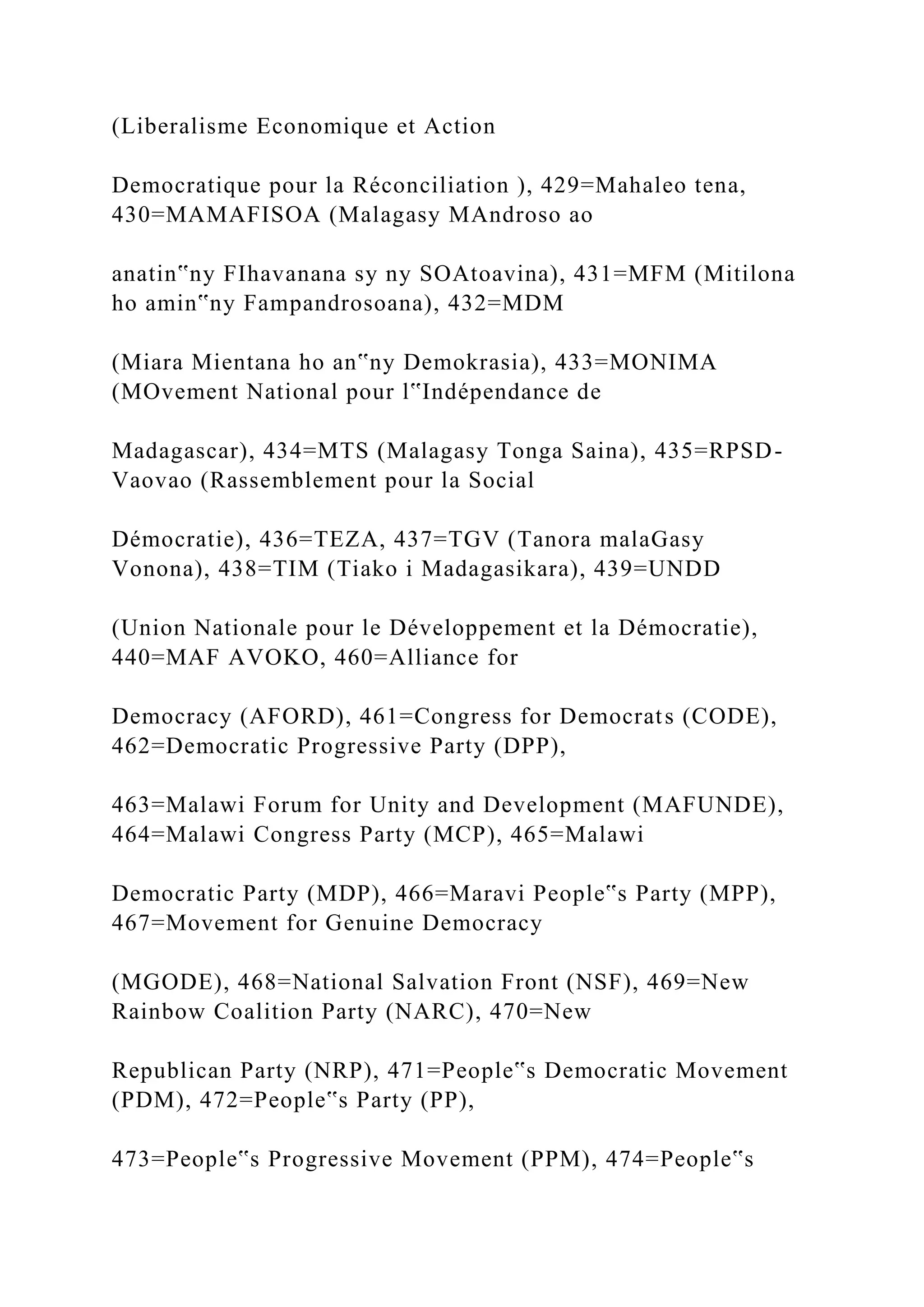
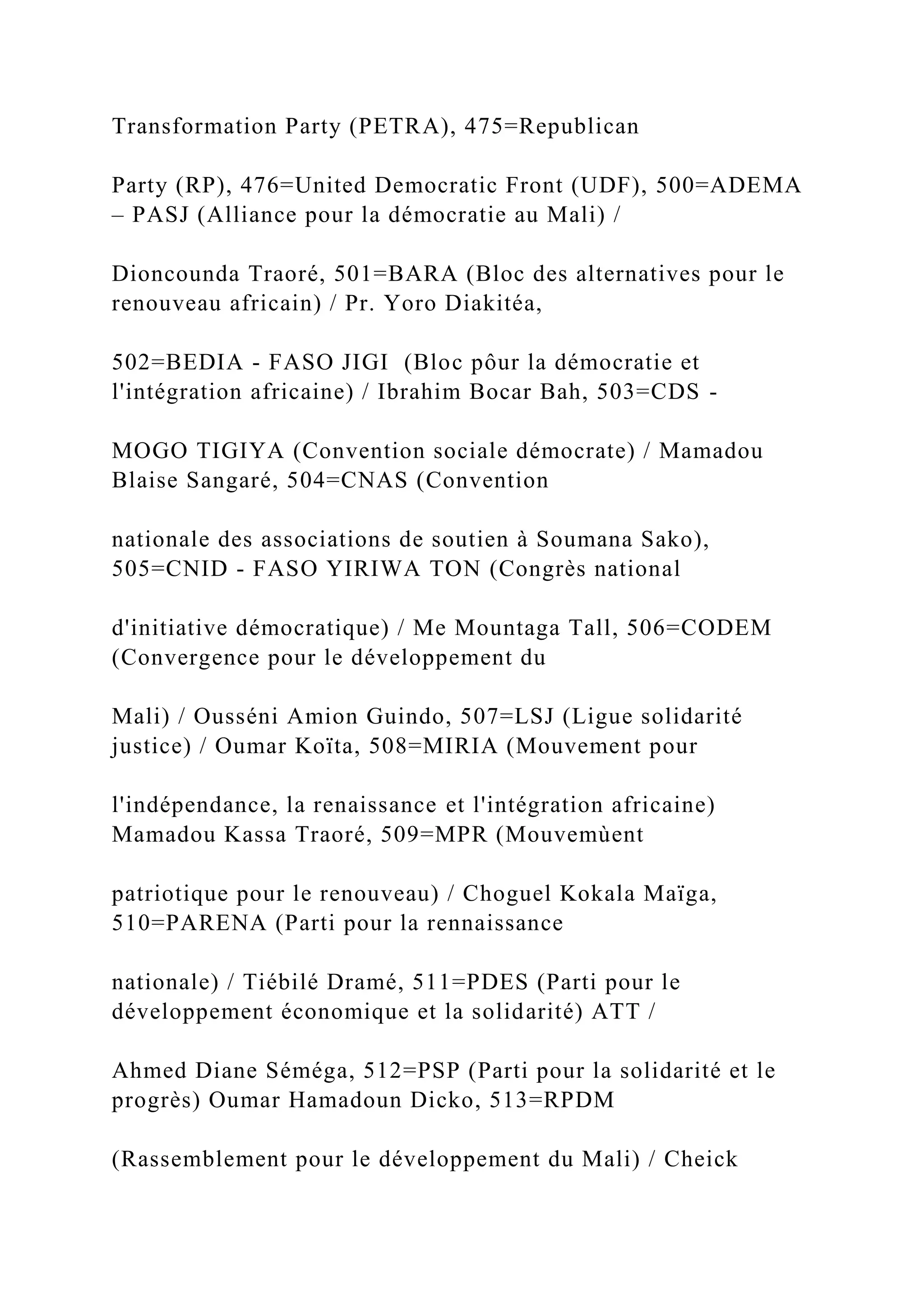
460=Central, 461=North, 462=South, 501=Kayes,
502=Koulikoro, 503=Sikasso, 504=Ségou, 505=Mopti,
509=Bamako, 540=Maputo Province, 541=Maputo City,
542=Gaza, 543=Inhambane, 544=Sofala, 545=Tete, 546=
Manica, 547=Zambezia, 548=Nampula, 549=Cabo
Delgado, 550=Niassa, 580=Caprivi, 581=Erongo, 582=Hardap,
583=Karas, 584=Kavango, 585=Khomas,
586=Kunene, 587=Ohangwena, 588=Omaheke, 589=Omusati,
590=Oshana, 591=Oshikoto,
592=Otjozondjupa, 620=Abia, 621=Adamawa, 622=Akwa-Ibom,
623=Anambra, 624=Bauchi, 625=Bayelsa,
626=Benue, 627=Borno, 628=Cross-River, 629=Delta,
630=Ebonyi, 631=Edo, 632=Ekiti, 633=Enugu, 634=FCT,
635=Gombe, 636=Imo, 637=Jigawa, 638=Kaduna, 639=Kano,
640=Katsina, 641=Kebbi, 642=Kogi,
643=Kwara, 644=Lagos, 645=Nasarawa, 646=Niger, 647=Ogun,
648=Ondo, 649=Osun, 650=Oyo,
651=Plateau, 652=Rivers, 653=Sokoto, 654=Taraba, 655=Yobe,
656=Zamfara, 660=Dakar, 661=Diourbel,
662=Fatick, 663=Kaffrine, 664=Kaolack, 665=Kédougou,
666=Kolda, 667=Louga, 668=Matam, 669=Saint-
Louis, 670=Sédhiou, 671=Tambacounda, 672=Thies,
673=Ziguinchor, 700=Eastern Cape, 701=Free State,
702=Gauteng, 703=Kwazulu Natal, 704=Limpopo,
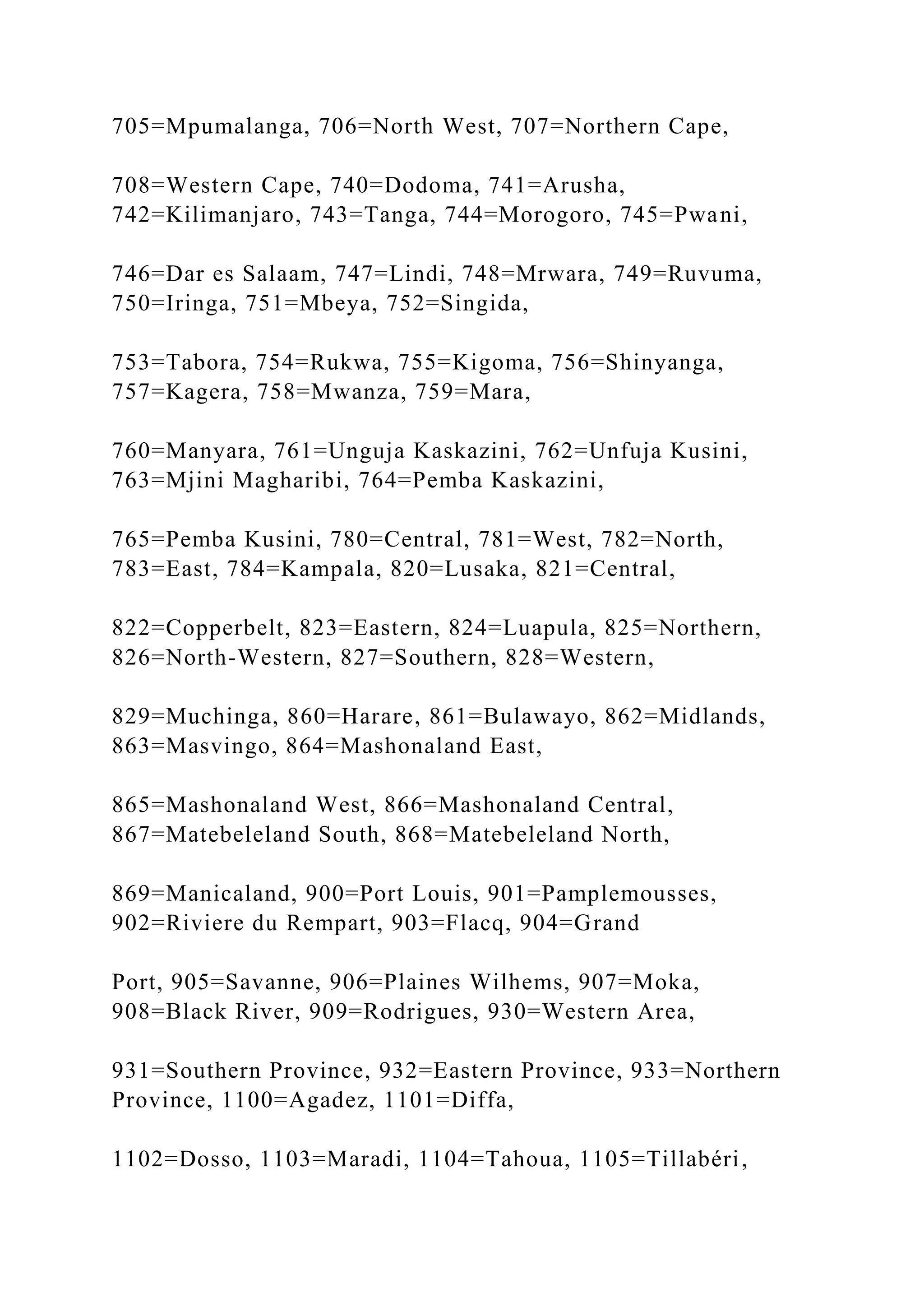
705=Mpumalanga, 706=North West, 707=Northern Cape,
708=Western Cape, 740=Dodoma, 741=Arusha,
742=Kilimanjaro, 743=Tanga, 744=Morogoro, 745=Pwani,
746=Dar es Salaam, 747=Lindi, 748=Mrwara, 749=Ruvuma,
750=Iringa, 751=Mbeya, 752=Singida,
753=Tabora, 754=Rukwa, 755=Kigoma, 756=Shinyanga,
757=Kagera, 758=Mwanza, 759=Mara,
760=Manyara, 761=Unguja Kaskazini, 762=Unfuja Kusini,
763=Mjini Magharibi, 764=Pemba Kaskazini,
765=Pemba Kusini, 780=Central, 781=West, 782=North,
783=East, 784=Kampala, 820=Lusaka, 821=Central,
822=Copperbelt, 823=Eastern, 824=Luapula, 825=Northern,
826=North-Western, 827=Southern, 828=Western,
829=Muchinga, 860=Harare, 861=Bulawayo, 862=Midlands,
863=Masvingo, 864=Mashonaland East,
865=Mashonaland West, 866=Mashonaland Central,
867=Matebeleland South, 868=Matebeleland North,
869=Manicaland, 900=Port Louis, 901=Pamplemousses,
902=Riviere du Rempart, 903=Flacq, 904=Grand
Port, 905=Savanne, 906=Plaines Wilhems, 907=Moka,
908=Black River, 909=Rodrigues, 930=Western Area,
931=Southern Province, 932=Eastern Province, 933=Northern
Province, 1100=Agadez, 1101=Diffa,
1102=Dosso, 1103=Maradi, 1104=Tahoua, 1105=Tillabéri,
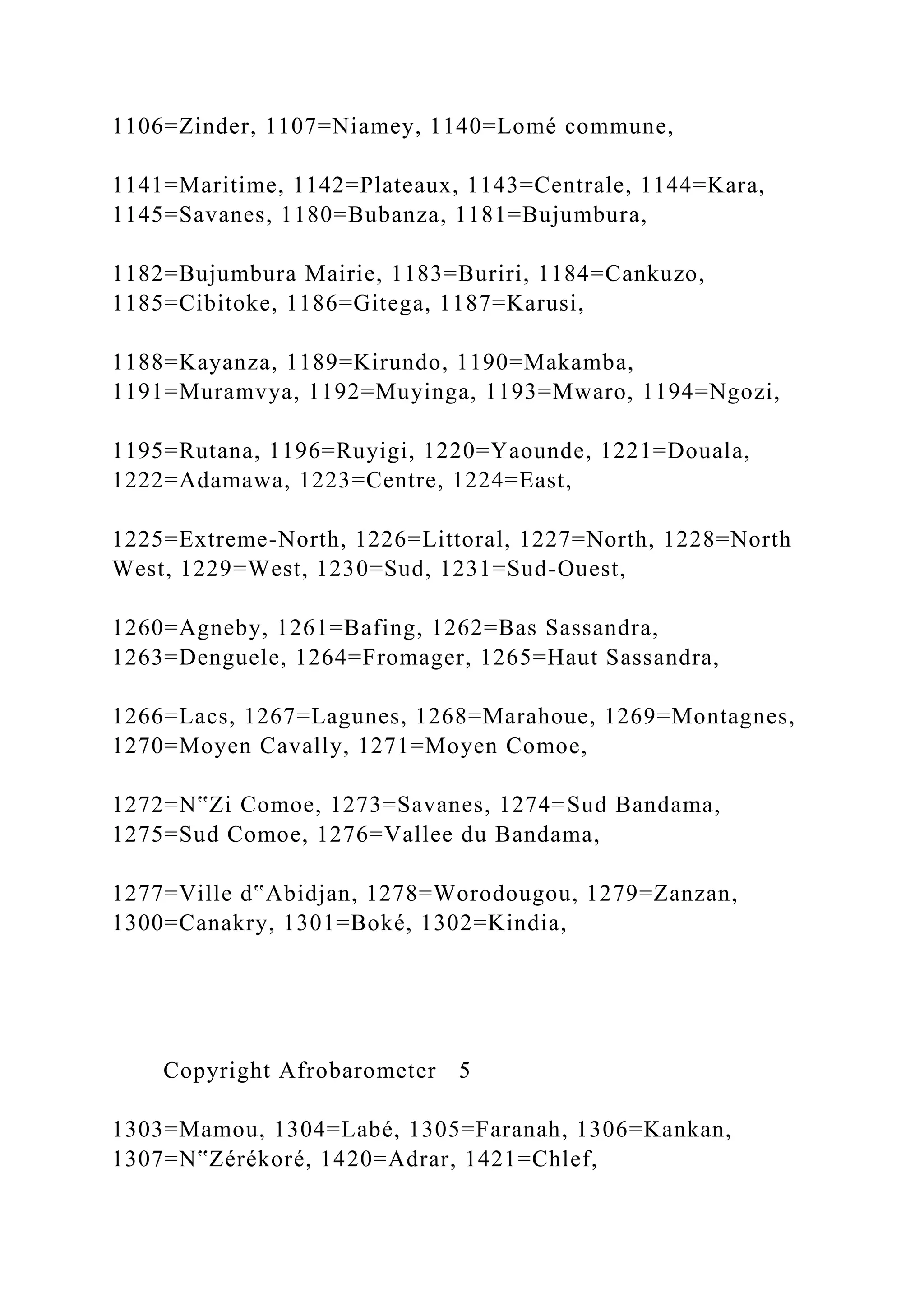
1106=Zinder, 1107=Niamey, 1140=Lomé commune,
1141=Maritime, 1142=Plateaux, 1143=Centrale, 1144=Kara,
1145=Savanes, 1180=Bubanza, 1181=Bujumbura,
1182=Bujumbura Mairie, 1183=Buriri, 1184=Cankuzo,
1185=Cibitoke, 1186=Gitega, 1187=Karusi,
1188=Kayanza, 1189=Kirundo, 1190=Makamba,
1191=Muramvya, 1192=Muyinga, 1193=Mwaro, 1194=Ngozi,
1195=Rutana, 1196=Ruyigi, 1220=Yaounde, 1221=Douala,
1222=Adamawa, 1223=Centre, 1224=East,
1225=Extreme-North, 1226=Littoral, 1227=North, 1228=North
West, 1229=West, 1230=Sud, 1231=Sud-Ouest,
1260=Agneby, 1261=Bafing, 1262=Bas Sassandra,
1263=Denguele, 1264=Fromager, 1265=Haut Sassandra,
1266=Lacs, 1267=Lagunes, 1268=Marahoue, 1269=Montagnes,
1270=Moyen Cavally, 1271=Moyen Comoe,
1272=N‟Zi Comoe, 1273=Savanes, 1274=Sud Bandama,
1275=Sud Comoe, 1276=Vallee du Bandama,
1277=Ville d‟Abidjan, 1278=Worodougou, 1279=Zanzan,
1300=Canakry, 1301=Boké, 1302=Kindia,
Copyright Afrobarometer 5
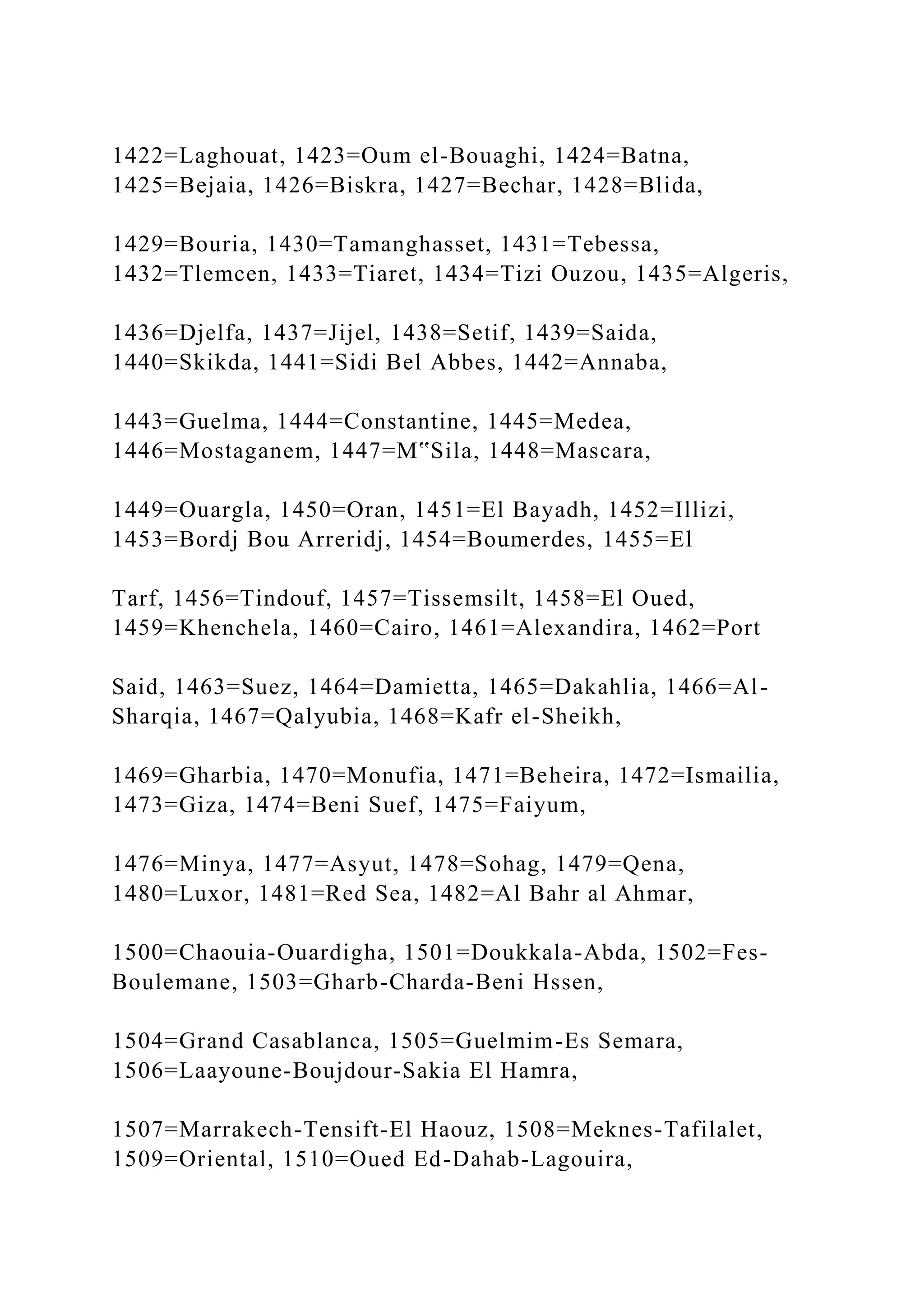
1303=Mamou, 1304=Labé, 1305=Faranah, 1306=Kankan,
1307=N‟Zérékoré, 1420=Adrar, 1421=Chlef,
1422=Laghouat, 1423=Oum el-Bouaghi, 1424=Batna,
1425=Bejaia, 1426=Biskra, 1427=Bechar, 1428=Blida,
1429=Bouria, 1430=Tamanghasset, 1431=Tebessa,
1432=Tlemcen, 1433=Tiaret, 1434=Tizi Ouzou, 1435=Algeris,
1436=Djelfa, 1437=Jijel, 1438=Setif, 1439=Saida,
1440=Skikda, 1441=Sidi Bel Abbes, 1442=Annaba,
1443=Guelma, 1444=Constantine, 1445=Medea,
1446=Mostaganem, 1447=M‟Sila, 1448=Mascara,
1449=Ouargla, 1450=Oran, 1451=El Bayadh, 1452=Illizi,
1453=Bordj Bou Arreridj, 1454=Boumerdes, 1455=El
Tarf, 1456=Tindouf, 1457=Tissemsilt, 1458=El Oued,
1459=Khenchela, 1460=Cairo, 1461=Alexandira, 1462=Port
Said, 1463=Suez, 1464=Damietta, 1465=Dakahlia, 1466=Al-
Sharqia, 1467=Qalyubia, 1468=Kafr el-Sheikh,
1469=Gharbia, 1470=Monufia, 1471=Beheira, 1472=Ismailia,
1473=Giza, 1474=Beni Suef, 1475=Faiyum,
1476=Minya, 1477=Asyut, 1478=Sohag, 1479=Qena,
1480=Luxor, 1481=Red Sea, 1482=Al Bahr al Ahmar,
1500=Chaouia-Ouardigha, 1501=Doukkala-Abda, 1502=Fes-
Boulemane, 1503=Gharb-Charda-Beni Hssen,
1504=Grand Casablanca, 1505=Guelmim-Es Semara,
1506=Laayoune-Boujdour-Sakia El Hamra,
1507=Marrakech-Tensift-El Haouz, 1508=Meknes-Tafilalet,
1509=Oriental, 1510=Oued Ed-Dahab-Lagouira,
1511=Rabat-Sale-Zemmour-Zaer, 1512=Souss-Massa-Draa,
1513=Tadla-Azilal, 1514=Tangier-Tetouan,
1515=Taza-Al Hoceima-Taounate, 1540=North, 1541=Nahr
ALnil, 1542=Red Sea, 1543=Kassala,
1544=Gadarif, 1545=Khartom, 1546=Gezira, 1547=White Nile,
1548=Sennar, 1549=Blue Nile, 1550=South
Kordufan, 1551=North Kordufan, 1552=North Darfur,
1553=West Darfur, 1554=South Darfur, 1580=Tunis,
1581=Ariana, 1582=Ben Arous, 1583=Manouba, 1584=Nabeul,
1585=Zaghouan, 1586=Bizerte, 1587=Beja,
1588=Jendouba, 1589=Le Kef, 1590=Siliana, 1591=Sousse,
1592=Monastir, 1593=Mahdia, 1594=Sfax,
1595=Kairouan, 1596=Kasserine, 1597=Sidi Bouzid,
1598=Gabes, 1599=Mednine, 1600=Tataouine,
1601=Gafsa, 1602=Tozeur, 1603=Kebili, 1620=Hhohho,
1621=Manzini, 1622=Shiselweni, 1623=Lubombo
Note: Answered by interviewer
Question Number: EA_SVC_A
Question: Are the following services present in the primary
sampling unit/enumeration area: Electricity grid
that most houses could access?
Variable Label: Electricity grid in the PSU/EA
Values: 0, 1, 9, -1
Value Labels: 0=No, 1=Yes, 9=Can‟t determine, -1=Missing
Source: SAB
Note: Question was filled in conjunction with field supervisor
Question Number: EA_SVC_B
Question: Are the following services present in the primary
sampling unit/enumeration area: Piped water
system that most houses could access?
Variable Label: Piped water system in the PSU/EA
Values: 0, 1, 9, -1
Value Labels: 0=No, 1=Yes, 9=Can‟t determine, -1=Missing
Source: SAB
Note: Question was filled in conjunction with field supervisor
Question Number: EA_SVC_C
Question: Are the following services present in the primary
sampling unit/enumeration area: Sewage system
that most houses could access?
Variable Label: Sewage system in the PSU/EA
Values: 0, 1, 9, -1
Value Labels: 0=No, 1=Yes, 9=Can‟t determine, -1=Missing
Source: SAB
Note: Question was filled in conjunction with field supervisor
Question Number: EA_SVC_D
Question: Are the following services present in the primary
sampling unit/enumeration area: Cell phone
service?
Variable Label: Cell phone service in the PSU/EA
Values: 0, 1, 9, -1
Value Labels: 0=No, 1=Yes, 9=Can‟t determine, -1=Missing
Source: SAB
Note: Question was filled in conjunction with field supervisor
Copyright Afrobarometer 6
Question Number: EA_FAC_A
Question: Are the following facilities present in the primary
sampling unit/enumeration area, or within easy
walking distance: Post-office?
Variable Label: Post-office in the PSU/EA
Values: 0, 1, 9, -1
Value Labels: 0=No, 1=Yes, 9=Can‟t determine, -1=Missing
Source: SAB
Note: Question was filled in conjunction with field supervisor
Question Number: EA_FAC_B
Question: Are the following facilities present in the primary
sampling unit/enumeration area, or within easy
walking distance: School?
Variable Label: School in the PSU/EA
Values: 0, 1, 9, -1
Value Labels: 0=No, 1=Yes, 9=Can‟t determine, -1=Missing
Source: SAB
Note: Question was filled in conjunction with field supervisor
Question Number: EA_FAC_C
Question: Are the following facilities present in the primary
sampling unit/enumeration area, or within easy
walking distance: Police station?
Variable Label: Police station in the PSU/EA
Values: 0, 1, 9, -1
Value Labels: 0=No, 1=Yes, 9=Can‟t determine, -1=Missing
Source: SAB
Note: Question was filled in conjunction with field supervisor
Question Number: EA_FAC_D
Question: Are the following facilities present in the primary
sampling unit/enumeration area, or within easy
walking distance: Health clinic?
Variable Label: Health clinic in the PSU/EA
Values: 0, 1, 9, -1
Value Labels: 0=No, 1=Yes, 9=Can‟t determine, -1 Missing
Source: SAB
Note: Question was filled in conjunction with field supervisor
Question Number: EA_FAC_E
Question: Are the following facilities present in the primary
sampling unit/enumeration area, or within easy
walking distance: Market stalls (selling groceries and/or
clothing)?
Variable Label: Market stalls in the PSU/EA
Values: 0, 1, 9, -1
Value Labels: 0=No, 1=Yes, 9=Can‟t determine, -1 Missing
Source: SAB
Note: Question was filled in conjunction with field supervisor
Question Number: EA_SEC_A
Question: In the PSU/EA, did you (or any of your colleagues)
see: Any policemen or police vehicles?
Variable Label: Police in the PSU/EA
Values: 0, 1, 9, -1
Value Labels: 0=No, 1=Yes, 9=Don‟t know, -1 Missing
Source: SAB
Note: Question was filled in conjunction with field supervisor
Question Number: EA_SEC_B
Question: In the PSU/EA, did you (or any of your colleagues)
see: Any soldiers or army vehicles?
Variable Label: Soldiers/army in the PSU/EA
Values: 0, 1, 9, -1
Copyright Afrobarometer 7
Value Labels: 0=No, 1=Yes, 9=Don‟t know, -1 Missing
Source: SAB
Note: Question was filled in conjunction with field supervisor
Question Number: EA_SEC_C
Question: In the PSU/EA, did you (or any of your colleagues)
see: Any roadblocks set up by police or army?
Variable Label: Roadblocks by police/army in the PSU/EA
Values: 0, 1, 9, -1
Value Labels: 0=No, 1=Yes, 9=Don‟t know, -1 Missing
Source: SAB
Note: Question was filled in conjunction with field supervisor
Question Number: EA_SEC_D
Question: In the PSU/EA, did you (or any of your colleagues)
see: Any roadblocks or booms set up by
private security providers?
Variable Label: Roadblocks by private security in the PSU/EA
Values: 0, 1, 9, -1
Value Labels: 0=No, 1=Yes, 9=Don‟t know, -1 Missing
Source: SAB
Note: Question was filled in conjunction with field supervisor
Question Number: EA_SEC_E
Question: In the PSU/EA, did you (or any of your colleagues)
see: Any roadblocks or booms set up by the
local community?
Variable Label: Roadblocks by local community in the PSU/EA
Values: 0, 1, 9, -1
Value Labels: 0=No, 1=Yes, 9=Don‟t know, -1 Missing
Source: SAB
Note: Question was filled in conjunction with field supervisor
Question Number: EA_ROAD
Question: Thinking of your journey here: Was the road at the
start point in the PSU/EA paved/ tarred/
concrete?
Variable Label: Tarred/paved road
Values: 0, 1
Value Labels: 0=No, 1=Yes
Source: SAB
Note: Question was filled in conjunction with field supervisor
Question Number: NOCALL_1
Question: Reasons for unsuccessful calls: Household 1
Variable Label: Reason for Unsuccessful Call Household 1
Values: 1-8, 997, -1
Value Labels: 1=Refused to be interviewed, 2=Person selected
was never at home after at least two visits,
3=Household/Premises empty for the survey period after at least
two visits, 4=Not a citizen/Spoke only a
foreign language, 5=Deaf/Did not speak a survey language,
6=Did not fit gender quota, 7=No adults in
household, 8=Other (specify), 997=Not applicable, -1=Missing
Source: Southern Africa Barometer (SAB)
Note: Answered by interviewer, after instructions, “It is your
job is to select a random (this means any)
household. A household is a group of people who presently eat
together from the same spot. Start your
walk pattern from the start point that has been randomly chosen
by your Field Supervisor. Team members
must walk in opposite directions to each other. If A walks
towards the sun, B must walk away from the sun;
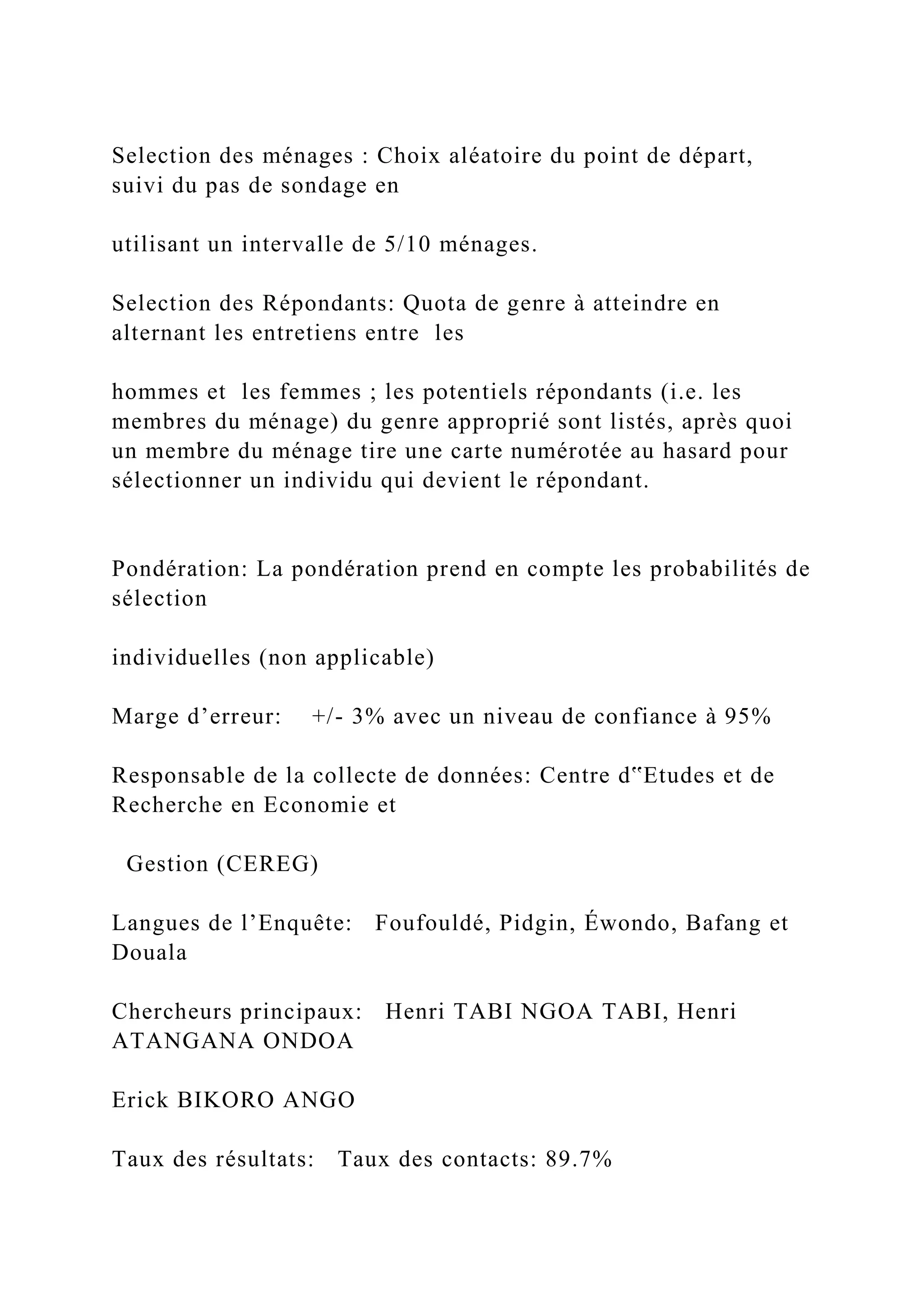
C and D must walk at right angles to A and B. Use a 5 / 10
interval pattern to select a household. That is,
walking in your designated direction away from the start point,
select the 5th household for the first
interview, counting houses on both the right and the left (and
starting with those on the right if they are
opposite each other). Once you leave your first interview,
continue on in the same direction, this time
selecting the 10th household, again counting houses on both the
right and the left. If the settlement comes
Copyright Afrobarometer 8
to an end and there are no more houses, turn at right angles to
the right and keep walking, continuing to
count until finding the tenth dwelling.”
Question Number: NOCALL_2
Question: Reasons for unsuccessful calls: Household 2
Variable Label: Reason for Unsuccessful Call Household 2
Values: 1-8, 997, -1
Value Labels: 1=Refused to be interviewed, 2=Person selected
was never at home after at least two visits,
3=Household/Premises empty for the survey period after at least
two visits, 4=Not a citizen/Spoke only a
foreign language, 5=Deaf/Did not speak a survey language,
6=Did not fit gender quota, 7=No adults in
household, 8=Other (specify), 997=Not applicable, -1=Missing
Source: SAB
Note: Answered by interviewer
Question Number: NOCALL_3
Question: Reasons for unsuccessful calls: Household 3
Variable Label: Reason for Unsuccessful Call Household 3
Values: 1-8, 997, -1
Value Labels: 1=Refused to be interviewed, 2=Person selected
was never at home after at least two visits,
3=Household/Premises empty for the survey period after at least
two visits, 4=Not a citizen/Spoke only a
foreign language, 5=Deaf/Did not speak a survey language,
6=Did not fit gender quota, 7=No adults in
household, 8=Other (specify), 997=Not applicable, -1=Missing
Source: SAB
Note: Answered by interviewer
Question Number: NOCALL_4
Question: Reasons for unsuccessful calls: Household 4
Variable Label: Reason for Unsuccessful Call Household 4
Values: 1-8, 997, -1
Value Labels: 1=Refused to be interviewed, 2=Person selected
was never at home after at least two visits,
3=Household/Premises empty for the survey period after at least
two visits, 4=Not a citizen/Spoke only a
foreign language, 5=Deaf/Did not speak a survey language,
6=Did not fit gender quota, 7=No adults in
household, 8=Other (specify), 997=Not applicable, -1=Missing
Source: SAB
Note: Answered by interviewer
Question Number: NOCALL_5
Question: Reasons for unsuccessful calls: Household 5
Variable Label: Reason for Unsuccessful Call Household 5
Values: 1-8, 997, -1
Value Labels: 1=Refused to be interviewed, 2=Person selected
was never at home after at least two visits,
3=Household/Premises empty for the survey period after at least
two visits, 4=Not a citizen/Spoke only a
foreign language, 5=Deaf/Did not speak a survey language,
6=Did not fit gender quota, 7=No adults in
household, 8=Other(specify), 997=Not applicable, -1=Missing
Source: SAB
Note: Answered by interviewer
Question Number: NOCALL_6
Question: Reasons for unsuccessful calls: Household 6
Variable Label: Reason for Unsuccessful Call Household 6
Values: 1-8, 997, -1
Value Labels: 1=Refused to be interviewed, 2=Person selected
was never at home after at least two visits,
3=Household/Premises empty for the survey period after at least
two visits, 4=Not a citizen/Spoke only a
foreign language, 5=Deaf/Did not speak a survey language,
6=Did not fit gender quota, 7=No adults in
household, 8=Other (specify), 997=Not applicable, -1=Missing
Source: SAB
Note: Answered by interviewer
Copyright Afrobarometer 9
Question Number: NOCALL_7
Question: Reasons for unsuccessful calls: Household 7
Variable Label: Reason for Unsuccessful Call Household 7
Values: 1-8, 997, -1
Value Labels: 1=Refused to be interviewed, 2=Person selected
was never at home after at least two visits,
3=Household/Premises empty for the survey period after at least
two visits, 4=Not a citizen/Spoke only a
foreign language, 5=Deaf/Did not speak a survey language,
6=Did not fit gender quota, 7=No adults in
household, 8=Other (specify), 997=Not applicable, -1=Missing
Source: SAB
Note: Answered by interviewer
Question Number: PREVINT
Question: Previous interview was with a:
Variable Label: Previous interview, gender
Values: 0, 1, 2
Value Labels: 0=First interview, 1=Male, 2=Female
Note: Answered by interviewer
Question Number: THISINT
Question: This interview must be with a:
Variable Label: This interview, gender
Values: 1, 2
Value Labels: 1=Male, 2=Female
Note: Answered by interviewer
Question Number: ADULT_CT
Question: Total number of adult citizens in household
Variable Label: Number of adults in household
Values: 1-99, 998, 999, -1
Value Labels: 998=Refused to answer, 999= Don‟t know, -
1=Missing
Source: Afrobarometer Round 4
Note: Interviewer was given the following instructions: “Please
record the total number of adult
women/men (select correct gender, from above table) who are
citizens of the country in the household,
i.e., how many names did you write in either the left or the right
column above. Enter a two-digit number.”
Question Number: CALLS
Question: How many calls were made to the household where
the interview actually took place?
Variable Label: Number of calls
Values: 1, 2
Value Labels: 1=One call, 2=Two calls
Source: SAB
Note: Answered by interviewer
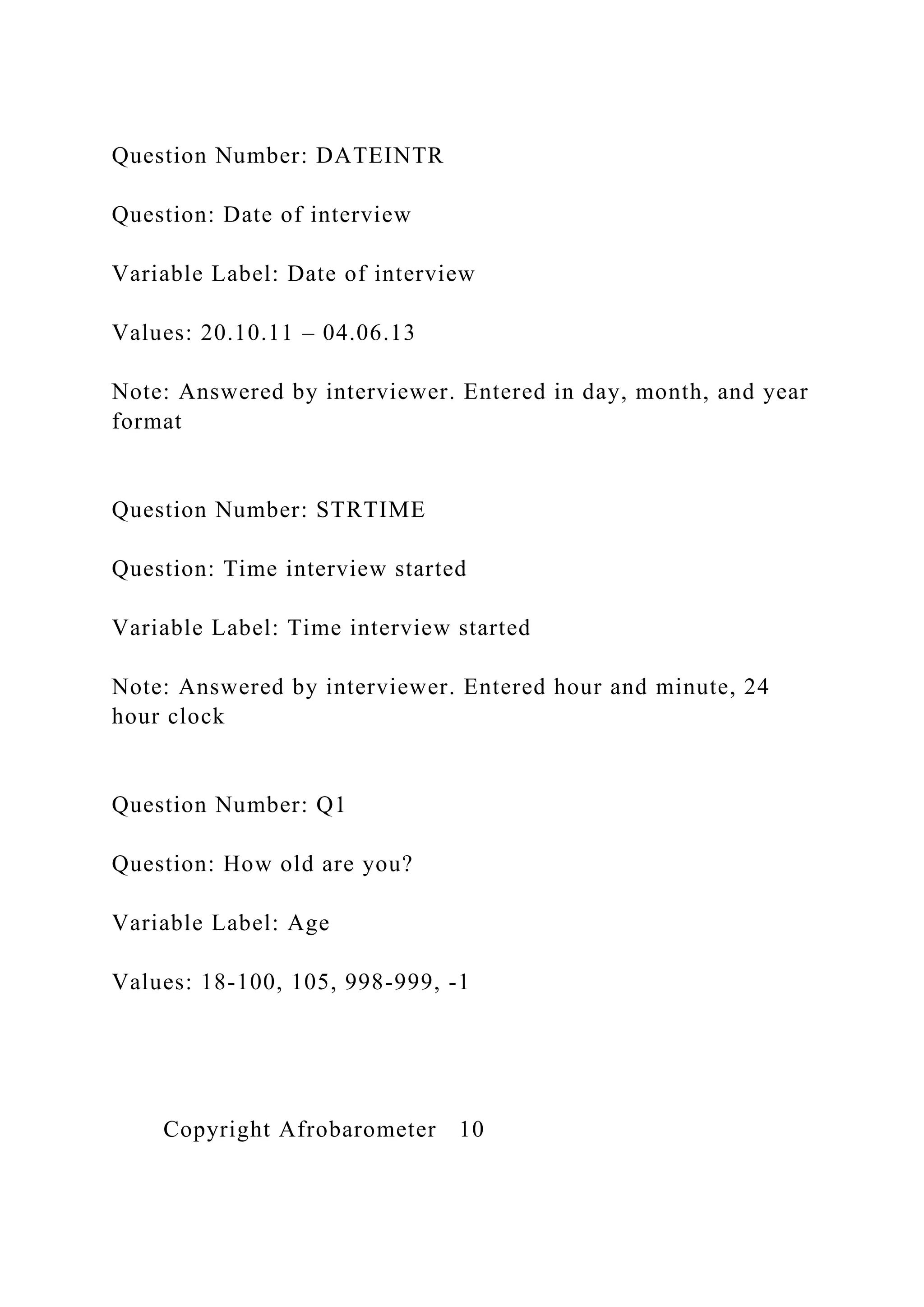
Question Number: DATEINTR
Question: Date of interview
Variable Label: Date of interview
Values: 20.10.11 – 04.06.13
Note: Answered by interviewer. Entered in day, month, and year
format
Question Number: STRTIME
Question: Time interview started
Variable Label: Time interview started
Note: Answered by interviewer. Entered hour and minute, 24
hour clock
Question Number: Q1
Question: How old are you?
Variable Label: Age
Values: 18-100, 105, 998-999, -1
Copyright Afrobarometer 10
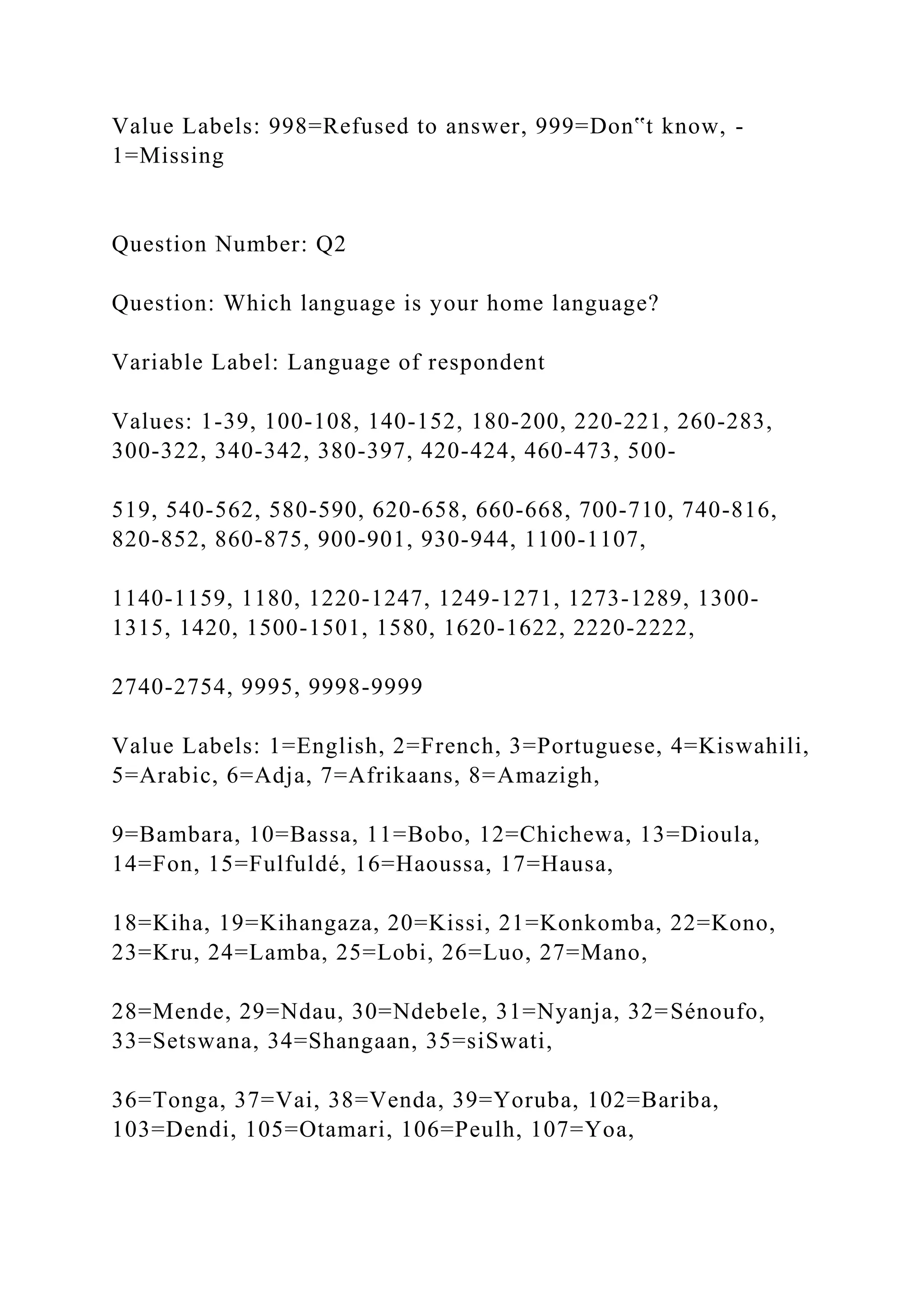
Value Labels: 998=Refused to answer, 999=Don‟t know, -
1=Missing
Question Number: Q2
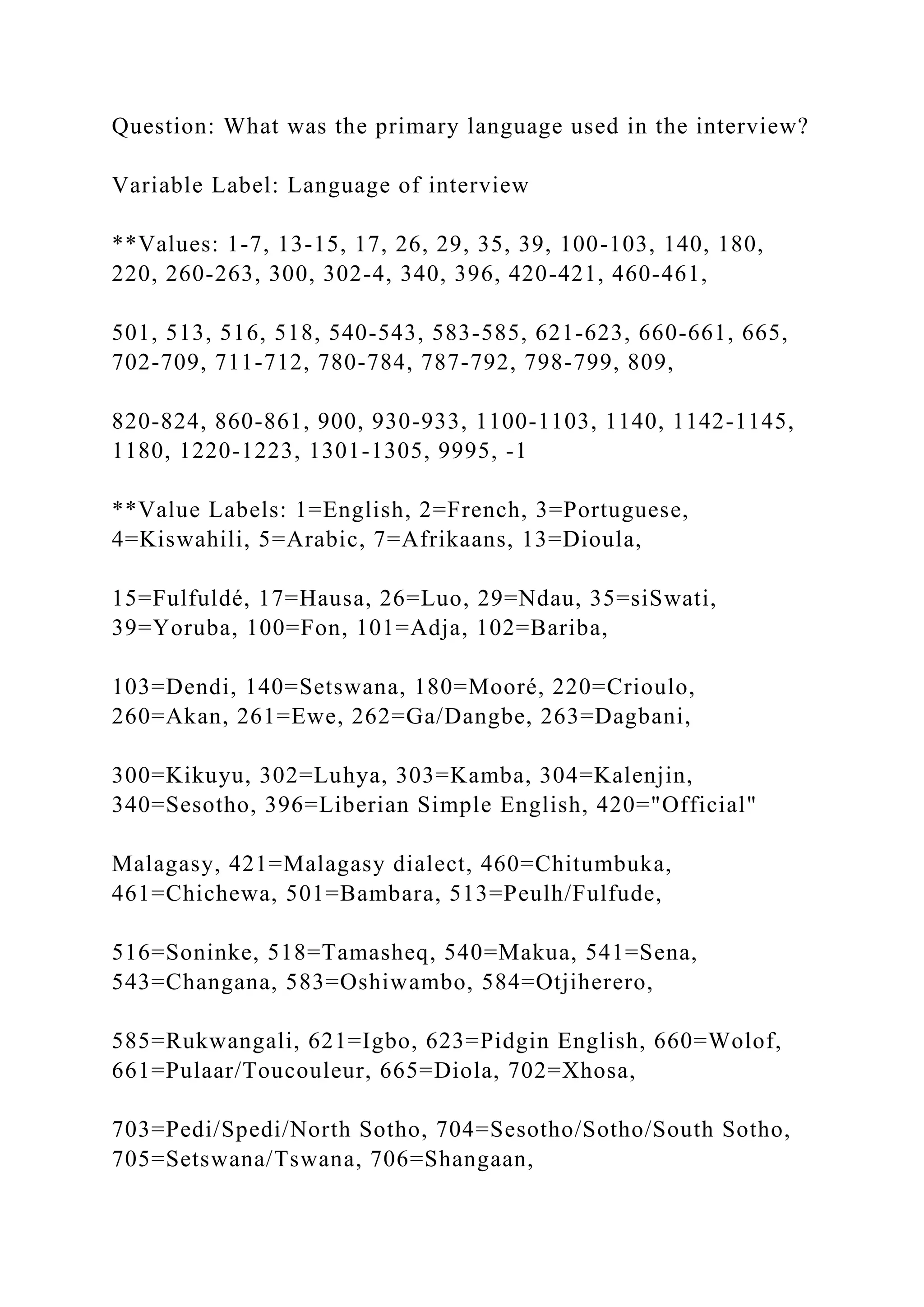
Question: Which language is your home language?
Variable Label: Language of respondent
Values: 1-39, 100-108, 140-152, 180-200, 220-221, 260-283,
300-322, 340-342, 380-397, 420-424, 460-473, 500-
519, 540-562, 580-590, 620-658, 660-668, 700-710, 740-816,
820-852, 860-875, 900-901, 930-944, 1100-1107,
1140-1159, 1180, 1220-1247, 1249-1271, 1273-1289, 1300-
1315, 1420, 1500-1501, 1580, 1620-1622, 2220-2222,
2740-2754, 9995, 9998-9999
Value Labels: 1=English, 2=French, 3=Portuguese, 4=Kiswahili,
5=Arabic, 6=Adja, 7=Afrikaans, 8=Amazigh,
9=Bambara, 10=Bassa, 11=Bobo, 12=Chichewa, 13=Dioula,
14=Fon, 15=Fulfuldé, 16=Haoussa, 17=Hausa,
18=Kiha, 19=Kihangaza, 20=Kissi, 21=Konkomba, 22=Kono,
23=Kru, 24=Lamba, 25=Lobi, 26=Luo, 27=Mano,
28=Mende, 29=Ndau, 30=Ndebele, 31=Nyanja, 32=Sénoufo,
33=Setswana, 34=Shangaan, 35=siSwati,
36=Tonga, 37=Vai, 38=Venda, 39=Yoruba, 102=Bariba,
103=Dendi, 105=Otamari, 106=Peulh, 107=Yoa,
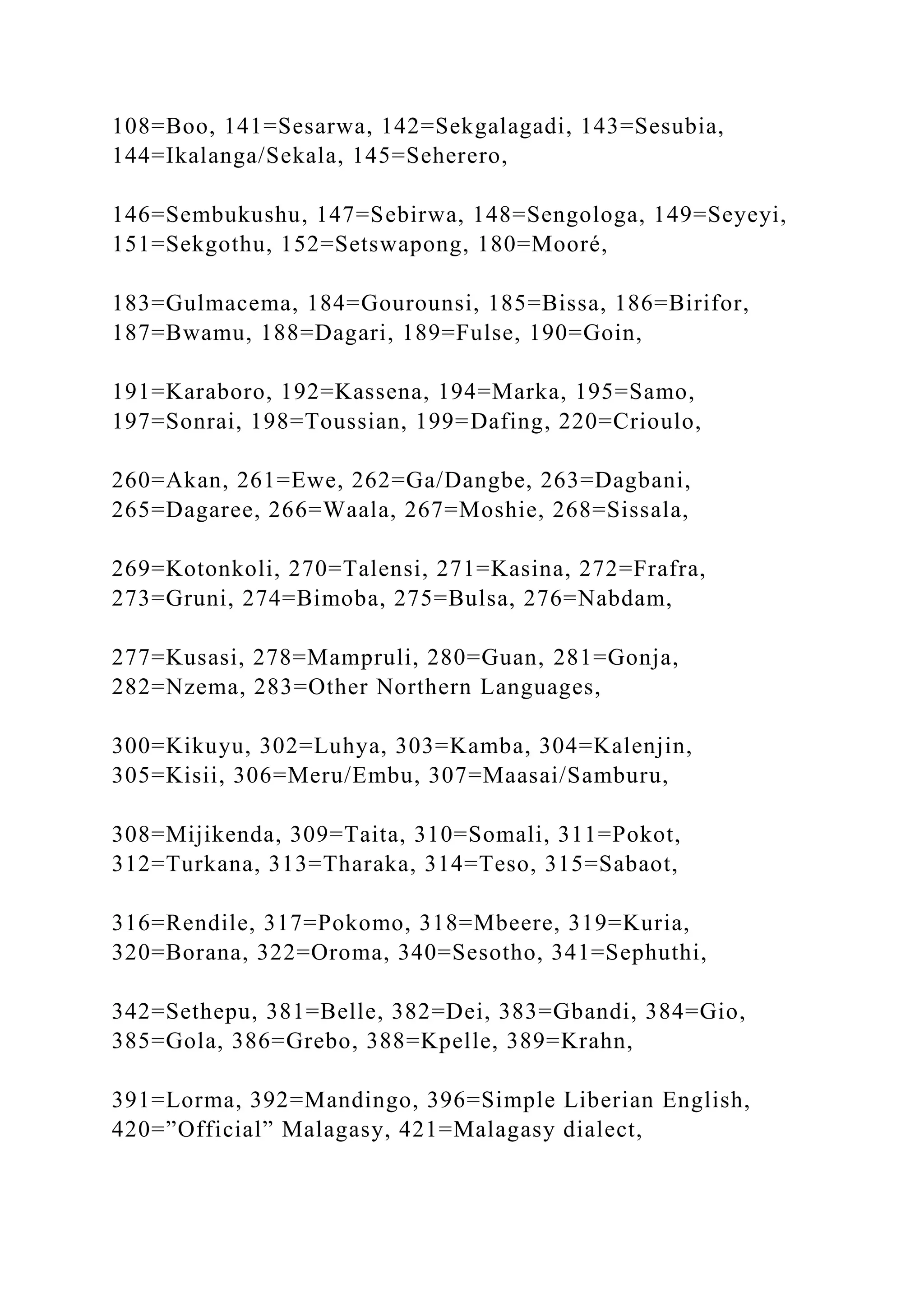
108=Boo, 141=Sesarwa, 142=Sekgalagadi, 143=Sesubia,
144=Ikalanga/Sekala, 145=Seherero,
146=Sembukushu, 147=Sebirwa, 148=Sengologa, 149=Seyeyi,
151=Sekgothu, 152=Setswapong, 180=Mooré,
183=Gulmacema, 184=Gourounsi, 185=Bissa, 186=Birifor,
187=Bwamu, 188=Dagari, 189=Fulse, 190=Goin,
191=Karaboro, 192=Kassena, 194=Marka, 195=Samo,
197=Sonrai, 198=Toussian, 199=Dafing, 220=Crioulo,
260=Akan, 261=Ewe, 262=Ga/Dangbe, 263=Dagbani,
265=Dagaree, 266=Waala, 267=Moshie, 268=Sissala,
269=Kotonkoli, 270=Talensi, 271=Kasina, 272=Frafra,
273=Gruni, 274=Bimoba, 275=Bulsa, 276=Nabdam,
277=Kusasi, 278=Mampruli, 280=Guan, 281=Gonja,
282=Nzema, 283=Other Northern Languages,
300=Kikuyu, 302=Luhya, 303=Kamba, 304=Kalenjin,
305=Kisii, 306=Meru/Embu, 307=Maasai/Samburu,
308=Mijikenda, 309=Taita, 310=Somali, 311=Pokot,
312=Turkana, 313=Tharaka, 314=Teso, 315=Sabaot,
316=Rendile, 317=Pokomo, 318=Mbeere, 319=Kuria,
320=Borana, 322=Oroma, 340=Sesotho, 341=Sephuthi,
342=Sethepu, 381=Belle, 382=Dei, 383=Gbandi, 384=Gio,
385=Gola, 386=Grebo, 388=Kpelle, 389=Krahn,
391=Lorma, 392=Mandingo, 396=Simple Liberian English,
420=”Official” Malagasy, 421=Malagasy dialect,
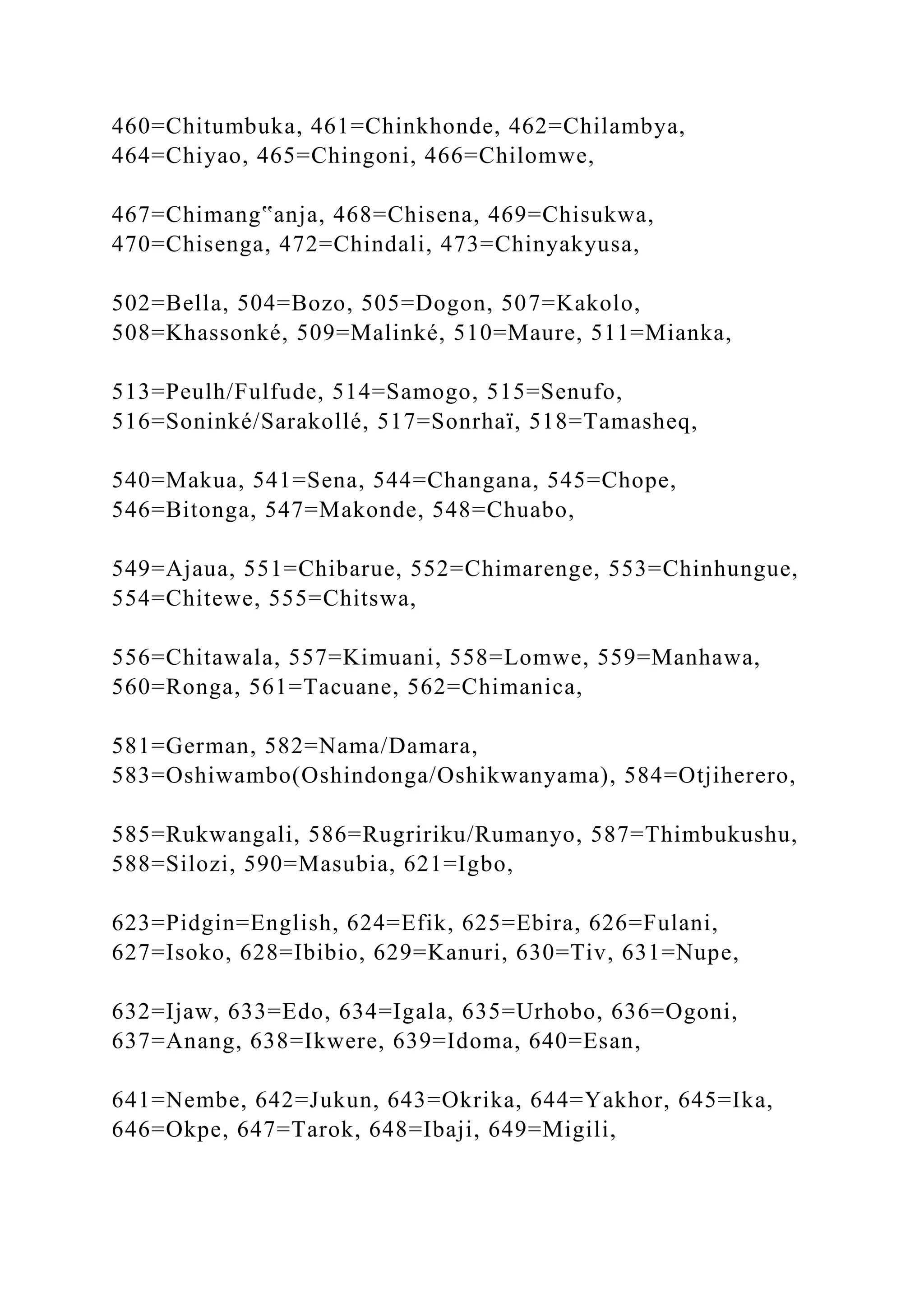
460=Chitumbuka, 461=Chinkhonde, 462=Chilambya,
464=Chiyao, 465=Chingoni, 466=Chilomwe,
467=Chimang‟anja, 468=Chisena, 469=Chisukwa,
470=Chisenga, 472=Chindali, 473=Chinyakyusa,
502=Bella, 504=Bozo, 505=Dogon, 507=Kakolo,
508=Khassonké, 509=Malinké, 510=Maure, 511=Mianka,
513=Peulh/Fulfude, 514=Samogo, 515=Senufo,
516=Soninké/Sarakollé, 517=Sonrhaï, 518=Tamasheq,
540=Makua, 541=Sena, 544=Changana, 545=Chope,
546=Bitonga, 547=Makonde, 548=Chuabo,
549=Ajaua, 551=Chibarue, 552=Chimarenge, 553=Chinhungue,
554=Chitewe, 555=Chitswa,
556=Chitawala, 557=Kimuani, 558=Lomwe, 559=Manhawa,
560=Ronga, 561=Tacuane, 562=Chimanica,
581=German, 582=Nama/Damara,
583=Oshiwambo(Oshindonga/Oshikwanyama), 584=Otjiherero,
585=Rukwangali, 586=Rugririku/Rumanyo, 587=Thimbukushu,
588=Silozi, 590=Masubia, 621=Igbo,
623=Pidgin=English, 624=Efik, 625=Ebira, 626=Fulani,
627=Isoko, 628=Ibibio, 629=Kanuri, 630=Tiv, 631=Nupe,
632=Ijaw, 633=Edo, 634=Igala, 635=Urhobo, 636=Ogoni,
637=Anang, 638=Ikwere, 639=Idoma, 640=Esan,
641=Nembe, 642=Jukun, 643=Okrika, 644=Yakhor, 645=Ika,
646=Okpe, 647=Tarok, 648=Ibaji, 649=Migili,
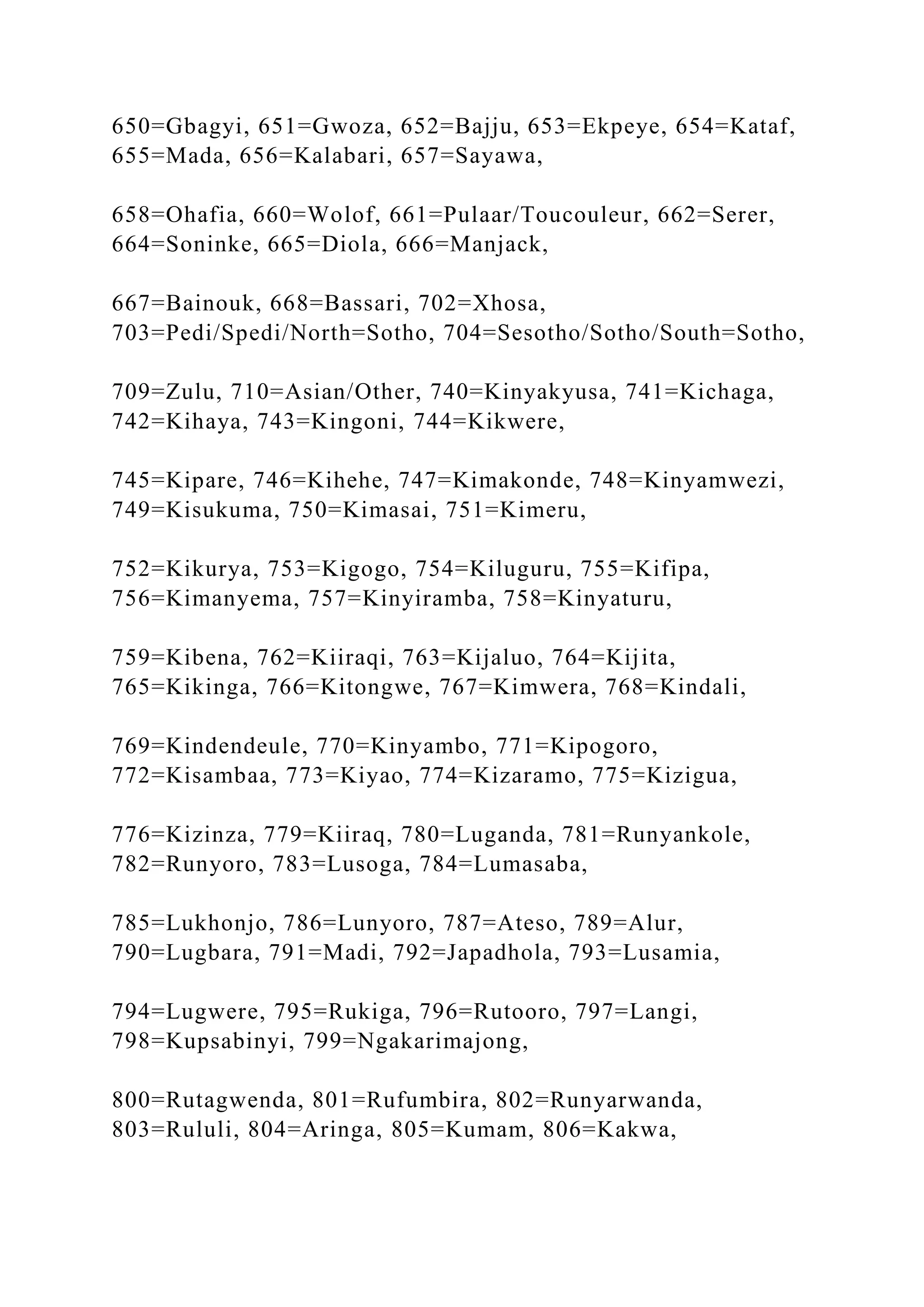
650=Gbagyi, 651=Gwoza, 652=Bajju, 653=Ekpeye, 654=Kataf,
655=Mada, 656=Kalabari, 657=Sayawa,
658=Ohafia, 660=Wolof, 661=Pulaar/Toucouleur, 662=Serer,
664=Soninke, 665=Diola, 666=Manjack,
667=Bainouk, 668=Bassari, 702=Xhosa,
703=Pedi/Spedi/North=Sotho, 704=Sesotho/Sotho/South=Sotho,
709=Zulu, 710=Asian/Other, 740=Kinyakyusa, 741=Kichaga,
742=Kihaya, 743=Kingoni, 744=Kikwere,
745=Kipare, 746=Kihehe, 747=Kimakonde, 748=Kinyamwezi,
749=Kisukuma, 750=Kimasai, 751=Kimeru,
752=Kikurya, 753=Kigogo, 754=Kiluguru, 755=Kifipa,
756=Kimanyema, 757=Kinyiramba, 758=Kinyaturu,
759=Kibena, 762=Kiiraqi, 763=Kijaluo, 764=Kijita,
765=Kikinga, 766=Kitongwe, 767=Kimwera, 768=Kindali,
769=Kindendeule, 770=Kinyambo, 771=Kipogoro,
772=Kisambaa, 773=Kiyao, 774=Kizaramo, 775=Kizigua,
776=Kizinza, 779=Kiiraq, 780=Luganda, 781=Runyankole,
782=Runyoro, 783=Lusoga, 784=Lumasaba,
785=Lukhonjo, 786=Lunyoro, 787=Ateso, 789=Alur,
790=Lugbara, 791=Madi, 792=Japadhola, 793=Lusamia,
794=Lugwere, 795=Rukiga, 796=Rutooro, 797=Langi,
798=Kupsabinyi, 799=Ngakarimajong,
800=Rutagwenda, 801=Rufumbira, 802=Runyarwanda,
803=Rululi, 804=Aringa, 805=Kumam, 806=Kakwa,
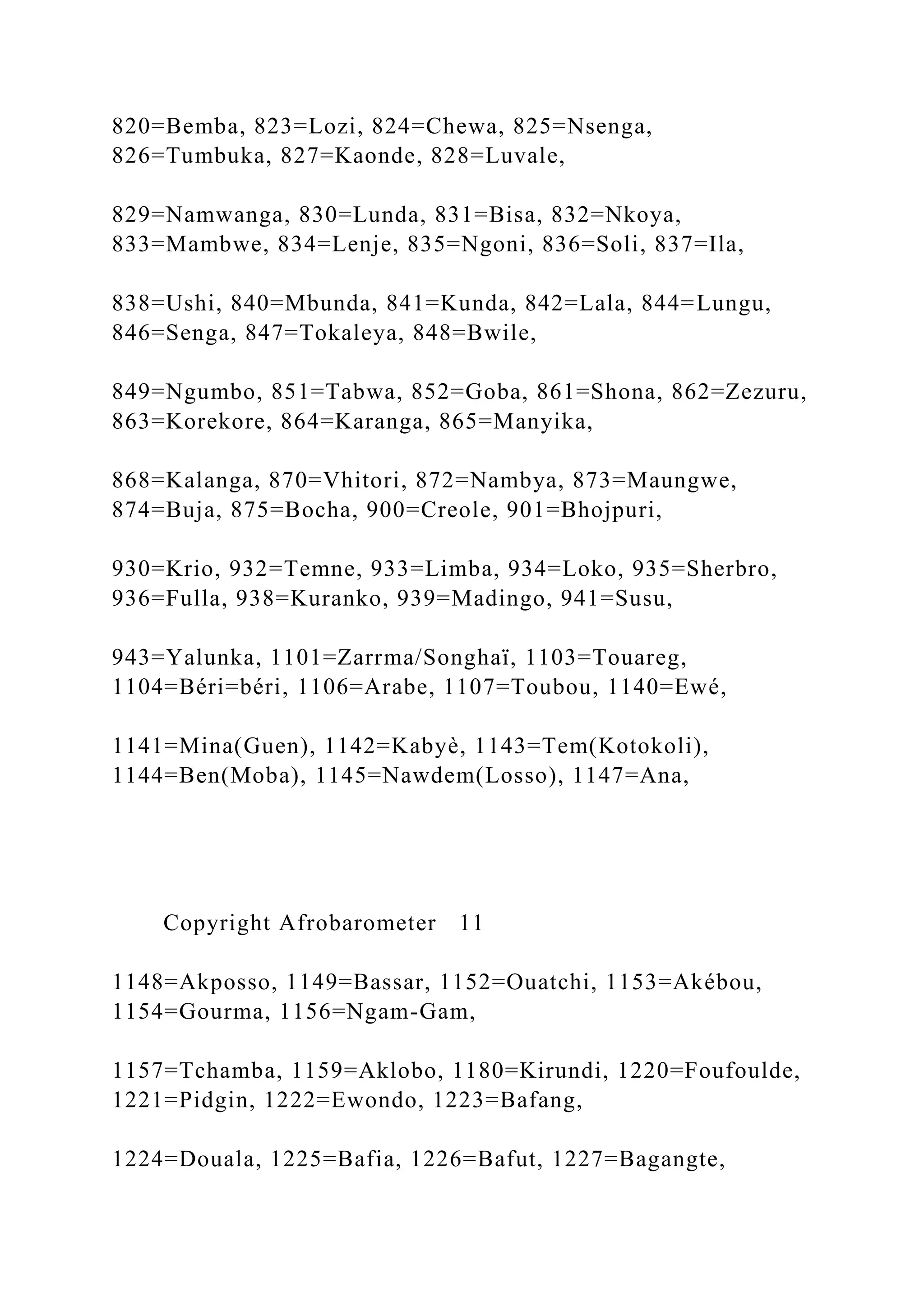
820=Bemba, 823=Lozi, 824=Chewa, 825=Nsenga,
826=Tumbuka, 827=Kaonde, 828=Luvale,
829=Namwanga, 830=Lunda, 831=Bisa, 832=Nkoya,
833=Mambwe, 834=Lenje, 835=Ngoni, 836=Soli, 837=Ila,
838=Ushi, 840=Mbunda, 841=Kunda, 842=Lala, 844=Lungu,
846=Senga, 847=Tokaleya, 848=Bwile,
849=Ngumbo, 851=Tabwa, 852=Goba, 861=Shona, 862=Zezuru,
863=Korekore, 864=Karanga, 865=Manyika,
868=Kalanga, 870=Vhitori, 872=Nambya, 873=Maungwe,
874=Buja, 875=Bocha, 900=Creole, 901=Bhojpuri,
930=Krio, 932=Temne, 933=Limba, 934=Loko, 935=Sherbro,
936=Fulla, 938=Kuranko, 939=Madingo, 941=Susu,
943=Yalunka, 1101=Zarrma/Songhaï, 1103=Touareg,
1104=Béri=béri, 1106=Arabe, 1107=Toubou, 1140=Ewé,
1141=Mina(Guen), 1142=Kabyè, 1143=Tem(Kotokoli),
1144=Ben(Moba), 1145=Nawdem(Losso), 1147=Ana,
Copyright Afrobarometer 11
1148=Akposso, 1149=Bassar, 1152=Ouatchi, 1153=Akébou,
1154=Gourma, 1156=Ngam-Gam,
1157=Tchamba, 1159=Aklobo, 1180=Kirundi, 1220=Foufoulde,
1221=Pidgin, 1222=Ewondo, 1223=Bafang,
1224=Douala, 1225=Bafia, 1226=Bafut, 1227=Bagangte,
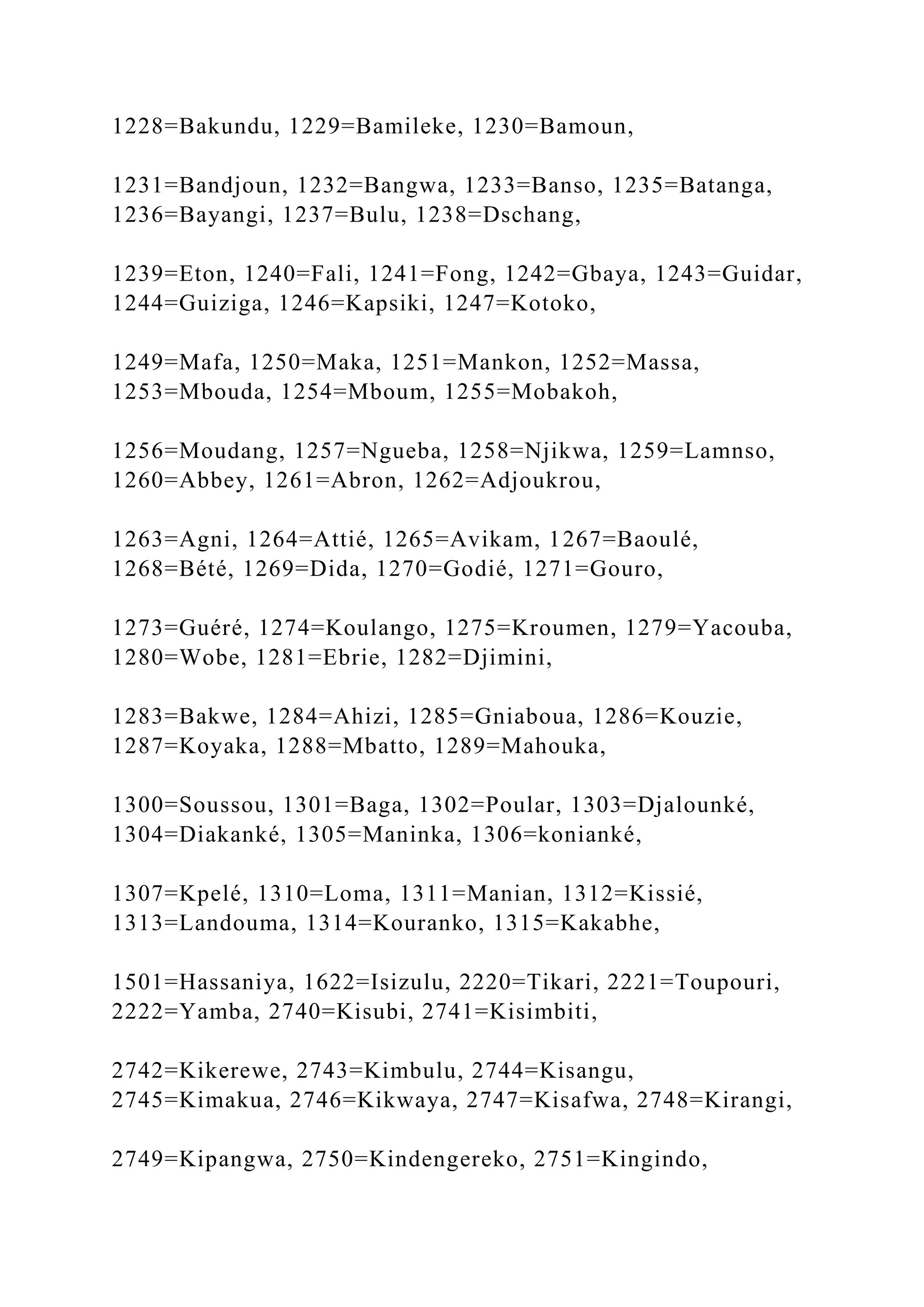
1228=Bakundu, 1229=Bamileke, 1230=Bamoun,
1231=Bandjoun, 1232=Bangwa, 1233=Banso, 1235=Batanga,
1236=Bayangi, 1237=Bulu, 1238=Dschang,
1239=Eton, 1240=Fali, 1241=Fong, 1242=Gbaya, 1243=Guidar,
1244=Guiziga, 1246=Kapsiki, 1247=Kotoko,
1249=Mafa, 1250=Maka, 1251=Mankon, 1252=Massa,
1253=Mbouda, 1254=Mboum, 1255=Mobakoh,
1256=Moudang, 1257=Ngueba, 1258=Njikwa, 1259=Lamnso,
1260=Abbey, 1261=Abron, 1262=Adjoukrou,
1263=Agni, 1264=Attié, 1265=Avikam, 1267=Baoulé,
1268=Bété, 1269=Dida, 1270=Godié, 1271=Gouro,
1273=Guéré, 1274=Koulango, 1275=Kroumen, 1279=Yacouba,
1280=Wobe, 1281=Ebrie, 1282=Djimini,
1283=Bakwe, 1284=Ahizi, 1285=Gniaboua, 1286=Kouzie,
1287=Koyaka, 1288=Mbatto, 1289=Mahouka,
1300=Soussou, 1301=Baga, 1302=Poular, 1303=Djalounké,
1304=Diakanké, 1305=Maninka, 1306=konianké,
1307=Kpelé, 1310=Loma, 1311=Manian, 1312=Kissié,
1313=Landouma, 1314=Kouranko, 1315=Kakabhe,
1501=Hassaniya, 1622=Isizulu, 2220=Tikari, 2221=Toupouri,
2222=Yamba, 2740=Kisubi, 2741=Kisimbiti,
2742=Kikerewe, 2743=Kimbulu, 2744=Kisangu,
2745=Kimakua, 2746=Kikwaya, 2747=Kisafwa, 2748=Kirangi,
2749=Kipangwa, 2750=Kindengereko, 2751=Kingindo,
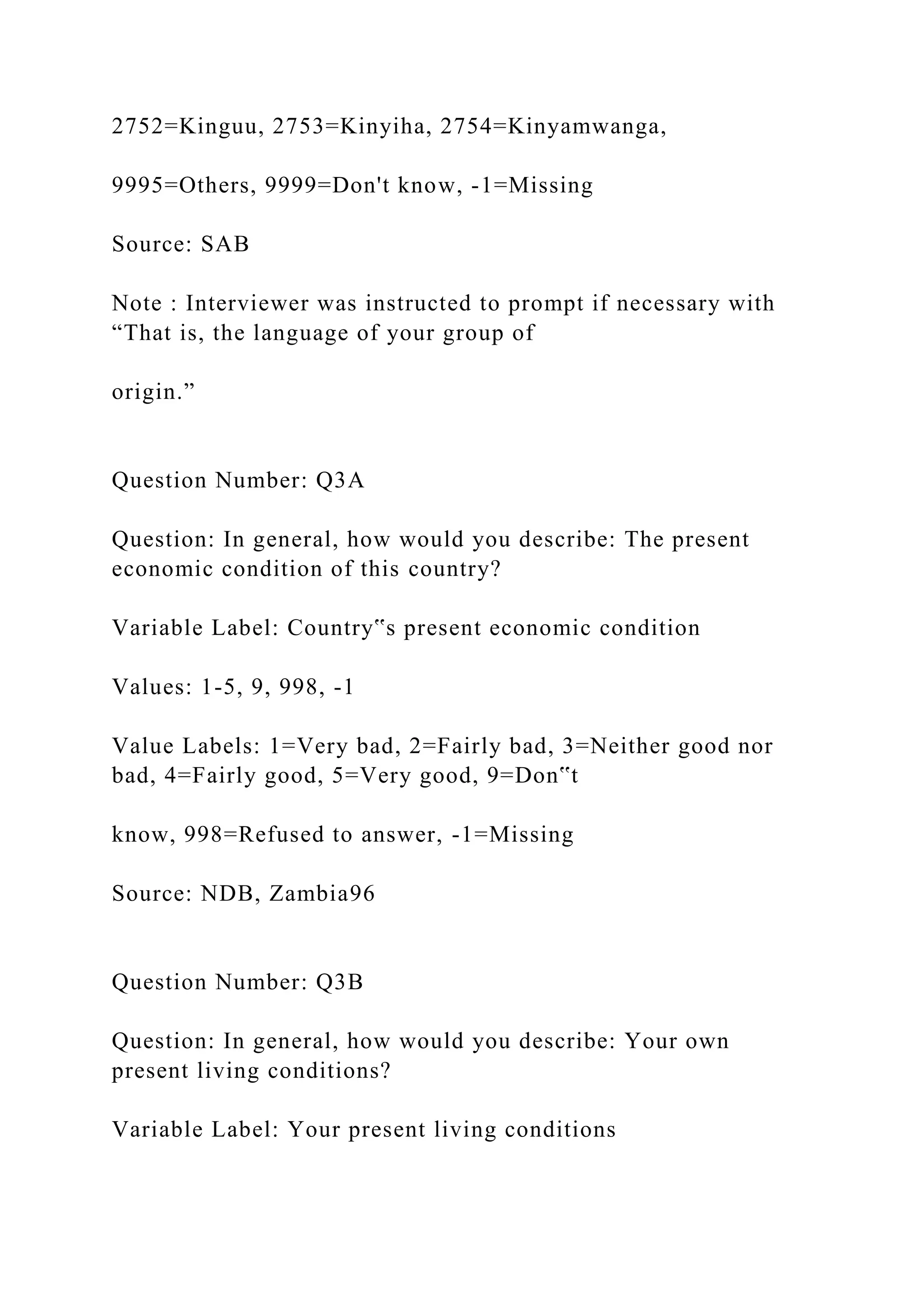
2752=Kinguu, 2753=Kinyiha, 2754=Kinyamwanga,
9995=Others, 9999=Don't know, -1=Missing
Source: SAB
Note : Interviewer was instructed to prompt if necessary with
“That is, the language of your group of
origin.”
Question Number: Q3A
Question: In general, how would you describe: The present
economic condition of this country?
Variable Label: Country‟s present economic condition
Values: 1-5, 9, 998, -1
Value Labels: 1=Very bad, 2=Fairly bad, 3=Neither good nor
bad, 4=Fairly good, 5=Very good, 9=Don‟t
know, 998=Refused to answer, -1=Missing
Source: NDB, Zambia96
Question Number: Q3B
Question: In general, how would you describe: Your own
present living conditions?
Variable Label: Your present living conditions
Values: 1-5, 9, 998, -1
Value Labels: 1=Very bad, 2=Fairly bad, 3=Neither good nor
bad, 4=Fairly good, 5=Very good, 9=Don‟t
know, 998=Refused to answer, -1=Missing
Source: NDB, Zambia96
Question Number: Q4
Question: In general, how do you rate your living conditions
compared to those of other [Ghanaians]?
Variable Label: Your living conditions vs. others
Values: 1-5, 9, 998, -1
Value Labels: 1=Much worse, 2=Worse, 3=Same, 4=Better,
5=Much better, 9=Don‟t know, 998=Refused to
answer, -1=Missing
Source: NDB, Zambia96
Question Number: Q5A
Question: Looking back, how do you rate the following
compared to twelve months ago: Economic
conditions in this country?
Variable Label: Country‟s economic condition compared to 12
months ago
Values: 1-5, 9, 998, -1
Value Labels: 1=Much worse, 2=Worse, 3=Same, 4=Better,
5=Much better, 9=Don‟t know, 998=Refused to
answer, -1=Missing
Source: SAB
Question Number: Q5B
Question: Looking back, how do you rate the following
compared to twelve months ago: Your living
conditions?
Variable Label: Your living conditions compared to 12 months
ago
Values: 1-5, 9, 998, -1
Copyright Afrobarometer 12
Value Labels: 1=Much worse, 2=Worse, 3=Same, 4=Better,
5=Much better, 9=Don‟t know, 998=Refused to
answer, -1=Missing
Source: NDB, Zambia96
Question Number: Q6A
Question: Looking ahead, do you expect the following to be
better or worse: Economic conditions in this
country in twelve months time?
Variable Label: Country‟s economic condition in 12 months
time
Values: 1-5, 9, 998, -1
Value Labels: 1=Much worse, 2=Worse, 3=Same, 4=Better,
5=Much better, 9=Don‟t know, 998=Refused to
answer, -1=Missing
Source: NDB, Zambia96
Question Number: Q6B
Question: Looking ahead, do you expect the following to be
better or worse: Your living conditions in
twelve months time?
Variable Label: Your living conditions in 12 months time
Values: 1-5, 9, 998, -1
Value Labels: 1=Much worse, 2=Worse, 3=Same, 4=Better,
5=Much better, 9=Don‟t know, 998=Refused to
answer, -1=Missing
Source: NDB, Zambia96
Question Number: Q7
Question: What about the overall direction of the country?
Would you say that the country is going in the
wrong direction or going in the right direction?
Variable Label: Overall direction of the country
Values: 1, 2, 9, 998, -1
Value Labels: 1= Going in the wrong direction, 2= Going in the
right direction, 9=Don‟t know, 998=Refused
to answer, -1=Missing
Source: Afrobarometer Round5
Question Number: Q8A
Question: Over the past year, how often, if ever, have you or
anyone in your family gone without: Enough
food to eat?
Variable Label: How often gone without food
Values: 0-4, 9, 998, -1
Value Labels: 0=Never, 1=Just once or twice, 2=Several times,
3=Many times, 4=Always, 9=Don‟t know,
998=Refused to answer, -1=Missing
Source: NDB
Question Number: Q8B
Question: Over the past year, how often, if ever, have you or
anyone in your family gone without: Enough
clean water for home use?
Variable Label: How often gone without water
Values: 0-4, 9, 998, -1
Value Labels: 0=Never, 1=Just once or twice, 2=Several times,
3=Many times, 4=Always, 9=Don‟t know,
998=Refused to answer, -1=Missing
Source: NDB
Question Number: Q8C
Question: Over the past year, how often, if ever, have you or
anyone in your family gone without:
Medicines or medical treatment?
Variable Label: How often gone without medical care
Values: 0-4, 9, 998, -1
Value Labels: 0=Never, 1=Just once or twice, 2=Several times,
3=Many times, 4=Always, 9=Don‟t know,
998=Refused to answer, -1=Missing
Source: NDB
Copyright Afrobarometer 13
Question Number: Q8D
Question: Over the past year, how often, if ever, have you or
anyone in your family gone without: Enough
fuel to cook your food?
Variable Label: How often gone without cooking fuel
Values: 0-4, 9, 998, -1
Value Labels: 0=Never, 1=Just once or twice, 2=Several times,
3=Many times, 4=Always, 9=Don‟t know,
998=Refused to answer, -1=Missing
Source: SAB
Question Number: Q8E
Question: Over the past year, how often, if ever, have you or
anyone in your family gone without: A cash
income?
Variable Label: How often gone without a cash income
Values: 0-4, 9, 998, -1
Value Labels: 0=Never, 1=Just once or twice, 2=Several times,
3=Many times, 4=Always, 9=Don‟t know,
998=Refused to answer, -1=Missing
Source: SAB
Question Number: Q9A
Question: Over the past year, how often, if ever, have you or
anyone in your family: Felt unsafe walking in
your neighbourhood?
Variable Label: How often felt unsafe walking in
neighbourhood
Values: 0-4, 9, 998, -1
Value Labels: 0=Never, 1=Just once or twice, 2=Several times,
3=Many times, 4=Always, 9=Don‟t know,
998=Refused to answer, -1=Missing
Source: Afrobarometer Round5
Question Number: Q9B
Question: Over the past year, how often, if ever, have you or
anyone in your family: Feared crime in your
own home?
Variable Label: How often feared crime in home
Values: 0-4, 9, 998, -1
Value Labels: 0=Never, 1=Just once or twice, 2=Several times,
3=Many times, 4=Always, 9=Don‟t know,
998=Refused to answer, -1=Missing
Source: Adapted from NDB
Question Number: Q10A
Question: During the past year, have you or anyone in your
family: Had something stolen from your house?
Variable Label: Had something stolen from house
Values: 0-3, 9, 998, -1
Value Labels: 0=No, 1=Once, 2=Twice, 3=Three or more times,
9=Don‟t know, 998=Refused to answer, -
1=Missing
Source: Adapted from NDB
Note : If respondent answered « Yes », interviewer was
instructed to follow up by asking « Did this happen
once, twice or three or more times ? ”
Question Number: Q10B
Question: During the past year, have you or anyone in your
family: Been physically attacked?
Variable Label: Have been physically attacked
Values: 0-3, 9, 998, -1
Value Labels: 0=No, 1=Once, 2=Twice, 3=Three or more times,
9=Don‟t know, 998=Refused to answer, -
1=Missing
Source: Adapted from NDB
Note : If respondent answered « Yes », interviewer was
instructed to follow up by asking « Did this happen
once, twice or three or more times ? ”
Question Number: Q10C
Question: Was any such incident reported to the police?
Copyright Afrobarometer 14
Variable Label: Reported the incident to the police
Values: 0, 1, 7, 9, 998, -1
Value Labels: 0=No, 1=Yes, 7= Not Applicable, 9=Don‟t know,
998=Refused to answer, -1=Missing
Source: Afrobarometer Round5
Question Number: Q11
Question: Some people say that many crimes are never reported
to the police. Based on your experience,
what do you think is the main reason that many people do not
report crimes like thefts or attacks to the
police when they occur?
Variable Label: Main reason for not reporting crimes to the
police
Values: 0-21, 142-145, 340, 421-422, 461-466, 620, 662, 900,
1623, 9995, 9998, 9999, -1
Value Labels: 0=Most people do report crimes to the police,
1=People don't have enough time to report
crimes, 2=No police or police station in the area/too far,
3=Police don't listen or care, 4=Police would have
demanded money or a bribe to help, 5=Police wouldn't have
been able to do anything, 6=Police may be
involved in the robbery or assault, 7=Victim feared reprisal
from attacker, 8=Victim too ashamed or
embarrassed, 9=Crime was reported to other authority, 10=Lack
of evidence or witnesses, 11=Criminal
unknown / lack of suspect, 12=People fear police / don‟t trust
police, 13=Crime was minor, 14=Criminals
were relatives or friends, 15=Don‟t know how to report /
ignorance, 16=People forgive the criminals,
17=Prefer settling issues amicably/at home, 18=Victim will
revenge, 19=Police delays, 20=Victim relies on
God, 21=Victim relies on black magic, 142=Fear of becoming a
witness, 143=Victim is part of criminal
activities, 144=Lack of transport for police, 145=People too
lazy to report, 340=Victim/People around them
have also committed crimes, 421=Lack of funds, 422=Complain
to the Presidents of Fokontany, 461=To
protect suspect, 462=Trust in traditional medicine, 464=Victim
not serious/foolish, 466=Victim discouraged to
report, 620=Police turn the case against you, 662=Procedure is
too slow, 900=Procedures too long,
1623=Victims are also guilty/criminals, 9995=Other,
9998=Refused, 9999=Don't know, -1=Missing
Source: Afrobarometer Round5
Question Number: Q12
Question: If you were a victim of crime in this country, who, if
anyone, would you go to first for assistance?
Variable Label: If a victim of crime, whom to go to first for
assistance
Values: 0-14, 140, 220-221, 420, 460, 580, 660, 9995, 9998,
9999, -1
Value Labels: 0= None of these / no effective assistance
available, 1= The police, 2= A security service or
security company that you pay for, 3= A traditional leader or
traditional court, 4= A street committee or
local security organization, 5= A powerful local person or local
gang, 6= You would personally take
revenge, 7= You would join with others to take revenge, 8=
Your own family or friends, 9= The family of the
perpetrator, 10= Local government official, 11= Neighbor, 12=
Employer or landlord, 13= God, 14=Army,
140= Cluster policing, 220= House of Law, 221=Hospital, 420=
Assemblee du Fokonolona, 460=HBO/CBO,
580= The Women and Men Network (Community policing
network), 660= President of the rural
communities, 9995=Other, 9998=Refused to answer,
9999=Don‟t know, -1=Missing
Source: Afrobarometer Round5
Question Number: Q13A
Question: How often do you get news from the following
sources: Radio?
Variable Label: Radio news
Values: 0-4, 9, 998, -1
Value Labels: 0=Never, 1=Less than once a month, 2=A few
times a month, 3=A few times a week, 4=Every
day, 9=Don‟t know, 998=Refused to answer, -1=Missing
Source: Zambia96
Question Number: Q13B
Question: How often do you get news from the following
sources: Television?
Variable Label: Television news
Values: 0-4, 9, 998, -1
Value Labels: 0=Never, 1=Less than once a month, 2=A few
times a month, 3=A few times a week, 4=Every
day, 9=Don‟t know, 998=Refused to answer, -1=Missing
Source: SAB
Copyright Afrobarometer 15
Question Number: Q13C
Question: How often do you get news from the following
sources: Newspapers?
Variable Label: Newspaper news
Values: 0-4, 9, 998, -1
Value Labels: 0=Never, 1=Less than once a month, 2=A few
times a month, 3=A few times a week, 4=Every
day, 9=Don‟t know, 998=Refused to answer, -1=Missing
Source: Zambia9
Question Number: Q13D
Question: How often do you get news from the following
sources: Internet?
Variable Label: Internet
Values: 0-4, 9, 998, -1
Value Labels: 0=Never, 1=Less than once a month, 2=A few
times a month, 3=A few times a week, 4=Every
day, 9=Don‟t know, 998=Refused to answer, -1=Missing
Source: Afrobarometer Round5
Question Number: Q14
Question: How interested would you say you are in public
affairs?
Variable Label: Interest in public affairs
Values: 0-3, 9, 998, -1
Value Labels: 0=Not at all interested, 1=Not very interested,
2=Somewhat interested, 3=Very interested,
9=Don‟t know, 998=Refused to answer, -1=Missing
Source: SAB
Note : Interviewer was instructed to prompt if necessary with
“You know, in politics and government.”
Question Number: Q15
Question: When you get together with your friends or family,
would you say you discuss political matters:
Variable Label: Discuss politics
Values: 0-2, 9, 998, -1
Value Labels: 0=Never, 1=Occasionally, 2=Frequently, 9=Don‟t
know, 998=Refused to answer, -1=Missing
Source: Adapted from Zambia96.
Question Number: Q16
Question: Do you agree or disagree with the following
statement: Sometimes politics and government
seem so complicated that a person like me cannot really
understand what is going on.
Variable Label: Politics and government too complicated
Values: 1-5, 9, 998, -1
Value Labels: 1=Strongly agree, 2=Agree, 3=Neither agree nor
disagree, 4=Disagree, 5=Strongly disagree,
9=Don‟t know, 998=Refused to answer, -1=Missing
Source: Afrobarometer Round 5
Note: The interviewer probed for strength of opinion.
Question Number: Q17A
Question: In this country, how free are you: To say what you
think?
Variable Label: Freedom to say what you think
Values: 1-4, 9, 998, -1
Value Labels: 1=Not at all free, 2=Not very free, 3=Somewhat
free, 4=Completely free, 9=Don‟t know,
998=Refused to answer, -1=Missing
Source: NDB
Question Number: Q17B
Question: In this country, how free are you: To join any
political organization you want?
Variable Label: Freedom to join any political organizations
Values: 1-4, 9, 998, -1
Value Labels: 1=Not at all free, 2=Not very free, 3=Somewhat
free, 4=Completely free, 9=Don‟t know,
998=Refused to answer, -1=Missing
Source: NDB
Copyright Afrobarometer 16
Question Number: Q17C
Question: In this country, how free are you: To choose who to
vote for without feeling pressured?
Variable Label: Freedom to choose who to vote for
Values: 1-4, 9, 998, -1
Value Labels: 1=Not at all free, 2=Not very free, 3=Somewhat
free, 4=Completely free, 9=Don‟t know,
998=Refused to answer, -1=Missing
Source: NDB
Question Number: Q18
Question: Let‟s talk for a moment about the kind of society we
would like to have in this country. Which of
the following statements is closest to your view? Choose
Statement 1 or Statement 2.
Statement 1: Once in office, elected leaders are obliged to help
their home community or group first.
Statement 2: Since elected leaders should represent everyone,
they should not do anything that favours
their own group over others.
Variable Label: Leaders help own community vs. treat all
equally
Values: 1-5, 9, 998, -1
Value Labels: 1=Agree very strongly with Statement 1, 2=Agree
with Statement 1, 3=Agree with Statement
2, 4=Agree very strongly with Statement 2, 5=Agree with
neither, 9=Don‟t know, 998=Refused to answer, -
1=Missing
Source: Afrobarometer Round2
Note: Interviewer probed for strength of opinion asking “Do
you agree or agree very strongly?”
Question Number: Q19
Question: Which of the following statements is closest to your
view? Choose Statement 1or Statement 2.
Statement 1: Government should be able to ban any
organization that goes against its policies.
Statement 2: We should be able to join any organization,
whether or not the government approves of it.
Variable Label: Government bans organization vs. join any
Values: 1-5, 9, 998, -1
Value Labels: 1=Agree very strongly with Statement 1, 2=Agree
with Statement 1, 3=Agree with Statement
2, 4=Agree very strongly with Statement 2, 5=Agree with
neither, 9=Don‟t know, 998=Refused to answer, -
1=Missing
Source: Uganda00
Note: Interviewer probed for strength of opinion asking “Do
you agree or agree very strongly?”
Question Number: Q20
Question: Which of the following statements is closest to your
view? Choose Statement 1 or Statement 2.
Statement 1: The media should have the right to publish any
views and ideas without government control.
Statement 2: The government should have the right to prevent
the media from publishing things that it
consider harmful to society.
Variable Label: Newspapers free to publish vs. government
closes
Values: 1-5, 9, 998, -1
Value Labels: 1=Agree very strongly with Statement 1, 2=Agree
with Statement 1, 3=Agree with Statement
2, 4=Agree very strongly with Statement 2, 5=Agree with
neither, 9=Don‟t know, 998=Refused to answer, -
1=Missing
Source: Uganda00
Note: Interviewer probed for strength of opinion asking “Do
you agree or agree very strongly?”
Question Number: Q21
Question: Which of the following statements is closest to your
view? Choose Statement 1 or Statement 2.
Statement 1: The government is like a parent. It should decide
which is good for us.
Statement 2: The government is like our employee. We are the
bosses and should tell government what to
do.
Variable Label: Government like a parent vs. an employee
Values: 1-5, 9, 998, -1
Value Labels: 1=Agree very strongly with Statement 1, 2=Agree
with Statement 1, 3=Agree with Statement
2, 4=Agree very strongly with Statement 2, 5=Agree with
neither, 9=Don‟t know, 998=Refused to answer, -
1=Missing
Source: Ghana99
Copyright Afrobarometer 17
Note: Interviewer probed for strength of opinion asking “Do
you agree or agree very strongly?”
Question Number: Q22
Question: Which of the following statements is closest to your
view? Choose Statement 1 or Statement 2.
Statement 1: Men make better political leaders than women, and
should be elected rather than women.
Statement 2: Women should have the same chance of being
elected to political office as men.
Variable Label: Men only as leaders vs. women leaders ok
Values: 1-5, 9, 998, -1
Value Labels: 1=Agree very strongly with Statement 1, 2=Agree
with Statement 1, 3=Agree with Statement
2, 4=Agree very strongly with Statement 2, 5=Agree with
neither, 9=Don‟t know, 998=Refused to answer, -
1=Missing
Source: Afrobarometer Round5
Note: Interviewer probed for strength of opinion asking “Do
you agree or agree very strongly?”
Question Number: Q23
Question: Which of the following statements is closest to your
view? Choose Statement 1 or Statement 2.
Statement 1: In our country, women should have equal rights
and receive the same treatment as men do.
Statement 2: Women have always been subject to traditional
laws and customs, and should remain so.
Variable Label: Women have equal rights vs. subject to
traditional laws
Values: 1-5, 9, 998, -1
Value Labels: 1=Agree very strongly with Statement 1, 2=Agree
with Statement 1, 3=Agree with Statement
2, 4=Agree very strongly with Statement 2, 5=Agree with
neither, 9=Don‟t know, 998=Refused to answer, -
1=Missing
Source: Afrobarometer Round3
Note: Interviewer probed for strength of opinion asking “Do
you agree or agree very strongly?”
Question Number: Q24
Question: Which of the following statements is closest to your
view? Choose Statement 1 or Statement 2.
Statement 1: If funds for schooling are limited, a boy should
always receive an education in school before a
girl. Statement 2: If funds for schooling are limited, a family
should send the child with the greatest ability to
learn.
Variable Label: Education recipient priority: boy vs ability
Values: 1-5, 9, 998, -1
Value Labels: 1=Agree very strongly with Statement 1, 2=Agree
with Statement 1, 3=Agree with Statement
2, 4=Agree very strongly with Statement 2, 5=Agree with
neither, 9=Don‟t know, 998=Refused to answer, -
1=Missing
Source: Afrobarometer Round5
Note: Interviewer probed for strength of opinion asking “Do
you agree or agree very strongly?”
Question Number: Q25A
Question: Let‟s turn to your role in the community. Now I am
going to read out a list of groups that people
join or attend. For each one, could you tell me whether you are
an official leader, an active member, an
inactive member, or not a member: A religious group that meets
outside of regular worship services?
Variable Label: Member of religious group
Values: 0-3, 9, 998, -1
Value Labels: 0=Not a Member, 1=Inactive member, 2=Active
member, 3=Official leader, 9=Don‟t know,
998=Refused to answer, -1=Missing
Source: SAB
Question Number: Q25B
Question: Let‟s turn to your role in the community. Now I am
going to read out a list of groups that people
join or attend. For each one, could you tell me whether you are
an official leader, an active member, an
inactive member, or not a member: Some other voluntary
association or community group?
Variable Label: Member of voluntary association or community
group
Values: 0-3, 9, 998, -1
Value Labels: 0=Not a member, 1=Inactive member, 2=Active
member, 3=Official leader, 9=Don‟t know,
998=Refused to answer, -1=Missing
Source: Afrobarometer Round 4
Copyright Afrobarometer 18
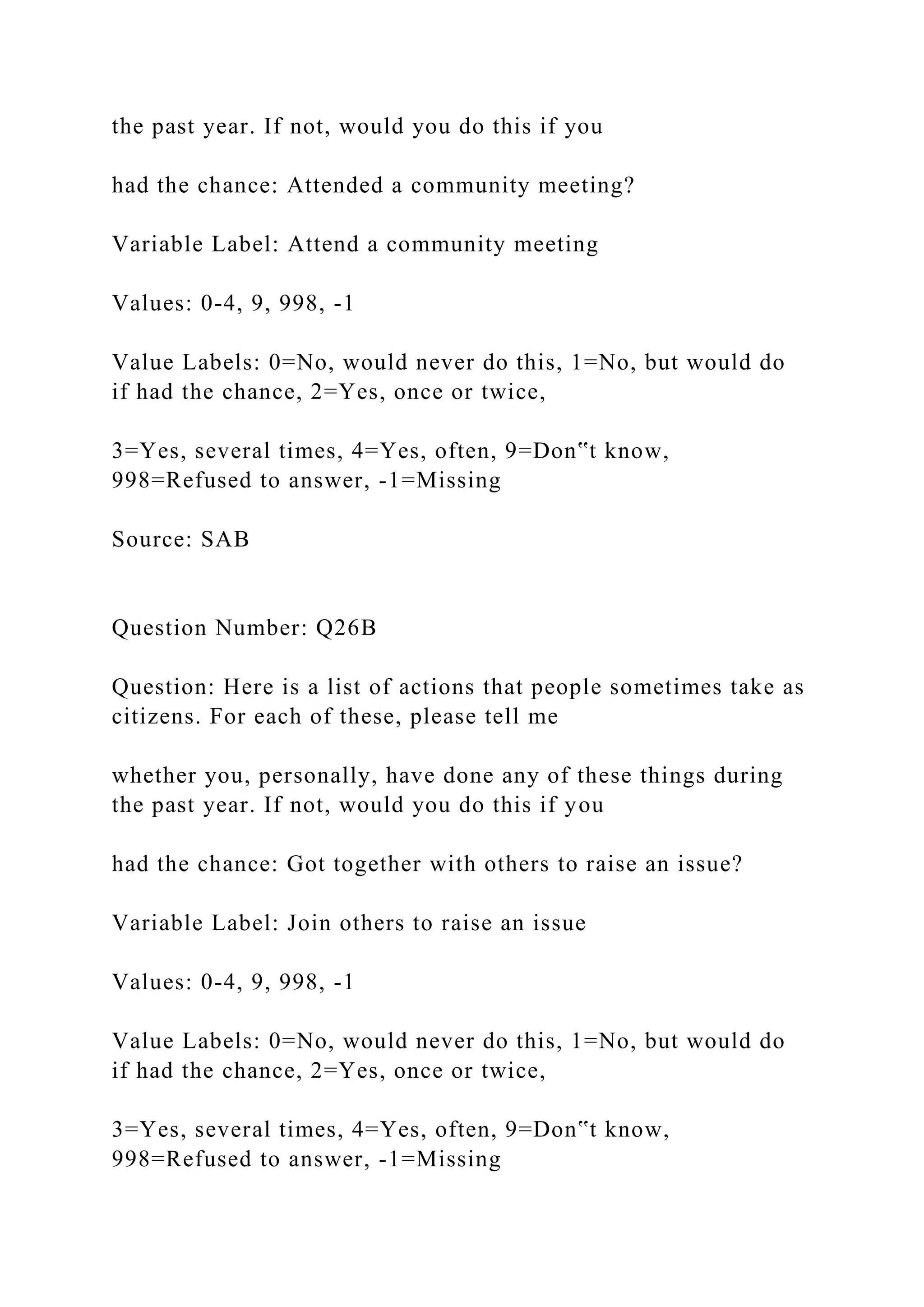
Question Number: Q26A
Question: Here is a list of actions that people sometimes take as
citizens. For each of these, please tell me
whether you, personally, have done any of these things during
the past year. If not, would you do this if you
had the chance: Attended a community meeting?
Variable Label: Attend a community meeting
Values: 0-4, 9, 998, -1
Value Labels: 0=No, would never do this, 1=No, but would do
if had the chance, 2=Yes, once or twice,
3=Yes, several times, 4=Yes, often, 9=Don‟t know,
998=Refused to answer, -1=Missing
Source: SAB
Question Number: Q26B
Question: Here is a list of actions that people sometimes take as
citizens. For each of these, please tell me
whether you, personally, have done any of these things during
the past year. If not, would you do this if you
had the chance: Got together with others to raise an issue?
Variable Label: Join others to raise an issue
Values: 0-4, 9, 998, -1
Value Labels: 0=No, would never do this, 1=No, but would do
if had the chance, 2=Yes, once or twice,
3=Yes, several times, 4=Yes, often, 9=Don‟t know,
998=Refused to answer, -1=Missing
Source: SAB
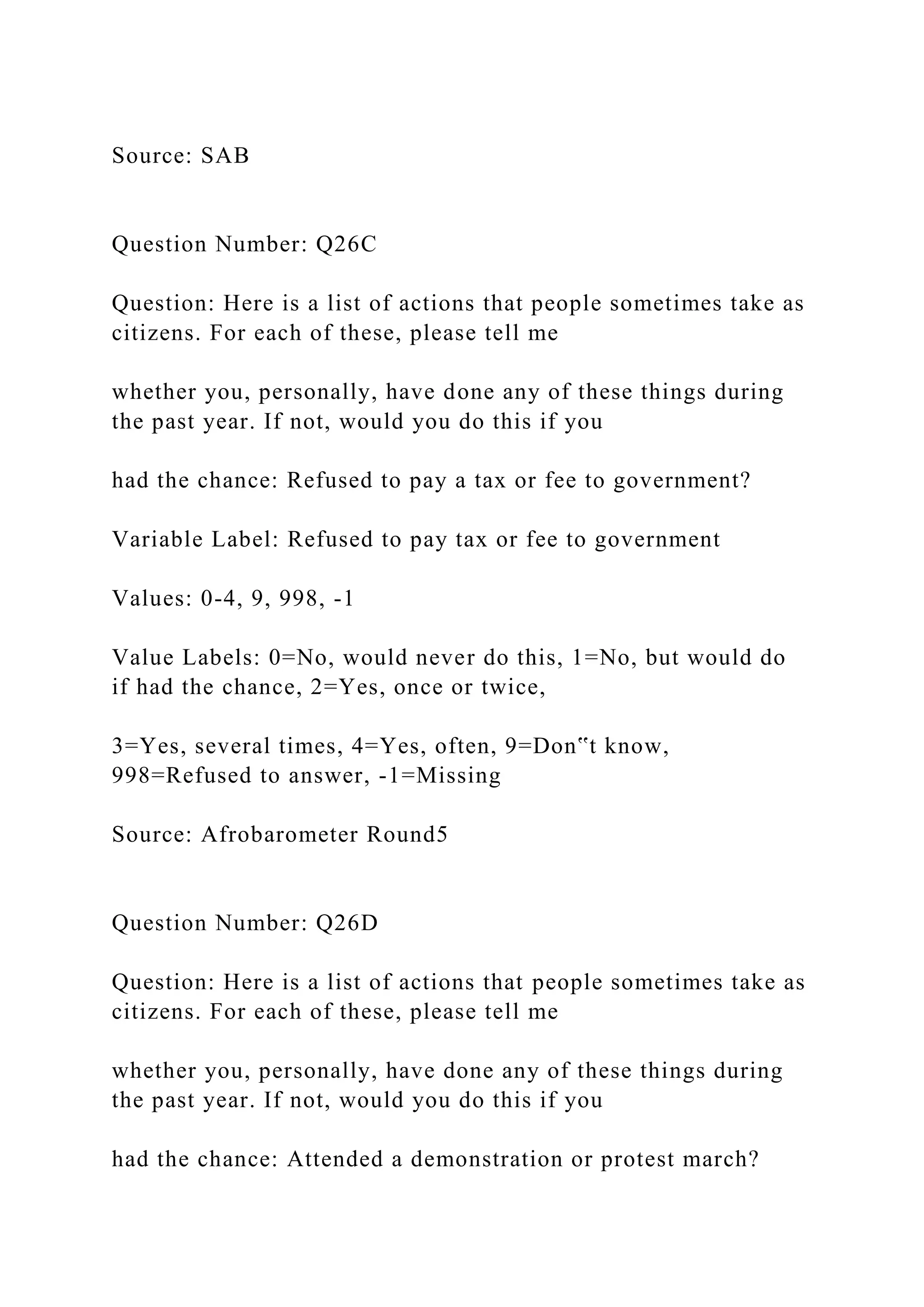
Question Number: Q26C
Question: Here is a list of actions that people sometimes take as
citizens. For each of these, please tell me
whether you, personally, have done any of these things during
the past year. If not, would you do this if you
had the chance: Refused to pay a tax or fee to government?
Variable Label: Refused to pay tax or fee to government
Values: 0-4, 9, 998, -1
Value Labels: 0=No, would never do this, 1=No, but would do
if had the chance, 2=Yes, once or twice,
3=Yes, several times, 4=Yes, often, 9=Don‟t know,
998=Refused to answer, -1=Missing
Source: Afrobarometer Round5
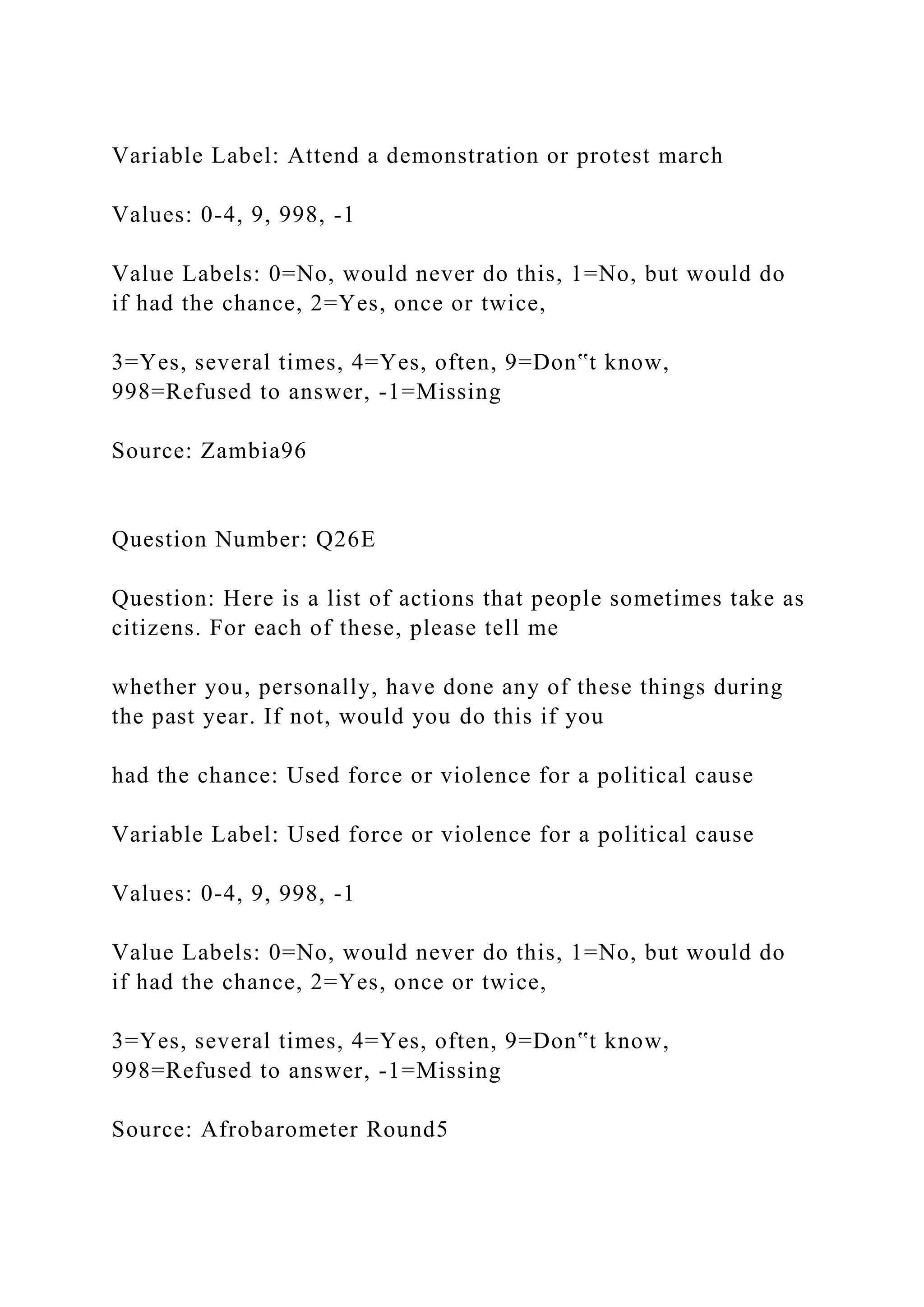
Question Number: Q26D
Question: Here is a list of actions that people sometimes take as
citizens. For each of these, please tell me
whether you, personally, have done any of these things during
the past year. If not, would you do this if you
had the chance: Attended a demonstration or protest march?
Variable Label: Attend a demonstration or protest march
Values: 0-4, 9, 998, -1
Value Labels: 0=No, would never do this, 1=No, but would do
if had the chance, 2=Yes, once or twice,
3=Yes, several times, 4=Yes, often, 9=Don‟t know,
998=Refused to answer, -1=Missing
Source: Zambia96
Question Number: Q26E
Question: Here is a list of actions that people sometimes take as
citizens. For each of these, please tell me
whether you, personally, have done any of these things during
the past year. If not, would you do this if you
had the chance: Used force or violence for a political cause
Variable Label: Used force or violence for a political cause
Values: 0-4, 9, 998, -1
Value Labels: 0=No, would never do this, 1=No, but would do
if had the chance, 2=Yes, once or twice,
3=Yes, several times, 4=Yes, often, 9=Don‟t know,
998=Refused to answer, -1=Missing
Source: Afrobarometer Round5
Question Number: Q27
**Question: With regard to the most recent national election in
[20xx], which statement is true for you?
Variable Label: Voting in the most recent national election
Values: 0-9, 998, -1
Value Labels: 0=You were not registered to vote, 1=You voted
in the elections, 2=You decided not to vote,
3=You could not find the polling station, 4=You were prevented
from voting, 5=You did not have time to
vote, 6= You did not vote because you could not find your name
in the voters‟ register, 7=Did not vote for
Copyright Afrobarometer 19
some other reason, 8= You were too young to vote, 9=Don‟t
know/Can't remember, 998=Refused to
answer, -1=Missing
Source: Afrobarometer Round 3
Question Number: Q28
**Question: On the whole, how would you rate the freeness and
fairness of the last national election, held in
[20xx]. Was it:
Variable Label: Freeness and fairness of the last national
election
Values: 1-4, 8, 9, 998, -1
Value Labels: 4=Completely free and fair, 3=Free and fair, but
with minor problems, 2=Free and fair, with
major problems, 1=Not free and fair, 8=Do not understand the
question, 9=Don‟t know, 998=Refused to
answer, -1=Missing
Source: Afrobarometer Round 3
Question Number: Q29A
**Question: Thinking about the last national election in [20xx],
did you: Attend a campaign meeting or
rally?
Variable Label: Last national election: attend a campaign
meeting or rally
Values: 0, 1, 9, 998, -1
Value Labels: 0=No, 1=Yes, 9=Don‟t know, 998=Refused to
answer, -1=Missing
Source: Afrobarometer Round 5
Question Number: Q29B
**Question: Thinking about the last national election in [20xx],
did you: Try to persuade others to vote for a
certain presidential or legislative candidate or political party?
Variable Label: Last national election: persuade others to vote
for a certain candidate or party
Values: 0, 1, 9, 998, -1
Value Labels: 0=No, 1=Yes, 9=Don‟t know, 998=Refused to
answer, -1=Missing
Source: Afrobarometer Round 5
Question Number: Q29C
**Question: Thinking about the last national election in [20xx],
did you: Work for a candidate or party?
Variable Label: Last national election: work for a candidate or
party
Values: 0, 1, 9, 997, 998, -1
Value Labels: 0=No, 1=Yes, 9=Don‟t know, 997=Not asked,
998=Refused to answer, -1=Missing
Source: Afrobarometer Round 5
* Not asked in EGY
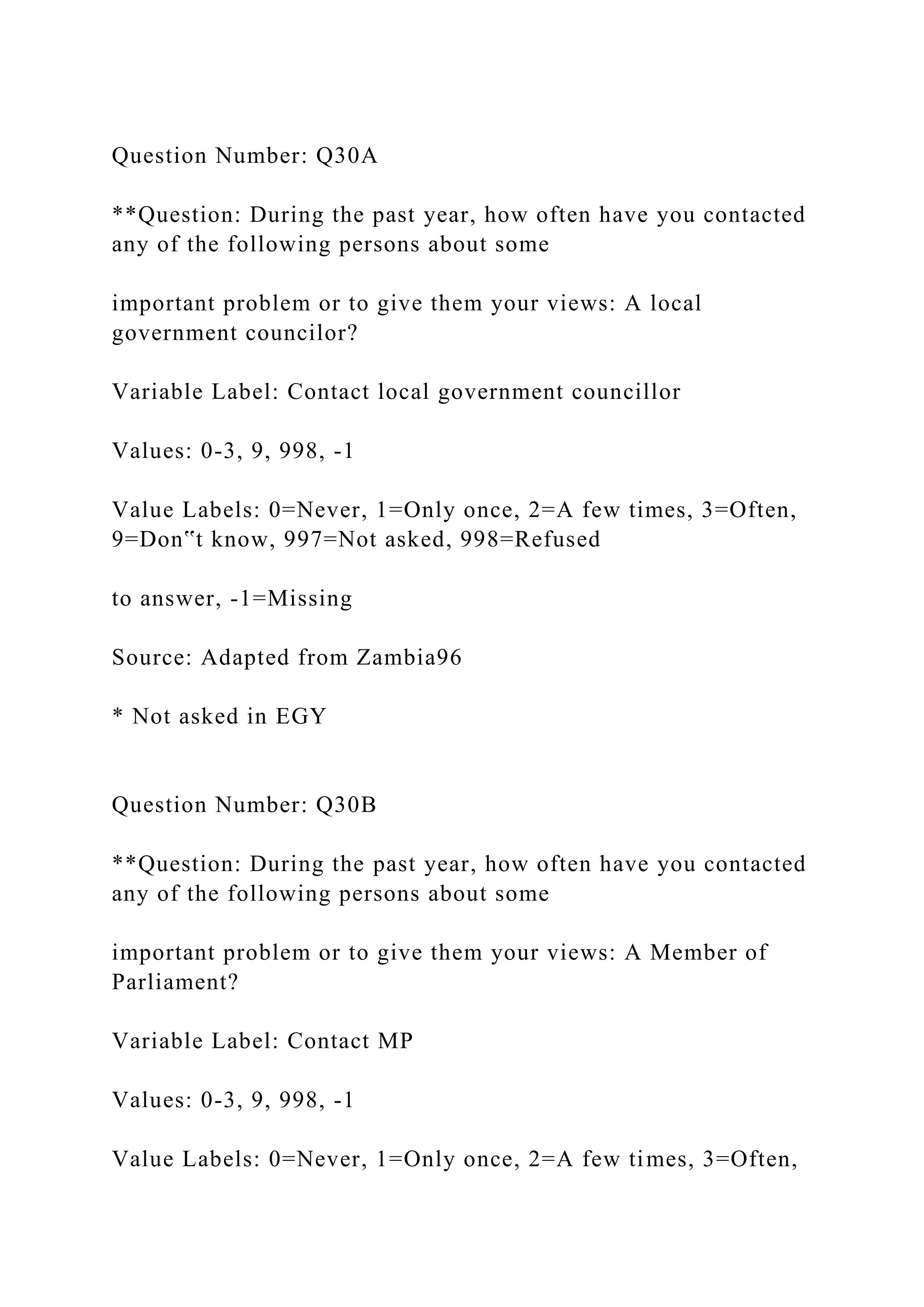
Question Number: Q30A
**Question: During the past year, how often have you contacted
any of the following persons about some
important problem or to give them your views: A local
government councilor?
Variable Label: Contact local government councillor
Values: 0-3, 9, 998, -1
Value Labels: 0=Never, 1=Only once, 2=A few times, 3=Often,
9=Don‟t know, 997=Not asked, 998=Refused
to answer, -1=Missing
Source: Adapted from Zambia96
* Not asked in EGY
Question Number: Q30B
**Question: During the past year, how often have you contacted
any of the following persons about some
important problem or to give them your views: A Member of
Parliament?
Variable Label: Contact MP
Values: 0-3, 9, 998, -1
Value Labels: 0=Never, 1=Only once, 2=A few times, 3=Often,
9=Don‟t know, 997=Not asked, 998=Refused
to answer, -1=Missing
Source: Adapted from Zambia96
* Not asked in MAD
Copyright Afrobarometer 20
Question Number: Q30C
Question: During the past year, how often have you contacted
any of the following persons about some
important problem or to give them your views: An official of a
government agency?
Variable Label: Contact official of a government agency
Values: 0-3, 9, 998, -1
Value Labels: 0=Never, 1=Only once, 2=A few times, 3=Often,
9=Don‟t know, 998=Refused to answer, -
1=Missing
Source: Adapted from Zambia96
Question Number: Q30D
Question: During the past year, how often have you contacted
any of the following persons about some
important problem or to give them your views: A political party
official?
Variable Label: Contact political party official
Values: 0-3, 9, 998, -1
Value Labels: 0=Never, 1=Only once, 2=A few times, 3=Often,
9=Don‟t know, 998=Refused to answer, -
1=Missing
Source: Afrobarometer Round 5
Question Number: Q31A
Question: There are many ways to govern a country. Would you
disapprove or approve of the following
alternatives: Only one political party is allowed to stand for
election and hold office?
Variable Label: Reject one-party rule
Values: 1-5, 9, 998, -1
Value Labels: 1=Strongly disapprove, 2=Disapprove, 3=Neither
approve nor disapprove, 4=Approve,
5=Strongly approve, 9=Don‟t know, 998=Refused to answer, -
1=Missing
Source: NDB
Note: Interviewer probed for strength of opinion.
Question Number: Q31B
Question: There are many ways to govern a country. Would you
disapprove or approve of the following
alternatives: The army comes in to govern the country?
Variable Label: Reject military rule
Values: 1-5, 9, 998, -1
Value Labels: 1=Strongly disapprove, 2=Disapprove, 3=Neither
approve nor disapprove, 4=Approve,
5=Strongly approve, 9=Don‟t know, 998=Refused to answer, -
1=Missing
Source: Adapted from NDB
Note: Interviewer probed for strength of opinion.
Question Number: Q31C
**Question: There are many ways to govern a country. Would
you disapprove or approve of the following
alternatives: Elections and Parliament are abolished so that the
president can decide everything?
Variable Label: Reject one-man rule
Values: 1-5, 9, 998, -1
Value Labels: 1=Strongly disapprove, 2=Disapprove, 3=Neither
approve nor disapprove, 4=Approve,
5=Strongly approve, 9=Don‟t know, 997=Not asked,
998=Refused to answer, -1=Missing.
Source: SAB
Note: Interviewer probed for strength of opinion.
* Not asked in SWZ
Question Number: Q31D_ARB
**Question: There are many ways to govern a country. Would
you disapprove or approve of the following
alternatives: A system governed by Islamic law without
elections or political parties?
Variable Label: Reject Islamic law system without elections or
political parties
Values: 1-5, 9, 997, 998, -1
Value Labels: 1=Strongly disapprove, 2=Disapprove, 3=Neither
approve nor disapprove, 4=Approve,
5=Strongly approve, 9=Don‟t know, 997=Not asked,
998=Refused to answer, -1=Missing.
Source: ArabBarometer
Note: Interviewer probed for strength of opinion.
Copyright Afrobarometer 21
** Only asked in ALG, EGY, MRC, SUD and TUN
Question Number: Q32
Question: Which of these three statements is closest to your
own opinion?
Statement 1: Democracy is preferable to any other kind of
government.
Statement 2: In some circumstances, a non-democratic
government can be preferable.
Statement 3: For someone like me, it doesn‟t matter what kind
of government we have.
Variable Label: Support for democracy
Values: 1-3, 9, 998, -1
Value Labels: 1=Statement 3: Doesn‟t matter, 2=Statement 2:
Sometimes non-democratic preferable,
3=Statement 1: Democracy preferable, 9=Don‟t know,
998=Refused to answer, -1=Missing
Source: Latinobarometer (LB)
Note: Interviewer was instructed to “read the question in the
language of the interview, but always read
„democracy‟ in English. Translate „democracy‟ into local
language only if respondent does not understand
English term.”
Question Number: Q33
Question: Which of the following statements is closest to your
view? Choose Statement 1 or Statement 2.
Statement 1: It is more important to have a government that can
get things done, even if we have no
influence over what it does.
Statement 2: It is more important for citizens to be able to hold
government accountable, even if that
means it makes decisions more slowly.
Variable Label: Government gets things done but no citizen
influence vs. government accountable to
citizens Values: 1-5, 9, 998, -1
Value Labels: 1=Agree very strongly with Statement 1, 2=Agree
with Statement 1, 3=Agree with Statement
2, 4=Agree very strongly with Statement 2, 5=Agree with
neither, 9=Don‟t know, 998=Refused to answer, -
1=Missing
Source: Afrobarometer Round 5
Note: Interviewer probed for strength of opinion asking “Do
you agree or agree very strongly?”
Question Number: Q34
Question: Which of the following statements is closest to your
view? Choose Statement 1 or Statement 2.
Statement 1: We should choose our leaders in this country
through regular, open and honest elections.
Statement 2: Since elections sometimes produce bad results, we
should adopt other methods for choosing
this country‟s leaders.
Variable Label: Choose leaders through elections vs. other
methods
Values: 1-5, 9, 997, 998, -1
Value Labels: 1=Agree very strongly with Statement 1, 2=Agree
with Statement 1, 3=Agree with Statement
2, 4=Agree very strongly with Statement 2, 5=Agree with
neither, 9=Don‟t know, 997=Not asked,
998=Refused to answer, -1=Missing
Source: Afrobarometer Round 2
Note: Interviewer probed for strength of opinion asking “Do
you agree or agree very strongly?”
* Not asked in MRC
Question Number: Q35
Question: Which of the following statements is closest to your
view? Choose Statement 1 or Statement 2.
**Statement 1: Political parties create division and confusion; it
is therefore unnecessary to have many
political parties in the country.
**Statement 2: Many political parties are needed to make sure
that [Ghanaians] have real choices in who
governs them.
Variable Label: Political parties divisive vs. many parties
needed
Values: 1-5, 9, 998, -1
Value Labels: 1=Agree very strongly with Statement 1, 2=Agree
with Statement 1, 3=Agree with Statement
2, 4=Agree very strongly with Statement 2, 5=Agree with
neither, 9=Don‟t know, 998=Refused to answer, -
1=Missing
Source: Afrobarometer Round 2
Note: Interviewer probed for strength of opinion asking “Do
you agree or agree very strongly?”
Copyright Afrobarometer 22
Question Number: Q36
Question: Which of the following statements is closest to your
view? Choose Statement 1 or Statement 2
**Statement 1: Parliament should ensure that the President
explains to it on a regular basis how his
government spends taxpayers‟ money.
**Statement 2: The President should be able to devote his full
attention to developing the country rather
than wasting time justifying his actions.
Variable Label: President monitored by parliament vs. free to
act on own
Values: 1-5, 9, 998, -1
Value Labels: 1=Agree very strongly with Statement 1, 2=Agree
with Statement 1, 3=Agree with Statement
2, 4=Agree very strongly with Statement 2, 5=Agree with
neither, 9=Don‟t know, 998=Refused to answer, -
1=Missing
Source: Afrobarometer Round 4
Note: Interviewer probed for strength of opinion asking “Do
you agree or agree very strongly?”
Question Number: Q37
Question: Which of the following statements is closest to your
view? Choose Statement 1 or Statement 2
Statement 1: Opposition parties should regularly examine and
criticize government policies and actions.
Statement 2: Opposition parties should concentrate on
cooperating with government and helping it
develop the country.
Variable Label: Opposition parties examine government vs.
cooperate
Values: 1-5, 9, 998, -1
Value Labels: 1=Agree very strongly with Statement 1, 2=Agree
with Statement 1, 3=Agree with Statement
2, 4=Agree very strongly with Statement 2, 5=Agree with
neither, 9=Don‟t know, 998=Refused to answer, -
1=Missing
Source: Afrobarometer Round 4
Note: Interviewer probed for strength of opinion asking “Do
you agree or agree very strongly?”
Question Number: Q38
Question: Which of the following statements is closest to your
view? Choose Statement 1 or Statement 2
Statement 1: The news media should constantly investigate and
report on government mistakes and
corruption.
Statement 2: Too much reporting on negative events, like
government mistakes and corruption, only harms
the country.
Variable Label: Media checks government vs. avoid negative
reporting
Values: 1-5, 9, 998, -1
Value Labels: 1=Agree very strongly with Statement 1, 2=Agree
with Statement 1, 3=Agree with Statement
2, 4=Agree very strongly with Statement 2, 5=Agree with
neither, 9=Don‟t know, 998=Refused to answer, -
1=Missing
Source: Afrobarometer Round 4
Note: Interviewer probed for strength of opinion asking “Do
you agree or agree very strongly?”
Question Number: Q39
Question: Which of the following statements is closest to your
view? Choose Statement 1 or Statement 2.
**Statement 1: Members of Parliament represent the people;
therefore they should make laws for this
country, even if the President does not agree.
**Statement 2: Since the President represents all of us, he
should pass laws without worrying about what
Parliament thinks.
Variable Label: Parliament makes laws vs. president does
Values: 1-5, 9, 998, -1
Value Labels: 1=Agree very strongly with Statement 1, 2=Agree
with Statement 1, 3=Agree with Statement
2, 4=Agree very strongly with Statement 2, 5=Agree with
neither, 9=Don‟t know, 998=Refused to answer, -
1=Missing
Source: Afrobarometer Round 2
Note: Interviewer probed for strength of opinion asking “Do
you agree or agree very strongly?”
Question Number: Q40
Question: Which of the following statements is closest to your
view? Choose Statement 1 or Statement 2.
Copyright Afrobarometer 23
**Statement 1: Since the President was elected to lead the
country, he should not be bound by laws or
court decisions that he thinks are wrong.
**Statement 2: The President must always obey the laws and the
courts, even if he thinks they are wrong.
Variable Label: President free to act vs. obey the laws and
courts
Values: 1-5, 9, 998, -1
Value Labels: 1=Agree very strongly with Statement 1, 2=Agree
with Statement 1, 3=Agree with Statement
2, 4=Agree very strongly with Statement 2, 5=Agree with
neither, 9=Don‟t know, 997=not asked,
998=Refused to answer, -1=Missing
Note: Interviewer probed for strength of opinion asking “Do
you agree or agree very strongly?”
* Not asked in MAD
Question Number: Q41
Question: Which of the following statements is closest to your
view? Choose Statement 1 or Statement 2
**Statement 1: The Constitution should limit the president to
serving a maximum of two terms in office.
**Statement 2: There should be no constitutional limit on how
long the president can serve.
Variable Label: Presidential two term limit vs. no term limits
Values: 1-5, 9, 998, -1
Value Labels: 1=Agree very strongly with Statement 1, 2=Agree
with Statement 1, 3=Agree with Statement
2, 4=Agree very strongly with Statement 2, 5=Agree with
neither, 9=Don‟t know, 998=Refused to answer, -
1=Missing
Source: Afrobarometer Round 4
Note: Interviewer probed for strength of opinion asking “Do
you agree or agree very strongly?”
Question Number: Q41A_ARB
Question: The opinions of Islamic jurists and religious scholars
differ with regard to their interpretations of
certain issues in Islam. What extent you agree or disagree with
each of the following statements:
Democracy is a system that contradicts the teachings of Islam?
Variable Label: Democracy is a system that contradicts the
teachings of Islam
Values: 1-5, 9, 997, 998, -1
Value Labels: 1=Strongly with Agree, 2=Agree, 3=Neither
Agree nor Disagree, 4=Disagree, 5=Strongly
Disagree, 9=Don‟t know, 997=Not asked, 998=Refused to
answer, -1=Missing
Source: ArabBarometer
Note: Interviewer probed for strength of opinion asking “Do
you agree or agree very strongly?”
** Only asked in ALG, EGY, MRC, SUD and TUN
Question Number: Q41B_ARB
Question: The opinions of Islamic jurists and religious scholars
differ with regard to their interpretations of
certain issues in Islam. What extent you agree or disagree with
each of the following statements: In a
Muslim country, non-Muslims should enjoy less political rights
than Muslims?
Variable Label: In a Muslim country, non-Muslims should enjoy
less political rights than Muslims
Values: 1-5, 9, 997, 998, -1
Value Labels: 1=Strongly with Agree, 2=Agree, 3=Neither
Agree nor Disagree, 4=Disagree, 5=Strongly
Disagree, 9=Don‟t know, 997=Not asked, 998=Refused to
answer, -1=Missing
Source: ArabBarometer
Note: Interviewer probed for strength of opinion asking “Do
you agree or agree very strongly?”
** Only asked in ALG, EGY, MRC, SUD and TUN
Question Number: Q41C_ARB
Question: The opinions of Islamic jurists and religious scholars
differ with regard to their interpretations of
certain issues in Islam. What extent you agree or disagree with
each of the following statements: Religious
leaders like imams, preachers and priests should not interfere in
voters‟ decisions in elections?
Variable Label: Religious leaders like imams, preachers and
priests should not interfere in voters‟ decisions in
elections.
Values: 1-5, 9, 997, 998, -1
Value Labels: 1=Strongly with Agree, 2=Agree, 3=Neither
Agree nor Disagree, 4=Disagree, 5=Strongly
Disagree, 9=Don‟t know, 997=Not asked, 998=Refused to
answer, -1=Missing
Source: ArabBarometer
Note: Interviewer probed for strength of opinion asking “Do
you agree or agree very strongly?”
Copyright Afrobarometer 24
** Only asked in ALG, EGY, MRC, SUD and TUN
Question Number: Q41D_ARB
Question: The opinions of Islamic jurists and religious scholars
differ with regard to their interpretations of
certain issues in Islam. What extent you agree or disagree with
each of the following statements: The
country is better off if religious people hold public positions in
the state?
Variable Label: The country is better off if religious people
hold public positions in the state.
Values: 1-5, 9, 997, 998, -1
Value Labels: 1=Strongly with Agree, 2=Agree, 3=Neither
Agree nor Disagree, 4=Disagree, 5=Strongly
Disagree, 9=Don‟t know, 997=Not asked, 998=Refused to
answer, -1=Missing
Source: ArabBarometer
Note: Interviewer probed for strength of opinion asking “Do
you agree or agree very strongly?”
** Only asked in ALG, EGY, MRC, SUD and TUN
Question Number: Q42
**Question: In your opinion how much of a democracy is the
country today?
Variable Label: Extent of democracy
Values: 1-4, 8, 9, 998, -1
Value Labels: 1=Not a democracy, 2=A democracy, with major
problems, 3=A democracy, but with minor
problems, 4=A full democracy, 8=Do not understand question/
do not understand what „democracy‟ is,
9=Don‟t know, 998=Refused to answer, -1=Missing
Source: Ghana 97
Note: Interviewer was instructed to “read the question in the
language of the interview, but always read
„democracy‟ in English. Translate „democracy‟ into local
language only if respondent does not understand
English term.”
Question Number: Q43
**Question: Overall, how satisfied are you with the way
democracy works in the country? Are you:
Variable Label: Satisfaction with democracy
Values: 0-4, 9, 998, -1
**Value Labels: 0=the country is not a democracy, 1=Not at all
satisfied, 2=Not very satisfied, 3=Fairly
satisfied, 4=Very satisfied, 9=Don‟t know, 998=Refused to
answer, -1=Missing
Source: Eurobarometer
Note: Interviewer was instructed to “Read the question in the
language of the interview, but always read
“democracy” in English Translate “democracy” into local
language only if respondent does not understand
English term.”
Question Number: Q43A_ARB
Question: Do you agree or disagree with each of the following
statements: Under a democratic system, the
country‟s economic performance is weak?
Variable Label: Under a democratic system, the country‟s
economic performance is weak
Values: 1-5, 8, 9, 997, -1
Value Labels: 1=Strongly with Agree, 2=Agree, 3=Neither
Agree nor Disagree, 4=Disagree, 5=Strongly
Disagree, 8=Refused to answer, 9=Don‟t know, 997=Not asked,
-1=Missing
Source: ArabBarometer
Note: Interviewer probed for strength of opinion asking “Do
you agree or agree very strongly?”
** Only asked in ALG, EGY, MRC, SUD and TUN
Question Number: Q43B_ARB
Question: Do you agree or disagree with each of the following
statements: Democratic regimes are
indecisive?
Variable Label: Democratic regimes are indecisive
Values: 1-5, 8, 9, 997, -1
Value Labels: 1=Strongly with Agree, 2=Agree, 3=Neither
Agree nor Disagree, 4=Disagree, 5=Strongly
Disagree, 8=Refused to answer, 9=Don‟t know, 997=Not asked,
-1=Missing
Source: ArabBarometer
Note: Interviewer probed for strength of opinion asking “Do
you agree or agree very strongly?”
** Only asked in ALG, EGY, MRC, SUD and TUN
Copyright Afrobarometer 25
Question Number: Q43C_ARB
Question: Do you agree or disagree with each of the following
statements: Democratic systems are not
effective at maintaining order and stability?
Variable Label: Democratic systems are not effective at
maintaining order and stability
Values: 1-5, 8, 9, 997, -1
Value Labels: 1=Strongly with Agree, 2=Agree, 3=Neither
Agree nor Disagree, 4=Disagree, 5=Strongly
Disagree, 8=Refused to answer, 9=Don‟t know, 997=Not asked,
-1=Missing
Source: ArabBarometer
Note: Interviewer probed for strength of opinion asking “Do
you agree or agree very strongly?”
** Only asked in ALG, EGY, MRC, SUD and TUN
Question Number: Q43D_ARB
Question: Do you agree or disagree with each of the following
statements: people are not prepared for a
democratic system?
Variable Label: The country‟s citizens are not prepared for a
democratic system.
Values: 1-5, 8, 9, 997, -1
Value Labels: 1=Strongly with Agree, 2=Agree, 3=Neither
Agree nor Disagree, 4=Disagree, 5=Strongly
Disagree, 8=Refused to answer, 9=Don‟t know, 997=Not asked,
-1=Missing
Source: ArabBarometer
Note: Interviewer probed for strength of opinion asking “Do
you agree or agree very strongly?”
** Only asked in ALG, EGY, MRC, SUD and TUN
Question Number: Q43E_ARB
Question: Do you agree or disagree with each of the following
statements: Democracy negatively affects
social and ethical values.
Variable Label: Democracy negatively affects social and ethical
values
Values: 1-5, 8, 9, 997, -1
Value Labels: 1=Strongly with Agree, 2=Agree, 3=Neither
Agree nor Disagree, 4=Disagree, 5=Strongly
Disagree, 8=Refused to answer, 9=Don‟t know, 997=Not asked,
-1=Missing
Source: ArabBarometer
Note: Interviewer probed for strength of opinion asking “Do
you agree or agree very strongly?”
** Only asked in ALG, EGY, MRC, SUD and TUN
Question Number: Q44
Question: Many things may be desirable, but not all of them are
essential characteristics of democracy. If
you have to choose only one of the things that I am going to
read, which one would you choose as the
most essential characteristic of democracy?
Variable Label: Essential characteristics of democracy:
equality, fair election, etc
Values: 1-4, 8, 9, 998, -1
Value Labels: 1= Government narrows the gap between the rich
and the poor, 2= People choose
government leaders in free and fair elections, 3= Government
does not waste any public money, 4=
People are free to express their political views openly, 8= None
of these, 9=Don‟t know, 998=Refused to
answer, -1=Missing
Source: Afrobarometer Round 5
Question Number: Q45
Question: And here is another list. Which one of these things
would you choose as the most essential
characteristic of democracy?
Variable Label: Essential characteristics of democracy: law and
order, job, etc
Values: 1-4, 8, 9, 998, -1
Value Labels: 1= Government ensures law and order, 2= Media
is free to criticize the things government
does, 3= Government ensures job opportunities for all, 4=
Multiple parties compete fairly in elections, 8=
None of these, 9=Don‟t know, 998=Refused to answer, -
1=Missing
Source: Afrobarometer Round 5
Copyright Afrobarometer 26
Question Number: Q46A
Question: On a scale between 0 and 10, where 0 means
completely undemocratic and 10 means
completely democratic, where would you place each of the
following, or haven‟t you heard enough to
say: Our country today?
Variable Label: Level of democracy: today
Values: 0-10, 98, 99, -1
Value Labels: 98=Refused to answer, 99=Don‟t know, -
1=Missing
Source: Afrobarometer Round 5
Note: For each part, enter a two-digit number between 00 and
10. For “Don‟t know / haven‟t heard
enough” enter 99.
Question Number: Q46B
Question: On a scale between 0 and 10, where 0 means
completely undemocratic and 10 means
completely democratic, where would you place each of the
following, or haven‟t you heard enough to
say: Our country ten years ago, in 2001?
Variable Label: Level of democracy: ten years ago
Values: 0-10, 98, 99, -1
Value Labels: 98=Refused to answer, 99=Don‟t know, -
1=Missing
Source: Afrobarometer Round 5
Note: For each part, enter a two-digit number between 00 and
10. For “Don‟t know / haven‟t heard
enough” enter 99.
Question Number: Q46C
**Question: On a scale between 0 and 10, where 0 means
completely undemocratic and 10 means
completely democratic, where would you place each of the
following, or haven‟t you heard enough to
say: Our country under [Insert previous non-democratic regime
(i.e., not elected through open multiparty
elections) if longer than 10 years ago, e.g. Apartheid,
Colonialism, one-party rule under Banda or Kaunda,
etc.]?
Variable Label: Level of democracy: under previous non-
democratic regime
Values: 0-10, 98, 99, -1
Value Labels: 98=Refused to answer, 99=Don‟t know, -
1=Missing
Source: Afrobarometer Round 5
Note: For each part, enter a two-digit number between 00 and
10. For “Don‟t know / haven‟t heard
enough” enter 99.
Question Number: Q46D
Question: On a scale between 0 and 10, where 0 means
completely undemocratic and 10 means
completely democratic, where would you place each of the
following, or haven‟t you heard enough to
say: And on the same scale, where would you want our country
to be in the future?
Variable Label: Level of democracy: in the future
Values: 0-10, 98, 99, -1
Value Labels: 98=Refused to answer, 99=Don‟t know, -
1=Missing
Source: Afrobarometer Round 5
Note: For each part, enter a two-digit number between 00 and
10. For “Don‟t know / haven‟t heard
enough” enter 99.
Question Number: Q47A
Question: On the same scale, where 0 means completely
undemocratic and 10 means completely
democratic, where would you place each of the following
countries, or haven‟t you heard enough to say:
People‟s Republic of China?
Variable Label: Level of democracy: China
Values: 0-10, 98, 99, -1
Value Labels: 98=Refused to answer, 99=Don‟t know, -
1=Missing
Source: Afrobarometer Round 5
Note: For each part, enter a two-digit number between 00 and
10. For “Don‟t know / haven‟t heard
enough” enter 99.
Copyright Afrobarometer 27
Question Number: Q47B
Question: On the same scale, where 0 means completely
undemocratic and 10 means completely
democratic, where would you place each of the following
countries, or haven‟t you heard enough to say:
United States of America?
Variable Label: Level of democracy: USA
Values: 0-10, 98, 99, -1
Value Labels: 98=Refused to answer, 99=Don‟t know, -
1=Missing
Source: Afrobarometer Round 5
Note: For each part, enter a two-digit number between 00 and
10. For “Don‟t know / haven‟t heard
enough” enter 99.
Question Number: Q47C
Question: On the same scale, where 0 means completely
undemocratic and 10 means completely
democratic, where would you place each of the following
countries, or haven‟t you heard enough to say:
South Africa?
Variable Label: Level of democracy: South Africa
Values: 0-10, 98, 99, -1
Value Labels: 98=Refused to answer, 99=Don‟t know, -
1=Missing
Source: Afrobarometer Round 5
Note: For each part, enter a two-digit number between 00 and
10. For “Don‟t know / haven‟t heard
enough” enter 99.
Question Number: Q47D
Question: On the same scale, where 0 means completely
undemocratic and 10 means completely
democratic, where would you place each of the following
countries, or haven‟t you heard enough to say:
Zimbabwe?
Variable Label: Level of democracy: Zimbabwe
Values: 0-10, 98, 99, -1
Value Labels: 98=Refused to answer, 99=Don‟t know, 997=Not
asked, -1=Missing
Source: Afrobarometer Round 5
Note: For each part, enter a two-digit number between 00 and
10. For “Don‟t know / haven‟t heard
enough” enter 99.
* Not asked in ZIM, EGY, ALG, MRC, SUD and TUN
Question Number: Q47E
**Question: On the same scale, where 0 means completely
undemocratic and 10 means completely
democratic, where would you place each of the following
countries, or haven‟t you heard enough to say:
[Insert former Colonial Power: France, Germany, Italy,
Portugal, Spain or United Kingdom]?
Variable Label: Level of democracy: former Colonial Power
Values: 0-10, 98, 99, -1
Value Labels: 98=Refused to answer, 99=Don‟t know, 997=Not
asked, -1=Missing
Source: Afrobarometer Round 5
Note: For each part, enter a two-digit number between 00 and
10. For “Don‟t know / haven‟t heard
enough” enter 99.
* Not asked in LIB
Question Number: Q47F_ARB
**Question: On the same scale, where 0 means completely
undemocratic and 10 means completely
democratic, where would you place each of the following
countries, or haven‟t you heard enough to say:
Iran?
Variable Label: Level of democracy: Iran
Values: 0-10, 98, 99, 997, -1
Value Labels: 98=Refused to answer, 99=Don‟t know, 997=Not
asked, -1=Missing
Source: ArabBarometer
Note: For each part, enter a two-digit number between 00 and
10. For “Don‟t know / haven‟t heard
enough” enter 99.
** Only asked in ALG, EGY, MRC, SUD and TUN
Copyright Afrobarometer 28
Question Number: Q47G_ARB
**Question: On the same scale, where 0 means completely
undemocratic and 10 means completely
democratic, where would you place each of the following
countries, or haven‟t you heard enough to say:
Turkey?
Variable Label: Level of democracy: Turkey
Values: 0-10, 98, 99, 997, -1
Value Labels: 98=Refused to answer, 99=Don‟t know, 997=Not
asked, -1=Missing
Source: ArabBarometer
Note: For each part, enter a two-digit number between 00 and
10. For “Don‟t know / haven‟t heard
enough” enter 99.
** Only asked in ALG, EGY, MRC, SUD and TUN
Question Number: Q47H_ARB
**Question: On the same scale, where 0 means completely
undemocratic and 10 means completely
democratic, where would you place each of the following
countries, or haven‟t you heard enough to say:
Saudi Arabia?
Variable Label: Level of democracy: Saudi Arabia
Values: 0-10, 98, 99, 997, -1
Value Labels: 98=Refused to answer, 99=Don‟t know, 997=Not
asked, -1=Missing
Source: ArabBarometer
Note: For each part, enter a two-digit number between 00 and
10. For “Don‟t know / haven‟t heard
enough” enter 99.
** Only asked in ALG, EGY, MRC, SUD and TUN
Question Number: Q47I_ARB
**Question: On the same scale, where 0 means completely
undemocratic and 10 means completely
democratic, where would you place each of the following
countries, or haven‟t you heard enough to say:
Israel?
Variable Label: Level of democracy: Israel
Values: 0-10, 98, 99, 997, -1
Value Labels: 98=Refused to answer, 99=Don‟t know, 997=Not
asked, -1=Missing
Source: ArabBarometer
Note: For each part, enter a two-digit number between 00 and
10. For “Don‟t know / haven‟t heard
enough” enter 99.
** Only asked in ALG, EGY, MRC, SUD and TUN
Question Number: Q48A
Question: For each of the following statements, please tell me
whether you disagree or agree: The courts
have the right to make decisions that people always have to
abide by.
Variable Label: Courts make binding decisions
Values: 1-5, 9, 998, -1
Value Labels: 1=Strongly disagree, 2=Disagree, 3=Neither
agree nor disagree, 4=Agree, 5=Strongly agree,
9=Don‟t know, 998=Refused to answer, -1=Missing
Source: Afrobarometer Round 2
Note: The interviewer probed for strength of opinion.
Question Number: Q48B
Question: For each of the following statements, please tell me
whether you disagree or agree: The police
always have the right to make people obey the law.
Variable Label: People must obey the law
Values: 1-5, 9, 998, -1
Value Labels: 1=Strongly disagree, 2=Disagree, 3=Neither
agree nor disagree, 4=Agree, 5=Strongly agree,
9=Don‟t know, 998=Refused to answer, -1=Missing
Source: Afrobarometer Round 2
Note: The interviewer probed for strength of opinion.
Copyright Afrobarometer 29
Question Number: Q48C
Question: For each of the following statements, please tell me
whether you disagree or agree: The tax
authorities always have the right to make people pay taxes.
Variable Label: People must pay taxes
Values: 1-5, 9, 998, -1
Value Labels: 1=Strongly disagree, 2=Disagree, 3=Neither
agree nor disagree, 4=Agree, 5=Strongly agree,
9=Don‟t know, 998=Refused to answer, -1=Missing
Source: Afrobarometer Round 2
Note: The interviewer probed for strength of opinion.
Question Number: Q49
Question: Which of the following statements is closest to your
view? Choose Statement 1 or Statement 2.
Statement 1: It is important to obey the government in power,
no matter who you voted for.
Statement 2: It is not necessary to obey the laws of a
government that you did not vote for.
Variable Label: Obey government always vs. only if vote for it
Values: 1-5, 9, 998, -1
Value Labels: 1=Agree very strongly with Statement 1, 2=Agree
with Statement 1, 3=Agree with Statement
2, 4=Agree very strongly with Statement 2, 5=Agree with
neither, 9=Don‟t know, 998=Refused to answer, -
1=Missing
Source: Afrobarometer Round 5
Note: Interviewer probed for strength of opinion asking “Do
you agree or agree very strongly?”
Question Number: Q50
Question: Which of the following statements is closest to your
view? Choose Statement 1 or Statement 2.
Statement 1: Citizens must pay their taxes to the government in
order for our country to develop.
Statement 2: The government can find enough resources for
development from other sources without
having to tax the people.
Variable Label: Citizens must pay taxes vs. no need to tax the
people
Values: 1-5, 9, 998, -1
Value Labels: 1=Agree very strongly with Statement 1, 2=Agree
with Statement 1, 3=Agree with Statement
2, 4=Agree very strongly with Statement 2, 5=Agree with
neither, 9=Don‟t know, 997=Not asked,
998=Refused to answer, -1=Missing
Source: Afrobarometer Round 5
Note: Interviewer probed for strength of opinion asking “Do
you agree or agree very strongly?”
* Not asked in EGY, ALG, MRC, SUD and TUN
Question Number: Q51
Question: Which of the following statements is closest to your
view? Choose Statement 1 or Statement 2.
Statement 1: It is better to pay higher taxes, if it means that
there will be more services provided by
government
Statement 2: It is better to pay lower taxes, even if it means
there will be fewer services provided by
government.
Variable Label: Higher taxes with more gov‟t services vs. lower
taxes with fewer gov‟t services
Values: 1-5, 9, 998, -1
Value Labels: 1=Agree very strongly with Statement 1, 2=Agree
with Statement 1, 3=Agree with Statement
2, 4=Agree very strongly with Statement 2, 5=Agree with
neither, 9=Don‟t know, 997=Not asked,
998=Refused to answer, -1=Missing
Source: Afrobarometer Round 5
Note: Interviewer probed for strength of opinion asking “Do
you agree or agree very strongly?”
* Not asked in EGY, ALG, MRC, SUD and TUN
Question Number: Q52A
Question: In your opinion, how often, in this country: Does the
news media abuse its freedoms by printing or
saying things it knows are not true?
Variable Label: How often news media abuse its freedom
Values: 0-3, 9, 998, -1
Value Labels: 0=Never, 1=Rarely, 2=Often, 3=Always, 9=Don‟t
know, 998=Refused to answer, -1=Missing
Source: Afrobarometer Round 5
Copyright Afrobarometer 30
Question Number: Q52B
Question: In your opinion, how often, in this country: Does
competition between political parties lead to
violent conflict?
Variable Label: How often party competition leads to conflict
Values: 0-3, 9, 998, -1
Value Labels: 0=Never, 1=Rarely, 2=Often, 3=Always, 9=Don‟t
know, 997=Not asked, 998=Refused to
answer, -1=Missing
Source: Afrobarometer Round 2
* Not asked in SWZ
Question Number: Q52C
**Question: In your opinion, how often, in this country: Does
the President ignore the courts and laws of the
country?
Variable Label: How often president ignores laws
Values: 0-3, 9, 998, -1
Value Labels: 0=Never, 1=Rarely, 2=Often, 3=Always, 9=Don‟t
know, 998=Refused to answer, -1=Missing
Source: Afrobarometer Round 2
Question Number: Q52D
Question: In your opinion, how often, in this country: Are
opposition parties or their supporters silenced by
the government?
Variable Label: How often opposition parties silenced by
government
Values: 0-3, 9, 998, -1
Value Labels: 0=Never, 1=Rarely, 2=Often, 3=Always, 9=Don‟t
know, 997=Not asked, 998=Refused to
answer, -1=Missing
Source: Afrobarometer Round 5
* Not asked in SWZ
Question Number: Q52E
**Question: In your opinion, how often, in this country: Does
the President ignore parliament and just do
what he wants?
Variable Label: How often president ignore parliament
Values: 0-3, 9, 998, -1
Value Labels: 0=Never, 1=Rarely, 2=Often, 3=Always, 9=Don‟t
know, 997=Not asked, 998=Refused to
answer, -1=Missing
Source: Afrobarometer Round 5
* Not asked in MAD
Question Number: Q53
Question: In this country, how effective is the news media in
revealing government mistakes and
corruption?
Variable Label: How effective the news media reveals
government mistakes and corruption
Values: 0-3, 9, 998, -1
Value Labels: 0= Not at all effective, 1= Not very effective, 2=
Somewhat effective, 3= Very effective,
9=Don‟t know, 998=Refused to answer, -1=Missing
Source: Afrobarometer Round 5
Question Number: Q54
Question: During election campaigns in this country, how much
do you personally fear becoming a victim
of political intimidation or violence?
Variable Label: How much fear political intimidation or
violence
Values: 0-3, 9, 998, -1
Value Labels: 0=A lot, 1=Somewhat, 2=A little bit, 3=Not at
all, 9=Don‟t know, 998=Refused to answer, -
1=Missing.
Source: Afrobarometer Round 4
Copyright Afrobarometer 31
Question Number: Q55
Question: How likely do you think it is that powerful people can
find out how you voted, even though there
is supposed to be a secret ballot in this country?
Variable Label: How likely powerful find out your vote
Values: 0-3, 9, 998, -1
Value Labels: 0=Not at all likely, 1=Not very likely,
2=Somewhat likely, 3=Very likely, 9=Don‟t know,
998=Refused to answer, -1=Missing.
Source: Afrobarometer Round 4
Question Number: Q56A
Question: In your opinion, how often, in this country:: do
people have to be careful of what they say about
politics?
Variable Label: How often careful what you say
Values: 0-3, 9, 998, -1
Value Labels: 0=Never, 1=Rarely, 2=Often, 3=Always, 9=Don‟t
know, 998=Refused to answer, -1=Missing
Source: SAB
Question Number: Q56B
Question: In your opinion, how often, in this country: Are
people treated unequally under the law?
Variable Label: How often people treated unequally
Values: 0-3, 9, 998, -1
Value Labels: 0=Never, 1=Rarely, 2=Often, 3=Always, 9=Don‟t
know, 998=Refused to answer, -1=Missing
Source: Afrobarometer Round 2
Question Number: Q56C
Question: In your opinion, how often, in this country: Are
women treated unequally by traditional leaders?
Variable Label: How often women treated unequally by
traditional leaders
Values: 0-3, 9, 998, -1
Value Labels: 0=Never, 1=Rarely, 2=Often, 3=Always, 9=Don‟t
know, 997=Not asked, 998=Refused to
answer, -1=Missing
Source: Afrobarometer Round 5
*Not asked in CVE and MAU
Question Number: Q56D
Question: In your opinion, how often, in this country: Are
women treated unequally by the police and
courts?
Variable Label: How often women treated unequally by police
and courts
Values: 0-3, 9, 998, -1
Value Labels: 0=Never, 1=Rarely, 2=Often, 3=Always, 9=Don‟t
know, 998=Refused to answer, -1=Missing
Source: Afrobarometer Round 5
Question Number: Q56E
Question: In your opinion, how often, in this country: Are
women treated unequally by employers?
Variable Label: How often women treated unequally by
employers
Values: 0-3, 9, 998, -1
Value Labels: 0=Never, 1=Rarely, 2=Often, 3=Always, 9=Don‟t
know, 998=Refused to answer, -1=Missing
Source: Afrobarometer Round 5
Question Number: Q56F
Question: In your opinion, how often, in this country: Do
officials who commit crimes go unpunished?
Variable Label: How often officials unpunished
Values: 0-3, 9, 998, -1
Value Labels: 0=Never, 1=Rarely, 2=Often, 3=Always, 9=Don‟t
know, 998=Refused to answer, -1=Missing
Source: Afrobarometer Round 4
Question Number: Q56G
Question: In your opinion, how often, in this country: Do
ordinary people who break the law go
unpunished?
Copyright Afrobarometer 32
Variable Label: How often ordinary people unpunished
Values: 0-3, 9, 998, -1
Value Labels: 0=Never, 1=Rarely, 2=Often, 3=Always, 9=Don‟t
know, 998=Refused to answer, -1=Missing
Source: Afrobarometer Round 4
Question Number: Q56H
Question: In your opinion, how often, in this country: Do
people obtain household services, like water or
electricity, without paying for them?
Variable Label: How often obtain household services without
paying
Values: 0-3, 9, 998, -1
Value Labels: 0=Never, 1=Rarely, 2=Often, 3=Always, 9=Don‟t
know, 998=Refused to answer, -1=Missing
Source: Afrobarometer Round 5
Question Number: Q56I
Question: In your opinion, how often, in this country: Do
people avoid paying the taxes that they owe the
government?
Variable Label: How often avoid paying taxes
Values: 0-3, 9, 998, -1
Value Labels: 0=Never, 1=Rarely, 2=Often, 3=Always, 9=Don‟t
know, 998=Refused to answer, -1=Missing
Source: Afrobarometer Round 5
Question Number: Q57
Question: Let me ask you again about the most essential
characteristics of democracy. If you have to
choose only one of the things that I am going to read, which one
would you choose as the most essential
characteristic of democracy?
Variable Label: Essential characteristics of democracy:
legislature, government, people etc.
Values: 1-4, 8, 9, 998, -1
**Value Labels: 1= The legislature closely monitors the actions
of the President, 2= Government provides
basic necessities, like food, clothing and shelter, for everyone,
3= People are free to form organizations to
influence government and public affairs, 4= Public services,
such as roads, water or sewerage, work well
and do not break down, 8= None of these, 9=Don‟t know,
998=Refused to answer, -1=Missing
Source: Afrobarometer Round 5
Question Number: Q58
Question: And here is another list. Which one of these things
would you choose as the most essential
characteristic of democracy?
Variable Label: Essential characteristics of democracy:
participation, no corruption, courts etc.
Values: 1-4, 8, 9, 998, -1
Value Labels: 1= People are free to take part in demonstrations
and protests, 2= Politics is clean and free of
corruption, 3= The court protects ordinary people if the
government mistreats them, 4= People receive aid
from government, such as food parcels, when they are in need,
8= None of these, 9=Don‟t know,
998=Refused to answer, -1=Missing
Source: Afrobarometer Round 5
Question Number: Q59A
**Question: How much do you trust each of the following, or
haven‟t you heard enough about them to say:
The President/Prime Minister?
Variable Label: Trust key leadership figure (President/Prime
Minister)
Values: 0-3, 9, 998, -1
Value Labels: 0=Not at all, 1=Just a little, 2=Somewhat, 3=A
lot, 9=Don‟t know/Haven‟t heard enough,
997=Not asked, 998=Refused to answer, -1=Missing
Source: Zambia96
* The question asked about the most powerful leadership role,
whether the President or the Prime Minister. If
there was a secondary leader, those are included in country-
specific data sets.
* The following countries asked about their President: ALG,
BDI, BEN, BFO, BOT, CAM, CDI, CVE, EGY, GHA,
GUI, KEN, LIB, MAD, MLI, MLW, MOZ, NAM, NGR, NIG,
SAF, SEN, SRL, SUD, TAN, TOG, UGA, ZAM, ZIM
* The following countries asked about their Prime Minister:
LES, MAU, MRC, TUN
* Not asked in SWZ
Copyright Afrobarometer 33
Question Number: Q59B
**Question: How much do you trust each of the following, or
haven‟t you heard enough about them to say:
Parliament?
Variable Label: Trust parliament/national assembly
Values: 0-3, 9, 998, -1
Value Labels: 0=Not at all, 1=Just a little, 2=Somewhat, 3=A
lot, 9=Don‟t know/Haven‟t heard enough,
997=Not asked, 998=Refused to answer, -1=Missing
Source: Adapted from Zambia96
* Not asked in MAD
Question Number: Q59C
**Question: How much do you trust each of the following, or
haven‟t you heard enough about them to say:
The Electoral Commission of [country]?
Variable Label: Trust national electoral commission
Values: 0-3, 9, 997, 998, -1
Value Labels: 0=Not at all, 1=Just a little, 2=Somewhat, 3=A
lot, 9=Don‟t know/Haven‟t heard enough,
997=Not asked, 998=Refused to answer, -1=Missing
Source: Adapted from Zambia96
* Not asked in MAD, MRC and TUN
Question Number: Q59D
**Question: How much do you trust each of the following, or
haven‟t you heard enough about them to say:
The [Tax Department]?
Variable Label: Trust tax department
Values: 0-3, 9, 998, -1
Value Labels: 0=Not at all, 1=Just a little, 2=Somewhat, 3=A
lot, 9=Don‟t know/Haven‟t heard enough,
998=Refused to answer, -1=Missing
Source: Afrobarometer Round 5
Question Number: Q59E
**Question: How much do you trust each of the following, or
haven‟t you heard enough about them to say:
Your Metropolitan, Municipal or District Assembly?
Variable Label: Trust your elected local government council
Values: 0-3, 9, 998, -1
Value Labels: 0=Not at all, 1=Just a little, 2=Somewhat, 3=A
lot, 9=Don‟t know/Haven‟t heard enough,
998=Refused to answer, -1=Missing
Source: Adapted from Zambia96
Question Number: Q59F
Question: How much do you trust each of the following, or
haven‟t you heard enough about them to say:
The Ruling Party?
Variable Label: Trust the ruling party
Values: 0-3, 9, 998, -1
Value Labels: 0=Not at all, 1=Just a little, 2=Somewhat, 3=A
lot, 9=Don‟t know/Haven‟t heard enough,
997=Not asked, 998=Refused to answer, -1=Missing
Source: Adapted from Zambia96
* Not asked in SWZ
**Question Number: Q59G
Question: How much do you trust each of the following, or
haven‟t you heard enough about them to say:
Opposition Political Parties?
Variable Label: Trust opposition political parties
Values: 0-3, 9, 998, -1
Value Labels: 0=Not at all, 1=Just a little, 2=Somewhat, 3=A
lot, 9=Don‟t know/Haven‟t heard enough,
997=Not asked, 998=Refused to answer, -1=Missing
Source: Adapted from Zambia 96
* Not asked in SWZ
Copyright Afrobarometer 34
Question Number: Q59H
Question: How much do you trust each of the following, or
haven‟t you heard enough about them to say:
The Police?
Variable Label: Trust police
Values: 0-3, 9, 998, -1
Value Labels: 0=Not at all, 1=Just a little, 2=Somewhat, 3=A
lot, 9=Don‟t know/Haven‟t heard enough,
998=Refused to answer, -1=Missing
Source: Zambia 96
Question Number: Q59I
Question: How much do you trust each of the following, or
haven‟t you heard enough about them to say:
The army?
Variable Label: Trust army
Values: 0-3, 9, 998, -1
Value Labels: 0=Not at all, 1=Just a little, 2=Somewhat, 3=A
lot, 9=Don‟t know/Haven‟t heard enough,
998=Refused to answer, -1=Missing
Source: Afrobarometer Round 5
Question Number: Q59J
Question: How much do you trust each of the following, or
haven‟t you heard enough about them to say:
Courts of law?
Variable Label: Trust courts of law
Values: 0-3, 9, 998, -1
Value Labels: 0=Not at all, 1=Just a little, 2=Somewhat, 3=A
lot, 9=Don‟t know/Haven‟t heard enough,
998=Refused to answer, -1=Missing
Source: Zambia 96
Question Number: Q60A
**Question: How many of the following people do you think are
involved in corruption, or haven‟t you
heard enough about them to say: The President/Prime Minister
and Officials in his Office?
Variable Label: Corruption: office of the President/Prime
Minister
Values: 0-3, 9, 997, 998, -1
Value Labels: 0=None, 1=Some of them, 2=Most of them, 3=All
of them, 9=Don‟t know, 997=Not asked,
998=Refused to answer,
-1=Missing
Source: SAB
* The question asked about the office of most powerful
leadership figure, whether the President or the
Prime Minister.
* The following countries asked about the Presidency Office:
ALG, BDI, BEN, BFO, BOT, CAM, CDI, CVE, EGY,
GHA, GUI, KEN, LIB, MAD, MLI, MLW, MOZ, NAM, NGR,
NIG, SAF, SEN, SRL, SUD, TAN, TOG, UGA, ZAM, ZIM
* The following countries asked about the office of the Prime
Minister: LES, MAU, MRC, SWZ, TUN
* Not asked in MRC
Question Number: Q60B
**Question: How many of the following people do you think are
involved in corruption, or haven‟t you
heard enough about them to say: Members of Parliament?
Variable Label: Corruption: Members of Parliament
Values: 0-3, 9, 998, -1
Value Labels: 0=None, 1=Some of them, 2=Most of them, 3=All
of them, 9=Don‟t know, 997=Not asked,
998=Refused to answer,
-1=Missing.
Source: SAB
* Not asked in MAD
Question Number: Q60C
Question: How many of the following people do you think are
involved in corruption, or haven‟t you heard
enough about them to say: Government Officials?
Copyright Afrobarometer 35
Variable Label: Corruption: government officials
Values: 0-3, 9, 998, -1
Value Labels: 0=None, 1=Some of them, 2=Most of them, 3=All
of them, 9=Don‟t know, 998=Refused to
answer,
-1=Missing.
Source: Afrobarometer Round 4
Question Number: Q60D
**Question: How many of the following people do you think are
involved in corruption, or haven‟t you
heard enough about them to say: Local government councilors?
Variable Label: Corruption: local government councilors
Values: 0-3, 9, 998, -1
Value Labels: 0=None, 1=Some of them, 2=Most of them, 3=All
of them, 9=Don‟t know, 997=Not asked,
998=Refused to answer,
-1=Missing
Source: SAB
* Not asked in EGY
Question Number: Q60E
Question: How many of the following people do you think are
involved in corruption, or haven‟t you heard
enough about them to say: Police?
Variable Label: Corruption: police
Values: 0-3, 9, 998, -1
Value Labels: 0=None, 1=Some of them, 2=Most of them, 3=All
of them, 9=Don‟t know, 998=Refused to
answer,
-1=Missing
Source: SAB
Question Number: Q60F
**Question: How many of the following people do you think are
involved in corruption, or haven‟t you
heard enough about them to say: Tax Officials (e.g. Ministry of
Finance officials or Local Government tax
collectors)
Variable Label: Corruption: tax officials
Values: 0-3, 9, 998, -1
Value Labels: 0=None, 1=Some of them, 2=Most of them, 3=All
of them, 9=Don‟t know, 998=Refused to
answer,
-1=Missing
Source: SAB
Question Number: Q60G
Question: How many of the following people do you think are
involved in corruption, or haven‟t you heard
enough about them to say: Judges and Magistrates?
Variable Label: Corruption: judges and magistrates
Values: 0-3, 9, 998, -1
Value Labels: 0=None, 1=Some of them, 2=Most of them, 3=All
of them, 9=Don‟t know, 998=Refused to
answer,
-1=Missing
Source: SAB
Question Number: Q61A
Question: In the past year, how often, (if ever, have you had to
pay a bribe, give a gift, or do a favor to
government officials in order to: Get a document or a permit?
Variable Label: Pay bribe for: document or permit
Values: 0-3, 7, 9, 998, -1
Value Labels: 0=Never, 1=Once or twice, 2=A few times,
3=Often, 7=No experience with this in the past
year, 9=Don‟t know, 998=Refused to answer, -1=Missing
Source: NDB
Copyright Afrobarometer 36
Question Number: Q61B
Question: In the past year, how often, if ever, have you had to
pay a bribe, give a gift, or do a favor to
government officials in order to: Get water or sanitation
services?
Variable Label: Pay bribe for: water or sanitation services
Values: 0-3, 7, 9, 998, -1
Value Labels: 0=Never, 1=Once or twice, 2=A few times,
3=Often, 7=No experience with this in the past
year, 9=Don‟t know, 998=Refused to answer, -1=Missing
Source: NDB
Question Number: Q61C
Question: In the past year, how often, if ever, have you had to
pay a bribe, give a gift, or do a favor to
government officials in order to: Get treatment at a local health
clinic or hospital?
Variable Label: Pay bribe for: treatment at local health clinic or
hospital
Values: 0-3, 7, 9, 998, -1
Value Labels: 0=Never, 1=Once or twice, 2=A few times,
3=Often, 7=No experience with this in the past
year, 9=Don‟t know, 998=Refused to answer, -1=Missing
Source: Afrobarometer Round 5
Question Number: Q61D
Question: In the past year, how often, if ever, have you had to
pay a bribe, give a gift, or do a favor to
government officials in order to: Avoid a problem with the
police (like passing a checkpoint or avoiding a
fine or arrest)?
Variable Label: Pay bribe for: avoid problem with police
Values: 0-3, 7, 9, 998, -1
Value Labels: 0=Never, 1=Once or twice, 2=A few times,
3=Often, 7=No experience with this in the past
year, 9=Don‟t know, 998=Refused to answer, -1=Missing
Source: NDB
Question Number: Q61E
Question: In the past year, how often, if ever, have you had to
pay a bribe, give a gift, or do a favor to
government officials in order to: Get a place in a primary school
for a child?
Variable Label: Pay bribe for: school placement
Values: 0-3, 7, 9, 998, -1
Value Labels: 0=Never, 1=Once or twice, 2=A few times,
3=Often, 7=No experience with this in the past
year, 9=Don‟t know, 998=Refused to answer, -1=Missing
Source: Afrobarometer Round 5
Question Number: Q61F
**Question: And during the last national election in [20xx],
how often, if ever did a candidate or someone
from a political party offer you something, like food or a gift or
money, in return for your vote?
Variable Label: Election incentives offered
Values: 0-3, 9, 998, -1
Value Labels: 0=Never, 1=Once or twice, 2=A few times,
3=Often, 9=Don‟t know, 998=Refused to answer, -
1=Missing
Source: Afrobarometer Round 5
Question Number: Q62A
**Question: How much of the time do you think the following
try their best to listen to what people like you
have to say: Members of Parliament?
Variable Label: MPs listen
Values: 0-3, 9, 998, -1
Value Labels: 0=Never 1=Only sometimes, 2=Often, 3=Always,
9=Don‟t know, 997=Not asked, 998=Refused
to answer, -1=Missing
Source: Afrobarometer Round 3
* Not asked in MAD
Copyright Afrobarometer 37
Question Number: Q62B
**Question: How much of the time do you think the following
try their best to listen to what people like you
have to say: Local government councilors?
Variable Label: Local government councilors listen
Values: 0-3, 9, 998, -1
Value Labels: 0=Never 1=Only sometimes, 2=Often, 3=Always,
9=Don‟t know, 997=Not asked, 998=Refused
to answer, -1=Missing
Source: Afrobarometer Round 3
* Not asked in EGY
Question Number: Q63PT1
Question: In your opinion, what are the most important
problems facing this country that government
should address?
Variable Label: Most important problems – 1st response
**Values: 0-33, 100, 140-144, 260, 301, 420, 460-465, 580,
621, 661, 700, 740-742,781, 860-863, 1100, 1180,
1261-1262, 1461, 1582-1583, 1620-1622, 9995, 9998-9999, -1
**Value Labels: 0=Nothing/No problems, 1=Management of
economy, 2=Wages, incomes and salaries,
3=Unemployment, 4=Poverty/ destitution, 5=Rates and taxes,
6=Loans/ credit, 7=Farming/ agriculture,
8=Food shortage/ famine, 9=Drought, 10=Land,
11=Transportation, 12=Communications, 13=Infrastructure/
roads, 14=Education, 15=Housing, 16=Electricity, 17=Water
supply, 18=Orphans/ street children/ homeless,
19=Services (other), 20=Health, 21=AIDS, 22=Sickness/
disease, 23=Crime and security, 24=Corruption,
25=Political violence, 26=Political instability/ ethnic tensions,
27=Discrimination/ inequality, 28=Gender
issues/ women's rights, 29=Democracy/ political rights, 30=War
(international), 31=Civil war, 32=Agricultural
marketing, 33=Food prices / Cost of living / Commodity prices,
100=Building markets, 140=Alcohol related
issues, 142=Immigrants related issues, 143=Poor work ethics,
144=Lack of transparency, 260=Toilet Facilities,
301=IDPs resettlement, 420=Political crisis / elections,
460=Foreign exchange, 461=Fuel, 463=Inputs subsidy
prog problems, 464=Domestic violence/VAW/rape, 465=Same
sex relationships, 580=Sewerage/Sanitation,
621=Flood Management & Control, 661=Floods, 700=Drug
abuse / Substance abuse, 740=Union Matters,
741=Constitutional matters, 742=Leadership, 781=Presidential
term limit, 860=Use of foreign currency,
861=Lack of local currency, 862=Removal of sanctions,
863=Financial support for the disabled and elderly,
1100=Grain mills, 1180=Demographic growth,
1261=Reconciliation / Real peace, 1262=Release of political
prisoners, 1461=Ineffectiveness or corruption in media,
1581=Strikes, 1582=Reforming the judiciary and
media, 1583=Decreasing the ratio L level of social and
economic development, 1620=Support for elderly,
1621=Social welfare, 1622=Care of disabled, marginalized,
9995=Other, 9998=Refused to answer,
9999=Don't know, -1=Missing.
Source: SAB
Note: Interviewer was instructed to “Accept up to three
answers. If respondent offers more than three
options, ask „Which three of these are the most important?‟; if
respondent offers one or two answers, ask
„Anything else?‟”
Question Number: Q63PT2
Question: In your opinion, what are the most important
problems facing this country that government
should address?
Variable Label: Most important problems – 2nd response
**Values: 1-33, 100, 140-144, 260, 301, 420, 460-465, 580,
621, 661, 700, 740-742,781, 860-863, 1100, 1180,
1261-1262, 1461, 1582-1583, 1620-1622, 9995, 9996, 9998, -1
**Value Labels: 1=Management of economy, 2=Wages, incomes
and salaries, 3=Unemployment,
4=Poverty/ destitution, 5=Rates and taxes, 6=Loans/ credit,
7=Farming/ agriculture, 8=Food shortage/
famine, 9=Drought, 10=Land, 11=Transportation,
12=Communications, 13=Infrastructure/ roads,
14=Education, 15=Housing, 16=Electricity, 17=Water supply,
18=Orphans/ street children/ homeless,
19=Services (other), 20=Health, 21=AIDS, 22=Sickness/
disease, 23=Crime and security, 24=Corruption,
25=Political violence, 26=Political instability/ ethnic tensions,
27=Discrimination/ inequality, 28=Gender
issues/ women's rights, 29=Democracy/ political rights, 30=War
(international), 31=Civil war, 32=Agricultural
marketing, 33=Food prices / Cost of living / Commodity prices,
100=Building markets, 140=Alcohol related
issues, 142=Immigrants related issues, 143=Poor work ethics,
144=Lack of transparency, 260=Toilet Facilities,
301=IDPs resettlement, 420=Political crisis / elections,
460=Foreign exchange, 461=Fuel, 463=Inputs subsidy
prog problems, 464=Domestic violence/VAW/rape, 465=Same
sex relationships, 580=Sewerage/Sanitation,
621=Flood Management & Control, 661=Floods, 700=Drug
abuse / Substance abuse, 740=Union Matters,
Copyright Afrobarometer 38
741=Constitutional matters, 742=Leadership, 781=Presidential
term limit, 860=Use of foreign currency,
861=Lack of local currency, 862=Removal of sanctions,
863=Financial support for the disabled and elderly,
1100=Grain mills, 1180=Demographic growth,
1261=Reconciliation / Real peace, 1262=Release of political
prisoners, 1461=Ineffectiveness or corruption in media,
1581=Strikes, 1582=Reforming the judiciary and
media, 1583=Decreasing the ratio L level of social and
economic development, 1620=Support for elderly,
1621=Social welfare, 1622=Care of disabled, marginalized,
9995=Other, 9996=No further reply,
9998=Refused to answer, -1=Missing.
Source: SAB
Note: Interviewer was instructed to “Accept up to three
answers. If respondent offers more than three
options, ask „Which three of these are the most important?‟; if
respondent offers one or two answers, ask
„Anything else?‟”
Question Number: Q63PT3
Question: In your opinion, what are the most important
problems facing this country that government
should address?
Variable Label: Most important problems – 3rd response
**Values: 1-33, 100, 140-144, 260, 301, 420, 460-465, 580,
621, 661, 700, 740-742,781, 860-863, 1100, 1180,
1261-1262, 1461, 1582-1583, 1620-1622, 9995, 9996, 9998, -1
**Value Labels: 1=Management of economy, 2=Wages, incomes
and salaries, 3=Unemployment,
4=Poverty/ destitution, 5=Rates and taxes, 6=Loans/ credit,
7=Farming/ agriculture, 8=Food shortage/
famine, 9=Drought, 10=Land, 11=Transportation,
12=Communications, 13=Infrastructure/ roads,
14=Education, 15=Housing, 16=Electricity, 17=Water supply,
18=Orphans/ street children/ homeless,
19=Services (other), 20=Health, 21=AIDS, 22=Sickness/
disease, 23=Crime and security, 24=Corruption,
25=Political violence, 26=Political instability/ ethnic tensions,
27=Discrimination/ inequality, 28=Gender
issues/ women's rights, 29=Democracy/ political rights, 30=War
(international), 31=Civil war, 32=Agricultural
marketing, 33=Food prices / Cost of living / Commodity prices,
100=Building markets, 140=Alcohol related
issues, 142=Immigrants related issues, 143=Poor work ethics,
144=Lack of transparency, 260=Toilet Facilities,
301=IDPs resettlement, 420=Political crisis / elections,
460=Foreign exchange, 461=Fuel, 463=Inputs subsidy
prog problems, 464=Domestic violence/VAW/rape, 465=Same
sex relationships, 580=Sewerage/Sanitation,
621=Flood Management & Control, 661=Floods, 700=Drug
abuse / Substance abuse, 740=Union Matters,
741=Constitutional matters, 742=Leadership, 781=Presidential
term limit, 860=Use of foreign currency,
861=Lack of local currency, 862=Removal of sanctions,
863=Financial support for the disabled and elderly,
1100=Grain mills, 1180=Demographic growth,
1261=Reconciliation / Real peace, 1262=Release of political
prisoners, 1461=Ineffectiveness or corruption in media,
1581=Strikes, 1582=Reforming the judiciary and
media, 1583=Decreasing the ratio L level of social and
economic development, 1620=Support for elderly,
1621=Social welfare, 1622=Care of disabled, marginalized,
9995=Other, 9996=No further reply,
9998=Refused to answer, -1=Missing
Source: SAB
Note: Interviewer was instructed to “Accept up to three
answers. If respondent offers more than three
options, ask „Which three of these are the most important?‟; if
respondent offers one or two answers, ask
„Anything else?‟”
Question Number: Q64
Question: Taking the problem that you mentioned first, how
likely do you think it is that government will
solve this problem within the next five years?
Variable Label: How likely government will solve this problem
within the next five years
Values: 0-3, 7, 9, 998, -1
Value Labels: 0= Not at all likely, 1= Not very likely, 2=
Somewhat likely, 3= Very likely, 7= Not applicable,
9=Don‟t know, 998=Refused to answer, -1=Missing
Source: Afrobarometer Round 3
Note: remind respondent of first problem identified.
Question Number: Q65A
Question: Now let‟s speak about the present government of this
country. How well or badly would you say
the current government is handling the following matters, or
haven‟t you heard enough to say: Managing
the economy?
Variable Label: Handling managing the economy
Values: 1-4, 9, 998, -1
Copyright Afrobarometer 39
Value Labels: 1=Very badly, 2=Fairly badly, 3=Fairly well,
4=Very well, 9=Don‟t know/Haven‟t heard enough,
998=Refused to answer, -1=Missing
Source: SAB
Note: Interviewer probed for strength of opinion.
Question Number: Q65B
Question: Now let‟s speak about the present government of this
country. How well or badly would you say
the current government is handling the following matters, or
haven‟t you heard enough to say: Improving
the living standards of the poor.
Variable Label: Handling improving living standards of the poor
Values: 1-4, 9, 998, -1
Value Labels: 1=Very badly, 2=Fairly badly, 3=Fairly well,
4=Very well, 9=Don‟t know/Haven‟t heard enough,
998=Refused to answer, -1=Missing
Source: Afrobarometer Round 4
Note: Interviewer probed for strength of opinion.
Question Number: Q65C
Question: How well or badly would you say the current
government is handling the following matters, or
haven‟t you heard enough to say: Creating jobs?
Variable Label: Handling creating jobs
Values: 1-4, 9, 998, -1
Value Labels: 1=Very badly, 2=Fairly badly, 3=Fairly well,
4=Very well, 9=Don‟t know/Haven‟t heard enough,
998=Refused to answer, -1=Missing
Source: NDB
Note: Interviewer probed for strength of opinion.
Question Number: Q65D
Question: How well or badly would you say the current
government is handling the following matters, or
haven‟t you heard enough to say: Keeping prices down?
Variable Label: Handling keeping prices down
Values: 1-4, 9, 998, -1
Value Labels: 1=Very badly, 2=Fairly badly, 3=Fairly well,
4=Very well, 9=Don‟t know/Haven‟t heard enough,
998=Refused to answer, -1=Missing
Source: NDB
Note: Interviewer probed for strength of opinion.
Question Number: Q65E
Question: How well or badly would you say the current
government is handling the following matters, or
haven‟t you heard enough to say: Narrowing gaps between rich
and poor?
Variable Label: Handling narrowing income gaps
Values: 1-4, 9, 998, -1
Value Labels: 1=Very badly, 2=Fairly badly, 3=Fairly well,
4=Very well, 9=Don‟t know/Haven‟t heard enough,
998=Refused to answer, -1=Missing
Source: SAB
Note: Interviewer probed for strength of opinion.
Question Number: Q65F
Question: How well or badly would you say the current
government is handling the following matters, or
haven‟t you heard enough to say: Reducing crime?
Variable Label: Handling reducing crime
Values: 1-4, 9, 998, -1
Value Labels: 1=Very Badly, 2=Fairly badly, 3=Fairly well,
4=Very well, 9=Don‟t know/Haven‟t heard enough,
998=Refused to answer, -1=Missing
Source: NDB
Note: Interviewer probed for strength of opinion.
Copyright Afrobarometer 40
Question Number: Q65G
Question: How well or badly would you say the current
government is handling the following matters, or
haven‟t you heard enough to say: Improving basic health
services?
Variable Label: Handling improving basic health services
Values: 1-4, 9, 998, -1
Value Labels: 1=Very badly, 2=Fairly badly, 3=Fairly well,
4=Very well, 9=Don‟t know/Haven‟t heard enough,
998=Refused to answer, -1=Missing
Source: NDB
Note: Interviewer probed for strength of opinion.
Question Number: Q65H
Question: How well or badly would you say the current
government is handling the following matters, or
haven‟t you heard enough to say: Addressing educational
needs?
Variable Label: Handling addressing educational needs
Values: 1-4, 9, 998, -1
Value Labels: 1=Very badly, 2=Fairly badly, 3=Fairly well,
4=Very well, 9=Don‟t know/Haven‟t heard enough,
998=Refused to answer, -1=Missing
Source: NDB
Note: Interviewer probed for strength of opinion.
Question Number: Q65I
Question: How well or badly would you say the current
government is handling the following matters, or
haven‟t you heard enough to say: Providing water and
sanitation services?
Variable Label: Handling providing water and sanitation
services
Values: 1-4, 9, 998, -1
Value Labels: 1=Very badly, 2=Fairly badly, 3=Fairly well,
4=Very well, 9=Don‟t know/Haven‟t heard enough,
998=Refused to answer, -1=Missing.
Source: SAB
Note: Interviewer probed for strength of opinion.
Question Number: Q65J
Question: How well or badly would you say the current
government is handling the following matters, or
haven‟t you heard enough to say: Ensuring everyone has enough
to eat?
Variable Label: Handling ensuring enough to eat
Values: 1-4, 9, 998, -1
Value Labels: 1=Very badly, 2=Fairly badly, 3=Fairly well,
4=Very well, 9=Don‟t know/Haven‟t heard enough,
998=Refused to answer, -1=Missing.
Source: SAB
Note: Interviewer probed for strength of opinion.
Question Number: Q65K
Question: How well or badly would you say the current
government is handling the following matters, or
haven‟t you heard enough to say: Fighting corruption in
government?
Variable Label: Handling fighting corruption
Values: 1-4, 9, 998, -1
Value Labels: 1=Very badly, 2=Fairly badly, 3=Fairly well,
4=Very well, 9=Don‟t know/Haven‟t heard enough,
998=Refused to answer, -1=Missing.
Source: SAB
Note: Interviewer probed for strength of opinion.
Question Number: Q65L
Question: How well or badly would you say the current
government is handling the following matters, or
haven‟t you heard enough to say: Resolving violent conflict
between communities?
Variable Label: Handling resolving violent conflict between
communities
Values: 1-4, 9, 998, -1
Value Labels: 1=Very badly, 2=Fairly badly, 3=Fairly well,
4=Very well, 9=Don‟t know/Haven‟t heard enough,
998=Refused to answer, -1=Missing.
Source: SAB
Copyright Afrobarometer 41
Note: Interviewer probed for strength of opinion.
Question Number: Q65M
Question: How well or badly would you say the current
government is handling the following matters, or
haven‟t you heard enough to say: Combating HIV/AIDS?
Variable Label: Handling combating HIV/AIDS
Values: 1-4, 9, 998, -1
Value Labels: 1=Very badly, 2=Fairly badly, 3=Fairly well,
4=Very well, 9=Don‟t know/Haven‟t heard enough,
998=Refused to answer, -1=Missing.
Source: SAB
Note: Interviewer probed for strength of opinion.
Question Number: Q65N
Question: How well or badly would you say the current
government is handling the following matters, or
haven‟t you heard enough to say: Maintaining roads and
bridges?
Variable Label: Handling and maintaining roads and bridges
Values: 1-4, 9, 998, -1
Value Labels: 1=Very badly, 2=Fairly badly, 3=Fairly well,
4=Very well, 9=Don‟t know/Haven‟t heard enough,
998=Refused to answer, -1=Missing
Source: Afrobarometer Round 4
Note: Interviewer probed for strength of opinion.
Question Number: Q65O
Question: How well or badly would you say the current
government is handling the following matters, or
haven‟t you heard enough to say: Providing a reliable supply of
electricity?
Variable Label: Handling providing reliable electric supply
Values: 1-4, 9, 998, -1
Value Labels: 1=Very badly, 2=Fairly badly, 3=Fairly well,
4=Very well, 9=Don‟t know/Haven‟t heard enough,
998=Refused to answer, -1=Missing
Source: Afrobarometer Round 4
Note: Interviewer probed for strength of opinion.
Question Number: Q65P
Question: How well or badly would you say the current
government is handling the following matters, or
haven‟t you heard enough to say: Empowering women?
Variable Label: Handling empowering women
Values: 1-4, 9, 998, -1
Value Labels: 1=Very badly, 2=Fairly badly, 3=Fairly well,
4=Very well, 9=Don‟t know/Haven‟t heard enough,
998=Refused to answer, -1=Missing
Source: Afrobarometer Round 4
Note: Interviewer probed for strength of opinion.
Question Number: Q66A
**Question: What about local government? I do not mean the
national government. I mean your
Metropolitan, Municipal or District Assembly. How well or
badly would you say your local government is
handling the following matters, or haven‟t you heard enough
about them to say: Maintaining local roads?
Variable Label: Local govt. handling maintaining roads
Values: 1-4, 9, 998, -1
Value Labels: 1=Very badly, 2=Fairly badly, 3=Fairly well,
4=Very well, 9=Don‟t know/Haven‟t heard enough,
998=Refused to answer, -1=Missing
Source: Afrobarometer Round 3
Note: Interviewer probed for strength of opinion.
Question Number: Q66B
**Question: What about local government? I do not mean the
national government. I mean your
Metropolitan, Municipal or District Assembly. How well or
badly would you say your local government is
handling the following matters, or haven‟t you heard enough
about them to say: Maintaining local market
places?
Copyright Afrobarometer 42
Variable Label: Local govt. handling maintaining local markets
Values: 1-4, 9, 998, -1
Value Labels: 1=Very badly, 2=Fairly badly, 3=Fairly well,
4=Very well, 9=Don‟t know/Haven‟t heard enough,
998=Refused to answer, -1=Missing
Source: Afrobarometer Round 4
Note: Interviewer probed for strength of opinion.
Question Number: Q66C
**Question: What about local government? I do not mean the
national government. I mean your
Metropolitan, Municipal or District Assembly. How well or
badly would you say your local government is
handling the following matters, or haven‟t you heard enough
about them to say: Maintaining health
standards, for example, in restaurants and food stalls?
Variable Label: Local govt. handling health standards in
restaurants
Values: 1-4, 9, 998, -1
Value Labels: 1=Very badly, 2=Fairly badly, 3=Fairly well,
4=Very well, 9=Don‟t know/Haven‟t heard enough,
998=Refused to answer, -1=Missing
Source: Afrobarometer Round 4
Note: Interviewer probed for strength of opinion.
Question Number: Q66D
**Question: What about local government? I do not mean the
national government. I mean your
Metropolitan, Municipal or District Assembly. How well or
badly would you say your local government is
handling the following matters, or haven‟t you heard enough
about them to say: Keeping our community
clean, for example, by having refuse removed?
Variable Label: Local govt. handling keeping community clean
Values: 1-4, 9, 998, -1
Value Labels: 1=Very badly, 2=Fairly badly, 3=Fairly well,
4=Very well, 9=Don‟t know/Haven‟t heard
enough, 998=Refused to answer, -1=Missing
Source: Afrobarometer Round 3
Note: Interviewer probed for strength of opinion.
Question Number: Q66E
**Question: What about local government? I do not mean the
national government. I mean your
Metropolitan, Municipal or District Assembly. How well or
badly would you say your local government is
handling the following matters, or haven‟t you heard enough
about them to say: Managing the use of
land?
Variable Label: Local govt. handling the use of land
Values: 1-4, 9, 998, -1
Value Labels: 1=Very badly, 2=Fairly badly, 3=Fairly well,
4=Very well, 9=Don‟t know/Haven‟t heard enough,
997=Not asked, 998=Refused to answer, -1=Missing
Source: Afrobarometer Round 5
Note: Interviewer probed for strength of opinion.
* Not asked in ALG
Question Number: Q67A
Question: Based on your experience, how easy or difficult is it
to obtain the following services from
government? Or do you never try and get these services from
government: An identity document, such as
a birth certificate, driver‟s license, passport or voter‟s card?
Variable Label: Difficulty to obtain identity document
Values: 1-5, 9, 998, -1
Value Labels: 1=Very difficult, 2=Difficult, 3=Easy, 4=Very
easy, 5=Never try, 9=Don‟t know/Haven‟t heard
enough, 998=Refused to answer, -1=Missing
Source: Afrobarometer Round 5
Note: Interviewer probed for strength of opinion.
Copyright Afrobarometer 43
Question Number: Q67B
Question: Based on your experience, how easy or difficult is it
to obtain the following services from
government? Or do you never try and get these services from
government: Household services like piped
water, electricity or telephone?
Variable Label: Difficulty to obtain household services
Values: 1-5, 9, 998, -1
Value Labels: 1=Very difficult, 2=Difficult, 3=Easy, 4=Very
easy, 5=Never try, 9=Don‟t know/Haven‟t heard
enough, 998=Refused to answer, -1=Missing
Source: Afrobarometer Round 5
Note: Interviewer probed for strength of opinion.
Question Number: Q67C
Question: Based on your experience, how easy or difficult is it
to obtain the following services from
government? Or do you never try and get these services from
government: Help from the police?
Variable Label: Difficulty to obtain help from the police
Values: 1-5, 9, 998, -1
Value Labels: 1=Very difficult, 2=Difficult, 3=Easy, 4=Very
easy, 5=Never try, 9=Don‟t know/Haven‟t heard
enough, 998=Refused to answer, -1=Missing
Source: Afrobarometer Round 5
Note: Interviewer probed for strength of opinion.
Question Number: Q67D
Question: Based on your experience, how easy or difficult is it
to obtain the following services from
government? Or do you never try and get these services from
government: A place in a public primary
school for a child?
Variable Label: Difficulty to obtain primary school placement
Values: 1-5, 9, 998, -1
Value Labels: 1=Very difficult, 2=Difficult, 3=Easy, 4=Very
easy, 5=Never try, 9=Don‟t know/Haven‟t heard
enough, 998=Refused to answer, -1=Missing
Source: Afrobarometer Round 5
Note: Interviewer probed for strength of opinion.
Question Number: Q67E
Question: Based on your experience, how easy or difficult is it
to obtain the following services from
government? Or do you never try and get these services from
government: Medical treatment at a public
clinic or hospital?
Variable Label: Difficulty to obtain medical treatment
Values: 1-5, 9, 998, -1
Value Labels: 1=Very difficult, 2=Difficult, 3=Easy, 4=Very
easy, 5=Never try, 9=Don‟t know/Haven‟t heard
enough, 998=Refused to answer, -1=Missing
Source: Afrobarometer Round 5
Note: Interviewer probed for strength of opinion.
Question Number: Q68A
Question: Have you encountered any of these problems with
your local public schools during the past 12
months: Services are too expensive / unable to pay?
Variable Label: Problems with schools: too expensive
Values: 0-3, 7, 9, 998, -1
Value Labels: 0=Never, 1=Once or twice, 2=A few times,
3=Often, 7= No experience with public schools in
last 12 months, 9=Don‟t know/Haven‟t heard enough,
998=Refused to answer, -1=Missing
Source: Afrobarometer Round 5
Note: Interviewer: For parts B-F, either ALL parts of the
question should be coded as 7=No experience with
schools, or NONE of the parts should be coded as 7.
Question Number: Q68B
Question: Have you encountered any of these problems with
your local public schools during the past 12
months: Lack of textbooks or other supplies?
Copyright Afrobarometer 44
Variable Label: Problems with schools: textbooks and supplies
Values: 0-3, 7, 9, 998, -1
Value Labels: 0=Never, 1=Once or twice, 2=A few times,
3=Often, 7= No experience with public schools in
last 12 months, 9=Don‟t know/Haven‟t heard enough,
998=Refused to answer, -1=Missing
Source: Afrobarometer Round 5
Note: Interviewer: For parts B-F, either ALL parts of the
question should be coded as 7=No experience with
schools, or NONE of the parts should be coded as 7.
Question Number: Q68C
Question: Have you encountered any of these problems with
your local public schools during the past 12
months: Poor teaching?
Variable Label: Problems with schools: poor teaching
Values: 0-3, 7, 9, 998, -1
Value Labels: 0=Never, 1=Once or twice, 2=A few times,
3=Often, 7= No experience with public schools in
last 12 months, 9=Don‟t know/Haven‟t heard enough,
998=Refused to answer, -1=Missing
Source: Afrobarometer Round 5
Note: Interviewer: For parts B-F, either ALL parts of the
question should be coded as 7=No experience with
schools, or NONE of the parts should be coded as 7.
Question Number: Q68D
Question: Have you encountered any of these problems with
your local public schools during the past 12
months: Absent teachers?
Variable Label: Problems with schools: absent teachers
Values: 0-3, 7, 9, 998, -1
Value Labels: 0=Never, 1=Once or twice, 2=A few times,
3=Often, 7= No experience with public schools in
last 12 months, 9=Don‟t know/Haven‟t heard enough,
998=Refused to answer, -1=Missing
Source: Afrobarometer Round 5
Note: Interviewer: For parts B-F, either ALL parts of the
question should be coded as 7=No experience with
schools, or NONE of the parts should be coded as 7.
Question Number: Q68E
Question: Have you encountered any of these problems with
your local public schools during the past 12
months: Overcrowded classrooms?
Variable Label: Problems with schools: overcrowded classrooms
Values: 0-3, 7, 9, 998, -1
Value Labels: 0=Never, 1=Once or twice, 2=A few times,
3=Often, 7= No experience with public schools in
last 12 months, 9=Don‟t know/Haven‟t heard enough,
998=Refused to answer, -1=Missing
Source: Afrobarometer Round 5
Note: Interviewer: For parts B-F, either ALL parts of the
question should be coded as 7=No experience with
schools, or NONE of the parts should be coded as 7.
Question Number: Q68F
Question: Have you encountered any of these problems with
your local public schools during the past 12
months: Poor conditions of facilities?
Variable Label: Problems with schools: poor facilities
Values: 0-3, 7, 9, 998, -1
Value Labels: 0=Never, 1=Once or twice, 2=A few times,
3=Often, 7= No experience with public schools in
last 12 months, 9=Don‟t know/Haven‟t heard enough,
998=Refused to answer, -1=Missing
Source: Afrobarometer Round 5
Note: Interviewer: For parts B-F, either ALL parts of the
question should be coded as 7=No experience with
schools, or NONE of the parts should be coded as 7.
Question Number: Q69A
Question: Have you encountered any of these problems with
your local public clinic or hospital during the
past 12 months: Services are too expensive / unable to pay?
Variable Label: Problems with public clinic: too expensive
Values: 0-3, 7, 9, 998, -1
Copyright Afrobarometer 45
Value Labels: 0=Never, 1=Once or twice, 2=A few times,
3=Often, 7= No experience with public clinics in
last 12 months, 9=Don‟t know/Haven‟t heard enough,
998=Refused to answer, -1=Missing
Source: Afrobarometer Round 5
Note: Interviewer: For parts B-F, either ALL parts of the
question should be coded as 7=No experience with
clinics, or NONE of the parts should be coded as 7.
Question Number: Q69B
Question: Have you encountered any of these problems with
your local public clinic or hospital during the
past 12 months: Lack of medicines or other supplies?
Variable Label: Problems with public clinic: lack of
medicine/supplies
Values: 0-3, 7, 9, 998, -1
Value Labels: 0=Never, 1=Once or twice, 2=A few times,
3=Often, 7= No experience with public clinics in
last 12 months, 9=Don‟t know/Haven‟t heard enough,
998=Refused to answer, -1=Missing
Source: Afrobarometer Round 5
Note: Interviewer: For parts B-F, either ALL parts of the
question should be coded as 7=No experience with
clinics, or NONE of the parts should be coded as 7.
Question Number: Q69C
Question: Have you encountered any of these problems with
your local public clinic or hospital during the
past 12 months: Lack of attention or respect from staff?
Variable Label: Problems with public clinic: lack of attention/
respect
Values: 0-3, 7, 9, 998, -1
Value Labels: 0=Never, 1=Once or twice, 2=A few times,
3=Often, 7= No experience with public clinics in
last 12 months, 9=Don‟t know/Haven‟t heard enough,
998=Refused to answer, -1=Missing
Source: Afrobarometer Round 5
Note: Interviewer: For parts B-F, either ALL parts of the
question should be coded as 7=No experience with
clinics, or NONE of the parts should be coded as 7.
Question Number: Q69D
Question: Have you encountered any of these problems with
your local public clinic or hospital during the
past 12 months: Absent doctors?
Variable Label: Problems with public clinic: absent doctors
Values: 0-3, 7, 9, 998, -1
Value Labels: 0=Never, 1=Once or twice, 2=A few times,
3=Often, 7= No experience with public clinics in
last 12 months, 9=Don‟t know/Haven‟t heard enough,
998=Refused to answer, -1=Missing
Source: Afrobarometer Round 5
Note: Interviewer: For parts B-F, either ALL parts of the
question should be coded as 7=No experience with
clinics, or NONE of the parts should be coded as 7.
Question Number: Q69E
Question: Have you encountered any of these problems with
your local public clinic or hospital during the
past 12 months: Long waiting time?
Variable Label: Problems with public clinic: long waiting time
Values: 0-3, 7, 9, 998, -1
Value Labels: 0=Never, 1=Once or twice, 2=A few times,
3=Often, 7= No experience with public clinics in
last 12 months, 9=Don‟t know/Haven‟t heard enough,
998=Refused to answer, -1=Missing
Source: Afrobarometer Round 5
Note: Interviewer: For parts B-F, either ALL parts of the
question should be coded as 7=No experience with
clinics, or NONE of the parts should be coded as 7.
Question Number: Q69F
Question: Have you encountered any of these problems with
your local public clinic or hospital during the
past 12 months: Dirty facilities?
Variable Label: Problems with public clinic: dirty facilities
Values: 0-3, 7, 9, 998, -1
Value Labels: 0=Never, 1=Once or twice, 2=A few times,
3=Often, 7= No experience with public clinics in
last 12 months, 9=Don‟t know/Haven‟t heard enough,
998=Refused to answer, -1=Missing
Source: Afrobarometer Round 5
Copyright Afrobarometer 46
Note: Interviewer: For parts B-F, either ALL parts of the
question should be coded as 7=No experience with
clinics, or NONE of the parts should be coded as 7.
Question Number: Q70A
Question: Do you or anyone in this household receive any of the
following: Free visits or medicines from a
public or government-run health clinic or hospital?
Variable Label: Received free visits or medicines
Values: 0, 1, 9, 998, -1
Value Labels: 0=No, 1=Yes, 9=Don‟t know/Haven‟t heard
enough, 998=Refused to answer, -1=Missing
Source: Afrobarometer Round 5
Question Number: Q70B
Question: Do you or anyone in this household receive any of the
following: Food for children from a
government-run school feeding program?
Variable Label: Received food for children
Values: 0, 1, 9, 998, -1
Value Labels: 0=No, 1=Yes, 9=Don‟t know/Haven‟t heard
enough, 997=Not asked, 998=Refused to answer, -
1=Missing
Source: Afrobarometer Round 5
* Not asked in ALG and TUN
**Question Number: Q70C
Question: Do you or anyone in this household receive any of the
following: An old age pension or grant
from the government?
Variable Label: Received pension or grant
Values: 0, 1, 9, 998, -1
Value Labels: 0=No, 1=Yes, 9=Don‟t know/Haven‟t heard
enough, 997=Not asked, 998=Refused to answer, -
1=Missing
Source: Afrobarometer Round 5
Note: Ask only in countries that have one
* The question does not refer to the traditional pension that
retired employees receive- but rather, a social
security payment by government to ALL old people irrespective
of whether or not they had a pensionable
job.
* Not asked in: BEN, GHA, LIB, MAD, MLI, NIG, SEN, TAN,
ZAM, ZIM, SRL, NGR, TOG, BDI, CAM, CDI and GUI
Question Number: Q71A
**Question: Do you approve or disapprove of the way the
following people have performed their jobs over
the past twelve months, or haven‟t you heard enough about
them to say: President / Prime Minister
Variable Label: Performance: President/Prime Minister
Values: 1-4, 9, 998, -1
Value Labels: 1=Strongly disapprove, 2=disapprove,
3=Approve, 4=Strongly approve, 9=Don‟t
know/Haven‟t heard enough, 998=Refused to answer, -
1=Missing
Source: SAB
Note: Interviewer probed for strength of opinion.
* The question asked about the most powerful leadership figure,
whether the President or the Prime Minister.
* The following countries asked about the President: ALG, BDI,
BEN, BFO, BOT, CAM, CDI, CVE, EGY, GHA,
GUI, KEN, LIB, MAD, MLI, MLW, MOZ, NAM, NGR, NIG,
SAF, SEN, SRL, SUD, TAN, TOG, UGA, ZAM, ZIM
* The following countries asked about the Prime Minister: LES,
MAU, MRC, SWZ, TUN
Question Number: Q71B
**Question: Do you approve or disapprove of the way the
following people have performed their jobs over
the past twelve months, or haven‟t you heard enough about
them to say: Your Member of Parliament?
Variable Label: Performance: MP/National Assembly rep.
Values: 1-4, 9, 998, -1
Value Labels: 1=Strongly disapprove, 2=disapprove,
3=Approve, 4=Strongly approve, 9=Don‟t
know/Haven‟t heard enough, 998=Refused to answer, -
1=Missing
Source: SAB
Note: Interviewer probed for strength of opinion.
Copyright Afrobarometer 47
Question Number: Q71C
**Question: Do you approve or disapprove of the way the
following people have performed their jobs over
the past twelve months, or haven‟t you heard enough about
them to say: Your Elected Assembly
man/woman?
Variable Label: Performance: local government councilor
Values: 1-4, 9, 998, -1
Value Labels: 1=Strongly disapprove, 2=disapprove,
3=Approve, 4=Strongly approve, 9=Don‟t
know/Haven‟t heard enough, 997=Not asked, 998=Refused to
answer, -1=Missing
Source: SAB
Note: Interviewer probed for strength of opinion.
* Not asked in EGY
Question Number: Q72A
**Question: Who should be responsible for: Making sure that,
once elected, Members of Parliament do their
jobs?
Variable Label: Who responsible: MPs do jobs
Values: 0-4, 9, 998, -1
**Value Labels: 0=The President/Executive, 1=The
Parliament/Local Council, 2=Their political party, 3=The
voters, 4=No one, 9=Don‟t know, 997=Not asked, 998=Refused
to answer, -1=Missing
Source: Afrobarometer Round 3
* Not asked in SWZ
Question Number: Q72B
**Question: Who should be responsible for: Making sure that,
once elected, local government councilors
do their jobs?
Variable Label: Who responsible: local councilors do jobs
Values: 0-4, 9, 998, -1
**Value Labels: 0=The President/Executive, 1=The
Parliament/Local Council, 2=Their political party, 3=The
voters, 4=No one, 9=Don‟t know, 997=Not asked, 998=Refused
to answer, -1=Missing
Source: Afrobarometer Round 3
* Not asked in SWZ
Question Number: Q72C
**Question: Who should be responsible for: Making sure that,
once elected, the President/Prime Minister
does his job?
Variable Label: Who responsible: President/Prime Minister does
job
Values: 0-4, 9, 998, -1
**Value Labels: 0=The President/Executive, 1=The
Parliament/Local Council, 2=Their political party, 3=The
voters, 4=No one, 9=Don‟t know, 997=Not asked, 998=Refused
to answer, -1=Missing
Source: Afrobarometer Round 4
* The question asked about the most powerful leadership figure,
whether the President or the Prime Minister.
* The following countries asked about the President: ALG, BDI,
BEN, BFO, BOT, CAM, CDI, CVE, EGY, GHA,
GUI, KEN, LIB, MAD, MLI, MLW, MOZ, NAM, NGR, NIG,
SAF, SEN, SRL, SUD, TAN, TOG, UGA, ZAM, ZIM
* The following countries asked about the Prime Minister: LES,
MAU, MRC, TUN
* Not asked in SWZ
Question Number: Q73A
**Question: Regardless of whether you are able to pay them,
are you required to pay each of the
following, or haven‟t you been able to find out about this:
[Insert either “General sales tax” or “Value
added tax”] on the food or goods that you buy from shops or
traders?
Variable Label: Payments required: general sales tax
Values: 0, 1, 9, 998, -1
Value Labels: 0= No, I am not required to pay, 1= Yes, I am
required to pay, 9= Don‟t know / Haven‟t had a
chance to find out, 997=Not asked, 998=Refused to answer, -
1=Missing
Source: Afrobarometer Round 5
* Not asked in ALG, EGY, MRC, SUD, TUN
Copyright Afrobarometer 48
Question Number: Q73A_ARB
**Question: Do you agree or disagree with each of the
following satements: Women and men should have
equal work opportunities?
Variable Label: Women and men should have equal work
opportunities
Values: 1-5, 9, 997, 998, -1
Value Labels: 1=Strongly Disagree, 2=Disagree, 3=Neither
Agree nor Disagree, 4=Agree, 5=Strongly Agree,
9= Don‟t know, 997=Not asked, 998=Refused to answer, -
1=Missing
Source: AfroBarometer Round 5
Note: Interviewer probed for strength of opinion.
** Only asked in ALG, EGY, MRC, SUD and TUN
Question Number: Q73B
Question: Regardless of whether you are able to pay them, are
you required to pay each of the following,
or haven‟t you been able to find out about this: License fees to
local government, for example, for a
bicycle, cart, business or market stall?
Variable Label: Payments made: license fees to local
government
Values: 0, 1, 9, 998, -1
Value Labels: 0= No, I am not required to pay, 1= Yes, I am
required to pay, 9= Don‟t know / Haven‟t had a
chance to find out, 997=Not asked, 998=Refused to answer, -
1=Missing
Source: Afrobarometer Round 5
* Not asked in ALG, EGY, MRC, SUD, TUN
Question Number: Q73B_ARB
**Question: Do you agree or disagree with each of the
following satements: A woman can become the
prime minister or president of a Muslim state?
Variable Label: A woman can become the prime minister or
president of a Muslim state
Values: 1-5, 9, 997, 998, -1
Value Labels: 1=Strongly Disagree, 2=Disagree, 3=Neither
Agree nor Disagree, 4=Agree, 5=Strongly Agree,
9= Don‟t know, 997=Not asked, 998=Refused to answer, -
1=Missing
Source: ArabBarometer
Note: Interviewer probed for strength of opinion.
** Only asked in ALG, EGY, MRC, SUD and TUN
Question Number: Q73C
Question: Regardless of whether you are able to pay them, are
you required to pay each of the following,
or haven‟t you been able to find out about this: Property rates
or taxes?
Variable Label: Payments made: property rates or taxes
Values: 0, 1, 9, 998, -1
Value Labels: 0= No, I am not required to pay, 1= Yes, I am
required to pay, 9= Don‟t know / Haven‟t had a
chance to find out, 997=Not asked, 998=Refused to answer, -
1=Missing
Source: Afrobarometer Round 5
* Not asked in ALG, EGY, MRC, SUD, TUN
Question Number: Q73C_ARB
**Question: Do you agree or disagree with each of the
following satements: Women‟s share of inheritance
should be equal to that of men?
Variable Label: Women‟s share of inheritance should be equal
to that of men
Values: 1-5, 9, 997, 998, -1
Value Labels: 1=Strongly Disagree, 2=Disagree, 3=Neither
Agree nor Disagree, 4=Agree, 5=Strongly Agree,
9= Don‟t know, 997=Not asked, 998=Refused to answer, -
1=Missing
Source: ArabBarometer
Note: Interviewer probed for strength of opinion.
** Only asked in ALG, EGY, MRC, SUD and TUN
Question Number: Q73D
Question: Regardless of whether you are able to pay them, are
you required to pay each of the following,
or haven‟t you been able to find out about this: If you have paid
employment, are you required to pay an
income tax, that is, a tax deducted from your wages by your
employer?
Copyright Afrobarometer 49
Variable Label: Payments made: income taxes
Values: 0, 1, 7, 9, 998, -1
Value Labels: 0= No, I am not required to pay, 1= Yes, I am
required to pay, 7= Not applicable, 9= Don‟t
know / Haven‟t had a chance to find out, 997=Not asked,
998=Refused to answer, -1=Missing
Source: Afrobarometer Round 5
* Not asked in ALG, EGY, MRC, SUD, TUN
Question Number: Q73D_ARB
**Question: Do you agree or disagree with each of the
following satements: Women and men should have
equal rights in making a decision to divorce?
Variable Label: Women and men should have equal rights in
making a decision to divorce
Values: 1-5, 9, 997, 998, -1
Value Labels: 1=Strongly Disagree, 2=Disagree, 3=Neither
Agree nor Disagree, 4=Agree, 5=Strongly Agree,
9= Don‟t know, 997=Not asked, 998=Refused to answer, -
1=Missing
Source: ArabBarometer
Note: Interviewer probed for strength of opinion.
** Only asked in ALG, EGY, MRC, SUD and TUN
Question Number: Q73E
Question: Regardless of whether you are able to pay them, are
you required to pay each of the following,
or haven‟t you been able to find out about this: If you are self
employed, are you required to pay a tax on
the earnings from your business or job?
Variable Label: Payments required: self-employer taxes
Values: 0, 1, 7, 9, 998, -1
Value Labels: 0= No, I am not required to pay, 1= Yes, I am
required to pay, 7= Not applicable, 9= Don‟t
know / Haven‟t had a chance to find out, 997=Not asked,
998=Refused to answer, -1=Missing
Source: Afrobarometer Round 5
* Not asked in ALG, EGY, MRC, SUD, TUN
Question Number: Q74
Question: In the last year, how often have powerful people or
groups other than government, such as
criminals or gangs, made people in your community or
neighborhood pay them money in return for
protecting them, their property or their businesses?
Variable Label: Payments required to powerful people
Values: 0-3, 9, 998, -1
Value Labels: 0= Never, 1=Only once, 2= A few times,
3=Often, 9= Don‟t know, 997=Not asked, 998=Refused
to answer, -1=Missing
Source: Afrobarometer Round 5
* Not asked in ALG, EGY, MRC, SUD, TUN
Question Number: Q75A
Question: Based on your experience, how easy or difficult is it
to do each of the following: To find out what
taxes and fees you are supposed to pay to the government?
Variable Label: Difficulty to find out what taxes or fees to pay
Values: 1-4, 9, 998, -1
Value Labels: 1=Very easy, 2=Easy, 3=Difficult, 4=Very
difficult, 9= Don‟t know, 997=Not asked, 998=Refused
to answer, -1=Missing
Source: Afrobarometer Round 5
Note: Interviewer probe for strength of opinion.
* Not asked in ALG, EGY, MRC, SUD, TUN
Question Number: Q75B
Question: Based on your experience, how easy or difficult is it
to do each of the following: To find out how
government uses the revenues from people‟s taxes and fees?
Variable Label: Difficulty to find out how government uses the
revenues
Values: 1-4, 9, 998, -1
Value Labels: 1=Very easy, 2=Easy, 3=Difficult, 4=Very
difficult, 9= Don‟t know, 997=Not asked, 998=Refused
to answer, -1=Missing
Copyright Afrobarometer 50
Source: Afrobarometer Round 5
Note: Interviewer probe for strength of opinion.
* Not asked in ALG, EGY, MRC, SUD, TUN
Question Number: Q75C
Question: Based on your experience, how easy or difficult is it
to do each of the following: To avoid paying
the income or property taxes that you owe to government?
Variable Label: Difficulty to avoid paying taxes
Values: 1-4, 7, 9, 998, -1
Value Labels: 1=Very easy, 2=Easy, 3=Difficult, 4=Very
difficult, 7= Don‟t have to pay taxes, 9= Don‟t know,
997=Not asked, 998=Refused to answer, -1=Missing
Source: Afrobarometer Round 5
Note: Interviewer probe for strength of opinion.
* Not asked in ALG, EGY, MRC, SUD, TUN
Question Number: Q76A
Question: I am now going to ask you about a range of different
actions that some people take. For each
of the following, please tell me whether you think the action is
not wrong at all, wrong but understandable,
or wrong and punishable: Not paying for the services they
receive from government?
Variable Label: Right or wrong: not paying for the government
services
Values: 1-3, 9, 998, -1
Value Labels: 1= Not wrong at all, 2= Wrong but
understandable, 3= Wrong and punishable, 9= Don‟t know,
997=Not asked, 998=Refused to answer, -1=Missing
Source: Afrobarometer Round 5
* Not asked in ALG, EGY, MRC, SUD, TUN
Question Number: Q76B
Question: I am now going to ask you about a range of different
actions that some people take. For each
of the following, please tell me whether you think the action is
not wrong at all, wrong but understandable,
or wrong and punishable: Not paying the taxes they owe on
their income?
Variable Label: Right or wrong: not paying the taxes
Values: 1-3, 9, 998, -1
Value Labels: 1= Not wrong at all, 2= Wrong but
understandable, 3= Wrong and punishable, 9= Don‟t know,
997=Not asked, 998=Refused to answer, -1=Missing
Source: Afrobarometer Round 5
* Not asked in ALG, EGY, MRC, SUD, TUN
Question Number: Q77
Question: What do you think is the main reason that some
people avoid paying government the taxes and
fees that they owe?
Variable Label: Why avoid paying taxes
**Values: 0-10, 661, 780, 1622, 9995, 9997, 9998, 9999, -1
**Value Labels: 0=People don't avoid paying, 1=The tax system
is unfair, 2=The taxes are too high, 3=People
cannot afford to pay, 4=The poor services they receive from
government, 5=Government does not listen to
them, 6=Government wastes tax money, 7=Government officials
steal tax money, 8=They know they will not
be caught, 9=Greed / selfishness, 10=Ignorance, don't know how
to pay or don‟t understand need to pay,
661=Negligence, 780=Government stopped people from paying
the tax(s), 1622=Employers don't deduct
or don't give to government, 9995=Other, 9997=Not asked,
9998=Refused, 9999=Don't know, -1=Missing
* Not asked in ALG, EGY, MRC, SUD, TUN
Question Number: Q78
Question: Which of the following statements is closest to your
view? Choose Statement 1 or Statement 2.
**Statement 1: The use of violence is never justified in
[Ghanaian] politics today.
Statement 2: In this country, it is sometimes necessary to use
violence in support of a just cause.
Variable Label: Violence never justified vs. sometimes
necessary
Values: 1-5, 9, 998, -1
Copyright Afrobarometer 51
Value Labels: 1=Agree very strongly with Statement 1, 2=Agree
with Statement 1, 3=Agree with Statement
2, 4=Agree very strongly with Statement 2, 5=Agree with
neither, 9=Don‟t know, 998=Refused to answer, -
1=Missing
Source: Ghana Afrobarometer Round 5
Note: Interviewer probed for strength of opinion asking “Do
you agree or agree very strongly”
Question Number: 78A1
Question: In your opinion, how much does the African Union do
to help this country, or haven’t you heard
enough to say?
Values: 0-3, 9, 998, -1
Value Labels: 0=Do nothing, no help, 1=Help a little bit,
2=Help somewhat, 3=Help a lot, 9=Don‟t know,
998=Refused to answer, 997=Not asked, -1=Missing
* Not asked in BEN, BOT, CVE, GHA, KEN, MLW, SAF, UGA,
ZIM, MAU, BDI, ALG, EGY, MRC, SUD and TUN
Question Number: Q84
Question: Let us get back to talking about you. What is your
ethnic community, cultural group or tribe?
Variable Label: Tribe or ethnic group
**Values: 1, 100-110, 140-165, 180-199, 220-229, 260-283,
300-322, 340-355, 380-395, 420-441, 460-472, 500-519,
540-564, 580-594, 620-669, 700-713, 740-805, 807-816, 820-
852, 860-883, 900-907, 930-944, 1100-1107, 1140-
1160, 1180-1182, 1220-1243, 1245-1264, 1300-1310, 2220-
2227, 2620-2623, 2740-2760, 9990, 9995, 9998-9999, -1
**Value Labels: 1=Adja, 2=Afrikaaner, 3=Akan, 4=Arabe,
5=Bobo, 6=Chewa, 7=Coloured, 8=Dafing,
9=English, 10=Fon, 11=Haoussa, 12=Hausa, 13=Kissi,
14=Konkomba, 15=Koro, 16=Kru, 17=Lomwe, 18=Lozi,
19=Mada, 20=Malinké, 21=Maure, 22=Mende, 23=Ndau,
24=Ndebele, 25=Ngoni, 26=Nyanja, 27=Peulh,
28=Sena, 29=Senga, 30=Tonga, 31=Tumbuka, 32=Vai,
33=Venda, 34=Yoruba, 102=Bariba, 103=Dendi,
105=Ditamari, 107=Yoa, 108=Boo, 109=Waama, 110=Natimba,
140=Mokgatla, 141=Mokwena,
142=Mongwato, 143=Mongwaketse, 144=Motlokwa,
145=Moherero, 146=Morolong, 147=Mosarwa,
148=Mokalaka/Mokalanga, 149=Mosubeya, 150=Motawana,
151=Mokgalagadi, 152=Moyeyi/Moyei,
153=Mohurutshe, 154=Mokhurutshe, 155=Mmirwa,
156=Mongologa, 157=Modamara, 158=Mombukushu,
159=Molete, 160=Motswapong, 161=Motlharo,
162=Motlhaping, 163=Mokgothu, 164=Motalaote,
165=Mopedi, 180=Mossi, 181=Dioula, 182=Peulh,
183=Goumantche, 184=Gourounsi, 185=Bissa, 187=Birifor,
188=Dagari, 189=Lobi, 190=Samo, 191=Sénoufo, 192=Bwaba,
193=Goin, 194=Yanan, 195=Marka,
196=Kassena, 197=Fulse, 198=Toussian, 220=Related to
regional origin (badio/sampadjudo), 221=African,
222=American or european, 223=Related to age, 224=Related to
gender, 225=Related to occupation,
226=Related to religion, 227=Related to class, 228=Related to
race, 261=Ewe/Anglo, 262=Ga/Adangbe,
263=Dagomba, 265=Dagarti, 266=Waale, 267=Mosi,
268=Sissala, 269=Kontonkoli, 270=Talensi, 271=Kasina,
272=Frafra, 273=Gruma, 274=Bimoba, 275=Bulsa,
276=Nandom, 277=Kusasi, 278=Mamprusi, 280=Guan,
281=Gonja, 282=Nzema, 283=Other Northern tribes,
300=Kikuyu, 301=Luo, 302=Luhya, 303=Kamba,
304=Kalenjin, 305=Kisii, 306=Meru / Embu, 307=Maasai /
Samburu, 308=Mijikenda, 309=Taita, 310=Somali,
311=Pokot, 312=Turkana, 313=Tharaka, 314=Teso, 315=Sabaot,
316=Rendile, 317=Pokomo, 318=Mbeere,
319=Kuria, 320=Borana, 321=Arabic, 322=Oroma,
340=Mokoena, 341=Motaung,
342=Mohlakoana/Motebang, 343=Mofokeng, 344=Mosiea,
345=Motsoeneng, 346=Motloung,
347=Lephuthing, 348=Mophuthi, 349=Motlokoa, 350=Letebele,
351=Lekholokoe, 352=Lekhoakhoa,
353=Mokubung, 354=Mothepu, 355=Mokhatla, 380=Bassa,
381=Belle, 382=Dei, 383=Gbandi, 384=Gio,
385=Gola, 386=Grebo, 388=Kpelle, 389=Krahn, 391=Lorma,
392=Mandingo, 393=Mano, 420=Antakarana,
421=Antambahoaka, 422=Antandroy, 423=Antanosy,
424=Antefasy, 425=Antemoro, 426=Antesaka,
427=Bara, 428=Betsileo, 429=Betsimisaraka, 430=Bezanozano,
431=Mahafaly, 432=Merina, 433=Sakalava,
434=Sihanaka, 435=Tanala, 436=Tsimihety, 437=Vezo,
438=Makoa, 439=Sahafatra, 440=Tealaotra,
441=Zafisoro, 461=Nkhonde, 462=Lambya, 463=Chewa,
464=Yao, 465=Ngoni, 467=Mang‟anja, 469=Sukwa,
472=Ndali, 501=Bambara, 502=Bella, 504=Bozo, 506=Dogon,
509=Kakolo, 510=Khassonké, 513=Mianka,
514=Peulh / Fulfude, 515=Samogo, 516=Senufo, 517=Soninké /
Sarakollé, 518=Sonrhaï, 519=Tamasheq,
540=Makua, 544=Changana, 545=Chope, 546=Bitonga,
547=Makonde, 548=Chuabo, 549=Ajaua,
551=Barue, 552=Marenge, 553=Nhungue, 554=Tewe,
555=Matswa, 556=Tawala, 557=Muani,
559=Manhawa, 560=Ronga, 561=Tacuane, 562=Manica,
564=Gorongozi, 580=Wambo, 581=Herero,
582=Caprivian, 583=Kavango (Rukwangali, Rumanyo,
Hambukushu), 584=German, 587=Portuguese,
588=Nama, 589=Damara, 591=Subia, 593=Tswana, 594=Baster,
621=Igbo, 623=Efik, 624=Ebira, 625=Fulani,
626=Isoko, 627=Ibibio, 628=Kanuri, 629=Tiv, 630=Nupe,
631=Ijaw, 632=Edo, 633=Igala, 634=Urhobo,
635=Idoma, 636=Itsekiri, 637=Ikwere, 638=Awori, 639=Tapa,
640=Kalabari, 641=Birom, 642=Shuwa-Arab,
643=Jukun, 644=Gwari, 645=Ogoni, 646=Anang, 647=Yakhor,
648=Okpella, 649=Tarok, 650=Esan, 651=Ika,
Copyright Afrobarometer 52
652=Gbagyi, 653=Okrika, 654=Bajju, 655=Gwoza, 656=Ibaji,
657=Kataf, 658=Migili, 660=Wolof,
661=Pulaar/Toucouleur, 662=Serer, 663=Mandinka/Bambara,
664=Soninke, 665=Diola, 666=Manjack,
668=BAYNOUK, 669=BALANTE, 703=Xhosa,
704=Pedi/Spedi/North Sotho, 705=Sesotho/Sotho/South Sotho,
706=Setswana/Tswana, 707=Shangaan, 708=Swazi, 710=Zulu,
711=White/European, 713=Indian,
740=Kinyakyusa, 741=Kichaga, 742=Kihaya, 743=Kingoni,
744=Kikwere, 745=Kipare, 746=Kihehe,
747=Kimakonde, 748=Kinyamwezi, 749=Kisukuma,
750=Kimasai, 751=Kimeru, 752=Kikurya, 753=Kigogo,
754=Kiluguru, 755=Kifipa, 756=Kimanyema, 757=Kinyiramba,
758=Kinyaturu, 759=Mbena, 760=Mha,
761=Mhangaza, 762=Muiraqi, 763=Mjaluo, 764=Mjita,
765=Mkinga, 766=Mtongwe, 767=Mmwera,
768=Mndali, 769=Mndendeule, 770=Mnyambo, 771=Mpogoro,
772=Msambaa, 773=Myao, 774=Mzaramo,
775=Mzigua, 776=Mzinza, 777=Mdoe, 778=Muarusha,
779=Msumbwa, 780=Muganda, 781=Munyankole,
782=Munyoro, 783=Musoga, 784=Mugishu, 785=Mukhonjo,
786=Munyole, 787=Ateso, 788=Acholi, 789=Alur,
790=Lugbara, 791=Madi, 792=Japhadhola, 793=Musamia,
794=Mugwere, 795=Mukiga, 796=Mutooro,
797=Langi, 798=Sabinyi, 799=Karamajong, 800=Mutagwenda,
801=Mufumbira, 802=Munyarwanda,
803=Mululi, 804=Aringa, 805=Kumam, 806=Kakwa,
807=Mulamogi, 808=Aliba, 820=Bemba, 825=Nsenga,
827=Kaonde, 828=Luvale, 829=Namwanga, 830=Lunda,
831=Bisa, 832=Nkoya, 833=Mambwe, 834=Lenje,
836=Soli, 837=Ila, 838=Ushi, 840=Mbunda, 841=Kunda,
842=Lala, 843=Lamba, 844=Lungu, 847=Tokaleya,
848=Bwile, 849=Ngumbo, 851=Tabwa, 852=Goba, 861=Shona,
862=Zezuru, 863=Korekore, 864=Karanga,
865=Manyika, 868=Kalanga, 870=Vhitori, 871=Shangani,
872=Nambya, 873=Maungwe, 874=Buja,
875=Bocha, 876=Sotho, 878=Mixed=race, 879=Hwesa,
880=Chikunda, 881=Chewa, 882=Shangwe,
883=Malawian, 900=Afro-Mauritian (Creole), 901=Chenese,
902=Euro-Mauritian (white), 903=Hindu,
904=Marathi, 905=Muslim, 906=Tamil, 907=Telegu,
930=Creole, 931=Fulla, 933=Kono, 935=Kuranko,
936=Limba, 937=Loko, 938=Madingo, 940=Sherbro, 941=Susu,
942=Temne, 944=Yalunka,
1101=Zarrma/Songhaï, 1103=Touareg, 1104=Kanouri,
1105=Gourmatché, 1107=Toubou, 1140=Ewé,
1141=Mina (Guen), 1142=Kabyè, 1143=Tem (Kotokoli),
1144=Ben (Moba), 1145=Nawdem (Losso),
1146=Lama (Lamba), 1147=Ifè (Ana), 1148=Ikposso (Akposso),
1149=N‟Tcha (Bassar), 1152=Ouatchi,
1153=Akébou, 1154=Gourma, 1156=Ngam-Gam,
1157=Tchamba, 1159=Aklobo, 1160=Tchokossi (Anoufom),
1180=Hutu, 1181=Tutsi, 1182=Twa, 1220=Beti,
1221=Bameleké, 1222=Sawa, 1224=Nso, 1225=Bakweri,
1226=Basa, 1227=Baya, 1228=Arabe choua, 1229=Bafia,
1230=Bafut, 1231=Bakassi, 1232=Bakundu,
1233=Bali Gashu, 1235=Bamoun, 1236=Bangwa,
1237=Batanga, 1238=Batibo, 1239=Bayangi, 1240=Daba,
1241=Dii, 1242=Fali, 1243=Foulbé, 1245=Guidar,
1246=Guiziga, 1247=Hina, 1248=Kapsiki, 1249=Kotoko,
1251=Mafa, 1252=Maka, 1253=Mandara, 1254=Mankon,
1255=Massa, 1256=Mbamois, 1257=Mbo,
1258=Mboum, 1259=Moudang, 1261=Krou, 1262=Mandé du
Nord, 1263=Mandé du Sud, 1264=Gur
(Voltaïque), 1300=Soussou, 1303=Guérzé, 1304=Kissien,
1305=Toma, 1306=Djalounké, 1307=Kouranko,
1308=Landouma, 1309=Diakanké, 2220=Mousgoum,
2221=Njikwa, 2222=Oku, 2223=Peule, 2224=Tikari,
2225=Toupouri, 2226=Wimbum, 2227=Yamba, 2621=Chamba,
2622=Jaba, 2740=Misubi, 2741=Misimbiti,
2742=Mkerewe, 2743=Mmbulu, 2744=Msangu, 2745=Mmakua,
2746=Mkwaya, 2747=Msafwa, 2748=Mrangi,
2749=Mpangwa, 2750=Mndengereko, 2751=Mngindo,
2752=Mnguu, 2753=Mnyiha, 2754=Mnyamwanga,
2755=Mtumbatu, 2756=Mswahili, 2757=Mshirazi,
2758=Mpemba, 2759=Mnyasa, 2760=Mgunya,
9990=National identity only, or "doesn't think of self in those
terms", 9995=Others, 9997=Not asked,
9998=Refused, 9999=Don't know, -1=Missing
Source: SAB
**Note: Interviewer entered respondent‟s exact response. If
respondent did not identify any group on this
question – that is, if they “Refused to answer” (9998), said
“Don‟t know” (9999), or “national identity only”
(9990) – then the interviewer marked “Not applicable” for
questions Q85A-Q85B and continued to question
85C.
* Not asked in ALG, EGY, MRC, SUD, TUN, SWZ
Question Number: Q85A
Question: How often is [Respondent‟s Ethnic Group] treated
unfairly by the government?
Variable Label: Ethnic group treated unfairly
Values: 0-3, 7, 9, 998, -1
Value Labels: 0=Never, 1=Sometimes, 2=Often, 3=Always,
7=Not applicable, 9=Don‟t know, 997=Not asked,
998=Refused to answer, -1=Missing
Source: SAB
**Note: Interviewer entered respondent‟s exact response. If
respondent did not identify any group on this
question – that is, if they “Refused to answer” (9998), said
“Don‟t know” (9999), or “national ID only” (9990) –
then the interviewer marked “Not applicable” for questions
Q85A-Q85B and continued to question 85C.
* Not asked in ALG, EGY, MRC, SUD, TUN
Copyright Afrobarometer 53
Question Number: Q85B
**Question: Let us suppose that you had to choose between
being a national ID and being a ________ [R‟s
Ethnic Group]. Which of the following best expresses your
feelings?
Variable Label: Ethnic or national identity
Values: 1-5, 7, 9, 998, -1
**Value Labels: 1=I feel only (R‟s ethnic group), 2=I feel more
(R‟s ethnic group) than national ID, 3=I feel
equally national ID and (R‟s ethnic group), 4=I feel more
national ID than (R‟s ethnic group), 5=I feel only
national ID, 7=Not applicable, 9=Don‟t know, 997=Not asked,
998=Refused to answer, -1=Missing
Source: SAB
**Note: Interviewer entered respondent‟s exact response. If
respondent did not identify any group on this
question – that is, if they “Refused to answer” (9998), said
“Don‟t know” (9999)– then the interviewer marked
“Not applicable” for questions Q85A-Q85B and continued to
question 85C.
* Not asked in ALG, EGY, MRC, SUD, TUN
Question Number: Q85C
**Question: Please tell me whether you agree or disagree with
the following statement: It makes you proud
to be called a national identity.
Variable Label: Proud of nationality
Values: 1-5, 9, 998, -1
Value Labels: 1=Strongly disagree, 2=Disagree, 3=Neither
agree nor disagree, 4=Agree, 5=Strongly agree,
9=Don‟t know, 998=Refused to answer, -1=Missing
Source: Afrobarometer Round 5
Note: The interviewer probed for strength of opinion.
Question Number: Q86A
**Question: In your opinion, which of the following people
have a right to be a citizen of the country? A
citizen would have the right to get a passport and to vote in
national elections if they are at least 18 years
old: A person born in the country with one national and one
non-national parent?
Variable Label: Right to be citizen: born in country with one
non-citizen parent
Values: 0, 1, 9, 998, -1
Value Labels: 0=No, 1=Yes, 9=Don‟t know, 997=Not asked,
998=Refused to answer, -1=Missing
Source: Afrobarometer Round 5
* Not asked in ALG, EGY, MRC, SUD, TUN
Question Number: Q86B
**Question: In your opinion, which of the following people
have a right to be a citizen of the country? A
citizen would have the right to get a passport and to vote in
national elections if they are at least 18 years
old: A person born in the country with two non-national
parents?
Variable Label: Right to be citizen: born in country with two
non-citizen parents
Values: 0, 1, 9, 998, -1
Value Labels: 0=No, 1=Yes, 9=Don‟t know, 997=Not asked,
998=Refused to answer, -1=Missing
Source: Afrobarometer Round 5
* Not asked in ALG, EGY, MRC, SUD, TUN
Question Number: Q86C
**Question: In your opinion, which of the following people
have a right to be a citizen of the country? A
citizen would have the right to get a passport and to vote in
national elections if they are at least 18 years
old: The wife of a national man, even if she was born outside of
the country?
Variable Label: Right to be citizen: wife of citizen husband
Values: 0, 1, 9, 998, -1
Value Labels: 0=No, 1=Yes, 9=Don‟t know, 997=Not asked,
998=Refused to answer, -1=Missing
Source: Afrobarometer Round 5
* Not asked in ALG, EGY, MRC, SUD, TUN
Copyright Afrobarometer 54
Question Number: Q86D
**Question: In your opinion, which of the following people
have a right to be a citizen of the country? A
citizen would have the right to get a passport and to vote in
national elections if they are at least 18 years
old: The husband of a national woman, even if he was born
outside of the country?
Variable Label: Right to be citizen: husband of citizen wife
Values: 0, 1, 9, 998, -1
Value Labels: 0=No, 1=Yes, 9=Don‟t know, 997=Not asked,
998=Refused to answer, -1=Missing
Source: Afrobarometer Round 5
* Not asked in ALG, EGY, MRC, SUD, TUN
Question Number: Q86E
**Question: In your opinion, which of the following people
have a right to be a citizen of the country? A
citizen would have the right to get a passport and to vote in
national elections if they are at least 18 years
old: A person who came from another country, but who has
lived and worked in the country for many
years, and wishes to make the country his or her home?
Variable Label: Right to be citizen: lived and worked in country
Values: 0, 1, 9, 998, -1
Value Labels: 0=No, 1=Yes, 9=Don‟t know, 997=Not asked,
998=Refused to answer, -1=Missing
Source: Afrobarometer Round 5
* Not asked in ALG, EGY, MRC, SUD, TUN
Question Number: Q86F
**Question: In your opinion, which of the following people
have a right to be a citizen of the country? A
citizen would have the right to get a passport and to vote in
national elections if they are at least 18 years
old: A person who wishes to hold dual citizenship, that is, to be
a citizen both of the country and some other
country?
Variable Label: Right to be citizen: hold dual citizenship
Values: 0, 1, 9, 998, -1
Value Labels: 0=No, 1=Yes, 9=Don‟t know, 997=Not asked,
998=Refused to answer, -1=Missing
Source: Afrobarometer Round 5
* Not asked in ALG, EGY, MRC, SUD, TUN
Question Number: Q87
Question: Let‟s turn to your views on your fellow citizens.
Generally speaking, would you say that most
people can be trusted or that you must be very careful in dealing
with people?
Variable Label: Most people can be trusted
Values: 0, 1, 9, 998, -1
Value Labels: 0= Must be very careful, 1= Most people can be
trusted, 9=Don‟t know, 998=Refused to
answer, -1=Missing
Source: Afrobarometer Round 5
Question Number: Q88A
Question: How much do you trust each of the following types of
people: Your relatives?
Variable Label: Trust relatives
Values: 0-3, 9, 998, -1
Value Labels: 0=Not at all, 1=Just a little, 2=I trust them
somewhat, 3=I trust them a lot, 9=Don‟t know,
998=Refused to answer, -1=Missing
Source: Adapted from Afrobarometer Round 3 and
Globalbarometer.
Question Number: Q88B
Question: How much do you trust each of the following types of
people: Your neighbors?
Variable Label: Trust neighbors
Values: 0-3, 9, 998, -1
Value Labels: 0=Not at all, 1=Just a little, 2=I trust them
somewhat, 3=I trust them a lot, 9=Don‟t know,
998=Refused to answer, -1=Missing
Source: Adapted from Afrobarometer Round 5.
Copyright Afrobarometer 55
Question Number: Q88C
Question: How much do you trust each of the following types of
people: Other people you know?
Variable Label: Trust other people you know
Values: 0-3, 9, 998, -1
Value Labels: 0=Not at all, 1=Just a little, 2=I trust them
somewhat, 3=I trust them a lot, 9=Don‟t know,
998=Refused to answer, -1=Missing
Source: Adapted from Afrobarometer Round 3 and
Globalbarometer.
Question Number: Q89A
Question: Do you feel close to any particular political party?
Variable Label: Close to political party
Values: 0-1, 8-9, -1
Value Labels: 0=No, (not close to any party), 1=Yes, (feels
close to a party), 8=Refused to answer, 9=Don‟t
know, 997=Not asked, -1=Missing
Source: Zambia 96
* Not asked in SWZ
Question Number: Q89B
Question: Which party is that?
Variable Label: Which party
**Values: 100-105, 140-147, 180-191, 220-223, 226, 260-265,
300-318, 340-349, 351, 380-409, 420-440, 460-476,
500-519, 540-544, 580-594, 620-644, 660-672, 700-709, 712,
714, 740-757, 780-789, 820-829, 860-865, 900-901,
903-909, 930-934, 1100-1114, 1140-1148, 1180-1189, 1220-
1227, 1260-1268, 1300-1311, 1420-1435, 1460-1475,
1500-1533, 1540-1545, 1580-1590, 9995, 9997-9999, -1
**Value Labels: 100=Force cauris pour un bénin Emergent
(FCBE de YAYI Boni), 101=Union fait la Nation (UN:
Adrien Houngbédji), 102=Alliance ABT 2011 (Abdoulaye Bio
Tchané), 103=Union pour la relève (UPR de Issa
Salifou), 104=Réveil Patriotique (RP de Janvier Yahouédéhou),
105=Force espoire (FE de Dayori Antoine),
140=Botswana Congress Party (BCP), 141=Botswana
Democratic Party (BDP), 142=Botswana Movement For
Democracy (BMD), 143=Botswana National Front (BNF),
144=Botswana People‟s Party (BPP), 145=Marx
Engels Lenin Stalin (MELS), 146=Umbrella Party,
147=Botswana Alliance Movement, 180=ADF/RDA de Gilbert
Noël OUEDRAOGO, 181=CDP de Assimi KOUANDA,
182=CFD/B de Amadou Diemdioda DICKO, 183=Le
Faso Autrement de Ablassé OUEDRAOGO, 184=PDP/PS de
François O. KABORE, 185=PAREN du Pr. Laurent
Bado, 186=PDS de Sambo Issouf BA, 187=UNDD de
Me.HermannYAMEOGO, 188=UNIR/PS de Me.
Bénéwendé Stanislas SANKARA, 189=UPC de Zéphirin
DIABRE, 190=UPR de Toussaint Abel COULIBALY,
191=PDS/METBA, 220=Movement for Democracy (MPD),
221=African Party of Independence of Cape
Verde (PAICV), 222=Party for Democratic Convergence (PCD),
223=Party of Democratic Renewal (PRD),
226=Cape Verdean Union Independent and Democratic (UCID),
260=Convention People‟s Party (CPP),
261=National Democratic Congress (NDC), 262=New Patriotic
Party (NPP), 263=People‟s National
Convention (PNC), 264=Progressive People‟s Party (PPP),
265=Democratic People‟s Party (DPP),
300=Orange Democratic Movement Party (ODM), 301=Orange
Democratic Movement Party of Kenya
(ODM-K), 302=Party of National Unity (PNU), 303=National
Rainbow Coalition (NARC), 304=NARK-Kenya,
305=Democratic Party of Kenya (DP), 306=Ford Kenya (Ford -
K), 307=Ford People (Ford -P), 308=Kenya
African National Union (KANU), 309=National Party of Kenya
(NPK), 310=Shirikisho Party, 311=Ford Asili (Ford -
A), 312=Labour Party of Kenya (LPK), 313=Safina, 314=Kenya
African Democratic Develoment Union
(KADDU), 315=KADDU -Asili, 316=United Democratic Party
of Kenya (UDM), 317=New Ford Kenya (New Ford
-K), 318=G7, 340=Democratic Congress (DC), 341=All Basotho
Convention (ABC), 342=Lesotho Congress for
Democracy (LCD), 343=Basotho National Party (BNP),
344=Popular Front for Democracy (PFD), 346=Lesotho
Peoples Congress (LPC), 347=Basotho Democratic National
Party (BDNP), 348=Marematlou Freedom Party
(MFP), 349=Basotho Congress Party (BCP), 351=Lesotho
Workers Party, 380=National Reformation Party
(NRP), 381=Free Democratic Party (FDP), 382=Alliance of
Peace and Democracy (APD) – UPP & LPP,
383=National Democratic Coalition (NDC), 384=Liberty Party
(LP), 385=True Whig Party (TWP), 386=Unity
Party (UP), 387=National Democratic Party of Liberia (NDPL),
388=Union of Liberian Democrats (ULD),
389=Congress for Democratic Change (CDC), 390=Liberia
Destiny Party (LDP), 391=Progressive Democratic
Party (PRODEM), 392=Liberian National Union (LINU),
393=All Liberia Coalition Party (ALCOP), 394=Liberia
Reconstruction Party (LRP), 395=National Union for
Democratic Progress (NUDP), 396=National Vision Party
of Liberia (NATVIPOL), 397=Progressive People‟s Party
(PPP), 398=Movement for Progressive Change (MPC),
399=Original Congress Party (OCP), 400=Victory for Change
(VCP), 401=Majority Party of Liberia (MAPOL),
402=Grassroot Democratic Party of Liberia (GDPL),
403=Citizens Unification Party (CUP), 404=Freedowm
Copyright Afrobarometer 56
Alliance Party of Liberia (FAPL), 405=Liberia Empowerment
Party (LEP), 406=Liberia Transformation Party
(TPL), 407=Natiinal Social Democratic Party of Liberia,
408=Republican Party (RP), 409=National Patriotic
Party (NPP), 420=AKFM (Antokon‟ny Kongresin‟ny
Fahaleovantenan‟i Madagasikara), 421=AKFM
Fanavaozana (Antokon‟ny Kongresin‟ny Fahaleovantenan‟i
Madagasikara Fanavaozana), 422=AME
(Antoko Miombon‟Ezaka), 423=Antoko Maintso (Hasin‟i
Madagasikara), 424=AREMA (Antokin‟ny REvolisiona
Malagasy), 425=AVI (Asa vita no Ifampitsarana), 426=CRN-
AFFA, 427=GRAD ILOAFO (Groupe de Réflexion
pour le Développement à Madagascar), 428=LEADER FANILO
(Liberalisme Economique et Action
Democratique pour la Réconciliation ), 429=Mahaleo tena,
430=MAMAFISOA (Malagasy MAndroso ao
anatin‟ny FIhavanana sy ny SOAtoavina), 431=MFM (Mitilona
ho amin‟ny Fampandrosoana), 432=MDM
(Miara Mientana ho an‟ny Demokrasia), 433=MONIMA
(MOvement National pour l‟Indépendance de
Madagascar), 434=MTS (Malagasy Tonga Saina), 435=RPSD-
Vaovao (Rassemblement pour la Social
Démocratie), 436=TEZA, 437=TGV (Tanora malaGasy
Vonona), 438=TIM (Tiako i Madagasikara), 439=UNDD
(Union Nationale pour le Développement et la Démocratie),
440=MAF AVOKO, 460=Alliance for
Democracy (AFORD), 461=Congress for Democrats (CODE),
462=Democratic Progressive Party (DPP),
463=Malawi Forum for Unity and Development (MAFUNDE),
464=Malawi Congress Party (MCP), 465=Malawi
Democratic Party (MDP), 466=Maravi People‟s Party (MPP),
467=Movement for Genuine Democracy
(MGODE), 468=National Salvation Front (NSF), 469=New
Rainbow Coalition Party (NARC), 470=New
Republican Party (NRP), 471=People‟s Democratic Movement
(PDM), 472=People‟s Party (PP),
473=People‟s Progressive Movement (PPM), 474=People‟s
Transformation Party (PETRA), 475=Republican
Party (RP), 476=United Democratic Front (UDF), 500=ADEMA
– PASJ (Alliance pour la démocratie au Mali) /
Dioncounda Traoré, 501=BARA (Bloc des alternatives pour le
renouveau africain) / Pr. Yoro Diakitéa,
502=BEDIA - FASO JIGI (Bloc pôur la démocratie et
l'intégration africaine) / Ibrahim Bocar Bah, 503=CDS -
MOGO TIGIYA (Convention sociale démocrate) / Mamadou
Blaise Sangaré, 504=CNAS (Convention
nationale des associations de soutien à Soumana Sako),
505=CNID - FASO YIRIWA TON (Congrès national
d'initiative démocratique) / Me Mountaga Tall, 506=CODEM
(Convergence pour le développement du
Mali) / Ousséni Amion Guindo, 507=LSJ (Ligue solidarité
justice) / Oumar Koïta, 508=MIRIA (Mouvement pour
l'indépendance, la renaissance et l'intégration africaine)
Mamadou Kassa Traoré, 509=MPR (Mouvemùent
patriotique pour le renouveau) / Choguel Kokala Maïga,
510=PARENA (Parti pour la rennaissance
nationale) / Tiébilé Dramé, 511=PDES (Parti pour le
développement économique et la solidarité) ATT /
Ahmed Diane Séméga, 512=PSP (Parti pour la solidarité et le
progrès) Oumar Hamadoun Dicko, 513=RPDM
(Rassemblement pour le développement du Mali) / Cheick
Modibo Diarra, 514=RPM (Rassemblement pour
le Mali) / IBK ou Ibrahim Boubacar Kéïta, 515=SADI
(Solidarité africaine pour la démocratie et
l'indépendance) Dr. Oumar Mariko / Cheick Oumar Sissoko,
516=UDD (Union pour la démocratie et le
développement) Moussa Balla Coulibaly / Tiéman Coulibaly,
517=UM - RDA (Union malienne du
rassemeblement démocratique africain) Dr. Badara Aliou
Macalou, 518=URD (Union pour la République et
la démocratie) Soumaïla Cissé / Younoussi Touré,
519=YELEMA, 540=Frelimo (Frente de Libertação de
Moçambique), 541=Renamo (Resistência Nacional
Moçambicana), 542=MDM (Movimento Democrático
Moçambicano), 543=PDD (Partido para a Paz, Democracia e
Desenvolvimento), 544=PIMO (Partido
Independente Moçambicano), 580=APP (All People‟s Party),
581=CoD (Congress of Democrats), 582=DTA
(DTA of Namibia), 583=MAG (Monitor Action Group),
584=Namibia DMC (Namibia Democratic Movement
for Change), 585=NUDO (National Unity Democratic
Organisation of Namibia), 586=NDP (National
Democratic Party of Namibia), 587=RDP (Rally for Democracy
and Progress), 588=RP (Republican Party of
Namibia), 589=SWANU (Swanu of Namibia), 590=SWAPO
(SWAPO Party of Namibia), 591=UDF (United
Democratic Front of Namibia), 592=Communist Party,
593=DPN (Democratic Party of Namibia), 594=UPM
(United People‟s Movement), 620=Advanced Congress of
Democrats (ACD), 621=Action Congress of
Nigeria (ACN), 622=Alliance for Democracy (AD),
623=African Democratic Congress (ADC), 624=All Nigeria
People‟s Party (ANPP), 625=All Progressives Grand Alliance
(APGA), 626=All People‟s Party (APP),
627=African Renaissance Party (ARP), 628=Conscience
People‟s Congress (CPC), 629=Community Party of
Nigeria (CPN), 630=Democratic Alternative (DA),
631=Democratic People‟s Party (DPP), 632=Democratic
Socialist Movement (DSM), 633=Fresh Democratic Party
(FDP), 634=Labour Party (LP), 635=Masses
Movement of Nigeria (MMN), 636=National Conscience Party
(NCP), 637=New Democrats (ND),
638=People‟s Democratic Party (PDP), 639=Progressive
People‟s Alliance (PPA), 640=Peoples Progressive
Party (PPP), 641=People‟s Redemption Party (PRP),
642=People‟s Salvation Party (PSP), 643=Social
Democratic Mega Party, 644=United Nigeria People‟s Party,
660=Parti Démocratique Sénégalais, 661=Parti
Socialiste, 662=Alliance des Forces du Progrès, 663=Alliance
Pour la République, 664=REWMI, 665=Union
pour le Renouveau Démocratique, 666=Front pour le Socialisme
et la Démocratie/ Benno Jubbel, 667=Parti
pour l, Indépendance et le Travail, 668=Mouvement pour le
Rassemblement Démocratique Sénégalais,
669=JEF JEL, 670=Ligue Démocratique /Mouvement Populaire
pour le Travail, 671=BOOK GUIS GUIS,
Copyright Afrobarometer 57
672=BENO BOOK YAKAAR, 700=African Christian
Democratic Party (ACDP), 701=African Muslim Party
(AMP), 702=African National Congress (ANC), 703=Azanian
People‟s Organization (AZAPO), 704=Congress
of the people (COPE), 705=Democratic Alliance (DA),
706=Freedom Front / Vryheidsfront Plus (VF Plus),
708=Inkatha Freedom Party (IFP), 709=Minority Front (MF),
712=Pan Africanist Congress (PAC), 714=United
Democratic Movement (UDM), 740=Chama cha Mapinduzi
(CCM), 741=The Civic United Front (CUF),
742=Chama cha Demokrasia na Maendeleo (CHADEMA),
743=The Union for Multiparty Democracy of
Tanzania (UMD), 744=National Convention for Construction
and Reform (NCCR – MAGEUZI), 745=National
Convention for Construction and Reform (NCCR – MAGEUZI),
746=United People‟s Democratic Party
(UPDP), 747=The National Reconstruction Alliance (NRA),
748=Tanzania Democratic Alliance (TADEA),
749=Tanzania Labour Party (TLP), 750=United Democratic
Party (UDP), 751=DEMOKRASIA MAKINI,
752=Chama cha Haki na Ustawi (CHAUSTA), 753=The Forum
for Restoration of Democracy (FORD),
754=Democratic Party (DP), 755=The Progressive Party of
Tanzania (PPT – MAENDELEO), 756=JAHAZI ASILIA,
757=SAUTI YA UMMA (SAU), 780=National Resistance
Movement (NRM), 781=Forum for Democraric Change
(FDC), 782=Democratic Party (DP), 783=Conservative Party
(CP), 784=Uganda Peoples Congress (UPC),
785=The Peoples Progressive Party (PPP), 786=Social
Democratic Party (SDP), 787=Uganda Federal Alliance
(UFA), 788=The Justice Forum (JEEMA), 789=The People's
Development Party (PDP), 820=Alliance for
Democracy & Development (ADD), 821=Forum for Democracy
& Developments (FDD), 822=Heritage Party
(HP), 823=Movement for Multiparty Democracy (MMD),
824=National Movement for Progress (NMP),
825=National Restoration Party (NAREP), 826=Patriotic Front
(PF), 827=United National Independence Party
(UNIP), 828=United Party for National Development (UPND),
829=Zambians for Empowerment &
Development (ZED), 860=Movement for democratic Change-
Tsvangirai (MDC-T), 861=Zimbabwe African
national Union-Patriotic Front (ZANU-PF), 862=Movement for
Democratic Change-Mutambara (MDC-M),
863=Mavambo.Kusile.Dawn. (MKD), 864=Zimbabwe African
Patriotic Union-Dabengwa (ZAPU-Dabengwa),
865=Movement for Democratic Change-Ncube (MDC-N),
900=Mauritian Labour Party, 901=Mauritian
Social Democratic Party (PMSD), 903=Mauritian Socialist
Movement (MSM), 904=Mauritian Solidarity Front
(FSM), 905=Mauritian Militant Movement (MMM),
906=National Union (UN), 907=Rodrigues Movement (MR),
908=Rodrigues People's Organization (OPR), 909=Front
Patriotique Rodriguais (FPR), 930=All People‟s
Congress (APC), 931=Sierra Leone People‟s Party (SLPP),
932=People‟s Movement for Democratic Change
(PMDC), 933=National Democratic Alliance (NDA),
934=United Democratic Movement (UDM) Party,
1100=Alliance Nigérienne pour la Démocratie et le Progrès
(ANDP Zaman Lahiya), 1101=Convention
Démocratique et Sociale (CDS Rahama), 1102=Mouvement
National pour la Société de Développement
(MNSD Nassara), 1103=Mouvement Démocratique Nigérien
pour une Fédération Africaine (MODEN FA
Lumana), 1104=Parti Nigérien pour l‟Auto gestion (PNA
Al‟Oumat), 1105=Parti Nigérien pour la Démocratie
et le Socialisme (PNDS Tarayya), 1106=Parti Progressiste
Nigérien (PPN RDA), 1107=Parti Social Démocrate
Nigérien (PSDN Alhéri), 1108=Parti pour l‟Union National et la
Démocratie (PUND Salama),
1109=Rassemblement pour la Démocratie et le Progrès (RDP
Jama‟a), 1110=Rassemeblement Social
Démocrate (RSD Gaskia), 1111=Union des Forces Populaires
pour la Démocratie et le Progrès (UDFP
Sawaba), 1112=Union pour la Démocratie et le Progrès Social
(UDPS Amana), 1113=Union pour la
Démocratie et le République (UDR Tabbat), 1114=Union des
Nigériens Indépendants (UNI), 1140=UNIR
(Union pour la République) de Faure Essozimna Gnassingb,
1141=UFC (Union des Forces de Changement)
de Gilchrist Olympio, 1142=ANC (Alliance Nationale pour le
Changement) de Jean-Pierre F, 1143=CAR
(Comité d‟Action pour le Renouveau) de Me Yaovi Agboyibo,
1144=CDPA (Convention Démocratique des
Peuples Africains) du Prof, 1145=PRR (Parti du Renouveau et
de la Rédemption) de Nicolas Laws,
1146=OBUTS (Organisation pour Batir dans l‟Union un Togo
Solidair, 1147=UDPS (Union pour la Démocratie et
le Progrès Social), 1148=ADDI (Alliance des Démocrates pour
le Développement Intégral, 1180=Conseil
Natinal pour la Défense de la Démocratie-Forces de D,
1181=Front National de Liibération (FNL), 1182=Unité
pour le Progrès National, 1183=Front pour la Démocratie au
Burundi Sahwanya-Frodebu, 1184=Conseil
National pour la Défense de la Démocratie (CNDD) (Lé,
1185=Mouvement pour la Solidarité et la
Démocratie (MSD), 1186=Union pour la Paix et la Démocratie -
UPD-Zigamibanga, 1187=Sahwanya-
Frodebu Nyakuri, 1188=Front National de Libération (FNL-
Miburo), 1189=Mouvement de Rassemblement
pour la Réhabilitation du Citoyen, 1220=Cameroon People‟s
Democratic Movement (CPDM), 1221=Social
Democratic Front (SDF), 1222=National Union For Democracy
and Progress (UNDP), 1223=Union
Démocratique du Cameroun (UDC), 1224=Mouvement
Progressiste (MP), 1225=UPC, 1226=ADD,
1227=MDR, 1260=Rassemblement des Républicains (RDR),
1261=Parti démocratique de Côte d‟Ivoire
(PDCI), 1262=Front populaire ivoirien (FPI), 1263=Union pour
la Démocratie et pour la Paix en Côte d‟Ivoire
(UDPCI), 1264=Union démocratique et citoyenne (UDCY),
1265=Mouvement des Forces d‟Avenir
d‟Innocent (MFA), 1266=Parti Ivoirien des Travailleurs (PIT),
1267=Parti des sociaux démocrates (USD),
1268=Union Pour la Côte d‟Ivoire (UPCI),
1300=Rassemblement du Peuple de Guinée, 1301=Union des
Copyright Afrobarometer 58
Forces Democratique de la Guinée, 1302=Union des Forces
Republicaines, 1303=Parti de l‟ Espoir pour le
Développement National, 1304=Nouvelle Generation pour la
Republique, 1305=Union pour le progrés,
1306=Parti de l‟Unité et du Progrés, 1307=Guinée pour Tous,
1308=Rassemblement pour le Développement
Intégré de la Guinée, 1309=Rassemblement Des Républicains,
1310=Union pour le Progrès et du
Renouveau, 1311=Nouvelles Forces Démocratiques,
1420=National Liberation Front, 1421=National Rally for
Democracy, 1422=Front of Socialist Forces, 1423=Rally for
Culture and Democracy, 1424=Workers‟ Party,
1425=Renaissance Movement, 1426=Movement of Society for
Peace, 1427=TAJ, 1428=Party of Algerian
Renewal, 1429=Algerian National Front, 1430=National
Direction, 1431=Islamic Direction, 1432=Socialist
Direction, 1433=Democratic Direction, 1434=Capitalist
Direction, 1435=Party of the New Generation,
1460=Freedom and Justice Party (Mohammad Morsi),
1461=Light Party, 1462=Constitution Party,
1463=Egyptian Social Democratic Party, 1464=Strong Egypt
Party (Abdel Moneim Aboul Fotouh), 1465=New
Center Party, 1466=Dignity Party, 1467=Flag Party (Hazem
Salah Abo Ismail), 1468=The Homeland Party,
1469=New Wafd Party, 1470=Popular Socialist Alliance Party,
1471=Ghad Al-Thawra Party, 1472=Popular
Current Party (Hamdeen Sabahi), 1473=Conference Party (Amro
Musa), 1474=Ahmad Shafiq, 1475=The
army, 1500=Socialist Union of Popular Forces (U.S.F.P),
1501=Istiqlal Party (P.I), 1502=Party of Justice and
Development (P.J.D), 1503=National Rally of Independents
(R.N.I), 1504=Popular Movement (M.P),
1505=Party of Socialist Unity (P.S.U), 1506=Party of Progress
and Socialism (P.P.S), 1507=Constitutional Union
(U.C), 1508=Social Democratic Movement (M.D.S), 1509=Front
Party of Democratic Forces (F.F.D),
1510=Action Party (P.A), 1511=Party of the Democratic
Socialist Avan -Garde (Pads), 1512=Party of Social
Center (Pc), 1513=National Assembly Ittihadi (C.N.I),
1514=Party of Citizen Forces (P.F.C), 1515=Party of
Reform and Development (P.R.D), 1516=Liberal Moroccan
Party (P.M.L), 1517=Party of Renewal and Equity
(P.R.E), 1518=Party of Renaissance and Virtue, 1519=Socialist
Party, 1520=Labour Party, 1521=Authenticity
and Modernity Party (Pam), 1522=Annahda Party, 1523=Al
Amal Party, 1524=Moroccan Union for
Democracy, 1525=Party of Democratic Society, 1526=Party of
Freedom and Social Justice, 1527=Annajah
Addimoqrati Party, 1528=Unity and Democracy Party, 1529=Al
Ahd Addimoqrati Party, 1530=National Union
for Popular Forces (U.N.F.P), 1531=Al Shurra and Istiklal
Party, 1532=Party of Environment and Sustainable
Development, 1533=Green Party of The Left, 1540=National
Congress Party, 1541=Popular Congress Party,
1542=Al-Umma Party, 1543=Sudanese Communist Party,
1544=Popular Freedom, 1545=Democratic Unionist
Origin Party, 1580=An-Nahda, 1581=Nidaa Tounes, 1582=The
Congress for the Republic (CPR),
1583=Democratic Forum for Labour and Liberties or (FDTL),
1584=The Republican Party (Al-Hizeb Al-
Joumhouri), 1585=Parti la voie Tunisienne (Hizeb Al-Masar Al-
Tunisi), 1586=Tunisian Workers‟s Party, 1587=The
Popular Front, 1588=The People‟s Petition for Freedom,
Justice, and Development Party, 1589=Hizb Uttahrir,
1590=Elwafa Litounes Movement, 9995=Other, 9996=Not
asked, 9997=Not applicable, 9998=Refused to
answer, 9999=Don‟t know, -1=Missing
Source: Zambia 96
* Not asked in SWZ
Question Number: Q90A
Question: Which of these things do you personally own: Radio?
Variable Label: Own radio
Values: 0-1, 9, 998, -1
Value Labels: 0=No (Don‟t own), 1=Yes (Do own), 9=Don‟t
know, 998=Refused to answer, -1=Missing
Source: Afrobarometer Round 3
Question Number: Q90B
Question: Which of these things do you personally own:
Television?
Variable Label: Own television
Values: 0-1, 9, 998, -1
Value Labels: 0=No (Don‟t own), 1=Yes (Do own), 9=Don‟t
know, 998=Refused to answer, -1=Missing
Source: Afrobarometer Round 3
Question Number: Q90C
Question: Which of these things do you personally own: Motor
vehicle, car or motorcycle?
Variable Label: Own motor vehicle, car, or motorcycle
Values: 0-1, 9, 998, -1
Value Labels: 0=No (Don‟t own), 1=Yes (Do own), 9=Don‟t
know, 998=Refused to answer, -1=Missing
Source: Afrobarometer Round 3
Copyright Afrobarometer 59
Question Number: Q91A
Question: How often do you use: A computer?
Variable Label: How often use a computer
Values: 0-4, 9, 998, -1
Value Labels: 0=Never, 1=Less than once a month, 2=A few
times a month, 3=A few times a week, 4=Every
day, 9=Don‟t know, 998=Refused to answer, -1=Missing
Source: Afrobarometer Round 4
Question Number: Q91B
Question: How often do you use: The Internet?
Variable Label: How often use the internet
Values: 0-4, 9, 998, -1
Value Labels: 0=Never, 1=Less than once a month, 2=A few
times a month, 3=A few times a week, 4=Every
day, 9=Don‟t know, 998=Refused to answer, -1=Missing
Source: Afrobarometer Round 4
Question Number: Q92
Question: Do you ever use a mobile phone? If so, who owns the
mobile phone that you use most often?
Variable Label: Usage and ownership of mobile phone
Values: 0-3, 9, 998, -1
Value Labels: 0= No, I never use a mobile phone, 1= Yes, I use
a mobile phone that I own, 2= Yes, I use a
mobile phone owned by someone else in my household, 3= Yes,
I use a mobile phone owned by someone
outside my household, 9=Don‟t know, 998=Refused to answer, -
1=Missing
Source: Afrobarometer Round 5
Question Number: Q93A
Question: How often do you normally use a mobile phone to:
Make or receive a call?
Variable Label: How often use a cell phone to make or receive
call
Values: 0-4, 9, 998, -1
Value Labels: 0=Never, 1= Less than one time per day, 2= One
or two times per day, 3= Three or four times
per day, 4= Five or more times per day, 9=Don‟t know,
998=Refused to answer, -1=Missing
Source: Afrobarometer Round 5
Question Number: Q93B
Question: How often do you normally use a mobile phone to:
Send or receive a text message or SMS?
Variable Label: How often use cell phone to send or receive a
text message
Values: 0-4, 9, 998, -1
Value Labels: 0=Never, 1= Less than one time per day, 2= One
or two times per day, 3= Three or four times
per day, 4= Five or more times per day, 9=Don‟t know,
998=Refused to answer, -1=Missing
Source: Afrobarometer Round 5
Question Number: Q93C
Question: How often do you normally use a mobile phone to:
Send or receive money or pay a bill?
Variable Label: How often use cell phone to send or receive
money
Values: 0-4, 9, 998, -1
Value Labels: 0=Never, 1= Less than one time per day, 2= One
or two times per day, 3= Three or four times
per day, 4= Five or more times per day, 9=Don‟t know,
997=Not asked, 998=Refused to answer, -1=Missing
Source: Afrobarometer Round 5
* Not asked in ALG and TUN
Question Number: Q94
Question: How many mobile phones are owned in total by
members of your household, including yourself?
Variable Label: How many mobile phones in household
Values: 0-99, 998, -1
Value Labels: 99=Don‟t know, 998=Refused to answer, -
1=Missing
Source: Afrobarometer Round 5
Copyright Afrobarometer 60
Question Number: Q94A_ARB
Question: How Do you use a cellphone or a computer to identify
political activities taking place in your
country?
Variable Label: Use phone to: identify political activities
Values: 0, 1, 8, 9, 997, -1
Value Labels: 0=No, 1=Yes, 8=Refused to answer, 9=Don‟t
know, 997=Not asked, -1=Missing
Source: Afrobarometer Round 5
** Only asked in ALG, EGY, MRC, SUD and TUN
Question Number: Q94B_ARB
Question: How Do you use a cellphone or a computer to express
your opinions on political issues?
Variable Label: Use phone to: express your political opinions
Values: 0, 1, 8, 9, 997, -1
Value Labels: 0=No, 1=Yes, 8=Refused to answer, 9=Don‟t
know, 997=Not asked, -1=Missing
Source: Afrobarometer Round 5
** Only asked in ALG, EGY, MRC, SUD and TUN
Question Number: Q94C_ARB
Question: How Do you use a cellphone or a computer to find out
opposing political opinions in your
country?
Variable Label: Use phone to: learn about opposing political
opinions
Values: 0, 1, 8, 9, 997, -1
Value Labels: 0=No, 1=Yes, 8=Refused to answer, 9=Don‟t
know, 997=Not asked, -1=Missing
Source: Afrobarometer Round 5
** Only asked in ALG, EGY, MRC, SUD and TUN
Question Number: Q95A
Question: Please tell me whether each of the following are
available inside your house, inside your
compound, or outside your compound: your main source of
water for household use?
Variable Label: Source of water for household use
Values: 1-3, 9, 998, -1
Value Labels: 1=Inside the house, 2=Inside the compound,
3=Outside the compound, 9=Don‟t know,
998=Refused to answer, -1=Missing
Source: Afrobarometer Round 4
Question Number: Q95B
Question: Please tell me whether each of the following are
available inside your house, inside your
compound, or outside your compound: A toilet or latrine
Variable Label: Location of toilet or latrine
Values: 0-3, 9, 998, -1
Value Labels: 0= None, no latrine available, 1=Inside the house,
2=Inside the compound, 3=Outside the
compound, 9=Don‟t know, 998=Refused to answer, -1=Missing
Source: Afrobarometer Round 5
Question Number: Q96
Question: Do you have a job that pays a cash income? If yes, is
it full-time or part-time? If no, are you
presently looking for a job?
Variable Label: Employment status
Values: 0-3, 9, 998, -1
Value Labels: 0=No (not looking), 1=No (looking), 2=Yes, part
time, 3= Yes, full time, 9=Don‟t know,
998=Refused to answer, -1=Missing
Source: SAB
Question Number: Q96_ARB
Question: What is your main occupation?
Variable Label: What is your main occupation?
Values: 0-24, 995, 997, 998, 999, -1
Copyright Afrobarometer 61
Value Labels: 0=Never Had A Job, 1=Subsistence farmer
(produces only for home consumption), 2=Peasant
Farmer (produces both for own consumption and some surplus
produce for sale), 3=Commercial Farmer
(produces mainly for sale), 4=Farm worker, 5=Fisherman,
6=Trader / Hawker / Vendor, 7=Miner, 8=Domestic
Worker / Maid / Char / Househelp, 9=Armed Services/ Police /
Security Personnel, 10=Artisan / skilled
manual worker in the formal sector, 11=Artisan / skilled manual
worker in the informal sector, 12=Clerical
Worker, 13=Unskilled manual worker in the formal sector,
14=Unskilled manual worker in the informal sector,
15=Businessperson (works in company for others),
16=Businessperson (Owns small business of less than 10
employees), 17=Businessperson (Owns large business of 10 or
more employees), 18=Professional Worker
(e.g., lawyer, accountant, nurse, engineer, etc.), 19=Supervisor /
Foreman, 20=Teacher, 21=Government
Worker, 22=Retail Worker, 23=Student, 24=Housewife / Works
In the Household, 995=Other, 997=Not asked,
998=Refused to answer, 999=Don‟t know, -1=Missing
Source: Afrobarometer Round 5
** Only asked in ALG, EGY, MRC, SUD and TUN
Question Number: Q97
Question: What is the highest level of education you have
completed?
Variable Label: Education of respondent
Values: 0-9, 99, 998 -1
Value Labels: 0=No formal schooling, 1=Informal schooling
only (including Koranic schooling), 2=Some
primary schooling, 3=Primary school completed, 4=Some
secondary school/ high school, 5=Secondary
school completed/high school completed, 6=Post-secondary
qualifications, other than university e.g. a
diploma or degree from polytechnic or college, 7=Some
university, 8=University completed, 9=Post-
graduate, 99=Don‟t know, 998=Refused to answer, -1=Missing
Source: SAB
Question Number: Q98A
Question: What is your religion, if any?
Variable Label: Religion of respondent
**Values: 0-34, 144-146, 220, 260, 300-304, 420-422, 460-466,
480, 500-503, 540-543, 620, 700-702, 780, 820-824,
860-865, 900-903, 930-931, 1140, 1260-1262, 1420, 9995,
9998-9999, -1
**Value Labels: 0=None, 1=Christian only, 2=Roman Catholic,
3=Orthodox, 4=Coptic, 5=Anglican,
6=Lutheran, 7=Methodist, 8=Presbyterian, 9=Baptist,
10=Quaker/Friends, 11=Mennonite, 12=Evangelical,
13=Pentecostal, 14=Independent, 15=Jehovah's Witness,
16=Seventh Day Adventist, 17=Mormon,
18=Muslim only, 19=Sunni only, 20=Ismaeli, 21=Mouridiya
Brotherhood, 22=Tijaniya Brotherhood, 23=Qadiriya
Brotherhood, 24=Shia only, 25=Traditional/ethnic religion,
26=Hindu, 27=Bahai, 28=Agnostic(Do not know if
there is a God), 29=Atheist(Do not believe in a God), 30=Dutch
Reformed, 31=Calvinist, 32=Church of
Christ, 33=Zionist Christian Church, 34=Apostolic,
35=Brethren in Christ, 36=New Apostolic Church, 37=Old
Apostolic, 144=UCCSA, 145=St John Apostolic, 220=Christian
Rationalism, 420=Rhema, 421=Vahao ny Oloko,
422=Toby Betela, 461=Last Church, 462=Utopia Church,
463=Bible Believers, 464=Covenant Church,
465=Emmanuel, 466=Nationality, 500=Confrerie de la Trabiya,
501=Confrerie de la Hamadiya (Hamalite),
540=Twelve Apostles, 542=Nazaren, 543=Topia, 620=Izala,
701=NG Kerk, 702=Nazareth Church, 780=Voice
of unity/unity of christ/faith of unity, 821=CMML, 822=Faith
Apostolic, 824=United Church of Zambia,
860=Zaoga, 861=Salvation Army, 862=Johanne Masowe,
864=African Apostolic Faith, 865=United Church,
900=Buddhist, 901=Marathi, 902=Tamil, 903=Telegu,
930=Bashariya Mission, 931=Hisbulah Mission,
1140=Assembly of God, 1260=Harriste, 1261=Christianisme
Celeste, 1262=CMA, 1420=Ibadi, 9995=Other,
9998=Refused, 9999=Don't know, -1=Missing
Source: SAB
Question Number: Q98B
Question: How important is religion in your life?
Variable Label: Importance of religion
Values: 1-4, 8, 9, -1
Value Labels: 1=Not at all important, 2=Not very important,
3=Somewhat important, 4=Very important,
8=Refused to answer, 9=Don‟t know, -1=Missing
Source: Afrobarometer Round 4
Question Number: Q98C_ARB
Question: How often is [Respondent‟s religious group] treated
unfairly by government?
Copyright Afrobarometer 62
Variable Label: How often religious group treated unfairly
Values: 0-3, 7-9, 997, -1
Value Labels: 0=Never, 1=Sometimes, 2=Often, 3=Always,
7=Not applicable, 8=Refused to answer, 9=Don‟t
know, 997=Not asked, -1=Missing
Source: Afrobarometer Round 5
** Only asked in ALG, EGY, MRC, SUD and TUN
Question Number: Q98D_ARB
Question: Let us suppose that you had to choose between being
an [Country Name] and being a [religious
group]. Which of the following statements best expresses your
feelings?
Variable Label: Choose religious or national identify
Values: 1-5, 7-9, 1580, 997, -1
Value Labels: 1=I feel only [religious group], 2=I feel more
[religious group] than [national identity], 3=I feel
equally [national identity] and [religious group], 4=I feel more
[national identity] than [religious group], 5=I
feel only [national identity], 7=Not applicable, 8=Refused to
answer, 9=Don‟t know, 1580=I am only a
human being, 997=Not asked, -1=Missing
Source: Afrobarometer Round 5
** Only asked in ALG, EGY, MRC, SUD and TUN
Question Number: Q99
Question: If a presidential election were held tomorrow, which
party‟s candidate would you vote for?
Variable Label: Vote for which party
**Values: 1, 100-104, 140-147, 180-191, 220-222, 224-226,
260-265, 300-318, 340-351, 380, 382-387, 389, 392-
395, 397, 399, 402, 406, 409, 420-441, 460-462, 464-466, 468,
470-473, 475-476, 500-521, 540-544, 580-594, 620-
629, 631, 633-634, 636-639, 645, 660-673, 700-709, 711-714,
740-744, 746, 749-750, 758-759, 780-782, 784-788,
791-793, 820-829, 860-865, 900-901, 903-909, 930-934, 1100-
1115, 1140-1149, 1180-1190, 1220-1227, 1260-1269,
1300-1311, 1420-1435, 1460-1475, 1500-1533, 1540-1545,
1580-1590, 9995, 9997-9999, -1
9995, 9997-9999, -1
**Value Labels: 1=Best capable candidate/party with best
policy, 100=Force cauris pour un bénin
Emergent (FCBE de YAYI Boni), 101=Union fait la Nation
(UN: Adrien Houngbédji), 102=Alliance ABT 2011
(Abdoulaye Bio Tchané), 103=Union pour la relève (UPR de
Issa Salifou), 104=Réveil Patriotique (RP de
Janvier Yahouédéhou), 140=Botswana Congress Party (BCP),
141=Botswana Democratic Party (BDP),
142=Botswana Movement For Democracy (BMD),
143=Botswana National Front (BNF), 144=Botswana
People‟s Party (BPP), 145=Marx Engels Lenin Stalin (MELS),
146=Umbrella Party, 147=Botswana Alliance
Movement, 180=ADF/RDA de Gilbert Noël OUEDRAOGO,
181=CDP de Assimi KOUANDA, 182=CFD/B de
Amadou Diemdioda DICKO, 183=Le Faso Autrement de
Ablassé OUEDRAOGO, 184=PDP/PS de François O.
KABORE, 185=PAREN du Pr. Laurent Bado, 186=PDS de
Sambo Issouf BA, 187=UNDD de
Me.HermannYAMEOGO, 188=UNIR/PS de Me. Bénéwendé
Stanislas SANKARA, 189=UPC de Zéphirin DIABRE,
190=UPR de Toussaint Abel COULIBALY, 191=PDS/METBA,
220=Movement for Democracy (MPD),
221=African Party of Independence of Cape Verde (PAICV),
222=Party for Democratic Convergence
(PCD), 224=Democratic Socialist Party (PSD), 225=Party of
Labour and Solidarity (PTS), 226=Cape Verdean
Union Independent and Democratic (UCID), 260=Convention
People‟s Party (CPP), 261=National
Democratic Congress (NDC), 262=New Patriotic Party (NPP),
263=People‟s National Convention (PNC),
264=Progressive People‟s Party (PPP), 266=Undecided,
300=Orange Democratic Movement Party (ODM),
301=Orange Democratic Movement Party of Kenya (ODM-K),
302=Party of National Unity (PNU),
303=National Rainbow Coalition (NARC), 304=NARK-Kenya,
305=Democratic Party of Kenya (DP), 306=Ford
Kenya (Ford -K), 307=Ford People (Ford -P), 308=Kenya
African National Union (KANU), 309=National Party
of Kenya (NPK), 310=Shirikisho Party, 311=Ford Asili (Ford -
A), 312=Labour Party of Kenya (LPK), 313=Safina,
314=Kenya African Democratic Develoment Union (KADDU),
315=KADDU -Asili, 316=United Democratic
Party of Kenya (UDM), 317=New Ford Kenya (New Ford -K),
318=G7, 340=Democratic Congress (DC),
341=All Basotho Convention (ABC), 342=Lesotho Congress for
Democracy (LCD), 343=Basotho National
Party (BNP), 344=Popular Front for Democracy (PFD),
346=Lesotho Peoples Congress (LPC), 347=Basotho
Democratic National Party (BDNP), 348=Marematlou Freedom
Party (MFP), 349=Basotho Congress Party
(BCP), 350=Basotho Batho Democratic Party, 351=Lesotho
Workers Party, 380=National Reformation Party
(NRP), 382=Alliance of Peace and Democracy (APD) – UPP &
LPP, 383=National Democratic Coalition
(NDC), 384=Liberty Party (LP), 385=True Whig Party (TWP),
386=Unity Party (UP), 387=National Democratic
Party of Liberia (NDPL), 389=Congress for Democratic Change
(CDC), 392=Liberian National Union (LINU),
393=All Liberia Coalition Party (ALCOP), 394=Liberia
Reconstruction Party (LRP), 395=National Union for
Copyright Afrobarometer 63
Democratic Progress (NUDP), 397=Progressive People‟s Party
(PPP), 399=Original Congress Party (OCP),
402=Grassroot Democratic Party of Liberia (GDPL),
406=Liberia Transformation Party (TPL), 409=National
Patriotic Party (NPP), 420=AKFM (Antokon‟ny Kongresin‟ny
Fahaleovantenan‟i Madagasikara), 421=AKFM
Fanavaozana (Antokon‟ny Kongresin‟ny Fahaleovantenan‟i
Madagasikara Fanavaozana), 422=AME
(Antoko Miombon‟Ezaka), 423=Antoko Maintso (Hasin‟i
Madagasikara), 424=AREMA (Antokin‟ny REvolisiona
Malagasy), 425=AVI (Asa vita no Ifampitsarana), 426=CRN-
AFFA, 427=GRAD ILOAFO (Groupe de Réflexion
pour le Développement à Madagascar), 428=LEADER FANILO
(Liberalisme Economique et Action
Democratique pour la Réconciliation ), 429=Mahaleo tena,
430=MAMAFISOA (Malagasy MAndroso ao
anatin‟ny FIhavanana sy ny SOAtoavina), 431=MFM (Mitilona
ho amin‟ny Fampandrosoana), 432=MDM
(Miara Mientana ho an‟ny Demokrasia), 433=MONIMA
(MOvement National pour l‟Indépendance de
Madagascar), 434=MTS (Malagasy Tonga Saina), 435=RPSD-
Vaovao (Rassemblement pour la Social
Démocratie), 436=TEZA, 437=TGV (Tanora malaGasy
Vonona), 438=TIM (Tiako i Madagasikara), 439=UNDD
(Union Nationale pour le Développement et la Démocratie),
440=MAF AVOKO, 460=Alliance for
Democracy (AFORD), 461=Congress for Democrats (CODE),
462=Democratic Progressive Party (DPP),
464=Malawi Congress Party (MCP), 465=Malawi Democratic
Party (MDP), 466=Maravi People‟s Party (MPP),
468=National Salvation Front (NSF), 470=New Republican
Party (NRP), 471=People‟s Democratic Movement
(PDM), 472=People‟s Party (PP), 473=People‟s Progressive
Movement (PPM), 475=Republican Party (RP),
476=United Democratic Front (UDF), 500=ADEMA – PASJ
(Alliance pour la démocratie au Mali) /
Dioncounda Traoré, 501=BARA (Bloc des alternatives pour le
renouveau africain) / Pr. Yoro Diakitéa,
502=BEDIA - FASO JIGI (Bloc pôur la démocratie et
l'intégration africaine) / Ibrahim Bocar Bah, 503=CDS -
MOGO TIGIYA (Convention sociale démocrate) / Mamadou
Blaise Sangaré, 504=CNAS (Convention
nationale des associations de soutien à Soumana Sako),
505=CNID - FASO YIRIWA TON (Congrès national
d'initiative démocratique) / Me Mountaga Tall, 506=CODEM
(Convergence pour le développement du
Mali) / Ousséni Amion Guindo, 507=LSJ (Ligue solidarité
justice) / Oumar Koïta, 508=MIRIA (Mouvement pour
l'indépendance, la renaissance et l'intégration africaine)
Mamadou Kassa Traoré, 509=MPR (Mouvemùent
patriotique pour le renouveau) / Choguel Kokala Maïga,
510=PARENA (Parti pour la rennaissance
nationale) / Tiébilé Dramé, 511=PDES (Parti pour le
développement économique et la solidarité) ATT /
Ahmed Diane Séméga, 512=PSP (Parti pour la solidarité et le
progrès) Oumar Hamadoun Dicko, 513=RPDM
(Rassemblement pour le développement du Mali) / Cheick
Modibo Diarra, 514=RPM (Rassemblement pour
le Mali) / IBK ou Ibrahim Boubacar Kéïta, 515=SADI
(Solidarité africaine pour la démocratie et
l'indépendance) Dr. Oumar Mariko / Cheick Oumar Sissoko,
516=UDD (Union pour la démocratie et le
développement) Moussa Balla Coulibaly / Tiéman Coulibaly,
517=UM - RDA (Union malienne du
rassemeblement démocratique africain) Dr. Badara Aliou
Macalou, 518=URD (Union pour la République et
la démocratie) Soumaïla Cissé / Younoussi Touré,
519=YELEMA, 520=Party of the mayor / husband / brother
/ village chief, 521=CNRDRE, 540=Frelimo (Frente de
Libertação de Moçambique), 541=Renamo
(Resistência Nacional Moçambicana), 542=MDM (Movimento
Democrático Moçambicano), 543=PDD
(Partido para a Paz, Democracia e Desenvolvimento),
544=PIMO (Partido Independente Moçambicano),
580=APP (All People‟s Party), 581=CoD (Congress of
Democrats), 582=DTA (DTA of Namibia), 583=MAG
(Monitor Action Group), 584=Namibia DMC (Namibia
Democratic Movement for Change), 585=NUDO
(National Unity Democratic Organisation of Namibia),
586=NDP (National Democratic Party of Namibia),
587=RDP (Rally for Democracy and Progress), 588=RP
(Republican Party of Namibia), 589=SWANU (Swanu
of Namibia), 590=SWAPO (SWAPO Party of Namibia),
591=UDF (United Democratic Front of Namibia),
592=Communist Party, 593=DPN (Democratic Party of
Namibia), 594=UPM (United People‟s Movement),
620=Advanced Congress of Democrats (ACD), 621=Action
Congress of Nigeria (ACN), 622=Alliance for
Democracy (AD), 623=African Democratic Congress (ADC),
624=All Nigeria People‟s Party (ANPP), 625=All
Progressives Grand Alliance (APGA), 626=All People‟s Party
(APP), 627=African Renaissance Party (ARP),
628=Conscience People‟s Congress (CPC), 629=Community
Party of Nigeria (CPN), 631=Democratic
People‟s Party (DPP), 633=Fresh Democratic Party (FDP),
634=Labour Party (LP), 636=National Conscience
Party (NCP), 637=New Democrats (ND), 638=People‟s
Democratic Party (PDP), 639=Progressive People‟s
Alliance (PPA), 660=Parti Démocratique Sénégalais, 661=Parti
Socialiste, 662=Alliance des Forces du
Progrès, 663=Alliance Pour la République, 664=REWMI,
665=Union pour le Renouveau Démocratique,
666=Front pour le Socialisme et la Démocratie/ Benno Jubbel,
667=Parti pour l, Indépendance et le Travail,
668=Mouvement pour le Rassemblement Démocratique
Sénégalais, 669=JEF JEL, 670=Ligue Démocratique
/Mouvement Populaire pour le Travail, 671=BOOK GUIS GUIS,
672=BENO BOOK YAKAAR, 673=Invalid Ballot
paper, 700=African Christian Democratic Party (ACDP),
701=African Muslim Party (AMP), 702=African
National Congress (ANC), 703=Azanian People‟s Organization
(AZAPO), 704=Congress of the people
(COPE), 705=Democratic Alliance (DA), 706=Freedom Front /
Vryheidsfront Plus (VF Plus), 707=Independent
Democrats (ID), 708=Inkatha Freedom Party (IFP),
709=Minority Front (MF), 711=New National Party / Nuwe
Copyright Afrobarometer 64
Nasionale Party (NNP), 712=Pan Africanist Congress (PAC),
713=United Christian Democratic Party (UCDP),
714=United Democratic Movement (UDM), 740=Chama cha
Mapinduzi (CCM), 741=The Civic United Front
(CUF), 742=Chama cha Demokrasia na Maendeleo
(CHADEMA), 743=The Union for Multiparty Democracy
of Tanzania (UMD), 744=National Convention for Construction
and Reform (NCCR – MAGEUZI), 746=United
People‟s Democratic Party (UPDP), 749=Tanzania Labour Party
(TLP), 750=United Democratic Party (UDP),
780=National Resistance Movement (NRM), 781=Forum for
Democraric Change (FDC), 782=Democratic
Party (DP), 784=Uganda Peoples Congress (UPC), 785=The
Peoples Progressive Party (PPP), 786=Social
Democratic Party (SDP), 787=Uganda Federal Alliance (UFA),
788=The Justice Forum (JEEMA), 791=Inter
Party Coalition, 792=Independent candidate, 793=Conservative
Party (CP), 820=Alliance for Democracy &
Development (ADD), 821=Forum for Democracy &
Developments (FDD), 822=Heritage Party (HP),
823=Movement for Multiparty Democracy (MMD),
824=National Movement for Progress (NMP),
825=National Restoration Party (NAREP), 826=Patriotic Front
(PF), 827=United National Independence Party
(UNIP), 828=United Party for National Development (UPND),
829=Zambians for Empowerment &
Development (ZED), 860=Movement for democratic Change-
Tsvangirai (MDC-T), 861=Zimbabwe African
national Union-Patriotic Front (ZANU-PF), 862=Movement for
Democratic Change-Mutambara (MDC-M),
863=Mavambo.Kusile.Dawn. (MKD), 864=Zimbabwe African
Patriotic Union-Dabengwa (ZAPU-Dabengwa),
865=Movement for Democratic Change-Ncube (MDC-N),
900=Mauritian Labour Party, 901=Mauritian
Social Democratic Party (PMSD), 903=Mauritian Socialist
Movement (MSM), 904=Mauritian Solidarity Front
(FSM), 905=Mauritian Militant Movement (MMM),
906=National Union (UN), 907=Rodrigues Movement (MR),
908=Rodrigues People's Organization (OPR), 909=Front
Patriotique Rodriguais (FPR), 930=All People‟s
Congress (APC), 931=Sierra Leone People‟s Party (SLPP),
932=People‟s Movement for Democratic Change
(PMDC), 933=National Democratic Alliance (NDA),
934=United Democratic Movement (UDM) Party,
1100=Alliance Nigérienne pour la Démocratie et le Progrès
(ANDP Zaman Lahiya), 1101=Convention
Démocratique et Sociale (CDS Rahama), 1102=Mouvement
National pour la Société de Développement
(MNSD Nassara), 1103=Mouvement Démocratique Nigérien
pour une Fédération Africaine (MODEN FA
Lumana), 1104=Parti Nigérien pour l‟Auto gestion (PNA
Al‟Oumat), 1105=Parti Nigérien pour la Démocratie
et le Socialisme (PNDS Tarayya), 1106=Parti Progressiste
Nigérien (PPN RDA), 1107=Parti Social Démocrate
Nigérien (PSDN Alhéri), 1108=Parti pour l‟Union National et la
Démocratie (PUND Salama),
1109=Rassemblement pour la Démocratie et le Progrès (RDP
Jama‟a), 1110=Rassemeblement Social
Démocrate (RSD Gaskia), 1111=Union des Forces Populaires
pour la Démocratie et le Progrès (UDFP
Sawaba), 1112=Union pour la Démocratie et le Progrès Social
(UDPS Amana), 1113=Union pour la
Démocratie et le République (UDR Tabbat), 1114=Union des
Nigériens Indépendants (UNI), 1115=Je voterai
celui de la mjorité du village, 1140=UNIR (Union pour la
République) de Faure Essozimna Gnassingb,
1141=UFC (Union des Forces de Changement) de Gilchrist
Olympio, 1142=ANC (Alliance Nationale pour le
Changement) de Jean-Pierre F, 1143=CAR (Comité d‟Action
pour le Renouveau) de Me Yaovi Agboyibo,
1144=CDPA (Convention Démocratique des Peuples Africains)
du Prof, 1145=PRR (Parti du Renouveau et
de la Rédemption) de Nicolas Laws, 1146=OBUTS
(Organisation pour Batir dans l‟Union un Togo Solidair,
1147=UDPS (Union pour la Démocratie et le Progrès Social),
1148=ADDI (Alliance des Démocrates pour le
Développement Intégral, 1149=Opposition party, 1180=Conseil
Natinal pour la Défense de la Démocratie-
Forces de D, 1181=Front National de Liibération (FNL),
1182=Unité pour le Progrès National, 1183=Front pour
la Démocratie au Burundi Sahwanya-Frodebu, 1184=Conseil
National pour la Défense de la Démocratie
(CNDD) (Lé, 1185=Mouvement pour la Solidarité et la
Démocratie (MSD), 1186=Union pour la Paix et la
Démocratie - UPD-Zigamibanga, 1187=Sahwanya-Frodebu
Nyakuri, 1188=Front National de Libération (FNL-
Miburo), 1189=Mouvement de Rassemblement pour la
Réhabilitation du Citoyen, 1220=Cameroon
People‟s Democratic Movement (CPDM), 1221=Social
Democratic Front (SDF), 1222=National Union For
Democracy and Progress (UNDP), 1223=Union Démocratique
du Cameroun (UDC), 1224=Mouvement
Progressiste (MP), 1225=UPC, 1226=ADD, 1227=MDR,
1260=Rassemblement des Républicains (RDR),
1261=Parti démocratique de Côte d‟Ivoire (PDCI), 1262=Front
populaire ivoirien (FPI), 1263=Union pour la
Démocratie et pour la Paix en Côte d‟Ivoire (UDPCI),
1264=Union démocratique et citoyenne (UDCY),
1265=Mouvement des Forces d‟Avenir d‟Innocent (MFA),
1266=Parti Ivoirien des Travailleurs (PIT), 1267=Parti
des sociaux démocrates (USD), 1268=Union Pour la Côte
d‟Ivoire (UPCI), 1269=Independent candidate,
1300=Rassemblement du Peuple de Guinée, 1301=Union des
Forces Democratique de la Guinée,
1302=Union des Forces Republicaines, 1303=Parti de l‟ Espoir
pour le Développement National,
1304=Nouvelle Generation pour la Republique, 1305=Union
pour le progrés, 1306=Parti de l‟Unité et du
Progrés, 1307=Guinée pour Tous, 1308=Rassemblement pour le
Développement Intégré de la Guinée,
1309=Rassemblement Des Républicains, 1310=Union pour le
Progrès et du Renouveau, 1311=Nouvelles
Forces Démocratiques, 1420=National Liberation Front,
1421=National Rally for Democracy, 1422=Front of
Socialist Forces, 1423=Rally for Culture and Democracy,
1424=Workers‟ Party, 1425=Renaissance
Copyright Afrobarometer 65
Movement, 1426=Movement of Society for Peace, 1427=TAJ,
1428=Party of Algerian Renewal,
1429=Algerian National Front, 1430=National Direction,
1431=Islamic Direction, 1432=Socialist Direction,
1433=Democratic Direction, 1434=Capitalist Direction,
1435=Party of the New Generation, 1460=Freedom
and Justice Party (Mohammad Morsi), 1461=Light Party,
1462=Constitution Party, 1463=Egyptian Social
Democratic Party, 1464=Strong Egypt Party (Abdel Moneim
Aboul Fotouh), 1465=New Center Party,
1466=Dignity Party, 1467=Flag Party (Hazem Salah Abo
Ismail), 1468=The Homeland Party, 1469=New Wafd
Party, 1470=Popular Socialist Alliance Party, 1471=Ghad Al-
Thawra Party, 1472=Popular Current Party
(Hamdeen Sabahi), 1473=Conference Party (Amro Musa),
1474=Ahmad Shafiq, 1475=The army,
1500=Socialist Union of Popular Forces (U.S.F.P),
1501=Istiqlal Party (P.I), 1502=Party of Justice and
Development (P.J.D), 1503=National Rally of Independents
(R.N.I), 1504=Popular Movement (M.P),
1505=Party of Socialist Unity (P.S.U), 1506=Party of Progress
and Socialism (P.P.S), 1507=Constitutional Union
(U.C), 1508=Social Democratic Movement (M.D.S), 1509=Front
Party of Democratic Forces (F.F.D),
1510=Action Party (P.A), 1511=Party of the Democratic
Socialist Avan -Garde (Pads), 1512=Party of Social
Center (Pc), 1513=National Assembly Ittihadi (C.N.I),
1514=Party of Citizen Forces (P.F.C), 1515=Party of
Reform and Development (P.R.D), 1516=Liberal Moroccan
Party (P.M.L), 1517=Party of Renewal and Equity
(P.R.E), 1518=Party of Renaissance and Virtue, 1519=Socialist
Party, 1520=Labour Party, 1521=Authenticity
and Modernity Party (Pam), 1522=Annahda Party, 1523=Al
Amal Party, 1524=Moroccan Union for
Democracy, 1525=Party of Democratic Society, 1526=Party of
Freedom and Social Justice, 1527=Annajah
Addimoqrati Party, 1528=Unity and Democracy Party, 1529=Al
Ahd Addimoqrati Party, 1530=National Union
for Popular Forces (U.N.F.P), 1531=Al Shurra and Istiklal
Party, 1532=Party of Environment and Sustainable
Development, 1533=Green Party of The Left, 1540=National
Congress Party, 1541=Popular Congress Party,
1542=Al-Umma Party, 1543=Sudanese Communist Party,
1544=Popular Freedom, 1545=Democratic Unionist
Origin Party, 1580=An-Nahda, 1581=Nidaa Tounes, 1582=The
Congress for the Republic (CPR),
1583=Democratic Forum for Labour and Liberties or (FDTL),
1584=The Republican Party (Al-Hizeb Al-
Joumhouri), 1585=Parti la voie Tunisienne (Hizeb Al-Masar Al-
Tunisi), 1586=Tunisian Workers‟s Party, 1587=The
Popular Front, 1588=The People‟s Petition for Freedom,
Justice, and Development Party, 1589=Hizb Uttahrir,
1590=Elwafa Litounes Movement, 9995=Other, 9996=Not
asked, 9997=Would not vote, 9998=Refused to
answer, 9999=Don‟t know, -1=Missing
Source: Zambia 96
* Not asked in SWZ
Question Number: Q100
Question: Just one more question: Who do you think sent us to
do this interview?
Variable Label: Perceived survey sponsor
Values: 0-24, 995, 998-999, -1
Value Labels: 0=No one, 1=Government (General),
2=National/Union government, 3=Provincial/Regional
government, 4=Local Government, 5=President/Prime
Minister‟s Office, 6=Parliament/National Assembly,
7=Government Census/Statistics Office, 8=National
Intelligence/ Secret Service, 9=Education or Social
Affairs Department/ Ministry, 10=Tax or Finance Department/
Ministry, 11=Health Department/ Ministry,
12=Other Government Department/Ministry, 13=Constitutional
Commission, 14=National Electoral
Commission, 15=National Planning Commission, 16=Public
Utility Company, 17=NGO, 18=Political
Party/Politicians, 19=Research company/
organization/programme (including the Afrobarometer National
Partner), 20=Newspapers/Media, 21=University/ school/
college, 22=Private company, 23=International
organization, 24=God or a religious organization, 995=Other,
998=Refused to answer, 999=Don't know, -
1=Missing
Source: Afrobarometer Round 2
Note: Interviewer entered verbatim response
Question Number: ENDTIME
Question: Time interview ended
Variable Label: Time interview ended
Note: Answered by interviewer. Entered hour and minute, 24
hour clock
Question Number: LENGTH
Question: Length of interview
Variable Label: Length of interview
Note: Answered by interviewer. Entered hour and minute, 24
hour clock
Copyright Afrobarometer 66
Question Number: Q101
Question: Respondent‟s gender
Variable Label: Gender of respondent
Values: 1, 2
Value Labels: 1=Male, 2=Female
Source: SAB
Note: Answered by interviewer
Question Number: Q102
Question: Respondent‟s race
Variable Label: Race of respondent
Values: 1-6, 95, -1
Value Labels: 1=Black/African, 2=White/European,
3=Colored/Mixed Race, 4=Arab/Lebanese/North
African, 5=South Asian (Indian, Pakistani, etc.), 6=Eat Asian
(Chinese, Korean, Indonesian, etc.), 95=Other, -
1=Missing
Source: SAB
Note: Answered by interviewer
Question Number: Q103
Question: What was the primary language used in the interview?
Variable Label: Language of interview
**Values: 1-7, 13-15, 17, 26, 29, 35, 39, 100-103, 140, 180,
220, 260-263, 300, 302-4, 340, 396, 420-421, 460-461,
501, 513, 516, 518, 540-543, 583-585, 621-623, 660-661, 665,
702-709, 711-712, 780-784, 787-792, 798-799, 809,
820-824, 860-861, 900, 930-933, 1100-1103, 1140, 1142-1145,
1180, 1220-1223, 1301-1305, 9995, -1
**Value Labels: 1=English, 2=French, 3=Portuguese,
4=Kiswahili, 5=Arabic, 7=Afrikaans, 13=Dioula,
15=Fulfuldé, 17=Hausa, 26=Luo, 29=Ndau, 35=siSwati,
39=Yoruba, 100=Fon, 101=Adja, 102=Bariba,
103=Dendi, 140=Setswana, 180=Mooré, 220=Crioulo,
260=Akan, 261=Ewe, 262=Ga/Dangbe, 263=Dagbani,
300=Kikuyu, 302=Luhya, 303=Kamba, 304=Kalenjin,
340=Sesotho, 396=Liberian Simple English, 420="Official"
Malagasy, 421=Malagasy dialect, 460=Chitumbuka,
461=Chichewa, 501=Bambara, 513=Peulh/Fulfude,
516=Soninke, 518=Tamasheq, 540=Makua, 541=Sena,
543=Changana, 583=Oshiwambo, 584=Otjiherero,
585=Rukwangali, 621=Igbo, 623=Pidgin English, 660=Wolof,
661=Pulaar/Toucouleur, 665=Diola, 702=Xhosa,
703=Pedi/Spedi/North Sotho, 704=Sesotho/Sotho/South Sotho,
705=Setswana/Tswana, 706=Shangaan,
707=Swazi, 708=Venda, 709=Zulu, 711=Mixed=-
=English/Afrikaans, 712=Tsonga, 780=Luganda,
781=Runyankole-Rukiga, 782=Runyoro-Rutooro, 783=Lusoga,
784=Lumasaba, 787=Ateso, 789=Alur,
790=Lugbara, 791=Madi, 792=Japadhola, 798=Kupsabinyi,
799=Ngakarimajong, 809=Lugwere,
820=Chewa/nyanja, 821=Ichibemba, 822=Tonga,
823=Kikaonde, 824=Silozi, 860=Ndebele, 861=Shona,
900=Creole, 930=Krio, 931=Mende, 932=Temne, 933=Limba,
1100=Haoussa, 1101=Zarrma/Songhaï,
1103=Touareg, 1140=Ewé, 1142=Kabyè, 1143=Tem (Kotokoli),
1144=Ben (Moba), 1145=Nawdem (Losso),
1180=Kirundi, 1220=Foufoulde, 1221=Pidgin, 1222=Ewondo,
1223=Bafang, 1300=Soussou, 1301=Poular,
1302=Maninka, 1303=Kpélé, 1304=Toma, 1305=Kissié,
9995=Other, -1=Missing
Source: SAB
Note: Answered by interviewer
Question Number: Q104
Question: In what type of shelter does the respondent live?
Variable Label: Type of shelter of respondent
Values: 1-8, 998, -1
Value Labels: 1= Non-traditional / formal house, 2= Traditional
house / hut, 3= Temporary structure / shack,
4= Flat in a block of flats, 5= Single room in a larger dwelling
structure or backyard, 6=Room in a hotel, or a
residential hotel, 7= Hostel in an industrial compound or
farming compound, 8=Other, 998=Refused to
answer, -1=Missing
Source: Afrobarometer Round 5
Question Number: Q105
Question: What was the roof of the respondent‟s home or
shelter made of?
Variable Label: Roof of respondent's home
Values: 1-10, 998, -1
Copyright Afrobarometer 67
Value Labels: 1= Metal, tin or zinc, 2= Tiles, 3= Shingles, 4=
Thatch or grass, 5= Plastic sheets, 6= Asbestos,
7=Multiple materials, 8=Some other material, 9=Could not tell/
could not see, 10=Concrete, 998=Refused to
answer, -1=Missing
Source: Afrobarometer Round 5
Question Number: Q106
Question: Were there any other people immediately present who
might be listening during the interview?
Variable Label: Others present
Values: 1-5, -1
Value Labels: 1=No one, 2=Spouse only, 3=Children only, 4=A
few others, 5=Small crowd, -1=Missing
Source: Nigeria00
Note: Answered by interviewer
Question Number: Q107A
Question: Did the respondent check with others for information
to answer any question?
Variable Label: Check with others
Values: 0, 1, -1
Value Labels: 0=No, 1=Yes, -1=Missing
Source: Nigeria00
Note: Answered by interviewer
Question Number: Q107B
Question: Do you think anyone influenced the respondent‟s
answers during the interview?
Variable Label: Influence by others
Values: 0, 1, -1
Value Labels: 0=No, 1=Yes, -1=Missing
Source: SAB99
Note: Answered by interviewer
Question Number: Q107C
Question: Were you approached by community and/or political
party representatives?
Variable Label: Approached by community/ party
representatives
Values: 0, 1, -1
Value Labels: 0=No, 1=Yes, -1=Missing
Source: SAB
Note: Answered by interviewer
Question Number: Q107D
Question: Did you feel threatened during the interview?
Variable Label: Feel threatened
Values: 0, 1, -1
Value Labels: 0=No, 1=Yes, -1=Missing
Source: SAB
Note: Answered by interviewer
Question Number: Q107E
Question: Were you physically threatened during the interview?
Variable Label: Physically threatened
Values: 0, 1, -1
Value Labels: 0=No, 1=Yes, -1=Missing
Source: SAB
Note: Answered by interviewer
Question Number: Q108
Question: What proportion of the questions do you feel the
respondent had difficulty answering?
Variable Label: Proportion difficulty answering
Values: 0-4, -1
Value Labels: 0=None, 1=Few, 2=Some, 3=Most, 4=All, -
1=Missing
Copyright Afrobarometer 68
Source: Nigeria00
Note: Answered by interviewer
Question Number: Q109A
Question: Which questions did the respondent have trouble
answering: First question?
Variable Label: Trouble answering- first response
Values: 0-100, -1
Value Labels: 0-100, -1=Missing
Source: Nigeria00
Note: Answered by interviewer
Question Number: Q109B
Question: Which questions did the respondent have trouble
answering: Second question?
Variable Label: Trouble answering- second response
Values: 0-100, -1
Value Labels: 0-100, -1=Missing
Source: Nigeria00
Note: Answered by interviewer
Question Number: Q109C
Question: Which questions did the respondent have trouble
answering: Third question?
Variable Label: Trouble answering- third response
Values: 0-100, -1
Value Labels: 0-100, -1=Missing
Source: Nigeria00
Note: Answered by interviewer
Question Number: Q110A
Question: What was the respondent‟s attitude toward you during
the interview? Was he or she: friendly, in
between, or hostile?
Variable Label: Respondent friendly
Values: 1-3, -1
Value Labels: 1=Friendly, 2=In between, 3=Hostile, -1=Missing
Source: SAB
Note: Answered by interviewer
Question Number: Q110B
Question: What was the respondent‟s attitude toward you during
the interview? Was he or she: interested,
in between, or bored?
Variable Label: Respondent interested
Values: 1-3. -1
Value Labels: 1=Interested, 2=In between, 3=Bored, -1=Missing
Source: SAB
Note: Answered by interviewer
Question Number: Q110C
Question: What was the respondent‟s attitude toward you during
the interview? Was he or she:
cooperative, in between, or uncooperative?
Variable Label: Respondent cooperative
Values: 1-3, -1
Value Labels: 1=Cooperative, 2=In between, 3=Uncooperative,
-1=Missing
Source: SAB
Note: Answered by interviewer
Question Number: Q110D
Question: What was the respondent‟s attitude toward you during
the interview? Was he or she: patient, in
between, or impatient?
Copyright Afrobarometer 69
Variable Label: Respondent patient
Values: 1-3, 1
Value Labels: 1=Patient, 2=In between, 3=Impatient, -
1=Missing
Source: SAB
Note: Answered by interviewer
Question Number: Q110E
Question: What was the respondent‟s attitude toward you during
the interview? Was he or she: at ease, in
between, or suspicious?
Variable Label: Respondent at ease
Values: 1-3, -1
Value Labels: 1=At ease, 2=In between, 3=Suspicious, -
1=Missing
Source: SAB
Note: Answered by interviewer
Question Number: Q110F
Question: What was the respondent‟s attitude toward you during
the interview? Was he or she: honest, in
between, or misleading?
Variable Label: Respondent honest
Values: 1-3, -1
Value Labels: 1=Honest, 2=In between, 3=Misleading, -
1=Missing
Source: SAB
Note: Answered by interviewer
Question Number: Q112
Question: Interviewer‟s number
Variable Label: Interviewer‟s number
**Values: ALG01-ALG19, BDI01-BDI28, BEN12-BEN15,
BEN22-BEN25, BEN32-BEN35, BEN42-BEN45, BFO01-
BFO24, BOT01-BOT32, CAM11-CAM14, CAM21-CAM24,
CAM31-CAM34, CAM41-CAM44, CAM51-CAM54,
CAM61-CAM64, CDI12-CDI15, CDI21-CDI24, CDI32-CDI35,
CDI42-CDI45, CDI52-CDI55, CDI62-CDI65, CVE01-
CVE05, CVE07-CVE15, CVE17-CVE27, EGY01-EGY04,
EGY06-EGY07, EGY09-EGY14, EGY16-EGY23, EGY25-
EGY53, GHA01-GHA50, GUI11-GUI14, GUI21-GUI24, GUI31-
GUI34, GUI41-GUI44, GUI51-GUI54, GUI61-GUI64,
KEN01-KEN33, KEN44-KEN45, LES01-LES17, LIB12-LIB15,
LIB21-LIB25, LIB31-LIB35, LIB41-LIB45, LIB52-LIB55,
LIB62-
LIB65, MAD16-MAD18, MAD20-MAD46, MAU01-MAU04,
MAU11-MAU14, MAU21-MAU25, MAU31-MAU34,
MAU41-MAU44, MAU51-MAU54, MAU61-MAU62, MAU64-
MAU65, MLI11-MLI14, MLI20-MLI24, MLI31-MLI34,
MLI41-MLI44, MLI51-MLI54, MLI91-MLI94, MLW01-
MLW02, MLW04-MLW09, MLW11-MLW20, MLW22-MLW33,
MLW35, MLW37-MLW38, MOZ01-MOZ37, MRC01-MRC28,
MRC30-MRC32, NAM01-NAM17, NGR11-NGR14,
NGR21-NGR24, NGR31-NGR34, NGR41-NGR44, NGR51-
NGR54, NIG01-NIG64, SAF001-SAF104, SEN01-SEN24,
SRL01-SRL16, SUD01-SUD26, SUD29, SUD31-SUD43,
SWZ01-SWZ24, SWZ26, SWZ28, TAN11-TAN14, TAN21-
TAN24,
TAN31-TAN35, TAN41-TAN44, TAN51-TAN55, TAN61-
TAN65, TOG12-TOG15, TOG22-TOG25, TOG32-TOG35,
TOG42-TOG45, TOG52-TOG55, TOG62-TOG65, TUN01-
TUN13, TUN20-TUN29, UGA001-UGA064, UGA088-
UGA089, UGA092-UGA095, zam01-zam34, ZIM001-ZIM004,
ZIM011-ZIM014, ZIM021-ZIM024, ZIM031-ZIM034,
ZIM041-ZIM044, ZIM051-ZIM054, ZIM061-ZIM064, ZIM071-
ZIM074, ZIM081-ZIM084, ZIM091-ZIM094, ZIM100-ZIM104,
ZIM110-ZIM114
Value Labels: String variable
Source: SAB
Note: Answered by interviewer
Question Number: Q113
Question: Interviewer‟s age
Variable Label: Interviewer‟s age
**Values: 19-60, 63, 69
Value Lables: String variable
Source: SAB
Note: Answered by interviewer
Question Number: Q114
Question: Interviewer‟s gender
Copyright Afrobarometer 70
Variable Label: Interviewer‟s gender
Values: 1, 2, -1
Value Labels: 1=Male, 2=Female, -1=Missing
Source: SAB
Note: Answered by interviewer
Question Number: Q115
Question: Do you come from a rural or urban area?
Variable Label: Interviewer urban or rural
Values: 1, 2, -1
Value Labels: 1=Rural, 2=Urban, -1=Missing
Source: SAB
Note: Answered by interviewer
Question Number: Q116
Question: Interviewer‟s home language
Variable Label: Interviewer‟s home language
**Values: 1-5, 10, 15, 17, 29-30, 39, 100-103, 106, 108, 140,
144, 147, 180-181, 184-185, 189, 192, 196-197, 220,
260-266, 272, 300-312, 340, 384-391, 393, 395, 420-421, 460,
463, 466, 471, 501-518, 540-541, 543, 548, 554-555,
582-588, 621, 628-630, 632-634, 639, 642, 652, 660-665, 700-
709, 740-742, 745-746, 749, 751-752, 764, 780-785,
787-800, 820-829, 833, 845-846, 861-865, 900-901, 930-933,
1100-1103, 1140-1148, 1160, 1180, 1220-1234, 1262-
1263, 1267-1269, 1273, 1277-1284, 1300-1312, 1500, 1620,
2620-2630, 2761, 9995, 9998-9999, -1
**Value Labels: 1=English, 2=French, 3=Portuguese,
4=Kiswahili, 5=Arabic, 10=Bassa, 15=Fulfuldé, 17=Hausa,
29=Ndau, 30=Ndebele, 39=Yoruba, 100=Fon, 101=Adja,
102=Bariba, 103=Dendi, 106=Peulh, 108=Boo,
140=Setswana, 144=Ikalanga/Sekalaka, 147=Sebirwa,
180=Mooré, 181=Dioula, 184=Gourounsi, 185=Bissa,
189=Lobi, 192=Bwamu, 196=Kassena, 197=Fulsé, 220=Crioulo,
260=Akan, 261=Ewe, 262=Ga/Dangbe,
263=Dagbani, 265=Dagare, 266=Waale, 272=Frafra,
300=Kikuyu, 301=Luo, 302=Luhya, 303=Kamba,
304=Kalenjin, 305=Kisii, 306=Meru/Embu, 310=Somali,
312=Turkana, 340=Sesotho, 384=Gio, 385=Gola,
386=Grebo, 387=Kissi, 388=Kpelle, 390=Kru, 391=Lorma,
393=Mano, 395=Vai, 420="Official" Malagasy,
421=Malagasy dialect, 460=Chitumbuka, 463=Chichewa,
466=Chilomwe, 471=Chitonga, 501=Bambara,
503=Bobo, 505=Dogon, 509=Malinké, 513=Peulh/Fulfude,
516=Soninké/Sarakollé, 517=Sonrhaï,
518=Tamasheq, 540=Makua, 541=Sena, 543=Changana,
548=Chuabo, 554=Chitewe, 555=Chitswa,
582=Nama/Damara, 583=Oshiwambo
(Oshindonga/Oshikwanyama), 584=Otjiherero,
585=Rukwangali,
586=Rugririku/Rumanyo, 588=Silozi, 621=Igbo, 628=Ibibio,
629=Kanuri, 630=Tiv, 632=Ijaw, 633=Edo, 634=Igala,
639=Idoma, 642=Jukun, 652=Bajju, 660=Wolof,
661=Pulaar/Toucouleur, 662=Serer, 663=Mandinka/Bambara,
664=Soninke, 665=Diola, 700=Afrikaans, 702=Xhosa,
703=Pedi/Spedi/North Sotho, 704=Sesotho/Sotho/South
Sotho, 705=Setswana/Tswana, 706=Shangaan, 707=Swazi,
708=Venda, 709=Zulu, 740=Kinyakyusa,
741=Kichaga, 742=Kihaya, 745=Kipare, 746=Kihehe,
749=Kisukuma, 751=Kimeru, 752=Kikurya, 764=Kijita,
780=Luganda, 781=Runyankole, 782=Runyoro, 783=Lusoga,
784=Lumasaba, 785=Lukhonjo, 787=Ateso,
788=Acholi, 789=Alur, 790=Lugbara, 791=Madi,
792=Japadhola, 793=Lusamia, 794=Lugwere, 795=Rukiga,
796=Rutooro, 797=Langi, 798=Kupsabinyi,
799=Ngakarimajong, 800=Rufumbira, 820=Bemba, 821=Nyanja,
822=Tonga, 823=Lozi, 825=Nsenga, 826=Tumbuka,
827=Kaonde, 828=Luvale, 829=Lala, 833=Senga, 845=Ila,
846=Nyika, 861=Shona, 862=Zezuru, 863=Korekore,
864=Karanga, 865=Manyika, 900=Creole, 901=Bhojpuri,
930=Krio, 931=Mende, 932=Temne, 933=Limba,
1100=Haoussa, 1101=Zarrma/Songhaï, 1103=Touareg,
1140=Ewé, 1141=Mina (Guen), 1142=Kabyè, 1143=Tem
(Kotokoli), 1144=Ben (Moba), 1145=Nawdem Losso),
1148=Ikposso (Akposso), 1160=Anyanga, 1180=Kirundi,
1220=Foufoulde, 1222=Ewondo, 1225=Babjoun,
1226=Banen, 1228=Bayangam, 1229=Eton, 1230=Kotoko,
1231=Mafa, 1232=Mbo, 1233=Ntoumou,
1234=Nyem Nyem, 1262=Adjoukrou, 1263=Agni, 1267=Baoulé,
1268=Bété, 1269=Dida, 1273=Guéré,
1277=Malinké/Dioula, 1278=Sénoufo, 1280=WOBE,
1281=TOURA, 1282=DAHOMEY, 1283=ABOURE,
1284=AHIZI, 1300=Soussou, 1302=Poular, 1304=Diakanké,
1305=Maninka, 1307=Kpelé, 1310=Loma,
1312=Kissié, 1500=Tamazight, 1620=siSwati, 2620=Jaba,
2621=Koro, 2622=Babur, 2623=Izere, 2624=Ngas,
2625=Zuru, 2626=Sayawa, 2627=Burah, 2628=Bachama,
2629=Jarawa, 2630=Ron, 2761=Kiluri, 9995=Other,
9998=Refused to answer, 9999=Don‟t know, -1=Missing
Source: SAB
Note: Answered by interviewer
Copyright Afrobarometer 71
Question Number: Q117
Question: Interviewer‟s highest level of education
Variable Label: Interviewer‟s education
Values: 3-9, -1
Value Labels: 3=Primary school completed, 4=Some
secondary/high school, 5=High school completed,
6=Post secondary qualifications other than university e.g. a
diploma or degree from a polytechnic or
college, 7=Some university, 8=University, completed, 9=Post
graduate, -1=Missing
Source: SAB
Note: Answered by interviewer
Question Number: withinwt
Variable Label: Within country weighting factor
Note: This weighting variable adjusts the distribution of the
sample based on individual selection
probabilities (i.e. based on region, gender, urban-rural
distribution, and size of household and enumeration
area).
Question Number: combinwt
Variable Label: Multi-country weighting factor
Note: This weighting variable adjusts the distribution of the
sample based on individual selection
probabilities (i.e. based on region, gender, urban-rural
distribution, and size of household and enumeration
area) and treats every country as if its sample were the same
size. This should be turned on when reporting
multi-country results.
Copyright Afrobarometer 72
Appendix 1: Sample characteristics
Gender Weighted Unweighted
Male 49.8% 50.0%
Female 50.2% 50.0%
Location
Urban 38.9% 38.6%
Rural 59.7% 60.1%
Semi-urban 1.5% 1.3%
Copyright Afrobarometer 73
Appendix 2: Country-specific codes
COUNTRY PREFIX COUNTRY FIRST CODE
LAST
CODE
FIRST
CODE
LAST
CODE
ALG Algeria 1420 1459
BDI Burundi 1460 1499 2180 2259
BEN Benin 100 139
BFO Burkina Faso 140 179
BOT Botswana 180 219
CAM Cameroon 220 259
CDI Cote d‟Ivoire 260 299
CVE Cape Verde 300 339
EGY Egypt 1460 1499
GHA Ghana 1540 1579
GUI Guinea 1580 1619
KEN Kenya 1620 1659
LES Lesotho 1660 1699
LIB Liberia 1700 1739
MAD Madagascar 1740 1779
MAU Mauritius 1780 929
MLI Mali 930 969
MLW Malawi 970 1009
MOR Morocco 1500 1539
MOZ Mozambique 1540 1579
NAM Namibia 1580 1619
NGR Niger 1100 1139
NIG Nigeria 1140 1179 2620 2659
SAF South Africa 1180 1219
SEN Senegal 1220 1259
SRL Sierra Leone 1260 959
SUD Sudan 1540 1579
SWZ Swaziland 1620 1659
TAN Tanzania 1660 1699 2740 2779
TOG Togo 1700 1739
TUN Tunisia 1580 1619
UGA Uganda 1620 1659
ZAM Zambia 1660 1699
ZIM Zimbabwe 1700 1739
Copyright Afrobarometer 74
Appendix 3: Technical Information Forms
Survey Overview
The Quality of Democracy and Governance in Algeria
Afrobarometer Round 5, 2013
Dates of Fieldwork: 27 January 2013 to 19 February 2013
Sample size: 1220
Sampling frame: General Census of Population and Housing,
2008
Sample universe: Citizens of Algeria who are 18 years and older
Sample design: Nationally representative, random, clustered,
stratified, multi-stage area
probability sample
Stratification: Regions, size of cities and urban-rural location
Stages: Rural areas: Secondary sampling units (SSUs) from
strata, Primary Sampling
Units (PSUs) (2 per SSU), start points, households, respondents
Urban areas: PSUs from strata, start points, households,
respondents
PSU selection: Probability proportionate to population size
(PPPS)
Cluster size: 10 households per PSU
Household selection: Randomly selected start points, followed
by walk pattern using interval of 10
Respondent selection: Gender quota filled by alternating
interviews between men and women
Weighting: Weighted to account for individual selection
probabilities
Margin of error: +/- 2.8 % at 95% confidence level
Fieldwork by: Nadjai Consult Algeria
Survey Languages: Arabic
Main researchers: Sara Ababneh, Center for Strategic
Studies, University of Jordan
Outcome rates: Contact rate: 97.7%
Cooperation rate: 92.7%
Refusal rate: 6.2%
Response rate: 90.6%
EA Substitution Rate: 0%
Copyright Afrobarometer 75
Survey Overview
The Quality of Democracy and Governance in Burundi
Afrobarometer Round 5, 2012
Dates of Fieldwork: November 26
th
to December 12
th
2012
Sample size: 1200
Sampling frame: Projections of 2012 total population
provided by the national institute of
statistics, Institut des Statistiques et Etudes Economiques du
Burundi (ISTEEBU),
based on 2008 Census Figures.
Sample universe: Citizens of Burundi who are 18 years and
older
Sample design: Nationally representative, random, clustered,
stratified, multi-stage area
probability sample
Stratification: Province and urban-rural location
Stages: PSUs (from strata), start points, households,
respondents
PSU selection: Probability proportionate to population size
(PPPS)
Cluster size: 8 households per PSU
Household selection: Randomly selected start points, followed
by walk pattern using 5/10 interval
Respondent selection: Gender quota filled by alternating
interviews between men and women;
respondents of appropriate gender listed, after which household
member
draws a numbered card to select individual
Weighting: Weighted to account for individual selection
probabilities
Margin of error: +/- 3% at 95% confidence level
Fieldwork by: GRADIS
Survey Languages: Kirundi, French
Main researchers: Christophe Sebudandi, Alain Ndikumana
Outcome rates:
Contact rate: 92.1%
Cooperation rate: 75.8 %
Refusal rate: 4.5%
Response rate: 69.8%
EA Substitution Rate: 4.7% (3 for 29 for urban strata and 3 for
121 rural strata)
Copyright Afrobarometer 76
Survey Overview
The Quality of Democracy and Governance in Benin
Afrobarometer Round 5, 2011
Dates of Fieldwork: Nov. 16 – Dec. 06, 2011
Sample size: 1200
Sampling frame: 2012 population projections developed by
Central Bureau of Statistics (INSAE)
based on 2002 Census
Sample universe: Citizens age 18 years or older, excluding
institutions
Sample design: Nationally representative, random, clustered,
stratified, multistage area
probability sample
Stratification: Department and urban-rural location
Stages: PSUs (from strata/ ZD), start points, households,
respondents
PSU selection: Probability proportionate to population size
(PPPS).
Note: There were some deviations between the sample that was
drawn in Benin and standard
Afrobarometer protocols. Specifically, while the sample was
stratified according to standard
practices based on Department and urban-rural location, and
thus correctly represents the
population distribution across strata, there were some anomalies
in the selection of the PSUs within
each strata. They were not selected from across all Communes
within the strata according to PPPS.
Rather, within each strata a selection of Communes was non-
randomly selected as Secondary
Sampling Units (SSUs), and PSUs were then allocated unevenly
across each SSU. However, the PSUs
allocated to each SSU were then randomly selected using PPPS.
Analysts may wish to take account
of the additional clustering that occurred and its possible impact
on the standard errors in their
analysis.
As a point of reference, Afrobarometer protocols normally
require that:
1) SSUs only be used in rural areas
2) SSUs are randomly selected from within each strata
3) Two PSUs are drawn from each SSU.
(For full details on standard Afrobarometer sampling protocols,
please see Section 5 of
the Afrobarometer Round 5 Survey Manual, available at
www.afrobarometer.org).
Cluster size: 8 households per PSU
Household selection: Randomly selected start points, followed
by walk pattern using 5/10 interval.
Respondent selection: Gender quota filled by alternating
interviews between men and women;
respondents of appropriate gender listed, after which household
member
draws a numbered card to select individual.
Weighting: Weighted to account for individual selection
probabilities
Margin of error: +/- 3% with 95% confidence level
Fieldwork by: Institute for Empirical Research in Political
Economy (IREEP)
Survey Languages: French, Fon, Adja, Bariba, Dendi, Yoruba,
Otamari, Boo, Peuhl
(official translations)
Main researchers: Leonard Wantchekon, Edon Cyriaque,
Azizou Chabi, Elfried Faton, Armande
Gninanfon.
Outcome rates: Contact rate: 87.7%
Cooperation rate: 71.0%
Refusal rate: 1.5%
Response rate: 62.3%
PSU Substitution Rate: 0%
http://www.afrobarometer.org/
Copyright Afrobarometer 77
Survey Overview
The Quality of Democracy and Governance in Burkina Faso
Afrobarometer Round 5, 2012
Dates of Fieldwork: December 3-17, 2012
Sample size: 1200
Sampling frame: Projections of 2012 population based on the
2006 Recensement Général de la
population et de l‟habitation (RGPH), produced by the Institute
National de la
Statistique et de la Démographie (INSD)
Sample universe: Citizens of Burkina Faso who are 18 years and
older
Sample design: Nationally representative, random, clustered,
stratified, multi-stage area
probability sample
Stratification: Regions and urban-rural location
Stages: PSUs (from strata), start points, households,
respondents
PSU selection: Probability proportionate to population size
(PPPS) Cluster
size: 8 households per PSU
Household selection: Randomly selected start points, followed
by walk pattern using 5/10 interval
Respondent selection: Gender quota filled by alternating
interviews between men and women;
respondents of appropriategender listed, after which household
member draws
a numbered card to select individual
Weighting: Weighted to account for individual selection
probabilities
Margin of error: +/- 3% at 95% confidence level
Fieldwork by: Centre pour la Gouvernance Democratique
(Center for Democratic
Governance, CGD)
Survey languages: French, Dioula, Fulfuldé, Mooré
Main researchers: Pr. Augustin Loada, Mrs. Rasmata Dikienga
Outcome rates: Contact rate: 92.5%
Cooperation rate: 69.9%
Refusal rate: 8.1%
Response rate: 64.6%
Copyright Afrobarometer 78
Survey Overview
The Quality of Democracy and Governance in Botswana
Afrobarometer Round 5, 2012
Dates of Fieldwork: 30 June to 11 July 2012
Sample size: 1200
Sampling frame: 2011 Statistics Botswana Population and
Housing Census
Sample universe: Citizens of Batswana who are 18 years and
older
Sample design: Nationally representative, random, clustered,
stratified, multi-stage area
probability sample
Stratification: District, Urban/Semi-urban/Rural
Stages: PSUs (from strata), start points, households,
respondents
PSU selection: Probability proportionate to population size
(PPPS) Cluster
size: 88 households per PSU
Household selection: Randomly selected start points, followed
by walk pattern using 5/10 interval
Respondent selection: Gender quota filled by alternating
interviews between men and women;
respondents of appropriate gender listed, after which household
member
draws a numbered card to select individual
Weighting: Weighted to account for individual selection
probabilities
Margin of error: +/- 2.8% at 95% confidence level
Fieldwork by: Southern African Barometer
Survey Languages: Setswana & English
(Official translations)
Main researchers: National Investigator: Prof. Mogopodi
Lekorwe
Co-National Investigators: Dr. Lucky Mokgatlhe, Dr. Wilford
Molefe
Researchers Prof Mpho Molomo, Prof David Sebudubudu,
Dr Gladys Mokhawa, Dr Christopher
Ntau and Mr Kabelo Moseki
Outcome rates: Contact rate: 94.0%
Cooperation rate: 77.0%
Refusal rate: 6.0%
Response rate: 72.0%
EA Substitution Rate: 3%
Copyright Afrobarometer 79
Aperçu Général de l’Enquête
Qualité de la Démocratie et de la Gouvernance au Cameroun-
Round 5, Afrobaromètre, 2013
Dates du Travail sur le Terrain: 17 mars 2013 au 02 avril 2013
Taille de l’Echantillon: 1200
Cadre de l’Echantillonage: Recensement général de la
population et de l‟habitat (RGPH) de
2005 et la population du Cameroun en 2010 (les estimations
effectuées en 2010 par le Bureau Central des Recensements et
des Etudes de Population)
Echantillon: Les citoyens du Cameroun âgés de 18ans et plus, à
l'exclusion
des institutions
Conception de l’Echantillon: Echantillon nationalement
représentatif, aléatoire, groupé,
stratifié, de probabilité à étapes multiple
Stratification: Régions et localité urbaine-rurale
Degré: Unité Primaire d‟Echantillonnage (UEP) (de strata),
points de
commencement, ménages, répondants
Selection d’UEP: Probabilité proportionnelle à la taille de la
population (PPTP)
Taille du Groupe: 8 ménages par UEP
Selection des ménages : Choix aléatoire du point de départ,
suivi du pas de sondage en
utilisant un intervalle de 5/10 ménages.
Selection des Répondants: Quota de genre à atteindre en
alternant les entretiens entre les
hommes et les femmes ; les potentiels répondants (i.e. les
membres du ménage) du genre approprié sont listés, après quoi
un membre du ménage tire une carte numérotée au hasard pour
sélectionner un individu qui devient le répondant.
Pondération: La pondération prend en compte les probabilités de
sélection
individuelles (non applicable)
Marge d’erreur: +/- 3% avec un niveau de confiance à 95%
Responsable de la collecte de données: Centre d‟Etudes et de
Recherche en Economie et
Gestion (CEREG)
Langues de l’Enquête: Foufouldé, Pidgin, Éwondo, Bafang et
Douala
Chercheurs principaux: Henri TABI NGOA TABI, Henri
ATANGANA ONDOA
Erick BIKORO ANGO
Taux des résultats: Taux des contacts: 89.7%
Taux de coopération : 68.9%
Taux des refus: 9.8%
Taux des Réponses: 61.8%
Taux de Substitution des EA : 0%
Copyright Afrobarometer 80
Vue d’ensemble de l’enquête
La qualité de la démocratie et de la gouvernance en Côte
d’Ivoire
Afrobarometer Round 5, 2013
Date de la collecte de données: Du 11 au 25 Mars 2013
Taille de l'échantillon: 1200
Base d'échantillonnage: Projections de la population en 2012
basées sur Cartographie et le
Recensement Général de la population et de l‟habitation
(RGPH) de
1998, réalisé par l‟Institut National de la Statistique (INS)
Echantillon: Les citoyens âgés d‟au moins 18 ans
Conception de l'échantillon : Représentation, aléatoire, en
grappes, stratifié, zones plusieurs degrés,
échantillonnage probabiliste
Stratification: Région, répartition urbain-rural
Degré: Unité Primaire d‟Echantillonnage (SE), les points de
départ, les
ménages, les répondants
Sélection des ZD: Probabilité proportionnelle à la taille de la
population
Taille de grappe: 8 ménages par ZD
Choix des ménages: Le tirage des ménages a été fait de manière
à partir de la base de
sondage fourni par l‟enquête emploi.
Sélection des répondants: Quota de genre à atteindre en
alternant les entretiens entre les
hommes et les femmes; les potentiels répondants (i.e. les
membres du
ménage) du genre approprié sont listés, après quoi un membre
du
ménage tire une carte numérotée au hasard pour sélectionner un
individu qui devient le répondant.
Pondération: La pondération prend en compte les probabilités
de sélection
individuelles
Marge d’erreur : +/- 3% avec un niveau de confiance de 95%
Responsable de la Centre de Recherche et de Formation sur le
Développement Intégré
Collecte de données: (CREFDI)
Langues d’enquête: Français et Malinké
Chercheurs principaux: Dr. ESSO Emmanuel, SILWE Kaphalo
Ségorbah Michel, M‟PELIKAN
Philémon Gerson, KOUASSI Affoué Marguerite, et
BANDAMAN Koffi
Résultats: Taux de contact: 90.2%
Taux de coopération: 78.6%
Taux de refus: 4.6%
Taux de réponses: 70.9%
Taux de substitution de UPE: 0%
_____________________________________________________
_____________________________________________
Copyright Afrobarometer 81
Survey Overview
The Quality of Democracy and Governance in Cape Verde
Afrobarometer Round 5, 2011
Dates of Fieldwork: December 3-12, 2011
Sample size: 1200
Sampling frame: Census 2010 - National Institute of Statistics,
Cape Verde (INE)
Sample universe: Citizens age 18 years or older, excluding
institutions
Sample design: Nationally representative, random, clustered,
stratified, multistage area probability
sample
Stratification: Island and urban-rural location
Stages: PSUs (from strata), start points, households,
respondents
PSU selection: Probability proportionate to population size
(PPPS)
Cluster size: 8 households per PSU
Household selection: Randomly selected start points, followed
by walk pattern using 5/10 interval.
Respondent selection: Gender quota filled by alternating
interviews between men and women;
respondents of appropriate gender listed, after which household
member
draws a numbered card to select individual.
Weighting: Weighted to account for individual selection
probabilities.
Margin of error: +/- 3% with 95% confidence level
Fieldwork by: AFROSONDAGEM
Survey Languages: Criulo, Portuguese
Main researchers: Deolinda Reis, Aguido Cabral, José Semedo
and Francisco Rodrigues
Outcome rates: Contact rate: 98.7%
Cooperation rate: 95.4%
Refusal rate: 1.3%
Response rate: 94.2%
EA Substitution Rate: 0%
Copyright Afrobarometer 82
Survey Overview
The Quality of Democracy and Governance in Egypt
Afrobarometer Round 5, 2013
Dates of Fieldwork: 8 to 19 March 2013
Sample size: 1200
Sampling frame: General census of population and housing
conducted by the Central Agency
for Public Mobilization and Statistics in Cairo in 2006.
Sample universe: Citizens of Egypt who are 18 years and older
Sample design: Nationally representative, random, clustered,
stratified, multi-stage area
probability sample
Stratification: Governorates and urban-rural location
Stages: Primary Sampling Units (PSUs) from strata, start points,
households, respondents
PSU selection: Random selection using probability
proportionate to population size (PPPS)
Cluster size: 10 households per PSU
Household selection: Randomly selected start points, followed
by walk pattern using 5/10 interval
Respondent selection: Gender quota filled by alternating
interviews between men and women;
respondents of appropriate gender listed, after which household
member
draws a numbered card to select individual
Weighting: Weighted to account for individual selection
probabilities
Margin of error: +/- 2.8 % at 95% confidence level
Fieldwork by: Mada Foundation for Media Development
Survey Languages: Arabic
Main researchers: Hesham GAAFAR and Adel SULTAN
Outcome rates: Contact rate: 90.1%
Cooperation rate: 79.4%
Refusal rate: 14.3%
Response rate: 71.6%
EA Substitution Rate: 0%
Copyright Afrobarometer 83
Survey Overview
The Quality of Democracy and Governance in Ghana
Afrobarometer Round 5, 2012
Dates of Fieldwork: 8-27 May 2012
Sample size: 2400 respondents.
Sampling frame: Pre-2010 Population and Housing Census
Enumeration Frame, listing
population estimates, provided by the Ghana Statistical Service
(GSS)
Sample universe: Citizens of Ghana who are 18 years and older
Sample design: Nationally representative, random, clustered,
stratified, multi-stage area
probability sample
Stratification: Region and urban-rural locations
Stages: PSUs (from strata), start points, households,
respondents
PSU selection: Probability proportionate to population size
(PPPS) Cluster
size: 8 households per PSU
Household selection: Randomly selected start points, followed
by walk pattern using 5/10 interval.
Respondent selection: Gender quota filled by alternating
interviews between men and women;
respondents of appropriate gender are listed, after which a
household member
draws a numbered card to select respondent.
Weighting: Weighted to account for individual selection
probabilities and to reflect the
2010 Population and Housing Census distribution of the adult
population.
Margin of error: +/-2% at 95% confidence level
Fieldwork by: Practical Sampling International (PSI-
Nigeria/Ghana)
Survey Languages: English, Akan, Ga, Ewe and Dagbani
Main researchers: E. Gyimah-Boadi and Daniel Armah-Attoh
Outcome rates: Contact rate: 91.2%
Cooperation rate: 79.9%
Refusal rate: 6.2%
Response rate: 72.9%
EA Substitution Rate: 2.3% (7 EAs)
Copyright Afrobarometer 84
Vue d’ensemble de l’enquête
La qualité de la démocratie et de la gouvernance en Guinée
Afrobarometer Round 5, 2013
Date de la collecte de données: Du 25 Mars au 12 Avril 2013
Taille de l'échantillon: 1200
Base d'échantillonnage: Projections de la population en 2010
basé sur Cartographie et le
Recensement Général de la population et de l‟habitation
(RGPH) de
1996, réalisé par l‟Institut National de la Statistique (INS)
Echantillon: Les citoyens âgés d‟au moins 18 ans
Conception de l'échantillon: Représentation, aléatoire, en
grappes, stratifié, zone plusieurs degrés,
échantillonnage probabiliste
Stratification: Région, répartition urbain-rural
Degré: Unité Primaire d‟Echantillonnage (SE), les points de
départ, les
ménages, les répondants
Sélection des ZD: Probabilité proportionnelle à la taille de la
population
Taille de grappe: 8 ménages par ZD
Choix des ménages: Choix aléatoire du point de départ, suivi
du pas de sondage en utilisant
un intervalle de 5/10 ménages
Sélection des répondants: Quota de genre à atteindre en
alternant les entretiens entre les
hommes et les femmes ; les potentiels répondants (i.e. les
membres du
ménage) du genre approprié sont listés, après quoi un membre
du
ménage tire une carte numérotée au hasard pour sélectionner un
individu qui devient le répondant.
Pondération: La pondération prend en compte les probabilités
de sélection
individuelles
Marge d’erreur : +/- 3% avec un niveau de confiance de 95%
Responsable de la Stat View International (SVI)
Collecte de données:
Langues d’enquête: Français, Soussou, Malinké, Poular, Kpelle
(Guerzé), Toma et Kissié
Chercheurs principaux: Mr. Aliou BARRY, Djiba KABA,
Mamadou Dabola DIALLO, Mamadou
Billo BAH, Massa GUILAVOGUI, Bangaly CAMARA, Alpha
Oumar DIALLO,
Alpha Ousmane DIALLO et Noumoukè CAMARA
Résultats: Taux de contact: 96.0%
Taux de coopération: 84.2%
Taux de refus: 8.6%
Taux de réponses: 80.8%
Taux de substitution de UPE: 1.3% (2 ZDs)
_____________________________________________________
________________________________________
Copyright Afrobarometer 85
Survey Overview
The Quality of Democracy and Governance in Kenya
Afrobarometer Round 5, 2011
Dates of Fieldwork: 4th November 2011 to 29th November 2012
Sample size: 2,400
Sampling frame: Obtained from Kenya National Bureau
Statistics (KNBS);
Based on 2009 National Population and Housing Census
Sample universe: Citizens aged 18 years or older, excluding
institutions
Sample design: Nationally representative, random, clustered,
stratified, multistage area probability
sample
Stratification: Province and Rural/Urban
Stages: PSUs (from strata), start points, households,
respondents
PSU selection: Probability Proportionate to Population Size
(PPPS)
Cluster size: 8 Households per PSU
Household selection: Randomly selected start points, followed
by walk pattern using 5/10 Interval.
Respondent selection: Gender quota filled by alternating
interviews between men and women;
respondents of appropriate gender listed, after which household
member draws a
numbered card to select individual.
Weighting: Weighted to account for individual selection
probabilities
Margin of error: +/- 2% with 95% confidence level
Fieldwork by: Institute for Development Studies (IDS),
University of Nairobi
Survey Languages: English, Kiswahili, Kikuyu, Luo, Kamba,
Kalenjin, and Luhya
(Official translations)
Main researchers: AB Project Director and
National Investigator: Prof. Winnie V. Mitullah
Co-National Investigator 1: Dr. Paul Kamau
Project Manager: Mr. Abel Oyuke
Co-National Investigator 2: Dr. Adams Oloo
Co-National Investigator 3: Dr. Joshua Kivuva
Outcome rates: Contact rate: 0.969
Cooperation rate: 0.757
Refusal rate: 0.091
Response rate: 0.734
EA Substitution Rate: 1.67%
Copyright Afrobarometer 86
Survey Overview
The Quality of Democracy and Governance in Lesotho
Afrobarometer Round 5, 2012
Dates of Fieldwork: 26 November to 21 December, 2012
Sample size: 1200
Sampling frame: Projections of 2012 population provided by
Lesotho Bureau of Statistics
(BOS) based on 2006 Population Census
Sample universe: Citizens of Lesotho who are 18 years and
older
Sample design: Nationally representative, random, clustered,
stratified, multi-stage area
probability sample
Stratification: District, ecological zone and urban-rural location
Stages: PSUs (from strata), start points, households,
respondents
PSU selection: Probability proportionate to population size
(PPPS) Cluster
size: 8 households per PSU
Household selection: Randomly selected start points, followed
by walk pattern using 5/10 interval
Respondent selection: Gender quota filled by alternating
interviews between men and women;
respondents of appropriate gender listed, after which household
member
draws a numbered card to select individual
Weighting: Weighted to account for individual selection
Margin of error: +/- 3% at 95% confidence level
Fieldwork by: Advision Lesotho
Survey Languages: Sesotho and English
Main researchers: Lipholo Makhetha and Mamochaki Shale
Outcome rates: Contact rate: 99.2%
Cooperation rate: 87.7%
Refusal rate: 2.9%
Response rate: 87.0%
EA Substitution Rate: 0. 67% (one EA out of 150)
Copyright Afrobarometer 87
Survey Overview
The Quality of Democracy and Governance in Liberia
Afrobarometer Round 5, 2012
Dates of Fieldwork: 24 June to 8 July 2012
Sample size: 1200 respondents.
Sampling frame: 2008 National Population and Housing Census
Enumeration Frame provided by
the Liberia Statistical Service (LISGIS)
Sample universe: Citizens of Liberia who are 18 years and older
Sample design: Nationally representative, random, clustered,
stratified, multi-stage area
probability sample
Stratification: County and urban-rural locations
Stages: Rural Strata: Randomly select Secondary
Sampling Units (SSUs) (Clan),
Primary Sampling Units (PSUs) (Enumeration Areas, EAs) (two
from each SSU),
start points, households, respondents
Urban Strata: Randomly select PSUs (EAs), start points,
households,
respondents
PSU selection: Probability proportionate to population size
(PPPS)
Cluster size: 8 households per PSU
Household selection: Randomly selected start points, followed
by walk pattern using 5/10 interval.
Respondent selection: Gender quota filled by alternating
interviews between men and women;
respondents of appropriate gender are listed, after which a
household member
draws a numbered card to select respondent.
Weighting: Weighted to account for individual selection
probabilities.
Margin of error: +/-2.8% at 95% confidence level
Fieldwork by: Liberia Democratic Institute (LDI) (now the
Institute for Research and
Democratic Development (IREDD)
Survey Languages: English & Simple Liberian English
Main researchers: Alaric Tokpa and Dan Saryee
Outcome rates: Contact rate: 96.4%
Cooperation rate: 97.2%
Refusal rate: 1.9%
Response rate: 93.7%
EA Substitution Rate: 5.3% (8/150 EAs)
Copyright Afrobarometer 88
Vue d’ensemble de l’enquête
La qualité de la démocratie et de la gouvernance à Madagascar
Afrobarometer Round 5, 2013
Date de la collecte de données: Du 11 Mars au 7 Avril 2013
Taille de l'échantillon: 1200
Base d'échantillonnage: L‟enquête nationale sur l‟emploi et le
secteur informel (ENEMPSI)
de 2012, réalisé par l‟Institut National de la Statistique
(INSTAT)
Echantillon: Les citoyens âgés d‟au moins 18 ans
Conception de l'échantillon: Représentation, aléatoire, en
grappes, stratifié, zone plusieurs
degrés, échantillonnage probabiliste
Stratification: Région, répartition urbain-rural
Degré: Unité Primaire d‟Echantillonnage (SE), les points de
départ, les
ménages, les répondants
Sélection des ZD: Probabilité proportionnelle à la taille de la
population
Taille de grappe: 8 ménages par ZD
Choix des ménages: Choix aléatoire du point de départ, suivi
du pas de sondage en
utilisant un intervalle de 5/10 ménages
Sélection des répondants: Quota de genre à atteindre en
alternant les entretiens entre les
hommes et les femmes ; les potentiels répondants (i.e. les
membres du ménage) du genre approprié sont listés, après quoi
un membre du ménage tire une carte numérotée au hasard pour
sélectionner un individu qui devient le répondant.
Pondération: La pondération prend en compte les probabilités
de sélection
individuelles
Marge d’erreur : +/- 3% avec un niveau de confiance de 95%
Responsable de la COEF Ressources
Collecte de données:
Langues d’enquête: Français, Malgache
Chercheurs principaux: Désiré RAZAFINDRAZAKA, Mireille
RAZAFINDRAKOTO, Laetitia
RAZAFIMAMONJY, Faly RAKOTOMANANA, Joël
RAKOTOMAMONJY, François ROUBAUD, Jean-Michel
WACHSBERGER.
Résultats: Taux de contact: 97.6%
Taux de coopération: 99.3%
Taux de refus: 0.0%
Taux de réponses: 96.9%
Taux de substitution de UPE: 4% (6 ZDs)
_____________________________________________________
_____________________________________
Copyright Afrobarometer 89
Survey Overview
The Quality of Democracy and Governance in Mauritius
Afrobarometer Round 5, 2012
Dates of Fieldwork: January 12- February 03, 2012
Sample size: 1200
Sampling frame: 2011 Housing Census
Sample universe: Citizens age 18 years or older, excluding
institutions
Sample design: Nationally representative, random, clustered,
stratified, multistage area probability
sample
Stratification: District, urban-rural distribution
Stages: PSUs (from strata), start points, households,
respondents
PSU selection: Probability proportionate to population size
(PPPS)
Cluster size: 8 households per PSU
Household selection: Walk pattern using day code, selecting nth
house on the right.
Respondent selection: Gender quota filled by alternating
interviews between men and women;
respondents of appropriate gender listed, after which household
member draws a
numbered card to select individual.
Weighting: None
Margin of error: +/- 3% with 95% confidence level
Fieldwork by: StraConsult Ltd
Survey Languages: Creole, English
(official translations)
Main researchers: Daniel Gilles Joomum and Sariff Abdool
Mungralee
Outcome rates: Contact rate: 0.9957
Cooperation rate: 0.8651
Refusal rate: 0.0732
Response rate: 0.8614
EA Substitution Rate: 0%
Copyright Afrobarometer 90
Vue d'ensemble de l'enquête
La qualité de la démocratie et la gouvernance au Mali
Round 5, Afrobaromètre, 2012
Dates de collecte de données: 16 décembre 2012 – 01 janvier
01 2013
Taille de l'échantillon: 1 200
Base d'échantillonnage: Recensement général de la population
et de l'habitat (RGPH) 2009
réalisé par l'INSTAT
Echantillon: Les citoyens âgés d‟au moins 18 ans, à l'exclusion
des institutions ; les trois régions du
nord- Tombouctou, Kidal et Gao, qui contiennent environ 10%
de la population
nationale, ont été exclus de l'échantillon en raison de
l'insécurité
Conception de l'échantillon: Représentation, aléatoire, en
grappes, stratifié, zone plusieurs
degrés, échantillonnage
probabiliste
Stratification: Région, répartition urbain-rural
Degré: Unité Primaire d‟Echantillonnage (SE), les points de
départ, les
ménages, les répondants
Sélection des SE: Probabilité proportionnelle à la taille de la
population
Taille de grappe : 8 ménages par SE
Choix des ménages: Choix aléatoire du point de départ, suivi
du pas de sondage
en utilisant un intervalle de 5/10 ménages.
Sélection des répondants: Quota de genre à atteindre en
alternant les entretiens entre les
hommes et les femmes ; les potentiels répondants (i.e. les
membres
du ménage) du genre approprié sont listés, après quoi un
membre
du ménage tire une carte numérotée au hasard pour
sélectionner un individu qui devient le répondant.
Pondération: La pondération prend en compte les
probabilités de
sélection individuelles
Marge d'erreur: ± 3% avec un niveau de confiance de 95%
Responsable de la Groupe de recherche en économie appliquée
et théorique
collecte de données:
Langues d’enquête: Français, Bambara, Peulh, Soninké,
Tamasheq
(Traductions officielles)
Chercheurs principaux: Massa Coulibaly, François Koné,
Boubacar Bougoudogo, Moussa
Coulibaly, Fatim Sow, Djénéba Diarra.
Résultats: Taux de contact: 96.7%
Taux de coopération: 85.9%
Taux de refus:5.8%
Taux de réponses: 83.1%
Taux de substitution de UPE: 1/150= 0.67%
Copyright Afrobarometer 91
Survey Overview
The Quality of Democracy and Governance in Malawi
Afrobarometer Round 5, 2012
Dates of Fieldwork: 4 June 2012 to 1 July 2012
Sample size: 2,400
Sampling frame: 2012 Projections based on 2008 National
Population and Housing
Census provided by National Statistics Office (NSO)
Sample universe: Citizens aged 18 years or older, excluding
institutions
Sample design: Nationally representative, random, clustered,
stratified, multistage
area probability sample
Stratification: Region (North, Centre, South) and Rural, Peri-
urban (towns and Bomas) and
Urban (Cities)
Stages: Secondary Sampling Units (SSUs) in rural areas at level
of Traditional
Authorities (TAs), Primary Sampling Units (Enumeration
Areas), start points,
households, respondents
PSU selection: Probability Proportionate to Population Size
(PPPS)
Cluster size: 8 Households per PSU
Household selection: Randomly selected start points, followed
by walk pattern using 5/10 Interval.
Respondent selection: Gender quota filled by alternating
interviews between men and women;
respondents of appropriate gender listed, after which household
member
draws a numbered card to select individual.
Weighting: Weighted to account for individual selection
probabilities and over sampling
in one EA and under sampling in another
Margin of error: +/- 2 with 95 confidence level
Fieldwork by: Centre for Social Research (CSR), University of
Malawi
Survey Languages: Chichewa and Chitumbuka
(Official translations)
Main researchers: National Investigator: Dr. Maxton Tsoka
Co-National Investigator: Mr. Joseph Chunga
Outcome rates: Contact rate: 98.7
Cooperation rate: 90.6
Refusal rate: 4.3
Response rate: 89.4
EA Substitution Rate: 0
Copyright Afrobarometer 92
Survey Overview The
Quality of Democracy and Governance in Mozambique
Afrobarometer Round 5, 2012
Dates of Fieldwork: 17 November to 9 December 2012
Sample size: 2,400
Sampling frame: 2012 projected population provided by the
National Institute of Statistics (INE)
based on the 2007 Population and Housing Census
Sample universe: Citizens of Mozambique who are 18 years and
older
Sample design: Nationally representative, random, clustered,
stratified, multi-stage area
probability sample
Stratification: Province and urban-rural location
Stages: Rural strata: Secondary Sampling Units (SSUs)
(Locality), Primary Sampling Units
(PSUs) (EAs, two from each SSU), start points, households,
respondents
Urban strata: PSUs (EAs), start points, households, respondents
PSU selection: Probability proportionate to population size
(PPPS)
Cluster size: 8 households per PSU
Household selection: Randomly selected start points, followed
by walk pattern using 5/10 interval
Respondent selection: Gender quota filled by alternating
interviews between men and women;
respondents of appropriate gender listed, after which household
member
draws a numbered card to select individual
Weighting: Weighted to account for individual selection
probabilities
Margin of error: +/-2 at 95 confidence level
Fieldwork by: Centre for Research on Governance and
Development (CPGD)
Survey Languages: Portuguese, Macua, Sena, Ndau and
Changana
Main researchers: Carlos Shenga, National Investigator
Custódio Pedro, Researcher,
Elísio Muendane, Researcher
Outcome rates: Contact rate: 97.7%
Cooperation rate: 73.9%
Refusal rate: 9%
Response rate: 72.2%
EA Substitution Rate: 3%
Copyright Afrobarometer 93
Survey Overview
The Quality of Democracy and Governance in Morocco
Afrobarometer Round 5, 2013
Dates of Fieldwork: 27 April 2013 to 30 May 2013
Sample size: 1200
Sampling frame: Population and Housing Census, 2004
Sample universe: Citizens of Morocco who are 18 years and
older
Sample design: Nationally representative, random, clustered,
stratified, multi-stage area
probability sample
Stratification: Sectors, urban-rural location
Stages: Primary Sampling Units (PSUs) from strata, start points,
households, respondents
PSU selection: Probability proportionate to population size
(PPPS)
Cluster size: 10 households per PSU
Household selection: Randomly selected start points, followed
by walk pattern using interval of 10
Respondent selection: Gender quota filled by alternating
interviews between men and women
Weighting: Weighted to account for individual selection
probabilities
Margin of error: +/- 2.8 % at 95% confidence level
Fieldwork by: Al-Hassan the Second University, Faculty of
Literature and the Humanities, Al-
Mohamadieh, Social Work Section
Survey Languages: Arabic
Main researchers: Dr. Mohammad Abedrabbi, Al-Hassan
the Second University, and Sara
Ababneh, Center for Strategic Studies, University of Jordan
Outcome rates: Contact rate: 92.3%
Cooperation rate: 89.8%
Refusal rate: 6.0%
Response rate: 82.8%
EA Substitution Rate: 0%
Copyright Afrobarometer 94
Survey Overview
The Quality of Democracy and Governance in Namibia
Afrobarometer Round 5, 2012-2013
Dates of Fieldwork: 19 November 2012 to 18 December 2012
Sample size: 1,200
Sampling frame: 2011 Namibia Population and Housing Census
Sample universe: Citizens of Namibia who are 18 years and
older
Sample design: Nationally representative, random, clustered,
stratified, multi-stage area
probability sample
Stratification: Region and urban-rural location
Stages: PSUs (from strata), start points, households,
respondents
PSU selection: Probability proportionate to population size
(PPPS)
Cluster size: 8 households per PSU
Household selection: Randomly selected start points, followed
by walk pattern using 5/10 interval
Respondent selection: Gender quota filled by alternating
interviews between men and women;
respondents of appropriate gender listed, after which household
member draws
a numbered card to select individual
Weighting: Weighted to account for individual selection
probabilities
Margin of error: +/- 3% at 95% confidence level
Fieldwork by: Survey Warehouse
Survey Languages: Afrikaans, Rukwangali, Otjiherero and
Oshikwanyama
Main researchers: Professor Bill Lindeke, Ellison Tjirera, Lizl
Stoman, Franko Venter
Outcome rates: Contact rate: 89.1%
Cooperation rate: 83.4%
Refusal rate: 4.0%
Response rate: 74.3%
EA Substitution Rate: 1/150= 0.0067
Copyright Afrobarometer 95
Vue d’ensemble de l’enquête
La qualité de la démocratie et de la gouvernance au Niger
Afrobarometer Round 5, 2013
Date de la collecte de données: 31 mars – 15 avril 2013
Taille de l'échantillon: 1200
Base d'échantillonnage: Projections de la population en 2010
basées sur le Recensement
Général de la Population et de l‟Habitat (RGPH) 2001, réalisé
par
l‟Institute National de la Statistique (INS)
Echantillon: Les citoyens âgés d‟au moins 18 ans
Conception de l'échantillon: Représentation, aléatoire, en
grappes, stratifié, zone plusieurs degrés,
échantillonnage probabiliste
Stratification: Région, répartition urbain-rural
Degré: Unité Primaire d‟Echantillonnage (SE), les points de
départ, les ménages,
les répondants
Sélection des SE: Probabilité proportionnelle à la taille de la
population
Taille de grappe: 8 ménages par SE
Choix des ménages: Choix aléatoire du point de départ, suivi
du pas de sondage en utilisant
un intervalle de 5/10 ménages.
Sélection des répondants: Quota de genre à atteindre en
alternant les entretiens entre les
hommes et les femmes ; les potentiels répondants (i.e. les
membres du
ménage) du genre approprié sont listés, après quoi un membre
du
ménage tire une carte numérotée au hasard pour sélectionner un
individu qui devient le répondant.
Pondération: La pondération prend en compte les probabilités
de sélection
individuelles
Marge d’erreur : +/- 3% avec un niveau de confiance de 95%
Responsable de la Laboratoire d‟Etudes et de Recherches
sur les Dynamiques Sociales et
Collecte de données: le Développement Local (LASDEL)
Langues d’enquête: Français, Haoussa, Zarma /Songhaï,
Fulfuldé, Touareg
Chercheurs principaux: Pr. Tidjani Alou, Adamou Moumouni
Résultats: Taux de contact: 96.8%
Taux de coopération: 91.0%
Taux de refus: 1.2%
Taux de réponses: 88.1%
Taux de substitution de UPE: 1.33% (2 SEs)
Copyright Afrobarometer 96
Survey Overview
The Quality of Democracy and Governance in Nigeria
Afrobarometer Round 5, 2013
Dates of Fieldwork: 29
th
October to 30
th
November, 2012
Sample size: 2,400
Sampling frame: 2012 population projections developed by
National Population
Commission (NPC) based on the 2006 Census
Sample universe: Citizens of Nigeria who are 18 years and older
Sample design: Nationally representative, random, clustered,
stratified, multi-stage area
probability sample
Stratification: States and urban-rural location
Stages: Rural areas: Randomly select SSUs (Local Government
Area) from strata,
PSUs (EAs, two per SSU), start points, households, respondents
Urban areas: Randomly select PSUs (EAs) from strata, start
points,
households, respondents
PSU selection: Probability proportionate to population size
(PPPS)
Cluster size: 8 households per PSU
Household selection: Randomly selected start points, followed
by walk pattern using 5/10 interval
Respondent selection: Gender quota filled by alternating
interviews between men and women;
respondents of appropriate gender listed, after which household
member
draws a numbered card to select individual
Weighting: Weighted to account for individual selection
probabilities and to correct for a
purposive over-sample in the South-South region.
Margin of error: +/- 2% at 95% confidence level
Fieldwork by: Practical Sampling International
Survey Languages: English, Pidgin English, Yoruba, Igbo and
Hausa
Main researchers: Taofeeq Akinremi & Moses Olusola
Outcome rates: Contact rate: 97.3%
Cooperation rate: 92.4%
Refusal rate: 1.5%
Response rate: 89.9%
EA Substitution Rate: No substitutions
Copyright Afrobarometer 97
Survey Overview
The Quality of Democracy and Governance in South Africa
Afrobarometer Round 5, 2011
Dates of Fieldwork: 20 October - 30 November 2011.
Sample size: 2399
Sampling frame: Population was projected for 2011 based on
2001 Census figures. Dr. Ariane
Neethling, Prof. Dawid Stoker and a team of sampling and
demography experts
made the projections.
Sample universe: Citizens age 18 years or older, excluding
institutions
Sample design: Nationally representative, random, clustered,
stratified, multistage area probability
sample
Stratification: Province, Race and Urban- Rural
Stages: PSUs, start points, households, and respondents
PSU selection: Optimal allocation
Cluster size: 4 households per PSU
Household selection: Randomly selected start points, followed
by walk pattern and selecting the 10th
household.
Respondent selection: Gender quota filled by alternating
interviews between men and women;
respondents of appropriate gender listed, after which household
member draws a
numbered card to select the individual.
Weighting: Weighted to account for individual selection
probabilities
Margin of error: +/- 2% with 95% confidence level
Fieldwork by: Citizens Surveys
Survey Languages: English, Afrikaans, Sepedi, Sotho, Xhosa,
Tswana and Zulu
(official translations)
Main researchers: Washeela Kapery, Philip Anastasiadis, Ariane
Neethling, Martin Ruzvidco, Mariam
Davids, Reza Omar
Outcome rates: Contact rate: 90.6%
Cooperation rate: 65.6%
Refusal rate: 16.7%
Response rate: 59.4%
EA Substitution Rate: 0%
Copyright Afrobarometer 98
Vue d'ensemble de l'enquête
La qualité de la démocratie et la gouvernance au Sénégal
Afrobarometer Round 5, 2012
Dates de collecte de données: 17 Février 2013 – 20 Mars 2013
Taille de l'échantillon: 1 200
Base d'échantillonnage: Recensement général de la population
et de l'habitat (RGPH) 2002
réalisé par l' Agence Nationale de la Statistique et de la
Démographie
(ANSD)
Echantillon: Les citoyens âgés d‟au moins 18 ans, à l'exclusion
des institutions
Conception de l'échantillon: Représentation, aléatoire, en
grappes, stratifié, zone plusieurs degrés,
échantillonnage probabiliste
Stratification: Région, répartition urbain-rural
Degré: Les zones rurales : Unités secondaires
d‟échantillonnage (SSUs), Unité
Primaire d‟Echantillonnage (SE), les points de départ, les
ménages, les
répondants
Les zones urbain : SE, les points de départ, les ménages, les
répondants
Sélection des SE: Probabilité proportionnelle à la taille de la
population
Taille de grappe : 8 ménages par SE
Choix des ménages: Choix aléatoire du point de départ, suivi
du pas de sondage en utilisant
un intervalle de 5/10 ménages.
Sélection des répondants: Quota de genre à atteindre en
alternant les entretiens entre les
hommes et les femmes ; les potentiels répondants (i.e. les
membres du
ménage) du genre approprié sont listés, après quoi un membre
du
ménage tire une carte numérotée au hasard pour sélectionner un
individu qui devient le répondant.
Pondération: La pondération prend en compte les probabilités
de sélection
individuelles
Marge d'erreur: ± 3% avec un niveau de confiance de 95%
Responsable de la CERADD
collecte de données:
Langues d’enquête: Français, Wolof, Poular, Diola
(Traductions officielles)
Chercheurs principaux: Pr Babaly Sall, Dr Ibrahima Gaye, Pr
Mohamadou Sall, Alpha Ba,
Ibrahima Sall, Omar Mbaye.
Résultats: Taux de contact: 97.9%
Taux de coopération: 82.5%
Taux de refus: 7.7%
Taux de réponses: 80.8%
Taux de substitution de UPE: 0.0%
Copyright Afrobarometer 99
Survey Overview
The Quality of Democracy and Governance in Sierra Leone
Afrobarometer Round 5, 2012
Dates of Fieldwork: 23
rd
June to 18
th
July 2012
Sample size: 1200 respondents
Sampling frame: 2012 projections of adult (18+) population
developed by Statistics Sierra Leone
based on the 2004 Population and Housing Census
Sample universe: Citizens of Sierra Leone who are 18 years and
older
Sample design: Nationally representative, random, clustered,
stratified, multi-stage area
probability sample
Stratification: District and urban-rural location
Stages: Rural Strata: Randomly select Secondary
Sampling Units (SSUs) (Chiefdom),
Primary Sampling Units (PSUs) (Enumeration Areas, EAs) (two
from each SSU),
start points, households, respondents.
Urban Strata: Randomly select PSUs (EAs), start points,
households, respondents
PSU selection: Probability proportionate to population size
(PPPS)
Cluster size: 8 households per PSU
Household selection: Randomly selected start points, followed
by walk pattern using 5/10 interval.
Respondent selection: Gender quota filled by alternating
interviews between men and women;
respondents of appropriate gender are listed, after which a
household
member draws a numbered card to select respondent.
Weighting: Weighted to account for individual selection
probabilities
Margin of error: +/-2.8% at 95% confidence level
Fieldwork by: ITASCAP Limited, Sierra Leone
Survey Languages: Krio, Mende, Temne, and Limba
Main researchers: Mahmoud A. Idriss and Umaru Katta
Outcome rates: Note: Unfortunately the data required to
calculate outcome rates was not
correctly captured in Sierra Leone so valid outcome rates cannot
be
determined.
EA Substitution Rate: 0%
Copyright Afrobarometer 100
Survey Overview
The Quality of Democracy and Governance in Sudan
Afrobarometer Round 5, 2013
Dates of Fieldwork: 13 to 23 February 2013
Sample size: 1200
Sampling frame: 2010 population projections based on the 2008
Sudan population census
provided by the Sudan Statistics Bureau
Sample universe: Citizens of Sudan who are 18 years and older
Sample design: Nationally representative, random, clustered,
stratified multistage area
probability sample
Stratification: Regions and urban-rural location
Stages: Primary Sampling Units (PSUs) from strata, start points,
households, respondents
PSU selection: Random selection of villages (in rural areas) or
blocks (in urban areas) using
probability proportionate to population size (PPPS
Cluster size: 10 households per PSU
Household selection: Randomly selected start points, followed
by walk pattern using 5/10 interval
Respondent selection: Gender quota filled by alternating
interviews between men and women;
respondents of appropriate gender listed, after which household
member
draws a numbered card to select individual
Weighting: Weighted to account for individual selection
probabilities
Margin of error: +/- 2.8% at 95% confidence level
Fieldwork by: Survey Polling and Statistical Studies Center
Survey Languages: Arabic
Main researchers: Ghefari Elsayed, Ali Ibrahim, Elmogiera
Elawad
Outcome rates: Contact rate: 99.8%
Cooperation rate: 99.8%
Refusal rate: 0.1%
Response rate: 99.7%
EA Substitution Rate: 0%
Note: Although in most respects the Sudan sample matches the
expected
distributions, the distribution with respect to level of education
appears to be
somewhat skewed towards higher education levels. The sample
and
sampling protocols appear to have been implemented correctly,
so the
source of any anomalies in the education distribution is not
clear. Analysts
should keep this in mind when interpreting the data.
Copyright Afrobarometer 101
Survey Overview
The Quality of Democracy and Governance in Swaziland
Afrobarometer Round 5, 2013
Dates of Fieldwork: 22 May to 4 June 2013
Sample size: 1200
Sampling frame: 2007 Swaziland Population and Housing
Census, with 2013 population
projections, provided by the Central Statistics Office
Sample universe: Citizens of Swaziland who are 18 years and
older
Sample design: Nationally representative, random, clustered,
stratified, multi-stage area
probability sample
Stratification: Regions and urban-rural location
Stages: Primary Sampling Units (PSUs) (from strata), start
points, households,
respondents
PSU selection: Probability proportionate to population size
(PPPS)
Cluster size: 8 households per PSU
Household selection: Randomly selected start points, followed
by walk pattern using 5/10 interval
Respondent selection: Gender quota filled by alternating
interviews between men and women;
respondents of appropriate gender listed, after which household
member
draws a numbered card to select an individual
Weighting: Weighted to account for individual selection
probabilities
Margin of error: +/- 3% at 95% confidence level
Fieldwork by: ActivQuest
Survey Languages: English & siSwati
Main researchers: Edward Okoth (NI), Sipho Kunene (Co-NI),
Vimbai Tsododo (Co-NI)
Outcome rates: Contact rate: 84.0%
Cooperation rate: 70.5%
Refusal rate: 2.7%
Response rate: 59.3%
EA Substitution Rate: 6.7% (10 PSUs)
Copyright Afrobarometer 102
Survey Overview
The Quality of Democracy and Governance in Tanzania
Afrobarometer Round 5, 2012
Dates of Fieldwork: 28 May to 30 June 2012
Sample size: 2400
Sampling frame: 2012 adult population projection provided by
National Bureau of Statistics
based on the 2002 National Population and Housing Census.
Sample universe: Citizens aged 18 years or older, excluding
institutions
Sample design: Nationally representative, random, clustered,
stratified, multistage
area probability sample
Stratification: Regions (21 Mainland and 5 in Zanzibar) and
place of residence (urban-rural).
Stages: Rural Areas: Randomly select Secondary Sampling
Units (SSUs) (Ward), PSUs
(EAs) (two from each SSU), Start Points, Households,
Respondents.
Note: Wards were used as SSUs in all regions except Tabora,
where the rural
sample was inadvertently drawn without using SSUs. This
sampling difference
in Tabora has been accounted for in the weighting of the data.
Urban Areas: Randomly select PSUs (EAs), Start
Points, Households,
Respondents.
PSU selection: Probability Proportionate to Population Size
(PPPS)
Cluster size: 8 Households per PSU
Household selection: Randomly selected start points, followed
by walk pattern using 5/10 interval.
Respondent selection: Gender quota filled by alternating
interviews between men and women;
respondents of appropriate gender listed, after which household
member
draws a numbered card to select individual.
Weighting: Weighted to account for individual selection
probabilities and
purposeful oversample in Zanzibar
Margin of error: +/- 2% with 95% confidence level
Fieldwork by: Research on Poverty Alleviation
(REPOA)
Survey Languages: Kiswahili
Main researchers: Joanita Magongo - National Investigator
Jamal Msami - Co-National Investigator
Lucas Katera - Associate Researcher
Prof. Samuel Wangwe – Executive Director, REPOA
Outcome rates: Contact rate: 93.6%
Cooperation rate: 91.4%
Refusal rate: 1.6%
Response rate: 85.5%
EA Substitution rate: 2% (6/300 EAs substituted)
Copyright Afrobarometer 103
Vue d'ensemble de l'enquête
La qualité de la démocratie et la gouvernance au Togo
Round 5, Afrobaromètre, 2012
Dates de collecte de données: Dec 17-29, 2012
Taille de l'échantillon: 1200
Base d'échantillonnage: Recensement Général de la Population
et de l‟Habitat (RGPH)
Novembre 2010 élaborée par la Direction Générale de la
Statistique et
de la Comptabilité Nationale (DGSCN)
Echantillon: Les citoyens âgés d‟au moins 18 ans, à l'exclusion
des institutions
Conception de l'échantillon: Représentative à l‟échelle
nationale, aléatoire, stratifié, plusieurs degrés
pour le tirage des ZD, échantillonnage probabiliste
Stratification: Région, répartition urbain-rural
Étapes: Unité Primaire d‟Echantillonnage (ZD), les points de
départ, les
ménages, les répondants
Sélection des UPEs: Probabilité proportionnelle à la taille de la
population (PPPS)
Taille de grappe : 8 ménages par UPE
Choix des ménages: Choix aléatoire du point de départ, suivi du
pas de sondage en utilisant
un intervalle de 5/10.
Sélection des répondants: Quota de genre à atteindre en
alternant les entretiens entre les
hommes et les femmes ; les potentiels répondants (i.e. les
membres du
ménage) du genre approprié sont listés, après quoi un membre
du
ménage tire une carte numérotée au hasard pour sélectionner un
individu.
Pondération: La pondération prend en compte les
probabilités de
sélection individuelles
Marge d'erreur: +/- 3% avec un niveau de confiance de 95%
Responsable de la Centre de Recherche et de Sondage
d‟Opinions (CROP)
collecte de données:
Langues d’enquête: Français, Ewe, Kabiye, Tem, Nawdem,
Moba
(Traductions officielles)
Chercheurs principaux: Ahlonkor E. Ahlin, Hervé Akinocho,
Moussa P. Blimpo, Ézéchiel A.
Djallo, Atabanam Simbou,
Résultats: Taux de contact: 92,8%
Taux de coopération: 75,8%
Taux de refus: 10,0%
Taux de réponses: 70,4%
Taux de substitution de UPE : 0%
Copyright Afrobarometer 104
Survey Overview
The Quality of Democracy and Governance in Tunisia
Afrobarometer Round 5, 2013
Dates of Fieldwork: 10 January to 1 February 2013
Sample size: 1200
Sampling frame: 2008 population projections based on the 2004
national census, provided by
National Institute of Statistics
Sample universe: Citizens of Tunisia who are 18 years and older
Sample design: Nationally representative, random, clustered,
stratified, multi-stage area
probability sample
Stratification: Governorate and urban-rural location
Stages: Primary sampling units (PSUs) from strata, start
points, households, respondents
PSU selection: Radom selection using probability proportionate
to population size (PPPS)
Cluster size: 10 households per PSU
Household selection: Randomly selected start points, followed
by walk pattern using 4 or 8 interval
according to the number of households in the PSU. If the
number of
households is less or equal to 100, the interval is 4. If the
number of households
is over than 100, the skip is 8.
Respondent selection: Gender quota filled by alternating
interviews between men and women;
respondents of appropriate gender listed in the kish table from
the oldest the
youngest (18 years old). After that, we look to the number in
the box where
there is the intersection between the youngest female in the
Kish table and
the serial number of the household. This number is the number
of the person
who should be interviewed.
Weighting: Weighted to account for individual selection
probabilities
Margin of error: +/- 2.8% at 95% confidence level
Fieldwork by: Sigma International Group
Survey Languages: Arabic
Main researchers: Youssef Meddeb, Imen Mezlini and Thouayba
Ennafti
Outcome rates: Contact rate: 77.9%
Cooperation rate: 55.2%
Refusal rate: 22.2%
Response rate: 43.0%
EA Substitution Rate: 0%
Copyright Afrobarometer 105
Survey Overview
The Quality of Democracy and Governance in Uganda
Afrobarometer Round 5, 2012
Dates of Fieldwork: 2/12/11 to 27/02/12
Sample size: 2400
Sampling frame: 2011, projected population from the 2002
Population and Housing Census
conducted by the Uganda Bureau of Statistics (UBOS)
Sample universe: Citizens age 18 years or older, excluding
institutions
Sample design: Nationally representative, random, clustered,
stratified, multistage area probability
sample
Stratification: Region and urban-rural
Stages: Region, Sub-county, Parish, households and
respondents
PSU selection: Probability proportionate to population size
(PPPS)
Cluster size: 8 households per PSU
Household selection: Random walk pattern
Respondent selection: Gender quota filled by alternating
interviews between men and women;
respondents of appropriate gender listed, after which household
member
draws a numbered card to select an individual.
Weighting:
Margin of error: +/- 2% with 95% confidence level
Fieldwork by: Wilsken Agencies Limited
Survey Languages:
(Official translations) Luganda, Runyankole-Rukiga, Runyoro-
Rutooro, Lugbara, Alur, Luo, Ateso,
Ngakirimojong, Lumasaba, Madi, Lugwere, Kupsabiny, Lusoga
and Japdhola
Main researchers: Robert Sentamu, Dianah Nanjeho , Urban
Illakut, Philip Kasibante
Outcome rates: Contact rate: 89.9%
Cooperation rate: 96.2%
Refusal rate: 3.69%
Response rate: 86.5%
Copyright Afrobarometer 106
Survey Overview
The Quality of Democracy and Governance in Zambia
Afrobarometer Round 5, 2013
Dates of Fieldwork: 21 January, 2012 to 8 February, 2013
Sample size: 1200
Sampling frame: 2010 Census of Population and Housing from
the Central Statistical Office
Sample universe: Citizens of Zambia who are 18 years and older
Sample design: Nationally representative, random, clustered,
stratified, multi-stage area
probability sample
Stratification: Province /ward and urban-rural location
Stages: PSUs (from strata), start points, households,
respondents
PSU selection: Probability proportionate to population size
(PPPS)
Cluster size: 8 households per PSU
Household selection: Randomly selected start points, followed
by walk pattern using 5/10 interval
Respondent selection: Gender quota filled by alternating
interviews between men and women;
respondents of appropriate gender listed, after which household
member
draws a numbered card to select individual
Weighting: Weighted to account for individual selection
probabilities
Margin of error: +/- 3% at 95% confidence level
Fieldwork by: RuralNet Associates
Survey Languages: Bemba, Kaonde, Lozi, Nyanja and Tonga
Main researchers: Stephen Tembo, Fison Mujenja
Outcome rates: Contact rate: 94.9%
Cooperation rate: 78.8%
Refusal rate: 3.8%
Response rate: 74.9%
EA Substitution Rate: No substitutions
Copyright Afrobarometer 107
Survey Overview
The Quality of Democracy and Governance in Zimbabwe
Afrobarometer Round 5, 2012
Dates of Fieldwork: 16-30 July 2012
Sample size: 2400
Sampling frame: 2011 projected population figures based on
2002 National Census
Population Figures provided by Zimbabwe Statistics Agency
(ZIMSTAT)
Sample universe: Citizens aged 18 years or older, excluding
institutions
Sample design: Nationally representative, random, clustered,
stratified, multistage,
probability sample design.
Stratification: (i) Sub-national area (Province) and (ii) Place of
residence (rural-urban)
Stages: Rural Areas: Randomly select SSUs (Wards), PSUs
(EAs), starting
points, households and respondents.
Urban Areas: Randomly select PSUs (EAs), starting points,
households
and respondents
PSU selection: Probability Proportionate to Population Size
(PPPS)
Cluster size: 8 households per PSU
Household selection: Randomly select start points, followed by
walk pattern using 5/10
interval.
Respondent selection: Gender quota filled by alternating
interviews between males and
females. Respondents of appropriate gender are listed, after
which a household member draws a numbered card to select the
respondent.
Weighting: Weighted to account for individual selection
probabilities.
Margin of Error: +/-2% with 95% confidence level
Fieldwork by: Mass Public Opinion Institute (MPOI)
Survey Languages: Shona, Ndebele and English
Main Researcher(s): Eldred V. Masunungure
Outcome Rates: Contact rate: 96%
Cooperation rate: 77.7%
Refusal rate: 10.2%
Response rate: 75.1%
EA Substitution Rate: 2.7% (8 EAs)

Copyright Afrobarometer Data codebook .docx

  • 1.
    Copyright Afrobarometer Data codebook fora Round 5 Afrobarometer survey in 34 African countries Prepared by: Chunho Park Michigan State University July 2015
  • 2.
    University of CapeTown (UCT) Center for Democratic Development (CDD-Ghana) Michigan State University (MSU) Centre for Social Science Research 14 W. Airport Residential Area Department of Political Science Private Bag, Rondebosch, 7701, South Africa P.O. Box 404, Legon-Accra, Ghana East Lansing, Michigan 48824 27 21 650 3827•fax: 27 21 650 4657 233 21 776 142•fax: 233 21 763 028 517 353 3377•fax: 517 432 1091 Mattes ([email protected]) Gyimah-Boadi ([email protected]) Bratton ([email protected]) Copyright Afrobarometer 2 Table of Contents
  • 3.
    Page number Variable descriptives3-71 Appendix 1: Sample characteristics 72 Appendix 2: List of country abbreviations and country-specific codes 73 Appendix 3: Technical Information Forms for each country survey 74-107 Copyright Afrobarometer 3 Question Number: COUNTRY_ALPHA Question: Country Variable Label: Country in alphabetical order Values: 1-35 Value Labels: 1=Algeria, 2=Benin, 3=Botswana, 4=Burkina Faso, 5=Burundi, 6=Cameroon, 7=Cape Verde,
  • 4.
    8=Cote d‟Ivoire, 9=Egypt,11=Ghana, 12=Guinea, 13=Kenya, 14=Lesotho, 15=Liberia, 16=Madagascar, 17=Malawi, 18=Mali, 19=Mauritius, 20=Morocco, 21=Mozambique, 22=Namibia, 23=Niger, 24=Nigeria, 25=Senegal, 26=Sierra Leone, 27=South Africa, 28=Sudan, 29=Swaziland, 30=Tanzania, 31=Togo, 32=Tunisia, 33=Uganda, 34=Zambia, 35=Zimbabwe Note: Answered by interviewer Question Number: RESPNO Question: Respondent number Variable Label: Respondent number Values: ALG0001-ALG0134, ALG0136-ALG0427, ALG0429, ALG0431-ALG1136, ALG1138-ALG1210, BDI0001- BDI1200, BEN0001-BEN1200, BFO0001-BFO1200, BOT0001- BOT1200, CAM0001-CAM1200, CDI0001-CDI1200, CVE0001-CVE0349, CVE0351-CVE1133, CVE1135-1210, EGY0001-EGY1200, GHA0001-GHA2400, GUI0001- GUI1200, KEN0001-KEN2122, KEN2124-KEN2400, LES0001- LES0060, LES0062-LES0098, LES0100-LES0528, LES0530- 0817, LES0819-LES1201, LIB0001-LIB0491, LIB0493-1200, MAD0001-MAD1200, MAU0001-MAU1200, MLI0001-
  • 5.
    MLI1200, MLW0001-MLW0597, MLW0599-MLW2408, MOZ0001-MOZ2400,MRC0001-MRC1200, NAM0001- NAM1200, NGR0001-NGR1200, NIG0001-NIG2400, SAF0001- SAF1334, SAF1336-SAF2400, SEN0001-SEN1200, SRL0001-SRL0463, SRL0465-SRL0681, SRL0683-1022, SRL1024-SRL1060, SRL1062-SRL1065, SRL1067-SRL1084, SRL1086-SRL1096, SRL1098-SRL1130, SRL1132-SRL1167, SRL1169-SRL1185, SRL1187-SRL1200, SUD0001-SUD1200, SWZ0001-SWZ1200, TAN0001-TAN2400, TOG0001-TOG1200, TUN0001-TUN1200, UGA0001-UGA0016, UGA0161- 0168, UGA0241-UGA0256, UGA0313-UGA0320, UGA0329- UGA0336, UGA0361-UGA0384, UGA0523-UGA0538, UGA0563-UGA0578, UGA0627-UGA0642, UGA0675- UGA0682, UGA0699-UGA0706, UGA0787-UGA0802, UGA0811-UGA0842, UGA0867-UGA0882, UGA0939- UGA0954, UGA0971-UGA0986, UGA1011-UGA1026, UGA1099-UGA1130, UGA1155-UGA1162, UGA1171- UGA1178, UGA1187-UGA1202, UGA1227-UGA1234, UGA1243-UGA1250, UGA1267-UGA1330, UGA1339- UGA1346, UGA1387-UGA1418, UGA1443-UGA1458, UGA1579-UGA1642, UGA1691-UGA1706, UGA1739- UGA1762, UGA1811-UGA1866, UGA1915-UGA1938, UGA1955-UGA1962, UGA1971-UGA1978, UGA2027- UGA2034, UGA2059-UGA2066, UGA2139-UGA2226,
  • 6.
    UGA2259-UGA2274, UGA2307-UGA2322, UGA2371- UGA2402,UGA2451-UGA2474, UGA2491-UGA2498, UGA2507-UGA2522, UGA2531-UGA2538, UGA2579- UGA2594, UGA2619-UGA2634, UGA2692-UGA2699, UGA2708-UGA2747, UGA2772-UGA2811, UGA2908- UGA2923, UGA2972-UGA3003, UGA3028-UGA3051, UGA3076-UGA3091, UGA3132-UGA3139, UGA3147- UGA3154, UGA3187-UGA3202, UGA3251-UGA3266, UGA3331-UGA3338, UGA3363-UGA3426, UGA3451- UGA3458, UGA3507-UGA3514, UGA3539-UGA3554, UGA3579-UGA3634, UGA3643-UGA3650, UGA3667- UGA3674, UGA3755-UGA3762, UGA3771-UGA3778, UGA3899-UGA3914, UGA3931-UGA3938, UGA3947- UGA3962, UGA4011-UGA4034, UGA4043-UGA4050, UGA4091-UGA4106, UGA4115-UGA4122, UGA4179- UGA4226, UGA4251-UGA4290, UGA4347-UGA4354, UGA4363-UGA4370, UGA4387-UGA4418, UGA4491- UGA4554, UGA4595-UGA4602, UGA4611-UGA4618, UGA4651-UGA4666, UGA4691-UGA4722, UGA4771- UGA4786, UGA4835-UGA4842, UGA4851-UGA4898, UGA4939-UGA4954, UGA4979-UGA5002, UGA5019- UGA5026, UGA5035-UGA5050, UGA5083-UGA5122, UGA5147-UGA5178, UGA5187-UGA5194, UGA5203- UGA5242, UGA5299-UGA5306, UGA5331-UGA5378,
  • 7.
    UGA5403-UGA5410, UGA5419-UGA5450, UGA5483- UGA5538,UGA5547-UGA5562, UGA5609-UGA5624, UGA5649-UGA5664, UGA5689-UGA5720, UGA5761- UGA5768, UGA5777-UGA5800, UGA5817-UGA5824, UGA5833-UGA5840, UGA5857-UGA5904, UGA5921- UGA5952, UGA5961-UGA5976, UGA6009-UGA6040, UGA6049-UGA6080, UGA6169-UGA6176, UGA6193- UGA6200, ZAM0001-ZAM1200, ZIM0001-ZIM2400 Value Labels: String variable Note: Assigned by data managers Question Number: URBRUR Question: PSU/EA Variable Label: Urban or Rural Primary Sampling Unit Values: 1-2 Value Labels: 1=urban, 2=rural Note: Answered by interviewer Question Number: REGION Copyright Afrobarometer 4
  • 8.
    Question: Region/Province Variable Label:Province or region Values: 100-111, 140-164, 180-192, 220-224, 260-269, 300- 307, 340-349, 380-394, 420-441, 460-462, 501-505, 509, 540-550, 580-592, 620-656, 660-673, 700-708, 740-765, 780-784, 820-829, 860-869, 900-909, 930-933, 1100- 1107, 1140-1145, 1180-1196, 1220-1231, 1260-1279, 1300- 1307, 1420-1482, 1500-1515, 1540-1554, 1580-1623 Value Labels: 100=Alibori, 101=Atacora, 102=Atlantique, 103=Borgou, 104=Collines, 105=Couffo, 106=Donga, 107=Littoral, 108=Mono, 109=Oueme, 110=Plateau, 111=Zou, 140=Barolong, 141=Central Bobonong, 142=Central Boteti, 143=Central Mahalapye, 144=Central Serowe/Palapye, 145=Central Tutume, 146=Chobe, 147=Francistown, 148=Gaborone, 149=Ghanzi, 150=Jwaneng, 151=Kgalagadi North, 152=Kgalagadi South, 153=Kgatleng, 154=Kweneng East, 155=Kweneng West, 156=Lobatse, 157=Ngamiland East, 158=Ngamiland West, 159=Ngwaketse, 160=Ngwaketse West, 161=North East, 162=Seleibe Phikwe, 163=South East, 164=Sowa, 180=Boucle du Mouhoun, 181=Cascades, 182=Centre, 183=Centre-Est, 184=Centre-Nord, 185=Centre-Ouest,
  • 9.
    186=Centre-Sud, 187=Est, 188=Hauts-Bassins, 189=Nord,190=Plateau Central, 191=Sahel, 192=Sud-Ouest, 220=S.Antão, 221=S.Vicente, 222=Santiago- Interior, 223=Santiago- Praia, 224=Fogo, 260=Western, 261=Central, 262=Greater Accra, 263=Volta, 264=Eastern, 265=Ashanti, 266=Brong Ahafo, 267=Northern, 268=Upper East, 269=Upper West, 300=Nairobi, 301=Central, 302=Eastern, 303=Rift Valley, 304=Nyanza, 305=Western, 306=North Eastern, 307=Coast, 340=Maseru, 341=Mafeteng, 342=Mohale‟s Hoek, 343=Quthing, 344=Qacha‟s Nek, 345=Mokhotlong, 346=Butha-Buthe, 347=Leribe, 348=Berea, 349=Thaba Tseka, 380=Bomi, 381=Bong, 382=Gbarpolu, 383=Grand Bassa, 384=Grand Cape Mount, 385=Grand Gedeh, 386=Grand Kru, 387=Lofa, 388=Margibi, 389=Maryland, 390=Montserrado, 391=Nimba, 392=River Cess, 393=River Gee, 394=Sinoe, 420=Alaotra Mangoro, 421=Amoron'i Mania, 422=Analamanga, 423=Analanjirofo, 424=Androy, 425=Anosy, 426=Atsimo Andrefana, 427=Atsimo Atsinanana, 428=Atsinanana, 429=Betsiboka, 430=Boeny, 431=Bongolava, 432=Diana, 433=Haute Matsiatra, 434=Ihorombe, 435=Itasy, 436=Melaky, 437=Menabe, 438=SAVA, 439=Sofia, 440=Vakinankaratra, 441=Vatovavy Fitovinany,
  • 10.
    460=Central, 461=North, 462=South,501=Kayes, 502=Koulikoro, 503=Sikasso, 504=Ségou, 505=Mopti, 509=Bamako, 540=Maputo Province, 541=Maputo City, 542=Gaza, 543=Inhambane, 544=Sofala, 545=Tete, 546= Manica, 547=Zambezia, 548=Nampula, 549=Cabo Delgado, 550=Niassa, 580=Caprivi, 581=Erongo, 582=Hardap, 583=Karas, 584=Kavango, 585=Khomas, 586=Kunene, 587=Ohangwena, 588=Omaheke, 589=Omusati, 590=Oshana, 591=Oshikoto, 592=Otjozondjupa, 620=Abia, 621=Adamawa, 622=Akwa-Ibom, 623=Anambra, 624=Bauchi, 625=Bayelsa, 626=Benue, 627=Borno, 628=Cross-River, 629=Delta, 630=Ebonyi, 631=Edo, 632=Ekiti, 633=Enugu, 634=FCT, 635=Gombe, 636=Imo, 637=Jigawa, 638=Kaduna, 639=Kano, 640=Katsina, 641=Kebbi, 642=Kogi, 643=Kwara, 644=Lagos, 645=Nasarawa, 646=Niger, 647=Ogun, 648=Ondo, 649=Osun, 650=Oyo, 651=Plateau, 652=Rivers, 653=Sokoto, 654=Taraba, 655=Yobe, 656=Zamfara, 660=Dakar, 661=Diourbel, 662=Fatick, 663=Kaffrine, 664=Kaolack, 665=Kédougou, 666=Kolda, 667=Louga, 668=Matam, 669=Saint- Louis, 670=Sédhiou, 671=Tambacounda, 672=Thies, 673=Ziguinchor, 700=Eastern Cape, 701=Free State, 702=Gauteng, 703=Kwazulu Natal, 704=Limpopo,
  • 11.
    705=Mpumalanga, 706=North West,707=Northern Cape, 708=Western Cape, 740=Dodoma, 741=Arusha, 742=Kilimanjaro, 743=Tanga, 744=Morogoro, 745=Pwani, 746=Dar es Salaam, 747=Lindi, 748=Mrwara, 749=Ruvuma, 750=Iringa, 751=Mbeya, 752=Singida, 753=Tabora, 754=Rukwa, 755=Kigoma, 756=Shinyanga, 757=Kagera, 758=Mwanza, 759=Mara, 760=Manyara, 761=Unguja Kaskazini, 762=Unfuja Kusini, 763=Mjini Magharibi, 764=Pemba Kaskazini, 765=Pemba Kusini, 780=Central, 781=West, 782=North, 783=East, 784=Kampala, 820=Lusaka, 821=Central, 822=Copperbelt, 823=Eastern, 824=Luapula, 825=Northern, 826=North-Western, 827=Southern, 828=Western, 829=Muchinga, 860=Harare, 861=Bulawayo, 862=Midlands, 863=Masvingo, 864=Mashonaland East, 865=Mashonaland West, 866=Mashonaland Central, 867=Matebeleland South, 868=Matebeleland North, 869=Manicaland, 900=Port Louis, 901=Pamplemousses, 902=Riviere du Rempart, 903=Flacq, 904=Grand Port, 905=Savanne, 906=Plaines Wilhems, 907=Moka, 908=Black River, 909=Rodrigues, 930=Western Area, 931=Southern Province, 932=Eastern Province, 933=Northern Province, 1100=Agadez, 1101=Diffa, 1102=Dosso, 1103=Maradi, 1104=Tahoua, 1105=Tillabéri,
  • 12.
    1106=Zinder, 1107=Niamey, 1140=Lomécommune, 1141=Maritime, 1142=Plateaux, 1143=Centrale, 1144=Kara, 1145=Savanes, 1180=Bubanza, 1181=Bujumbura, 1182=Bujumbura Mairie, 1183=Buriri, 1184=Cankuzo, 1185=Cibitoke, 1186=Gitega, 1187=Karusi, 1188=Kayanza, 1189=Kirundo, 1190=Makamba, 1191=Muramvya, 1192=Muyinga, 1193=Mwaro, 1194=Ngozi, 1195=Rutana, 1196=Ruyigi, 1220=Yaounde, 1221=Douala, 1222=Adamawa, 1223=Centre, 1224=East, 1225=Extreme-North, 1226=Littoral, 1227=North, 1228=North West, 1229=West, 1230=Sud, 1231=Sud-Ouest, 1260=Agneby, 1261=Bafing, 1262=Bas Sassandra, 1263=Denguele, 1264=Fromager, 1265=Haut Sassandra, 1266=Lacs, 1267=Lagunes, 1268=Marahoue, 1269=Montagnes, 1270=Moyen Cavally, 1271=Moyen Comoe, 1272=N‟Zi Comoe, 1273=Savanes, 1274=Sud Bandama, 1275=Sud Comoe, 1276=Vallee du Bandama, 1277=Ville d‟Abidjan, 1278=Worodougou, 1279=Zanzan, 1300=Canakry, 1301=Boké, 1302=Kindia, Copyright Afrobarometer 5 1303=Mamou, 1304=Labé, 1305=Faranah, 1306=Kankan, 1307=N‟Zérékoré, 1420=Adrar, 1421=Chlef,
  • 13.
    1422=Laghouat, 1423=Oum el-Bouaghi,1424=Batna, 1425=Bejaia, 1426=Biskra, 1427=Bechar, 1428=Blida, 1429=Bouria, 1430=Tamanghasset, 1431=Tebessa, 1432=Tlemcen, 1433=Tiaret, 1434=Tizi Ouzou, 1435=Algeris, 1436=Djelfa, 1437=Jijel, 1438=Setif, 1439=Saida, 1440=Skikda, 1441=Sidi Bel Abbes, 1442=Annaba, 1443=Guelma, 1444=Constantine, 1445=Medea, 1446=Mostaganem, 1447=M‟Sila, 1448=Mascara, 1449=Ouargla, 1450=Oran, 1451=El Bayadh, 1452=Illizi, 1453=Bordj Bou Arreridj, 1454=Boumerdes, 1455=El Tarf, 1456=Tindouf, 1457=Tissemsilt, 1458=El Oued, 1459=Khenchela, 1460=Cairo, 1461=Alexandira, 1462=Port Said, 1463=Suez, 1464=Damietta, 1465=Dakahlia, 1466=Al- Sharqia, 1467=Qalyubia, 1468=Kafr el-Sheikh, 1469=Gharbia, 1470=Monufia, 1471=Beheira, 1472=Ismailia, 1473=Giza, 1474=Beni Suef, 1475=Faiyum, 1476=Minya, 1477=Asyut, 1478=Sohag, 1479=Qena, 1480=Luxor, 1481=Red Sea, 1482=Al Bahr al Ahmar, 1500=Chaouia-Ouardigha, 1501=Doukkala-Abda, 1502=Fes- Boulemane, 1503=Gharb-Charda-Beni Hssen, 1504=Grand Casablanca, 1505=Guelmim-Es Semara, 1506=Laayoune-Boujdour-Sakia El Hamra, 1507=Marrakech-Tensift-El Haouz, 1508=Meknes-Tafilalet, 1509=Oriental, 1510=Oued Ed-Dahab-Lagouira,
  • 14.
    1511=Rabat-Sale-Zemmour-Zaer, 1512=Souss-Massa-Draa, 1513=Tadla-Azilal, 1514=Tangier-Tetouan, 1515=Taza-AlHoceima-Taounate, 1540=North, 1541=Nahr ALnil, 1542=Red Sea, 1543=Kassala, 1544=Gadarif, 1545=Khartom, 1546=Gezira, 1547=White Nile, 1548=Sennar, 1549=Blue Nile, 1550=South Kordufan, 1551=North Kordufan, 1552=North Darfur, 1553=West Darfur, 1554=South Darfur, 1580=Tunis, 1581=Ariana, 1582=Ben Arous, 1583=Manouba, 1584=Nabeul, 1585=Zaghouan, 1586=Bizerte, 1587=Beja, 1588=Jendouba, 1589=Le Kef, 1590=Siliana, 1591=Sousse, 1592=Monastir, 1593=Mahdia, 1594=Sfax, 1595=Kairouan, 1596=Kasserine, 1597=Sidi Bouzid, 1598=Gabes, 1599=Mednine, 1600=Tataouine, 1601=Gafsa, 1602=Tozeur, 1603=Kebili, 1620=Hhohho, 1621=Manzini, 1622=Shiselweni, 1623=Lubombo Note: Answered by interviewer Question Number: EA_SVC_A Question: Are the following services present in the primary sampling unit/enumeration area: Electricity grid that most houses could access? Variable Label: Electricity grid in the PSU/EA
  • 15.
    Values: 0, 1,9, -1 Value Labels: 0=No, 1=Yes, 9=Can‟t determine, -1=Missing Source: SAB Note: Question was filled in conjunction with field supervisor Question Number: EA_SVC_B Question: Are the following services present in the primary sampling unit/enumeration area: Piped water system that most houses could access? Variable Label: Piped water system in the PSU/EA Values: 0, 1, 9, -1 Value Labels: 0=No, 1=Yes, 9=Can‟t determine, -1=Missing Source: SAB Note: Question was filled in conjunction with field supervisor Question Number: EA_SVC_C Question: Are the following services present in the primary sampling unit/enumeration area: Sewage system that most houses could access? Variable Label: Sewage system in the PSU/EA
  • 16.
    Values: 0, 1,9, -1 Value Labels: 0=No, 1=Yes, 9=Can‟t determine, -1=Missing Source: SAB Note: Question was filled in conjunction with field supervisor Question Number: EA_SVC_D Question: Are the following services present in the primary sampling unit/enumeration area: Cell phone service? Variable Label: Cell phone service in the PSU/EA Values: 0, 1, 9, -1 Value Labels: 0=No, 1=Yes, 9=Can‟t determine, -1=Missing Source: SAB Note: Question was filled in conjunction with field supervisor Copyright Afrobarometer 6 Question Number: EA_FAC_A Question: Are the following facilities present in the primary
  • 17.
    sampling unit/enumeration area,or within easy walking distance: Post-office? Variable Label: Post-office in the PSU/EA Values: 0, 1, 9, -1 Value Labels: 0=No, 1=Yes, 9=Can‟t determine, -1=Missing Source: SAB Note: Question was filled in conjunction with field supervisor Question Number: EA_FAC_B Question: Are the following facilities present in the primary sampling unit/enumeration area, or within easy walking distance: School? Variable Label: School in the PSU/EA Values: 0, 1, 9, -1 Value Labels: 0=No, 1=Yes, 9=Can‟t determine, -1=Missing Source: SAB Note: Question was filled in conjunction with field supervisor Question Number: EA_FAC_C Question: Are the following facilities present in the primary
  • 18.
    sampling unit/enumeration area,or within easy walking distance: Police station? Variable Label: Police station in the PSU/EA Values: 0, 1, 9, -1 Value Labels: 0=No, 1=Yes, 9=Can‟t determine, -1=Missing Source: SAB Note: Question was filled in conjunction with field supervisor Question Number: EA_FAC_D Question: Are the following facilities present in the primary sampling unit/enumeration area, or within easy walking distance: Health clinic? Variable Label: Health clinic in the PSU/EA Values: 0, 1, 9, -1 Value Labels: 0=No, 1=Yes, 9=Can‟t determine, -1 Missing Source: SAB Note: Question was filled in conjunction with field supervisor Question Number: EA_FAC_E Question: Are the following facilities present in the primary
  • 19.
    sampling unit/enumeration area,or within easy walking distance: Market stalls (selling groceries and/or clothing)? Variable Label: Market stalls in the PSU/EA Values: 0, 1, 9, -1 Value Labels: 0=No, 1=Yes, 9=Can‟t determine, -1 Missing Source: SAB Note: Question was filled in conjunction with field supervisor Question Number: EA_SEC_A Question: In the PSU/EA, did you (or any of your colleagues) see: Any policemen or police vehicles? Variable Label: Police in the PSU/EA Values: 0, 1, 9, -1 Value Labels: 0=No, 1=Yes, 9=Don‟t know, -1 Missing Source: SAB Note: Question was filled in conjunction with field supervisor Question Number: EA_SEC_B Question: In the PSU/EA, did you (or any of your colleagues) see: Any soldiers or army vehicles?
  • 20.
    Variable Label: Soldiers/armyin the PSU/EA Values: 0, 1, 9, -1 Copyright Afrobarometer 7 Value Labels: 0=No, 1=Yes, 9=Don‟t know, -1 Missing Source: SAB Note: Question was filled in conjunction with field supervisor Question Number: EA_SEC_C Question: In the PSU/EA, did you (or any of your colleagues) see: Any roadblocks set up by police or army? Variable Label: Roadblocks by police/army in the PSU/EA Values: 0, 1, 9, -1 Value Labels: 0=No, 1=Yes, 9=Don‟t know, -1 Missing Source: SAB Note: Question was filled in conjunction with field supervisor Question Number: EA_SEC_D Question: In the PSU/EA, did you (or any of your colleagues)
  • 21.
    see: Any roadblocksor booms set up by private security providers? Variable Label: Roadblocks by private security in the PSU/EA Values: 0, 1, 9, -1 Value Labels: 0=No, 1=Yes, 9=Don‟t know, -1 Missing Source: SAB Note: Question was filled in conjunction with field supervisor Question Number: EA_SEC_E Question: In the PSU/EA, did you (or any of your colleagues) see: Any roadblocks or booms set up by the local community? Variable Label: Roadblocks by local community in the PSU/EA Values: 0, 1, 9, -1 Value Labels: 0=No, 1=Yes, 9=Don‟t know, -1 Missing Source: SAB Note: Question was filled in conjunction with field supervisor Question Number: EA_ROAD Question: Thinking of your journey here: Was the road at the
  • 22.
    start point inthe PSU/EA paved/ tarred/ concrete? Variable Label: Tarred/paved road Values: 0, 1 Value Labels: 0=No, 1=Yes Source: SAB Note: Question was filled in conjunction with field supervisor Question Number: NOCALL_1 Question: Reasons for unsuccessful calls: Household 1 Variable Label: Reason for Unsuccessful Call Household 1 Values: 1-8, 997, -1 Value Labels: 1=Refused to be interviewed, 2=Person selected was never at home after at least two visits, 3=Household/Premises empty for the survey period after at least two visits, 4=Not a citizen/Spoke only a foreign language, 5=Deaf/Did not speak a survey language, 6=Did not fit gender quota, 7=No adults in household, 8=Other (specify), 997=Not applicable, -1=Missing Source: Southern Africa Barometer (SAB)
  • 23.
    Note: Answered byinterviewer, after instructions, “It is your job is to select a random (this means any) household. A household is a group of people who presently eat together from the same spot. Start your walk pattern from the start point that has been randomly chosen by your Field Supervisor. Team members must walk in opposite directions to each other. If A walks towards the sun, B must walk away from the sun; C and D must walk at right angles to A and B. Use a 5 / 10 interval pattern to select a household. That is, walking in your designated direction away from the start point, select the 5th household for the first interview, counting houses on both the right and the left (and starting with those on the right if they are opposite each other). Once you leave your first interview, continue on in the same direction, this time selecting the 10th household, again counting houses on both the right and the left. If the settlement comes Copyright Afrobarometer 8 to an end and there are no more houses, turn at right angles to the right and keep walking, continuing to count until finding the tenth dwelling.”
  • 24.
    Question Number: NOCALL_2 Question:Reasons for unsuccessful calls: Household 2 Variable Label: Reason for Unsuccessful Call Household 2 Values: 1-8, 997, -1 Value Labels: 1=Refused to be interviewed, 2=Person selected was never at home after at least two visits, 3=Household/Premises empty for the survey period after at least two visits, 4=Not a citizen/Spoke only a foreign language, 5=Deaf/Did not speak a survey language, 6=Did not fit gender quota, 7=No adults in household, 8=Other (specify), 997=Not applicable, -1=Missing Source: SAB Note: Answered by interviewer Question Number: NOCALL_3 Question: Reasons for unsuccessful calls: Household 3 Variable Label: Reason for Unsuccessful Call Household 3 Values: 1-8, 997, -1 Value Labels: 1=Refused to be interviewed, 2=Person selected was never at home after at least two visits,
  • 25.
    3=Household/Premises empty forthe survey period after at least two visits, 4=Not a citizen/Spoke only a foreign language, 5=Deaf/Did not speak a survey language, 6=Did not fit gender quota, 7=No adults in household, 8=Other (specify), 997=Not applicable, -1=Missing Source: SAB Note: Answered by interviewer Question Number: NOCALL_4 Question: Reasons for unsuccessful calls: Household 4 Variable Label: Reason for Unsuccessful Call Household 4 Values: 1-8, 997, -1 Value Labels: 1=Refused to be interviewed, 2=Person selected was never at home after at least two visits, 3=Household/Premises empty for the survey period after at least two visits, 4=Not a citizen/Spoke only a foreign language, 5=Deaf/Did not speak a survey language, 6=Did not fit gender quota, 7=No adults in household, 8=Other (specify), 997=Not applicable, -1=Missing Source: SAB Note: Answered by interviewer
  • 26.
    Question Number: NOCALL_5 Question:Reasons for unsuccessful calls: Household 5 Variable Label: Reason for Unsuccessful Call Household 5 Values: 1-8, 997, -1 Value Labels: 1=Refused to be interviewed, 2=Person selected was never at home after at least two visits, 3=Household/Premises empty for the survey period after at least two visits, 4=Not a citizen/Spoke only a foreign language, 5=Deaf/Did not speak a survey language, 6=Did not fit gender quota, 7=No adults in household, 8=Other(specify), 997=Not applicable, -1=Missing Source: SAB Note: Answered by interviewer Question Number: NOCALL_6 Question: Reasons for unsuccessful calls: Household 6 Variable Label: Reason for Unsuccessful Call Household 6 Values: 1-8, 997, -1 Value Labels: 1=Refused to be interviewed, 2=Person selected was never at home after at least two visits,
  • 27.
    3=Household/Premises empty forthe survey period after at least two visits, 4=Not a citizen/Spoke only a foreign language, 5=Deaf/Did not speak a survey language, 6=Did not fit gender quota, 7=No adults in household, 8=Other (specify), 997=Not applicable, -1=Missing Source: SAB Note: Answered by interviewer Copyright Afrobarometer 9 Question Number: NOCALL_7 Question: Reasons for unsuccessful calls: Household 7 Variable Label: Reason for Unsuccessful Call Household 7 Values: 1-8, 997, -1 Value Labels: 1=Refused to be interviewed, 2=Person selected was never at home after at least two visits, 3=Household/Premises empty for the survey period after at least two visits, 4=Not a citizen/Spoke only a foreign language, 5=Deaf/Did not speak a survey language, 6=Did not fit gender quota, 7=No adults in
  • 28.
    household, 8=Other (specify),997=Not applicable, -1=Missing Source: SAB Note: Answered by interviewer Question Number: PREVINT Question: Previous interview was with a: Variable Label: Previous interview, gender Values: 0, 1, 2 Value Labels: 0=First interview, 1=Male, 2=Female Note: Answered by interviewer Question Number: THISINT Question: This interview must be with a: Variable Label: This interview, gender Values: 1, 2 Value Labels: 1=Male, 2=Female Note: Answered by interviewer Question Number: ADULT_CT
  • 29.
    Question: Total numberof adult citizens in household Variable Label: Number of adults in household Values: 1-99, 998, 999, -1 Value Labels: 998=Refused to answer, 999= Don‟t know, - 1=Missing Source: Afrobarometer Round 4 Note: Interviewer was given the following instructions: “Please record the total number of adult women/men (select correct gender, from above table) who are citizens of the country in the household, i.e., how many names did you write in either the left or the right column above. Enter a two-digit number.” Question Number: CALLS Question: How many calls were made to the household where the interview actually took place? Variable Label: Number of calls Values: 1, 2 Value Labels: 1=One call, 2=Two calls Source: SAB Note: Answered by interviewer
  • 30.
    Question Number: DATEINTR Question:Date of interview Variable Label: Date of interview Values: 20.10.11 – 04.06.13 Note: Answered by interviewer. Entered in day, month, and year format Question Number: STRTIME Question: Time interview started Variable Label: Time interview started Note: Answered by interviewer. Entered hour and minute, 24 hour clock Question Number: Q1 Question: How old are you? Variable Label: Age Values: 18-100, 105, 998-999, -1 Copyright Afrobarometer 10
  • 31.
    Value Labels: 998=Refusedto answer, 999=Don‟t know, - 1=Missing Question Number: Q2 Question: Which language is your home language? Variable Label: Language of respondent Values: 1-39, 100-108, 140-152, 180-200, 220-221, 260-283, 300-322, 340-342, 380-397, 420-424, 460-473, 500- 519, 540-562, 580-590, 620-658, 660-668, 700-710, 740-816, 820-852, 860-875, 900-901, 930-944, 1100-1107, 1140-1159, 1180, 1220-1247, 1249-1271, 1273-1289, 1300- 1315, 1420, 1500-1501, 1580, 1620-1622, 2220-2222, 2740-2754, 9995, 9998-9999 Value Labels: 1=English, 2=French, 3=Portuguese, 4=Kiswahili, 5=Arabic, 6=Adja, 7=Afrikaans, 8=Amazigh, 9=Bambara, 10=Bassa, 11=Bobo, 12=Chichewa, 13=Dioula, 14=Fon, 15=Fulfuldé, 16=Haoussa, 17=Hausa, 18=Kiha, 19=Kihangaza, 20=Kissi, 21=Konkomba, 22=Kono, 23=Kru, 24=Lamba, 25=Lobi, 26=Luo, 27=Mano, 28=Mende, 29=Ndau, 30=Ndebele, 31=Nyanja, 32=Sénoufo, 33=Setswana, 34=Shangaan, 35=siSwati, 36=Tonga, 37=Vai, 38=Venda, 39=Yoruba, 102=Bariba, 103=Dendi, 105=Otamari, 106=Peulh, 107=Yoa,
  • 32.
    108=Boo, 141=Sesarwa, 142=Sekgalagadi,143=Sesubia, 144=Ikalanga/Sekala, 145=Seherero, 146=Sembukushu, 147=Sebirwa, 148=Sengologa, 149=Seyeyi, 151=Sekgothu, 152=Setswapong, 180=Mooré, 183=Gulmacema, 184=Gourounsi, 185=Bissa, 186=Birifor, 187=Bwamu, 188=Dagari, 189=Fulse, 190=Goin, 191=Karaboro, 192=Kassena, 194=Marka, 195=Samo, 197=Sonrai, 198=Toussian, 199=Dafing, 220=Crioulo, 260=Akan, 261=Ewe, 262=Ga/Dangbe, 263=Dagbani, 265=Dagaree, 266=Waala, 267=Moshie, 268=Sissala, 269=Kotonkoli, 270=Talensi, 271=Kasina, 272=Frafra, 273=Gruni, 274=Bimoba, 275=Bulsa, 276=Nabdam, 277=Kusasi, 278=Mampruli, 280=Guan, 281=Gonja, 282=Nzema, 283=Other Northern Languages, 300=Kikuyu, 302=Luhya, 303=Kamba, 304=Kalenjin, 305=Kisii, 306=Meru/Embu, 307=Maasai/Samburu, 308=Mijikenda, 309=Taita, 310=Somali, 311=Pokot, 312=Turkana, 313=Tharaka, 314=Teso, 315=Sabaot, 316=Rendile, 317=Pokomo, 318=Mbeere, 319=Kuria, 320=Borana, 322=Oroma, 340=Sesotho, 341=Sephuthi, 342=Sethepu, 381=Belle, 382=Dei, 383=Gbandi, 384=Gio, 385=Gola, 386=Grebo, 388=Kpelle, 389=Krahn, 391=Lorma, 392=Mandingo, 396=Simple Liberian English, 420=”Official” Malagasy, 421=Malagasy dialect,
  • 33.
    460=Chitumbuka, 461=Chinkhonde, 462=Chilambya, 464=Chiyao,465=Chingoni, 466=Chilomwe, 467=Chimang‟anja, 468=Chisena, 469=Chisukwa, 470=Chisenga, 472=Chindali, 473=Chinyakyusa, 502=Bella, 504=Bozo, 505=Dogon, 507=Kakolo, 508=Khassonké, 509=Malinké, 510=Maure, 511=Mianka, 513=Peulh/Fulfude, 514=Samogo, 515=Senufo, 516=Soninké/Sarakollé, 517=Sonrhaï, 518=Tamasheq, 540=Makua, 541=Sena, 544=Changana, 545=Chope, 546=Bitonga, 547=Makonde, 548=Chuabo, 549=Ajaua, 551=Chibarue, 552=Chimarenge, 553=Chinhungue, 554=Chitewe, 555=Chitswa, 556=Chitawala, 557=Kimuani, 558=Lomwe, 559=Manhawa, 560=Ronga, 561=Tacuane, 562=Chimanica, 581=German, 582=Nama/Damara, 583=Oshiwambo(Oshindonga/Oshikwanyama), 584=Otjiherero, 585=Rukwangali, 586=Rugririku/Rumanyo, 587=Thimbukushu, 588=Silozi, 590=Masubia, 621=Igbo, 623=Pidgin=English, 624=Efik, 625=Ebira, 626=Fulani, 627=Isoko, 628=Ibibio, 629=Kanuri, 630=Tiv, 631=Nupe, 632=Ijaw, 633=Edo, 634=Igala, 635=Urhobo, 636=Ogoni, 637=Anang, 638=Ikwere, 639=Idoma, 640=Esan, 641=Nembe, 642=Jukun, 643=Okrika, 644=Yakhor, 645=Ika, 646=Okpe, 647=Tarok, 648=Ibaji, 649=Migili,
  • 34.
    650=Gbagyi, 651=Gwoza, 652=Bajju,653=Ekpeye, 654=Kataf, 655=Mada, 656=Kalabari, 657=Sayawa, 658=Ohafia, 660=Wolof, 661=Pulaar/Toucouleur, 662=Serer, 664=Soninke, 665=Diola, 666=Manjack, 667=Bainouk, 668=Bassari, 702=Xhosa, 703=Pedi/Spedi/North=Sotho, 704=Sesotho/Sotho/South=Sotho, 709=Zulu, 710=Asian/Other, 740=Kinyakyusa, 741=Kichaga, 742=Kihaya, 743=Kingoni, 744=Kikwere, 745=Kipare, 746=Kihehe, 747=Kimakonde, 748=Kinyamwezi, 749=Kisukuma, 750=Kimasai, 751=Kimeru, 752=Kikurya, 753=Kigogo, 754=Kiluguru, 755=Kifipa, 756=Kimanyema, 757=Kinyiramba, 758=Kinyaturu, 759=Kibena, 762=Kiiraqi, 763=Kijaluo, 764=Kijita, 765=Kikinga, 766=Kitongwe, 767=Kimwera, 768=Kindali, 769=Kindendeule, 770=Kinyambo, 771=Kipogoro, 772=Kisambaa, 773=Kiyao, 774=Kizaramo, 775=Kizigua, 776=Kizinza, 779=Kiiraq, 780=Luganda, 781=Runyankole, 782=Runyoro, 783=Lusoga, 784=Lumasaba, 785=Lukhonjo, 786=Lunyoro, 787=Ateso, 789=Alur, 790=Lugbara, 791=Madi, 792=Japadhola, 793=Lusamia, 794=Lugwere, 795=Rukiga, 796=Rutooro, 797=Langi, 798=Kupsabinyi, 799=Ngakarimajong, 800=Rutagwenda, 801=Rufumbira, 802=Runyarwanda, 803=Rululi, 804=Aringa, 805=Kumam, 806=Kakwa,
  • 35.
    820=Bemba, 823=Lozi, 824=Chewa,825=Nsenga, 826=Tumbuka, 827=Kaonde, 828=Luvale, 829=Namwanga, 830=Lunda, 831=Bisa, 832=Nkoya, 833=Mambwe, 834=Lenje, 835=Ngoni, 836=Soli, 837=Ila, 838=Ushi, 840=Mbunda, 841=Kunda, 842=Lala, 844=Lungu, 846=Senga, 847=Tokaleya, 848=Bwile, 849=Ngumbo, 851=Tabwa, 852=Goba, 861=Shona, 862=Zezuru, 863=Korekore, 864=Karanga, 865=Manyika, 868=Kalanga, 870=Vhitori, 872=Nambya, 873=Maungwe, 874=Buja, 875=Bocha, 900=Creole, 901=Bhojpuri, 930=Krio, 932=Temne, 933=Limba, 934=Loko, 935=Sherbro, 936=Fulla, 938=Kuranko, 939=Madingo, 941=Susu, 943=Yalunka, 1101=Zarrma/Songhaï, 1103=Touareg, 1104=Béri=béri, 1106=Arabe, 1107=Toubou, 1140=Ewé, 1141=Mina(Guen), 1142=Kabyè, 1143=Tem(Kotokoli), 1144=Ben(Moba), 1145=Nawdem(Losso), 1147=Ana, Copyright Afrobarometer 11 1148=Akposso, 1149=Bassar, 1152=Ouatchi, 1153=Akébou, 1154=Gourma, 1156=Ngam-Gam, 1157=Tchamba, 1159=Aklobo, 1180=Kirundi, 1220=Foufoulde, 1221=Pidgin, 1222=Ewondo, 1223=Bafang, 1224=Douala, 1225=Bafia, 1226=Bafut, 1227=Bagangte,
  • 36.
    1228=Bakundu, 1229=Bamileke, 1230=Bamoun, 1231=Bandjoun,1232=Bangwa, 1233=Banso, 1235=Batanga, 1236=Bayangi, 1237=Bulu, 1238=Dschang, 1239=Eton, 1240=Fali, 1241=Fong, 1242=Gbaya, 1243=Guidar, 1244=Guiziga, 1246=Kapsiki, 1247=Kotoko, 1249=Mafa, 1250=Maka, 1251=Mankon, 1252=Massa, 1253=Mbouda, 1254=Mboum, 1255=Mobakoh, 1256=Moudang, 1257=Ngueba, 1258=Njikwa, 1259=Lamnso, 1260=Abbey, 1261=Abron, 1262=Adjoukrou, 1263=Agni, 1264=Attié, 1265=Avikam, 1267=Baoulé, 1268=Bété, 1269=Dida, 1270=Godié, 1271=Gouro, 1273=Guéré, 1274=Koulango, 1275=Kroumen, 1279=Yacouba, 1280=Wobe, 1281=Ebrie, 1282=Djimini, 1283=Bakwe, 1284=Ahizi, 1285=Gniaboua, 1286=Kouzie, 1287=Koyaka, 1288=Mbatto, 1289=Mahouka, 1300=Soussou, 1301=Baga, 1302=Poular, 1303=Djalounké, 1304=Diakanké, 1305=Maninka, 1306=konianké, 1307=Kpelé, 1310=Loma, 1311=Manian, 1312=Kissié, 1313=Landouma, 1314=Kouranko, 1315=Kakabhe, 1501=Hassaniya, 1622=Isizulu, 2220=Tikari, 2221=Toupouri, 2222=Yamba, 2740=Kisubi, 2741=Kisimbiti, 2742=Kikerewe, 2743=Kimbulu, 2744=Kisangu, 2745=Kimakua, 2746=Kikwaya, 2747=Kisafwa, 2748=Kirangi, 2749=Kipangwa, 2750=Kindengereko, 2751=Kingindo,
  • 37.
    2752=Kinguu, 2753=Kinyiha, 2754=Kinyamwanga, 9995=Others,9999=Don't know, -1=Missing Source: SAB Note : Interviewer was instructed to prompt if necessary with “That is, the language of your group of origin.” Question Number: Q3A Question: In general, how would you describe: The present economic condition of this country? Variable Label: Country‟s present economic condition Values: 1-5, 9, 998, -1 Value Labels: 1=Very bad, 2=Fairly bad, 3=Neither good nor bad, 4=Fairly good, 5=Very good, 9=Don‟t know, 998=Refused to answer, -1=Missing Source: NDB, Zambia96 Question Number: Q3B Question: In general, how would you describe: Your own present living conditions? Variable Label: Your present living conditions
  • 38.
    Values: 1-5, 9,998, -1 Value Labels: 1=Very bad, 2=Fairly bad, 3=Neither good nor bad, 4=Fairly good, 5=Very good, 9=Don‟t know, 998=Refused to answer, -1=Missing Source: NDB, Zambia96 Question Number: Q4 Question: In general, how do you rate your living conditions compared to those of other [Ghanaians]? Variable Label: Your living conditions vs. others Values: 1-5, 9, 998, -1 Value Labels: 1=Much worse, 2=Worse, 3=Same, 4=Better, 5=Much better, 9=Don‟t know, 998=Refused to answer, -1=Missing Source: NDB, Zambia96 Question Number: Q5A Question: Looking back, how do you rate the following compared to twelve months ago: Economic conditions in this country? Variable Label: Country‟s economic condition compared to 12 months ago
  • 39.
    Values: 1-5, 9,998, -1 Value Labels: 1=Much worse, 2=Worse, 3=Same, 4=Better, 5=Much better, 9=Don‟t know, 998=Refused to answer, -1=Missing Source: SAB Question Number: Q5B Question: Looking back, how do you rate the following compared to twelve months ago: Your living conditions? Variable Label: Your living conditions compared to 12 months ago Values: 1-5, 9, 998, -1 Copyright Afrobarometer 12 Value Labels: 1=Much worse, 2=Worse, 3=Same, 4=Better, 5=Much better, 9=Don‟t know, 998=Refused to answer, -1=Missing Source: NDB, Zambia96
  • 40.
    Question Number: Q6A Question:Looking ahead, do you expect the following to be better or worse: Economic conditions in this country in twelve months time? Variable Label: Country‟s economic condition in 12 months time Values: 1-5, 9, 998, -1 Value Labels: 1=Much worse, 2=Worse, 3=Same, 4=Better, 5=Much better, 9=Don‟t know, 998=Refused to answer, -1=Missing Source: NDB, Zambia96 Question Number: Q6B Question: Looking ahead, do you expect the following to be better or worse: Your living conditions in twelve months time? Variable Label: Your living conditions in 12 months time Values: 1-5, 9, 998, -1 Value Labels: 1=Much worse, 2=Worse, 3=Same, 4=Better, 5=Much better, 9=Don‟t know, 998=Refused to answer, -1=Missing
  • 41.
    Source: NDB, Zambia96 QuestionNumber: Q7 Question: What about the overall direction of the country? Would you say that the country is going in the wrong direction or going in the right direction? Variable Label: Overall direction of the country Values: 1, 2, 9, 998, -1 Value Labels: 1= Going in the wrong direction, 2= Going in the right direction, 9=Don‟t know, 998=Refused to answer, -1=Missing Source: Afrobarometer Round5 Question Number: Q8A Question: Over the past year, how often, if ever, have you or anyone in your family gone without: Enough food to eat? Variable Label: How often gone without food Values: 0-4, 9, 998, -1 Value Labels: 0=Never, 1=Just once or twice, 2=Several times, 3=Many times, 4=Always, 9=Don‟t know,
  • 42.
    998=Refused to answer,-1=Missing Source: NDB Question Number: Q8B Question: Over the past year, how often, if ever, have you or anyone in your family gone without: Enough clean water for home use? Variable Label: How often gone without water Values: 0-4, 9, 998, -1 Value Labels: 0=Never, 1=Just once or twice, 2=Several times, 3=Many times, 4=Always, 9=Don‟t know, 998=Refused to answer, -1=Missing Source: NDB Question Number: Q8C Question: Over the past year, how often, if ever, have you or anyone in your family gone without: Medicines or medical treatment? Variable Label: How often gone without medical care Values: 0-4, 9, 998, -1 Value Labels: 0=Never, 1=Just once or twice, 2=Several times,
  • 43.
    3=Many times, 4=Always,9=Don‟t know, 998=Refused to answer, -1=Missing Source: NDB Copyright Afrobarometer 13 Question Number: Q8D Question: Over the past year, how often, if ever, have you or anyone in your family gone without: Enough fuel to cook your food? Variable Label: How often gone without cooking fuel Values: 0-4, 9, 998, -1 Value Labels: 0=Never, 1=Just once or twice, 2=Several times, 3=Many times, 4=Always, 9=Don‟t know, 998=Refused to answer, -1=Missing Source: SAB Question Number: Q8E Question: Over the past year, how often, if ever, have you or anyone in your family gone without: A cash
  • 44.
    income? Variable Label: Howoften gone without a cash income Values: 0-4, 9, 998, -1 Value Labels: 0=Never, 1=Just once or twice, 2=Several times, 3=Many times, 4=Always, 9=Don‟t know, 998=Refused to answer, -1=Missing Source: SAB Question Number: Q9A Question: Over the past year, how often, if ever, have you or anyone in your family: Felt unsafe walking in your neighbourhood? Variable Label: How often felt unsafe walking in neighbourhood Values: 0-4, 9, 998, -1 Value Labels: 0=Never, 1=Just once or twice, 2=Several times, 3=Many times, 4=Always, 9=Don‟t know, 998=Refused to answer, -1=Missing Source: Afrobarometer Round5 Question Number: Q9B
  • 45.
    Question: Over thepast year, how often, if ever, have you or anyone in your family: Feared crime in your own home? Variable Label: How often feared crime in home Values: 0-4, 9, 998, -1 Value Labels: 0=Never, 1=Just once or twice, 2=Several times, 3=Many times, 4=Always, 9=Don‟t know, 998=Refused to answer, -1=Missing Source: Adapted from NDB Question Number: Q10A Question: During the past year, have you or anyone in your family: Had something stolen from your house? Variable Label: Had something stolen from house Values: 0-3, 9, 998, -1 Value Labels: 0=No, 1=Once, 2=Twice, 3=Three or more times, 9=Don‟t know, 998=Refused to answer, - 1=Missing Source: Adapted from NDB Note : If respondent answered « Yes », interviewer was instructed to follow up by asking « Did this happen
  • 46.
    once, twice orthree or more times ? ” Question Number: Q10B Question: During the past year, have you or anyone in your family: Been physically attacked? Variable Label: Have been physically attacked Values: 0-3, 9, 998, -1 Value Labels: 0=No, 1=Once, 2=Twice, 3=Three or more times, 9=Don‟t know, 998=Refused to answer, - 1=Missing Source: Adapted from NDB Note : If respondent answered « Yes », interviewer was instructed to follow up by asking « Did this happen once, twice or three or more times ? ” Question Number: Q10C Question: Was any such incident reported to the police? Copyright Afrobarometer 14 Variable Label: Reported the incident to the police
  • 47.
    Values: 0, 1,7, 9, 998, -1 Value Labels: 0=No, 1=Yes, 7= Not Applicable, 9=Don‟t know, 998=Refused to answer, -1=Missing Source: Afrobarometer Round5 Question Number: Q11 Question: Some people say that many crimes are never reported to the police. Based on your experience, what do you think is the main reason that many people do not report crimes like thefts or attacks to the police when they occur? Variable Label: Main reason for not reporting crimes to the police Values: 0-21, 142-145, 340, 421-422, 461-466, 620, 662, 900, 1623, 9995, 9998, 9999, -1 Value Labels: 0=Most people do report crimes to the police, 1=People don't have enough time to report crimes, 2=No police or police station in the area/too far, 3=Police don't listen or care, 4=Police would have demanded money or a bribe to help, 5=Police wouldn't have been able to do anything, 6=Police may be involved in the robbery or assault, 7=Victim feared reprisal from attacker, 8=Victim too ashamed or
  • 48.
    embarrassed, 9=Crime wasreported to other authority, 10=Lack of evidence or witnesses, 11=Criminal unknown / lack of suspect, 12=People fear police / don‟t trust police, 13=Crime was minor, 14=Criminals were relatives or friends, 15=Don‟t know how to report / ignorance, 16=People forgive the criminals, 17=Prefer settling issues amicably/at home, 18=Victim will revenge, 19=Police delays, 20=Victim relies on God, 21=Victim relies on black magic, 142=Fear of becoming a witness, 143=Victim is part of criminal activities, 144=Lack of transport for police, 145=People too lazy to report, 340=Victim/People around them have also committed crimes, 421=Lack of funds, 422=Complain to the Presidents of Fokontany, 461=To protect suspect, 462=Trust in traditional medicine, 464=Victim not serious/foolish, 466=Victim discouraged to report, 620=Police turn the case against you, 662=Procedure is too slow, 900=Procedures too long, 1623=Victims are also guilty/criminals, 9995=Other, 9998=Refused, 9999=Don't know, -1=Missing Source: Afrobarometer Round5 Question Number: Q12
  • 49.
    Question: If youwere a victim of crime in this country, who, if anyone, would you go to first for assistance? Variable Label: If a victim of crime, whom to go to first for assistance Values: 0-14, 140, 220-221, 420, 460, 580, 660, 9995, 9998, 9999, -1 Value Labels: 0= None of these / no effective assistance available, 1= The police, 2= A security service or security company that you pay for, 3= A traditional leader or traditional court, 4= A street committee or local security organization, 5= A powerful local person or local gang, 6= You would personally take revenge, 7= You would join with others to take revenge, 8= Your own family or friends, 9= The family of the perpetrator, 10= Local government official, 11= Neighbor, 12= Employer or landlord, 13= God, 14=Army, 140= Cluster policing, 220= House of Law, 221=Hospital, 420= Assemblee du Fokonolona, 460=HBO/CBO, 580= The Women and Men Network (Community policing network), 660= President of the rural communities, 9995=Other, 9998=Refused to answer, 9999=Don‟t know, -1=Missing Source: Afrobarometer Round5
  • 50.
    Question Number: Q13A Question:How often do you get news from the following sources: Radio? Variable Label: Radio news Values: 0-4, 9, 998, -1 Value Labels: 0=Never, 1=Less than once a month, 2=A few times a month, 3=A few times a week, 4=Every day, 9=Don‟t know, 998=Refused to answer, -1=Missing Source: Zambia96 Question Number: Q13B Question: How often do you get news from the following sources: Television? Variable Label: Television news Values: 0-4, 9, 998, -1 Value Labels: 0=Never, 1=Less than once a month, 2=A few times a month, 3=A few times a week, 4=Every day, 9=Don‟t know, 998=Refused to answer, -1=Missing Source: SAB
  • 51.
    Copyright Afrobarometer 15 QuestionNumber: Q13C Question: How often do you get news from the following sources: Newspapers? Variable Label: Newspaper news Values: 0-4, 9, 998, -1 Value Labels: 0=Never, 1=Less than once a month, 2=A few times a month, 3=A few times a week, 4=Every day, 9=Don‟t know, 998=Refused to answer, -1=Missing Source: Zambia9 Question Number: Q13D Question: How often do you get news from the following sources: Internet? Variable Label: Internet Values: 0-4, 9, 998, -1 Value Labels: 0=Never, 1=Less than once a month, 2=A few times a month, 3=A few times a week, 4=Every day, 9=Don‟t know, 998=Refused to answer, -1=Missing Source: Afrobarometer Round5
  • 52.
    Question Number: Q14 Question:How interested would you say you are in public affairs? Variable Label: Interest in public affairs Values: 0-3, 9, 998, -1 Value Labels: 0=Not at all interested, 1=Not very interested, 2=Somewhat interested, 3=Very interested, 9=Don‟t know, 998=Refused to answer, -1=Missing Source: SAB Note : Interviewer was instructed to prompt if necessary with “You know, in politics and government.” Question Number: Q15 Question: When you get together with your friends or family, would you say you discuss political matters: Variable Label: Discuss politics Values: 0-2, 9, 998, -1 Value Labels: 0=Never, 1=Occasionally, 2=Frequently, 9=Don‟t know, 998=Refused to answer, -1=Missing Source: Adapted from Zambia96.
  • 53.
    Question Number: Q16 Question:Do you agree or disagree with the following statement: Sometimes politics and government seem so complicated that a person like me cannot really understand what is going on. Variable Label: Politics and government too complicated Values: 1-5, 9, 998, -1 Value Labels: 1=Strongly agree, 2=Agree, 3=Neither agree nor disagree, 4=Disagree, 5=Strongly disagree, 9=Don‟t know, 998=Refused to answer, -1=Missing Source: Afrobarometer Round 5 Note: The interviewer probed for strength of opinion. Question Number: Q17A Question: In this country, how free are you: To say what you think? Variable Label: Freedom to say what you think Values: 1-4, 9, 998, -1 Value Labels: 1=Not at all free, 2=Not very free, 3=Somewhat free, 4=Completely free, 9=Don‟t know, 998=Refused to answer, -1=Missing
  • 54.
    Source: NDB Question Number:Q17B Question: In this country, how free are you: To join any political organization you want? Variable Label: Freedom to join any political organizations Values: 1-4, 9, 998, -1 Value Labels: 1=Not at all free, 2=Not very free, 3=Somewhat free, 4=Completely free, 9=Don‟t know, 998=Refused to answer, -1=Missing Source: NDB Copyright Afrobarometer 16 Question Number: Q17C Question: In this country, how free are you: To choose who to vote for without feeling pressured? Variable Label: Freedom to choose who to vote for Values: 1-4, 9, 998, -1
  • 55.
    Value Labels: 1=Notat all free, 2=Not very free, 3=Somewhat free, 4=Completely free, 9=Don‟t know, 998=Refused to answer, -1=Missing Source: NDB Question Number: Q18 Question: Let‟s talk for a moment about the kind of society we would like to have in this country. Which of the following statements is closest to your view? Choose Statement 1 or Statement 2. Statement 1: Once in office, elected leaders are obliged to help their home community or group first. Statement 2: Since elected leaders should represent everyone, they should not do anything that favours their own group over others. Variable Label: Leaders help own community vs. treat all equally Values: 1-5, 9, 998, -1 Value Labels: 1=Agree very strongly with Statement 1, 2=Agree with Statement 1, 3=Agree with Statement 2, 4=Agree very strongly with Statement 2, 5=Agree with neither, 9=Don‟t know, 998=Refused to answer, - 1=Missing
  • 56.
    Source: Afrobarometer Round2 Note:Interviewer probed for strength of opinion asking “Do you agree or agree very strongly?” Question Number: Q19 Question: Which of the following statements is closest to your view? Choose Statement 1or Statement 2. Statement 1: Government should be able to ban any organization that goes against its policies. Statement 2: We should be able to join any organization, whether or not the government approves of it. Variable Label: Government bans organization vs. join any Values: 1-5, 9, 998, -1 Value Labels: 1=Agree very strongly with Statement 1, 2=Agree with Statement 1, 3=Agree with Statement 2, 4=Agree very strongly with Statement 2, 5=Agree with neither, 9=Don‟t know, 998=Refused to answer, - 1=Missing Source: Uganda00 Note: Interviewer probed for strength of opinion asking “Do you agree or agree very strongly?”
  • 57.
    Question Number: Q20 Question:Which of the following statements is closest to your view? Choose Statement 1 or Statement 2. Statement 1: The media should have the right to publish any views and ideas without government control. Statement 2: The government should have the right to prevent the media from publishing things that it consider harmful to society. Variable Label: Newspapers free to publish vs. government closes Values: 1-5, 9, 998, -1 Value Labels: 1=Agree very strongly with Statement 1, 2=Agree with Statement 1, 3=Agree with Statement 2, 4=Agree very strongly with Statement 2, 5=Agree with neither, 9=Don‟t know, 998=Refused to answer, - 1=Missing Source: Uganda00 Note: Interviewer probed for strength of opinion asking “Do you agree or agree very strongly?” Question Number: Q21 Question: Which of the following statements is closest to your view? Choose Statement 1 or Statement 2.
  • 58.
    Statement 1: Thegovernment is like a parent. It should decide which is good for us. Statement 2: The government is like our employee. We are the bosses and should tell government what to do. Variable Label: Government like a parent vs. an employee Values: 1-5, 9, 998, -1 Value Labels: 1=Agree very strongly with Statement 1, 2=Agree with Statement 1, 3=Agree with Statement 2, 4=Agree very strongly with Statement 2, 5=Agree with neither, 9=Don‟t know, 998=Refused to answer, - 1=Missing Source: Ghana99 Copyright Afrobarometer 17 Note: Interviewer probed for strength of opinion asking “Do you agree or agree very strongly?” Question Number: Q22 Question: Which of the following statements is closest to your view? Choose Statement 1 or Statement 2.
  • 59.
    Statement 1: Menmake better political leaders than women, and should be elected rather than women. Statement 2: Women should have the same chance of being elected to political office as men. Variable Label: Men only as leaders vs. women leaders ok Values: 1-5, 9, 998, -1 Value Labels: 1=Agree very strongly with Statement 1, 2=Agree with Statement 1, 3=Agree with Statement 2, 4=Agree very strongly with Statement 2, 5=Agree with neither, 9=Don‟t know, 998=Refused to answer, - 1=Missing Source: Afrobarometer Round5 Note: Interviewer probed for strength of opinion asking “Do you agree or agree very strongly?” Question Number: Q23 Question: Which of the following statements is closest to your view? Choose Statement 1 or Statement 2. Statement 1: In our country, women should have equal rights and receive the same treatment as men do. Statement 2: Women have always been subject to traditional laws and customs, and should remain so.
  • 60.
    Variable Label: Womenhave equal rights vs. subject to traditional laws Values: 1-5, 9, 998, -1 Value Labels: 1=Agree very strongly with Statement 1, 2=Agree with Statement 1, 3=Agree with Statement 2, 4=Agree very strongly with Statement 2, 5=Agree with neither, 9=Don‟t know, 998=Refused to answer, - 1=Missing Source: Afrobarometer Round3 Note: Interviewer probed for strength of opinion asking “Do you agree or agree very strongly?” Question Number: Q24 Question: Which of the following statements is closest to your view? Choose Statement 1 or Statement 2. Statement 1: If funds for schooling are limited, a boy should always receive an education in school before a girl. Statement 2: If funds for schooling are limited, a family should send the child with the greatest ability to learn. Variable Label: Education recipient priority: boy vs ability Values: 1-5, 9, 998, -1
  • 61.
    Value Labels: 1=Agreevery strongly with Statement 1, 2=Agree with Statement 1, 3=Agree with Statement 2, 4=Agree very strongly with Statement 2, 5=Agree with neither, 9=Don‟t know, 998=Refused to answer, - 1=Missing Source: Afrobarometer Round5 Note: Interviewer probed for strength of opinion asking “Do you agree or agree very strongly?” Question Number: Q25A Question: Let‟s turn to your role in the community. Now I am going to read out a list of groups that people join or attend. For each one, could you tell me whether you are an official leader, an active member, an inactive member, or not a member: A religious group that meets outside of regular worship services? Variable Label: Member of religious group Values: 0-3, 9, 998, -1 Value Labels: 0=Not a Member, 1=Inactive member, 2=Active member, 3=Official leader, 9=Don‟t know, 998=Refused to answer, -1=Missing Source: SAB
  • 62.
    Question Number: Q25B Question:Let‟s turn to your role in the community. Now I am going to read out a list of groups that people join or attend. For each one, could you tell me whether you are an official leader, an active member, an inactive member, or not a member: Some other voluntary association or community group? Variable Label: Member of voluntary association or community group Values: 0-3, 9, 998, -1 Value Labels: 0=Not a member, 1=Inactive member, 2=Active member, 3=Official leader, 9=Don‟t know, 998=Refused to answer, -1=Missing Source: Afrobarometer Round 4 Copyright Afrobarometer 18 Question Number: Q26A Question: Here is a list of actions that people sometimes take as citizens. For each of these, please tell me whether you, personally, have done any of these things during
  • 63.
    the past year.If not, would you do this if you had the chance: Attended a community meeting? Variable Label: Attend a community meeting Values: 0-4, 9, 998, -1 Value Labels: 0=No, would never do this, 1=No, but would do if had the chance, 2=Yes, once or twice, 3=Yes, several times, 4=Yes, often, 9=Don‟t know, 998=Refused to answer, -1=Missing Source: SAB Question Number: Q26B Question: Here is a list of actions that people sometimes take as citizens. For each of these, please tell me whether you, personally, have done any of these things during the past year. If not, would you do this if you had the chance: Got together with others to raise an issue? Variable Label: Join others to raise an issue Values: 0-4, 9, 998, -1 Value Labels: 0=No, would never do this, 1=No, but would do if had the chance, 2=Yes, once or twice, 3=Yes, several times, 4=Yes, often, 9=Don‟t know, 998=Refused to answer, -1=Missing
  • 64.
    Source: SAB Question Number:Q26C Question: Here is a list of actions that people sometimes take as citizens. For each of these, please tell me whether you, personally, have done any of these things during the past year. If not, would you do this if you had the chance: Refused to pay a tax or fee to government? Variable Label: Refused to pay tax or fee to government Values: 0-4, 9, 998, -1 Value Labels: 0=No, would never do this, 1=No, but would do if had the chance, 2=Yes, once or twice, 3=Yes, several times, 4=Yes, often, 9=Don‟t know, 998=Refused to answer, -1=Missing Source: Afrobarometer Round5 Question Number: Q26D Question: Here is a list of actions that people sometimes take as citizens. For each of these, please tell me whether you, personally, have done any of these things during the past year. If not, would you do this if you had the chance: Attended a demonstration or protest march?
  • 65.
    Variable Label: Attenda demonstration or protest march Values: 0-4, 9, 998, -1 Value Labels: 0=No, would never do this, 1=No, but would do if had the chance, 2=Yes, once or twice, 3=Yes, several times, 4=Yes, often, 9=Don‟t know, 998=Refused to answer, -1=Missing Source: Zambia96 Question Number: Q26E Question: Here is a list of actions that people sometimes take as citizens. For each of these, please tell me whether you, personally, have done any of these things during the past year. If not, would you do this if you had the chance: Used force or violence for a political cause Variable Label: Used force or violence for a political cause Values: 0-4, 9, 998, -1 Value Labels: 0=No, would never do this, 1=No, but would do if had the chance, 2=Yes, once or twice, 3=Yes, several times, 4=Yes, often, 9=Don‟t know, 998=Refused to answer, -1=Missing Source: Afrobarometer Round5
  • 66.
    Question Number: Q27 **Question:With regard to the most recent national election in [20xx], which statement is true for you? Variable Label: Voting in the most recent national election Values: 0-9, 998, -1 Value Labels: 0=You were not registered to vote, 1=You voted in the elections, 2=You decided not to vote, 3=You could not find the polling station, 4=You were prevented from voting, 5=You did not have time to vote, 6= You did not vote because you could not find your name in the voters‟ register, 7=Did not vote for Copyright Afrobarometer 19 some other reason, 8= You were too young to vote, 9=Don‟t know/Can't remember, 998=Refused to answer, -1=Missing Source: Afrobarometer Round 3 Question Number: Q28 **Question: On the whole, how would you rate the freeness and fairness of the last national election, held in
  • 67.
    [20xx]. Was it: VariableLabel: Freeness and fairness of the last national election Values: 1-4, 8, 9, 998, -1 Value Labels: 4=Completely free and fair, 3=Free and fair, but with minor problems, 2=Free and fair, with major problems, 1=Not free and fair, 8=Do not understand the question, 9=Don‟t know, 998=Refused to answer, -1=Missing Source: Afrobarometer Round 3 Question Number: Q29A **Question: Thinking about the last national election in [20xx], did you: Attend a campaign meeting or rally? Variable Label: Last national election: attend a campaign meeting or rally Values: 0, 1, 9, 998, -1 Value Labels: 0=No, 1=Yes, 9=Don‟t know, 998=Refused to answer, -1=Missing Source: Afrobarometer Round 5
  • 68.
    Question Number: Q29B **Question:Thinking about the last national election in [20xx], did you: Try to persuade others to vote for a certain presidential or legislative candidate or political party? Variable Label: Last national election: persuade others to vote for a certain candidate or party Values: 0, 1, 9, 998, -1 Value Labels: 0=No, 1=Yes, 9=Don‟t know, 998=Refused to answer, -1=Missing Source: Afrobarometer Round 5 Question Number: Q29C **Question: Thinking about the last national election in [20xx], did you: Work for a candidate or party? Variable Label: Last national election: work for a candidate or party Values: 0, 1, 9, 997, 998, -1 Value Labels: 0=No, 1=Yes, 9=Don‟t know, 997=Not asked, 998=Refused to answer, -1=Missing Source: Afrobarometer Round 5 * Not asked in EGY
  • 69.
    Question Number: Q30A **Question:During the past year, how often have you contacted any of the following persons about some important problem or to give them your views: A local government councilor? Variable Label: Contact local government councillor Values: 0-3, 9, 998, -1 Value Labels: 0=Never, 1=Only once, 2=A few times, 3=Often, 9=Don‟t know, 997=Not asked, 998=Refused to answer, -1=Missing Source: Adapted from Zambia96 * Not asked in EGY Question Number: Q30B **Question: During the past year, how often have you contacted any of the following persons about some important problem or to give them your views: A Member of Parliament? Variable Label: Contact MP Values: 0-3, 9, 998, -1 Value Labels: 0=Never, 1=Only once, 2=A few times, 3=Often,
  • 70.
    9=Don‟t know, 997=Notasked, 998=Refused to answer, -1=Missing Source: Adapted from Zambia96 * Not asked in MAD Copyright Afrobarometer 20 Question Number: Q30C Question: During the past year, how often have you contacted any of the following persons about some important problem or to give them your views: An official of a government agency? Variable Label: Contact official of a government agency Values: 0-3, 9, 998, -1 Value Labels: 0=Never, 1=Only once, 2=A few times, 3=Often, 9=Don‟t know, 998=Refused to answer, - 1=Missing Source: Adapted from Zambia96 Question Number: Q30D
  • 71.
    Question: During thepast year, how often have you contacted any of the following persons about some important problem or to give them your views: A political party official? Variable Label: Contact political party official Values: 0-3, 9, 998, -1 Value Labels: 0=Never, 1=Only once, 2=A few times, 3=Often, 9=Don‟t know, 998=Refused to answer, - 1=Missing Source: Afrobarometer Round 5 Question Number: Q31A Question: There are many ways to govern a country. Would you disapprove or approve of the following alternatives: Only one political party is allowed to stand for election and hold office? Variable Label: Reject one-party rule Values: 1-5, 9, 998, -1 Value Labels: 1=Strongly disapprove, 2=Disapprove, 3=Neither approve nor disapprove, 4=Approve, 5=Strongly approve, 9=Don‟t know, 998=Refused to answer, - 1=Missing
  • 72.
    Source: NDB Note: Interviewerprobed for strength of opinion. Question Number: Q31B Question: There are many ways to govern a country. Would you disapprove or approve of the following alternatives: The army comes in to govern the country? Variable Label: Reject military rule Values: 1-5, 9, 998, -1 Value Labels: 1=Strongly disapprove, 2=Disapprove, 3=Neither approve nor disapprove, 4=Approve, 5=Strongly approve, 9=Don‟t know, 998=Refused to answer, - 1=Missing Source: Adapted from NDB Note: Interviewer probed for strength of opinion. Question Number: Q31C **Question: There are many ways to govern a country. Would you disapprove or approve of the following alternatives: Elections and Parliament are abolished so that the president can decide everything?
  • 73.
    Variable Label: Rejectone-man rule Values: 1-5, 9, 998, -1 Value Labels: 1=Strongly disapprove, 2=Disapprove, 3=Neither approve nor disapprove, 4=Approve, 5=Strongly approve, 9=Don‟t know, 997=Not asked, 998=Refused to answer, -1=Missing. Source: SAB Note: Interviewer probed for strength of opinion. * Not asked in SWZ Question Number: Q31D_ARB **Question: There are many ways to govern a country. Would you disapprove or approve of the following alternatives: A system governed by Islamic law without elections or political parties? Variable Label: Reject Islamic law system without elections or political parties Values: 1-5, 9, 997, 998, -1 Value Labels: 1=Strongly disapprove, 2=Disapprove, 3=Neither approve nor disapprove, 4=Approve, 5=Strongly approve, 9=Don‟t know, 997=Not asked, 998=Refused to answer, -1=Missing.
  • 74.
    Source: ArabBarometer Note: Interviewerprobed for strength of opinion. Copyright Afrobarometer 21 ** Only asked in ALG, EGY, MRC, SUD and TUN Question Number: Q32 Question: Which of these three statements is closest to your own opinion? Statement 1: Democracy is preferable to any other kind of government. Statement 2: In some circumstances, a non-democratic government can be preferable. Statement 3: For someone like me, it doesn‟t matter what kind of government we have. Variable Label: Support for democracy Values: 1-3, 9, 998, -1 Value Labels: 1=Statement 3: Doesn‟t matter, 2=Statement 2: Sometimes non-democratic preferable, 3=Statement 1: Democracy preferable, 9=Don‟t know, 998=Refused to answer, -1=Missing
  • 75.
    Source: Latinobarometer (LB) Note:Interviewer was instructed to “read the question in the language of the interview, but always read „democracy‟ in English. Translate „democracy‟ into local language only if respondent does not understand English term.” Question Number: Q33 Question: Which of the following statements is closest to your view? Choose Statement 1 or Statement 2. Statement 1: It is more important to have a government that can get things done, even if we have no influence over what it does. Statement 2: It is more important for citizens to be able to hold government accountable, even if that means it makes decisions more slowly. Variable Label: Government gets things done but no citizen influence vs. government accountable to citizens Values: 1-5, 9, 998, -1 Value Labels: 1=Agree very strongly with Statement 1, 2=Agree with Statement 1, 3=Agree with Statement 2, 4=Agree very strongly with Statement 2, 5=Agree with neither, 9=Don‟t know, 998=Refused to answer, -
  • 76.
    1=Missing Source: Afrobarometer Round5 Note: Interviewer probed for strength of opinion asking “Do you agree or agree very strongly?” Question Number: Q34 Question: Which of the following statements is closest to your view? Choose Statement 1 or Statement 2. Statement 1: We should choose our leaders in this country through regular, open and honest elections. Statement 2: Since elections sometimes produce bad results, we should adopt other methods for choosing this country‟s leaders. Variable Label: Choose leaders through elections vs. other methods Values: 1-5, 9, 997, 998, -1 Value Labels: 1=Agree very strongly with Statement 1, 2=Agree with Statement 1, 3=Agree with Statement 2, 4=Agree very strongly with Statement 2, 5=Agree with neither, 9=Don‟t know, 997=Not asked, 998=Refused to answer, -1=Missing Source: Afrobarometer Round 2
  • 77.
    Note: Interviewer probedfor strength of opinion asking “Do you agree or agree very strongly?” * Not asked in MRC Question Number: Q35 Question: Which of the following statements is closest to your view? Choose Statement 1 or Statement 2. **Statement 1: Political parties create division and confusion; it is therefore unnecessary to have many political parties in the country. **Statement 2: Many political parties are needed to make sure that [Ghanaians] have real choices in who governs them. Variable Label: Political parties divisive vs. many parties needed Values: 1-5, 9, 998, -1 Value Labels: 1=Agree very strongly with Statement 1, 2=Agree with Statement 1, 3=Agree with Statement 2, 4=Agree very strongly with Statement 2, 5=Agree with neither, 9=Don‟t know, 998=Refused to answer, - 1=Missing Source: Afrobarometer Round 2
  • 78.
    Note: Interviewer probedfor strength of opinion asking “Do you agree or agree very strongly?” Copyright Afrobarometer 22 Question Number: Q36 Question: Which of the following statements is closest to your view? Choose Statement 1 or Statement 2 **Statement 1: Parliament should ensure that the President explains to it on a regular basis how his government spends taxpayers‟ money. **Statement 2: The President should be able to devote his full attention to developing the country rather than wasting time justifying his actions. Variable Label: President monitored by parliament vs. free to act on own Values: 1-5, 9, 998, -1 Value Labels: 1=Agree very strongly with Statement 1, 2=Agree with Statement 1, 3=Agree with Statement 2, 4=Agree very strongly with Statement 2, 5=Agree with neither, 9=Don‟t know, 998=Refused to answer, -
  • 79.
    1=Missing Source: Afrobarometer Round4 Note: Interviewer probed for strength of opinion asking “Do you agree or agree very strongly?” Question Number: Q37 Question: Which of the following statements is closest to your view? Choose Statement 1 or Statement 2 Statement 1: Opposition parties should regularly examine and criticize government policies and actions. Statement 2: Opposition parties should concentrate on cooperating with government and helping it develop the country. Variable Label: Opposition parties examine government vs. cooperate Values: 1-5, 9, 998, -1 Value Labels: 1=Agree very strongly with Statement 1, 2=Agree with Statement 1, 3=Agree with Statement 2, 4=Agree very strongly with Statement 2, 5=Agree with neither, 9=Don‟t know, 998=Refused to answer, - 1=Missing Source: Afrobarometer Round 4
  • 80.
    Note: Interviewer probedfor strength of opinion asking “Do you agree or agree very strongly?” Question Number: Q38 Question: Which of the following statements is closest to your view? Choose Statement 1 or Statement 2 Statement 1: The news media should constantly investigate and report on government mistakes and corruption. Statement 2: Too much reporting on negative events, like government mistakes and corruption, only harms the country. Variable Label: Media checks government vs. avoid negative reporting Values: 1-5, 9, 998, -1 Value Labels: 1=Agree very strongly with Statement 1, 2=Agree with Statement 1, 3=Agree with Statement 2, 4=Agree very strongly with Statement 2, 5=Agree with neither, 9=Don‟t know, 998=Refused to answer, - 1=Missing Source: Afrobarometer Round 4 Note: Interviewer probed for strength of opinion asking “Do
  • 81.
    you agree oragree very strongly?” Question Number: Q39 Question: Which of the following statements is closest to your view? Choose Statement 1 or Statement 2. **Statement 1: Members of Parliament represent the people; therefore they should make laws for this country, even if the President does not agree. **Statement 2: Since the President represents all of us, he should pass laws without worrying about what Parliament thinks. Variable Label: Parliament makes laws vs. president does Values: 1-5, 9, 998, -1 Value Labels: 1=Agree very strongly with Statement 1, 2=Agree with Statement 1, 3=Agree with Statement 2, 4=Agree very strongly with Statement 2, 5=Agree with neither, 9=Don‟t know, 998=Refused to answer, - 1=Missing Source: Afrobarometer Round 2 Note: Interviewer probed for strength of opinion asking “Do you agree or agree very strongly?”
  • 82.
    Question Number: Q40 Question:Which of the following statements is closest to your view? Choose Statement 1 or Statement 2. Copyright Afrobarometer 23 **Statement 1: Since the President was elected to lead the country, he should not be bound by laws or court decisions that he thinks are wrong. **Statement 2: The President must always obey the laws and the courts, even if he thinks they are wrong. Variable Label: President free to act vs. obey the laws and courts Values: 1-5, 9, 998, -1 Value Labels: 1=Agree very strongly with Statement 1, 2=Agree with Statement 1, 3=Agree with Statement 2, 4=Agree very strongly with Statement 2, 5=Agree with neither, 9=Don‟t know, 997=not asked, 998=Refused to answer, -1=Missing Note: Interviewer probed for strength of opinion asking “Do you agree or agree very strongly?” * Not asked in MAD
  • 83.
    Question Number: Q41 Question:Which of the following statements is closest to your view? Choose Statement 1 or Statement 2 **Statement 1: The Constitution should limit the president to serving a maximum of two terms in office. **Statement 2: There should be no constitutional limit on how long the president can serve. Variable Label: Presidential two term limit vs. no term limits Values: 1-5, 9, 998, -1 Value Labels: 1=Agree very strongly with Statement 1, 2=Agree with Statement 1, 3=Agree with Statement 2, 4=Agree very strongly with Statement 2, 5=Agree with neither, 9=Don‟t know, 998=Refused to answer, - 1=Missing Source: Afrobarometer Round 4 Note: Interviewer probed for strength of opinion asking “Do you agree or agree very strongly?” Question Number: Q41A_ARB Question: The opinions of Islamic jurists and religious scholars differ with regard to their interpretations of certain issues in Islam. What extent you agree or disagree with
  • 84.
    each of thefollowing statements: Democracy is a system that contradicts the teachings of Islam? Variable Label: Democracy is a system that contradicts the teachings of Islam Values: 1-5, 9, 997, 998, -1 Value Labels: 1=Strongly with Agree, 2=Agree, 3=Neither Agree nor Disagree, 4=Disagree, 5=Strongly Disagree, 9=Don‟t know, 997=Not asked, 998=Refused to answer, -1=Missing Source: ArabBarometer Note: Interviewer probed for strength of opinion asking “Do you agree or agree very strongly?” ** Only asked in ALG, EGY, MRC, SUD and TUN Question Number: Q41B_ARB Question: The opinions of Islamic jurists and religious scholars differ with regard to their interpretations of certain issues in Islam. What extent you agree or disagree with each of the following statements: In a Muslim country, non-Muslims should enjoy less political rights than Muslims? Variable Label: In a Muslim country, non-Muslims should enjoy less political rights than Muslims
  • 85.
    Values: 1-5, 9,997, 998, -1 Value Labels: 1=Strongly with Agree, 2=Agree, 3=Neither Agree nor Disagree, 4=Disagree, 5=Strongly Disagree, 9=Don‟t know, 997=Not asked, 998=Refused to answer, -1=Missing Source: ArabBarometer Note: Interviewer probed for strength of opinion asking “Do you agree or agree very strongly?” ** Only asked in ALG, EGY, MRC, SUD and TUN Question Number: Q41C_ARB Question: The opinions of Islamic jurists and religious scholars differ with regard to their interpretations of certain issues in Islam. What extent you agree or disagree with each of the following statements: Religious leaders like imams, preachers and priests should not interfere in voters‟ decisions in elections? Variable Label: Religious leaders like imams, preachers and priests should not interfere in voters‟ decisions in elections. Values: 1-5, 9, 997, 998, -1 Value Labels: 1=Strongly with Agree, 2=Agree, 3=Neither
  • 86.
    Agree nor Disagree,4=Disagree, 5=Strongly Disagree, 9=Don‟t know, 997=Not asked, 998=Refused to answer, -1=Missing Source: ArabBarometer Note: Interviewer probed for strength of opinion asking “Do you agree or agree very strongly?” Copyright Afrobarometer 24 ** Only asked in ALG, EGY, MRC, SUD and TUN Question Number: Q41D_ARB Question: The opinions of Islamic jurists and religious scholars differ with regard to their interpretations of certain issues in Islam. What extent you agree or disagree with each of the following statements: The country is better off if religious people hold public positions in the state? Variable Label: The country is better off if religious people hold public positions in the state. Values: 1-5, 9, 997, 998, -1 Value Labels: 1=Strongly with Agree, 2=Agree, 3=Neither Agree nor Disagree, 4=Disagree, 5=Strongly
  • 87.
    Disagree, 9=Don‟t know,997=Not asked, 998=Refused to answer, -1=Missing Source: ArabBarometer Note: Interviewer probed for strength of opinion asking “Do you agree or agree very strongly?” ** Only asked in ALG, EGY, MRC, SUD and TUN Question Number: Q42 **Question: In your opinion how much of a democracy is the country today? Variable Label: Extent of democracy Values: 1-4, 8, 9, 998, -1 Value Labels: 1=Not a democracy, 2=A democracy, with major problems, 3=A democracy, but with minor problems, 4=A full democracy, 8=Do not understand question/ do not understand what „democracy‟ is, 9=Don‟t know, 998=Refused to answer, -1=Missing Source: Ghana 97 Note: Interviewer was instructed to “read the question in the language of the interview, but always read „democracy‟ in English. Translate „democracy‟ into local language only if respondent does not understand
  • 88.
    English term.” Question Number:Q43 **Question: Overall, how satisfied are you with the way democracy works in the country? Are you: Variable Label: Satisfaction with democracy Values: 0-4, 9, 998, -1 **Value Labels: 0=the country is not a democracy, 1=Not at all satisfied, 2=Not very satisfied, 3=Fairly satisfied, 4=Very satisfied, 9=Don‟t know, 998=Refused to answer, -1=Missing Source: Eurobarometer Note: Interviewer was instructed to “Read the question in the language of the interview, but always read “democracy” in English Translate “democracy” into local language only if respondent does not understand English term.” Question Number: Q43A_ARB Question: Do you agree or disagree with each of the following statements: Under a democratic system, the country‟s economic performance is weak?
  • 89.
    Variable Label: Undera democratic system, the country‟s economic performance is weak Values: 1-5, 8, 9, 997, -1 Value Labels: 1=Strongly with Agree, 2=Agree, 3=Neither Agree nor Disagree, 4=Disagree, 5=Strongly Disagree, 8=Refused to answer, 9=Don‟t know, 997=Not asked, -1=Missing Source: ArabBarometer Note: Interviewer probed for strength of opinion asking “Do you agree or agree very strongly?” ** Only asked in ALG, EGY, MRC, SUD and TUN Question Number: Q43B_ARB Question: Do you agree or disagree with each of the following statements: Democratic regimes are indecisive? Variable Label: Democratic regimes are indecisive Values: 1-5, 8, 9, 997, -1 Value Labels: 1=Strongly with Agree, 2=Agree, 3=Neither Agree nor Disagree, 4=Disagree, 5=Strongly Disagree, 8=Refused to answer, 9=Don‟t know, 997=Not asked, -1=Missing
  • 90.
    Source: ArabBarometer Note: Interviewerprobed for strength of opinion asking “Do you agree or agree very strongly?” ** Only asked in ALG, EGY, MRC, SUD and TUN Copyright Afrobarometer 25 Question Number: Q43C_ARB Question: Do you agree or disagree with each of the following statements: Democratic systems are not effective at maintaining order and stability? Variable Label: Democratic systems are not effective at maintaining order and stability Values: 1-5, 8, 9, 997, -1 Value Labels: 1=Strongly with Agree, 2=Agree, 3=Neither Agree nor Disagree, 4=Disagree, 5=Strongly Disagree, 8=Refused to answer, 9=Don‟t know, 997=Not asked, -1=Missing Source: ArabBarometer Note: Interviewer probed for strength of opinion asking “Do you agree or agree very strongly?”
  • 91.
    ** Only askedin ALG, EGY, MRC, SUD and TUN Question Number: Q43D_ARB Question: Do you agree or disagree with each of the following statements: people are not prepared for a democratic system? Variable Label: The country‟s citizens are not prepared for a democratic system. Values: 1-5, 8, 9, 997, -1 Value Labels: 1=Strongly with Agree, 2=Agree, 3=Neither Agree nor Disagree, 4=Disagree, 5=Strongly Disagree, 8=Refused to answer, 9=Don‟t know, 997=Not asked, -1=Missing Source: ArabBarometer Note: Interviewer probed for strength of opinion asking “Do you agree or agree very strongly?” ** Only asked in ALG, EGY, MRC, SUD and TUN Question Number: Q43E_ARB Question: Do you agree or disagree with each of the following statements: Democracy negatively affects social and ethical values.
  • 92.
    Variable Label: Democracynegatively affects social and ethical values Values: 1-5, 8, 9, 997, -1 Value Labels: 1=Strongly with Agree, 2=Agree, 3=Neither Agree nor Disagree, 4=Disagree, 5=Strongly Disagree, 8=Refused to answer, 9=Don‟t know, 997=Not asked, -1=Missing Source: ArabBarometer Note: Interviewer probed for strength of opinion asking “Do you agree or agree very strongly?” ** Only asked in ALG, EGY, MRC, SUD and TUN Question Number: Q44 Question: Many things may be desirable, but not all of them are essential characteristics of democracy. If you have to choose only one of the things that I am going to read, which one would you choose as the most essential characteristic of democracy? Variable Label: Essential characteristics of democracy: equality, fair election, etc Values: 1-4, 8, 9, 998, -1 Value Labels: 1= Government narrows the gap between the rich
  • 93.
    and the poor,2= People choose government leaders in free and fair elections, 3= Government does not waste any public money, 4= People are free to express their political views openly, 8= None of these, 9=Don‟t know, 998=Refused to answer, -1=Missing Source: Afrobarometer Round 5 Question Number: Q45 Question: And here is another list. Which one of these things would you choose as the most essential characteristic of democracy? Variable Label: Essential characteristics of democracy: law and order, job, etc Values: 1-4, 8, 9, 998, -1 Value Labels: 1= Government ensures law and order, 2= Media is free to criticize the things government does, 3= Government ensures job opportunities for all, 4= Multiple parties compete fairly in elections, 8= None of these, 9=Don‟t know, 998=Refused to answer, - 1=Missing Source: Afrobarometer Round 5
  • 94.
    Copyright Afrobarometer 26 QuestionNumber: Q46A Question: On a scale between 0 and 10, where 0 means completely undemocratic and 10 means completely democratic, where would you place each of the following, or haven‟t you heard enough to say: Our country today? Variable Label: Level of democracy: today Values: 0-10, 98, 99, -1 Value Labels: 98=Refused to answer, 99=Don‟t know, - 1=Missing Source: Afrobarometer Round 5 Note: For each part, enter a two-digit number between 00 and 10. For “Don‟t know / haven‟t heard enough” enter 99. Question Number: Q46B Question: On a scale between 0 and 10, where 0 means completely undemocratic and 10 means
  • 95.
    completely democratic, wherewould you place each of the following, or haven‟t you heard enough to say: Our country ten years ago, in 2001? Variable Label: Level of democracy: ten years ago Values: 0-10, 98, 99, -1 Value Labels: 98=Refused to answer, 99=Don‟t know, - 1=Missing Source: Afrobarometer Round 5 Note: For each part, enter a two-digit number between 00 and 10. For “Don‟t know / haven‟t heard enough” enter 99. Question Number: Q46C **Question: On a scale between 0 and 10, where 0 means completely undemocratic and 10 means completely democratic, where would you place each of the following, or haven‟t you heard enough to say: Our country under [Insert previous non-democratic regime (i.e., not elected through open multiparty elections) if longer than 10 years ago, e.g. Apartheid, Colonialism, one-party rule under Banda or Kaunda, etc.]?
  • 96.
    Variable Label: Levelof democracy: under previous non- democratic regime Values: 0-10, 98, 99, -1 Value Labels: 98=Refused to answer, 99=Don‟t know, - 1=Missing Source: Afrobarometer Round 5 Note: For each part, enter a two-digit number between 00 and 10. For “Don‟t know / haven‟t heard enough” enter 99. Question Number: Q46D Question: On a scale between 0 and 10, where 0 means completely undemocratic and 10 means completely democratic, where would you place each of the following, or haven‟t you heard enough to say: And on the same scale, where would you want our country to be in the future? Variable Label: Level of democracy: in the future Values: 0-10, 98, 99, -1 Value Labels: 98=Refused to answer, 99=Don‟t know, - 1=Missing Source: Afrobarometer Round 5
  • 97.
    Note: For eachpart, enter a two-digit number between 00 and 10. For “Don‟t know / haven‟t heard enough” enter 99. Question Number: Q47A Question: On the same scale, where 0 means completely undemocratic and 10 means completely democratic, where would you place each of the following countries, or haven‟t you heard enough to say: People‟s Republic of China? Variable Label: Level of democracy: China Values: 0-10, 98, 99, -1 Value Labels: 98=Refused to answer, 99=Don‟t know, - 1=Missing Source: Afrobarometer Round 5 Note: For each part, enter a two-digit number between 00 and 10. For “Don‟t know / haven‟t heard enough” enter 99.
  • 98.
    Copyright Afrobarometer 27 QuestionNumber: Q47B Question: On the same scale, where 0 means completely undemocratic and 10 means completely democratic, where would you place each of the following countries, or haven‟t you heard enough to say: United States of America? Variable Label: Level of democracy: USA Values: 0-10, 98, 99, -1 Value Labels: 98=Refused to answer, 99=Don‟t know, - 1=Missing Source: Afrobarometer Round 5 Note: For each part, enter a two-digit number between 00 and 10. For “Don‟t know / haven‟t heard enough” enter 99. Question Number: Q47C Question: On the same scale, where 0 means completely undemocratic and 10 means completely democratic, where would you place each of the following countries, or haven‟t you heard enough to say: South Africa?
  • 99.
    Variable Label: Levelof democracy: South Africa Values: 0-10, 98, 99, -1 Value Labels: 98=Refused to answer, 99=Don‟t know, - 1=Missing Source: Afrobarometer Round 5 Note: For each part, enter a two-digit number between 00 and 10. For “Don‟t know / haven‟t heard enough” enter 99. Question Number: Q47D Question: On the same scale, where 0 means completely undemocratic and 10 means completely democratic, where would you place each of the following countries, or haven‟t you heard enough to say: Zimbabwe? Variable Label: Level of democracy: Zimbabwe Values: 0-10, 98, 99, -1 Value Labels: 98=Refused to answer, 99=Don‟t know, 997=Not asked, -1=Missing Source: Afrobarometer Round 5 Note: For each part, enter a two-digit number between 00 and
  • 100.
    10. For “Don‟tknow / haven‟t heard enough” enter 99. * Not asked in ZIM, EGY, ALG, MRC, SUD and TUN Question Number: Q47E **Question: On the same scale, where 0 means completely undemocratic and 10 means completely democratic, where would you place each of the following countries, or haven‟t you heard enough to say: [Insert former Colonial Power: France, Germany, Italy, Portugal, Spain or United Kingdom]? Variable Label: Level of democracy: former Colonial Power Values: 0-10, 98, 99, -1 Value Labels: 98=Refused to answer, 99=Don‟t know, 997=Not asked, -1=Missing Source: Afrobarometer Round 5 Note: For each part, enter a two-digit number between 00 and 10. For “Don‟t know / haven‟t heard enough” enter 99. * Not asked in LIB Question Number: Q47F_ARB
  • 101.
    **Question: On thesame scale, where 0 means completely undemocratic and 10 means completely democratic, where would you place each of the following countries, or haven‟t you heard enough to say: Iran? Variable Label: Level of democracy: Iran Values: 0-10, 98, 99, 997, -1 Value Labels: 98=Refused to answer, 99=Don‟t know, 997=Not asked, -1=Missing Source: ArabBarometer Note: For each part, enter a two-digit number between 00 and 10. For “Don‟t know / haven‟t heard enough” enter 99. ** Only asked in ALG, EGY, MRC, SUD and TUN Copyright Afrobarometer 28 Question Number: Q47G_ARB **Question: On the same scale, where 0 means completely undemocratic and 10 means completely
  • 102.
    democratic, where wouldyou place each of the following countries, or haven‟t you heard enough to say: Turkey? Variable Label: Level of democracy: Turkey Values: 0-10, 98, 99, 997, -1 Value Labels: 98=Refused to answer, 99=Don‟t know, 997=Not asked, -1=Missing Source: ArabBarometer Note: For each part, enter a two-digit number between 00 and 10. For “Don‟t know / haven‟t heard enough” enter 99. ** Only asked in ALG, EGY, MRC, SUD and TUN Question Number: Q47H_ARB **Question: On the same scale, where 0 means completely undemocratic and 10 means completely democratic, where would you place each of the following countries, or haven‟t you heard enough to say: Saudi Arabia? Variable Label: Level of democracy: Saudi Arabia Values: 0-10, 98, 99, 997, -1
  • 103.
    Value Labels: 98=Refusedto answer, 99=Don‟t know, 997=Not asked, -1=Missing Source: ArabBarometer Note: For each part, enter a two-digit number between 00 and 10. For “Don‟t know / haven‟t heard enough” enter 99. ** Only asked in ALG, EGY, MRC, SUD and TUN Question Number: Q47I_ARB **Question: On the same scale, where 0 means completely undemocratic and 10 means completely democratic, where would you place each of the following countries, or haven‟t you heard enough to say: Israel? Variable Label: Level of democracy: Israel Values: 0-10, 98, 99, 997, -1 Value Labels: 98=Refused to answer, 99=Don‟t know, 997=Not asked, -1=Missing Source: ArabBarometer Note: For each part, enter a two-digit number between 00 and 10. For “Don‟t know / haven‟t heard
  • 104.
    enough” enter 99. **Only asked in ALG, EGY, MRC, SUD and TUN Question Number: Q48A Question: For each of the following statements, please tell me whether you disagree or agree: The courts have the right to make decisions that people always have to abide by. Variable Label: Courts make binding decisions Values: 1-5, 9, 998, -1 Value Labels: 1=Strongly disagree, 2=Disagree, 3=Neither agree nor disagree, 4=Agree, 5=Strongly agree, 9=Don‟t know, 998=Refused to answer, -1=Missing Source: Afrobarometer Round 2 Note: The interviewer probed for strength of opinion. Question Number: Q48B Question: For each of the following statements, please tell me whether you disagree or agree: The police always have the right to make people obey the law. Variable Label: People must obey the law
  • 105.
    Values: 1-5, 9,998, -1 Value Labels: 1=Strongly disagree, 2=Disagree, 3=Neither agree nor disagree, 4=Agree, 5=Strongly agree, 9=Don‟t know, 998=Refused to answer, -1=Missing Source: Afrobarometer Round 2 Note: The interviewer probed for strength of opinion. Copyright Afrobarometer 29 Question Number: Q48C Question: For each of the following statements, please tell me whether you disagree or agree: The tax authorities always have the right to make people pay taxes. Variable Label: People must pay taxes Values: 1-5, 9, 998, -1 Value Labels: 1=Strongly disagree, 2=Disagree, 3=Neither agree nor disagree, 4=Agree, 5=Strongly agree, 9=Don‟t know, 998=Refused to answer, -1=Missing Source: Afrobarometer Round 2
  • 106.
    Note: The interviewerprobed for strength of opinion. Question Number: Q49 Question: Which of the following statements is closest to your view? Choose Statement 1 or Statement 2. Statement 1: It is important to obey the government in power, no matter who you voted for. Statement 2: It is not necessary to obey the laws of a government that you did not vote for. Variable Label: Obey government always vs. only if vote for it Values: 1-5, 9, 998, -1 Value Labels: 1=Agree very strongly with Statement 1, 2=Agree with Statement 1, 3=Agree with Statement 2, 4=Agree very strongly with Statement 2, 5=Agree with neither, 9=Don‟t know, 998=Refused to answer, - 1=Missing Source: Afrobarometer Round 5 Note: Interviewer probed for strength of opinion asking “Do you agree or agree very strongly?” Question Number: Q50 Question: Which of the following statements is closest to your view? Choose Statement 1 or Statement 2.
  • 107.
    Statement 1: Citizensmust pay their taxes to the government in order for our country to develop. Statement 2: The government can find enough resources for development from other sources without having to tax the people. Variable Label: Citizens must pay taxes vs. no need to tax the people Values: 1-5, 9, 998, -1 Value Labels: 1=Agree very strongly with Statement 1, 2=Agree with Statement 1, 3=Agree with Statement 2, 4=Agree very strongly with Statement 2, 5=Agree with neither, 9=Don‟t know, 997=Not asked, 998=Refused to answer, -1=Missing Source: Afrobarometer Round 5 Note: Interviewer probed for strength of opinion asking “Do you agree or agree very strongly?” * Not asked in EGY, ALG, MRC, SUD and TUN Question Number: Q51 Question: Which of the following statements is closest to your view? Choose Statement 1 or Statement 2. Statement 1: It is better to pay higher taxes, if it means that
  • 108.
    there will bemore services provided by government Statement 2: It is better to pay lower taxes, even if it means there will be fewer services provided by government. Variable Label: Higher taxes with more gov‟t services vs. lower taxes with fewer gov‟t services Values: 1-5, 9, 998, -1 Value Labels: 1=Agree very strongly with Statement 1, 2=Agree with Statement 1, 3=Agree with Statement 2, 4=Agree very strongly with Statement 2, 5=Agree with neither, 9=Don‟t know, 997=Not asked, 998=Refused to answer, -1=Missing Source: Afrobarometer Round 5 Note: Interviewer probed for strength of opinion asking “Do you agree or agree very strongly?” * Not asked in EGY, ALG, MRC, SUD and TUN Question Number: Q52A Question: In your opinion, how often, in this country: Does the news media abuse its freedoms by printing or saying things it knows are not true?
  • 109.
    Variable Label: Howoften news media abuse its freedom Values: 0-3, 9, 998, -1 Value Labels: 0=Never, 1=Rarely, 2=Often, 3=Always, 9=Don‟t know, 998=Refused to answer, -1=Missing Source: Afrobarometer Round 5 Copyright Afrobarometer 30 Question Number: Q52B Question: In your opinion, how often, in this country: Does competition between political parties lead to violent conflict? Variable Label: How often party competition leads to conflict Values: 0-3, 9, 998, -1 Value Labels: 0=Never, 1=Rarely, 2=Often, 3=Always, 9=Don‟t know, 997=Not asked, 998=Refused to answer, -1=Missing Source: Afrobarometer Round 2 * Not asked in SWZ
  • 110.
    Question Number: Q52C **Question:In your opinion, how often, in this country: Does the President ignore the courts and laws of the country? Variable Label: How often president ignores laws Values: 0-3, 9, 998, -1 Value Labels: 0=Never, 1=Rarely, 2=Often, 3=Always, 9=Don‟t know, 998=Refused to answer, -1=Missing Source: Afrobarometer Round 2 Question Number: Q52D Question: In your opinion, how often, in this country: Are opposition parties or their supporters silenced by the government? Variable Label: How often opposition parties silenced by government Values: 0-3, 9, 998, -1 Value Labels: 0=Never, 1=Rarely, 2=Often, 3=Always, 9=Don‟t know, 997=Not asked, 998=Refused to answer, -1=Missing Source: Afrobarometer Round 5
  • 111.
    * Not askedin SWZ Question Number: Q52E **Question: In your opinion, how often, in this country: Does the President ignore parliament and just do what he wants? Variable Label: How often president ignore parliament Values: 0-3, 9, 998, -1 Value Labels: 0=Never, 1=Rarely, 2=Often, 3=Always, 9=Don‟t know, 997=Not asked, 998=Refused to answer, -1=Missing Source: Afrobarometer Round 5 * Not asked in MAD Question Number: Q53 Question: In this country, how effective is the news media in revealing government mistakes and corruption? Variable Label: How effective the news media reveals government mistakes and corruption Values: 0-3, 9, 998, -1
  • 112.
    Value Labels: 0=Not at all effective, 1= Not very effective, 2= Somewhat effective, 3= Very effective, 9=Don‟t know, 998=Refused to answer, -1=Missing Source: Afrobarometer Round 5 Question Number: Q54 Question: During election campaigns in this country, how much do you personally fear becoming a victim of political intimidation or violence? Variable Label: How much fear political intimidation or violence Values: 0-3, 9, 998, -1 Value Labels: 0=A lot, 1=Somewhat, 2=A little bit, 3=Not at all, 9=Don‟t know, 998=Refused to answer, - 1=Missing. Source: Afrobarometer Round 4 Copyright Afrobarometer 31 Question Number: Q55
  • 113.
    Question: How likelydo you think it is that powerful people can find out how you voted, even though there is supposed to be a secret ballot in this country? Variable Label: How likely powerful find out your vote Values: 0-3, 9, 998, -1 Value Labels: 0=Not at all likely, 1=Not very likely, 2=Somewhat likely, 3=Very likely, 9=Don‟t know, 998=Refused to answer, -1=Missing. Source: Afrobarometer Round 4 Question Number: Q56A Question: In your opinion, how often, in this country:: do people have to be careful of what they say about politics? Variable Label: How often careful what you say Values: 0-3, 9, 998, -1 Value Labels: 0=Never, 1=Rarely, 2=Often, 3=Always, 9=Don‟t know, 998=Refused to answer, -1=Missing Source: SAB Question Number: Q56B
  • 114.
    Question: In youropinion, how often, in this country: Are people treated unequally under the law? Variable Label: How often people treated unequally Values: 0-3, 9, 998, -1 Value Labels: 0=Never, 1=Rarely, 2=Often, 3=Always, 9=Don‟t know, 998=Refused to answer, -1=Missing Source: Afrobarometer Round 2 Question Number: Q56C Question: In your opinion, how often, in this country: Are women treated unequally by traditional leaders? Variable Label: How often women treated unequally by traditional leaders Values: 0-3, 9, 998, -1 Value Labels: 0=Never, 1=Rarely, 2=Often, 3=Always, 9=Don‟t know, 997=Not asked, 998=Refused to answer, -1=Missing Source: Afrobarometer Round 5 *Not asked in CVE and MAU Question Number: Q56D
  • 115.
    Question: In youropinion, how often, in this country: Are women treated unequally by the police and courts? Variable Label: How often women treated unequally by police and courts Values: 0-3, 9, 998, -1 Value Labels: 0=Never, 1=Rarely, 2=Often, 3=Always, 9=Don‟t know, 998=Refused to answer, -1=Missing Source: Afrobarometer Round 5 Question Number: Q56E Question: In your opinion, how often, in this country: Are women treated unequally by employers? Variable Label: How often women treated unequally by employers Values: 0-3, 9, 998, -1 Value Labels: 0=Never, 1=Rarely, 2=Often, 3=Always, 9=Don‟t know, 998=Refused to answer, -1=Missing Source: Afrobarometer Round 5 Question Number: Q56F Question: In your opinion, how often, in this country: Do officials who commit crimes go unpunished?
  • 116.
    Variable Label: Howoften officials unpunished Values: 0-3, 9, 998, -1 Value Labels: 0=Never, 1=Rarely, 2=Often, 3=Always, 9=Don‟t know, 998=Refused to answer, -1=Missing Source: Afrobarometer Round 4 Question Number: Q56G Question: In your opinion, how often, in this country: Do ordinary people who break the law go unpunished? Copyright Afrobarometer 32 Variable Label: How often ordinary people unpunished Values: 0-3, 9, 998, -1 Value Labels: 0=Never, 1=Rarely, 2=Often, 3=Always, 9=Don‟t know, 998=Refused to answer, -1=Missing Source: Afrobarometer Round 4 Question Number: Q56H Question: In your opinion, how often, in this country: Do
  • 117.
    people obtain householdservices, like water or electricity, without paying for them? Variable Label: How often obtain household services without paying Values: 0-3, 9, 998, -1 Value Labels: 0=Never, 1=Rarely, 2=Often, 3=Always, 9=Don‟t know, 998=Refused to answer, -1=Missing Source: Afrobarometer Round 5 Question Number: Q56I Question: In your opinion, how often, in this country: Do people avoid paying the taxes that they owe the government? Variable Label: How often avoid paying taxes Values: 0-3, 9, 998, -1 Value Labels: 0=Never, 1=Rarely, 2=Often, 3=Always, 9=Don‟t know, 998=Refused to answer, -1=Missing Source: Afrobarometer Round 5 Question Number: Q57 Question: Let me ask you again about the most essential characteristics of democracy. If you have to
  • 118.
    choose only oneof the things that I am going to read, which one would you choose as the most essential characteristic of democracy? Variable Label: Essential characteristics of democracy: legislature, government, people etc. Values: 1-4, 8, 9, 998, -1 **Value Labels: 1= The legislature closely monitors the actions of the President, 2= Government provides basic necessities, like food, clothing and shelter, for everyone, 3= People are free to form organizations to influence government and public affairs, 4= Public services, such as roads, water or sewerage, work well and do not break down, 8= None of these, 9=Don‟t know, 998=Refused to answer, -1=Missing Source: Afrobarometer Round 5 Question Number: Q58 Question: And here is another list. Which one of these things would you choose as the most essential characteristic of democracy? Variable Label: Essential characteristics of democracy: participation, no corruption, courts etc.
  • 119.
    Values: 1-4, 8,9, 998, -1 Value Labels: 1= People are free to take part in demonstrations and protests, 2= Politics is clean and free of corruption, 3= The court protects ordinary people if the government mistreats them, 4= People receive aid from government, such as food parcels, when they are in need, 8= None of these, 9=Don‟t know, 998=Refused to answer, -1=Missing Source: Afrobarometer Round 5 Question Number: Q59A **Question: How much do you trust each of the following, or haven‟t you heard enough about them to say: The President/Prime Minister? Variable Label: Trust key leadership figure (President/Prime Minister) Values: 0-3, 9, 998, -1 Value Labels: 0=Not at all, 1=Just a little, 2=Somewhat, 3=A lot, 9=Don‟t know/Haven‟t heard enough, 997=Not asked, 998=Refused to answer, -1=Missing Source: Zambia96 * The question asked about the most powerful leadership role,
  • 120.
    whether the Presidentor the Prime Minister. If there was a secondary leader, those are included in country- specific data sets. * The following countries asked about their President: ALG, BDI, BEN, BFO, BOT, CAM, CDI, CVE, EGY, GHA, GUI, KEN, LIB, MAD, MLI, MLW, MOZ, NAM, NGR, NIG, SAF, SEN, SRL, SUD, TAN, TOG, UGA, ZAM, ZIM * The following countries asked about their Prime Minister: LES, MAU, MRC, TUN * Not asked in SWZ Copyright Afrobarometer 33 Question Number: Q59B **Question: How much do you trust each of the following, or haven‟t you heard enough about them to say: Parliament? Variable Label: Trust parliament/national assembly Values: 0-3, 9, 998, -1 Value Labels: 0=Not at all, 1=Just a little, 2=Somewhat, 3=A lot, 9=Don‟t know/Haven‟t heard enough,
  • 121.
    997=Not asked, 998=Refusedto answer, -1=Missing Source: Adapted from Zambia96 * Not asked in MAD Question Number: Q59C **Question: How much do you trust each of the following, or haven‟t you heard enough about them to say: The Electoral Commission of [country]? Variable Label: Trust national electoral commission Values: 0-3, 9, 997, 998, -1 Value Labels: 0=Not at all, 1=Just a little, 2=Somewhat, 3=A lot, 9=Don‟t know/Haven‟t heard enough, 997=Not asked, 998=Refused to answer, -1=Missing Source: Adapted from Zambia96 * Not asked in MAD, MRC and TUN Question Number: Q59D **Question: How much do you trust each of the following, or haven‟t you heard enough about them to say: The [Tax Department]? Variable Label: Trust tax department
  • 122.
    Values: 0-3, 9,998, -1 Value Labels: 0=Not at all, 1=Just a little, 2=Somewhat, 3=A lot, 9=Don‟t know/Haven‟t heard enough, 998=Refused to answer, -1=Missing Source: Afrobarometer Round 5 Question Number: Q59E **Question: How much do you trust each of the following, or haven‟t you heard enough about them to say: Your Metropolitan, Municipal or District Assembly? Variable Label: Trust your elected local government council Values: 0-3, 9, 998, -1 Value Labels: 0=Not at all, 1=Just a little, 2=Somewhat, 3=A lot, 9=Don‟t know/Haven‟t heard enough, 998=Refused to answer, -1=Missing Source: Adapted from Zambia96 Question Number: Q59F Question: How much do you trust each of the following, or haven‟t you heard enough about them to say: The Ruling Party?
  • 123.
    Variable Label: Trustthe ruling party Values: 0-3, 9, 998, -1 Value Labels: 0=Not at all, 1=Just a little, 2=Somewhat, 3=A lot, 9=Don‟t know/Haven‟t heard enough, 997=Not asked, 998=Refused to answer, -1=Missing Source: Adapted from Zambia96 * Not asked in SWZ **Question Number: Q59G Question: How much do you trust each of the following, or haven‟t you heard enough about them to say: Opposition Political Parties? Variable Label: Trust opposition political parties Values: 0-3, 9, 998, -1 Value Labels: 0=Not at all, 1=Just a little, 2=Somewhat, 3=A lot, 9=Don‟t know/Haven‟t heard enough, 997=Not asked, 998=Refused to answer, -1=Missing Source: Adapted from Zambia 96 * Not asked in SWZ
  • 124.
    Copyright Afrobarometer 34 QuestionNumber: Q59H Question: How much do you trust each of the following, or haven‟t you heard enough about them to say: The Police? Variable Label: Trust police Values: 0-3, 9, 998, -1 Value Labels: 0=Not at all, 1=Just a little, 2=Somewhat, 3=A lot, 9=Don‟t know/Haven‟t heard enough, 998=Refused to answer, -1=Missing Source: Zambia 96 Question Number: Q59I Question: How much do you trust each of the following, or haven‟t you heard enough about them to say: The army? Variable Label: Trust army Values: 0-3, 9, 998, -1 Value Labels: 0=Not at all, 1=Just a little, 2=Somewhat, 3=A
  • 125.
    lot, 9=Don‟t know/Haven‟theard enough, 998=Refused to answer, -1=Missing Source: Afrobarometer Round 5 Question Number: Q59J Question: How much do you trust each of the following, or haven‟t you heard enough about them to say: Courts of law? Variable Label: Trust courts of law Values: 0-3, 9, 998, -1 Value Labels: 0=Not at all, 1=Just a little, 2=Somewhat, 3=A lot, 9=Don‟t know/Haven‟t heard enough, 998=Refused to answer, -1=Missing Source: Zambia 96 Question Number: Q60A **Question: How many of the following people do you think are involved in corruption, or haven‟t you heard enough about them to say: The President/Prime Minister and Officials in his Office? Variable Label: Corruption: office of the President/Prime Minister
  • 126.
    Values: 0-3, 9,997, 998, -1 Value Labels: 0=None, 1=Some of them, 2=Most of them, 3=All of them, 9=Don‟t know, 997=Not asked, 998=Refused to answer, -1=Missing Source: SAB * The question asked about the office of most powerful leadership figure, whether the President or the Prime Minister. * The following countries asked about the Presidency Office: ALG, BDI, BEN, BFO, BOT, CAM, CDI, CVE, EGY, GHA, GUI, KEN, LIB, MAD, MLI, MLW, MOZ, NAM, NGR, NIG, SAF, SEN, SRL, SUD, TAN, TOG, UGA, ZAM, ZIM * The following countries asked about the office of the Prime Minister: LES, MAU, MRC, SWZ, TUN * Not asked in MRC Question Number: Q60B **Question: How many of the following people do you think are involved in corruption, or haven‟t you heard enough about them to say: Members of Parliament?
  • 127.
    Variable Label: Corruption:Members of Parliament Values: 0-3, 9, 998, -1 Value Labels: 0=None, 1=Some of them, 2=Most of them, 3=All of them, 9=Don‟t know, 997=Not asked, 998=Refused to answer, -1=Missing. Source: SAB * Not asked in MAD Question Number: Q60C Question: How many of the following people do you think are involved in corruption, or haven‟t you heard enough about them to say: Government Officials? Copyright Afrobarometer 35 Variable Label: Corruption: government officials Values: 0-3, 9, 998, -1 Value Labels: 0=None, 1=Some of them, 2=Most of them, 3=All of them, 9=Don‟t know, 998=Refused to answer,
  • 128.
    -1=Missing. Source: Afrobarometer Round4 Question Number: Q60D **Question: How many of the following people do you think are involved in corruption, or haven‟t you heard enough about them to say: Local government councilors? Variable Label: Corruption: local government councilors Values: 0-3, 9, 998, -1 Value Labels: 0=None, 1=Some of them, 2=Most of them, 3=All of them, 9=Don‟t know, 997=Not asked, 998=Refused to answer, -1=Missing Source: SAB * Not asked in EGY Question Number: Q60E Question: How many of the following people do you think are involved in corruption, or haven‟t you heard enough about them to say: Police?
  • 129.
    Variable Label: Corruption:police Values: 0-3, 9, 998, -1 Value Labels: 0=None, 1=Some of them, 2=Most of them, 3=All of them, 9=Don‟t know, 998=Refused to answer, -1=Missing Source: SAB Question Number: Q60F **Question: How many of the following people do you think are involved in corruption, or haven‟t you heard enough about them to say: Tax Officials (e.g. Ministry of Finance officials or Local Government tax collectors) Variable Label: Corruption: tax officials Values: 0-3, 9, 998, -1 Value Labels: 0=None, 1=Some of them, 2=Most of them, 3=All of them, 9=Don‟t know, 998=Refused to answer, -1=Missing Source: SAB
  • 130.
    Question Number: Q60G Question:How many of the following people do you think are involved in corruption, or haven‟t you heard enough about them to say: Judges and Magistrates? Variable Label: Corruption: judges and magistrates Values: 0-3, 9, 998, -1 Value Labels: 0=None, 1=Some of them, 2=Most of them, 3=All of them, 9=Don‟t know, 998=Refused to answer, -1=Missing Source: SAB Question Number: Q61A Question: In the past year, how often, (if ever, have you had to pay a bribe, give a gift, or do a favor to government officials in order to: Get a document or a permit? Variable Label: Pay bribe for: document or permit Values: 0-3, 7, 9, 998, -1 Value Labels: 0=Never, 1=Once or twice, 2=A few times, 3=Often, 7=No experience with this in the past
  • 131.
    year, 9=Don‟t know,998=Refused to answer, -1=Missing Source: NDB Copyright Afrobarometer 36 Question Number: Q61B Question: In the past year, how often, if ever, have you had to pay a bribe, give a gift, or do a favor to government officials in order to: Get water or sanitation services? Variable Label: Pay bribe for: water or sanitation services Values: 0-3, 7, 9, 998, -1 Value Labels: 0=Never, 1=Once or twice, 2=A few times, 3=Often, 7=No experience with this in the past year, 9=Don‟t know, 998=Refused to answer, -1=Missing Source: NDB Question Number: Q61C Question: In the past year, how often, if ever, have you had to pay a bribe, give a gift, or do a favor to
  • 132.
    government officials inorder to: Get treatment at a local health clinic or hospital? Variable Label: Pay bribe for: treatment at local health clinic or hospital Values: 0-3, 7, 9, 998, -1 Value Labels: 0=Never, 1=Once or twice, 2=A few times, 3=Often, 7=No experience with this in the past year, 9=Don‟t know, 998=Refused to answer, -1=Missing Source: Afrobarometer Round 5 Question Number: Q61D Question: In the past year, how often, if ever, have you had to pay a bribe, give a gift, or do a favor to government officials in order to: Avoid a problem with the police (like passing a checkpoint or avoiding a fine or arrest)? Variable Label: Pay bribe for: avoid problem with police Values: 0-3, 7, 9, 998, -1 Value Labels: 0=Never, 1=Once or twice, 2=A few times, 3=Often, 7=No experience with this in the past year, 9=Don‟t know, 998=Refused to answer, -1=Missing
  • 133.
    Source: NDB Question Number:Q61E Question: In the past year, how often, if ever, have you had to pay a bribe, give a gift, or do a favor to government officials in order to: Get a place in a primary school for a child? Variable Label: Pay bribe for: school placement Values: 0-3, 7, 9, 998, -1 Value Labels: 0=Never, 1=Once or twice, 2=A few times, 3=Often, 7=No experience with this in the past year, 9=Don‟t know, 998=Refused to answer, -1=Missing Source: Afrobarometer Round 5 Question Number: Q61F **Question: And during the last national election in [20xx], how often, if ever did a candidate or someone from a political party offer you something, like food or a gift or money, in return for your vote? Variable Label: Election incentives offered Values: 0-3, 9, 998, -1 Value Labels: 0=Never, 1=Once or twice, 2=A few times,
  • 134.
    3=Often, 9=Don‟t know,998=Refused to answer, - 1=Missing Source: Afrobarometer Round 5 Question Number: Q62A **Question: How much of the time do you think the following try their best to listen to what people like you have to say: Members of Parliament? Variable Label: MPs listen Values: 0-3, 9, 998, -1 Value Labels: 0=Never 1=Only sometimes, 2=Often, 3=Always, 9=Don‟t know, 997=Not asked, 998=Refused to answer, -1=Missing Source: Afrobarometer Round 3 * Not asked in MAD Copyright Afrobarometer 37 Question Number: Q62B
  • 135.
    **Question: How muchof the time do you think the following try their best to listen to what people like you have to say: Local government councilors? Variable Label: Local government councilors listen Values: 0-3, 9, 998, -1 Value Labels: 0=Never 1=Only sometimes, 2=Often, 3=Always, 9=Don‟t know, 997=Not asked, 998=Refused to answer, -1=Missing Source: Afrobarometer Round 3 * Not asked in EGY Question Number: Q63PT1 Question: In your opinion, what are the most important problems facing this country that government should address? Variable Label: Most important problems – 1st response **Values: 0-33, 100, 140-144, 260, 301, 420, 460-465, 580, 621, 661, 700, 740-742,781, 860-863, 1100, 1180, 1261-1262, 1461, 1582-1583, 1620-1622, 9995, 9998-9999, -1 **Value Labels: 0=Nothing/No problems, 1=Management of economy, 2=Wages, incomes and salaries,
  • 136.
    3=Unemployment, 4=Poverty/ destitution,5=Rates and taxes, 6=Loans/ credit, 7=Farming/ agriculture, 8=Food shortage/ famine, 9=Drought, 10=Land, 11=Transportation, 12=Communications, 13=Infrastructure/ roads, 14=Education, 15=Housing, 16=Electricity, 17=Water supply, 18=Orphans/ street children/ homeless, 19=Services (other), 20=Health, 21=AIDS, 22=Sickness/ disease, 23=Crime and security, 24=Corruption, 25=Political violence, 26=Political instability/ ethnic tensions, 27=Discrimination/ inequality, 28=Gender issues/ women's rights, 29=Democracy/ political rights, 30=War (international), 31=Civil war, 32=Agricultural marketing, 33=Food prices / Cost of living / Commodity prices, 100=Building markets, 140=Alcohol related issues, 142=Immigrants related issues, 143=Poor work ethics, 144=Lack of transparency, 260=Toilet Facilities, 301=IDPs resettlement, 420=Political crisis / elections, 460=Foreign exchange, 461=Fuel, 463=Inputs subsidy prog problems, 464=Domestic violence/VAW/rape, 465=Same sex relationships, 580=Sewerage/Sanitation, 621=Flood Management & Control, 661=Floods, 700=Drug abuse / Substance abuse, 740=Union Matters, 741=Constitutional matters, 742=Leadership, 781=Presidential term limit, 860=Use of foreign currency,
  • 137.
    861=Lack of localcurrency, 862=Removal of sanctions, 863=Financial support for the disabled and elderly, 1100=Grain mills, 1180=Demographic growth, 1261=Reconciliation / Real peace, 1262=Release of political prisoners, 1461=Ineffectiveness or corruption in media, 1581=Strikes, 1582=Reforming the judiciary and media, 1583=Decreasing the ratio L level of social and economic development, 1620=Support for elderly, 1621=Social welfare, 1622=Care of disabled, marginalized, 9995=Other, 9998=Refused to answer, 9999=Don't know, -1=Missing. Source: SAB Note: Interviewer was instructed to “Accept up to three answers. If respondent offers more than three options, ask „Which three of these are the most important?‟; if respondent offers one or two answers, ask „Anything else?‟” Question Number: Q63PT2 Question: In your opinion, what are the most important problems facing this country that government should address? Variable Label: Most important problems – 2nd response
  • 138.
    **Values: 1-33, 100,140-144, 260, 301, 420, 460-465, 580, 621, 661, 700, 740-742,781, 860-863, 1100, 1180, 1261-1262, 1461, 1582-1583, 1620-1622, 9995, 9996, 9998, -1 **Value Labels: 1=Management of economy, 2=Wages, incomes and salaries, 3=Unemployment, 4=Poverty/ destitution, 5=Rates and taxes, 6=Loans/ credit, 7=Farming/ agriculture, 8=Food shortage/ famine, 9=Drought, 10=Land, 11=Transportation, 12=Communications, 13=Infrastructure/ roads, 14=Education, 15=Housing, 16=Electricity, 17=Water supply, 18=Orphans/ street children/ homeless, 19=Services (other), 20=Health, 21=AIDS, 22=Sickness/ disease, 23=Crime and security, 24=Corruption, 25=Political violence, 26=Political instability/ ethnic tensions, 27=Discrimination/ inequality, 28=Gender issues/ women's rights, 29=Democracy/ political rights, 30=War (international), 31=Civil war, 32=Agricultural marketing, 33=Food prices / Cost of living / Commodity prices, 100=Building markets, 140=Alcohol related issues, 142=Immigrants related issues, 143=Poor work ethics, 144=Lack of transparency, 260=Toilet Facilities, 301=IDPs resettlement, 420=Political crisis / elections, 460=Foreign exchange, 461=Fuel, 463=Inputs subsidy
  • 139.
    prog problems, 464=Domesticviolence/VAW/rape, 465=Same sex relationships, 580=Sewerage/Sanitation, 621=Flood Management & Control, 661=Floods, 700=Drug abuse / Substance abuse, 740=Union Matters, Copyright Afrobarometer 38 741=Constitutional matters, 742=Leadership, 781=Presidential term limit, 860=Use of foreign currency, 861=Lack of local currency, 862=Removal of sanctions, 863=Financial support for the disabled and elderly, 1100=Grain mills, 1180=Demographic growth, 1261=Reconciliation / Real peace, 1262=Release of political prisoners, 1461=Ineffectiveness or corruption in media, 1581=Strikes, 1582=Reforming the judiciary and media, 1583=Decreasing the ratio L level of social and economic development, 1620=Support for elderly, 1621=Social welfare, 1622=Care of disabled, marginalized, 9995=Other, 9996=No further reply, 9998=Refused to answer, -1=Missing. Source: SAB Note: Interviewer was instructed to “Accept up to three answers. If respondent offers more than three
  • 140.
    options, ask „Whichthree of these are the most important?‟; if respondent offers one or two answers, ask „Anything else?‟” Question Number: Q63PT3 Question: In your opinion, what are the most important problems facing this country that government should address? Variable Label: Most important problems – 3rd response **Values: 1-33, 100, 140-144, 260, 301, 420, 460-465, 580, 621, 661, 700, 740-742,781, 860-863, 1100, 1180, 1261-1262, 1461, 1582-1583, 1620-1622, 9995, 9996, 9998, -1 **Value Labels: 1=Management of economy, 2=Wages, incomes and salaries, 3=Unemployment, 4=Poverty/ destitution, 5=Rates and taxes, 6=Loans/ credit, 7=Farming/ agriculture, 8=Food shortage/ famine, 9=Drought, 10=Land, 11=Transportation, 12=Communications, 13=Infrastructure/ roads, 14=Education, 15=Housing, 16=Electricity, 17=Water supply, 18=Orphans/ street children/ homeless, 19=Services (other), 20=Health, 21=AIDS, 22=Sickness/ disease, 23=Crime and security, 24=Corruption, 25=Political violence, 26=Political instability/ ethnic tensions,
  • 141.
    27=Discrimination/ inequality, 28=Gender issues/women's rights, 29=Democracy/ political rights, 30=War (international), 31=Civil war, 32=Agricultural marketing, 33=Food prices / Cost of living / Commodity prices, 100=Building markets, 140=Alcohol related issues, 142=Immigrants related issues, 143=Poor work ethics, 144=Lack of transparency, 260=Toilet Facilities, 301=IDPs resettlement, 420=Political crisis / elections, 460=Foreign exchange, 461=Fuel, 463=Inputs subsidy prog problems, 464=Domestic violence/VAW/rape, 465=Same sex relationships, 580=Sewerage/Sanitation, 621=Flood Management & Control, 661=Floods, 700=Drug abuse / Substance abuse, 740=Union Matters, 741=Constitutional matters, 742=Leadership, 781=Presidential term limit, 860=Use of foreign currency, 861=Lack of local currency, 862=Removal of sanctions, 863=Financial support for the disabled and elderly, 1100=Grain mills, 1180=Demographic growth, 1261=Reconciliation / Real peace, 1262=Release of political prisoners, 1461=Ineffectiveness or corruption in media, 1581=Strikes, 1582=Reforming the judiciary and media, 1583=Decreasing the ratio L level of social and economic development, 1620=Support for elderly, 1621=Social welfare, 1622=Care of disabled, marginalized,
  • 142.
    9995=Other, 9996=No furtherreply, 9998=Refused to answer, -1=Missing Source: SAB Note: Interviewer was instructed to “Accept up to three answers. If respondent offers more than three options, ask „Which three of these are the most important?‟; if respondent offers one or two answers, ask „Anything else?‟” Question Number: Q64 Question: Taking the problem that you mentioned first, how likely do you think it is that government will solve this problem within the next five years? Variable Label: How likely government will solve this problem within the next five years Values: 0-3, 7, 9, 998, -1 Value Labels: 0= Not at all likely, 1= Not very likely, 2= Somewhat likely, 3= Very likely, 7= Not applicable, 9=Don‟t know, 998=Refused to answer, -1=Missing Source: Afrobarometer Round 3 Note: remind respondent of first problem identified.
  • 143.
    Question Number: Q65A Question:Now let‟s speak about the present government of this country. How well or badly would you say the current government is handling the following matters, or haven‟t you heard enough to say: Managing the economy? Variable Label: Handling managing the economy Values: 1-4, 9, 998, -1 Copyright Afrobarometer 39 Value Labels: 1=Very badly, 2=Fairly badly, 3=Fairly well, 4=Very well, 9=Don‟t know/Haven‟t heard enough, 998=Refused to answer, -1=Missing Source: SAB Note: Interviewer probed for strength of opinion. Question Number: Q65B Question: Now let‟s speak about the present government of this country. How well or badly would you say the current government is handling the following matters, or
  • 144.
    haven‟t you heardenough to say: Improving the living standards of the poor. Variable Label: Handling improving living standards of the poor Values: 1-4, 9, 998, -1 Value Labels: 1=Very badly, 2=Fairly badly, 3=Fairly well, 4=Very well, 9=Don‟t know/Haven‟t heard enough, 998=Refused to answer, -1=Missing Source: Afrobarometer Round 4 Note: Interviewer probed for strength of opinion. Question Number: Q65C Question: How well or badly would you say the current government is handling the following matters, or haven‟t you heard enough to say: Creating jobs? Variable Label: Handling creating jobs Values: 1-4, 9, 998, -1 Value Labels: 1=Very badly, 2=Fairly badly, 3=Fairly well, 4=Very well, 9=Don‟t know/Haven‟t heard enough, 998=Refused to answer, -1=Missing Source: NDB
  • 145.
    Note: Interviewer probedfor strength of opinion. Question Number: Q65D Question: How well or badly would you say the current government is handling the following matters, or haven‟t you heard enough to say: Keeping prices down? Variable Label: Handling keeping prices down Values: 1-4, 9, 998, -1 Value Labels: 1=Very badly, 2=Fairly badly, 3=Fairly well, 4=Very well, 9=Don‟t know/Haven‟t heard enough, 998=Refused to answer, -1=Missing Source: NDB Note: Interviewer probed for strength of opinion. Question Number: Q65E Question: How well or badly would you say the current government is handling the following matters, or haven‟t you heard enough to say: Narrowing gaps between rich and poor? Variable Label: Handling narrowing income gaps Values: 1-4, 9, 998, -1
  • 146.
    Value Labels: 1=Verybadly, 2=Fairly badly, 3=Fairly well, 4=Very well, 9=Don‟t know/Haven‟t heard enough, 998=Refused to answer, -1=Missing Source: SAB Note: Interviewer probed for strength of opinion. Question Number: Q65F Question: How well or badly would you say the current government is handling the following matters, or haven‟t you heard enough to say: Reducing crime? Variable Label: Handling reducing crime Values: 1-4, 9, 998, -1 Value Labels: 1=Very Badly, 2=Fairly badly, 3=Fairly well, 4=Very well, 9=Don‟t know/Haven‟t heard enough, 998=Refused to answer, -1=Missing Source: NDB Note: Interviewer probed for strength of opinion. Copyright Afrobarometer 40
  • 147.
    Question Number: Q65G Question:How well or badly would you say the current government is handling the following matters, or haven‟t you heard enough to say: Improving basic health services? Variable Label: Handling improving basic health services Values: 1-4, 9, 998, -1 Value Labels: 1=Very badly, 2=Fairly badly, 3=Fairly well, 4=Very well, 9=Don‟t know/Haven‟t heard enough, 998=Refused to answer, -1=Missing Source: NDB Note: Interviewer probed for strength of opinion. Question Number: Q65H Question: How well or badly would you say the current government is handling the following matters, or haven‟t you heard enough to say: Addressing educational needs? Variable Label: Handling addressing educational needs Values: 1-4, 9, 998, -1 Value Labels: 1=Very badly, 2=Fairly badly, 3=Fairly well,
  • 148.
    4=Very well, 9=Don‟tknow/Haven‟t heard enough, 998=Refused to answer, -1=Missing Source: NDB Note: Interviewer probed for strength of opinion. Question Number: Q65I Question: How well or badly would you say the current government is handling the following matters, or haven‟t you heard enough to say: Providing water and sanitation services? Variable Label: Handling providing water and sanitation services Values: 1-4, 9, 998, -1 Value Labels: 1=Very badly, 2=Fairly badly, 3=Fairly well, 4=Very well, 9=Don‟t know/Haven‟t heard enough, 998=Refused to answer, -1=Missing. Source: SAB Note: Interviewer probed for strength of opinion. Question Number: Q65J Question: How well or badly would you say the current government is handling the following matters, or
  • 149.
    haven‟t you heardenough to say: Ensuring everyone has enough to eat? Variable Label: Handling ensuring enough to eat Values: 1-4, 9, 998, -1 Value Labels: 1=Very badly, 2=Fairly badly, 3=Fairly well, 4=Very well, 9=Don‟t know/Haven‟t heard enough, 998=Refused to answer, -1=Missing. Source: SAB Note: Interviewer probed for strength of opinion. Question Number: Q65K Question: How well or badly would you say the current government is handling the following matters, or haven‟t you heard enough to say: Fighting corruption in government? Variable Label: Handling fighting corruption Values: 1-4, 9, 998, -1 Value Labels: 1=Very badly, 2=Fairly badly, 3=Fairly well, 4=Very well, 9=Don‟t know/Haven‟t heard enough, 998=Refused to answer, -1=Missing. Source: SAB
  • 150.
    Note: Interviewer probedfor strength of opinion. Question Number: Q65L Question: How well or badly would you say the current government is handling the following matters, or haven‟t you heard enough to say: Resolving violent conflict between communities? Variable Label: Handling resolving violent conflict between communities Values: 1-4, 9, 998, -1 Value Labels: 1=Very badly, 2=Fairly badly, 3=Fairly well, 4=Very well, 9=Don‟t know/Haven‟t heard enough, 998=Refused to answer, -1=Missing. Source: SAB Copyright Afrobarometer 41 Note: Interviewer probed for strength of opinion. Question Number: Q65M Question: How well or badly would you say the current government is handling the following matters, or
  • 151.
    haven‟t you heardenough to say: Combating HIV/AIDS? Variable Label: Handling combating HIV/AIDS Values: 1-4, 9, 998, -1 Value Labels: 1=Very badly, 2=Fairly badly, 3=Fairly well, 4=Very well, 9=Don‟t know/Haven‟t heard enough, 998=Refused to answer, -1=Missing. Source: SAB Note: Interviewer probed for strength of opinion. Question Number: Q65N Question: How well or badly would you say the current government is handling the following matters, or haven‟t you heard enough to say: Maintaining roads and bridges? Variable Label: Handling and maintaining roads and bridges Values: 1-4, 9, 998, -1 Value Labels: 1=Very badly, 2=Fairly badly, 3=Fairly well, 4=Very well, 9=Don‟t know/Haven‟t heard enough, 998=Refused to answer, -1=Missing Source: Afrobarometer Round 4
  • 152.
    Note: Interviewer probedfor strength of opinion. Question Number: Q65O Question: How well or badly would you say the current government is handling the following matters, or haven‟t you heard enough to say: Providing a reliable supply of electricity? Variable Label: Handling providing reliable electric supply Values: 1-4, 9, 998, -1 Value Labels: 1=Very badly, 2=Fairly badly, 3=Fairly well, 4=Very well, 9=Don‟t know/Haven‟t heard enough, 998=Refused to answer, -1=Missing Source: Afrobarometer Round 4 Note: Interviewer probed for strength of opinion. Question Number: Q65P Question: How well or badly would you say the current government is handling the following matters, or haven‟t you heard enough to say: Empowering women? Variable Label: Handling empowering women Values: 1-4, 9, 998, -1
  • 153.
    Value Labels: 1=Verybadly, 2=Fairly badly, 3=Fairly well, 4=Very well, 9=Don‟t know/Haven‟t heard enough, 998=Refused to answer, -1=Missing Source: Afrobarometer Round 4 Note: Interviewer probed for strength of opinion. Question Number: Q66A **Question: What about local government? I do not mean the national government. I mean your Metropolitan, Municipal or District Assembly. How well or badly would you say your local government is handling the following matters, or haven‟t you heard enough about them to say: Maintaining local roads? Variable Label: Local govt. handling maintaining roads Values: 1-4, 9, 998, -1 Value Labels: 1=Very badly, 2=Fairly badly, 3=Fairly well, 4=Very well, 9=Don‟t know/Haven‟t heard enough, 998=Refused to answer, -1=Missing Source: Afrobarometer Round 3 Note: Interviewer probed for strength of opinion. Question Number: Q66B
  • 154.
    **Question: What aboutlocal government? I do not mean the national government. I mean your Metropolitan, Municipal or District Assembly. How well or badly would you say your local government is handling the following matters, or haven‟t you heard enough about them to say: Maintaining local market places? Copyright Afrobarometer 42 Variable Label: Local govt. handling maintaining local markets Values: 1-4, 9, 998, -1 Value Labels: 1=Very badly, 2=Fairly badly, 3=Fairly well, 4=Very well, 9=Don‟t know/Haven‟t heard enough, 998=Refused to answer, -1=Missing Source: Afrobarometer Round 4 Note: Interviewer probed for strength of opinion. Question Number: Q66C **Question: What about local government? I do not mean the national government. I mean your
  • 155.
    Metropolitan, Municipal orDistrict Assembly. How well or badly would you say your local government is handling the following matters, or haven‟t you heard enough about them to say: Maintaining health standards, for example, in restaurants and food stalls? Variable Label: Local govt. handling health standards in restaurants Values: 1-4, 9, 998, -1 Value Labels: 1=Very badly, 2=Fairly badly, 3=Fairly well, 4=Very well, 9=Don‟t know/Haven‟t heard enough, 998=Refused to answer, -1=Missing Source: Afrobarometer Round 4 Note: Interviewer probed for strength of opinion. Question Number: Q66D **Question: What about local government? I do not mean the national government. I mean your Metropolitan, Municipal or District Assembly. How well or badly would you say your local government is handling the following matters, or haven‟t you heard enough about them to say: Keeping our community clean, for example, by having refuse removed?
  • 156.
    Variable Label: Localgovt. handling keeping community clean Values: 1-4, 9, 998, -1 Value Labels: 1=Very badly, 2=Fairly badly, 3=Fairly well, 4=Very well, 9=Don‟t know/Haven‟t heard enough, 998=Refused to answer, -1=Missing Source: Afrobarometer Round 3 Note: Interviewer probed for strength of opinion. Question Number: Q66E **Question: What about local government? I do not mean the national government. I mean your Metropolitan, Municipal or District Assembly. How well or badly would you say your local government is handling the following matters, or haven‟t you heard enough about them to say: Managing the use of land? Variable Label: Local govt. handling the use of land Values: 1-4, 9, 998, -1 Value Labels: 1=Very badly, 2=Fairly badly, 3=Fairly well, 4=Very well, 9=Don‟t know/Haven‟t heard enough, 997=Not asked, 998=Refused to answer, -1=Missing
  • 157.
    Source: Afrobarometer Round5 Note: Interviewer probed for strength of opinion. * Not asked in ALG Question Number: Q67A Question: Based on your experience, how easy or difficult is it to obtain the following services from government? Or do you never try and get these services from government: An identity document, such as a birth certificate, driver‟s license, passport or voter‟s card? Variable Label: Difficulty to obtain identity document Values: 1-5, 9, 998, -1 Value Labels: 1=Very difficult, 2=Difficult, 3=Easy, 4=Very easy, 5=Never try, 9=Don‟t know/Haven‟t heard enough, 998=Refused to answer, -1=Missing Source: Afrobarometer Round 5 Note: Interviewer probed for strength of opinion. Copyright Afrobarometer 43
  • 158.
    Question Number: Q67B Question:Based on your experience, how easy or difficult is it to obtain the following services from government? Or do you never try and get these services from government: Household services like piped water, electricity or telephone? Variable Label: Difficulty to obtain household services Values: 1-5, 9, 998, -1 Value Labels: 1=Very difficult, 2=Difficult, 3=Easy, 4=Very easy, 5=Never try, 9=Don‟t know/Haven‟t heard enough, 998=Refused to answer, -1=Missing Source: Afrobarometer Round 5 Note: Interviewer probed for strength of opinion. Question Number: Q67C Question: Based on your experience, how easy or difficult is it to obtain the following services from government? Or do you never try and get these services from government: Help from the police? Variable Label: Difficulty to obtain help from the police Values: 1-5, 9, 998, -1
  • 159.
    Value Labels: 1=Verydifficult, 2=Difficult, 3=Easy, 4=Very easy, 5=Never try, 9=Don‟t know/Haven‟t heard enough, 998=Refused to answer, -1=Missing Source: Afrobarometer Round 5 Note: Interviewer probed for strength of opinion. Question Number: Q67D Question: Based on your experience, how easy or difficult is it to obtain the following services from government? Or do you never try and get these services from government: A place in a public primary school for a child? Variable Label: Difficulty to obtain primary school placement Values: 1-5, 9, 998, -1 Value Labels: 1=Very difficult, 2=Difficult, 3=Easy, 4=Very easy, 5=Never try, 9=Don‟t know/Haven‟t heard enough, 998=Refused to answer, -1=Missing Source: Afrobarometer Round 5 Note: Interviewer probed for strength of opinion. Question Number: Q67E
  • 160.
    Question: Based onyour experience, how easy or difficult is it to obtain the following services from government? Or do you never try and get these services from government: Medical treatment at a public clinic or hospital? Variable Label: Difficulty to obtain medical treatment Values: 1-5, 9, 998, -1 Value Labels: 1=Very difficult, 2=Difficult, 3=Easy, 4=Very easy, 5=Never try, 9=Don‟t know/Haven‟t heard enough, 998=Refused to answer, -1=Missing Source: Afrobarometer Round 5 Note: Interviewer probed for strength of opinion. Question Number: Q68A Question: Have you encountered any of these problems with your local public schools during the past 12 months: Services are too expensive / unable to pay? Variable Label: Problems with schools: too expensive Values: 0-3, 7, 9, 998, -1 Value Labels: 0=Never, 1=Once or twice, 2=A few times, 3=Often, 7= No experience with public schools in
  • 161.
    last 12 months,9=Don‟t know/Haven‟t heard enough, 998=Refused to answer, -1=Missing Source: Afrobarometer Round 5 Note: Interviewer: For parts B-F, either ALL parts of the question should be coded as 7=No experience with schools, or NONE of the parts should be coded as 7. Question Number: Q68B Question: Have you encountered any of these problems with your local public schools during the past 12 months: Lack of textbooks or other supplies? Copyright Afrobarometer 44 Variable Label: Problems with schools: textbooks and supplies Values: 0-3, 7, 9, 998, -1 Value Labels: 0=Never, 1=Once or twice, 2=A few times, 3=Often, 7= No experience with public schools in last 12 months, 9=Don‟t know/Haven‟t heard enough, 998=Refused to answer, -1=Missing Source: Afrobarometer Round 5
  • 162.
    Note: Interviewer: Forparts B-F, either ALL parts of the question should be coded as 7=No experience with schools, or NONE of the parts should be coded as 7. Question Number: Q68C Question: Have you encountered any of these problems with your local public schools during the past 12 months: Poor teaching? Variable Label: Problems with schools: poor teaching Values: 0-3, 7, 9, 998, -1 Value Labels: 0=Never, 1=Once or twice, 2=A few times, 3=Often, 7= No experience with public schools in last 12 months, 9=Don‟t know/Haven‟t heard enough, 998=Refused to answer, -1=Missing Source: Afrobarometer Round 5 Note: Interviewer: For parts B-F, either ALL parts of the question should be coded as 7=No experience with schools, or NONE of the parts should be coded as 7. Question Number: Q68D Question: Have you encountered any of these problems with your local public schools during the past 12
  • 163.
    months: Absent teachers? VariableLabel: Problems with schools: absent teachers Values: 0-3, 7, 9, 998, -1 Value Labels: 0=Never, 1=Once or twice, 2=A few times, 3=Often, 7= No experience with public schools in last 12 months, 9=Don‟t know/Haven‟t heard enough, 998=Refused to answer, -1=Missing Source: Afrobarometer Round 5 Note: Interviewer: For parts B-F, either ALL parts of the question should be coded as 7=No experience with schools, or NONE of the parts should be coded as 7. Question Number: Q68E Question: Have you encountered any of these problems with your local public schools during the past 12 months: Overcrowded classrooms? Variable Label: Problems with schools: overcrowded classrooms Values: 0-3, 7, 9, 998, -1 Value Labels: 0=Never, 1=Once or twice, 2=A few times, 3=Often, 7= No experience with public schools in last 12 months, 9=Don‟t know/Haven‟t heard enough, 998=Refused to answer, -1=Missing
  • 164.
    Source: Afrobarometer Round5 Note: Interviewer: For parts B-F, either ALL parts of the question should be coded as 7=No experience with schools, or NONE of the parts should be coded as 7. Question Number: Q68F Question: Have you encountered any of these problems with your local public schools during the past 12 months: Poor conditions of facilities? Variable Label: Problems with schools: poor facilities Values: 0-3, 7, 9, 998, -1 Value Labels: 0=Never, 1=Once or twice, 2=A few times, 3=Often, 7= No experience with public schools in last 12 months, 9=Don‟t know/Haven‟t heard enough, 998=Refused to answer, -1=Missing Source: Afrobarometer Round 5 Note: Interviewer: For parts B-F, either ALL parts of the question should be coded as 7=No experience with schools, or NONE of the parts should be coded as 7. Question Number: Q69A
  • 165.
    Question: Have youencountered any of these problems with your local public clinic or hospital during the past 12 months: Services are too expensive / unable to pay? Variable Label: Problems with public clinic: too expensive Values: 0-3, 7, 9, 998, -1 Copyright Afrobarometer 45 Value Labels: 0=Never, 1=Once or twice, 2=A few times, 3=Often, 7= No experience with public clinics in last 12 months, 9=Don‟t know/Haven‟t heard enough, 998=Refused to answer, -1=Missing Source: Afrobarometer Round 5 Note: Interviewer: For parts B-F, either ALL parts of the question should be coded as 7=No experience with clinics, or NONE of the parts should be coded as 7. Question Number: Q69B Question: Have you encountered any of these problems with your local public clinic or hospital during the past 12 months: Lack of medicines or other supplies? Variable Label: Problems with public clinic: lack of
  • 166.
    medicine/supplies Values: 0-3, 7,9, 998, -1 Value Labels: 0=Never, 1=Once or twice, 2=A few times, 3=Often, 7= No experience with public clinics in last 12 months, 9=Don‟t know/Haven‟t heard enough, 998=Refused to answer, -1=Missing Source: Afrobarometer Round 5 Note: Interviewer: For parts B-F, either ALL parts of the question should be coded as 7=No experience with clinics, or NONE of the parts should be coded as 7. Question Number: Q69C Question: Have you encountered any of these problems with your local public clinic or hospital during the past 12 months: Lack of attention or respect from staff? Variable Label: Problems with public clinic: lack of attention/ respect Values: 0-3, 7, 9, 998, -1 Value Labels: 0=Never, 1=Once or twice, 2=A few times, 3=Often, 7= No experience with public clinics in last 12 months, 9=Don‟t know/Haven‟t heard enough, 998=Refused to answer, -1=Missing
  • 167.
    Source: Afrobarometer Round5 Note: Interviewer: For parts B-F, either ALL parts of the question should be coded as 7=No experience with clinics, or NONE of the parts should be coded as 7. Question Number: Q69D Question: Have you encountered any of these problems with your local public clinic or hospital during the past 12 months: Absent doctors? Variable Label: Problems with public clinic: absent doctors Values: 0-3, 7, 9, 998, -1 Value Labels: 0=Never, 1=Once or twice, 2=A few times, 3=Often, 7= No experience with public clinics in last 12 months, 9=Don‟t know/Haven‟t heard enough, 998=Refused to answer, -1=Missing Source: Afrobarometer Round 5 Note: Interviewer: For parts B-F, either ALL parts of the question should be coded as 7=No experience with clinics, or NONE of the parts should be coded as 7. Question Number: Q69E Question: Have you encountered any of these problems with
  • 168.
    your local publicclinic or hospital during the past 12 months: Long waiting time? Variable Label: Problems with public clinic: long waiting time Values: 0-3, 7, 9, 998, -1 Value Labels: 0=Never, 1=Once or twice, 2=A few times, 3=Often, 7= No experience with public clinics in last 12 months, 9=Don‟t know/Haven‟t heard enough, 998=Refused to answer, -1=Missing Source: Afrobarometer Round 5 Note: Interviewer: For parts B-F, either ALL parts of the question should be coded as 7=No experience with clinics, or NONE of the parts should be coded as 7. Question Number: Q69F Question: Have you encountered any of these problems with your local public clinic or hospital during the past 12 months: Dirty facilities? Variable Label: Problems with public clinic: dirty facilities Values: 0-3, 7, 9, 998, -1 Value Labels: 0=Never, 1=Once or twice, 2=A few times, 3=Often, 7= No experience with public clinics in
  • 169.
    last 12 months,9=Don‟t know/Haven‟t heard enough, 998=Refused to answer, -1=Missing Source: Afrobarometer Round 5 Copyright Afrobarometer 46 Note: Interviewer: For parts B-F, either ALL parts of the question should be coded as 7=No experience with clinics, or NONE of the parts should be coded as 7. Question Number: Q70A Question: Do you or anyone in this household receive any of the following: Free visits or medicines from a public or government-run health clinic or hospital? Variable Label: Received free visits or medicines Values: 0, 1, 9, 998, -1 Value Labels: 0=No, 1=Yes, 9=Don‟t know/Haven‟t heard enough, 998=Refused to answer, -1=Missing Source: Afrobarometer Round 5 Question Number: Q70B Question: Do you or anyone in this household receive any of the
  • 170.
    following: Food forchildren from a government-run school feeding program? Variable Label: Received food for children Values: 0, 1, 9, 998, -1 Value Labels: 0=No, 1=Yes, 9=Don‟t know/Haven‟t heard enough, 997=Not asked, 998=Refused to answer, - 1=Missing Source: Afrobarometer Round 5 * Not asked in ALG and TUN **Question Number: Q70C Question: Do you or anyone in this household receive any of the following: An old age pension or grant from the government? Variable Label: Received pension or grant Values: 0, 1, 9, 998, -1 Value Labels: 0=No, 1=Yes, 9=Don‟t know/Haven‟t heard enough, 997=Not asked, 998=Refused to answer, - 1=Missing Source: Afrobarometer Round 5
  • 171.
    Note: Ask onlyin countries that have one * The question does not refer to the traditional pension that retired employees receive- but rather, a social security payment by government to ALL old people irrespective of whether or not they had a pensionable job. * Not asked in: BEN, GHA, LIB, MAD, MLI, NIG, SEN, TAN, ZAM, ZIM, SRL, NGR, TOG, BDI, CAM, CDI and GUI Question Number: Q71A **Question: Do you approve or disapprove of the way the following people have performed their jobs over the past twelve months, or haven‟t you heard enough about them to say: President / Prime Minister Variable Label: Performance: President/Prime Minister Values: 1-4, 9, 998, -1 Value Labels: 1=Strongly disapprove, 2=disapprove, 3=Approve, 4=Strongly approve, 9=Don‟t know/Haven‟t heard enough, 998=Refused to answer, - 1=Missing Source: SAB Note: Interviewer probed for strength of opinion.
  • 172.
    * The questionasked about the most powerful leadership figure, whether the President or the Prime Minister. * The following countries asked about the President: ALG, BDI, BEN, BFO, BOT, CAM, CDI, CVE, EGY, GHA, GUI, KEN, LIB, MAD, MLI, MLW, MOZ, NAM, NGR, NIG, SAF, SEN, SRL, SUD, TAN, TOG, UGA, ZAM, ZIM * The following countries asked about the Prime Minister: LES, MAU, MRC, SWZ, TUN Question Number: Q71B **Question: Do you approve or disapprove of the way the following people have performed their jobs over the past twelve months, or haven‟t you heard enough about them to say: Your Member of Parliament? Variable Label: Performance: MP/National Assembly rep. Values: 1-4, 9, 998, -1 Value Labels: 1=Strongly disapprove, 2=disapprove, 3=Approve, 4=Strongly approve, 9=Don‟t know/Haven‟t heard enough, 998=Refused to answer, - 1=Missing Source: SAB Note: Interviewer probed for strength of opinion.
  • 173.
    Copyright Afrobarometer 47 QuestionNumber: Q71C **Question: Do you approve or disapprove of the way the following people have performed their jobs over the past twelve months, or haven‟t you heard enough about them to say: Your Elected Assembly man/woman? Variable Label: Performance: local government councilor Values: 1-4, 9, 998, -1 Value Labels: 1=Strongly disapprove, 2=disapprove, 3=Approve, 4=Strongly approve, 9=Don‟t know/Haven‟t heard enough, 997=Not asked, 998=Refused to answer, -1=Missing Source: SAB Note: Interviewer probed for strength of opinion. * Not asked in EGY Question Number: Q72A **Question: Who should be responsible for: Making sure that, once elected, Members of Parliament do their
  • 174.
    jobs? Variable Label: Whoresponsible: MPs do jobs Values: 0-4, 9, 998, -1 **Value Labels: 0=The President/Executive, 1=The Parliament/Local Council, 2=Their political party, 3=The voters, 4=No one, 9=Don‟t know, 997=Not asked, 998=Refused to answer, -1=Missing Source: Afrobarometer Round 3 * Not asked in SWZ Question Number: Q72B **Question: Who should be responsible for: Making sure that, once elected, local government councilors do their jobs? Variable Label: Who responsible: local councilors do jobs Values: 0-4, 9, 998, -1 **Value Labels: 0=The President/Executive, 1=The Parliament/Local Council, 2=Their political party, 3=The voters, 4=No one, 9=Don‟t know, 997=Not asked, 998=Refused to answer, -1=Missing Source: Afrobarometer Round 3
  • 175.
    * Not askedin SWZ Question Number: Q72C **Question: Who should be responsible for: Making sure that, once elected, the President/Prime Minister does his job? Variable Label: Who responsible: President/Prime Minister does job Values: 0-4, 9, 998, -1 **Value Labels: 0=The President/Executive, 1=The Parliament/Local Council, 2=Their political party, 3=The voters, 4=No one, 9=Don‟t know, 997=Not asked, 998=Refused to answer, -1=Missing Source: Afrobarometer Round 4 * The question asked about the most powerful leadership figure, whether the President or the Prime Minister. * The following countries asked about the President: ALG, BDI, BEN, BFO, BOT, CAM, CDI, CVE, EGY, GHA, GUI, KEN, LIB, MAD, MLI, MLW, MOZ, NAM, NGR, NIG, SAF, SEN, SRL, SUD, TAN, TOG, UGA, ZAM, ZIM * The following countries asked about the Prime Minister: LES, MAU, MRC, TUN
  • 176.
    * Not askedin SWZ Question Number: Q73A **Question: Regardless of whether you are able to pay them, are you required to pay each of the following, or haven‟t you been able to find out about this: [Insert either “General sales tax” or “Value added tax”] on the food or goods that you buy from shops or traders? Variable Label: Payments required: general sales tax Values: 0, 1, 9, 998, -1 Value Labels: 0= No, I am not required to pay, 1= Yes, I am required to pay, 9= Don‟t know / Haven‟t had a chance to find out, 997=Not asked, 998=Refused to answer, - 1=Missing Source: Afrobarometer Round 5 * Not asked in ALG, EGY, MRC, SUD, TUN Copyright Afrobarometer 48 Question Number: Q73A_ARB
  • 177.
    **Question: Do youagree or disagree with each of the following satements: Women and men should have equal work opportunities? Variable Label: Women and men should have equal work opportunities Values: 1-5, 9, 997, 998, -1 Value Labels: 1=Strongly Disagree, 2=Disagree, 3=Neither Agree nor Disagree, 4=Agree, 5=Strongly Agree, 9= Don‟t know, 997=Not asked, 998=Refused to answer, - 1=Missing Source: AfroBarometer Round 5 Note: Interviewer probed for strength of opinion. ** Only asked in ALG, EGY, MRC, SUD and TUN Question Number: Q73B Question: Regardless of whether you are able to pay them, are you required to pay each of the following, or haven‟t you been able to find out about this: License fees to local government, for example, for a bicycle, cart, business or market stall? Variable Label: Payments made: license fees to local government
  • 178.
    Values: 0, 1,9, 998, -1 Value Labels: 0= No, I am not required to pay, 1= Yes, I am required to pay, 9= Don‟t know / Haven‟t had a chance to find out, 997=Not asked, 998=Refused to answer, - 1=Missing Source: Afrobarometer Round 5 * Not asked in ALG, EGY, MRC, SUD, TUN Question Number: Q73B_ARB **Question: Do you agree or disagree with each of the following satements: A woman can become the prime minister or president of a Muslim state? Variable Label: A woman can become the prime minister or president of a Muslim state Values: 1-5, 9, 997, 998, -1 Value Labels: 1=Strongly Disagree, 2=Disagree, 3=Neither Agree nor Disagree, 4=Agree, 5=Strongly Agree, 9= Don‟t know, 997=Not asked, 998=Refused to answer, - 1=Missing Source: ArabBarometer Note: Interviewer probed for strength of opinion.
  • 179.
    ** Only askedin ALG, EGY, MRC, SUD and TUN Question Number: Q73C Question: Regardless of whether you are able to pay them, are you required to pay each of the following, or haven‟t you been able to find out about this: Property rates or taxes? Variable Label: Payments made: property rates or taxes Values: 0, 1, 9, 998, -1 Value Labels: 0= No, I am not required to pay, 1= Yes, I am required to pay, 9= Don‟t know / Haven‟t had a chance to find out, 997=Not asked, 998=Refused to answer, - 1=Missing Source: Afrobarometer Round 5 * Not asked in ALG, EGY, MRC, SUD, TUN Question Number: Q73C_ARB **Question: Do you agree or disagree with each of the following satements: Women‟s share of inheritance should be equal to that of men? Variable Label: Women‟s share of inheritance should be equal to that of men
  • 180.
    Values: 1-5, 9,997, 998, -1 Value Labels: 1=Strongly Disagree, 2=Disagree, 3=Neither Agree nor Disagree, 4=Agree, 5=Strongly Agree, 9= Don‟t know, 997=Not asked, 998=Refused to answer, - 1=Missing Source: ArabBarometer Note: Interviewer probed for strength of opinion. ** Only asked in ALG, EGY, MRC, SUD and TUN Question Number: Q73D Question: Regardless of whether you are able to pay them, are you required to pay each of the following, or haven‟t you been able to find out about this: If you have paid employment, are you required to pay an income tax, that is, a tax deducted from your wages by your employer? Copyright Afrobarometer 49 Variable Label: Payments made: income taxes Values: 0, 1, 7, 9, 998, -1 Value Labels: 0= No, I am not required to pay, 1= Yes, I am
  • 181.
    required to pay,7= Not applicable, 9= Don‟t know / Haven‟t had a chance to find out, 997=Not asked, 998=Refused to answer, -1=Missing Source: Afrobarometer Round 5 * Not asked in ALG, EGY, MRC, SUD, TUN Question Number: Q73D_ARB **Question: Do you agree or disagree with each of the following satements: Women and men should have equal rights in making a decision to divorce? Variable Label: Women and men should have equal rights in making a decision to divorce Values: 1-5, 9, 997, 998, -1 Value Labels: 1=Strongly Disagree, 2=Disagree, 3=Neither Agree nor Disagree, 4=Agree, 5=Strongly Agree, 9= Don‟t know, 997=Not asked, 998=Refused to answer, - 1=Missing Source: ArabBarometer Note: Interviewer probed for strength of opinion. ** Only asked in ALG, EGY, MRC, SUD and TUN Question Number: Q73E
  • 182.
    Question: Regardless ofwhether you are able to pay them, are you required to pay each of the following, or haven‟t you been able to find out about this: If you are self employed, are you required to pay a tax on the earnings from your business or job? Variable Label: Payments required: self-employer taxes Values: 0, 1, 7, 9, 998, -1 Value Labels: 0= No, I am not required to pay, 1= Yes, I am required to pay, 7= Not applicable, 9= Don‟t know / Haven‟t had a chance to find out, 997=Not asked, 998=Refused to answer, -1=Missing Source: Afrobarometer Round 5 * Not asked in ALG, EGY, MRC, SUD, TUN Question Number: Q74 Question: In the last year, how often have powerful people or groups other than government, such as criminals or gangs, made people in your community or neighborhood pay them money in return for protecting them, their property or their businesses? Variable Label: Payments required to powerful people
  • 183.
    Values: 0-3, 9,998, -1 Value Labels: 0= Never, 1=Only once, 2= A few times, 3=Often, 9= Don‟t know, 997=Not asked, 998=Refused to answer, -1=Missing Source: Afrobarometer Round 5 * Not asked in ALG, EGY, MRC, SUD, TUN Question Number: Q75A Question: Based on your experience, how easy or difficult is it to do each of the following: To find out what taxes and fees you are supposed to pay to the government? Variable Label: Difficulty to find out what taxes or fees to pay Values: 1-4, 9, 998, -1 Value Labels: 1=Very easy, 2=Easy, 3=Difficult, 4=Very difficult, 9= Don‟t know, 997=Not asked, 998=Refused to answer, -1=Missing Source: Afrobarometer Round 5 Note: Interviewer probe for strength of opinion. * Not asked in ALG, EGY, MRC, SUD, TUN Question Number: Q75B
  • 184.
    Question: Based onyour experience, how easy or difficult is it to do each of the following: To find out how government uses the revenues from people‟s taxes and fees? Variable Label: Difficulty to find out how government uses the revenues Values: 1-4, 9, 998, -1 Value Labels: 1=Very easy, 2=Easy, 3=Difficult, 4=Very difficult, 9= Don‟t know, 997=Not asked, 998=Refused to answer, -1=Missing Copyright Afrobarometer 50 Source: Afrobarometer Round 5 Note: Interviewer probe for strength of opinion. * Not asked in ALG, EGY, MRC, SUD, TUN Question Number: Q75C Question: Based on your experience, how easy or difficult is it to do each of the following: To avoid paying the income or property taxes that you owe to government? Variable Label: Difficulty to avoid paying taxes
  • 185.
    Values: 1-4, 7,9, 998, -1 Value Labels: 1=Very easy, 2=Easy, 3=Difficult, 4=Very difficult, 7= Don‟t have to pay taxes, 9= Don‟t know, 997=Not asked, 998=Refused to answer, -1=Missing Source: Afrobarometer Round 5 Note: Interviewer probe for strength of opinion. * Not asked in ALG, EGY, MRC, SUD, TUN Question Number: Q76A Question: I am now going to ask you about a range of different actions that some people take. For each of the following, please tell me whether you think the action is not wrong at all, wrong but understandable, or wrong and punishable: Not paying for the services they receive from government? Variable Label: Right or wrong: not paying for the government services Values: 1-3, 9, 998, -1 Value Labels: 1= Not wrong at all, 2= Wrong but understandable, 3= Wrong and punishable, 9= Don‟t know, 997=Not asked, 998=Refused to answer, -1=Missing
  • 186.
    Source: Afrobarometer Round5 * Not asked in ALG, EGY, MRC, SUD, TUN Question Number: Q76B Question: I am now going to ask you about a range of different actions that some people take. For each of the following, please tell me whether you think the action is not wrong at all, wrong but understandable, or wrong and punishable: Not paying the taxes they owe on their income? Variable Label: Right or wrong: not paying the taxes Values: 1-3, 9, 998, -1 Value Labels: 1= Not wrong at all, 2= Wrong but understandable, 3= Wrong and punishable, 9= Don‟t know, 997=Not asked, 998=Refused to answer, -1=Missing Source: Afrobarometer Round 5 * Not asked in ALG, EGY, MRC, SUD, TUN Question Number: Q77 Question: What do you think is the main reason that some people avoid paying government the taxes and fees that they owe?
  • 187.
    Variable Label: Whyavoid paying taxes **Values: 0-10, 661, 780, 1622, 9995, 9997, 9998, 9999, -1 **Value Labels: 0=People don't avoid paying, 1=The tax system is unfair, 2=The taxes are too high, 3=People cannot afford to pay, 4=The poor services they receive from government, 5=Government does not listen to them, 6=Government wastes tax money, 7=Government officials steal tax money, 8=They know they will not be caught, 9=Greed / selfishness, 10=Ignorance, don't know how to pay or don‟t understand need to pay, 661=Negligence, 780=Government stopped people from paying the tax(s), 1622=Employers don't deduct or don't give to government, 9995=Other, 9997=Not asked, 9998=Refused, 9999=Don't know, -1=Missing * Not asked in ALG, EGY, MRC, SUD, TUN Question Number: Q78 Question: Which of the following statements is closest to your view? Choose Statement 1 or Statement 2. **Statement 1: The use of violence is never justified in [Ghanaian] politics today. Statement 2: In this country, it is sometimes necessary to use violence in support of a just cause.
  • 188.
    Variable Label: Violencenever justified vs. sometimes necessary Values: 1-5, 9, 998, -1 Copyright Afrobarometer 51 Value Labels: 1=Agree very strongly with Statement 1, 2=Agree with Statement 1, 3=Agree with Statement 2, 4=Agree very strongly with Statement 2, 5=Agree with neither, 9=Don‟t know, 998=Refused to answer, - 1=Missing Source: Ghana Afrobarometer Round 5 Note: Interviewer probed for strength of opinion asking “Do you agree or agree very strongly” Question Number: 78A1 Question: In your opinion, how much does the African Union do to help this country, or haven’t you heard enough to say? Values: 0-3, 9, 998, -1 Value Labels: 0=Do nothing, no help, 1=Help a little bit, 2=Help somewhat, 3=Help a lot, 9=Don‟t know,
  • 189.
    998=Refused to answer,997=Not asked, -1=Missing * Not asked in BEN, BOT, CVE, GHA, KEN, MLW, SAF, UGA, ZIM, MAU, BDI, ALG, EGY, MRC, SUD and TUN Question Number: Q84 Question: Let us get back to talking about you. What is your ethnic community, cultural group or tribe? Variable Label: Tribe or ethnic group **Values: 1, 100-110, 140-165, 180-199, 220-229, 260-283, 300-322, 340-355, 380-395, 420-441, 460-472, 500-519, 540-564, 580-594, 620-669, 700-713, 740-805, 807-816, 820- 852, 860-883, 900-907, 930-944, 1100-1107, 1140- 1160, 1180-1182, 1220-1243, 1245-1264, 1300-1310, 2220- 2227, 2620-2623, 2740-2760, 9990, 9995, 9998-9999, -1 **Value Labels: 1=Adja, 2=Afrikaaner, 3=Akan, 4=Arabe, 5=Bobo, 6=Chewa, 7=Coloured, 8=Dafing, 9=English, 10=Fon, 11=Haoussa, 12=Hausa, 13=Kissi, 14=Konkomba, 15=Koro, 16=Kru, 17=Lomwe, 18=Lozi, 19=Mada, 20=Malinké, 21=Maure, 22=Mende, 23=Ndau, 24=Ndebele, 25=Ngoni, 26=Nyanja, 27=Peulh, 28=Sena, 29=Senga, 30=Tonga, 31=Tumbuka, 32=Vai, 33=Venda, 34=Yoruba, 102=Bariba, 103=Dendi, 105=Ditamari, 107=Yoa, 108=Boo, 109=Waama, 110=Natimba,
  • 190.
    140=Mokgatla, 141=Mokwena, 142=Mongwato, 143=Mongwaketse,144=Motlokwa, 145=Moherero, 146=Morolong, 147=Mosarwa, 148=Mokalaka/Mokalanga, 149=Mosubeya, 150=Motawana, 151=Mokgalagadi, 152=Moyeyi/Moyei, 153=Mohurutshe, 154=Mokhurutshe, 155=Mmirwa, 156=Mongologa, 157=Modamara, 158=Mombukushu, 159=Molete, 160=Motswapong, 161=Motlharo, 162=Motlhaping, 163=Mokgothu, 164=Motalaote, 165=Mopedi, 180=Mossi, 181=Dioula, 182=Peulh, 183=Goumantche, 184=Gourounsi, 185=Bissa, 187=Birifor, 188=Dagari, 189=Lobi, 190=Samo, 191=Sénoufo, 192=Bwaba, 193=Goin, 194=Yanan, 195=Marka, 196=Kassena, 197=Fulse, 198=Toussian, 220=Related to regional origin (badio/sampadjudo), 221=African, 222=American or european, 223=Related to age, 224=Related to gender, 225=Related to occupation, 226=Related to religion, 227=Related to class, 228=Related to race, 261=Ewe/Anglo, 262=Ga/Adangbe, 263=Dagomba, 265=Dagarti, 266=Waale, 267=Mosi, 268=Sissala, 269=Kontonkoli, 270=Talensi, 271=Kasina, 272=Frafra, 273=Gruma, 274=Bimoba, 275=Bulsa, 276=Nandom, 277=Kusasi, 278=Mamprusi, 280=Guan, 281=Gonja, 282=Nzema, 283=Other Northern tribes,
  • 191.
    300=Kikuyu, 301=Luo, 302=Luhya,303=Kamba, 304=Kalenjin, 305=Kisii, 306=Meru / Embu, 307=Maasai / Samburu, 308=Mijikenda, 309=Taita, 310=Somali, 311=Pokot, 312=Turkana, 313=Tharaka, 314=Teso, 315=Sabaot, 316=Rendile, 317=Pokomo, 318=Mbeere, 319=Kuria, 320=Borana, 321=Arabic, 322=Oroma, 340=Mokoena, 341=Motaung, 342=Mohlakoana/Motebang, 343=Mofokeng, 344=Mosiea, 345=Motsoeneng, 346=Motloung, 347=Lephuthing, 348=Mophuthi, 349=Motlokoa, 350=Letebele, 351=Lekholokoe, 352=Lekhoakhoa, 353=Mokubung, 354=Mothepu, 355=Mokhatla, 380=Bassa, 381=Belle, 382=Dei, 383=Gbandi, 384=Gio, 385=Gola, 386=Grebo, 388=Kpelle, 389=Krahn, 391=Lorma, 392=Mandingo, 393=Mano, 420=Antakarana, 421=Antambahoaka, 422=Antandroy, 423=Antanosy, 424=Antefasy, 425=Antemoro, 426=Antesaka, 427=Bara, 428=Betsileo, 429=Betsimisaraka, 430=Bezanozano, 431=Mahafaly, 432=Merina, 433=Sakalava, 434=Sihanaka, 435=Tanala, 436=Tsimihety, 437=Vezo, 438=Makoa, 439=Sahafatra, 440=Tealaotra, 441=Zafisoro, 461=Nkhonde, 462=Lambya, 463=Chewa, 464=Yao, 465=Ngoni, 467=Mang‟anja, 469=Sukwa, 472=Ndali, 501=Bambara, 502=Bella, 504=Bozo, 506=Dogon,
  • 192.
    509=Kakolo, 510=Khassonké, 513=Mianka, 514=Peulh/ Fulfude, 515=Samogo, 516=Senufo, 517=Soninké / Sarakollé, 518=Sonrhaï, 519=Tamasheq, 540=Makua, 544=Changana, 545=Chope, 546=Bitonga, 547=Makonde, 548=Chuabo, 549=Ajaua, 551=Barue, 552=Marenge, 553=Nhungue, 554=Tewe, 555=Matswa, 556=Tawala, 557=Muani, 559=Manhawa, 560=Ronga, 561=Tacuane, 562=Manica, 564=Gorongozi, 580=Wambo, 581=Herero, 582=Caprivian, 583=Kavango (Rukwangali, Rumanyo, Hambukushu), 584=German, 587=Portuguese, 588=Nama, 589=Damara, 591=Subia, 593=Tswana, 594=Baster, 621=Igbo, 623=Efik, 624=Ebira, 625=Fulani, 626=Isoko, 627=Ibibio, 628=Kanuri, 629=Tiv, 630=Nupe, 631=Ijaw, 632=Edo, 633=Igala, 634=Urhobo, 635=Idoma, 636=Itsekiri, 637=Ikwere, 638=Awori, 639=Tapa, 640=Kalabari, 641=Birom, 642=Shuwa-Arab, 643=Jukun, 644=Gwari, 645=Ogoni, 646=Anang, 647=Yakhor, 648=Okpella, 649=Tarok, 650=Esan, 651=Ika, Copyright Afrobarometer 52 652=Gbagyi, 653=Okrika, 654=Bajju, 655=Gwoza, 656=Ibaji, 657=Kataf, 658=Migili, 660=Wolof,
  • 193.
    661=Pulaar/Toucouleur, 662=Serer, 663=Mandinka/Bambara, 664=Soninke,665=Diola, 666=Manjack, 668=BAYNOUK, 669=BALANTE, 703=Xhosa, 704=Pedi/Spedi/North Sotho, 705=Sesotho/Sotho/South Sotho, 706=Setswana/Tswana, 707=Shangaan, 708=Swazi, 710=Zulu, 711=White/European, 713=Indian, 740=Kinyakyusa, 741=Kichaga, 742=Kihaya, 743=Kingoni, 744=Kikwere, 745=Kipare, 746=Kihehe, 747=Kimakonde, 748=Kinyamwezi, 749=Kisukuma, 750=Kimasai, 751=Kimeru, 752=Kikurya, 753=Kigogo, 754=Kiluguru, 755=Kifipa, 756=Kimanyema, 757=Kinyiramba, 758=Kinyaturu, 759=Mbena, 760=Mha, 761=Mhangaza, 762=Muiraqi, 763=Mjaluo, 764=Mjita, 765=Mkinga, 766=Mtongwe, 767=Mmwera, 768=Mndali, 769=Mndendeule, 770=Mnyambo, 771=Mpogoro, 772=Msambaa, 773=Myao, 774=Mzaramo, 775=Mzigua, 776=Mzinza, 777=Mdoe, 778=Muarusha, 779=Msumbwa, 780=Muganda, 781=Munyankole, 782=Munyoro, 783=Musoga, 784=Mugishu, 785=Mukhonjo, 786=Munyole, 787=Ateso, 788=Acholi, 789=Alur, 790=Lugbara, 791=Madi, 792=Japhadhola, 793=Musamia, 794=Mugwere, 795=Mukiga, 796=Mutooro, 797=Langi, 798=Sabinyi, 799=Karamajong, 800=Mutagwenda, 801=Mufumbira, 802=Munyarwanda,
  • 194.
    803=Mululi, 804=Aringa, 805=Kumam,806=Kakwa, 807=Mulamogi, 808=Aliba, 820=Bemba, 825=Nsenga, 827=Kaonde, 828=Luvale, 829=Namwanga, 830=Lunda, 831=Bisa, 832=Nkoya, 833=Mambwe, 834=Lenje, 836=Soli, 837=Ila, 838=Ushi, 840=Mbunda, 841=Kunda, 842=Lala, 843=Lamba, 844=Lungu, 847=Tokaleya, 848=Bwile, 849=Ngumbo, 851=Tabwa, 852=Goba, 861=Shona, 862=Zezuru, 863=Korekore, 864=Karanga, 865=Manyika, 868=Kalanga, 870=Vhitori, 871=Shangani, 872=Nambya, 873=Maungwe, 874=Buja, 875=Bocha, 876=Sotho, 878=Mixed=race, 879=Hwesa, 880=Chikunda, 881=Chewa, 882=Shangwe, 883=Malawian, 900=Afro-Mauritian (Creole), 901=Chenese, 902=Euro-Mauritian (white), 903=Hindu, 904=Marathi, 905=Muslim, 906=Tamil, 907=Telegu, 930=Creole, 931=Fulla, 933=Kono, 935=Kuranko, 936=Limba, 937=Loko, 938=Madingo, 940=Sherbro, 941=Susu, 942=Temne, 944=Yalunka, 1101=Zarrma/Songhaï, 1103=Touareg, 1104=Kanouri, 1105=Gourmatché, 1107=Toubou, 1140=Ewé, 1141=Mina (Guen), 1142=Kabyè, 1143=Tem (Kotokoli), 1144=Ben (Moba), 1145=Nawdem (Losso), 1146=Lama (Lamba), 1147=Ifè (Ana), 1148=Ikposso (Akposso), 1149=N‟Tcha (Bassar), 1152=Ouatchi,
  • 195.
    1153=Akébou, 1154=Gourma, 1156=Ngam-Gam, 1157=Tchamba,1159=Aklobo, 1160=Tchokossi (Anoufom), 1180=Hutu, 1181=Tutsi, 1182=Twa, 1220=Beti, 1221=Bameleké, 1222=Sawa, 1224=Nso, 1225=Bakweri, 1226=Basa, 1227=Baya, 1228=Arabe choua, 1229=Bafia, 1230=Bafut, 1231=Bakassi, 1232=Bakundu, 1233=Bali Gashu, 1235=Bamoun, 1236=Bangwa, 1237=Batanga, 1238=Batibo, 1239=Bayangi, 1240=Daba, 1241=Dii, 1242=Fali, 1243=Foulbé, 1245=Guidar, 1246=Guiziga, 1247=Hina, 1248=Kapsiki, 1249=Kotoko, 1251=Mafa, 1252=Maka, 1253=Mandara, 1254=Mankon, 1255=Massa, 1256=Mbamois, 1257=Mbo, 1258=Mboum, 1259=Moudang, 1261=Krou, 1262=Mandé du Nord, 1263=Mandé du Sud, 1264=Gur (Voltaïque), 1300=Soussou, 1303=Guérzé, 1304=Kissien, 1305=Toma, 1306=Djalounké, 1307=Kouranko, 1308=Landouma, 1309=Diakanké, 2220=Mousgoum, 2221=Njikwa, 2222=Oku, 2223=Peule, 2224=Tikari, 2225=Toupouri, 2226=Wimbum, 2227=Yamba, 2621=Chamba, 2622=Jaba, 2740=Misubi, 2741=Misimbiti, 2742=Mkerewe, 2743=Mmbulu, 2744=Msangu, 2745=Mmakua, 2746=Mkwaya, 2747=Msafwa, 2748=Mrangi, 2749=Mpangwa, 2750=Mndengereko, 2751=Mngindo, 2752=Mnguu, 2753=Mnyiha, 2754=Mnyamwanga,
  • 196.
    2755=Mtumbatu, 2756=Mswahili, 2757=Mshirazi, 2758=Mpemba,2759=Mnyasa, 2760=Mgunya, 9990=National identity only, or "doesn't think of self in those terms", 9995=Others, 9997=Not asked, 9998=Refused, 9999=Don't know, -1=Missing Source: SAB **Note: Interviewer entered respondent‟s exact response. If respondent did not identify any group on this question – that is, if they “Refused to answer” (9998), said “Don‟t know” (9999), or “national identity only” (9990) – then the interviewer marked “Not applicable” for questions Q85A-Q85B and continued to question 85C. * Not asked in ALG, EGY, MRC, SUD, TUN, SWZ Question Number: Q85A Question: How often is [Respondent‟s Ethnic Group] treated unfairly by the government? Variable Label: Ethnic group treated unfairly Values: 0-3, 7, 9, 998, -1 Value Labels: 0=Never, 1=Sometimes, 2=Often, 3=Always, 7=Not applicable, 9=Don‟t know, 997=Not asked,
  • 197.
    998=Refused to answer,-1=Missing Source: SAB **Note: Interviewer entered respondent‟s exact response. If respondent did not identify any group on this question – that is, if they “Refused to answer” (9998), said “Don‟t know” (9999), or “national ID only” (9990) – then the interviewer marked “Not applicable” for questions Q85A-Q85B and continued to question 85C. * Not asked in ALG, EGY, MRC, SUD, TUN Copyright Afrobarometer 53 Question Number: Q85B **Question: Let us suppose that you had to choose between being a national ID and being a ________ [R‟s Ethnic Group]. Which of the following best expresses your feelings? Variable Label: Ethnic or national identity Values: 1-5, 7, 9, 998, -1 **Value Labels: 1=I feel only (R‟s ethnic group), 2=I feel more (R‟s ethnic group) than national ID, 3=I feel
  • 198.
    equally national IDand (R‟s ethnic group), 4=I feel more national ID than (R‟s ethnic group), 5=I feel only national ID, 7=Not applicable, 9=Don‟t know, 997=Not asked, 998=Refused to answer, -1=Missing Source: SAB **Note: Interviewer entered respondent‟s exact response. If respondent did not identify any group on this question – that is, if they “Refused to answer” (9998), said “Don‟t know” (9999)– then the interviewer marked “Not applicable” for questions Q85A-Q85B and continued to question 85C. * Not asked in ALG, EGY, MRC, SUD, TUN Question Number: Q85C **Question: Please tell me whether you agree or disagree with the following statement: It makes you proud to be called a national identity. Variable Label: Proud of nationality Values: 1-5, 9, 998, -1 Value Labels: 1=Strongly disagree, 2=Disagree, 3=Neither agree nor disagree, 4=Agree, 5=Strongly agree, 9=Don‟t know, 998=Refused to answer, -1=Missing
  • 199.
    Source: Afrobarometer Round5 Note: The interviewer probed for strength of opinion. Question Number: Q86A **Question: In your opinion, which of the following people have a right to be a citizen of the country? A citizen would have the right to get a passport and to vote in national elections if they are at least 18 years old: A person born in the country with one national and one non-national parent? Variable Label: Right to be citizen: born in country with one non-citizen parent Values: 0, 1, 9, 998, -1 Value Labels: 0=No, 1=Yes, 9=Don‟t know, 997=Not asked, 998=Refused to answer, -1=Missing Source: Afrobarometer Round 5 * Not asked in ALG, EGY, MRC, SUD, TUN Question Number: Q86B **Question: In your opinion, which of the following people have a right to be a citizen of the country? A citizen would have the right to get a passport and to vote in
  • 200.
    national elections ifthey are at least 18 years old: A person born in the country with two non-national parents? Variable Label: Right to be citizen: born in country with two non-citizen parents Values: 0, 1, 9, 998, -1 Value Labels: 0=No, 1=Yes, 9=Don‟t know, 997=Not asked, 998=Refused to answer, -1=Missing Source: Afrobarometer Round 5 * Not asked in ALG, EGY, MRC, SUD, TUN Question Number: Q86C **Question: In your opinion, which of the following people have a right to be a citizen of the country? A citizen would have the right to get a passport and to vote in national elections if they are at least 18 years old: The wife of a national man, even if she was born outside of the country? Variable Label: Right to be citizen: wife of citizen husband Values: 0, 1, 9, 998, -1 Value Labels: 0=No, 1=Yes, 9=Don‟t know, 997=Not asked, 998=Refused to answer, -1=Missing
  • 201.
    Source: Afrobarometer Round5 * Not asked in ALG, EGY, MRC, SUD, TUN Copyright Afrobarometer 54 Question Number: Q86D **Question: In your opinion, which of the following people have a right to be a citizen of the country? A citizen would have the right to get a passport and to vote in national elections if they are at least 18 years old: The husband of a national woman, even if he was born outside of the country? Variable Label: Right to be citizen: husband of citizen wife Values: 0, 1, 9, 998, -1 Value Labels: 0=No, 1=Yes, 9=Don‟t know, 997=Not asked, 998=Refused to answer, -1=Missing Source: Afrobarometer Round 5 * Not asked in ALG, EGY, MRC, SUD, TUN Question Number: Q86E
  • 202.
    **Question: In youropinion, which of the following people have a right to be a citizen of the country? A citizen would have the right to get a passport and to vote in national elections if they are at least 18 years old: A person who came from another country, but who has lived and worked in the country for many years, and wishes to make the country his or her home? Variable Label: Right to be citizen: lived and worked in country Values: 0, 1, 9, 998, -1 Value Labels: 0=No, 1=Yes, 9=Don‟t know, 997=Not asked, 998=Refused to answer, -1=Missing Source: Afrobarometer Round 5 * Not asked in ALG, EGY, MRC, SUD, TUN Question Number: Q86F **Question: In your opinion, which of the following people have a right to be a citizen of the country? A citizen would have the right to get a passport and to vote in national elections if they are at least 18 years old: A person who wishes to hold dual citizenship, that is, to be a citizen both of the country and some other country?
  • 203.
    Variable Label: Rightto be citizen: hold dual citizenship Values: 0, 1, 9, 998, -1 Value Labels: 0=No, 1=Yes, 9=Don‟t know, 997=Not asked, 998=Refused to answer, -1=Missing Source: Afrobarometer Round 5 * Not asked in ALG, EGY, MRC, SUD, TUN Question Number: Q87 Question: Let‟s turn to your views on your fellow citizens. Generally speaking, would you say that most people can be trusted or that you must be very careful in dealing with people? Variable Label: Most people can be trusted Values: 0, 1, 9, 998, -1 Value Labels: 0= Must be very careful, 1= Most people can be trusted, 9=Don‟t know, 998=Refused to answer, -1=Missing Source: Afrobarometer Round 5 Question Number: Q88A Question: How much do you trust each of the following types of people: Your relatives?
  • 204.
    Variable Label: Trustrelatives Values: 0-3, 9, 998, -1 Value Labels: 0=Not at all, 1=Just a little, 2=I trust them somewhat, 3=I trust them a lot, 9=Don‟t know, 998=Refused to answer, -1=Missing Source: Adapted from Afrobarometer Round 3 and Globalbarometer. Question Number: Q88B Question: How much do you trust each of the following types of people: Your neighbors? Variable Label: Trust neighbors Values: 0-3, 9, 998, -1 Value Labels: 0=Not at all, 1=Just a little, 2=I trust them somewhat, 3=I trust them a lot, 9=Don‟t know, 998=Refused to answer, -1=Missing Source: Adapted from Afrobarometer Round 5. Copyright Afrobarometer 55
  • 205.
    Question Number: Q88C Question:How much do you trust each of the following types of people: Other people you know? Variable Label: Trust other people you know Values: 0-3, 9, 998, -1 Value Labels: 0=Not at all, 1=Just a little, 2=I trust them somewhat, 3=I trust them a lot, 9=Don‟t know, 998=Refused to answer, -1=Missing Source: Adapted from Afrobarometer Round 3 and Globalbarometer. Question Number: Q89A Question: Do you feel close to any particular political party? Variable Label: Close to political party Values: 0-1, 8-9, -1 Value Labels: 0=No, (not close to any party), 1=Yes, (feels close to a party), 8=Refused to answer, 9=Don‟t know, 997=Not asked, -1=Missing Source: Zambia 96 * Not asked in SWZ
  • 206.
    Question Number: Q89B Question:Which party is that? Variable Label: Which party **Values: 100-105, 140-147, 180-191, 220-223, 226, 260-265, 300-318, 340-349, 351, 380-409, 420-440, 460-476, 500-519, 540-544, 580-594, 620-644, 660-672, 700-709, 712, 714, 740-757, 780-789, 820-829, 860-865, 900-901, 903-909, 930-934, 1100-1114, 1140-1148, 1180-1189, 1220- 1227, 1260-1268, 1300-1311, 1420-1435, 1460-1475, 1500-1533, 1540-1545, 1580-1590, 9995, 9997-9999, -1 **Value Labels: 100=Force cauris pour un bénin Emergent (FCBE de YAYI Boni), 101=Union fait la Nation (UN: Adrien Houngbédji), 102=Alliance ABT 2011 (Abdoulaye Bio Tchané), 103=Union pour la relève (UPR de Issa Salifou), 104=Réveil Patriotique (RP de Janvier Yahouédéhou), 105=Force espoire (FE de Dayori Antoine), 140=Botswana Congress Party (BCP), 141=Botswana Democratic Party (BDP), 142=Botswana Movement For Democracy (BMD), 143=Botswana National Front (BNF), 144=Botswana People‟s Party (BPP), 145=Marx Engels Lenin Stalin (MELS), 146=Umbrella Party, 147=Botswana Alliance Movement, 180=ADF/RDA de Gilbert
  • 207.
    Noël OUEDRAOGO, 181=CDPde Assimi KOUANDA, 182=CFD/B de Amadou Diemdioda DICKO, 183=Le Faso Autrement de Ablassé OUEDRAOGO, 184=PDP/PS de François O. KABORE, 185=PAREN du Pr. Laurent Bado, 186=PDS de Sambo Issouf BA, 187=UNDD de Me.HermannYAMEOGO, 188=UNIR/PS de Me. Bénéwendé Stanislas SANKARA, 189=UPC de Zéphirin DIABRE, 190=UPR de Toussaint Abel COULIBALY, 191=PDS/METBA, 220=Movement for Democracy (MPD), 221=African Party of Independence of Cape Verde (PAICV), 222=Party for Democratic Convergence (PCD), 223=Party of Democratic Renewal (PRD), 226=Cape Verdean Union Independent and Democratic (UCID), 260=Convention People‟s Party (CPP), 261=National Democratic Congress (NDC), 262=New Patriotic Party (NPP), 263=People‟s National Convention (PNC), 264=Progressive People‟s Party (PPP), 265=Democratic People‟s Party (DPP), 300=Orange Democratic Movement Party (ODM), 301=Orange Democratic Movement Party of Kenya (ODM-K), 302=Party of National Unity (PNU), 303=National Rainbow Coalition (NARC), 304=NARK-Kenya, 305=Democratic Party of Kenya (DP), 306=Ford Kenya (Ford - K), 307=Ford People (Ford -P), 308=Kenya
  • 208.
    African National Union(KANU), 309=National Party of Kenya (NPK), 310=Shirikisho Party, 311=Ford Asili (Ford - A), 312=Labour Party of Kenya (LPK), 313=Safina, 314=Kenya African Democratic Develoment Union (KADDU), 315=KADDU -Asili, 316=United Democratic Party of Kenya (UDM), 317=New Ford Kenya (New Ford -K), 318=G7, 340=Democratic Congress (DC), 341=All Basotho Convention (ABC), 342=Lesotho Congress for Democracy (LCD), 343=Basotho National Party (BNP), 344=Popular Front for Democracy (PFD), 346=Lesotho Peoples Congress (LPC), 347=Basotho Democratic National Party (BDNP), 348=Marematlou Freedom Party (MFP), 349=Basotho Congress Party (BCP), 351=Lesotho Workers Party, 380=National Reformation Party (NRP), 381=Free Democratic Party (FDP), 382=Alliance of Peace and Democracy (APD) – UPP & LPP, 383=National Democratic Coalition (NDC), 384=Liberty Party (LP), 385=True Whig Party (TWP), 386=Unity Party (UP), 387=National Democratic Party of Liberia (NDPL), 388=Union of Liberian Democrats (ULD), 389=Congress for Democratic Change (CDC), 390=Liberia Destiny Party (LDP), 391=Progressive Democratic Party (PRODEM), 392=Liberian National Union (LINU), 393=All Liberia Coalition Party (ALCOP), 394=Liberia
  • 209.
    Reconstruction Party (LRP),395=National Union for Democratic Progress (NUDP), 396=National Vision Party of Liberia (NATVIPOL), 397=Progressive People‟s Party (PPP), 398=Movement for Progressive Change (MPC), 399=Original Congress Party (OCP), 400=Victory for Change (VCP), 401=Majority Party of Liberia (MAPOL), 402=Grassroot Democratic Party of Liberia (GDPL), 403=Citizens Unification Party (CUP), 404=Freedowm Copyright Afrobarometer 56 Alliance Party of Liberia (FAPL), 405=Liberia Empowerment Party (LEP), 406=Liberia Transformation Party (TPL), 407=Natiinal Social Democratic Party of Liberia, 408=Republican Party (RP), 409=National Patriotic Party (NPP), 420=AKFM (Antokon‟ny Kongresin‟ny Fahaleovantenan‟i Madagasikara), 421=AKFM Fanavaozana (Antokon‟ny Kongresin‟ny Fahaleovantenan‟i Madagasikara Fanavaozana), 422=AME (Antoko Miombon‟Ezaka), 423=Antoko Maintso (Hasin‟i Madagasikara), 424=AREMA (Antokin‟ny REvolisiona Malagasy), 425=AVI (Asa vita no Ifampitsarana), 426=CRN- AFFA, 427=GRAD ILOAFO (Groupe de Réflexion pour le Développement à Madagascar), 428=LEADER FANILO
  • 210.
    (Liberalisme Economique etAction Democratique pour la Réconciliation ), 429=Mahaleo tena, 430=MAMAFISOA (Malagasy MAndroso ao anatin‟ny FIhavanana sy ny SOAtoavina), 431=MFM (Mitilona ho amin‟ny Fampandrosoana), 432=MDM (Miara Mientana ho an‟ny Demokrasia), 433=MONIMA (MOvement National pour l‟Indépendance de Madagascar), 434=MTS (Malagasy Tonga Saina), 435=RPSD- Vaovao (Rassemblement pour la Social Démocratie), 436=TEZA, 437=TGV (Tanora malaGasy Vonona), 438=TIM (Tiako i Madagasikara), 439=UNDD (Union Nationale pour le Développement et la Démocratie), 440=MAF AVOKO, 460=Alliance for Democracy (AFORD), 461=Congress for Democrats (CODE), 462=Democratic Progressive Party (DPP), 463=Malawi Forum for Unity and Development (MAFUNDE), 464=Malawi Congress Party (MCP), 465=Malawi Democratic Party (MDP), 466=Maravi People‟s Party (MPP), 467=Movement for Genuine Democracy (MGODE), 468=National Salvation Front (NSF), 469=New Rainbow Coalition Party (NARC), 470=New Republican Party (NRP), 471=People‟s Democratic Movement (PDM), 472=People‟s Party (PP), 473=People‟s Progressive Movement (PPM), 474=People‟s
  • 211.
    Transformation Party (PETRA),475=Republican Party (RP), 476=United Democratic Front (UDF), 500=ADEMA – PASJ (Alliance pour la démocratie au Mali) / Dioncounda Traoré, 501=BARA (Bloc des alternatives pour le renouveau africain) / Pr. Yoro Diakitéa, 502=BEDIA - FASO JIGI (Bloc pôur la démocratie et l'intégration africaine) / Ibrahim Bocar Bah, 503=CDS - MOGO TIGIYA (Convention sociale démocrate) / Mamadou Blaise Sangaré, 504=CNAS (Convention nationale des associations de soutien à Soumana Sako), 505=CNID - FASO YIRIWA TON (Congrès national d'initiative démocratique) / Me Mountaga Tall, 506=CODEM (Convergence pour le développement du Mali) / Ousséni Amion Guindo, 507=LSJ (Ligue solidarité justice) / Oumar Koïta, 508=MIRIA (Mouvement pour l'indépendance, la renaissance et l'intégration africaine) Mamadou Kassa Traoré, 509=MPR (Mouvemùent patriotique pour le renouveau) / Choguel Kokala Maïga, 510=PARENA (Parti pour la rennaissance nationale) / Tiébilé Dramé, 511=PDES (Parti pour le développement économique et la solidarité) ATT / Ahmed Diane Séméga, 512=PSP (Parti pour la solidarité et le progrès) Oumar Hamadoun Dicko, 513=RPDM (Rassemblement pour le développement du Mali) / Cheick
  • 212.
    Modibo Diarra, 514=RPM(Rassemblement pour le Mali) / IBK ou Ibrahim Boubacar Kéïta, 515=SADI (Solidarité africaine pour la démocratie et l'indépendance) Dr. Oumar Mariko / Cheick Oumar Sissoko, 516=UDD (Union pour la démocratie et le développement) Moussa Balla Coulibaly / Tiéman Coulibaly, 517=UM - RDA (Union malienne du rassemeblement démocratique africain) Dr. Badara Aliou Macalou, 518=URD (Union pour la République et la démocratie) Soumaïla Cissé / Younoussi Touré, 519=YELEMA, 540=Frelimo (Frente de Libertação de Moçambique), 541=Renamo (Resistência Nacional Moçambicana), 542=MDM (Movimento Democrático Moçambicano), 543=PDD (Partido para a Paz, Democracia e Desenvolvimento), 544=PIMO (Partido Independente Moçambicano), 580=APP (All People‟s Party), 581=CoD (Congress of Democrats), 582=DTA (DTA of Namibia), 583=MAG (Monitor Action Group), 584=Namibia DMC (Namibia Democratic Movement for Change), 585=NUDO (National Unity Democratic Organisation of Namibia), 586=NDP (National Democratic Party of Namibia), 587=RDP (Rally for Democracy and Progress), 588=RP (Republican Party of Namibia), 589=SWANU (Swanu of Namibia), 590=SWAPO
  • 213.
    (SWAPO Party ofNamibia), 591=UDF (United Democratic Front of Namibia), 592=Communist Party, 593=DPN (Democratic Party of Namibia), 594=UPM (United People‟s Movement), 620=Advanced Congress of Democrats (ACD), 621=Action Congress of Nigeria (ACN), 622=Alliance for Democracy (AD), 623=African Democratic Congress (ADC), 624=All Nigeria People‟s Party (ANPP), 625=All Progressives Grand Alliance (APGA), 626=All People‟s Party (APP), 627=African Renaissance Party (ARP), 628=Conscience People‟s Congress (CPC), 629=Community Party of Nigeria (CPN), 630=Democratic Alternative (DA), 631=Democratic People‟s Party (DPP), 632=Democratic Socialist Movement (DSM), 633=Fresh Democratic Party (FDP), 634=Labour Party (LP), 635=Masses Movement of Nigeria (MMN), 636=National Conscience Party (NCP), 637=New Democrats (ND), 638=People‟s Democratic Party (PDP), 639=Progressive People‟s Alliance (PPA), 640=Peoples Progressive Party (PPP), 641=People‟s Redemption Party (PRP), 642=People‟s Salvation Party (PSP), 643=Social Democratic Mega Party, 644=United Nigeria People‟s Party, 660=Parti Démocratique Sénégalais, 661=Parti Socialiste, 662=Alliance des Forces du Progrès, 663=Alliance
  • 214.
    Pour la République,664=REWMI, 665=Union pour le Renouveau Démocratique, 666=Front pour le Socialisme et la Démocratie/ Benno Jubbel, 667=Parti pour l, Indépendance et le Travail, 668=Mouvement pour le Rassemblement Démocratique Sénégalais, 669=JEF JEL, 670=Ligue Démocratique /Mouvement Populaire pour le Travail, 671=BOOK GUIS GUIS, Copyright Afrobarometer 57 672=BENO BOOK YAKAAR, 700=African Christian Democratic Party (ACDP), 701=African Muslim Party (AMP), 702=African National Congress (ANC), 703=Azanian People‟s Organization (AZAPO), 704=Congress of the people (COPE), 705=Democratic Alliance (DA), 706=Freedom Front / Vryheidsfront Plus (VF Plus), 708=Inkatha Freedom Party (IFP), 709=Minority Front (MF), 712=Pan Africanist Congress (PAC), 714=United Democratic Movement (UDM), 740=Chama cha Mapinduzi (CCM), 741=The Civic United Front (CUF), 742=Chama cha Demokrasia na Maendeleo (CHADEMA), 743=The Union for Multiparty Democracy of Tanzania (UMD), 744=National Convention for Construction and Reform (NCCR – MAGEUZI), 745=National
  • 215.
    Convention for Constructionand Reform (NCCR – MAGEUZI), 746=United People‟s Democratic Party (UPDP), 747=The National Reconstruction Alliance (NRA), 748=Tanzania Democratic Alliance (TADEA), 749=Tanzania Labour Party (TLP), 750=United Democratic Party (UDP), 751=DEMOKRASIA MAKINI, 752=Chama cha Haki na Ustawi (CHAUSTA), 753=The Forum for Restoration of Democracy (FORD), 754=Democratic Party (DP), 755=The Progressive Party of Tanzania (PPT – MAENDELEO), 756=JAHAZI ASILIA, 757=SAUTI YA UMMA (SAU), 780=National Resistance Movement (NRM), 781=Forum for Democraric Change (FDC), 782=Democratic Party (DP), 783=Conservative Party (CP), 784=Uganda Peoples Congress (UPC), 785=The Peoples Progressive Party (PPP), 786=Social Democratic Party (SDP), 787=Uganda Federal Alliance (UFA), 788=The Justice Forum (JEEMA), 789=The People's Development Party (PDP), 820=Alliance for Democracy & Development (ADD), 821=Forum for Democracy & Developments (FDD), 822=Heritage Party (HP), 823=Movement for Multiparty Democracy (MMD), 824=National Movement for Progress (NMP), 825=National Restoration Party (NAREP), 826=Patriotic Front (PF), 827=United National Independence Party
  • 216.
    (UNIP), 828=United Partyfor National Development (UPND), 829=Zambians for Empowerment & Development (ZED), 860=Movement for democratic Change- Tsvangirai (MDC-T), 861=Zimbabwe African national Union-Patriotic Front (ZANU-PF), 862=Movement for Democratic Change-Mutambara (MDC-M), 863=Mavambo.Kusile.Dawn. (MKD), 864=Zimbabwe African Patriotic Union-Dabengwa (ZAPU-Dabengwa), 865=Movement for Democratic Change-Ncube (MDC-N), 900=Mauritian Labour Party, 901=Mauritian Social Democratic Party (PMSD), 903=Mauritian Socialist Movement (MSM), 904=Mauritian Solidarity Front (FSM), 905=Mauritian Militant Movement (MMM), 906=National Union (UN), 907=Rodrigues Movement (MR), 908=Rodrigues People's Organization (OPR), 909=Front Patriotique Rodriguais (FPR), 930=All People‟s Congress (APC), 931=Sierra Leone People‟s Party (SLPP), 932=People‟s Movement for Democratic Change (PMDC), 933=National Democratic Alliance (NDA), 934=United Democratic Movement (UDM) Party, 1100=Alliance Nigérienne pour la Démocratie et le Progrès (ANDP Zaman Lahiya), 1101=Convention Démocratique et Sociale (CDS Rahama), 1102=Mouvement National pour la Société de Développement
  • 217.
    (MNSD Nassara), 1103=MouvementDémocratique Nigérien pour une Fédération Africaine (MODEN FA Lumana), 1104=Parti Nigérien pour l‟Auto gestion (PNA Al‟Oumat), 1105=Parti Nigérien pour la Démocratie et le Socialisme (PNDS Tarayya), 1106=Parti Progressiste Nigérien (PPN RDA), 1107=Parti Social Démocrate Nigérien (PSDN Alhéri), 1108=Parti pour l‟Union National et la Démocratie (PUND Salama), 1109=Rassemblement pour la Démocratie et le Progrès (RDP Jama‟a), 1110=Rassemeblement Social Démocrate (RSD Gaskia), 1111=Union des Forces Populaires pour la Démocratie et le Progrès (UDFP Sawaba), 1112=Union pour la Démocratie et le Progrès Social (UDPS Amana), 1113=Union pour la Démocratie et le République (UDR Tabbat), 1114=Union des Nigériens Indépendants (UNI), 1140=UNIR (Union pour la République) de Faure Essozimna Gnassingb, 1141=UFC (Union des Forces de Changement) de Gilchrist Olympio, 1142=ANC (Alliance Nationale pour le Changement) de Jean-Pierre F, 1143=CAR (Comité d‟Action pour le Renouveau) de Me Yaovi Agboyibo, 1144=CDPA (Convention Démocratique des Peuples Africains) du Prof, 1145=PRR (Parti du Renouveau et de la Rédemption) de Nicolas Laws,
  • 218.
    1146=OBUTS (Organisation pourBatir dans l‟Union un Togo Solidair, 1147=UDPS (Union pour la Démocratie et le Progrès Social), 1148=ADDI (Alliance des Démocrates pour le Développement Intégral, 1180=Conseil Natinal pour la Défense de la Démocratie-Forces de D, 1181=Front National de Liibération (FNL), 1182=Unité pour le Progrès National, 1183=Front pour la Démocratie au Burundi Sahwanya-Frodebu, 1184=Conseil National pour la Défense de la Démocratie (CNDD) (Lé, 1185=Mouvement pour la Solidarité et la Démocratie (MSD), 1186=Union pour la Paix et la Démocratie - UPD-Zigamibanga, 1187=Sahwanya- Frodebu Nyakuri, 1188=Front National de Libération (FNL- Miburo), 1189=Mouvement de Rassemblement pour la Réhabilitation du Citoyen, 1220=Cameroon People‟s Democratic Movement (CPDM), 1221=Social Democratic Front (SDF), 1222=National Union For Democracy and Progress (UNDP), 1223=Union Démocratique du Cameroun (UDC), 1224=Mouvement Progressiste (MP), 1225=UPC, 1226=ADD, 1227=MDR, 1260=Rassemblement des Républicains (RDR), 1261=Parti démocratique de Côte d‟Ivoire (PDCI), 1262=Front populaire ivoirien (FPI), 1263=Union pour la Démocratie et pour la Paix en Côte d‟Ivoire
  • 219.
    (UDPCI), 1264=Union démocratiqueet citoyenne (UDCY), 1265=Mouvement des Forces d‟Avenir d‟Innocent (MFA), 1266=Parti Ivoirien des Travailleurs (PIT), 1267=Parti des sociaux démocrates (USD), 1268=Union Pour la Côte d‟Ivoire (UPCI), 1300=Rassemblement du Peuple de Guinée, 1301=Union des Copyright Afrobarometer 58 Forces Democratique de la Guinée, 1302=Union des Forces Republicaines, 1303=Parti de l‟ Espoir pour le Développement National, 1304=Nouvelle Generation pour la Republique, 1305=Union pour le progrés, 1306=Parti de l‟Unité et du Progrés, 1307=Guinée pour Tous, 1308=Rassemblement pour le Développement Intégré de la Guinée, 1309=Rassemblement Des Républicains, 1310=Union pour le Progrès et du Renouveau, 1311=Nouvelles Forces Démocratiques, 1420=National Liberation Front, 1421=National Rally for Democracy, 1422=Front of Socialist Forces, 1423=Rally for Culture and Democracy, 1424=Workers‟ Party, 1425=Renaissance Movement, 1426=Movement of Society for Peace, 1427=TAJ, 1428=Party of Algerian
  • 220.
    Renewal, 1429=Algerian NationalFront, 1430=National Direction, 1431=Islamic Direction, 1432=Socialist Direction, 1433=Democratic Direction, 1434=Capitalist Direction, 1435=Party of the New Generation, 1460=Freedom and Justice Party (Mohammad Morsi), 1461=Light Party, 1462=Constitution Party, 1463=Egyptian Social Democratic Party, 1464=Strong Egypt Party (Abdel Moneim Aboul Fotouh), 1465=New Center Party, 1466=Dignity Party, 1467=Flag Party (Hazem Salah Abo Ismail), 1468=The Homeland Party, 1469=New Wafd Party, 1470=Popular Socialist Alliance Party, 1471=Ghad Al-Thawra Party, 1472=Popular Current Party (Hamdeen Sabahi), 1473=Conference Party (Amro Musa), 1474=Ahmad Shafiq, 1475=The army, 1500=Socialist Union of Popular Forces (U.S.F.P), 1501=Istiqlal Party (P.I), 1502=Party of Justice and Development (P.J.D), 1503=National Rally of Independents (R.N.I), 1504=Popular Movement (M.P), 1505=Party of Socialist Unity (P.S.U), 1506=Party of Progress and Socialism (P.P.S), 1507=Constitutional Union (U.C), 1508=Social Democratic Movement (M.D.S), 1509=Front Party of Democratic Forces (F.F.D), 1510=Action Party (P.A), 1511=Party of the Democratic Socialist Avan -Garde (Pads), 1512=Party of Social
  • 221.
    Center (Pc), 1513=NationalAssembly Ittihadi (C.N.I), 1514=Party of Citizen Forces (P.F.C), 1515=Party of Reform and Development (P.R.D), 1516=Liberal Moroccan Party (P.M.L), 1517=Party of Renewal and Equity (P.R.E), 1518=Party of Renaissance and Virtue, 1519=Socialist Party, 1520=Labour Party, 1521=Authenticity and Modernity Party (Pam), 1522=Annahda Party, 1523=Al Amal Party, 1524=Moroccan Union for Democracy, 1525=Party of Democratic Society, 1526=Party of Freedom and Social Justice, 1527=Annajah Addimoqrati Party, 1528=Unity and Democracy Party, 1529=Al Ahd Addimoqrati Party, 1530=National Union for Popular Forces (U.N.F.P), 1531=Al Shurra and Istiklal Party, 1532=Party of Environment and Sustainable Development, 1533=Green Party of The Left, 1540=National Congress Party, 1541=Popular Congress Party, 1542=Al-Umma Party, 1543=Sudanese Communist Party, 1544=Popular Freedom, 1545=Democratic Unionist Origin Party, 1580=An-Nahda, 1581=Nidaa Tounes, 1582=The Congress for the Republic (CPR), 1583=Democratic Forum for Labour and Liberties or (FDTL), 1584=The Republican Party (Al-Hizeb Al- Joumhouri), 1585=Parti la voie Tunisienne (Hizeb Al-Masar Al- Tunisi), 1586=Tunisian Workers‟s Party, 1587=The
  • 222.
    Popular Front, 1588=ThePeople‟s Petition for Freedom, Justice, and Development Party, 1589=Hizb Uttahrir, 1590=Elwafa Litounes Movement, 9995=Other, 9996=Not asked, 9997=Not applicable, 9998=Refused to answer, 9999=Don‟t know, -1=Missing Source: Zambia 96 * Not asked in SWZ Question Number: Q90A Question: Which of these things do you personally own: Radio? Variable Label: Own radio Values: 0-1, 9, 998, -1 Value Labels: 0=No (Don‟t own), 1=Yes (Do own), 9=Don‟t know, 998=Refused to answer, -1=Missing Source: Afrobarometer Round 3 Question Number: Q90B Question: Which of these things do you personally own: Television? Variable Label: Own television Values: 0-1, 9, 998, -1
  • 223.
    Value Labels: 0=No(Don‟t own), 1=Yes (Do own), 9=Don‟t know, 998=Refused to answer, -1=Missing Source: Afrobarometer Round 3 Question Number: Q90C Question: Which of these things do you personally own: Motor vehicle, car or motorcycle? Variable Label: Own motor vehicle, car, or motorcycle Values: 0-1, 9, 998, -1 Value Labels: 0=No (Don‟t own), 1=Yes (Do own), 9=Don‟t know, 998=Refused to answer, -1=Missing Source: Afrobarometer Round 3 Copyright Afrobarometer 59 Question Number: Q91A Question: How often do you use: A computer? Variable Label: How often use a computer Values: 0-4, 9, 998, -1 Value Labels: 0=Never, 1=Less than once a month, 2=A few
  • 224.
    times a month,3=A few times a week, 4=Every day, 9=Don‟t know, 998=Refused to answer, -1=Missing Source: Afrobarometer Round 4 Question Number: Q91B Question: How often do you use: The Internet? Variable Label: How often use the internet Values: 0-4, 9, 998, -1 Value Labels: 0=Never, 1=Less than once a month, 2=A few times a month, 3=A few times a week, 4=Every day, 9=Don‟t know, 998=Refused to answer, -1=Missing Source: Afrobarometer Round 4 Question Number: Q92 Question: Do you ever use a mobile phone? If so, who owns the mobile phone that you use most often? Variable Label: Usage and ownership of mobile phone Values: 0-3, 9, 998, -1 Value Labels: 0= No, I never use a mobile phone, 1= Yes, I use a mobile phone that I own, 2= Yes, I use a mobile phone owned by someone else in my household, 3= Yes,
  • 225.
    I use amobile phone owned by someone outside my household, 9=Don‟t know, 998=Refused to answer, - 1=Missing Source: Afrobarometer Round 5 Question Number: Q93A Question: How often do you normally use a mobile phone to: Make or receive a call? Variable Label: How often use a cell phone to make or receive call Values: 0-4, 9, 998, -1 Value Labels: 0=Never, 1= Less than one time per day, 2= One or two times per day, 3= Three or four times per day, 4= Five or more times per day, 9=Don‟t know, 998=Refused to answer, -1=Missing Source: Afrobarometer Round 5 Question Number: Q93B Question: How often do you normally use a mobile phone to: Send or receive a text message or SMS? Variable Label: How often use cell phone to send or receive a text message Values: 0-4, 9, 998, -1
  • 226.
    Value Labels: 0=Never,1= Less than one time per day, 2= One or two times per day, 3= Three or four times per day, 4= Five or more times per day, 9=Don‟t know, 998=Refused to answer, -1=Missing Source: Afrobarometer Round 5 Question Number: Q93C Question: How often do you normally use a mobile phone to: Send or receive money or pay a bill? Variable Label: How often use cell phone to send or receive money Values: 0-4, 9, 998, -1 Value Labels: 0=Never, 1= Less than one time per day, 2= One or two times per day, 3= Three or four times per day, 4= Five or more times per day, 9=Don‟t know, 997=Not asked, 998=Refused to answer, -1=Missing Source: Afrobarometer Round 5 * Not asked in ALG and TUN Question Number: Q94 Question: How many mobile phones are owned in total by members of your household, including yourself?
  • 227.
    Variable Label: Howmany mobile phones in household Values: 0-99, 998, -1 Value Labels: 99=Don‟t know, 998=Refused to answer, - 1=Missing Source: Afrobarometer Round 5 Copyright Afrobarometer 60 Question Number: Q94A_ARB Question: How Do you use a cellphone or a computer to identify political activities taking place in your country? Variable Label: Use phone to: identify political activities Values: 0, 1, 8, 9, 997, -1 Value Labels: 0=No, 1=Yes, 8=Refused to answer, 9=Don‟t know, 997=Not asked, -1=Missing Source: Afrobarometer Round 5 ** Only asked in ALG, EGY, MRC, SUD and TUN Question Number: Q94B_ARB
  • 228.
    Question: How Doyou use a cellphone or a computer to express your opinions on political issues? Variable Label: Use phone to: express your political opinions Values: 0, 1, 8, 9, 997, -1 Value Labels: 0=No, 1=Yes, 8=Refused to answer, 9=Don‟t know, 997=Not asked, -1=Missing Source: Afrobarometer Round 5 ** Only asked in ALG, EGY, MRC, SUD and TUN Question Number: Q94C_ARB Question: How Do you use a cellphone or a computer to find out opposing political opinions in your country? Variable Label: Use phone to: learn about opposing political opinions Values: 0, 1, 8, 9, 997, -1 Value Labels: 0=No, 1=Yes, 8=Refused to answer, 9=Don‟t know, 997=Not asked, -1=Missing Source: Afrobarometer Round 5 ** Only asked in ALG, EGY, MRC, SUD and TUN
  • 229.
    Question Number: Q95A Question:Please tell me whether each of the following are available inside your house, inside your compound, or outside your compound: your main source of water for household use? Variable Label: Source of water for household use Values: 1-3, 9, 998, -1 Value Labels: 1=Inside the house, 2=Inside the compound, 3=Outside the compound, 9=Don‟t know, 998=Refused to answer, -1=Missing Source: Afrobarometer Round 4 Question Number: Q95B Question: Please tell me whether each of the following are available inside your house, inside your compound, or outside your compound: A toilet or latrine Variable Label: Location of toilet or latrine Values: 0-3, 9, 998, -1 Value Labels: 0= None, no latrine available, 1=Inside the house, 2=Inside the compound, 3=Outside the compound, 9=Don‟t know, 998=Refused to answer, -1=Missing
  • 230.
    Source: Afrobarometer Round5 Question Number: Q96 Question: Do you have a job that pays a cash income? If yes, is it full-time or part-time? If no, are you presently looking for a job? Variable Label: Employment status Values: 0-3, 9, 998, -1 Value Labels: 0=No (not looking), 1=No (looking), 2=Yes, part time, 3= Yes, full time, 9=Don‟t know, 998=Refused to answer, -1=Missing Source: SAB Question Number: Q96_ARB Question: What is your main occupation? Variable Label: What is your main occupation? Values: 0-24, 995, 997, 998, 999, -1 Copyright Afrobarometer 61 Value Labels: 0=Never Had A Job, 1=Subsistence farmer
  • 231.
    (produces only forhome consumption), 2=Peasant Farmer (produces both for own consumption and some surplus produce for sale), 3=Commercial Farmer (produces mainly for sale), 4=Farm worker, 5=Fisherman, 6=Trader / Hawker / Vendor, 7=Miner, 8=Domestic Worker / Maid / Char / Househelp, 9=Armed Services/ Police / Security Personnel, 10=Artisan / skilled manual worker in the formal sector, 11=Artisan / skilled manual worker in the informal sector, 12=Clerical Worker, 13=Unskilled manual worker in the formal sector, 14=Unskilled manual worker in the informal sector, 15=Businessperson (works in company for others), 16=Businessperson (Owns small business of less than 10 employees), 17=Businessperson (Owns large business of 10 or more employees), 18=Professional Worker (e.g., lawyer, accountant, nurse, engineer, etc.), 19=Supervisor / Foreman, 20=Teacher, 21=Government Worker, 22=Retail Worker, 23=Student, 24=Housewife / Works In the Household, 995=Other, 997=Not asked, 998=Refused to answer, 999=Don‟t know, -1=Missing Source: Afrobarometer Round 5 ** Only asked in ALG, EGY, MRC, SUD and TUN
  • 232.
    Question Number: Q97 Question:What is the highest level of education you have completed? Variable Label: Education of respondent Values: 0-9, 99, 998 -1 Value Labels: 0=No formal schooling, 1=Informal schooling only (including Koranic schooling), 2=Some primary schooling, 3=Primary school completed, 4=Some secondary school/ high school, 5=Secondary school completed/high school completed, 6=Post-secondary qualifications, other than university e.g. a diploma or degree from polytechnic or college, 7=Some university, 8=University completed, 9=Post- graduate, 99=Don‟t know, 998=Refused to answer, -1=Missing Source: SAB Question Number: Q98A Question: What is your religion, if any? Variable Label: Religion of respondent **Values: 0-34, 144-146, 220, 260, 300-304, 420-422, 460-466, 480, 500-503, 540-543, 620, 700-702, 780, 820-824, 860-865, 900-903, 930-931, 1140, 1260-1262, 1420, 9995,
  • 233.
    9998-9999, -1 **Value Labels:0=None, 1=Christian only, 2=Roman Catholic, 3=Orthodox, 4=Coptic, 5=Anglican, 6=Lutheran, 7=Methodist, 8=Presbyterian, 9=Baptist, 10=Quaker/Friends, 11=Mennonite, 12=Evangelical, 13=Pentecostal, 14=Independent, 15=Jehovah's Witness, 16=Seventh Day Adventist, 17=Mormon, 18=Muslim only, 19=Sunni only, 20=Ismaeli, 21=Mouridiya Brotherhood, 22=Tijaniya Brotherhood, 23=Qadiriya Brotherhood, 24=Shia only, 25=Traditional/ethnic religion, 26=Hindu, 27=Bahai, 28=Agnostic(Do not know if there is a God), 29=Atheist(Do not believe in a God), 30=Dutch Reformed, 31=Calvinist, 32=Church of Christ, 33=Zionist Christian Church, 34=Apostolic, 35=Brethren in Christ, 36=New Apostolic Church, 37=Old Apostolic, 144=UCCSA, 145=St John Apostolic, 220=Christian Rationalism, 420=Rhema, 421=Vahao ny Oloko, 422=Toby Betela, 461=Last Church, 462=Utopia Church, 463=Bible Believers, 464=Covenant Church, 465=Emmanuel, 466=Nationality, 500=Confrerie de la Trabiya, 501=Confrerie de la Hamadiya (Hamalite), 540=Twelve Apostles, 542=Nazaren, 543=Topia, 620=Izala, 701=NG Kerk, 702=Nazareth Church, 780=Voice of unity/unity of christ/faith of unity, 821=CMML, 822=Faith
  • 234.
    Apostolic, 824=United Churchof Zambia, 860=Zaoga, 861=Salvation Army, 862=Johanne Masowe, 864=African Apostolic Faith, 865=United Church, 900=Buddhist, 901=Marathi, 902=Tamil, 903=Telegu, 930=Bashariya Mission, 931=Hisbulah Mission, 1140=Assembly of God, 1260=Harriste, 1261=Christianisme Celeste, 1262=CMA, 1420=Ibadi, 9995=Other, 9998=Refused, 9999=Don't know, -1=Missing Source: SAB Question Number: Q98B Question: How important is religion in your life? Variable Label: Importance of religion Values: 1-4, 8, 9, -1 Value Labels: 1=Not at all important, 2=Not very important, 3=Somewhat important, 4=Very important, 8=Refused to answer, 9=Don‟t know, -1=Missing Source: Afrobarometer Round 4 Question Number: Q98C_ARB Question: How often is [Respondent‟s religious group] treated unfairly by government?
  • 235.
    Copyright Afrobarometer 62 VariableLabel: How often religious group treated unfairly Values: 0-3, 7-9, 997, -1 Value Labels: 0=Never, 1=Sometimes, 2=Often, 3=Always, 7=Not applicable, 8=Refused to answer, 9=Don‟t know, 997=Not asked, -1=Missing Source: Afrobarometer Round 5 ** Only asked in ALG, EGY, MRC, SUD and TUN Question Number: Q98D_ARB Question: Let us suppose that you had to choose between being an [Country Name] and being a [religious group]. Which of the following statements best expresses your feelings? Variable Label: Choose religious or national identify Values: 1-5, 7-9, 1580, 997, -1 Value Labels: 1=I feel only [religious group], 2=I feel more [religious group] than [national identity], 3=I feel equally [national identity] and [religious group], 4=I feel more
  • 236.
    [national identity] than[religious group], 5=I feel only [national identity], 7=Not applicable, 8=Refused to answer, 9=Don‟t know, 1580=I am only a human being, 997=Not asked, -1=Missing Source: Afrobarometer Round 5 ** Only asked in ALG, EGY, MRC, SUD and TUN Question Number: Q99 Question: If a presidential election were held tomorrow, which party‟s candidate would you vote for? Variable Label: Vote for which party **Values: 1, 100-104, 140-147, 180-191, 220-222, 224-226, 260-265, 300-318, 340-351, 380, 382-387, 389, 392- 395, 397, 399, 402, 406, 409, 420-441, 460-462, 464-466, 468, 470-473, 475-476, 500-521, 540-544, 580-594, 620- 629, 631, 633-634, 636-639, 645, 660-673, 700-709, 711-714, 740-744, 746, 749-750, 758-759, 780-782, 784-788, 791-793, 820-829, 860-865, 900-901, 903-909, 930-934, 1100- 1115, 1140-1149, 1180-1190, 1220-1227, 1260-1269, 1300-1311, 1420-1435, 1460-1475, 1500-1533, 1540-1545, 1580-1590, 9995, 9997-9999, -1 9995, 9997-9999, -1
  • 237.
    **Value Labels: 1=Bestcapable candidate/party with best policy, 100=Force cauris pour un bénin Emergent (FCBE de YAYI Boni), 101=Union fait la Nation (UN: Adrien Houngbédji), 102=Alliance ABT 2011 (Abdoulaye Bio Tchané), 103=Union pour la relève (UPR de Issa Salifou), 104=Réveil Patriotique (RP de Janvier Yahouédéhou), 140=Botswana Congress Party (BCP), 141=Botswana Democratic Party (BDP), 142=Botswana Movement For Democracy (BMD), 143=Botswana National Front (BNF), 144=Botswana People‟s Party (BPP), 145=Marx Engels Lenin Stalin (MELS), 146=Umbrella Party, 147=Botswana Alliance Movement, 180=ADF/RDA de Gilbert Noël OUEDRAOGO, 181=CDP de Assimi KOUANDA, 182=CFD/B de Amadou Diemdioda DICKO, 183=Le Faso Autrement de Ablassé OUEDRAOGO, 184=PDP/PS de François O. KABORE, 185=PAREN du Pr. Laurent Bado, 186=PDS de Sambo Issouf BA, 187=UNDD de Me.HermannYAMEOGO, 188=UNIR/PS de Me. Bénéwendé Stanislas SANKARA, 189=UPC de Zéphirin DIABRE, 190=UPR de Toussaint Abel COULIBALY, 191=PDS/METBA, 220=Movement for Democracy (MPD), 221=African Party of Independence of Cape Verde (PAICV), 222=Party for Democratic Convergence
  • 238.
    (PCD), 224=Democratic SocialistParty (PSD), 225=Party of Labour and Solidarity (PTS), 226=Cape Verdean Union Independent and Democratic (UCID), 260=Convention People‟s Party (CPP), 261=National Democratic Congress (NDC), 262=New Patriotic Party (NPP), 263=People‟s National Convention (PNC), 264=Progressive People‟s Party (PPP), 266=Undecided, 300=Orange Democratic Movement Party (ODM), 301=Orange Democratic Movement Party of Kenya (ODM-K), 302=Party of National Unity (PNU), 303=National Rainbow Coalition (NARC), 304=NARK-Kenya, 305=Democratic Party of Kenya (DP), 306=Ford Kenya (Ford -K), 307=Ford People (Ford -P), 308=Kenya African National Union (KANU), 309=National Party of Kenya (NPK), 310=Shirikisho Party, 311=Ford Asili (Ford - A), 312=Labour Party of Kenya (LPK), 313=Safina, 314=Kenya African Democratic Develoment Union (KADDU), 315=KADDU -Asili, 316=United Democratic Party of Kenya (UDM), 317=New Ford Kenya (New Ford -K), 318=G7, 340=Democratic Congress (DC), 341=All Basotho Convention (ABC), 342=Lesotho Congress for Democracy (LCD), 343=Basotho National Party (BNP), 344=Popular Front for Democracy (PFD), 346=Lesotho Peoples Congress (LPC), 347=Basotho
  • 239.
    Democratic National Party(BDNP), 348=Marematlou Freedom Party (MFP), 349=Basotho Congress Party (BCP), 350=Basotho Batho Democratic Party, 351=Lesotho Workers Party, 380=National Reformation Party (NRP), 382=Alliance of Peace and Democracy (APD) – UPP & LPP, 383=National Democratic Coalition (NDC), 384=Liberty Party (LP), 385=True Whig Party (TWP), 386=Unity Party (UP), 387=National Democratic Party of Liberia (NDPL), 389=Congress for Democratic Change (CDC), 392=Liberian National Union (LINU), 393=All Liberia Coalition Party (ALCOP), 394=Liberia Reconstruction Party (LRP), 395=National Union for Copyright Afrobarometer 63 Democratic Progress (NUDP), 397=Progressive People‟s Party (PPP), 399=Original Congress Party (OCP), 402=Grassroot Democratic Party of Liberia (GDPL), 406=Liberia Transformation Party (TPL), 409=National Patriotic Party (NPP), 420=AKFM (Antokon‟ny Kongresin‟ny Fahaleovantenan‟i Madagasikara), 421=AKFM Fanavaozana (Antokon‟ny Kongresin‟ny Fahaleovantenan‟i Madagasikara Fanavaozana), 422=AME (Antoko Miombon‟Ezaka), 423=Antoko Maintso (Hasin‟i
  • 240.
    Madagasikara), 424=AREMA (Antokin‟nyREvolisiona Malagasy), 425=AVI (Asa vita no Ifampitsarana), 426=CRN- AFFA, 427=GRAD ILOAFO (Groupe de Réflexion pour le Développement à Madagascar), 428=LEADER FANILO (Liberalisme Economique et Action Democratique pour la Réconciliation ), 429=Mahaleo tena, 430=MAMAFISOA (Malagasy MAndroso ao anatin‟ny FIhavanana sy ny SOAtoavina), 431=MFM (Mitilona ho amin‟ny Fampandrosoana), 432=MDM (Miara Mientana ho an‟ny Demokrasia), 433=MONIMA (MOvement National pour l‟Indépendance de Madagascar), 434=MTS (Malagasy Tonga Saina), 435=RPSD- Vaovao (Rassemblement pour la Social Démocratie), 436=TEZA, 437=TGV (Tanora malaGasy Vonona), 438=TIM (Tiako i Madagasikara), 439=UNDD (Union Nationale pour le Développement et la Démocratie), 440=MAF AVOKO, 460=Alliance for Democracy (AFORD), 461=Congress for Democrats (CODE), 462=Democratic Progressive Party (DPP), 464=Malawi Congress Party (MCP), 465=Malawi Democratic Party (MDP), 466=Maravi People‟s Party (MPP), 468=National Salvation Front (NSF), 470=New Republican Party (NRP), 471=People‟s Democratic Movement (PDM), 472=People‟s Party (PP), 473=People‟s Progressive
  • 241.
    Movement (PPM), 475=RepublicanParty (RP), 476=United Democratic Front (UDF), 500=ADEMA – PASJ (Alliance pour la démocratie au Mali) / Dioncounda Traoré, 501=BARA (Bloc des alternatives pour le renouveau africain) / Pr. Yoro Diakitéa, 502=BEDIA - FASO JIGI (Bloc pôur la démocratie et l'intégration africaine) / Ibrahim Bocar Bah, 503=CDS - MOGO TIGIYA (Convention sociale démocrate) / Mamadou Blaise Sangaré, 504=CNAS (Convention nationale des associations de soutien à Soumana Sako), 505=CNID - FASO YIRIWA TON (Congrès national d'initiative démocratique) / Me Mountaga Tall, 506=CODEM (Convergence pour le développement du Mali) / Ousséni Amion Guindo, 507=LSJ (Ligue solidarité justice) / Oumar Koïta, 508=MIRIA (Mouvement pour l'indépendance, la renaissance et l'intégration africaine) Mamadou Kassa Traoré, 509=MPR (Mouvemùent patriotique pour le renouveau) / Choguel Kokala Maïga, 510=PARENA (Parti pour la rennaissance nationale) / Tiébilé Dramé, 511=PDES (Parti pour le développement économique et la solidarité) ATT / Ahmed Diane Séméga, 512=PSP (Parti pour la solidarité et le progrès) Oumar Hamadoun Dicko, 513=RPDM (Rassemblement pour le développement du Mali) / Cheick
  • 242.
    Modibo Diarra, 514=RPM(Rassemblement pour le Mali) / IBK ou Ibrahim Boubacar Kéïta, 515=SADI (Solidarité africaine pour la démocratie et l'indépendance) Dr. Oumar Mariko / Cheick Oumar Sissoko, 516=UDD (Union pour la démocratie et le développement) Moussa Balla Coulibaly / Tiéman Coulibaly, 517=UM - RDA (Union malienne du rassemeblement démocratique africain) Dr. Badara Aliou Macalou, 518=URD (Union pour la République et la démocratie) Soumaïla Cissé / Younoussi Touré, 519=YELEMA, 520=Party of the mayor / husband / brother / village chief, 521=CNRDRE, 540=Frelimo (Frente de Libertação de Moçambique), 541=Renamo (Resistência Nacional Moçambicana), 542=MDM (Movimento Democrático Moçambicano), 543=PDD (Partido para a Paz, Democracia e Desenvolvimento), 544=PIMO (Partido Independente Moçambicano), 580=APP (All People‟s Party), 581=CoD (Congress of Democrats), 582=DTA (DTA of Namibia), 583=MAG (Monitor Action Group), 584=Namibia DMC (Namibia Democratic Movement for Change), 585=NUDO (National Unity Democratic Organisation of Namibia), 586=NDP (National Democratic Party of Namibia), 587=RDP (Rally for Democracy and Progress), 588=RP
  • 243.
    (Republican Party ofNamibia), 589=SWANU (Swanu of Namibia), 590=SWAPO (SWAPO Party of Namibia), 591=UDF (United Democratic Front of Namibia), 592=Communist Party, 593=DPN (Democratic Party of Namibia), 594=UPM (United People‟s Movement), 620=Advanced Congress of Democrats (ACD), 621=Action Congress of Nigeria (ACN), 622=Alliance for Democracy (AD), 623=African Democratic Congress (ADC), 624=All Nigeria People‟s Party (ANPP), 625=All Progressives Grand Alliance (APGA), 626=All People‟s Party (APP), 627=African Renaissance Party (ARP), 628=Conscience People‟s Congress (CPC), 629=Community Party of Nigeria (CPN), 631=Democratic People‟s Party (DPP), 633=Fresh Democratic Party (FDP), 634=Labour Party (LP), 636=National Conscience Party (NCP), 637=New Democrats (ND), 638=People‟s Democratic Party (PDP), 639=Progressive People‟s Alliance (PPA), 660=Parti Démocratique Sénégalais, 661=Parti Socialiste, 662=Alliance des Forces du Progrès, 663=Alliance Pour la République, 664=REWMI, 665=Union pour le Renouveau Démocratique, 666=Front pour le Socialisme et la Démocratie/ Benno Jubbel, 667=Parti pour l, Indépendance et le Travail, 668=Mouvement pour le Rassemblement Démocratique
  • 244.
    Sénégalais, 669=JEF JEL,670=Ligue Démocratique /Mouvement Populaire pour le Travail, 671=BOOK GUIS GUIS, 672=BENO BOOK YAKAAR, 673=Invalid Ballot paper, 700=African Christian Democratic Party (ACDP), 701=African Muslim Party (AMP), 702=African National Congress (ANC), 703=Azanian People‟s Organization (AZAPO), 704=Congress of the people (COPE), 705=Democratic Alliance (DA), 706=Freedom Front / Vryheidsfront Plus (VF Plus), 707=Independent Democrats (ID), 708=Inkatha Freedom Party (IFP), 709=Minority Front (MF), 711=New National Party / Nuwe Copyright Afrobarometer 64 Nasionale Party (NNP), 712=Pan Africanist Congress (PAC), 713=United Christian Democratic Party (UCDP), 714=United Democratic Movement (UDM), 740=Chama cha Mapinduzi (CCM), 741=The Civic United Front (CUF), 742=Chama cha Demokrasia na Maendeleo (CHADEMA), 743=The Union for Multiparty Democracy of Tanzania (UMD), 744=National Convention for Construction and Reform (NCCR – MAGEUZI), 746=United People‟s Democratic Party (UPDP), 749=Tanzania Labour Party (TLP), 750=United Democratic Party (UDP),
  • 245.
    780=National Resistance Movement(NRM), 781=Forum for Democraric Change (FDC), 782=Democratic Party (DP), 784=Uganda Peoples Congress (UPC), 785=The Peoples Progressive Party (PPP), 786=Social Democratic Party (SDP), 787=Uganda Federal Alliance (UFA), 788=The Justice Forum (JEEMA), 791=Inter Party Coalition, 792=Independent candidate, 793=Conservative Party (CP), 820=Alliance for Democracy & Development (ADD), 821=Forum for Democracy & Developments (FDD), 822=Heritage Party (HP), 823=Movement for Multiparty Democracy (MMD), 824=National Movement for Progress (NMP), 825=National Restoration Party (NAREP), 826=Patriotic Front (PF), 827=United National Independence Party (UNIP), 828=United Party for National Development (UPND), 829=Zambians for Empowerment & Development (ZED), 860=Movement for democratic Change- Tsvangirai (MDC-T), 861=Zimbabwe African national Union-Patriotic Front (ZANU-PF), 862=Movement for Democratic Change-Mutambara (MDC-M), 863=Mavambo.Kusile.Dawn. (MKD), 864=Zimbabwe African Patriotic Union-Dabengwa (ZAPU-Dabengwa), 865=Movement for Democratic Change-Ncube (MDC-N), 900=Mauritian Labour Party, 901=Mauritian
  • 246.
    Social Democratic Party(PMSD), 903=Mauritian Socialist Movement (MSM), 904=Mauritian Solidarity Front (FSM), 905=Mauritian Militant Movement (MMM), 906=National Union (UN), 907=Rodrigues Movement (MR), 908=Rodrigues People's Organization (OPR), 909=Front Patriotique Rodriguais (FPR), 930=All People‟s Congress (APC), 931=Sierra Leone People‟s Party (SLPP), 932=People‟s Movement for Democratic Change (PMDC), 933=National Democratic Alliance (NDA), 934=United Democratic Movement (UDM) Party, 1100=Alliance Nigérienne pour la Démocratie et le Progrès (ANDP Zaman Lahiya), 1101=Convention Démocratique et Sociale (CDS Rahama), 1102=Mouvement National pour la Société de Développement (MNSD Nassara), 1103=Mouvement Démocratique Nigérien pour une Fédération Africaine (MODEN FA Lumana), 1104=Parti Nigérien pour l‟Auto gestion (PNA Al‟Oumat), 1105=Parti Nigérien pour la Démocratie et le Socialisme (PNDS Tarayya), 1106=Parti Progressiste Nigérien (PPN RDA), 1107=Parti Social Démocrate Nigérien (PSDN Alhéri), 1108=Parti pour l‟Union National et la Démocratie (PUND Salama), 1109=Rassemblement pour la Démocratie et le Progrès (RDP Jama‟a), 1110=Rassemeblement Social
  • 247.
    Démocrate (RSD Gaskia),1111=Union des Forces Populaires pour la Démocratie et le Progrès (UDFP Sawaba), 1112=Union pour la Démocratie et le Progrès Social (UDPS Amana), 1113=Union pour la Démocratie et le République (UDR Tabbat), 1114=Union des Nigériens Indépendants (UNI), 1115=Je voterai celui de la mjorité du village, 1140=UNIR (Union pour la République) de Faure Essozimna Gnassingb, 1141=UFC (Union des Forces de Changement) de Gilchrist Olympio, 1142=ANC (Alliance Nationale pour le Changement) de Jean-Pierre F, 1143=CAR (Comité d‟Action pour le Renouveau) de Me Yaovi Agboyibo, 1144=CDPA (Convention Démocratique des Peuples Africains) du Prof, 1145=PRR (Parti du Renouveau et de la Rédemption) de Nicolas Laws, 1146=OBUTS (Organisation pour Batir dans l‟Union un Togo Solidair, 1147=UDPS (Union pour la Démocratie et le Progrès Social), 1148=ADDI (Alliance des Démocrates pour le Développement Intégral, 1149=Opposition party, 1180=Conseil Natinal pour la Défense de la Démocratie- Forces de D, 1181=Front National de Liibération (FNL), 1182=Unité pour le Progrès National, 1183=Front pour la Démocratie au Burundi Sahwanya-Frodebu, 1184=Conseil National pour la Défense de la Démocratie
  • 248.
    (CNDD) (Lé, 1185=Mouvementpour la Solidarité et la Démocratie (MSD), 1186=Union pour la Paix et la Démocratie - UPD-Zigamibanga, 1187=Sahwanya-Frodebu Nyakuri, 1188=Front National de Libération (FNL- Miburo), 1189=Mouvement de Rassemblement pour la Réhabilitation du Citoyen, 1220=Cameroon People‟s Democratic Movement (CPDM), 1221=Social Democratic Front (SDF), 1222=National Union For Democracy and Progress (UNDP), 1223=Union Démocratique du Cameroun (UDC), 1224=Mouvement Progressiste (MP), 1225=UPC, 1226=ADD, 1227=MDR, 1260=Rassemblement des Républicains (RDR), 1261=Parti démocratique de Côte d‟Ivoire (PDCI), 1262=Front populaire ivoirien (FPI), 1263=Union pour la Démocratie et pour la Paix en Côte d‟Ivoire (UDPCI), 1264=Union démocratique et citoyenne (UDCY), 1265=Mouvement des Forces d‟Avenir d‟Innocent (MFA), 1266=Parti Ivoirien des Travailleurs (PIT), 1267=Parti des sociaux démocrates (USD), 1268=Union Pour la Côte d‟Ivoire (UPCI), 1269=Independent candidate, 1300=Rassemblement du Peuple de Guinée, 1301=Union des Forces Democratique de la Guinée, 1302=Union des Forces Republicaines, 1303=Parti de l‟ Espoir pour le Développement National,
  • 249.
    1304=Nouvelle Generation pourla Republique, 1305=Union pour le progrés, 1306=Parti de l‟Unité et du Progrés, 1307=Guinée pour Tous, 1308=Rassemblement pour le Développement Intégré de la Guinée, 1309=Rassemblement Des Républicains, 1310=Union pour le Progrès et du Renouveau, 1311=Nouvelles Forces Démocratiques, 1420=National Liberation Front, 1421=National Rally for Democracy, 1422=Front of Socialist Forces, 1423=Rally for Culture and Democracy, 1424=Workers‟ Party, 1425=Renaissance Copyright Afrobarometer 65 Movement, 1426=Movement of Society for Peace, 1427=TAJ, 1428=Party of Algerian Renewal, 1429=Algerian National Front, 1430=National Direction, 1431=Islamic Direction, 1432=Socialist Direction, 1433=Democratic Direction, 1434=Capitalist Direction, 1435=Party of the New Generation, 1460=Freedom and Justice Party (Mohammad Morsi), 1461=Light Party, 1462=Constitution Party, 1463=Egyptian Social Democratic Party, 1464=Strong Egypt Party (Abdel Moneim Aboul Fotouh), 1465=New Center Party,
  • 250.
    1466=Dignity Party, 1467=FlagParty (Hazem Salah Abo Ismail), 1468=The Homeland Party, 1469=New Wafd Party, 1470=Popular Socialist Alliance Party, 1471=Ghad Al- Thawra Party, 1472=Popular Current Party (Hamdeen Sabahi), 1473=Conference Party (Amro Musa), 1474=Ahmad Shafiq, 1475=The army, 1500=Socialist Union of Popular Forces (U.S.F.P), 1501=Istiqlal Party (P.I), 1502=Party of Justice and Development (P.J.D), 1503=National Rally of Independents (R.N.I), 1504=Popular Movement (M.P), 1505=Party of Socialist Unity (P.S.U), 1506=Party of Progress and Socialism (P.P.S), 1507=Constitutional Union (U.C), 1508=Social Democratic Movement (M.D.S), 1509=Front Party of Democratic Forces (F.F.D), 1510=Action Party (P.A), 1511=Party of the Democratic Socialist Avan -Garde (Pads), 1512=Party of Social Center (Pc), 1513=National Assembly Ittihadi (C.N.I), 1514=Party of Citizen Forces (P.F.C), 1515=Party of Reform and Development (P.R.D), 1516=Liberal Moroccan Party (P.M.L), 1517=Party of Renewal and Equity (P.R.E), 1518=Party of Renaissance and Virtue, 1519=Socialist Party, 1520=Labour Party, 1521=Authenticity and Modernity Party (Pam), 1522=Annahda Party, 1523=Al Amal Party, 1524=Moroccan Union for
  • 251.
    Democracy, 1525=Party ofDemocratic Society, 1526=Party of Freedom and Social Justice, 1527=Annajah Addimoqrati Party, 1528=Unity and Democracy Party, 1529=Al Ahd Addimoqrati Party, 1530=National Union for Popular Forces (U.N.F.P), 1531=Al Shurra and Istiklal Party, 1532=Party of Environment and Sustainable Development, 1533=Green Party of The Left, 1540=National Congress Party, 1541=Popular Congress Party, 1542=Al-Umma Party, 1543=Sudanese Communist Party, 1544=Popular Freedom, 1545=Democratic Unionist Origin Party, 1580=An-Nahda, 1581=Nidaa Tounes, 1582=The Congress for the Republic (CPR), 1583=Democratic Forum for Labour and Liberties or (FDTL), 1584=The Republican Party (Al-Hizeb Al- Joumhouri), 1585=Parti la voie Tunisienne (Hizeb Al-Masar Al- Tunisi), 1586=Tunisian Workers‟s Party, 1587=The Popular Front, 1588=The People‟s Petition for Freedom, Justice, and Development Party, 1589=Hizb Uttahrir, 1590=Elwafa Litounes Movement, 9995=Other, 9996=Not asked, 9997=Would not vote, 9998=Refused to answer, 9999=Don‟t know, -1=Missing Source: Zambia 96 * Not asked in SWZ
  • 252.
    Question Number: Q100 Question:Just one more question: Who do you think sent us to do this interview? Variable Label: Perceived survey sponsor Values: 0-24, 995, 998-999, -1 Value Labels: 0=No one, 1=Government (General), 2=National/Union government, 3=Provincial/Regional government, 4=Local Government, 5=President/Prime Minister‟s Office, 6=Parliament/National Assembly, 7=Government Census/Statistics Office, 8=National Intelligence/ Secret Service, 9=Education or Social Affairs Department/ Ministry, 10=Tax or Finance Department/ Ministry, 11=Health Department/ Ministry, 12=Other Government Department/Ministry, 13=Constitutional Commission, 14=National Electoral Commission, 15=National Planning Commission, 16=Public Utility Company, 17=NGO, 18=Political Party/Politicians, 19=Research company/ organization/programme (including the Afrobarometer National Partner), 20=Newspapers/Media, 21=University/ school/ college, 22=Private company, 23=International organization, 24=God or a religious organization, 995=Other, 998=Refused to answer, 999=Don't know, -
  • 253.
    1=Missing Source: Afrobarometer Round2 Note: Interviewer entered verbatim response Question Number: ENDTIME Question: Time interview ended Variable Label: Time interview ended Note: Answered by interviewer. Entered hour and minute, 24 hour clock Question Number: LENGTH Question: Length of interview Variable Label: Length of interview Note: Answered by interviewer. Entered hour and minute, 24 hour clock Copyright Afrobarometer 66 Question Number: Q101
  • 254.
    Question: Respondent‟s gender VariableLabel: Gender of respondent Values: 1, 2 Value Labels: 1=Male, 2=Female Source: SAB Note: Answered by interviewer Question Number: Q102 Question: Respondent‟s race Variable Label: Race of respondent Values: 1-6, 95, -1 Value Labels: 1=Black/African, 2=White/European, 3=Colored/Mixed Race, 4=Arab/Lebanese/North African, 5=South Asian (Indian, Pakistani, etc.), 6=Eat Asian (Chinese, Korean, Indonesian, etc.), 95=Other, - 1=Missing Source: SAB Note: Answered by interviewer Question Number: Q103
  • 255.
    Question: What wasthe primary language used in the interview? Variable Label: Language of interview **Values: 1-7, 13-15, 17, 26, 29, 35, 39, 100-103, 140, 180, 220, 260-263, 300, 302-4, 340, 396, 420-421, 460-461, 501, 513, 516, 518, 540-543, 583-585, 621-623, 660-661, 665, 702-709, 711-712, 780-784, 787-792, 798-799, 809, 820-824, 860-861, 900, 930-933, 1100-1103, 1140, 1142-1145, 1180, 1220-1223, 1301-1305, 9995, -1 **Value Labels: 1=English, 2=French, 3=Portuguese, 4=Kiswahili, 5=Arabic, 7=Afrikaans, 13=Dioula, 15=Fulfuldé, 17=Hausa, 26=Luo, 29=Ndau, 35=siSwati, 39=Yoruba, 100=Fon, 101=Adja, 102=Bariba, 103=Dendi, 140=Setswana, 180=Mooré, 220=Crioulo, 260=Akan, 261=Ewe, 262=Ga/Dangbe, 263=Dagbani, 300=Kikuyu, 302=Luhya, 303=Kamba, 304=Kalenjin, 340=Sesotho, 396=Liberian Simple English, 420="Official" Malagasy, 421=Malagasy dialect, 460=Chitumbuka, 461=Chichewa, 501=Bambara, 513=Peulh/Fulfude, 516=Soninke, 518=Tamasheq, 540=Makua, 541=Sena, 543=Changana, 583=Oshiwambo, 584=Otjiherero, 585=Rukwangali, 621=Igbo, 623=Pidgin English, 660=Wolof, 661=Pulaar/Toucouleur, 665=Diola, 702=Xhosa, 703=Pedi/Spedi/North Sotho, 704=Sesotho/Sotho/South Sotho, 705=Setswana/Tswana, 706=Shangaan,
  • 256.
    707=Swazi, 708=Venda, 709=Zulu,711=Mixed=- =English/Afrikaans, 712=Tsonga, 780=Luganda, 781=Runyankole-Rukiga, 782=Runyoro-Rutooro, 783=Lusoga, 784=Lumasaba, 787=Ateso, 789=Alur, 790=Lugbara, 791=Madi, 792=Japadhola, 798=Kupsabinyi, 799=Ngakarimajong, 809=Lugwere, 820=Chewa/nyanja, 821=Ichibemba, 822=Tonga, 823=Kikaonde, 824=Silozi, 860=Ndebele, 861=Shona, 900=Creole, 930=Krio, 931=Mende, 932=Temne, 933=Limba, 1100=Haoussa, 1101=Zarrma/Songhaï, 1103=Touareg, 1140=Ewé, 1142=Kabyè, 1143=Tem (Kotokoli), 1144=Ben (Moba), 1145=Nawdem (Losso), 1180=Kirundi, 1220=Foufoulde, 1221=Pidgin, 1222=Ewondo, 1223=Bafang, 1300=Soussou, 1301=Poular, 1302=Maninka, 1303=Kpélé, 1304=Toma, 1305=Kissié, 9995=Other, -1=Missing Source: SAB Note: Answered by interviewer Question Number: Q104 Question: In what type of shelter does the respondent live? Variable Label: Type of shelter of respondent
  • 257.
    Values: 1-8, 998,-1 Value Labels: 1= Non-traditional / formal house, 2= Traditional house / hut, 3= Temporary structure / shack, 4= Flat in a block of flats, 5= Single room in a larger dwelling structure or backyard, 6=Room in a hotel, or a residential hotel, 7= Hostel in an industrial compound or farming compound, 8=Other, 998=Refused to answer, -1=Missing Source: Afrobarometer Round 5 Question Number: Q105 Question: What was the roof of the respondent‟s home or shelter made of? Variable Label: Roof of respondent's home Values: 1-10, 998, -1 Copyright Afrobarometer 67 Value Labels: 1= Metal, tin or zinc, 2= Tiles, 3= Shingles, 4= Thatch or grass, 5= Plastic sheets, 6= Asbestos, 7=Multiple materials, 8=Some other material, 9=Could not tell/ could not see, 10=Concrete, 998=Refused to
  • 258.
    answer, -1=Missing Source: AfrobarometerRound 5 Question Number: Q106 Question: Were there any other people immediately present who might be listening during the interview? Variable Label: Others present Values: 1-5, -1 Value Labels: 1=No one, 2=Spouse only, 3=Children only, 4=A few others, 5=Small crowd, -1=Missing Source: Nigeria00 Note: Answered by interviewer Question Number: Q107A Question: Did the respondent check with others for information to answer any question? Variable Label: Check with others Values: 0, 1, -1 Value Labels: 0=No, 1=Yes, -1=Missing Source: Nigeria00 Note: Answered by interviewer
  • 259.
    Question Number: Q107B Question:Do you think anyone influenced the respondent‟s answers during the interview? Variable Label: Influence by others Values: 0, 1, -1 Value Labels: 0=No, 1=Yes, -1=Missing Source: SAB99 Note: Answered by interviewer Question Number: Q107C Question: Were you approached by community and/or political party representatives? Variable Label: Approached by community/ party representatives Values: 0, 1, -1 Value Labels: 0=No, 1=Yes, -1=Missing Source: SAB Note: Answered by interviewer Question Number: Q107D
  • 260.
    Question: Did youfeel threatened during the interview? Variable Label: Feel threatened Values: 0, 1, -1 Value Labels: 0=No, 1=Yes, -1=Missing Source: SAB Note: Answered by interviewer Question Number: Q107E Question: Were you physically threatened during the interview? Variable Label: Physically threatened Values: 0, 1, -1 Value Labels: 0=No, 1=Yes, -1=Missing Source: SAB Note: Answered by interviewer Question Number: Q108 Question: What proportion of the questions do you feel the respondent had difficulty answering? Variable Label: Proportion difficulty answering
  • 261.
    Values: 0-4, -1 ValueLabels: 0=None, 1=Few, 2=Some, 3=Most, 4=All, - 1=Missing Copyright Afrobarometer 68 Source: Nigeria00 Note: Answered by interviewer Question Number: Q109A Question: Which questions did the respondent have trouble answering: First question? Variable Label: Trouble answering- first response Values: 0-100, -1 Value Labels: 0-100, -1=Missing Source: Nigeria00 Note: Answered by interviewer Question Number: Q109B Question: Which questions did the respondent have trouble answering: Second question?
  • 262.
    Variable Label: Troubleanswering- second response Values: 0-100, -1 Value Labels: 0-100, -1=Missing Source: Nigeria00 Note: Answered by interviewer Question Number: Q109C Question: Which questions did the respondent have trouble answering: Third question? Variable Label: Trouble answering- third response Values: 0-100, -1 Value Labels: 0-100, -1=Missing Source: Nigeria00 Note: Answered by interviewer Question Number: Q110A Question: What was the respondent‟s attitude toward you during the interview? Was he or she: friendly, in between, or hostile? Variable Label: Respondent friendly
  • 263.
    Values: 1-3, -1 ValueLabels: 1=Friendly, 2=In between, 3=Hostile, -1=Missing Source: SAB Note: Answered by interviewer Question Number: Q110B Question: What was the respondent‟s attitude toward you during the interview? Was he or she: interested, in between, or bored? Variable Label: Respondent interested Values: 1-3. -1 Value Labels: 1=Interested, 2=In between, 3=Bored, -1=Missing Source: SAB Note: Answered by interviewer Question Number: Q110C Question: What was the respondent‟s attitude toward you during the interview? Was he or she: cooperative, in between, or uncooperative? Variable Label: Respondent cooperative
  • 264.
    Values: 1-3, -1 ValueLabels: 1=Cooperative, 2=In between, 3=Uncooperative, -1=Missing Source: SAB Note: Answered by interviewer Question Number: Q110D Question: What was the respondent‟s attitude toward you during the interview? Was he or she: patient, in between, or impatient? Copyright Afrobarometer 69 Variable Label: Respondent patient Values: 1-3, 1 Value Labels: 1=Patient, 2=In between, 3=Impatient, - 1=Missing Source: SAB Note: Answered by interviewer Question Number: Q110E
  • 265.
    Question: What wasthe respondent‟s attitude toward you during the interview? Was he or she: at ease, in between, or suspicious? Variable Label: Respondent at ease Values: 1-3, -1 Value Labels: 1=At ease, 2=In between, 3=Suspicious, - 1=Missing Source: SAB Note: Answered by interviewer Question Number: Q110F Question: What was the respondent‟s attitude toward you during the interview? Was he or she: honest, in between, or misleading? Variable Label: Respondent honest Values: 1-3, -1 Value Labels: 1=Honest, 2=In between, 3=Misleading, - 1=Missing Source: SAB Note: Answered by interviewer
  • 266.
    Question Number: Q112 Question:Interviewer‟s number Variable Label: Interviewer‟s number **Values: ALG01-ALG19, BDI01-BDI28, BEN12-BEN15, BEN22-BEN25, BEN32-BEN35, BEN42-BEN45, BFO01- BFO24, BOT01-BOT32, CAM11-CAM14, CAM21-CAM24, CAM31-CAM34, CAM41-CAM44, CAM51-CAM54, CAM61-CAM64, CDI12-CDI15, CDI21-CDI24, CDI32-CDI35, CDI42-CDI45, CDI52-CDI55, CDI62-CDI65, CVE01- CVE05, CVE07-CVE15, CVE17-CVE27, EGY01-EGY04, EGY06-EGY07, EGY09-EGY14, EGY16-EGY23, EGY25- EGY53, GHA01-GHA50, GUI11-GUI14, GUI21-GUI24, GUI31- GUI34, GUI41-GUI44, GUI51-GUI54, GUI61-GUI64, KEN01-KEN33, KEN44-KEN45, LES01-LES17, LIB12-LIB15, LIB21-LIB25, LIB31-LIB35, LIB41-LIB45, LIB52-LIB55, LIB62- LIB65, MAD16-MAD18, MAD20-MAD46, MAU01-MAU04, MAU11-MAU14, MAU21-MAU25, MAU31-MAU34, MAU41-MAU44, MAU51-MAU54, MAU61-MAU62, MAU64- MAU65, MLI11-MLI14, MLI20-MLI24, MLI31-MLI34, MLI41-MLI44, MLI51-MLI54, MLI91-MLI94, MLW01- MLW02, MLW04-MLW09, MLW11-MLW20, MLW22-MLW33, MLW35, MLW37-MLW38, MOZ01-MOZ37, MRC01-MRC28, MRC30-MRC32, NAM01-NAM17, NGR11-NGR14,
  • 267.
    NGR21-NGR24, NGR31-NGR34, NGR41-NGR44,NGR51- NGR54, NIG01-NIG64, SAF001-SAF104, SEN01-SEN24, SRL01-SRL16, SUD01-SUD26, SUD29, SUD31-SUD43, SWZ01-SWZ24, SWZ26, SWZ28, TAN11-TAN14, TAN21- TAN24, TAN31-TAN35, TAN41-TAN44, TAN51-TAN55, TAN61- TAN65, TOG12-TOG15, TOG22-TOG25, TOG32-TOG35, TOG42-TOG45, TOG52-TOG55, TOG62-TOG65, TUN01- TUN13, TUN20-TUN29, UGA001-UGA064, UGA088- UGA089, UGA092-UGA095, zam01-zam34, ZIM001-ZIM004, ZIM011-ZIM014, ZIM021-ZIM024, ZIM031-ZIM034, ZIM041-ZIM044, ZIM051-ZIM054, ZIM061-ZIM064, ZIM071- ZIM074, ZIM081-ZIM084, ZIM091-ZIM094, ZIM100-ZIM104, ZIM110-ZIM114 Value Labels: String variable Source: SAB Note: Answered by interviewer Question Number: Q113 Question: Interviewer‟s age Variable Label: Interviewer‟s age **Values: 19-60, 63, 69
  • 268.
    Value Lables: Stringvariable Source: SAB Note: Answered by interviewer Question Number: Q114 Question: Interviewer‟s gender Copyright Afrobarometer 70 Variable Label: Interviewer‟s gender Values: 1, 2, -1 Value Labels: 1=Male, 2=Female, -1=Missing Source: SAB Note: Answered by interviewer Question Number: Q115 Question: Do you come from a rural or urban area? Variable Label: Interviewer urban or rural Values: 1, 2, -1
  • 269.
    Value Labels: 1=Rural,2=Urban, -1=Missing Source: SAB Note: Answered by interviewer Question Number: Q116 Question: Interviewer‟s home language Variable Label: Interviewer‟s home language **Values: 1-5, 10, 15, 17, 29-30, 39, 100-103, 106, 108, 140, 144, 147, 180-181, 184-185, 189, 192, 196-197, 220, 260-266, 272, 300-312, 340, 384-391, 393, 395, 420-421, 460, 463, 466, 471, 501-518, 540-541, 543, 548, 554-555, 582-588, 621, 628-630, 632-634, 639, 642, 652, 660-665, 700- 709, 740-742, 745-746, 749, 751-752, 764, 780-785, 787-800, 820-829, 833, 845-846, 861-865, 900-901, 930-933, 1100-1103, 1140-1148, 1160, 1180, 1220-1234, 1262- 1263, 1267-1269, 1273, 1277-1284, 1300-1312, 1500, 1620, 2620-2630, 2761, 9995, 9998-9999, -1 **Value Labels: 1=English, 2=French, 3=Portuguese, 4=Kiswahili, 5=Arabic, 10=Bassa, 15=Fulfuldé, 17=Hausa, 29=Ndau, 30=Ndebele, 39=Yoruba, 100=Fon, 101=Adja, 102=Bariba, 103=Dendi, 106=Peulh, 108=Boo, 140=Setswana, 144=Ikalanga/Sekalaka, 147=Sebirwa, 180=Mooré, 181=Dioula, 184=Gourounsi, 185=Bissa,
  • 270.
    189=Lobi, 192=Bwamu, 196=Kassena,197=Fulsé, 220=Crioulo, 260=Akan, 261=Ewe, 262=Ga/Dangbe, 263=Dagbani, 265=Dagare, 266=Waale, 272=Frafra, 300=Kikuyu, 301=Luo, 302=Luhya, 303=Kamba, 304=Kalenjin, 305=Kisii, 306=Meru/Embu, 310=Somali, 312=Turkana, 340=Sesotho, 384=Gio, 385=Gola, 386=Grebo, 387=Kissi, 388=Kpelle, 390=Kru, 391=Lorma, 393=Mano, 395=Vai, 420="Official" Malagasy, 421=Malagasy dialect, 460=Chitumbuka, 463=Chichewa, 466=Chilomwe, 471=Chitonga, 501=Bambara, 503=Bobo, 505=Dogon, 509=Malinké, 513=Peulh/Fulfude, 516=Soninké/Sarakollé, 517=Sonrhaï, 518=Tamasheq, 540=Makua, 541=Sena, 543=Changana, 548=Chuabo, 554=Chitewe, 555=Chitswa, 582=Nama/Damara, 583=Oshiwambo (Oshindonga/Oshikwanyama), 584=Otjiherero, 585=Rukwangali, 586=Rugririku/Rumanyo, 588=Silozi, 621=Igbo, 628=Ibibio, 629=Kanuri, 630=Tiv, 632=Ijaw, 633=Edo, 634=Igala, 639=Idoma, 642=Jukun, 652=Bajju, 660=Wolof, 661=Pulaar/Toucouleur, 662=Serer, 663=Mandinka/Bambara, 664=Soninke, 665=Diola, 700=Afrikaans, 702=Xhosa, 703=Pedi/Spedi/North Sotho, 704=Sesotho/Sotho/South Sotho, 705=Setswana/Tswana, 706=Shangaan, 707=Swazi,
  • 271.
    708=Venda, 709=Zulu, 740=Kinyakyusa, 741=Kichaga,742=Kihaya, 745=Kipare, 746=Kihehe, 749=Kisukuma, 751=Kimeru, 752=Kikurya, 764=Kijita, 780=Luganda, 781=Runyankole, 782=Runyoro, 783=Lusoga, 784=Lumasaba, 785=Lukhonjo, 787=Ateso, 788=Acholi, 789=Alur, 790=Lugbara, 791=Madi, 792=Japadhola, 793=Lusamia, 794=Lugwere, 795=Rukiga, 796=Rutooro, 797=Langi, 798=Kupsabinyi, 799=Ngakarimajong, 800=Rufumbira, 820=Bemba, 821=Nyanja, 822=Tonga, 823=Lozi, 825=Nsenga, 826=Tumbuka, 827=Kaonde, 828=Luvale, 829=Lala, 833=Senga, 845=Ila, 846=Nyika, 861=Shona, 862=Zezuru, 863=Korekore, 864=Karanga, 865=Manyika, 900=Creole, 901=Bhojpuri, 930=Krio, 931=Mende, 932=Temne, 933=Limba, 1100=Haoussa, 1101=Zarrma/Songhaï, 1103=Touareg, 1140=Ewé, 1141=Mina (Guen), 1142=Kabyè, 1143=Tem (Kotokoli), 1144=Ben (Moba), 1145=Nawdem Losso), 1148=Ikposso (Akposso), 1160=Anyanga, 1180=Kirundi, 1220=Foufoulde, 1222=Ewondo, 1225=Babjoun, 1226=Banen, 1228=Bayangam, 1229=Eton, 1230=Kotoko, 1231=Mafa, 1232=Mbo, 1233=Ntoumou, 1234=Nyem Nyem, 1262=Adjoukrou, 1263=Agni, 1267=Baoulé, 1268=Bété, 1269=Dida, 1273=Guéré, 1277=Malinké/Dioula, 1278=Sénoufo, 1280=WOBE,
  • 272.
    1281=TOURA, 1282=DAHOMEY, 1283=ABOURE, 1284=AHIZI,1300=Soussou, 1302=Poular, 1304=Diakanké, 1305=Maninka, 1307=Kpelé, 1310=Loma, 1312=Kissié, 1500=Tamazight, 1620=siSwati, 2620=Jaba, 2621=Koro, 2622=Babur, 2623=Izere, 2624=Ngas, 2625=Zuru, 2626=Sayawa, 2627=Burah, 2628=Bachama, 2629=Jarawa, 2630=Ron, 2761=Kiluri, 9995=Other, 9998=Refused to answer, 9999=Don‟t know, -1=Missing Source: SAB Note: Answered by interviewer Copyright Afrobarometer 71 Question Number: Q117 Question: Interviewer‟s highest level of education Variable Label: Interviewer‟s education Values: 3-9, -1 Value Labels: 3=Primary school completed, 4=Some secondary/high school, 5=High school completed, 6=Post secondary qualifications other than university e.g. a
  • 273.
    diploma or degreefrom a polytechnic or college, 7=Some university, 8=University, completed, 9=Post graduate, -1=Missing Source: SAB Note: Answered by interviewer Question Number: withinwt Variable Label: Within country weighting factor Note: This weighting variable adjusts the distribution of the sample based on individual selection probabilities (i.e. based on region, gender, urban-rural distribution, and size of household and enumeration area). Question Number: combinwt Variable Label: Multi-country weighting factor Note: This weighting variable adjusts the distribution of the sample based on individual selection probabilities (i.e. based on region, gender, urban-rural distribution, and size of household and enumeration area) and treats every country as if its sample were the same size. This should be turned on when reporting
  • 274.
    multi-country results. Copyright Afrobarometer72 Appendix 1: Sample characteristics Gender Weighted Unweighted Male 49.8% 50.0% Female 50.2% 50.0% Location Urban 38.9% 38.6% Rural 59.7% 60.1% Semi-urban 1.5% 1.3% Copyright Afrobarometer 73 Appendix 2: Country-specific codes
  • 275.
    COUNTRY PREFIX COUNTRYFIRST CODE LAST CODE FIRST CODE LAST CODE ALG Algeria 1420 1459 BDI Burundi 1460 1499 2180 2259 BEN Benin 100 139 BFO Burkina Faso 140 179 BOT Botswana 180 219 CAM Cameroon 220 259 CDI Cote d‟Ivoire 260 299 CVE Cape Verde 300 339 EGY Egypt 1460 1499 GHA Ghana 1540 1579 GUI Guinea 1580 1619
  • 276.
    KEN Kenya 16201659 LES Lesotho 1660 1699 LIB Liberia 1700 1739 MAD Madagascar 1740 1779 MAU Mauritius 1780 929 MLI Mali 930 969 MLW Malawi 970 1009 MOR Morocco 1500 1539 MOZ Mozambique 1540 1579 NAM Namibia 1580 1619 NGR Niger 1100 1139 NIG Nigeria 1140 1179 2620 2659 SAF South Africa 1180 1219 SEN Senegal 1220 1259 SRL Sierra Leone 1260 959 SUD Sudan 1540 1579 SWZ Swaziland 1620 1659 TAN Tanzania 1660 1699 2740 2779
  • 277.
    TOG Togo 17001739 TUN Tunisia 1580 1619 UGA Uganda 1620 1659 ZAM Zambia 1660 1699 ZIM Zimbabwe 1700 1739 Copyright Afrobarometer 74 Appendix 3: Technical Information Forms Survey Overview The Quality of Democracy and Governance in Algeria Afrobarometer Round 5, 2013 Dates of Fieldwork: 27 January 2013 to 19 February 2013 Sample size: 1220 Sampling frame: General Census of Population and Housing, 2008 Sample universe: Citizens of Algeria who are 18 years and older Sample design: Nationally representative, random, clustered,
  • 278.
    stratified, multi-stage area probabilitysample Stratification: Regions, size of cities and urban-rural location Stages: Rural areas: Secondary sampling units (SSUs) from strata, Primary Sampling Units (PSUs) (2 per SSU), start points, households, respondents Urban areas: PSUs from strata, start points, households, respondents PSU selection: Probability proportionate to population size (PPPS) Cluster size: 10 households per PSU Household selection: Randomly selected start points, followed by walk pattern using interval of 10 Respondent selection: Gender quota filled by alternating interviews between men and women Weighting: Weighted to account for individual selection probabilities Margin of error: +/- 2.8 % at 95% confidence level Fieldwork by: Nadjai Consult Algeria Survey Languages: Arabic Main researchers: Sara Ababneh, Center for Strategic Studies, University of Jordan
  • 279.
    Outcome rates: Contactrate: 97.7% Cooperation rate: 92.7% Refusal rate: 6.2% Response rate: 90.6% EA Substitution Rate: 0% Copyright Afrobarometer 75 Survey Overview The Quality of Democracy and Governance in Burundi Afrobarometer Round 5, 2012 Dates of Fieldwork: November 26 th to December 12 th 2012
  • 280.
    Sample size: 1200 Samplingframe: Projections of 2012 total population provided by the national institute of statistics, Institut des Statistiques et Etudes Economiques du Burundi (ISTEEBU), based on 2008 Census Figures. Sample universe: Citizens of Burundi who are 18 years and older Sample design: Nationally representative, random, clustered, stratified, multi-stage area probability sample Stratification: Province and urban-rural location Stages: PSUs (from strata), start points, households, respondents PSU selection: Probability proportionate to population size (PPPS) Cluster size: 8 households per PSU Household selection: Randomly selected start points, followed by walk pattern using 5/10 interval
  • 281.
    Respondent selection: Genderquota filled by alternating interviews between men and women; respondents of appropriate gender listed, after which household member draws a numbered card to select individual Weighting: Weighted to account for individual selection probabilities Margin of error: +/- 3% at 95% confidence level Fieldwork by: GRADIS Survey Languages: Kirundi, French Main researchers: Christophe Sebudandi, Alain Ndikumana Outcome rates: Contact rate: 92.1% Cooperation rate: 75.8 % Refusal rate: 4.5% Response rate: 69.8%
  • 282.
    EA Substitution Rate:4.7% (3 for 29 for urban strata and 3 for 121 rural strata) Copyright Afrobarometer 76 Survey Overview The Quality of Democracy and Governance in Benin Afrobarometer Round 5, 2011 Dates of Fieldwork: Nov. 16 – Dec. 06, 2011 Sample size: 1200 Sampling frame: 2012 population projections developed by Central Bureau of Statistics (INSAE) based on 2002 Census Sample universe: Citizens age 18 years or older, excluding institutions Sample design: Nationally representative, random, clustered, stratified, multistage area probability sample Stratification: Department and urban-rural location
  • 283.
    Stages: PSUs (fromstrata/ ZD), start points, households, respondents PSU selection: Probability proportionate to population size (PPPS). Note: There were some deviations between the sample that was drawn in Benin and standard Afrobarometer protocols. Specifically, while the sample was stratified according to standard practices based on Department and urban-rural location, and thus correctly represents the population distribution across strata, there were some anomalies in the selection of the PSUs within each strata. They were not selected from across all Communes within the strata according to PPPS. Rather, within each strata a selection of Communes was non- randomly selected as Secondary Sampling Units (SSUs), and PSUs were then allocated unevenly across each SSU. However, the PSUs allocated to each SSU were then randomly selected using PPPS. Analysts may wish to take account of the additional clustering that occurred and its possible impact on the standard errors in their analysis.
  • 284.
    As a pointof reference, Afrobarometer protocols normally require that: 1) SSUs only be used in rural areas 2) SSUs are randomly selected from within each strata 3) Two PSUs are drawn from each SSU. (For full details on standard Afrobarometer sampling protocols, please see Section 5 of the Afrobarometer Round 5 Survey Manual, available at www.afrobarometer.org). Cluster size: 8 households per PSU Household selection: Randomly selected start points, followed by walk pattern using 5/10 interval. Respondent selection: Gender quota filled by alternating interviews between men and women; respondents of appropriate gender listed, after which household member draws a numbered card to select individual. Weighting: Weighted to account for individual selection probabilities Margin of error: +/- 3% with 95% confidence level Fieldwork by: Institute for Empirical Research in Political Economy (IREEP)
  • 285.
    Survey Languages: French,Fon, Adja, Bariba, Dendi, Yoruba, Otamari, Boo, Peuhl (official translations) Main researchers: Leonard Wantchekon, Edon Cyriaque, Azizou Chabi, Elfried Faton, Armande Gninanfon. Outcome rates: Contact rate: 87.7% Cooperation rate: 71.0% Refusal rate: 1.5% Response rate: 62.3% PSU Substitution Rate: 0% http://www.afrobarometer.org/ Copyright Afrobarometer 77 Survey Overview The Quality of Democracy and Governance in Burkina Faso Afrobarometer Round 5, 2012 Dates of Fieldwork: December 3-17, 2012
  • 286.
    Sample size: 1200 Samplingframe: Projections of 2012 population based on the 2006 Recensement Général de la population et de l‟habitation (RGPH), produced by the Institute National de la Statistique et de la Démographie (INSD) Sample universe: Citizens of Burkina Faso who are 18 years and older Sample design: Nationally representative, random, clustered, stratified, multi-stage area probability sample Stratification: Regions and urban-rural location Stages: PSUs (from strata), start points, households, respondents PSU selection: Probability proportionate to population size (PPPS) Cluster size: 8 households per PSU Household selection: Randomly selected start points, followed by walk pattern using 5/10 interval
  • 287.
    Respondent selection: Genderquota filled by alternating interviews between men and women; respondents of appropriategender listed, after which household member draws a numbered card to select individual Weighting: Weighted to account for individual selection probabilities Margin of error: +/- 3% at 95% confidence level Fieldwork by: Centre pour la Gouvernance Democratique (Center for Democratic Governance, CGD) Survey languages: French, Dioula, Fulfuldé, Mooré Main researchers: Pr. Augustin Loada, Mrs. Rasmata Dikienga Outcome rates: Contact rate: 92.5% Cooperation rate: 69.9% Refusal rate: 8.1% Response rate: 64.6%
  • 288.
    Copyright Afrobarometer 78 SurveyOverview The Quality of Democracy and Governance in Botswana Afrobarometer Round 5, 2012 Dates of Fieldwork: 30 June to 11 July 2012 Sample size: 1200 Sampling frame: 2011 Statistics Botswana Population and Housing Census Sample universe: Citizens of Batswana who are 18 years and older Sample design: Nationally representative, random, clustered, stratified, multi-stage area probability sample Stratification: District, Urban/Semi-urban/Rural
  • 289.
    Stages: PSUs (fromstrata), start points, households, respondents PSU selection: Probability proportionate to population size (PPPS) Cluster size: 88 households per PSU Household selection: Randomly selected start points, followed by walk pattern using 5/10 interval Respondent selection: Gender quota filled by alternating interviews between men and women; respondents of appropriate gender listed, after which household member draws a numbered card to select individual Weighting: Weighted to account for individual selection probabilities Margin of error: +/- 2.8% at 95% confidence level Fieldwork by: Southern African Barometer Survey Languages: Setswana & English (Official translations) Main researchers: National Investigator: Prof. Mogopodi
  • 290.
    Lekorwe Co-National Investigators: Dr.Lucky Mokgatlhe, Dr. Wilford Molefe Researchers Prof Mpho Molomo, Prof David Sebudubudu, Dr Gladys Mokhawa, Dr Christopher Ntau and Mr Kabelo Moseki Outcome rates: Contact rate: 94.0% Cooperation rate: 77.0% Refusal rate: 6.0% Response rate: 72.0% EA Substitution Rate: 3% Copyright Afrobarometer 79 Aperçu Général de l’Enquête Qualité de la Démocratie et de la Gouvernance au Cameroun- Round 5, Afrobaromètre, 2013
  • 291.
    Dates du Travailsur le Terrain: 17 mars 2013 au 02 avril 2013 Taille de l’Echantillon: 1200 Cadre de l’Echantillonage: Recensement général de la population et de l‟habitat (RGPH) de 2005 et la population du Cameroun en 2010 (les estimations effectuées en 2010 par le Bureau Central des Recensements et des Etudes de Population) Echantillon: Les citoyens du Cameroun âgés de 18ans et plus, à l'exclusion des institutions Conception de l’Echantillon: Echantillon nationalement représentatif, aléatoire, groupé, stratifié, de probabilité à étapes multiple Stratification: Régions et localité urbaine-rurale Degré: Unité Primaire d‟Echantillonnage (UEP) (de strata), points de commencement, ménages, répondants Selection d’UEP: Probabilité proportionnelle à la taille de la population (PPTP) Taille du Groupe: 8 ménages par UEP
  • 292.
    Selection des ménages: Choix aléatoire du point de départ, suivi du pas de sondage en utilisant un intervalle de 5/10 ménages. Selection des Répondants: Quota de genre à atteindre en alternant les entretiens entre les hommes et les femmes ; les potentiels répondants (i.e. les membres du ménage) du genre approprié sont listés, après quoi un membre du ménage tire une carte numérotée au hasard pour sélectionner un individu qui devient le répondant. Pondération: La pondération prend en compte les probabilités de sélection individuelles (non applicable) Marge d’erreur: +/- 3% avec un niveau de confiance à 95% Responsable de la collecte de données: Centre d‟Etudes et de Recherche en Economie et Gestion (CEREG) Langues de l’Enquête: Foufouldé, Pidgin, Éwondo, Bafang et Douala Chercheurs principaux: Henri TABI NGOA TABI, Henri ATANGANA ONDOA Erick BIKORO ANGO Taux des résultats: Taux des contacts: 89.7%
  • 293.
    Taux de coopération: 68.9% Taux des refus: 9.8% Taux des Réponses: 61.8% Taux de Substitution des EA : 0% Copyright Afrobarometer 80 Vue d’ensemble de l’enquête La qualité de la démocratie et de la gouvernance en Côte d’Ivoire Afrobarometer Round 5, 2013 Date de la collecte de données: Du 11 au 25 Mars 2013 Taille de l'échantillon: 1200 Base d'échantillonnage: Projections de la population en 2012 basées sur Cartographie et le Recensement Général de la population et de l‟habitation (RGPH) de 1998, réalisé par l‟Institut National de la Statistique (INS) Echantillon: Les citoyens âgés d‟au moins 18 ans Conception de l'échantillon : Représentation, aléatoire, en grappes, stratifié, zones plusieurs degrés,
  • 294.
    échantillonnage probabiliste Stratification: Région,répartition urbain-rural Degré: Unité Primaire d‟Echantillonnage (SE), les points de départ, les ménages, les répondants Sélection des ZD: Probabilité proportionnelle à la taille de la population Taille de grappe: 8 ménages par ZD Choix des ménages: Le tirage des ménages a été fait de manière à partir de la base de sondage fourni par l‟enquête emploi. Sélection des répondants: Quota de genre à atteindre en alternant les entretiens entre les hommes et les femmes; les potentiels répondants (i.e. les membres du ménage) du genre approprié sont listés, après quoi un membre du ménage tire une carte numérotée au hasard pour sélectionner un individu qui devient le répondant. Pondération: La pondération prend en compte les probabilités de sélection individuelles
  • 295.
    Marge d’erreur :+/- 3% avec un niveau de confiance de 95% Responsable de la Centre de Recherche et de Formation sur le Développement Intégré Collecte de données: (CREFDI) Langues d’enquête: Français et Malinké Chercheurs principaux: Dr. ESSO Emmanuel, SILWE Kaphalo Ségorbah Michel, M‟PELIKAN Philémon Gerson, KOUASSI Affoué Marguerite, et BANDAMAN Koffi Résultats: Taux de contact: 90.2% Taux de coopération: 78.6% Taux de refus: 4.6% Taux de réponses: 70.9% Taux de substitution de UPE: 0% _____________________________________________________ _____________________________________________ Copyright Afrobarometer 81
  • 296.
    Survey Overview The Qualityof Democracy and Governance in Cape Verde Afrobarometer Round 5, 2011 Dates of Fieldwork: December 3-12, 2011 Sample size: 1200 Sampling frame: Census 2010 - National Institute of Statistics, Cape Verde (INE) Sample universe: Citizens age 18 years or older, excluding institutions Sample design: Nationally representative, random, clustered, stratified, multistage area probability sample Stratification: Island and urban-rural location Stages: PSUs (from strata), start points, households, respondents PSU selection: Probability proportionate to population size
  • 297.
    (PPPS) Cluster size: 8households per PSU Household selection: Randomly selected start points, followed by walk pattern using 5/10 interval. Respondent selection: Gender quota filled by alternating interviews between men and women; respondents of appropriate gender listed, after which household member draws a numbered card to select individual. Weighting: Weighted to account for individual selection probabilities. Margin of error: +/- 3% with 95% confidence level Fieldwork by: AFROSONDAGEM Survey Languages: Criulo, Portuguese Main researchers: Deolinda Reis, Aguido Cabral, José Semedo and Francisco Rodrigues
  • 298.
    Outcome rates: Contactrate: 98.7% Cooperation rate: 95.4% Refusal rate: 1.3% Response rate: 94.2% EA Substitution Rate: 0% Copyright Afrobarometer 82 Survey Overview The Quality of Democracy and Governance in Egypt Afrobarometer Round 5, 2013 Dates of Fieldwork: 8 to 19 March 2013 Sample size: 1200 Sampling frame: General census of population and housing conducted by the Central Agency for Public Mobilization and Statistics in Cairo in 2006. Sample universe: Citizens of Egypt who are 18 years and older Sample design: Nationally representative, random, clustered, stratified, multi-stage area
  • 299.
    probability sample Stratification: Governoratesand urban-rural location Stages: Primary Sampling Units (PSUs) from strata, start points, households, respondents PSU selection: Random selection using probability proportionate to population size (PPPS) Cluster size: 10 households per PSU Household selection: Randomly selected start points, followed by walk pattern using 5/10 interval Respondent selection: Gender quota filled by alternating interviews between men and women; respondents of appropriate gender listed, after which household member draws a numbered card to select individual Weighting: Weighted to account for individual selection probabilities Margin of error: +/- 2.8 % at 95% confidence level Fieldwork by: Mada Foundation for Media Development Survey Languages: Arabic Main researchers: Hesham GAAFAR and Adel SULTAN Outcome rates: Contact rate: 90.1%
  • 300.
    Cooperation rate: 79.4% Refusalrate: 14.3% Response rate: 71.6% EA Substitution Rate: 0% Copyright Afrobarometer 83 Survey Overview The Quality of Democracy and Governance in Ghana Afrobarometer Round 5, 2012 Dates of Fieldwork: 8-27 May 2012 Sample size: 2400 respondents. Sampling frame: Pre-2010 Population and Housing Census Enumeration Frame, listing population estimates, provided by the Ghana Statistical Service (GSS)
  • 301.
    Sample universe: Citizensof Ghana who are 18 years and older Sample design: Nationally representative, random, clustered, stratified, multi-stage area probability sample Stratification: Region and urban-rural locations Stages: PSUs (from strata), start points, households, respondents PSU selection: Probability proportionate to population size (PPPS) Cluster size: 8 households per PSU Household selection: Randomly selected start points, followed by walk pattern using 5/10 interval. Respondent selection: Gender quota filled by alternating interviews between men and women; respondents of appropriate gender are listed, after which a household member draws a numbered card to select respondent. Weighting: Weighted to account for individual selection probabilities and to reflect the
  • 302.
    2010 Population andHousing Census distribution of the adult population. Margin of error: +/-2% at 95% confidence level Fieldwork by: Practical Sampling International (PSI- Nigeria/Ghana) Survey Languages: English, Akan, Ga, Ewe and Dagbani Main researchers: E. Gyimah-Boadi and Daniel Armah-Attoh Outcome rates: Contact rate: 91.2% Cooperation rate: 79.9% Refusal rate: 6.2% Response rate: 72.9% EA Substitution Rate: 2.3% (7 EAs) Copyright Afrobarometer 84 Vue d’ensemble de l’enquête
  • 303.
    La qualité dela démocratie et de la gouvernance en Guinée Afrobarometer Round 5, 2013 Date de la collecte de données: Du 25 Mars au 12 Avril 2013 Taille de l'échantillon: 1200 Base d'échantillonnage: Projections de la population en 2010 basé sur Cartographie et le Recensement Général de la population et de l‟habitation (RGPH) de 1996, réalisé par l‟Institut National de la Statistique (INS) Echantillon: Les citoyens âgés d‟au moins 18 ans Conception de l'échantillon: Représentation, aléatoire, en grappes, stratifié, zone plusieurs degrés, échantillonnage probabiliste Stratification: Région, répartition urbain-rural Degré: Unité Primaire d‟Echantillonnage (SE), les points de départ, les ménages, les répondants Sélection des ZD: Probabilité proportionnelle à la taille de la population Taille de grappe: 8 ménages par ZD
  • 304.
    Choix des ménages:Choix aléatoire du point de départ, suivi du pas de sondage en utilisant un intervalle de 5/10 ménages Sélection des répondants: Quota de genre à atteindre en alternant les entretiens entre les hommes et les femmes ; les potentiels répondants (i.e. les membres du ménage) du genre approprié sont listés, après quoi un membre du ménage tire une carte numérotée au hasard pour sélectionner un individu qui devient le répondant. Pondération: La pondération prend en compte les probabilités de sélection individuelles Marge d’erreur : +/- 3% avec un niveau de confiance de 95% Responsable de la Stat View International (SVI) Collecte de données: Langues d’enquête: Français, Soussou, Malinké, Poular, Kpelle (Guerzé), Toma et Kissié Chercheurs principaux: Mr. Aliou BARRY, Djiba KABA, Mamadou Dabola DIALLO, Mamadou
  • 305.
    Billo BAH, MassaGUILAVOGUI, Bangaly CAMARA, Alpha Oumar DIALLO, Alpha Ousmane DIALLO et Noumoukè CAMARA Résultats: Taux de contact: 96.0% Taux de coopération: 84.2% Taux de refus: 8.6% Taux de réponses: 80.8% Taux de substitution de UPE: 1.3% (2 ZDs) _____________________________________________________ ________________________________________ Copyright Afrobarometer 85 Survey Overview The Quality of Democracy and Governance in Kenya Afrobarometer Round 5, 2011 Dates of Fieldwork: 4th November 2011 to 29th November 2012 Sample size: 2,400
  • 306.
    Sampling frame: Obtainedfrom Kenya National Bureau Statistics (KNBS); Based on 2009 National Population and Housing Census Sample universe: Citizens aged 18 years or older, excluding institutions Sample design: Nationally representative, random, clustered, stratified, multistage area probability sample Stratification: Province and Rural/Urban Stages: PSUs (from strata), start points, households, respondents PSU selection: Probability Proportionate to Population Size (PPPS) Cluster size: 8 Households per PSU Household selection: Randomly selected start points, followed by walk pattern using 5/10 Interval. Respondent selection: Gender quota filled by alternating interviews between men and women; respondents of appropriate gender listed, after which household member draws a numbered card to select individual. Weighting: Weighted to account for individual selection
  • 307.
    probabilities Margin of error:+/- 2% with 95% confidence level Fieldwork by: Institute for Development Studies (IDS), University of Nairobi Survey Languages: English, Kiswahili, Kikuyu, Luo, Kamba, Kalenjin, and Luhya (Official translations) Main researchers: AB Project Director and National Investigator: Prof. Winnie V. Mitullah Co-National Investigator 1: Dr. Paul Kamau Project Manager: Mr. Abel Oyuke Co-National Investigator 2: Dr. Adams Oloo Co-National Investigator 3: Dr. Joshua Kivuva Outcome rates: Contact rate: 0.969 Cooperation rate: 0.757 Refusal rate: 0.091 Response rate: 0.734 EA Substitution Rate: 1.67%
  • 308.
    Copyright Afrobarometer 86 SurveyOverview The Quality of Democracy and Governance in Lesotho Afrobarometer Round 5, 2012 Dates of Fieldwork: 26 November to 21 December, 2012 Sample size: 1200 Sampling frame: Projections of 2012 population provided by Lesotho Bureau of Statistics (BOS) based on 2006 Population Census Sample universe: Citizens of Lesotho who are 18 years and older Sample design: Nationally representative, random, clustered, stratified, multi-stage area probability sample Stratification: District, ecological zone and urban-rural location
  • 309.
    Stages: PSUs (fromstrata), start points, households, respondents PSU selection: Probability proportionate to population size (PPPS) Cluster size: 8 households per PSU Household selection: Randomly selected start points, followed by walk pattern using 5/10 interval Respondent selection: Gender quota filled by alternating interviews between men and women; respondents of appropriate gender listed, after which household member draws a numbered card to select individual Weighting: Weighted to account for individual selection Margin of error: +/- 3% at 95% confidence level Fieldwork by: Advision Lesotho Survey Languages: Sesotho and English Main researchers: Lipholo Makhetha and Mamochaki Shale
  • 310.
    Outcome rates: Contactrate: 99.2% Cooperation rate: 87.7% Refusal rate: 2.9% Response rate: 87.0% EA Substitution Rate: 0. 67% (one EA out of 150) Copyright Afrobarometer 87 Survey Overview The Quality of Democracy and Governance in Liberia Afrobarometer Round 5, 2012 Dates of Fieldwork: 24 June to 8 July 2012 Sample size: 1200 respondents. Sampling frame: 2008 National Population and Housing Census Enumeration Frame provided by
  • 311.
    the Liberia StatisticalService (LISGIS) Sample universe: Citizens of Liberia who are 18 years and older Sample design: Nationally representative, random, clustered, stratified, multi-stage area probability sample Stratification: County and urban-rural locations Stages: Rural Strata: Randomly select Secondary Sampling Units (SSUs) (Clan), Primary Sampling Units (PSUs) (Enumeration Areas, EAs) (two from each SSU), start points, households, respondents Urban Strata: Randomly select PSUs (EAs), start points, households, respondents PSU selection: Probability proportionate to population size (PPPS) Cluster size: 8 households per PSU
  • 312.
    Household selection: Randomlyselected start points, followed by walk pattern using 5/10 interval. Respondent selection: Gender quota filled by alternating interviews between men and women; respondents of appropriate gender are listed, after which a household member draws a numbered card to select respondent. Weighting: Weighted to account for individual selection probabilities. Margin of error: +/-2.8% at 95% confidence level Fieldwork by: Liberia Democratic Institute (LDI) (now the Institute for Research and Democratic Development (IREDD) Survey Languages: English & Simple Liberian English Main researchers: Alaric Tokpa and Dan Saryee Outcome rates: Contact rate: 96.4% Cooperation rate: 97.2%
  • 313.
    Refusal rate: 1.9% Responserate: 93.7% EA Substitution Rate: 5.3% (8/150 EAs) Copyright Afrobarometer 88 Vue d’ensemble de l’enquête La qualité de la démocratie et de la gouvernance à Madagascar Afrobarometer Round 5, 2013 Date de la collecte de données: Du 11 Mars au 7 Avril 2013 Taille de l'échantillon: 1200 Base d'échantillonnage: L‟enquête nationale sur l‟emploi et le secteur informel (ENEMPSI) de 2012, réalisé par l‟Institut National de la Statistique (INSTAT) Echantillon: Les citoyens âgés d‟au moins 18 ans Conception de l'échantillon: Représentation, aléatoire, en grappes, stratifié, zone plusieurs degrés, échantillonnage probabiliste
  • 314.
    Stratification: Région, répartitionurbain-rural Degré: Unité Primaire d‟Echantillonnage (SE), les points de départ, les ménages, les répondants Sélection des ZD: Probabilité proportionnelle à la taille de la population Taille de grappe: 8 ménages par ZD Choix des ménages: Choix aléatoire du point de départ, suivi du pas de sondage en utilisant un intervalle de 5/10 ménages Sélection des répondants: Quota de genre à atteindre en alternant les entretiens entre les hommes et les femmes ; les potentiels répondants (i.e. les membres du ménage) du genre approprié sont listés, après quoi un membre du ménage tire une carte numérotée au hasard pour sélectionner un individu qui devient le répondant. Pondération: La pondération prend en compte les probabilités de sélection individuelles Marge d’erreur : +/- 3% avec un niveau de confiance de 95%
  • 315.
    Responsable de laCOEF Ressources Collecte de données: Langues d’enquête: Français, Malgache Chercheurs principaux: Désiré RAZAFINDRAZAKA, Mireille RAZAFINDRAKOTO, Laetitia RAZAFIMAMONJY, Faly RAKOTOMANANA, Joël RAKOTOMAMONJY, François ROUBAUD, Jean-Michel WACHSBERGER. Résultats: Taux de contact: 97.6% Taux de coopération: 99.3% Taux de refus: 0.0% Taux de réponses: 96.9% Taux de substitution de UPE: 4% (6 ZDs) _____________________________________________________ _____________________________________ Copyright Afrobarometer 89
  • 316.
    Survey Overview The Qualityof Democracy and Governance in Mauritius Afrobarometer Round 5, 2012 Dates of Fieldwork: January 12- February 03, 2012 Sample size: 1200 Sampling frame: 2011 Housing Census Sample universe: Citizens age 18 years or older, excluding institutions Sample design: Nationally representative, random, clustered, stratified, multistage area probability sample Stratification: District, urban-rural distribution Stages: PSUs (from strata), start points, households, respondents PSU selection: Probability proportionate to population size (PPPS) Cluster size: 8 households per PSU Household selection: Walk pattern using day code, selecting nth house on the right. Respondent selection: Gender quota filled by alternating interviews between men and women;
  • 317.
    respondents of appropriategender listed, after which household member draws a numbered card to select individual. Weighting: None Margin of error: +/- 3% with 95% confidence level Fieldwork by: StraConsult Ltd Survey Languages: Creole, English (official translations) Main researchers: Daniel Gilles Joomum and Sariff Abdool Mungralee Outcome rates: Contact rate: 0.9957 Cooperation rate: 0.8651 Refusal rate: 0.0732 Response rate: 0.8614 EA Substitution Rate: 0% Copyright Afrobarometer 90 Vue d'ensemble de l'enquête La qualité de la démocratie et la gouvernance au Mali
  • 318.
    Round 5, Afrobaromètre,2012 Dates de collecte de données: 16 décembre 2012 – 01 janvier 01 2013 Taille de l'échantillon: 1 200 Base d'échantillonnage: Recensement général de la population et de l'habitat (RGPH) 2009 réalisé par l'INSTAT Echantillon: Les citoyens âgés d‟au moins 18 ans, à l'exclusion des institutions ; les trois régions du nord- Tombouctou, Kidal et Gao, qui contiennent environ 10% de la population nationale, ont été exclus de l'échantillon en raison de l'insécurité Conception de l'échantillon: Représentation, aléatoire, en grappes, stratifié, zone plusieurs degrés, échantillonnage probabiliste Stratification: Région, répartition urbain-rural
  • 319.
    Degré: Unité Primaired‟Echantillonnage (SE), les points de départ, les ménages, les répondants Sélection des SE: Probabilité proportionnelle à la taille de la population Taille de grappe : 8 ménages par SE Choix des ménages: Choix aléatoire du point de départ, suivi du pas de sondage en utilisant un intervalle de 5/10 ménages. Sélection des répondants: Quota de genre à atteindre en alternant les entretiens entre les hommes et les femmes ; les potentiels répondants (i.e. les membres du ménage) du genre approprié sont listés, après quoi un membre du ménage tire une carte numérotée au hasard pour sélectionner un individu qui devient le répondant. Pondération: La pondération prend en compte les probabilités de
  • 320.
    sélection individuelles Marge d'erreur:± 3% avec un niveau de confiance de 95% Responsable de la Groupe de recherche en économie appliquée et théorique collecte de données: Langues d’enquête: Français, Bambara, Peulh, Soninké, Tamasheq (Traductions officielles) Chercheurs principaux: Massa Coulibaly, François Koné, Boubacar Bougoudogo, Moussa Coulibaly, Fatim Sow, Djénéba Diarra. Résultats: Taux de contact: 96.7% Taux de coopération: 85.9% Taux de refus:5.8% Taux de réponses: 83.1% Taux de substitution de UPE: 1/150= 0.67%
  • 321.
    Copyright Afrobarometer 91 SurveyOverview The Quality of Democracy and Governance in Malawi Afrobarometer Round 5, 2012 Dates of Fieldwork: 4 June 2012 to 1 July 2012 Sample size: 2,400 Sampling frame: 2012 Projections based on 2008 National Population and Housing Census provided by National Statistics Office (NSO) Sample universe: Citizens aged 18 years or older, excluding institutions Sample design: Nationally representative, random, clustered, stratified, multistage area probability sample
  • 322.
    Stratification: Region (North,Centre, South) and Rural, Peri- urban (towns and Bomas) and Urban (Cities) Stages: Secondary Sampling Units (SSUs) in rural areas at level of Traditional Authorities (TAs), Primary Sampling Units (Enumeration Areas), start points, households, respondents PSU selection: Probability Proportionate to Population Size (PPPS) Cluster size: 8 Households per PSU Household selection: Randomly selected start points, followed by walk pattern using 5/10 Interval. Respondent selection: Gender quota filled by alternating interviews between men and women; respondents of appropriate gender listed, after which household member draws a numbered card to select individual.
  • 323.
    Weighting: Weighted toaccount for individual selection probabilities and over sampling in one EA and under sampling in another Margin of error: +/- 2 with 95 confidence level Fieldwork by: Centre for Social Research (CSR), University of Malawi Survey Languages: Chichewa and Chitumbuka (Official translations) Main researchers: National Investigator: Dr. Maxton Tsoka Co-National Investigator: Mr. Joseph Chunga Outcome rates: Contact rate: 98.7 Cooperation rate: 90.6 Refusal rate: 4.3 Response rate: 89.4 EA Substitution Rate: 0 Copyright Afrobarometer 92
  • 324.
    Survey Overview The Qualityof Democracy and Governance in Mozambique Afrobarometer Round 5, 2012 Dates of Fieldwork: 17 November to 9 December 2012 Sample size: 2,400 Sampling frame: 2012 projected population provided by the National Institute of Statistics (INE) based on the 2007 Population and Housing Census Sample universe: Citizens of Mozambique who are 18 years and older Sample design: Nationally representative, random, clustered, stratified, multi-stage area probability sample Stratification: Province and urban-rural location
  • 325.
    Stages: Rural strata:Secondary Sampling Units (SSUs) (Locality), Primary Sampling Units (PSUs) (EAs, two from each SSU), start points, households, respondents Urban strata: PSUs (EAs), start points, households, respondents PSU selection: Probability proportionate to population size (PPPS) Cluster size: 8 households per PSU Household selection: Randomly selected start points, followed by walk pattern using 5/10 interval Respondent selection: Gender quota filled by alternating interviews between men and women; respondents of appropriate gender listed, after which household member draws a numbered card to select individual Weighting: Weighted to account for individual selection probabilities
  • 326.
    Margin of error:+/-2 at 95 confidence level Fieldwork by: Centre for Research on Governance and Development (CPGD) Survey Languages: Portuguese, Macua, Sena, Ndau and Changana Main researchers: Carlos Shenga, National Investigator Custódio Pedro, Researcher, Elísio Muendane, Researcher Outcome rates: Contact rate: 97.7% Cooperation rate: 73.9% Refusal rate: 9% Response rate: 72.2% EA Substitution Rate: 3% Copyright Afrobarometer 93 Survey Overview
  • 327.
    The Quality ofDemocracy and Governance in Morocco Afrobarometer Round 5, 2013 Dates of Fieldwork: 27 April 2013 to 30 May 2013 Sample size: 1200 Sampling frame: Population and Housing Census, 2004 Sample universe: Citizens of Morocco who are 18 years and older Sample design: Nationally representative, random, clustered, stratified, multi-stage area probability sample Stratification: Sectors, urban-rural location Stages: Primary Sampling Units (PSUs) from strata, start points, households, respondents PSU selection: Probability proportionate to population size (PPPS) Cluster size: 10 households per PSU Household selection: Randomly selected start points, followed by walk pattern using interval of 10 Respondent selection: Gender quota filled by alternating interviews between men and women
  • 328.
    Weighting: Weighted toaccount for individual selection probabilities Margin of error: +/- 2.8 % at 95% confidence level Fieldwork by: Al-Hassan the Second University, Faculty of Literature and the Humanities, Al- Mohamadieh, Social Work Section Survey Languages: Arabic Main researchers: Dr. Mohammad Abedrabbi, Al-Hassan the Second University, and Sara Ababneh, Center for Strategic Studies, University of Jordan Outcome rates: Contact rate: 92.3% Cooperation rate: 89.8% Refusal rate: 6.0% Response rate: 82.8% EA Substitution Rate: 0% Copyright Afrobarometer 94 Survey Overview The Quality of Democracy and Governance in Namibia
  • 329.
    Afrobarometer Round 5,2012-2013 Dates of Fieldwork: 19 November 2012 to 18 December 2012 Sample size: 1,200 Sampling frame: 2011 Namibia Population and Housing Census Sample universe: Citizens of Namibia who are 18 years and older Sample design: Nationally representative, random, clustered, stratified, multi-stage area probability sample Stratification: Region and urban-rural location Stages: PSUs (from strata), start points, households, respondents PSU selection: Probability proportionate to population size (PPPS) Cluster size: 8 households per PSU Household selection: Randomly selected start points, followed by walk pattern using 5/10 interval
  • 330.
    Respondent selection: Genderquota filled by alternating interviews between men and women; respondents of appropriate gender listed, after which household member draws a numbered card to select individual Weighting: Weighted to account for individual selection probabilities Margin of error: +/- 3% at 95% confidence level Fieldwork by: Survey Warehouse Survey Languages: Afrikaans, Rukwangali, Otjiherero and Oshikwanyama Main researchers: Professor Bill Lindeke, Ellison Tjirera, Lizl Stoman, Franko Venter Outcome rates: Contact rate: 89.1% Cooperation rate: 83.4% Refusal rate: 4.0% Response rate: 74.3%
  • 331.
    EA Substitution Rate:1/150= 0.0067 Copyright Afrobarometer 95 Vue d’ensemble de l’enquête La qualité de la démocratie et de la gouvernance au Niger Afrobarometer Round 5, 2013 Date de la collecte de données: 31 mars – 15 avril 2013 Taille de l'échantillon: 1200 Base d'échantillonnage: Projections de la population en 2010 basées sur le Recensement Général de la Population et de l‟Habitat (RGPH) 2001, réalisé par l‟Institute National de la Statistique (INS) Echantillon: Les citoyens âgés d‟au moins 18 ans Conception de l'échantillon: Représentation, aléatoire, en grappes, stratifié, zone plusieurs degrés, échantillonnage probabiliste Stratification: Région, répartition urbain-rural
  • 332.
    Degré: Unité Primaired‟Echantillonnage (SE), les points de départ, les ménages, les répondants Sélection des SE: Probabilité proportionnelle à la taille de la population Taille de grappe: 8 ménages par SE Choix des ménages: Choix aléatoire du point de départ, suivi du pas de sondage en utilisant un intervalle de 5/10 ménages. Sélection des répondants: Quota de genre à atteindre en alternant les entretiens entre les hommes et les femmes ; les potentiels répondants (i.e. les membres du ménage) du genre approprié sont listés, après quoi un membre du ménage tire une carte numérotée au hasard pour sélectionner un individu qui devient le répondant. Pondération: La pondération prend en compte les probabilités de sélection individuelles Marge d’erreur : +/- 3% avec un niveau de confiance de 95%
  • 333.
    Responsable de laLaboratoire d‟Etudes et de Recherches sur les Dynamiques Sociales et Collecte de données: le Développement Local (LASDEL) Langues d’enquête: Français, Haoussa, Zarma /Songhaï, Fulfuldé, Touareg Chercheurs principaux: Pr. Tidjani Alou, Adamou Moumouni Résultats: Taux de contact: 96.8% Taux de coopération: 91.0% Taux de refus: 1.2% Taux de réponses: 88.1% Taux de substitution de UPE: 1.33% (2 SEs) Copyright Afrobarometer 96 Survey Overview The Quality of Democracy and Governance in Nigeria Afrobarometer Round 5, 2013 Dates of Fieldwork: 29 th
  • 334.
    October to 30 th November,2012 Sample size: 2,400 Sampling frame: 2012 population projections developed by National Population Commission (NPC) based on the 2006 Census Sample universe: Citizens of Nigeria who are 18 years and older Sample design: Nationally representative, random, clustered, stratified, multi-stage area probability sample Stratification: States and urban-rural location Stages: Rural areas: Randomly select SSUs (Local Government Area) from strata, PSUs (EAs, two per SSU), start points, households, respondents Urban areas: Randomly select PSUs (EAs) from strata, start points,
  • 335.
    households, respondents PSU selection:Probability proportionate to population size (PPPS) Cluster size: 8 households per PSU Household selection: Randomly selected start points, followed by walk pattern using 5/10 interval Respondent selection: Gender quota filled by alternating interviews between men and women; respondents of appropriate gender listed, after which household member draws a numbered card to select individual Weighting: Weighted to account for individual selection probabilities and to correct for a purposive over-sample in the South-South region. Margin of error: +/- 2% at 95% confidence level Fieldwork by: Practical Sampling International
  • 336.
    Survey Languages: English,Pidgin English, Yoruba, Igbo and Hausa Main researchers: Taofeeq Akinremi & Moses Olusola Outcome rates: Contact rate: 97.3% Cooperation rate: 92.4% Refusal rate: 1.5% Response rate: 89.9% EA Substitution Rate: No substitutions Copyright Afrobarometer 97 Survey Overview The Quality of Democracy and Governance in South Africa Afrobarometer Round 5, 2011 Dates of Fieldwork: 20 October - 30 November 2011. Sample size: 2399 Sampling frame: Population was projected for 2011 based on
  • 337.
    2001 Census figures.Dr. Ariane Neethling, Prof. Dawid Stoker and a team of sampling and demography experts made the projections. Sample universe: Citizens age 18 years or older, excluding institutions Sample design: Nationally representative, random, clustered, stratified, multistage area probability sample Stratification: Province, Race and Urban- Rural Stages: PSUs, start points, households, and respondents PSU selection: Optimal allocation Cluster size: 4 households per PSU Household selection: Randomly selected start points, followed by walk pattern and selecting the 10th household. Respondent selection: Gender quota filled by alternating interviews between men and women; respondents of appropriate gender listed, after which household member draws a numbered card to select the individual.
  • 338.
    Weighting: Weighted toaccount for individual selection probabilities Margin of error: +/- 2% with 95% confidence level Fieldwork by: Citizens Surveys Survey Languages: English, Afrikaans, Sepedi, Sotho, Xhosa, Tswana and Zulu (official translations) Main researchers: Washeela Kapery, Philip Anastasiadis, Ariane Neethling, Martin Ruzvidco, Mariam Davids, Reza Omar Outcome rates: Contact rate: 90.6% Cooperation rate: 65.6% Refusal rate: 16.7% Response rate: 59.4% EA Substitution Rate: 0% Copyright Afrobarometer 98
  • 339.
    Vue d'ensemble del'enquête La qualité de la démocratie et la gouvernance au Sénégal Afrobarometer Round 5, 2012 Dates de collecte de données: 17 Février 2013 – 20 Mars 2013 Taille de l'échantillon: 1 200 Base d'échantillonnage: Recensement général de la population et de l'habitat (RGPH) 2002 réalisé par l' Agence Nationale de la Statistique et de la Démographie (ANSD) Echantillon: Les citoyens âgés d‟au moins 18 ans, à l'exclusion des institutions Conception de l'échantillon: Représentation, aléatoire, en grappes, stratifié, zone plusieurs degrés, échantillonnage probabiliste Stratification: Région, répartition urbain-rural Degré: Les zones rurales : Unités secondaires d‟échantillonnage (SSUs), Unité Primaire d‟Echantillonnage (SE), les points de départ, les ménages, les répondants Les zones urbain : SE, les points de départ, les ménages, les
  • 340.
    répondants Sélection des SE:Probabilité proportionnelle à la taille de la population Taille de grappe : 8 ménages par SE Choix des ménages: Choix aléatoire du point de départ, suivi du pas de sondage en utilisant un intervalle de 5/10 ménages. Sélection des répondants: Quota de genre à atteindre en alternant les entretiens entre les hommes et les femmes ; les potentiels répondants (i.e. les membres du ménage) du genre approprié sont listés, après quoi un membre du ménage tire une carte numérotée au hasard pour sélectionner un individu qui devient le répondant. Pondération: La pondération prend en compte les probabilités de sélection individuelles Marge d'erreur: ± 3% avec un niveau de confiance de 95% Responsable de la CERADD collecte de données:
  • 341.
    Langues d’enquête: Français,Wolof, Poular, Diola (Traductions officielles) Chercheurs principaux: Pr Babaly Sall, Dr Ibrahima Gaye, Pr Mohamadou Sall, Alpha Ba, Ibrahima Sall, Omar Mbaye. Résultats: Taux de contact: 97.9% Taux de coopération: 82.5% Taux de refus: 7.7% Taux de réponses: 80.8% Taux de substitution de UPE: 0.0% Copyright Afrobarometer 99 Survey Overview The Quality of Democracy and Governance in Sierra Leone Afrobarometer Round 5, 2012 Dates of Fieldwork: 23 rd
  • 342.
    June to 18 th July2012 Sample size: 1200 respondents Sampling frame: 2012 projections of adult (18+) population developed by Statistics Sierra Leone based on the 2004 Population and Housing Census Sample universe: Citizens of Sierra Leone who are 18 years and older Sample design: Nationally representative, random, clustered, stratified, multi-stage area probability sample Stratification: District and urban-rural location Stages: Rural Strata: Randomly select Secondary Sampling Units (SSUs) (Chiefdom), Primary Sampling Units (PSUs) (Enumeration Areas, EAs) (two from each SSU), start points, households, respondents. Urban Strata: Randomly select PSUs (EAs), start points, households, respondents
  • 343.
    PSU selection: Probabilityproportionate to population size (PPPS) Cluster size: 8 households per PSU Household selection: Randomly selected start points, followed by walk pattern using 5/10 interval. Respondent selection: Gender quota filled by alternating interviews between men and women; respondents of appropriate gender are listed, after which a household member draws a numbered card to select respondent. Weighting: Weighted to account for individual selection probabilities Margin of error: +/-2.8% at 95% confidence level Fieldwork by: ITASCAP Limited, Sierra Leone Survey Languages: Krio, Mende, Temne, and Limba Main researchers: Mahmoud A. Idriss and Umaru Katta Outcome rates: Note: Unfortunately the data required to calculate outcome rates was not correctly captured in Sierra Leone so valid outcome rates cannot
  • 344.
    be determined. EA Substitution Rate:0% Copyright Afrobarometer 100 Survey Overview The Quality of Democracy and Governance in Sudan Afrobarometer Round 5, 2013 Dates of Fieldwork: 13 to 23 February 2013 Sample size: 1200 Sampling frame: 2010 population projections based on the 2008 Sudan population census provided by the Sudan Statistics Bureau Sample universe: Citizens of Sudan who are 18 years and older Sample design: Nationally representative, random, clustered, stratified multistage area probability sample
  • 345.
    Stratification: Regions andurban-rural location Stages: Primary Sampling Units (PSUs) from strata, start points, households, respondents PSU selection: Random selection of villages (in rural areas) or blocks (in urban areas) using probability proportionate to population size (PPPS Cluster size: 10 households per PSU Household selection: Randomly selected start points, followed by walk pattern using 5/10 interval Respondent selection: Gender quota filled by alternating interviews between men and women; respondents of appropriate gender listed, after which household member draws a numbered card to select individual Weighting: Weighted to account for individual selection probabilities Margin of error: +/- 2.8% at 95% confidence level Fieldwork by: Survey Polling and Statistical Studies Center Survey Languages: Arabic Main researchers: Ghefari Elsayed, Ali Ibrahim, Elmogiera Elawad
  • 346.
    Outcome rates: Contactrate: 99.8% Cooperation rate: 99.8% Refusal rate: 0.1% Response rate: 99.7% EA Substitution Rate: 0% Note: Although in most respects the Sudan sample matches the expected distributions, the distribution with respect to level of education appears to be somewhat skewed towards higher education levels. The sample and sampling protocols appear to have been implemented correctly, so the source of any anomalies in the education distribution is not clear. Analysts should keep this in mind when interpreting the data. Copyright Afrobarometer 101 Survey Overview
  • 347.
    The Quality ofDemocracy and Governance in Swaziland Afrobarometer Round 5, 2013 Dates of Fieldwork: 22 May to 4 June 2013 Sample size: 1200 Sampling frame: 2007 Swaziland Population and Housing Census, with 2013 population projections, provided by the Central Statistics Office Sample universe: Citizens of Swaziland who are 18 years and older Sample design: Nationally representative, random, clustered, stratified, multi-stage area probability sample Stratification: Regions and urban-rural location Stages: Primary Sampling Units (PSUs) (from strata), start points, households, respondents PSU selection: Probability proportionate to population size (PPPS) Cluster size: 8 households per PSU Household selection: Randomly selected start points, followed by walk pattern using 5/10 interval
  • 348.
    Respondent selection: Genderquota filled by alternating interviews between men and women; respondents of appropriate gender listed, after which household member draws a numbered card to select an individual Weighting: Weighted to account for individual selection probabilities Margin of error: +/- 3% at 95% confidence level Fieldwork by: ActivQuest Survey Languages: English & siSwati Main researchers: Edward Okoth (NI), Sipho Kunene (Co-NI), Vimbai Tsododo (Co-NI) Outcome rates: Contact rate: 84.0% Cooperation rate: 70.5% Refusal rate: 2.7% Response rate: 59.3% EA Substitution Rate: 6.7% (10 PSUs)
  • 349.
    Copyright Afrobarometer 102 SurveyOverview The Quality of Democracy and Governance in Tanzania Afrobarometer Round 5, 2012 Dates of Fieldwork: 28 May to 30 June 2012 Sample size: 2400 Sampling frame: 2012 adult population projection provided by National Bureau of Statistics based on the 2002 National Population and Housing Census. Sample universe: Citizens aged 18 years or older, excluding institutions Sample design: Nationally representative, random, clustered, stratified, multistage area probability sample Stratification: Regions (21 Mainland and 5 in Zanzibar) and place of residence (urban-rural).
  • 350.
    Stages: Rural Areas:Randomly select Secondary Sampling Units (SSUs) (Ward), PSUs (EAs) (two from each SSU), Start Points, Households, Respondents. Note: Wards were used as SSUs in all regions except Tabora, where the rural sample was inadvertently drawn without using SSUs. This sampling difference in Tabora has been accounted for in the weighting of the data. Urban Areas: Randomly select PSUs (EAs), Start Points, Households, Respondents. PSU selection: Probability Proportionate to Population Size (PPPS) Cluster size: 8 Households per PSU Household selection: Randomly selected start points, followed by walk pattern using 5/10 interval. Respondent selection: Gender quota filled by alternating interviews between men and women;
  • 351.
    respondents of appropriategender listed, after which household member draws a numbered card to select individual. Weighting: Weighted to account for individual selection probabilities and purposeful oversample in Zanzibar Margin of error: +/- 2% with 95% confidence level Fieldwork by: Research on Poverty Alleviation (REPOA) Survey Languages: Kiswahili Main researchers: Joanita Magongo - National Investigator Jamal Msami - Co-National Investigator Lucas Katera - Associate Researcher Prof. Samuel Wangwe – Executive Director, REPOA Outcome rates: Contact rate: 93.6% Cooperation rate: 91.4% Refusal rate: 1.6% Response rate: 85.5%
  • 352.
    EA Substitution rate:2% (6/300 EAs substituted) Copyright Afrobarometer 103 Vue d'ensemble de l'enquête La qualité de la démocratie et la gouvernance au Togo Round 5, Afrobaromètre, 2012 Dates de collecte de données: Dec 17-29, 2012 Taille de l'échantillon: 1200 Base d'échantillonnage: Recensement Général de la Population et de l‟Habitat (RGPH) Novembre 2010 élaborée par la Direction Générale de la Statistique et de la Comptabilité Nationale (DGSCN) Echantillon: Les citoyens âgés d‟au moins 18 ans, à l'exclusion des institutions Conception de l'échantillon: Représentative à l‟échelle
  • 353.
    nationale, aléatoire, stratifié,plusieurs degrés pour le tirage des ZD, échantillonnage probabiliste Stratification: Région, répartition urbain-rural Étapes: Unité Primaire d‟Echantillonnage (ZD), les points de départ, les ménages, les répondants Sélection des UPEs: Probabilité proportionnelle à la taille de la population (PPPS) Taille de grappe : 8 ménages par UPE Choix des ménages: Choix aléatoire du point de départ, suivi du pas de sondage en utilisant un intervalle de 5/10. Sélection des répondants: Quota de genre à atteindre en alternant les entretiens entre les hommes et les femmes ; les potentiels répondants (i.e. les membres du ménage) du genre approprié sont listés, après quoi un membre du
  • 354.
    ménage tire unecarte numérotée au hasard pour sélectionner un individu. Pondération: La pondération prend en compte les probabilités de sélection individuelles Marge d'erreur: +/- 3% avec un niveau de confiance de 95% Responsable de la Centre de Recherche et de Sondage d‟Opinions (CROP) collecte de données: Langues d’enquête: Français, Ewe, Kabiye, Tem, Nawdem, Moba (Traductions officielles) Chercheurs principaux: Ahlonkor E. Ahlin, Hervé Akinocho, Moussa P. Blimpo, Ézéchiel A. Djallo, Atabanam Simbou, Résultats: Taux de contact: 92,8% Taux de coopération: 75,8%
  • 355.
    Taux de refus:10,0% Taux de réponses: 70,4% Taux de substitution de UPE : 0% Copyright Afrobarometer 104 Survey Overview The Quality of Democracy and Governance in Tunisia Afrobarometer Round 5, 2013 Dates of Fieldwork: 10 January to 1 February 2013 Sample size: 1200 Sampling frame: 2008 population projections based on the 2004 national census, provided by National Institute of Statistics Sample universe: Citizens of Tunisia who are 18 years and older Sample design: Nationally representative, random, clustered, stratified, multi-stage area probability sample
  • 356.
    Stratification: Governorate andurban-rural location Stages: Primary sampling units (PSUs) from strata, start points, households, respondents PSU selection: Radom selection using probability proportionate to population size (PPPS) Cluster size: 10 households per PSU Household selection: Randomly selected start points, followed by walk pattern using 4 or 8 interval according to the number of households in the PSU. If the number of households is less or equal to 100, the interval is 4. If the number of households is over than 100, the skip is 8. Respondent selection: Gender quota filled by alternating interviews between men and women; respondents of appropriate gender listed in the kish table from the oldest the youngest (18 years old). After that, we look to the number in the box where there is the intersection between the youngest female in the Kish table and the serial number of the household. This number is the number of the person
  • 357.
    who should beinterviewed. Weighting: Weighted to account for individual selection probabilities Margin of error: +/- 2.8% at 95% confidence level Fieldwork by: Sigma International Group Survey Languages: Arabic Main researchers: Youssef Meddeb, Imen Mezlini and Thouayba Ennafti Outcome rates: Contact rate: 77.9% Cooperation rate: 55.2% Refusal rate: 22.2% Response rate: 43.0% EA Substitution Rate: 0% Copyright Afrobarometer 105 Survey Overview The Quality of Democracy and Governance in Uganda Afrobarometer Round 5, 2012
  • 358.
    Dates of Fieldwork:2/12/11 to 27/02/12 Sample size: 2400 Sampling frame: 2011, projected population from the 2002 Population and Housing Census conducted by the Uganda Bureau of Statistics (UBOS) Sample universe: Citizens age 18 years or older, excluding institutions Sample design: Nationally representative, random, clustered, stratified, multistage area probability sample Stratification: Region and urban-rural Stages: Region, Sub-county, Parish, households and respondents PSU selection: Probability proportionate to population size (PPPS) Cluster size: 8 households per PSU
  • 359.
    Household selection: Randomwalk pattern Respondent selection: Gender quota filled by alternating interviews between men and women; respondents of appropriate gender listed, after which household member draws a numbered card to select an individual. Weighting: Margin of error: +/- 2% with 95% confidence level Fieldwork by: Wilsken Agencies Limited Survey Languages: (Official translations) Luganda, Runyankole-Rukiga, Runyoro- Rutooro, Lugbara, Alur, Luo, Ateso, Ngakirimojong, Lumasaba, Madi, Lugwere, Kupsabiny, Lusoga and Japdhola Main researchers: Robert Sentamu, Dianah Nanjeho , Urban Illakut, Philip Kasibante Outcome rates: Contact rate: 89.9%
  • 360.
    Cooperation rate: 96.2% Refusalrate: 3.69% Response rate: 86.5% Copyright Afrobarometer 106 Survey Overview The Quality of Democracy and Governance in Zambia Afrobarometer Round 5, 2013 Dates of Fieldwork: 21 January, 2012 to 8 February, 2013 Sample size: 1200 Sampling frame: 2010 Census of Population and Housing from the Central Statistical Office Sample universe: Citizens of Zambia who are 18 years and older Sample design: Nationally representative, random, clustered, stratified, multi-stage area
  • 361.
    probability sample Stratification: Province/ward and urban-rural location Stages: PSUs (from strata), start points, households, respondents PSU selection: Probability proportionate to population size (PPPS) Cluster size: 8 households per PSU Household selection: Randomly selected start points, followed by walk pattern using 5/10 interval Respondent selection: Gender quota filled by alternating interviews between men and women; respondents of appropriate gender listed, after which household member draws a numbered card to select individual Weighting: Weighted to account for individual selection probabilities Margin of error: +/- 3% at 95% confidence level Fieldwork by: RuralNet Associates
  • 362.
    Survey Languages: Bemba,Kaonde, Lozi, Nyanja and Tonga Main researchers: Stephen Tembo, Fison Mujenja Outcome rates: Contact rate: 94.9% Cooperation rate: 78.8% Refusal rate: 3.8% Response rate: 74.9% EA Substitution Rate: No substitutions Copyright Afrobarometer 107 Survey Overview The Quality of Democracy and Governance in Zimbabwe Afrobarometer Round 5, 2012 Dates of Fieldwork: 16-30 July 2012
  • 363.
    Sample size: 2400 Samplingframe: 2011 projected population figures based on 2002 National Census Population Figures provided by Zimbabwe Statistics Agency (ZIMSTAT) Sample universe: Citizens aged 18 years or older, excluding institutions Sample design: Nationally representative, random, clustered, stratified, multistage, probability sample design. Stratification: (i) Sub-national area (Province) and (ii) Place of residence (rural-urban) Stages: Rural Areas: Randomly select SSUs (Wards), PSUs (EAs), starting points, households and respondents. Urban Areas: Randomly select PSUs (EAs), starting points, households and respondents
  • 364.
    PSU selection: ProbabilityProportionate to Population Size (PPPS) Cluster size: 8 households per PSU Household selection: Randomly select start points, followed by walk pattern using 5/10 interval. Respondent selection: Gender quota filled by alternating interviews between males and females. Respondents of appropriate gender are listed, after which a household member draws a numbered card to select the respondent. Weighting: Weighted to account for individual selection probabilities. Margin of Error: +/-2% with 95% confidence level Fieldwork by: Mass Public Opinion Institute (MPOI) Survey Languages: Shona, Ndebele and English
  • 365.
    Main Researcher(s): EldredV. Masunungure Outcome Rates: Contact rate: 96% Cooperation rate: 77.7% Refusal rate: 10.2% Response rate: 75.1% EA Substitution Rate: 2.7% (8 EAs)