Design Project
Presentation
By:
K. Deepak Raj
2011A8PS348G
AGENDA
 Introduction
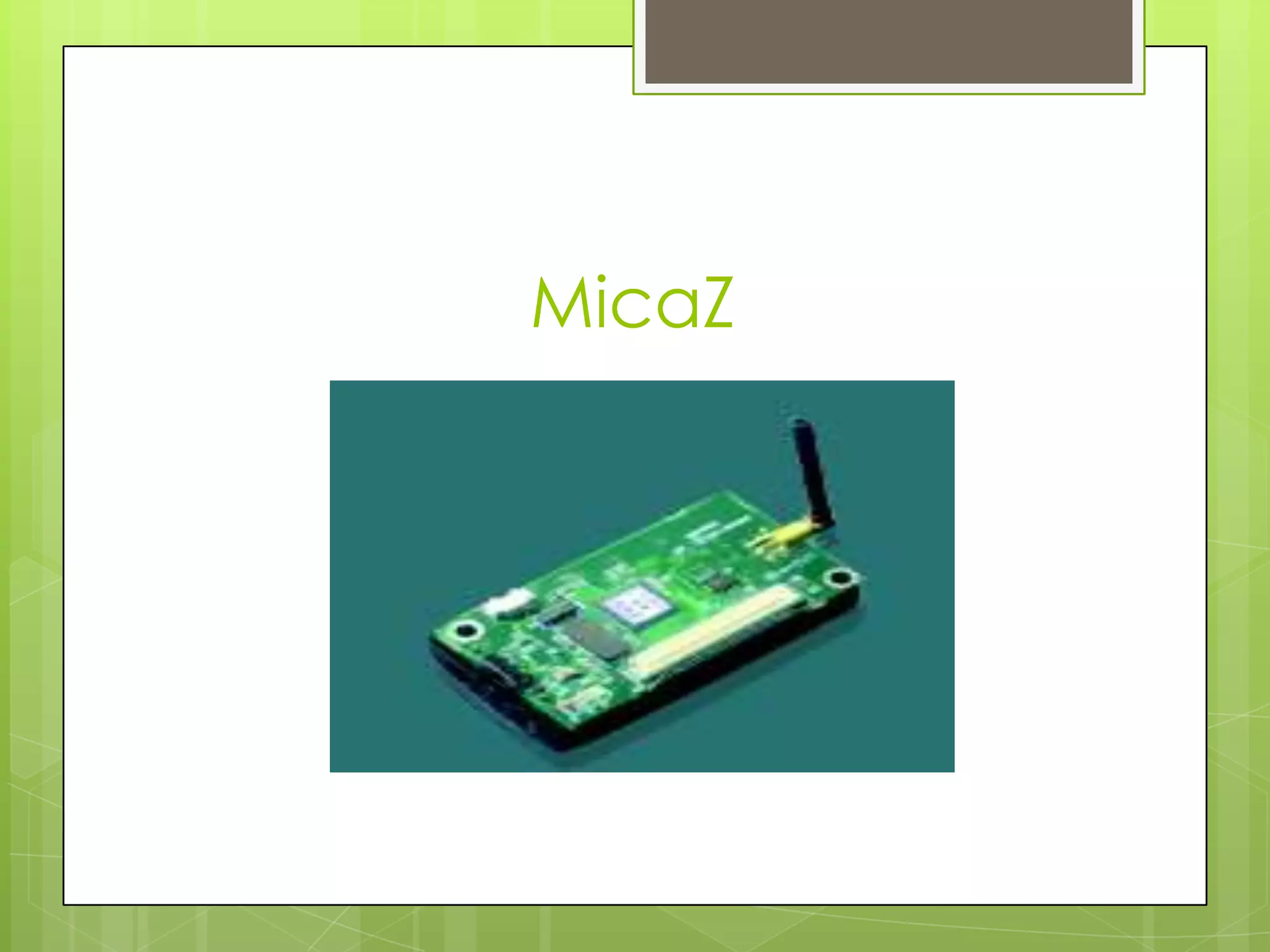
 MicaZ
 Hardware Components
 Software Components
 TelosB
 Specifications
 MicaZ vs. TelosB
Introduction
 A sensor network contains many sensor nodes.
 A sensor node contains
microcontroller, transceiver, external
memory, power source and one or more
sensors.
 Motes are building blocks of Wireless Sensor
Networks.
 The most popular motes are:
 Mica2
 MicaZ
 TelosB
MicaZ
Hardware components
 Microprocessor: Atmel ATmega128L
 7.3728 MHz clock
 128 kB of Flash for program memory
 4 kB of SRAM for data and variables
 2 UARTs
 Serial Port Interface (SPI) bus
 Dedicated hardware I2C bus
 Radio: Chipcon’s CC2420
 External serial flash memory: 512 kB
 51-pin expansion connector
 Eight 10-bit analog I/O
 21 general purpose digital I/O
 User interface: 3 programmable LEDs
 JTAG port
 Powered by two AA batteries
 1850 mAh capacity
Logger
Flash
ATMega128L
controller
Analog I/O
Digital I/O
Freq. Tunable
Radio
51-PinExpansionConnector
Antenna
MMCX connector
LEDs
Software components
 TinyOS
 it is open source, portable.
 designed for low-power wireless devices.
 supports scheduling.
 component library includes network
protocols, distributed
 services, sensor drivers, and data acquisition tools.
 Programming Environment
 Network Embedded System C (nesC): is a component-
based, event-driven programming language used to
build applications for the TinyOS platform.
 Java: Allows portable message structure handling and
used for GUI.
 Shell scripting: Frontend tool and for writing tools for
working smoothly with TinyOS environment
TelosB
Specifications
 TI MSP430 microcontroller with.
 10kB RAM
 Up to 8Mhz *8 Channels of 12bit A/D
 Extremely low power in periods of
inactivity
 Data collection and programming
via USB interface.
 Integrated onboard antenna.
 1MB external flash for data logging.
 Integrated Temperature, Light and
Humidity Sensor.
MicaZ vs. TelosB
MicaZ TeleosB
1. CC2420 IEEE 802.15.4 radio 1. CC2420 IEEE 802.15.4 radio
2. Mcu ATmega128 2. Mcu TIMSP430
3. Modular 3. Not modular
4. Sleep-30A 4. Sleep- 2.4A
5. Wakeup- 60s max 5. Wakeup- 6s max
6. Active- 8MHz 8-bit 6. Active- 4-8MHz 16-bit
7. 250 kbps data rate radio 7. 250 kbps data rate radio
Thank you!

Micaz and TelosB

  • 1.
  • 2.
    AGENDA  Introduction  MicaZ Hardware Components  Software Components  TelosB  Specifications  MicaZ vs. TelosB
  • 3.
    Introduction  A sensornetwork contains many sensor nodes.  A sensor node contains microcontroller, transceiver, external memory, power source and one or more sensors.  Motes are building blocks of Wireless Sensor Networks.  The most popular motes are:  Mica2  MicaZ  TelosB
  • 4.
  • 5.
    Hardware components  Microprocessor:Atmel ATmega128L  7.3728 MHz clock  128 kB of Flash for program memory  4 kB of SRAM for data and variables  2 UARTs  Serial Port Interface (SPI) bus  Dedicated hardware I2C bus  Radio: Chipcon’s CC2420  External serial flash memory: 512 kB  51-pin expansion connector  Eight 10-bit analog I/O  21 general purpose digital I/O  User interface: 3 programmable LEDs  JTAG port  Powered by two AA batteries  1850 mAh capacity Logger Flash ATMega128L controller Analog I/O Digital I/O Freq. Tunable Radio 51-PinExpansionConnector Antenna MMCX connector LEDs
  • 6.
    Software components  TinyOS it is open source, portable.  designed for low-power wireless devices.  supports scheduling.  component library includes network protocols, distributed  services, sensor drivers, and data acquisition tools.  Programming Environment  Network Embedded System C (nesC): is a component- based, event-driven programming language used to build applications for the TinyOS platform.  Java: Allows portable message structure handling and used for GUI.  Shell scripting: Frontend tool and for writing tools for working smoothly with TinyOS environment
  • 7.
  • 8.
    Specifications  TI MSP430microcontroller with.  10kB RAM  Up to 8Mhz *8 Channels of 12bit A/D  Extremely low power in periods of inactivity  Data collection and programming via USB interface.  Integrated onboard antenna.  1MB external flash for data logging.  Integrated Temperature, Light and Humidity Sensor.
  • 9.
    MicaZ vs. TelosB MicaZTeleosB 1. CC2420 IEEE 802.15.4 radio 1. CC2420 IEEE 802.15.4 radio 2. Mcu ATmega128 2. Mcu TIMSP430 3. Modular 3. Not modular 4. Sleep-30A 4. Sleep- 2.4A 5. Wakeup- 60s max 5. Wakeup- 6s max 6. Active- 8MHz 8-bit 6. Active- 4-8MHz 16-bit 7. 250 kbps data rate radio 7. 250 kbps data rate radio
  • 10.