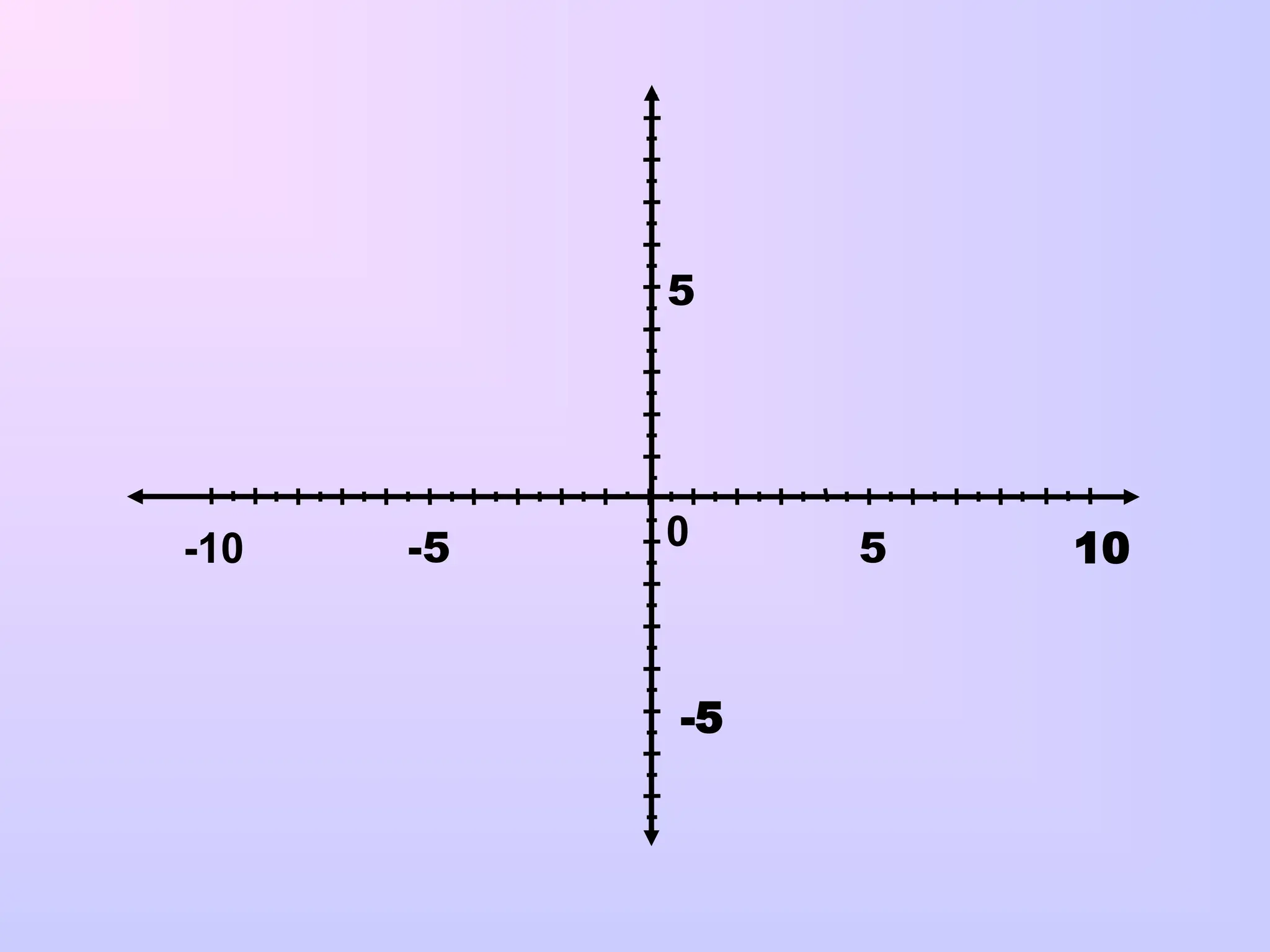
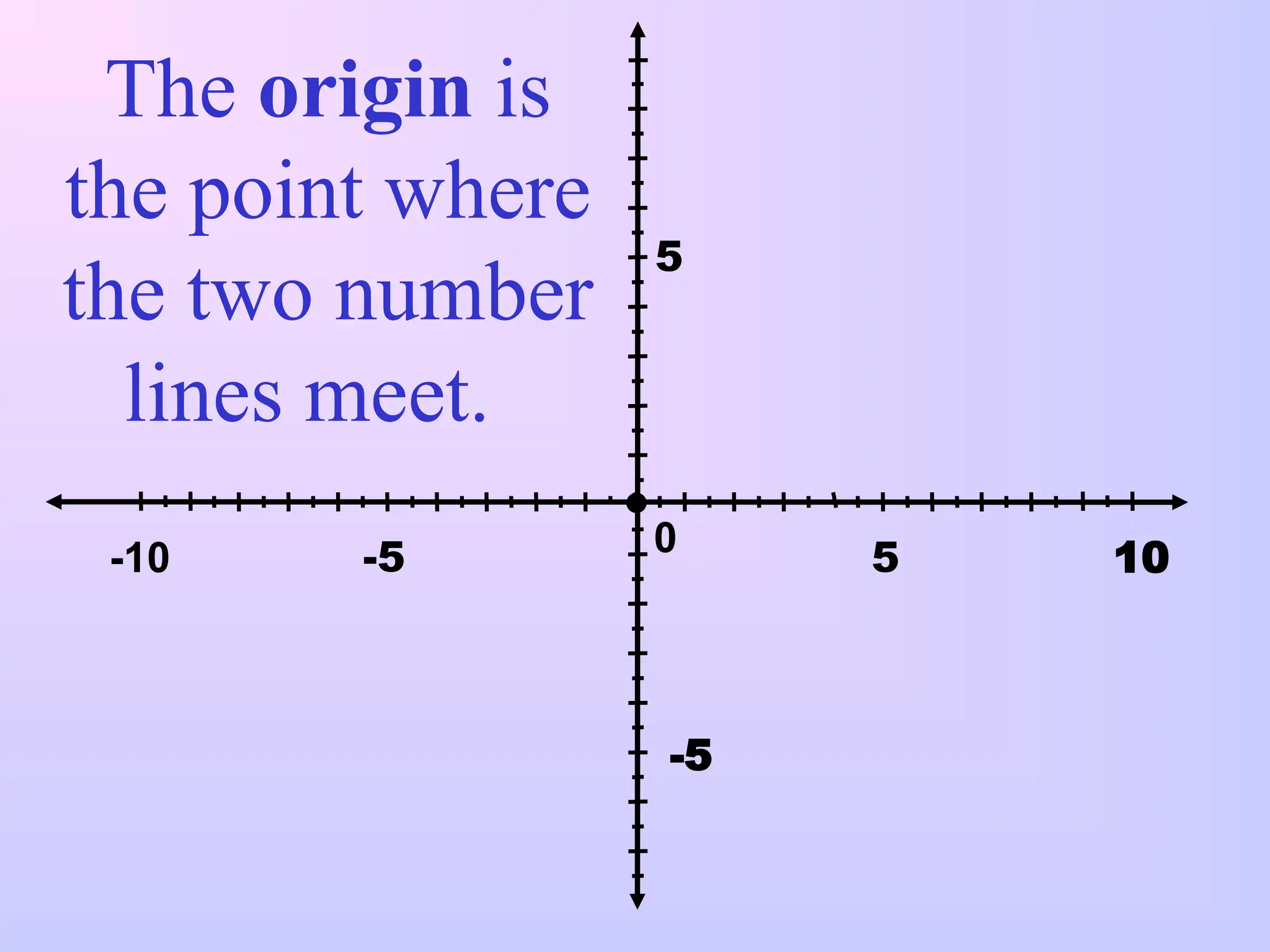
-5 5
0 10
-10
5
-5
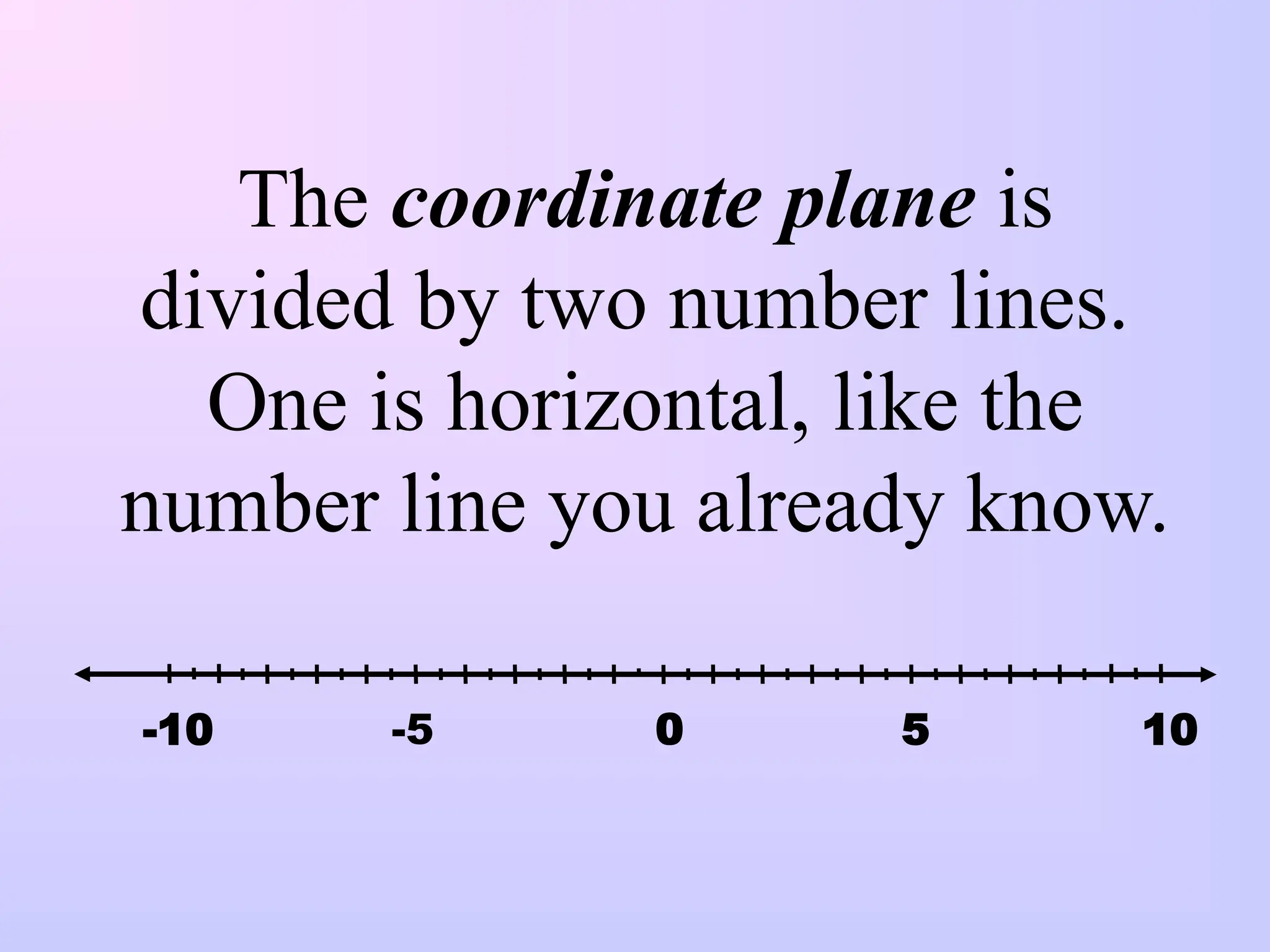
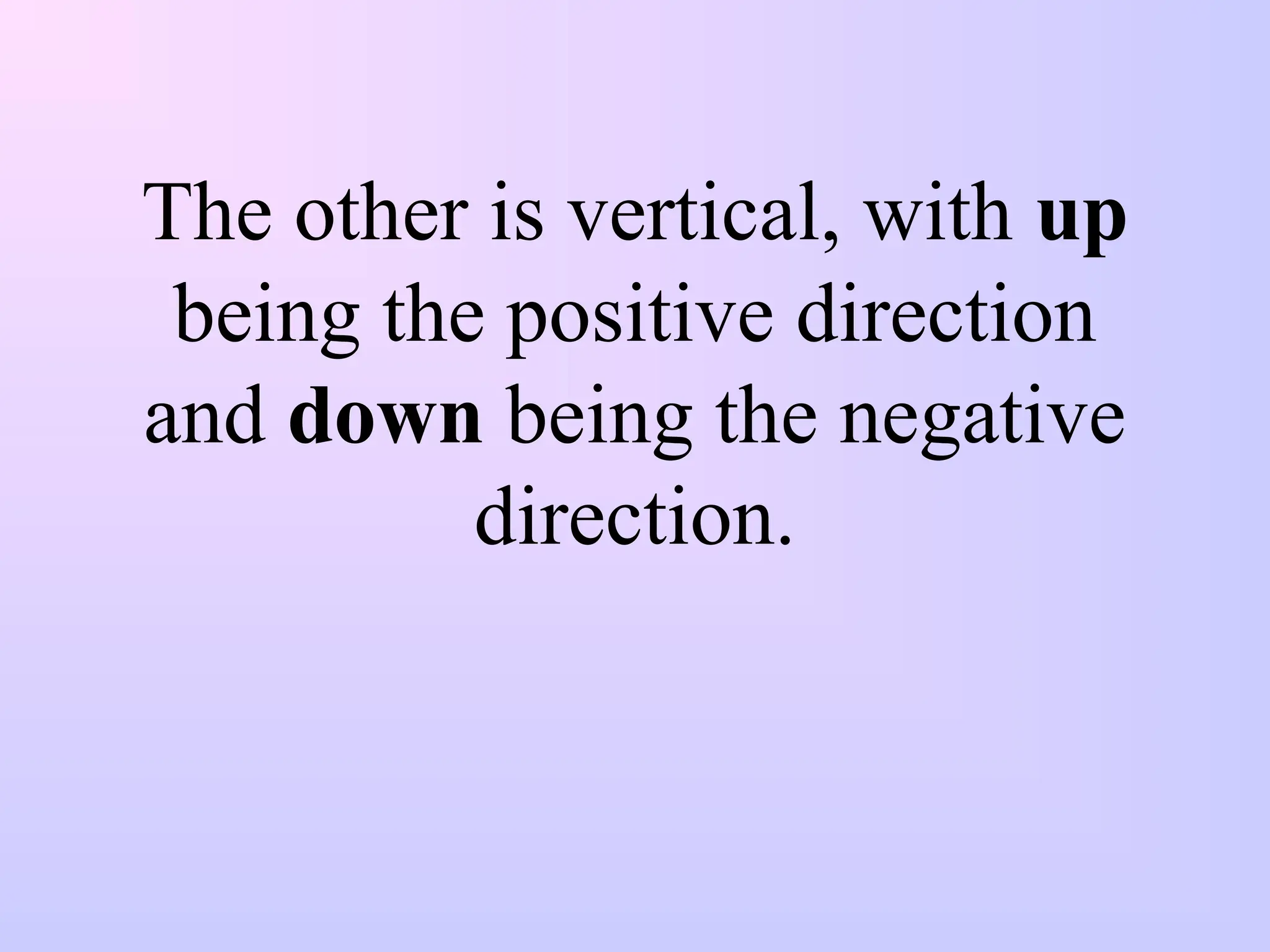
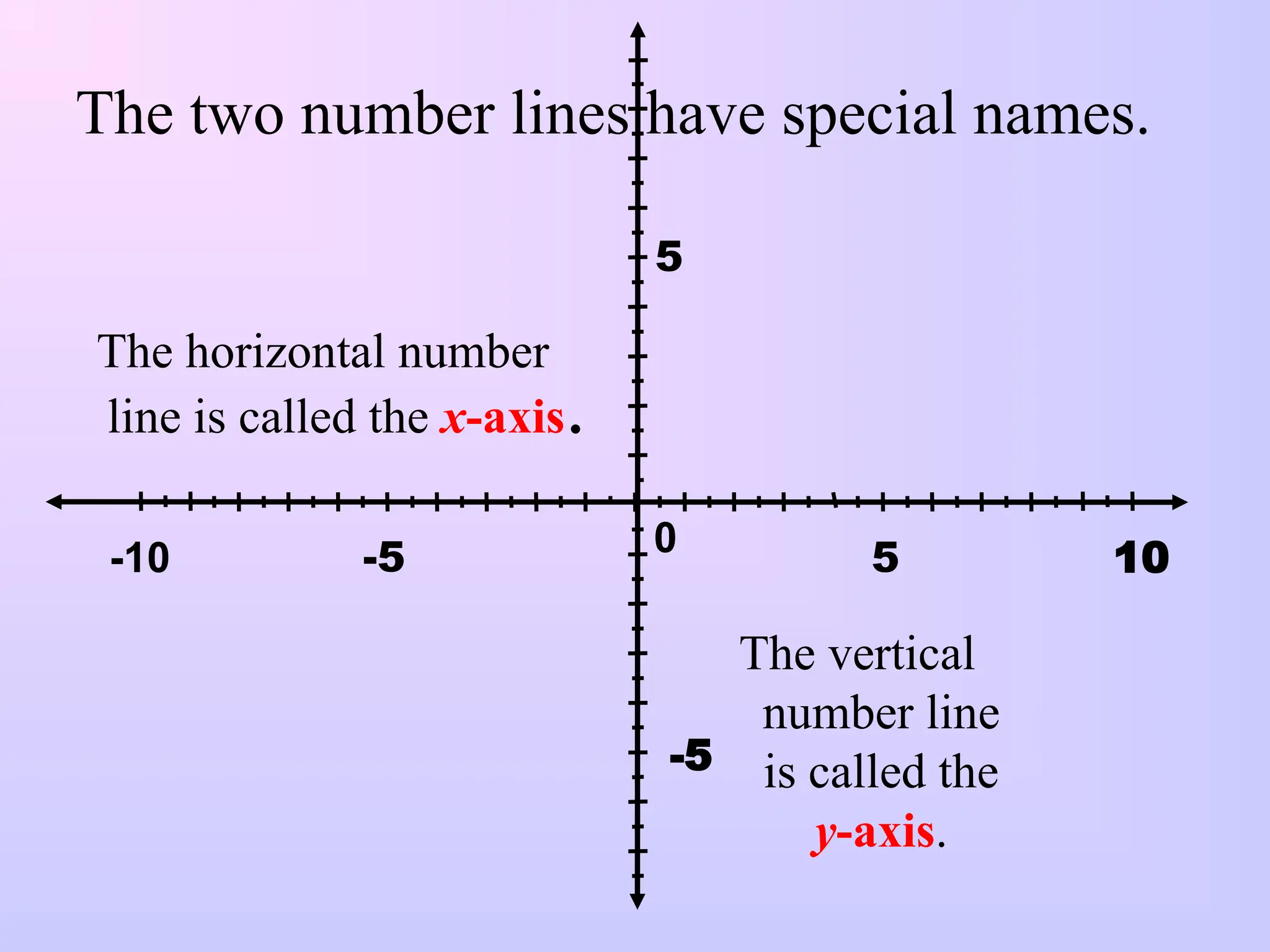
Thetwo number lines have special names.
The horizontal number
line is called the x-axis.
The vertical
number line
is called the
y-axis.
To study apoint, we need to
know where to find it. So we
give it coordinates.
Coordinates are like an address.
They tell you how you can get to
a point if you start at the origin.
12.
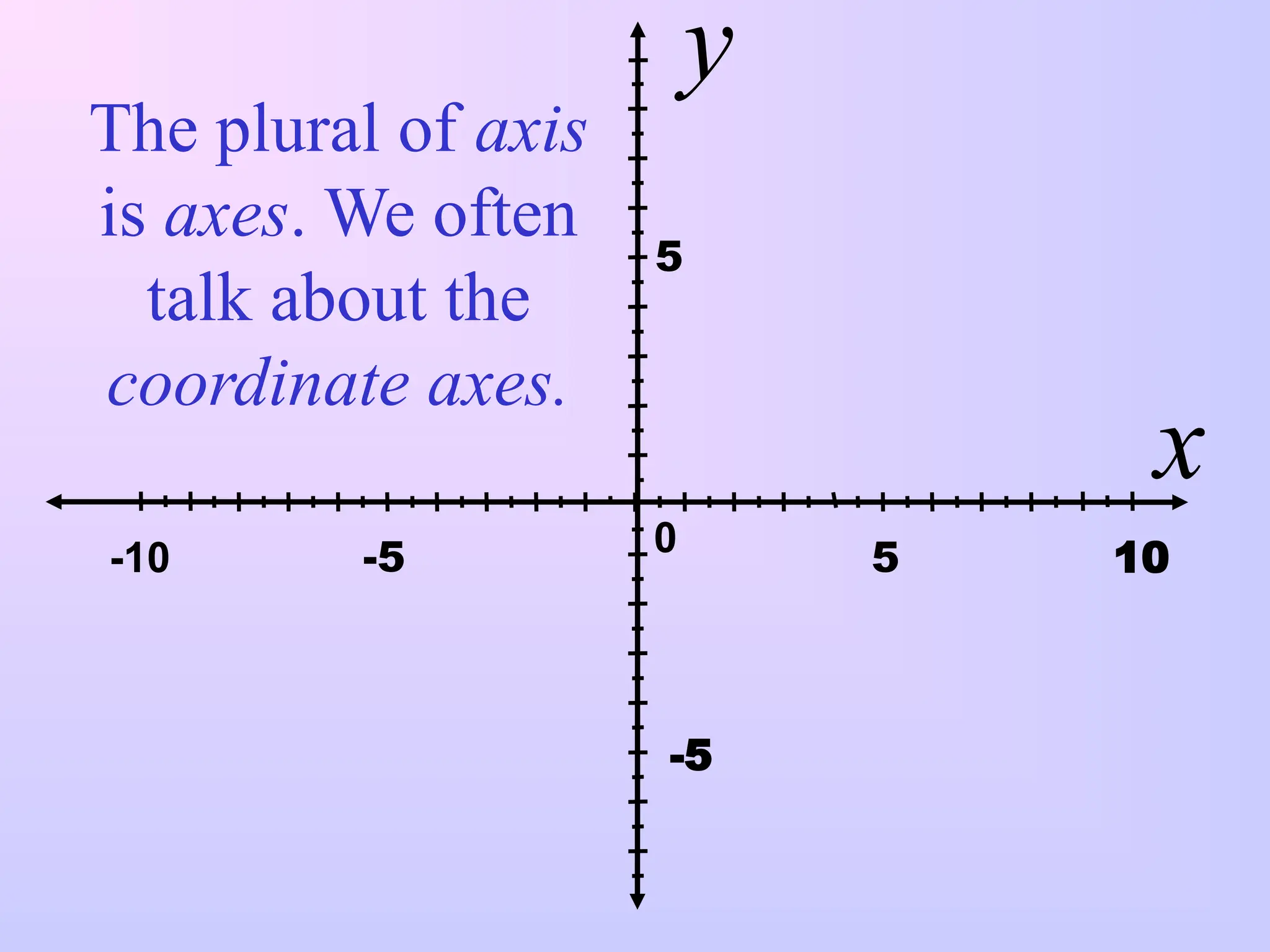
y
y
x,
x
-5 5
010
-10
5
-5
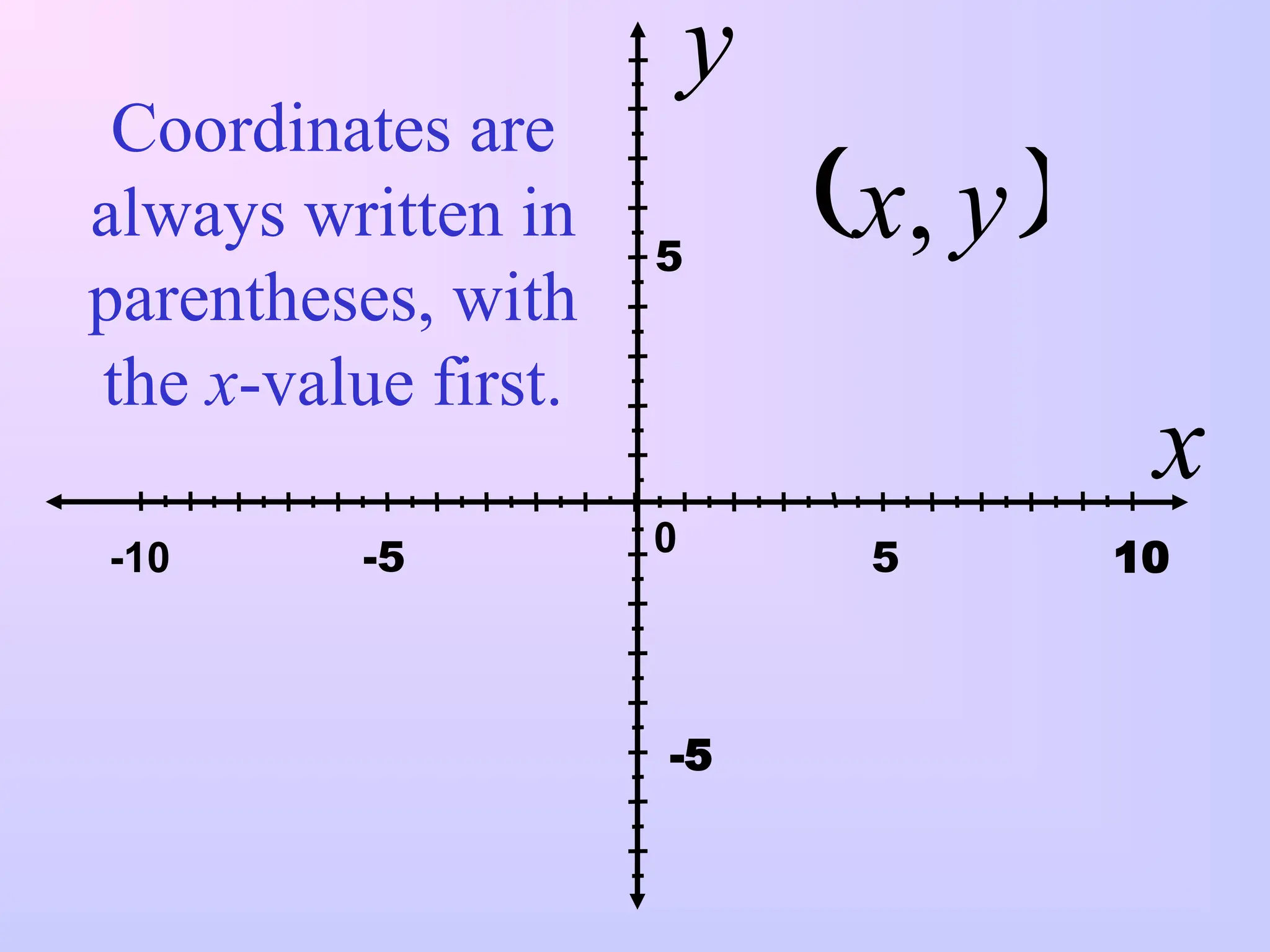
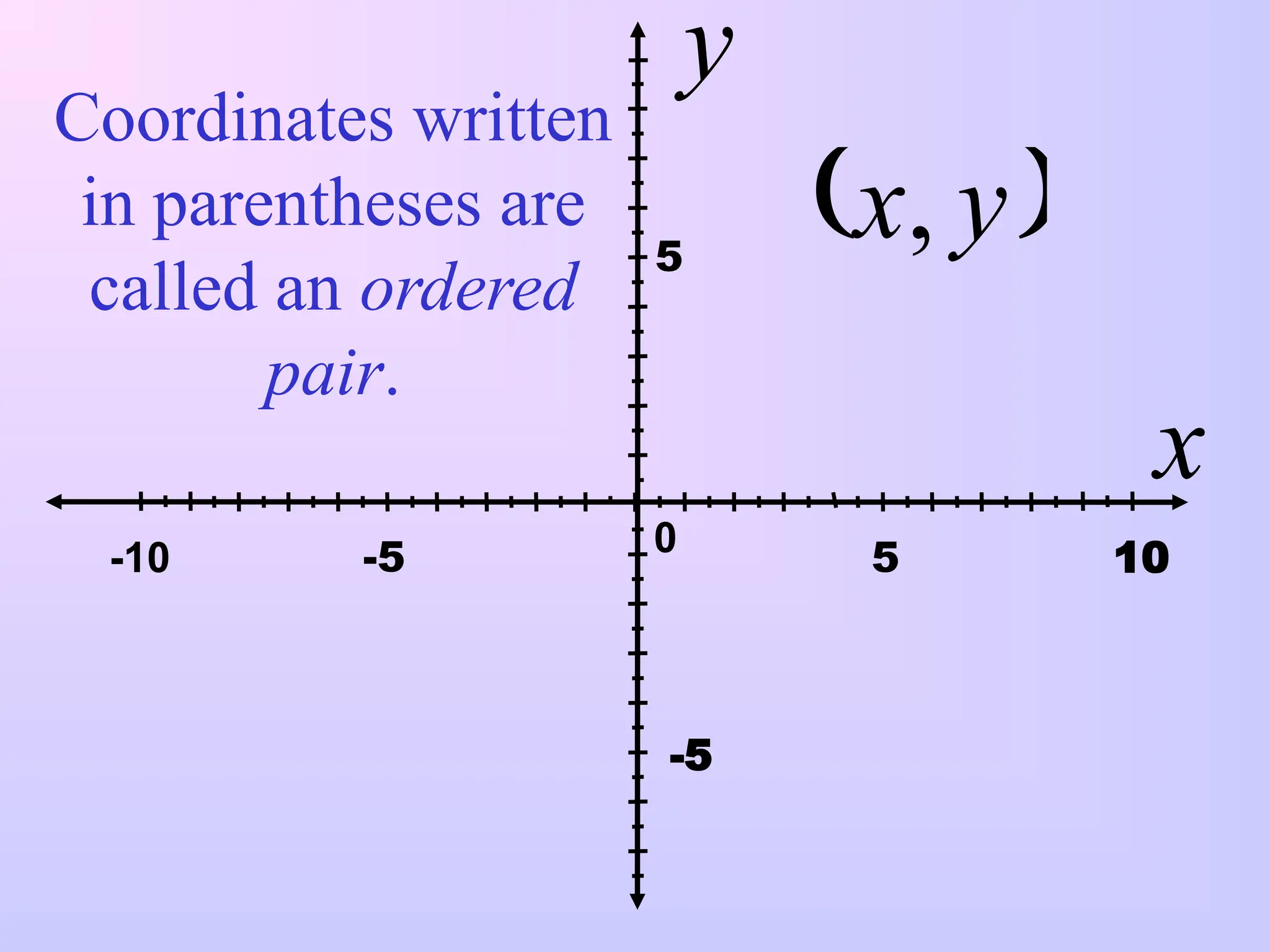
Coordinates are
always written in
parentheses, with
the x-value first.
13.
y
y
x,
x
-5 5
010
-10
5
-5
Coordinates written
in parentheses are
called an ordered
pair.
14.
-5 5
0 10
-10
5
-5
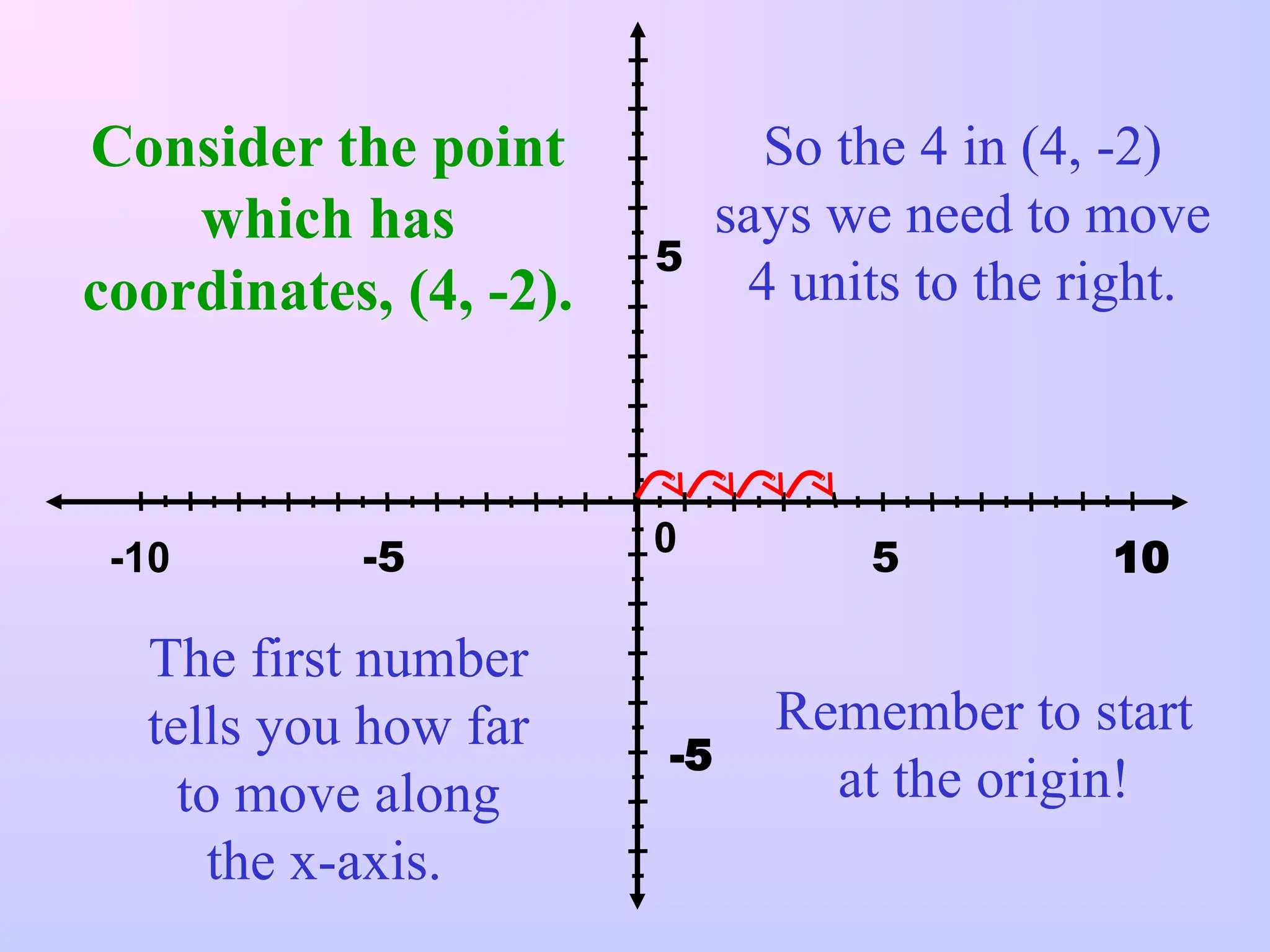
Thefirst number
tells you how far
to move along
the x-axis.
Consider the point
which has
coordinates, (4, -2).
So the 4 in (4, -2)
says we need to move
4 units to the right.
Remember to start
at the origin!
15.
2
,
4
-55
0 10
-10
5
-5
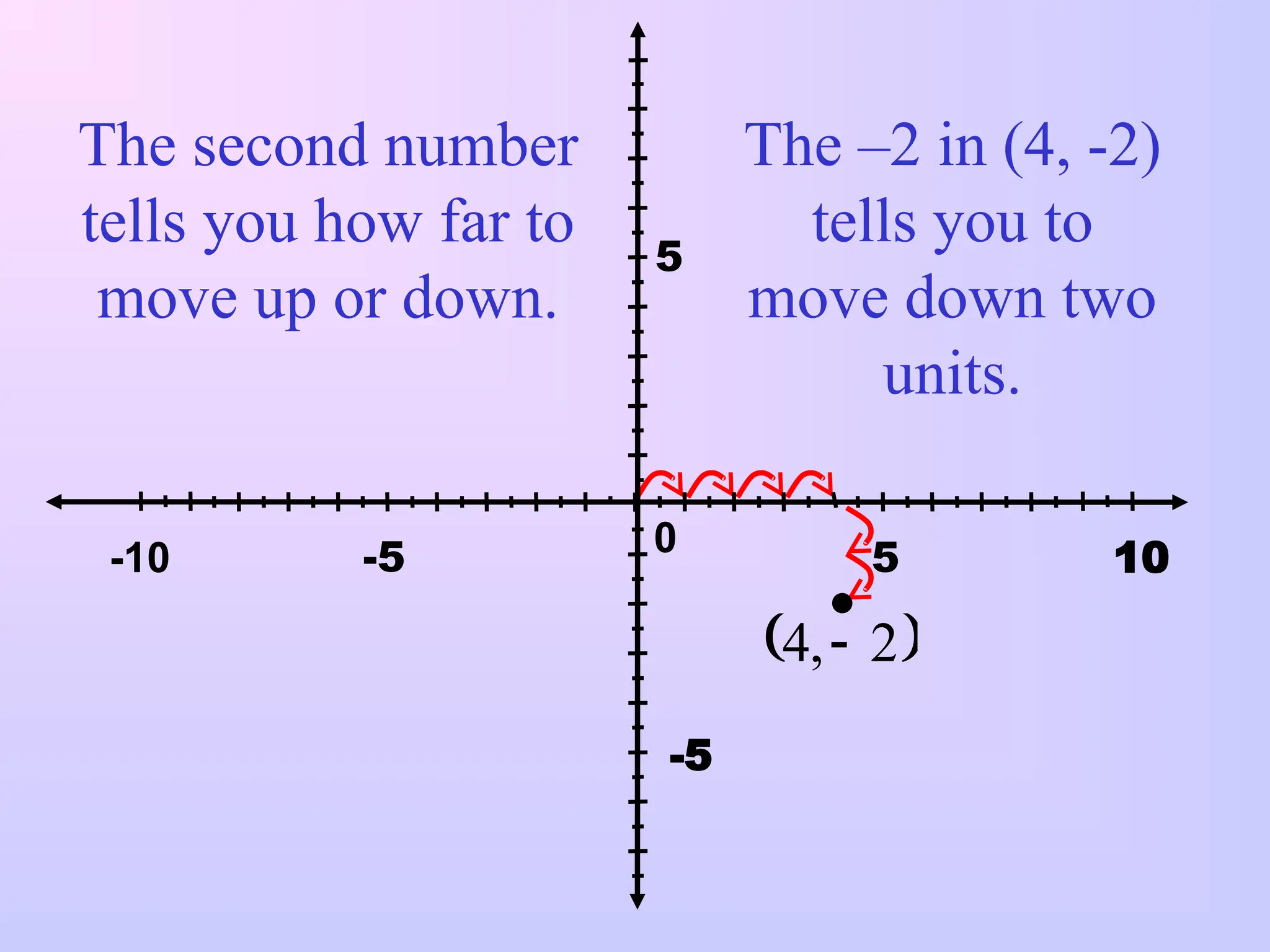
The second number
tells you how far to
move up or down.
The –2 in (4, -2)
tells you to
move down two
units.
16.
0
,
0
-5 5
010
-10
5
-5
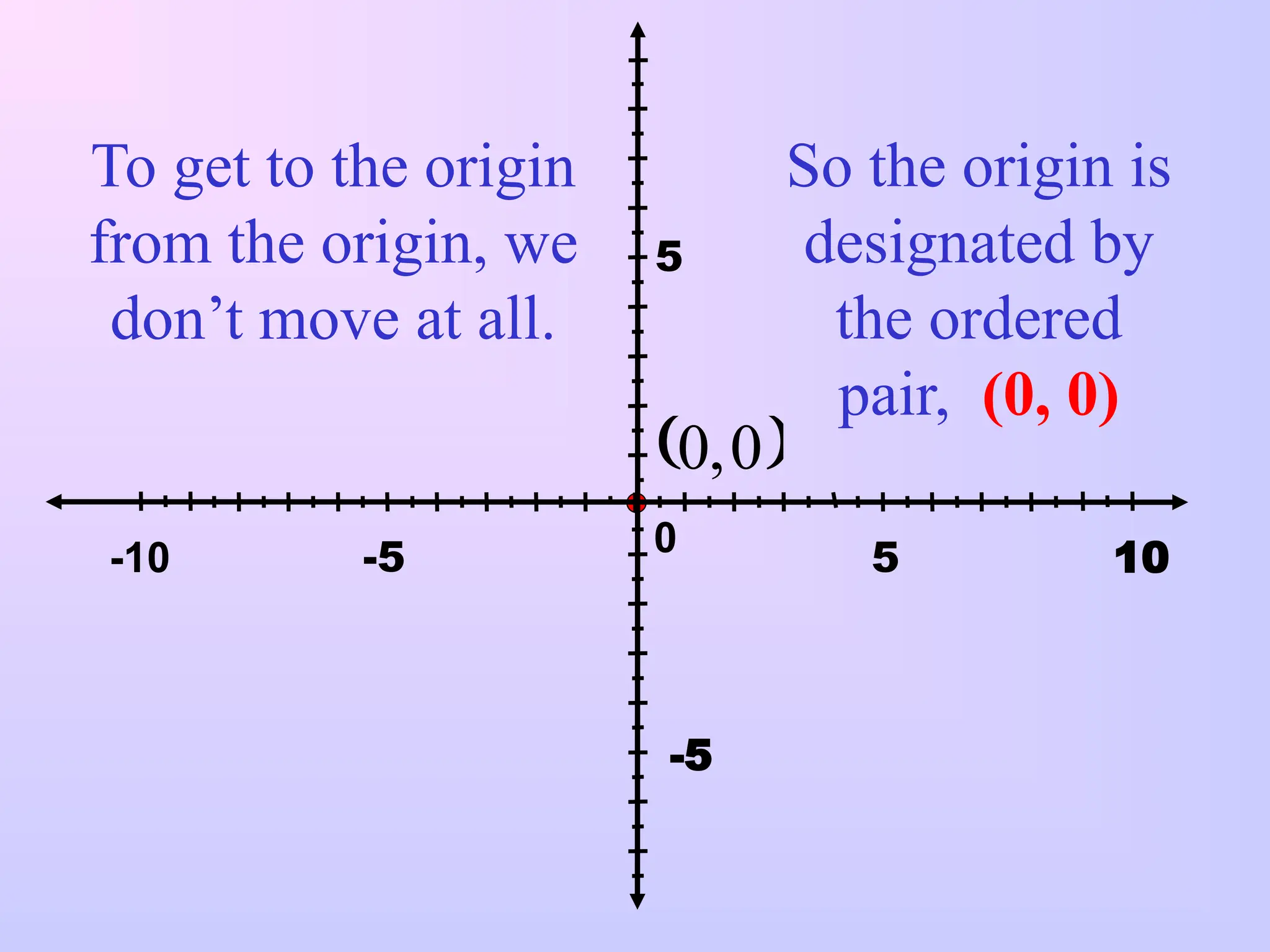
To get to the origin
from the origin, we
don’t move at all.
So the origin is
designated by
the ordered
pair, (0, 0)
17.
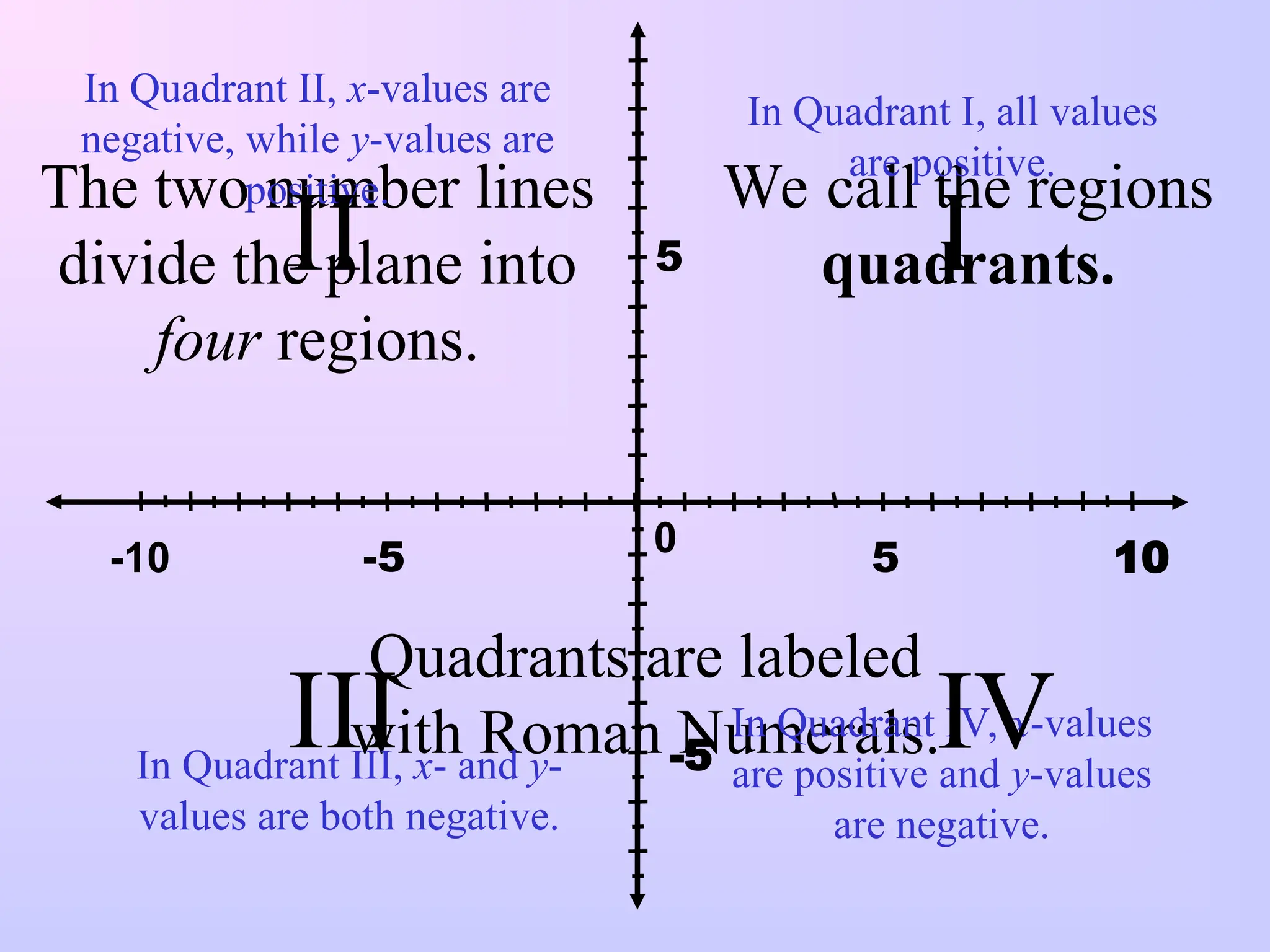
The two numberlines
divide the plane into
four regions.
Quadrants are labeled
with Roman Numerals.
We call the regions
quadrants.
In Quadrant I, all values
are positive.
In Quadrant II, x-values are
negative, while y-values are
positive.
In Quadrant III, x- and y-
values are both negative.
In Quadrant IV, x-values
are positive and y-values
are negative.
I
II
III IV
-5 5
0 10
-10
5
-5
18.
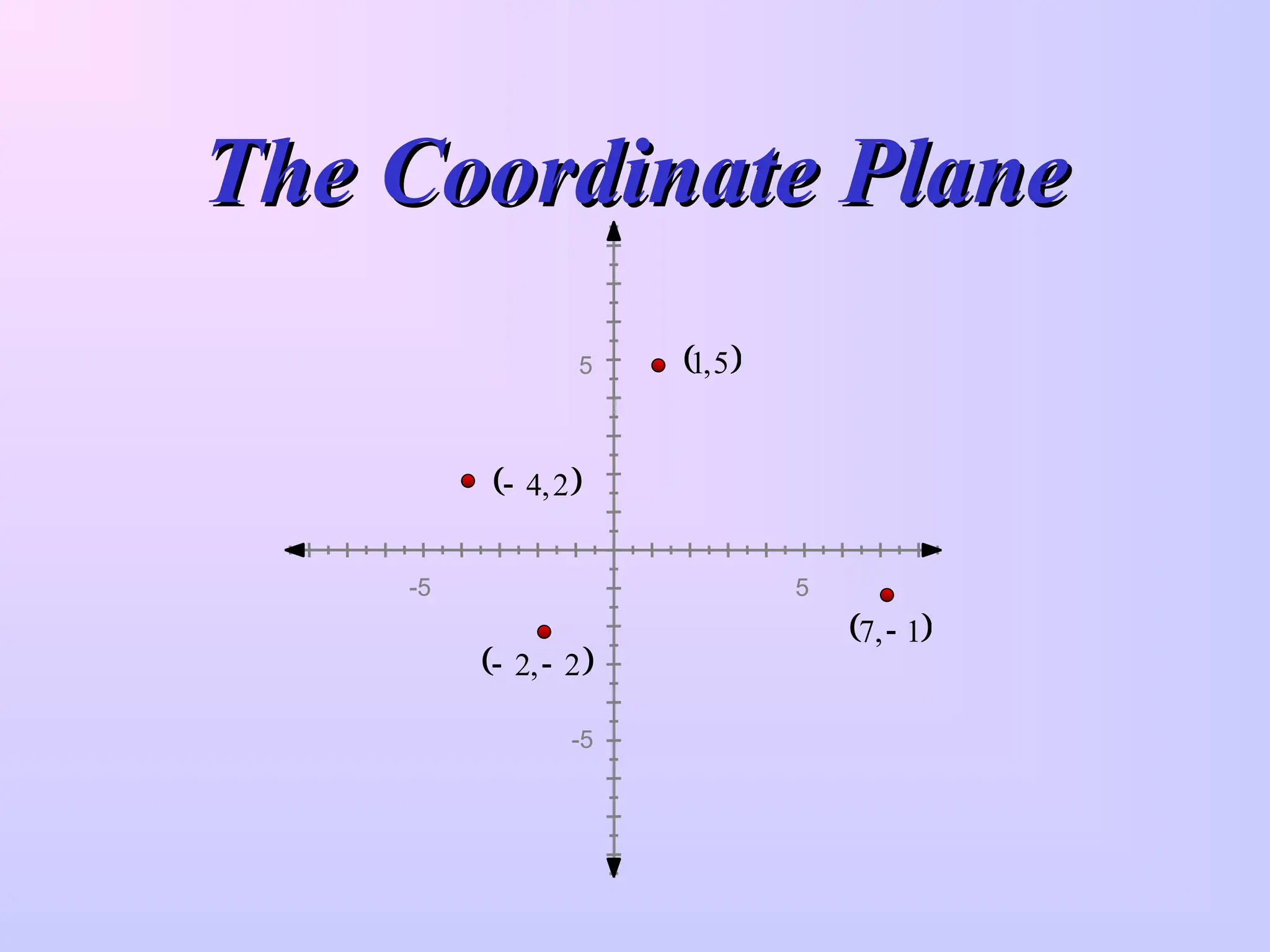
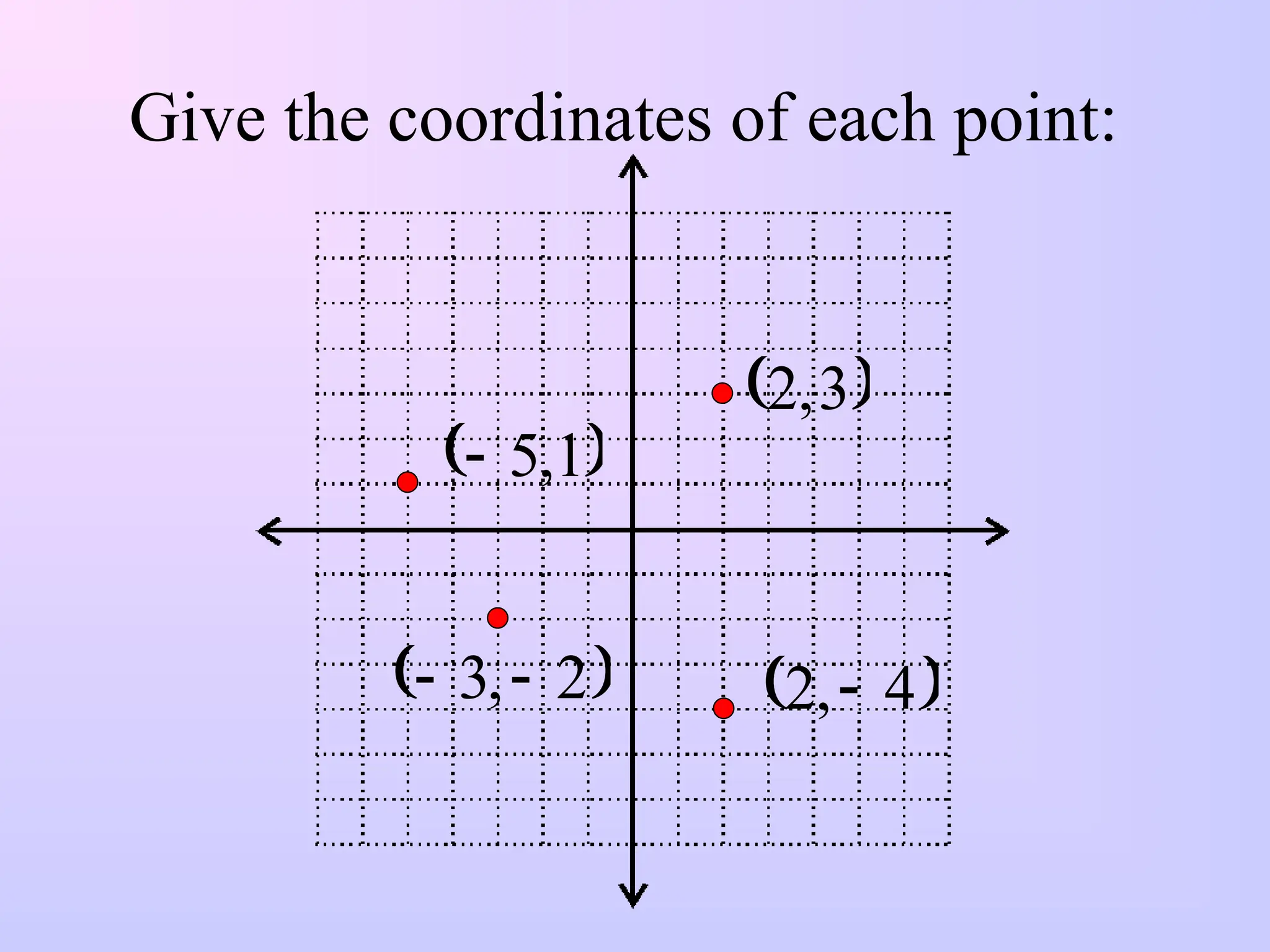
3
,
2
2
,
3
4
,
2
1
,
5
Give the coordinates of each point:
19.
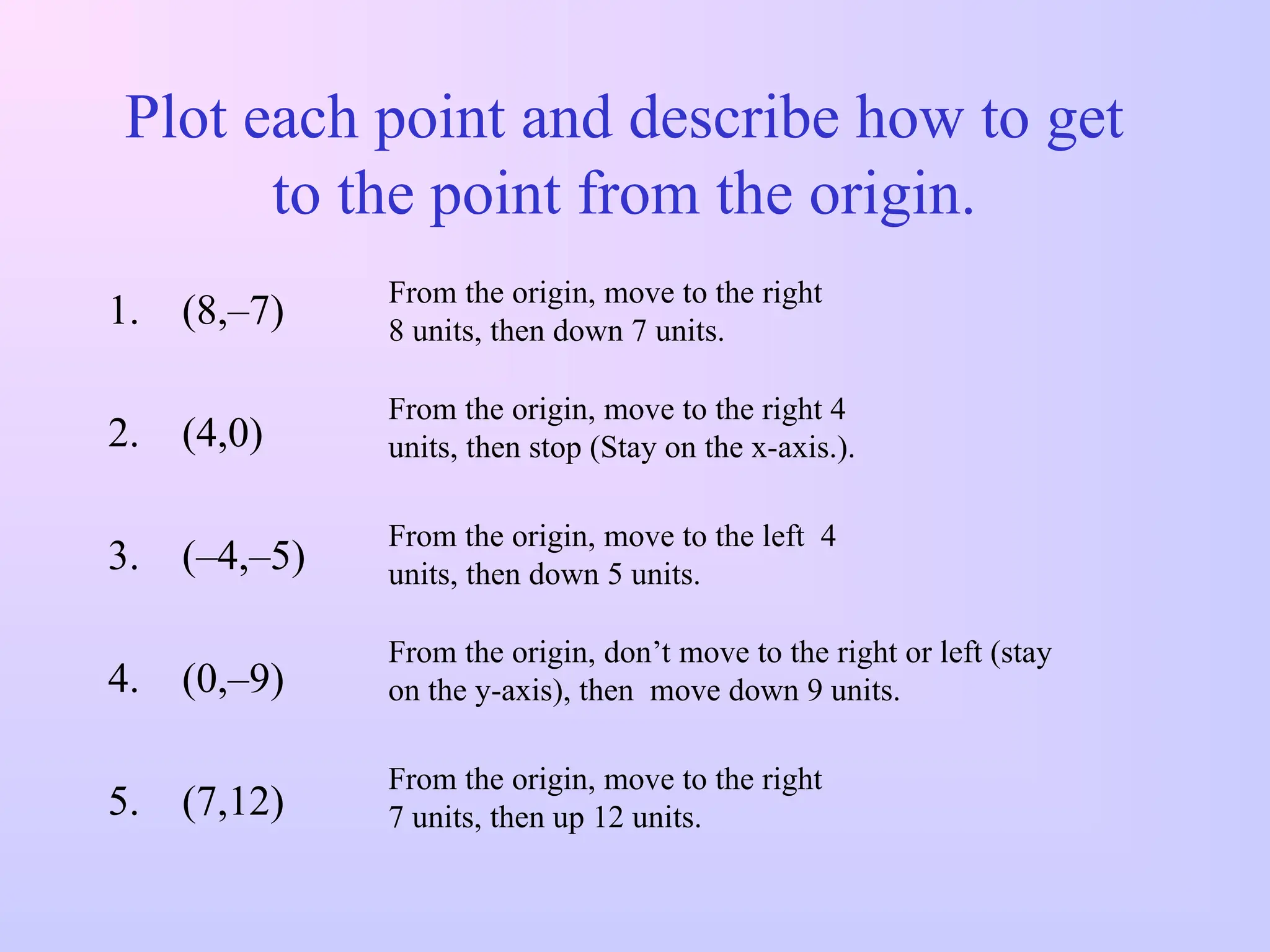
1. (8,–7)
2. (4,0)
3.(–4,–5)
4. (0,–9)
5. (7,12)
Plot each point and describe how to get
to the point from the origin.
From the origin, move to the right
8 units, then down 7 units.
From the origin, move to the right 4
units, then stop (Stay on the x-axis.).
From the origin, move to the left 4
units, then down 5 units.
From the origin, don’t move to the right or left (stay
on the y-axis), then move down 9 units.
From the origin, move to the right
7 units, then up 12 units.


![[DSC Europe 25] Danica Soc - The Science Behind Marketing: Experimentation me...](https://cdn.slidesharecdn.com/ss_thumbnails/c0nofsggs9gw5ucmallr-3-251216103155-56bd64d1-thumbnail.jpg?width=640&height=640&fit=bounds)


![[DSC Europe 25] Katherine Forrest - AI NOW: Understanding the Velocity of Cha...](https://cdn.slidesharecdn.com/ss_thumbnails/wvvbruqfrci0sfq9xwgb-4-251212104007-e5ad1987-thumbnail.jpg?width=640&height=640&fit=bounds)


![[DSC Europe 25] Branko Urosevic -Rethinking Financial Talent: Integrating Cod...](https://cdn.slidesharecdn.com/ss_thumbnails/8jjrus8ttko6qj64f58f-3-251212103250-642c6374-thumbnail.jpg?width=640&height=640&fit=bounds)
![[DSC Europe 25] Behzad Hosseini - AI Agents in the Wild: Deploying Models tha...](https://cdn.slidesharecdn.com/ss_thumbnails/3qtejajvsjqrzwfept2c-10-251212103250-7f2b1068-thumbnail.jpg?width=640&height=640&fit=bounds)
![[DSC Europe 25] Jon Dajci - Bridging TradFi and DeFi: Building the Future of ...](https://cdn.slidesharecdn.com/ss_thumbnails/fqmhfvlbqhkihjvqvhmu-7-251211083849-6af7e325-thumbnail.jpg?width=640&height=640&fit=bounds)
![[DSC Europe 25] Hans Kleinsman - The Compliance Gearbox: How Tax Tech Mediate...](https://cdn.slidesharecdn.com/ss_thumbnails/dxdytie1toel0hr90bjs-2-251212103250-174fdbe7-thumbnail.jpg?width=640&height=640&fit=bounds)


![[DSC Europe 25] Bassam Maharmeh - Artificial Intelligence: Opportunities and ...](https://cdn.slidesharecdn.com/ss_thumbnails/thhfmr2fqpawzj7hsjpg-5-251211083048-2c23204f-thumbnail.jpg?width=640&height=640&fit=bounds)
![[DSC Europe 25] Kaja Kandare - LLM as a judge.pptx](https://cdn.slidesharecdn.com/ss_thumbnails/arxyccaxsdsd1ba99wjw-7-251212104007-2b4e3f64-thumbnail.jpg?width=640&height=640&fit=bounds)
