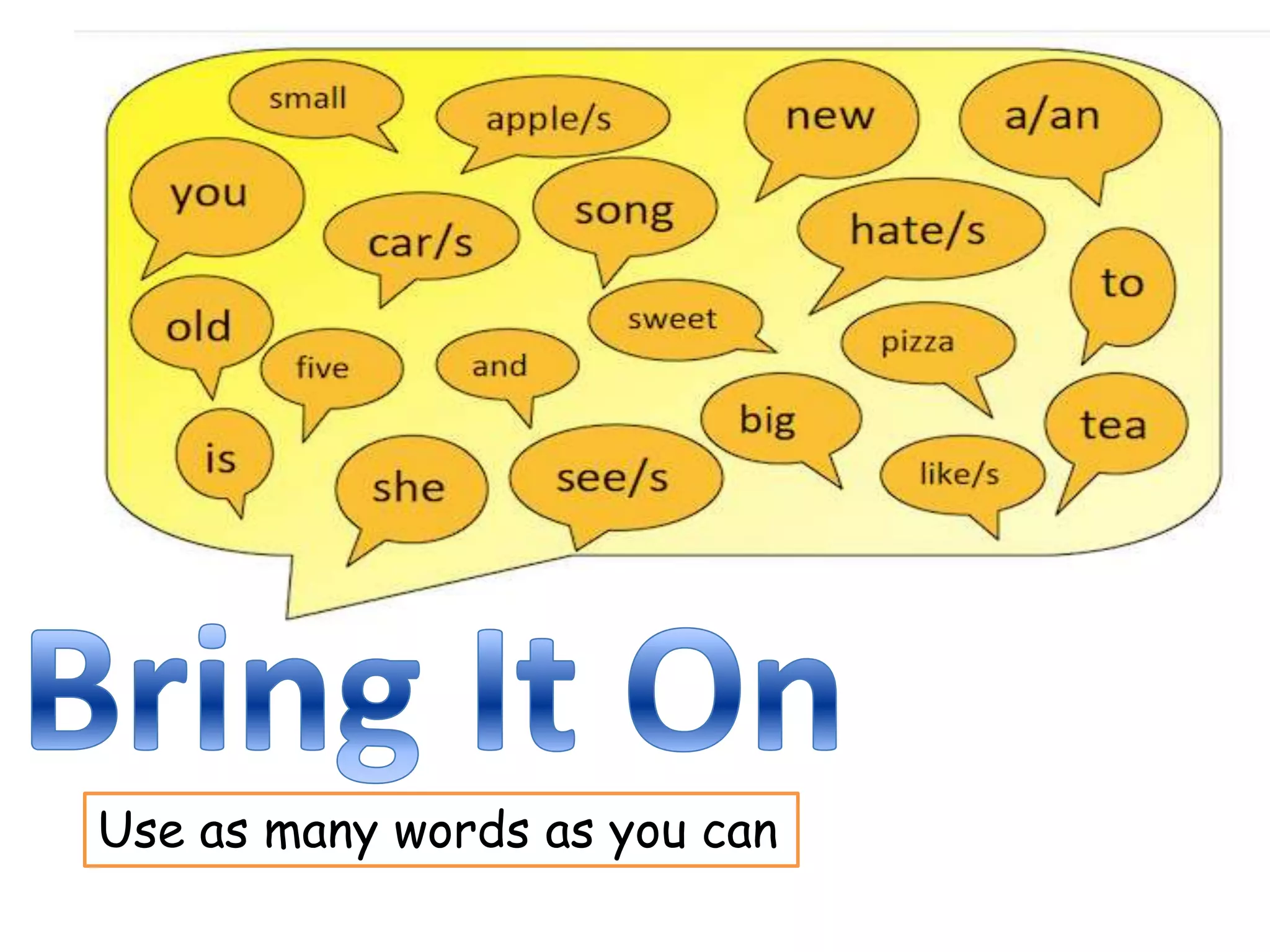
Use as many words as you can
similar to guided writing (not the
same though)and serves as
foundation for free writing.
Stresses the importance
of grammar, syntax and
mechanics
Emerge in 1940’s to 1960’s
One of the main proponents of controlled
writing is Raimes (1983), which states
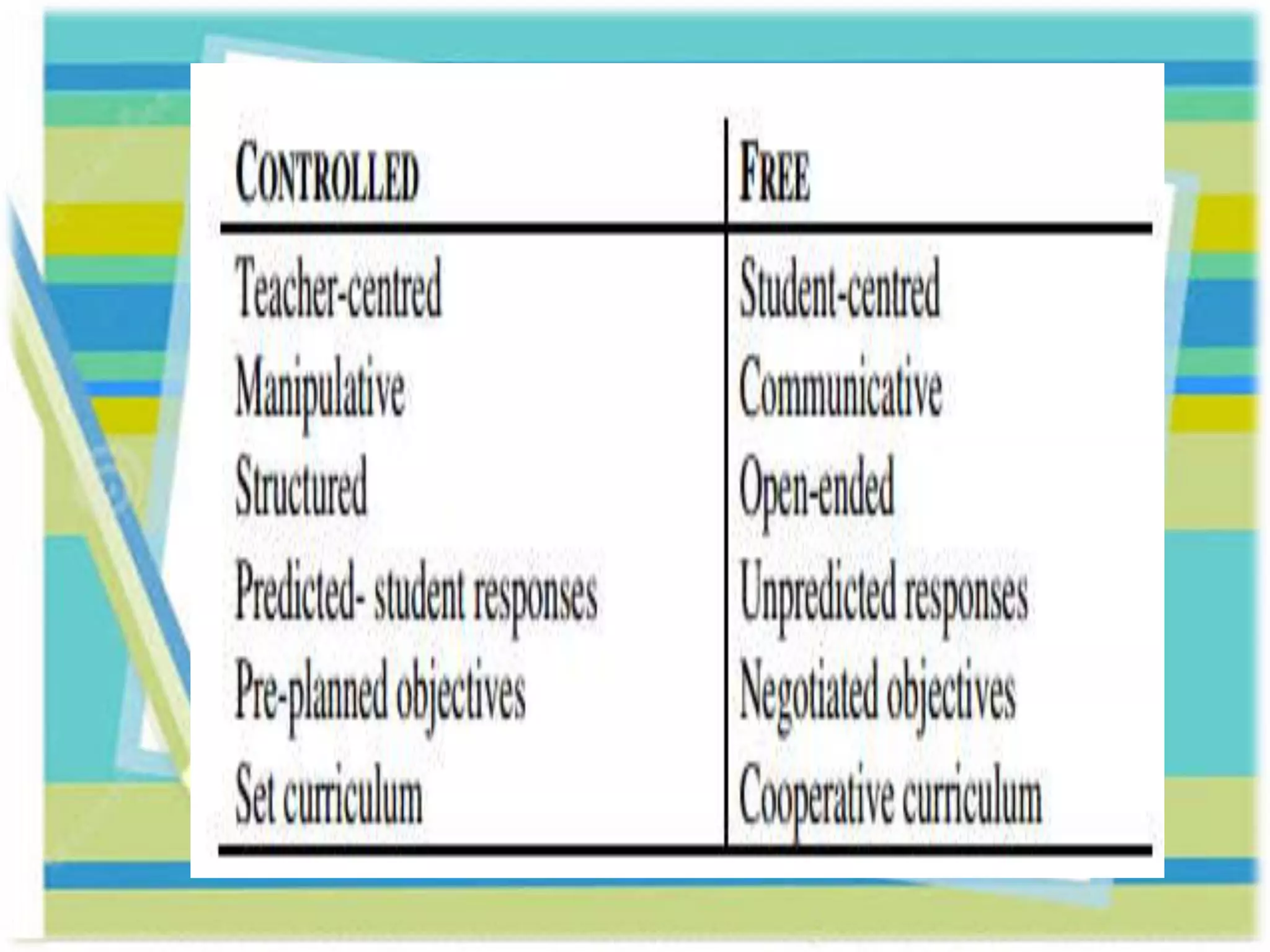
that, unlike free writing, controlled writing
takes place when learners are supplied with
“a great deal of the content and/or form
an outline to complete
a paragraph to
manipulate passage to continuemodel to follow
Silva (1990) added that controlled writing
assists in both preventing errors that
apparently occur from first language
interference and reinforcing proper use of
L2 patterns. Therefore, engaging
learners in controlled writing in L2 can
be “as an exercise in habit formation
[in which the ESL/EFL learner] is simply
a manipulator of previously learned
language structures”.
A useful tool at all levels of composition
teaching.
 Controlled writing tasks give students
focused practice in:
1. Getting words down on paper.
2. Concentrating on one or two problems at a
time.
Can fit into a writing curriculum at any
level of student ability in these places:
1. Before writing – students
practice a grammatical point or
syntactic structure within a
text and not just as a sentence
exercise.
2. After writing – when we
determine what problems
students may face and assign a
guided task to give them
practice with the problematic
areas.
CONTROLLED COMPOSITION, QUESTION
AND ANSWER, GUIDED COMPOSITION,
PARALLEL WRITING, & SENTENCE
COMBINING
Example:
Everyday Kate wakes up at 6.
She prepares breakfast for the
whole family before preparing
herself to go to work.
She drives to her workplace
which is twenty minutes away.
She takes a coffee break at 10
a.m.
Instruction: Describe Kate’s
routine last Monday, and change
the report. Start with “Last
Monday, Alice woke up at 6.”
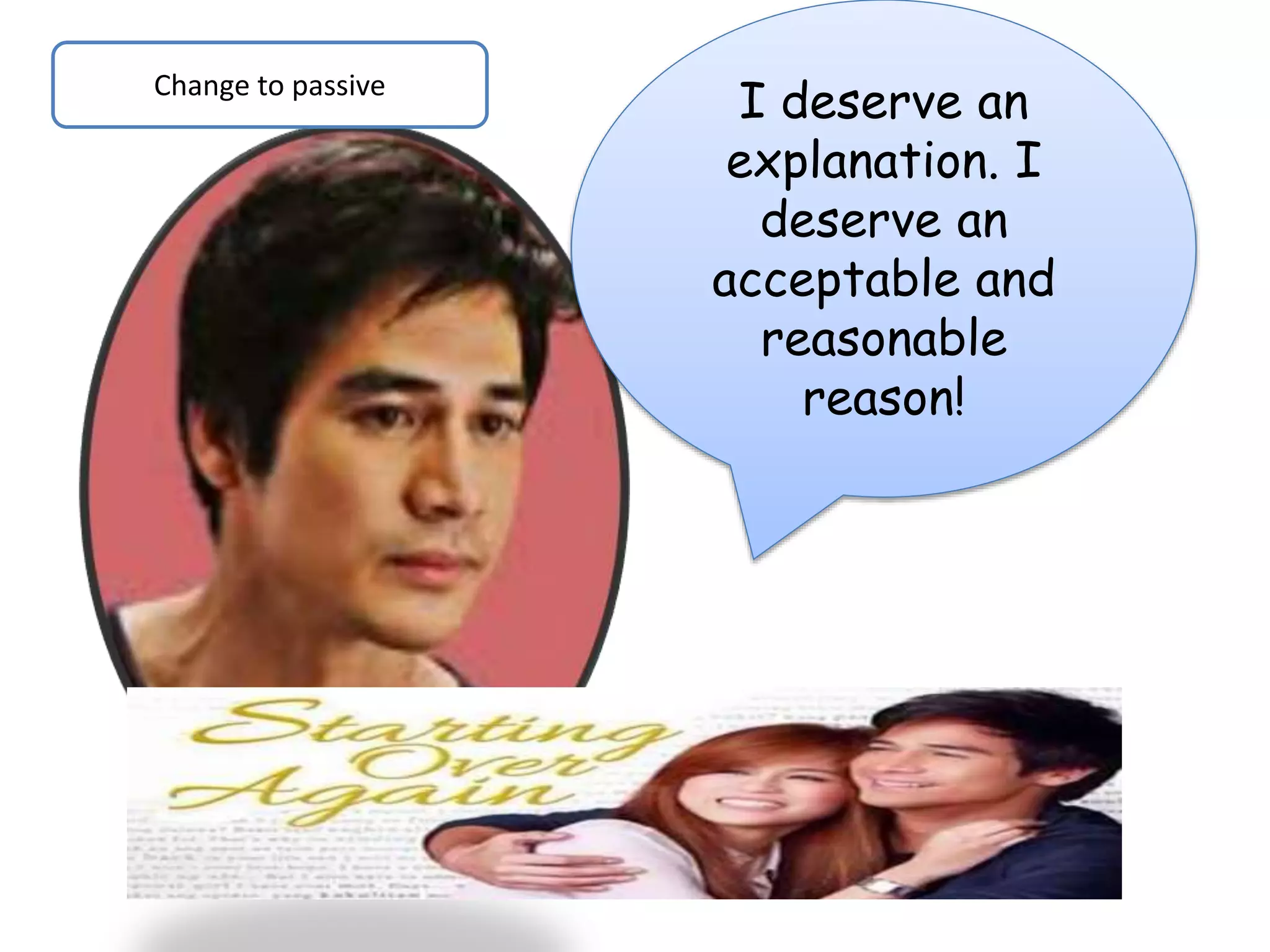
I deserve an
explanation. I
deserve an
acceptable and
reasonable
reason!
Change to passive
This format allows students a little more
freedom in structuring sentences.
Students are not given actual text they are
going to write, but rather are given a series
of questions, the answers to which form the
text.
Carefully constructed questions will produce
a coherent text.
Example:
James daily morning routine
6:00 wake up
6:05 shower
6:10 put on school uniform
6:20 eat breakfast
6:35: put on shoes
6:40 say goodbye to Mom and walk to school
Instruction:
By answering the following questions with complete
sentences, write a paragraph that describes Abu’s
daily morning routine.
1. When does Abu wake up?
2. What does he do first?
3. What does he do next?
4. What does he do then?
5. When does he eat his breakfast?
6. What does he do after breakfast?
7. What does he do before walking to school?
It is an extension of controlled composition.
Less controlled than the previous ones – provides
only some of the content and form of the
sentences students will use.
Finished products will be similar but not exactly
alike.
Students are given a first sentence, a last
sentence, an outline to fill out, a series of
questions to respond to, or information to include
in their writing.
Students can discuss, make notes, share findings
and plan strategies before they begin to write.
Example:
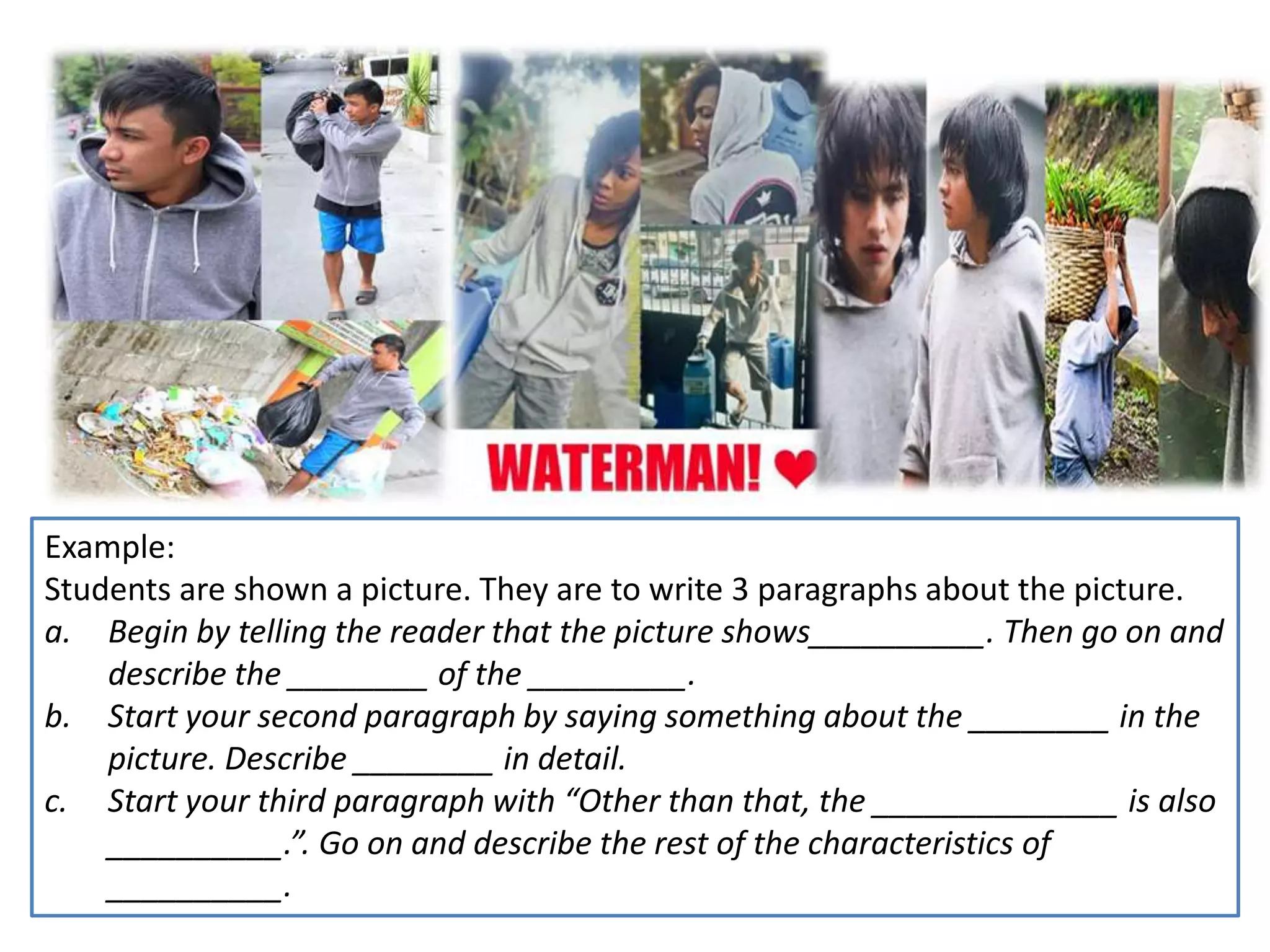
Students are shown a picture. They are to write 3 paragraphs about the picture.
a. Begin by telling the reader that the picture shows__________. Then go on and
describe the ________ of the _________.
b. Start your second paragraph by saying something about the ________ in the
picture. Describe ________ in detail.
c. Start your third paragraph with “Other than that, the ______________ is also
__________.”. Go on and describe the rest of the characteristics of
__________.
It is the combining of “base” or “kernel” sentences
into one longer compound or complex sentences.
Researchers found that sentence-combining
exercises improve students’ sentence structure,
length of sentence, and sentence variety.
A good way of introducing new language structures
without the complicated explanations and jargons.
Content is given – does not provide students
opportunity to formulate ideas, but does provide
plenty of practice with syntactic structures that are
more common in writing than in speech.
Gives students chance to use grammatical knowledge
they have to make choices about structures.
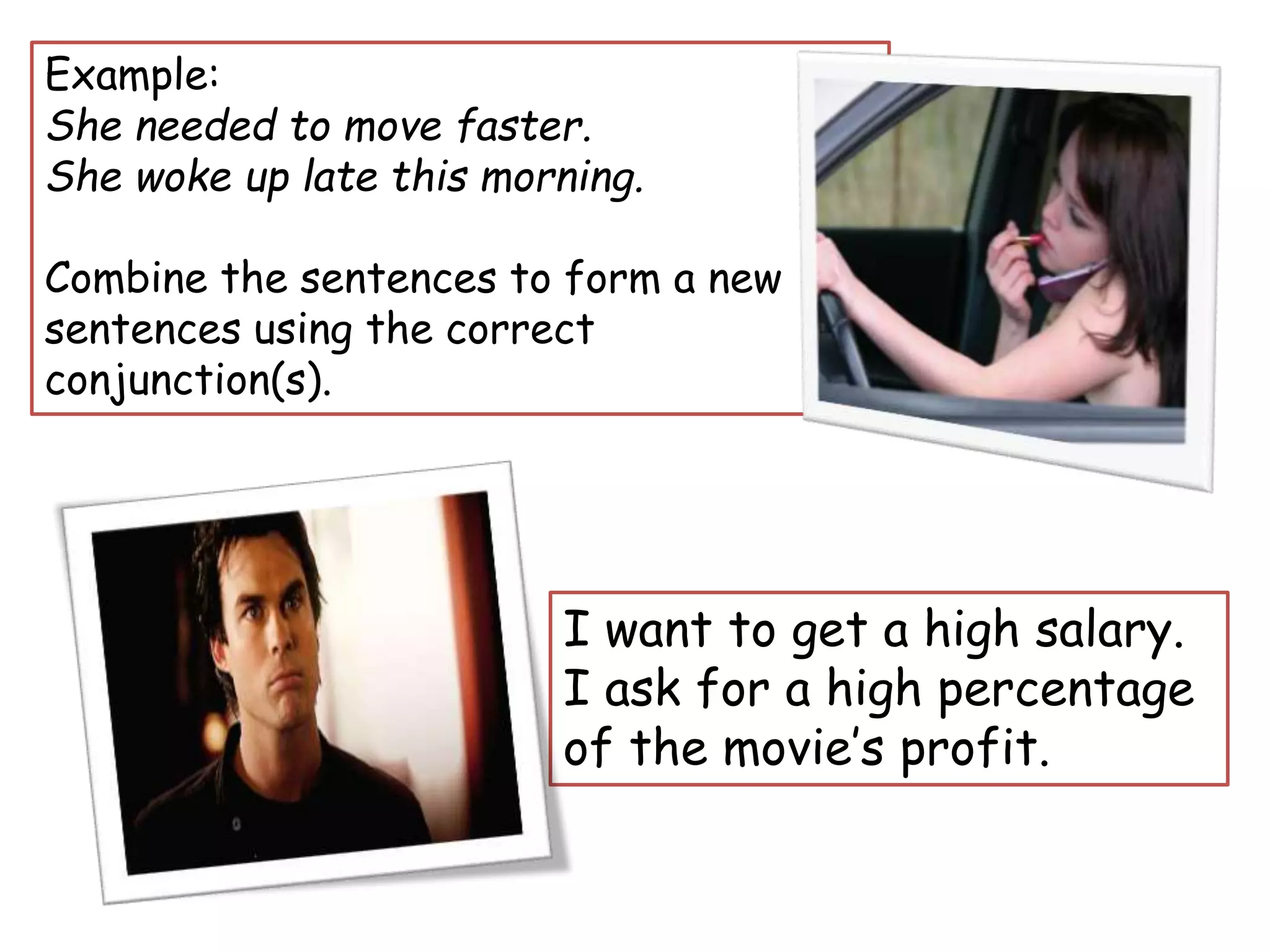
Example:
She needed to move faster.
She woke up late this morning.
Combine the sentences to form a new
sentences using the correct
conjunction(s).
I want to get a high salary.
I ask for a high percentage
of the movie’s profit.
The freest kind of controlled writing.
Students read and study a passage and then
write their own on a similar theme – use as a
guide the vocabulary, sentence structure,
cohesive device and the organization of the
model passage.
Thus, parallel writing can best be described as
rewriting with different basic information,
which again is provided.
Okay. Please close
the front gate
behind you when
you leave.I’m leavingfor
swimming
practice,
Mom. See
you later.
Rewrite the
dialogue into a
narrative.
A practical process of reinforcing grammar, vocabulary
and syntax in context (Raimes, 1983).
When the students write the passages, conventions of
written English (indentation, punctuation, connecting
words, spelling etc.) are used.
Can be used with different levels.
PROS OF CONTROLLED WRITING
Provide learners with ample
writing practice using correct
grammar forms compared to
free writing.
Allows learners to monitor
their own progress within the
parameters provided.
Can be prepared and
corrected quickly – reduces
burden on the teacher.
Helps to systematically and
gradually cover different
teaching points (Paulston,
1972).
Helen is a bilingual secretary. She has a good job with a
large corporation. Last year she worked in Los Angelos,
but this year she is working in her company’s
Washington office. Her time in California was fun; she
enjoyed going to the beach often. She has many good
memories of that year. She likes the change to
Washington, D.C., though. There is a lot to do in D.C.:
theaters, concerts, shopping.
Helen is looking for a desk lamp today. She loves to read in
the evening, but her apartment doesn’t have enough
lights. There is a large department store near her office.
This store is a good place to start, she thinks. Helen
looks at the pictures of credit cards in the store window.
Luckily, she can use the card in her wallet; payday isn’t
until Friday.
Exercise 1: Ask the students to
rewrite the story using the
first person point of view. So,
the first sentence of the story
will be: I am a bilingual
secretary.Exercise 2: Ask the students
to rewrite the story by
changing the tense into past
tense. So, the first sentence
of the story will be: Helen
was a bilingual secretary.
Conclusion
Although writing now seen also not only as a product but also a
process, it is not inherently wrong to pay attention to the criteria in
which the students will be graded. A list of criteria that is usually
included is content, organization, vocabulary use, grammatical use,
and mechanical considerations. (Brown, 2001) Based also on the
micro skills in writing stated by Brown, these controlled writing
exercises can be very useful for beginner writer in order to learn
from the model and to practice how to combine sentences and to
think in chronological order, before they move to the further stage,
which is to produce their own ideas in form of writing. As it is sated
by Sokolik in Nunan (2003) that writing is not a talent and cannot
be taught like many people believe, instead writing is a teachable
and learnable skill. Here, the instructor can play an important role
in making this skill an enjoyable one for the students.
References
Cambridge English. Retrieved from
http://www.cambridge.org/elt/blog/2015/06/controlled-
guided-writing-tasks-beginners-part-1/
http://www.slideshare.net/willys007/approaches-
to-student-writing
Controlled Writing: An Effective Traditional Practice for
Developing ELLs’ Composition. Retrieved
fromhttp://fll.univ
biskra.dz/images/pdf_revue/revue14_15/nemou
chi%20abdel%20hak%202.pdf

Controlled writing

  • 2.
    Use as manywords as you can
  • 4.
    similar to guidedwriting (not the same though)and serves as foundation for free writing. Stresses the importance of grammar, syntax and mechanics Emerge in 1940’s to 1960’s
  • 5.
    One of themain proponents of controlled writing is Raimes (1983), which states that, unlike free writing, controlled writing takes place when learners are supplied with “a great deal of the content and/or form an outline to complete a paragraph to manipulate passage to continuemodel to follow
  • 6.
    Silva (1990) addedthat controlled writing assists in both preventing errors that apparently occur from first language interference and reinforcing proper use of L2 patterns. Therefore, engaging learners in controlled writing in L2 can be “as an exercise in habit formation [in which the ESL/EFL learner] is simply a manipulator of previously learned language structures”.
  • 7.
    A useful toolat all levels of composition teaching.  Controlled writing tasks give students focused practice in: 1. Getting words down on paper. 2. Concentrating on one or two problems at a time.
  • 8.
    Can fit intoa writing curriculum at any level of student ability in these places: 1. Before writing – students practice a grammatical point or syntactic structure within a text and not just as a sentence exercise. 2. After writing – when we determine what problems students may face and assign a guided task to give them practice with the problematic areas.
  • 10.
    CONTROLLED COMPOSITION, QUESTION ANDANSWER, GUIDED COMPOSITION, PARALLEL WRITING, & SENTENCE COMBINING
  • 12.
    Example: Everyday Kate wakesup at 6. She prepares breakfast for the whole family before preparing herself to go to work. She drives to her workplace which is twenty minutes away. She takes a coffee break at 10 a.m. Instruction: Describe Kate’s routine last Monday, and change the report. Start with “Last Monday, Alice woke up at 6.”
  • 13.
    I deserve an explanation.I deserve an acceptable and reasonable reason! Change to passive
  • 14.
    This format allowsstudents a little more freedom in structuring sentences. Students are not given actual text they are going to write, but rather are given a series of questions, the answers to which form the text. Carefully constructed questions will produce a coherent text.
  • 15.
    Example: James daily morningroutine 6:00 wake up 6:05 shower 6:10 put on school uniform 6:20 eat breakfast 6:35: put on shoes 6:40 say goodbye to Mom and walk to school Instruction: By answering the following questions with complete sentences, write a paragraph that describes Abu’s daily morning routine. 1. When does Abu wake up? 2. What does he do first? 3. What does he do next? 4. What does he do then? 5. When does he eat his breakfast? 6. What does he do after breakfast? 7. What does he do before walking to school?
  • 16.
    It is anextension of controlled composition. Less controlled than the previous ones – provides only some of the content and form of the sentences students will use. Finished products will be similar but not exactly alike. Students are given a first sentence, a last sentence, an outline to fill out, a series of questions to respond to, or information to include in their writing. Students can discuss, make notes, share findings and plan strategies before they begin to write.
  • 17.
    Example: Students are showna picture. They are to write 3 paragraphs about the picture. a. Begin by telling the reader that the picture shows__________. Then go on and describe the ________ of the _________. b. Start your second paragraph by saying something about the ________ in the picture. Describe ________ in detail. c. Start your third paragraph with “Other than that, the ______________ is also __________.”. Go on and describe the rest of the characteristics of __________.
  • 18.
    It is thecombining of “base” or “kernel” sentences into one longer compound or complex sentences. Researchers found that sentence-combining exercises improve students’ sentence structure, length of sentence, and sentence variety. A good way of introducing new language structures without the complicated explanations and jargons. Content is given – does not provide students opportunity to formulate ideas, but does provide plenty of practice with syntactic structures that are more common in writing than in speech. Gives students chance to use grammatical knowledge they have to make choices about structures.
  • 19.
    Example: She needed tomove faster. She woke up late this morning. Combine the sentences to form a new sentences using the correct conjunction(s). I want to get a high salary. I ask for a high percentage of the movie’s profit.
  • 20.
    The freest kindof controlled writing. Students read and study a passage and then write their own on a similar theme – use as a guide the vocabulary, sentence structure, cohesive device and the organization of the model passage. Thus, parallel writing can best be described as rewriting with different basic information, which again is provided.
  • 21.
    Okay. Please close thefront gate behind you when you leave.I’m leavingfor swimming practice, Mom. See you later. Rewrite the dialogue into a narrative.
  • 22.
    A practical processof reinforcing grammar, vocabulary and syntax in context (Raimes, 1983). When the students write the passages, conventions of written English (indentation, punctuation, connecting words, spelling etc.) are used. Can be used with different levels. PROS OF CONTROLLED WRITING
  • 23.
    Provide learners withample writing practice using correct grammar forms compared to free writing. Allows learners to monitor their own progress within the parameters provided. Can be prepared and corrected quickly – reduces burden on the teacher. Helps to systematically and gradually cover different teaching points (Paulston, 1972).
  • 26.
    Helen is abilingual secretary. She has a good job with a large corporation. Last year she worked in Los Angelos, but this year she is working in her company’s Washington office. Her time in California was fun; she enjoyed going to the beach often. She has many good memories of that year. She likes the change to Washington, D.C., though. There is a lot to do in D.C.: theaters, concerts, shopping. Helen is looking for a desk lamp today. She loves to read in the evening, but her apartment doesn’t have enough lights. There is a large department store near her office. This store is a good place to start, she thinks. Helen looks at the pictures of credit cards in the store window. Luckily, she can use the card in her wallet; payday isn’t until Friday.
  • 27.
    Exercise 1: Askthe students to rewrite the story using the first person point of view. So, the first sentence of the story will be: I am a bilingual secretary.Exercise 2: Ask the students to rewrite the story by changing the tense into past tense. So, the first sentence of the story will be: Helen was a bilingual secretary.
  • 28.
    Conclusion Although writing nowseen also not only as a product but also a process, it is not inherently wrong to pay attention to the criteria in which the students will be graded. A list of criteria that is usually included is content, organization, vocabulary use, grammatical use, and mechanical considerations. (Brown, 2001) Based also on the micro skills in writing stated by Brown, these controlled writing exercises can be very useful for beginner writer in order to learn from the model and to practice how to combine sentences and to think in chronological order, before they move to the further stage, which is to produce their own ideas in form of writing. As it is sated by Sokolik in Nunan (2003) that writing is not a talent and cannot be taught like many people believe, instead writing is a teachable and learnable skill. Here, the instructor can play an important role in making this skill an enjoyable one for the students.
  • 29.
    References Cambridge English. Retrievedfrom http://www.cambridge.org/elt/blog/2015/06/controlled- guided-writing-tasks-beginners-part-1/ http://www.slideshare.net/willys007/approaches- to-student-writing Controlled Writing: An Effective Traditional Practice for Developing ELLs’ Composition. Retrieved fromhttp://fll.univ biskra.dz/images/pdf_revue/revue14_15/nemou chi%20abdel%20hak%202.pdf