The Difficulty of
Accepting Reality
The Difficulty of Accepting Reality
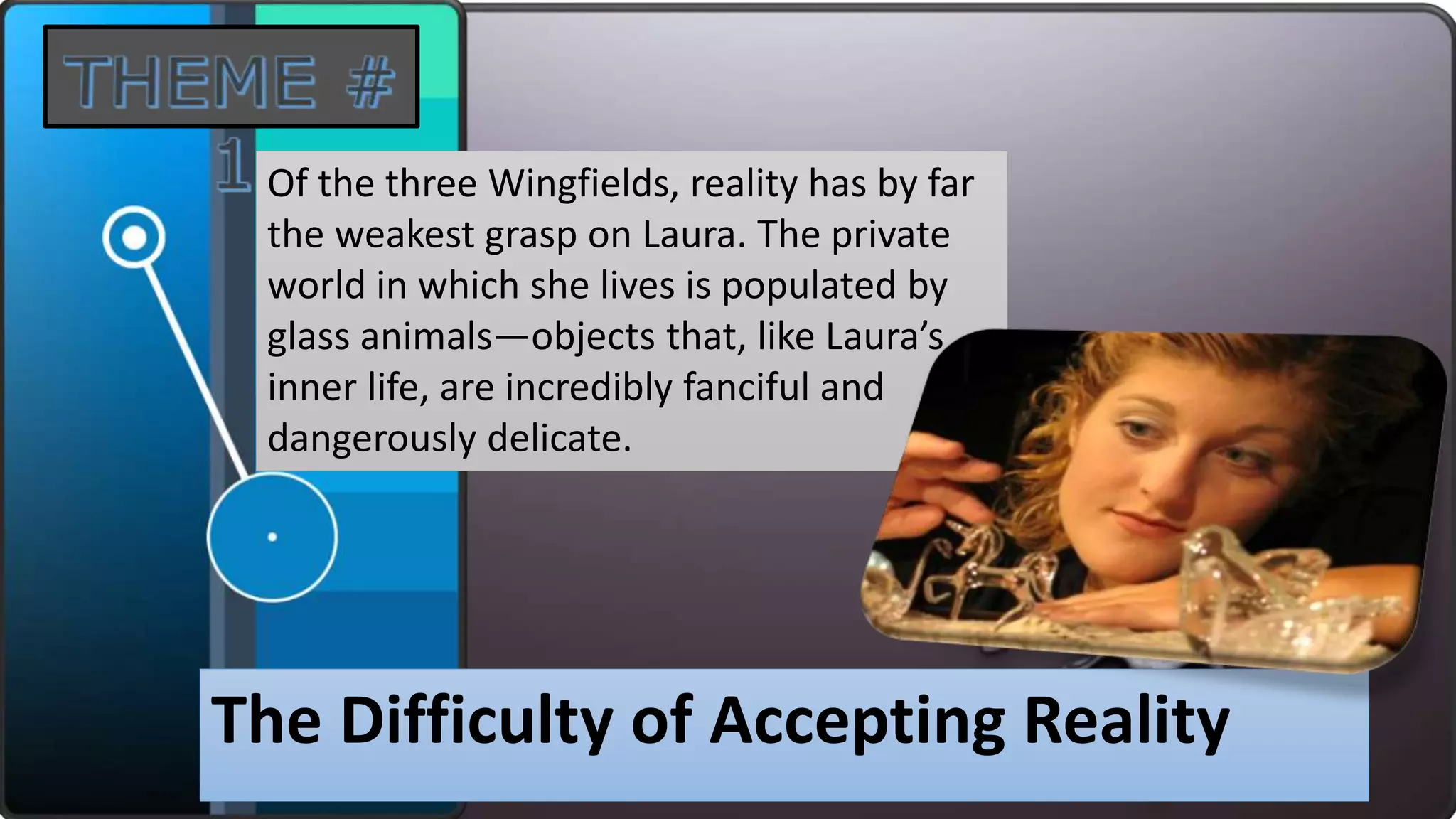
Of the three Wingfields, reality has by far
the weakest grasp on Laura. The private
world in which she lives is populated by
glass animals—objects that, like Laura’s
inner life, are incredibly fanciful and
dangerously delicate.
The Difficulty of Accepting Reality
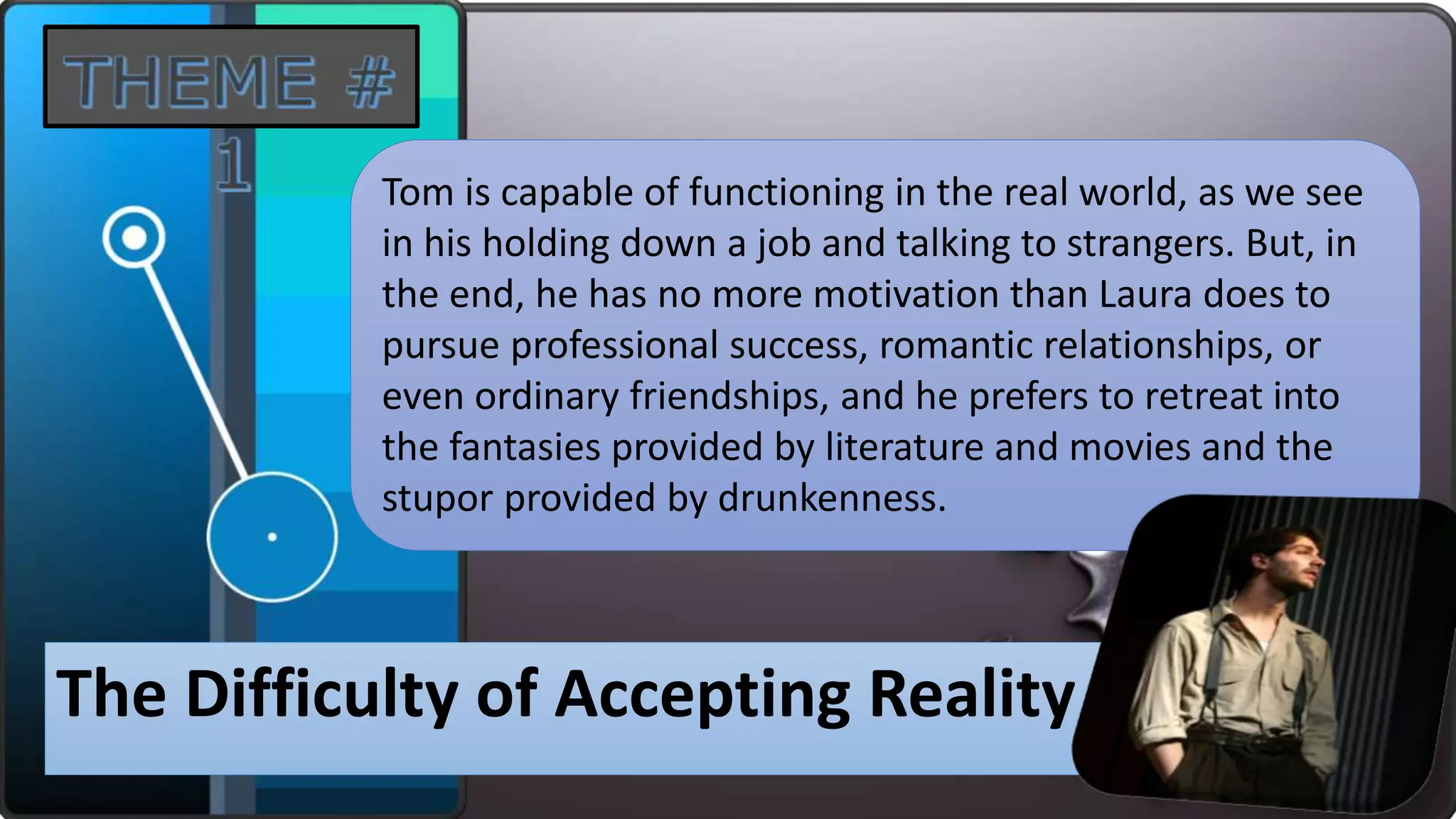
Tom is capable of functioning in the real world, as we see
in his holding down a job and talking to strangers. But, in
the end, he has no more motivation than Laura does to
pursue professional success, romantic relationships, or
even ordinary friendships, and he prefers to retreat into
the fantasies provided by literature and movies and the
stupor provided by drunkenness.
The Difficulty of Accepting Reality
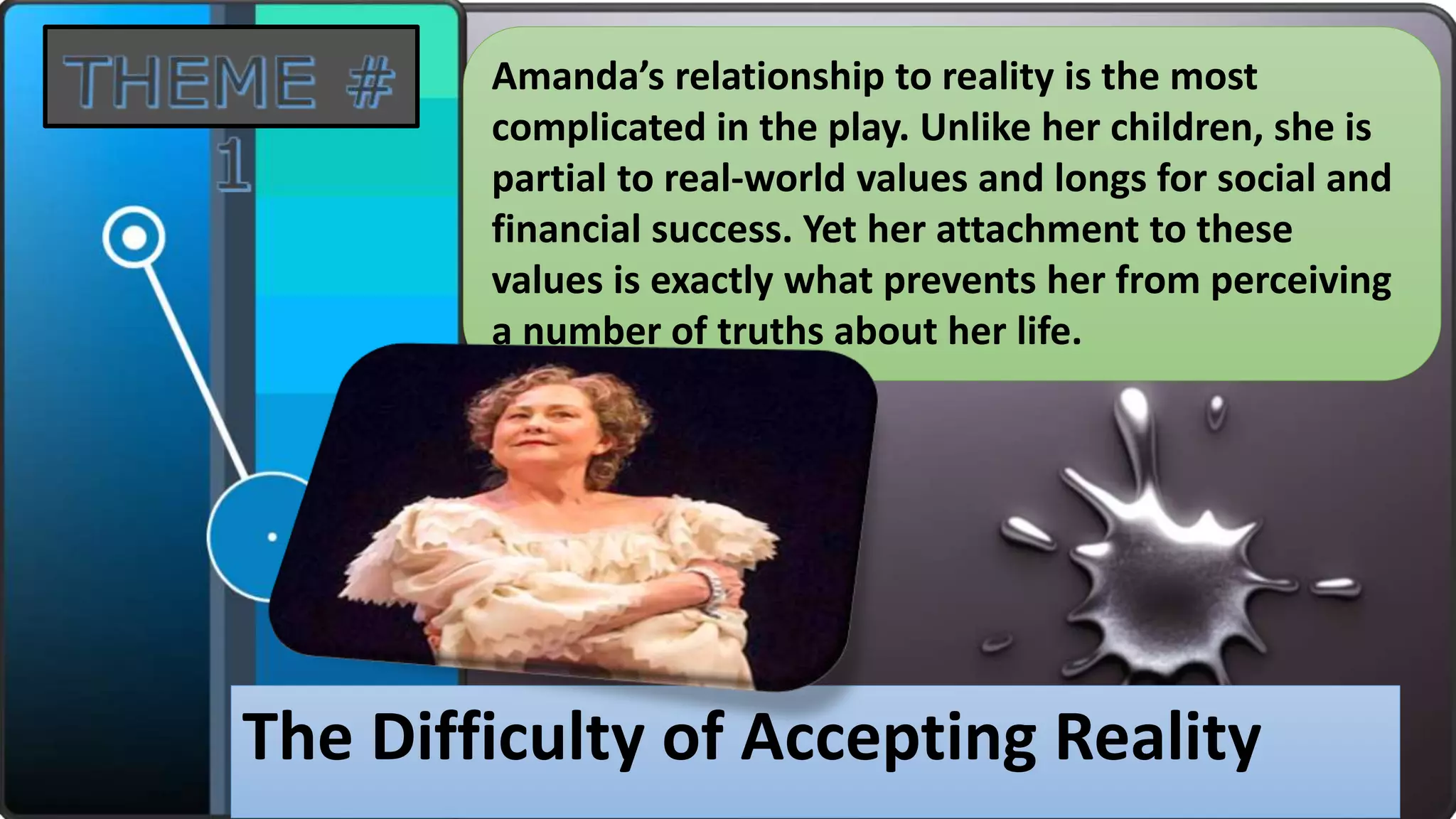
Amanda’s relationship to reality is the most
complicated in the play. Unlike her children, she is
partial to real-world values and longs for social and
financial success. Yet her attachment to these
values is exactly what prevents her from perceiving
a number of truths about her life.
The play takes an ambiguous attitude toward the
moral implications and even the effectiveness of
Tom’s escape. As an able-bodied young man, he is
locked into his life not by exterior factors but by
emotional ones—by his loyalty to and possibly even
love for Laura and Amanda.
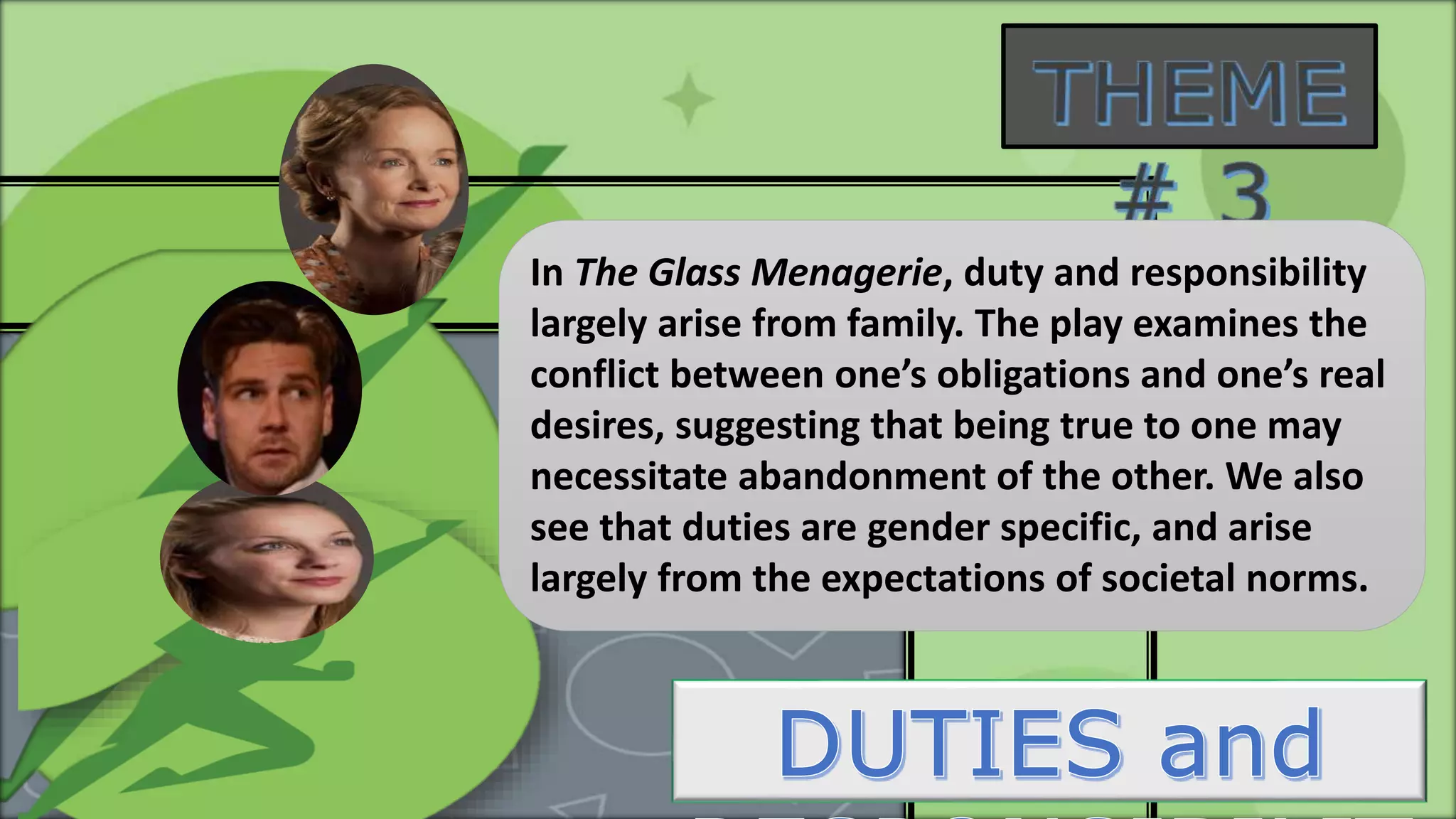
In The Glass Menagerie, duty and responsibility
largely arise from family. The play examines the
conflict between one’s obligations and one’s real
desires, suggesting that being true to one may
necessitate abandonment of the other. We also
see that duties are gender specific, and arise
largely from the expectations of societal norms.
Laura’s Glass
Menagerie
Laura’s collection of glass animal figurines
represents a number of facets of her
personality. The menagerie also represents the
imaginative world to which Laura devotes
herself—a world that is colorful and enticing
but based on fragile illusions.
The Glass
Unicorn
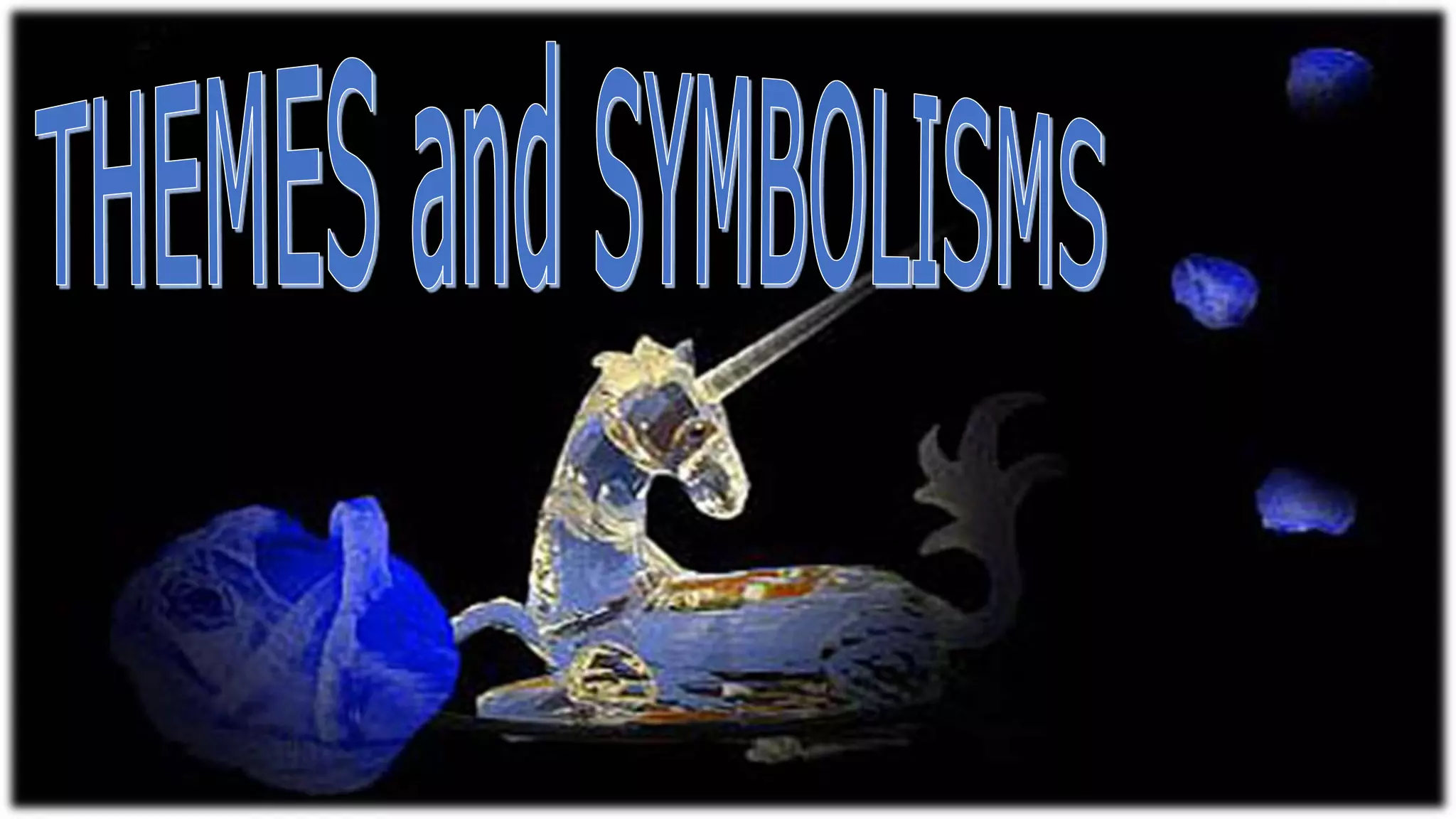
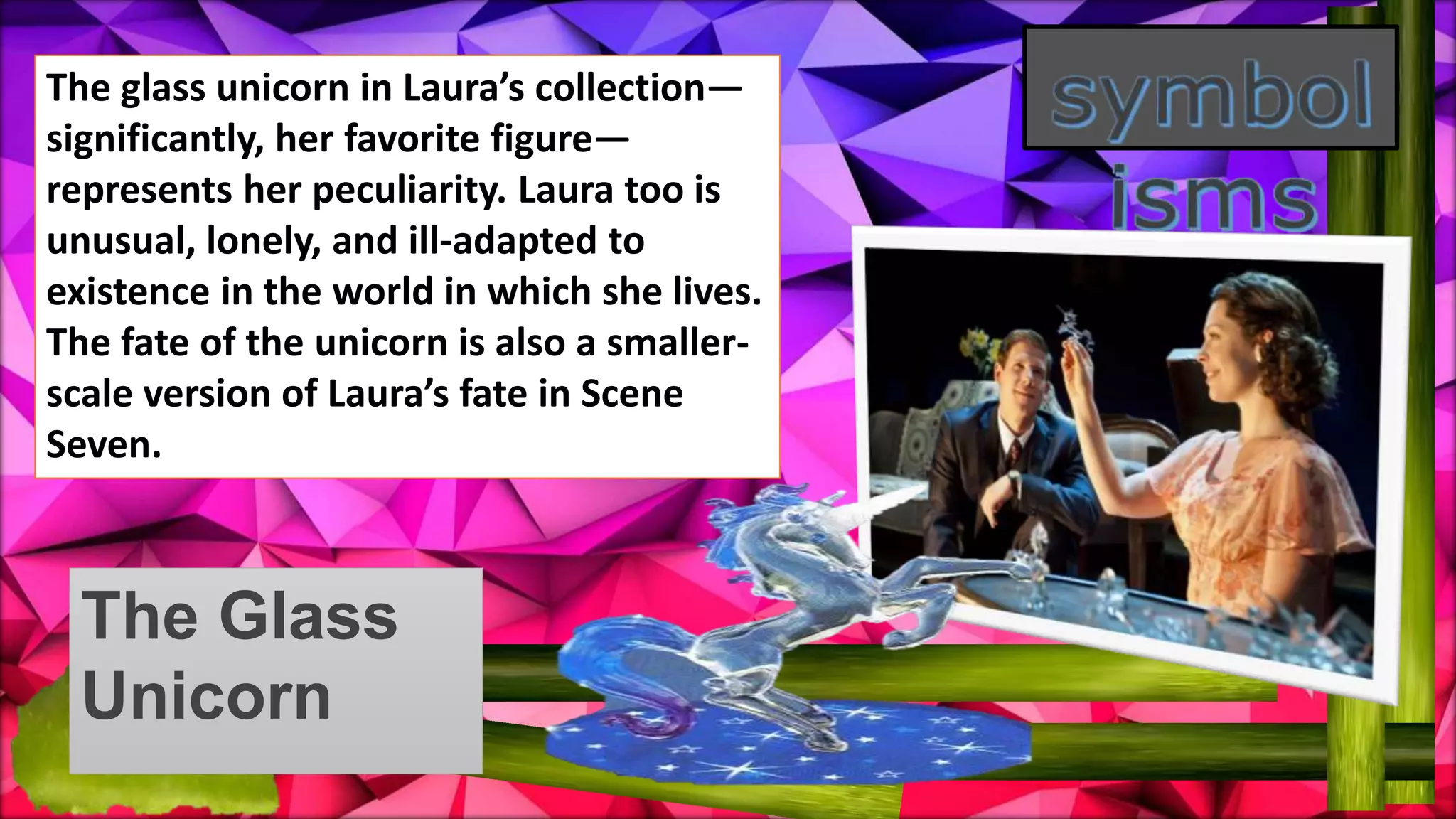
The glass unicorn in Laura’s collection—
significantly, her favorite figure—
represents her peculiarity. Laura too is
unusual, lonely, and ill-adapted to
existence in the world in which she lives.
The fate of the unicorn is also a smaller-
scale version of Laura’s fate in Scene
Seven.
The Fire
Escape
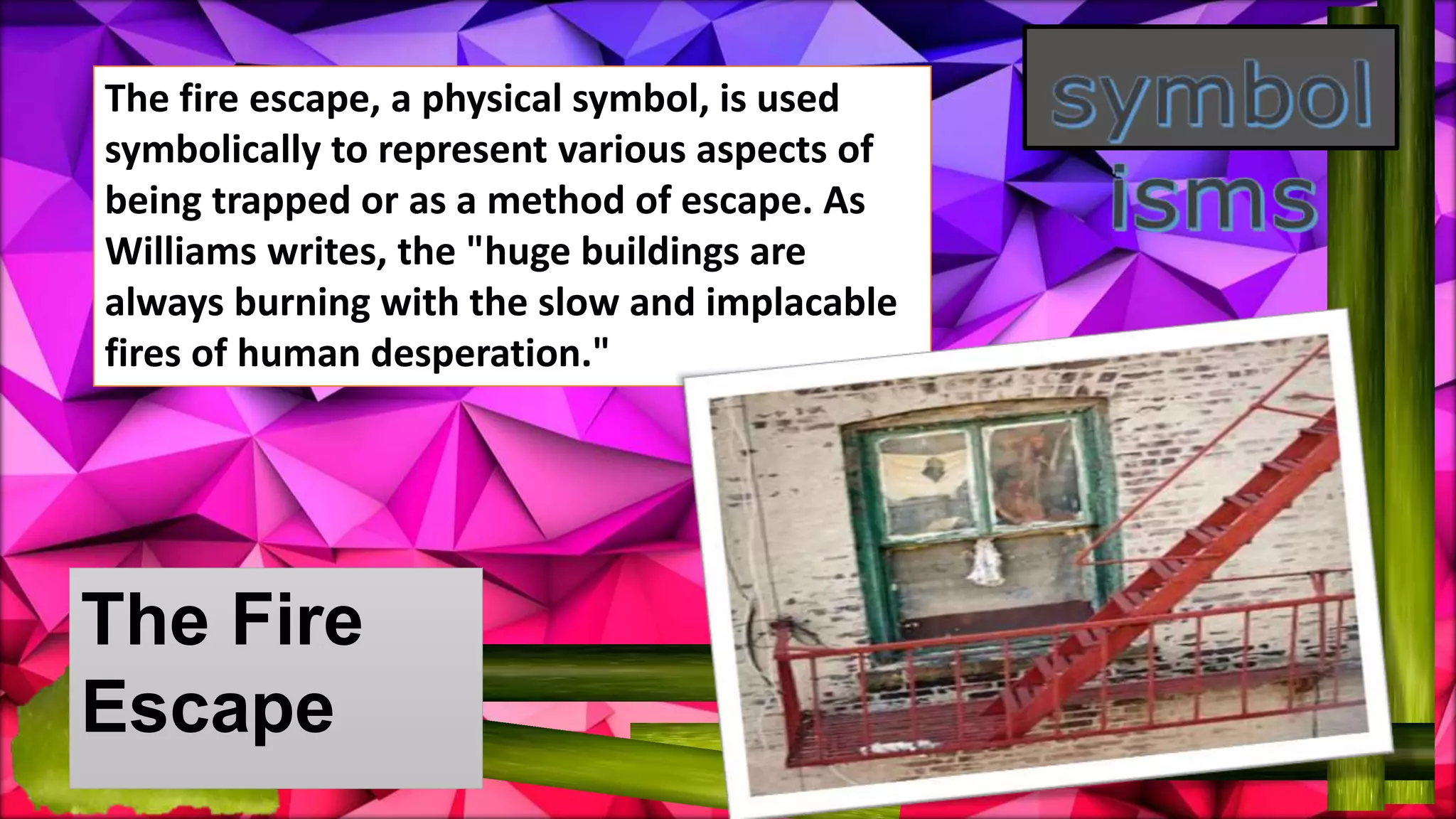
The fire escape, a physical symbol, is used
symbolically to represent various aspects of
being trapped or as a method of escape. As
Williams writes, the "huge buildings are
always burning with the slow and implacable
fires of human desperation."
REFERENCES:
Play Summary. Retrieved November 1, 2016 from
https://www.cliffsnotes.com/literature/g/the-glass-menagerie/play-
summary
The Glass Unicorn. Retrieved November 1, 2016 from
https://www.google.com.ph/search?q=glass+menagerie&biw=1366&b
ih=638&source=lnms&tbm=isch&sa=X&ved=0ahUKEwjdmbacjIfQAhXH
zLwKHS6NCe8Q_AUIBigB#tbm=isch&q=The+Glass+Unicorn&imgrc=5W
5xr9Cn8Z60-M%3A
The Fire Escape. Retrieved November 1, 2016 from
https://www.google.com.ph/search?q=themes&biw=1366&bih=589&s
ource=lnms&tbm=isch&sa=X&ved=0ahUKEwiMwP2UoYfQAhWGxbwK
HZDyAVQQ_AUIBigB#tbm=isch&q=The+Fire+Escape&imgrc=4RQ-
vL9Ne3UakM%3A
REFERENCES:
The Glass Menagerie. Retrieved November 1, 2016 from
http://www.shmoop.com/glass-menagerie/dreams-hopes-plans-
theme.html
The Glass Menagerie. Retrieved November 1, 2016 from
http://debbiejlee.com/the_glass_menagerie.pdf

Glass managerie themes and symbolisms

  • 4.
  • 5.
    The Difficulty ofAccepting Reality Of the three Wingfields, reality has by far the weakest grasp on Laura. The private world in which she lives is populated by glass animals—objects that, like Laura’s inner life, are incredibly fanciful and dangerously delicate.
  • 6.
    The Difficulty ofAccepting Reality Tom is capable of functioning in the real world, as we see in his holding down a job and talking to strangers. But, in the end, he has no more motivation than Laura does to pursue professional success, romantic relationships, or even ordinary friendships, and he prefers to retreat into the fantasies provided by literature and movies and the stupor provided by drunkenness.
  • 7.
    The Difficulty ofAccepting Reality Amanda’s relationship to reality is the most complicated in the play. Unlike her children, she is partial to real-world values and longs for social and financial success. Yet her attachment to these values is exactly what prevents her from perceiving a number of truths about her life.
  • 9.
    The play takesan ambiguous attitude toward the moral implications and even the effectiveness of Tom’s escape. As an able-bodied young man, he is locked into his life not by exterior factors but by emotional ones—by his loyalty to and possibly even love for Laura and Amanda.
  • 11.
    In The GlassMenagerie, duty and responsibility largely arise from family. The play examines the conflict between one’s obligations and one’s real desires, suggesting that being true to one may necessitate abandonment of the other. We also see that duties are gender specific, and arise largely from the expectations of societal norms.
  • 16.
    Laura’s Glass Menagerie Laura’s collectionof glass animal figurines represents a number of facets of her personality. The menagerie also represents the imaginative world to which Laura devotes herself—a world that is colorful and enticing but based on fragile illusions.
  • 17.
    The Glass Unicorn The glassunicorn in Laura’s collection— significantly, her favorite figure— represents her peculiarity. Laura too is unusual, lonely, and ill-adapted to existence in the world in which she lives. The fate of the unicorn is also a smaller- scale version of Laura’s fate in Scene Seven.
  • 18.
    The Fire Escape The fireescape, a physical symbol, is used symbolically to represent various aspects of being trapped or as a method of escape. As Williams writes, the "huge buildings are always burning with the slow and implacable fires of human desperation."
  • 19.
    REFERENCES: Play Summary. RetrievedNovember 1, 2016 from https://www.cliffsnotes.com/literature/g/the-glass-menagerie/play- summary The Glass Unicorn. Retrieved November 1, 2016 from https://www.google.com.ph/search?q=glass+menagerie&biw=1366&b ih=638&source=lnms&tbm=isch&sa=X&ved=0ahUKEwjdmbacjIfQAhXH zLwKHS6NCe8Q_AUIBigB#tbm=isch&q=The+Glass+Unicorn&imgrc=5W 5xr9Cn8Z60-M%3A The Fire Escape. Retrieved November 1, 2016 from https://www.google.com.ph/search?q=themes&biw=1366&bih=589&s ource=lnms&tbm=isch&sa=X&ved=0ahUKEwiMwP2UoYfQAhWGxbwK HZDyAVQQ_AUIBigB#tbm=isch&q=The+Fire+Escape&imgrc=4RQ- vL9Ne3UakM%3A
  • 20.
    REFERENCES: The Glass Menagerie.Retrieved November 1, 2016 from http://www.shmoop.com/glass-menagerie/dreams-hopes-plans- theme.html The Glass Menagerie. Retrieved November 1, 2016 from http://debbiejlee.com/the_glass_menagerie.pdf

Editor's Notes

  • #5 Each member of the Wingfield family is unable to overcome this difficulty, and each, as a result, withdraws into a private world of illusion where he or she finds the comfort and meaning that the real world does not seem to offer.
  • #9 Escape can mean two things here: escape from reality into an alternate world, or escape from a trap or confinement. This play hints at the moral ramifications of some kinds of escape, asking the question of who is left behind and what happens to them when you leave.
  • #17 Like the figurines, Laura is delicate, fanciful, and somehow old-fashioned. Glass is transparent, but, when light is shined upon it correctly, it refracts an entire rainbow of colors.