CONTROL FLOW
STATEMENTS
IN C PROGRAMMING LANGUAGE
CREATED BY
TARUN SHARMA
(LECTURER COMPUTER
SCIENCE)
WHAT IS CONTROL FLOW STATEMENTS
• A control flow statements is a primary concept in most high-
level programming languages. It is a block of code. More
specifically, control flow statements are blocks of code that
control the flow of a program. In other words, a control
structure is a container for a series of function calls,
instructions and statements.
2
TYPES OF CONTROL FLOW STATEMENTS
• There are three types of control flow statements:
• Branching / Decision Making Statements
• Iterative / Looping Statements
• Jumping Statements
3
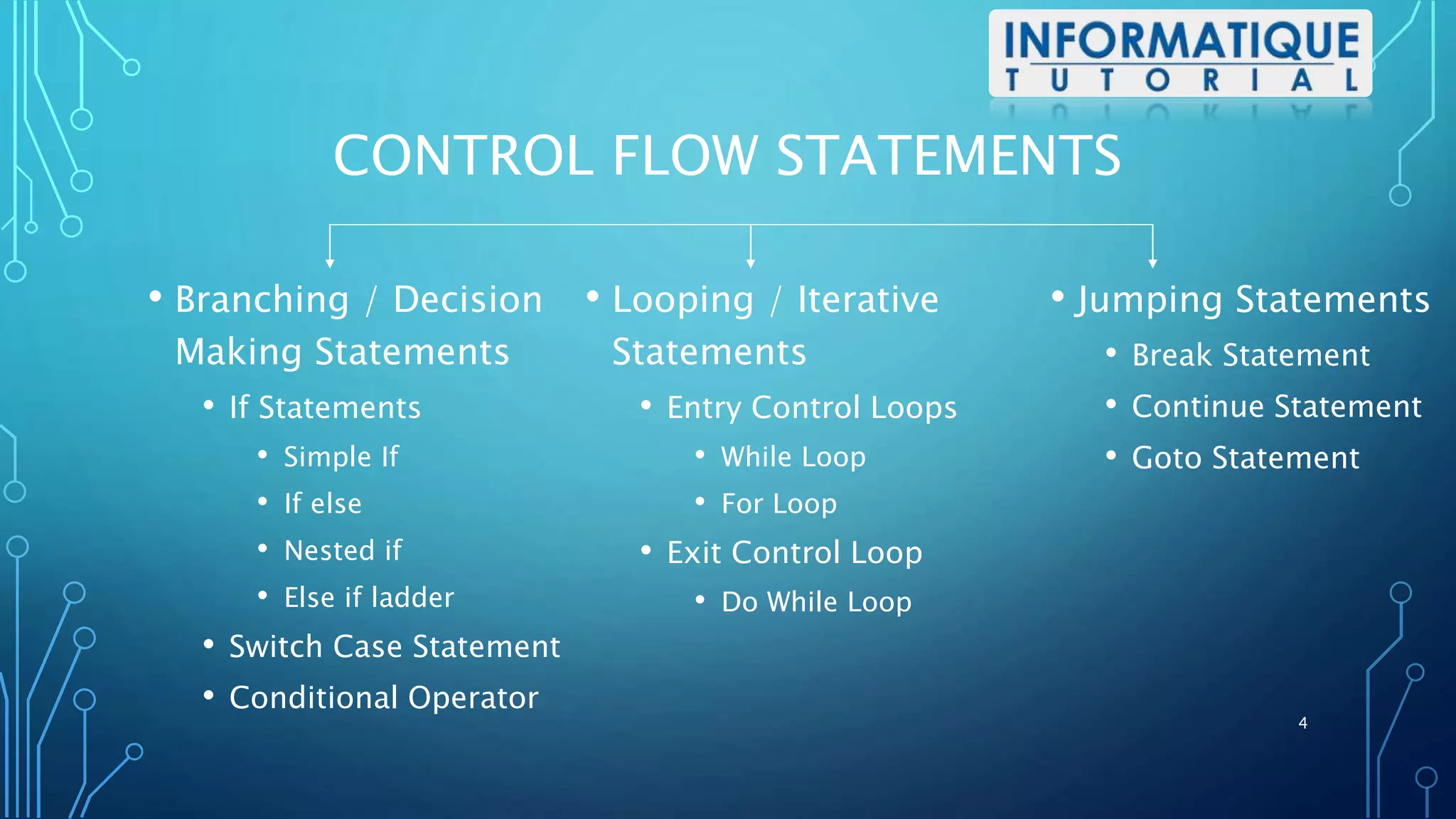
CONTROL FLOW STATEMENTS
• Branching / Decision
Making Statements
• If Statements
• Simple If
• If else
• Nested if
• Else if ladder
• Switch Case Statement
• Conditional Operator
• Looping / Iterative
Statements
• Entry Control Loops
• While Loop
• For Loop
• Exit Control Loop
• Do While Loop
• Jumping Statements
• Break Statement
• Continue Statement
• Goto Statement
4
BRANCHING STATEMENTS
• C program executes program sequentially. Sometimes, a
program requires checking of certain conditions in program
execution. C provides various key condition statements to
check condition and execute statements according conditional
criteria. These statements are called as 'Decision Making
Statements' or 'Conditional Statements.'
5
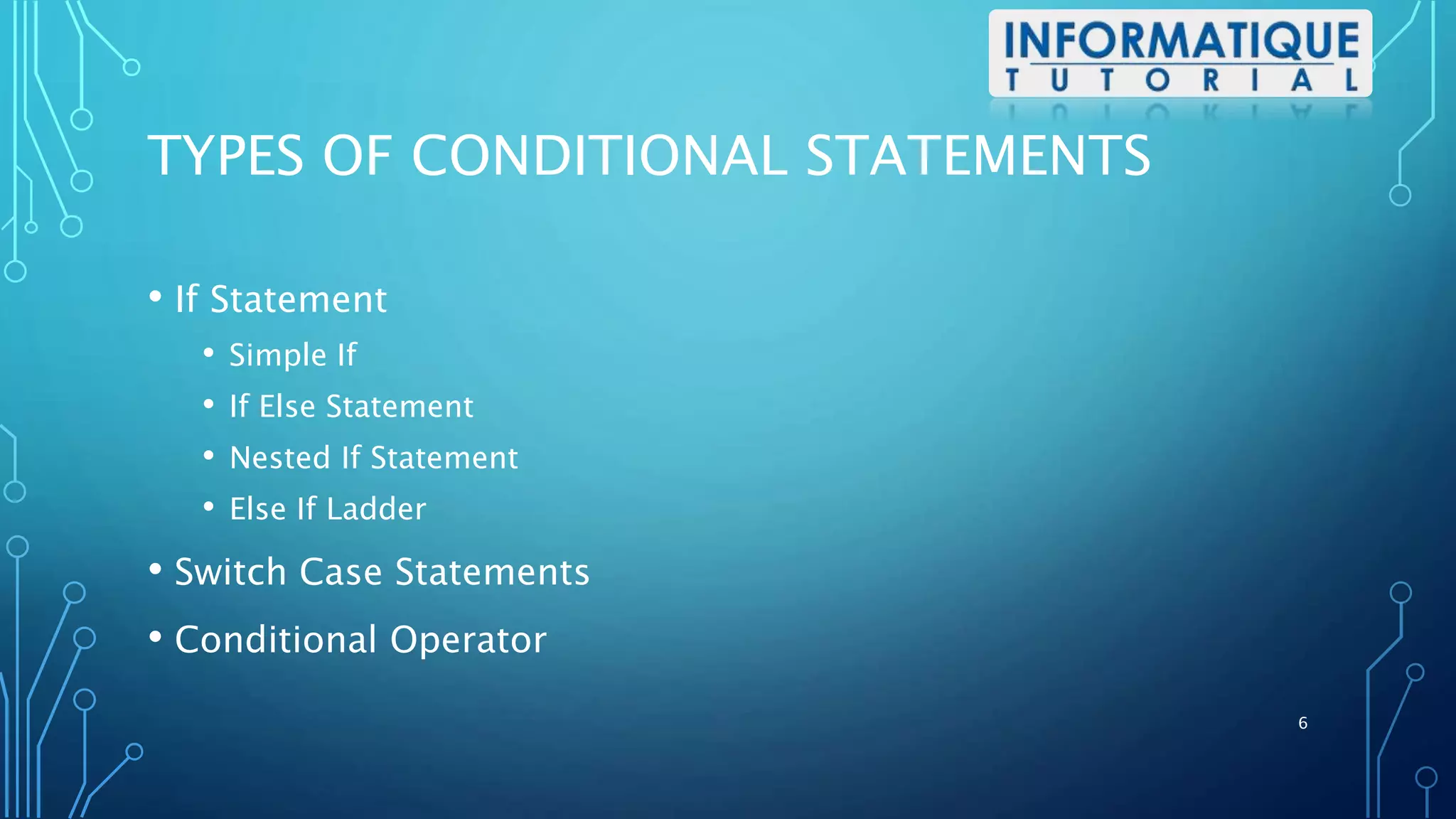
TYPES OF CONDITIONAL STATEMENTS
• If Statement
• Simple If
• If Else Statement
• Nested If Statement
• Else If Ladder
• Switch Case Statements
• Conditional Operator
6
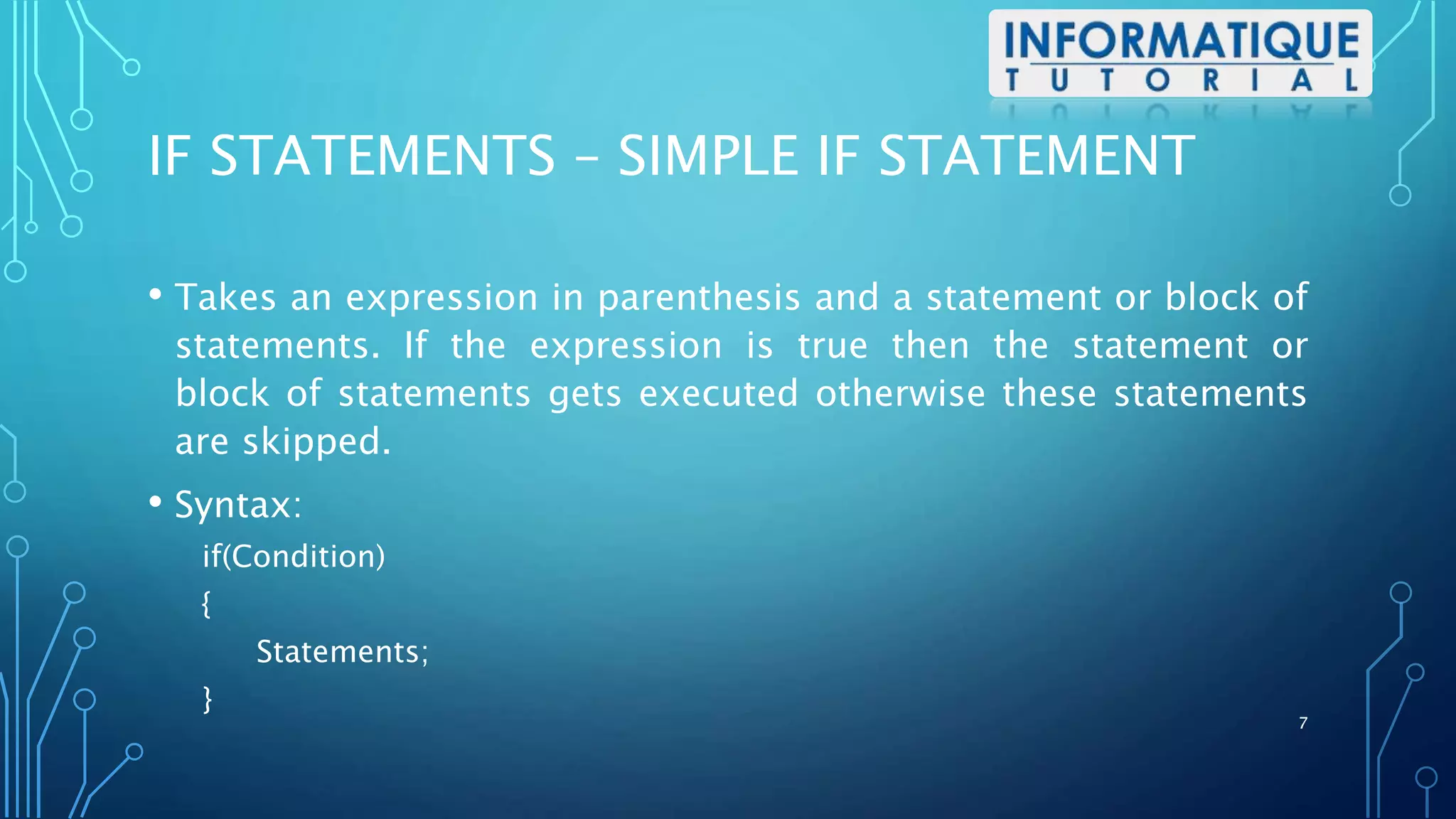
IF STATEMENTS – SIMPLE IF STATEMENT
• Takes an expression in parenthesis and a statement or block of
statements. If the expression is true then the statement or
block of statements gets executed otherwise these statements
are skipped.
• Syntax:
if(Condition)
{
Statements;
}
7
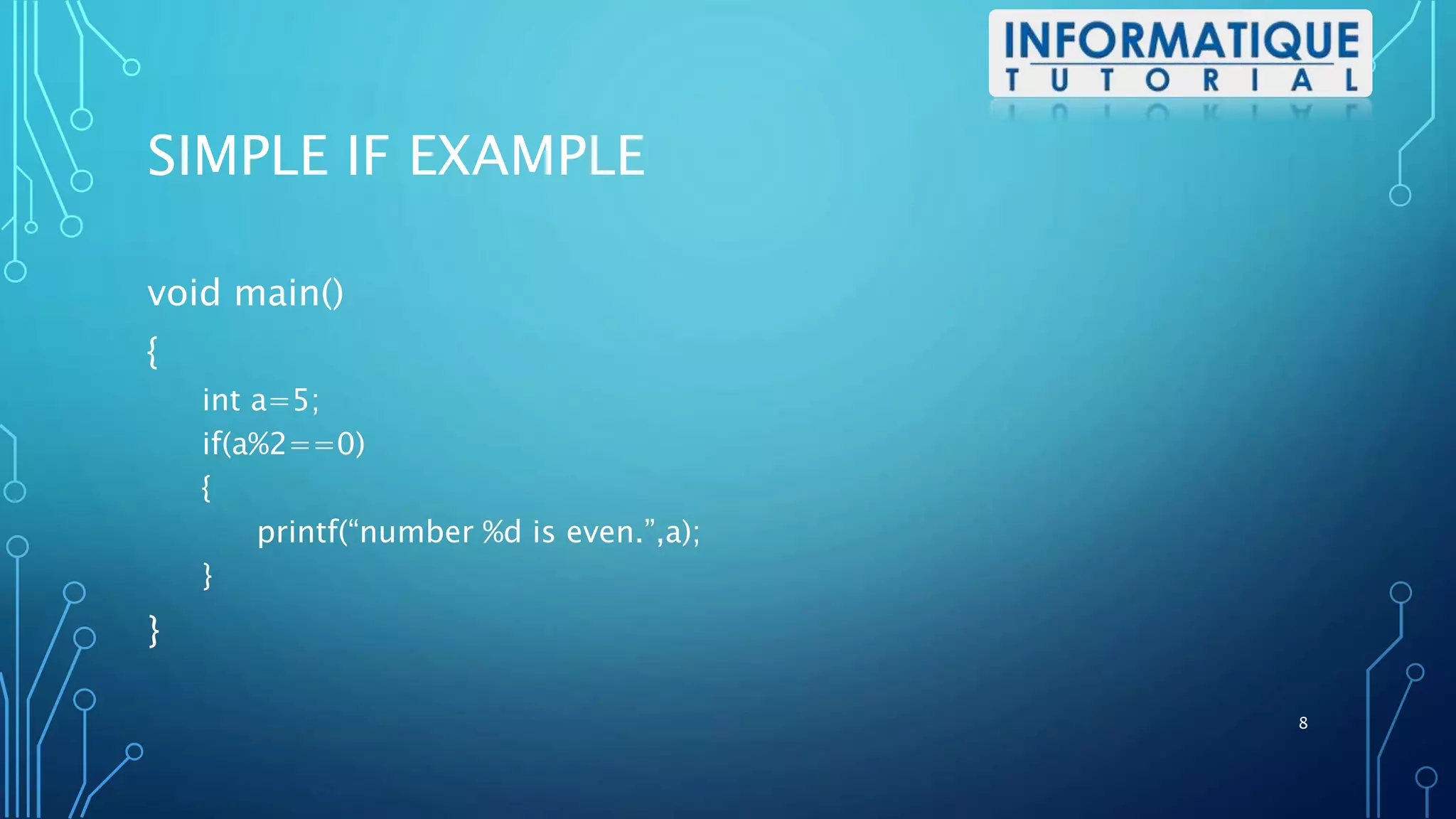
SIMPLE IF EXAMPLE
void main()
{
int a=5;
if(a%2==0)
{
printf(“number %d is even.”,a);
}
}
8
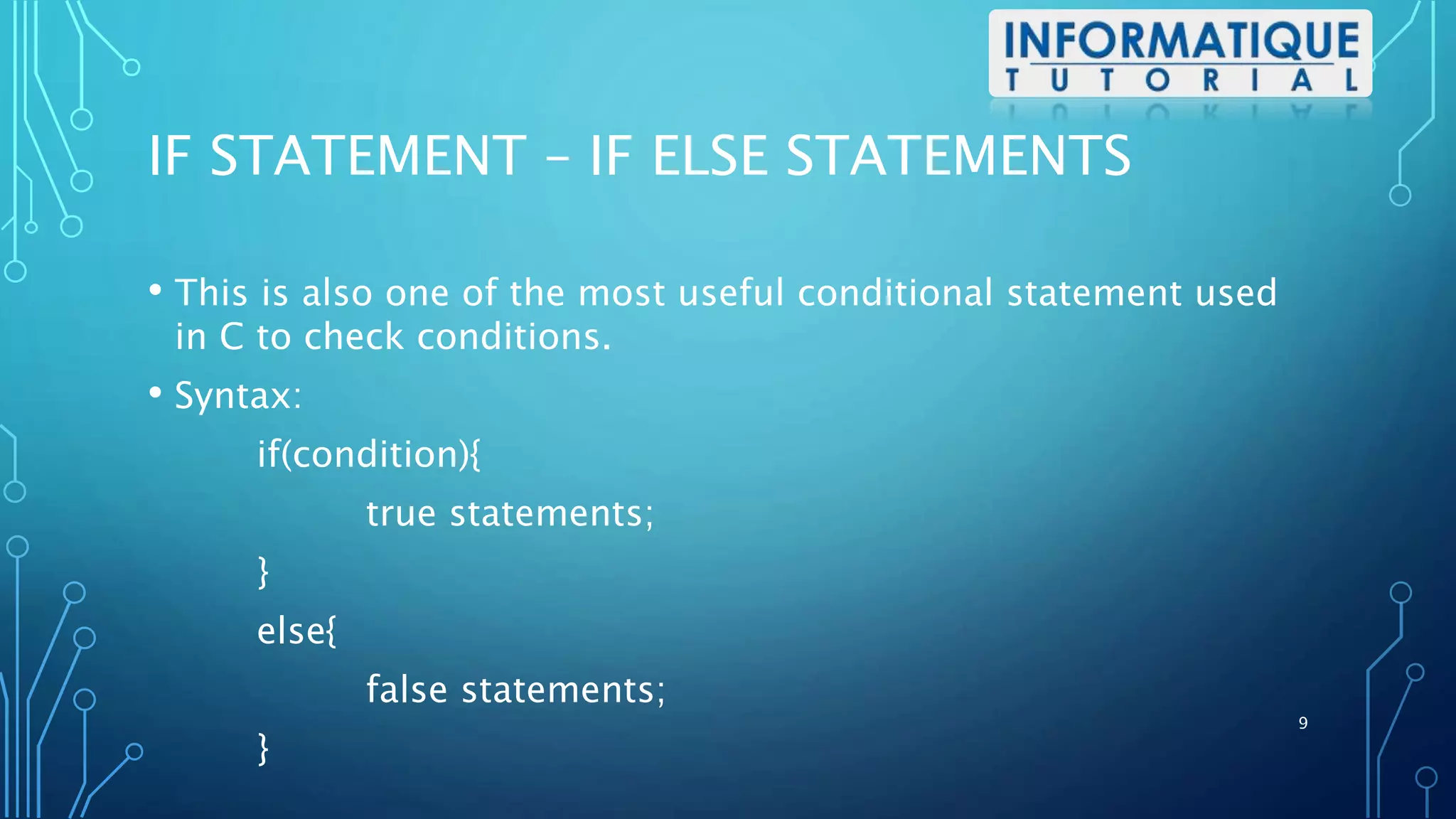
IF STATEMENT – IF ELSE STATEMENTS
• This is also one of the most useful conditional statement used
in C to check conditions.
• Syntax:
if(condition){
true statements;
}
else{
false statements;
}
9
EXAMPLE
void main()
{
int a=5;
if(a%2==0){
printf(“number %d is even”,a);
}
else{
printf(“number %d is odd”,a);
}
} 10
IF STATEMENT – NESTED IF STATEMENTS
• If within a If condition is called Nested If condition. It is a
conditional statement which is used when we want to check
more than 1 conditions at a time in a same program.
• Syntax:
11
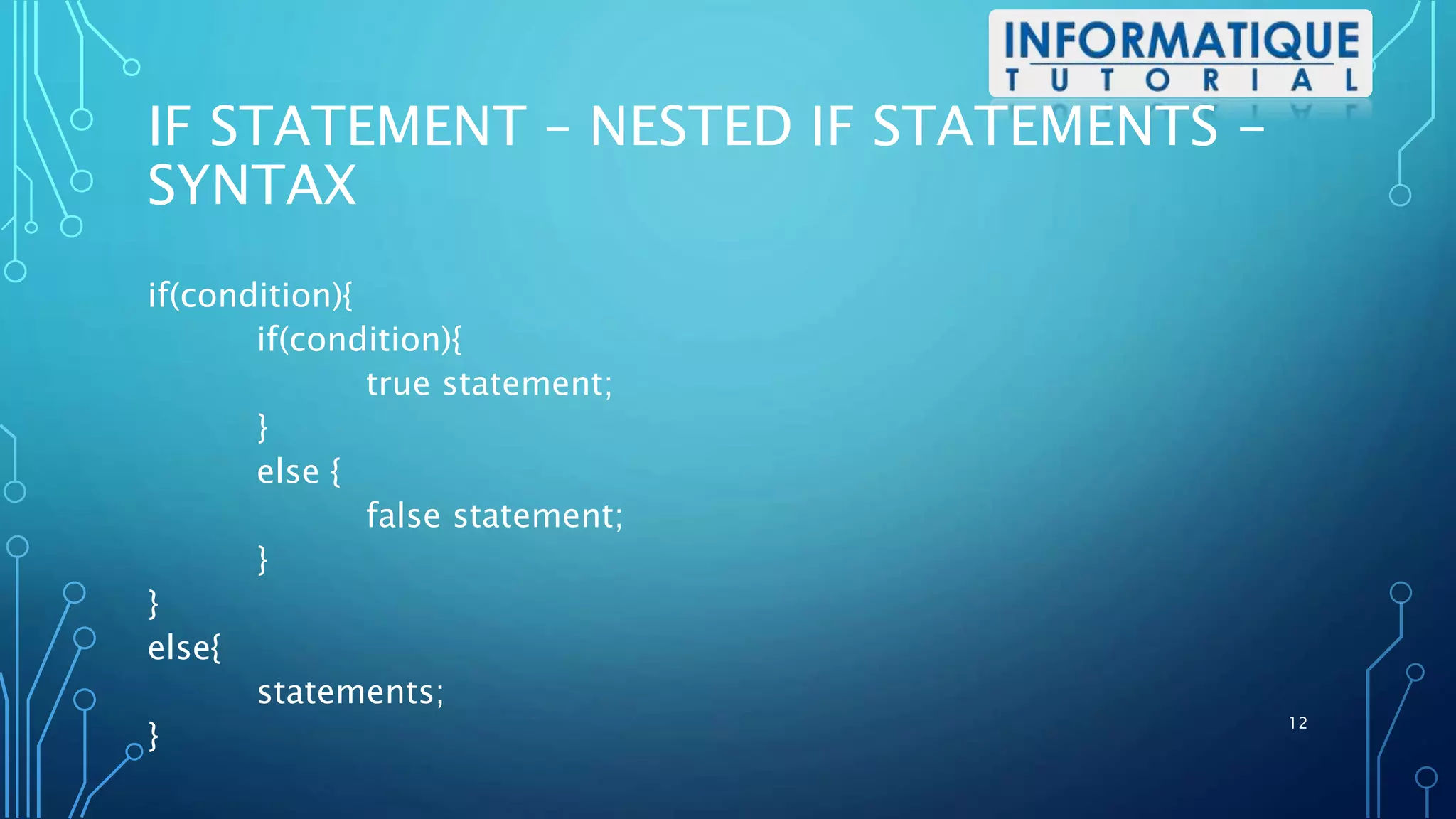
IF STATEMENT – NESTED IF STATEMENTS -
SYNTAX
if(condition){
if(condition){
true statement;
}
else {
false statement;
}
}
else{
statements;
}
12
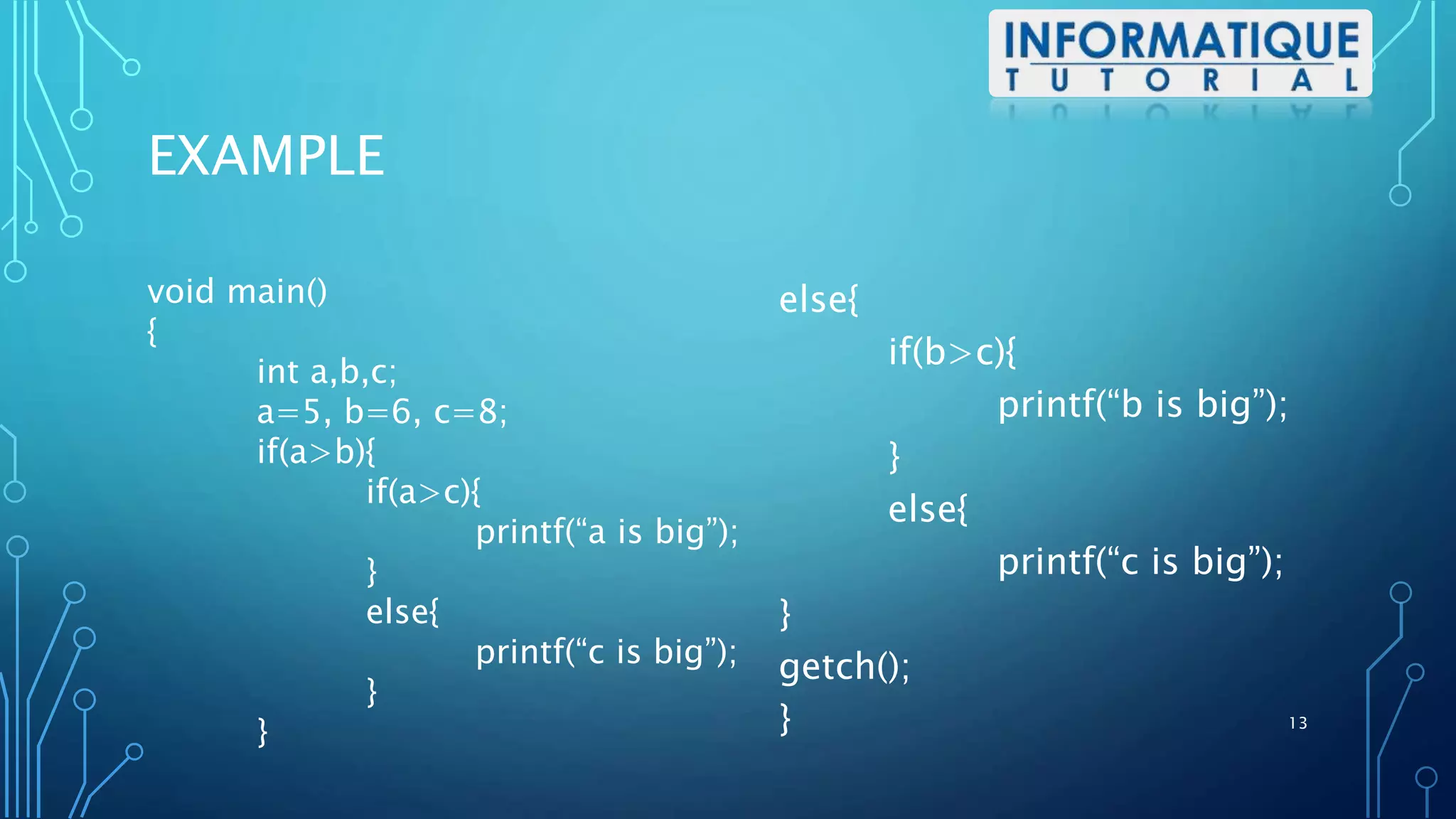
EXAMPLE
void main()
{
int a,b,c;
a=5, b=6, c=8;
if(a>b){
if(a>c){
printf(“a is big”);
}
else{
printf(“c is big”);
}
}
else{
if(b>c){
printf(“b is big”);
}
else{
printf(“c is big”);
}
getch();
} 13
IF STATEMENT – ELSE IF LADDER
• Else if() ladder is similar to if else control statement. Else if()
ladder is used to check for another condition if the previously
specified condition becomes false.
• Syntax:
14
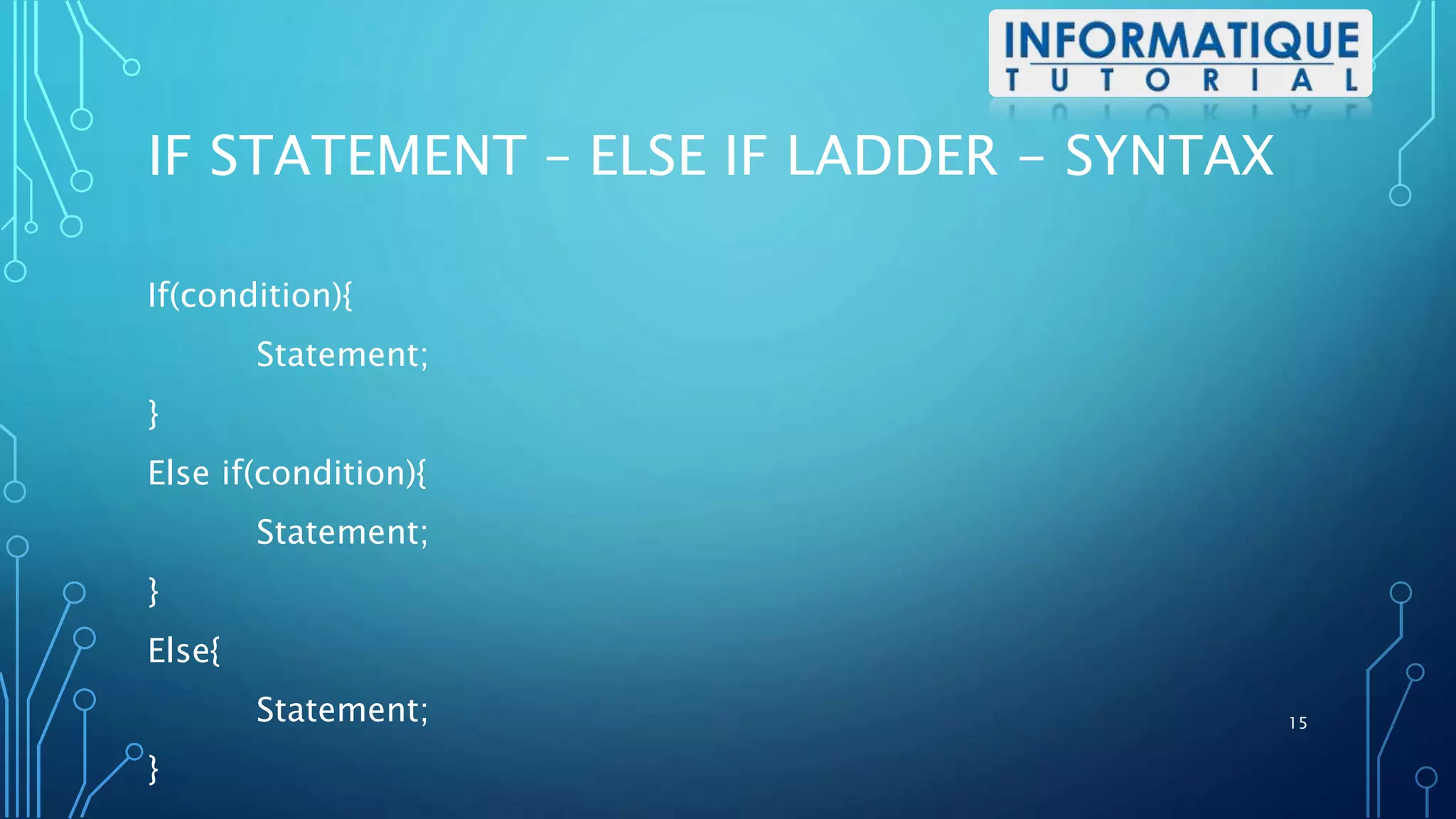
IF STATEMENT – ELSE IF LADDER - SYNTAX
If(condition){
Statement;
}
Else if(condition){
Statement;
}
Else{
Statement;
}
15
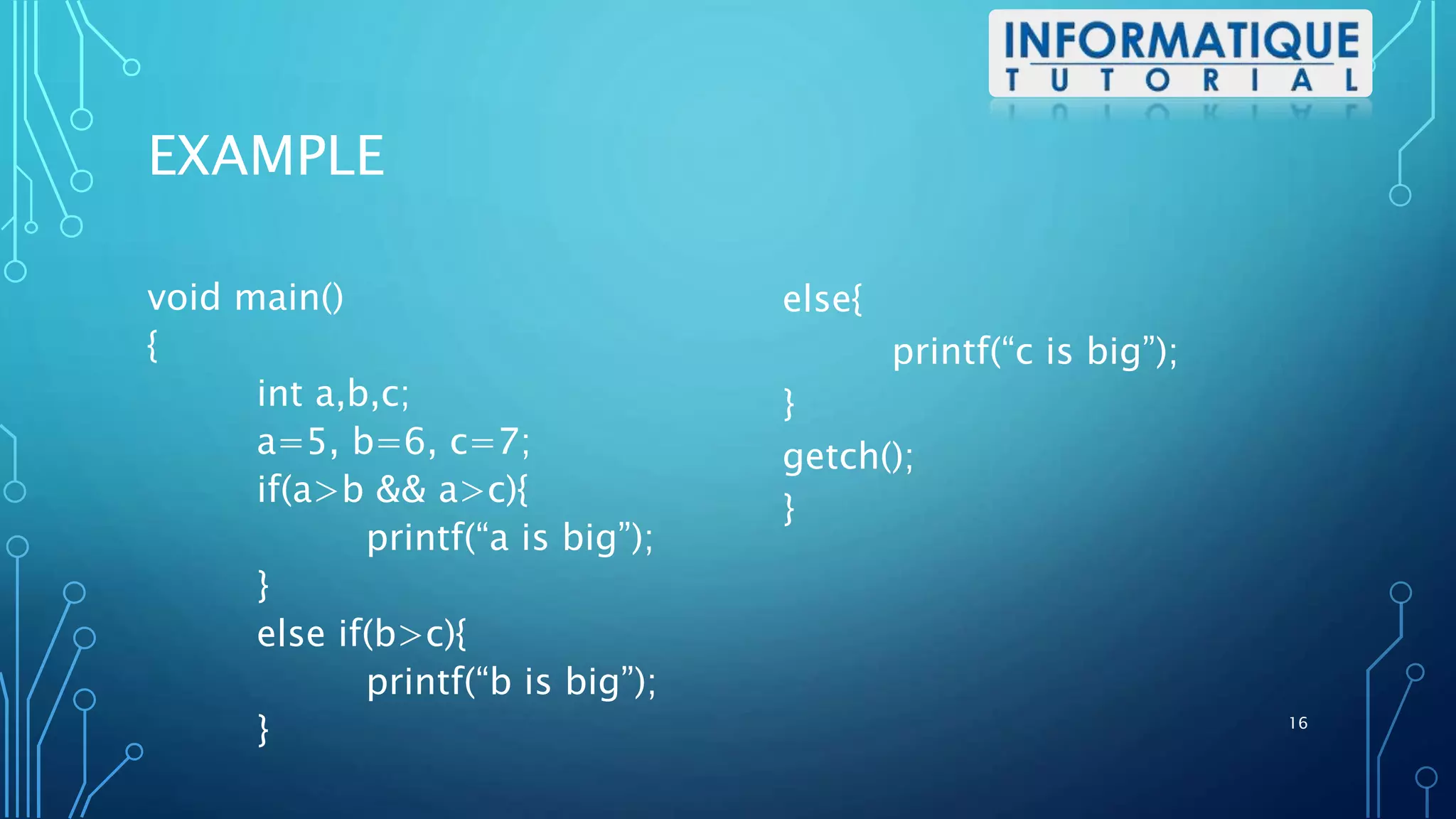
EXAMPLE
void main()
{
int a,b,c;
a=5, b=6, c=7;
if(a>b && a>c){
printf(“a is big”);
}
else if(b>c){
printf(“b is big”);
}
else{
printf(“c is big”);
}
getch();
}
16
SWITCH CASE STATEMENTS
• This is a multiple or multiway branching decision making
statement. When we use nested if-else statement to check
more than 1 condition then the complexity of a program
increases in case of a lot of conditions. Thus, the program is
difficult to read and maintain. So to overcome this problem, C
provides 'switch case'. Switch case checks the value of a
expression against a case values, if condition matches the case
values then the control is transferred to that point.
• Syntax
17
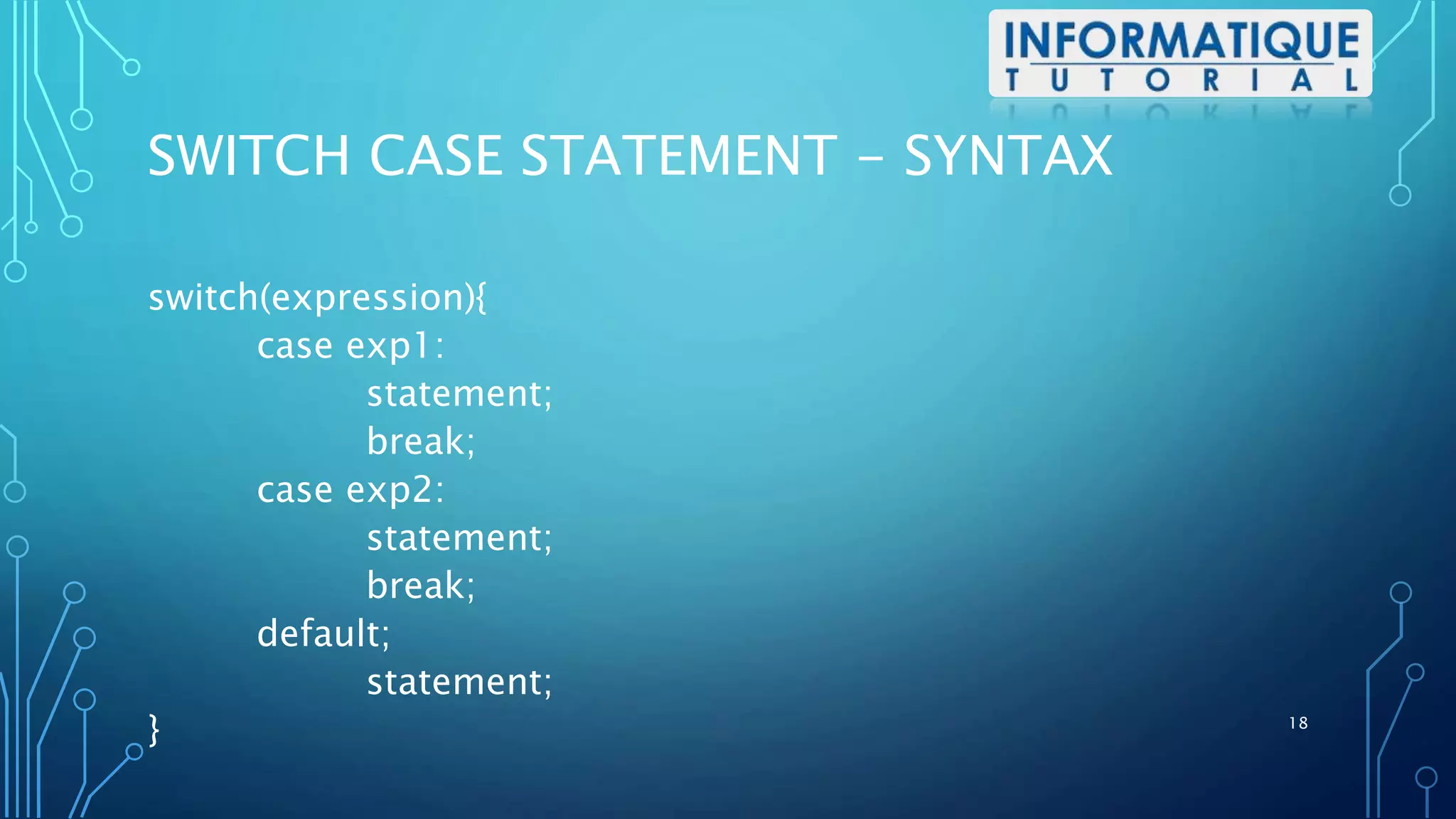
SWITCH CASE STATEMENT - SYNTAX
switch(expression){
case exp1:
statement;
break;
case exp2:
statement;
break;
default;
statement;
} 18
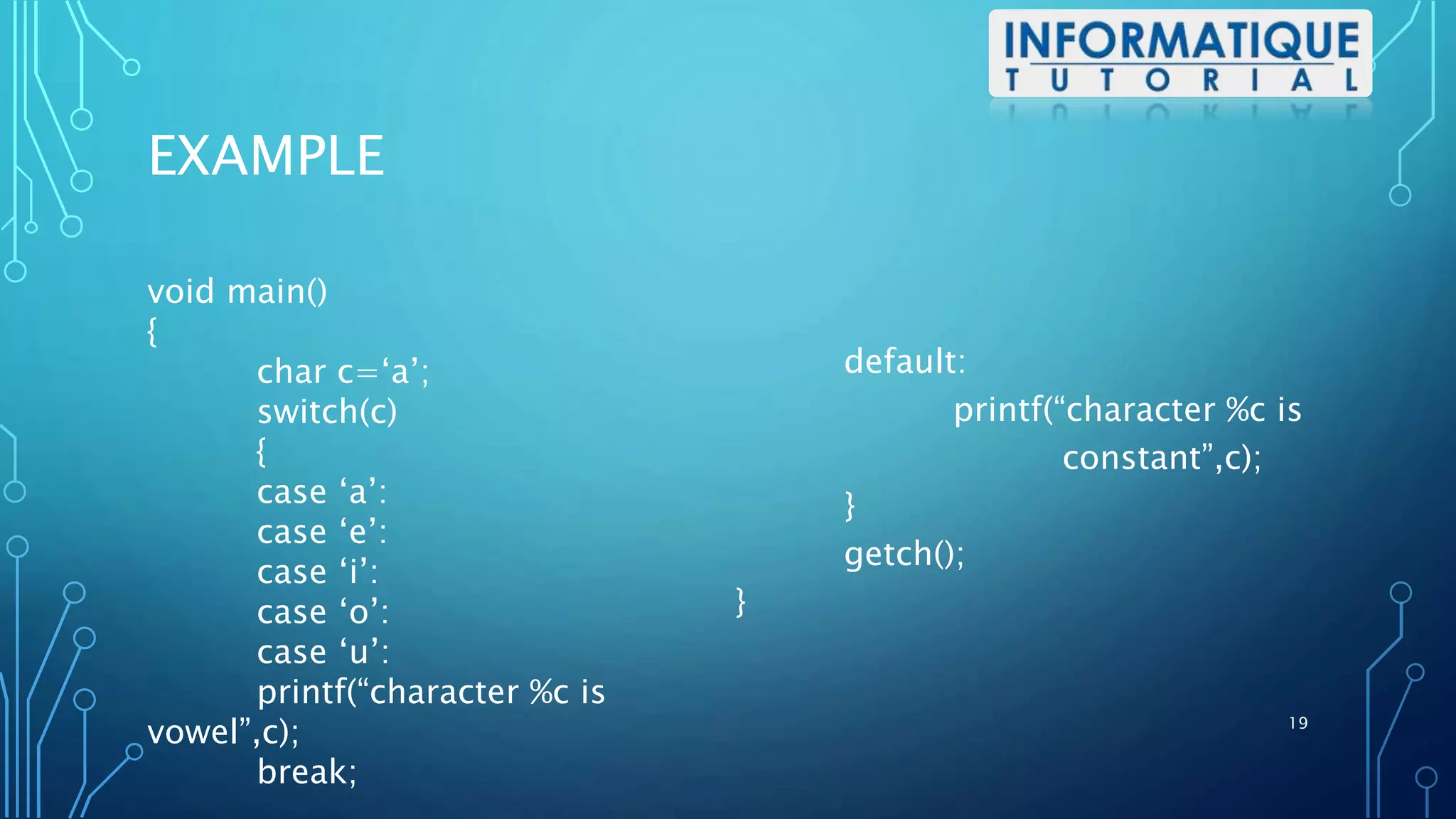
EXAMPLE
void main()
{
char c=‘a’;
switch(c)
{
case ‘a’:
case ‘e’:
case ‘i’:
case ‘o’:
case ‘u’:
printf(“character %c is
vowel”,c);
break;
default:
printf(“character %c is
constant”,c);
}
getch();
}
19
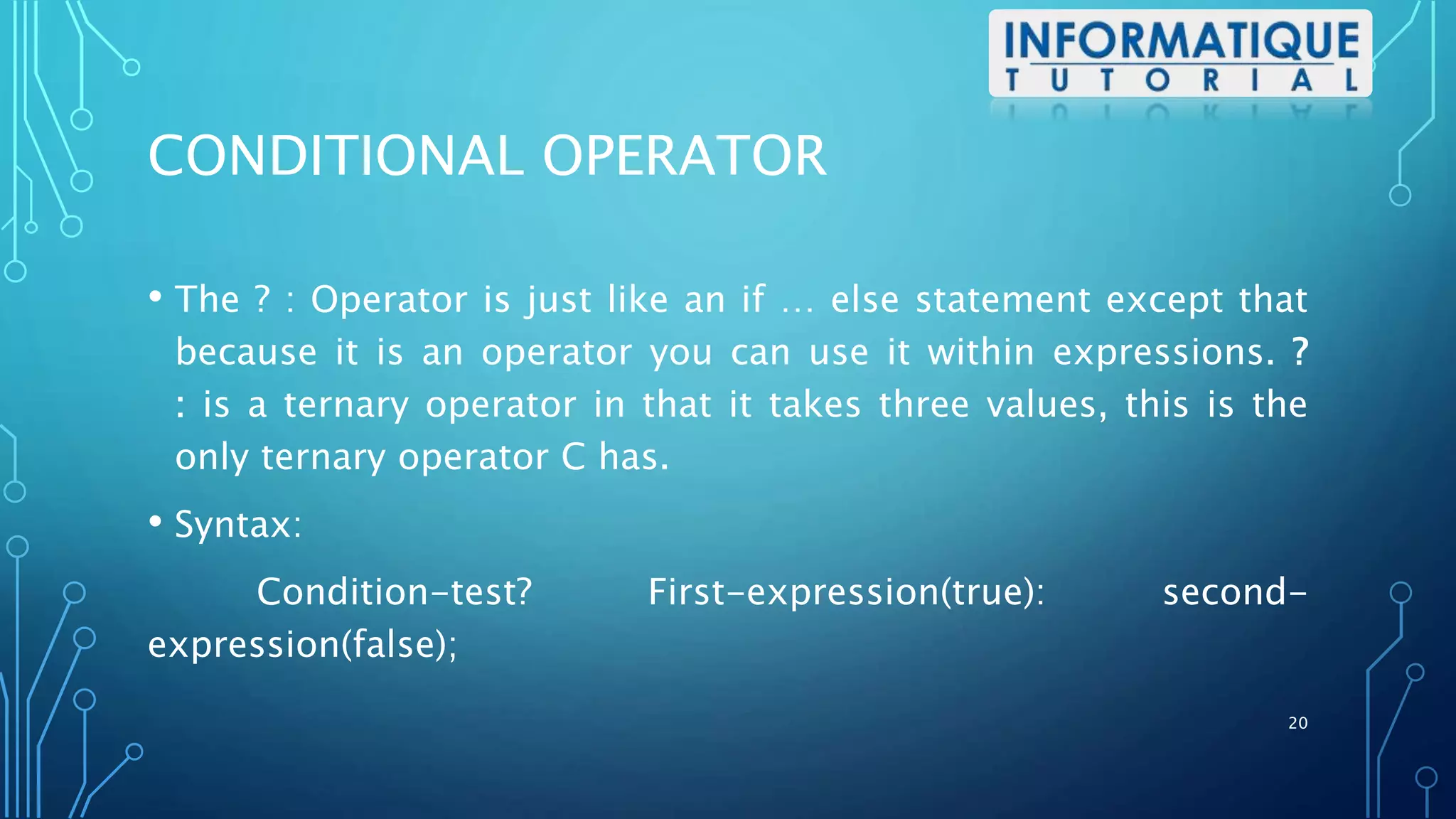
CONDITIONAL OPERATOR
• The ? : Operator is just like an if … else statement except that
because it is an operator you can use it within expressions. ?
: is a ternary operator in that it takes three values, this is the
only ternary operator C has.
• Syntax:
Condition-test? First-expression(true): second-
expression(false);
20
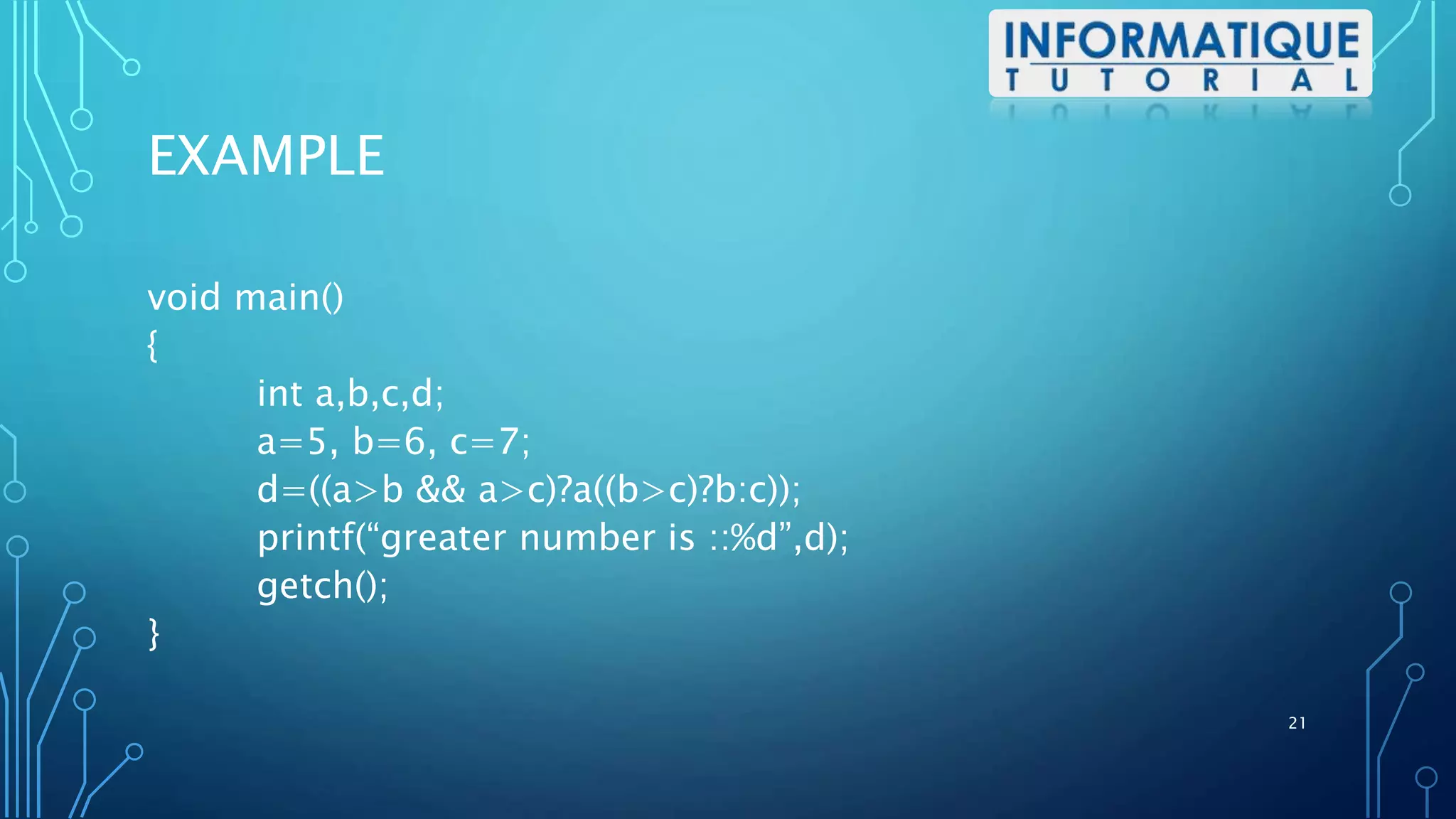
EXAMPLE
void main()
{
int a,b,c,d;
a=5, b=6, c=7;
d=((a>b && a>c)?a((b>c)?b:c));
printf(“greater number is ::%d”,d);
getch();
}
21
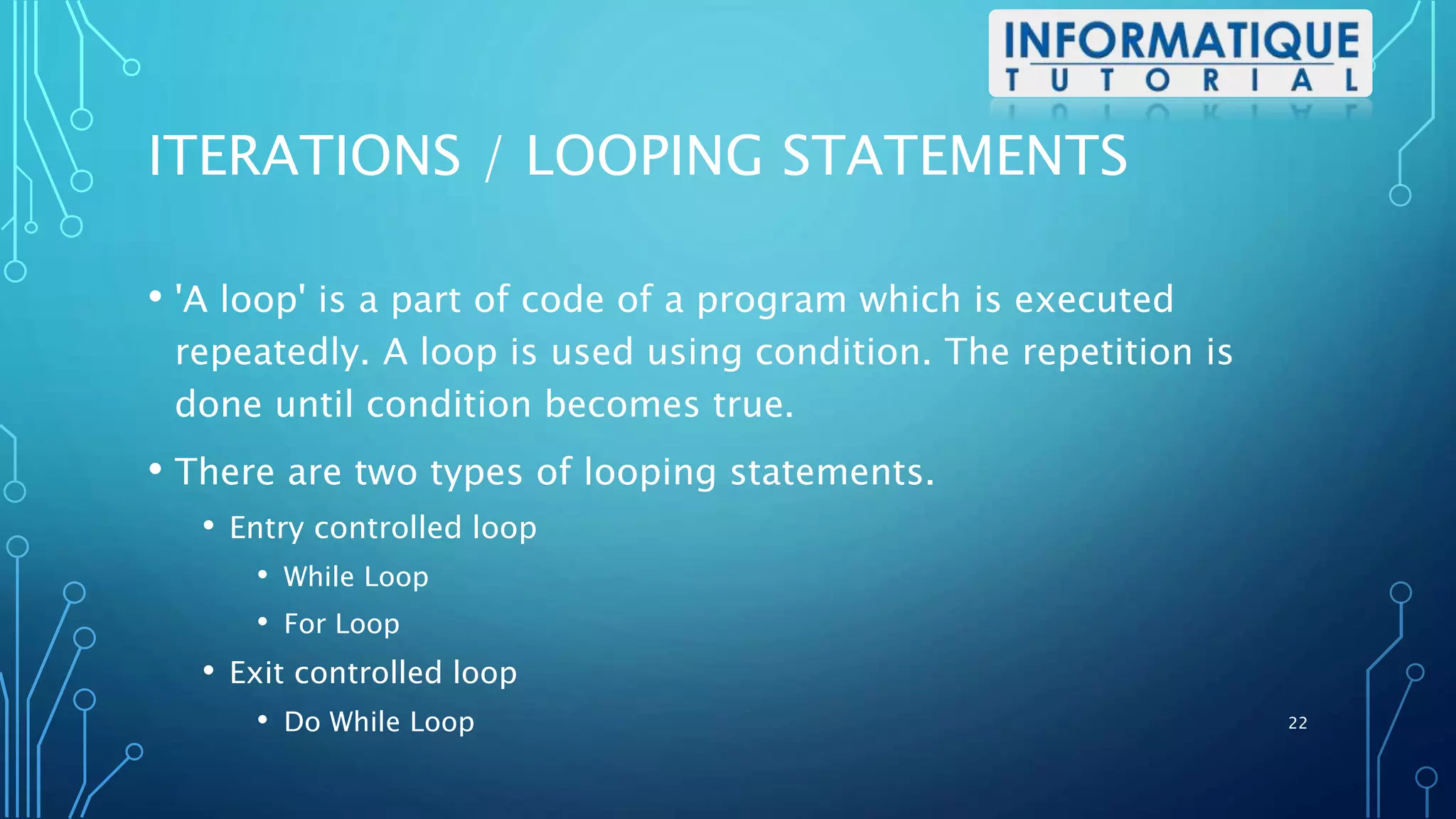
ITERATIONS / LOOPING STATEMENTS
• 'A loop' is a part of code of a program which is executed
repeatedly. A loop is used using condition. The repetition is
done until condition becomes true.
• There are two types of looping statements.
• Entry controlled loop
• While Loop
• For Loop
• Exit controlled loop
• Do While Loop 22
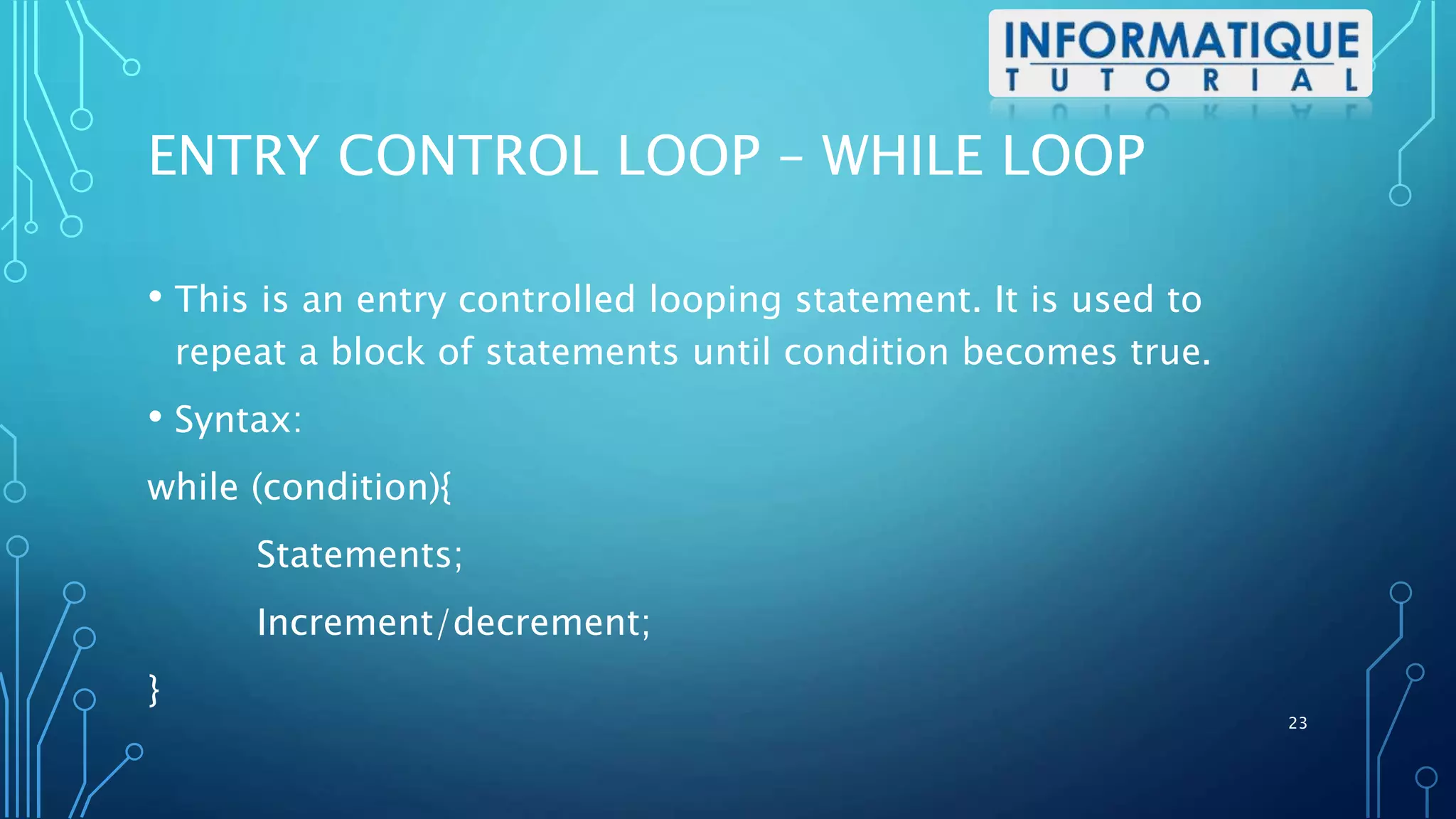
ENTRY CONTROL LOOP – WHILE LOOP
• This is an entry controlled looping statement. It is used to
repeat a block of statements until condition becomes true.
• Syntax:
while (condition){
Statements;
Increment/decrement;
}
23
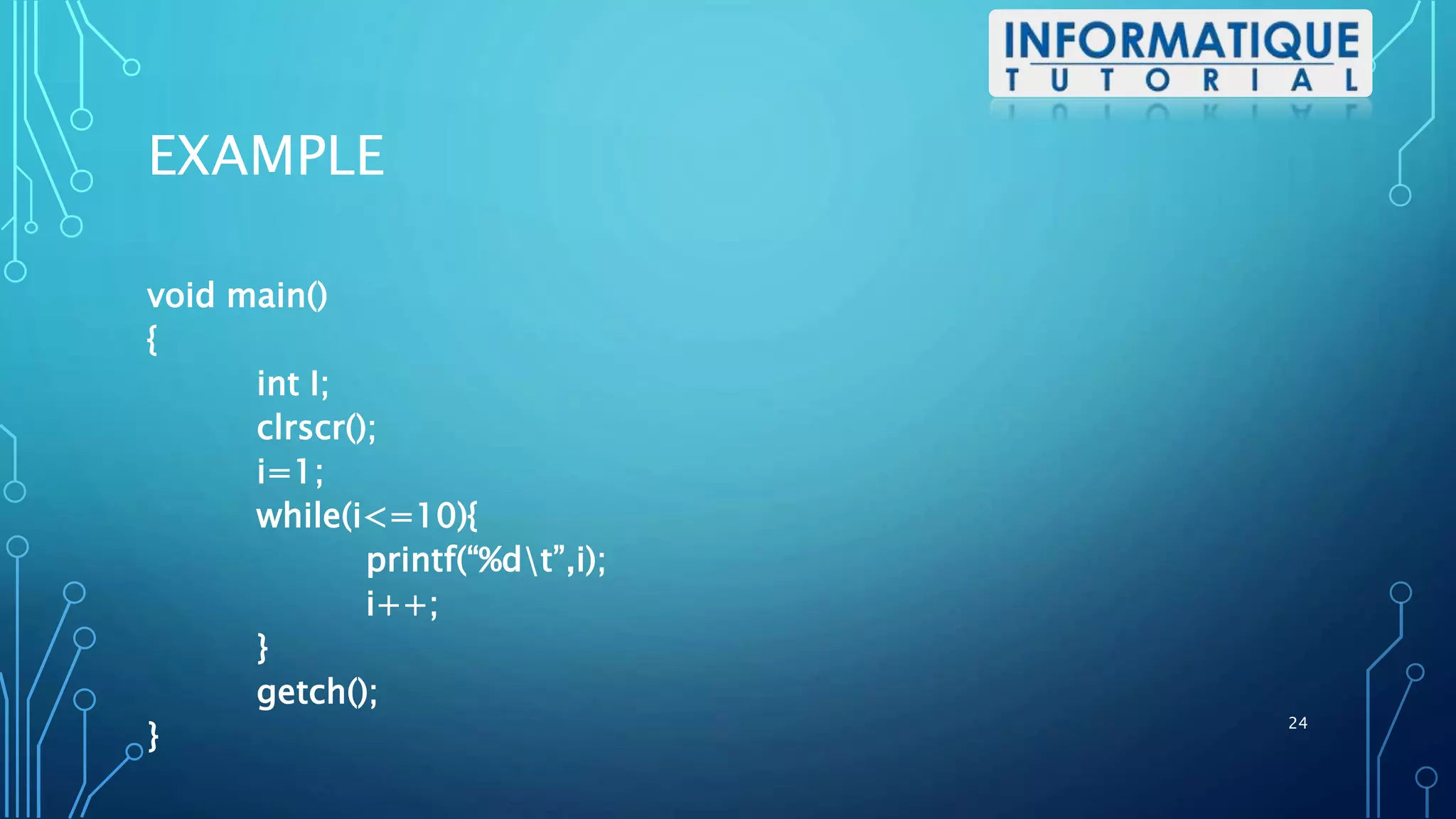
EXAMPLE
void main()
{
int I;
clrscr();
i=1;
while(i<=10){
printf(“%dt”,i);
i++;
}
getch();
}
24
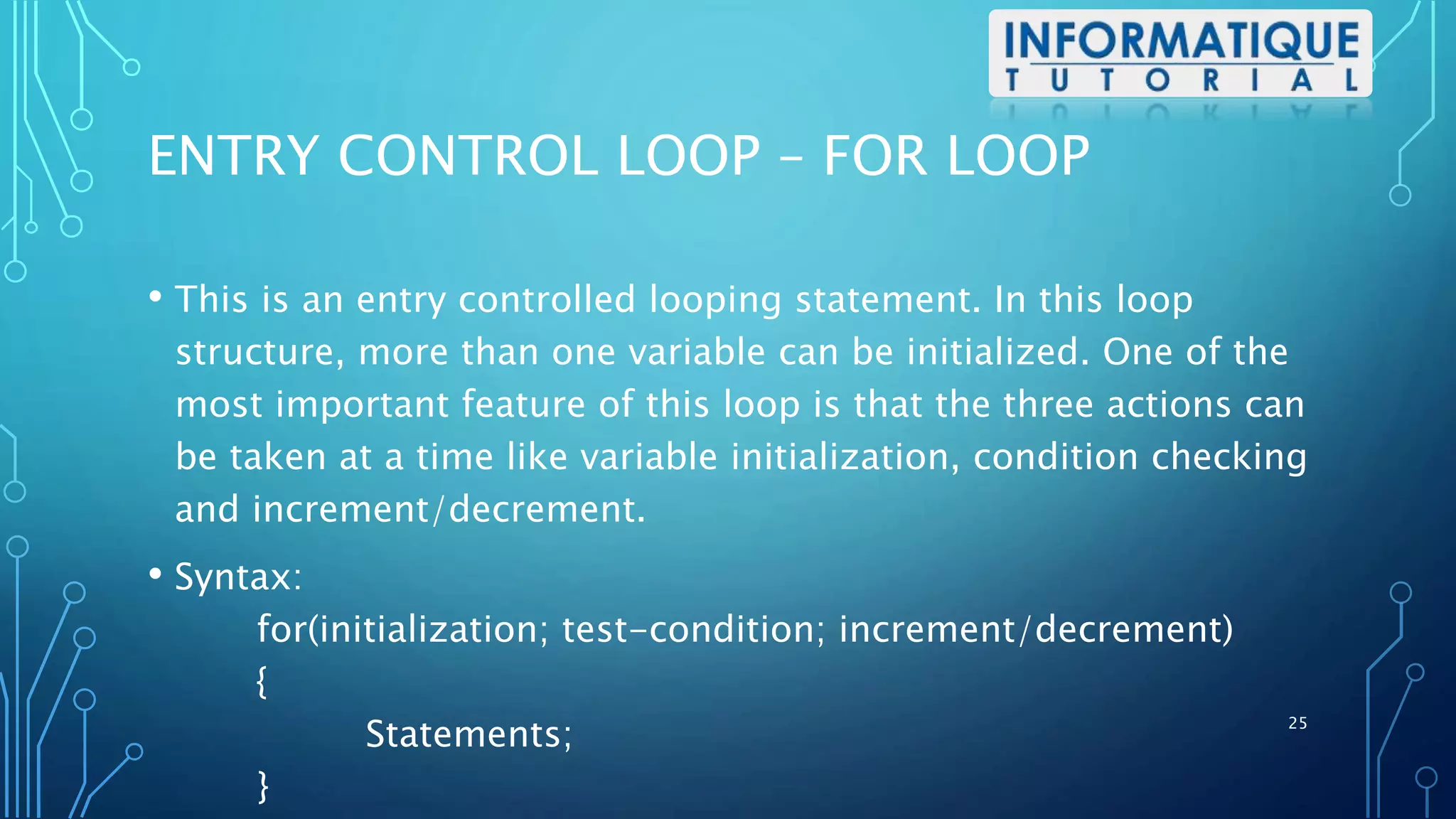
ENTRY CONTROL LOOP – FOR LOOP
• This is an entry controlled looping statement. In this loop
structure, more than one variable can be initialized. One of the
most important feature of this loop is that the three actions can
be taken at a time like variable initialization, condition checking
and increment/decrement.
• Syntax:
for(initialization; test-condition; increment/decrement)
{
Statements;
}
25
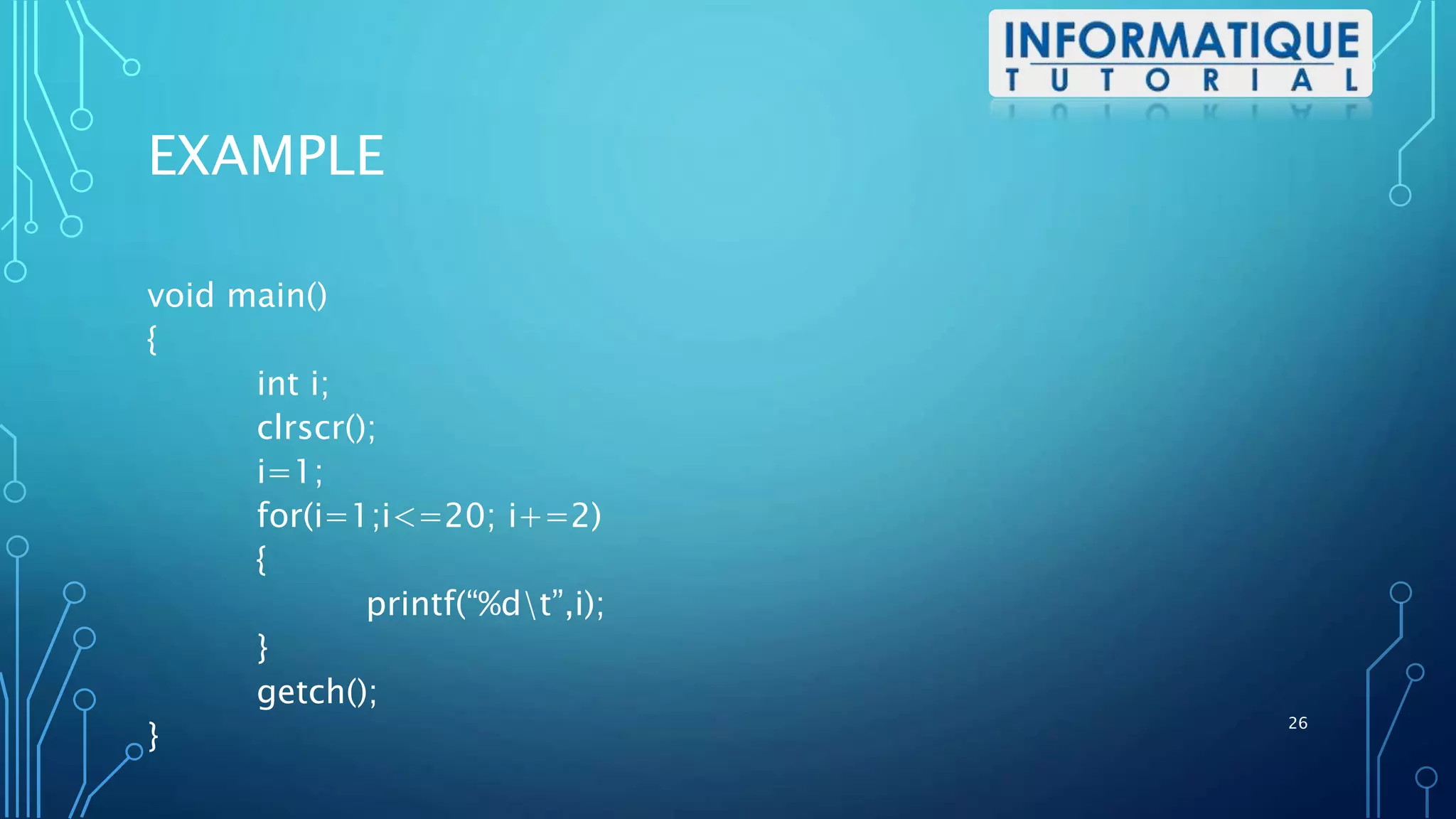
EXAMPLE
void main()
{
int i;
clrscr();
i=1;
for(i=1;i<=20; i+=2)
{
printf(“%dt”,i);
}
getch();
}
26
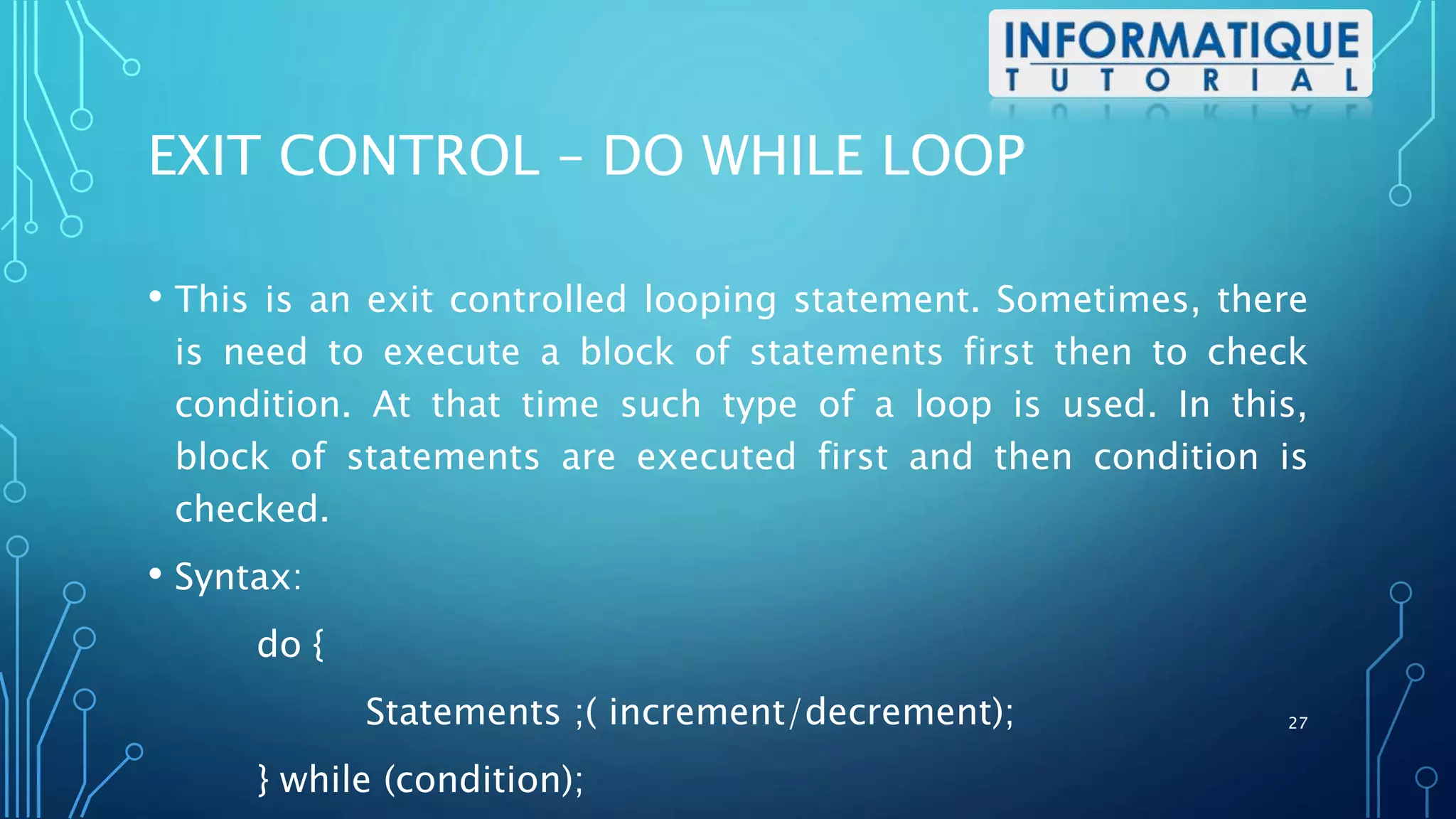
EXIT CONTROL – DO WHILE LOOP
• This is an exit controlled looping statement. Sometimes, there
is need to execute a block of statements first then to check
condition. At that time such type of a loop is used. In this,
block of statements are executed first and then condition is
checked.
• Syntax:
do {
Statements ;( increment/decrement);
} while (condition);
27
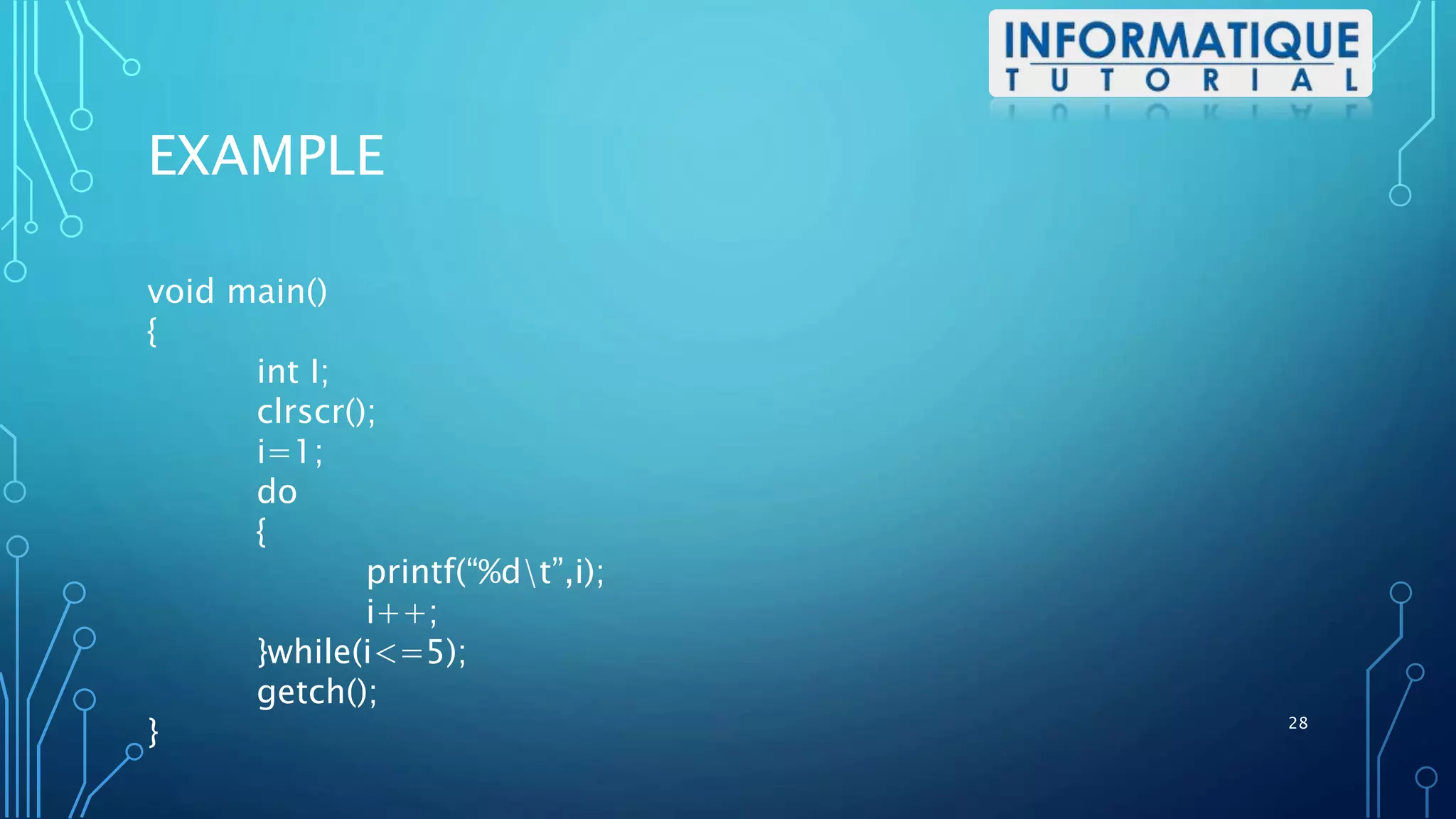
EXAMPLE
void main()
{
int I;
clrscr();
i=1;
do
{
printf(“%dt”,i);
i++;
}while(i<=5);
getch();
} 28
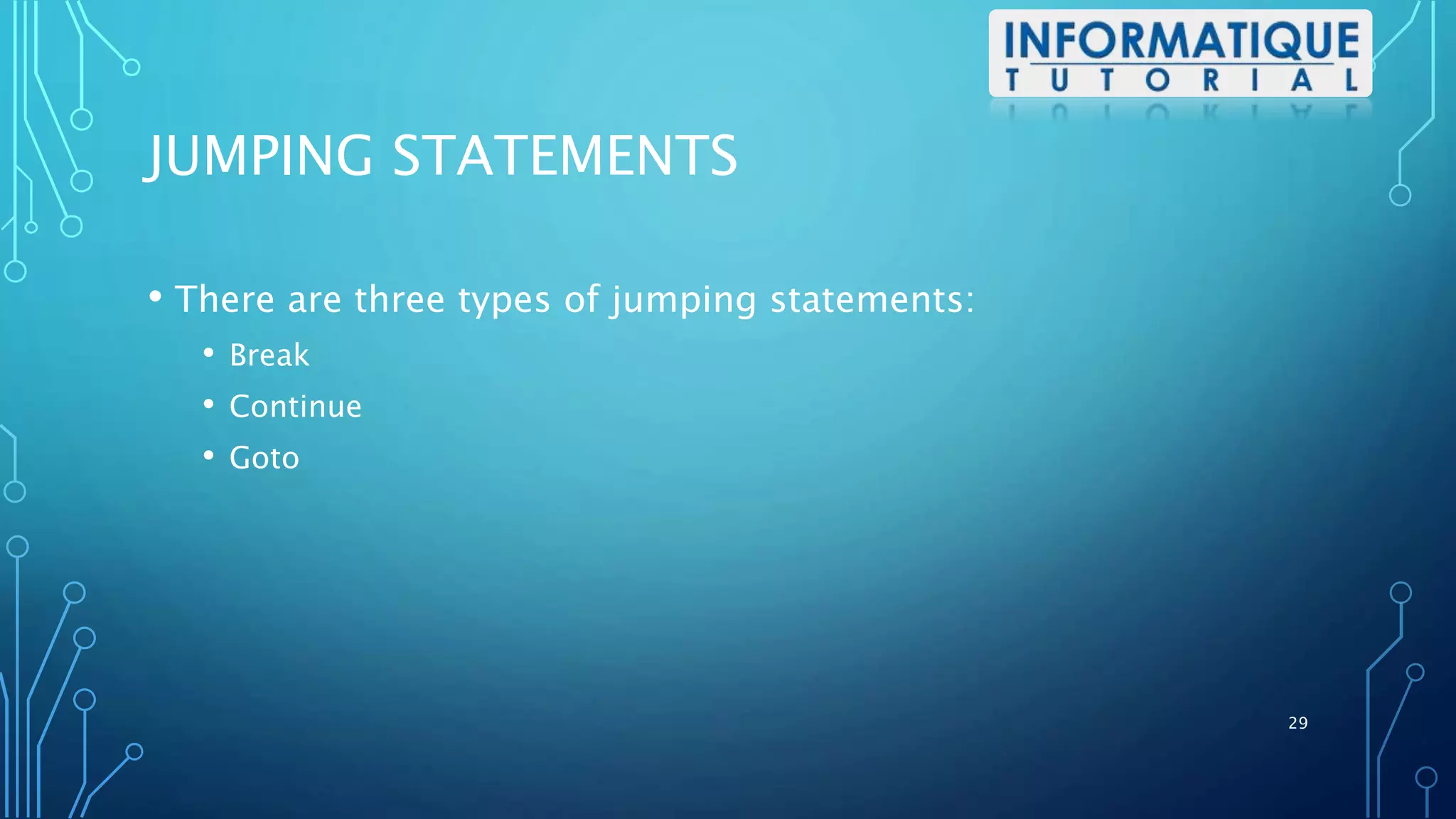
JUMPING STATEMENTS
• There are three types of jumping statements:
• Break
• Continue
• Goto
29
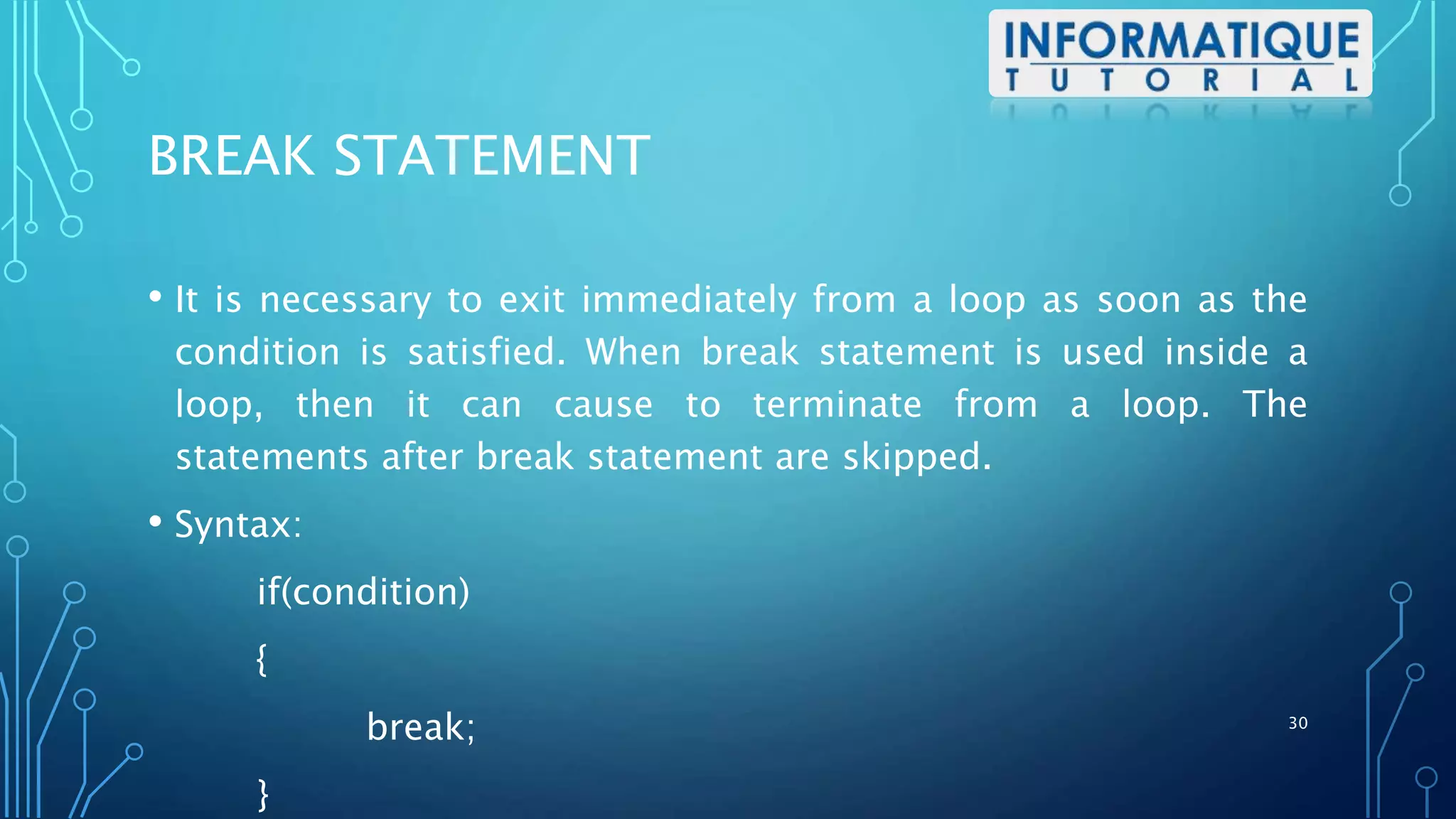
BREAK STATEMENT
• It is necessary to exit immediately from a loop as soon as the
condition is satisfied. When break statement is used inside a
loop, then it can cause to terminate from a loop. The
statements after break statement are skipped.
• Syntax:
if(condition)
{
break;
}
30
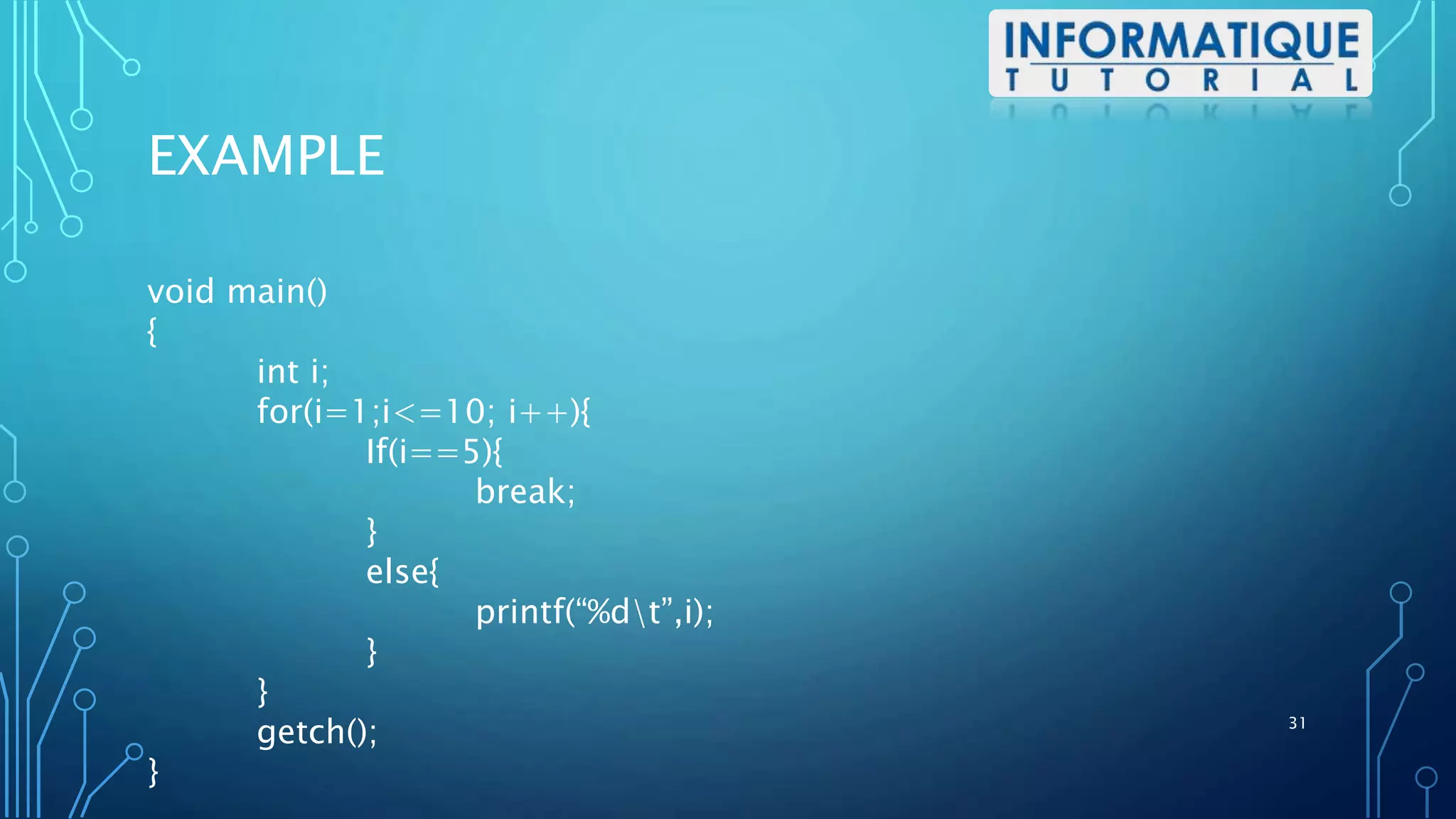
EXAMPLE
void main()
{
int i;
for(i=1;i<=10; i++){
If(i==5){
break;
}
else{
printf(“%dt”,i);
}
}
getch();
}
31
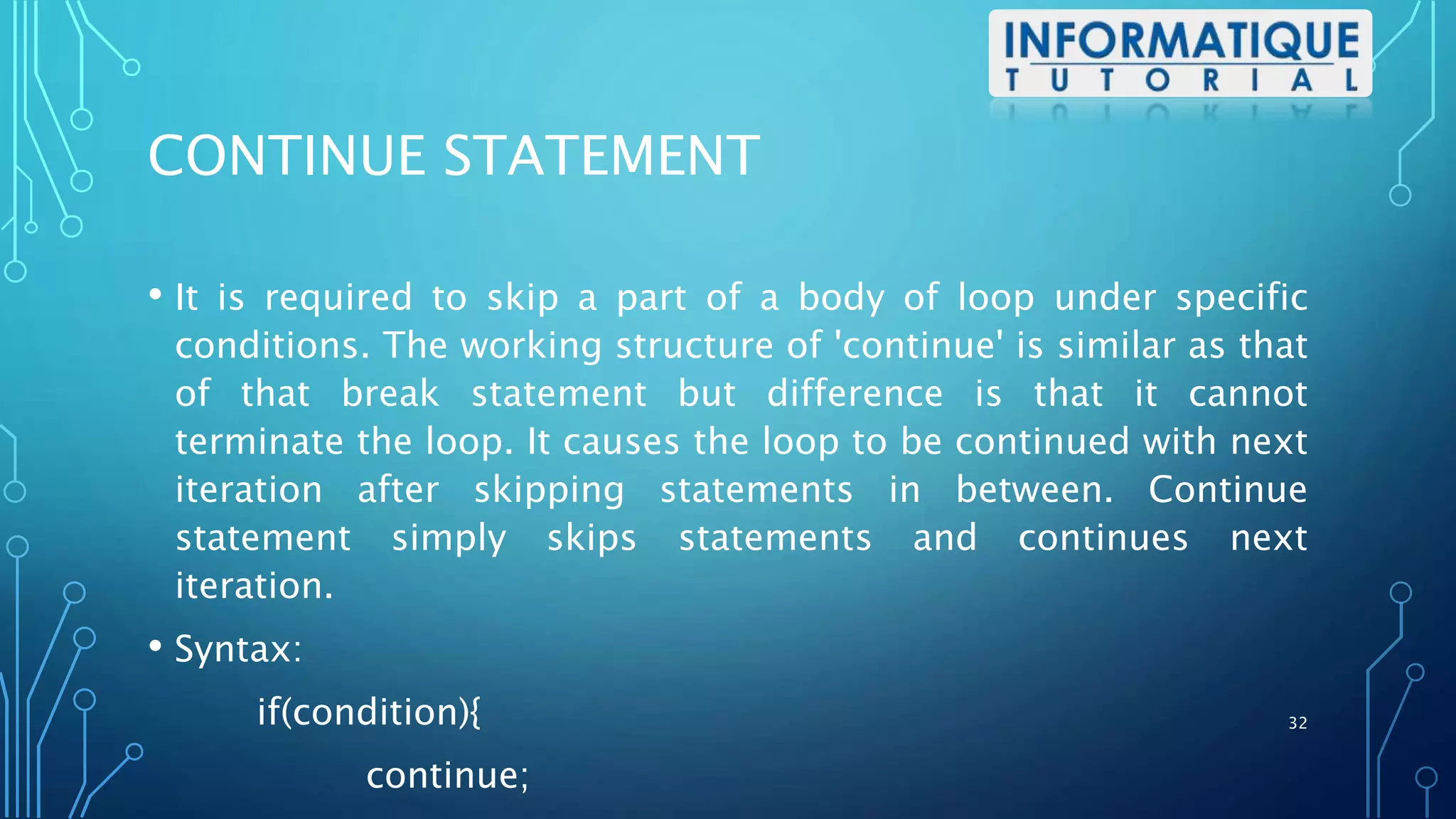
CONTINUE STATEMENT
• It is required to skip a part of a body of loop under specific
conditions. The working structure of 'continue' is similar as that
of that break statement but difference is that it cannot
terminate the loop. It causes the loop to be continued with next
iteration after skipping statements in between. Continue
statement simply skips statements and continues next
iteration.
• Syntax:
if(condition){
continue;
32
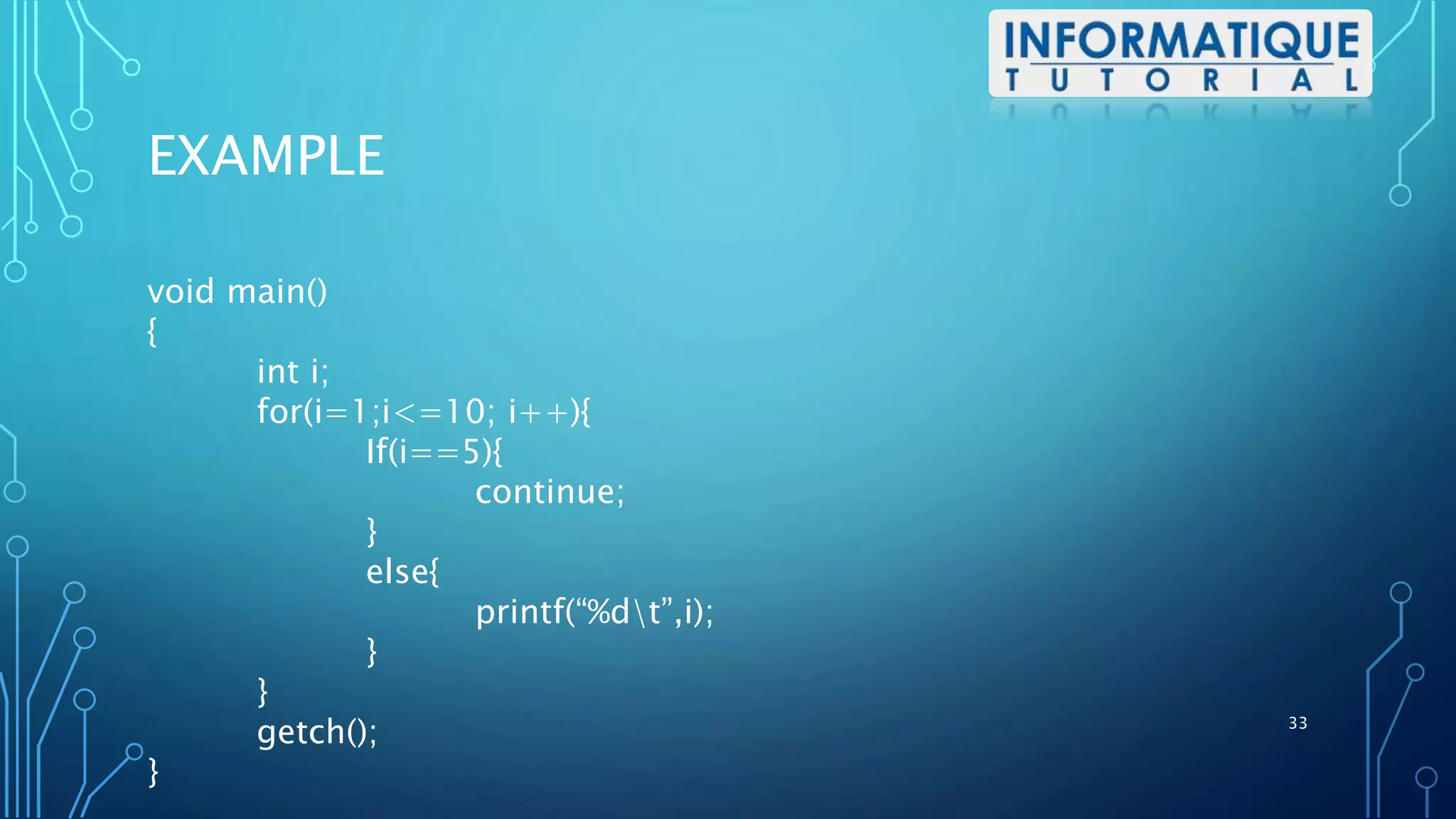
EXAMPLE
void main()
{
int i;
for(i=1;i<=10; i++){
If(i==5){
continue;
}
else{
printf(“%dt”,i);
}
}
getch();
}
33
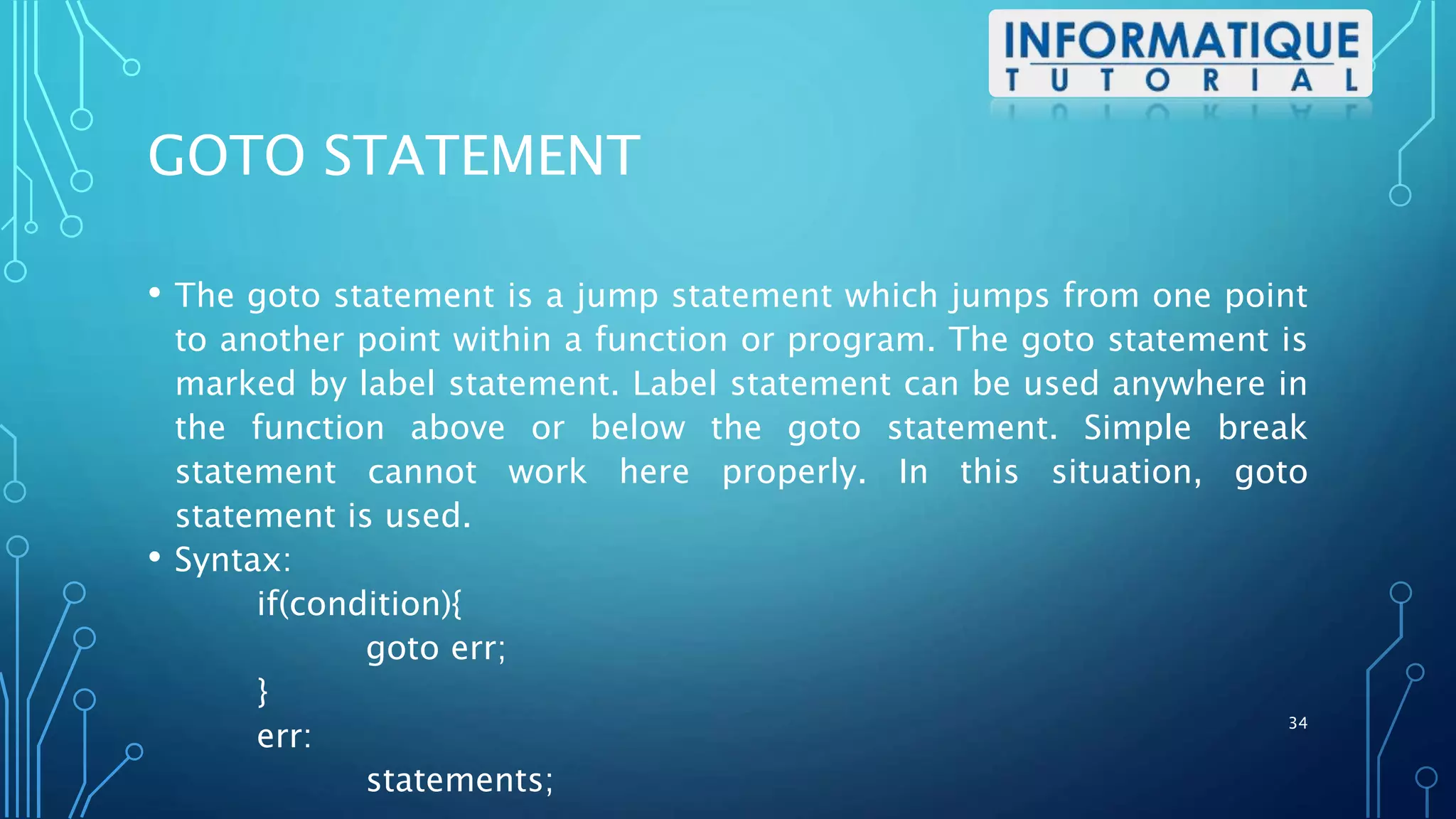
GOTO STATEMENT
• The goto statement is a jump statement which jumps from one point
to another point within a function or program. The goto statement is
marked by label statement. Label statement can be used anywhere in
the function above or below the goto statement. Simple break
statement cannot work here properly. In this situation, goto
statement is used.
• Syntax:
if(condition){
goto err;
}
err:
statements;
34
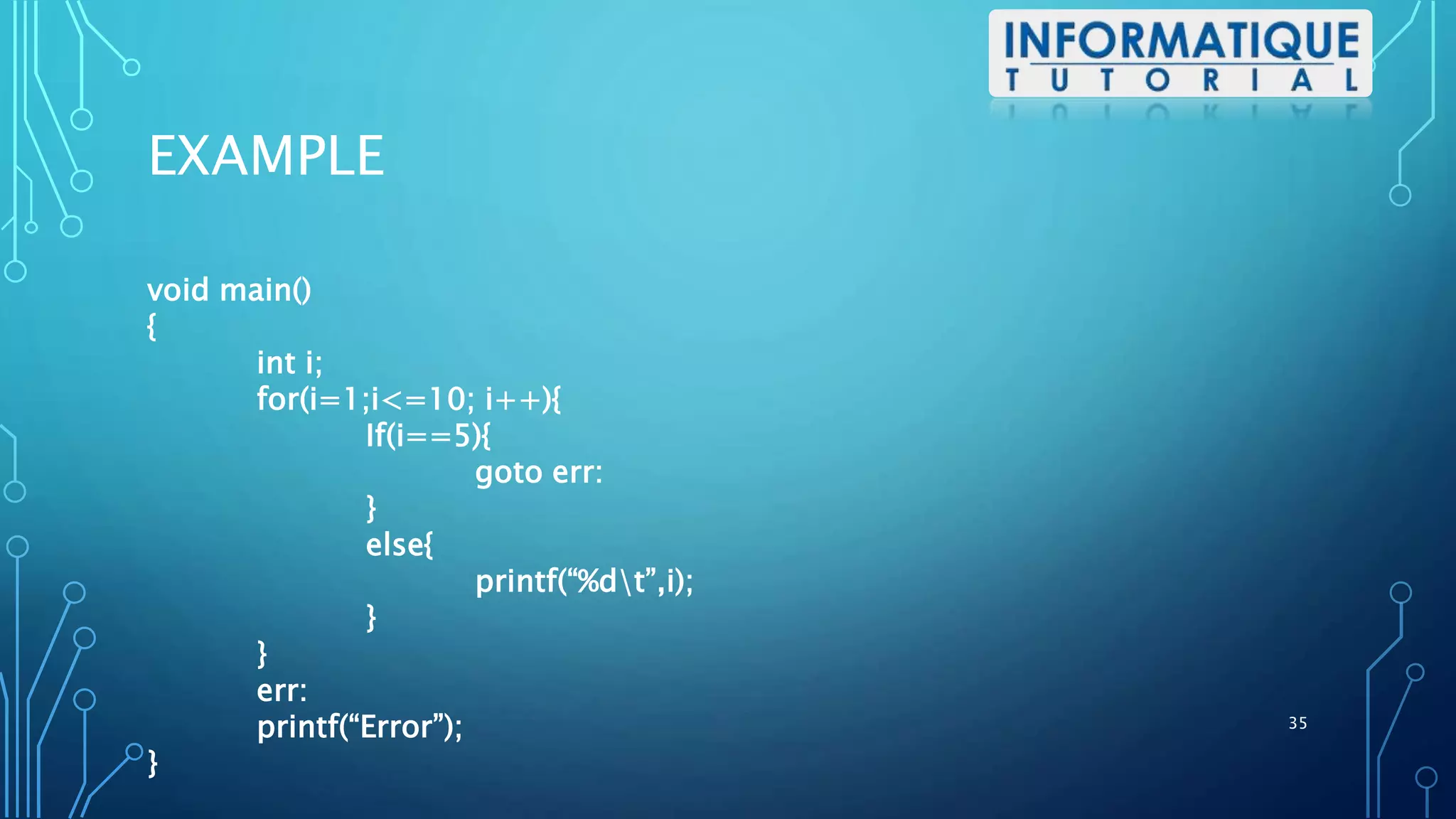
EXAMPLE
void main()
{
int i;
for(i=1;i<=10; i++){
If(i==5){
goto err:
}
else{
printf(“%dt”,i);
}
}
err:
printf(“Error”);
}
35
THANK YOU
36

Control Flow Statements

  • 1.
    CONTROL FLOW STATEMENTS IN CPROGRAMMING LANGUAGE CREATED BY TARUN SHARMA (LECTURER COMPUTER SCIENCE)
  • 2.
    WHAT IS CONTROLFLOW STATEMENTS • A control flow statements is a primary concept in most high- level programming languages. It is a block of code. More specifically, control flow statements are blocks of code that control the flow of a program. In other words, a control structure is a container for a series of function calls, instructions and statements. 2
  • 3.
    TYPES OF CONTROLFLOW STATEMENTS • There are three types of control flow statements: • Branching / Decision Making Statements • Iterative / Looping Statements • Jumping Statements 3
  • 4.
    CONTROL FLOW STATEMENTS •Branching / Decision Making Statements • If Statements • Simple If • If else • Nested if • Else if ladder • Switch Case Statement • Conditional Operator • Looping / Iterative Statements • Entry Control Loops • While Loop • For Loop • Exit Control Loop • Do While Loop • Jumping Statements • Break Statement • Continue Statement • Goto Statement 4
  • 5.
    BRANCHING STATEMENTS • Cprogram executes program sequentially. Sometimes, a program requires checking of certain conditions in program execution. C provides various key condition statements to check condition and execute statements according conditional criteria. These statements are called as 'Decision Making Statements' or 'Conditional Statements.' 5
  • 6.
    TYPES OF CONDITIONALSTATEMENTS • If Statement • Simple If • If Else Statement • Nested If Statement • Else If Ladder • Switch Case Statements • Conditional Operator 6
  • 7.
    IF STATEMENTS –SIMPLE IF STATEMENT • Takes an expression in parenthesis and a statement or block of statements. If the expression is true then the statement or block of statements gets executed otherwise these statements are skipped. • Syntax: if(Condition) { Statements; } 7
  • 8.
    SIMPLE IF EXAMPLE voidmain() { int a=5; if(a%2==0) { printf(“number %d is even.”,a); } } 8
  • 9.
    IF STATEMENT –IF ELSE STATEMENTS • This is also one of the most useful conditional statement used in C to check conditions. • Syntax: if(condition){ true statements; } else{ false statements; } 9
  • 10.
    EXAMPLE void main() { int a=5; if(a%2==0){ printf(“number%d is even”,a); } else{ printf(“number %d is odd”,a); } } 10
  • 11.
    IF STATEMENT –NESTED IF STATEMENTS • If within a If condition is called Nested If condition. It is a conditional statement which is used when we want to check more than 1 conditions at a time in a same program. • Syntax: 11
  • 12.
    IF STATEMENT –NESTED IF STATEMENTS - SYNTAX if(condition){ if(condition){ true statement; } else { false statement; } } else{ statements; } 12
  • 13.
    EXAMPLE void main() { int a,b,c; a=5,b=6, c=8; if(a>b){ if(a>c){ printf(“a is big”); } else{ printf(“c is big”); } } else{ if(b>c){ printf(“b is big”); } else{ printf(“c is big”); } getch(); } 13
  • 14.
    IF STATEMENT –ELSE IF LADDER • Else if() ladder is similar to if else control statement. Else if() ladder is used to check for another condition if the previously specified condition becomes false. • Syntax: 14
  • 15.
    IF STATEMENT –ELSE IF LADDER - SYNTAX If(condition){ Statement; } Else if(condition){ Statement; } Else{ Statement; } 15
  • 16.
    EXAMPLE void main() { int a,b,c; a=5,b=6, c=7; if(a>b && a>c){ printf(“a is big”); } else if(b>c){ printf(“b is big”); } else{ printf(“c is big”); } getch(); } 16
  • 17.
    SWITCH CASE STATEMENTS •This is a multiple or multiway branching decision making statement. When we use nested if-else statement to check more than 1 condition then the complexity of a program increases in case of a lot of conditions. Thus, the program is difficult to read and maintain. So to overcome this problem, C provides 'switch case'. Switch case checks the value of a expression against a case values, if condition matches the case values then the control is transferred to that point. • Syntax 17
  • 18.
    SWITCH CASE STATEMENT- SYNTAX switch(expression){ case exp1: statement; break; case exp2: statement; break; default; statement; } 18
  • 19.
    EXAMPLE void main() { char c=‘a’; switch(c) { case‘a’: case ‘e’: case ‘i’: case ‘o’: case ‘u’: printf(“character %c is vowel”,c); break; default: printf(“character %c is constant”,c); } getch(); } 19
  • 20.
    CONDITIONAL OPERATOR • The? : Operator is just like an if … else statement except that because it is an operator you can use it within expressions. ? : is a ternary operator in that it takes three values, this is the only ternary operator C has. • Syntax: Condition-test? First-expression(true): second- expression(false); 20
  • 21.
    EXAMPLE void main() { int a,b,c,d; a=5,b=6, c=7; d=((a>b && a>c)?a((b>c)?b:c)); printf(“greater number is ::%d”,d); getch(); } 21
  • 22.
    ITERATIONS / LOOPINGSTATEMENTS • 'A loop' is a part of code of a program which is executed repeatedly. A loop is used using condition. The repetition is done until condition becomes true. • There are two types of looping statements. • Entry controlled loop • While Loop • For Loop • Exit controlled loop • Do While Loop 22
  • 23.
    ENTRY CONTROL LOOP– WHILE LOOP • This is an entry controlled looping statement. It is used to repeat a block of statements until condition becomes true. • Syntax: while (condition){ Statements; Increment/decrement; } 23
  • 24.
  • 25.
    ENTRY CONTROL LOOP– FOR LOOP • This is an entry controlled looping statement. In this loop structure, more than one variable can be initialized. One of the most important feature of this loop is that the three actions can be taken at a time like variable initialization, condition checking and increment/decrement. • Syntax: for(initialization; test-condition; increment/decrement) { Statements; } 25
  • 26.
    EXAMPLE void main() { int i; clrscr(); i=1; for(i=1;i<=20;i+=2) { printf(“%dt”,i); } getch(); } 26
  • 27.
    EXIT CONTROL –DO WHILE LOOP • This is an exit controlled looping statement. Sometimes, there is need to execute a block of statements first then to check condition. At that time such type of a loop is used. In this, block of statements are executed first and then condition is checked. • Syntax: do { Statements ;( increment/decrement); } while (condition); 27
  • 28.
  • 29.
    JUMPING STATEMENTS • Thereare three types of jumping statements: • Break • Continue • Goto 29
  • 30.
    BREAK STATEMENT • Itis necessary to exit immediately from a loop as soon as the condition is satisfied. When break statement is used inside a loop, then it can cause to terminate from a loop. The statements after break statement are skipped. • Syntax: if(condition) { break; } 30
  • 31.
    EXAMPLE void main() { int i; for(i=1;i<=10;i++){ If(i==5){ break; } else{ printf(“%dt”,i); } } getch(); } 31
  • 32.
    CONTINUE STATEMENT • Itis required to skip a part of a body of loop under specific conditions. The working structure of 'continue' is similar as that of that break statement but difference is that it cannot terminate the loop. It causes the loop to be continued with next iteration after skipping statements in between. Continue statement simply skips statements and continues next iteration. • Syntax: if(condition){ continue; 32
  • 33.
    EXAMPLE void main() { int i; for(i=1;i<=10;i++){ If(i==5){ continue; } else{ printf(“%dt”,i); } } getch(); } 33
  • 34.
    GOTO STATEMENT • Thegoto statement is a jump statement which jumps from one point to another point within a function or program. The goto statement is marked by label statement. Label statement can be used anywhere in the function above or below the goto statement. Simple break statement cannot work here properly. In this situation, goto statement is used. • Syntax: if(condition){ goto err; } err: statements; 34
  • 35.
    EXAMPLE void main() { int i; for(i=1;i<=10;i++){ If(i==5){ goto err: } else{ printf(“%dt”,i); } } err: printf(“Error”); } 35
  • 36.