Contractual Risk Transfer in
Construction Contracts
Presented by: Thor Insurance & Registries
Ltd
Contractual Risk Transfer
Definition: Contractual Risk Transfer is the shifting
of responsibility from one party to another in a
construction contract.
•Part of the Risk Management Process
•Used as a Risk Management Technique
Contractual Risk Transfer
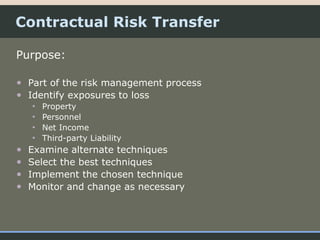
Purpose:
• Part of the risk management process
• Identify exposures to loss
• Property
• Personnel
• Net Income
• Third-party Liability
• Examine alternate techniques
• Select the best techniques
• Implement the chosen technique
• Monitor and change as necessary
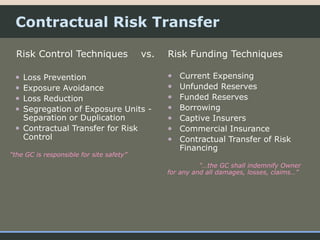
• Loss Prevention
• Exposure Avoidance
• Loss Reduction
• Segregation of Exposure Units -
Separation or Duplication
• Contractual Transfer for Risk
Control
Contractual Risk Transfer
• Current Expensing
• Unfunded Reserves
• Funded Reserves
• Borrowing
• Captive Insurers
• Commercial Insurance
• Contractual Transfer of Risk
Financing
Risk Control Techniques vs. Risk Funding Techniques
“the GC is responsible for site safety”
“…the GC shall indemnify Owner
for any and all damages, losses, claims…”
Risk Transfer Perspectives
Owners
•Paying customer – all powerful
•Want a no-risk proposition
•Need own liability & builder’s risk coverage
•Rarely draft the contract
Risk Transfer Perspectives
Owners
Architects & Construction Managers
• Draft & manage contracts
• “Professional” standard of care
• Little control, great risk
• Often-shallow pockets
• Architect Errors & Omissions
Risk Transfer Perspectives
Owners
Architects & Construction Managers
General Contractors
• Responsible for everything
• Deep pockets, prime target
• Power over subs
• Transfer responsibility to subs
• Vicariously liable
Risk Transfer Perspectives
Owners
Architects & Construction Managers
General Contractors
Sub-Contractors
• Did the deed – primary responsibility
• Indemnify everybody
• In control of own actions
• Little power to alter contract terms
• Inadequate insurance
Indemnification Agreements
Broad Form
• “Pay any and all damages, costs, expenses…”
• No or few limitations
• Even for the sole negligence of the owner
• Owners favour over GCs
• GCs favour over Subs
• Inequitable, possibly unenforceable
Indemnification Agreements
Broad Form
Limited Form
• “Pay to the extent of own negligence…”
• Limited scope “…for bodily injury and property damages…”
• Everyone responsible for own actions
• Equitable, likely to be enforced
• Acceptable to contractors
Broad Form
Limited Form
Contractual Liability Insurance Coverage
• Included in post-1985 general liability policies
• Covers “Insured Contracts”
• Subject to insurance policy terms, conditions, exclusions, limits, etc.
Indemnification Agreements
Easements, Elevator Maintenance, Lease of Premises,
Sidetrack Agreements…and the tort liability of others
assumed in an Indemnification Agreement
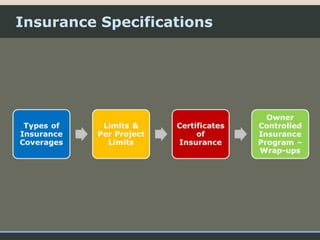
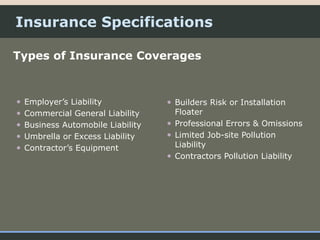
Insurance Specifications
• Employer’s Liability
• Commercial General Liability
• Business Automobile Liability
• Umbrella or Excess Liability
• Contractor’s Equipment
• Builders Risk or Installation
Floater
• Professional Errors & Omissions
• Limited Job-site Pollution
Liability
• Contractors Pollution Liability
Types of Insurance Coverages
Insurance Specifications
• Owner > GC
• GC > Owner
• Prof. > Owner & GC
• Subs > GC
• Confirm compliance
• Avoid uninsured subs
• Avoid audit charges
Types of Insurance Coverages
Limits & Per Project Limits
Certificates of Insurance
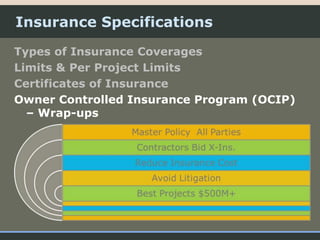
Insurance Specifications
Types of Insurance Coverages
Limits & Per Project Limits
Certificates of Insurance
Owner Controlled Insurance Program (OCIP)
– Wrap-ups
Additional Insureds
Additional Insureds
Coverage Granted
• 100% defence expenses to Party A
• If Party B insured – settlement apportioned between Parties A & B
• If Party B uninsured – 100% settlement to Party A
Additional Insureds
Coverage Granted
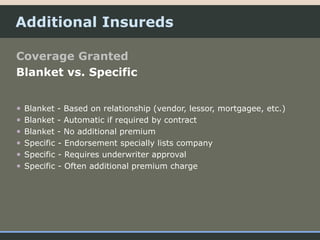
Blanket vs. Specific
• Blanket - Based on relationship (vendor, lessor, mortgagee, etc.)
• Blanket - Automatic if required by contract
• Blanket - No additional premium
• Specific - Endorsement specially lists company
• Specific - Requires underwriter approval
• Specific - Often additional premium charge
Additional Insureds
Coverage Granted
Blanket vs. Specific
Primary & Non-Contributory
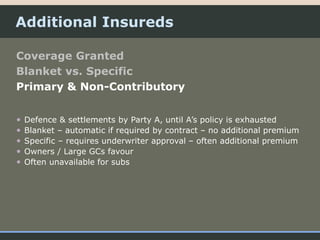
• Defence & settlements by Party A, until A’s policy is exhausted
• Blanket – automatic if required by contract – no additional premium
• Specific – requires underwriter approval – often additional premium
• Owners / Large GCs favour
• Often unavailable for subs
Waivers of Subrogation
Restricts Insurer Rights
• Voids insurer’s right to mitigate losses by collecting from
responsible parties
Waivers of Subrogation
Restricts Insurer Rights
Blanket vs. Specific
• Blanket - Automatic if required by contract
• Blanket - No additional premium
• Specific - Endorsement specially lists company
• Specific - Requires underwriter approval
• Specific - Often additional premium charge
Waivers of Subrogation
Restricts Insurer Rights
Blanket vs. Specific
Property vs. Casualty
• Significant casualty change
• Eliminates disputes in property claims
Builder’s Risk & Installation Floaters
Ownership Interests
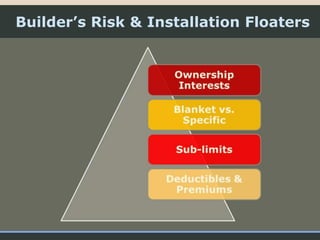
• Named insured includes: Owner, GC & Subs of all tiers
• Owners or GC can obtain policy
• Owner’s property policy is a poor substitute for builder’s risk
Builder’s Risk & Installation Floaters
Ownership Interests
Blanket vs. Specific
• GCs often have blanket builder’s risk – limits may be too low
• Subs often have installation floaters – limits may be acceptable
• Other insurance clauses may cause conflicts
Builder’s Risk & Installation Floaters
Ownership Interests
Blanket vs. Specific
Sub-limits
• Materials off-site
• Materials in transit
• Soft costs
• Loss of use
• Mechanical startup & testing
Builder’s Risk & Installation Floaters
Ownership Interests
Blanket vs. Specific
Sub-limits
Deductibles & Premiums
• Contract often vague about who bears deductible
• Contract may elect Owner Claim Fiduciary
• Contract typically allows premium to be charged to Owner
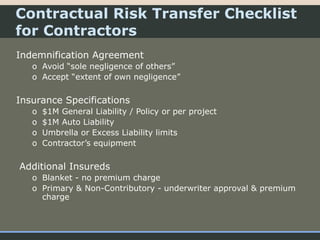
Contractual Risk Transfer Checklist
for Contractors
Indemnification Agreement
o Avoid “sole negligence of others”
o Accept “extent of own negligence”
Insurance Specifications
o $1M General Liability / Policy or per project
o $1M Auto Liability
o Umbrella or Excess Liability limits
o Contractor’s equipment
Additional Insureds
o Blanket - no premium charge
o Primary & Non-Contributory - underwriter approval & premium
charge
Contractual Risk Transfer Checklist
for Contractors
Waivers of Subrogation
o GL, Auto, Umbrella - underwriter approval
o Contractor’s equipment - underwriter approval
Builder’s Risk / Installation Floater
o Who obtains coverage?
o All parties are named insureds
o Project cost = Policy limits
o Adequate Off-site & In-transit sub-limits
o Optional soft cost coverage
o Who bears deductible obligations?
o Who pays premium?
Contractual Risk Transfer Checklist
for Contractors
Professional Liability
o Architects & Engineers
o Construction Managers
o Design Builders
Pollution Liability
o Limited on-site, sudden, & accidental
o Full Contractors Pollution Liability
o Auto Pollution Liability
Certificates of Insurance
o Obtained from agent
o Sent to Owner
o Obtained from subcontractors
o Contractor coverage adequate?
Questions or Comments?
Contracts can be confusing. We have the construction expertise
and resources to help you manage your contract risks and
support a total risk management approach.
Thor Insurance & Registries Ltd: How can we assist you?
© 2008, 2012 Zywave Inc. All rights reserved.

Contractual-Risk-Transfer-Presentation.ppt

  • 1.
    Contractual Risk Transferin Construction Contracts Presented by: Thor Insurance & Registries Ltd
  • 2.
    Contractual Risk Transfer Definition:Contractual Risk Transfer is the shifting of responsibility from one party to another in a construction contract. •Part of the Risk Management Process •Used as a Risk Management Technique
  • 3.
    Contractual Risk Transfer Purpose: •Part of the risk management process • Identify exposures to loss • Property • Personnel • Net Income • Third-party Liability • Examine alternate techniques • Select the best techniques • Implement the chosen technique • Monitor and change as necessary
  • 4.
    • Loss Prevention •Exposure Avoidance • Loss Reduction • Segregation of Exposure Units - Separation or Duplication • Contractual Transfer for Risk Control Contractual Risk Transfer • Current Expensing • Unfunded Reserves • Funded Reserves • Borrowing • Captive Insurers • Commercial Insurance • Contractual Transfer of Risk Financing Risk Control Techniques vs. Risk Funding Techniques “the GC is responsible for site safety” “…the GC shall indemnify Owner for any and all damages, losses, claims…”
  • 5.
  • 6.
    Risk Transfer Perspectives Owners •Payingcustomer – all powerful •Want a no-risk proposition •Need own liability & builder’s risk coverage •Rarely draft the contract
  • 7.
    Risk Transfer Perspectives Owners Architects& Construction Managers • Draft & manage contracts • “Professional” standard of care • Little control, great risk • Often-shallow pockets • Architect Errors & Omissions
  • 8.
    Risk Transfer Perspectives Owners Architects& Construction Managers General Contractors • Responsible for everything • Deep pockets, prime target • Power over subs • Transfer responsibility to subs • Vicariously liable
  • 9.
    Risk Transfer Perspectives Owners Architects& Construction Managers General Contractors Sub-Contractors • Did the deed – primary responsibility • Indemnify everybody • In control of own actions • Little power to alter contract terms • Inadequate insurance
  • 10.
  • 11.
    Indemnification Agreements Broad Form •“Pay any and all damages, costs, expenses…” • No or few limitations • Even for the sole negligence of the owner • Owners favour over GCs • GCs favour over Subs • Inequitable, possibly unenforceable
  • 12.
    Indemnification Agreements Broad Form LimitedForm • “Pay to the extent of own negligence…” • Limited scope “…for bodily injury and property damages…” • Everyone responsible for own actions • Equitable, likely to be enforced • Acceptable to contractors
  • 13.
    Broad Form Limited Form ContractualLiability Insurance Coverage • Included in post-1985 general liability policies • Covers “Insured Contracts” • Subject to insurance policy terms, conditions, exclusions, limits, etc. Indemnification Agreements Easements, Elevator Maintenance, Lease of Premises, Sidetrack Agreements…and the tort liability of others assumed in an Indemnification Agreement
  • 14.
  • 15.
    Insurance Specifications • Employer’sLiability • Commercial General Liability • Business Automobile Liability • Umbrella or Excess Liability • Contractor’s Equipment • Builders Risk or Installation Floater • Professional Errors & Omissions • Limited Job-site Pollution Liability • Contractors Pollution Liability Types of Insurance Coverages
  • 16.
    Insurance Specifications • Owner> GC • GC > Owner • Prof. > Owner & GC • Subs > GC • Confirm compliance • Avoid uninsured subs • Avoid audit charges Types of Insurance Coverages Limits & Per Project Limits Certificates of Insurance
  • 17.
    Insurance Specifications Types ofInsurance Coverages Limits & Per Project Limits Certificates of Insurance Owner Controlled Insurance Program (OCIP) – Wrap-ups
  • 18.
  • 19.
    Additional Insureds Coverage Granted •100% defence expenses to Party A • If Party B insured – settlement apportioned between Parties A & B • If Party B uninsured – 100% settlement to Party A
  • 20.
    Additional Insureds Coverage Granted Blanketvs. Specific • Blanket - Based on relationship (vendor, lessor, mortgagee, etc.) • Blanket - Automatic if required by contract • Blanket - No additional premium • Specific - Endorsement specially lists company • Specific - Requires underwriter approval • Specific - Often additional premium charge
  • 21.
    Additional Insureds Coverage Granted Blanketvs. Specific Primary & Non-Contributory • Defence & settlements by Party A, until A’s policy is exhausted • Blanket – automatic if required by contract – no additional premium • Specific – requires underwriter approval – often additional premium • Owners / Large GCs favour • Often unavailable for subs
  • 22.
  • 23.
    Waivers of Subrogation RestrictsInsurer Rights • Voids insurer’s right to mitigate losses by collecting from responsible parties
  • 24.
    Waivers of Subrogation RestrictsInsurer Rights Blanket vs. Specific • Blanket - Automatic if required by contract • Blanket - No additional premium • Specific - Endorsement specially lists company • Specific - Requires underwriter approval • Specific - Often additional premium charge
  • 25.
    Waivers of Subrogation RestrictsInsurer Rights Blanket vs. Specific Property vs. Casualty • Significant casualty change • Eliminates disputes in property claims
  • 26.
    Builder’s Risk &Installation Floaters
  • 27.
    Builder’s Risk &Installation Floaters Ownership Interests • Named insured includes: Owner, GC & Subs of all tiers • Owners or GC can obtain policy • Owner’s property policy is a poor substitute for builder’s risk
  • 28.
    Builder’s Risk &Installation Floaters Ownership Interests Blanket vs. Specific • GCs often have blanket builder’s risk – limits may be too low • Subs often have installation floaters – limits may be acceptable • Other insurance clauses may cause conflicts
  • 29.
    Builder’s Risk &Installation Floaters Ownership Interests Blanket vs. Specific Sub-limits • Materials off-site • Materials in transit • Soft costs • Loss of use • Mechanical startup & testing
  • 30.
    Builder’s Risk &Installation Floaters Ownership Interests Blanket vs. Specific Sub-limits Deductibles & Premiums • Contract often vague about who bears deductible • Contract may elect Owner Claim Fiduciary • Contract typically allows premium to be charged to Owner
  • 31.
    Contractual Risk TransferChecklist for Contractors Indemnification Agreement o Avoid “sole negligence of others” o Accept “extent of own negligence” Insurance Specifications o $1M General Liability / Policy or per project o $1M Auto Liability o Umbrella or Excess Liability limits o Contractor’s equipment Additional Insureds o Blanket - no premium charge o Primary & Non-Contributory - underwriter approval & premium charge
  • 32.
    Contractual Risk TransferChecklist for Contractors Waivers of Subrogation o GL, Auto, Umbrella - underwriter approval o Contractor’s equipment - underwriter approval Builder’s Risk / Installation Floater o Who obtains coverage? o All parties are named insureds o Project cost = Policy limits o Adequate Off-site & In-transit sub-limits o Optional soft cost coverage o Who bears deductible obligations? o Who pays premium?
  • 33.
    Contractual Risk TransferChecklist for Contractors Professional Liability o Architects & Engineers o Construction Managers o Design Builders Pollution Liability o Limited on-site, sudden, & accidental o Full Contractors Pollution Liability o Auto Pollution Liability Certificates of Insurance o Obtained from agent o Sent to Owner o Obtained from subcontractors o Contractor coverage adequate?
  • 34.
    Questions or Comments? Contractscan be confusing. We have the construction expertise and resources to help you manage your contract risks and support a total risk management approach. Thor Insurance & Registries Ltd: How can we assist you? © 2008, 2012 Zywave Inc. All rights reserved.