
AUGUST 2016. Seminario
Inglés Jurídico U.C.C.
MUÑOZ LUNA, Mauricio
PEREZ DEL VISO, Adela.
**CONTRACT LAW: ELEMENTS OF A CONTRACT. REVISION
+
**NEW CONCEPTS AS REGARDS CONTRACT LAW.
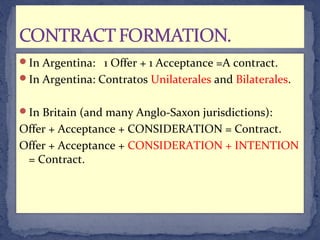
In Argentina: 1 Offer + 1 Acceptance =A contract.
In Argentina: Contratos Unilaterales and Bilaterales.
In Britain (and many Anglo-Saxon jurisdictions):
Offer + Acceptance + CONSIDERATION = Contract.
Offer + Acceptance + CONSIDERATION + INTENTION
= Contract.
OFFER
It is a definite promise to be bound by, provided
that the terms of the offer are accepted.
Offeror/ offeree
An offer is not «mere willingness to deal or
negotiate».
John says: «Hey, Peter, I will sell you some
calendars…» but no specifications as to quality, size,
style or price:
At this stage: NO LEGALLY BINDING CONTRACT
between John and Peter.
OFFER
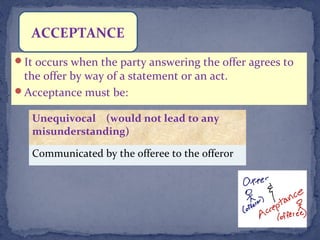
It occurs when the party answering the offer agrees to
the offer by way of a statement or an act.
Acceptance must be:
ACCEPTANCE
Unequivocal (would not lead to any
misunderstanding)
Communicated by the offeree to the offeror
It is the price paid for the promise
of the other party.
It must be SOMETHING OF
VALUE, although it must not need
to be money.
It would be some RIGHT,
INTEREST, OR BENEFIT going to
the other party.
CONSIDERATION
Intention, or «Intention to create
legal relations»: It is a concept
which implies that the parties have
entered into a contract which is
ENFORCEABLE at law.
NO INTENTION: not
enforceability.
A) The style of written contracts (long sentences, no
contractions, etc).
B) Formal expressions (due to the fact that, until such
time as…, in the near future).
C) Technical words (retailer, outlet, defective, etc)
D) Archaic compound words (hereinafter, thereon,
thereof, herein)
E) Common words in contracts related to products or
services.
F) The structure of a contract (parties, the definition
section, the recitals, etc.)
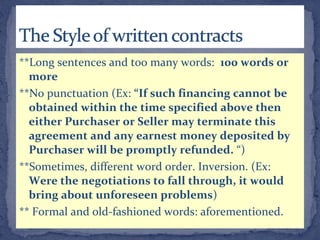
**Long sentences and too many words: 100 words or
more
**No punctuation (Ex: “If such financing cannot be
obtained within the time specified above then
either Purchaser or Seller may terminate this
agreement and any earnest money deposited by
Purchaser will be promptly refunded. “)
**Sometimes, different word order. Inversion. (Ex:
Were the negotiations to fall through, it would
bring about unforeseen problems)
** Formal and old-fashioned words: aforementioned.
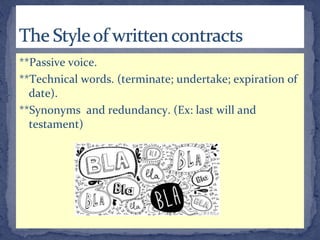
**Passive voice.
**Technical words. (terminate; undertake; expiration of
date).
**Synonyms and redundancy. (Ex: last will and
testament)
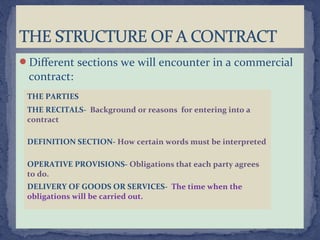
Different sections we will encounter in a commercial
contract:
THE PARTIES
THE RECITALS- Background or reasons for entering into a
contract
DEFINITION SECTION- How certain words must be interpreted
OPERATIVE PROVISIONS- Obligations that each party agrees
to do.
DELIVERY OF GOODS OR SERVICES- The time when the
obligations will be carried out.
THANK YOU VERY MUCH!!
AUGUST 5 , 2016
ADELA AND MAURICIO

CONTRACT LAW. Vocabulary

  • 1.
    AUGUST 2016. Seminario InglésJurídico U.C.C. MUÑOZ LUNA, Mauricio PEREZ DEL VISO, Adela.
  • 2.
    **CONTRACT LAW: ELEMENTSOF A CONTRACT. REVISION + **NEW CONCEPTS AS REGARDS CONTRACT LAW.
  • 3.
    In Argentina: 1Offer + 1 Acceptance =A contract. In Argentina: Contratos Unilaterales and Bilaterales. In Britain (and many Anglo-Saxon jurisdictions): Offer + Acceptance + CONSIDERATION = Contract. Offer + Acceptance + CONSIDERATION + INTENTION = Contract.
  • 4.
  • 5.
    It is adefinite promise to be bound by, provided that the terms of the offer are accepted. Offeror/ offeree An offer is not «mere willingness to deal or negotiate». John says: «Hey, Peter, I will sell you some calendars…» but no specifications as to quality, size, style or price: At this stage: NO LEGALLY BINDING CONTRACT between John and Peter. OFFER
  • 6.
    It occurs whenthe party answering the offer agrees to the offer by way of a statement or an act. Acceptance must be: ACCEPTANCE Unequivocal (would not lead to any misunderstanding) Communicated by the offeree to the offeror
  • 7.
    It is theprice paid for the promise of the other party. It must be SOMETHING OF VALUE, although it must not need to be money. It would be some RIGHT, INTEREST, OR BENEFIT going to the other party. CONSIDERATION
  • 8.
    Intention, or «Intentionto create legal relations»: It is a concept which implies that the parties have entered into a contract which is ENFORCEABLE at law. NO INTENTION: not enforceability.
  • 9.
    A) The styleof written contracts (long sentences, no contractions, etc). B) Formal expressions (due to the fact that, until such time as…, in the near future). C) Technical words (retailer, outlet, defective, etc) D) Archaic compound words (hereinafter, thereon, thereof, herein) E) Common words in contracts related to products or services. F) The structure of a contract (parties, the definition section, the recitals, etc.)
  • 10.
    **Long sentences andtoo many words: 100 words or more **No punctuation (Ex: “If such financing cannot be obtained within the time specified above then either Purchaser or Seller may terminate this agreement and any earnest money deposited by Purchaser will be promptly refunded. “) **Sometimes, different word order. Inversion. (Ex: Were the negotiations to fall through, it would bring about unforeseen problems) ** Formal and old-fashioned words: aforementioned.
  • 11.
    **Passive voice. **Technical words.(terminate; undertake; expiration of date). **Synonyms and redundancy. (Ex: last will and testament)
  • 12.
    Different sections wewill encounter in a commercial contract: THE PARTIES THE RECITALS- Background or reasons for entering into a contract DEFINITION SECTION- How certain words must be interpreted OPERATIVE PROVISIONS- Obligations that each party agrees to do. DELIVERY OF GOODS OR SERVICES- The time when the obligations will be carried out.
  • 15.
    THANK YOU VERYMUCH!! AUGUST 5 , 2016 ADELA AND MAURICIO