04/01/2012 Gift 2012 by Dr P H
Waghodekar, Aurangabad 1
Outcome Based Education (OBE)
Ref: Dr. Fabian Kung Wai Lee, Programme Coordinator, Faculty of
Engineering, Outcome-Based Approach to Engineering Education ,
EAC Accreditation in 2009, B.Eng. (Hons) Electronics Majoring in
Microwave and Communications (Malaysia).
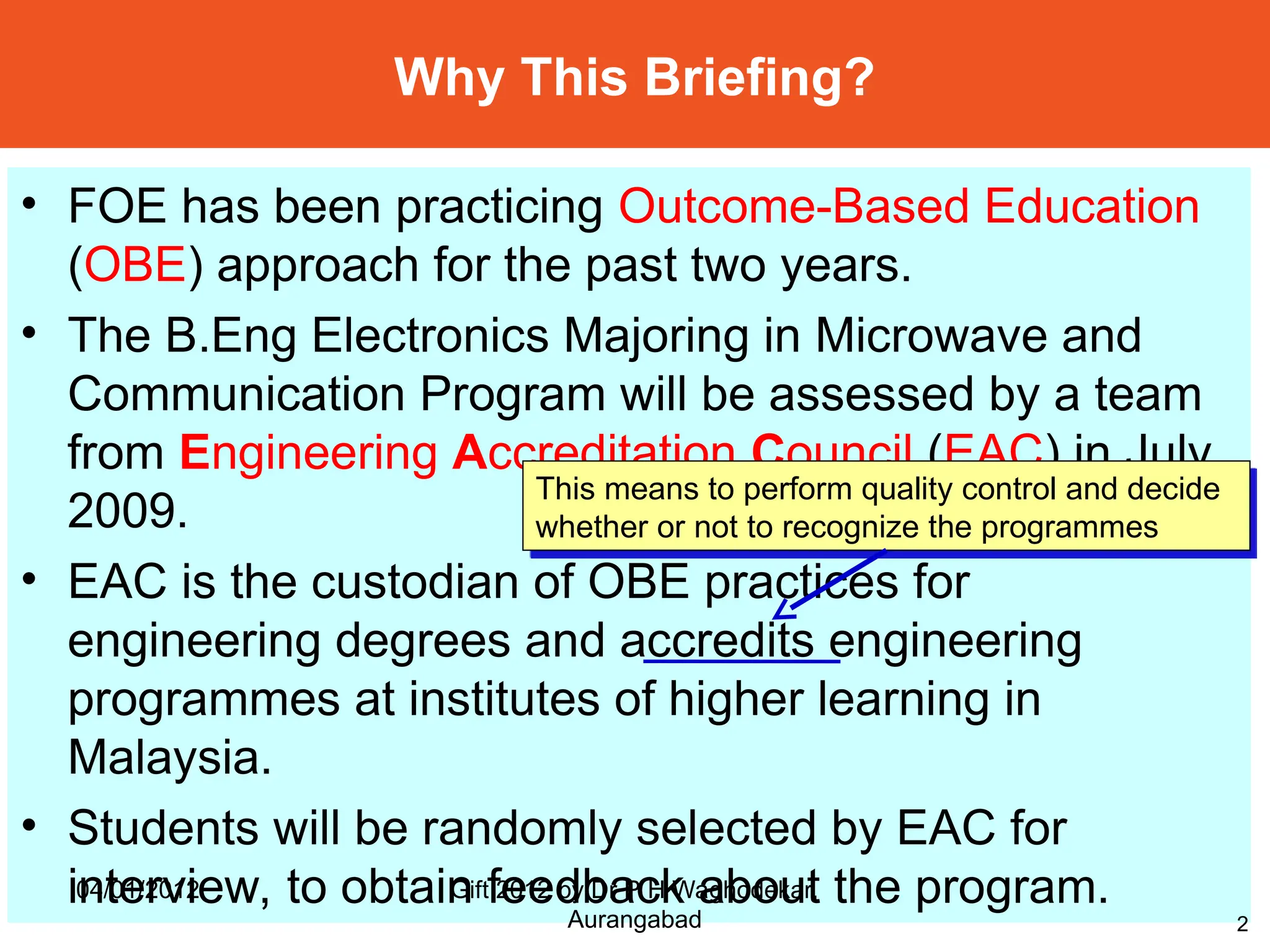
• FOE has been practicing Outcome-Based Education
(OBE) approach for the past two years.
• The B.Eng Electronics Majoring in Microwave and
Communication Program will be assessed by a team
from Engineering Accreditation Council (EAC) in July
2009.
• EAC is the custodian of OBE practices for
engineering degrees and accredits engineering
programmes at institutes of higher learning in
Malaysia.
• Students will be randomly selected by EAC for
interview, to obtain feedback about the program.
2
Why This Briefing?
This means to perform quality control and decide
whether or not to recognize the programmes
04/01/2012 Gift 2012 by Dr P H Waghodekar,
Aurangabad
3
What Is Outcome Based Engineering Education?
IT’S NOT WHAT WE TEACH,
IT’S WHAT YOU LEARN
In a nutshell, learner-centric approach
to tertiary education
04/01/2012 Gift 2012 by Dr P H Waghodekar,
Aurangabad
4
• What is EAC?
• Why Need Accreditation?
• EAC Accreditation Criteria
• Deficiencies of Traditional Education
• Outcome Based Education (OBE)
• Roles of Lecturers
• Roles of Students
• Q & A
Contents
04/01/2012 Gift 2012 by Dr P H Waghodekar,
Aurangabad
What Is EAC?
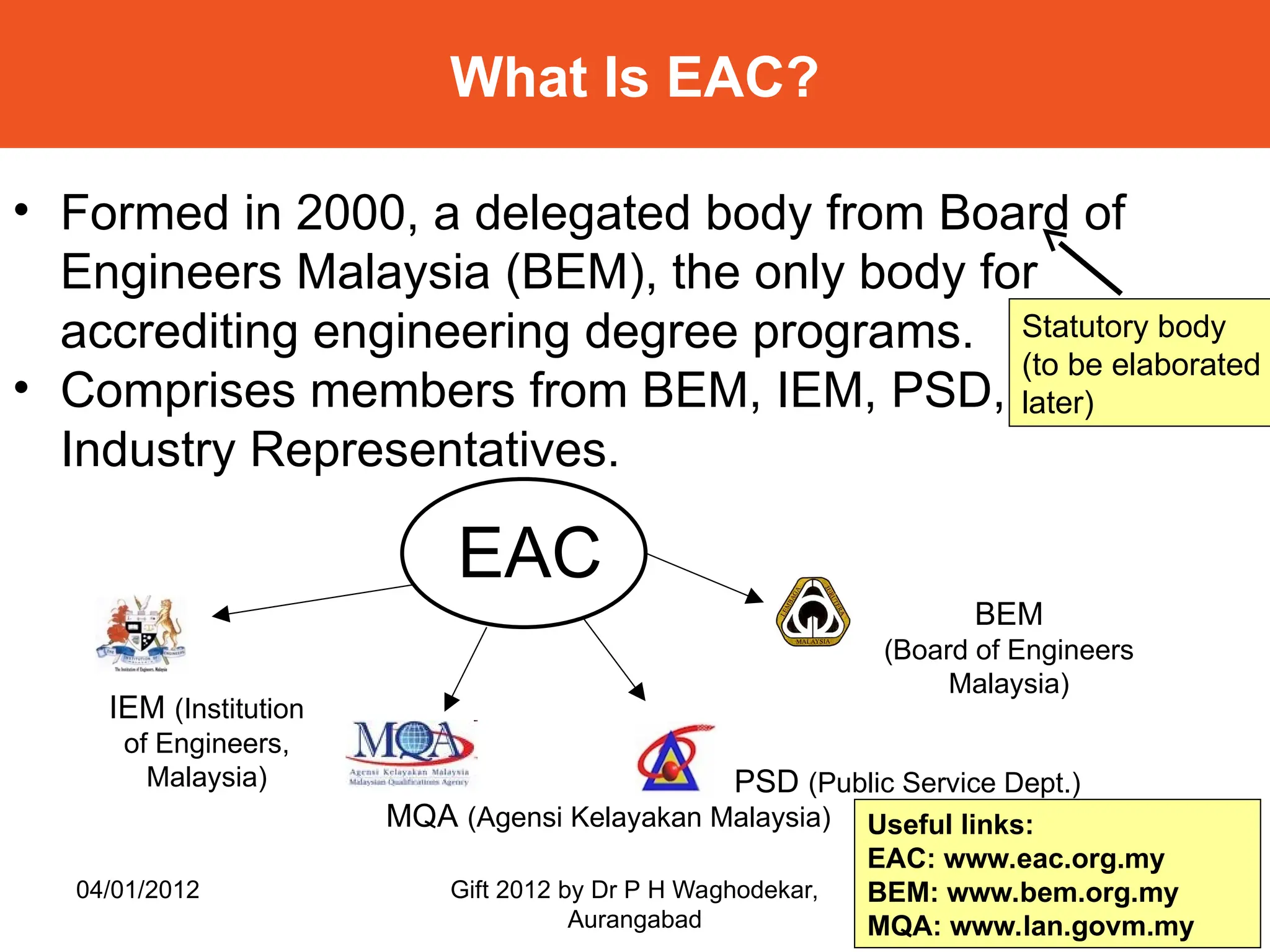
• Formed in 2000, a delegated body from Board of
Engineers Malaysia (BEM), the only body for
accrediting engineering degree programs.
• Comprises members from BEM, IEM, PSD, MQA and
Industry Representatives.
EAC
IEM (Institution
of Engineers,
Malaysia) PSD (Public Service Dept.)
BEM
(Board of Engineers
Malaysia)
MQA (Agensi Kelayakan Malaysia) Useful links:
EAC: www.eac.org.my
BEM: www.bem.org.my
MQA: www.lan.govm.my
Statutory body
(to be elaborated
later)
04/01/2012 Gift 2012 by Dr P H Waghodekar,
Aurangabad
6
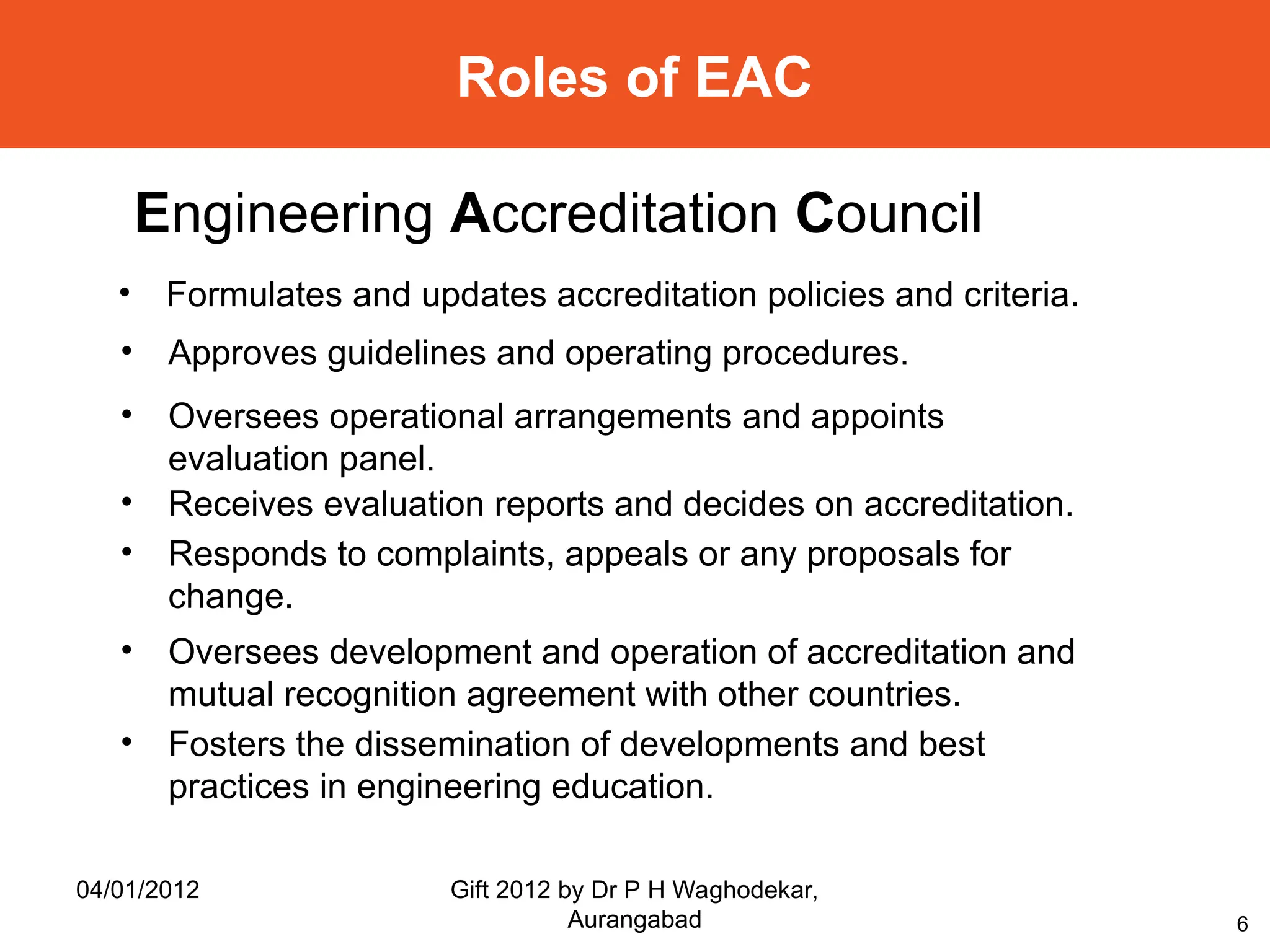
Roles of EAC
Engineering Accreditation Council
• Formulates and updates accreditation policies and criteria.
• Approves guidelines and operating procedures.
• Oversees operational arrangements and appoints
evaluation panel.
• Receives evaluation reports and decides on accreditation.
• Responds to complaints, appeals or any proposals for
change.
• Oversees development and operation of accreditation and
mutual recognition agreement with other countries.
• Fosters the dissemination of developments and best
practices in engineering education.
04/01/2012 Gift 2012 by Dr P H Waghodekar,
Aurangabad
7
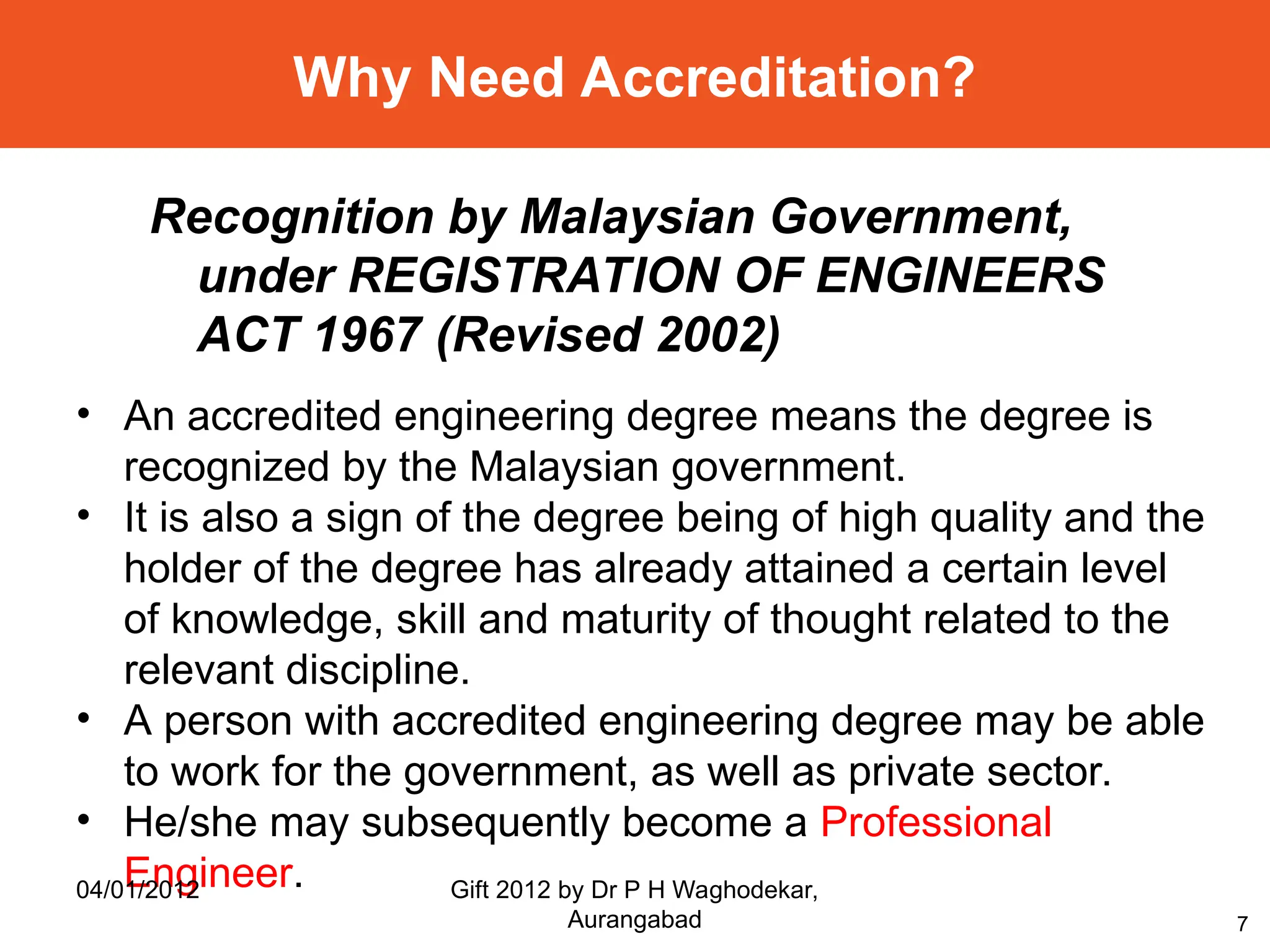
Why Need Accreditation?
• An accredited engineering degree means the degree is
recognized by the Malaysian government.
• It is also a sign of the degree being of high quality and the
holder of the degree has already attained a certain level
of knowledge, skill and maturity of thought related to the
relevant discipline.
• A person with accredited engineering degree may be able
to work for the government, as well as private sector.
• He/she may subsequently become a Professional
Engineer.
Recognition by Malaysian Government,
under REGISTRATION OF ENGINEERS
ACT 1967 (Revised 2002)
04/01/2012 Gift 2012 by Dr P H Waghodekar,
Aurangabad
8
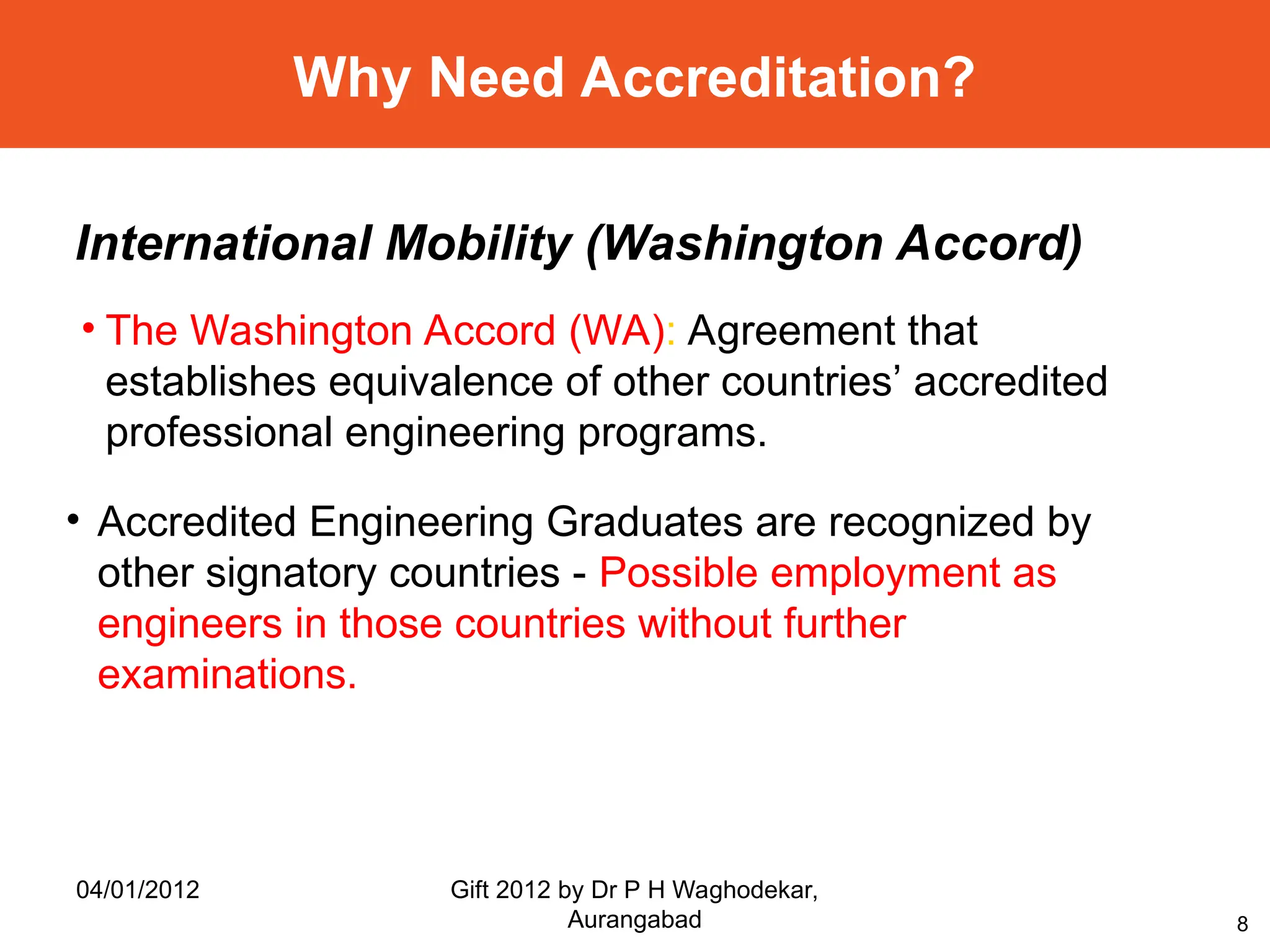
Why Need Accreditation?
• The Washington Accord (WA): Agreement that
establishes equivalence of other countries’ accredited
professional engineering programs.
International Mobility (Washington Accord)
• Accredited Engineering Graduates are recognized by
other signatory countries - Possible employment as
engineers in those countries without further
examinations.
04/01/2012 Gift 2012 by Dr P H Waghodekar,
Aurangabad
9
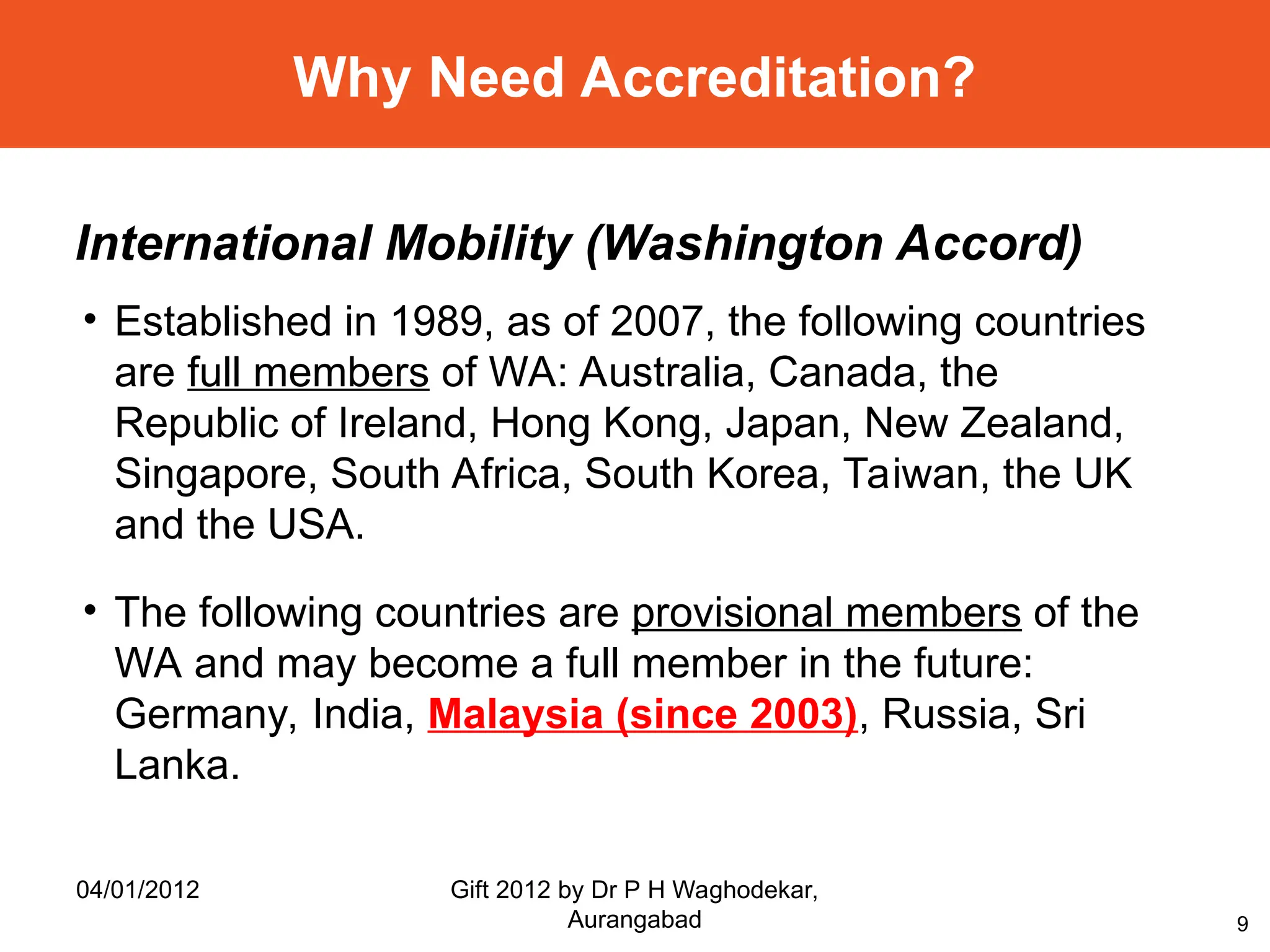
Why Need Accreditation?
International Mobility (Washington Accord)
• Established in 1989, as of 2007, the following countries
are full members of WA: Australia, Canada, the
Republic of Ireland, Hong Kong, Japan, New Zealand,
Singapore, South Africa, South Korea, Taiwan, the UK
and the USA.
• The following countries are provisional members of the
WA and may become a full member in the future:
Germany, India, Malaysia (since 2003), Russia, Sri
Lanka.
04/01/2012 Gift 2012 by Dr P H Waghodekar,
Aurangabad
10
Why Need Accreditation?
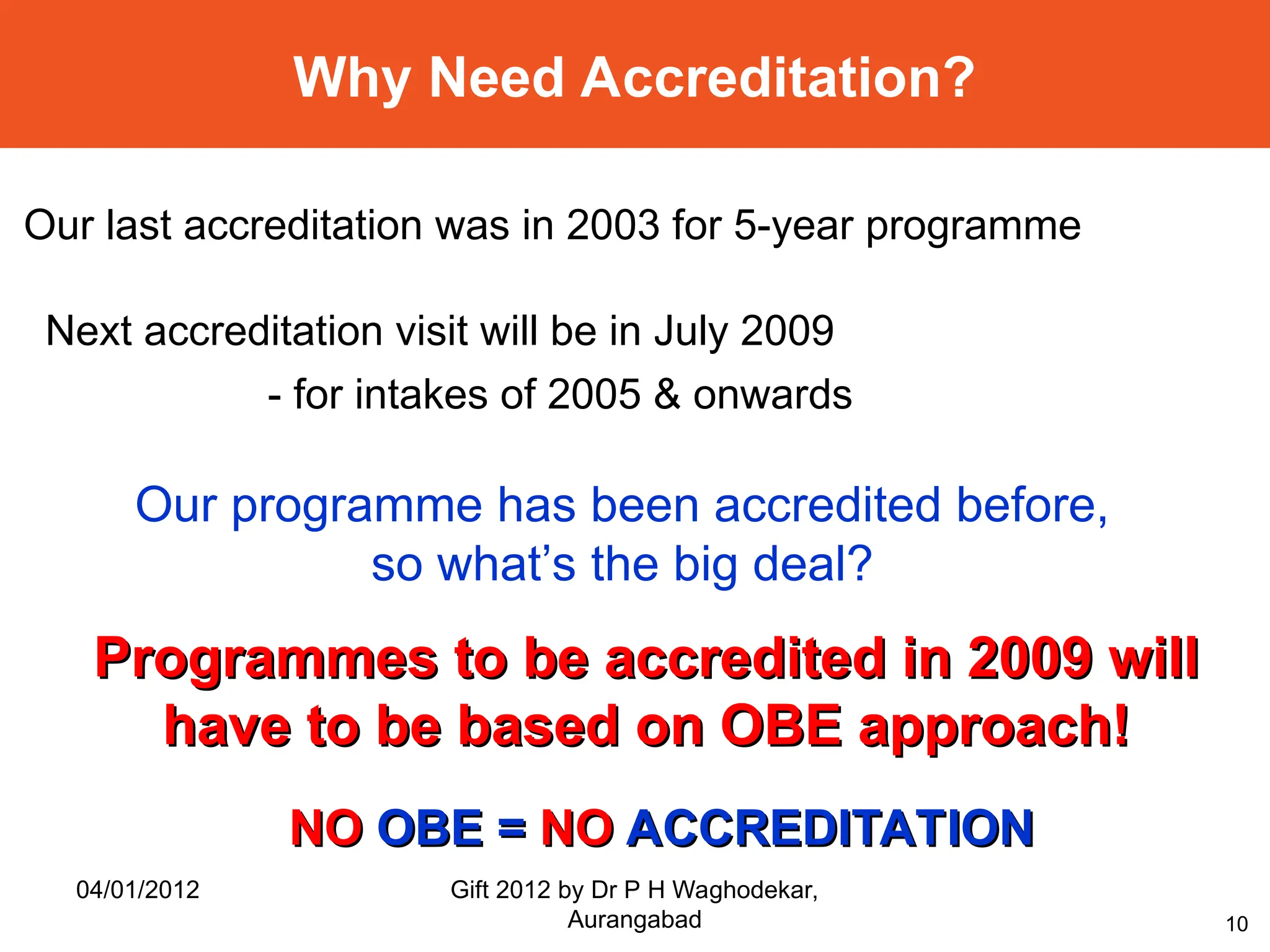
Our last accreditation was in 2003 for 5-year programme
Next accreditation visit will be in July 2009
- for intakes of 2005 & onwards
Programmes to be accredited in 2009 will
have to be based on OBE approach!
Our programme has been accredited before,
so what’s the big deal?
NO
NO OBE =
OBE = NO
NO ACCREDITATION
ACCREDITATION
04/01/2012 Gift 2012 by Dr P H Waghodekar,
Aurangabad
11
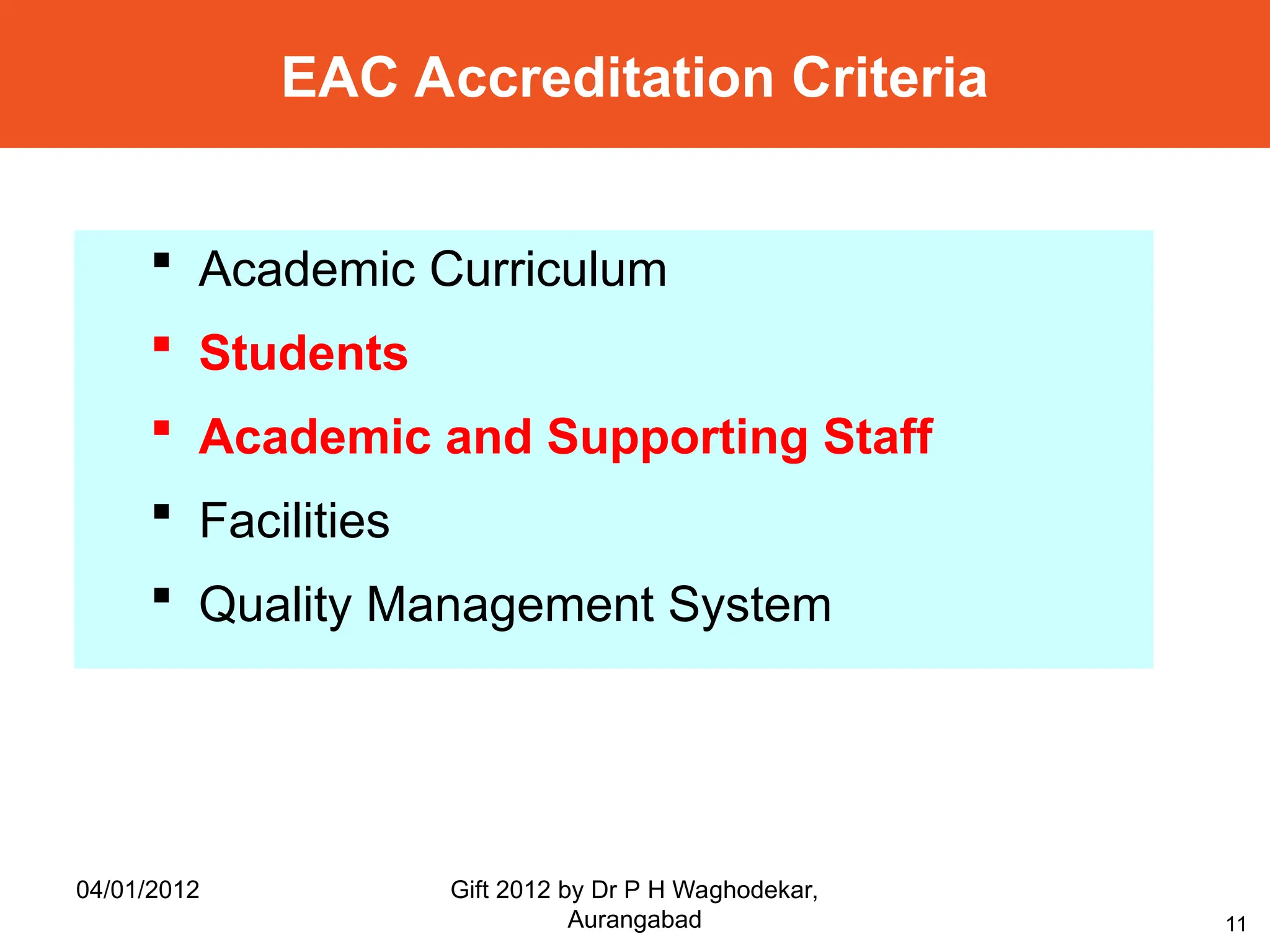
 Academic Curriculum
 Students
 Academic and Supporting Staff
 Facilities
 Quality Management System
EAC Accreditation Criteria
04/01/2012 Gift 2012 by Dr P H Waghodekar,
Aurangabad
12
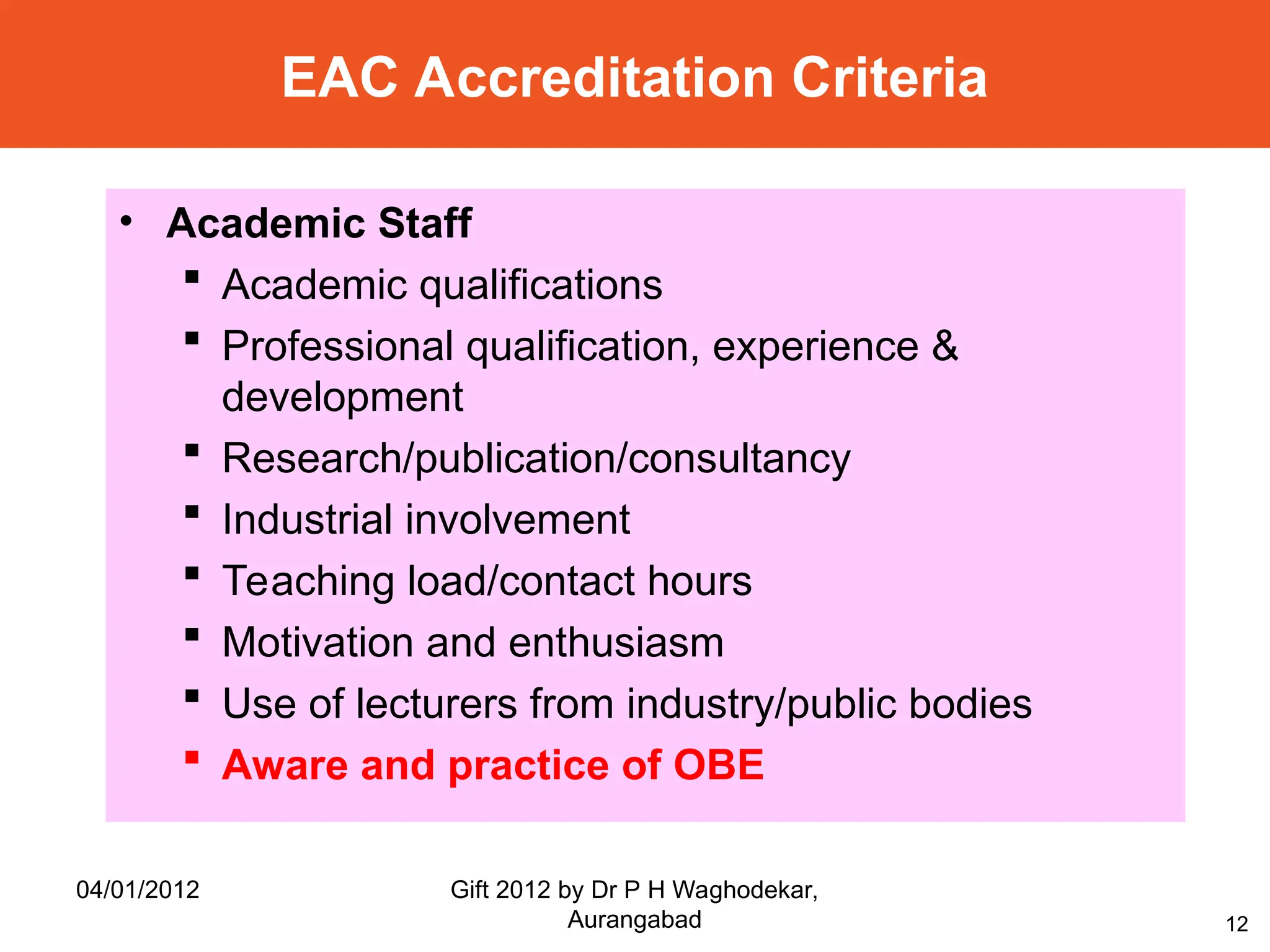
• Academic Staff
 Academic qualifications
 Professional qualification, experience &
development
 Research/publication/consultancy
 Industrial involvement
 Teaching load/contact hours
 Motivation and enthusiasm
 Use of lecturers from industry/public bodies
 Aware and practice of OBE
EAC Accreditation Criteria
04/01/2012 Gift 2012 by Dr P H Waghodekar,
Aurangabad
13
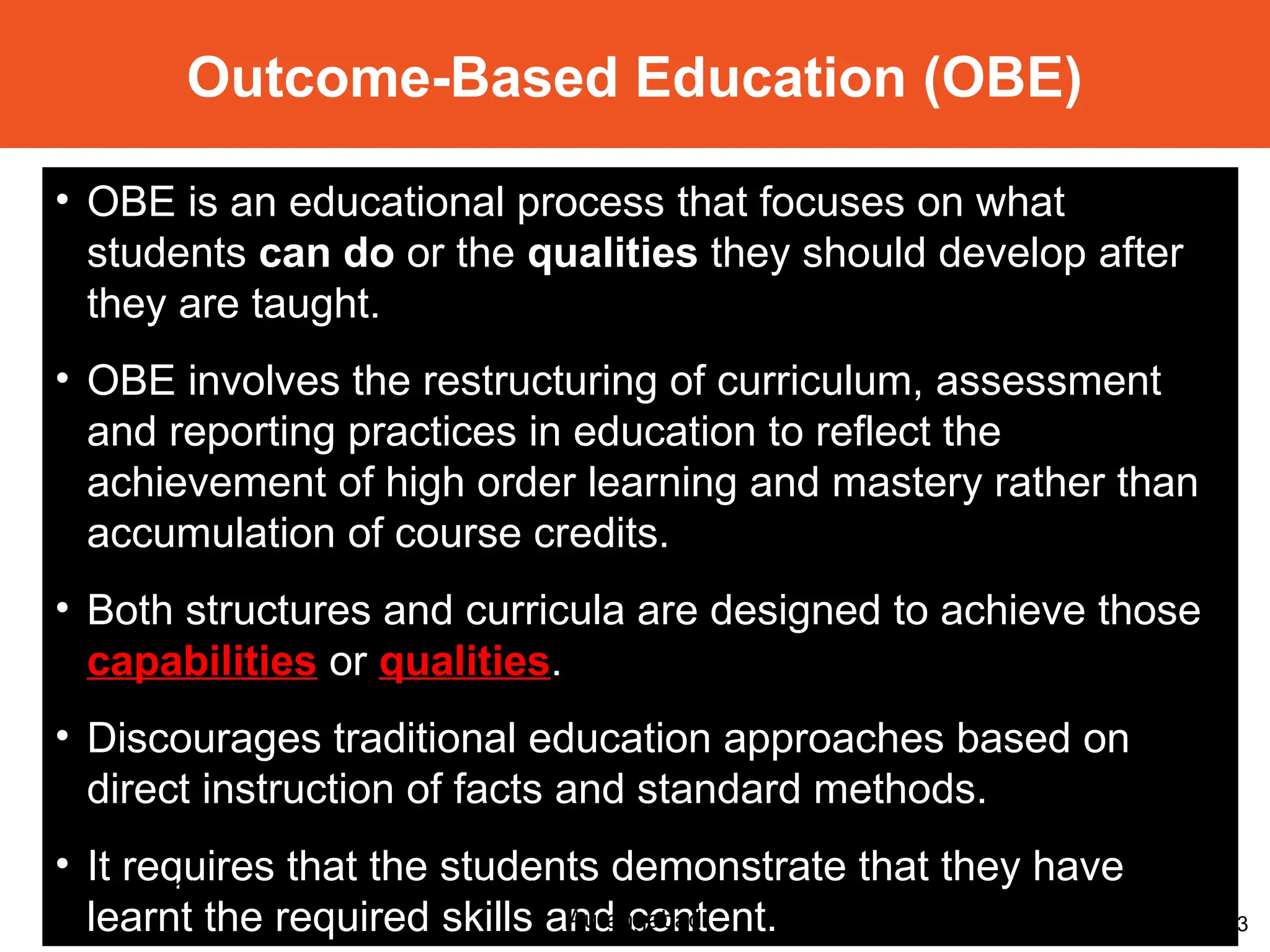
Outcome-Based Education (OBE)
• OBE is an educational process that focuses on what
students can do or the qualities they should develop after
they are taught.
• OBE involves the restructuring of curriculum, assessment
and reporting practices in education to reflect the
achievement of high order learning and mastery rather than
accumulation of course credits.
• Both structures and curricula are designed to achieve those
capabilities or qualities.
• Discourages traditional education approaches based on
direct instruction of facts and standard methods.
• It requires that the students demonstrate that they have
learnt the required skills and content.
04/01/2012 Gift 2012 by Dr P H Waghodekar,
Aurangabad
14
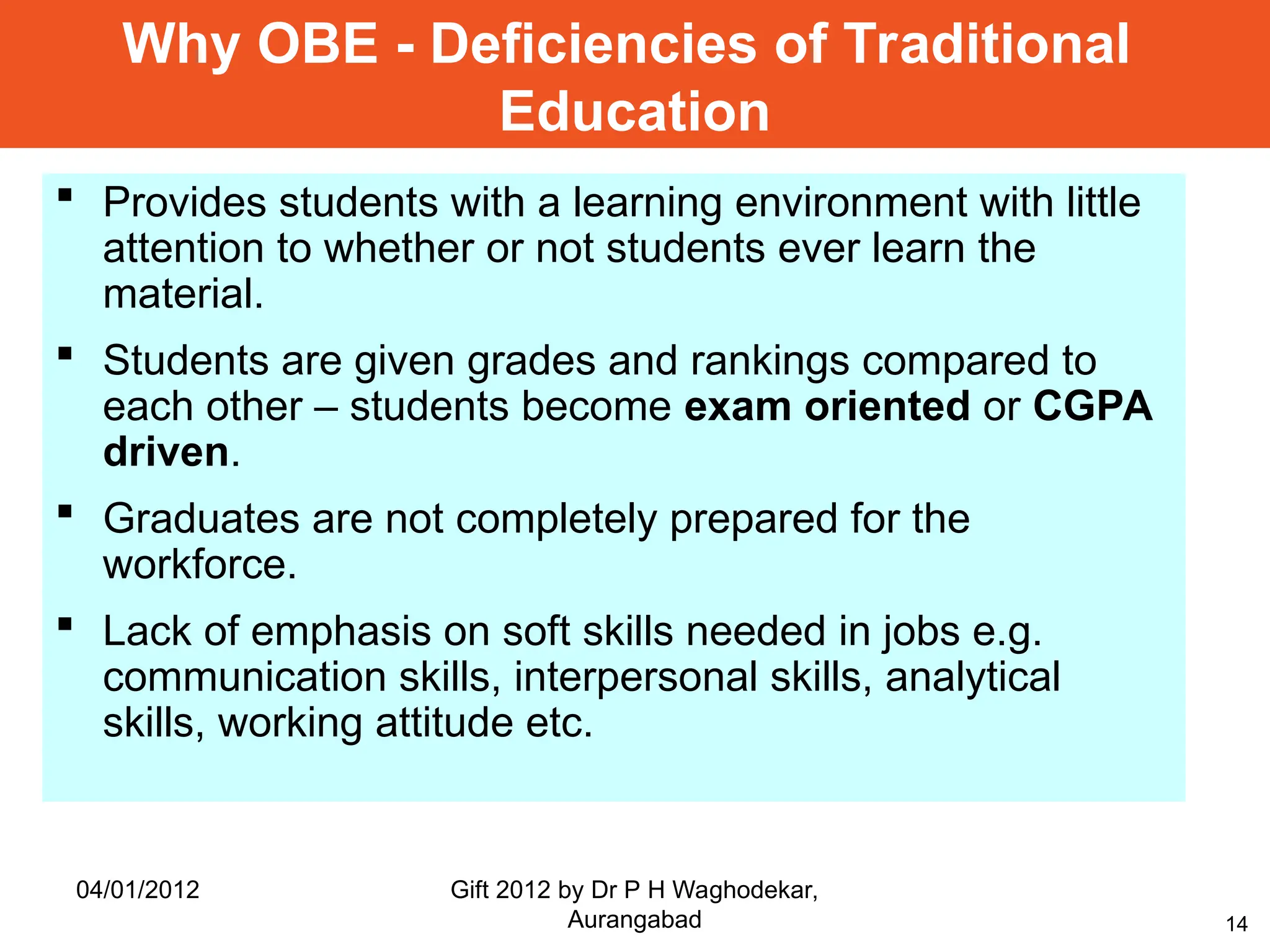
 Provides students with a learning environment with little
attention to whether or not students ever learn the
material.
 Students are given grades and rankings compared to
each other – students become exam oriented or CGPA
driven.
 Graduates are not completely prepared for the
workforce.
 Lack of emphasis on soft skills needed in jobs e.g.
communication skills, interpersonal skills, analytical
skills, working attitude etc.
Why OBE - Deficiencies of Traditional
Education
04/01/2012 Gift 2012 by Dr P H Waghodekar,
Aurangabad
15
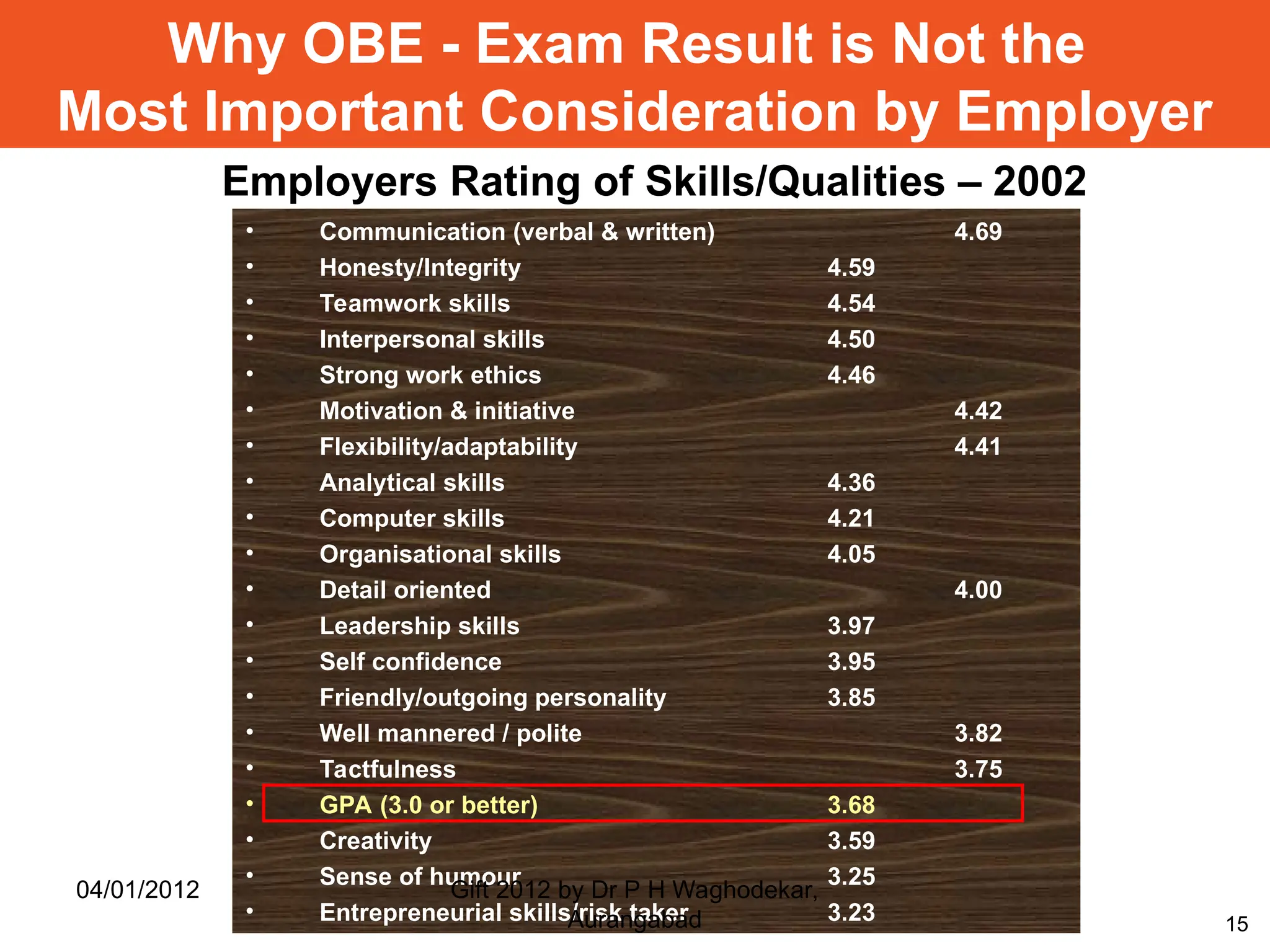
• Communication (verbal & written) 4.69
• Honesty/Integrity 4.59
• Teamwork skills 4.54
• Interpersonal skills 4.50
• Strong work ethics 4.46
• Motivation & initiative 4.42
• Flexibility/adaptability 4.41
• Analytical skills 4.36
• Computer skills 4.21
• Organisational skills 4.05
• Detail oriented 4.00
• Leadership skills 3.97
• Self confidence 3.95
• Friendly/outgoing personality 3.85
• Well mannered / polite 3.82
• Tactfulness 3.75
• GPA (3.0 or better) 3.68
• Creativity 3.59
• Sense of humour 3.25
• Entrepreneurial skills/risk taker 3.23
Employers Rating of Skills/Qualities – 2002
Why OBE - Exam Result is Not the
Most Important Consideration by Employer
04/01/2012 Gift 2012 by Dr P H Waghodekar,
Aurangabad
16
Focus and Benefits of OBE
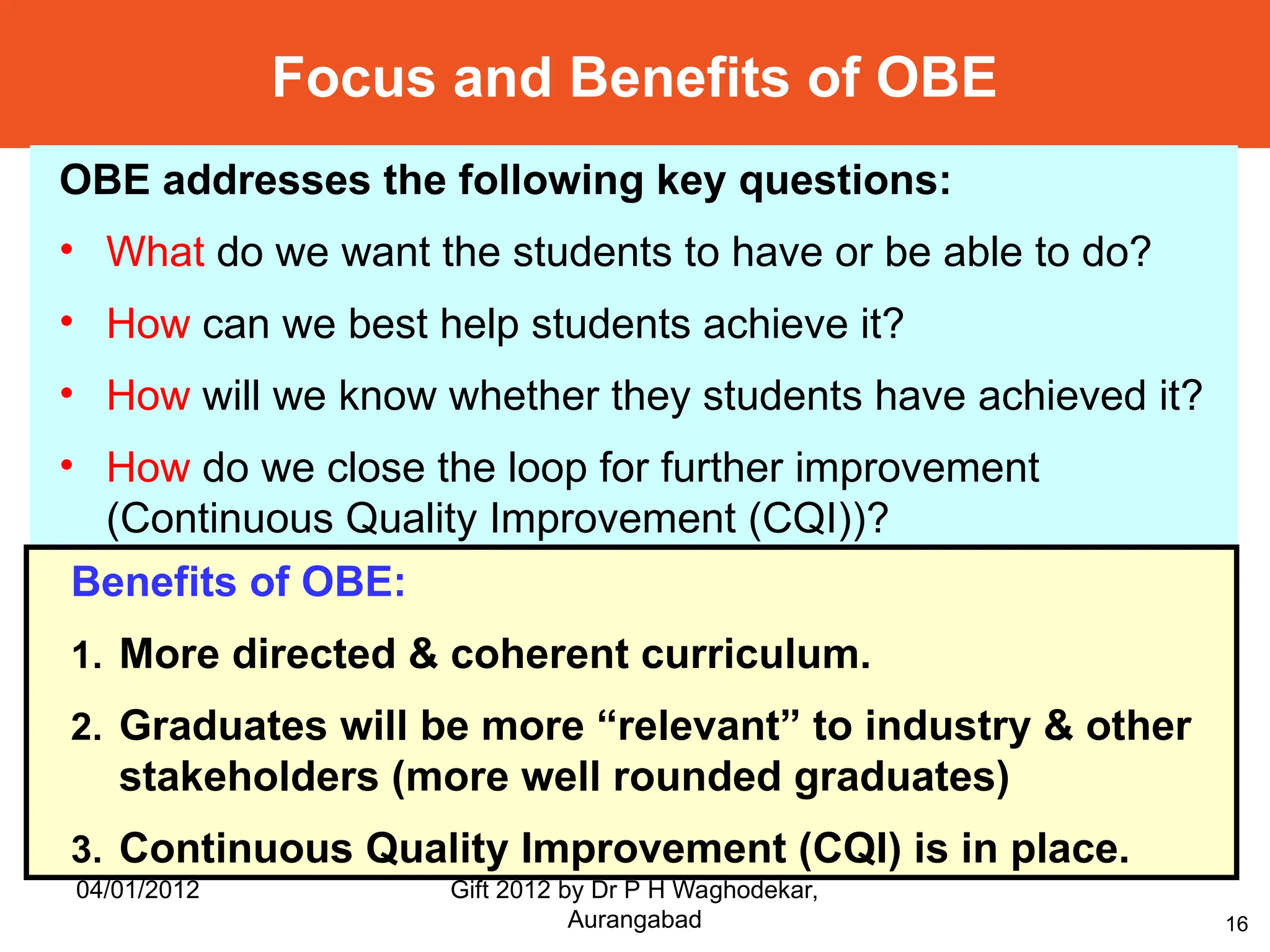
OBE addresses the following key questions:
• What do we want the students to have or be able to do?
• How can we best help students achieve it?
• How will we know whether they students have achieved it?
• How do we close the loop for further improvement
(Continuous Quality Improvement (CQI))?
Benefits of OBE:
1. More directed & coherent curriculum.
2. Graduates will be more “relevant” to industry & other
stakeholders (more well rounded graduates)
3. Continuous Quality Improvement (CQI) is in place.
04/01/2012 Gift 2012 by Dr P H Waghodekar,
Aurangabad
17
Expectations on Students under
OBE – the Outcomes
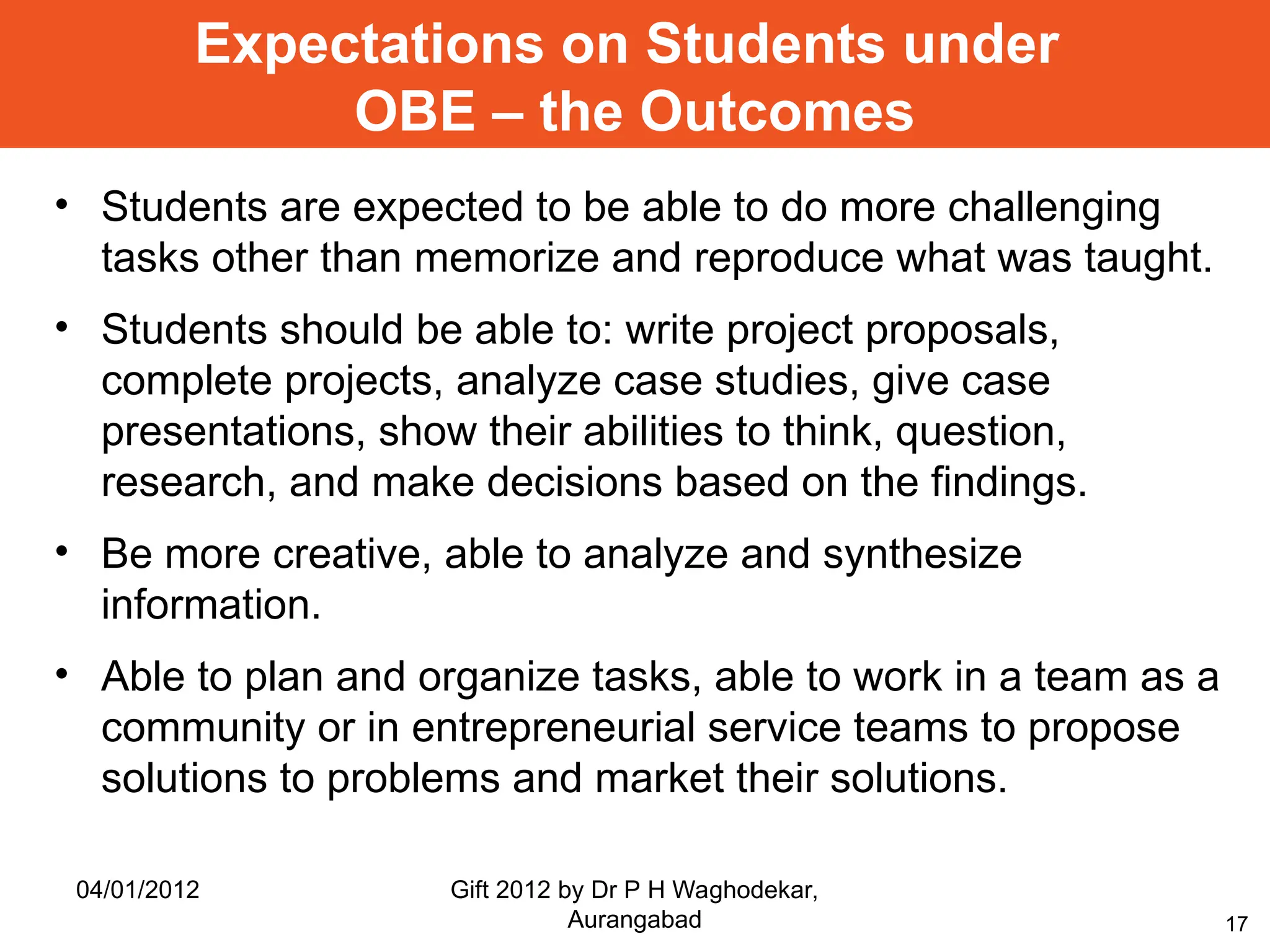
• Students are expected to be able to do more challenging
tasks other than memorize and reproduce what was taught.
• Students should be able to: write project proposals,
complete projects, analyze case studies, give case
presentations, show their abilities to think, question,
research, and make decisions based on the findings.
• Be more creative, able to analyze and synthesize
information.
• Able to plan and organize tasks, able to work in a team as a
community or in entrepreneurial service teams to propose
solutions to problems and market their solutions.
04/01/2012 Gift 2012 by Dr P H Waghodekar,
Aurangabad
18
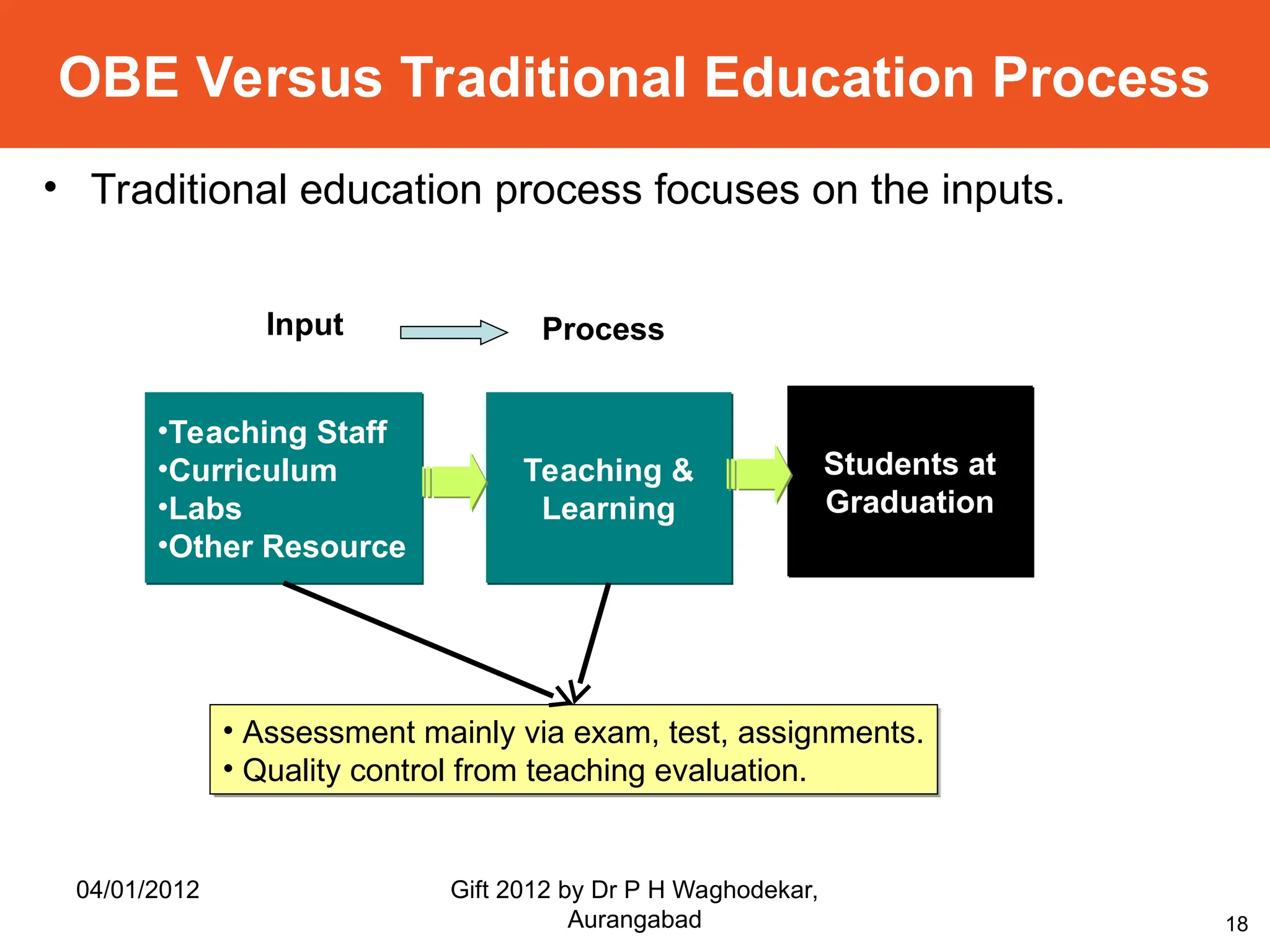
•Teaching Staff
•Curriculum
•Labs
•Other Resource
Input
Teaching &
Learning
Process
OBE Versus Traditional Education Process
• Traditional education process focuses on the inputs.
Students at
Graduation
• Assessment mainly via exam, test, assignments.
• Quality control from teaching evaluation.
04/01/2012 Gift 2012 by Dr P H Waghodekar,
Aurangabad
19
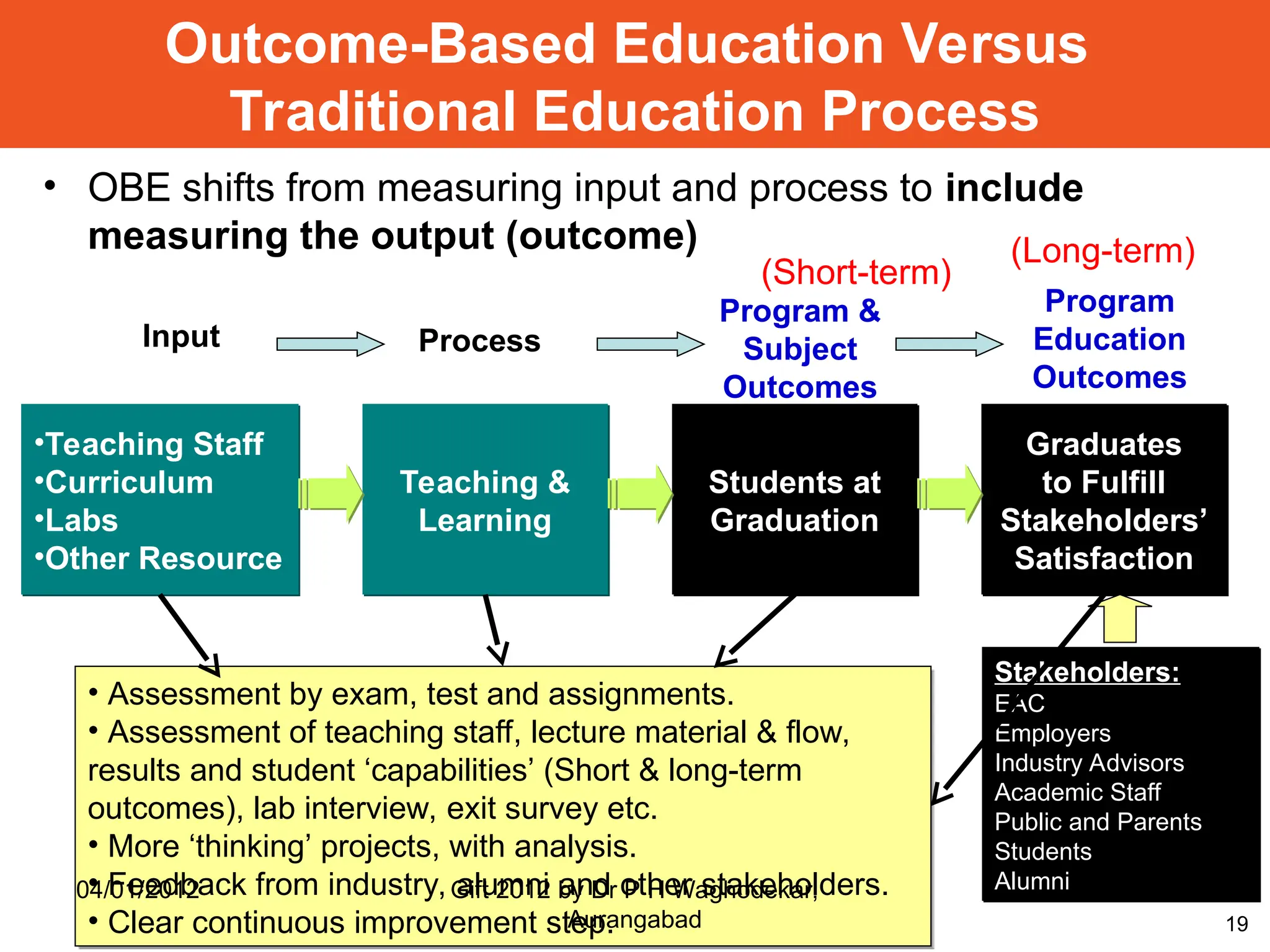
•Teaching Staff
•Curriculum
•Labs
•Other Resource
Input
Teaching &
Learning
Process
Students at
Graduation
Program &
Subject
Outcomes
(Short-term)
Graduates
to Fulfill
Stakeholders’
Satisfaction
Program
Education
Outcomes
Stakeholders:
EAC
Employers
Industry Advisors
Academic Staff
Public and Parents
Students
Alumni
(Long-term)
Outcome-Based Education Versus
Traditional Education Process
• OBE shifts from measuring input and process to include
measuring the output (outcome)
• Assessment by exam, test and assignments.
• Assessment of teaching staff, lecture material & flow,
results and student ‘capabilities’ (Short & long-term
outcomes), lab interview, exit survey etc.
• More ‘thinking’ projects, with analysis.
• Feedback from industry, alumni and other stakeholders.
• Clear continuous improvement step.
04/01/2012 Gift 2012 by Dr P H Waghodekar,
Aurangabad
20
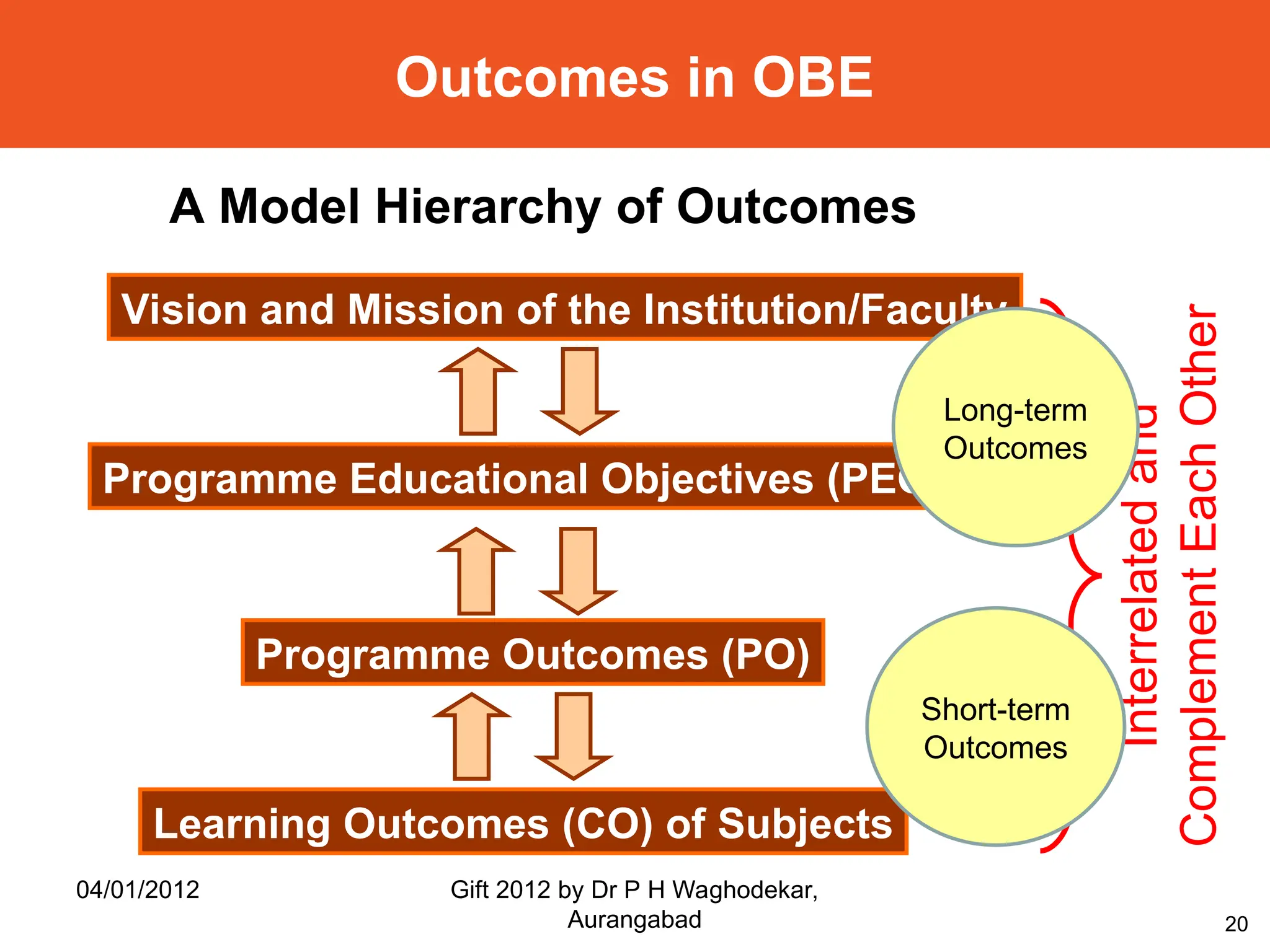
Vision and Mission of the Institution/Faculty
Programme Educational Objectives (PEO)
Programme Outcomes (PO)
Learning Outcomes (CO) of Subjects
A Model Hierarchy of Outcomes
Outcomes in OBE
Interrelated
and
Complement
Each
Other
Short-term
Outcomes
Long-term
Outcomes
04/01/2012 Gift 2012 by Dr P H Waghodekar,
Aurangabad
21
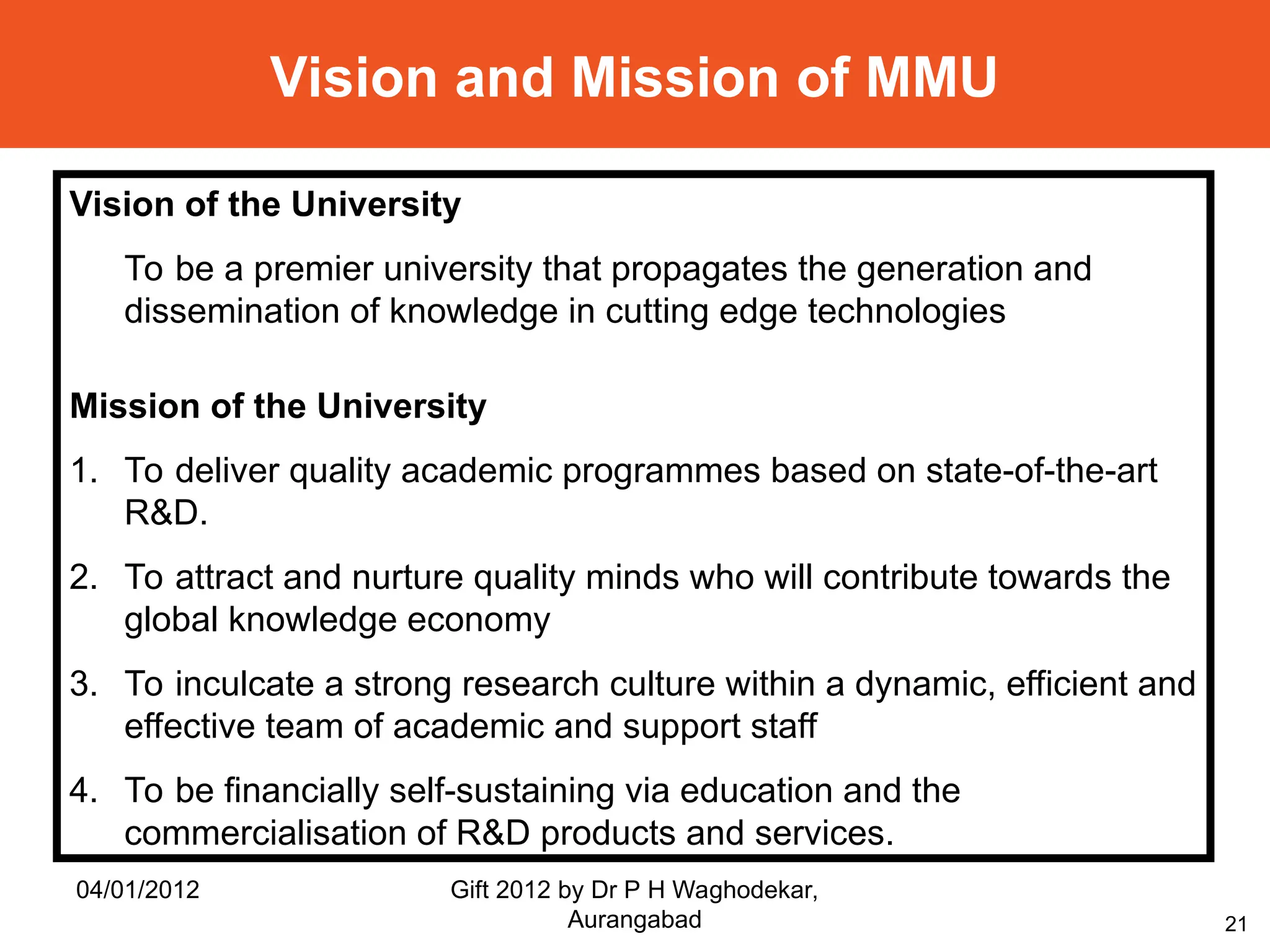
Vision and Mission of MMU
Vision of the University
To be a premier university that propagates the generation and
dissemination of knowledge in cutting edge technologies
Mission of the University
1. To deliver quality academic programmes based on state-of-the-art
R&D.
2. To attract and nurture quality minds who will contribute towards the
global knowledge economy
3. To inculcate a strong research culture within a dynamic, efficient and
effective team of academic and support staff
4. To be financially self-sustaining via education and the
commercialisation of R&D products and services.
04/01/2012 Gift 2012 by Dr P H Waghodekar,
Aurangabad
22
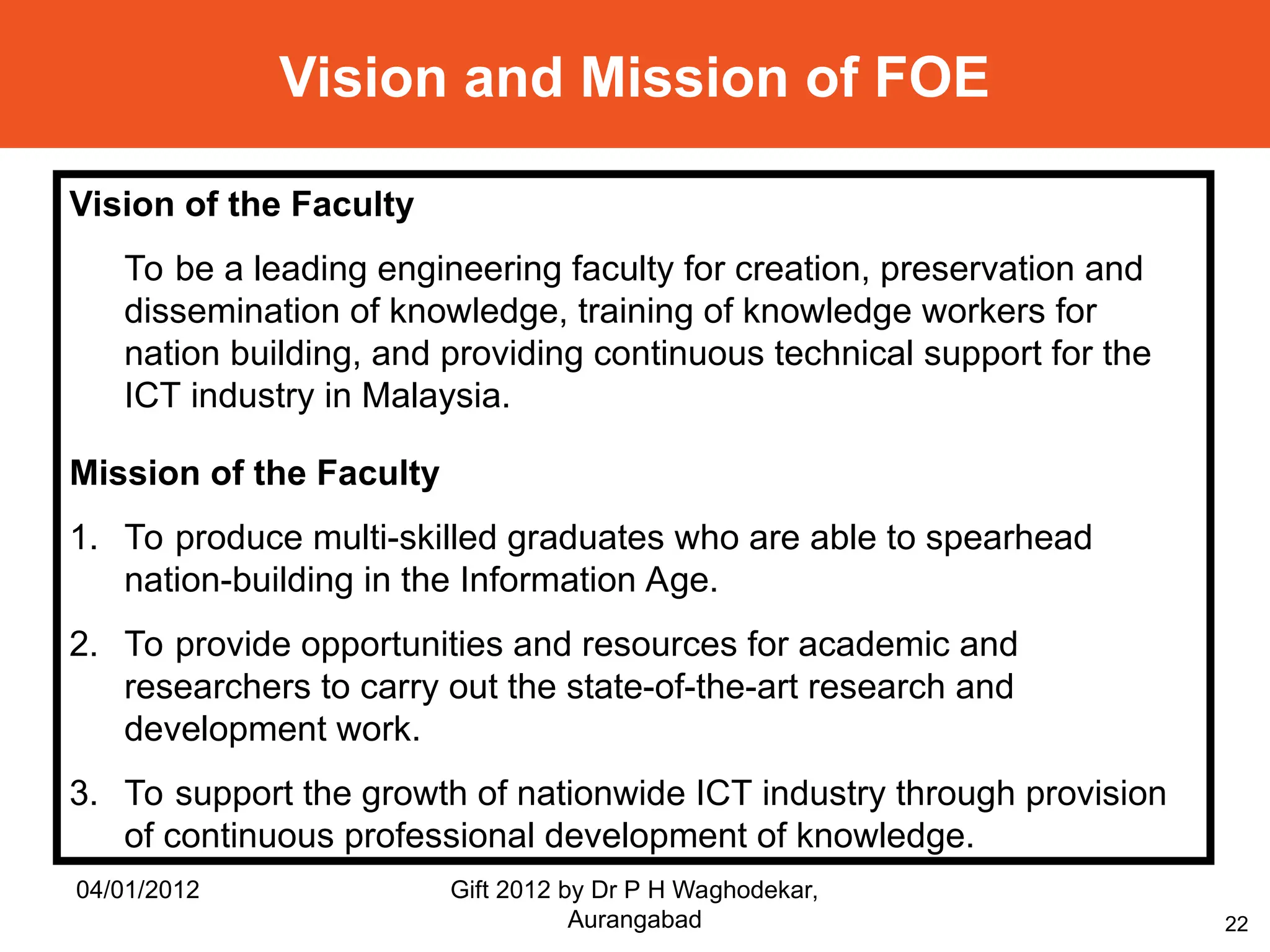
Vision and Mission of FOE
Vision of the Faculty
To be a leading engineering faculty for creation, preservation and
dissemination of knowledge, training of knowledge workers for
nation building, and providing continuous technical support for the
ICT industry in Malaysia.
Mission of the Faculty
1. To produce multi-skilled graduates who are able to spearhead
nation-building in the Information Age.
2. To provide opportunities and resources for academic and
researchers to carry out the state-of-the-art research and
development work.
3. To support the growth of nationwide ICT industry through provision
of continuous professional development of knowledge.
04/01/2012 Gift 2012 by Dr P H Waghodekar,
Aurangabad
23
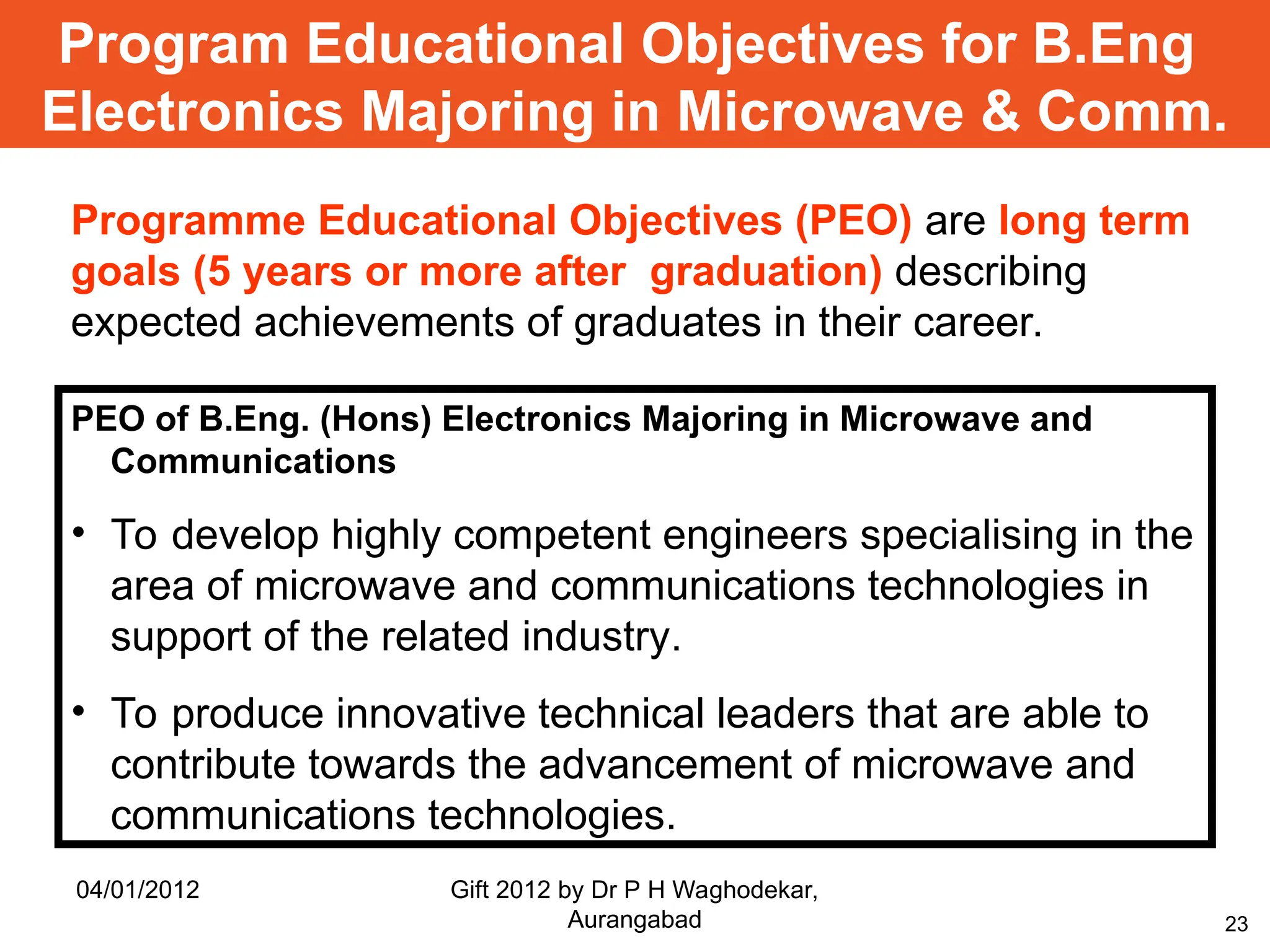
Programme Educational Objectives (PEO) are long term
goals (5 years or more after graduation) describing
expected achievements of graduates in their career.
Program Educational Objectives for B.Eng
Electronics Majoring in Microwave & Comm.
PEO of B.Eng. (Hons) Electronics Majoring in Microwave and
Communications
• To develop highly competent engineers specialising in the
area of microwave and communications technologies in
support of the related industry.
• To produce innovative technical leaders that are able to
contribute towards the advancement of microwave and
communications technologies.
04/01/2012 Gift 2012 by Dr P H Waghodekar,
Aurangabad
24
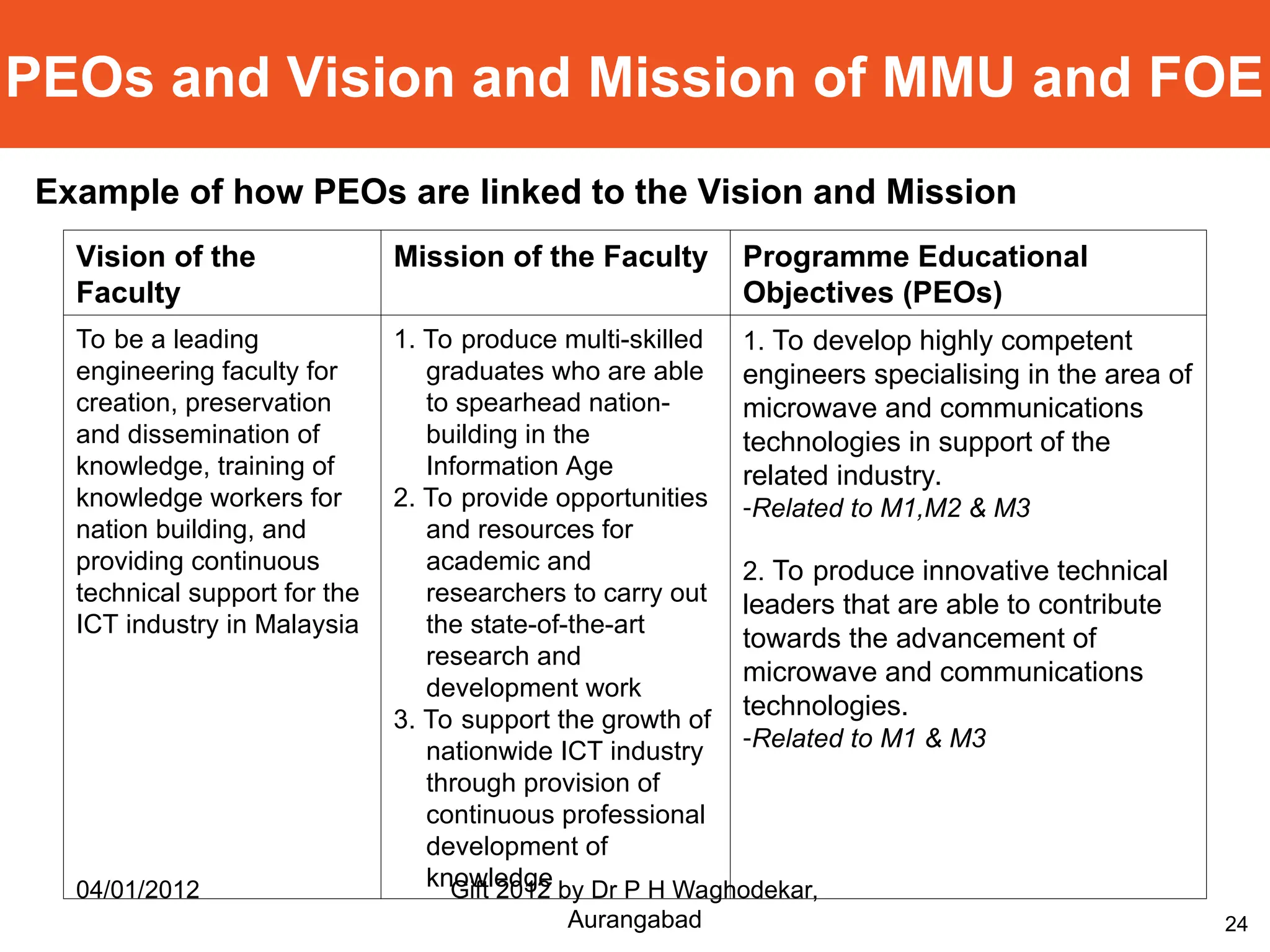
PEOs and Vision and Mission of MMU and FOE
Vision of the
Faculty
Mission of the Faculty Programme Educational
Objectives (PEOs)
To be a leading
engineering faculty for
creation, preservation
and dissemination of
knowledge, training of
knowledge workers for
nation building, and
providing continuous
technical support for the
ICT industry in Malaysia
1. To produce multi-skilled
graduates who are able
to spearhead nation-
building in the
Information Age
2. To provide opportunities
and resources for
academic and
researchers to carry out
the state-of-the-art
research and
development work
3. To support the growth of
nationwide ICT industry
through provision of
continuous professional
development of
knowledge
1. To develop highly competent
engineers specialising in the area of
microwave and communications
technologies in support of the
related industry.
-Related to M1,M2 & M3
2. To produce innovative technical
leaders that are able to contribute
towards the advancement of
microwave and communications
technologies.
-Related to M1 & M3
Example of how PEOs are linked to the Vision and Mission
04/01/2012 Gift 2012 by Dr P H Waghodekar,
Aurangabad
25
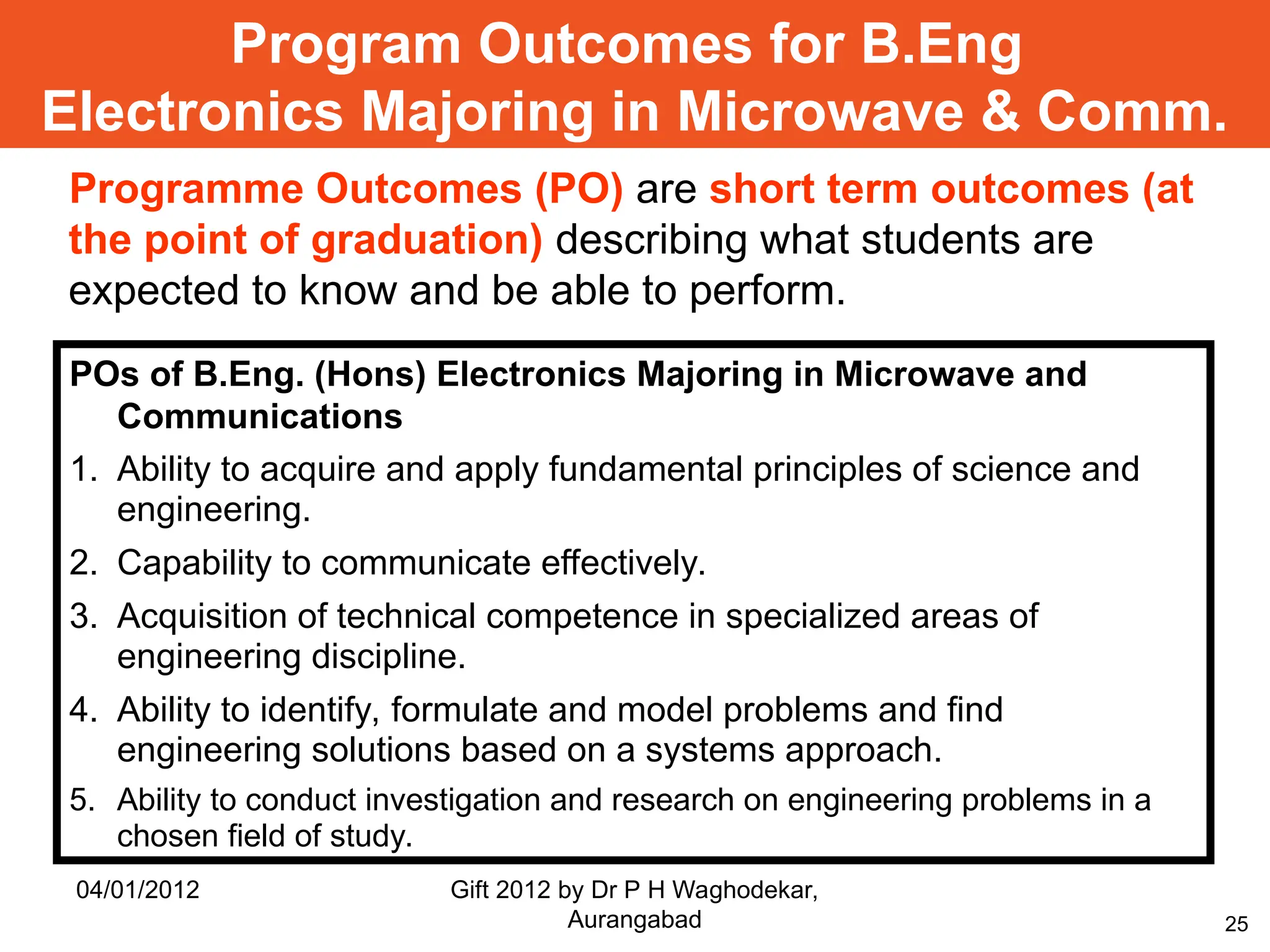
Program Outcomes for B.Eng
Electronics Majoring in Microwave & Comm.
POs of B.Eng. (Hons) Electronics Majoring in Microwave and
Communications
1. Ability to acquire and apply fundamental principles of science and
engineering.
2. Capability to communicate effectively.
3. Acquisition of technical competence in specialized areas of
engineering discipline.
4. Ability to identify, formulate and model problems and find
engineering solutions based on a systems approach.
5. Ability to conduct investigation and research on engineering problems in a
chosen field of study.
Programme Outcomes (PO) are short term outcomes (at
the point of graduation) describing what students are
expected to know and be able to perform.
04/01/2012 Gift 2012 by Dr P H Waghodekar,
Aurangabad
26
Program Outcomes for B.Eng
Electronics Majoring in Microwave & Comm.
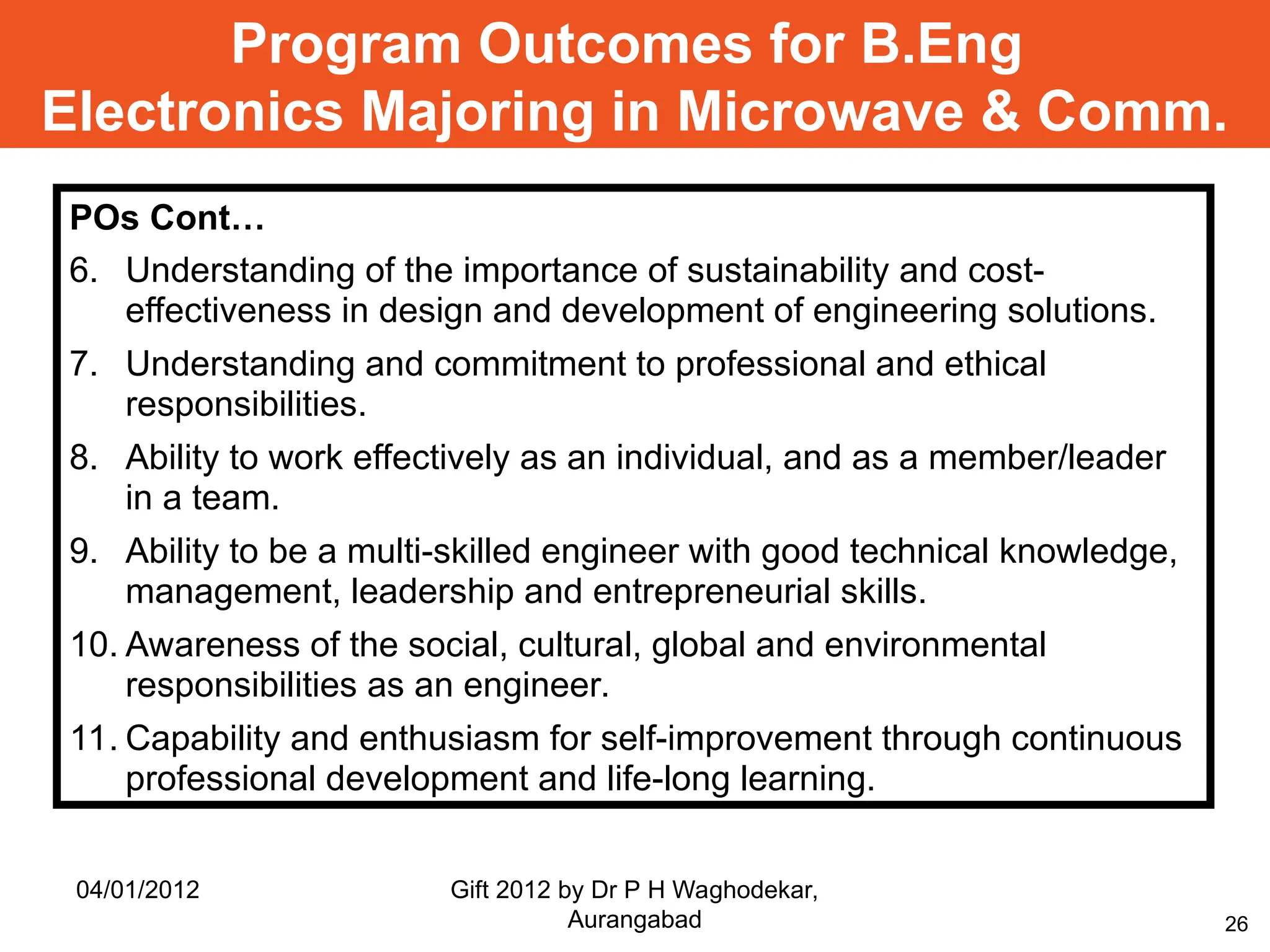
POs Cont…
6. Understanding of the importance of sustainability and cost-
effectiveness in design and development of engineering solutions.
7. Understanding and commitment to professional and ethical
responsibilities.
8. Ability to work effectively as an individual, and as a member/leader
in a team.
9. Ability to be a multi-skilled engineer with good technical knowledge,
management, leadership and entrepreneurial skills.
10. Awareness of the social, cultural, global and environmental
responsibilities as an engineer.
11. Capability and enthusiasm for self-improvement through continuous
professional development and life-long learning.
04/01/2012 Gift 2012 by Dr P H Waghodekar,
Aurangabad
27
Outcome-Based Education
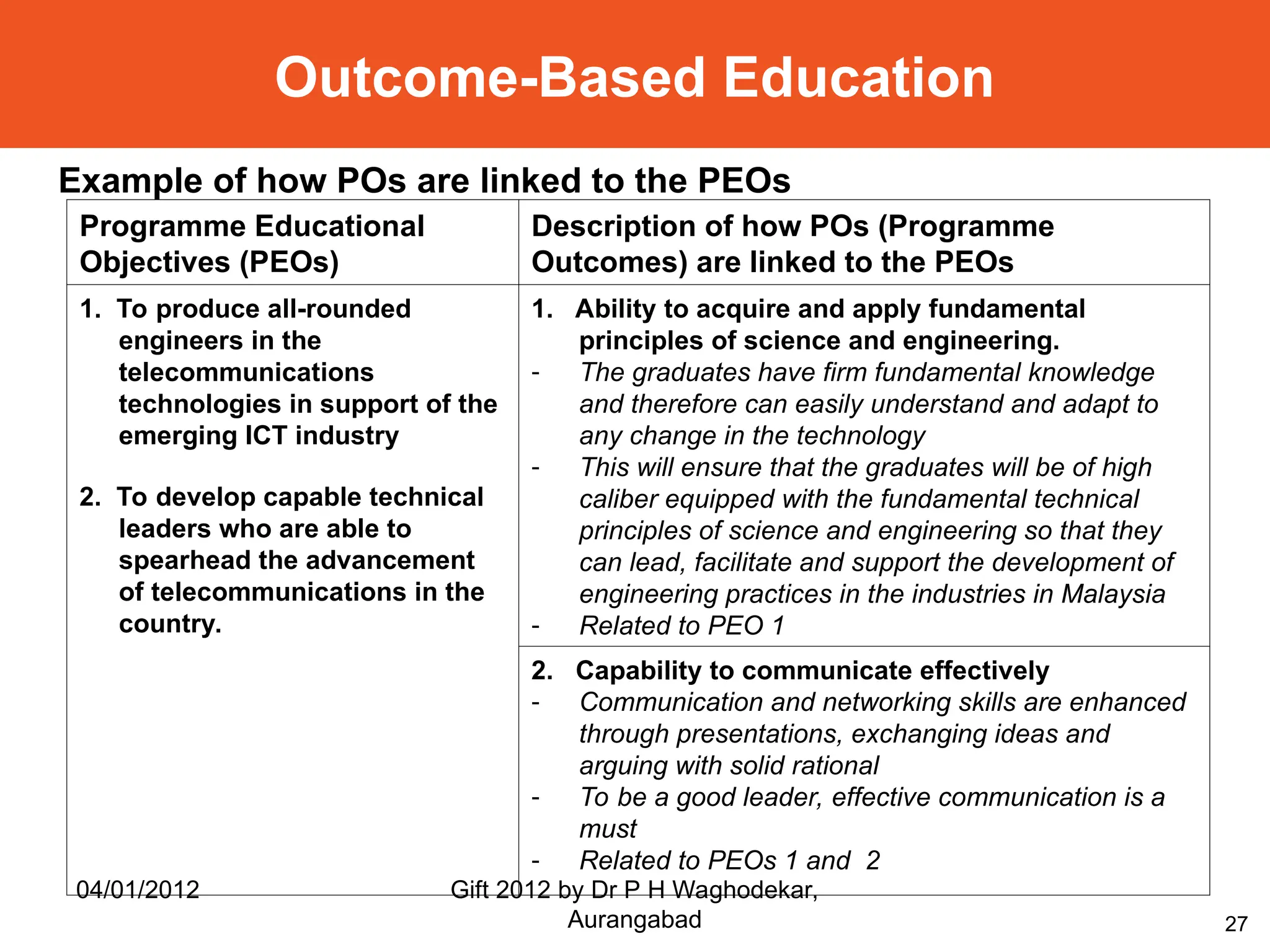
Example of how POs are linked to the PEOs
Programme Educational
Objectives (PEOs)
Description of how POs (Programme
Outcomes) are linked to the PEOs
1. To produce all-rounded
engineers in the
telecommunications
technologies in support of the
emerging ICT industry
2. To develop capable technical
leaders who are able to
spearhead the advancement
of telecommunications in the
country.
1. Ability to acquire and apply fundamental
principles of science and engineering.
- The graduates have firm fundamental knowledge
and therefore can easily understand and adapt to
any change in the technology
- This will ensure that the graduates will be of high
caliber equipped with the fundamental technical
principles of science and engineering so that they
can lead, facilitate and support the development of
engineering practices in the industries in Malaysia
- Related to PEO 1
2. Capability to communicate effectively
- Communication and networking skills are enhanced
through presentations, exchanging ideas and
arguing with solid rational
- To be a good leader, effective communication is a
must
- Related to PEOs 1 and 2
04/01/2012 Gift 2012 by Dr P H Waghodekar,
Aurangabad
28
Outcome-Based Education
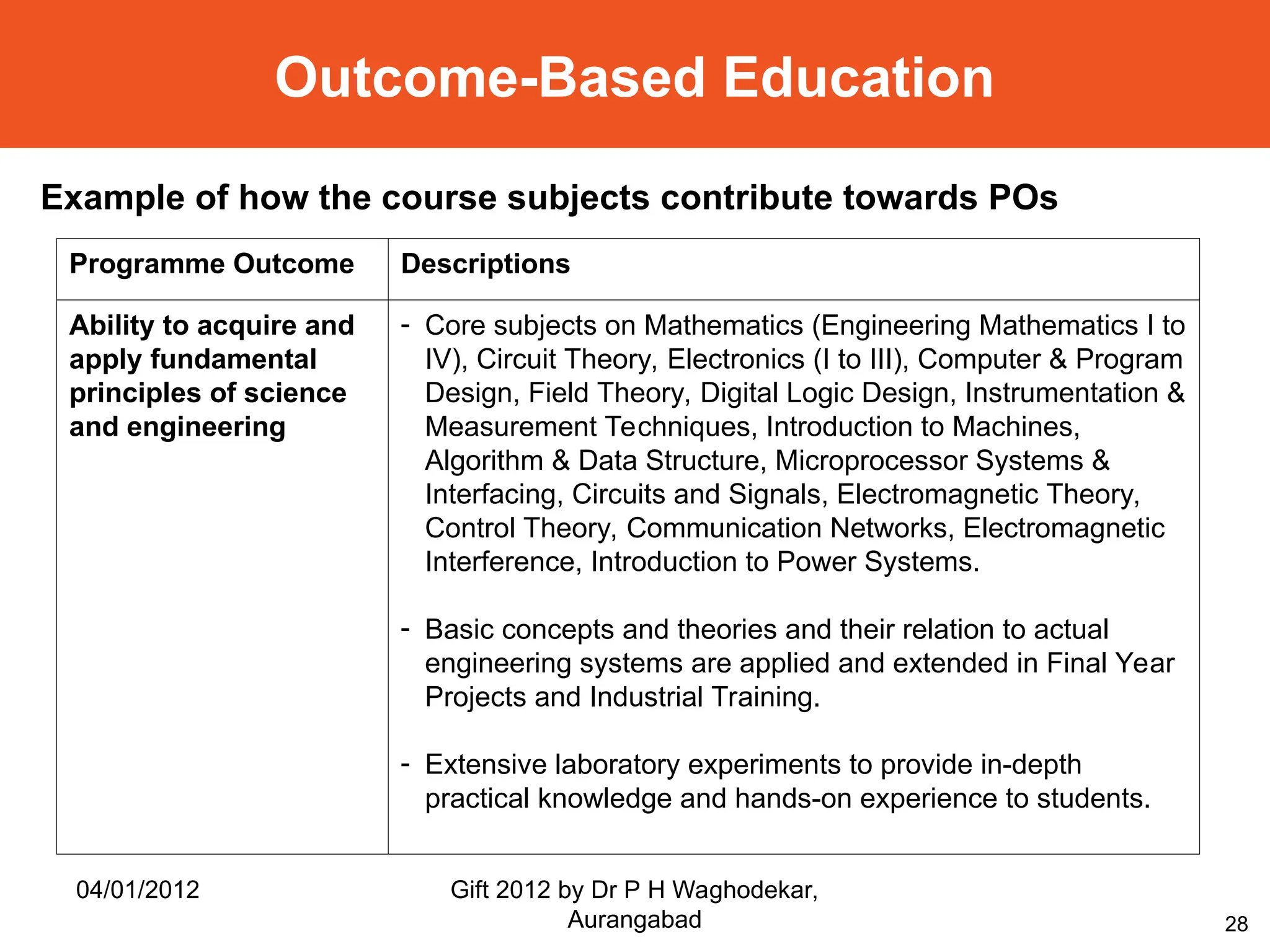
Example of how the course subjects contribute towards POs
Programme Outcome Descriptions
Ability to acquire and
apply fundamental
principles of science
and engineering
- Core subjects on Mathematics (Engineering Mathematics I to
IV), Circuit Theory, Electronics (I to III), Computer & Program
Design, Field Theory, Digital Logic Design, Instrumentation &
Measurement Techniques, Introduction to Machines,
Algorithm & Data Structure, Microprocessor Systems &
Interfacing, Circuits and Signals, Electromagnetic Theory,
Control Theory, Communication Networks, Electromagnetic
Interference, Introduction to Power Systems.
- Basic concepts and theories and their relation to actual
engineering systems are applied and extended in Final Year
Projects and Industrial Training.
- Extensive laboratory experiments to provide in-depth
practical knowledge and hands-on experience to students.
04/01/2012 Gift 2012 by Dr P H Waghodekar,
Aurangabad
29
Outcome-Based Education
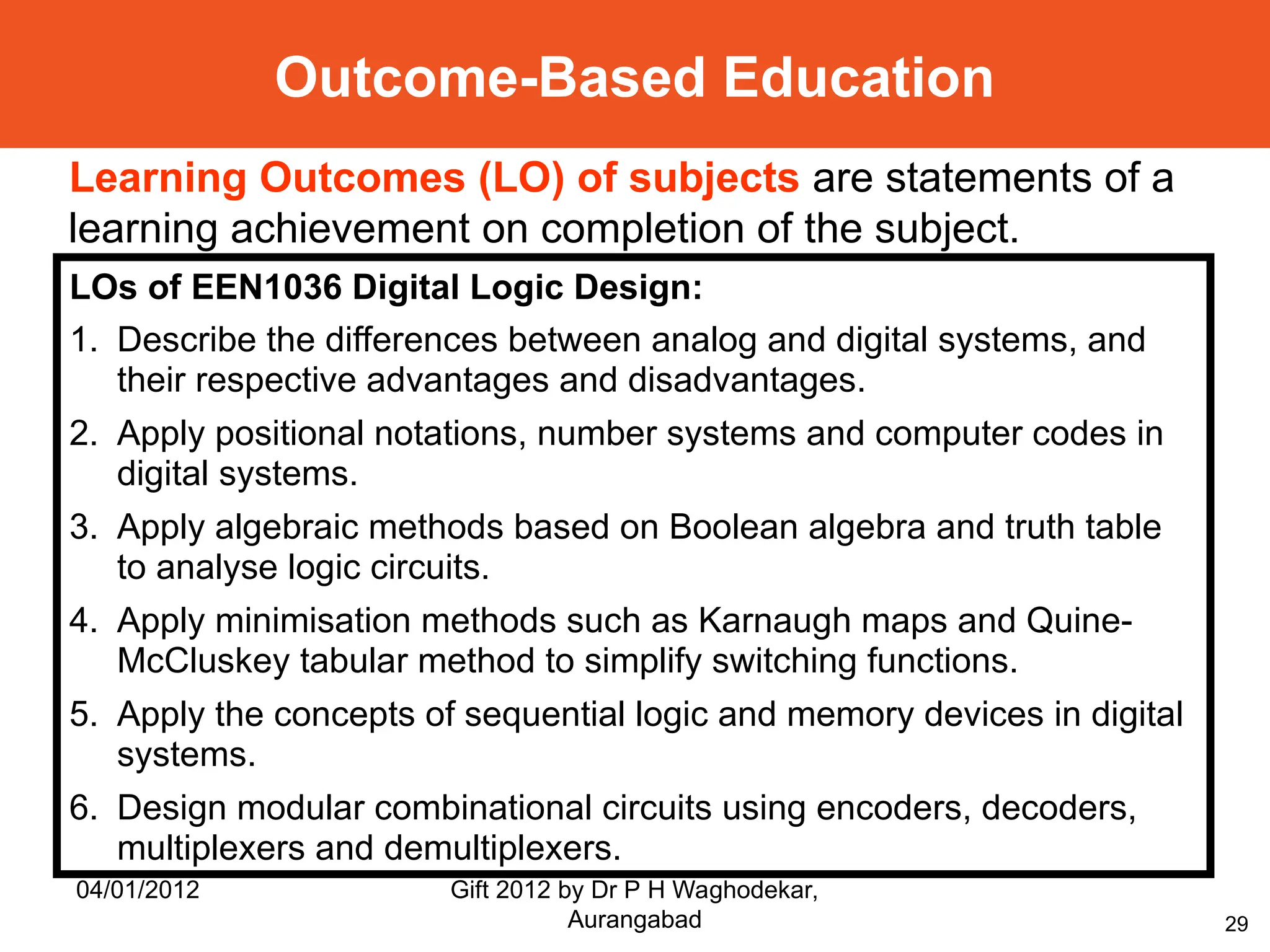
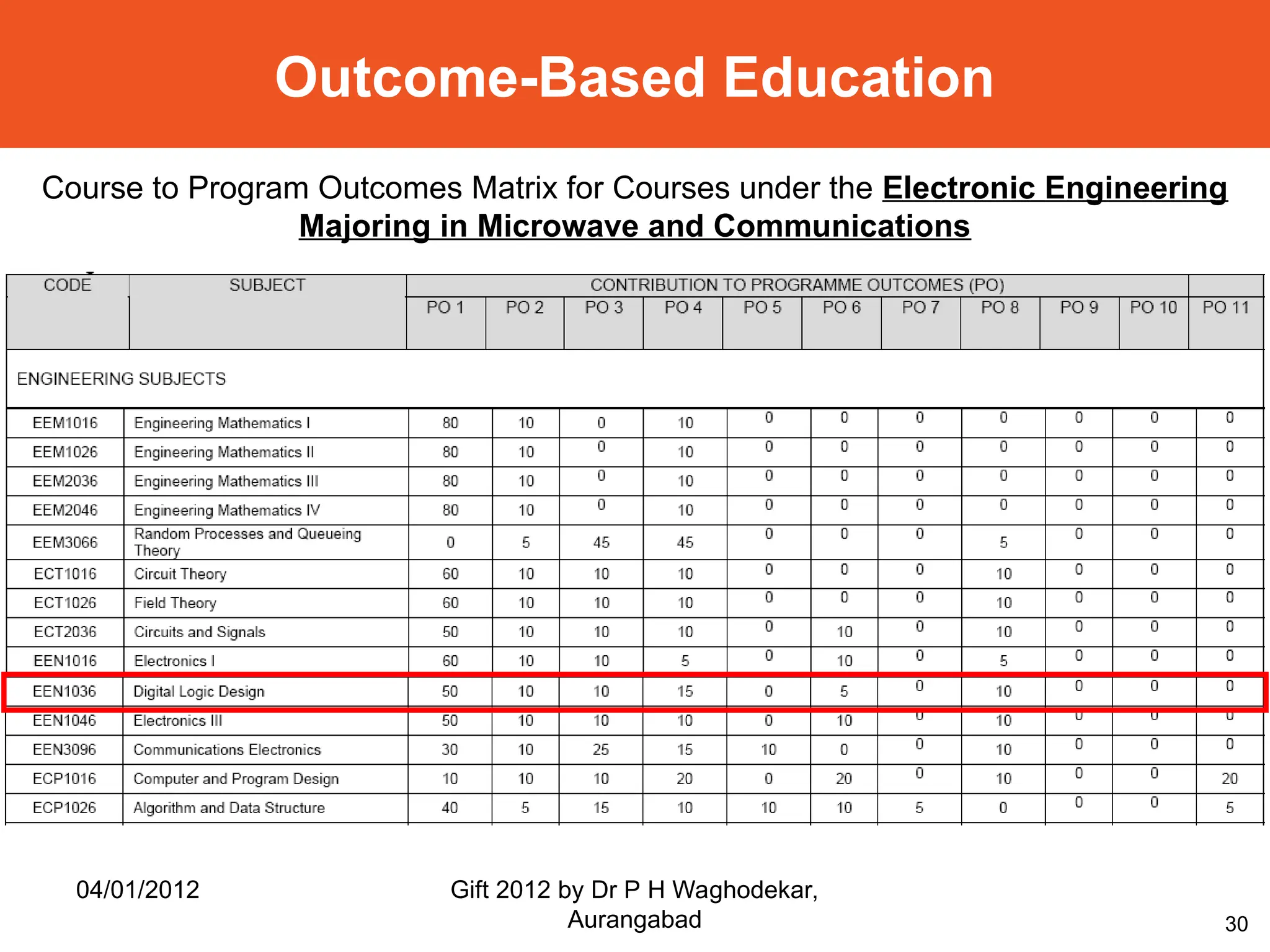
LOs of EEN1036 Digital Logic Design:
1. Describe the differences between analog and digital systems, and
their respective advantages and disadvantages.
2. Apply positional notations, number systems and computer codes in
digital systems.
3. Apply algebraic methods based on Boolean algebra and truth table
to analyse logic circuits.
4. Apply minimisation methods such as Karnaugh maps and Quine-
McCluskey tabular method to simplify switching functions.
5. Apply the concepts of sequential logic and memory devices in digital
systems.
6. Design modular combinational circuits using encoders, decoders,
multiplexers and demultiplexers.
Learning Outcomes (LO) of subjects are statements of a
learning achievement on completion of the subject.
04/01/2012 Gift 2012 by Dr P H Waghodekar,
Aurangabad
30
Course to Program Outcomes Matrix for Courses under the Electronic Engineering
Majoring in Microwave and Communications
Outcome-Based Education
04/01/2012 Gift 2012 by Dr P H Waghodekar,
Aurangabad
31
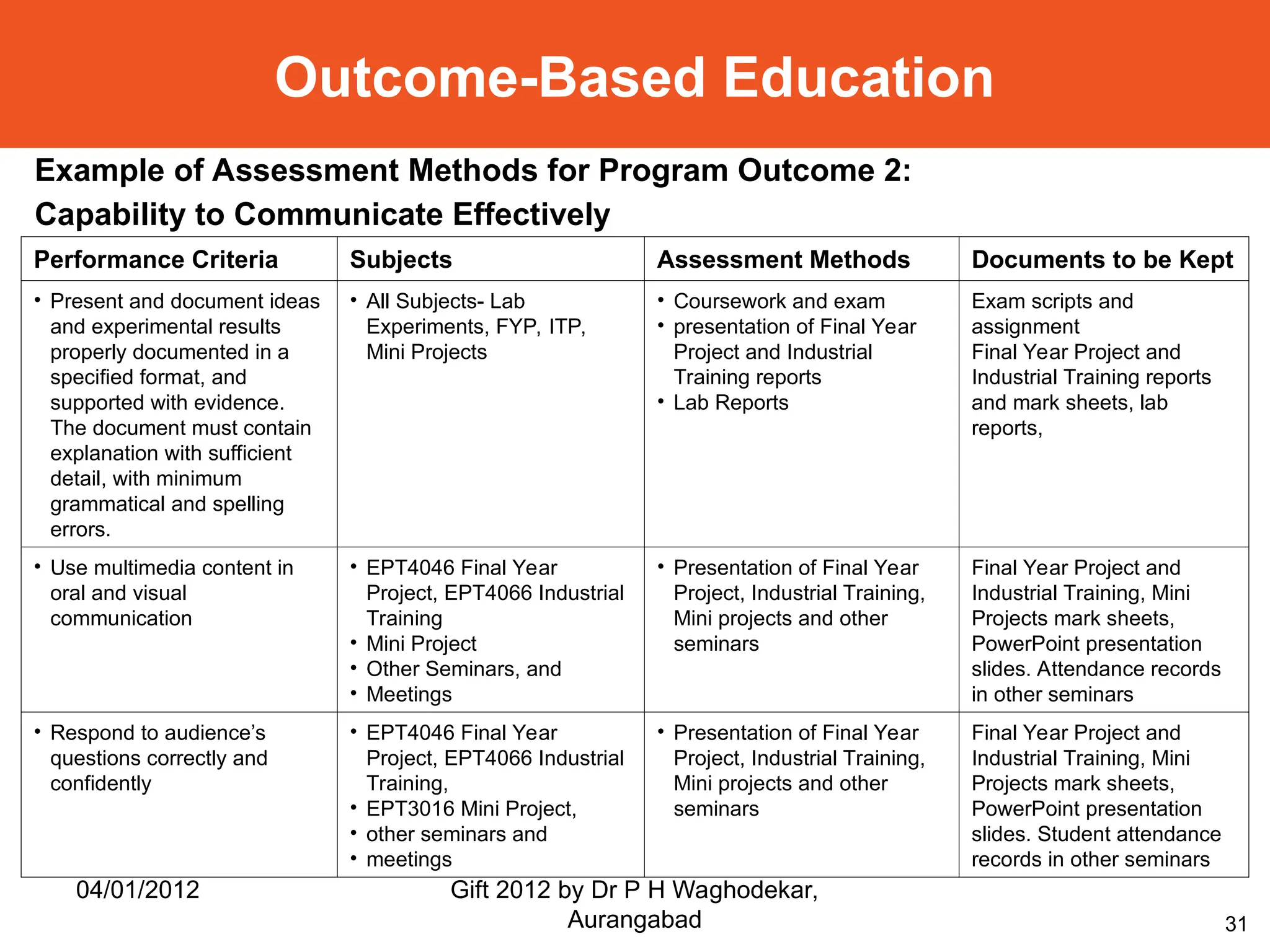
Example of Assessment Methods for Program Outcome 2:
Capability to Communicate Effectively
Performance Criteria Subjects Assessment Methods Documents to be Kept
• Present and document ideas
and experimental results
properly documented in a
specified format, and
supported with evidence.
The document must contain
explanation with sufficient
detail, with minimum
grammatical and spelling
errors.
• All Subjects- Lab
Experiments, FYP, ITP,
Mini Projects
• Coursework and exam
• presentation of Final Year
Project and Industrial
Training reports
• Lab Reports
Exam scripts and
assignment
Final Year Project and
Industrial Training reports
and mark sheets, lab
reports,
• Use multimedia content in
oral and visual
communication
• EPT4046 Final Year
Project, EPT4066 Industrial
Training
• Mini Project
• Other Seminars, and
• Meetings
• Presentation of Final Year
Project, Industrial Training,
Mini projects and other
seminars
Final Year Project and
Industrial Training, Mini
Projects mark sheets,
PowerPoint presentation
slides. Attendance records
in other seminars
• Respond to audience’s
questions correctly and
confidently
• EPT4046 Final Year
Project, EPT4066 Industrial
Training,
• EPT3016 Mini Project,
• other seminars and
• meetings
• Presentation of Final Year
Project, Industrial Training,
Mini projects and other
seminars
Final Year Project and
Industrial Training, Mini
Projects mark sheets,
PowerPoint presentation
slides. Student attendance
records in other seminars
Outcome-Based Education
04/01/2012 Gift 2012 by Dr P H Waghodekar,
Aurangabad
32
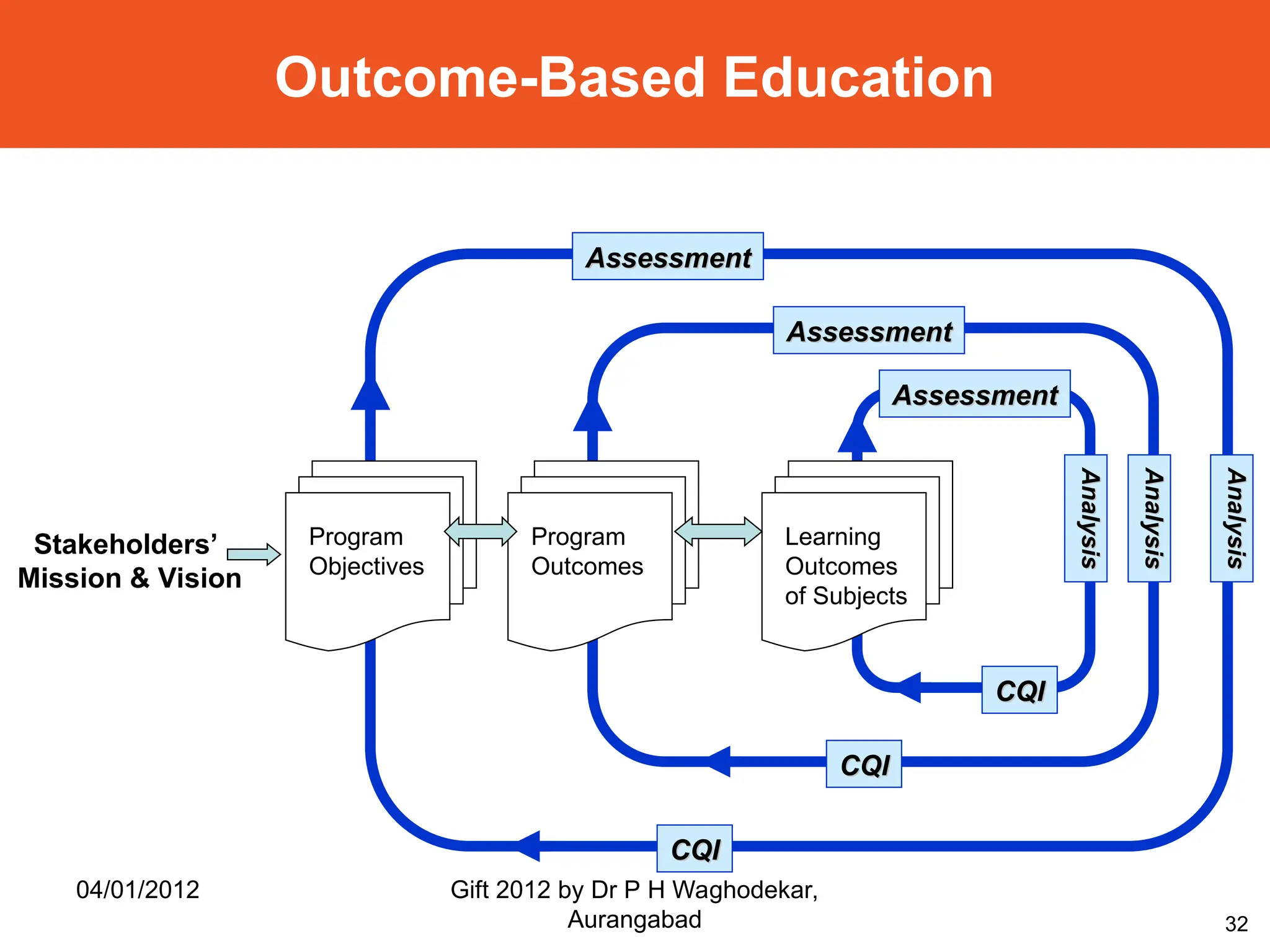
Outcome-Based Education
Program
Outcomes
Program
Objectives
Stakeholders’
Mission & Vision
Learning
Outcomes
of Subjects
Assessment
Assessment
Assessment
Assessment
Assessment
Assessment
CQI
CQI
CQI
CQI
CQI
CQI
Analysis
Analysis
Analysis
Analysis
Analysis
Analysis
04/01/2012 Gift 2012 by Dr P H Waghodekar,
Aurangabad
33
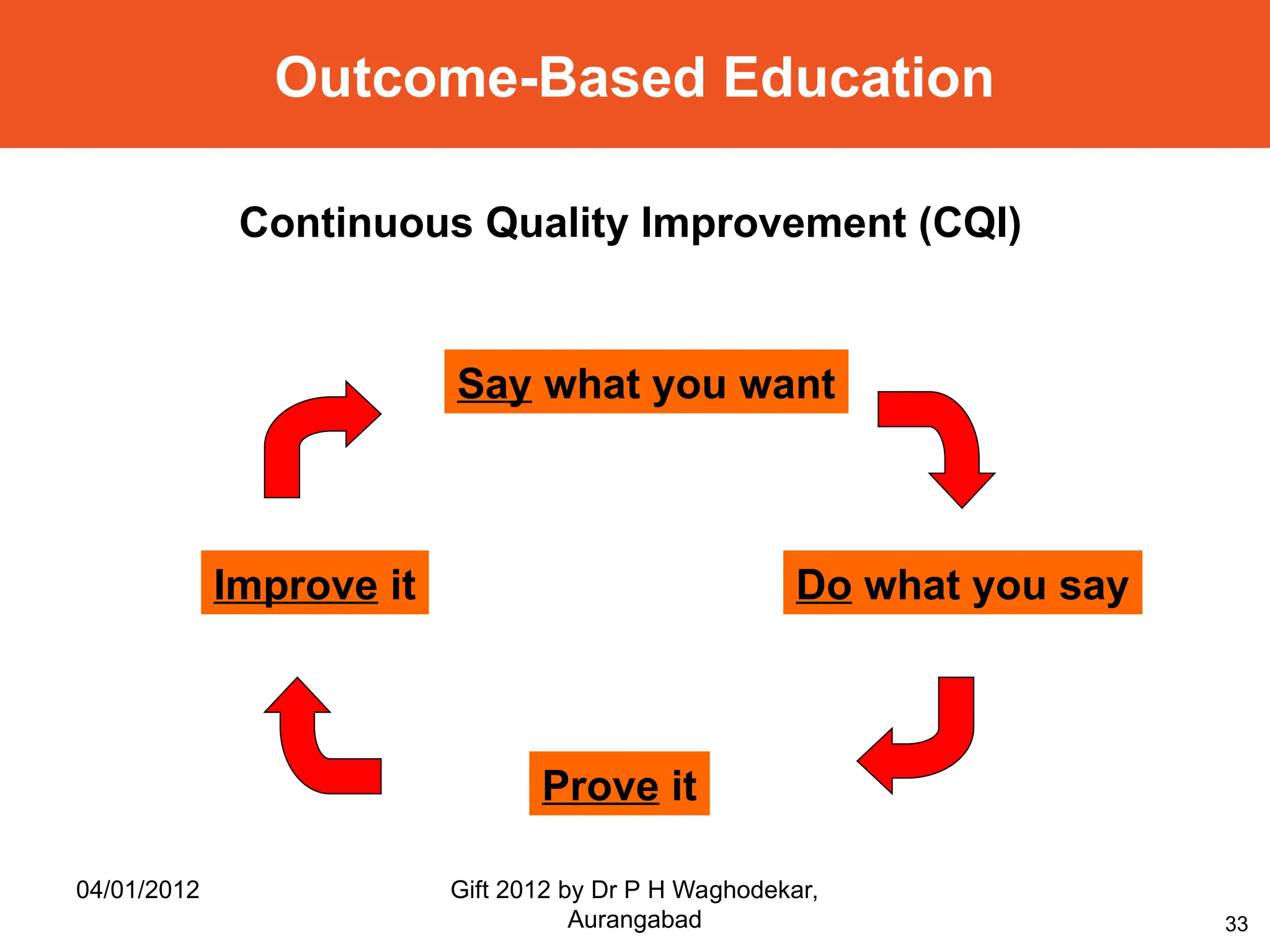
Say what you want
Do what you say
Prove it
Improve it
Continuous Quality Improvement (CQI)
Outcome-Based Education
04/01/2012 Gift 2012 by Dr P H Waghodekar,
Aurangabad
34
Roles of Lecturers
• Review PEOs, POs, course structures and syllabi.
• Teach the relevant engineering, maths, and other
relevant subjects.
• Conduct relevant tutorials and laboratory practical
sessions.
• Give appropriate guide on assignments and projects.
• Conduct empirical measurements of POs.
• Prepare the required documentation.
• Assure EAC and public on the standard of our
graduates.
• Obtain and maintain accreditation from EAC through
Continuous Quality Improvement (CQI).
04/01/2012 Gift 2012 by Dr P H Waghodekar,
Aurangabad
35
• Know the required Programme Outcomes and Programme
Objectives (available at the FOE website).
• For each course, review the Learning Outcomes (available at the
FOE website/uploaded in MMLS) at the beginning of each
trimester. This gives you an idea of the knowledge and skills
expected from a particular course.
• Be more proactive in the learning process to acquire the Learning
Outcomes of subjects.
• Demonstrate through the assessment methods that the required
skills and knowledge have been acquired.
• Attain the Programme Outcomes and Programme Objectives as a
whole during the entire programme.
• Give constructive feedbacks on the programme/course/academic
staff to obtain accreditation through active participation in Online
Teaching Evaluation, Academic Advisory System, dialog sessions
with Dean, etc.
Roles of Students
04/01/2012 Gift 2012 by Dr P H Waghodekar,
Aurangabad
36
The End
Q & A
04/01/2012 Gift 2012 by Dr P H Waghodekar,
Aurangabad
37
References
• Outcome-based education, Wikipedia,
(http://en.wikipedia.org/wiki/Outcome-based_education).
• TOWARDS EAC ACCREDITATION IN 2009 - Direct
Assessment of Program Outcomes, Fakulti Kejuruteraan
Elektrik, Universiti Teknologi Malaysia
(http://encon.fke.utm.my/OBE.ppt).
• T. A. Grossman, Shifting the Focus from Teaching to Learning:
Learning Objectives for OR Course Design, Masagung School of
Management, University of San Francisco
(http://meetings.informs.org/TMSWorkshop/TMS04/presentation
s/Grossman.ppt).
• S. S. Chong, Outcome-based Education (OBE), 2008, UTAR
(http://www.utar.edu.my/fes/file/OBE.pdf).
• B.K.Chung, Outcome-based Education (OBE), 2009, Faculty of
Engineering and Science, UTAR
(http://www.utar.edu.my/fes/file/OBE%20Presentation.pps).
04/01/2012 Gift 2012 by Dr P H Waghodekar,
Aurangabad
38
Why Need Accreditation?
Governed by the REGISTRATION OF
ENGINEERS ACT 1967 (Revised 2002)
• Legally, no person is allowed to practice unless he/she is
a professional engineer (of one can do it in private
sector).
• Professional engineer may use “Ir” before his name OR
“PEng” after his name.
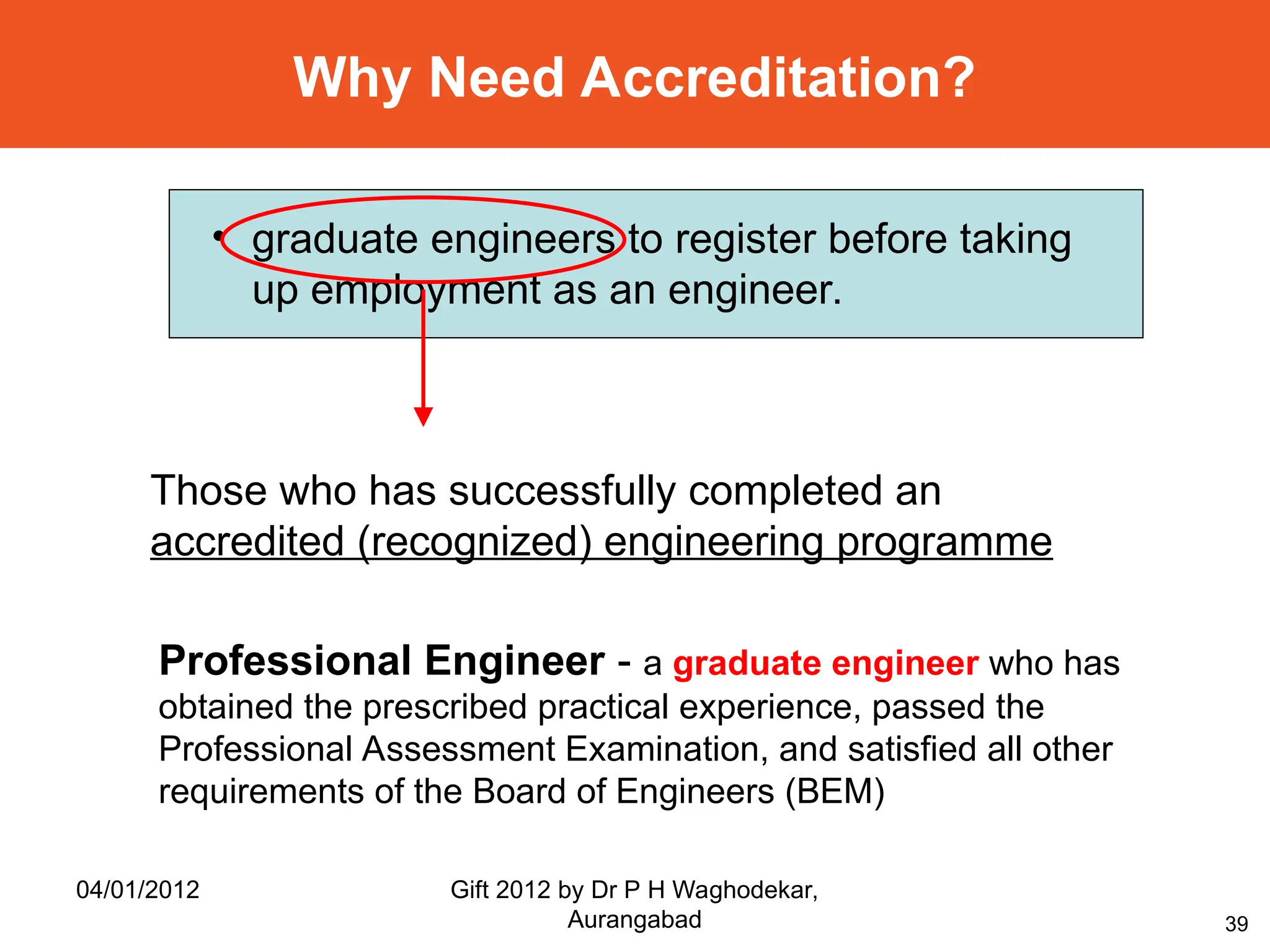
• Graduate engineers to register with BEM before taking
up employment as an engineer.
04/01/2012 Gift 2012 by Dr P H Waghodekar,
Aurangabad
39
Why Need Accreditation?
• graduate engineers to register before taking
up employment as an engineer.
Those who has successfully completed an
accredited (recognized) engineering programme
Professional Engineer - a graduate engineer who has
obtained the prescribed practical experience, passed the
Professional Assessment Examination, and satisfied all other
requirements of the Board of Engineers (BEM)
04/01/2012 Gift 2012 by Dr P H Waghodekar,
Aurangabad
40
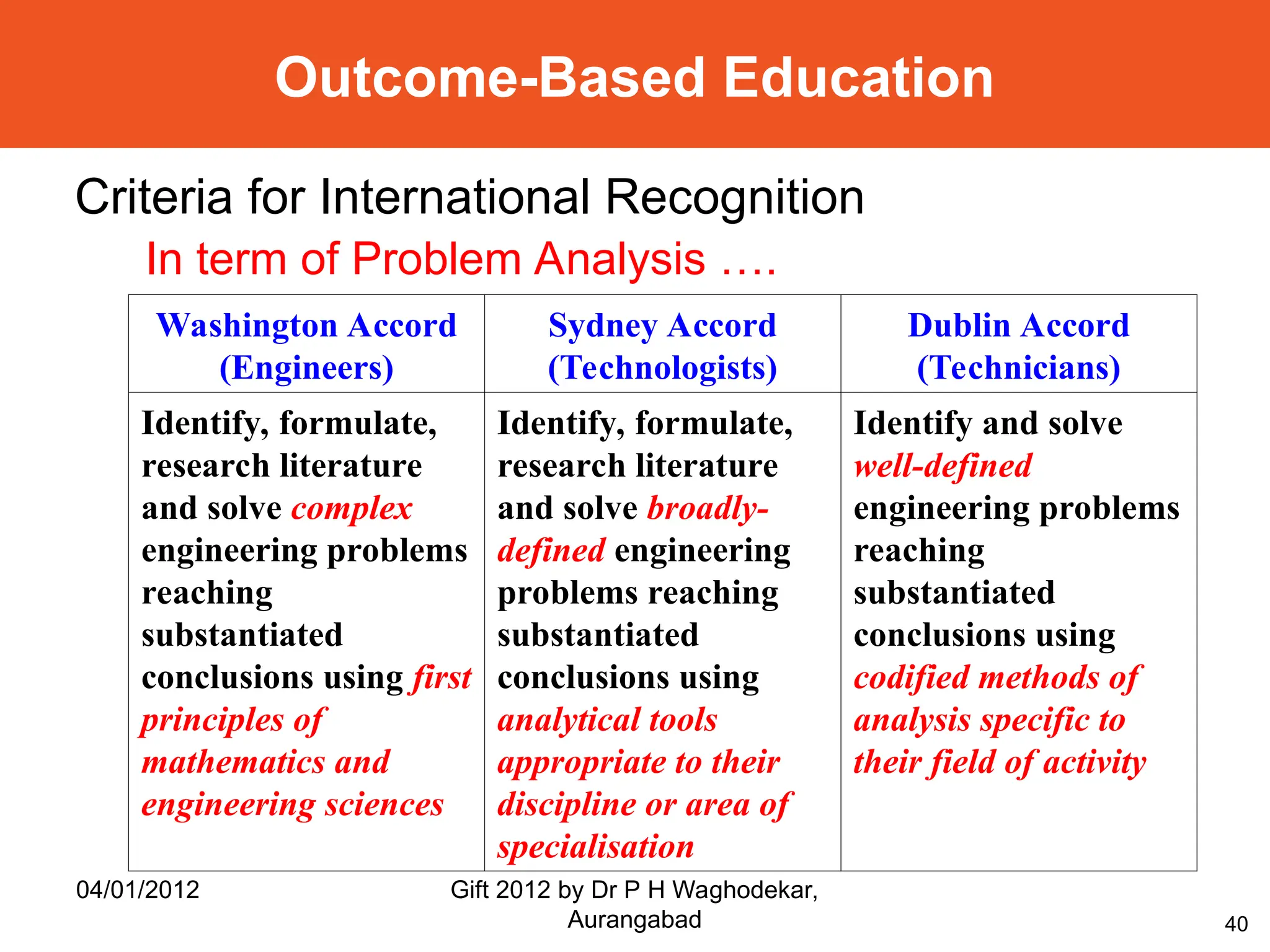
Criteria for International Recognition
In term of Problem Analysis ….
Washington Accord
(Engineers)
Sydney Accord
(Technologists)
Dublin Accord
(Technicians)
Identify, formulate,
research literature
and solve complex
engineering problems
reaching
substantiated
conclusions using first
principles of
mathematics and
engineering sciences
Identify, formulate,
research literature
and solve broadly-
defined engineering
problems reaching
substantiated
conclusions using
analytical tools
appropriate to their
discipline or area of
specialisation
Identify and solve
well-defined
engineering problems
reaching
substantiated
conclusions using
codified methods of
analysis specific to
their field of activity
Outcome-Based Education
04/01/2012 Gift 2012 by Dr P H Waghodekar,
Aurangabad
41
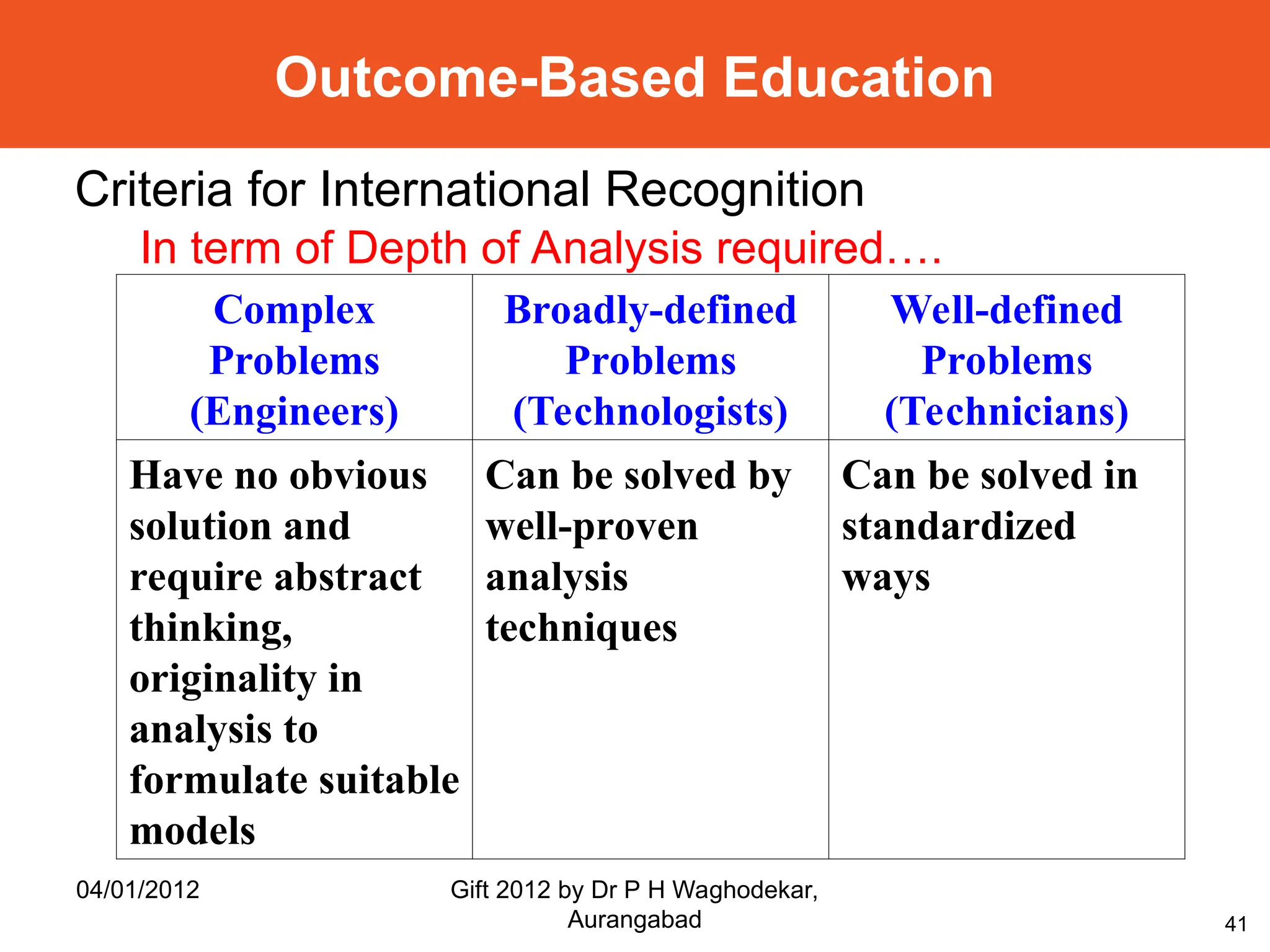
In term of Depth of Analysis required….
Complex
Problems
(Engineers)
Broadly-defined
Problems
(Technologists)
Well-defined
Problems
(Technicians)
Have no obvious
solution and
require abstract
thinking,
originality in
analysis to
formulate suitable
models
Can be solved by
well-proven
analysis
techniques
Can be solved in
standardized
ways
Criteria for International Recognition
Outcome-Based Education
04/01/2012 Gift 2012 by Dr P H Waghodekar,
Aurangabad
42
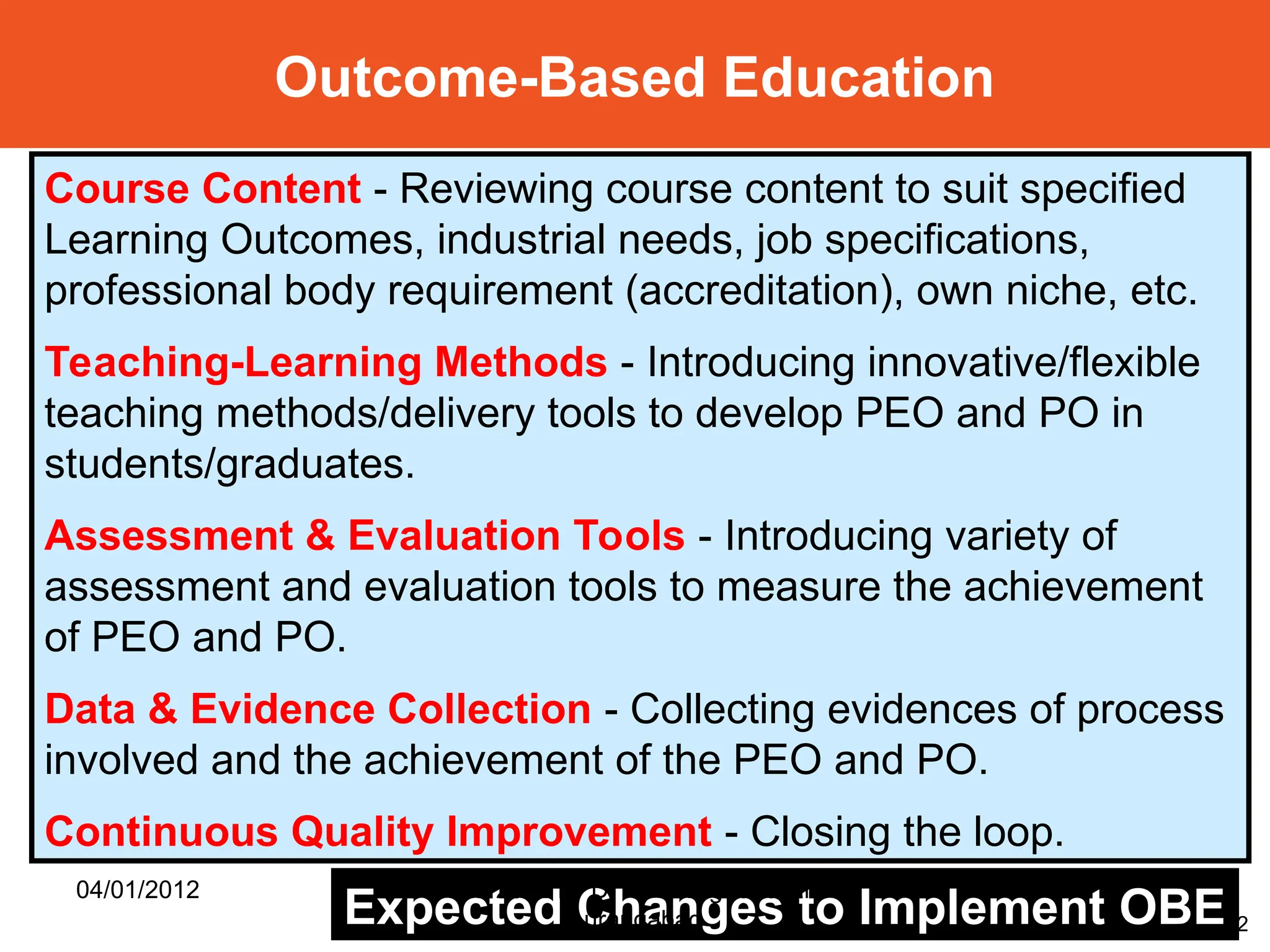
Course Content - Reviewing course content to suit specified
Learning Outcomes, industrial needs, job specifications,
professional body requirement (accreditation), own niche, etc.
Teaching-Learning Methods - Introducing innovative/flexible
teaching methods/delivery tools to develop PEO and PO in
students/graduates.
Assessment & Evaluation Tools - Introducing variety of
assessment and evaluation tools to measure the achievement
of PEO and PO.
Data & Evidence Collection - Collecting evidences of process
involved and the achievement of the PEO and PO.
Continuous Quality Improvement - Closing the loop.
Expected Changes to Implement OBE
Outcome-Based Education
04/01/2012 Gift 2012 by Dr P H Waghodekar,
Aurangabad
43
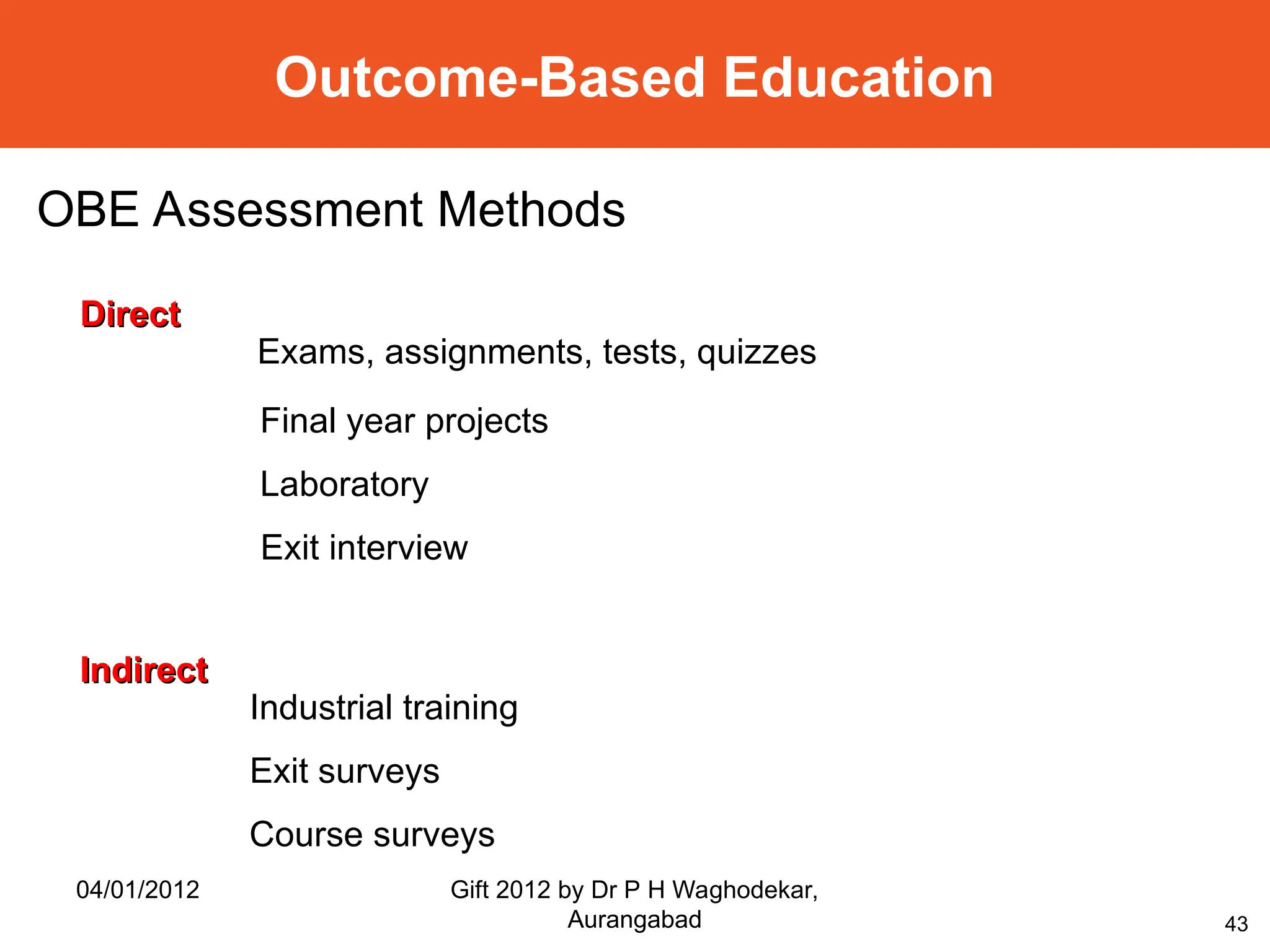
Outcome-Based Education
Direct
Direct
Exams, assignments, tests, quizzes
Final year projects
Laboratory
Exit interview
Indirect
Indirect
Industrial training
Exit surveys
Course surveys
OBE Assessment Methods
04/01/2012 Gift 2012 by Dr P H Waghodekar,
Aurangabad
0
10
20
30
40
50
60
70
80
1 2 3 4 5 6 7 8 9 10 11
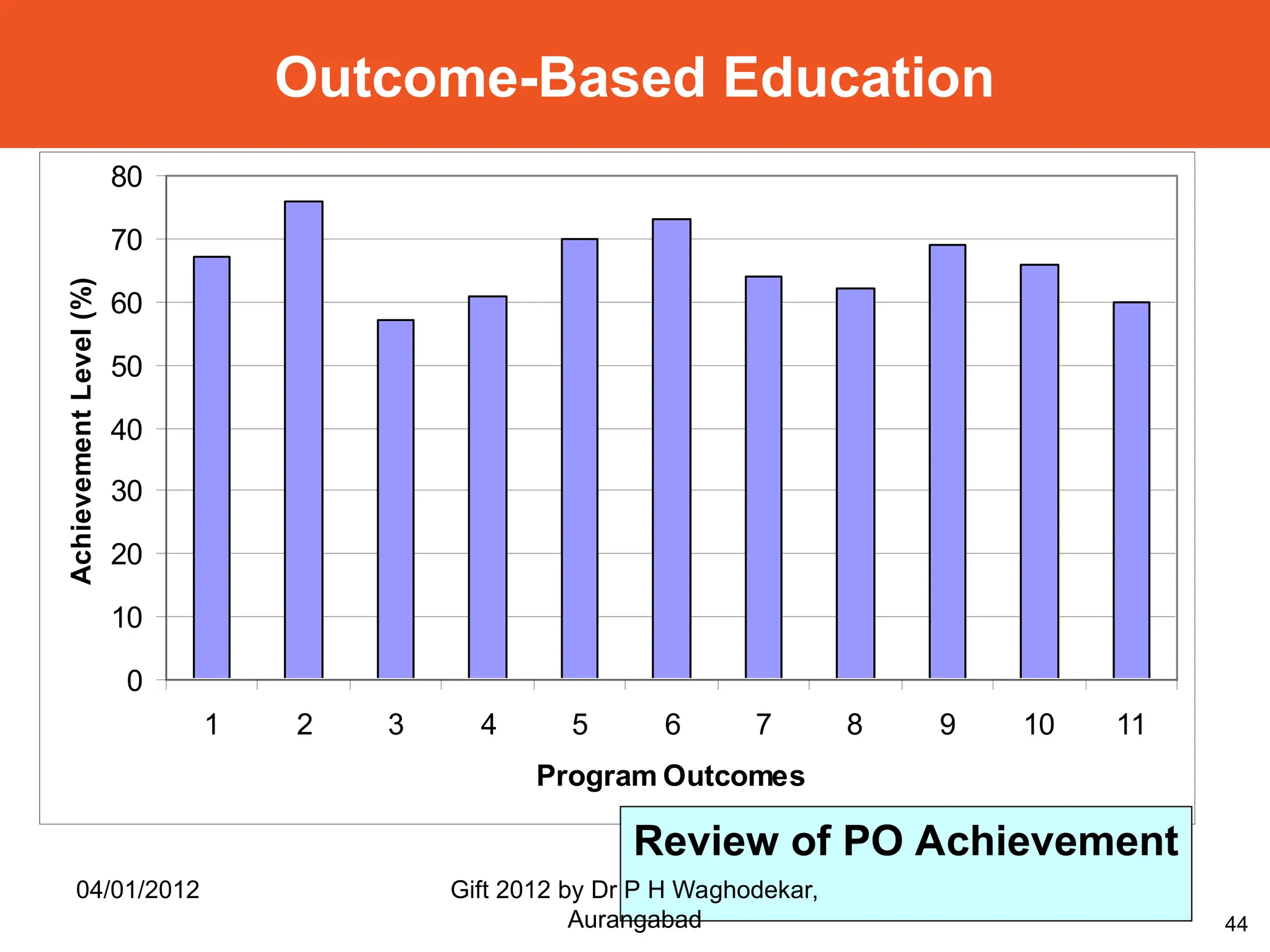
Program Outcomes
Achievement
Level
(%)
44
Review of PO Achievement
Outcome-Based Education
04/01/2012 Gift 2012 by Dr P H Waghodekar,
Aurangabad
04/01/2012 Gift 2012 by Dr P H Waghodekar,
Aurangabad 45
Brahmaputra Bridge
NO OBE = NO Accreditation!
Thanks!
Continuous improvement of business in the global situation

  • 1.
    04/01/2012 Gift 2012by Dr P H Waghodekar, Aurangabad 1 Outcome Based Education (OBE) Ref: Dr. Fabian Kung Wai Lee, Programme Coordinator, Faculty of Engineering, Outcome-Based Approach to Engineering Education , EAC Accreditation in 2009, B.Eng. (Hons) Electronics Majoring in Microwave and Communications (Malaysia).
  • 2.
    • FOE hasbeen practicing Outcome-Based Education (OBE) approach for the past two years. • The B.Eng Electronics Majoring in Microwave and Communication Program will be assessed by a team from Engineering Accreditation Council (EAC) in July 2009. • EAC is the custodian of OBE practices for engineering degrees and accredits engineering programmes at institutes of higher learning in Malaysia. • Students will be randomly selected by EAC for interview, to obtain feedback about the program. 2 Why This Briefing? This means to perform quality control and decide whether or not to recognize the programmes 04/01/2012 Gift 2012 by Dr P H Waghodekar, Aurangabad
  • 3.
    3 What Is OutcomeBased Engineering Education? IT’S NOT WHAT WE TEACH, IT’S WHAT YOU LEARN In a nutshell, learner-centric approach to tertiary education 04/01/2012 Gift 2012 by Dr P H Waghodekar, Aurangabad
  • 4.
    4 • What isEAC? • Why Need Accreditation? • EAC Accreditation Criteria • Deficiencies of Traditional Education • Outcome Based Education (OBE) • Roles of Lecturers • Roles of Students • Q & A Contents 04/01/2012 Gift 2012 by Dr P H Waghodekar, Aurangabad
  • 5.
    What Is EAC? •Formed in 2000, a delegated body from Board of Engineers Malaysia (BEM), the only body for accrediting engineering degree programs. • Comprises members from BEM, IEM, PSD, MQA and Industry Representatives. EAC IEM (Institution of Engineers, Malaysia) PSD (Public Service Dept.) BEM (Board of Engineers Malaysia) MQA (Agensi Kelayakan Malaysia) Useful links: EAC: www.eac.org.my BEM: www.bem.org.my MQA: www.lan.govm.my Statutory body (to be elaborated later) 04/01/2012 Gift 2012 by Dr P H Waghodekar, Aurangabad
  • 6.
    6 Roles of EAC EngineeringAccreditation Council • Formulates and updates accreditation policies and criteria. • Approves guidelines and operating procedures. • Oversees operational arrangements and appoints evaluation panel. • Receives evaluation reports and decides on accreditation. • Responds to complaints, appeals or any proposals for change. • Oversees development and operation of accreditation and mutual recognition agreement with other countries. • Fosters the dissemination of developments and best practices in engineering education. 04/01/2012 Gift 2012 by Dr P H Waghodekar, Aurangabad
  • 7.
    7 Why Need Accreditation? •An accredited engineering degree means the degree is recognized by the Malaysian government. • It is also a sign of the degree being of high quality and the holder of the degree has already attained a certain level of knowledge, skill and maturity of thought related to the relevant discipline. • A person with accredited engineering degree may be able to work for the government, as well as private sector. • He/she may subsequently become a Professional Engineer. Recognition by Malaysian Government, under REGISTRATION OF ENGINEERS ACT 1967 (Revised 2002) 04/01/2012 Gift 2012 by Dr P H Waghodekar, Aurangabad
  • 8.
    8 Why Need Accreditation? •The Washington Accord (WA): Agreement that establishes equivalence of other countries’ accredited professional engineering programs. International Mobility (Washington Accord) • Accredited Engineering Graduates are recognized by other signatory countries - Possible employment as engineers in those countries without further examinations. 04/01/2012 Gift 2012 by Dr P H Waghodekar, Aurangabad
  • 9.
    9 Why Need Accreditation? InternationalMobility (Washington Accord) • Established in 1989, as of 2007, the following countries are full members of WA: Australia, Canada, the Republic of Ireland, Hong Kong, Japan, New Zealand, Singapore, South Africa, South Korea, Taiwan, the UK and the USA. • The following countries are provisional members of the WA and may become a full member in the future: Germany, India, Malaysia (since 2003), Russia, Sri Lanka. 04/01/2012 Gift 2012 by Dr P H Waghodekar, Aurangabad
  • 10.
    10 Why Need Accreditation? Ourlast accreditation was in 2003 for 5-year programme Next accreditation visit will be in July 2009 - for intakes of 2005 & onwards Programmes to be accredited in 2009 will Programmes to be accredited in 2009 will have to be based on OBE approach! have to be based on OBE approach! Our programme has been accredited before, so what’s the big deal? NO NO OBE = OBE = NO NO ACCREDITATION ACCREDITATION 04/01/2012 Gift 2012 by Dr P H Waghodekar, Aurangabad
  • 11.
    11  Academic Curriculum Students  Academic and Supporting Staff  Facilities  Quality Management System EAC Accreditation Criteria 04/01/2012 Gift 2012 by Dr P H Waghodekar, Aurangabad
  • 12.
    12 • Academic Staff Academic qualifications  Professional qualification, experience & development  Research/publication/consultancy  Industrial involvement  Teaching load/contact hours  Motivation and enthusiasm  Use of lecturers from industry/public bodies  Aware and practice of OBE EAC Accreditation Criteria 04/01/2012 Gift 2012 by Dr P H Waghodekar, Aurangabad
  • 13.
    13 Outcome-Based Education (OBE) •OBE is an educational process that focuses on what students can do or the qualities they should develop after they are taught. • OBE involves the restructuring of curriculum, assessment and reporting practices in education to reflect the achievement of high order learning and mastery rather than accumulation of course credits. • Both structures and curricula are designed to achieve those capabilities or qualities. • Discourages traditional education approaches based on direct instruction of facts and standard methods. • It requires that the students demonstrate that they have learnt the required skills and content. 04/01/2012 Gift 2012 by Dr P H Waghodekar, Aurangabad
  • 14.
    14  Provides studentswith a learning environment with little attention to whether or not students ever learn the material.  Students are given grades and rankings compared to each other – students become exam oriented or CGPA driven.  Graduates are not completely prepared for the workforce.  Lack of emphasis on soft skills needed in jobs e.g. communication skills, interpersonal skills, analytical skills, working attitude etc. Why OBE - Deficiencies of Traditional Education 04/01/2012 Gift 2012 by Dr P H Waghodekar, Aurangabad
  • 15.
    15 • Communication (verbal& written) 4.69 • Honesty/Integrity 4.59 • Teamwork skills 4.54 • Interpersonal skills 4.50 • Strong work ethics 4.46 • Motivation & initiative 4.42 • Flexibility/adaptability 4.41 • Analytical skills 4.36 • Computer skills 4.21 • Organisational skills 4.05 • Detail oriented 4.00 • Leadership skills 3.97 • Self confidence 3.95 • Friendly/outgoing personality 3.85 • Well mannered / polite 3.82 • Tactfulness 3.75 • GPA (3.0 or better) 3.68 • Creativity 3.59 • Sense of humour 3.25 • Entrepreneurial skills/risk taker 3.23 Employers Rating of Skills/Qualities – 2002 Why OBE - Exam Result is Not the Most Important Consideration by Employer 04/01/2012 Gift 2012 by Dr P H Waghodekar, Aurangabad
  • 16.
    16 Focus and Benefitsof OBE OBE addresses the following key questions: • What do we want the students to have or be able to do? • How can we best help students achieve it? • How will we know whether they students have achieved it? • How do we close the loop for further improvement (Continuous Quality Improvement (CQI))? Benefits of OBE: 1. More directed & coherent curriculum. 2. Graduates will be more “relevant” to industry & other stakeholders (more well rounded graduates) 3. Continuous Quality Improvement (CQI) is in place. 04/01/2012 Gift 2012 by Dr P H Waghodekar, Aurangabad
  • 17.
    17 Expectations on Studentsunder OBE – the Outcomes • Students are expected to be able to do more challenging tasks other than memorize and reproduce what was taught. • Students should be able to: write project proposals, complete projects, analyze case studies, give case presentations, show their abilities to think, question, research, and make decisions based on the findings. • Be more creative, able to analyze and synthesize information. • Able to plan and organize tasks, able to work in a team as a community or in entrepreneurial service teams to propose solutions to problems and market their solutions. 04/01/2012 Gift 2012 by Dr P H Waghodekar, Aurangabad
  • 18.
    18 •Teaching Staff •Curriculum •Labs •Other Resource Input Teaching& Learning Process OBE Versus Traditional Education Process • Traditional education process focuses on the inputs. Students at Graduation • Assessment mainly via exam, test, assignments. • Quality control from teaching evaluation. 04/01/2012 Gift 2012 by Dr P H Waghodekar, Aurangabad
  • 19.
    19 •Teaching Staff •Curriculum •Labs •Other Resource Input Teaching& Learning Process Students at Graduation Program & Subject Outcomes (Short-term) Graduates to Fulfill Stakeholders’ Satisfaction Program Education Outcomes Stakeholders: EAC Employers Industry Advisors Academic Staff Public and Parents Students Alumni (Long-term) Outcome-Based Education Versus Traditional Education Process • OBE shifts from measuring input and process to include measuring the output (outcome) • Assessment by exam, test and assignments. • Assessment of teaching staff, lecture material & flow, results and student ‘capabilities’ (Short & long-term outcomes), lab interview, exit survey etc. • More ‘thinking’ projects, with analysis. • Feedback from industry, alumni and other stakeholders. • Clear continuous improvement step. 04/01/2012 Gift 2012 by Dr P H Waghodekar, Aurangabad
  • 20.
    20 Vision and Missionof the Institution/Faculty Programme Educational Objectives (PEO) Programme Outcomes (PO) Learning Outcomes (CO) of Subjects A Model Hierarchy of Outcomes Outcomes in OBE Interrelated and Complement Each Other Short-term Outcomes Long-term Outcomes 04/01/2012 Gift 2012 by Dr P H Waghodekar, Aurangabad
  • 21.
    21 Vision and Missionof MMU Vision of the University To be a premier university that propagates the generation and dissemination of knowledge in cutting edge technologies Mission of the University 1. To deliver quality academic programmes based on state-of-the-art R&D. 2. To attract and nurture quality minds who will contribute towards the global knowledge economy 3. To inculcate a strong research culture within a dynamic, efficient and effective team of academic and support staff 4. To be financially self-sustaining via education and the commercialisation of R&D products and services. 04/01/2012 Gift 2012 by Dr P H Waghodekar, Aurangabad
  • 22.
    22 Vision and Missionof FOE Vision of the Faculty To be a leading engineering faculty for creation, preservation and dissemination of knowledge, training of knowledge workers for nation building, and providing continuous technical support for the ICT industry in Malaysia. Mission of the Faculty 1. To produce multi-skilled graduates who are able to spearhead nation-building in the Information Age. 2. To provide opportunities and resources for academic and researchers to carry out the state-of-the-art research and development work. 3. To support the growth of nationwide ICT industry through provision of continuous professional development of knowledge. 04/01/2012 Gift 2012 by Dr P H Waghodekar, Aurangabad
  • 23.
    23 Programme Educational Objectives(PEO) are long term goals (5 years or more after graduation) describing expected achievements of graduates in their career. Program Educational Objectives for B.Eng Electronics Majoring in Microwave & Comm. PEO of B.Eng. (Hons) Electronics Majoring in Microwave and Communications • To develop highly competent engineers specialising in the area of microwave and communications technologies in support of the related industry. • To produce innovative technical leaders that are able to contribute towards the advancement of microwave and communications technologies. 04/01/2012 Gift 2012 by Dr P H Waghodekar, Aurangabad
  • 24.
    24 PEOs and Visionand Mission of MMU and FOE Vision of the Faculty Mission of the Faculty Programme Educational Objectives (PEOs) To be a leading engineering faculty for creation, preservation and dissemination of knowledge, training of knowledge workers for nation building, and providing continuous technical support for the ICT industry in Malaysia 1. To produce multi-skilled graduates who are able to spearhead nation- building in the Information Age 2. To provide opportunities and resources for academic and researchers to carry out the state-of-the-art research and development work 3. To support the growth of nationwide ICT industry through provision of continuous professional development of knowledge 1. To develop highly competent engineers specialising in the area of microwave and communications technologies in support of the related industry. -Related to M1,M2 & M3 2. To produce innovative technical leaders that are able to contribute towards the advancement of microwave and communications technologies. -Related to M1 & M3 Example of how PEOs are linked to the Vision and Mission 04/01/2012 Gift 2012 by Dr P H Waghodekar, Aurangabad
  • 25.
    25 Program Outcomes forB.Eng Electronics Majoring in Microwave & Comm. POs of B.Eng. (Hons) Electronics Majoring in Microwave and Communications 1. Ability to acquire and apply fundamental principles of science and engineering. 2. Capability to communicate effectively. 3. Acquisition of technical competence in specialized areas of engineering discipline. 4. Ability to identify, formulate and model problems and find engineering solutions based on a systems approach. 5. Ability to conduct investigation and research on engineering problems in a chosen field of study. Programme Outcomes (PO) are short term outcomes (at the point of graduation) describing what students are expected to know and be able to perform. 04/01/2012 Gift 2012 by Dr P H Waghodekar, Aurangabad
  • 26.
    26 Program Outcomes forB.Eng Electronics Majoring in Microwave & Comm. POs Cont… 6. Understanding of the importance of sustainability and cost- effectiveness in design and development of engineering solutions. 7. Understanding and commitment to professional and ethical responsibilities. 8. Ability to work effectively as an individual, and as a member/leader in a team. 9. Ability to be a multi-skilled engineer with good technical knowledge, management, leadership and entrepreneurial skills. 10. Awareness of the social, cultural, global and environmental responsibilities as an engineer. 11. Capability and enthusiasm for self-improvement through continuous professional development and life-long learning. 04/01/2012 Gift 2012 by Dr P H Waghodekar, Aurangabad
  • 27.
    27 Outcome-Based Education Example ofhow POs are linked to the PEOs Programme Educational Objectives (PEOs) Description of how POs (Programme Outcomes) are linked to the PEOs 1. To produce all-rounded engineers in the telecommunications technologies in support of the emerging ICT industry 2. To develop capable technical leaders who are able to spearhead the advancement of telecommunications in the country. 1. Ability to acquire and apply fundamental principles of science and engineering. - The graduates have firm fundamental knowledge and therefore can easily understand and adapt to any change in the technology - This will ensure that the graduates will be of high caliber equipped with the fundamental technical principles of science and engineering so that they can lead, facilitate and support the development of engineering practices in the industries in Malaysia - Related to PEO 1 2. Capability to communicate effectively - Communication and networking skills are enhanced through presentations, exchanging ideas and arguing with solid rational - To be a good leader, effective communication is a must - Related to PEOs 1 and 2 04/01/2012 Gift 2012 by Dr P H Waghodekar, Aurangabad
  • 28.
    28 Outcome-Based Education Example ofhow the course subjects contribute towards POs Programme Outcome Descriptions Ability to acquire and apply fundamental principles of science and engineering - Core subjects on Mathematics (Engineering Mathematics I to IV), Circuit Theory, Electronics (I to III), Computer & Program Design, Field Theory, Digital Logic Design, Instrumentation & Measurement Techniques, Introduction to Machines, Algorithm & Data Structure, Microprocessor Systems & Interfacing, Circuits and Signals, Electromagnetic Theory, Control Theory, Communication Networks, Electromagnetic Interference, Introduction to Power Systems. - Basic concepts and theories and their relation to actual engineering systems are applied and extended in Final Year Projects and Industrial Training. - Extensive laboratory experiments to provide in-depth practical knowledge and hands-on experience to students. 04/01/2012 Gift 2012 by Dr P H Waghodekar, Aurangabad
  • 29.
    29 Outcome-Based Education LOs ofEEN1036 Digital Logic Design: 1. Describe the differences between analog and digital systems, and their respective advantages and disadvantages. 2. Apply positional notations, number systems and computer codes in digital systems. 3. Apply algebraic methods based on Boolean algebra and truth table to analyse logic circuits. 4. Apply minimisation methods such as Karnaugh maps and Quine- McCluskey tabular method to simplify switching functions. 5. Apply the concepts of sequential logic and memory devices in digital systems. 6. Design modular combinational circuits using encoders, decoders, multiplexers and demultiplexers. Learning Outcomes (LO) of subjects are statements of a learning achievement on completion of the subject. 04/01/2012 Gift 2012 by Dr P H Waghodekar, Aurangabad
  • 30.
    30 Course to ProgramOutcomes Matrix for Courses under the Electronic Engineering Majoring in Microwave and Communications Outcome-Based Education 04/01/2012 Gift 2012 by Dr P H Waghodekar, Aurangabad
  • 31.
    31 Example of AssessmentMethods for Program Outcome 2: Capability to Communicate Effectively Performance Criteria Subjects Assessment Methods Documents to be Kept • Present and document ideas and experimental results properly documented in a specified format, and supported with evidence. The document must contain explanation with sufficient detail, with minimum grammatical and spelling errors. • All Subjects- Lab Experiments, FYP, ITP, Mini Projects • Coursework and exam • presentation of Final Year Project and Industrial Training reports • Lab Reports Exam scripts and assignment Final Year Project and Industrial Training reports and mark sheets, lab reports, • Use multimedia content in oral and visual communication • EPT4046 Final Year Project, EPT4066 Industrial Training • Mini Project • Other Seminars, and • Meetings • Presentation of Final Year Project, Industrial Training, Mini projects and other seminars Final Year Project and Industrial Training, Mini Projects mark sheets, PowerPoint presentation slides. Attendance records in other seminars • Respond to audience’s questions correctly and confidently • EPT4046 Final Year Project, EPT4066 Industrial Training, • EPT3016 Mini Project, • other seminars and • meetings • Presentation of Final Year Project, Industrial Training, Mini projects and other seminars Final Year Project and Industrial Training, Mini Projects mark sheets, PowerPoint presentation slides. Student attendance records in other seminars Outcome-Based Education 04/01/2012 Gift 2012 by Dr P H Waghodekar, Aurangabad
  • 32.
    32 Outcome-Based Education Program Outcomes Program Objectives Stakeholders’ Mission &Vision Learning Outcomes of Subjects Assessment Assessment Assessment Assessment Assessment Assessment CQI CQI CQI CQI CQI CQI Analysis Analysis Analysis Analysis Analysis Analysis 04/01/2012 Gift 2012 by Dr P H Waghodekar, Aurangabad
  • 33.
    33 Say what youwant Do what you say Prove it Improve it Continuous Quality Improvement (CQI) Outcome-Based Education 04/01/2012 Gift 2012 by Dr P H Waghodekar, Aurangabad
  • 34.
    34 Roles of Lecturers •Review PEOs, POs, course structures and syllabi. • Teach the relevant engineering, maths, and other relevant subjects. • Conduct relevant tutorials and laboratory practical sessions. • Give appropriate guide on assignments and projects. • Conduct empirical measurements of POs. • Prepare the required documentation. • Assure EAC and public on the standard of our graduates. • Obtain and maintain accreditation from EAC through Continuous Quality Improvement (CQI). 04/01/2012 Gift 2012 by Dr P H Waghodekar, Aurangabad
  • 35.
    35 • Know therequired Programme Outcomes and Programme Objectives (available at the FOE website). • For each course, review the Learning Outcomes (available at the FOE website/uploaded in MMLS) at the beginning of each trimester. This gives you an idea of the knowledge and skills expected from a particular course. • Be more proactive in the learning process to acquire the Learning Outcomes of subjects. • Demonstrate through the assessment methods that the required skills and knowledge have been acquired. • Attain the Programme Outcomes and Programme Objectives as a whole during the entire programme. • Give constructive feedbacks on the programme/course/academic staff to obtain accreditation through active participation in Online Teaching Evaluation, Academic Advisory System, dialog sessions with Dean, etc. Roles of Students 04/01/2012 Gift 2012 by Dr P H Waghodekar, Aurangabad
  • 36.
    36 The End Q &A 04/01/2012 Gift 2012 by Dr P H Waghodekar, Aurangabad
  • 37.
    37 References • Outcome-based education,Wikipedia, (http://en.wikipedia.org/wiki/Outcome-based_education). • TOWARDS EAC ACCREDITATION IN 2009 - Direct Assessment of Program Outcomes, Fakulti Kejuruteraan Elektrik, Universiti Teknologi Malaysia (http://encon.fke.utm.my/OBE.ppt). • T. A. Grossman, Shifting the Focus from Teaching to Learning: Learning Objectives for OR Course Design, Masagung School of Management, University of San Francisco (http://meetings.informs.org/TMSWorkshop/TMS04/presentation s/Grossman.ppt). • S. S. Chong, Outcome-based Education (OBE), 2008, UTAR (http://www.utar.edu.my/fes/file/OBE.pdf). • B.K.Chung, Outcome-based Education (OBE), 2009, Faculty of Engineering and Science, UTAR (http://www.utar.edu.my/fes/file/OBE%20Presentation.pps). 04/01/2012 Gift 2012 by Dr P H Waghodekar, Aurangabad
  • 38.
    38 Why Need Accreditation? Governedby the REGISTRATION OF ENGINEERS ACT 1967 (Revised 2002) • Legally, no person is allowed to practice unless he/she is a professional engineer (of one can do it in private sector). • Professional engineer may use “Ir” before his name OR “PEng” after his name. • Graduate engineers to register with BEM before taking up employment as an engineer. 04/01/2012 Gift 2012 by Dr P H Waghodekar, Aurangabad
  • 39.
    39 Why Need Accreditation? •graduate engineers to register before taking up employment as an engineer. Those who has successfully completed an accredited (recognized) engineering programme Professional Engineer - a graduate engineer who has obtained the prescribed practical experience, passed the Professional Assessment Examination, and satisfied all other requirements of the Board of Engineers (BEM) 04/01/2012 Gift 2012 by Dr P H Waghodekar, Aurangabad
  • 40.
    40 Criteria for InternationalRecognition In term of Problem Analysis …. Washington Accord (Engineers) Sydney Accord (Technologists) Dublin Accord (Technicians) Identify, formulate, research literature and solve complex engineering problems reaching substantiated conclusions using first principles of mathematics and engineering sciences Identify, formulate, research literature and solve broadly- defined engineering problems reaching substantiated conclusions using analytical tools appropriate to their discipline or area of specialisation Identify and solve well-defined engineering problems reaching substantiated conclusions using codified methods of analysis specific to their field of activity Outcome-Based Education 04/01/2012 Gift 2012 by Dr P H Waghodekar, Aurangabad
  • 41.
    41 In term ofDepth of Analysis required…. Complex Problems (Engineers) Broadly-defined Problems (Technologists) Well-defined Problems (Technicians) Have no obvious solution and require abstract thinking, originality in analysis to formulate suitable models Can be solved by well-proven analysis techniques Can be solved in standardized ways Criteria for International Recognition Outcome-Based Education 04/01/2012 Gift 2012 by Dr P H Waghodekar, Aurangabad
  • 42.
    42 Course Content -Reviewing course content to suit specified Learning Outcomes, industrial needs, job specifications, professional body requirement (accreditation), own niche, etc. Teaching-Learning Methods - Introducing innovative/flexible teaching methods/delivery tools to develop PEO and PO in students/graduates. Assessment & Evaluation Tools - Introducing variety of assessment and evaluation tools to measure the achievement of PEO and PO. Data & Evidence Collection - Collecting evidences of process involved and the achievement of the PEO and PO. Continuous Quality Improvement - Closing the loop. Expected Changes to Implement OBE Outcome-Based Education 04/01/2012 Gift 2012 by Dr P H Waghodekar, Aurangabad
  • 43.
    43 Outcome-Based Education Direct Direct Exams, assignments,tests, quizzes Final year projects Laboratory Exit interview Indirect Indirect Industrial training Exit surveys Course surveys OBE Assessment Methods 04/01/2012 Gift 2012 by Dr P H Waghodekar, Aurangabad
  • 44.
    0 10 20 30 40 50 60 70 80 1 2 34 5 6 7 8 9 10 11 Program Outcomes Achievement Level (%) 44 Review of PO Achievement Outcome-Based Education 04/01/2012 Gift 2012 by Dr P H Waghodekar, Aurangabad
  • 45.
    04/01/2012 Gift 2012by Dr P H Waghodekar, Aurangabad 45 Brahmaputra Bridge NO OBE = NO Accreditation! Thanks!