Hidden Markov Modelling
• Introduction
• Problem formulation
• Forward-Backward algorithm
• Viterbi search
• Baum-Welch parameter estimation
• Other considerations
– Multiple observation sequences
– Phone-based models for continuous speech recognition
– Continuous density HMMs
– Implementation issues
6.345 Automatic Speech Recognition HMM 1
Lecture # 10
Session 2003
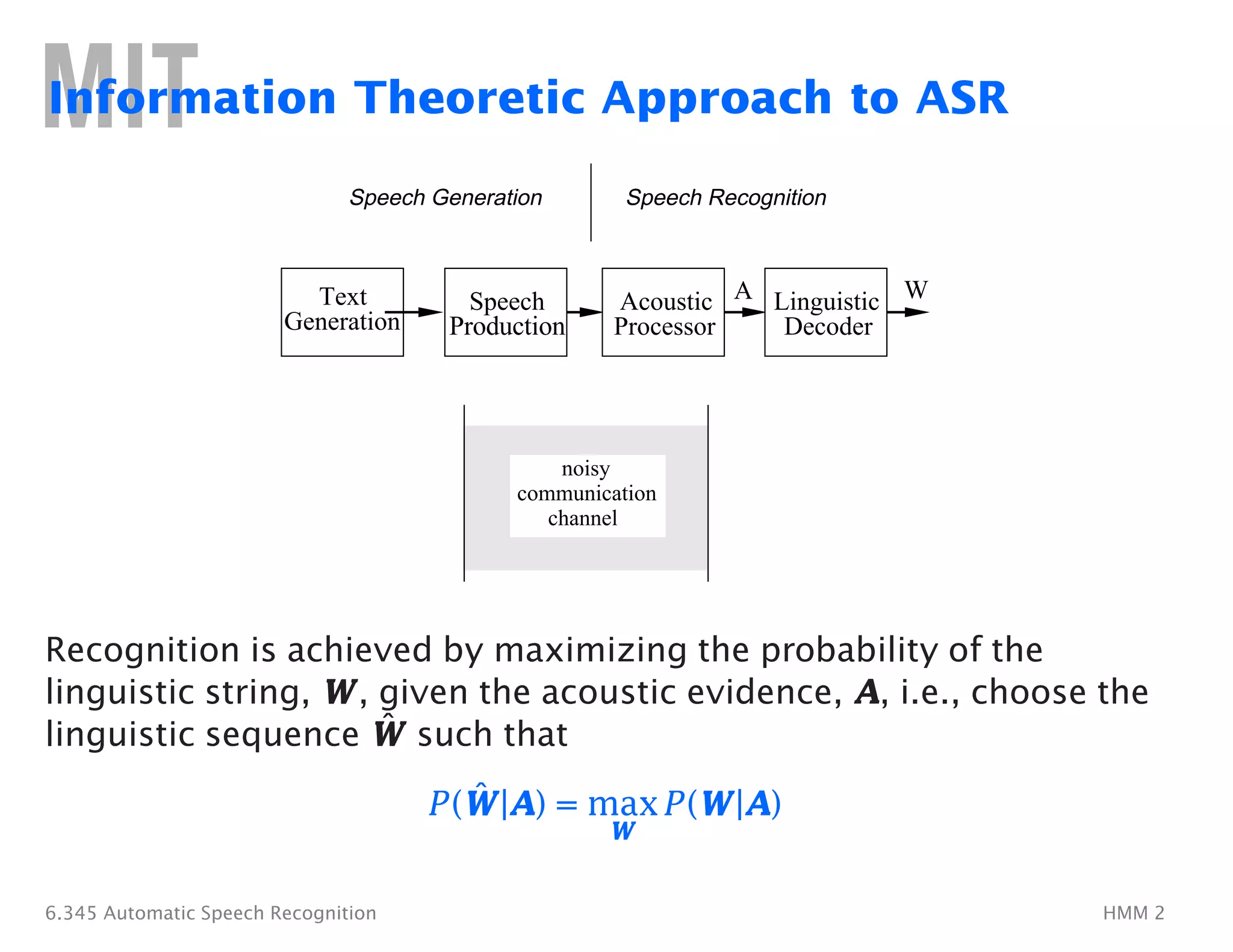
Information Theoretic Approach to ASR
Speech Generation

Text
Generation
Speech Recognition

noisy
communication
channel
Linguistic
Decoder
Speech
����������
Acoustic
Processor
A W
Recognition is achieved by maximizing the probability of the
linguistic string, W, given the acoustic evidence, A, i.e., choose the
ˆ
linguistic sequence W such that
P(Ŵ|A) = m
W
ax P(W|A)
6.345 Automatic Speech Recognition HMM 2
Information Theoretic Approach to ASR
• From Bayes rule:
P(W|A) =
P(A|W)P(W)
P(A)
• Hidden Markov modelling (HMM) deals with the quantity P(A|W)
• Change in notation:
A → O
W → λ
P(A|W) → P(O|λ)
6.345 Automatic Speech Recognition HMM 3
HMM: An Example
2
2
2
1
1
1
1
2
2
1
2
0
2
2
2
1
1
1
1
2
2
1
2
1
2
2
2
1
1
1
1
2
2
1
2
2
1 2
1
2
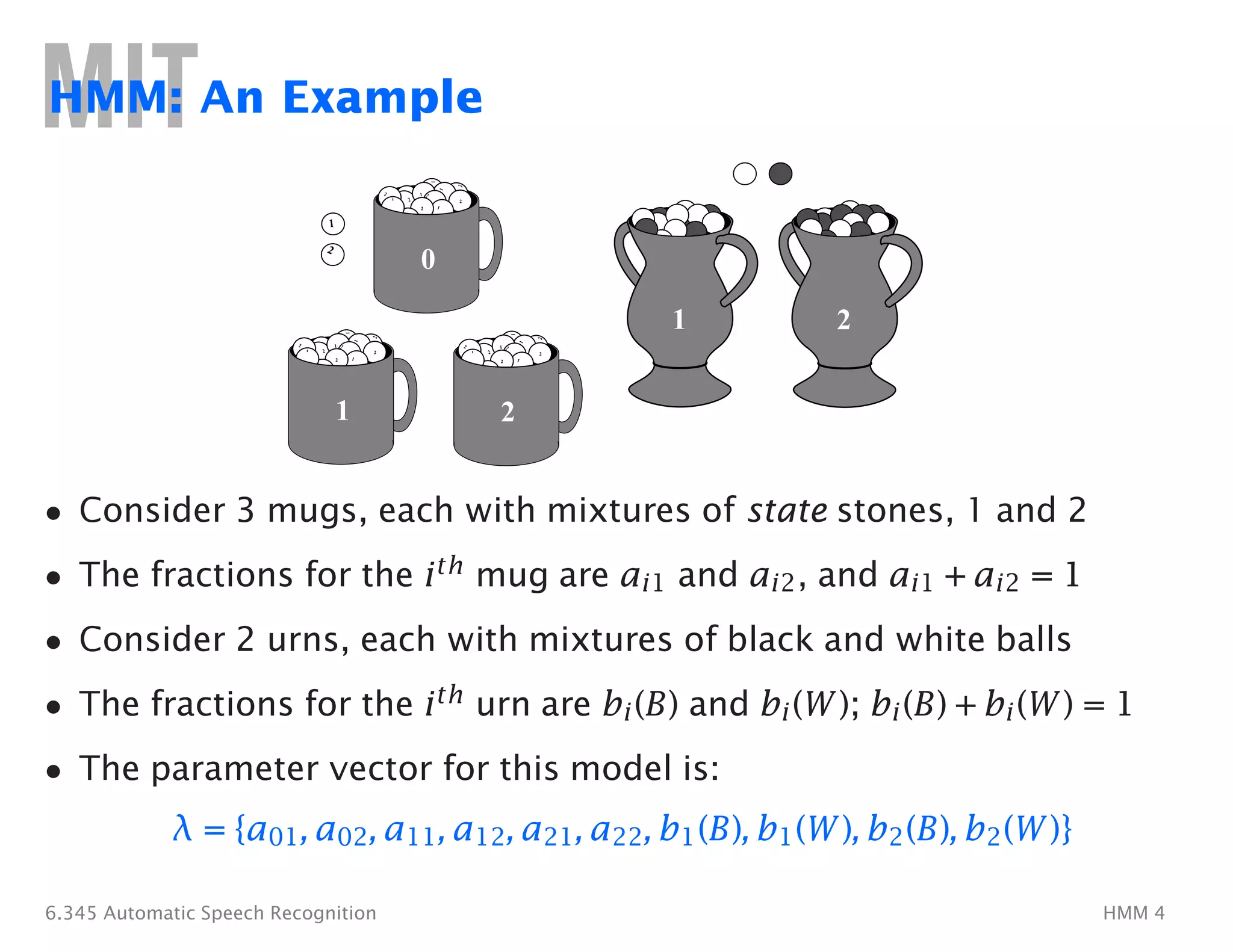
• Consider 3 mugs, each with mixtures of state stones, 1 and 2
• The fractions for the ith mug are ai1 and ai2, and ai1 + ai2 = 1
• Consider 2 urns, each with mixtures of black and white balls
• The fractions for the ith urn are bi(B) and bi(W); bi(B) + bi(W) = 1
•	 The parameter vector for this model is:
λ = {a01, a02, a11, a12, a21, a22, b1(B), b1(W), b2(B), b2(W)}
6.345 Automatic Speech Recognition HMM 4
HMM: An Example (cont’d)
2
2
2
1
1
1
1
2
2
1
2
0
2
2
2
1
1
1
1
2
2
1
2
1
2
2
2
1
1
1
1
2
2
1
2
1
2
1 1
1 1
1 2 2 1
Observation Sequence: O = {B, W, B, W, W, B}
State Sequence: Q = {1, 1, 2, 1, 2, 1}
Goal: Given the model λ and the observation sequence O,
how can the underlying state sequence Q be determined?
6.345 Automatic Speech Recognition HMM 5
2
2
2
1
1
1
1
2
2
1
2
2
2
2
2
1
1
1
1
2
2
1
2
1
1 2
2
2
2
1
1
1
1
2
2
1
2
2
1
Elements of a Discrete Hidden Markov Model

• N: number of states in the model
– states, s = {s1, s2, . . . , sN}
– state at time t, qt ∈ s
•	 M: number of observation symbols (i.e., discrete observations)
– observation symbols, v = {v1, v2, . . . , vM}
– observation at time t, ot ∈ v
• A = {aij}: state transition probability distribution
– aij = P(qt+1 = sj|qt = si), 1 ≤ i, j ≤ N
• B = {bj(k)}: observation symbol probability distribution in state j
– bj(k) = P(vk at t|qt = sj), 1 ≤ j ≤ N, 1 ≤ k ≤ M
• π = {πi}: initial state distribution
– πi = P(q1 = si), 1 ≤ i ≤ N
Notationally, an HMM is typically written as: λ = {A, B, π}
6.345 Automatic Speech Recognition HMM 6
� � � �
HMM: An Example (cont’d)
For our simple example:
π = {a01, a02}, A =
a11 a12
, and B =
b1(B) b1(W)
a21 a22 b2(B) b2(W)
State Diagram
2-state 3-state
1 2
a11 a12
a22
1 3
2
a21
{b1(B), b1(W)} {b2(B), b2(W)}
6.345 Automatic Speech Recognition HMM 7
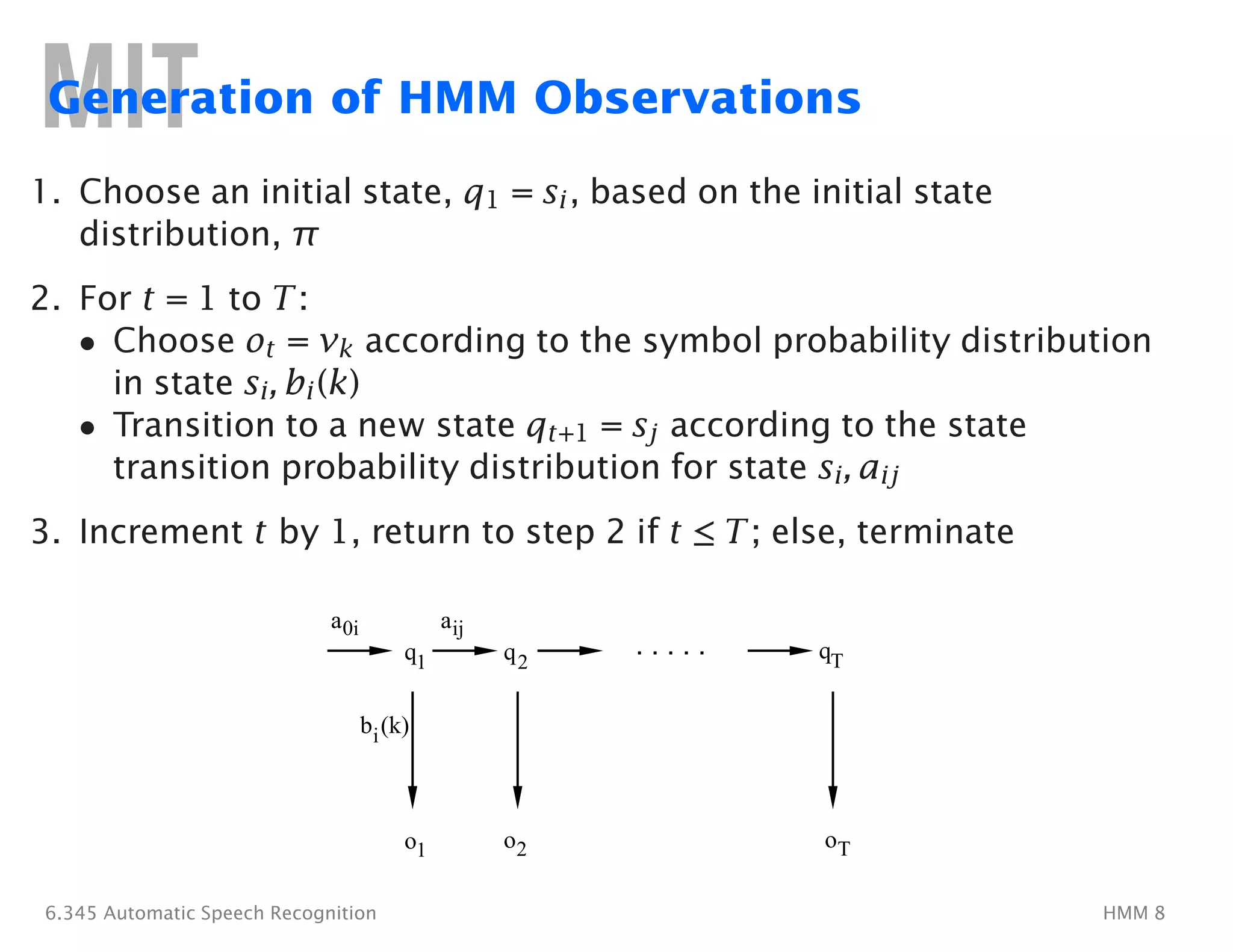
Generation of HMM Observations
1.	 Choose an initial state, q1 = si, based on the initial state
distribution, π
2. For t = 1 to T:
•	 Choose ot = vk according to the symbol probability distribution
in state si, bi(k)
•	 Transition to a new state qt+1 = sj according to the state
transition probability distribution for state si, aij
3. Increment t by 1, return to step 2 if t ≤ T; else, terminate
a0i aij
q1 q2
. . . . .
bi(k)
o1 o2
qT
oT
6.345 Automatic Speech Recognition HMM 8
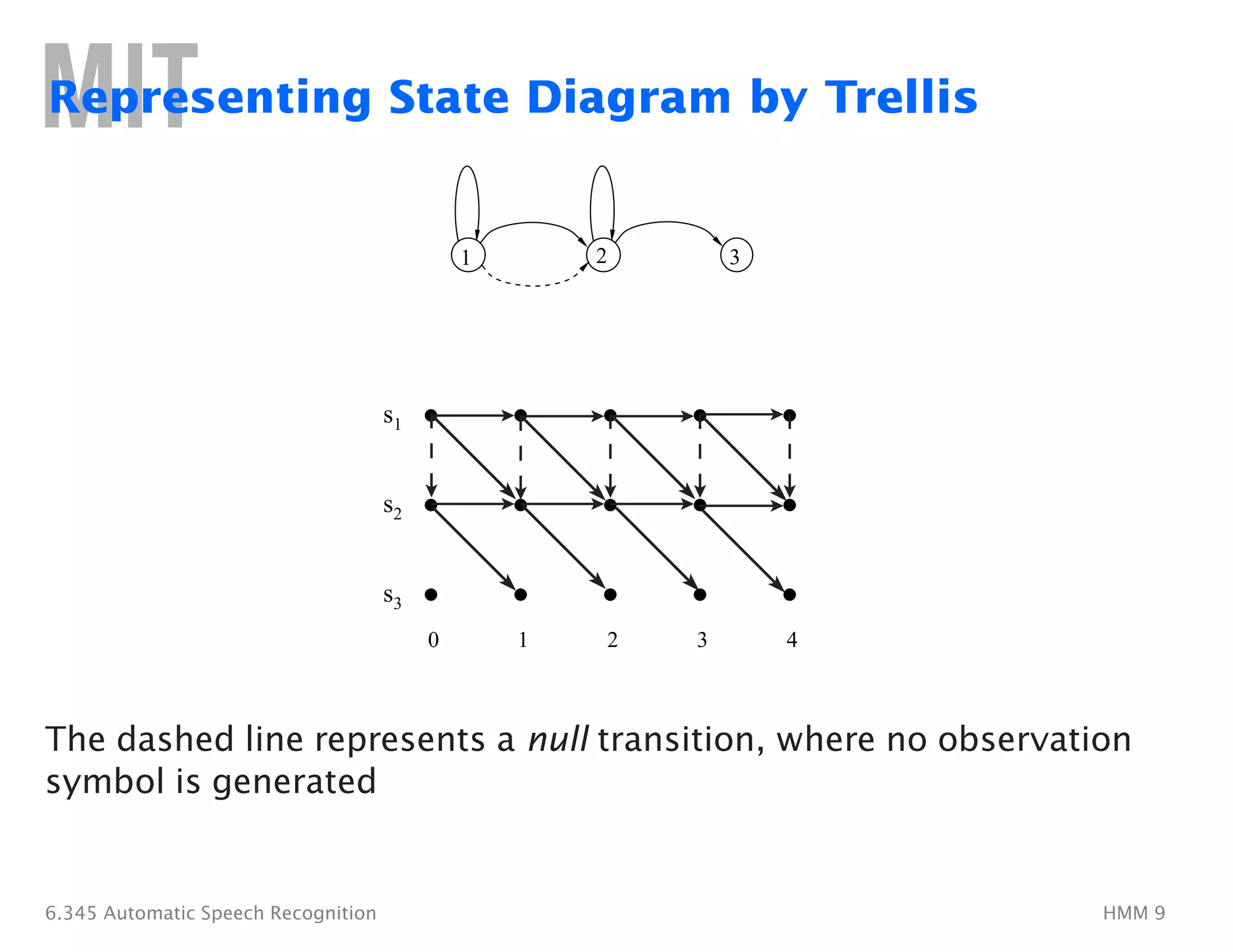
Representing State Diagram by Trellis
1 2 3
s1
s2
s3
0 1 2 3 4
The dashed line represents a null transition, where no observation
symbol is generated
6.345 Automatic Speech Recognition HMM 9
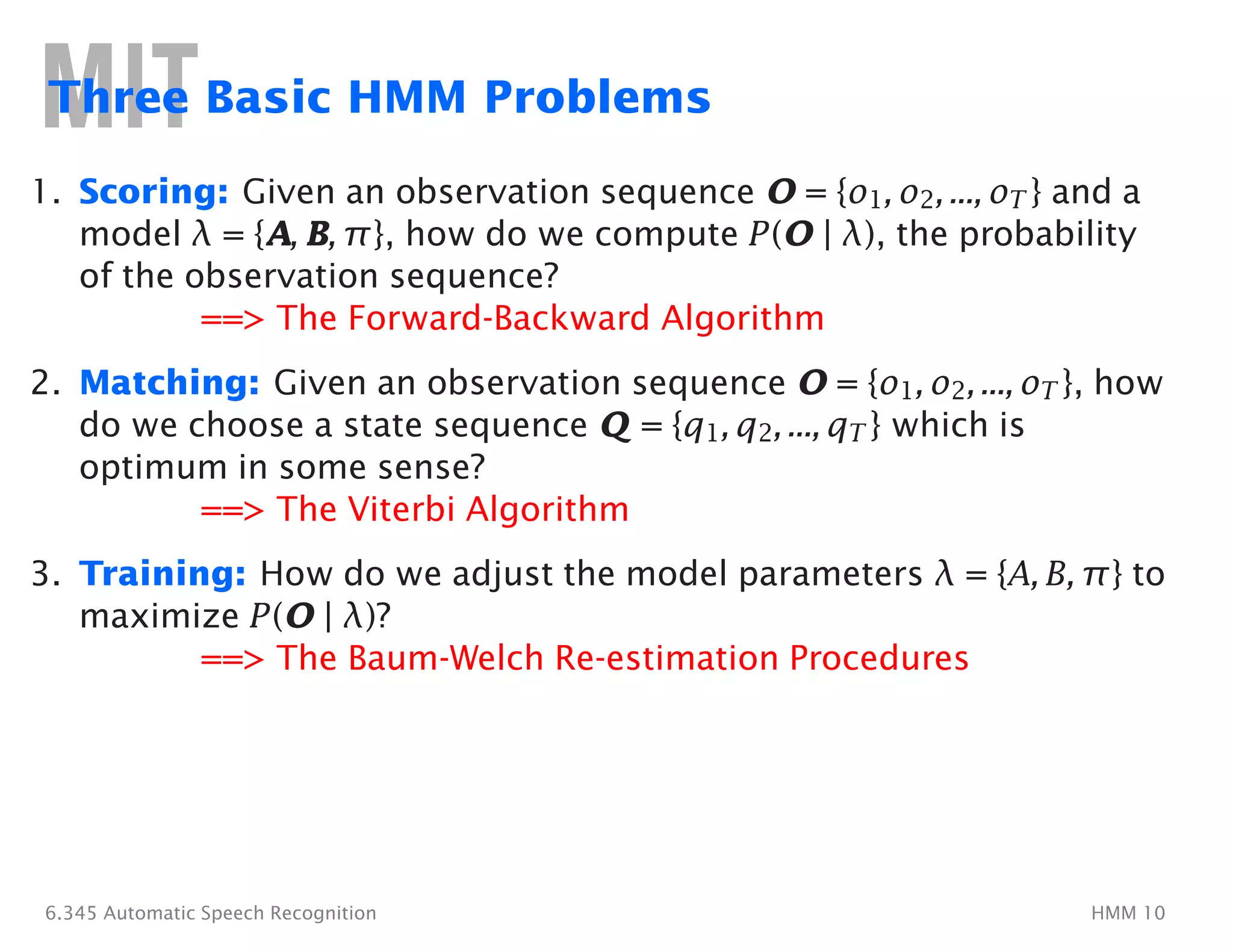
Three Basic HMM Problems
1.	 Scoring: Given an observation sequence O�= {o1, o2, ..., oT } and a
model λ = {A, B, π}, how do we compute P(O�| λ), the probability
of the observation sequence?
==> The Forward-Backward Algorithm
2.	 Matching: Given an observation sequence O�= {o1, o2, ..., oT }, how
do we choose a state sequence Q�= {q1, q2, ..., qT } which is
optimum in some sense?
==> The Viterbi Algorithm
3. Training: How do we adjust the model parameters λ = {A, B, π} to
maximize P(O�| λ)?
==> The Baum-Welch Re-estimation Procedures
6.345 Automatic Speech Recognition HMM 10
�
�
Computation of P(O|λ)
P(O|λ) = P(O, Q�
|λ)
allQ�
P(O, Q�
|λ) = P(O|Q�
, λ)P(Q�
|λ)

• Consider the fixed�state sequence: Q�= q1q2 . . . qT
P(O|Q�
, λ) = bq1 (o1)bq2 (o2) . . . bqT (oT )
P(Q�
|λ) = πq1 aq1q2 aq2q3 . . . aqT−1qT
Therefore:
P(O|λ) = 

q1,q2,...,qT

πq1 bq1 (o1)aq1q2 bq2 (o2) . . . aqT−1qT bqT (oT )

• Calculation required ≈ 2T · NT (there are NT such sequences)
For N = 5, T = 100 ⇒ 2 · 100 · 5100 ≈ 1072 computations!
6.345 Automatic Speech Recognition HMM 11
�
�
The Forward Algorithm
•	 Let us define the forward variable, αt(i), as the probability of the
partial observation sequence up to time t and�state si at time t,
given the model, i.e.
αt(i) = P(o1o2 . . . ot, qt = si|λ)
• It can easily be shown that:
α1(i) = πibi(o1), 1 ≤ i ≤ N
N
P(O|λ) = αT (i)
• By induction: i=1
N
1 ≤ t ≤ T − 1
αt+1 (j) = [ αt (i) aij]bj (ot+1),
1 ≤ j ≤ N
i=1
•	 Calculation is on the order of N2T.
For N = 5, T = 100 ⇒ 100 · 52 computations, instead of 1072
6.345 Automatic Speech Recognition HMM 12
Forward Algorithm Illustration
s1
si
sj
sN
1 t t+1 T
a1j
aNj
ajj
aij
αt(i)
αt+1(j)
6.345 Automatic Speech Recognition HMM 13
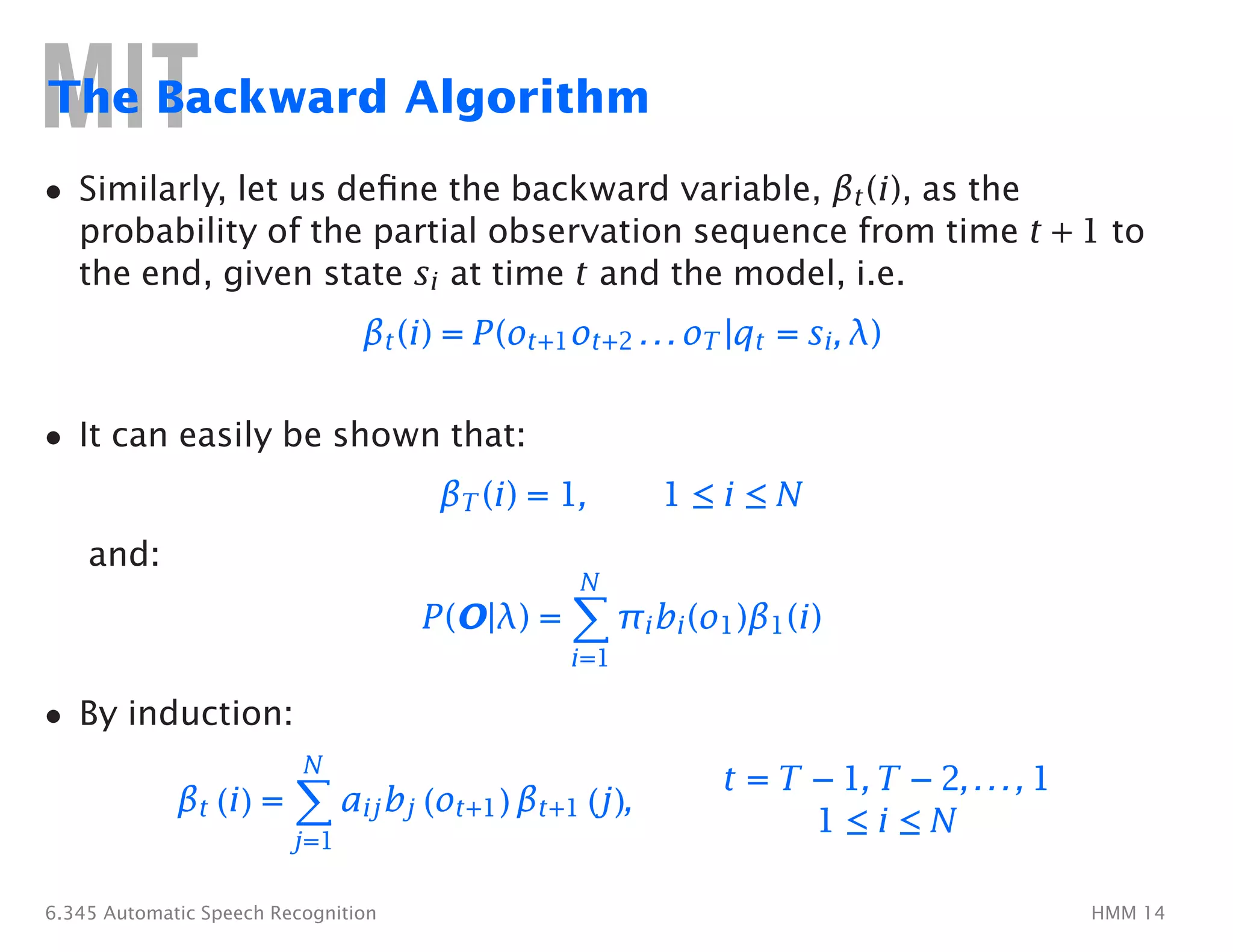
The Backward Algorithm
•	 Similarly, let us define the backward variable, βt(i), as the
probability of the partial observation sequence from time t + 1 to
the end, given state si at time t and the model, i.e.
βt(i) = P(ot+1ot+2 . . . oT |qt = si, λ)
• It can easily be shown that:
and:
• By induction:
N
�
βt (i) =
j=1
βT (i) = 1, 1 ≤ i ≤ N
N
�
P(O|λ) = πibi(o1)β1(i)
i=1
t = T − 1, T − 2, . . . , 1
aijbj (ot+1) βt+1 (j),
1 ≤ i ≤ N
6.345 Automatic Speech Recognition HMM 14
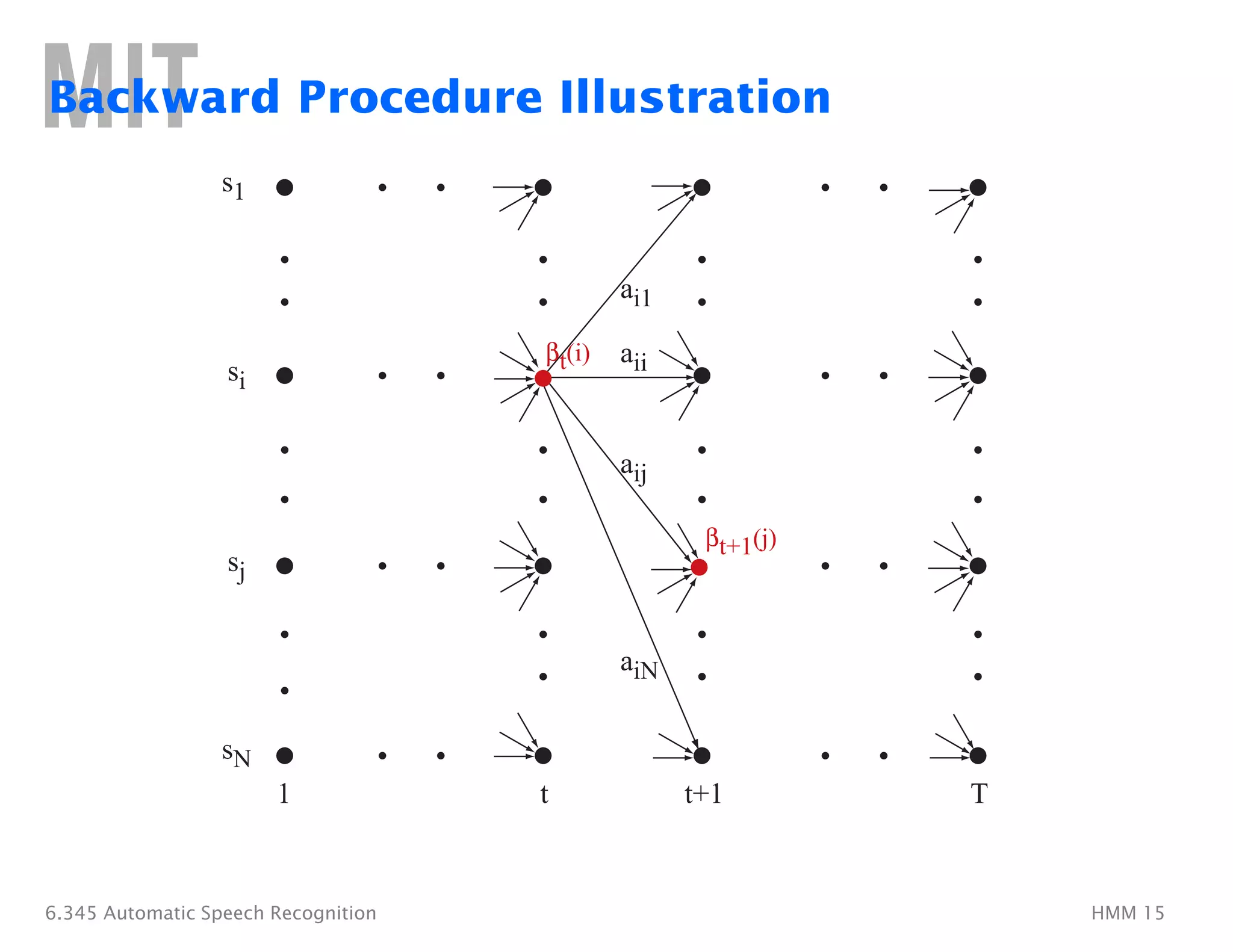
Backward Procedure Illustration
s1
si
sj
sN
1 t t+1 T
ai1
aiN
aij
aii
βt(i)
βt+1(j)
6.345 Automatic Speech Recognition HMM 15
N
�
Finding Optimal State Sequences
• One criterion chooses states, qt, which are individually most likely
– This maximizes the expected number of correct states
•	 Let us define γt(i)�as the probability of being in state si at time t,
given the observation sequence and the model, i.e.
γt(i) = �
P(qt =�si|O, λ)
i=1
γt(i) = 1, ∀t

•	 Then the individually most likely state, qt, at time t is:
qt =�argmax�γt(i) 1�≤ t ≤ T

1≤i≤N

• Note that it can be shown that:
γt(i) = �
αt(i)βt(i)�
P(O|λ)�
6.345 Automatic Speech Recognition HMM 16
i
Finding Optimal State Sequences
•	 The individual optimality criterion has the problem that the
optimum state sequence may not obey state transition constraints
•	 Another optimality criterion is to choose the state sequence which
maximizes P(Q, O|λ); This can be found by the Viterbi algorithm
•	 Let us define δt(i)�as the highest probability along a single path, at
time t, which accounts for the first t observations, i.e.
δt(i) = � max� P(q1q2�. . . qt−1, qt =�si, o1o2�. . . ot|λ)
q1,q2,...,qt−1�
• By induction: δt+1(j) = [max�δt(i)aij]bj(ot+1)�
•	 To retrieve the state sequence, we must keep track of the state
sequence which gave the best path, at time t, to state si
– We do this in a separate array ψt(i)�
6.345 Automatic Speech Recognition HMM 17
T
The Viterbi Algorithm
1. Initialization:
δ1(i) = �
πibi(o1), 1�≤ i ≤ N
ψ1(i) = 0�
2. Recursion:
δt(j) = �
max�
1≤i≤N
[δt−1(i)aij]bj(ot), 2�≤ t ≤ T 1�≤ j ≤ N
ψt(j)� =�argmax[δt−1(i)aij], 2�≤ t ≤ T 1�≤ j ≤ N
1≤i≤N
3. Termination:
P∗ = max�
1≤i≤N
[δT (i)]�
q∗
=�argmax[δT (i)]
1≤i≤N

4.	 Path (state-sequence) backtracking:
qt
∗
=�ψt+1(qt
∗
+1), t =�T − 1, T − 2, . . . , 1�
Computation ≈ N2T
6.345 Automatic Speech Recognition HMM 18
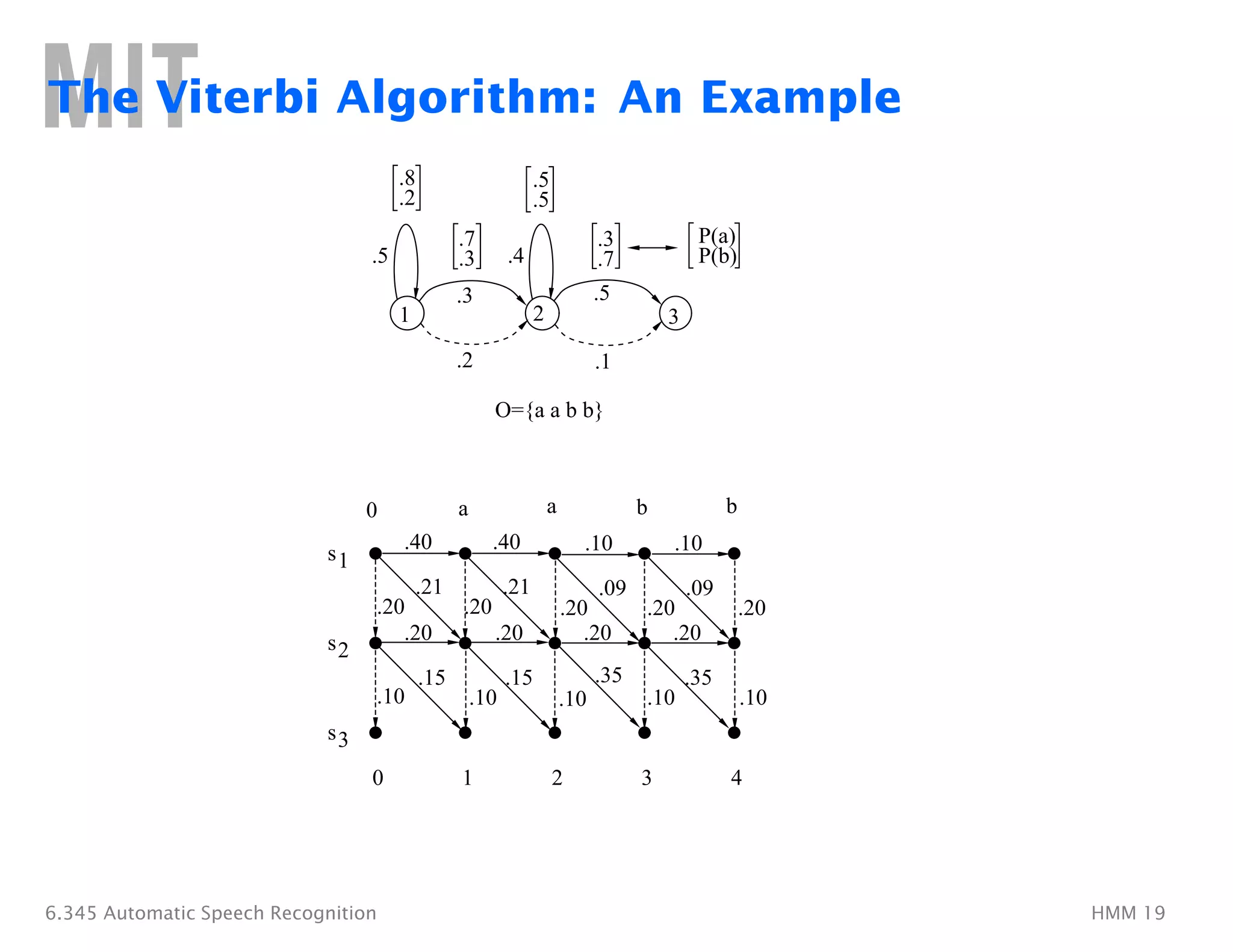
The Viterbi Algorithm: An Example
1
s1
s3
s2
4
3
2
0
0 b
b
a
a
1 2 3
.8
.2
.5
.5
.7
.3
.3
.7
P(a)
P(b)
.5 .4
.1
.5
.2
.3
O={a a b b}
.40
.09
.35
.35
.40
.15
.10
.10
.15
.21
.21
.20
.20
.20
.20
.20
.20
.20
.20
.20
.10
.10
.10
.10
.10
.09
6.345 Automatic Speech Recognition HMM 19
The Viterbi Algorithm: An Example (cont’d)
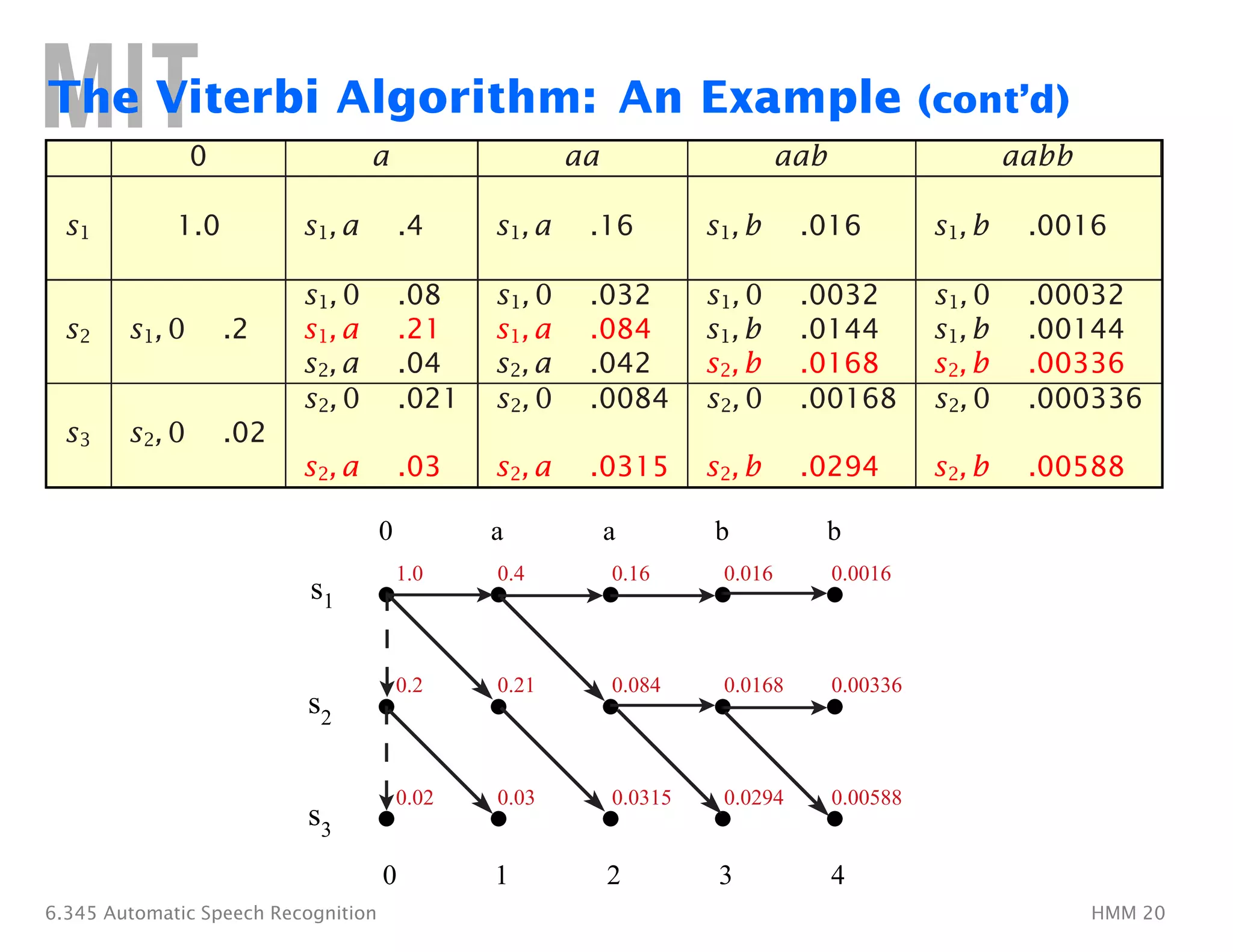
0 a aa aab aabb
s1 1.0 s1, a .4 s1, a .16 s1, b .016 s1, b .0016
s1, 0 .08 s1, 0 .032 s1, 0 .0032 s1, 0 .00032
s2 s1, 0 .2 s1, a .21 s1, a .084 s1, b .0144 s1, b .00144
s2, a .04 s2, a .042 s2, b .0168 s2, b .00336
s2, 0 .021 s2, 0 .0084 s2, 0 .00168 s2, 0 .000336
s3 s2, 0 .02
s2, a .03 s2, a .0315 s2, b .0294 s2, b .00588
0 a a b b
1.0 0.4 0.16 0.016 0.0016
s1
s2
s3
0 1 2 3 4
0.00588
0.0294
0.0315
0.03
0.02
0.00336
0.0168
0.084
0.21
0.2
6.345 Automatic Speech Recognition HMM 20
Matching Using Forward-Backward Algorithm
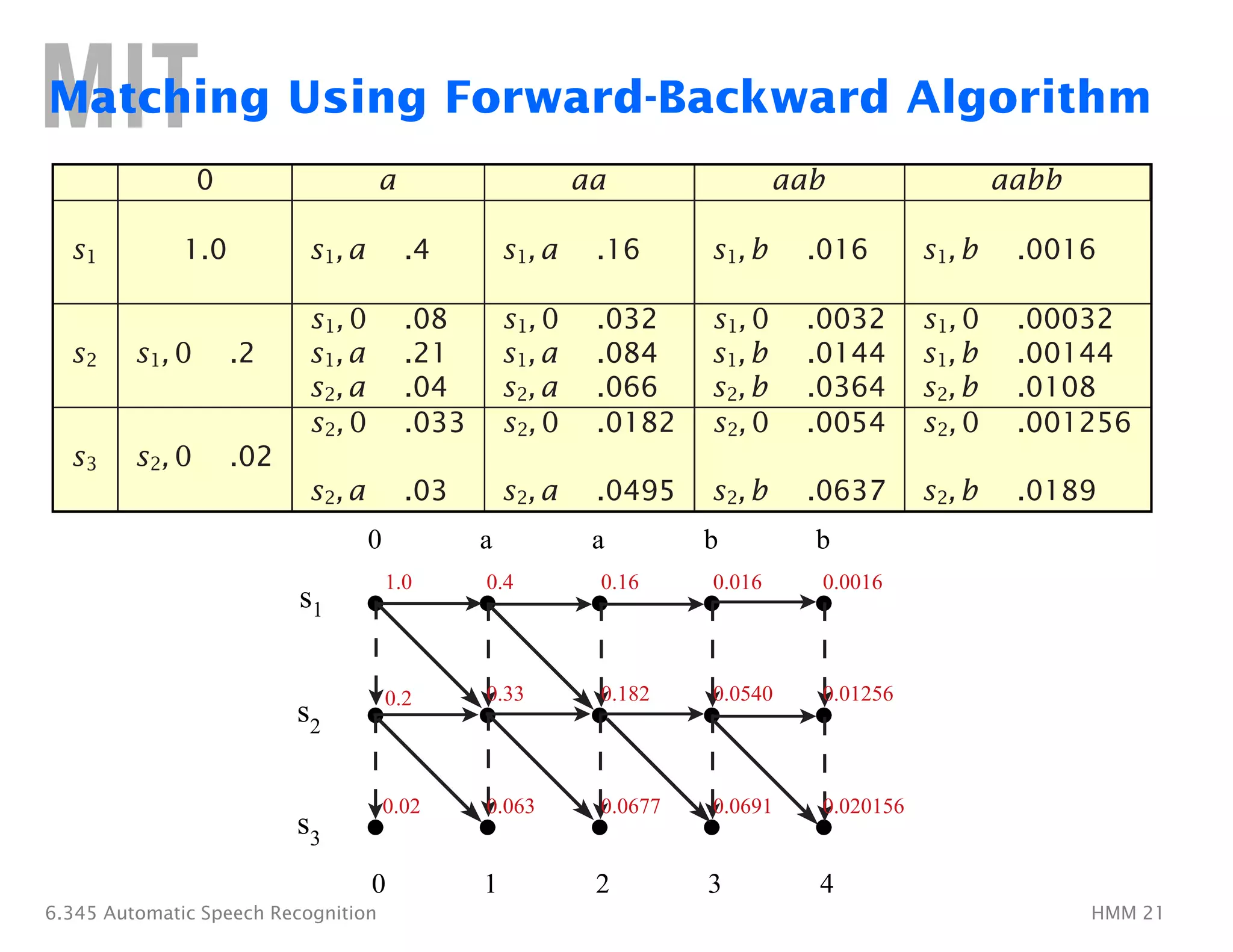
0 a aa aab aabb
s1 1.0 s1, a .4 s1, a .16 s1, b .016 s1, b .0016
s1, 0 .08 s1, 0 .032 s1, 0 .0032 s1, 0 .00032
s2 s1, 0 .2 s1, a .21 s1, a .084 s1, b .0144 s1, b .00144
s2, a .04 s2, a .066 s2, b .0364 s2, b .0108
s2, 0 .033 s2, 0 .0182 s2, 0 .0054 s2, 0 .001256
s3 s2, 0 .02
s2, a .03 s2, a .0495 s2, b .0637 s2, b .0189
s1
s2
s3
0 a a b b
1.0 0.4 0.16 0.016 0.0016
0.01256
0.0540
0.182
0.33
0.2
0.020156
0.0691
0.0677
0.063
0.02
0 1 2 3 4
6.345 Automatic Speech Recognition HMM 21
�
�
�
Baum-Welch Re-estimation
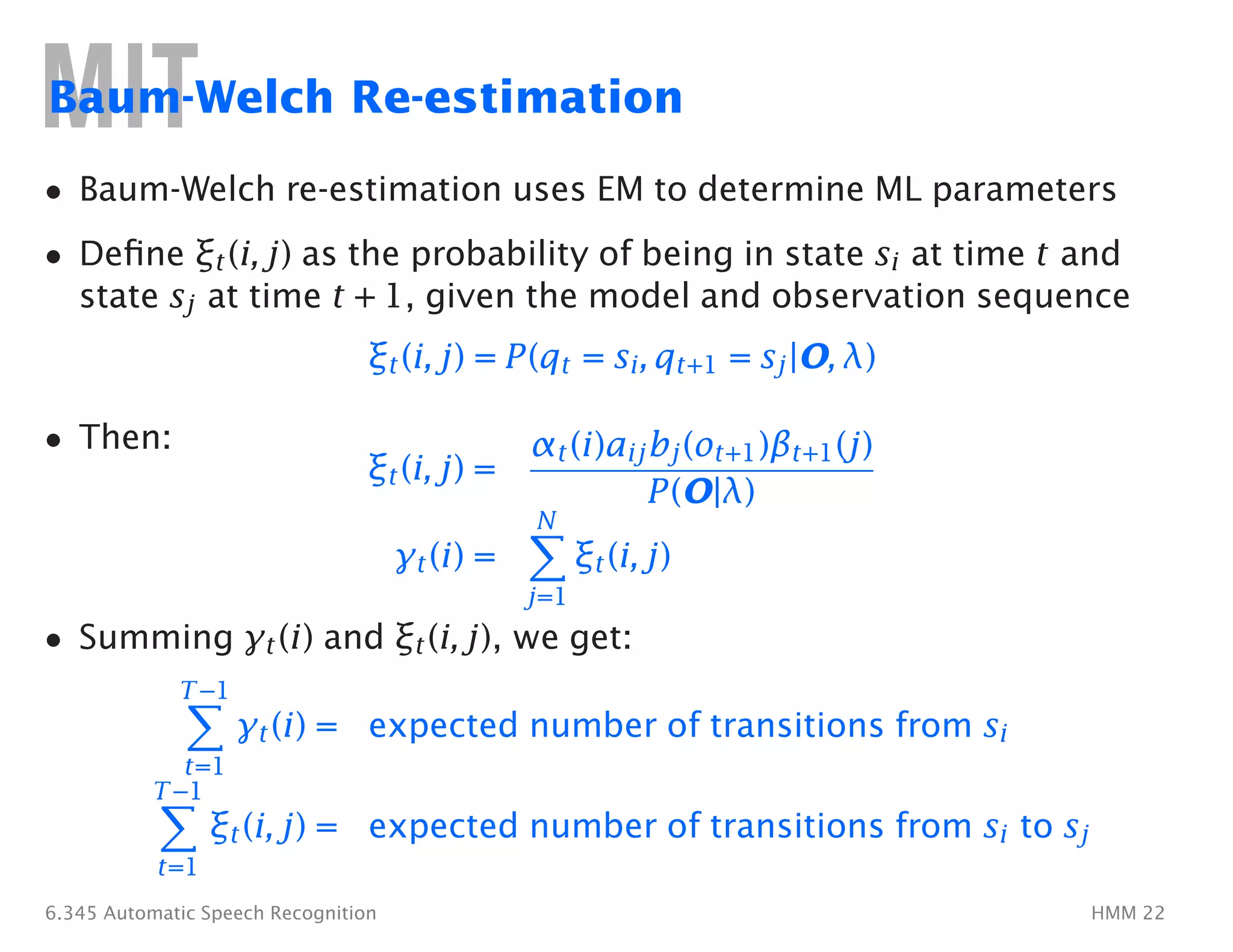
• Baum-Welch re-estimation uses EM to determine ML parameters
•	 Define ξt(i, j) as the probability of being in state si at time t and
state sj at time t + 1, given the model and observation sequence
ξt(i, j) = P(qt = si, qt+1 = sj|O, λ)
• Then:
ξt(i, j) =
αt(i)aijbj(ot+1)βt+1(j)
P(O|λ)
N
γt(i) = ξt(i, j)
j=1
• Summing γt(i) and ξt(i, j), we get:
T−1
γt(i) = expected number of transitions from si
t=1
T−1
ξt(i, j) = expected number of transitions from si to sj
t=1
6.345 Automatic Speech Recognition HMM 22
Baum-Welch Re-estimation Procedures
s1
si
sj
sN
1 t-1 t t+1 t+2 T
αt(i)
βt+1(j)
aij
6.345 Automatic Speech Recognition HMM 23
¯
¯
¯
�
�
T
�
T
�
Baum-Welch Re-estimation Formulas
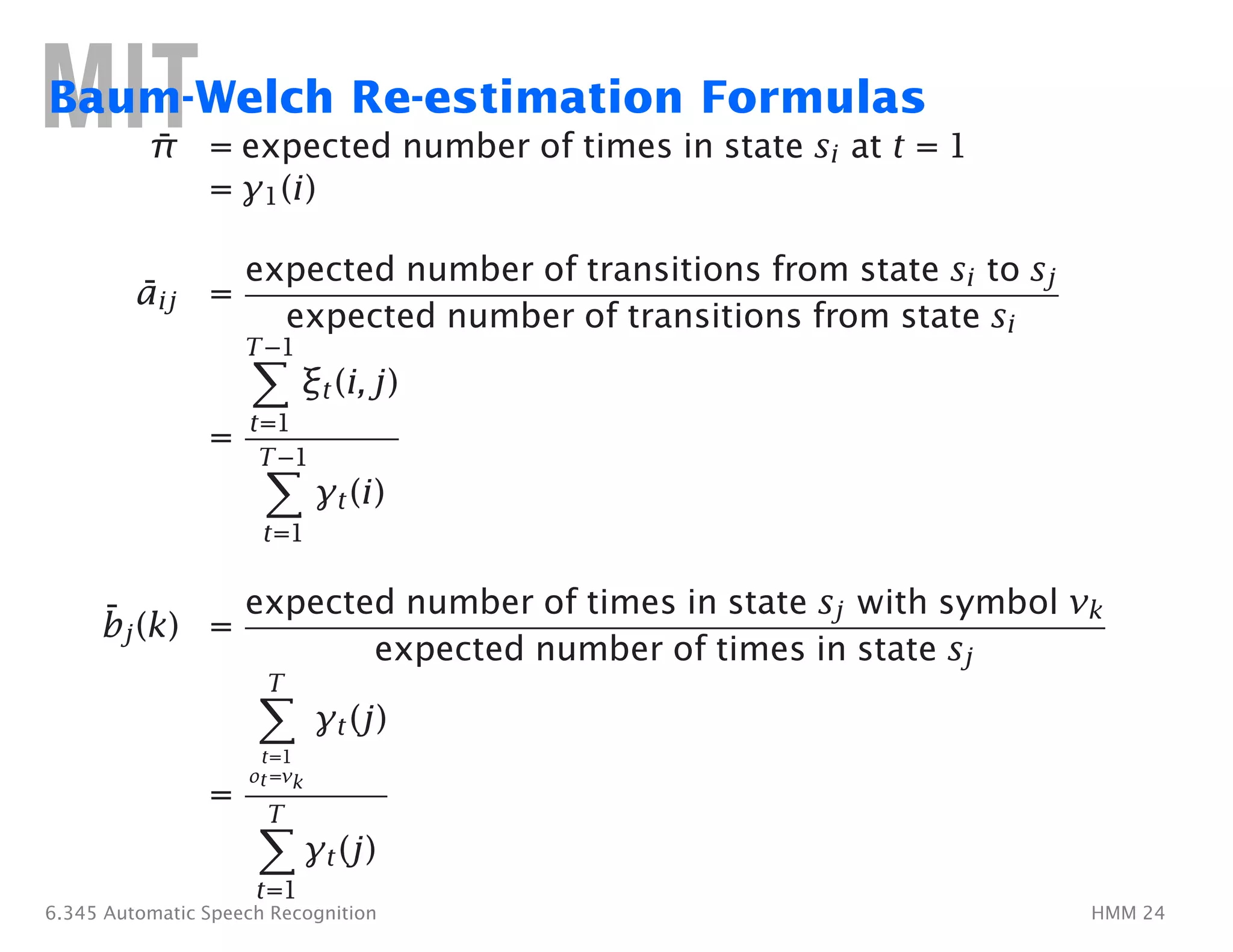
π =�expected number of times in state si at t = 1 �
=�γ1(i)�
aij =�
expected number of transitions from state si to sj
expected number of transitions from state si
T−1�
ξt(i, j)�
t=1
=�
T−1�
γt(i)�
t=1�
bj(k) = �
expected number of times in state sj with symbol vk
expected number of times in state sj
γt(j)�
t=1�
ot=vk
=�
γt(j)�
t=1�
6.345 Automatic Speech Recognition HMM 24
¯
¯
¯
¯
¯
Baum-Welch Re-estimation Formulas
A, ¯ π)�is the
•	 If λ = (A, B, π)�is the initial model, and λ = (¯ B, ¯
re-estimated model. Then it can be proved that either:
1.	 The initial model, λ, defines a critical point of the likelihood
function, in which case λ =�λ, or
2. Model λ is more likely than λ in the sense that P(O|λ̄)�> P(O|λ),
i.e., we have found a new model λ from which the observation
sequence is more likely to have been produced.
•	 Thus we can improve the probability of O being observed from
the model if we iteratively use λ in place of λ and repeat the
re-estimation until some limiting point is reached. The resulting
model is called the maximum likelihood HMM.
6.345 Automatic Speech Recognition HMM 25
K K
� �
Multiple Observation Sequences
•	 Speech recognition typically uses left-to-right HMMs. These HMMs
can not be trained using a single observation sequence, because
only a small number of observations are available to train each
state. To obtain reliable estimates of model parameters, one must
use multiple observation sequences. In this case, the
re-estimation procedure needs to be modified.
• Let us denote the set of K observation sequences as
O =�{O(1)
, O(2)
, . . . , O(K)
}
1 2� Tk
} is the k-th observation sequence.
where O(k) =�{o
(k)
, o
(k)
, . . . , o
(k)�
•	 Assume that the observations sequences are mutually
independent, we want to estimate the parameters so as to
maximize
P(O | λ) = � P(O(k)�
| λ) = � Pk
k=1� k=1�
6.345 Automatic Speech Recognition HMM 26
¯
¯
� �
� �
� �
� �
� �
� �
� Tk
�
Multiple Observation Sequences (cont’d)
•	 Since the re-estimation formulas are based on frequency of
occurrence of various events, we can modify them by adding up
the individual frequencies of occurrence for each sequence
K Tk−1� K
1�Tk−1�
ξt
k
(i, j)�
k=1�
Pk t=1�
αt
k
(i)aijbj(o
(k)�
t+1)βk
t+1(j)�
k=1�t=1�
=
aij =�
K Tk−1� K
1�Tk−1�
γt
k
(i)� αt
k
(i)βk
t (i)�
k=1�t=1� k=1�
Pk t=1�
K Tk K
1� �
γt
k
(j)�
k=1�
Pk t=1�
αt
k
(i)βk
t (i)�
k=1� t=1�
ot
(k)
=v� ot
(k)
=v�
bj(�) = �
K Tk
=�
K Tk
γt
k
(j)�
k=1�
Pk t=1�
1��
αt
k
(i)βk
t (i)�
k=1t=1�
6.345 Automatic Speech Recognition HMM 27
Phone-based HMMs
•	 Word-based HMMs are appropriate for small vocabulary speech
recognition. For large vocabulary ASR, sub-word-based (e.g.,
phone-based) models are more appropriate.
6.345 Automatic Speech Recognition HMM 28
Phone-based HMMs (cont’d)
•	 The phone models can have many states, and words are made up
from a concatenation of phone models.
6.345 Automatic Speech Recognition HMM 29
�
�
Continuous Density Hidden Markov Models
•	 A continuous density HMM replaces the discrete observation
probabilities, bj(k), by a continuous PDF bj(x)
• A common practice is to represent bj(x) as a mixture of Gaussians:
M
bj(x) = cjkN[x, µjk, Σjk] 1 ≤ j ≤ N
k=1
where cjk is the mixture weight
M
cjk ≥ 0 (1 ≤ j ≤ N, 1 ≤ k ≤ M, and cjk = 1, 1 ≤ j ≤ N),
k=1
N is the normal density, and

µjk and Σjk are the mean vector and covariance matrix

associated with state j and mixture k.

6.345 Automatic Speech Recognition HMM 30
Acoustic Modelling Variations
• Semi-continuous HMMs first compute a VQ codebook of size M
– The VQ codebook is then modelled as a family of Gaussian PDFs
–	 Each codeword is represented by a Gaussian PDF, and may be
used together with others to model the acoustic vectors
–	 From the CD-HMM viewpoint, this is equivalent to using the
same set of M mixtures to model all the states
– It is therefore often referred to as a Tied Mixture HMM
•	 All three methods have been used in many speech recognition
tasks, with varying outcomes
•	 For large-vocabulary, continuous speech recognition with
sufficient amount (i.e., tens of hours) of training data, CD-HMM
systems currently yield the best performance, but with
considerable increase in computation
6.345 Automatic Speech Recognition HMM 31
Implementation Issues
• Scaling: to prevent underflow
•	 Segmental K-means Training: to train observation probabilities by
first performing Viterbi alignment
• Initial estimates of λ: to provide robust models
• Pruning: to reduce search computation
6.345 Automatic Speech Recognition HMM 32
References
•	 X. Huang, A. Acero, and H. Hon, Spoken Language Processing,
Prentice-Hall, 2001.
•	 F. Jelinek, Statistical Methods for Speech Recognition. MIT Press,
1997.
•	 L. Rabiner and B. Juang, Fundamentals of Speech Recognition,
Prentice-Hall, 1993.
6.345 Automatic Speech Recognition HMM 33

continious hmm.pdf

  • 1.
    Hidden Markov Modelling •Introduction • Problem formulation • Forward-Backward algorithm • Viterbi search • Baum-Welch parameter estimation • Other considerations – Multiple observation sequences – Phone-based models for continuous speech recognition – Continuous density HMMs – Implementation issues 6.345 Automatic Speech Recognition HMM 1 Lecture # 10 Session 2003
  • 2.
    Information Theoretic Approachto ASR Speech Generation Text Generation Speech Recognition noisy communication channel Linguistic Decoder Speech ���������� Acoustic Processor A W Recognition is achieved by maximizing the probability of the linguistic string, W, given the acoustic evidence, A, i.e., choose the ˆ linguistic sequence W such that P(Ŵ|A) = m W ax P(W|A) 6.345 Automatic Speech Recognition HMM 2
  • 3.
    Information Theoretic Approachto ASR • From Bayes rule: P(W|A) = P(A|W)P(W) P(A) • Hidden Markov modelling (HMM) deals with the quantity P(A|W) • Change in notation: A → O W → λ P(A|W) → P(O|λ) 6.345 Automatic Speech Recognition HMM 3
  • 4.
    HMM: An Example 2 2 2 1 1 1 1 2 2 1 2 0 2 2 2 1 1 1 1 2 2 1 2 1 2 2 2 1 1 1 1 2 2 1 2 2 12 1 2 • Consider 3 mugs, each with mixtures of state stones, 1 and 2 • The fractions for the ith mug are ai1 and ai2, and ai1 + ai2 = 1 • Consider 2 urns, each with mixtures of black and white balls • The fractions for the ith urn are bi(B) and bi(W); bi(B) + bi(W) = 1 • The parameter vector for this model is: λ = {a01, a02, a11, a12, a21, a22, b1(B), b1(W), b2(B), b2(W)} 6.345 Automatic Speech Recognition HMM 4
  • 5.
    HMM: An Example(cont’d) 2 2 2 1 1 1 1 2 2 1 2 0 2 2 2 1 1 1 1 2 2 1 2 1 2 2 2 1 1 1 1 2 2 1 2 1 2 1 1 1 1 1 2 2 1 Observation Sequence: O = {B, W, B, W, W, B} State Sequence: Q = {1, 1, 2, 1, 2, 1} Goal: Given the model λ and the observation sequence O, how can the underlying state sequence Q be determined? 6.345 Automatic Speech Recognition HMM 5 2 2 2 1 1 1 1 2 2 1 2 2 2 2 2 1 1 1 1 2 2 1 2 1 1 2 2 2 2 1 1 1 1 2 2 1 2 2 1
  • 6.
    Elements of aDiscrete Hidden Markov Model • N: number of states in the model – states, s = {s1, s2, . . . , sN} – state at time t, qt ∈ s • M: number of observation symbols (i.e., discrete observations) – observation symbols, v = {v1, v2, . . . , vM} – observation at time t, ot ∈ v • A = {aij}: state transition probability distribution – aij = P(qt+1 = sj|qt = si), 1 ≤ i, j ≤ N • B = {bj(k)}: observation symbol probability distribution in state j – bj(k) = P(vk at t|qt = sj), 1 ≤ j ≤ N, 1 ≤ k ≤ M • π = {πi}: initial state distribution – πi = P(q1 = si), 1 ≤ i ≤ N Notationally, an HMM is typically written as: λ = {A, B, π} 6.345 Automatic Speech Recognition HMM 6
  • 7.
    � � �� HMM: An Example (cont’d) For our simple example: π = {a01, a02}, A = a11 a12 , and B = b1(B) b1(W) a21 a22 b2(B) b2(W) State Diagram 2-state 3-state 1 2 a11 a12 a22 1 3 2 a21 {b1(B), b1(W)} {b2(B), b2(W)} 6.345 Automatic Speech Recognition HMM 7
  • 8.
    Generation of HMMObservations 1. Choose an initial state, q1 = si, based on the initial state distribution, π 2. For t = 1 to T: • Choose ot = vk according to the symbol probability distribution in state si, bi(k) • Transition to a new state qt+1 = sj according to the state transition probability distribution for state si, aij 3. Increment t by 1, return to step 2 if t ≤ T; else, terminate a0i aij q1 q2 . . . . . bi(k) o1 o2 qT oT 6.345 Automatic Speech Recognition HMM 8
  • 9.
    Representing State Diagramby Trellis 1 2 3 s1 s2 s3 0 1 2 3 4 The dashed line represents a null transition, where no observation symbol is generated 6.345 Automatic Speech Recognition HMM 9
  • 10.
    Three Basic HMMProblems 1. Scoring: Given an observation sequence O�= {o1, o2, ..., oT } and a model λ = {A, B, π}, how do we compute P(O�| λ), the probability of the observation sequence? ==> The Forward-Backward Algorithm 2. Matching: Given an observation sequence O�= {o1, o2, ..., oT }, how do we choose a state sequence Q�= {q1, q2, ..., qT } which is optimum in some sense? ==> The Viterbi Algorithm 3. Training: How do we adjust the model parameters λ = {A, B, π} to maximize P(O�| λ)? ==> The Baum-Welch Re-estimation Procedures 6.345 Automatic Speech Recognition HMM 10
  • 11.
    � � Computation of P(O|λ) P(O|λ)= P(O, Q� |λ) allQ� P(O, Q� |λ) = P(O|Q� , λ)P(Q� |λ) • Consider the fixed�state sequence: Q�= q1q2 . . . qT P(O|Q� , λ) = bq1 (o1)bq2 (o2) . . . bqT (oT ) P(Q� |λ) = πq1 aq1q2 aq2q3 . . . aqT−1qT Therefore: P(O|λ) = q1,q2,...,qT πq1 bq1 (o1)aq1q2 bq2 (o2) . . . aqT−1qT bqT (oT ) • Calculation required ≈ 2T · NT (there are NT such sequences) For N = 5, T = 100 ⇒ 2 · 100 · 5100 ≈ 1072 computations! 6.345 Automatic Speech Recognition HMM 11
  • 12.
    � � The Forward Algorithm • Let us define the forward variable, αt(i), as the probability of the partial observation sequence up to time t and�state si at time t, given the model, i.e. αt(i) = P(o1o2 . . . ot, qt = si|λ) • It can easily be shown that: α1(i) = πibi(o1), 1 ≤ i ≤ N N P(O|λ) = αT (i) • By induction: i=1 N 1 ≤ t ≤ T − 1 αt+1 (j) = [ αt (i) aij]bj (ot+1), 1 ≤ j ≤ N i=1 • Calculation is on the order of N2T. For N = 5, T = 100 ⇒ 100 · 52 computations, instead of 1072 6.345 Automatic Speech Recognition HMM 12
  • 13.
    Forward Algorithm Illustration s1 si sj sN 1t t+1 T a1j aNj ajj aij αt(i) αt+1(j) 6.345 Automatic Speech Recognition HMM 13
  • 14.
    The Backward Algorithm • Similarly, let us define the backward variable, βt(i), as the probability of the partial observation sequence from time t + 1 to the end, given state si at time t and the model, i.e. βt(i) = P(ot+1ot+2 . . . oT |qt = si, λ) • It can easily be shown that: and: • By induction: N � βt (i) = j=1 βT (i) = 1, 1 ≤ i ≤ N N � P(O|λ) = πibi(o1)β1(i) i=1 t = T − 1, T − 2, . . . , 1 aijbj (ot+1) βt+1 (j), 1 ≤ i ≤ N 6.345 Automatic Speech Recognition HMM 14
  • 15.
    Backward Procedure Illustration s1 si sj sN 1t t+1 T ai1 aiN aij aii βt(i) βt+1(j) 6.345 Automatic Speech Recognition HMM 15
  • 16.
    N � Finding Optimal StateSequences • One criterion chooses states, qt, which are individually most likely – This maximizes the expected number of correct states • Let us define γt(i)�as the probability of being in state si at time t, given the observation sequence and the model, i.e. γt(i) = � P(qt =�si|O, λ) i=1 γt(i) = 1, ∀t • Then the individually most likely state, qt, at time t is: qt =�argmax�γt(i) 1�≤ t ≤ T 1≤i≤N • Note that it can be shown that: γt(i) = � αt(i)βt(i)� P(O|λ)� 6.345 Automatic Speech Recognition HMM 16
  • 17.
    i Finding Optimal StateSequences • The individual optimality criterion has the problem that the optimum state sequence may not obey state transition constraints • Another optimality criterion is to choose the state sequence which maximizes P(Q, O|λ); This can be found by the Viterbi algorithm • Let us define δt(i)�as the highest probability along a single path, at time t, which accounts for the first t observations, i.e. δt(i) = � max� P(q1q2�. . . qt−1, qt =�si, o1o2�. . . ot|λ) q1,q2,...,qt−1� • By induction: δt+1(j) = [max�δt(i)aij]bj(ot+1)� • To retrieve the state sequence, we must keep track of the state sequence which gave the best path, at time t, to state si – We do this in a separate array ψt(i)� 6.345 Automatic Speech Recognition HMM 17
  • 18.
    T The Viterbi Algorithm 1.Initialization: δ1(i) = � πibi(o1), 1�≤ i ≤ N ψ1(i) = 0� 2. Recursion: δt(j) = � max� 1≤i≤N [δt−1(i)aij]bj(ot), 2�≤ t ≤ T 1�≤ j ≤ N ψt(j)� =�argmax[δt−1(i)aij], 2�≤ t ≤ T 1�≤ j ≤ N 1≤i≤N 3. Termination: P∗ = max� 1≤i≤N [δT (i)]� q∗ =�argmax[δT (i)] 1≤i≤N 4. Path (state-sequence) backtracking: qt ∗ =�ψt+1(qt ∗ +1), t =�T − 1, T − 2, . . . , 1� Computation ≈ N2T 6.345 Automatic Speech Recognition HMM 18
  • 19.
    The Viterbi Algorithm:An Example 1 s1 s3 s2 4 3 2 0 0 b b a a 1 2 3 .8 .2 .5 .5 .7 .3 .3 .7 P(a) P(b) .5 .4 .1 .5 .2 .3 O={a a b b} .40 .09 .35 .35 .40 .15 .10 .10 .15 .21 .21 .20 .20 .20 .20 .20 .20 .20 .20 .20 .10 .10 .10 .10 .10 .09 6.345 Automatic Speech Recognition HMM 19
  • 20.
    The Viterbi Algorithm:An Example (cont’d) 0 a aa aab aabb s1 1.0 s1, a .4 s1, a .16 s1, b .016 s1, b .0016 s1, 0 .08 s1, 0 .032 s1, 0 .0032 s1, 0 .00032 s2 s1, 0 .2 s1, a .21 s1, a .084 s1, b .0144 s1, b .00144 s2, a .04 s2, a .042 s2, b .0168 s2, b .00336 s2, 0 .021 s2, 0 .0084 s2, 0 .00168 s2, 0 .000336 s3 s2, 0 .02 s2, a .03 s2, a .0315 s2, b .0294 s2, b .00588 0 a a b b 1.0 0.4 0.16 0.016 0.0016 s1 s2 s3 0 1 2 3 4 0.00588 0.0294 0.0315 0.03 0.02 0.00336 0.0168 0.084 0.21 0.2 6.345 Automatic Speech Recognition HMM 20
  • 21.
    Matching Using Forward-BackwardAlgorithm 0 a aa aab aabb s1 1.0 s1, a .4 s1, a .16 s1, b .016 s1, b .0016 s1, 0 .08 s1, 0 .032 s1, 0 .0032 s1, 0 .00032 s2 s1, 0 .2 s1, a .21 s1, a .084 s1, b .0144 s1, b .00144 s2, a .04 s2, a .066 s2, b .0364 s2, b .0108 s2, 0 .033 s2, 0 .0182 s2, 0 .0054 s2, 0 .001256 s3 s2, 0 .02 s2, a .03 s2, a .0495 s2, b .0637 s2, b .0189 s1 s2 s3 0 a a b b 1.0 0.4 0.16 0.016 0.0016 0.01256 0.0540 0.182 0.33 0.2 0.020156 0.0691 0.0677 0.063 0.02 0 1 2 3 4 6.345 Automatic Speech Recognition HMM 21
  • 22.
    � � � Baum-Welch Re-estimation • Baum-Welchre-estimation uses EM to determine ML parameters • Define ξt(i, j) as the probability of being in state si at time t and state sj at time t + 1, given the model and observation sequence ξt(i, j) = P(qt = si, qt+1 = sj|O, λ) • Then: ξt(i, j) = αt(i)aijbj(ot+1)βt+1(j) P(O|λ) N γt(i) = ξt(i, j) j=1 • Summing γt(i) and ξt(i, j), we get: T−1 γt(i) = expected number of transitions from si t=1 T−1 ξt(i, j) = expected number of transitions from si to sj t=1 6.345 Automatic Speech Recognition HMM 22
  • 23.
    Baum-Welch Re-estimation Procedures s1 si sj sN 1t-1 t t+1 t+2 T αt(i) βt+1(j) aij 6.345 Automatic Speech Recognition HMM 23
  • 24.
    ¯ ¯ ¯ � � T � T � Baum-Welch Re-estimation Formulas π=�expected number of times in state si at t = 1 � =�γ1(i)� aij =� expected number of transitions from state si to sj expected number of transitions from state si T−1� ξt(i, j)� t=1 =� T−1� γt(i)� t=1� bj(k) = � expected number of times in state sj with symbol vk expected number of times in state sj γt(j)� t=1� ot=vk =� γt(j)� t=1� 6.345 Automatic Speech Recognition HMM 24
  • 25.
    ¯ ¯ ¯ ¯ ¯ Baum-Welch Re-estimation Formulas A,¯ π)�is the • If λ = (A, B, π)�is the initial model, and λ = (¯ B, ¯ re-estimated model. Then it can be proved that either: 1. The initial model, λ, defines a critical point of the likelihood function, in which case λ =�λ, or 2. Model λ is more likely than λ in the sense that P(O|λ̄)�> P(O|λ), i.e., we have found a new model λ from which the observation sequence is more likely to have been produced. • Thus we can improve the probability of O being observed from the model if we iteratively use λ in place of λ and repeat the re-estimation until some limiting point is reached. The resulting model is called the maximum likelihood HMM. 6.345 Automatic Speech Recognition HMM 25
  • 26.
    K K � � MultipleObservation Sequences • Speech recognition typically uses left-to-right HMMs. These HMMs can not be trained using a single observation sequence, because only a small number of observations are available to train each state. To obtain reliable estimates of model parameters, one must use multiple observation sequences. In this case, the re-estimation procedure needs to be modified. • Let us denote the set of K observation sequences as O =�{O(1) , O(2) , . . . , O(K) } 1 2� Tk } is the k-th observation sequence. where O(k) =�{o (k) , o (k) , . . . , o (k)� • Assume that the observations sequences are mutually independent, we want to estimate the parameters so as to maximize P(O | λ) = � P(O(k)� | λ) = � Pk k=1� k=1� 6.345 Automatic Speech Recognition HMM 26
  • 27.
    ¯ ¯ � � � � �� � � � � � � � Tk � Multiple Observation Sequences (cont’d) • Since the re-estimation formulas are based on frequency of occurrence of various events, we can modify them by adding up the individual frequencies of occurrence for each sequence K Tk−1� K 1�Tk−1� ξt k (i, j)� k=1� Pk t=1� αt k (i)aijbj(o (k)� t+1)βk t+1(j)� k=1�t=1� = aij =� K Tk−1� K 1�Tk−1� γt k (i)� αt k (i)βk t (i)� k=1�t=1� k=1� Pk t=1� K Tk K 1� � γt k (j)� k=1� Pk t=1� αt k (i)βk t (i)� k=1� t=1� ot (k) =v� ot (k) =v� bj(�) = � K Tk =� K Tk γt k (j)� k=1� Pk t=1� 1�� αt k (i)βk t (i)� k=1t=1� 6.345 Automatic Speech Recognition HMM 27
  • 28.
    Phone-based HMMs • Word-basedHMMs are appropriate for small vocabulary speech recognition. For large vocabulary ASR, sub-word-based (e.g., phone-based) models are more appropriate. 6.345 Automatic Speech Recognition HMM 28
  • 29.
    Phone-based HMMs (cont’d) • The phone models can have many states, and words are made up from a concatenation of phone models. 6.345 Automatic Speech Recognition HMM 29
  • 30.
    � � Continuous Density HiddenMarkov Models • A continuous density HMM replaces the discrete observation probabilities, bj(k), by a continuous PDF bj(x) • A common practice is to represent bj(x) as a mixture of Gaussians: M bj(x) = cjkN[x, µjk, Σjk] 1 ≤ j ≤ N k=1 where cjk is the mixture weight M cjk ≥ 0 (1 ≤ j ≤ N, 1 ≤ k ≤ M, and cjk = 1, 1 ≤ j ≤ N), k=1 N is the normal density, and µjk and Σjk are the mean vector and covariance matrix associated with state j and mixture k. 6.345 Automatic Speech Recognition HMM 30
  • 31.
    Acoustic Modelling Variations •Semi-continuous HMMs first compute a VQ codebook of size M – The VQ codebook is then modelled as a family of Gaussian PDFs – Each codeword is represented by a Gaussian PDF, and may be used together with others to model the acoustic vectors – From the CD-HMM viewpoint, this is equivalent to using the same set of M mixtures to model all the states – It is therefore often referred to as a Tied Mixture HMM • All three methods have been used in many speech recognition tasks, with varying outcomes • For large-vocabulary, continuous speech recognition with sufficient amount (i.e., tens of hours) of training data, CD-HMM systems currently yield the best performance, but with considerable increase in computation 6.345 Automatic Speech Recognition HMM 31
  • 32.
    Implementation Issues • Scaling:to prevent underflow • Segmental K-means Training: to train observation probabilities by first performing Viterbi alignment • Initial estimates of λ: to provide robust models • Pruning: to reduce search computation 6.345 Automatic Speech Recognition HMM 32
  • 33.
    References • X. Huang,A. Acero, and H. Hon, Spoken Language Processing, Prentice-Hall, 2001. • F. Jelinek, Statistical Methods for Speech Recognition. MIT Press, 1997. • L. Rabiner and B. Juang, Fundamentals of Speech Recognition, Prentice-Hall, 1993. 6.345 Automatic Speech Recognition HMM 33