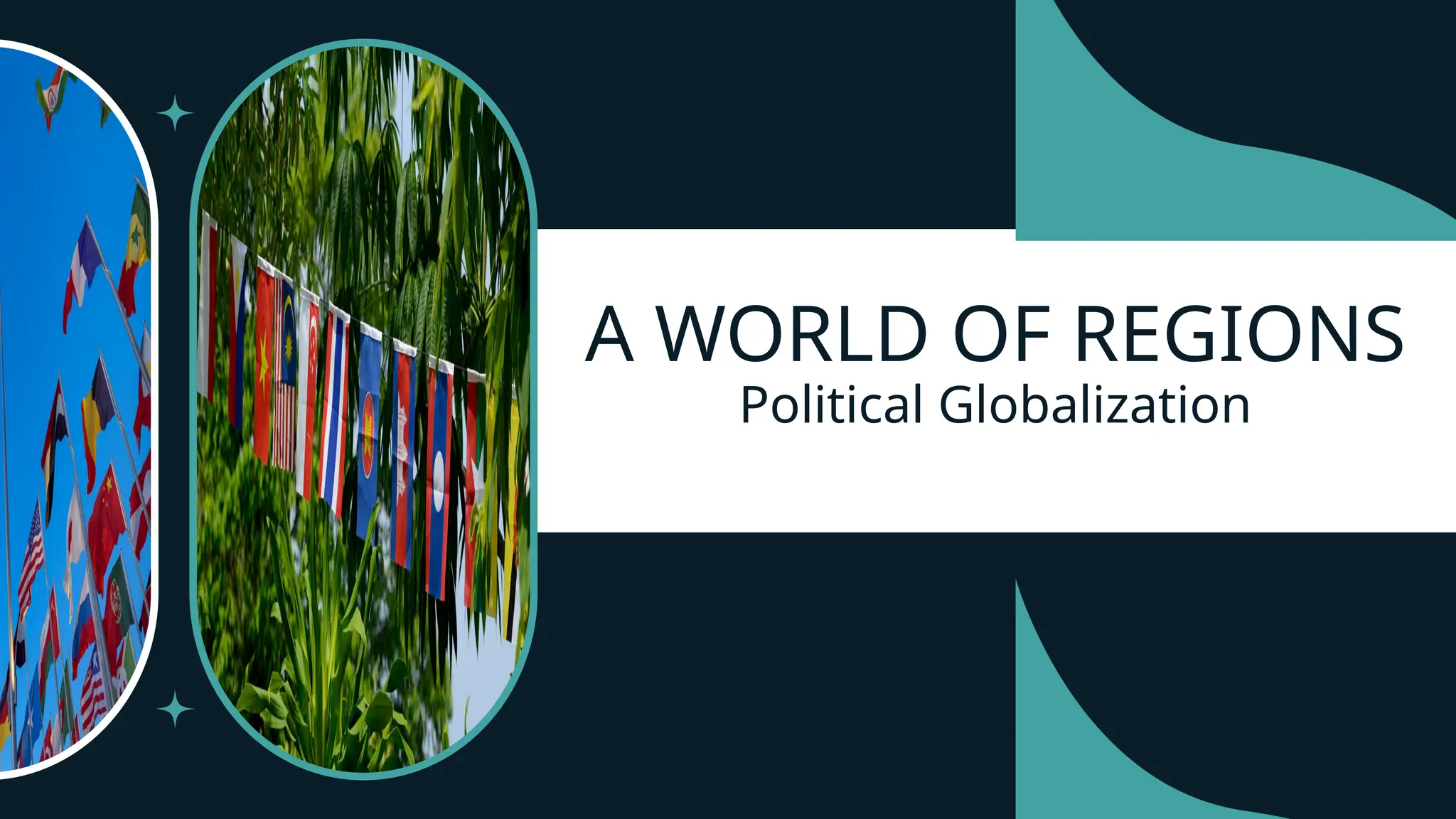
A WORLD OF REGIONS
Political Globalization
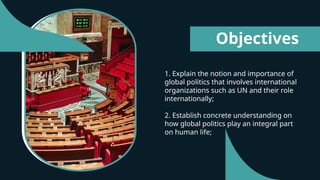
1. Explain the notion and importance of
global politics that involves international
organizations such as UN and their role
internationally;
2. Establish concrete understanding on
how global politics play an integral part
on human life;
Objectives
Starting Point
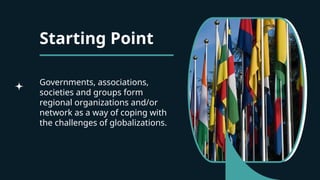
Governments, associations,
societies and groups form
regional organizations and/or
network as a way of coping with
the challenges of globalizations.
Starting Terms
State is defined as a community of persons
more or less numerous, permanently
occupying a definite portion of territory ,
having a government of their own to which
the great body of inhabitants render
obedience, and enjoying freedom from
external control.
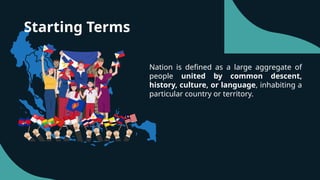
Nation is defined as a large aggregate of
people united by common descent, history,
culture, or language, inhabiting a particular
country or territory.
Starting Terms
State is defined as a community of
persons more or less numerous,
permanently occupying a definite portion
of territory, having a government of their
own to which the great body of inhabitants
render obedience, and enjoying freedom
from external control.
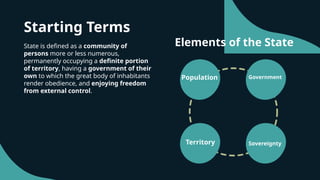
Elements of the State
Population Government
Territory Sovereignty
Starting Terms
Nation is defined as a large aggregate of
people united by common descent,
history, culture, or language, inhabiting a
particular country or territory.
Political Globalization
Refers to an increasing trend toward
multilateralism in an emerging
transnational state apparatus and the
emergence of national and international
non-governmental organizations that act
as watchdogs over governments.
How did it happened?
Treaty of
Westphalia
French
Revolution
Concert
of Europe
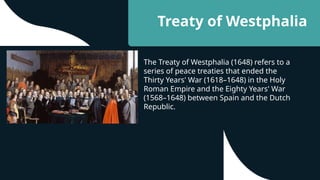
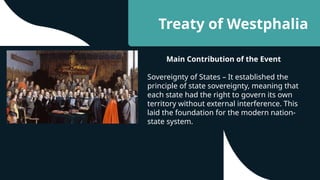
Treaty of Westphalia
The Treaty of Westphalia (1648) refers to a
series of peace treaties that ended the
Thirty Years' War (1618–1648) in the Holy
Roman Empire and the Eighty Years' War
(1568–1648) between Spain and the Dutch
Republic.
Treaty of Westphalia
Main Contribution of the Event
Sovereignty of States – It established the
principle of state sovereignty, meaning that
each state had the right to govern its own
territory without external interference. This
laid the foundation for the modern nation-
state system.
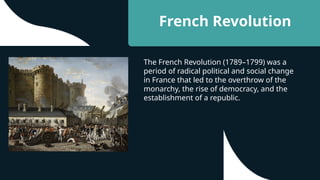
French Revolution
The French Revolution (1789–1799) was a
period of radical political and social change
in France that led to the overthrow of the
monarchy, the rise of democracy, and the
establishment of a republic.
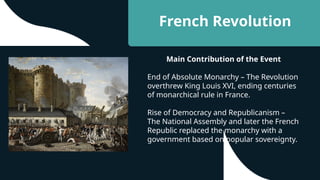
French Revolution
Main Contribution of the Event
End of Absolute Monarchy – The Revolution
overthrew King Louis XVI, ending centuries
of monarchical rule in France.
Rise of Democracy and Republicanism –
The National Assembly and later the French
Republic replaced the monarchy with a
government based on popular sovereignty.
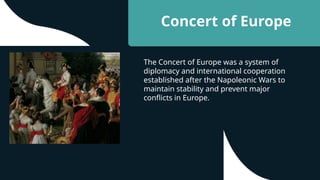
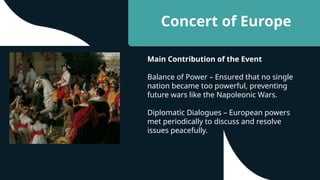
Concert of Europe
The Concert of Europe was a system of
diplomacy and international cooperation
established after the Napoleonic Wars to
maintain stability and prevent major
conflicts in Europe.
Concert of Europe
Main Contribution of the Event
Balance of Power – Ensured that no single
nation became too powerful, preventing
future wars like the Napoleonic Wars.
Diplomatic Dialogues – European powers
met periodically to discuss and resolve
issues peacefully.
Rise of Regionalism and
International Organizations
Regionalism
Political process characterized by economic policy cooperation and
coordination among countries.
ASEAN Regionalism
The process of political, economic, and socio-cultural integration among
the ten member states of the Association of Southeast Asian Nations
(ASEAN). It is a form of regional cooperation that promotes unity,
stability, and shared development in Southeast Asia.
Regionalism
Political process characterized by economic policy cooperation and
coordination among countries.
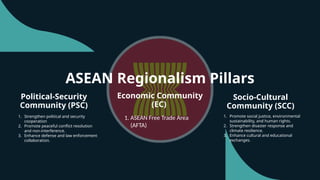
ASEAN Regionalism Pillars
Political-Security
Community (PSC)
Economic Community
(EC)
Socio-Cultural
Community (SCC)
1. Strengthen political and security
cooperation
2. Promote peaceful conflict resolution
and non-interference.
3. Enhance defense and law enforcement
collaboration.
1. ASEAN Free Trade Area
(AFTA)
1. Promote social justice, environmental
sustainability, and human rights.
2. Strengthen disaster response and
climate resilience.
3. Enhance cultural and educational
exchanges.
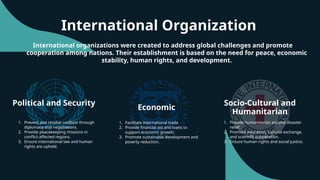
International Organization
Political and Security
Economic
Socio-Cultural and
Humanitarian
International organizations were created to address global challenges and promote
cooperation among nations. Their establishment is based on the need for peace, economic
stability, human rights, and development.
1. Prevent and resolve conflicts through
diplomacy and negotiations.
2. Provide peacekeeping missions in
conflict-affected regions.
3. Ensure international law and human
rights are upheld.
1. Facilitate international trade
2. Provide financial aid and loans to
support economic growth.
3. Promote sustainable development and
poverty reduction.
1. Provide humanitarian aid and disaster
relief.
2. Promote education, cultural exchange,
and scientific cooperation.
3. Ensure human rights and social justice.

Contemporary World General Education Topic 2

  • 1.
    A WORLD OFREGIONS Political Globalization
  • 2.
    1. Explain thenotion and importance of global politics that involves international organizations such as UN and their role internationally; 2. Establish concrete understanding on how global politics play an integral part on human life; Objectives
  • 3.
    Starting Point Governments, associations, societiesand groups form regional organizations and/or network as a way of coping with the challenges of globalizations.
  • 4.
    Starting Terms State isdefined as a community of persons more or less numerous, permanently occupying a definite portion of territory , having a government of their own to which the great body of inhabitants render obedience, and enjoying freedom from external control. Nation is defined as a large aggregate of people united by common descent, history, culture, or language, inhabiting a particular country or territory.
  • 5.
    Starting Terms State isdefined as a community of persons more or less numerous, permanently occupying a definite portion of territory, having a government of their own to which the great body of inhabitants render obedience, and enjoying freedom from external control. Elements of the State Population Government Territory Sovereignty
  • 6.
    Starting Terms Nation isdefined as a large aggregate of people united by common descent, history, culture, or language, inhabiting a particular country or territory.
  • 7.
    Political Globalization Refers toan increasing trend toward multilateralism in an emerging transnational state apparatus and the emergence of national and international non-governmental organizations that act as watchdogs over governments.
  • 8.
    How did ithappened? Treaty of Westphalia French Revolution Concert of Europe
  • 9.
    Treaty of Westphalia TheTreaty of Westphalia (1648) refers to a series of peace treaties that ended the Thirty Years' War (1618–1648) in the Holy Roman Empire and the Eighty Years' War (1568–1648) between Spain and the Dutch Republic.
  • 10.
    Treaty of Westphalia MainContribution of the Event Sovereignty of States – It established the principle of state sovereignty, meaning that each state had the right to govern its own territory without external interference. This laid the foundation for the modern nation- state system.
  • 11.
    French Revolution The FrenchRevolution (1789–1799) was a period of radical political and social change in France that led to the overthrow of the monarchy, the rise of democracy, and the establishment of a republic.
  • 12.
    French Revolution Main Contributionof the Event End of Absolute Monarchy – The Revolution overthrew King Louis XVI, ending centuries of monarchical rule in France. Rise of Democracy and Republicanism – The National Assembly and later the French Republic replaced the monarchy with a government based on popular sovereignty.
  • 13.
    Concert of Europe TheConcert of Europe was a system of diplomacy and international cooperation established after the Napoleonic Wars to maintain stability and prevent major conflicts in Europe.
  • 14.
    Concert of Europe MainContribution of the Event Balance of Power – Ensured that no single nation became too powerful, preventing future wars like the Napoleonic Wars. Diplomatic Dialogues – European powers met periodically to discuss and resolve issues peacefully.
  • 15.
    Rise of Regionalismand International Organizations
  • 16.
    Regionalism Political process characterizedby economic policy cooperation and coordination among countries.
  • 17.
    ASEAN Regionalism The processof political, economic, and socio-cultural integration among the ten member states of the Association of Southeast Asian Nations (ASEAN). It is a form of regional cooperation that promotes unity, stability, and shared development in Southeast Asia.
  • 18.
    Regionalism Political process characterizedby economic policy cooperation and coordination among countries.
  • 19.
    ASEAN Regionalism Pillars Political-Security Community(PSC) Economic Community (EC) Socio-Cultural Community (SCC) 1. Strengthen political and security cooperation 2. Promote peaceful conflict resolution and non-interference. 3. Enhance defense and law enforcement collaboration. 1. ASEAN Free Trade Area (AFTA) 1. Promote social justice, environmental sustainability, and human rights. 2. Strengthen disaster response and climate resilience. 3. Enhance cultural and educational exchanges.
  • 20.
    International Organization Political andSecurity Economic Socio-Cultural and Humanitarian International organizations were created to address global challenges and promote cooperation among nations. Their establishment is based on the need for peace, economic stability, human rights, and development. 1. Prevent and resolve conflicts through diplomacy and negotiations. 2. Provide peacekeeping missions in conflict-affected regions. 3. Ensure international law and human rights are upheld. 1. Facilitate international trade 2. Provide financial aid and loans to support economic growth. 3. Promote sustainable development and poverty reduction. 1. Provide humanitarian aid and disaster relief. 2. Promote education, cultural exchange, and scientific cooperation. 3. Ensure human rights and social justice.