BY
DR. SAMUEL ESSAM
CONTEMPORARY MANAGEMENT
The Second Lecture
FOR
MBA Candidates
Class /
1 FF/1MR
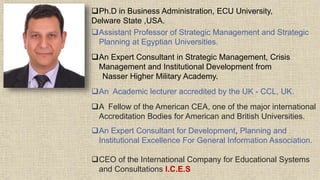
Ph.D in Business Administration, ECU University,
Delware State ,USA.
Assistant Professor of Strategic Management and Strategic
Planning at Egyptian Universities.
An Expert Consultant in Strategic Management, Crisis
Management and Institutional Development from
Nasser Higher Military Academy.
An Academic lecturer accredited by the UK - CCL, UK.
A Fellow of the American CEA, one of the major international
Accreditation Bodies for American and British Universities.
An Expert Consultant for Development, Planning and
Institutional Excellence For General Information Association.
CEO of the International Company for Educational Systems
and Consultations I.C.E.S
Types of Contemporary Management
 Contemporary Management skills also include overseeing
individuals achieve organizational goals and objectives,
maintaining power, ensuring discipline and ensuring that the
strategy aligns with the company’s long-term goals.
System Management
 System Management offers an elective way to deal
with contemporary management and planning of the
organization. The system Management recommends
that organizations, similar to the human body, comprise
different segments that work together to build a more
extensive framework that can work ideally.
According to this theory, a company’s success
relies upon few key components: collaboration,
relationships, and interrelations among different
subsists.
Contingency Theory
 The Contingency Management Theory’s fundamental idea is
that there is no one management solution for a specific
organization.
 There are a few internal and external factors that will
eventually Influence the approach chosen by the management.
The contingency theory recognizes three factors that
will probably impact an association’s design: the
size, innovation being utilized, and initiative
style.
The qualities of a leader in an organization can be
used as a distinguishing factor to help in
contemporary management.
 As indicated by Contemporary Theory, there are
many administration qualities convenient for each sort
of circumstance.
 It implies that a leader should be adequately
adaptable to adjust to the evolving climate.
 WHAT DO WE MEAN BY “SMALL BUSINESS” AND
“MANAGERIAL SKILLS”?
 A small business is defined as an independent
profit- orientated business unit that is personally
managed by the owners and has a small
influence or market share in the business world.
 ALSO, The small business is normally the natural
habitat of entrepreneurs. The small business
provides the ideal environment for entrepreneurs
to test their talents.
 Managerial skills are specific abilities that result from
knowledge, experience, information, practice, and
aptitude .
 In addition, Managerial skills can be improved through
training programs and practical experience.
 Improving Managerial Skills
1. Technical skills
A manager must be able to use whatever business technology
and tools are needed to do the job. If you rely on a platform
like Slack for communication within your organization, it’s no
good if your new manager doesn’t have a clue how to use it.
This is especially true for more specialized software and tools,
and technical skills are also needed for specific managerial
roles, such as those in marketing, design, finance, IT, product,
and sales.
 Improving Managerial Skills
2. Conceptual skills
This one calls for the ability to use abstract thinking,
but also means being able to see the business or
organization as a whole, and know exactly where
everything fits into it. Skills like these enable a
manager to evaluate, plan, and strategize, and are
particularly valuable in top managerial positions.
 Improving Managerial Skills
3. Interpersonal / human relations skills
This skill is so important, but sometimes overlooked. You’ll no doubt
have heard the saying that people don’t leave bad jobs, they leave
bad bosses. So many managers have achieved great things in their
previous roles that it’s easy to overlook qualities like being able to
work with and relate to colleagues and employees.
Good interpersonal skills in a manager go a long way to creating a
happy working environment, and can even reduce the number of
employees leaving a company. This creates harmony and saves the
business money.
To contact
Dr.Samuel
f
012 - 2491 8685
https://www.facebook.com/profile.php?id=1000021
34500831
https://www.facebook.com/DrSamuelEssamofficial/
https://www.facebook.com/ICESEdu/
LinkedIn
https://www.linkedin.com/in/dr-samuel-essam-4b771931/
Subscribe YouTube channel
https://www.youtube.com/channel/UCHt2h1Ulf1wd3NmS8v
kI8_A
Instagram
https://instagram.com/drsamuelessam?igshid=rno5vc8mkyvl
samuelamanoeeil4@gmail.com
info.icesacademy@gmail.com

Contemporary Management lecture 002.pptx

  • 1.
    BY DR. SAMUEL ESSAM CONTEMPORARYMANAGEMENT The Second Lecture FOR MBA Candidates Class / 1 FF/1MR
  • 2.
    Ph.D in BusinessAdministration, ECU University, Delware State ,USA. Assistant Professor of Strategic Management and Strategic Planning at Egyptian Universities. An Expert Consultant in Strategic Management, Crisis Management and Institutional Development from Nasser Higher Military Academy. An Academic lecturer accredited by the UK - CCL, UK. A Fellow of the American CEA, one of the major international Accreditation Bodies for American and British Universities. An Expert Consultant for Development, Planning and Institutional Excellence For General Information Association. CEO of the International Company for Educational Systems and Consultations I.C.E.S
  • 3.
    Types of ContemporaryManagement  Contemporary Management skills also include overseeing individuals achieve organizational goals and objectives, maintaining power, ensuring discipline and ensuring that the strategy aligns with the company’s long-term goals.
  • 4.
    System Management  SystemManagement offers an elective way to deal with contemporary management and planning of the organization. The system Management recommends that organizations, similar to the human body, comprise different segments that work together to build a more extensive framework that can work ideally.
  • 5.
    According to thistheory, a company’s success relies upon few key components: collaboration, relationships, and interrelations among different subsists.
  • 6.
    Contingency Theory  TheContingency Management Theory’s fundamental idea is that there is no one management solution for a specific organization.  There are a few internal and external factors that will eventually Influence the approach chosen by the management.
  • 7.
    The contingency theoryrecognizes three factors that will probably impact an association’s design: the size, innovation being utilized, and initiative style. The qualities of a leader in an organization can be used as a distinguishing factor to help in contemporary management.
  • 8.
     As indicatedby Contemporary Theory, there are many administration qualities convenient for each sort of circumstance.  It implies that a leader should be adequately adaptable to adjust to the evolving climate.
  • 9.
     WHAT DOWE MEAN BY “SMALL BUSINESS” AND “MANAGERIAL SKILLS”?  A small business is defined as an independent profit- orientated business unit that is personally managed by the owners and has a small influence or market share in the business world.  ALSO, The small business is normally the natural habitat of entrepreneurs. The small business provides the ideal environment for entrepreneurs to test their talents.
  • 10.
     Managerial skillsare specific abilities that result from knowledge, experience, information, practice, and aptitude .  In addition, Managerial skills can be improved through training programs and practical experience.
  • 11.
     Improving ManagerialSkills 1. Technical skills A manager must be able to use whatever business technology and tools are needed to do the job. If you rely on a platform like Slack for communication within your organization, it’s no good if your new manager doesn’t have a clue how to use it. This is especially true for more specialized software and tools, and technical skills are also needed for specific managerial roles, such as those in marketing, design, finance, IT, product, and sales.
  • 12.
     Improving ManagerialSkills 2. Conceptual skills This one calls for the ability to use abstract thinking, but also means being able to see the business or organization as a whole, and know exactly where everything fits into it. Skills like these enable a manager to evaluate, plan, and strategize, and are particularly valuable in top managerial positions.
  • 13.
     Improving ManagerialSkills 3. Interpersonal / human relations skills This skill is so important, but sometimes overlooked. You’ll no doubt have heard the saying that people don’t leave bad jobs, they leave bad bosses. So many managers have achieved great things in their previous roles that it’s easy to overlook qualities like being able to work with and relate to colleagues and employees. Good interpersonal skills in a manager go a long way to creating a happy working environment, and can even reduce the number of employees leaving a company. This creates harmony and saves the business money.
  • 14.
    To contact Dr.Samuel f 012 -2491 8685 https://www.facebook.com/profile.php?id=1000021 34500831 https://www.facebook.com/DrSamuelEssamofficial/ https://www.facebook.com/ICESEdu/ LinkedIn https://www.linkedin.com/in/dr-samuel-essam-4b771931/ Subscribe YouTube channel https://www.youtube.com/channel/UCHt2h1Ulf1wd3NmS8v kI8_A Instagram https://instagram.com/drsamuelessam?igshid=rno5vc8mkyvl samuelamanoeeil4@gmail.com info.icesacademy@gmail.com