
Consumer-driven contracts
Avoid microservices integration hell!
@PierreVincent
Oct 11th, 2016
Pierre Vincent
Technical Team Lead at Newsweaver
techblog.newsweaver.com
@PierreVincent
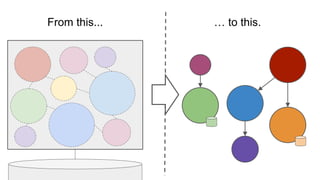
From this... … to this.
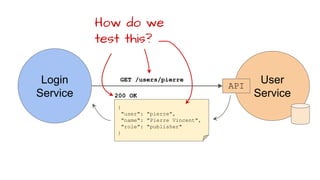
Login
Service
User
Service
API
GET /users/pierre
{
"user": "pierre",
"name": "Pierre Vincent",
"role": "publisher"
}
200 OK
How do we
test this?
Running in Prod
Tests Pass in
Build
Implement
changes
Deployed in
Prod
User
Service
Login
Service
!
✓ ✓ ✓ ✓
✓
{
...
"role": "editor"
}
{
...
"roles": ["publisher","editor"]
}
Running in Prod
✓ ✓
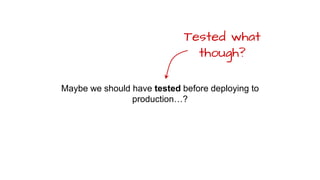
Maybe we should have tested before deploying to
production…?
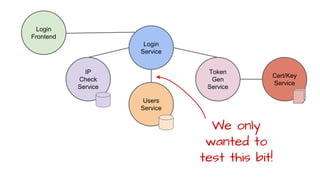
Tested what
though?
Users
Service
Login
Service
IP
Check
Service
Token
Gen
Service
Cert/Key
Service
Login
Frontend
We only
wanted to
test this bit!
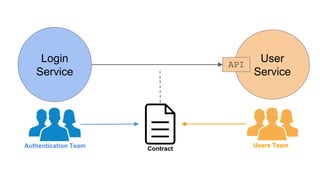
Contract
Login
Service
User
Service
API
Authentication Team Users Team
[docs.pact.io]
PACT Specification
Verification philosophy: Tolerant Reader
Implementation guidelines
Implementations
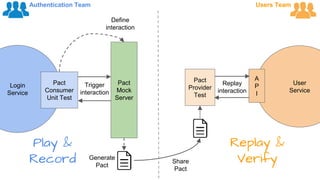
Login
Service
User
Service
A
P
I
Pact
Mock
Server
Authentication Team Users Team
Pact
Consumer
Unit Test
Define
interaction
Trigger
interaction
Generate
Pact
Pact
Provider
Test
Share
Pact
Replay
interaction
Replay &
Verify
Play &
Record
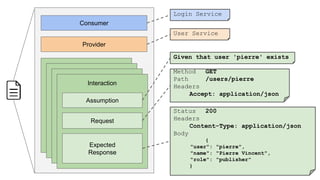
Consumer
Provider
Assumption
Request
Expected
Response
Login Service
User Service
Given that user 'pierre' exists
Method GET
Path /users/pierre
Headers
Accept: application/json
Status 200
Headers
Content-Type: application/json
Body
{
"user": "pierre",
"name": "Pierre Vincent",
"role": "publisher"
}
Interaction
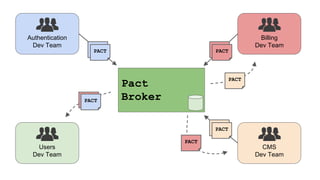
Authentication
Dev Team
Users
Dev Team
CMS
Dev Team
Billing
Dev Team
Pact
Broker
PACT
PACT
PACT
PACT
PACT
PACT
PACTPACT
PACT
PACT
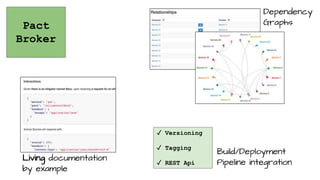
Pact
Broker
Dependency
Graphs
Living documentation
by example
✓ Versioning
✓ Tagging
✓ REST Api
Build/Deployment
Pipeline integration
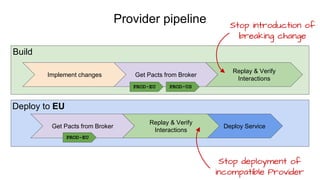
Provider pipeline
Implement changes Get Pacts from Broker
Replay & Verify
Interactions
Deploy Service
Build
Deploy to EU
PROD-EU
Get Pacts from Broker
Replay & Verify
Interactions
Stop deployment of
incompatible Provider
Stop introduction of
breaking change
PROD-US
PROD-EU
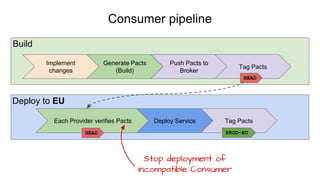
Consumer pipeline
Implement
changes
Generate Pacts
(Build)
Push Pacts to
Broker
Tag Pacts
Each Provider verifies Pacts Deploy Service Tag Pacts
Build
Deploy to EU
HEAD
Stop deployment of
incompatible Consumer
HEAD
PROD-EU
Caution: side-effects may include teams
collaborating on API design
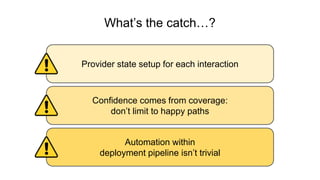
Provider state setup for each interaction
Confidence comes from coverage:
don’t limit to happy paths
Automation within
deployment pipeline isn’t trivial
What’s the catch…?
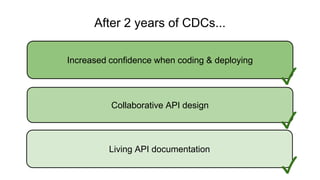
After 2 years of CDCs...
Increased confidence when coding & deploying
✓
Collaborative API design
✓
Living API documentation
✓
Pact docs.pact.io, github.com/pact-foundation
Pact Broker github.com/bethesque/pact_broker
Try it out!
“Pact Matrix” (Beth Skurrie) rea.tech/enter-the-pact-matrix-or-how-to-decouple-the-release-
cycles-of-your-microservices
Why should you use CDC for microservices integration tests
techblog.newsweaver.com/why-should-you-use-consumer-driven-contracts-for-microservices-
integration-tests
Sharing CDCs with Pact Broker
techblog.newsweaver.com/sharing-consumer-driven-contracts-with-pact-broker
More reading...
techblog.newsweaver.com
Questions?
@PierreVincent

Consumer-driven contracts: avoid microservices integration hell! (LondonCD - Oct 2016)

Editor's Notes

  • #3 Been working for >8 years in Newsweaver SaaS company, Internal Comms platform for large enterprises improve and unify communication across channels by giving them tools to manage their content and measuring engagement across channels Worked 6 years on large J2EE app Could be qualified as Monolithic app Still going great, making for 90% of the company’s income 2 years ago, moved to a new team New product, greenfield, analytics based Focus on Continuous Delivery Microservices emerged as our architecture of choice Now all of our new work is on microservices / splitting the monolith
  • #4 Rarely start from scratch - even if we do, we’ve usually been working on this system (left) - large, with components (if lucky), on one single DB etc - typically called monolith Then moving to microservices, look like this (right) - boundaries are clearer, concepts more clearly separate What’s missing is the interactions - in monolith, implicit, compile time, hard to break - in micro, more central, less validation (almost none!), easy to break if not careful
  • #5 Different dev cycles Different teams Different languages Different dependencies
  • #6 Breaking example of API backward compatibility: Provider tests are all passing in build Provider deploys new version Some services then start throwing errors, even though they have not changed Why? Interactions got broken How do we test the interactions
  • #7 What are we testing? Can we login? Are we breaking an interaction? Who should test that? At what stage? Testing is there to stop us from doing something stupid We want to know as early as possible if we’re doing something stupid
  • #8 The problem with end to end testing Why was this wrong? - team responsible for users need to concern themselves more than what they should - environment will take time to come up This is turning into a full e2e acceptance test. - there might still be value for e2e AT in the pipeline - but this is not what we’re trying to test here - temptation to think e2e AT cover everything Can we test that small thing here earlier? - anything we get faster feedback on is a win for our pipeline time In general e2e integration is really not practical - illusion of coverage (explosion of potential branches as nb of services go up) - slow, painful to maintain (e.g. UI based) - if it’s slow, this is stopping us from deploy (or even fixing forward) How do we get rid of this? This is where contracts testing comes in...
  • #9 We wanted to test the interaction - the idea behind CDC is to put the interaction at the center of the problem. By creating a contract between the 2 services, it makes things more explicit This is not an API specification that we write once and drift away from as the weeks go by! Consumers will have to ensure that they are using the provider in the way the contract specified Providers will have to ensure that they work the way the contract specified These contracts need to be tested and validated
  • #10 I will talk more specifically about PACT, framework we are using Some people roll their own thing, and it’s perfectly fine - PACT has worked great for our workflow, so why reinvent the wheel Pact terminology = a Pact (or Pact file) is a CDC between 2 services Pact spec = what the pact file contains, will go in more details, but quite simple - specify how interactions are defined Verif as Tolerant Reader / Postel’s Law: allows for flexibility in API evolution - ex. If provider starts sending back more fields, consumers shouldn’t be considered as broken (should ignore the new fields) - steers away for API versioning nightmares Implementation guidelines for the verification. Support in a lot of languages - on both sides of the puzzle (consumer / provider)
  • #11 Both parties are responsible for the interactions Consumer can define their expectations Provider can check that they are fulfilling them Contracts: Consumer define a contract, which is a set of interactions Interaction = request, response (in short) Provider verifies interactions by replaying requests and checking responses Benefits: Share the work, with each side keeping their concerns. Each step can be done separately, repeatedly and on their own time
  • #12 What’s inside the PACT file? Request: also query params, POST body...
  • #13 How do we share the PACTs? For small number of services/teams, start by copy/pasting - we did this for more than a year and it was fine (with 2 teams) When it starts becoming painful, Pact Broker will help to scale up Pact Broker Consumers push the contracts they have generated Providers can query the broker for all contracts consumers have with them
  • #14 So it’s just some database of contracts? Kind of, but with a few added bonuses…
  • #15 Provider build workflow > Fast feedback during development > Find out unindented breaking change before commit Deployment workflow > Important if gap of time between build and deploy > Important if deploying to different environment (in that case there can be different PROD tags)
  • #16 Prevented breaking before deploying anything! (didn’t even break a test server!) HEAD pacts are “tentative” contracts that need to be verified by each related providers before the service can go forward. Provider pact tests are still unit tests, very quick to run - still no need to deploy anything.
  • #17 Original advantage: cover more interactions, faster, increase confidence in having backward compatible API. Extra finding: PACTs become very central to our way to work Team discuss them first thing when planning a new interaction
  • #18 Pacts against services that rely on state (e.g. with saved data) will require some setup logic (catered for with the assumptions piece) Large number of interactions and assumed starting state can put some pressure on the provider Confidence from the Pacts comes from interaction coverage Consumer tests must interact with mock and assert results, not check responses directly Beware of only testing happy paths. Errors are also interactions. But! Beware of being overzealous - this is probably not a place to test the Provider’s business logic (e.g. validation criteria) Integration in Build/Deploy workflow is key to scale Automating the verification prevents mistakes (CD book is all about this) Can be trickier when dealing with multiple live environments but tags are very powerful with the Broker Take the time to think about your flow and where the tests should sit best
  • #19 Increased in confidence when coding & deploying > Break fast, without having to deploy anything anywhere > Saved us many times (forgot consumers, forgot use case…) Relying less and less on full e2e env and tests > Reserved for acceptance and synthetic API design at the forefront > Interactions are discussed early “let’s see what the pact would look like” Consumer-driven benefits > API are designed with consumer in mind > Consumers are responsible for documenting their usage in PACT (“please don’t break this”) API documents itself as it’s being used > New consumers can check out existing pacts for examples of usage