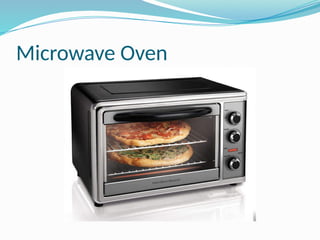
Microwave Oven
Microwaveovens are great kitchen appliance to
reheat, grill or even bake. Microwave ovens are
helpful in cooking a wide range of recipes and
food items.
It was invented by American electrical
engineer Percy Spencer
4.
Types of MicrowaveOven
There are three types of microwave ovens are
available in the market.
Solo microwave oven
Best for Reheat, simple cooking
Grill microwave oven
Best for Reheat and Grill
Convection microwave oven
Best for Reheat, Grill and Bake
5.
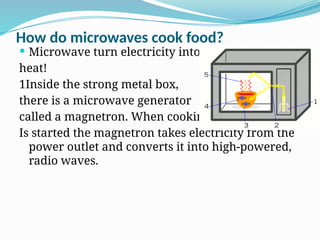
How do microwavescook food?
Microwave turn electricity into
heat!
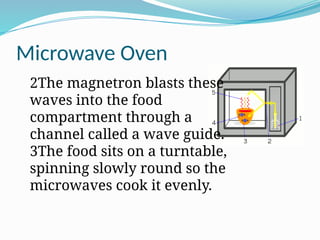
1Inside the strong metal box,
there is a microwave generator
called a magnetron. When cooking
Is started the magnetron takes electricity from the
power outlet and converts it into high-powered,
radio waves.
6.
Microwave Oven
2The magnetronblasts these
waves into the food
compartment through a
channel called a wave guide.
3The food sits on a turntable,
spinning slowly round so the
microwaves cook it evenly.
7.
Microwave Oven
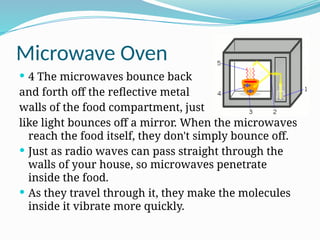
4The microwaves bounce back
and forth off the reflective metal
walls of the food compartment, just
like light bounces off a mirror. When the microwaves
reach the food itself, they don't simply bounce off.
Just as radio waves can pass straight through the
walls of your house, so microwaves penetrate
inside the food.
As they travel through it, they make the molecules
inside it vibrate more quickly.
8.
Microwave Oven
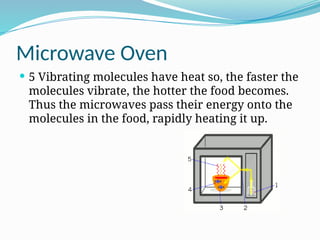
5Vibrating molecules have heat so, the faster the
molecules vibrate, the hotter the food becomes.
Thus the microwaves pass their energy onto the
molecules in the food, rapidly heating it up.
Block diagram ofMicrowave Oven
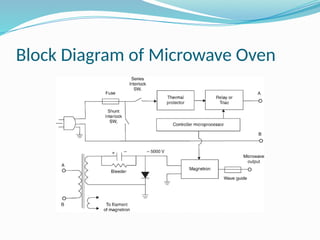
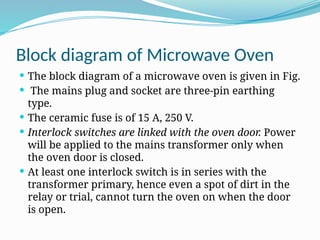
The block diagram of a microwave oven is given in Fig.
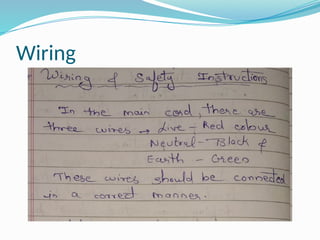
The mains plug and socket are three-pin earthing
type.
The ceramic fuse is of 15 A, 250 V.
Interlock switches are linked with the oven door. Power
will be applied to the mains transformer only when
the oven door is closed.
At least one interlock switch is in series with the
transformer primary, hence even a spot of dirt in the
relay or trial, cannot turn the oven on when the door
is open.
11.
Block Diagram ofMicrowave Oven
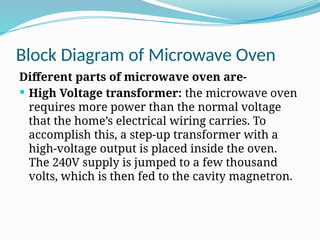
Different parts of microwave oven are-
High Voltage transformer: the microwave oven
requires more power than the normal voltage
that the home’s electrical wiring carries. To
accomplish this, a step-up transformer with a
high-voltage output is placed inside the oven.
The 240V supply is jumped to a few thousand
volts, which is then fed to the cavity magnetron.
12.
Block Diagram ofMicrowave Oven
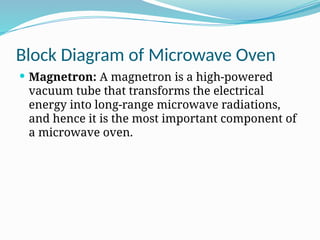
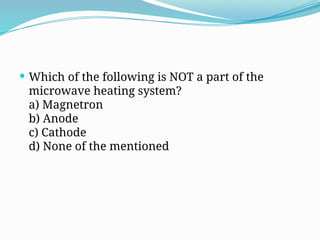
Magnetron: A magnetron is a high-powered
vacuum tube that transforms the electrical
energy into long-range microwave radiations,
and hence it is the most important component of
a microwave oven.
13.
Block Diagram ofMicrowave Oven
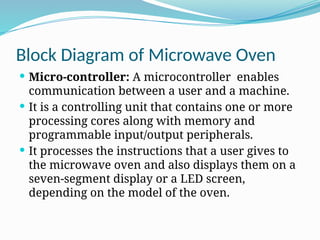
Micro-controller: A microcontroller enables
communication between a user and a machine.
It is a controlling unit that contains one or more
processing cores along with memory and
programmable input/output peripherals.
It processes the instructions that a user gives to
the microwave oven and also displays them on a
seven-segment display or a LED screen,
depending on the model of the oven.
14.
Block Diagram ofMicrowave Oven
WaveGuide: A waveguide is a hollow metallic
tube that guides the waves generated at the
magnetron’s output toward the cavity (the place
where we place the food).
15.
Block Diagram ofMicrowave Oven
The process of heating food in the microwave
oven is fairly simple; however, the mechanism
involved in that process is somewhat atypical.
After the generation of microwaves at the
magnetron, they are guided by the waveguide
towards the food inside the cavity. The
microwaves penetrate through the surface of the
food and reach the water molecules present
inside it.
16.
Block Diagram ofMicrowave Oven
As the orientation of the electric field changes
over time, the polar molecules of water attempt to
follow the field by changing their orientation
inside the material to line up along the field lines
in an energetically favourable configuration
(namely, with the positive side pointing in the
same direction as the field lines). As these
molecules change direction rapidly (millions of
times per second at least), they gain energy, which
increases the temperature of the material. This
process is called dielectric heating.
17.
Electrical specifications ofMicrowave oven
The electrical specifications for microwave oven are:
Supply voltage: 220 volts,50 Hz. Single phase A.C.
Power consumption: 1300 W approx.(power
consumption vary as manufacturer from500W to
1500W)
Microwave power: 700 w-850 W
Microwave frequency: 2450 Mhz (1000Mhz to
3000Mhz)
Timer: 60 min. – 90 min(timer can also varied)
Control: Soft/one touch control
18.
Precautions While UsingMicrowave Oven
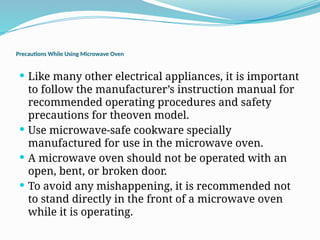
Like many other electrical appliances, it is important
to follow the manufacturer’s instruction manual for
recommended operating procedures and safety
precautions for theoven model.
Use microwave-safe cookware specially
manufactured for use in the microwave oven.
A microwave oven should not be operated with an
open, bent, or broken door.
To avoid any mishappening, it is recommended not
to stand directly in the front of a microwave oven
while it is operating.
19.
Precautions While UsingMicrowave Oven
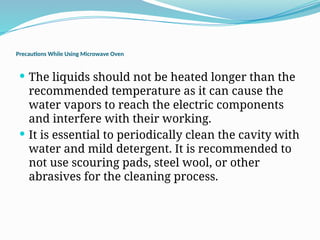
The liquids should not be heated longer than the
recommended temperature as it can cause the
water vapors to reach the electric components
and interfere with their working.
It is essential to periodically clean the cavity with
water and mild detergent. It is recommended to
not use scouring pads, steel wool, or other
abrasives for the cleaning process.