CONSUMER
DECISION
MAKING
PROCESS
Morgan Rodgers
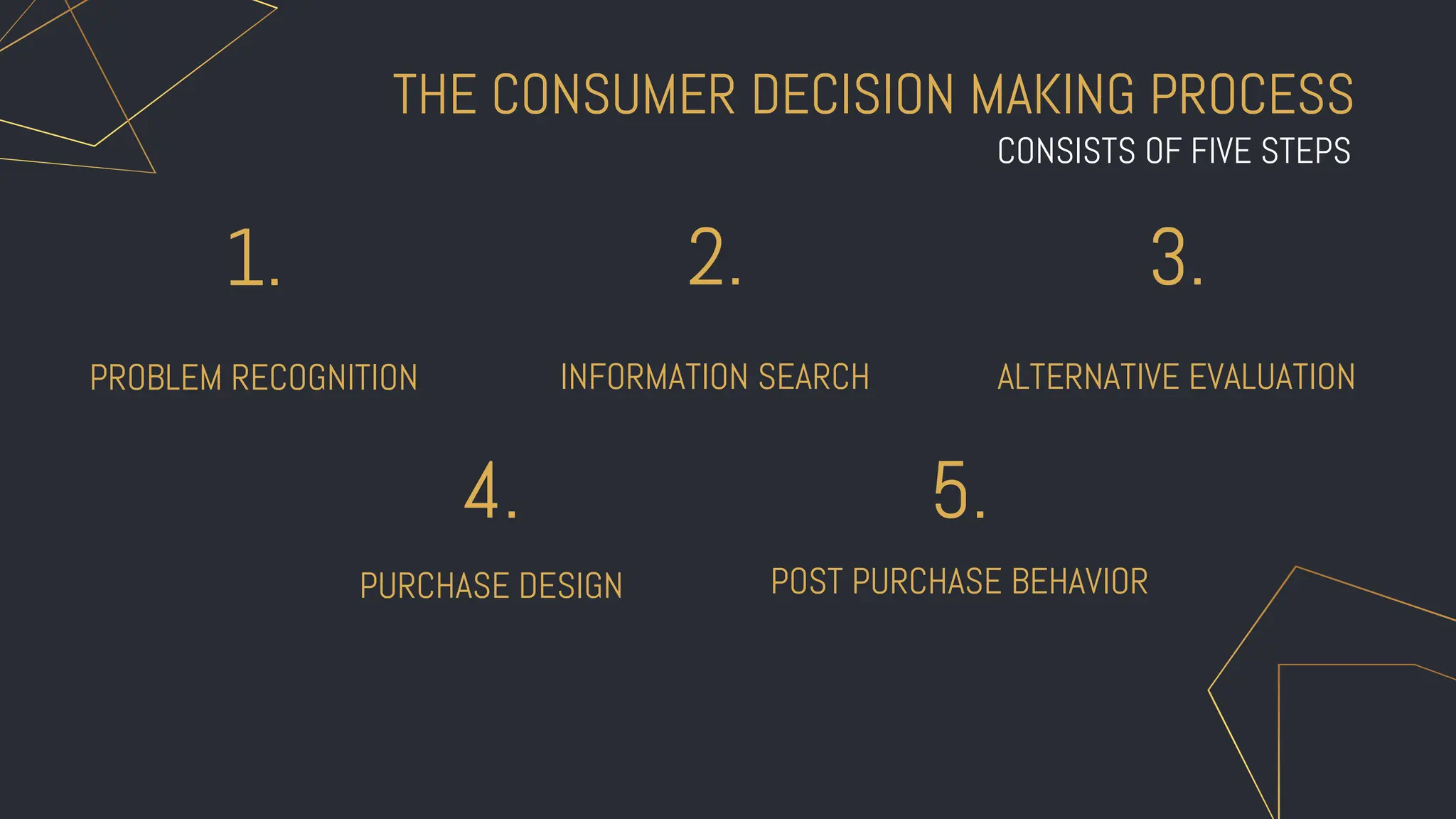
THE CONSUMER DECISION MAKING PROCESS
PROBLEM RECOGNITION
1.
INFORMATION SEARCH
2.
ALTERNATIVE EVALUATION
3.
PURCHASE DESIGN
4.
POST PURCHASE BEHAVIOR
5.
CONSISTS OF FIVE STEPS
- Identifying the problem, current state and
desired state
- Current State: the position which you are
currently in
- Desired state: the position which you hope to
finish in after making your purchase
PROBLEM
RECOGNITION
1
INFORMATION
SEARCH
2
- Searching for particulars that will help you
make your decision internally or externally
- Internal Search: looking within one’s prior
knowledge
- External Search: looking elsewhere for details
on possible purchases (through friends, the
internet, etc.)
ALTERNATIVE
EVALUATION
3
- Defining your criteria and consideration set
- Criteria: important factors considered and
judged upon when analyzing the product
- Consideration Set: a group of products which
one will compare and decide the best fit
(brands, types, etc.)
PURCHASE
DECISION
4
- The final details of making the purchase
- What, when and where
POST-PURCHASE
BEHAVIOR
5
- Evaluating your purchase and traveling
through cognitive dissonance
- Purchase Evaluation: determining whether
one made a good purchase
- Cognitive Dissonance: the broad process of
evaluating the purchase and it’s worth
When a consumer is making a decision, some
outlying factors may affect how they feel
(Social Influence) or the level of thought they
put towards the product they purchase
(Consumer Involvement).
OPINION
LEADERS
GROUPS THEY
WANT TO BE IN
GROUPS THEY WANT
NOTHING TO DO W/
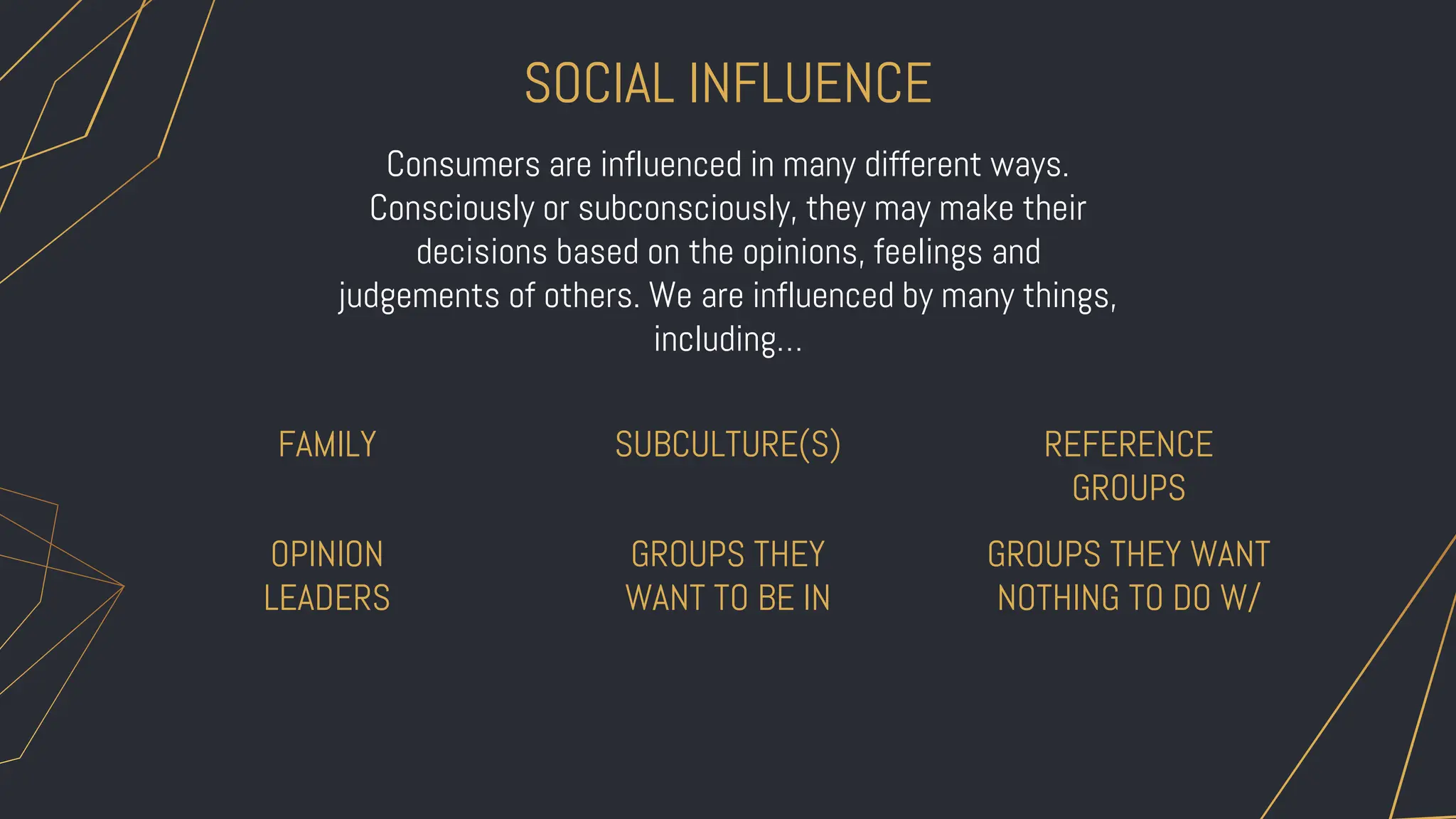
SOCIAL INFLUENCE
FAMILY SUBCULTURE(S) REFERENCE
GROUPS
Consumers are influenced in many different ways.
Consciously or subconsciously, they may make their
decisions based on the opinions, feelings and
judgements of others. We are influenced by many things,
including…
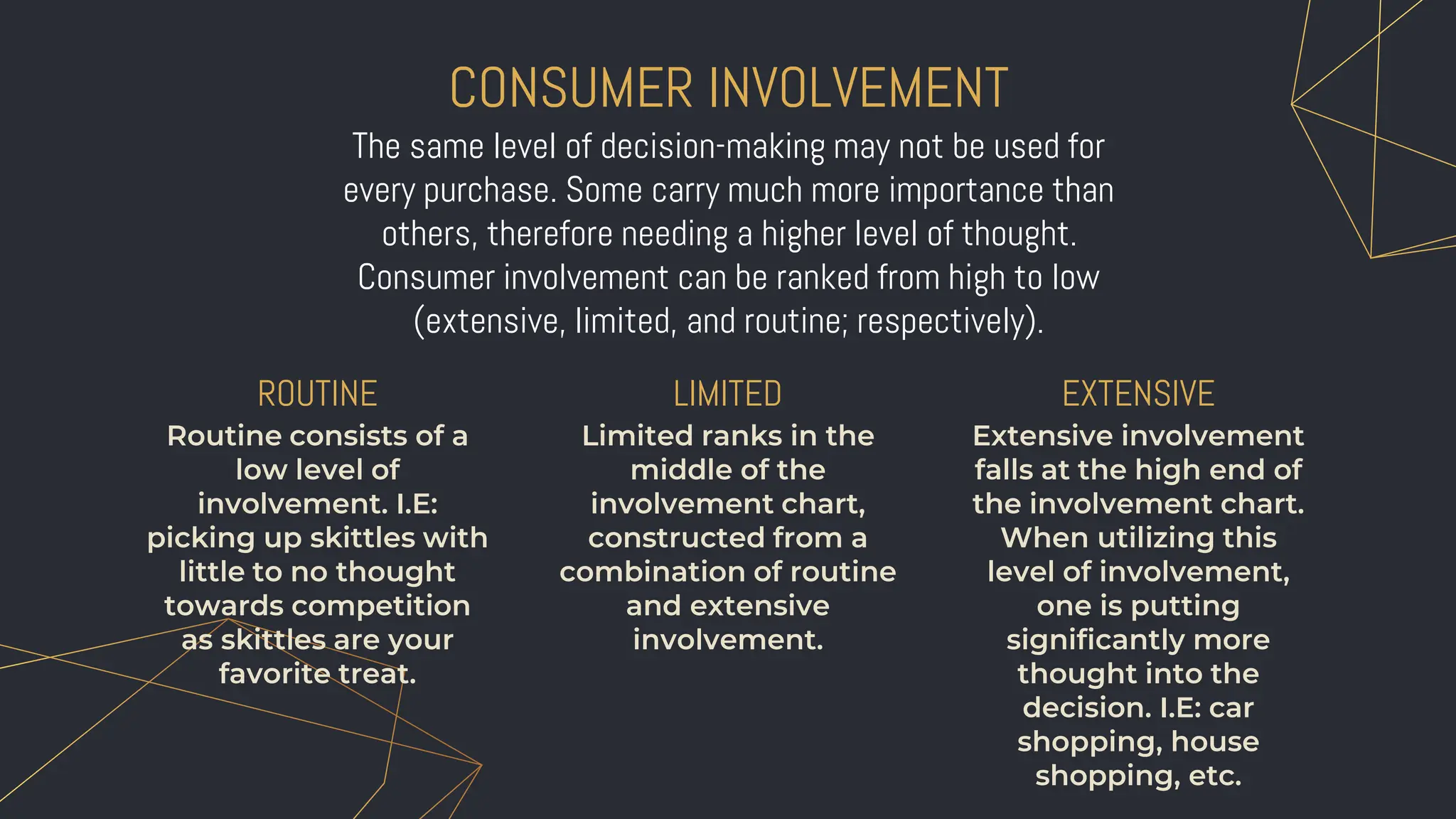
CONSUMER INVOLVEMENT
Limited ranks in the
middle of the
involvement chart,
constructed from a
combination of routine
and extensive
involvement.
LIMITED
ROUTINE
Routine consists of a
low level of
involvement. I.E:
picking up skittles with
little to no thought
towards competition
as skittles are your
favorite treat.
EXTENSIVE
Extensive involvement
falls at the high end of
the involvement chart.
When utilizing this
level of involvement,
one is putting
significantly more
thought into the
decision. I.E: car
shopping, house
shopping, etc.
The same level of decision-making may not be used for
every purchase. Some carry much more importance than
others, therefore needing a higher level of thought.
Consumer involvement can be ranked from high to low
(extensive, limited, and routine; respectively).
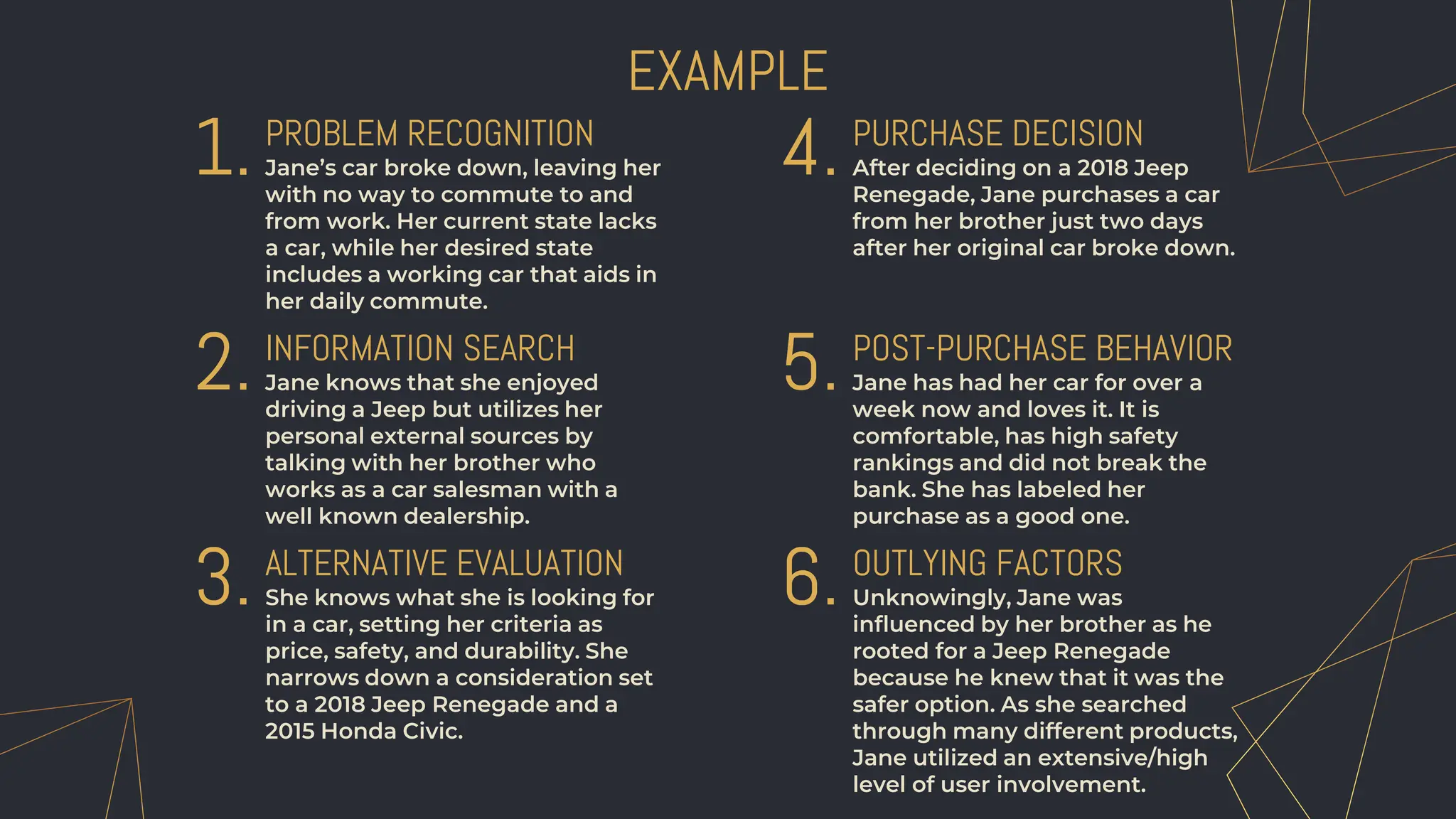
EXAMPLE
PROBLEM RECOGNITION
Jane’s car broke down, leaving her
with no way to commute to and
from work. Her current state lacks
a car, while her desired state
includes a working car that aids in
her daily commute.
1.
INFORMATION SEARCH
Jane knows that she enjoyed
driving a Jeep but utilizes her
personal external sources by
talking with her brother who
works as a car salesman with a
well known dealership.
2.
ALTERNATIVE EVALUATION
She knows what she is looking for
in a car, setting her criteria as
price, safety, and durability. She
narrows down a consideration set
to a 2018 Jeep Renegade and a
2015 Honda Civic.
3.
PURCHASE DECISION
After deciding on a 2018 Jeep
Renegade, Jane purchases a car
from her brother just two days
after her original car broke down.
4.
POST-PURCHASE BEHAVIOR
Jane has had her car for over a
week now and loves it. It is
comfortable, has high safety
rankings and did not break the
bank. She has labeled her
purchase as a good one.
5.
OUTLYING FACTORS
Unknowingly, Jane was
influenced by her brother as he
rooted for a Jeep Renegade
because he knew that it was the
safer option. As she searched
through many different products,
Jane utilized an extensive/high
level of user involvement.
6.

Consumer Decision Making Process

  • 1.
  • 2.
    THE CONSUMER DECISIONMAKING PROCESS PROBLEM RECOGNITION 1. INFORMATION SEARCH 2. ALTERNATIVE EVALUATION 3. PURCHASE DESIGN 4. POST PURCHASE BEHAVIOR 5. CONSISTS OF FIVE STEPS
  • 3.
    - Identifying theproblem, current state and desired state - Current State: the position which you are currently in - Desired state: the position which you hope to finish in after making your purchase PROBLEM RECOGNITION 1
  • 4.
    INFORMATION SEARCH 2 - Searching forparticulars that will help you make your decision internally or externally - Internal Search: looking within one’s prior knowledge - External Search: looking elsewhere for details on possible purchases (through friends, the internet, etc.)
  • 5.
    ALTERNATIVE EVALUATION 3 - Defining yourcriteria and consideration set - Criteria: important factors considered and judged upon when analyzing the product - Consideration Set: a group of products which one will compare and decide the best fit (brands, types, etc.)
  • 6.
    PURCHASE DECISION 4 - The finaldetails of making the purchase - What, when and where
  • 7.
    POST-PURCHASE BEHAVIOR 5 - Evaluating yourpurchase and traveling through cognitive dissonance - Purchase Evaluation: determining whether one made a good purchase - Cognitive Dissonance: the broad process of evaluating the purchase and it’s worth
  • 8.
    When a consumeris making a decision, some outlying factors may affect how they feel (Social Influence) or the level of thought they put towards the product they purchase (Consumer Involvement).
  • 9.
    OPINION LEADERS GROUPS THEY WANT TOBE IN GROUPS THEY WANT NOTHING TO DO W/ SOCIAL INFLUENCE FAMILY SUBCULTURE(S) REFERENCE GROUPS Consumers are influenced in many different ways. Consciously or subconsciously, they may make their decisions based on the opinions, feelings and judgements of others. We are influenced by many things, including…
  • 10.
    CONSUMER INVOLVEMENT Limited ranksin the middle of the involvement chart, constructed from a combination of routine and extensive involvement. LIMITED ROUTINE Routine consists of a low level of involvement. I.E: picking up skittles with little to no thought towards competition as skittles are your favorite treat. EXTENSIVE Extensive involvement falls at the high end of the involvement chart. When utilizing this level of involvement, one is putting significantly more thought into the decision. I.E: car shopping, house shopping, etc. The same level of decision-making may not be used for every purchase. Some carry much more importance than others, therefore needing a higher level of thought. Consumer involvement can be ranked from high to low (extensive, limited, and routine; respectively).
  • 11.
    EXAMPLE PROBLEM RECOGNITION Jane’s carbroke down, leaving her with no way to commute to and from work. Her current state lacks a car, while her desired state includes a working car that aids in her daily commute. 1. INFORMATION SEARCH Jane knows that she enjoyed driving a Jeep but utilizes her personal external sources by talking with her brother who works as a car salesman with a well known dealership. 2. ALTERNATIVE EVALUATION She knows what she is looking for in a car, setting her criteria as price, safety, and durability. She narrows down a consideration set to a 2018 Jeep Renegade and a 2015 Honda Civic. 3. PURCHASE DECISION After deciding on a 2018 Jeep Renegade, Jane purchases a car from her brother just two days after her original car broke down. 4. POST-PURCHASE BEHAVIOR Jane has had her car for over a week now and loves it. It is comfortable, has high safety rankings and did not break the bank. She has labeled her purchase as a good one. 5. OUTLYING FACTORS Unknowingly, Jane was influenced by her brother as he rooted for a Jeep Renegade because he knew that it was the safer option. As she searched through many different products, Jane utilized an extensive/high level of user involvement. 6.