Visit https://ebookfinal.com to download the full version and
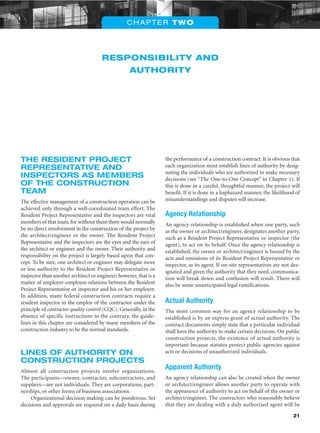
explore more ebooks
Construction Project Administration 9th Edition
Edward R. Fisk
_____ Click the link below to download _____
https://ebookfinal.com/download/construction-project-
administration-9th-edition-edward-r-fisk/
Explore and download more ebooks at ebookfinal.com
Here are some suggested products you might be interested in.
Click the link to download
Construction Project Administration Edward R. Fisk
https://ebookfinal.com/download/construction-project-administration-
edward-r-fisk/
Construction contract administration Second Edition
Goldfayl
https://ebookfinal.com/download/construction-contract-administration-
second-edition-goldfayl/
Construction Project Management 3rd Edition Frederick E.
Gould
https://ebookfinal.com/download/construction-project-management-3rd-
edition-frederick-e-gould/
Macs For Dummies 9th ed Edition Edward C. Baig
https://ebookfinal.com/download/macs-for-dummies-9th-ed-edition-
edward-c-baig/
Project Icarus R. D. Shah
https://ebookfinal.com/download/project-icarus-r-d-shah/
Stakeholder Theory R. Edward Freeman
https://ebookfinal.com/download/stakeholder-theory-r-edward-freeman/
Construction Project Management Theory and Practices 2nd
Edition Kumar Neeraj Jha
https://ebookfinal.com/download/construction-project-management-
theory-and-practices-2nd-edition-kumar-neeraj-jha/
Oracle9i Administration and Management Michael R. Ault
https://ebookfinal.com/download/oracle9i-administration-and-
management-michael-r-ault/
Applied Statistics for Public and Nonprofit Administration
9th Edition Kenneth J. Meier
https://ebookfinal.com/download/applied-statistics-for-public-and-
nonprofit-administration-9th-edition-kenneth-j-meier/
Construction Project Administration 9th Edition Edward
R. Fisk Digital Instant Download
Author(s): Edward R. Fisk, Wayne De Reynolds
ISBN(s): 9780135000076, 0135000076
Edition: 9th Edition
File Details: PDF, 16.85 MB
Year: 2009
Language: english
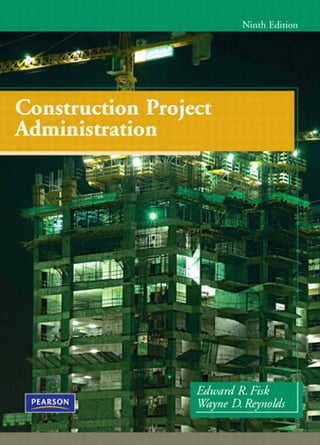
Construction Project Administration
This page intentionally left blank
Prentice Hall
Boston Columbus Indianapolis New York San Francisco Upper Saddle River
Amsterdam Cape Town Dubai London Madrid Milan Munich Paris Montreal Toronto
Delhi Mexico City Sao Paulo Sydney Hong Kong Seoul Singapore Taipei Tokyo
NINTH EDITION
Edward R. Fisk, PE
Wayne D. Reynolds, PE
Construction Project Administration
Vice President and Executive Editor: Vernon
R. Anthony
Acquisitions Editor: David Ploskonka
Editorial Assistant: Nancy Kesterson
Director of Marketing: David Gesell
Executive Marketing Manager: Derril Trakalo
Senior Marketing Coordinator: Alicia Wozniak
Project Manager: Susan Hannahs
Operations Specialist: Laura Weaver
Art Director: Jayne Conte
Cover Designer: Bruce Kenselaar
Cover Image: Getty Images
Full-Service Project Management:
Shiny Rajesh, Integra
Composition: Integra Software
Services Pvt. Ltd.
Printer/Binder: Edward Brothers
Cover Printer: Demand Production
Centre
Text Font: 10/12 Minion
Credits and acknowledgments borrowed from other sources and reproduced, with permission, in
this textbook appear on the appropriate page within text.
Copyright © 2010, 2006, 2003, 2000, 1997 Pearson Education, Inc., publishing as Prentice Hall,
One Lake Street, Upper Saddle River, New Jersey, 07458. All rights reserved. Manufactured in the
United States of America. This publication is protected by Copyright, and permission should be
obtained from the publisher prior to any prohibited reproduction, storage in a retrieval system,
or transmission in any form or by any means, electronic, mechanical, photocopying, recording,
or likewise. To obtain permission(s) to use material from this work, please submit a written request
to Pearson Education, Inc., Permissions Department, One Lake Street, Upper Saddle River,
New Jersey, 07458.
Many of the designations by manufacturers and seller to distinguish their products are claimed
as trademarks. Where those designations appear in this book, and the publisher was aware of
a trademark claim, the designations have been printed in initial caps or all caps.
Library of Congress Cataloging-in-Publication Data
Fisk, Edward R., 1924–
Construction project administration / Edward R. Fisk, Wayne D. Reynolds.—9th ed.
p. cm.
Includes bibliographical references and index.
ISBN-13: 978-0-13-500007-6 (alk. paper)
ISBN-10: 0-13-500007-6 (alk. paper)
1. Construction industry—Management. 2. Building––Superintendence. I. Reynolds,
Wayne D., 1949– II. Title.
TH438.F57 2010
624.068––dc22
2009018897
10 9 8 7 6 5 4 3 2 1
ISBN 13: 978-0-13-500007-6
ISBN 10: 0-13-500007-6
v
PREFACE
The principal objective of this book is to provide those
of us who are active in the construction industry with
a single source of information that will help address
the responsibilities and risks that we are likely to encounter.
The book not only introduces students, design professionals,
project managers, and owners to the special problems of con-
struction, but also serves as a ready reference to experienced
contract administrators and construction engineers.
The first edition was addressed to students of construc-
tion management, on-site representatives, engineers, and
inspectors to provide them with a ready source of informa-
tion in preparing for the responsibilities they could expect to
confront on modern construction projects.
However, during the many seminars held by the authors
throughout the United States, Venezuela, Guam, Canada,
Jamaica, and Mexico, and in the courses they have taught for
the University of California, Berkeley, Institute of Transporta-
tion Studies; University of Washington, Seattle, Engineering
Professional Programs; Eastern Kentucky University; and the
American Society of Civil Engineers, it became evident that
the project managers, contract administrators, and other
management personnel who worked with or exercised control
over the on-site project representatives had special problems
that also needed to be addressed if the project team concept
was to be realized. Thus, the concept for the second edition
was born: to bring together the office and field personnel and
present them with a workable system for operating as an effec-
tive construction team.
The third edition continued the concept of developing the
project team approach, with the added consideration of
claims-avoidance methods to reduce claims losses. Each mem-
ber of the project team needed to become intimately familiar
with the principles of construction project administration. It
was toward this end that the author strove to meet the particu-
lar needs of the project team in today’s changing construction
environment. A considerable amount of new material was
added, and some of the chapters were reorganized for a more
logical flow of information.
Later editions provided the updating necessary to remain
current with state-of-the-art techniques in construction and
to add new material, including references to AIA, EJCDC, and
FIDIC documents, so that the book can literally become a
single source for most construction-phase activities.
As a part of the continuing effort to stay abreast of the
state of the art of the construction industry, and in recogni-
tion of the federal declaration to make the metric system
(SI) the basic system of measurement in the United States
and that federal agencies be required to use it exclusively, the
fifth edition was updated to emphasize its use and included
supplementary information to assist civil and construction
engineers in utilizing metric (SI) civil engineering units in
construction. In addition, all of the original material was
reviewed and updated; the subject of partnering was
addressed; and the index was made more user-friendly.
For the seventh edition, author Ed Fisk added a new
chapter, “Electronic Project Administration” (Chapter 5)
and welcomed two new contributors who were experts in
their own right on computer application as applied to pro-
curement and project administration. They were Mr. Harold
Good, CPPO, formerly Director of Procurement and Con-
tracting for the City of Palm Springs and a leader in his field,
and W. Gary Craig, PE, President of ProjectEDGE.
For the eighth edition, Mr. Wayne Reynolds joined
author Ed Fisk in revising much of Chapters 13 and 14 on
construction scheduling, and Chapter 16 on value engineer-
ing. Together, the authors made many updates regarding
twenty-first-century technology.
The authors are grateful to the many contributions made
through the years since this book was first published. Contrib-
utors to previous editions included Julius (Jim) Calhoun, Esq.,
Asst. General Counsel for Montgomery-Watson in Pasadena,
CA (ret.); Gary L. McFarland, PE, and Charles H. Lawrance,
PE, President and Vice-President, respectively, of Lawrance,
Fisk, & McFarland, Inc., of Santa Barbara, CA; Wendell Rigby,
PE, former Senior Civil Engineer of the City of Thousand
Oaks, CA; Albert Rodriguez, CPCU, ARM, President,
Rodriguez Consulting Group, Inc., Jacksonville, FL; Robert
Rubin, Esq., PE, of Postner & Rubin, Attorneys-at-Law, New
York, NY; Joseph Litvin, Esq., PE, Attorney-at-Law, Dayton,
OH; Arthur Schwartz, Esq., General Counsel for the National
Society of Professional Engineers, Alexandria, VA; Robert
Smith, Esq., PE, of Wickwire Gavin, PC of Madison, WI,
General Counsel for the Engineers Joint Contract Documents
Committee (EJCDC); and the members of the EJCDC whose
contributions to the tools of the contract administrator are
without equal.
The author extends his particular thanks and appreciation
to Donald Scarborough, President of Forward Associates, Ltd.,
of Novato, CA, for his valuable contributions to the updated
chapters on CPM scheduling; to William W. Gurry, President
of Wm. Gurry & Associates, Atlanta, GA, for his contributions
on design–build contracts; and to the Associated General Con-
tractors of America for its input on the concept of partnering.
Special thanks and appreciation is offered to my daugh-
ter, Jacqueline, and to her son, John Stamp, PhD, who did
most of the indexing for the sixth edition. Thanks also to my
son, Edward, who provided all of the computer expertise,
both editorially and in a support capacity, for editions five
through seven of this book.
vi Preface
vii
PREFACE TO THE NINTH
EDITION
O
n August 5, 2008, the Architecture/Engineering/
Construction community lost a great constructor
when Mr. Ed Fisk passed away. His more than three
decades of construction insights will be sorely missed. This
ninth edition of Construction Project Administration is dedi-
cated to his memory. He was my mentor and good friend.
With the ninth edition, we have continued to fine-tune
all chapters to current technologies, to incorporate the latest
developments in construction project administration, and to
correct any errors in the previous edition. Chapter 6 has
been updated to include the Construction Specifications
Institute 2004 version of Masterformat™. Chapter 5 has been
updated to include a discussion on Building Information
Modeling.
I wish to thank Mr. Steven E. Williams, Autodesk Inc.,
for writing the Building Information Modeling update for
Chapter 5. I also wish to acknowledge Mr. Matt Gumm,
Alliance Corporation, for his suggestions on how to improve
this textbook and Mr. James Dall, Dormitory Authority—
New York, for identifying errata that needed correction from
the eighth edition. Finally, I would like to thank my wife,
Karen Reynolds, for her patience and support throughout
the duration of this project.
To access supplementary materials online, instruc-
tors need to request an instructor access code. Go to
www.pearsonhighered.com, click the Instructor Resource
Center link, and then click Register Today for an instructor
access code. Within 48 hours after registering you will
receive a confirming e-mail including an instructor access
code. Once you have received your code, go to the site and
log on for full instructions on downloading the materials
you wish to use.
This page intentionally left blank
ix
ABOUT THE AUTHORS
Edward R. Fisk, PE, LS,
was a construction consul-
tant in Orange, California.
He was a licensed civil and
structural engineer, land
surveyor, and licensed gen-
eral contractor and held
licenses in 13 states. Before
becoming an independent
consultant, he was presi-
dent of Gleason, Peacock, &
Fisk, Inc., of Brea, CA, construction consultants; vice presi-
dent of Lawrence, Fisk, & McFarland, Inc., engineers, of
Santa Barbara, CA; and vice president of Construction Ser-
vices for Wilsey & Ham, engineers, Foster City, CA. Prior
to that he served as Corporate Director of Construction
Management for J.M. Montgomery Engineers (now MWH
Global), and VTN Consolidated, Inc., and was an Engineer
and a Field Engineer for Bechtel Corp., Power Division. He
had extensive experience in both the public and private sec-
tors. He was a Life Fellow of the American Society of Civil
Engineers and former chairman of its Construction Division
and was a Fellow of the National Academy of Forensic Engi-
neers. He taught short courses statewide at the University of
California, Berkeley, Institute of Transportation Studies, and
at the University of Washington, Engineering Professional
Programs, Seattle, for many years. He lectured nationally
and internationally for the American Society of Civil Engi-
neers until succeeded by co-author Wayne Reynolds.
Wayne D. Reynolds, PE, is
a Professor in the Depart-
ment of Technology at East-
ern Kentucky University.
He teaches introduction to
construction, project orga-
nization and supervision,
scheduling and cost control,
contracts and bidding,
quantity and cost estimat-
ing, engineering economy,
statics, structures, and soils in the Construction Management
program.He also lectures nationally and internationally for the
American Society of Civil Engineers. He has a B.S. from the
U.S. Military Academy and an M.S. in civil engineering from
the Ohio State University. Mr. Reynolds has experience in
design and construction projects including transportation
facilities, navigation structures, flood protection, and institu-
tional buildings, and has served as Inspector, Project Engineer,
Assistant Resident Engineer, Project Manager, Deputy District
Engineer, and Contracting Officer. He was an Assistant Profes-
sor of Civil Engineering at the U.S. Air Force Academy and
completed service in the U.S. Army Corps of Engineers as a
Lieutenant Colonel. He is a member of American Society of
Civil Engineers, the Society of American Military Engineers,
and the Associated Schools of Construction.
This page intentionally left blank
xi
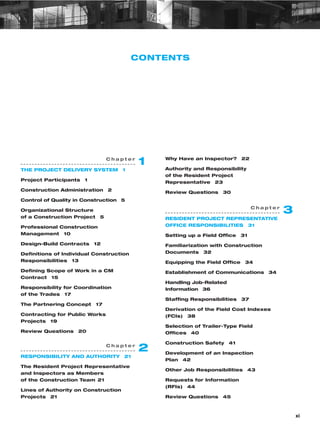
CONTENTS
Why Have an Inspector? 22
Authority and Responsibility
of the Resident Project
Representative 23
Review Questions 30
C h a p t e r
1
THE PROJECT DELIVERY SYSTEM 1
Project Participants 1
Construction Administration 2
Control of Quality in Construction 5
Organizational Structure
of a Construction Project 5
Professional Construction
Management 10
Design–Build Contracts 12
Definitions of Individual Construction
Responsibilities 13
Defining Scope of Work in a CM
Contract 15
Responsibility for Coordination
of the Trades 17
The Partnering Concept 17
Contracting for Public Works
Projects 19
Review Questions 20
C h a p t e r
2
RESPONSIBILITY AND AUTHORITY 21
The Resident Project Representative
and Inspectors as Members
of the Construction Team 21
Lines of Authority on Construction
Projects 21
C h a p t e r
3
RESIDENT PROJECT REPRESENTATIVE
OFFICE RESPONSIBILITIES 31
Setting up a Field Office 31
Familiarization with Construction
Documents 32
Equipping the Field Office 34
Establishment of Communications 34
Handling Job-Related
Information 36
Staffing Responsibilities 37
Derivation of the Field Cost Indexes
(FCIs) 38
Selection of Trailer-Type Field
Offices 40
Construction Safety 41
Development of an Inspection
Plan 42
Other Job Responsibilities 43
Requests for Information
(RFIs) 44
Review Questions 45
Unenforceable Phrases 98
Content and Component Parts
of a Specification 98
What Do the Specifications Mean
to the Inspector? 101
CSI Specifications Format—Its
Meaning and Importance 101
Heavy Construction Engineering
Specification Format 105
State Highway Department
Formats 105
Other Nonstandard Construction
Specifications Formats
in Use 107
Project Specifications (Project
Manual) versus Special Provisions
Concept 108
Inspector Training and Knowledge
of Specifications 109
Allowances and Tolerances
in Specifications 110
Review Questions 111
xii Contents
C h a p t e r
4
DOCUMENTATION: RECORDS
AND REPORTS 46
Project Documentation as Evidence
in Claims 47
Files and Records 47
Construction Progress Record 54
Electronic Record Keeping 54
Construction Reports 55
Construction Diary 56
Who Should Maintain Diaries and Daily
Reports? 59
Documentation of Intermittent
Inspection 59
Special Feedback Reports 59
Documentation of Dangerous Safety
Hazard Warnings 63
Miscellaneous Records 65
Labor Standards Review Records 65
Job Conferences 66
Contractor Submittals 66
Construction Photographs 67
Photographic Equipment
and Materials 71
Digital Cameras for Construction 75
Review Questions 75
C h a p t e r
7
USING THE SPECIFICATIONS
IN CONTRACT ADMINISTRATION 112
General Conditions of the Construction
Contract 112
International Construction
Contracts 113
Differing Site Conditions 115
Materials and Equipment 117
The Contractor and
Subcontractors 117
Shop Drawings and Samples 118
Disapproving or Stopping
the Work 119
Supplementary General
Conditions 120
Technical Provisions of the
Specifications 121
Addenda to the Specifications 122
Standard Specifications 123
Master Specifications (Guide
Specifications) 124
C h a p t e r
6
SPECIFICATIONS AND DRAWINGS 96
What Is a Specification? 96
Conflicts Due to Drawings
and Specifications 96
C h a p t e r
5
ELECTRONIC PROJECT
ADMINISTRATION 76
Using Computers for Project
Administration 76
Web-Enabled Project Management
Applications 86
Building Information Modeling (BIM) 90
Review Questions 94
Special Material and Product
Standards 124
Building Codes, Regulations,
Ordinances, and Permits 128
Types of Drawings Comprising the
Construction Contract 129
Order of Precedence of the Contract
Documents 130
Review Questions 130
Special Applications 146
Procedural Guidelines 147
Shoring and Bracing 148
The Competent Person 150
Safety Requirements in Construction
Contracts 150
Review Questions 151
Contents xiii
C h a p t e r
12
PRECONSTRUCTION OPERATIONS 174
Description of Approach 174
Constructability Analysis 174
Advertise and Award Phase 175
Issuance of Bidding Documents 177
Prequalification of Bidders 178
Bonds 178
C h a p t e r
11
RISK ALLOCATION AND LIABILITY
SHARING 164
Risk Management 164
Identification and Nature
of Construction Risks 166
Contractual Allocation of Risk 166
Who Should Accept What
Risks? 167
Types of Risks and Allocation of Those
Risks 167
Minimizing Risks and Mitigating
Losses 171
Review Questions 173
C h a p t e r
10
MEETINGS AND NEGOTIATIONS 152
Types of Meetings in Construction 152
Meeting Resources 153
Handling Yourself at a Meeting 153
Preconstruction Conference 155
Principles of Negotiation 159
Techniques of Negotiation 161
Review Questions 163
C h a p t e r
9
CONSTRUCTION SAFETY 141
OSHA and Construction Safety 142
General Responsibility for Construction
Safety 142
Owner Participation in the Safety
Program 143
Typical Federal, State, and Utility
Company Approach 143
Safety Responsibility under
Construction Management
and Turnkey Contracts 143
Effect of Including Contractor’s Safety
Obligations in the Specifications 144
Applicability of State and Federal
OSHA Provisions to a Project 146
C h a p t e r
8
CONSTRUCTION LAWS AND LABOR
RELATIONS 131
Compliance with Laws
and Regulations 131
Public versus Private Contracts 132
Traffic Requirements during
Construction 133
Code Enforcement Agency
Requirements 133
Work within or Adjacent to Navigable
Waterways 133
Fair Subcontracting Laws 134
The Hazardous Waste Problem 135
Federal Labor Laws 135
Labor Relations 138
Prejob Labor Agreements 139
Review Questions 140
Liability Forms of Insurance 179
Property Forms of Insurance 180
Opening, Acceptance,
and Documentation of Bids 181
Development of a Quality Control
or Assurance Program 187
Inspection and Testing Manual 188
Field Office Organization of the Owner
or the Field Representative 189
The Preconstruction Conference 193
Study Plans and Specifications 195
Key Dates 196
Listing of Emergency
Information 196
Agency Permits 197
Starting a Project 197
Review Questions 204
Precedence Diagraming versus i–j
Diagraming 228
Precedence Formats 229
Reading a Manual CPM Network
Schedule 229
Reading a Computerized CPM
Network Schedule 232
Review Questions 240
xiv Contents
C h a p t e r
17
MEASUREMENT AND PAYMENT 259
Contracts for Construction 259
Construction Progress Payments 260
Approval of Payment Requests 261
C h a p t e r
16
VALUE ENGINEERING 251
Definition 251
The Role of the Resident Project
Representative 252
Fundamentals of Value
Engineering 253
Areas of Opportunity for Value
Engineering 256
Field Responsibility in Value
Engineering 257
Review Questions 258
C h a p t e r
15
CONSTRUCTION OPERATIONS 241
Authority and Responsibility of All
Parties 241
Temporary Facilities Provided
by the Contractor 244
Time of Inspection and Tests 244
Contractor Submittals 245
Opening a Project 245
Job Philosophy 246
Administrative Activities 247
Suspension or Termination
of the Work 247
Construction Services Cost
Monitoring 249
Review Questions 250
C h a p t e r
14
CPM SCHEDULING FOR
CONSTRUCTION 221
CPM: What It Is and What It Does 221
Basic Procedure in Setting Up a CPM
Schedule 222
Project Planning 222
Fundamentals of CPM 223
Who Owns Float? 227
C h a p t e r
13
PLANNING FOR CONSTRUCTION 205
Construction Schedules as Related
to Building Costs 207
Scheduling Methods 207
Bar Charts 209
S-Curve Scheduling or Velocity
Diagrams 211
Line-of-Balance Charts 211
Network Diagrams 213
Specifying CPM for a Project 215
Computerized Progress Payments 215
Selection of PC Scheduling
Software 218
Review Questions 220
Contents xv
C h a p t e r
19
CHANGES AND EXTRA WORK 309
Contract Modifications 309
Changes in the Work 309
Types of Changes 314
Elements of a Change Order 316
Evaluating the Need 317
Considerations for Evaluation 317
Change Orders for Differing Site
Conditions 318
Starting the Change Order
Process 320
Cost of Delays Caused by Change
Orders 322
Review Questions 322
C h a p t e r
20
CLAIMS AND DISPUTES 323
Five Principles of Contract
Administration 323
Construction Problems 324
Protests 324
Claims 326
Claims and Disputes 328
Differences between
the Parties 329
Home Office Overhead 332
Scheduling Changes 337
Constructive Changes 337
Other Causes of Claims
and Disputes 338
Resolving Differences 342
Preparations for Claims
Defense 344
The Use of Project Records
in Litigation 347
Order of Precedence of Contract
Documents 347
Obligations of the Contractor 348
Alternative Methods for Dispute
Resolution 348
Arbitration or Litigation? 349
C h a p t e r
18
CONSTRUCTION MATERIALS
AND WORKMANSHIP 294
Materials and Methods
of Construction 294
Requests for Substitutions
of Materials 295
Access to the Work by Quality
Assurance Personnel 297
Inspection of Materials Delivered
to the Site 298
Rejection of Faulty Material 299
Construction Equipment
and Methods 300
Quality Level and Quality
Assurance 302
Quality Assurance Provisions 303
Ownership of Materials 308
Delivery and Storage
of Materials 308
Handling of Materials 308
Review Questions 308
Basis for Payment Amounts 262
Evaluation of Contractor’s Payment
Requests 265
Force Account 267
Payment for Extra Work and Change
Orders 270
Payment for Mobilization Costs 272
Partial Payments to the
Contractor 275
Retainage 278
Liquidated Damages during
Construction 282
Standard Contract Provisions
for Measurement and Payment 283
Interpreting the Contractor’s Bid 283
Measurement for Payment 287
Measurement Guidelines
for Determination of Unit-Price
Pay Quantities 289
Final Payment to the Contractor 291
Review Questions 293
The Mediation Process 350
Settlement of Disputes
by Arbitration 351
Preliminary Notice of Potential
Claim 354
Review Questions 354
Completion versus Substantial
Completion 367
Substantial Completion versus
Beneficial Occupancy or Use 371
Beneficial Use/Partial
Utilization 372
Liens and Stop Orders 373
Final Payment and Waiver
of Liens 374
Stop Notice Release Bond 375
Post Completion 376
Review Questions 379
BIBLOGRAPHY 381
INDEX 385
FORMS INDEX 395
xvi Contents
C h a p t e r
21
PROJECT CLOSEOUT 355
Acceptance of the Work 355
Guarantee Period 355
Contract Time 356
Liquidated Damages for Delay 357
Cleanup 360
The Punch List 360
Preparations for Closeout 363
Construction Project Administration
This page intentionally left blank
1
THE PROJECT
DELIVERY SYSTEM
CHAPTER ONE
Throughout the ages,human beings have been building
to meet the needs of their habitation on this earth.
Then, just as now, the planning and building of each
such project involved the collective efforts of many workers, all
with different skills and types of specialized knowledge.At first
the methods were primitive but effective. As the products of
modern technology replaced the older, outdated tools of these
early builders, the methods of construction and the types of
skills and specialized knowledge required to complete a con-
struction project had to change to keep pace. Now, in the
twenty-first century, we are again experiencing change as the
computer has revolutionized the way that projects can be
administered, both on the Web and in extranet applications.
PROJECT PARTICIPANTS
Whether the project involves a building,bridge,dam,pipeline,
sewage treatment plant, water supply system, or any one of
numerous other types of projects, it requires the skills and
services of a project team comprised of three principal partic-
ipants, or only two participants if we consider the concept of a
design–build contract.
The owner
The designer
The builder
The design-builder
In practice, the owner usually enters into a contract with
an architect/engineer or a design–build contractor to plan
and design a project to satisfy the owner’s particular needs.
The owner participates during the design period to set crite-
ria for design, cost, and time limits for completion and to
provide decision-making inputs to the architect/engineer or
design–build contractor.
Under conventional contracts, upon completion of
the planning and design process the project is ready for
construction, and the advertising or selection process to
obtain one or more qualified construction contractors begins.
After selection of one or more qualified construction
contractors, or, as in the case of public works projects, selec-
tion of the lowest qualified bidders, the owner enters into a
contract directly with each prime contractor, who will then
be fully responsible directly to the owner or the owner’s des-
ignated representative for building the project in accordance
with the plans, specifications, and local laws. The contractor
has the further responsibility for the integrity of the new
structure that has been built—in effect, the contractor must
guarantee the work. Although the architect/engineer may be
obligated to make field visitations to the construction site
during the progress of the work, such periodic visits are for
the purpose of observing materials and completed work to
evaluate their general compliance with plans, specifications,
and design and planning concepts only. Such basic services
should not be interpreted as including full-time inspection
for quality control and assurance.
Thus, on the typical project, there are usually only two
prime contracts with the owner: one with the architect/
engineer for the design and planning of the project and the
other with a single construction contractor or occasionally
several prime construction contractors to build the project.
As is frequently the case on a modern, complex project,
numerous special types of construction are involved, and the
contractor who enters into an agreement with the owner to
build a project finds that the work can be better accomplished
by subcontracting with a specialty contractor to do a particu-
lar portion of the work. Such subcontracts are agreements
between the prime or “general” contractor and the subcon-
tractor only and involve no contractual relationship between
any subcontractor and the owner. Under the owner’s contract
for construction, the general contractor is fully responsible
for the entire work, whether or not subcontractors have been
utilized to accomplish any portion of it. The traditional
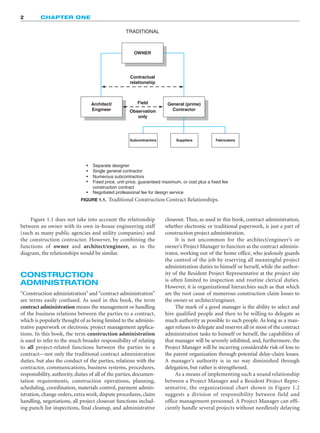
contractual arrangement is illustrated in Figure 1.1.
2 CHAPTER ONE
TRADITIONAL
OWNER
Contractual
relationship
Architect/
Engineer
Field
Observation
only
Separate designer
•
•
•
•
•
Single general contractor
Numerous subcontractors
Fixed price, unit price, guaranteed maximum, or cost plus a fixed fee
construction contract
Negotiated professional fee for design service
Subcontractors Suppliers Fabricators
General (prime)
Contractor
FIGURE 1.1. Traditional Construction Contract Relationships.
Figure 1.1 does not take into account the relationship
between an owner with its own in-house engineering staff
(such as many public agencies and utility companies) and
the construction contractor. However, by combining the
functions of owner and architect/engineer, as in the
diagram, the relationships would be similar.
CONSTRUCTION
ADMINISTRATION
“Construction administration” and “contract administration”
are terms easily confused. As used in this book, the term
contract administration means the management or handling
of the business relations between the parties to a contract,
which is popularly thought of as being limited to the adminis-
trative paperwork or electronic project management applica-
tions. In this book, the term construction administration
is used to refer to the much broader responsibility of relating
to all project-related functions between the parties to a
contract—not only the traditional contract administration
duties, but also the conduct of the parties, relations with the
contractor, communications, business systems, procedures,
responsibility, authority, duties of all of the parties, documen-
tation requirements, construction operations, planning,
scheduling, coordination, materials control, payment admin-
istration, change orders, extra work, dispute procedures, claim
handling, negotiations, all project closeout functions includ-
ing punch list inspections, final cleanup, and administrative
closeout. Thus, as used in this book, contract administration,
whether electronic or traditional paperwork, is just a part of
construction project administration.
It is not uncommon for the architect/engineer’s or
owner’s Project Manager to function as the contract adminis-
trator, working out of the home office, who jealously guards
the control of the job by reserving all meaningful project
administration duties to himself or herself, while the author-
ity of the Resident Project Representative at the project site
is often limited to inspection and routine clerical duties.
However, it is organizational hierarchies such as that which
are the root cause of numerous construction claim losses to
the owner or architect/engineer.
The mark of a good manager is the ability to select and
hire qualified people and then to be willing to delegate as
much authority as possible to such people. As long as a man-
ager refuses to delegate and reserves all or most of the contract
administration tasks to himself or herself, the capabilities of
that manager will be severely inhibited, and, furthermore, the
Project Manager will be incurring considerable risk of loss to
the parent organization through potential delay-claim losses.
A manager’s authority is in no way diminished through
delegation, but rather is strengthened.
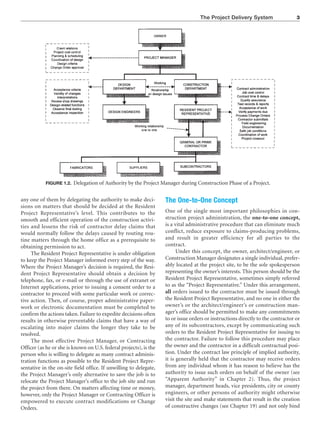
As a means of implementing such a sound relationship
between a Project Manager and a Resident Project Repre-
sentative, the organizational chart shown in Figure 1.2
suggests a division of responsibility between field and
office management personnel. A Project Manager can effi-
ciently handle several projects without needlessly delaying
The Project Delivery System 3
FIGURE 1.2. Delegation of Authority by the Project Manager during Construction Phase of a Project.
any one of them by delegating the authority to make deci-
sions on matters that should be decided at the Resident
Project Representative’s level. This contributes to the
smooth and efficient operation of the construction activi-
ties and lessens the risk of contractor delay claims that
would normally follow the delays caused by routing rou-
tine matters through the home office as a prerequisite to
obtaining permission to act.
The Resident Project Representative is under obligation
to keep the Project Manager informed every step of the way.
Where the Project Manager’s decision is required, the Resi-
dent Project Representative should obtain a decision by
telephone, fax, or e-mail or through the use of extranet or
Internet applications, prior to issuing a consent order to a
contractor to proceed with some particular work or correc-
tive action. Then, of course, proper administrative paper-
work or electronic documentation must be completed to
confirm the actions taken. Failure to expedite decisions often
results in otherwise preventable claims that have a way of
escalating into major claims the longer they take to be
resolved.
The most effective Project Manager, or Contracting
Officer (as he or she is known on U.S. federal projects), is the
person who is willing to delegate as many contract adminis-
tration functions as possible to the Resident Project Repre-
sentative in the on-site field office. If unwilling to delegate,
the Project Manager’s only alternative to save the job is to
relocate the Project Manager’s office to the job site and run
the project from there. On matters affecting time or money,
however, only the Project Manager or Contracting Officer is
empowered to execute contract modifications or Change
Orders.
The One-to-One Concept
One of the single most important philosophies in con-
struction project administration, the one-to-one concept,
is a vital administrative procedure that can eliminate much
conflict, reduce exposure to claims-producing problems,
and result in greater efficiency for all parties to the
contract.
Under this concept, the owner, architect/engineer, or
Construction Manager designates a single individual, prefer-
ably located at the project site, to be the sole spokesperson
representing the owner’s interests. This person should be the
Resident Project Representative, sometimes simply referred
to as the “Project Representative.” Under this arrangement,
all orders issued to the contractor must be issued through
the Resident Project Representative, and no one in either the
owner’s or the architect/engineer’s or construction man-
ager’s office should be permitted to make any commitments
to or issue orders or instructions directly to the contractor or
any of its subcontractors, except by communicating such
orders to the Resident Project Representative for issuing to
the contractor. Failure to follow this procedure may place
the owner and the contractor in a difficult contractual posi-
tion. Under the contract law principle of implied authority,
it is generally held that the contractor may receive orders
from any individual whom it has reason to believe has the
authority to issue such orders on behalf of the owner (see
“Apparent Authority” in Chapter 2). Thus, the project
manager, department heads, vice presidents, city or county
engineers, or other persons of authority might otherwise
visit the site and make statements that result in the creation
of constructive changes (see Chapter 19) and not only bind
4 CHAPTER ONE
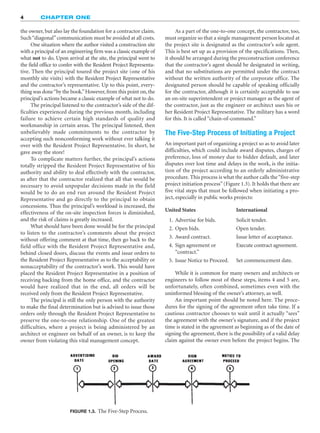
FIGURE 1.3. The Five-Step Process.
United States International
1. Advertise for bids. Solicit tender.
2. Open bids. Open tender.
3. Award contract. Issue letter of acceptance.
4. Sign agreement or
“contract.”
Execute contract agreement.
5. Issue Notice to Proceed. Set commencement date.
the owner, but also lay the foundation for a contractor claim.
Such“diagonal”communication must be avoided at all costs.
One situation where the author visited a construction site
with a principal of an engineering firm was a classic example of
what not to do. Upon arrival at the site, the principal went to
the field office to confer with the Resident Project Representa-
tive. Then the principal toured the project site (one of his
monthly site visits) with the Resident Project Representative
and the contractor’s representative. Up to this point, every-
thing was done“by the book.”However, from this point on, the
principal’s actions became a classic example of what not to do.
The principal listened to the contractor’s side of the dif-
ficulties experienced during the previous month, including
failure to achieve certain high standards of quality and
workmanship in certain areas. The principal listened, then
unbelievably made commitments to the contractor by
accepting such nonconforming work without ever talking it
over with the Resident Project Representative. In short, he
gave away the store!
To complicate matters further, the principal’s actions
totally stripped the Resident Project Representative of his
authority and ability to deal effectively with the contractor,
as after that the contractor realized that all that would be
necessary to avoid unpopular decisions made in the field
would be to do an end run around the Resident Project
Representative and go directly to the principal to obtain
concessions. Thus the principal’s workload is increased, the
effectiveness of the on-site inspection forces is diminished,
and the risk of claims is greatly increased.
What should have been done would be for the principal
to listen to the contractor’s comments about the project
without offering comment at that time, then go back to the
field office with the Resident Project Representative and,
behind closed doors, discuss the events and issue orders to
the Resident Project Representative as to the acceptability or
nonacceptability of the contractor’s work. This would have
placed the Resident Project Representative in a position of
receiving backing from the home office, and the contractor
would have realized that in the end, all orders will be
received only from the Resident Project Representative.
The principal is still the only person with the authority
to make the final determination but is advised to issue those
orders only through the Resident Project Representative to
preserve the one-to-one relationship. One of the greatest
difficulties, where a project is being administered by an
architect or engineer on behalf of an owner, is to keep the
owner from violating this vital management concept.
As a part of the one-to-one concept, the contractor, too,
must organize so that a single management person located at
the project site is designated as the contractor’s sole agent.
This is best set up as a provision of the specifications. Then,
it should be arranged during the preconstruction conference
that the contractor’s agent should be designated in writing,
and that no substitutions are permitted under the contract
without the written authority of the corporate office. The
designated person should be capable of speaking officially
for the contractor, although it is certainly acceptable to use
an on-site superintendent or project manager as the agent of
the contractor, just as the engineer or architect uses his or
her Resident Project Representative. The military has a word
for this. It is called “chain-of-command.”
The Five-Step Process of Initiating a Project
An important part of organizing a project so as to avoid later
difficulties, which could include award disputes, charges of
preference, loss of money due to bidder default, and later
disputes over lost time and delays in the work, is the initia-
tion of the project according to an orderly administrative
procedure. This process is what the author calls the“five-step
project initiation process”(Figure 1.3). It holds that there are
five vital steps that must be followed when initiating a pro-
ject, especially in public works projects:
While it is common for many owners and architects or
engineers to follow most of these steps, items 4 and 5 are,
unfortunately, often combined, sometimes even with the
uninformed blessing of the owner’s attorney, as well.
An important point should be noted here. The proce-
dures for the signing of the agreement often take time. If a
cautious contractor chooses to wait until it actually “sees”
the agreement with the owner’s signature, and if the project
time is stated in the agreement as beginning as of the date of
signing the agreement, there is the possibility of a valid delay
claim against the owner even before the project begins. The
The Project Delivery System 5
contractor can rightfully claim that (1) it could not start
until a signed contract was received, (2) the time lost in
receiving the signed document was part of its construction
time, and (3) it should be compensated with an extension of
project time to cover the days lost while waiting for a signed
agreement.
Throughout the book references will be made to the
five-step process and partial diagrams will retain the identi-
fication numbers in the foregoing list to identify any of the
five tasks listed.
CONTROL OF QUALITY
IN CONSTRUCTION
Without definition, the term quality control in construc-
tion can have several meanings. To be sure, the actual
quality of construction depends largely upon the control of
the construction itself, thus involving the contractor to a
great extent. What constitutes quality control and quality
assurance appears to be the subject of dispute by some. For
example, checking the placement of reinforcing steel in
concrete formwork may be considered as quality control if
the contractor does it and as quality assurance if the owner
observes or verifies that it has been done; yet the physical
act of checking this work is exactly the same in either case.
Whether the subject is called quality control or quality
assurance, the function performed is essentially that which
has been recognized over the years as being construction
inspection and testing of materials and workmanship to see
that the work meets the requirements of the drawings and
specifications. Inspection takes many forms, and its respon-
sibilities vary somewhat depending upon the intended
inspection objective. As an example, an inspector in the
employ of the local building official is principally concerned
with the safety and integrity of the structure being built and
whether it meets the local building code requirements. Qual-
ity of workmanship or aesthetics is largely beyond the code
inspector’s responsibility and, because his or her salary is
paid by the public, quality of workmanship is, to a great
extent, left to the owner to control, using the owner’s, con-
tractor’s, or designer’s personnel. However, inspection by the
owner’s representative is intended to include concern not
only for the structural integrity and safety of the structure,
but also for the quality of workmanship, selection of materi-
als being used, aesthetic values, and similar matters involv-
ing compliance with the provisions of the contract plans and
specifications.
ORGANIZATIONAL
STRUCTURE OF A
CONSTRUCTION PROJECT
There is no single organization chart that will remotely
approximate the organizational structure of the field
forces of the owner, the design organization, or the con-
tractor on all projects. Before the internal structure of any
of the principals to a construction contract can be exam-
ined, some understanding of the several basic types of
contractual relationships must be gained. Of the several
types of contractual relationships frequently encountered
in construction, four of the principal types are:
1. Traditional architect/engineer (A/E) contract
2. Design/construction manager (D/CM) contract
3. Professional construction manager (PCM) contract
4. Design–build contract (similar to turnkey construction)
Under the provisions of the traditional architect/
engineer contract illustrated in Figure 1.1, the owner
usually engages the services of an architect/engineer to
perform planning and design services, including prepara-
tion of plans, specifications, and estimates. Professional
services of the architect/engineer during the construction
are generally limited to performance of intermittent field
visitations and certain contract administration functions
such as review of the contractor’s payment requests, review
of shop drawings, evaluation of contractor claims, inter-
pretation of plans and specifications during construction,
change order requests, and final inspection.
A design/construction manager contract, illustrated in
Figure 1.4, is quite similar to the traditional A/E contract
with the exception that the architect/engineer’s project man-
ager is fully responsible to the owner during both the design
and planning phases as well as the entire construction phase
to provide for all project needs. This includes all scheduling,
cost control, quality control, long-lead purchasing, letting of
single or multiple contracts, and coordination of the work.
The design/CM responsibilities do not terminate until final
acceptance of the completed project by the owner.
These responsibilities include the examination of cost-
saving alternatives during both the design and construction
phases of the project and the authority to require the design
or construction changes necessary to accomplish the owner’s
objectives.
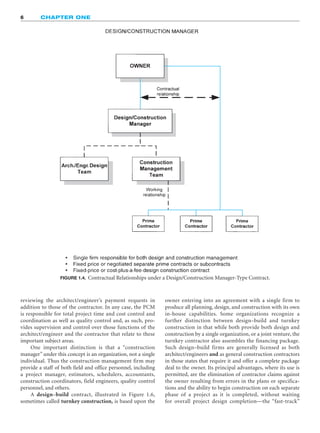
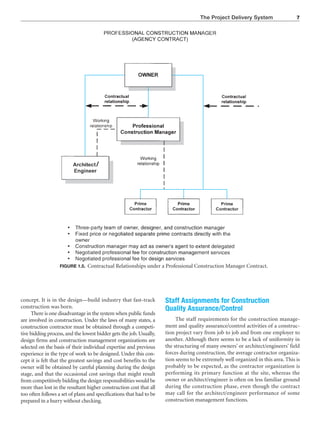
A professional construction management (PCM) con-
tract is based upon a concept pioneered several years ago by
the General Services Administration of the federal govern-
ment, and for a time was used extensively by that agency for
the construction of public buildings. Although the functions
performed by the professional construction manager may be
no different than those of a design firm doing construction
management, the responsibilities and contractual status are
significantly different. Under the professional construction
manager (PCM) concept, illustrated in Figure 1.5, the owner
engages a construction management firm under a separate
contract in addition to a conventional architect/engineer
and construction contractor contract. Thus, instead of only
two contracts for a project, the owner has actually executed
three. In keeping with the principles of this concept, the
professional construction management firm performs no
design or construction with its own forces, but acts solely in
the capacity of an owner’s representative during the life of
the project. In many cases, the PCM is responsible for
6 CHAPTER ONE
FIGURE 1.4. Contractual Relationships under a Design/Construction Manager-Type Contract.
reviewing the architect/engineer’s payment requests in
addition to those of the contractor. In any case, the PCM
is responsible for total project time and cost control and
coordination as well as quality control and, as such, pro-
vides supervision and control over those functions of the
architect/engineer and the contractor that relate to these
important subject areas.
One important distinction is that a “construction
manager” under this concept is an organization, not a single
individual. Thus the construction management firm may
provide a staff of both field and office personnel, including
a project manager, estimators, schedulers, accountants,
construction coordinators, field engineers, quality control
personnel, and others.
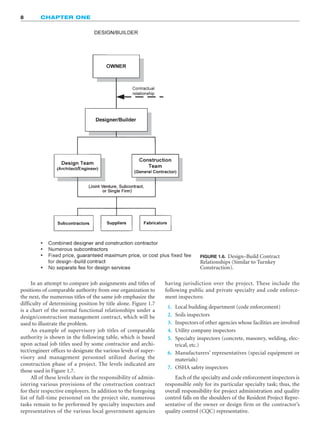
A design–build contract, illustrated in Figure 1.6,
sometimes called turnkey construction, is based upon the
owner entering into an agreement with a single firm to
produce all planning, design, and construction with its own
in-house capabilities. Some organizations recognize a
further distinction between design–build and turnkey
construction in that while both provide both design and
construction by a single organization, or a joint venture, the
turnkey contractor also assembles the financing package.
Such design–build firms are generally licensed as both
architect/engineers and as general construction contractors
in those states that require it and offer a complete package
deal to the owner. Its principal advantages, where its use is
permitted, are the elimination of contractor claims against
the owner resulting from errors in the plans or specifica-
tions and the ability to begin construction on each separate
phase of a project as it is completed, without waiting
for overall project design completion—the “fast-track”
The Project Delivery System 7
FIGURE 1.5. Contractual Relationships under a Professional Construction Manager Contract.
concept. It is in the design—build industry that fast-track
construction was born.
There is one disadvantage in the system when public funds
are involved in construction. Under the laws of many states, a
construction contractor must be obtained through a competi-
tive bidding process, and the lowest bidder gets the job. Usually,
design firms and construction management organizations are
selected on the basis of their individual expertise and previous
experience in the type of work to be designed. Under this con-
cept it is felt that the greatest savings and cost benefits to the
owner will be obtained by careful planning during the design
stage, and that the occasional cost savings that might result
from competitively bidding the design responsibilities would be
more than lost in the resultant higher construction cost that all
too often follows a set of plans and specifications that had to be
prepared in a hurry without checking.
Staff Assignments for Construction
Quality Assurance/Control
The staff requirements for the construction manage-
ment and quality assurance/control activities of a construc-
tion project vary from job to job and from one employer to
another. Although there seems to be a lack of uniformity in
the structuring of many owners’ or architect/engineers’ field
forces during construction, the average contractor organiza-
tion seems to be extremely well organized in this area. This is
probably to be expected, as the contractor organization is
performing its primary function at the site, whereas the
owner or architect/engineer is often on less familiar ground
during the construction phase, even though the contract
may call for the architect/engineer performance of some
construction management functions.
8 CHAPTER ONE
FIGURE 1.6. Design–Build Contract
Relationships (Similar to Turnkey
Construction).
In an attempt to compare job assignments and titles of
positions of comparable authority from one organization to
the next, the numerous titles of the same job emphasize the
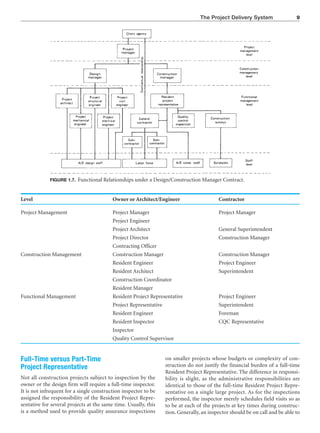
difficulty of determining position by title alone. Figure 1.7
is a chart of the normal functional relationships under a
design/construction management contract, which will be
used to illustrate the problem.
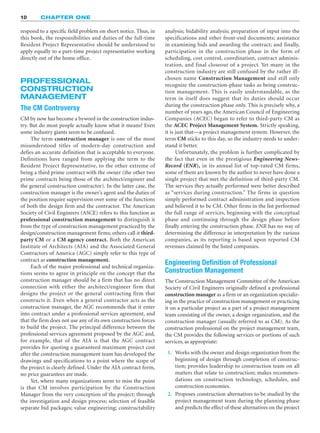
An example of supervisory job titles of comparable
authority is shown in the following table, which is based
upon actual job titles used by some contractor and archi-
tect/engineer offices to designate the various levels of super-
visory and management personnel utilized during the
construction phase of a project. The levels indicated are
those used in Figure 1.7.
All of these levels share in the responsibility of admin-
istering various provisions of the construction contract
for their respective employers. In addition to the foregoing
list of full-time personnel on the project site, numerous
tasks remain to be performed by specialty inspectors and
representatives of the various local government agencies
having jurisdiction over the project. These include the
following public and private specialty and code enforce-
ment inspectors:
1. Local building department (code enforcement)
2. Soils inspectors
3. Inspectors of other agencies whose facilities are involved
4. Utility company inspectors
5. Specialty inspectors (concrete, masonry, welding, elec-
trical, etc.)
6. Manufacturers’ representatives (special equipment or
materials)
7. OSHA safety inspectors
Each of the specialty and code enforcement inspectors is
responsible only for its particular specialty task; thus, the
overall responsibility for project administration and quality
control falls on the shoulders of the Resident Project Repre-
sentative of the owner or design firm or the contractor’s
quality control (CQC) representative.
The Project Delivery System 9
Level Owner or Architect/Engineer Contractor
Project Management Project Manager Project Manager
Project Engineer
Project Architect General Superintendent
Project Director Construction Manager
Contracting Officer
Construction Management Construction Manager Construction Manager
Resident Engineer Project Engineer
Resident Architect Superintendent
Construction Coordinator
Resident Manager
Functional Management Resident Project Representative Project Engineer
Project Representative Superintendent
Resident Engineer Foreman
Resident Inspector CQC Representative
Inspector
Quality Control Supervisor
FIGURE 1.7. Functional Relationships under a Design/Construction Manager Contract.
Full-Time versus Part-Time
Project Representative
Not all construction projects subject to inspection by the
owner or the design firm will require a full-time inspector.
It is not infrequent for a single construction inspector to be
assigned the responsibility of the Resident Project Repre-
sentative for several projects at the same time. Usually, this
is a method used to provide quality assurance inspections
on smaller projects whose budgets or complexity of con-
struction do not justify the financial burden of a full-time
Resident Project Representative. The difference in responsi-
bility is slight, as the administrative responsibilities are
identical to those of the full-time Resident Project Repre-
sentative on a single large project. As for the inspections
performed, the inspector merely schedules field visits so as
to be at each of the projects at key times during construc-
tion. Generally, an inspector should be on call and be able to
respond to a specific field problem on short notice. Thus, in
this book, the responsibilities and duties of the full-time
Resident Project Representative should be understood to
apply equally to a part-time project representative working
directly out of the home office.
PROFESSIONAL
CONSTRUCTION
MANAGEMENT
The CM Controversy
CM by now has become a byword in the construction indus-
try. But do most people actually know what it means? Even
some industry giants seem to be confused.
The term construction manager is one of the most
misunderstood titles of modern-day construction and
defies an accurate definition that is acceptable to everyone.
Definitions have ranged from applying the term to the
Resident Project Representative, to the other extreme of
being a third prime contract with the owner (the other two
prime contracts being those of the architect/engineer and
the general construction contractor). In the latter case, the
construction manager is the owner’s agent and the duties of
the position require supervision over some of the functions
of both the design firm and the contractor. The American
Society of Civil Engineers (ASCE) refers to this function as
professional construction management to distinguish it
from the type of construction management practiced by the
design/construction management firms; others call it third-
party CM or a CM agency contract. Both the American
Institute of Architects (AIA) and the Associated General
Contractors of America (AGC) simply refer to this type of
contract as construction management.
Each of the major professional and technical organiza-
tions seems to agree in principle on the concept that the
construction manager should be a firm that has no direct
connection with either the architect/engineer firm that
designs the project or the general contracting firm that
constructs it. Even when a general contractor acts as the
construction manager, the AGC recommends that it enter
into contract under a professional services agreement, and
that the firm does not use any of its own construction forces
to build the project. The principal difference between the
professional services agreement proposed by the AGC and,
for example, that of the AIA is that the AGC contract
provides for quoting a guaranteed maximum project cost
after the construction management team has developed the
drawings and specifications to a point where the scope of
the project is clearly defined. Under the AIA contract form,
no price guarantees are made.
Yet, where many organizations seem to miss the point
is that CM involves participation by the Construction
Manager from the very conception of the project; through
the investigation and design process; selection of feasible
separate bid packages; value engineering; constructability
10 CHAPTER ONE
analysis; bidability analysis; preparation of input into the
specifications and other front-end documents; assistance
in examining bids and awarding the contract; and finally,
participation in the construction phase in the form of
scheduling, cost control, coordination, contract adminis-
tration, and final closeout of a project. Yet many in the
construction industry are still confused by the rather ill-
chosen name Construction Management and still only
recognize the construction-phase tasks as being construc-
tion management. This is easily understandable, as the
term in itself does suggest that its duties should occur
during the construction phase only. This is precisely why, a
number of years ago, the American Council of Engineering
Companies (ACEC) began to refer to third-party CM as
the ACEC Project Management System. Strictly speaking,
it is just that—a project management system. However, the
term CM sticks to this day, so the industry needs to under-
stand it better.
Unfortunately, the problem is further complicated by
the fact that even in the prestigious Engineering News-
Record (ENR), in its annual list of top-rated CM firms,
some of them are known by the author to never have done a
single project that met the definition of third-party CM.
The services they actually performed were better described
as “services during construction.” The firms in question
simply performed contract administration and inspection
and believed it to be CM. Other firms in the list performed
the full range of services, beginning with the conceptual
phase and continuing through the design phase before
finally entering the construction phase. ENR has no way of
determining the difference in interpretation by the various
companies, as its reporting is based upon reported CM
revenues claimed by the listed companies.
Engineering Definition of Professional
Construction Management
The Construction Management Committee of the American
Society of Civil Engineers originally defined a professional
construction manager as a firm or an organization specializ-
ing in the practice of construction management or practicing
it on a particular project as a part of a project management
team consisting of the owner, a design organization, and the
construction manager (usually referred to as CM). As the
construction professional on the project management team,
the CM provides the following services or portions of such
services, as appropriate:
1. Works with the owner and design organization from the
beginning of design through completion of construc-
tion; provides leadership to construction team on all
matters that relate to construction; makes recommen-
dations on construction technology, schedules, and
construction economies.
2. Proposes construction alternatives to be studied by the
project management team during the planning phase
and predicts the effect of these alternatives on the project
The Project Delivery System 11
cost and schedule; once the project budget, schedule, and
quality requirements have been established, the CM
monitors subsequent development of the project to see
that those targets are not exceeded without the knowl-
edge of the owner.
3. Advises on and coordinates procurement of material
and equipment and the work of all the construction
contractors; monitors and inspects for conformity to
design requirements; provides current cost and progress
information as the work proceeds; and performs other
construction-related services as required by the owner.
4. In keeping with the nonadversary relationship of the
team members, the CM does not normally perform
significant design or construction work with its own
forces. (In a more recent action, the ASCE Committee
on Construction Management also accepts the concept
of CM being performed by the firm responsible for
design.)
The typical functional relationships associated with a
professional construction management contract are best
shown in Figure 1.8, which was prepared by the General
Services Administration (GSA), Public Buildings Service of
the U.S. federal government.
Fast-Track Construction
Frequently, a construction management contract is
encountered that requires the letting and administering of
multiple construction contracts for the same project, with
each let at different times during the life of the project.
Such staggered letting of construction contracts on the
same project is referred to as fast-track contracting, and
its principal objective is to shorten construction time for
the overall project by starting some portions of the work
as soon as it has been designed (Chapter 13), even though
other portions of the project have not yet been designed. It
is a risky process, depending heavily upon the careful
selection of the various separate bid packages and the
ability to schedule and control the design effort. Without
this, fast-track can become the most costly method ever
designed for completing a project late. Many times, such
contracts also require purchase of special equipment or
materials long before a contract has been let to install
them. This is referred to as long-lead procurement, and
such early purchases, along with the accompanying expe-
diting and scheduling, is one of the functions required
to be performed by the CM team. The Resident Project
Representative is a vital link in the successful operation of
a construction management contract and will be called
upon to assist in many of the tasks described. When utiliz-
ing the fast-track process, the services of a construction
management firm are essential, as the skills and experience
required to complete a fast-track project successfully are
seldom possessed by the design firm. On the other hand,
if a single prime (general) contractor is used to build a
project, the use of a construction management firm may
actually be redundant, as many of the tasks that the CM is
being paid for will ordinarily be done by the general
contractor.
FIGURE 1.8. Functional Relationships under a General Services Administration Professional Construction Management Contract.
DESIGN–BUILD CONTRACTS
The design–build concept, as originally conceived, was based
on the concept that a single firm had the in-house staff and
expertise to perform all planning, design, and construction
tasks. Later, increased interest in the concept had engineers,
architects, and conventional contractors seeking to compete
with the original design–build firms to meet the growing
interest by owners in the project delivery process.
Under the current approach, instead of limiting
design–build to firms with in-house capability in both areas,
the field has now been opened up to permit contracts with
engineers who subcontract the construction portion to a
contracting firm, with construction contractors that sub-
contract design services to an engineer or architect, and with
engineers and architects in joint venture with contractor
firms.
There are basically three types of design–build firms
today: contractor-led, designer-led, and single firm.
Contractor-led firms tend to dominate due to their experi-
ence in estimating, purchasing, cost control, and construc-
tion supervision, not to mention the contractor’s better
financial backing and ability to manage risk.
Design–Build Documents
In recognition of these relationships, a special group of stan-
dard contract documents for design–build projects was
prepared by the Engineers Joint Contract Documents
Committee (EJCDC).1 They are available from ASCE, NSPE,
AGC, or ACEC.2 The documents, and an accompanying
guide on how to use them, are probably the most compre-
hensive set of standard documents now available to those
who work with design–build projects.
The special design–build documents cover a variety of
situations—for example, the relationship between owner
and design-builder, which includes both general condi-
tions and two agreements (one for a stipulated sum con-
tract, another for a cost-plus contract that has a provision
for guaranteed maximum price). For design-builders
without a professional in-house staff to perform design
services, EJCDC has prepared a subagreement to be used
by both design-builder and engineer. To cover the rela-
tionship between design-builders and construction sub-
contractors, another document covers general conditions
and two subagreements (one for stipulated price, the other
for cost-plus).
Among the highlights of the new documents are descrip-
tions of the selection process; scope definition; differentiation
12 CHAPTER ONE
2The ACEC referred to here is the American Council of Engineering
Companies, not to be confused with the Association of Consulting
Engineers of Canada, which shares the same acronym.
of design and construction work in several areas (such as pro-
viding for a general warranty and guarantee for construction
work as well as a standard of care for design work); a dispute
resolution process; responsibilities for subsurface conditions;
remedies in the event an engineer is asked by design-builders
to compromise an engineer’s legal and professional responsi-
bilities; and communications among engineer, design-
builder, and owner.
An integral part of the new group of documents is
a separate guide describing their use. The guide includes a
commentary, a guide for preparing requests for proposals,
a suggested proposal form, and a “how-to” guide on the
preparation of supplementary conditions.
Because many owners don’t have the in-house expertise
to prepare proposal documents (or review design-builders’
design submittals, observe the quality of construction, and
so forth), EJCDC is now preparing another document for
use by the owner (and an owner’s consultant) to cover such
services.
Design–Build for Public Projects
While quite popular in the private sector, some public agen-
cies find that the process still presents legal hurdles resulting
from alleged conflict between the design professional selec-
tion process under the Brooks law and similar local regula-
tions and the competitive bid process traditionally used for
contractor award. At the federal level, however, legislation
enacted in 1997 makes it possible to award design–build
contracts under specified conditions.
The principal barrier to the use of the design–build
process in the public sector lies in the difference between the
procurement laws governing the selection process for archi-
tects and engineers versus that for construction contractors.
Most state laws require the selection of architect/engineers
on the basis of the most qualified, with the price set by nego-
tiation. Construction contractors, on the other hand, must
be selected on the basis of sealed bids, with award going to
the lowest responsible bidder. As it can be seen, there is an
immediate conflict when attempts are made to contract for
both design and construction under the same contract. To
further complicate matters, many states require bidders to
list subcontractors in their bids, a near impossible task in a
design–build contract, as the project has not yet been
designed.
Federal Design–Build Contracts 3
Effective October 10, 1997, the federal government was
authorized to enter into design–build contracts using a
two-phase design–build selection process authorized by
10 U.S.C. 2305a and 41 U.S.C. 253m. Under those provi-
sions, a two-phase design–build selection process may be
3c.f. 48 CFR Ch. 1 (10-1-97 edition) Subpart 36.3—Two-Phase Design–Build
Selection Procedure.
1EJCDC is a multidisciplinary group made up of the American Society of
Civil Engineers (ASCE), the National Society of Professional Engineers
(NSPE), the American Council of Engineering Companies (ACEC),
and the Associated General Contractors of America (AGC).
The Project Delivery System 13
used when a contracting officer determines that the method
is appropriate based upon the following considerations:
䊉 At least three, but not more than five offers are considered
䊉 Design work must be performed before developing price
or cost proposals, and offerors will incur a considerable
expense in preparing offers.
Proposals must be evaluated in phase one to determine
who may submit proposals for phase two. The phase one
contract must be awarded using competitive negotiation.
After evaluating phase one proposals, the contracting officer
must select the most highly qualified offerors, and only those
offerors may submit a phase two proposal.
Phase two involves submittal of a cost proposal which is
subject to consideration for technical evaluation factors,
including design concepts, management approach, key per-
sonnel, and proposed technical solutions. It may take some
time before the lawyers work out all of the wrinkles in this
latest adaptation of the original two-step process, but it
appears to offer considerable flexibility in combining the
concept of competitive price bidding along with an equitable
architect/engineer selection process that appears to be
acceptable to the design community.
Legal Barriers for State and Local
Public Projects
Due to the growing popularity of the design–build con-
cept, the potential conflict between laws of the various
states governing selection of design professionals as
opposed to the competitive bidding process used in public
works for award of a construction contract is being reex-
amined in many states. Many states are revising their
statutes to permit the award of a design–build contract
without violating the law.
The following summary was abstracted from anAmerican
Bar Association review of design–build contracts under the
various state and local procurement laws as they existed in
1996.4 State procurement laws, with respect to design–build,
can be grouped into four categories. In some cases state laws
are not the same for all agencies within the state, thus some
states will fall into more than one of the following categories:
1. Laws that expressly prohibit design–build by any public
agency (4 states)
2. Laws that pose obstacles to design–build by some public
agencies (26 states)
3. Laws that pose no obstacles to design–build, even though
design–build is not expressly permissible (22 states)
4. Laws that expressly allow design–build for all or some
types of public projects (26 states)
Very few state statutes expressly prohibit the use of
design–build, such as by requiring that a project be split into
separate design and construction phases and requiring the
preparation of plans and specifications before bids are
solicited. Other barriers to using the design–build method
are laws that prohibit the award of a single construction
contract to a general contractor by requiring multi-prime
contracts, a practice widely used on public projects in the
Northeast. In that instance, laws require the preparation of
separate plans and specifications to allow for separate award
of contracts for any number of trades. If a state agency
cannot award a contract to a single general contractor for
construction, it may also have trouble awarding a single
contract for design and construction.
DEFINITIONS OF INDIVIDUAL
CONSTRUCTION
RESPONSIBILITIES
Local building codes often require intermittent and some-
times “continuous” inspection on certain critical types
of construction, such as structural concrete, structural
masonry, prestressed concrete, structural welding, high-
strength bolting, and similar work to be performed by
special inspectors. The word continuous in this context is
sometimes confusing because there are cases in which
“continuous” is not synonymous with “constant” without a
reasonable interpretation. Work on structural masonry or
concrete work that can be inspected only as it is being
placed requires the constant presence of the inspector.
Placement of forms for concrete or reinforcing for concrete
can fairly be interpreted as requiring continuous monitor-
ing of the work so as to miss nothing, yet would hardly be
interpreted as requiring the inspector’s presence during the
entire time that the steel is being placed. Generally, any
special inspector coming onto the job will be under the
authority of the Resident Project Representative and
should be advised to follow his or her instructions.
Project Manager
Every participating organization on a project has its project
manager. Although the person is sometimes known by dif-
ferent names, the duties remain the same. Whether in the
direct employ of the owner, the design firm, or the contrac-
tor, the project manager (PM) is usually the person responsi-
ble for the management of all phases of the project for his or
her organization. For a design firm, the project manager
controls the scheduling, budgeting, cost control coordina-
tion of design and construction, letting of contracts for the
owner, and is normally the sole contact with the client as a
representative of the design firm.
For the owner, a project manager is similarly responsi-
ble for all phases of a project and may also participate in
architect/engineer selection and is the representative of the
owner in connection with any business concerning the pro-
ject. Where an architect/engineer firm has been engaged for
4“Design–Build Contracts under State and Local Procurement Laws” by
Kenneth M. Roberts, partner in the Construction Group at Schiff Hardin &
Waite in Chicago, and Nancy C. Smith, partner at Nossaman, Guthner,
Knox & Elliot in Los Angeles. American Bar Association, Public Contract
Law Journal, Vol. 25, No. 4, Sept. 1996.
14 CHAPTER ONE
design services only, the owner’s project manager will
provide construction contract administration and may
employ a Resident Project Representative or other on-site
quality control personnel to work under his or her supervi-
sion. Wherever this is the case, the architect/engineer may
still be called upon to review shop drawings for the owner,
and wherever a proposed design change is contemplated, the
architect/engineer of record should always be consulted.
In a contractor’s organization,“Project Manager” is also
a frequently used title, although many very large firms still
use the title “Superintendent” for this function. As the title
implies, the contractor’s project manager is in complete
charge of his or her project for the general contractor. This
particular project manager or superintendent’s responsibili-
ties include coordination of subcontractors, scheduling, cost
control, labor relations, billing, purchasing, expediting, and
numerous other functions related to the project. To the
owner, the PM or superintendent is the general contractor.
Whether referred to as project manager or as superinten-
dent, his or her duties are the same in many contractor
organizations.
Professional Construction Manager
The services performed by the professional construction
manager cover a broad range of activities and, to some
extent, overlap those traditionally performed by both the
architect/engineer and the construction contractor, involv-
ing both the design and construction phases of a project.
A comprehensive construction management contract may
easily cover any if not all of the tasks included within the fol-
lowing six categories:
1. Participation in determining the bidding strategy
involved in a fast-track, multiple-prime-contract pro-
ject so as to avoid conflicts during the letting of the
separate contracts.
2. Design phase review, including review of formal design
submittals, review of contract documents, and overall
constructability analysis.
3. Cost management, including estimates of construction
cost and development of the project budget.
4. Scheduling for all phases of a project, generally incorpo-
rating critical path techniques.
5. Bid opening and evaluation, and assistance in contrac-
tor selection.
6. On-site, construction-phase management to provide
contract administration, inspection, coordination, and
field management.
On-site, construction-phase management may include
coordination of separate contracts, phased construction (fast-
track) contracts, monitoring of individual phases of the work,
adjustment of the work to accommodate changed conditions
or unanticipated interferences, determination of whether
materials and workmanship are in conformance with the
approved contract drawings and specifications, arrangements
for the performance of necessary field and laboratory tests
where required, preparation of change orders and change
proposals, and review of progress payments and recommen-
dations to the owner for payments to the contractors.
The construction manager (CM) may also, in some
contracts, provide certain services that would normally have
been provided by a general contractor, had there been one.
These might well include establishment, maintenance, and
operation of temporary field construction facilities, provi-
sions for site security, cleanup, temporary utilities, and simi-
lar General Conditions items of work. Such items of work
are generally paid for under this type of contract on a
reimbursable basis and are not a part of the construction
manager’s professional fee for services. In certain respects,
the professional construction manager’s responsibilities may
overlap or even preempt those of the contractor and the
architect/engineer under some contracts.
Quality Control Representative
Under the provisions of the construction contracts of
numerous federal agencies, in particular the Corps of Engi-
neers, Naval Facilities Engineering Command, National
Aeronautics and Space Administration, and others, an
inspection concept known as contractor quality control
(CQC) is often implemented. Though not favored by much
of the construction industry, under this system the contrac-
tor must organize and maintain an inspection system within
the organization to assure that the work performed by the
contractor and subcontractor forces conforms to contract
requirements and to make available to the government
adequate records of such inspections. Under the majority of
such plans, as implemented by their respective agencies, a
government representative is stationed on-site to provide
quality assurance inspections. In some cases, the design firm
may be engaged to provide quality assurance inspection in
addition to contractor quality control. In such cases, the
design firm may have a full-time Resident Project Represen-
tative and supporting staff on-site to perform this function.
Resident Project Representative; Resident
Engineer; Resident Inspector; Resident
Manager; Project Representative
These titles usually refer to an on-site full-time project repre-
sentative to whom has been delegated the authority and
responsibility of administering the field operations of a con-
struction project as the representative of the owner or the
design firm. On some occasions, the inspection needs of a
particular project may require that the Resident Project Repre-
sentative be a qualified, registered professional engineer; in
other cases, a highly qualified nonregistered engineer may be
desired. Wherever a nonregistered engineer is permissible, it is
often equally acceptable to use an experienced construction
inspector for this purpose. The American Institute of Archi-
tects, in its documents, describes this individual as the “full-
time project representative,” whereas the Engineers Joint
The Project Delivery System 15
Contract Documents Committee uses the term “Resident
Project Representative.”In this book the term Resident Project
Representative is used to stand collectively for resident engi-
neer, resident inspector, full-time project representative,
resident manager, and project representative.
Inspector; Field Engineer; Quality
Assurance Supervisor
These titles usually refer to a staff-level, on-site representative
of the owner, design firm, or contractor who has the respon-
sibility of observing the work being performed and of report-
ing any variations from the plans and specifications or other
contract documents. In addition, the inspector should call to
the attention of the quality control supervisor or Resident
Project Representative any unforeseen field conditions in
time for remedial measures to be taken without creating
delays in the work or changes in existing work to correct a
problem. The inspector is the on-site eyes and ears of his or
her employer, and although not empowered to make field
changes that depart from the plans and specifications, the
inspector should be capable of evaluating field problems and
submitting competent recommendations to his or her super-
visor. In that sense, the inspector is a logical part of the design
process and a valid extension of it. On projects using a Resi-
dent Project Representative, the inspector will normally work
under that person’s direct supervision.
Except for the responsibility for construction field
administration, which is one of the principal functions of the
Resident Project Representative, the inspector’s job is identi-
cal in all respects to that of the Resident Project Representa-
tive. Inspection of construction is an occupation that requires
a highly qualified person with a good working knowledge of
construction practices, construction materials, specifications,
and construction contract provisions. It is not in itself a job
title, as the inspector may be a registered professional engi-
neer or architect, a field engineer, a quality control specialist,
or any of a host of other classifications. In this book the term
inspector will be used to stand collectively for field engineer,
inspector, quality control supervisor, or in some cases, the
Resident Project Representative where the duties referred to
apply to all field representatives on-site, whether full time or
part-time.
Contractor’s Engineering Section
The contractor’s engineering section is an important tool for
assisting the contractor’s management forces in analyzing
construction and engineering problems. Not all construc-
tion companies are set up the same; however, engineering
functions may be set up to operate at three levels:
1. Project level, where responsibility is usually limited to a
single project
2. Area or regional level, where responsibility includes
several projects
3. Main office level
Interaction with the owner’s or architect/engineer’s
Resident Project Representative at the above level is necessary
under a one-to-one relationship or a partnering agreement.
Representative tasks that may be performed by the
contractor’s engineering section may include the following:
1. Estimate and prepare bid proposals
2. Plan and schedule
3. Stay alert to future work prospects
4. Maintain preconstruction liaison with joint venture
partners
5. Review subcontract proposals
6. Prepare budget control estimates
7. Develop construction methods
8. Maintain contract relations
9. Lay out the work
10. Handle requisitioning, scheduling, and expediting
11. Document all work performed
12. Prepare and check payment estimates
13. Document costs and extra work
14. Document subcontract performance and payment
estimates
15. Prepare reports of costs and construction activities
16. Issue progress reports: daily, weekly, monthly
17. Draft contract modifications, change orders, and claims
18. Provide assistance in contract settlements
However lengthy, the list is not exhaustive and is subject
to wide variation depending on the size and structure of the
contractor’s organization. A representative organization of
an engineering department of a small contractor is illus-
trated in Figure 1.9.
DEFINING SCOPE OF WORK
IN A CM CONTRACT
It is important, because of the differences in definition of the
term CM, to clearly define the scope of the services to be
performed in the CM contract with the owner. Without such
definition, there are often claims and disputes between the
architect/engineer as CM and the owner, due to a failure of
the parties to achieve a meeting of the minds, as one party
assumes that the term includes services that the other party
never planned to provide for the basic fee agreed upon.
Construction Administration Task List
It is recommended that all anticipated tasks be listed and
included in any CM contract executed with the owner.
A checklist of some of the tasks that may be involved follows:
Conceptual Phase
Develop conceptual estimates
Develop conceptual schedules
Provide input to program risk analysis
16 CHAPTER ONE
FIGURE 1.9. Typical Organization of an
Engineering Department of a Small-Size
Contractor.
Program Planning Phase
Provide constructability analysis
Identify potential major construction problems
Develop project resource requirements
Inventory available area resources
Assist in development of capital budgets
Assist in development of cash flow projections
Develop parametric estimates and cost budgets
Update preliminary schedule
Develop preliminary project control system
Develop preliminary project management information
system
Develop project safety program
Develop project labor relations program
Assist in development of insurance program
Administer electronic data processing (EDP) services
Design Phase
Oversee overall project planning
Assist in development of project life-cycle costs
Evaluate cost trade-offs
Provide value engineering function
Qualify potential bidders
Procure long-lead-time items
Finalize bid work packages
Finalize prequalified contractor lists
Finalize project schedules
Finalize physical layout of construction areas
Finalize project control systems and management infor-
mation systems
Assist in obtaining required permits and licenses
Provide input and review of contract documents
The Project Delivery System 17
Construction Phase
Develop and administer area transportation system
Administer project EEO program
Enforce project safety program
Coordinate labor relations
Receive and evaluate bids and award prime contracts
Manage and perform general conditions tasks
Implement time- and cost-control systems
Manage daily construction activities of the owner or
architect/engineer
Administer prime contracts
Receive, review, and approve contractor’s requests for
progress payments
Administer contract changes and claims
Quality assurance and inspection
Interpret contract documents
Closeout and Startup Phase
Oversee project closeout
Oversee systems validation, testing, and startup
RESPONSIBILITY FOR
COORDINATION OF
THE TRADES
Construction projects of any size usually require the efforts of
several specialty contractors. Usually, of course, such work is
performed under subcontract with a general contractor who
is responsible for the coordination of all of the subcontractors.
A large number of claims involving changes, delays, and
even site conditions result from coordination problems. As
a result, the courts have been asked to determine who is
responsible, as well as the scope of that responsibility.
Changes in the methods of construction contracting, such as
design–build and multiple-prime contracts, have made the
problem worse and increased the volume of litigation.
Owner’s Responsibility
Traditionally, the owner has had no responsibility for coor-
dination of subcontractors. Scheduling and coordination of
the trades have traditionally been the exclusive responsibility
of the general contractor, and most standard construction
contracts are clear on this issue. The owner’s obligation is
simply to avoid any active interference with the work of the
various contractors.
As long as a single general contractor is used to construct
a project, this will still hold true. However, if the owner
awards more than one prime contract or elects to perform
some of the work with its own forces, the owner inherits
coordination responsibilities.
On a multiple-prime project, the owner is responsible
for coordinating the various trade contractors with whom it
has contracted in much the same way as a general contractor
must coordinate its subcontractors. Few owners are equipped
to do this, which has created the need for the professional
construction manager.
Less apparent to owners is the fact that if they perform
even a small portion of the work themselves, they have an
implied obligation to coordinate the work in order to avoid
economic harm to the prime contractors. Failure to meet
this obligation can be expensive for the owners, as payment
of delay damages will quickly offset the savings realized from
performing the work with one’s own forces.
On traditional projects, the project architect/engineer
is not responsible for coordinating the various trades. The
architect/engineer may be called upon to interpret the
requirements of the contract documents to resolve scope-
of-work problems but will not become involved in the
actual scheduling or coordinating of the work itself.
On a multiple-prime project, however, the owner’s repre-
sentative (usually called the construction manager) plays a very
different role. In the absence of a general contractor, the owner
must rely on the construction manager to provide overall
scheduling and coordination of the trade contractors.In such a
case, if delays due to improper coordination harm one of the
contractors, the construction manager may be held liable.
The construction manager may be held directly liable
to the contractor on a theory of negligence. More com-
monly, the contractor will sue the owner with whom it has
contracted. The owner may then seek indemnification
from the construction manager, arguing that any liability
to the contractor is the result of the construction manager’s
failure to perform its duties properly, as established in the
owner–construction manager agreement. This is part of
what the owner pays for in awarding a lump sum contract
to a single general contractor
THE PARTNERING CONCEPT5
The Partnering concept is not a new way of doing business;
some have always conducted themselves in this manner. It
is going back to the way people used to do business when
their word was their bond and people accepted responsibil-
ity. Partnering is not a contract, but a recognition that
every contract includes an implied covenant of good faith.
While the contract establishes the legal relationships, the
Partnering process is designed to establish working relation-
ships among the parties through a mutually developed,
formal strategy of commitment and communication. It
attempts to create an environment where trust and teamwork
prevent disputes, foster a cooperative bond to everyone’s
benefit, and facilitate the completion of a successful project.
For the most effective results, parties involved in the
contract should conduct a Partnering workshop, ideally at
the early stages of the contract. The sole agenda of the work-
shop is to establish and begin implementing the partnering
process. This forum produces the opportunity to initiate the
key elements of Partnering.
5Partnering, a Concept for Success, © Copyright AGC of America, 1991,
The Associated General Contractors of America, 1957 E. Street NW,
Washington, DC, 2006.
18 CHAPTER ONE
The key elements of Partnering include the following:
䊉 Commitment. Commitment to Partnering must come
from top management. The jointly developed Partnering
charter is not a contract, but a symbol of commitment.
䊉 Equity. All of the parties’ interests need to be considered
in creating mutual goals, and there must be a commit-
ment to satisfying each of the parties’ requirements for a
successful project by utilizing win-win thinking.
䊉 Trust. Teamwork is not possible where there is cynicism
about others’ motives. Through the development of per-
sonal relationships and communication about each of the
parties’ risks and goals, there will be better understand-
ing. Along with understanding comes trust, and with
trust comes the possibility for a cooperative relationship.
䊉 Development of Mutual Goals/Objectives. At a
Partnering workshop the parties should identify all
respective goals for the project in which their interests
overlap. These jointly developed and mutually agreed
upon goals may include achieving value engineering sav-
ings, meeting the financial goals of each party, limiting
cost growth, limiting review periods for contract submit-
tals, early completion, no lost time because of injuries,
minimizing paperwork generated for the purpose of case
building or posturing, no litigation, or other goals
specific to the nature of the project.
䊉 Implementation. The parties should jointly develop
strategies for implementing their mutual goals and the
mechanisms for solving problems.
䊉 Continuous Evaluation. In order to assure effective
implementation, the parties need to agree to a plan for
periodic joint evaluation based on the mutually agreed
upon goals to assure that the plan is proceeding as
intended and that all of the parties are carrying their
share of the load.
䊉 Timely Responsiveness. Timely communication and
decision making not only save money, but also can
keep a problem from growing into a dispute. In the
Partnering workshop the parties must develop mecha-
nisms for encouraging rapid issue resolution, including
the escalation of unresolved issues to the next level of
management.
Partnering Benefits
For all of the parties involved in a project, Partnering is a
high-leveraged effort. It may require increased staff and man-
agement time up front, but the benefits accrue in a more har-
monious, less confrontational process, and at completion a
successful project can be realized without litigation and
claims. The Partnering process empowers the project
personnel of each of the parties with the freedom and
authority to accept responsibility—to do their jobs by
encouraging decision making and problem solving at the
lowest possible level of authority. It encourages everyone to
take pride in their efforts and tells them it’s OK to get along
with each other.
Partnering is also an opportunity for public sector
contracting, where the open competitive-bid process ordi-
narily keeps the parties at arm’s length prior to award, to
achieve some of the benefits of closer personal contact that
are possible in negotiated or design–build contracts.
Potential Problems
Partnering requires that all parties to a contract commit
themselves to the concept. The Partnering concept is endan-
gered if there is no true commitment.
Those people who have been conditioned in an adversar-
ial environment may be uncomfortable with the perceived
risk in trusting. Some may even find it impossible to adapt
their thinking to a relationship based on trust. Giving only lip
service to the term or treating the concept as a fad is not true
commitment.
For some, changing the myopic attitude that leads to
thinking that it is necessary to win every battle, every day, at
the other parties’ expense will be very difficult. Win-win
thinking is an essential element for success in this process. It
must be remembered that the win-win concept, after all, is
based upon the acceptance of the concept of compromise
between the parties.
The Partnering Process
In the words of the Associated General Contractors of
America,“The partnering process involves the empowerment
of the project personnel of all participating organizations
with the freedom and authority to accept responsibility—to
do their jobs by encouraging decision making and problem
solving at the lowest possible level of authority.” This, of
course, involves a major commitment by top management of
all participating organizations to delegate such authority to
the lowest possible management level at the site, such as the
owner/engineer’s Resident Project Representative and the
contractor’s project manager or superintendent.
The Partnering process emphasizes the need to educate
your organization to the facts about the concept. It is
important to make Partnering intentions clear from the
beginning and obtain a commitment from top management
from the start.
The Partnering workshop must involve the following:
1. Creation of a Partnering charter
2. Development of an issue-resolution process
3. Development of a joint evaluation process
4. Discussion of individual roles and concerns
5. Presentation of a facilitated workshop
For success of the Partnering concept, it is necessary to
provide for periodic evaluation. Occasional escalation of an
issue may surface, of course, but the process is structured to
accommodate such problems. In the end, final evaluations
must be made, and refinements may be considered to
improve future Partnering contracts.
The Project Delivery System 19
FIGURE 1.10. Example of Specifications Provision for
Partnering from a DOT Specification.
Closing
Many of us have witnessed the construction industry evolve
into an adversarial, confrontational business where the
parties’ energies are misdirected away from the ultimate goal
of constructing a quality product, on time, and within
budget. Partnering changes mind-sets. It helps everyone in
the construction process to redirect his or her energies and
to focus on the real issues associated with achieving our
ultimate objective.
Specifying Partnering
In the specifications, the owner needs to state its intention
to encourage the formation of a cohesive Partnering rela-
tionship with the contractor and its subcontractors. This
Partnering relationship must be structured to draw on the
strengths of each organization to identify and achieve recip-
rocal goals. The objectives are effective and efficient con-
tract performance, intended to achieve completion within
budget, on schedule, and in accordance with plans and
specifications.
An example of a provision for partnering in a Depart-
ment of Transportation (DOT) specification is illustrated in
Figure 1.10.
The Partnering relationship must be bilateral in
makeup, and participation must be totally voluntary. Any
cost associated with effecting this partnership should be
agreed to by both parties and should be shared equally with
no change in contract price. To implement this Partnering
initiative, it is anticipated that within 60 days of the Notice to
Proceed, the contractor’s on-site project manager and the
owner’s on-site representative should attend a Partnering
development seminar followed by a team-building work-
shop to be attended by both the contractor’s key on-site staff
and the owner’s personnel. Follow-up workshops should be
held periodically throughout the duration of the contract as
agreed to by the contractor and owner.
An integral aspect of Partnering is the resolution of dis-
putes in a timely, professional, and nonadversarial manner.
Alternative dispute resolution (ADR) methodologies need to
be encouraged in place of the more formal dispute resolution
procedures.ADR will assist in promoting and maintaining an
amicable working relationship to preserve the partnership.
ADR in this context is intended to be a voluntary, nonbinding
procedure available for use by the parties to this contract to
resolve any dispute that may arise during performance.
CONTRACTING FOR PUBLIC
WORKS PROJECTS
A few words of wisdom are offered for the contractor’s
benefit. The words are not about how a contractor should
manage its construction projects, however. That task is up to
the contractor. These are guidelines that may help a contrac-
tor sidestep some of the usual pitfalls when expanding its
business from private contracts to public works contracting.
The author makes no pretense of offering management
methods that will revolutionize a contractor’s business. Only
that, if you follow some basic guidelines, you will be less
likely to be caught unaware when you suddenly realize that
you failed to include enough money in your public works
bid to cover the many unforeseen costs that are common-
place in public works construction contracts.
If you have been a successful small contractor in the
private sector and wish to cash in on that pot of gold at the
end of the public works rainbow, listen up!
If you are low bidder on your first public project, you probably
made a serious mistake in your bid.
The newcomer to the business of public works contract-
ing may be in for a shocking surprise if the work is judged by
private work of a similar nature. Those appealing advertise-
ments in the daily construction newspapers and the local
newspapers seem to suggest that there is a virtual pot of gold
at the end of the construction rainbow, and that all you need
do to reach it is to underbid the competition, and the rest
should be all downhill. If anything is true, it is the opposite.
That is precisely where the contractor’s trouble begins. The
methods used in managing the construction projects that
worked so well in the private sector cannot be readily applied
to the much more regimented and documented area of pub-
lic works contracting. The old concept of simply providing
the agency with a “good job” is no longer sufficient. The new
game must be played “by the book.”
It all begins with the Notice Inviting Bids or another
similarly named document. The bidders should be prepared
to follow all instructions to the letter. The often-followed
practice among contractors in the private sector of submit-
ting a“qualified”bid by marking over portions of the bidding
documents serves little in public works contracting, except to
have the entire bid rejected as being “nonresponsive” without
20 CHAPTER ONE
any opportunity for the bidder to negotiate or make correc-
tions. Then all of the time and money spent by the contractor
to prepare the bid is needlessly wasted. There are no second
chances. The bid must be right the first time, as there will be
no opportunity to talk about it later on.
In the business of public works contracting, the bidder
had better be prepared to read all of the specifications,
including the front-end documents, before submitting its
bid; otherwise, later surprises may be sufficient to force a
small contractor into bankruptcy. Some contractors refer
to public bidding as “a method of finding a contractor will-
ing to work at a loss.” Interpretations of apparent ambigui-
ties in the contract documents can be the source of serious
problems.
If the new entrant into the field of public works con-
tracting assumes that the contractor’s mission is “just to
build a project as it appears on the plans and specifications,”
then it is time to review the facts. The project that is sup-
posed to be built may, after a while, seem to be treated as a
secondary by-product by the agency, and the contractor
may soon feel that the true objective is to generate reams of
paperwork and make work for local politicians. The paper-
work is, indeed, overwhelming at times, but it is important.
In fact, it may even be well for the contractor to initiate a
few in-house paperwork systems of its own. Otherwise,
when you want to file claims for recovery of job costs, your
case may be lost even before it is ready to present.
Many newcomers to the contracting business feel that
they are fairly shrewd people and may feel that they know a few
tricks of their own. In all too many cases, the opportunity to
use some of these innovative methods may never arrive, as the
die may have been cast the moment those voluminous contract
documents were signed, without your taking the time to study
the terms as carefully as you should have. Generally, those con-
tract documents were compiled by experts whose only objec-
tive (it sometimes seems) was to place all of the risk on the
contractor’s shoulders and none on the public agency.
Remember:
The Contract Documents were written for a reason, and it was
probably not to help you.
It should be remembered that the architect/engineer and the
public agency are not generally out to “get” the contractor
but are just trying to protect their own positions (though
sometimes somewhat excessively). They are usually just
following the numerous laws governing the administration
of public works contracts at all levels. A public agency may
not be aware of a newcomer’s unfamiliarity with the special
circumstances of public works contracting and may merely
treat each contractor in the same manner as it would any
other of the more experienced public works contractors. The
agency is required by law to administer its contracts in a
fashion that will provide maximum protection to the public,
not the contractor.
The subject of this book is intended to serve owners,
architect/engineers, and contractors of both the public and the
private sectors.In addition,it’s going to tell the contractor what
the owner and the architect/engineer are up to. A contractor
can increase its profitability if it is aware of all that is involved.
The best solution is to not try to fight city hall by
attempting to bypass the rules. That approach will only cost
both ill will and your money. To be profitable, a contractor
needs to learn to respond by playing the game by the owner’s
rules and winning.
Review Questions
1. What are some concerns of a Resident Project Represen-
tative or an inspector with respect to his or her project
during the construction phase?
2. What type of organizational structure is best suited for
fast-track construction?
3. Under a construction management (CM) contract,
should the CM firm’s responsibilities normally begin at
the construction phase, the design phase, the planning
phase, or the conceptual phase?
4. A design–build firm may be (check all that apply): (a) a
single firm with both design and construction
capability; (b) a joint venture contract between a
contractor and a design firm; (c) a design firm that
subcontracts the construction portion to a construc-
tion contractor; or (d) a construction contracting firm
that subcontracts the design work to an architect or
engineer firm.
5. True or false? Under the Partnering concept, all differ-
ences are intended to be resolved at the lowest manage-
ment level—preferably at the project site.
6. What types of relationships are intended to be estab-
lished under a Partnering agreement?
7. What are the five steps necessary to set up a Partnering
workshop?
8. Is Partnering a totally informal process, or should it be
addressed in the specifications?
9. True or false? Under the CQC process, inspection is
provided by the contractor.
10. What is the five-step process of initiating a project?
Name each of the steps in proper order.
11. Explain the one-to-one concept.
12. What is the principal barrier to the use of design–build
contracts on public works projects?
21
RESPONSIBILITY AND
AUTHORITY
CHAPTER TWO
THE RESIDENT PROJECT
REPRESENTATIVE AND
INSPECTORS AS MEMBERS
OF THE CONSTRUCTION
TEAM
The effective management of a construction operation can be
achieved only through a well-coordinated team effort. The
Resident Project Representative and the inspectors are vital
members of that team,for without them there would normally
be no direct involvement in the construction of the project by
the architect/engineer or the owner. The Resident Project
Representative and the inspectors are the eyes and the ears of
the architect or engineer and the owner. Their authority and
responsibility on the project is largely based upon that con-
cept. To be sure, one architect or engineer may delegate more
or less authority to the Resident Project Representative or
inspector than another architect or engineer; however, that is a
matter of employer–employee relations between the Resident
Project Representative or inspector and his or her employer.
In addition, many federal construction contracts require a
resident inspector in the employ of the contractor under the
principle of contractor quality control (CQC). Generally, in the
absence of specific instructions to the contrary, the guide-
lines in this chapter are considered by many members of the
construction industry to be the normal standards.
LINES OF AUTHORITY ON
CONSTRUCTION PROJECTS
Almost all construction projects involve organizations.
The participants—owner, contractor, subcontractors, and
suppliers—are not individuals. They are corporations, part-
nerships, or other forms of business associations.
Organizational decision making can be ponderous. Yet
decisions and approvals are required on a daily basis during
the performance of a construction contract. It is obvious that
each organization must establish lines of authority by desig-
nating the individuals who are authorized to make necessary
decisions (see “The One-to-One Concept” in Chapter 1). If
this is done in a careful, thoughtful manner, the project will
benefit. If it is done in a haphazard manner, the likelihood of
misunderstandings and disputes will increase.
Agency Relationship
An agency relationship is established when one party, such
as the owner or architect/engineer, designates another party,
such as a Resident Project Representative or inspector (the
agent), to act on its behalf. Once the agency relationship is
established, the owner or architect/engineer is bound by the
acts and omissions of its Resident Project Representative or
inspector, as its agent. If on-site representatives are not des-
ignated and given the authority that they need, communica-
tion will break down and confusion will result. There will
also be some unanticipated legal ramifications.
Actual Authority
The most common way for an agency relationship to be
established is by an express grant of actual authority. The
contract documents simply state that a particular individual
shall have the authority to make certain decisions. On public
construction projects, the existence of actual authority is
important because statutes protect public agencies against
acts or decisions of unauthorized individuals.
Apparent Authority
An agency relationship can also be created when the owner
or architect/engineer allows another party to operate with
the appearance of authority to act on behalf of the owner or
architect/engineer. The contractors who reasonably believe
that they are dealing with a duly authorized agent will be
Exploring the Variety of Random
Documents with Different Content
A CHRISTMAS CAROL
HE Christ-child lay on Mary’s lap,
His hair was like a light.
(O weary, weary were the world,
But here is all aright.)
The Christ-child lay on Mary’s breast,
His hair was like a star.
(O stern and cunning are the Kings,
But here the true hearts are.)
The Christ-child lay on Mary’s heart,
His hair was like a fire.
(O weary, weary is the world,
But here the world’s desire.)
The Christ-child stood at Mary’s knee,
His hair was like a crown,
And all the flowers looked up at Him
And all the stars looked down.
G. K. Chesterton
EX ORE INFANTIUM
ITTLE Jesus, wast Thou shy
Once, and just so small as I?
And what did it feel like to be
Out of Heaven, and just like me?
Didst Thou sometimes think of there.
And ask where all the angels were?
I should think that I would cry
For my house all made of sky;
I would look about the air,
And wonder where my angels were;
And at waking ’twould distress me—
Not an angel there to dress me!
Hadst Thou ever any toys,
Like us little girls and boys?
And didst Thou play in Heaven with all
The angels, that were not too tall,
With stars for marbles? Did the things
Play Can you see me? through their wings?
And did Thy Mother let Thee spoil
Thy robes, with playing on our soil?
How nice to have them always new
In Heaven, because ’twas quite clean blue.
Didst Thou kneel at night to pray,
And didst Thou join Thy hands, this way?
And did they tire sometimes, being young,
And make the prayer seem very long?
And dost Thou like it best, that we
Should join our hands to pray to Thee?
I used to think, before I knew,
The prayer not said unless we do.
And did Thy Mother at the night
Kiss Thee, and fold the clothes in right?
And didst Thou feel quite good in bed,
Kiss’d, and sweet, and Thy prayers said?
Thou canst not have forgotten all
That it feels like to be small:
And Thou know’st I cannot pray
To Thee in my father’s way—
When Thou wast so little, say,
Couldst Thou talk Thy Father’s way?—
So, a little Child, come down
And hear a child’s tongue like Thy own;
Take me by the hand and walk,
And listen to my baby-talk.
To Thy Father show my prayer
(He will look, Thou art so fair),
And say: “O Father, I, thy Son,
Bring the prayer of a little one.”
And He will smile, that children’s tongue
Has not changed since Thou wast young!
Francis Thompson
A SONG OF CHRISTMAS
HE Christmas moon shines clear and bright;
There were poor travellers such a night
Had neither fire nor candle-light.
One plucked them stars out of the sky
To show the road to travel by;
So that the Ass go warily.
She had all Heaven safe in her hold,
Hidden within her mantle’s fold—
All Heaven, and It was one hour old.
Her hair under, over Him spread
His spun-gold coverlet and His bed,
Twined with His little golden head.
She sang and rocked Him to-and-fro
Such songs as little babies know,
With Lullaby Sweet, and Lullalo.
He had no need of moons and suns,
Nor the gold-crested bird-legions,
Singing their lauds and orisons.
The Christmas moon shows a cold beam;
He hath His Mother, she hath Him:
Together they sleep, together dream.
Katharine Tynan
THE HOLLY AND THE IVY
HE holly and the ivy,
Now are both well grown.
Of all the trees that are in the wood
The holly bears the crown.
The holly bears a blossom
As white as the lily flower,
And Mary bore sweet Jesus Christ
To be our sweet Saviour.
The holly bears a berry
As red as any blood,
And Mary bore sweet Jesus Christ
To do poor sinners good.
The holly bears a prickle
As sharp as any thorn,
And Mary bore sweet Jesus Christ
On Christmas Day in the morn.
The holly bears a bark
As bitter as any gall,
And Mary bore sweet Jesus Christ
For to redeem us all.
The holly and the ivy
Now are both well grown,
Of all the trees that are in the wood
The holly bears the crown.
Traditional
A CRADLE HYMN
USH! my dear, lie still and slumber,
Holy angels guard thy bed!
Heavenly blessings without number
Gently falling on thy head.
How much better thou’rt attended
Than the Son of God could be,
When from heaven He descended
And became a child like thee!
Soft and easy is thy cradle:
Coarse and hard thy Saviour lay,
When His birthplace was a stable
And His softest bed was hay.
See the kinder shepherds round Him,
Telling wonders from the sky!
Where they sought Him, there they found Him,
With His Virgin Mother by.
See the lovely babe adressing;
Lovely infant, how He smiled!
When He wept, the Mother’s blessing
Soothed and hush’d the holy child.
Lo, He slumbers in His manger,
Where the hornèd oxen fed:
Peace, my darling; here’s no danger,
Here’s no ox anear thy bed.
Isaac Watts
BEFORE DAWN
IM-BERRIED is the mistletoe
With globes of sheenless grey,
The holly mid ten thousand thorns
Smolders its fires away;
And in the manger Jesu sleeps
This Christmas Day.
Bull unto bull with hollow throat
Makes echo every hill,
Cold sheep in pastures thick with snow
The air with bleatings fill;
While of His Mother’s heart this Babe
Takes His sweet will.
All flowers and butterflies lie hid,
The blackbird and the thrush
Pipe but a little as they flit
Restless from bush to bush;
Even to the robin Gabriel hath
Cried softly, “Hush!”
Now night is astir with burning stars
In darkness of the snow;
Burdened with frankincense and myrrh
And gold the Strangers go
Into a dusk where one dim lamp
Burns faintly, Lo!
No snowdrop yet its small head nods,
In winds of winter drear;
No lark at casement in the sky
Sings matins shrill and clear;
Yet in this frozen mirk the Dawn
Breathes, Spring is here!
Walter de la Mare
THE WAITS
HERE were sparkles on the window-pane and sparkles in
the sky,
The moon it sparkled like a star above the world so high,
There was star-shine on the ceiling, there was star-shine on
the bed,
There was star-shine in my eyes, I think, and star-shine in my
head.
I clambered from my sleep, I did; I flung the window wide,
I wanted all that waited in the Christmas Eve outside,
I wanted for myself to hear the Christmas people sing,
I wanted for myself to hear the Christmas joy-bells ring.
And there outside were waiting three grey Shepherds in the snow,
(I knew that they were Shepherds, for they all had crooks, you
know,)
And when they saw me waiting too they sang to me a song—
The stars, they caught and whispered it the whole wide sky along.
And then the Shepherds went their way and three black camels
came,
They stayed beneath the window there and waited just the same,
And each black camel on his back had brought an Eastern King,
And though each King was very great each had a song to sing.
They sang it as the Shepherds sang, a little low sweet song,—
The white stars caught and whispered it the whole wide sky along;
And then the camels went their way, I watched them down the street,
The snow lay white and soft and still beneath their silent feet.
There was singing in the tree-tops, there was singing in the sky,
The moon was singing to the clouds above the world so high,
And all the stars were singing too and when I looked below,
I saw a little, tiny Child was waiting in the snow.
And first I watched him wait there—watched and only waved my
hand,
For though the song was in my heart I did not understand,
Until at last it burst in words, because at last I knew,
And then he looked at me and laughed and sang the star-song too.
And right across the misty fields I heard the church bells ring,
The star-song echoed far and wide for all the world to sing,
But still the tiny Child stood there—the Child that once was born—
We sang His birthday song—we did—upon His Christmas morn.
M. Nightingale
IN PRÆSEPIO
N stable straw the Infant lay,
Turned from the hostelry away,
There was no room its doors within,
For Him Who is the whole world’s Inn.
Creation sang, no longer dumb,
Because her great Desire was come;
The sad earth in His joy had part,
Who bore her sorrow in His Heart.
The Angels danced, the Shepherds piped,
Because earth’s tears away were wiped;
The Ox and Ass adoring saw
The Infant lying in the straw.
R. L. Gales
WHEN CHRIST WAS BORN
HEN Christ was born of Mary free,
In Bethlehem in that fair citie,
Angels sang there with mirth and glee,
In Excelsis Gloria!
Herdsmen beheld these angels bright,
To them appearing with great light,
Who said, “God’s Son is born this night,”
In Excelsis Gloria!
This King is come to save mankind,
As in Scripture truths we find,
Therefore this song have we in mind,
In Excelsis Gloria!
Then, dear Lord, for Thy great grace,
Grant us the bliss to see Thy face,
That we may sing to Thy solace,
In Excelsis Gloria!
Traditional
THE CAROL OF THE POOR CHILDREN
E are the poor children, come out to see the sights
On this day of all days, on this night of nights,
The stars in merry parties are dancing in the sky,
A fine star, a new star, is shining on high!
We are the poor children, our lips are frosty blue,
We cannot sing our carol as well as rich folk do,
Our bellies are so empty we have no singing voice,
But this night of all nights good children must rejoice.
We do rejoice, we do rejoice, as hard as we can try,
A fine star, a new star is shining in the sky!
And while we sing our carol, we think of the delight
The happy kings and shepherds make in Bethlehem to-night.
Are we naked, mother, and are we starving poor—
Oh, see what gifts the kings have brought outside the stable door,
Are we cold, mother, the ass will give his hay
To make the manger warm and keep the cruel winds away.
We are the poor children, but not so poor who sing
Our carol with our voiceless hearts to greet the new-born king,
On this night of all nights, when in the frosty sky
A new star, a kind star, is shining on high!
Richard Middleton
STAR OF THE EAST
TAR of the East, that long ago
Brought wise men on their way
Where, angels singing to and fro,
The Child of Bethlehem lay—
Above that Syrian hill afar
Thou shinest out to-night, O Star!
Star of the East, the night were drear
But for the tender grace
That with thy glory comes to cheer
Earth’s loneliest, darkest place;
For by that charity we see
Where there is hope for all and me.
Star of the East! show us the way
In wisdom undefiled
To seek that manger out and lay
Our gifts before the Child—
To bring our hearts and offer them
Unto our King in Bethlehem!
Eugene Field
A CHRISTMAS CAROL
EFORE the paling of the stars,
Before the winter morn,
Before the earliest cock-crow,
Jesus Christ was born:
Born in a stable,
Cradled in a manger,
In the world His Hands had made
Born a stranger.
Priest and King lay fast asleep
In Jerusalem,
Young and old lay fast asleep
In crowded Bethlehem:
Saint and angel, ox and ass,
Kept a watch together
Before the Christmas daybreak
In the winter weather.
Jesus on His mother’s breast
In the stable cold,
Spotless Lamb of God was He,
Shepherd of the Fold:
Let us kneel with Mary Maid,
With Joseph bent and hoary,
With saint and angel, ox and ass,
To hail the King of Glory.
Christina Rossetti
YULE-TIDE FIRES
LEANSE with the burning log of oak
The canker of thy care,
Deck with the scarlet-berried bough
The temple of the fair;
Spread pure-white linen for a feast,
Perchance some guest may share.
Give forth thy gold and silver coins,
For they were lent to thee;
Put out to usury thy dross,
One talent gaineth three.
Perchance the hungered and the poor
May pray to God for thee.
Once a pale star rose in the East
For watching herds to see,
And weakness came to Bethlehem,
And strength to Galilee.
Perchance! if thou dost keep thy tryst
A star may rise for thee.
Anonymous
SIX GREEN SINGERS
HE frost of the moon fell over my floor
And six green singers stood at my door.
“What do ye here that music make?”
“Let us come in for Christ’s sweet Sake.”
“Long have ye journeyed in coming here?”
“Our Pilgrimage was the length of the year.”
“Where do ye make for?” I asked of them.
“Our Shrine is a Stable in Bethlehem.”
“What will ye do as ye go along?”
“Sing to the world an ever-green song.”
“What will ye sing for the listening earth?”
“One will sing of a brave-souled Mirth,
“One of the Holiest Mystery,
The Glory of glories shall one song be,
“One of the Memory of things,
One of the Child’s imaginings,
“One of our songs is the fadeless Faith,
And all are the Life more mighty than death.”
“Ere ye be gone that music make,
Give me an alms for Christ’s sweet Sake.”
“Six green branches we leave with you;
See they be scattered your house-place through.
“The staunch blithe Holly your board shall grace,
Mistletoe bless your chimney place,
“Laurel to crown your lighted hall,
Over your bed let the Yew-bough fall,
“Close by the cradle the Christmas Fir,
For elfin dreams in its branches stir,
“Last and loveliest, high and low,
From ceil to floor let the Ivy go.”
From each glad guest I received my gift
And then the latch of my door did lift—
“Green singers, God prosper the song ye make
As ye sing to the world for Christ’s sweet Sake.”
Eleanor Farjeon
THAT HOLY KING
HEY all were looking for a king
To slay their foes and lift them high:
Thou cam’st, a little baby thing
That made a woman cry.
O Son of Man, to right my lot
Naught but Thy presence can avail;
Yet on the road Thy wheels are not,
Nor on the sea Thy sail!
My how or when Thou wilt not heed,
But come down thine own secret stair,
That Thou mayst answer all my need—
Yea, every bygone prayer.
George Macdonald
Welcome to our website – the ideal destination for book lovers and
knowledge seekers. With a mission to inspire endlessly, we offer a
vast collection of books, ranging from classic literary works to
specialized publications, self-development books, and children's
literature. Each book is a new journey of discovery, expanding
knowledge and enriching the soul of the reade
Our website is not just a platform for buying books, but a bridge
connecting readers to the timeless values of culture and wisdom. With
an elegant, user-friendly interface and an intelligent search system,
we are committed to providing a quick and convenient shopping
experience. Additionally, our special promotions and home delivery
services ensure that you save time and fully enjoy the joy of reading.
Let us accompany you on the journey of exploring knowledge and
personal growth!
ebookfinal.com
Construction Project Administration 9th Edition Edward R. Fisk

  • 1.
    Visit https://ebookfinal.com todownload the full version and explore more ebooks Construction Project Administration 9th Edition Edward R. Fisk _____ Click the link below to download _____ https://ebookfinal.com/download/construction-project- administration-9th-edition-edward-r-fisk/ Explore and download more ebooks at ebookfinal.com

  • 2.
    Here are somesuggested products you might be interested in. Click the link to download Construction Project Administration Edward R. Fisk https://ebookfinal.com/download/construction-project-administration- edward-r-fisk/ Construction contract administration Second Edition Goldfayl https://ebookfinal.com/download/construction-contract-administration- second-edition-goldfayl/ Construction Project Management 3rd Edition Frederick E. Gould https://ebookfinal.com/download/construction-project-management-3rd- edition-frederick-e-gould/ Macs For Dummies 9th ed Edition Edward C. Baig https://ebookfinal.com/download/macs-for-dummies-9th-ed-edition- edward-c-baig/
  • 3.
    Project Icarus R.D. Shah https://ebookfinal.com/download/project-icarus-r-d-shah/ Stakeholder Theory R. Edward Freeman https://ebookfinal.com/download/stakeholder-theory-r-edward-freeman/ Construction Project Management Theory and Practices 2nd Edition Kumar Neeraj Jha https://ebookfinal.com/download/construction-project-management- theory-and-practices-2nd-edition-kumar-neeraj-jha/ Oracle9i Administration and Management Michael R. Ault https://ebookfinal.com/download/oracle9i-administration-and- management-michael-r-ault/ Applied Statistics for Public and Nonprofit Administration 9th Edition Kenneth J. Meier https://ebookfinal.com/download/applied-statistics-for-public-and- nonprofit-administration-9th-edition-kenneth-j-meier/
  • 5.
    Construction Project Administration9th Edition Edward R. Fisk Digital Instant Download Author(s): Edward R. Fisk, Wayne De Reynolds ISBN(s): 9780135000076, 0135000076 Edition: 9th Edition File Details: PDF, 16.85 MB Year: 2009 Language: english
  • 7.
  • 8.
  • 9.
    Prentice Hall Boston ColumbusIndianapolis New York San Francisco Upper Saddle River Amsterdam Cape Town Dubai London Madrid Milan Munich Paris Montreal Toronto Delhi Mexico City Sao Paulo Sydney Hong Kong Seoul Singapore Taipei Tokyo NINTH EDITION Edward R. Fisk, PE Wayne D. Reynolds, PE Construction Project Administration
  • 10.
    Vice President andExecutive Editor: Vernon R. Anthony Acquisitions Editor: David Ploskonka Editorial Assistant: Nancy Kesterson Director of Marketing: David Gesell Executive Marketing Manager: Derril Trakalo Senior Marketing Coordinator: Alicia Wozniak Project Manager: Susan Hannahs Operations Specialist: Laura Weaver Art Director: Jayne Conte Cover Designer: Bruce Kenselaar Cover Image: Getty Images Full-Service Project Management: Shiny Rajesh, Integra Composition: Integra Software Services Pvt. Ltd. Printer/Binder: Edward Brothers Cover Printer: Demand Production Centre Text Font: 10/12 Minion Credits and acknowledgments borrowed from other sources and reproduced, with permission, in this textbook appear on the appropriate page within text. Copyright © 2010, 2006, 2003, 2000, 1997 Pearson Education, Inc., publishing as Prentice Hall, One Lake Street, Upper Saddle River, New Jersey, 07458. All rights reserved. Manufactured in the United States of America. This publication is protected by Copyright, and permission should be obtained from the publisher prior to any prohibited reproduction, storage in a retrieval system, or transmission in any form or by any means, electronic, mechanical, photocopying, recording, or likewise. To obtain permission(s) to use material from this work, please submit a written request to Pearson Education, Inc., Permissions Department, One Lake Street, Upper Saddle River, New Jersey, 07458. Many of the designations by manufacturers and seller to distinguish their products are claimed as trademarks. Where those designations appear in this book, and the publisher was aware of a trademark claim, the designations have been printed in initial caps or all caps. Library of Congress Cataloging-in-Publication Data Fisk, Edward R., 1924– Construction project administration / Edward R. Fisk, Wayne D. Reynolds.—9th ed. p. cm. Includes bibliographical references and index. ISBN-13: 978-0-13-500007-6 (alk. paper) ISBN-10: 0-13-500007-6 (alk. paper) 1. Construction industry—Management. 2. Building––Superintendence. I. Reynolds, Wayne D., 1949– II. Title. TH438.F57 2010 624.068––dc22 2009018897 10 9 8 7 6 5 4 3 2 1 ISBN 13: 978-0-13-500007-6 ISBN 10: 0-13-500007-6
  • 11.
    v PREFACE The principal objectiveof this book is to provide those of us who are active in the construction industry with a single source of information that will help address the responsibilities and risks that we are likely to encounter. The book not only introduces students, design professionals, project managers, and owners to the special problems of con- struction, but also serves as a ready reference to experienced contract administrators and construction engineers. The first edition was addressed to students of construc- tion management, on-site representatives, engineers, and inspectors to provide them with a ready source of informa- tion in preparing for the responsibilities they could expect to confront on modern construction projects. However, during the many seminars held by the authors throughout the United States, Venezuela, Guam, Canada, Jamaica, and Mexico, and in the courses they have taught for the University of California, Berkeley, Institute of Transporta- tion Studies; University of Washington, Seattle, Engineering Professional Programs; Eastern Kentucky University; and the American Society of Civil Engineers, it became evident that the project managers, contract administrators, and other management personnel who worked with or exercised control over the on-site project representatives had special problems that also needed to be addressed if the project team concept was to be realized. Thus, the concept for the second edition was born: to bring together the office and field personnel and present them with a workable system for operating as an effec- tive construction team. The third edition continued the concept of developing the project team approach, with the added consideration of claims-avoidance methods to reduce claims losses. Each mem- ber of the project team needed to become intimately familiar with the principles of construction project administration. It was toward this end that the author strove to meet the particu- lar needs of the project team in today’s changing construction environment. A considerable amount of new material was added, and some of the chapters were reorganized for a more logical flow of information. Later editions provided the updating necessary to remain current with state-of-the-art techniques in construction and to add new material, including references to AIA, EJCDC, and FIDIC documents, so that the book can literally become a single source for most construction-phase activities. As a part of the continuing effort to stay abreast of the state of the art of the construction industry, and in recogni- tion of the federal declaration to make the metric system (SI) the basic system of measurement in the United States and that federal agencies be required to use it exclusively, the fifth edition was updated to emphasize its use and included supplementary information to assist civil and construction engineers in utilizing metric (SI) civil engineering units in construction. In addition, all of the original material was reviewed and updated; the subject of partnering was addressed; and the index was made more user-friendly. For the seventh edition, author Ed Fisk added a new chapter, “Electronic Project Administration” (Chapter 5) and welcomed two new contributors who were experts in their own right on computer application as applied to pro- curement and project administration. They were Mr. Harold Good, CPPO, formerly Director of Procurement and Con- tracting for the City of Palm Springs and a leader in his field, and W. Gary Craig, PE, President of ProjectEDGE. For the eighth edition, Mr. Wayne Reynolds joined author Ed Fisk in revising much of Chapters 13 and 14 on construction scheduling, and Chapter 16 on value engineer- ing. Together, the authors made many updates regarding twenty-first-century technology. The authors are grateful to the many contributions made through the years since this book was first published. Contrib- utors to previous editions included Julius (Jim) Calhoun, Esq., Asst. General Counsel for Montgomery-Watson in Pasadena, CA (ret.); Gary L. McFarland, PE, and Charles H. Lawrance, PE, President and Vice-President, respectively, of Lawrance,
  • 12.
    Fisk, & McFarland,Inc., of Santa Barbara, CA; Wendell Rigby, PE, former Senior Civil Engineer of the City of Thousand Oaks, CA; Albert Rodriguez, CPCU, ARM, President, Rodriguez Consulting Group, Inc., Jacksonville, FL; Robert Rubin, Esq., PE, of Postner & Rubin, Attorneys-at-Law, New York, NY; Joseph Litvin, Esq., PE, Attorney-at-Law, Dayton, OH; Arthur Schwartz, Esq., General Counsel for the National Society of Professional Engineers, Alexandria, VA; Robert Smith, Esq., PE, of Wickwire Gavin, PC of Madison, WI, General Counsel for the Engineers Joint Contract Documents Committee (EJCDC); and the members of the EJCDC whose contributions to the tools of the contract administrator are without equal. The author extends his particular thanks and appreciation to Donald Scarborough, President of Forward Associates, Ltd., of Novato, CA, for his valuable contributions to the updated chapters on CPM scheduling; to William W. Gurry, President of Wm. Gurry & Associates, Atlanta, GA, for his contributions on design–build contracts; and to the Associated General Con- tractors of America for its input on the concept of partnering. Special thanks and appreciation is offered to my daugh- ter, Jacqueline, and to her son, John Stamp, PhD, who did most of the indexing for the sixth edition. Thanks also to my son, Edward, who provided all of the computer expertise, both editorially and in a support capacity, for editions five through seven of this book. vi Preface
  • 13.
    vii PREFACE TO THENINTH EDITION O n August 5, 2008, the Architecture/Engineering/ Construction community lost a great constructor when Mr. Ed Fisk passed away. His more than three decades of construction insights will be sorely missed. This ninth edition of Construction Project Administration is dedi- cated to his memory. He was my mentor and good friend. With the ninth edition, we have continued to fine-tune all chapters to current technologies, to incorporate the latest developments in construction project administration, and to correct any errors in the previous edition. Chapter 6 has been updated to include the Construction Specifications Institute 2004 version of Masterformat™. Chapter 5 has been updated to include a discussion on Building Information Modeling. I wish to thank Mr. Steven E. Williams, Autodesk Inc., for writing the Building Information Modeling update for Chapter 5. I also wish to acknowledge Mr. Matt Gumm, Alliance Corporation, for his suggestions on how to improve this textbook and Mr. James Dall, Dormitory Authority— New York, for identifying errata that needed correction from the eighth edition. Finally, I would like to thank my wife, Karen Reynolds, for her patience and support throughout the duration of this project. To access supplementary materials online, instruc- tors need to request an instructor access code. Go to www.pearsonhighered.com, click the Instructor Resource Center link, and then click Register Today for an instructor access code. Within 48 hours after registering you will receive a confirming e-mail including an instructor access code. Once you have received your code, go to the site and log on for full instructions on downloading the materials you wish to use.
  • 14.
  • 15.
    ix ABOUT THE AUTHORS EdwardR. Fisk, PE, LS, was a construction consul- tant in Orange, California. He was a licensed civil and structural engineer, land surveyor, and licensed gen- eral contractor and held licenses in 13 states. Before becoming an independent consultant, he was presi- dent of Gleason, Peacock, & Fisk, Inc., of Brea, CA, construction consultants; vice presi- dent of Lawrence, Fisk, & McFarland, Inc., engineers, of Santa Barbara, CA; and vice president of Construction Ser- vices for Wilsey & Ham, engineers, Foster City, CA. Prior to that he served as Corporate Director of Construction Management for J.M. Montgomery Engineers (now MWH Global), and VTN Consolidated, Inc., and was an Engineer and a Field Engineer for Bechtel Corp., Power Division. He had extensive experience in both the public and private sec- tors. He was a Life Fellow of the American Society of Civil Engineers and former chairman of its Construction Division and was a Fellow of the National Academy of Forensic Engi- neers. He taught short courses statewide at the University of California, Berkeley, Institute of Transportation Studies, and at the University of Washington, Engineering Professional Programs, Seattle, for many years. He lectured nationally and internationally for the American Society of Civil Engi- neers until succeeded by co-author Wayne Reynolds. Wayne D. Reynolds, PE, is a Professor in the Depart- ment of Technology at East- ern Kentucky University. He teaches introduction to construction, project orga- nization and supervision, scheduling and cost control, contracts and bidding, quantity and cost estimat- ing, engineering economy, statics, structures, and soils in the Construction Management program.He also lectures nationally and internationally for the American Society of Civil Engineers. He has a B.S. from the U.S. Military Academy and an M.S. in civil engineering from the Ohio State University. Mr. Reynolds has experience in design and construction projects including transportation facilities, navigation structures, flood protection, and institu- tional buildings, and has served as Inspector, Project Engineer, Assistant Resident Engineer, Project Manager, Deputy District Engineer, and Contracting Officer. He was an Assistant Profes- sor of Civil Engineering at the U.S. Air Force Academy and completed service in the U.S. Army Corps of Engineers as a Lieutenant Colonel. He is a member of American Society of Civil Engineers, the Society of American Military Engineers, and the Associated Schools of Construction.
  • 16.
  • 17.
    xi CONTENTS Why Have anInspector? 22 Authority and Responsibility of the Resident Project Representative 23 Review Questions 30 C h a p t e r 1 THE PROJECT DELIVERY SYSTEM 1 Project Participants 1 Construction Administration 2 Control of Quality in Construction 5 Organizational Structure of a Construction Project 5 Professional Construction Management 10 Design–Build Contracts 12 Definitions of Individual Construction Responsibilities 13 Defining Scope of Work in a CM Contract 15 Responsibility for Coordination of the Trades 17 The Partnering Concept 17 Contracting for Public Works Projects 19 Review Questions 20 C h a p t e r 2 RESPONSIBILITY AND AUTHORITY 21 The Resident Project Representative and Inspectors as Members of the Construction Team 21 Lines of Authority on Construction Projects 21 C h a p t e r 3 RESIDENT PROJECT REPRESENTATIVE OFFICE RESPONSIBILITIES 31 Setting up a Field Office 31 Familiarization with Construction Documents 32 Equipping the Field Office 34 Establishment of Communications 34 Handling Job-Related Information 36 Staffing Responsibilities 37 Derivation of the Field Cost Indexes (FCIs) 38 Selection of Trailer-Type Field Offices 40 Construction Safety 41 Development of an Inspection Plan 42 Other Job Responsibilities 43 Requests for Information (RFIs) 44 Review Questions 45
  • 18.
    Unenforceable Phrases 98 Contentand Component Parts of a Specification 98 What Do the Specifications Mean to the Inspector? 101 CSI Specifications Format—Its Meaning and Importance 101 Heavy Construction Engineering Specification Format 105 State Highway Department Formats 105 Other Nonstandard Construction Specifications Formats in Use 107 Project Specifications (Project Manual) versus Special Provisions Concept 108 Inspector Training and Knowledge of Specifications 109 Allowances and Tolerances in Specifications 110 Review Questions 111 xii Contents C h a p t e r 4 DOCUMENTATION: RECORDS AND REPORTS 46 Project Documentation as Evidence in Claims 47 Files and Records 47 Construction Progress Record 54 Electronic Record Keeping 54 Construction Reports 55 Construction Diary 56 Who Should Maintain Diaries and Daily Reports? 59 Documentation of Intermittent Inspection 59 Special Feedback Reports 59 Documentation of Dangerous Safety Hazard Warnings 63 Miscellaneous Records 65 Labor Standards Review Records 65 Job Conferences 66 Contractor Submittals 66 Construction Photographs 67 Photographic Equipment and Materials 71 Digital Cameras for Construction 75 Review Questions 75 C h a p t e r 7 USING THE SPECIFICATIONS IN CONTRACT ADMINISTRATION 112 General Conditions of the Construction Contract 112 International Construction Contracts 113 Differing Site Conditions 115 Materials and Equipment 117 The Contractor and Subcontractors 117 Shop Drawings and Samples 118 Disapproving or Stopping the Work 119 Supplementary General Conditions 120 Technical Provisions of the Specifications 121 Addenda to the Specifications 122 Standard Specifications 123 Master Specifications (Guide Specifications) 124 C h a p t e r 6 SPECIFICATIONS AND DRAWINGS 96 What Is a Specification? 96 Conflicts Due to Drawings and Specifications 96 C h a p t e r 5 ELECTRONIC PROJECT ADMINISTRATION 76 Using Computers for Project Administration 76 Web-Enabled Project Management Applications 86 Building Information Modeling (BIM) 90 Review Questions 94
  • 19.
    Special Material andProduct Standards 124 Building Codes, Regulations, Ordinances, and Permits 128 Types of Drawings Comprising the Construction Contract 129 Order of Precedence of the Contract Documents 130 Review Questions 130 Special Applications 146 Procedural Guidelines 147 Shoring and Bracing 148 The Competent Person 150 Safety Requirements in Construction Contracts 150 Review Questions 151 Contents xiii C h a p t e r 12 PRECONSTRUCTION OPERATIONS 174 Description of Approach 174 Constructability Analysis 174 Advertise and Award Phase 175 Issuance of Bidding Documents 177 Prequalification of Bidders 178 Bonds 178 C h a p t e r 11 RISK ALLOCATION AND LIABILITY SHARING 164 Risk Management 164 Identification and Nature of Construction Risks 166 Contractual Allocation of Risk 166 Who Should Accept What Risks? 167 Types of Risks and Allocation of Those Risks 167 Minimizing Risks and Mitigating Losses 171 Review Questions 173 C h a p t e r 10 MEETINGS AND NEGOTIATIONS 152 Types of Meetings in Construction 152 Meeting Resources 153 Handling Yourself at a Meeting 153 Preconstruction Conference 155 Principles of Negotiation 159 Techniques of Negotiation 161 Review Questions 163 C h a p t e r 9 CONSTRUCTION SAFETY 141 OSHA and Construction Safety 142 General Responsibility for Construction Safety 142 Owner Participation in the Safety Program 143 Typical Federal, State, and Utility Company Approach 143 Safety Responsibility under Construction Management and Turnkey Contracts 143 Effect of Including Contractor’s Safety Obligations in the Specifications 144 Applicability of State and Federal OSHA Provisions to a Project 146 C h a p t e r 8 CONSTRUCTION LAWS AND LABOR RELATIONS 131 Compliance with Laws and Regulations 131 Public versus Private Contracts 132 Traffic Requirements during Construction 133 Code Enforcement Agency Requirements 133 Work within or Adjacent to Navigable Waterways 133 Fair Subcontracting Laws 134 The Hazardous Waste Problem 135 Federal Labor Laws 135 Labor Relations 138 Prejob Labor Agreements 139 Review Questions 140
  • 20.
    Liability Forms ofInsurance 179 Property Forms of Insurance 180 Opening, Acceptance, and Documentation of Bids 181 Development of a Quality Control or Assurance Program 187 Inspection and Testing Manual 188 Field Office Organization of the Owner or the Field Representative 189 The Preconstruction Conference 193 Study Plans and Specifications 195 Key Dates 196 Listing of Emergency Information 196 Agency Permits 197 Starting a Project 197 Review Questions 204 Precedence Diagraming versus i–j Diagraming 228 Precedence Formats 229 Reading a Manual CPM Network Schedule 229 Reading a Computerized CPM Network Schedule 232 Review Questions 240 xiv Contents C h a p t e r 17 MEASUREMENT AND PAYMENT 259 Contracts for Construction 259 Construction Progress Payments 260 Approval of Payment Requests 261 C h a p t e r 16 VALUE ENGINEERING 251 Definition 251 The Role of the Resident Project Representative 252 Fundamentals of Value Engineering 253 Areas of Opportunity for Value Engineering 256 Field Responsibility in Value Engineering 257 Review Questions 258 C h a p t e r 15 CONSTRUCTION OPERATIONS 241 Authority and Responsibility of All Parties 241 Temporary Facilities Provided by the Contractor 244 Time of Inspection and Tests 244 Contractor Submittals 245 Opening a Project 245 Job Philosophy 246 Administrative Activities 247 Suspension or Termination of the Work 247 Construction Services Cost Monitoring 249 Review Questions 250 C h a p t e r 14 CPM SCHEDULING FOR CONSTRUCTION 221 CPM: What It Is and What It Does 221 Basic Procedure in Setting Up a CPM Schedule 222 Project Planning 222 Fundamentals of CPM 223 Who Owns Float? 227 C h a p t e r 13 PLANNING FOR CONSTRUCTION 205 Construction Schedules as Related to Building Costs 207 Scheduling Methods 207 Bar Charts 209 S-Curve Scheduling or Velocity Diagrams 211 Line-of-Balance Charts 211 Network Diagrams 213 Specifying CPM for a Project 215 Computerized Progress Payments 215 Selection of PC Scheduling Software 218 Review Questions 220
  • 21.
    Contents xv C ha p t e r 19 CHANGES AND EXTRA WORK 309 Contract Modifications 309 Changes in the Work 309 Types of Changes 314 Elements of a Change Order 316 Evaluating the Need 317 Considerations for Evaluation 317 Change Orders for Differing Site Conditions 318 Starting the Change Order Process 320 Cost of Delays Caused by Change Orders 322 Review Questions 322 C h a p t e r 20 CLAIMS AND DISPUTES 323 Five Principles of Contract Administration 323 Construction Problems 324 Protests 324 Claims 326 Claims and Disputes 328 Differences between the Parties 329 Home Office Overhead 332 Scheduling Changes 337 Constructive Changes 337 Other Causes of Claims and Disputes 338 Resolving Differences 342 Preparations for Claims Defense 344 The Use of Project Records in Litigation 347 Order of Precedence of Contract Documents 347 Obligations of the Contractor 348 Alternative Methods for Dispute Resolution 348 Arbitration or Litigation? 349 C h a p t e r 18 CONSTRUCTION MATERIALS AND WORKMANSHIP 294 Materials and Methods of Construction 294 Requests for Substitutions of Materials 295 Access to the Work by Quality Assurance Personnel 297 Inspection of Materials Delivered to the Site 298 Rejection of Faulty Material 299 Construction Equipment and Methods 300 Quality Level and Quality Assurance 302 Quality Assurance Provisions 303 Ownership of Materials 308 Delivery and Storage of Materials 308 Handling of Materials 308 Review Questions 308 Basis for Payment Amounts 262 Evaluation of Contractor’s Payment Requests 265 Force Account 267 Payment for Extra Work and Change Orders 270 Payment for Mobilization Costs 272 Partial Payments to the Contractor 275 Retainage 278 Liquidated Damages during Construction 282 Standard Contract Provisions for Measurement and Payment 283 Interpreting the Contractor’s Bid 283 Measurement for Payment 287 Measurement Guidelines for Determination of Unit-Price Pay Quantities 289 Final Payment to the Contractor 291 Review Questions 293
  • 22.
    The Mediation Process350 Settlement of Disputes by Arbitration 351 Preliminary Notice of Potential Claim 354 Review Questions 354 Completion versus Substantial Completion 367 Substantial Completion versus Beneficial Occupancy or Use 371 Beneficial Use/Partial Utilization 372 Liens and Stop Orders 373 Final Payment and Waiver of Liens 374 Stop Notice Release Bond 375 Post Completion 376 Review Questions 379 BIBLOGRAPHY 381 INDEX 385 FORMS INDEX 395 xvi Contents C h a p t e r 21 PROJECT CLOSEOUT 355 Acceptance of the Work 355 Guarantee Period 355 Contract Time 356 Liquidated Damages for Delay 357 Cleanup 360 The Punch List 360 Preparations for Closeout 363
  • 23.
  • 24.
  • 25.
    1 THE PROJECT DELIVERY SYSTEM CHAPTERONE Throughout the ages,human beings have been building to meet the needs of their habitation on this earth. Then, just as now, the planning and building of each such project involved the collective efforts of many workers, all with different skills and types of specialized knowledge.At first the methods were primitive but effective. As the products of modern technology replaced the older, outdated tools of these early builders, the methods of construction and the types of skills and specialized knowledge required to complete a con- struction project had to change to keep pace. Now, in the twenty-first century, we are again experiencing change as the computer has revolutionized the way that projects can be administered, both on the Web and in extranet applications. PROJECT PARTICIPANTS Whether the project involves a building,bridge,dam,pipeline, sewage treatment plant, water supply system, or any one of numerous other types of projects, it requires the skills and services of a project team comprised of three principal partic- ipants, or only two participants if we consider the concept of a design–build contract. The owner The designer The builder The design-builder In practice, the owner usually enters into a contract with an architect/engineer or a design–build contractor to plan and design a project to satisfy the owner’s particular needs. The owner participates during the design period to set crite- ria for design, cost, and time limits for completion and to provide decision-making inputs to the architect/engineer or design–build contractor. Under conventional contracts, upon completion of the planning and design process the project is ready for construction, and the advertising or selection process to obtain one or more qualified construction contractors begins. After selection of one or more qualified construction contractors, or, as in the case of public works projects, selec- tion of the lowest qualified bidders, the owner enters into a contract directly with each prime contractor, who will then be fully responsible directly to the owner or the owner’s des- ignated representative for building the project in accordance with the plans, specifications, and local laws. The contractor has the further responsibility for the integrity of the new structure that has been built—in effect, the contractor must guarantee the work. Although the architect/engineer may be obligated to make field visitations to the construction site during the progress of the work, such periodic visits are for the purpose of observing materials and completed work to evaluate their general compliance with plans, specifications, and design and planning concepts only. Such basic services should not be interpreted as including full-time inspection for quality control and assurance. Thus, on the typical project, there are usually only two prime contracts with the owner: one with the architect/ engineer for the design and planning of the project and the other with a single construction contractor or occasionally several prime construction contractors to build the project. As is frequently the case on a modern, complex project, numerous special types of construction are involved, and the contractor who enters into an agreement with the owner to build a project finds that the work can be better accomplished by subcontracting with a specialty contractor to do a particu- lar portion of the work. Such subcontracts are agreements between the prime or “general” contractor and the subcon- tractor only and involve no contractual relationship between any subcontractor and the owner. Under the owner’s contract for construction, the general contractor is fully responsible for the entire work, whether or not subcontractors have been utilized to accomplish any portion of it. The traditional contractual arrangement is illustrated in Figure 1.1.
  • 26.
    2 CHAPTER ONE TRADITIONAL OWNER Contractual relationship Architect/ Engineer Field Observation only Separatedesigner • • • • • Single general contractor Numerous subcontractors Fixed price, unit price, guaranteed maximum, or cost plus a fixed fee construction contract Negotiated professional fee for design service Subcontractors Suppliers Fabricators General (prime) Contractor FIGURE 1.1. Traditional Construction Contract Relationships. Figure 1.1 does not take into account the relationship between an owner with its own in-house engineering staff (such as many public agencies and utility companies) and the construction contractor. However, by combining the functions of owner and architect/engineer, as in the diagram, the relationships would be similar. CONSTRUCTION ADMINISTRATION “Construction administration” and “contract administration” are terms easily confused. As used in this book, the term contract administration means the management or handling of the business relations between the parties to a contract, which is popularly thought of as being limited to the adminis- trative paperwork or electronic project management applica- tions. In this book, the term construction administration is used to refer to the much broader responsibility of relating to all project-related functions between the parties to a contract—not only the traditional contract administration duties, but also the conduct of the parties, relations with the contractor, communications, business systems, procedures, responsibility, authority, duties of all of the parties, documen- tation requirements, construction operations, planning, scheduling, coordination, materials control, payment admin- istration, change orders, extra work, dispute procedures, claim handling, negotiations, all project closeout functions includ- ing punch list inspections, final cleanup, and administrative closeout. Thus, as used in this book, contract administration, whether electronic or traditional paperwork, is just a part of construction project administration. It is not uncommon for the architect/engineer’s or owner’s Project Manager to function as the contract adminis- trator, working out of the home office, who jealously guards the control of the job by reserving all meaningful project administration duties to himself or herself, while the author- ity of the Resident Project Representative at the project site is often limited to inspection and routine clerical duties. However, it is organizational hierarchies such as that which are the root cause of numerous construction claim losses to the owner or architect/engineer. The mark of a good manager is the ability to select and hire qualified people and then to be willing to delegate as much authority as possible to such people. As long as a man- ager refuses to delegate and reserves all or most of the contract administration tasks to himself or herself, the capabilities of that manager will be severely inhibited, and, furthermore, the Project Manager will be incurring considerable risk of loss to the parent organization through potential delay-claim losses. A manager’s authority is in no way diminished through delegation, but rather is strengthened. As a means of implementing such a sound relationship between a Project Manager and a Resident Project Repre- sentative, the organizational chart shown in Figure 1.2 suggests a division of responsibility between field and office management personnel. A Project Manager can effi- ciently handle several projects without needlessly delaying
  • 27.
    The Project DeliverySystem 3 FIGURE 1.2. Delegation of Authority by the Project Manager during Construction Phase of a Project. any one of them by delegating the authority to make deci- sions on matters that should be decided at the Resident Project Representative’s level. This contributes to the smooth and efficient operation of the construction activi- ties and lessens the risk of contractor delay claims that would normally follow the delays caused by routing rou- tine matters through the home office as a prerequisite to obtaining permission to act. The Resident Project Representative is under obligation to keep the Project Manager informed every step of the way. Where the Project Manager’s decision is required, the Resi- dent Project Representative should obtain a decision by telephone, fax, or e-mail or through the use of extranet or Internet applications, prior to issuing a consent order to a contractor to proceed with some particular work or correc- tive action. Then, of course, proper administrative paper- work or electronic documentation must be completed to confirm the actions taken. Failure to expedite decisions often results in otherwise preventable claims that have a way of escalating into major claims the longer they take to be resolved. The most effective Project Manager, or Contracting Officer (as he or she is known on U.S. federal projects), is the person who is willing to delegate as many contract adminis- tration functions as possible to the Resident Project Repre- sentative in the on-site field office. If unwilling to delegate, the Project Manager’s only alternative to save the job is to relocate the Project Manager’s office to the job site and run the project from there. On matters affecting time or money, however, only the Project Manager or Contracting Officer is empowered to execute contract modifications or Change Orders. The One-to-One Concept One of the single most important philosophies in con- struction project administration, the one-to-one concept, is a vital administrative procedure that can eliminate much conflict, reduce exposure to claims-producing problems, and result in greater efficiency for all parties to the contract. Under this concept, the owner, architect/engineer, or Construction Manager designates a single individual, prefer- ably located at the project site, to be the sole spokesperson representing the owner’s interests. This person should be the Resident Project Representative, sometimes simply referred to as the “Project Representative.” Under this arrangement, all orders issued to the contractor must be issued through the Resident Project Representative, and no one in either the owner’s or the architect/engineer’s or construction man- ager’s office should be permitted to make any commitments to or issue orders or instructions directly to the contractor or any of its subcontractors, except by communicating such orders to the Resident Project Representative for issuing to the contractor. Failure to follow this procedure may place the owner and the contractor in a difficult contractual posi- tion. Under the contract law principle of implied authority, it is generally held that the contractor may receive orders from any individual whom it has reason to believe has the authority to issue such orders on behalf of the owner (see “Apparent Authority” in Chapter 2). Thus, the project manager, department heads, vice presidents, city or county engineers, or other persons of authority might otherwise visit the site and make statements that result in the creation of constructive changes (see Chapter 19) and not only bind
  • 28.
    4 CHAPTER ONE FIGURE1.3. The Five-Step Process. United States International 1. Advertise for bids. Solicit tender. 2. Open bids. Open tender. 3. Award contract. Issue letter of acceptance. 4. Sign agreement or “contract.” Execute contract agreement. 5. Issue Notice to Proceed. Set commencement date. the owner, but also lay the foundation for a contractor claim. Such“diagonal”communication must be avoided at all costs. One situation where the author visited a construction site with a principal of an engineering firm was a classic example of what not to do. Upon arrival at the site, the principal went to the field office to confer with the Resident Project Representa- tive. Then the principal toured the project site (one of his monthly site visits) with the Resident Project Representative and the contractor’s representative. Up to this point, every- thing was done“by the book.”However, from this point on, the principal’s actions became a classic example of what not to do. The principal listened to the contractor’s side of the dif- ficulties experienced during the previous month, including failure to achieve certain high standards of quality and workmanship in certain areas. The principal listened, then unbelievably made commitments to the contractor by accepting such nonconforming work without ever talking it over with the Resident Project Representative. In short, he gave away the store! To complicate matters further, the principal’s actions totally stripped the Resident Project Representative of his authority and ability to deal effectively with the contractor, as after that the contractor realized that all that would be necessary to avoid unpopular decisions made in the field would be to do an end run around the Resident Project Representative and go directly to the principal to obtain concessions. Thus the principal’s workload is increased, the effectiveness of the on-site inspection forces is diminished, and the risk of claims is greatly increased. What should have been done would be for the principal to listen to the contractor’s comments about the project without offering comment at that time, then go back to the field office with the Resident Project Representative and, behind closed doors, discuss the events and issue orders to the Resident Project Representative as to the acceptability or nonacceptability of the contractor’s work. This would have placed the Resident Project Representative in a position of receiving backing from the home office, and the contractor would have realized that in the end, all orders will be received only from the Resident Project Representative. The principal is still the only person with the authority to make the final determination but is advised to issue those orders only through the Resident Project Representative to preserve the one-to-one relationship. One of the greatest difficulties, where a project is being administered by an architect or engineer on behalf of an owner, is to keep the owner from violating this vital management concept. As a part of the one-to-one concept, the contractor, too, must organize so that a single management person located at the project site is designated as the contractor’s sole agent. This is best set up as a provision of the specifications. Then, it should be arranged during the preconstruction conference that the contractor’s agent should be designated in writing, and that no substitutions are permitted under the contract without the written authority of the corporate office. The designated person should be capable of speaking officially for the contractor, although it is certainly acceptable to use an on-site superintendent or project manager as the agent of the contractor, just as the engineer or architect uses his or her Resident Project Representative. The military has a word for this. It is called “chain-of-command.” The Five-Step Process of Initiating a Project An important part of organizing a project so as to avoid later difficulties, which could include award disputes, charges of preference, loss of money due to bidder default, and later disputes over lost time and delays in the work, is the initia- tion of the project according to an orderly administrative procedure. This process is what the author calls the“five-step project initiation process”(Figure 1.3). It holds that there are five vital steps that must be followed when initiating a pro- ject, especially in public works projects: While it is common for many owners and architects or engineers to follow most of these steps, items 4 and 5 are, unfortunately, often combined, sometimes even with the uninformed blessing of the owner’s attorney, as well. An important point should be noted here. The proce- dures for the signing of the agreement often take time. If a cautious contractor chooses to wait until it actually “sees” the agreement with the owner’s signature, and if the project time is stated in the agreement as beginning as of the date of signing the agreement, there is the possibility of a valid delay claim against the owner even before the project begins. The
  • 29.
    The Project DeliverySystem 5 contractor can rightfully claim that (1) it could not start until a signed contract was received, (2) the time lost in receiving the signed document was part of its construction time, and (3) it should be compensated with an extension of project time to cover the days lost while waiting for a signed agreement. Throughout the book references will be made to the five-step process and partial diagrams will retain the identi- fication numbers in the foregoing list to identify any of the five tasks listed. CONTROL OF QUALITY IN CONSTRUCTION Without definition, the term quality control in construc- tion can have several meanings. To be sure, the actual quality of construction depends largely upon the control of the construction itself, thus involving the contractor to a great extent. What constitutes quality control and quality assurance appears to be the subject of dispute by some. For example, checking the placement of reinforcing steel in concrete formwork may be considered as quality control if the contractor does it and as quality assurance if the owner observes or verifies that it has been done; yet the physical act of checking this work is exactly the same in either case. Whether the subject is called quality control or quality assurance, the function performed is essentially that which has been recognized over the years as being construction inspection and testing of materials and workmanship to see that the work meets the requirements of the drawings and specifications. Inspection takes many forms, and its respon- sibilities vary somewhat depending upon the intended inspection objective. As an example, an inspector in the employ of the local building official is principally concerned with the safety and integrity of the structure being built and whether it meets the local building code requirements. Qual- ity of workmanship or aesthetics is largely beyond the code inspector’s responsibility and, because his or her salary is paid by the public, quality of workmanship is, to a great extent, left to the owner to control, using the owner’s, con- tractor’s, or designer’s personnel. However, inspection by the owner’s representative is intended to include concern not only for the structural integrity and safety of the structure, but also for the quality of workmanship, selection of materi- als being used, aesthetic values, and similar matters involv- ing compliance with the provisions of the contract plans and specifications. ORGANIZATIONAL STRUCTURE OF A CONSTRUCTION PROJECT There is no single organization chart that will remotely approximate the organizational structure of the field forces of the owner, the design organization, or the con- tractor on all projects. Before the internal structure of any of the principals to a construction contract can be exam- ined, some understanding of the several basic types of contractual relationships must be gained. Of the several types of contractual relationships frequently encountered in construction, four of the principal types are: 1. Traditional architect/engineer (A/E) contract 2. Design/construction manager (D/CM) contract 3. Professional construction manager (PCM) contract 4. Design–build contract (similar to turnkey construction) Under the provisions of the traditional architect/ engineer contract illustrated in Figure 1.1, the owner usually engages the services of an architect/engineer to perform planning and design services, including prepara- tion of plans, specifications, and estimates. Professional services of the architect/engineer during the construction are generally limited to performance of intermittent field visitations and certain contract administration functions such as review of the contractor’s payment requests, review of shop drawings, evaluation of contractor claims, inter- pretation of plans and specifications during construction, change order requests, and final inspection. A design/construction manager contract, illustrated in Figure 1.4, is quite similar to the traditional A/E contract with the exception that the architect/engineer’s project man- ager is fully responsible to the owner during both the design and planning phases as well as the entire construction phase to provide for all project needs. This includes all scheduling, cost control, quality control, long-lead purchasing, letting of single or multiple contracts, and coordination of the work. The design/CM responsibilities do not terminate until final acceptance of the completed project by the owner. These responsibilities include the examination of cost- saving alternatives during both the design and construction phases of the project and the authority to require the design or construction changes necessary to accomplish the owner’s objectives. A professional construction management (PCM) con- tract is based upon a concept pioneered several years ago by the General Services Administration of the federal govern- ment, and for a time was used extensively by that agency for the construction of public buildings. Although the functions performed by the professional construction manager may be no different than those of a design firm doing construction management, the responsibilities and contractual status are significantly different. Under the professional construction manager (PCM) concept, illustrated in Figure 1.5, the owner engages a construction management firm under a separate contract in addition to a conventional architect/engineer and construction contractor contract. Thus, instead of only two contracts for a project, the owner has actually executed three. In keeping with the principles of this concept, the professional construction management firm performs no design or construction with its own forces, but acts solely in the capacity of an owner’s representative during the life of the project. In many cases, the PCM is responsible for
  • 30.
    6 CHAPTER ONE FIGURE1.4. Contractual Relationships under a Design/Construction Manager-Type Contract. reviewing the architect/engineer’s payment requests in addition to those of the contractor. In any case, the PCM is responsible for total project time and cost control and coordination as well as quality control and, as such, pro- vides supervision and control over those functions of the architect/engineer and the contractor that relate to these important subject areas. One important distinction is that a “construction manager” under this concept is an organization, not a single individual. Thus the construction management firm may provide a staff of both field and office personnel, including a project manager, estimators, schedulers, accountants, construction coordinators, field engineers, quality control personnel, and others. A design–build contract, illustrated in Figure 1.6, sometimes called turnkey construction, is based upon the owner entering into an agreement with a single firm to produce all planning, design, and construction with its own in-house capabilities. Some organizations recognize a further distinction between design–build and turnkey construction in that while both provide both design and construction by a single organization, or a joint venture, the turnkey contractor also assembles the financing package. Such design–build firms are generally licensed as both architect/engineers and as general construction contractors in those states that require it and offer a complete package deal to the owner. Its principal advantages, where its use is permitted, are the elimination of contractor claims against the owner resulting from errors in the plans or specifica- tions and the ability to begin construction on each separate phase of a project as it is completed, without waiting for overall project design completion—the “fast-track”
  • 31.
    The Project DeliverySystem 7 FIGURE 1.5. Contractual Relationships under a Professional Construction Manager Contract. concept. It is in the design—build industry that fast-track construction was born. There is one disadvantage in the system when public funds are involved in construction. Under the laws of many states, a construction contractor must be obtained through a competi- tive bidding process, and the lowest bidder gets the job. Usually, design firms and construction management organizations are selected on the basis of their individual expertise and previous experience in the type of work to be designed. Under this con- cept it is felt that the greatest savings and cost benefits to the owner will be obtained by careful planning during the design stage, and that the occasional cost savings that might result from competitively bidding the design responsibilities would be more than lost in the resultant higher construction cost that all too often follows a set of plans and specifications that had to be prepared in a hurry without checking. Staff Assignments for Construction Quality Assurance/Control The staff requirements for the construction manage- ment and quality assurance/control activities of a construc- tion project vary from job to job and from one employer to another. Although there seems to be a lack of uniformity in the structuring of many owners’ or architect/engineers’ field forces during construction, the average contractor organiza- tion seems to be extremely well organized in this area. This is probably to be expected, as the contractor organization is performing its primary function at the site, whereas the owner or architect/engineer is often on less familiar ground during the construction phase, even though the contract may call for the architect/engineer performance of some construction management functions.
  • 32.
    8 CHAPTER ONE FIGURE1.6. Design–Build Contract Relationships (Similar to Turnkey Construction). In an attempt to compare job assignments and titles of positions of comparable authority from one organization to the next, the numerous titles of the same job emphasize the difficulty of determining position by title alone. Figure 1.7 is a chart of the normal functional relationships under a design/construction management contract, which will be used to illustrate the problem. An example of supervisory job titles of comparable authority is shown in the following table, which is based upon actual job titles used by some contractor and archi- tect/engineer offices to designate the various levels of super- visory and management personnel utilized during the construction phase of a project. The levels indicated are those used in Figure 1.7. All of these levels share in the responsibility of admin- istering various provisions of the construction contract for their respective employers. In addition to the foregoing list of full-time personnel on the project site, numerous tasks remain to be performed by specialty inspectors and representatives of the various local government agencies having jurisdiction over the project. These include the following public and private specialty and code enforce- ment inspectors: 1. Local building department (code enforcement) 2. Soils inspectors 3. Inspectors of other agencies whose facilities are involved 4. Utility company inspectors 5. Specialty inspectors (concrete, masonry, welding, elec- trical, etc.) 6. Manufacturers’ representatives (special equipment or materials) 7. OSHA safety inspectors Each of the specialty and code enforcement inspectors is responsible only for its particular specialty task; thus, the overall responsibility for project administration and quality control falls on the shoulders of the Resident Project Repre- sentative of the owner or design firm or the contractor’s quality control (CQC) representative.
  • 33.
    The Project DeliverySystem 9 Level Owner or Architect/Engineer Contractor Project Management Project Manager Project Manager Project Engineer Project Architect General Superintendent Project Director Construction Manager Contracting Officer Construction Management Construction Manager Construction Manager Resident Engineer Project Engineer Resident Architect Superintendent Construction Coordinator Resident Manager Functional Management Resident Project Representative Project Engineer Project Representative Superintendent Resident Engineer Foreman Resident Inspector CQC Representative Inspector Quality Control Supervisor FIGURE 1.7. Functional Relationships under a Design/Construction Manager Contract. Full-Time versus Part-Time Project Representative Not all construction projects subject to inspection by the owner or the design firm will require a full-time inspector. It is not infrequent for a single construction inspector to be assigned the responsibility of the Resident Project Repre- sentative for several projects at the same time. Usually, this is a method used to provide quality assurance inspections on smaller projects whose budgets or complexity of con- struction do not justify the financial burden of a full-time Resident Project Representative. The difference in responsi- bility is slight, as the administrative responsibilities are identical to those of the full-time Resident Project Repre- sentative on a single large project. As for the inspections performed, the inspector merely schedules field visits so as to be at each of the projects at key times during construc- tion. Generally, an inspector should be on call and be able to
  • 34.
    respond to aspecific field problem on short notice. Thus, in this book, the responsibilities and duties of the full-time Resident Project Representative should be understood to apply equally to a part-time project representative working directly out of the home office. PROFESSIONAL CONSTRUCTION MANAGEMENT The CM Controversy CM by now has become a byword in the construction indus- try. But do most people actually know what it means? Even some industry giants seem to be confused. The term construction manager is one of the most misunderstood titles of modern-day construction and defies an accurate definition that is acceptable to everyone. Definitions have ranged from applying the term to the Resident Project Representative, to the other extreme of being a third prime contract with the owner (the other two prime contracts being those of the architect/engineer and the general construction contractor). In the latter case, the construction manager is the owner’s agent and the duties of the position require supervision over some of the functions of both the design firm and the contractor. The American Society of Civil Engineers (ASCE) refers to this function as professional construction management to distinguish it from the type of construction management practiced by the design/construction management firms; others call it third- party CM or a CM agency contract. Both the American Institute of Architects (AIA) and the Associated General Contractors of America (AGC) simply refer to this type of contract as construction management. Each of the major professional and technical organiza- tions seems to agree in principle on the concept that the construction manager should be a firm that has no direct connection with either the architect/engineer firm that designs the project or the general contracting firm that constructs it. Even when a general contractor acts as the construction manager, the AGC recommends that it enter into contract under a professional services agreement, and that the firm does not use any of its own construction forces to build the project. The principal difference between the professional services agreement proposed by the AGC and, for example, that of the AIA is that the AGC contract provides for quoting a guaranteed maximum project cost after the construction management team has developed the drawings and specifications to a point where the scope of the project is clearly defined. Under the AIA contract form, no price guarantees are made. Yet, where many organizations seem to miss the point is that CM involves participation by the Construction Manager from the very conception of the project; through the investigation and design process; selection of feasible separate bid packages; value engineering; constructability 10 CHAPTER ONE analysis; bidability analysis; preparation of input into the specifications and other front-end documents; assistance in examining bids and awarding the contract; and finally, participation in the construction phase in the form of scheduling, cost control, coordination, contract adminis- tration, and final closeout of a project. Yet many in the construction industry are still confused by the rather ill- chosen name Construction Management and still only recognize the construction-phase tasks as being construc- tion management. This is easily understandable, as the term in itself does suggest that its duties should occur during the construction phase only. This is precisely why, a number of years ago, the American Council of Engineering Companies (ACEC) began to refer to third-party CM as the ACEC Project Management System. Strictly speaking, it is just that—a project management system. However, the term CM sticks to this day, so the industry needs to under- stand it better. Unfortunately, the problem is further complicated by the fact that even in the prestigious Engineering News- Record (ENR), in its annual list of top-rated CM firms, some of them are known by the author to never have done a single project that met the definition of third-party CM. The services they actually performed were better described as “services during construction.” The firms in question simply performed contract administration and inspection and believed it to be CM. Other firms in the list performed the full range of services, beginning with the conceptual phase and continuing through the design phase before finally entering the construction phase. ENR has no way of determining the difference in interpretation by the various companies, as its reporting is based upon reported CM revenues claimed by the listed companies. Engineering Definition of Professional Construction Management The Construction Management Committee of the American Society of Civil Engineers originally defined a professional construction manager as a firm or an organization specializ- ing in the practice of construction management or practicing it on a particular project as a part of a project management team consisting of the owner, a design organization, and the construction manager (usually referred to as CM). As the construction professional on the project management team, the CM provides the following services or portions of such services, as appropriate: 1. Works with the owner and design organization from the beginning of design through completion of construc- tion; provides leadership to construction team on all matters that relate to construction; makes recommen- dations on construction technology, schedules, and construction economies. 2. Proposes construction alternatives to be studied by the project management team during the planning phase and predicts the effect of these alternatives on the project
  • 35.
    The Project DeliverySystem 11 cost and schedule; once the project budget, schedule, and quality requirements have been established, the CM monitors subsequent development of the project to see that those targets are not exceeded without the knowl- edge of the owner. 3. Advises on and coordinates procurement of material and equipment and the work of all the construction contractors; monitors and inspects for conformity to design requirements; provides current cost and progress information as the work proceeds; and performs other construction-related services as required by the owner. 4. In keeping with the nonadversary relationship of the team members, the CM does not normally perform significant design or construction work with its own forces. (In a more recent action, the ASCE Committee on Construction Management also accepts the concept of CM being performed by the firm responsible for design.) The typical functional relationships associated with a professional construction management contract are best shown in Figure 1.8, which was prepared by the General Services Administration (GSA), Public Buildings Service of the U.S. federal government. Fast-Track Construction Frequently, a construction management contract is encountered that requires the letting and administering of multiple construction contracts for the same project, with each let at different times during the life of the project. Such staggered letting of construction contracts on the same project is referred to as fast-track contracting, and its principal objective is to shorten construction time for the overall project by starting some portions of the work as soon as it has been designed (Chapter 13), even though other portions of the project have not yet been designed. It is a risky process, depending heavily upon the careful selection of the various separate bid packages and the ability to schedule and control the design effort. Without this, fast-track can become the most costly method ever designed for completing a project late. Many times, such contracts also require purchase of special equipment or materials long before a contract has been let to install them. This is referred to as long-lead procurement, and such early purchases, along with the accompanying expe- diting and scheduling, is one of the functions required to be performed by the CM team. The Resident Project Representative is a vital link in the successful operation of a construction management contract and will be called upon to assist in many of the tasks described. When utiliz- ing the fast-track process, the services of a construction management firm are essential, as the skills and experience required to complete a fast-track project successfully are seldom possessed by the design firm. On the other hand, if a single prime (general) contractor is used to build a project, the use of a construction management firm may actually be redundant, as many of the tasks that the CM is being paid for will ordinarily be done by the general contractor. FIGURE 1.8. Functional Relationships under a General Services Administration Professional Construction Management Contract.
  • 36.
    DESIGN–BUILD CONTRACTS The design–buildconcept, as originally conceived, was based on the concept that a single firm had the in-house staff and expertise to perform all planning, design, and construction tasks. Later, increased interest in the concept had engineers, architects, and conventional contractors seeking to compete with the original design–build firms to meet the growing interest by owners in the project delivery process. Under the current approach, instead of limiting design–build to firms with in-house capability in both areas, the field has now been opened up to permit contracts with engineers who subcontract the construction portion to a contracting firm, with construction contractors that sub- contract design services to an engineer or architect, and with engineers and architects in joint venture with contractor firms. There are basically three types of design–build firms today: contractor-led, designer-led, and single firm. Contractor-led firms tend to dominate due to their experi- ence in estimating, purchasing, cost control, and construc- tion supervision, not to mention the contractor’s better financial backing and ability to manage risk. Design–Build Documents In recognition of these relationships, a special group of stan- dard contract documents for design–build projects was prepared by the Engineers Joint Contract Documents Committee (EJCDC).1 They are available from ASCE, NSPE, AGC, or ACEC.2 The documents, and an accompanying guide on how to use them, are probably the most compre- hensive set of standard documents now available to those who work with design–build projects. The special design–build documents cover a variety of situations—for example, the relationship between owner and design-builder, which includes both general condi- tions and two agreements (one for a stipulated sum con- tract, another for a cost-plus contract that has a provision for guaranteed maximum price). For design-builders without a professional in-house staff to perform design services, EJCDC has prepared a subagreement to be used by both design-builder and engineer. To cover the rela- tionship between design-builders and construction sub- contractors, another document covers general conditions and two subagreements (one for stipulated price, the other for cost-plus). Among the highlights of the new documents are descrip- tions of the selection process; scope definition; differentiation 12 CHAPTER ONE 2The ACEC referred to here is the American Council of Engineering Companies, not to be confused with the Association of Consulting Engineers of Canada, which shares the same acronym. of design and construction work in several areas (such as pro- viding for a general warranty and guarantee for construction work as well as a standard of care for design work); a dispute resolution process; responsibilities for subsurface conditions; remedies in the event an engineer is asked by design-builders to compromise an engineer’s legal and professional responsi- bilities; and communications among engineer, design- builder, and owner. An integral part of the new group of documents is a separate guide describing their use. The guide includes a commentary, a guide for preparing requests for proposals, a suggested proposal form, and a “how-to” guide on the preparation of supplementary conditions. Because many owners don’t have the in-house expertise to prepare proposal documents (or review design-builders’ design submittals, observe the quality of construction, and so forth), EJCDC is now preparing another document for use by the owner (and an owner’s consultant) to cover such services. Design–Build for Public Projects While quite popular in the private sector, some public agen- cies find that the process still presents legal hurdles resulting from alleged conflict between the design professional selec- tion process under the Brooks law and similar local regula- tions and the competitive bid process traditionally used for contractor award. At the federal level, however, legislation enacted in 1997 makes it possible to award design–build contracts under specified conditions. The principal barrier to the use of the design–build process in the public sector lies in the difference between the procurement laws governing the selection process for archi- tects and engineers versus that for construction contractors. Most state laws require the selection of architect/engineers on the basis of the most qualified, with the price set by nego- tiation. Construction contractors, on the other hand, must be selected on the basis of sealed bids, with award going to the lowest responsible bidder. As it can be seen, there is an immediate conflict when attempts are made to contract for both design and construction under the same contract. To further complicate matters, many states require bidders to list subcontractors in their bids, a near impossible task in a design–build contract, as the project has not yet been designed. Federal Design–Build Contracts 3 Effective October 10, 1997, the federal government was authorized to enter into design–build contracts using a two-phase design–build selection process authorized by 10 U.S.C. 2305a and 41 U.S.C. 253m. Under those provi- sions, a two-phase design–build selection process may be 3c.f. 48 CFR Ch. 1 (10-1-97 edition) Subpart 36.3—Two-Phase Design–Build Selection Procedure. 1EJCDC is a multidisciplinary group made up of the American Society of Civil Engineers (ASCE), the National Society of Professional Engineers (NSPE), the American Council of Engineering Companies (ACEC), and the Associated General Contractors of America (AGC).
  • 37.
    The Project DeliverySystem 13 used when a contracting officer determines that the method is appropriate based upon the following considerations: 䊉 At least three, but not more than five offers are considered 䊉 Design work must be performed before developing price or cost proposals, and offerors will incur a considerable expense in preparing offers. Proposals must be evaluated in phase one to determine who may submit proposals for phase two. The phase one contract must be awarded using competitive negotiation. After evaluating phase one proposals, the contracting officer must select the most highly qualified offerors, and only those offerors may submit a phase two proposal. Phase two involves submittal of a cost proposal which is subject to consideration for technical evaluation factors, including design concepts, management approach, key per- sonnel, and proposed technical solutions. It may take some time before the lawyers work out all of the wrinkles in this latest adaptation of the original two-step process, but it appears to offer considerable flexibility in combining the concept of competitive price bidding along with an equitable architect/engineer selection process that appears to be acceptable to the design community. Legal Barriers for State and Local Public Projects Due to the growing popularity of the design–build con- cept, the potential conflict between laws of the various states governing selection of design professionals as opposed to the competitive bidding process used in public works for award of a construction contract is being reex- amined in many states. Many states are revising their statutes to permit the award of a design–build contract without violating the law. The following summary was abstracted from anAmerican Bar Association review of design–build contracts under the various state and local procurement laws as they existed in 1996.4 State procurement laws, with respect to design–build, can be grouped into four categories. In some cases state laws are not the same for all agencies within the state, thus some states will fall into more than one of the following categories: 1. Laws that expressly prohibit design–build by any public agency (4 states) 2. Laws that pose obstacles to design–build by some public agencies (26 states) 3. Laws that pose no obstacles to design–build, even though design–build is not expressly permissible (22 states) 4. Laws that expressly allow design–build for all or some types of public projects (26 states) Very few state statutes expressly prohibit the use of design–build, such as by requiring that a project be split into separate design and construction phases and requiring the preparation of plans and specifications before bids are solicited. Other barriers to using the design–build method are laws that prohibit the award of a single construction contract to a general contractor by requiring multi-prime contracts, a practice widely used on public projects in the Northeast. In that instance, laws require the preparation of separate plans and specifications to allow for separate award of contracts for any number of trades. If a state agency cannot award a contract to a single general contractor for construction, it may also have trouble awarding a single contract for design and construction. DEFINITIONS OF INDIVIDUAL CONSTRUCTION RESPONSIBILITIES Local building codes often require intermittent and some- times “continuous” inspection on certain critical types of construction, such as structural concrete, structural masonry, prestressed concrete, structural welding, high- strength bolting, and similar work to be performed by special inspectors. The word continuous in this context is sometimes confusing because there are cases in which “continuous” is not synonymous with “constant” without a reasonable interpretation. Work on structural masonry or concrete work that can be inspected only as it is being placed requires the constant presence of the inspector. Placement of forms for concrete or reinforcing for concrete can fairly be interpreted as requiring continuous monitor- ing of the work so as to miss nothing, yet would hardly be interpreted as requiring the inspector’s presence during the entire time that the steel is being placed. Generally, any special inspector coming onto the job will be under the authority of the Resident Project Representative and should be advised to follow his or her instructions. Project Manager Every participating organization on a project has its project manager. Although the person is sometimes known by dif- ferent names, the duties remain the same. Whether in the direct employ of the owner, the design firm, or the contrac- tor, the project manager (PM) is usually the person responsi- ble for the management of all phases of the project for his or her organization. For a design firm, the project manager controls the scheduling, budgeting, cost control coordina- tion of design and construction, letting of contracts for the owner, and is normally the sole contact with the client as a representative of the design firm. For the owner, a project manager is similarly responsi- ble for all phases of a project and may also participate in architect/engineer selection and is the representative of the owner in connection with any business concerning the pro- ject. Where an architect/engineer firm has been engaged for 4“Design–Build Contracts under State and Local Procurement Laws” by Kenneth M. Roberts, partner in the Construction Group at Schiff Hardin & Waite in Chicago, and Nancy C. Smith, partner at Nossaman, Guthner, Knox & Elliot in Los Angeles. American Bar Association, Public Contract Law Journal, Vol. 25, No. 4, Sept. 1996.
  • 38.
    14 CHAPTER ONE designservices only, the owner’s project manager will provide construction contract administration and may employ a Resident Project Representative or other on-site quality control personnel to work under his or her supervi- sion. Wherever this is the case, the architect/engineer may still be called upon to review shop drawings for the owner, and wherever a proposed design change is contemplated, the architect/engineer of record should always be consulted. In a contractor’s organization,“Project Manager” is also a frequently used title, although many very large firms still use the title “Superintendent” for this function. As the title implies, the contractor’s project manager is in complete charge of his or her project for the general contractor. This particular project manager or superintendent’s responsibili- ties include coordination of subcontractors, scheduling, cost control, labor relations, billing, purchasing, expediting, and numerous other functions related to the project. To the owner, the PM or superintendent is the general contractor. Whether referred to as project manager or as superinten- dent, his or her duties are the same in many contractor organizations. Professional Construction Manager The services performed by the professional construction manager cover a broad range of activities and, to some extent, overlap those traditionally performed by both the architect/engineer and the construction contractor, involv- ing both the design and construction phases of a project. A comprehensive construction management contract may easily cover any if not all of the tasks included within the fol- lowing six categories: 1. Participation in determining the bidding strategy involved in a fast-track, multiple-prime-contract pro- ject so as to avoid conflicts during the letting of the separate contracts. 2. Design phase review, including review of formal design submittals, review of contract documents, and overall constructability analysis. 3. Cost management, including estimates of construction cost and development of the project budget. 4. Scheduling for all phases of a project, generally incorpo- rating critical path techniques. 5. Bid opening and evaluation, and assistance in contrac- tor selection. 6. On-site, construction-phase management to provide contract administration, inspection, coordination, and field management. On-site, construction-phase management may include coordination of separate contracts, phased construction (fast- track) contracts, monitoring of individual phases of the work, adjustment of the work to accommodate changed conditions or unanticipated interferences, determination of whether materials and workmanship are in conformance with the approved contract drawings and specifications, arrangements for the performance of necessary field and laboratory tests where required, preparation of change orders and change proposals, and review of progress payments and recommen- dations to the owner for payments to the contractors. The construction manager (CM) may also, in some contracts, provide certain services that would normally have been provided by a general contractor, had there been one. These might well include establishment, maintenance, and operation of temporary field construction facilities, provi- sions for site security, cleanup, temporary utilities, and simi- lar General Conditions items of work. Such items of work are generally paid for under this type of contract on a reimbursable basis and are not a part of the construction manager’s professional fee for services. In certain respects, the professional construction manager’s responsibilities may overlap or even preempt those of the contractor and the architect/engineer under some contracts. Quality Control Representative Under the provisions of the construction contracts of numerous federal agencies, in particular the Corps of Engi- neers, Naval Facilities Engineering Command, National Aeronautics and Space Administration, and others, an inspection concept known as contractor quality control (CQC) is often implemented. Though not favored by much of the construction industry, under this system the contrac- tor must organize and maintain an inspection system within the organization to assure that the work performed by the contractor and subcontractor forces conforms to contract requirements and to make available to the government adequate records of such inspections. Under the majority of such plans, as implemented by their respective agencies, a government representative is stationed on-site to provide quality assurance inspections. In some cases, the design firm may be engaged to provide quality assurance inspection in addition to contractor quality control. In such cases, the design firm may have a full-time Resident Project Represen- tative and supporting staff on-site to perform this function. Resident Project Representative; Resident Engineer; Resident Inspector; Resident Manager; Project Representative These titles usually refer to an on-site full-time project repre- sentative to whom has been delegated the authority and responsibility of administering the field operations of a con- struction project as the representative of the owner or the design firm. On some occasions, the inspection needs of a particular project may require that the Resident Project Repre- sentative be a qualified, registered professional engineer; in other cases, a highly qualified nonregistered engineer may be desired. Wherever a nonregistered engineer is permissible, it is often equally acceptable to use an experienced construction inspector for this purpose. The American Institute of Archi- tects, in its documents, describes this individual as the “full- time project representative,” whereas the Engineers Joint
  • 39.
    The Project DeliverySystem 15 Contract Documents Committee uses the term “Resident Project Representative.”In this book the term Resident Project Representative is used to stand collectively for resident engi- neer, resident inspector, full-time project representative, resident manager, and project representative. Inspector; Field Engineer; Quality Assurance Supervisor These titles usually refer to a staff-level, on-site representative of the owner, design firm, or contractor who has the respon- sibility of observing the work being performed and of report- ing any variations from the plans and specifications or other contract documents. In addition, the inspector should call to the attention of the quality control supervisor or Resident Project Representative any unforeseen field conditions in time for remedial measures to be taken without creating delays in the work or changes in existing work to correct a problem. The inspector is the on-site eyes and ears of his or her employer, and although not empowered to make field changes that depart from the plans and specifications, the inspector should be capable of evaluating field problems and submitting competent recommendations to his or her super- visor. In that sense, the inspector is a logical part of the design process and a valid extension of it. On projects using a Resi- dent Project Representative, the inspector will normally work under that person’s direct supervision. Except for the responsibility for construction field administration, which is one of the principal functions of the Resident Project Representative, the inspector’s job is identi- cal in all respects to that of the Resident Project Representa- tive. Inspection of construction is an occupation that requires a highly qualified person with a good working knowledge of construction practices, construction materials, specifications, and construction contract provisions. It is not in itself a job title, as the inspector may be a registered professional engi- neer or architect, a field engineer, a quality control specialist, or any of a host of other classifications. In this book the term inspector will be used to stand collectively for field engineer, inspector, quality control supervisor, or in some cases, the Resident Project Representative where the duties referred to apply to all field representatives on-site, whether full time or part-time. Contractor’s Engineering Section The contractor’s engineering section is an important tool for assisting the contractor’s management forces in analyzing construction and engineering problems. Not all construc- tion companies are set up the same; however, engineering functions may be set up to operate at three levels: 1. Project level, where responsibility is usually limited to a single project 2. Area or regional level, where responsibility includes several projects 3. Main office level Interaction with the owner’s or architect/engineer’s Resident Project Representative at the above level is necessary under a one-to-one relationship or a partnering agreement. Representative tasks that may be performed by the contractor’s engineering section may include the following: 1. Estimate and prepare bid proposals 2. Plan and schedule 3. Stay alert to future work prospects 4. Maintain preconstruction liaison with joint venture partners 5. Review subcontract proposals 6. Prepare budget control estimates 7. Develop construction methods 8. Maintain contract relations 9. Lay out the work 10. Handle requisitioning, scheduling, and expediting 11. Document all work performed 12. Prepare and check payment estimates 13. Document costs and extra work 14. Document subcontract performance and payment estimates 15. Prepare reports of costs and construction activities 16. Issue progress reports: daily, weekly, monthly 17. Draft contract modifications, change orders, and claims 18. Provide assistance in contract settlements However lengthy, the list is not exhaustive and is subject to wide variation depending on the size and structure of the contractor’s organization. A representative organization of an engineering department of a small contractor is illus- trated in Figure 1.9. DEFINING SCOPE OF WORK IN A CM CONTRACT It is important, because of the differences in definition of the term CM, to clearly define the scope of the services to be performed in the CM contract with the owner. Without such definition, there are often claims and disputes between the architect/engineer as CM and the owner, due to a failure of the parties to achieve a meeting of the minds, as one party assumes that the term includes services that the other party never planned to provide for the basic fee agreed upon. Construction Administration Task List It is recommended that all anticipated tasks be listed and included in any CM contract executed with the owner. A checklist of some of the tasks that may be involved follows: Conceptual Phase Develop conceptual estimates Develop conceptual schedules Provide input to program risk analysis
  • 40.
    16 CHAPTER ONE FIGURE1.9. Typical Organization of an Engineering Department of a Small-Size Contractor. Program Planning Phase Provide constructability analysis Identify potential major construction problems Develop project resource requirements Inventory available area resources Assist in development of capital budgets Assist in development of cash flow projections Develop parametric estimates and cost budgets Update preliminary schedule Develop preliminary project control system Develop preliminary project management information system Develop project safety program Develop project labor relations program Assist in development of insurance program Administer electronic data processing (EDP) services Design Phase Oversee overall project planning Assist in development of project life-cycle costs Evaluate cost trade-offs Provide value engineering function Qualify potential bidders Procure long-lead-time items Finalize bid work packages Finalize prequalified contractor lists Finalize project schedules Finalize physical layout of construction areas Finalize project control systems and management infor- mation systems Assist in obtaining required permits and licenses Provide input and review of contract documents
  • 41.
    The Project DeliverySystem 17 Construction Phase Develop and administer area transportation system Administer project EEO program Enforce project safety program Coordinate labor relations Receive and evaluate bids and award prime contracts Manage and perform general conditions tasks Implement time- and cost-control systems Manage daily construction activities of the owner or architect/engineer Administer prime contracts Receive, review, and approve contractor’s requests for progress payments Administer contract changes and claims Quality assurance and inspection Interpret contract documents Closeout and Startup Phase Oversee project closeout Oversee systems validation, testing, and startup RESPONSIBILITY FOR COORDINATION OF THE TRADES Construction projects of any size usually require the efforts of several specialty contractors. Usually, of course, such work is performed under subcontract with a general contractor who is responsible for the coordination of all of the subcontractors. A large number of claims involving changes, delays, and even site conditions result from coordination problems. As a result, the courts have been asked to determine who is responsible, as well as the scope of that responsibility. Changes in the methods of construction contracting, such as design–build and multiple-prime contracts, have made the problem worse and increased the volume of litigation. Owner’s Responsibility Traditionally, the owner has had no responsibility for coor- dination of subcontractors. Scheduling and coordination of the trades have traditionally been the exclusive responsibility of the general contractor, and most standard construction contracts are clear on this issue. The owner’s obligation is simply to avoid any active interference with the work of the various contractors. As long as a single general contractor is used to construct a project, this will still hold true. However, if the owner awards more than one prime contract or elects to perform some of the work with its own forces, the owner inherits coordination responsibilities. On a multiple-prime project, the owner is responsible for coordinating the various trade contractors with whom it has contracted in much the same way as a general contractor must coordinate its subcontractors. Few owners are equipped to do this, which has created the need for the professional construction manager. Less apparent to owners is the fact that if they perform even a small portion of the work themselves, they have an implied obligation to coordinate the work in order to avoid economic harm to the prime contractors. Failure to meet this obligation can be expensive for the owners, as payment of delay damages will quickly offset the savings realized from performing the work with one’s own forces. On traditional projects, the project architect/engineer is not responsible for coordinating the various trades. The architect/engineer may be called upon to interpret the requirements of the contract documents to resolve scope- of-work problems but will not become involved in the actual scheduling or coordinating of the work itself. On a multiple-prime project, however, the owner’s repre- sentative (usually called the construction manager) plays a very different role. In the absence of a general contractor, the owner must rely on the construction manager to provide overall scheduling and coordination of the trade contractors.In such a case, if delays due to improper coordination harm one of the contractors, the construction manager may be held liable. The construction manager may be held directly liable to the contractor on a theory of negligence. More com- monly, the contractor will sue the owner with whom it has contracted. The owner may then seek indemnification from the construction manager, arguing that any liability to the contractor is the result of the construction manager’s failure to perform its duties properly, as established in the owner–construction manager agreement. This is part of what the owner pays for in awarding a lump sum contract to a single general contractor THE PARTNERING CONCEPT5 The Partnering concept is not a new way of doing business; some have always conducted themselves in this manner. It is going back to the way people used to do business when their word was their bond and people accepted responsibil- ity. Partnering is not a contract, but a recognition that every contract includes an implied covenant of good faith. While the contract establishes the legal relationships, the Partnering process is designed to establish working relation- ships among the parties through a mutually developed, formal strategy of commitment and communication. It attempts to create an environment where trust and teamwork prevent disputes, foster a cooperative bond to everyone’s benefit, and facilitate the completion of a successful project. For the most effective results, parties involved in the contract should conduct a Partnering workshop, ideally at the early stages of the contract. The sole agenda of the work- shop is to establish and begin implementing the partnering process. This forum produces the opportunity to initiate the key elements of Partnering. 5Partnering, a Concept for Success, © Copyright AGC of America, 1991, The Associated General Contractors of America, 1957 E. Street NW, Washington, DC, 2006.
  • 42.
    18 CHAPTER ONE Thekey elements of Partnering include the following: 䊉 Commitment. Commitment to Partnering must come from top management. The jointly developed Partnering charter is not a contract, but a symbol of commitment. 䊉 Equity. All of the parties’ interests need to be considered in creating mutual goals, and there must be a commit- ment to satisfying each of the parties’ requirements for a successful project by utilizing win-win thinking. 䊉 Trust. Teamwork is not possible where there is cynicism about others’ motives. Through the development of per- sonal relationships and communication about each of the parties’ risks and goals, there will be better understand- ing. Along with understanding comes trust, and with trust comes the possibility for a cooperative relationship. 䊉 Development of Mutual Goals/Objectives. At a Partnering workshop the parties should identify all respective goals for the project in which their interests overlap. These jointly developed and mutually agreed upon goals may include achieving value engineering sav- ings, meeting the financial goals of each party, limiting cost growth, limiting review periods for contract submit- tals, early completion, no lost time because of injuries, minimizing paperwork generated for the purpose of case building or posturing, no litigation, or other goals specific to the nature of the project. 䊉 Implementation. The parties should jointly develop strategies for implementing their mutual goals and the mechanisms for solving problems. 䊉 Continuous Evaluation. In order to assure effective implementation, the parties need to agree to a plan for periodic joint evaluation based on the mutually agreed upon goals to assure that the plan is proceeding as intended and that all of the parties are carrying their share of the load. 䊉 Timely Responsiveness. Timely communication and decision making not only save money, but also can keep a problem from growing into a dispute. In the Partnering workshop the parties must develop mecha- nisms for encouraging rapid issue resolution, including the escalation of unresolved issues to the next level of management. Partnering Benefits For all of the parties involved in a project, Partnering is a high-leveraged effort. It may require increased staff and man- agement time up front, but the benefits accrue in a more har- monious, less confrontational process, and at completion a successful project can be realized without litigation and claims. The Partnering process empowers the project personnel of each of the parties with the freedom and authority to accept responsibility—to do their jobs by encouraging decision making and problem solving at the lowest possible level of authority. It encourages everyone to take pride in their efforts and tells them it’s OK to get along with each other. Partnering is also an opportunity for public sector contracting, where the open competitive-bid process ordi- narily keeps the parties at arm’s length prior to award, to achieve some of the benefits of closer personal contact that are possible in negotiated or design–build contracts. Potential Problems Partnering requires that all parties to a contract commit themselves to the concept. The Partnering concept is endan- gered if there is no true commitment. Those people who have been conditioned in an adversar- ial environment may be uncomfortable with the perceived risk in trusting. Some may even find it impossible to adapt their thinking to a relationship based on trust. Giving only lip service to the term or treating the concept as a fad is not true commitment. For some, changing the myopic attitude that leads to thinking that it is necessary to win every battle, every day, at the other parties’ expense will be very difficult. Win-win thinking is an essential element for success in this process. It must be remembered that the win-win concept, after all, is based upon the acceptance of the concept of compromise between the parties. The Partnering Process In the words of the Associated General Contractors of America,“The partnering process involves the empowerment of the project personnel of all participating organizations with the freedom and authority to accept responsibility—to do their jobs by encouraging decision making and problem solving at the lowest possible level of authority.” This, of course, involves a major commitment by top management of all participating organizations to delegate such authority to the lowest possible management level at the site, such as the owner/engineer’s Resident Project Representative and the contractor’s project manager or superintendent. The Partnering process emphasizes the need to educate your organization to the facts about the concept. It is important to make Partnering intentions clear from the beginning and obtain a commitment from top management from the start. The Partnering workshop must involve the following: 1. Creation of a Partnering charter 2. Development of an issue-resolution process 3. Development of a joint evaluation process 4. Discussion of individual roles and concerns 5. Presentation of a facilitated workshop For success of the Partnering concept, it is necessary to provide for periodic evaluation. Occasional escalation of an issue may surface, of course, but the process is structured to accommodate such problems. In the end, final evaluations must be made, and refinements may be considered to improve future Partnering contracts.
  • 43.
    The Project DeliverySystem 19 FIGURE 1.10. Example of Specifications Provision for Partnering from a DOT Specification. Closing Many of us have witnessed the construction industry evolve into an adversarial, confrontational business where the parties’ energies are misdirected away from the ultimate goal of constructing a quality product, on time, and within budget. Partnering changes mind-sets. It helps everyone in the construction process to redirect his or her energies and to focus on the real issues associated with achieving our ultimate objective. Specifying Partnering In the specifications, the owner needs to state its intention to encourage the formation of a cohesive Partnering rela- tionship with the contractor and its subcontractors. This Partnering relationship must be structured to draw on the strengths of each organization to identify and achieve recip- rocal goals. The objectives are effective and efficient con- tract performance, intended to achieve completion within budget, on schedule, and in accordance with plans and specifications. An example of a provision for partnering in a Depart- ment of Transportation (DOT) specification is illustrated in Figure 1.10. The Partnering relationship must be bilateral in makeup, and participation must be totally voluntary. Any cost associated with effecting this partnership should be agreed to by both parties and should be shared equally with no change in contract price. To implement this Partnering initiative, it is anticipated that within 60 days of the Notice to Proceed, the contractor’s on-site project manager and the owner’s on-site representative should attend a Partnering development seminar followed by a team-building work- shop to be attended by both the contractor’s key on-site staff and the owner’s personnel. Follow-up workshops should be held periodically throughout the duration of the contract as agreed to by the contractor and owner. An integral aspect of Partnering is the resolution of dis- putes in a timely, professional, and nonadversarial manner. Alternative dispute resolution (ADR) methodologies need to be encouraged in place of the more formal dispute resolution procedures.ADR will assist in promoting and maintaining an amicable working relationship to preserve the partnership. ADR in this context is intended to be a voluntary, nonbinding procedure available for use by the parties to this contract to resolve any dispute that may arise during performance. CONTRACTING FOR PUBLIC WORKS PROJECTS A few words of wisdom are offered for the contractor’s benefit. The words are not about how a contractor should manage its construction projects, however. That task is up to the contractor. These are guidelines that may help a contrac- tor sidestep some of the usual pitfalls when expanding its business from private contracts to public works contracting. The author makes no pretense of offering management methods that will revolutionize a contractor’s business. Only that, if you follow some basic guidelines, you will be less likely to be caught unaware when you suddenly realize that you failed to include enough money in your public works bid to cover the many unforeseen costs that are common- place in public works construction contracts. If you have been a successful small contractor in the private sector and wish to cash in on that pot of gold at the end of the public works rainbow, listen up! If you are low bidder on your first public project, you probably made a serious mistake in your bid. The newcomer to the business of public works contract- ing may be in for a shocking surprise if the work is judged by private work of a similar nature. Those appealing advertise- ments in the daily construction newspapers and the local newspapers seem to suggest that there is a virtual pot of gold at the end of the construction rainbow, and that all you need do to reach it is to underbid the competition, and the rest should be all downhill. If anything is true, it is the opposite. That is precisely where the contractor’s trouble begins. The methods used in managing the construction projects that worked so well in the private sector cannot be readily applied to the much more regimented and documented area of pub- lic works contracting. The old concept of simply providing the agency with a “good job” is no longer sufficient. The new game must be played “by the book.” It all begins with the Notice Inviting Bids or another similarly named document. The bidders should be prepared to follow all instructions to the letter. The often-followed practice among contractors in the private sector of submit- ting a“qualified”bid by marking over portions of the bidding documents serves little in public works contracting, except to have the entire bid rejected as being “nonresponsive” without
  • 44.
    20 CHAPTER ONE anyopportunity for the bidder to negotiate or make correc- tions. Then all of the time and money spent by the contractor to prepare the bid is needlessly wasted. There are no second chances. The bid must be right the first time, as there will be no opportunity to talk about it later on. In the business of public works contracting, the bidder had better be prepared to read all of the specifications, including the front-end documents, before submitting its bid; otherwise, later surprises may be sufficient to force a small contractor into bankruptcy. Some contractors refer to public bidding as “a method of finding a contractor will- ing to work at a loss.” Interpretations of apparent ambigui- ties in the contract documents can be the source of serious problems. If the new entrant into the field of public works con- tracting assumes that the contractor’s mission is “just to build a project as it appears on the plans and specifications,” then it is time to review the facts. The project that is sup- posed to be built may, after a while, seem to be treated as a secondary by-product by the agency, and the contractor may soon feel that the true objective is to generate reams of paperwork and make work for local politicians. The paper- work is, indeed, overwhelming at times, but it is important. In fact, it may even be well for the contractor to initiate a few in-house paperwork systems of its own. Otherwise, when you want to file claims for recovery of job costs, your case may be lost even before it is ready to present. Many newcomers to the contracting business feel that they are fairly shrewd people and may feel that they know a few tricks of their own. In all too many cases, the opportunity to use some of these innovative methods may never arrive, as the die may have been cast the moment those voluminous contract documents were signed, without your taking the time to study the terms as carefully as you should have. Generally, those con- tract documents were compiled by experts whose only objec- tive (it sometimes seems) was to place all of the risk on the contractor’s shoulders and none on the public agency. Remember: The Contract Documents were written for a reason, and it was probably not to help you. It should be remembered that the architect/engineer and the public agency are not generally out to “get” the contractor but are just trying to protect their own positions (though sometimes somewhat excessively). They are usually just following the numerous laws governing the administration of public works contracts at all levels. A public agency may not be aware of a newcomer’s unfamiliarity with the special circumstances of public works contracting and may merely treat each contractor in the same manner as it would any other of the more experienced public works contractors. The agency is required by law to administer its contracts in a fashion that will provide maximum protection to the public, not the contractor. The subject of this book is intended to serve owners, architect/engineers, and contractors of both the public and the private sectors.In addition,it’s going to tell the contractor what the owner and the architect/engineer are up to. A contractor can increase its profitability if it is aware of all that is involved. The best solution is to not try to fight city hall by attempting to bypass the rules. That approach will only cost both ill will and your money. To be profitable, a contractor needs to learn to respond by playing the game by the owner’s rules and winning. Review Questions 1. What are some concerns of a Resident Project Represen- tative or an inspector with respect to his or her project during the construction phase? 2. What type of organizational structure is best suited for fast-track construction? 3. Under a construction management (CM) contract, should the CM firm’s responsibilities normally begin at the construction phase, the design phase, the planning phase, or the conceptual phase? 4. A design–build firm may be (check all that apply): (a) a single firm with both design and construction capability; (b) a joint venture contract between a contractor and a design firm; (c) a design firm that subcontracts the construction portion to a construc- tion contractor; or (d) a construction contracting firm that subcontracts the design work to an architect or engineer firm. 5. True or false? Under the Partnering concept, all differ- ences are intended to be resolved at the lowest manage- ment level—preferably at the project site. 6. What types of relationships are intended to be estab- lished under a Partnering agreement? 7. What are the five steps necessary to set up a Partnering workshop? 8. Is Partnering a totally informal process, or should it be addressed in the specifications? 9. True or false? Under the CQC process, inspection is provided by the contractor. 10. What is the five-step process of initiating a project? Name each of the steps in proper order. 11. Explain the one-to-one concept. 12. What is the principal barrier to the use of design–build contracts on public works projects?
  • 45.
    21 RESPONSIBILITY AND AUTHORITY CHAPTER TWO THERESIDENT PROJECT REPRESENTATIVE AND INSPECTORS AS MEMBERS OF THE CONSTRUCTION TEAM The effective management of a construction operation can be achieved only through a well-coordinated team effort. The Resident Project Representative and the inspectors are vital members of that team,for without them there would normally be no direct involvement in the construction of the project by the architect/engineer or the owner. The Resident Project Representative and the inspectors are the eyes and the ears of the architect or engineer and the owner. Their authority and responsibility on the project is largely based upon that con- cept. To be sure, one architect or engineer may delegate more or less authority to the Resident Project Representative or inspector than another architect or engineer; however, that is a matter of employer–employee relations between the Resident Project Representative or inspector and his or her employer. In addition, many federal construction contracts require a resident inspector in the employ of the contractor under the principle of contractor quality control (CQC). Generally, in the absence of specific instructions to the contrary, the guide- lines in this chapter are considered by many members of the construction industry to be the normal standards. LINES OF AUTHORITY ON CONSTRUCTION PROJECTS Almost all construction projects involve organizations. The participants—owner, contractor, subcontractors, and suppliers—are not individuals. They are corporations, part- nerships, or other forms of business associations. Organizational decision making can be ponderous. Yet decisions and approvals are required on a daily basis during the performance of a construction contract. It is obvious that each organization must establish lines of authority by desig- nating the individuals who are authorized to make necessary decisions (see “The One-to-One Concept” in Chapter 1). If this is done in a careful, thoughtful manner, the project will benefit. If it is done in a haphazard manner, the likelihood of misunderstandings and disputes will increase. Agency Relationship An agency relationship is established when one party, such as the owner or architect/engineer, designates another party, such as a Resident Project Representative or inspector (the agent), to act on its behalf. Once the agency relationship is established, the owner or architect/engineer is bound by the acts and omissions of its Resident Project Representative or inspector, as its agent. If on-site representatives are not des- ignated and given the authority that they need, communica- tion will break down and confusion will result. There will also be some unanticipated legal ramifications. Actual Authority The most common way for an agency relationship to be established is by an express grant of actual authority. The contract documents simply state that a particular individual shall have the authority to make certain decisions. On public construction projects, the existence of actual authority is important because statutes protect public agencies against acts or decisions of unauthorized individuals. Apparent Authority An agency relationship can also be created when the owner or architect/engineer allows another party to operate with the appearance of authority to act on behalf of the owner or architect/engineer. The contractors who reasonably believe that they are dealing with a duly authorized agent will be
  • 46.
    Exploring the Varietyof Random Documents with Different Content
  • 47.
    A CHRISTMAS CAROL HEChrist-child lay on Mary’s lap, His hair was like a light. (O weary, weary were the world, But here is all aright.) The Christ-child lay on Mary’s breast, His hair was like a star. (O stern and cunning are the Kings, But here the true hearts are.) The Christ-child lay on Mary’s heart, His hair was like a fire. (O weary, weary is the world, But here the world’s desire.) The Christ-child stood at Mary’s knee, His hair was like a crown, And all the flowers looked up at Him And all the stars looked down. G. K. Chesterton
  • 48.
    EX ORE INFANTIUM ITTLEJesus, wast Thou shy Once, and just so small as I? And what did it feel like to be Out of Heaven, and just like me? Didst Thou sometimes think of there. And ask where all the angels were? I should think that I would cry For my house all made of sky; I would look about the air, And wonder where my angels were; And at waking ’twould distress me— Not an angel there to dress me! Hadst Thou ever any toys, Like us little girls and boys? And didst Thou play in Heaven with all The angels, that were not too tall, With stars for marbles? Did the things Play Can you see me? through their wings? And did Thy Mother let Thee spoil Thy robes, with playing on our soil? How nice to have them always new In Heaven, because ’twas quite clean blue. Didst Thou kneel at night to pray, And didst Thou join Thy hands, this way? And did they tire sometimes, being young, And make the prayer seem very long? And dost Thou like it best, that we Should join our hands to pray to Thee? I used to think, before I knew, The prayer not said unless we do. And did Thy Mother at the night
  • 49.
    Kiss Thee, andfold the clothes in right? And didst Thou feel quite good in bed, Kiss’d, and sweet, and Thy prayers said? Thou canst not have forgotten all That it feels like to be small: And Thou know’st I cannot pray To Thee in my father’s way— When Thou wast so little, say, Couldst Thou talk Thy Father’s way?— So, a little Child, come down And hear a child’s tongue like Thy own; Take me by the hand and walk, And listen to my baby-talk. To Thy Father show my prayer (He will look, Thou art so fair), And say: “O Father, I, thy Son, Bring the prayer of a little one.” And He will smile, that children’s tongue Has not changed since Thou wast young! Francis Thompson
  • 50.
    A SONG OFCHRISTMAS HE Christmas moon shines clear and bright; There were poor travellers such a night Had neither fire nor candle-light. One plucked them stars out of the sky To show the road to travel by; So that the Ass go warily. She had all Heaven safe in her hold, Hidden within her mantle’s fold— All Heaven, and It was one hour old. Her hair under, over Him spread His spun-gold coverlet and His bed, Twined with His little golden head. She sang and rocked Him to-and-fro Such songs as little babies know, With Lullaby Sweet, and Lullalo. He had no need of moons and suns, Nor the gold-crested bird-legions, Singing their lauds and orisons. The Christmas moon shows a cold beam; He hath His Mother, she hath Him: Together they sleep, together dream. Katharine Tynan
  • 51.
    THE HOLLY ANDTHE IVY HE holly and the ivy, Now are both well grown. Of all the trees that are in the wood The holly bears the crown. The holly bears a blossom As white as the lily flower, And Mary bore sweet Jesus Christ To be our sweet Saviour. The holly bears a berry As red as any blood, And Mary bore sweet Jesus Christ To do poor sinners good. The holly bears a prickle As sharp as any thorn, And Mary bore sweet Jesus Christ On Christmas Day in the morn. The holly bears a bark As bitter as any gall, And Mary bore sweet Jesus Christ For to redeem us all. The holly and the ivy Now are both well grown, Of all the trees that are in the wood The holly bears the crown. Traditional
  • 52.
    A CRADLE HYMN USH!my dear, lie still and slumber, Holy angels guard thy bed! Heavenly blessings without number Gently falling on thy head. How much better thou’rt attended Than the Son of God could be, When from heaven He descended And became a child like thee! Soft and easy is thy cradle: Coarse and hard thy Saviour lay, When His birthplace was a stable And His softest bed was hay. See the kinder shepherds round Him, Telling wonders from the sky! Where they sought Him, there they found Him, With His Virgin Mother by. See the lovely babe adressing; Lovely infant, how He smiled! When He wept, the Mother’s blessing Soothed and hush’d the holy child. Lo, He slumbers in His manger, Where the hornèd oxen fed:
  • 53.
    Peace, my darling;here’s no danger, Here’s no ox anear thy bed. Isaac Watts
  • 54.
    BEFORE DAWN IM-BERRIED isthe mistletoe With globes of sheenless grey, The holly mid ten thousand thorns Smolders its fires away; And in the manger Jesu sleeps This Christmas Day. Bull unto bull with hollow throat Makes echo every hill, Cold sheep in pastures thick with snow The air with bleatings fill; While of His Mother’s heart this Babe Takes His sweet will. All flowers and butterflies lie hid, The blackbird and the thrush Pipe but a little as they flit Restless from bush to bush; Even to the robin Gabriel hath Cried softly, “Hush!” Now night is astir with burning stars In darkness of the snow; Burdened with frankincense and myrrh And gold the Strangers go Into a dusk where one dim lamp Burns faintly, Lo! No snowdrop yet its small head nods, In winds of winter drear; No lark at casement in the sky Sings matins shrill and clear; Yet in this frozen mirk the Dawn
  • 55.
    Breathes, Spring ishere! Walter de la Mare
  • 56.
    THE WAITS HERE weresparkles on the window-pane and sparkles in the sky, The moon it sparkled like a star above the world so high, There was star-shine on the ceiling, there was star-shine on the bed, There was star-shine in my eyes, I think, and star-shine in my head. I clambered from my sleep, I did; I flung the window wide, I wanted all that waited in the Christmas Eve outside, I wanted for myself to hear the Christmas people sing, I wanted for myself to hear the Christmas joy-bells ring. And there outside were waiting three grey Shepherds in the snow, (I knew that they were Shepherds, for they all had crooks, you know,) And when they saw me waiting too they sang to me a song— The stars, they caught and whispered it the whole wide sky along. And then the Shepherds went their way and three black camels came, They stayed beneath the window there and waited just the same, And each black camel on his back had brought an Eastern King, And though each King was very great each had a song to sing. They sang it as the Shepherds sang, a little low sweet song,— The white stars caught and whispered it the whole wide sky along; And then the camels went their way, I watched them down the street, The snow lay white and soft and still beneath their silent feet. There was singing in the tree-tops, there was singing in the sky, The moon was singing to the clouds above the world so high, And all the stars were singing too and when I looked below,
  • 57.
    I saw alittle, tiny Child was waiting in the snow. And first I watched him wait there—watched and only waved my hand, For though the song was in my heart I did not understand, Until at last it burst in words, because at last I knew, And then he looked at me and laughed and sang the star-song too. And right across the misty fields I heard the church bells ring, The star-song echoed far and wide for all the world to sing, But still the tiny Child stood there—the Child that once was born— We sang His birthday song—we did—upon His Christmas morn. M. Nightingale
  • 58.
    IN PRÆSEPIO N stablestraw the Infant lay, Turned from the hostelry away, There was no room its doors within, For Him Who is the whole world’s Inn. Creation sang, no longer dumb, Because her great Desire was come; The sad earth in His joy had part, Who bore her sorrow in His Heart. The Angels danced, the Shepherds piped, Because earth’s tears away were wiped; The Ox and Ass adoring saw The Infant lying in the straw. R. L. Gales
  • 59.
    WHEN CHRIST WASBORN HEN Christ was born of Mary free, In Bethlehem in that fair citie, Angels sang there with mirth and glee, In Excelsis Gloria! Herdsmen beheld these angels bright, To them appearing with great light, Who said, “God’s Son is born this night,” In Excelsis Gloria! This King is come to save mankind, As in Scripture truths we find, Therefore this song have we in mind, In Excelsis Gloria! Then, dear Lord, for Thy great grace, Grant us the bliss to see Thy face, That we may sing to Thy solace, In Excelsis Gloria! Traditional
  • 60.
    THE CAROL OFTHE POOR CHILDREN E are the poor children, come out to see the sights On this day of all days, on this night of nights, The stars in merry parties are dancing in the sky, A fine star, a new star, is shining on high! We are the poor children, our lips are frosty blue, We cannot sing our carol as well as rich folk do, Our bellies are so empty we have no singing voice, But this night of all nights good children must rejoice. We do rejoice, we do rejoice, as hard as we can try, A fine star, a new star is shining in the sky! And while we sing our carol, we think of the delight The happy kings and shepherds make in Bethlehem to-night. Are we naked, mother, and are we starving poor— Oh, see what gifts the kings have brought outside the stable door, Are we cold, mother, the ass will give his hay To make the manger warm and keep the cruel winds away. We are the poor children, but not so poor who sing Our carol with our voiceless hearts to greet the new-born king, On this night of all nights, when in the frosty sky A new star, a kind star, is shining on high! Richard Middleton
  • 61.
    STAR OF THEEAST TAR of the East, that long ago Brought wise men on their way Where, angels singing to and fro, The Child of Bethlehem lay— Above that Syrian hill afar Thou shinest out to-night, O Star! Star of the East, the night were drear But for the tender grace That with thy glory comes to cheer Earth’s loneliest, darkest place; For by that charity we see Where there is hope for all and me. Star of the East! show us the way In wisdom undefiled To seek that manger out and lay Our gifts before the Child— To bring our hearts and offer them Unto our King in Bethlehem! Eugene Field
  • 62.
    A CHRISTMAS CAROL EFOREthe paling of the stars, Before the winter morn, Before the earliest cock-crow, Jesus Christ was born: Born in a stable, Cradled in a manger, In the world His Hands had made Born a stranger. Priest and King lay fast asleep In Jerusalem, Young and old lay fast asleep In crowded Bethlehem: Saint and angel, ox and ass, Kept a watch together Before the Christmas daybreak In the winter weather. Jesus on His mother’s breast In the stable cold, Spotless Lamb of God was He, Shepherd of the Fold: Let us kneel with Mary Maid, With Joseph bent and hoary, With saint and angel, ox and ass, To hail the King of Glory. Christina Rossetti
  • 63.
    YULE-TIDE FIRES LEANSE withthe burning log of oak The canker of thy care, Deck with the scarlet-berried bough The temple of the fair; Spread pure-white linen for a feast, Perchance some guest may share. Give forth thy gold and silver coins, For they were lent to thee; Put out to usury thy dross, One talent gaineth three. Perchance the hungered and the poor May pray to God for thee. Once a pale star rose in the East For watching herds to see, And weakness came to Bethlehem, And strength to Galilee. Perchance! if thou dost keep thy tryst A star may rise for thee. Anonymous
  • 64.
    SIX GREEN SINGERS HEfrost of the moon fell over my floor And six green singers stood at my door. “What do ye here that music make?” “Let us come in for Christ’s sweet Sake.” “Long have ye journeyed in coming here?” “Our Pilgrimage was the length of the year.” “Where do ye make for?” I asked of them. “Our Shrine is a Stable in Bethlehem.” “What will ye do as ye go along?” “Sing to the world an ever-green song.” “What will ye sing for the listening earth?” “One will sing of a brave-souled Mirth, “One of the Holiest Mystery, The Glory of glories shall one song be, “One of the Memory of things, One of the Child’s imaginings, “One of our songs is the fadeless Faith, And all are the Life more mighty than death.” “Ere ye be gone that music make, Give me an alms for Christ’s sweet Sake.” “Six green branches we leave with you; See they be scattered your house-place through. “The staunch blithe Holly your board shall grace,
  • 65.
    Mistletoe bless yourchimney place, “Laurel to crown your lighted hall, Over your bed let the Yew-bough fall, “Close by the cradle the Christmas Fir, For elfin dreams in its branches stir, “Last and loveliest, high and low, From ceil to floor let the Ivy go.” From each glad guest I received my gift And then the latch of my door did lift— “Green singers, God prosper the song ye make As ye sing to the world for Christ’s sweet Sake.” Eleanor Farjeon
  • 66.
    THAT HOLY KING HEYall were looking for a king To slay their foes and lift them high: Thou cam’st, a little baby thing That made a woman cry. O Son of Man, to right my lot Naught but Thy presence can avail; Yet on the road Thy wheels are not, Nor on the sea Thy sail! My how or when Thou wilt not heed, But come down thine own secret stair, That Thou mayst answer all my need— Yea, every bygone prayer. George Macdonald
  • 67.
    Welcome to ourwebsite – the ideal destination for book lovers and knowledge seekers. With a mission to inspire endlessly, we offer a vast collection of books, ranging from classic literary works to specialized publications, self-development books, and children's literature. Each book is a new journey of discovery, expanding knowledge and enriching the soul of the reade Our website is not just a platform for buying books, but a bridge connecting readers to the timeless values of culture and wisdom. With an elegant, user-friendly interface and an intelligent search system, we are committed to providing a quick and convenient shopping experience. Additionally, our special promotions and home delivery services ensure that you save time and fully enjoy the joy of reading. Let us accompany you on the journey of exploring knowledge and personal growth! ebookfinal.com