How do we assign words meaning?
Connotation vs. Denotation
SWBAT
Define connotation and denotation
Read a sentence and determine if
the wording is connotative or
denotative
Connotation and Denotation
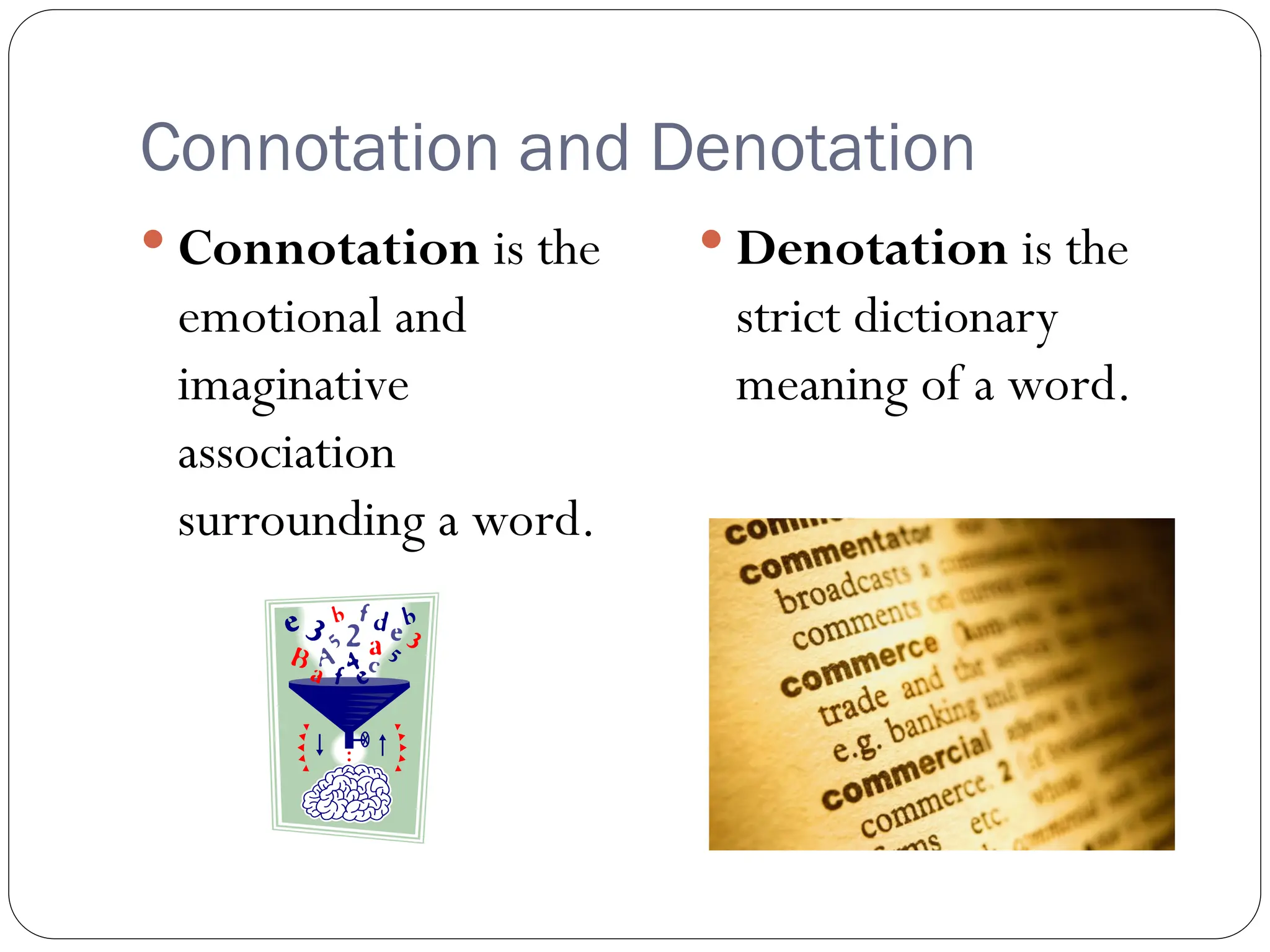
 Connotation is the
emotional and
imaginative
association
surrounding a word.
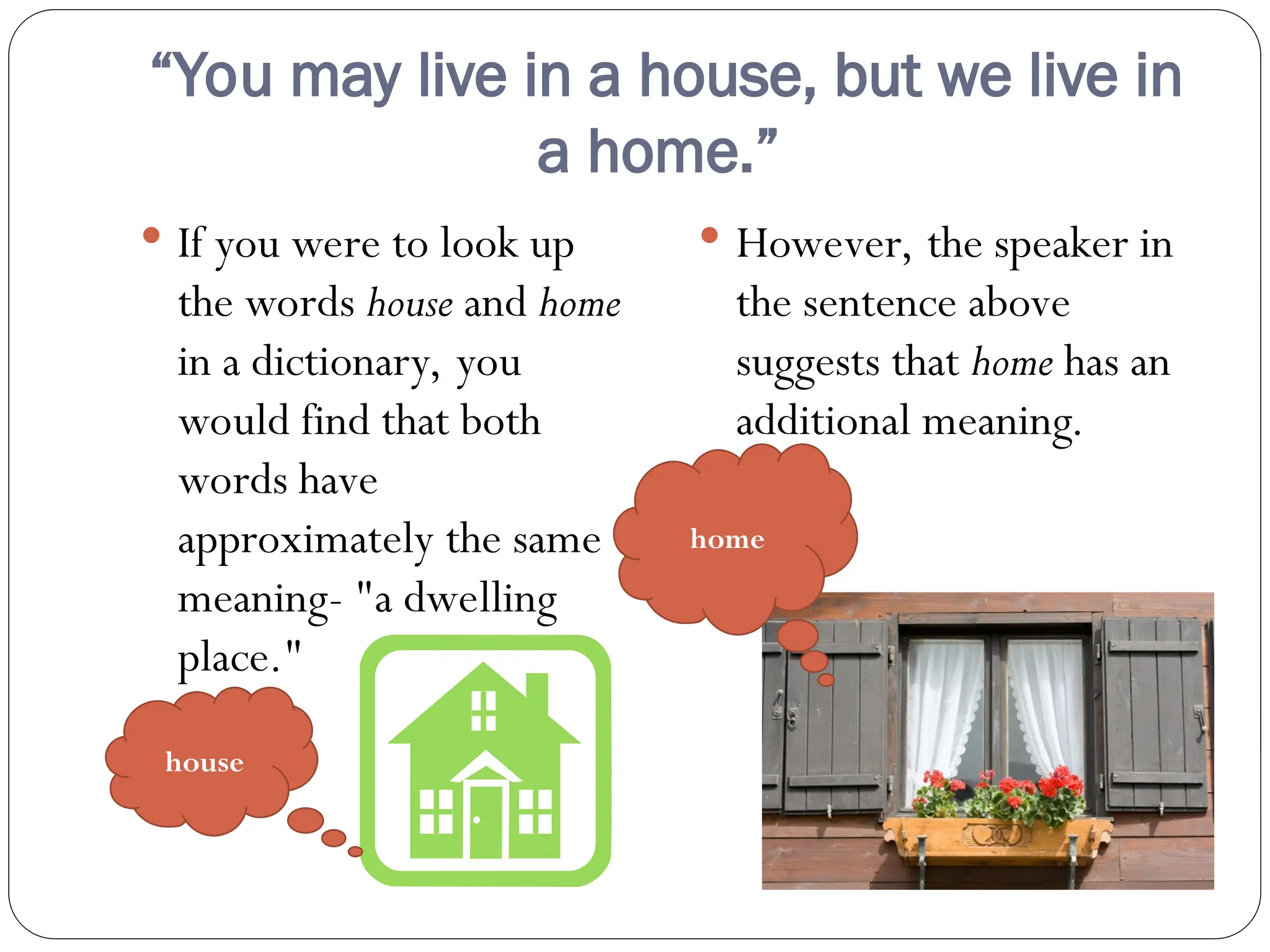
 Denotation is the
strict dictionary
meaning of a word.
“You may live in a house, but we live in
a home.”
 If you were to look up
the words house and home
in a dictionary, you
would find that both
words have
approximately the same
meaning- "a dwelling
place."
 However, the speaker in
the sentence above
suggests that home has an
additional meaning.
house
home
Connotation and denotation
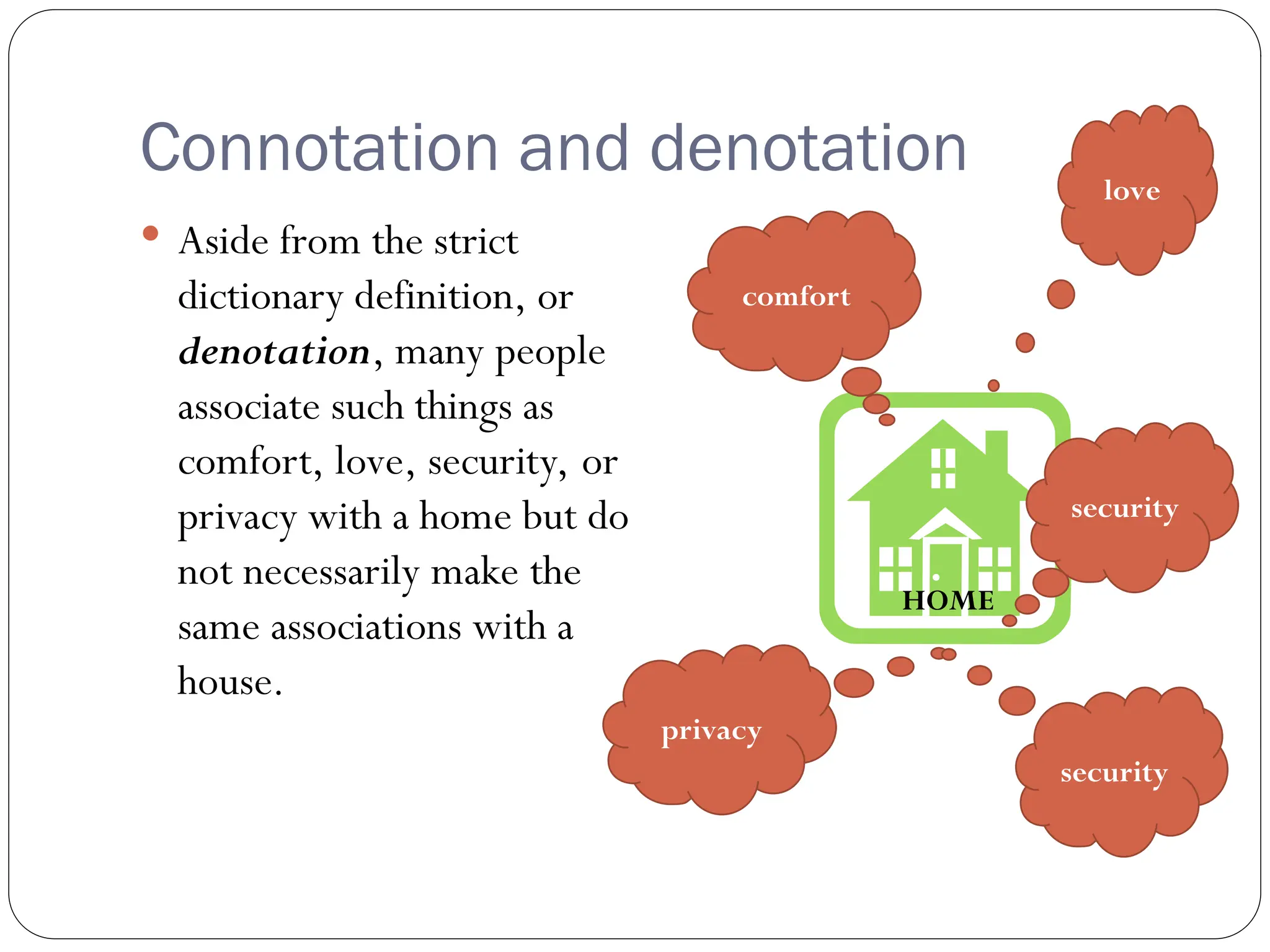
 Aside from the strict
dictionary definition, or
denotation, many people
associate such things as
comfort, love, security, or
privacy with a home but do
not necessarily make the
same associations with a
house.
love
security
comfort
privacy
security
HOME
Questions to brainstorm….
 What is the first thing that
comes to your mind when
you think of:
 a home?
 of a house?
 Why do you think that
real-estate advertisers use
the word home more
frequently than house?
Connotation
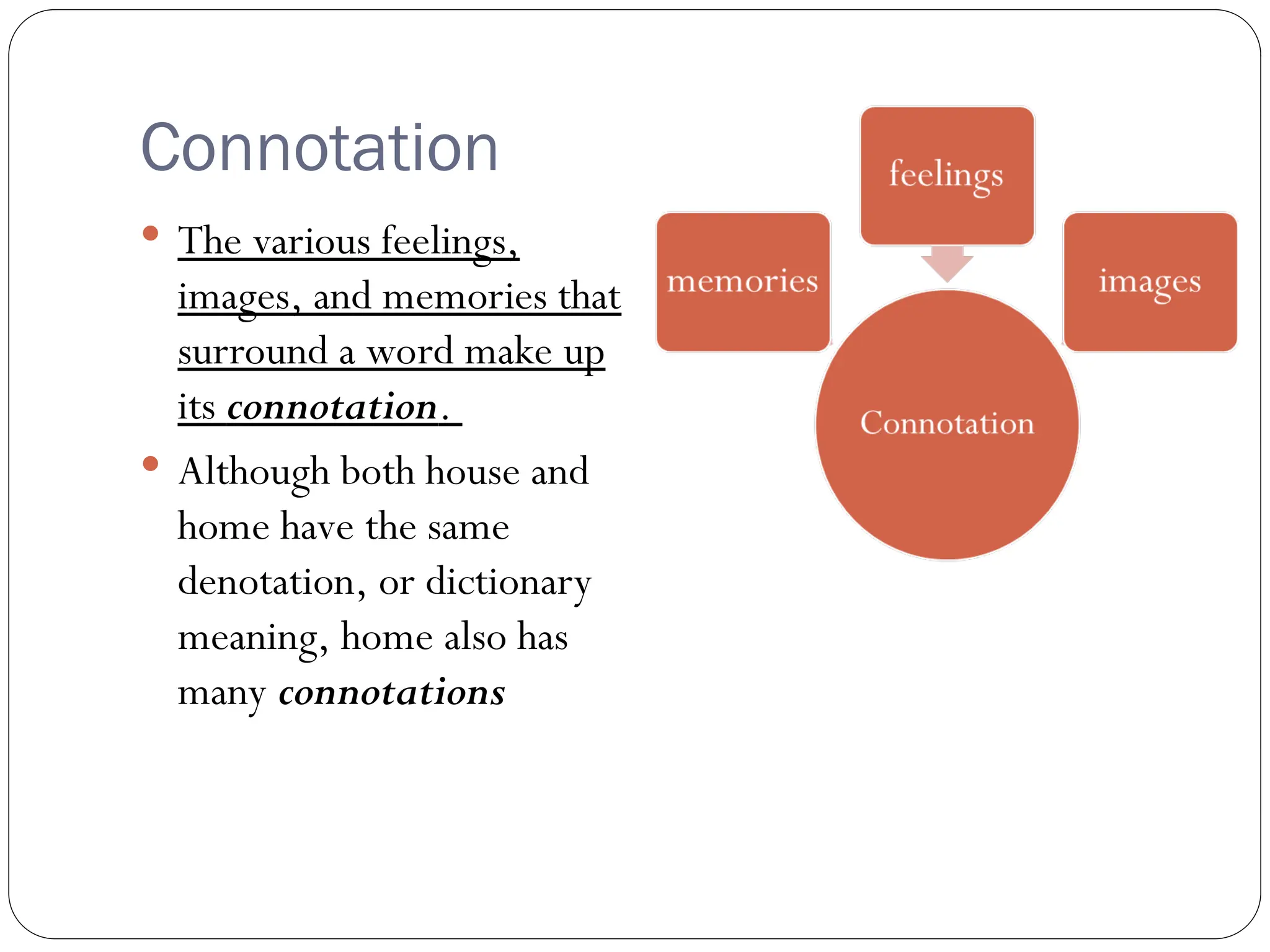
 The various feelings,
images, and memories that
surround a word make up
its connotation.
 Although both house and
home have the same
denotation, or dictionary
meaning, home also has
many connotations
“I know what you said, but what did you mean?”
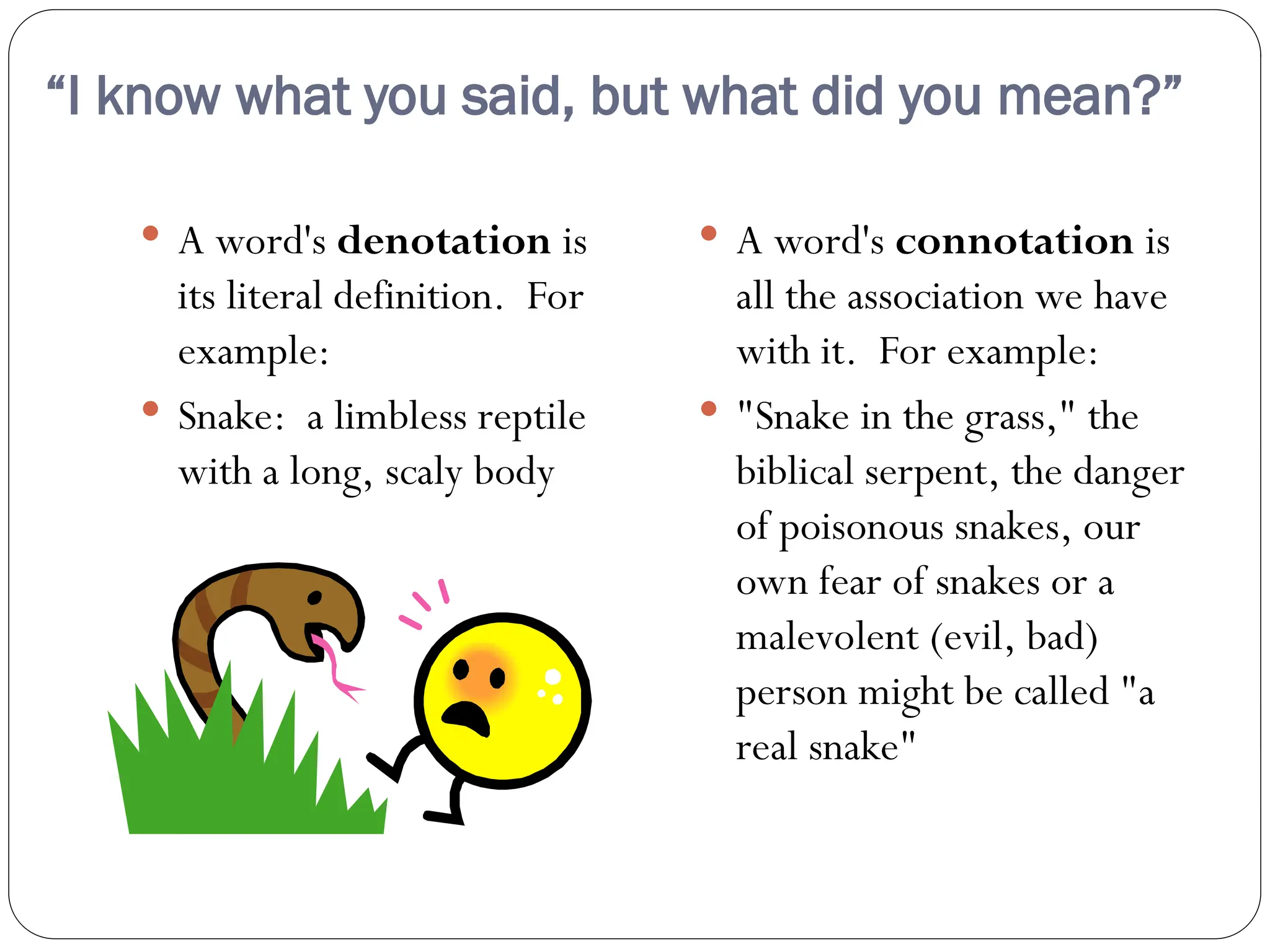
 A word's denotation is
its literal definition. For
example:
 Snake: a limbless reptile
with a long, scaly body
 A word's connotation is
all the association we have
with it. For example:
 "Snake in the grass," the
biblical serpent, the danger
of poisonous snakes, our
own fear of snakes or a
malevolent (evil, bad)
person might be called "a
real snake"
Who is hearing the word?
 Connotation can depend
on the person who hears
the word and brings his or
her own associations to it.
 * A plumber might
immediately think of a
plumbing tool called a
snake.
 *A biologist might think of
the rare Indigo Snake he
felt lucky to see the past
weekend.
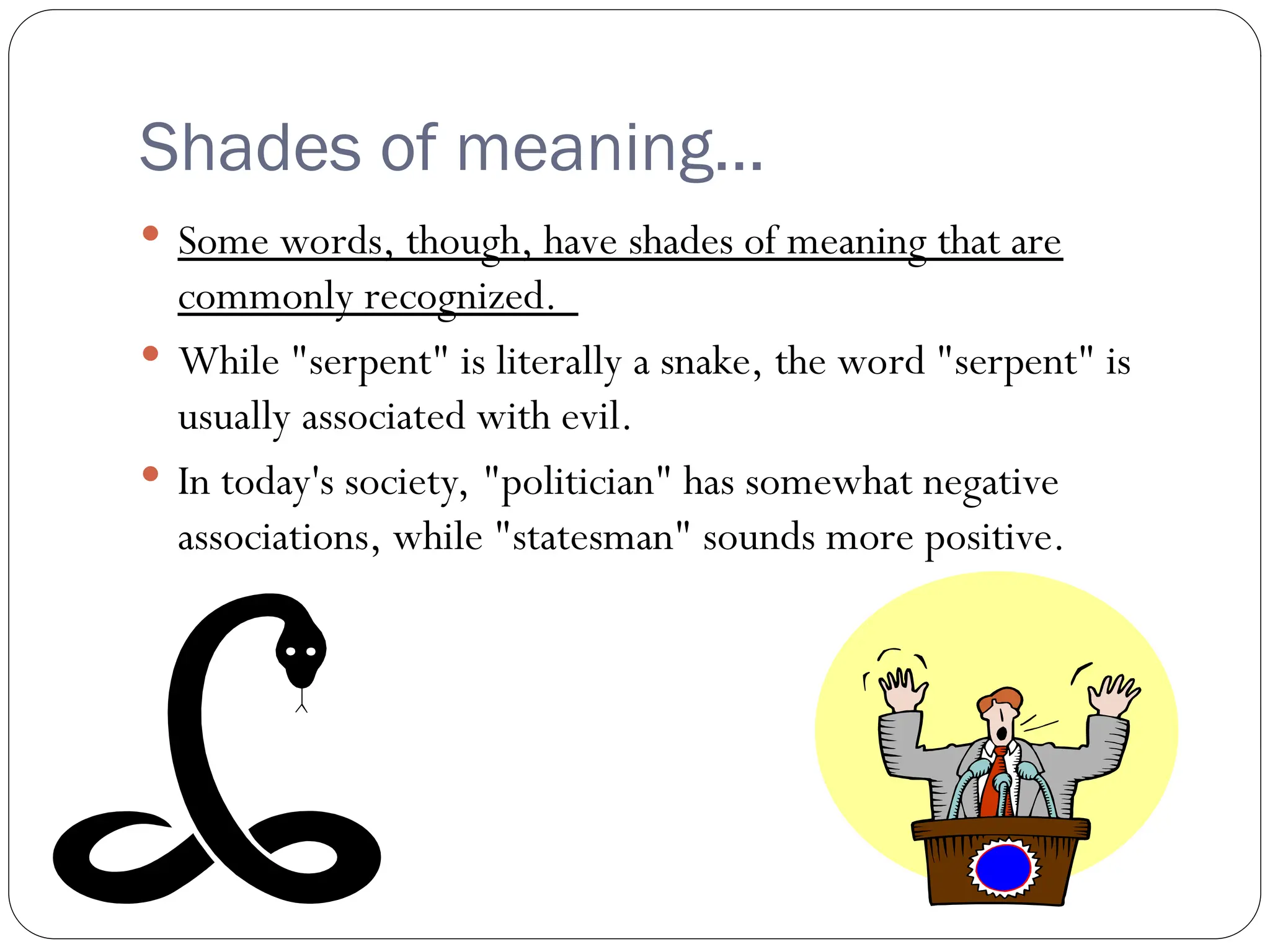
Shades of meaning…
 Some words, though, have shades of meaning that are
commonly recognized.
 While "serpent" is literally a snake, the word "serpent" is
usually associated with evil.
 In today's society, "politician" has somewhat negative
associations, while "statesman" sounds more positive.
Use it in a sentence.
 You will answer ten questions while viewing the upcoming
slides.
 Read the following sentences.
 Annette was surprised.
 Annette was amazed.
 Annette was astonished.
 1. What is the general meaning of each of the three sentences
about Annette? Do the words surprised, amazed, and
astonished have approximately the same denotation?
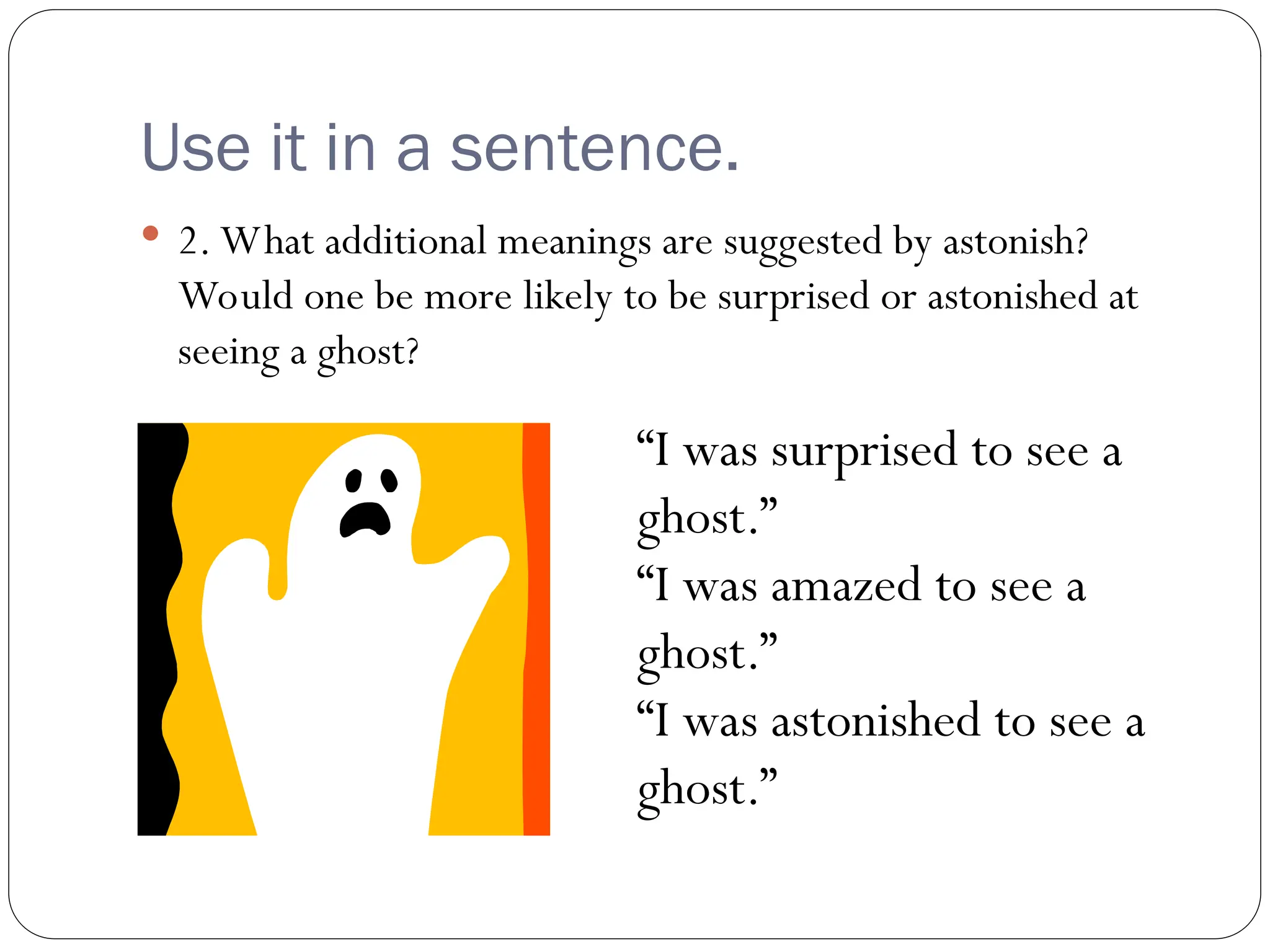
Use it in a sentence.
 2. What additional meanings are suggested by astonish?
Would one be more likely to be surprised or astonished at
seeing a ghost?
“I was surprised to see a
ghost.”
“I was amazed to see a
ghost.”
“I was astonished to see a
ghost.”
Compare some words.
 Write these examples in your daybook along with your
answers
 3. Which word in each pair below has the more favorable
connotation to you?
 thrifty-penny-pinching
 pushy-aggressive
 politician-statesman
 chef-cook
 slender-skinny
Read it in text.
 Since everyone reacts
emotionally to certain
words, writers often
deliberately select words
that they think will
influence your reactions
and appeal to your
emotions. Read the
dictionary definition
below.
 cock roach (kok' roch'), n.
any of an order of
nocturnal insects, usually
brown with flattened oval
bodies, some species of
which are household pests
inhabiting kitchens, areas
around water pipes, etc.
[Spanish cucaracha]
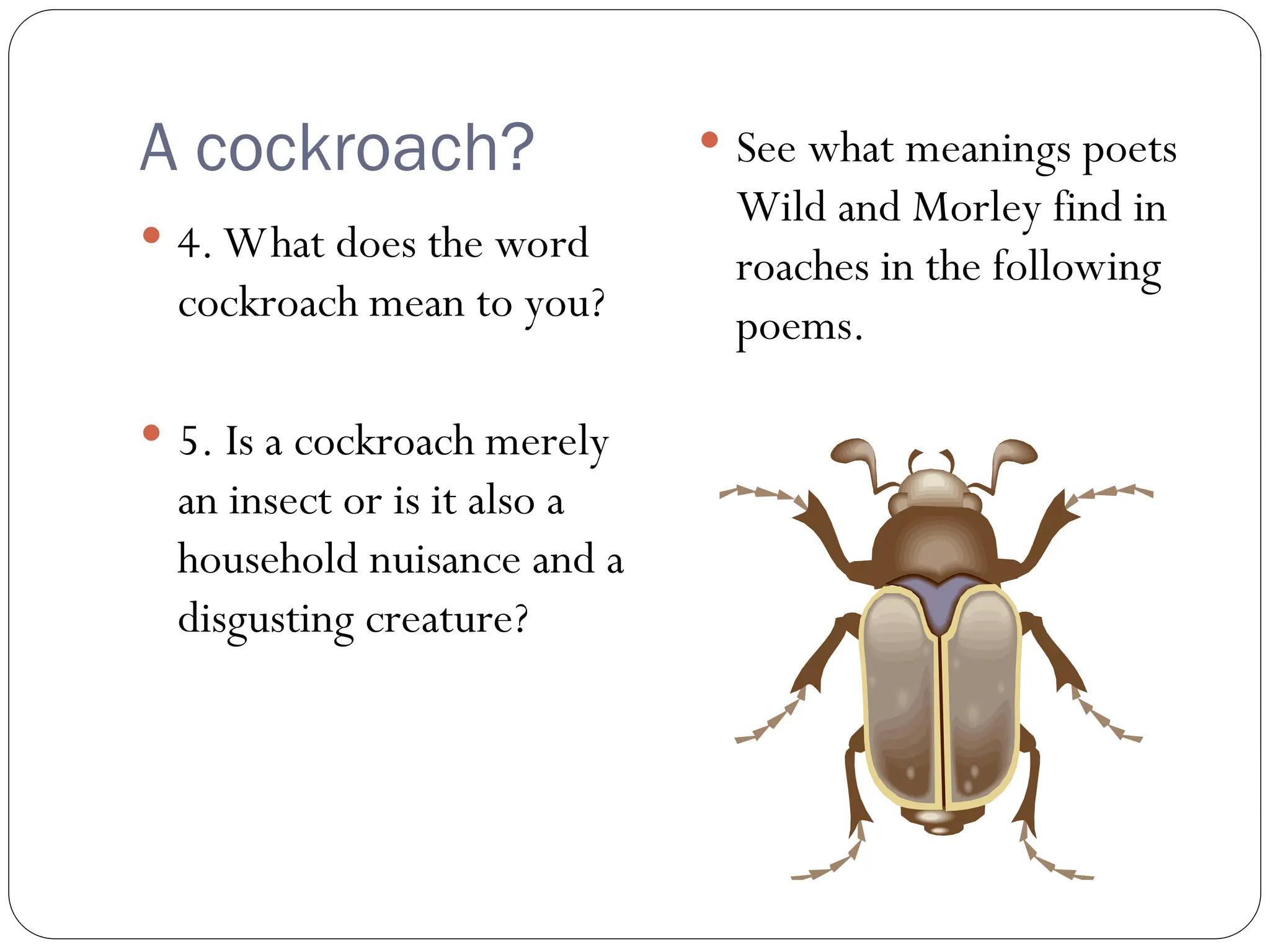
A cockroach?
 4. What does the word
cockroach mean to you?
 5. Is a cockroach merely
an insect or is it also a
household nuisance and a
disgusting creature?
 See what meanings poets
Wild and Morley find in
roaches in the following
poems.
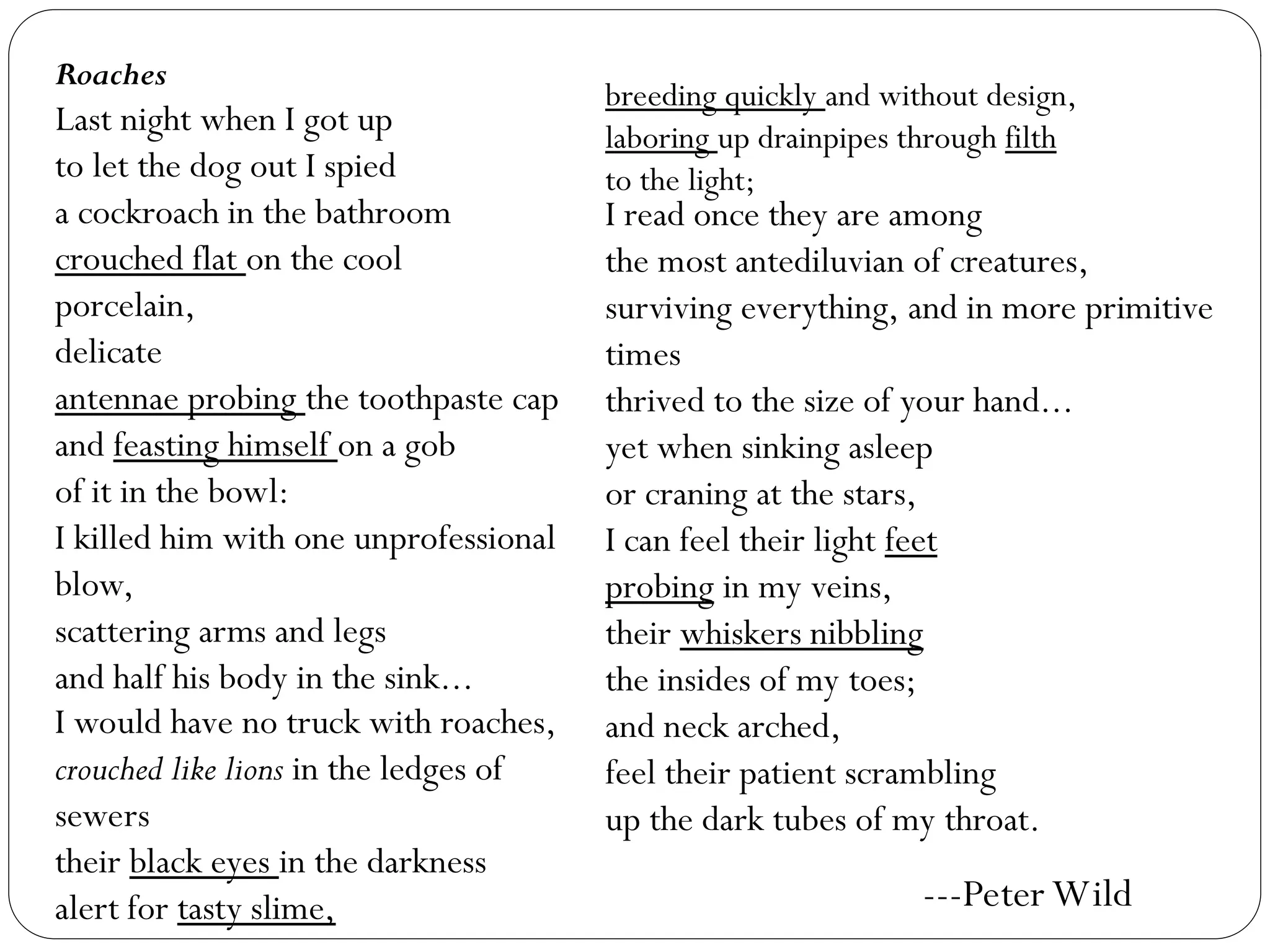
Roaches
Last night when I got up
to let the dog out I spied
a cockroach in the bathroom
crouched flat on the cool
porcelain,
delicate
antennae probing the toothpaste cap
and feasting himself on a gob
of it in the bowl:
I killed him with one unprofessional
blow,
scattering arms and legs
and half his body in the sink...
breeding quickly and without design,
laboring up drainpipes through filth
to the light;
I read once they are among
the most antediluvian of creatures,
surviving everything, and in more primitive
times
thrived to the size of your hand...
yet when sinking asleep
or craning at the stars,
I can feel their light feet
probing in my veins,
their whiskers nibbling
the insides of my toes;
and neck arched,
feel their patient scrambling
up the dark tubes of my throat.
---Peter Wild
I would have no truck with roaches,
crouched like lions in the ledges of
sewers
their black eyes in the darkness
alert for tasty slime,
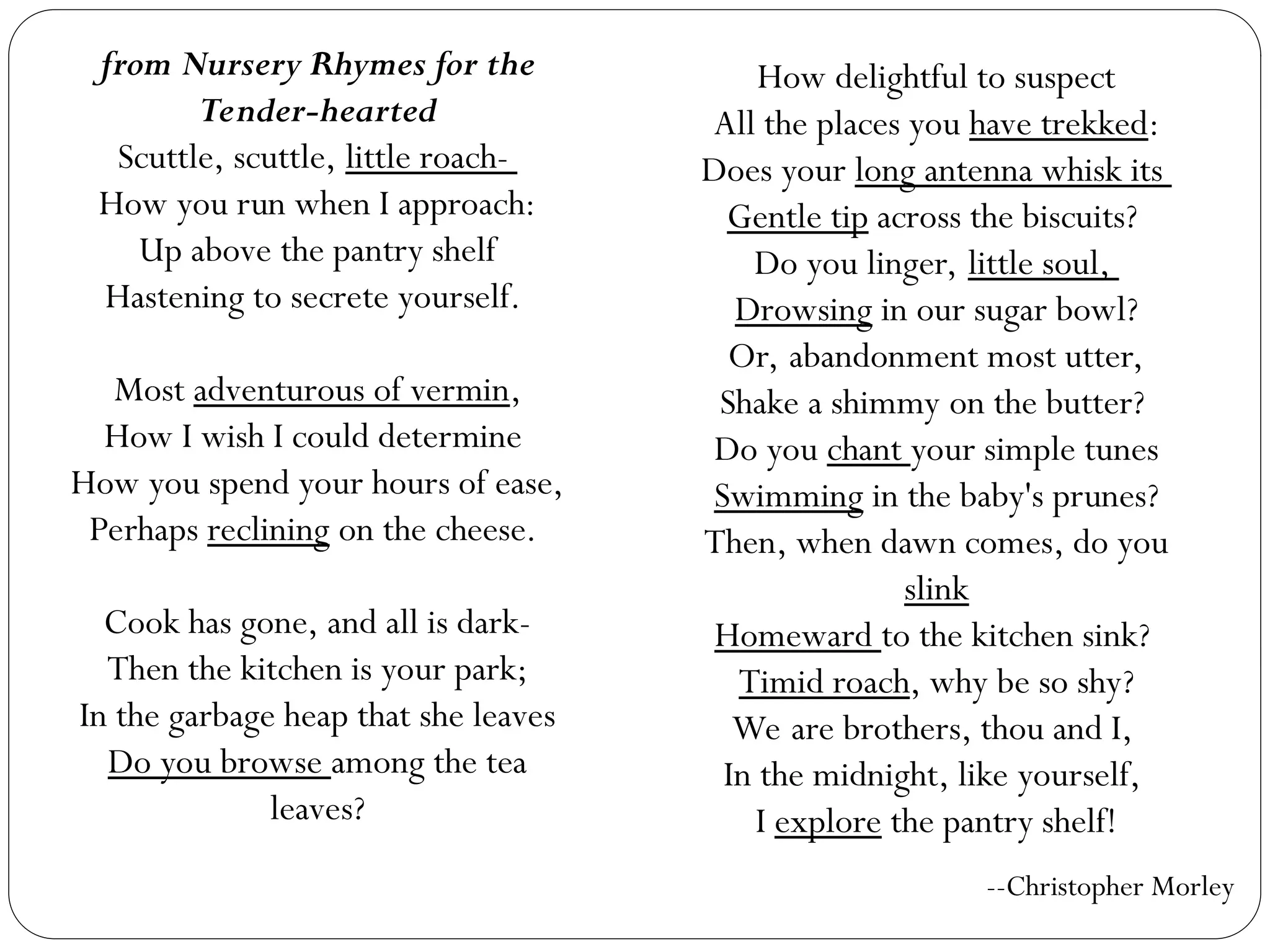
from Nursery Rhymes for the
Tender-hearted
Scuttle, scuttle, little roach-
How you run when I approach:
Up above the pantry shelf
Hastening to secrete yourself.
Most adventurous of vermin,
How I wish I could determine
How you spend your hours of ease,
Perhaps reclining on the cheese.
Cook has gone, and all is dark-
Then the kitchen is your park;
In the garbage heap that she leaves
Do you browse among the tea
leaves?
How delightful to suspect
All the places you have trekked:
Does your long antenna whisk its
Gentle tip across the biscuits?
Do you linger, little soul,
Drowsing in our sugar bowl?
Or, abandonment most utter,
Shake a shimmy on the butter?
Do you chant your simple tunes
Swimming in the baby's prunes?
Then, when dawn comes, do you
slink
Homeward to the kitchen sink?
Timid roach, why be so shy?
We are brothers, thou and I,
In the midnight, like yourself,
I explore the pantry shelf!
--Christopher Morley
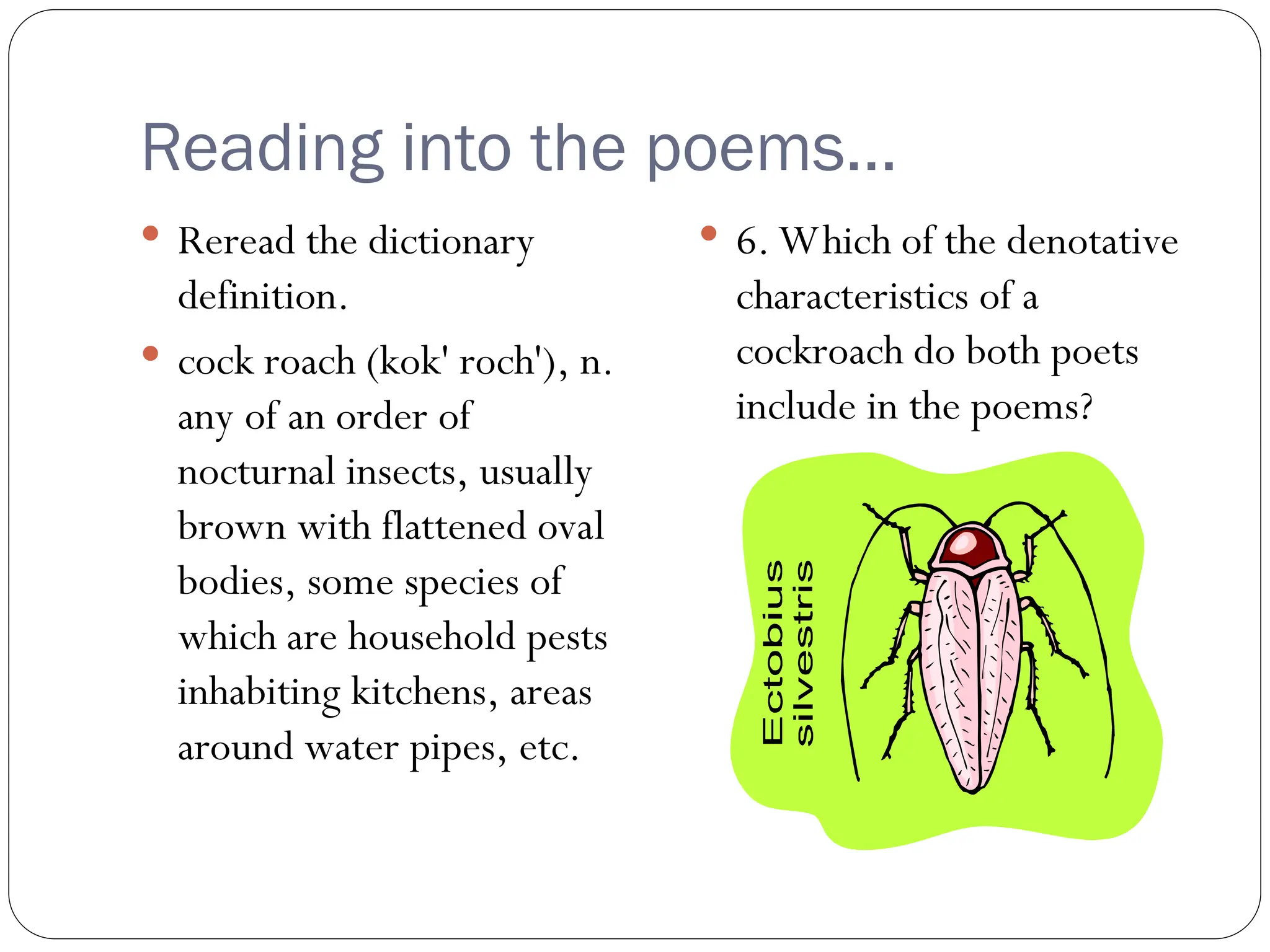
Reading into the poems…
 Reread the dictionary
definition.
 cock roach (kok' roch'), n.
any of an order of
nocturnal insects, usually
brown with flattened oval
bodies, some species of
which are household pests
inhabiting kitchens, areas
around water pipes, etc.
 6. Which of the denotative
characteristics of a
cockroach do both poets
include in the poems?
Reading into the poems…
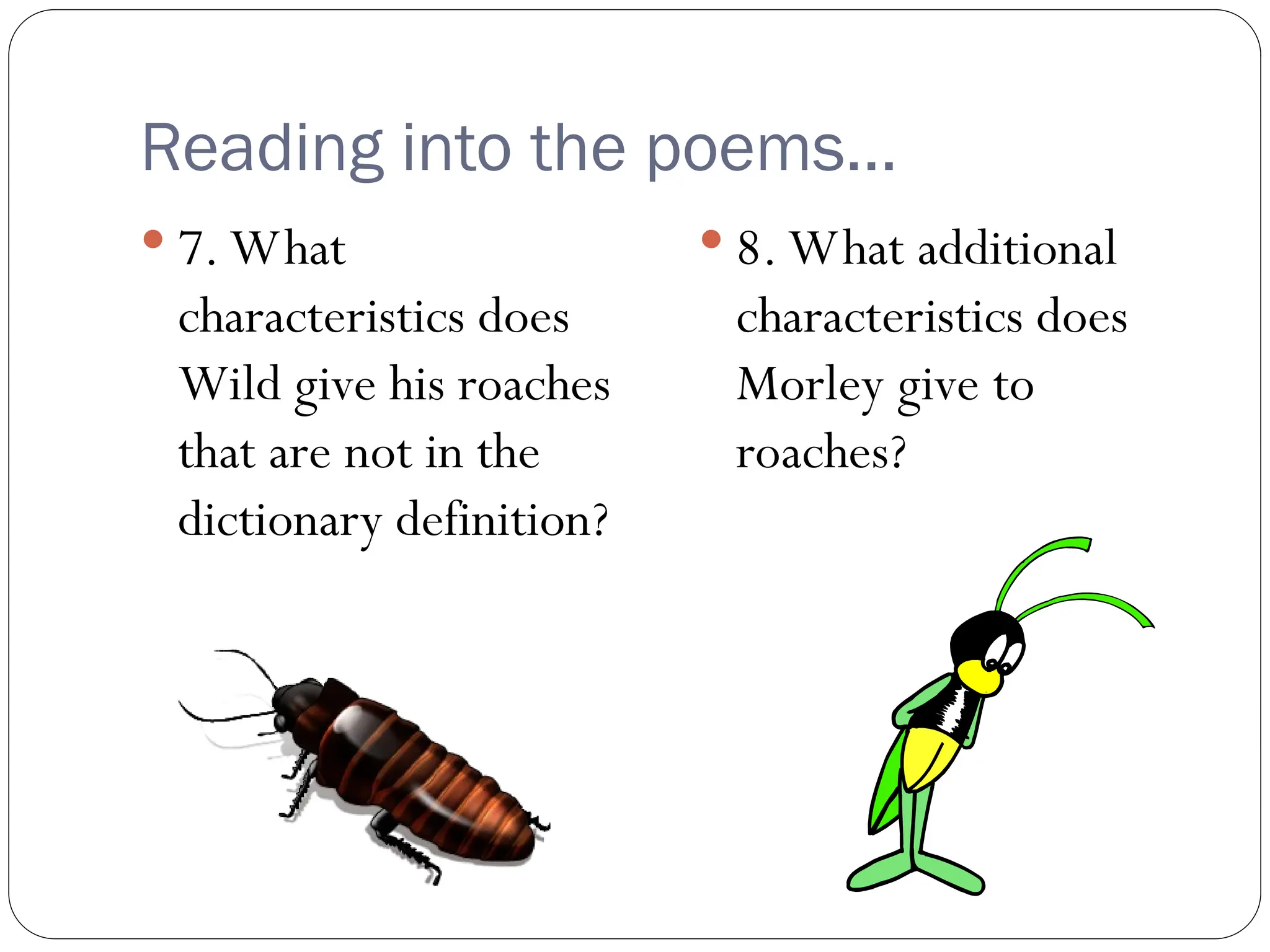
 7. What
characteristics does
Wild give his roaches
that are not in the
dictionary definition?
 8. What additional
characteristics does
Morley give to
roaches?
Reading into the poems…
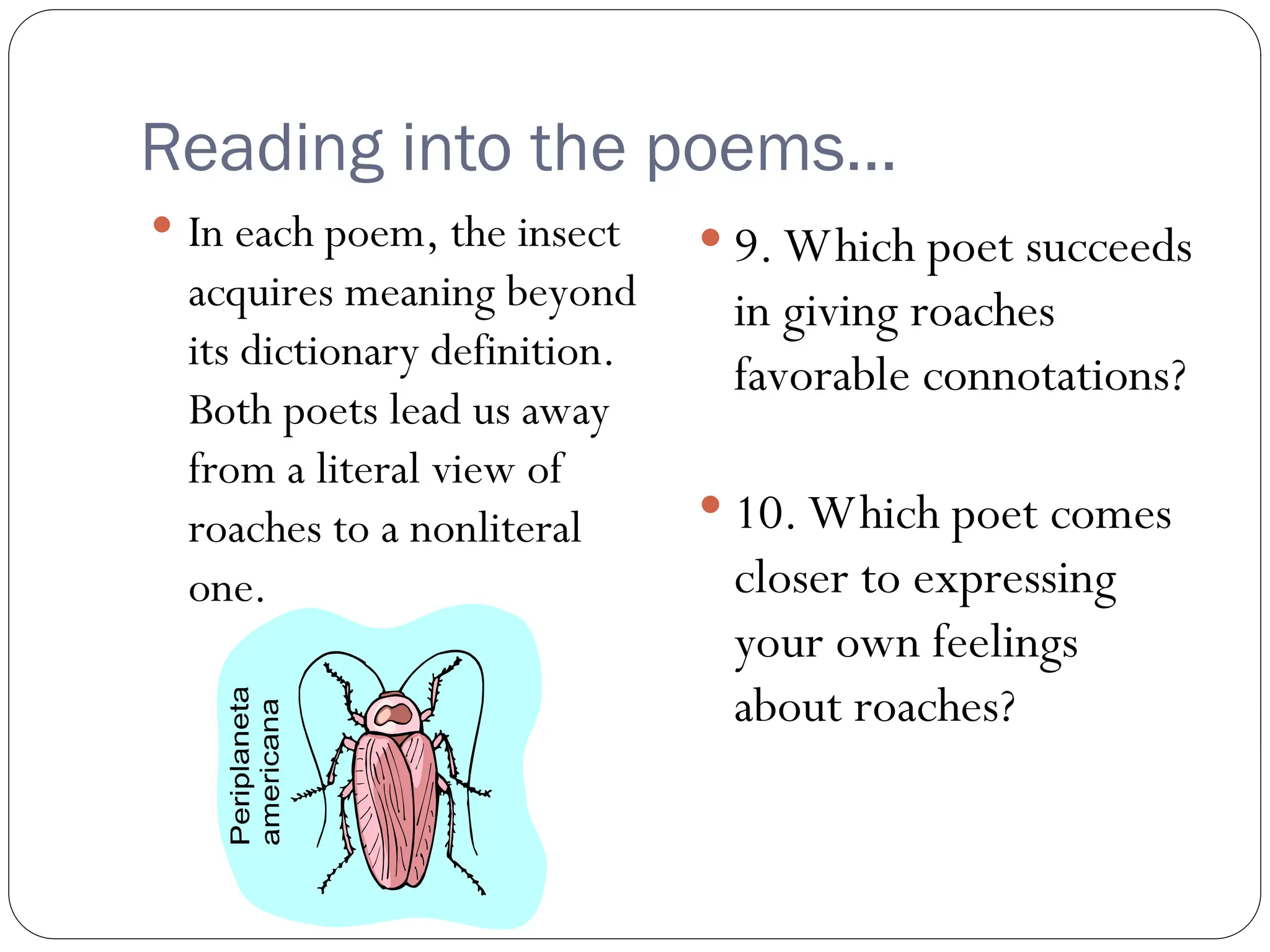
 In each poem, the insect
acquires meaning beyond
its dictionary definition.
Both poets lead us away
from a literal view of
roaches to a nonliteral
one.
 9. Which poet succeeds
in giving roaches
favorable connotations?
 10. Which poet comes
closer to expressing
your own feelings
about roaches?
More practice…..
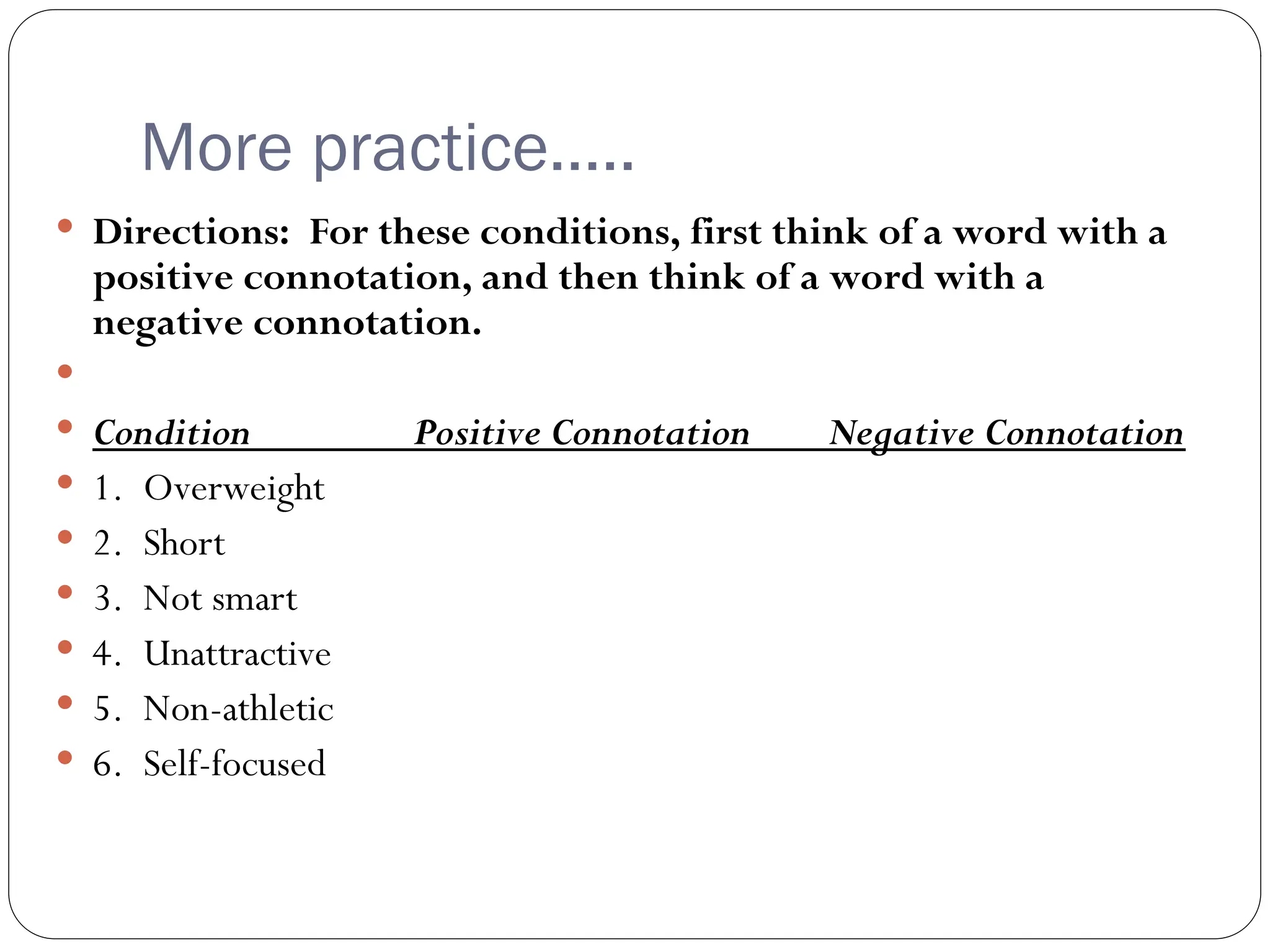
 Directions: For these conditions, first think of a word with a
positive connotation, and then think of a word with a
negative connotation.

 Condition Positive Connotation Negative Connotation
 1. Overweight
 2. Short
 3. Not smart
 4. Unattractive
 5. Non-athletic
 6. Self-focused

Connotative and denotative connotation_versus_denotation.ppt

  • 1.
    How do weassign words meaning? Connotation vs. Denotation
  • 2.
    SWBAT Define connotation anddenotation Read a sentence and determine if the wording is connotative or denotative
  • 3.
    Connotation and Denotation Connotation is the emotional and imaginative association surrounding a word.  Denotation is the strict dictionary meaning of a word.
  • 4.
    “You may livein a house, but we live in a home.”  If you were to look up the words house and home in a dictionary, you would find that both words have approximately the same meaning- "a dwelling place."  However, the speaker in the sentence above suggests that home has an additional meaning. house home
  • 5.
    Connotation and denotation Aside from the strict dictionary definition, or denotation, many people associate such things as comfort, love, security, or privacy with a home but do not necessarily make the same associations with a house. love security comfort privacy security HOME
  • 6.
    Questions to brainstorm…. What is the first thing that comes to your mind when you think of:  a home?  of a house?  Why do you think that real-estate advertisers use the word home more frequently than house?
  • 7.
    Connotation  The variousfeelings, images, and memories that surround a word make up its connotation.  Although both house and home have the same denotation, or dictionary meaning, home also has many connotations
  • 8.
    “I know whatyou said, but what did you mean?”  A word's denotation is its literal definition. For example:  Snake: a limbless reptile with a long, scaly body  A word's connotation is all the association we have with it. For example:  "Snake in the grass," the biblical serpent, the danger of poisonous snakes, our own fear of snakes or a malevolent (evil, bad) person might be called "a real snake"
  • 9.
    Who is hearingthe word?  Connotation can depend on the person who hears the word and brings his or her own associations to it.  * A plumber might immediately think of a plumbing tool called a snake.  *A biologist might think of the rare Indigo Snake he felt lucky to see the past weekend.
  • 10.
    Shades of meaning… Some words, though, have shades of meaning that are commonly recognized.  While "serpent" is literally a snake, the word "serpent" is usually associated with evil.  In today's society, "politician" has somewhat negative associations, while "statesman" sounds more positive.
  • 11.
    Use it ina sentence.  You will answer ten questions while viewing the upcoming slides.  Read the following sentences.  Annette was surprised.  Annette was amazed.  Annette was astonished.  1. What is the general meaning of each of the three sentences about Annette? Do the words surprised, amazed, and astonished have approximately the same denotation?
  • 12.
    Use it ina sentence.  2. What additional meanings are suggested by astonish? Would one be more likely to be surprised or astonished at seeing a ghost? “I was surprised to see a ghost.” “I was amazed to see a ghost.” “I was astonished to see a ghost.”
  • 13.
    Compare some words. Write these examples in your daybook along with your answers  3. Which word in each pair below has the more favorable connotation to you?  thrifty-penny-pinching  pushy-aggressive  politician-statesman  chef-cook  slender-skinny
  • 14.
    Read it intext.  Since everyone reacts emotionally to certain words, writers often deliberately select words that they think will influence your reactions and appeal to your emotions. Read the dictionary definition below.  cock roach (kok' roch'), n. any of an order of nocturnal insects, usually brown with flattened oval bodies, some species of which are household pests inhabiting kitchens, areas around water pipes, etc. [Spanish cucaracha]
  • 15.
    A cockroach?  4.What does the word cockroach mean to you?  5. Is a cockroach merely an insect or is it also a household nuisance and a disgusting creature?  See what meanings poets Wild and Morley find in roaches in the following poems.
  • 16.
    Roaches Last night whenI got up to let the dog out I spied a cockroach in the bathroom crouched flat on the cool porcelain, delicate antennae probing the toothpaste cap and feasting himself on a gob of it in the bowl: I killed him with one unprofessional blow, scattering arms and legs and half his body in the sink... breeding quickly and without design, laboring up drainpipes through filth to the light; I read once they are among the most antediluvian of creatures, surviving everything, and in more primitive times thrived to the size of your hand... yet when sinking asleep or craning at the stars, I can feel their light feet probing in my veins, their whiskers nibbling the insides of my toes; and neck arched, feel their patient scrambling up the dark tubes of my throat. ---Peter Wild I would have no truck with roaches, crouched like lions in the ledges of sewers their black eyes in the darkness alert for tasty slime,
  • 17.
    from Nursery Rhymesfor the Tender-hearted Scuttle, scuttle, little roach- How you run when I approach: Up above the pantry shelf Hastening to secrete yourself. Most adventurous of vermin, How I wish I could determine How you spend your hours of ease, Perhaps reclining on the cheese. Cook has gone, and all is dark- Then the kitchen is your park; In the garbage heap that she leaves Do you browse among the tea leaves? How delightful to suspect All the places you have trekked: Does your long antenna whisk its Gentle tip across the biscuits? Do you linger, little soul, Drowsing in our sugar bowl? Or, abandonment most utter, Shake a shimmy on the butter? Do you chant your simple tunes Swimming in the baby's prunes? Then, when dawn comes, do you slink Homeward to the kitchen sink? Timid roach, why be so shy? We are brothers, thou and I, In the midnight, like yourself, I explore the pantry shelf! --Christopher Morley
  • 18.
    Reading into thepoems…  Reread the dictionary definition.  cock roach (kok' roch'), n. any of an order of nocturnal insects, usually brown with flattened oval bodies, some species of which are household pests inhabiting kitchens, areas around water pipes, etc.  6. Which of the denotative characteristics of a cockroach do both poets include in the poems?
  • 19.
    Reading into thepoems…  7. What characteristics does Wild give his roaches that are not in the dictionary definition?  8. What additional characteristics does Morley give to roaches?
  • 20.
    Reading into thepoems…  In each poem, the insect acquires meaning beyond its dictionary definition. Both poets lead us away from a literal view of roaches to a nonliteral one.  9. Which poet succeeds in giving roaches favorable connotations?  10. Which poet comes closer to expressing your own feelings about roaches?
  • 21.
    More practice…..  Directions:For these conditions, first think of a word with a positive connotation, and then think of a word with a negative connotation.   Condition Positive Connotation Negative Connotation  1. Overweight  2. Short  3. Not smart  4. Unattractive  5. Non-athletic  6. Self-focused