Ruben Amortegui
@ramortegui
http://rubenamortegui.com
https://github.com/ramortegui
Concurrent
Programming
Austin, TX, February 10-11, 2018
● Videos https://www.youtube.com/channel/UCOy-_b9bqjokoWX9Hg5ZgUg/featured
– Consistent, Distributed Elixir - Chris Keathley
– Keynote - Aaron Patterson
– Usercentered API Versioning - Niall Burkley
Elixir 1.6.4
● Code formater
● Dynamic supervisor
● Enhacements
● Bug Fixes
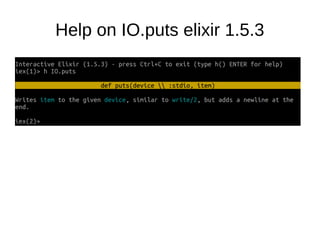
Help on IO.puts elixir 1.5.3
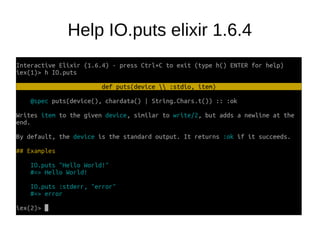
Help IO.puts elixir 1.6.4
Concurrent Programming in Elixir
– Agenda
● Concepts
● Code samples and implementations
● Summary
Erlang
● Erlang is a programming language and runtime
system for building massively scalable soft real-
time systems with requirements on high
availability.
https://github.com/erlang/otp
Elixir
● Elixir is a dynamic, functional language
designed for building scalable and maintainable
applications.
– https://elixir-lang.org/
OTP
● OTP is a set of Erlang libraries, which consists
of the Erlang runtime system, a number of
ready-to-use components mainly written in
Erlang, and a set of design principles for Erlang
programs.
https://github.com/erlang/otp
OTP
● OTP stands for Open Telecomunication
Platform.
● Is a general purpose tool for developing and
managing large systems.
● Provides tools, libraries, conventions and
defines a structure for your application.
OTP
● Features included in OTP:
– Erlang interpreter and compiler
– Standard libraries
– Dialyzer, a static analysis tool
– Mnesia, a distributed database
– Erlang Term Storage (ETS)
– A debugger
– An event tracer
– A release management tool (hot swap)
Concurrent Programming
● Programs that can handle several threads of
execution at the same time.
– A CPU is processing one thread(or job) at a time.
– Swaps between jobs a such rate that gives the
illusion of running at the same time.
http://erlang.org/doc/getting_started/conc_prog.html
Actor Concurrency Model
● An actor is a computational entity that, in
response to a message it receives, can
concurrently:
– Send a finite number of messages to other actors.
– Create a finite number of new actors.
– Designate the behaviour to be used for the next
message it receives.
Actor Concurrency Model in Erlang
● Each actor is a process.
● Each process performs a specific task.
● To tell a process to do something, you need to send
it a message. The process can reply by sending
back another message.
● The kinds of messages can act on are specific to the
process itself.
● Other than that, processes don’t share any
information with other processes.
Process
● Fundamental part of concurrency
● Are light weight
● Doesn’t share memory
Processes
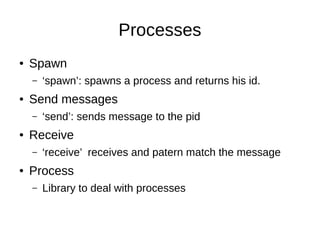
● Spawn
– ‘spawn’: spawns a process and returns his id.
● Send messages
– ‘send’: sends message to the pid
● Receive
– ‘receive’ receives and patern match the message
● Process
– Library to deal with processes
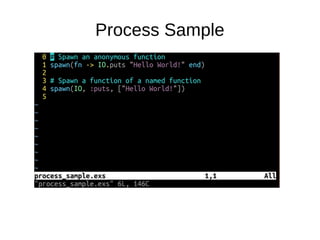
Process Sample
Process
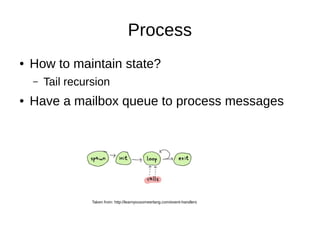
● How to maintain state?
– Tail recursion
● Have a mailbox queue to process messages
Taken from: http://learnyousomeerlang.com/event-handlers
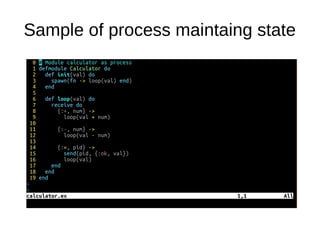
Sample of process maintaing state
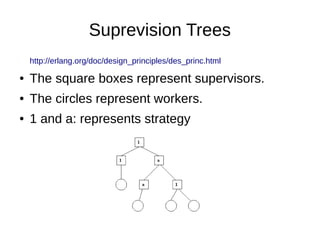
Suprevision Trees
http://erlang.org/doc/design_principles/des_princ.html
● The square boxes represent supervisors.
● The circles represent workers.
● 1 and a: represents strategy
App
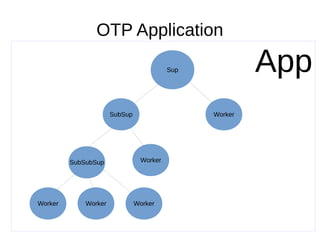
OTP Application
Sup
SubSup Worker
SubSubSup
Worker Worker Worker
Worker
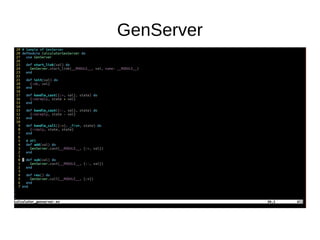
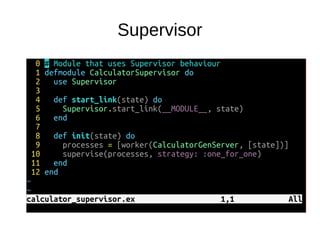
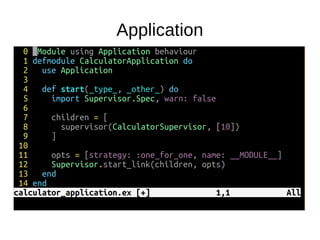
Behaviours
– Code that implements a common pattern.
– OTP provides:
● GenServer
● Supervisor
● Application
GenServer
Supervisor
Application
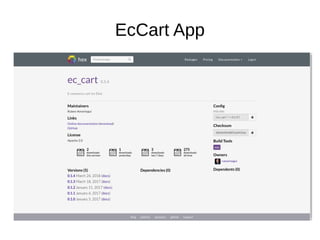
EcCart App
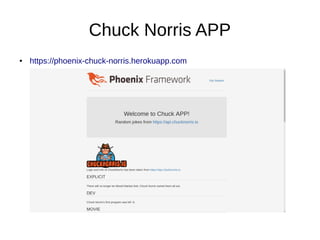
Chuck Norris APP
● https://phoenix-chuck-norris.herokuapp.com
Summary
● Processes are the basic primitive of
concurrency in Elixir.
● Elixir uses the actor concurrency model.
● The OTP behaviours makes ‘hard’ tasks ‘easy’
tasks.
References
●
NY: Manning Publications.
● Thomas, D. (2016). Programming Elixir 1.3:
functional, concurrent, pragmatic, fun. Releigh,
NC: Pragmatic Bookshelf.
● Tan Wei Hao, B.(2017). The little Elixir & OTP
Guidebook. Shelter Island, NY: Manning
Publications.
Thanks!
Q & A?
@ramortegui
http://rubenamortegui.com
https://github.com/ramortegui

Concurrent programming

Editor's Notes

  • #2 - Welcome to the meetup Projects Good practices Tools Ideas Implementations
  • #3 - Software consultancy company
  • #4 - Amazing event. - Community really friendly - People running elixir in production, and/or planning to do. (discovering stages) - Talks - Consistent Distributed Elixir: Avaiability or Consistency on distributed applications - Key Note: how to implement a langauge using lambdas in elixir - Distillery (status)
  • #5 Seriers of rules to update your code. - standard reading You need to write code to be readable to. Dinamic Supervisor
  • #11 Elixir runs on the Erlang virtual machine (BEAM). Elixir builds on top of Erlang and shares the same abstractions for building distributed, fault-tolerant applications
  • #13 it’s important to talk about OTP because Elixir runs on the Erlang VM (Beam).
  • #16 Created by Carl Hewitt (1973)
  • #18 (Aside: the term "process" is usually used when the threads of execution share no data with each other and the term "thread" when they share data in some way. Threads of execution in Erlang share no data, that is why they are called processes).
  • #19 spawn a process Use Process.alive? Process.whereis( Use Process.exit(pid, reason)
  • #20 How to spawn a process Observer tool: :observer.start Fibonacci (one process)
  • #21 In order to mainain state in a function you use tail recursion
  • #22 Send and receive messages pid = Calculator.init(0) send(pid,{:+,1}) Receive do {:ok, val} -> IO.puts val end
  • #23 When you are writing concurrent applicaitons you will need to deal with some issues like: -What happend when a process dies? There is this concept of a process fails, let it crash, and restart with a stable state How elixir acomplish all of this? Well, using all the erlang/OTP power and concepts. One of the most important are: Supervision trees
  • #24 Supervision trees are structures of processes with defined roles
  • #27 Using GenServer behavour will allow: - battle tested code - all the functions that you will need programming concurrent and fault tolerant applications - able to use OTP tools ( observer )